Rochester Institute of Technology
RIT Scholar Works
Theses Thesis/Dissertation Collections
6-10-2016
A Qualitative Analysis of Effectiveness, Efficiency
and Equity of Payment for Ecosystem Services in a
User-financed and a Government-financed
Program
Tanya WilliamsFollow this and additional works at:http://scholarworks.rit.edu/theses
This Thesis is brought to you for free and open access by the Thesis/Dissertation Collections at RIT Scholar Works. It has been accepted for inclusion in Theses by an authorized administrator of RIT Scholar Works. For more information, please [email protected].
Recommended Citation
A Qualitative Analysis of Effectiveness, Efficiency and Equity of Payment for
Ecosystem Services in a User-financed and a Government-financed Program
By
Tanya Williams
A Thesis Submitted in Partial Fulfillment of the Requirements for the Degree of
Masters of Science
Science, Technology, and Public Policy
Department of Public Policy College of Liberal Arts Rochester Institute of Technology
Rochester, NY
A Qualitative Analysis of Effectiveness, Efficiency and Equity of Payment for
Ecosystem Services in a User-financed and a Government-financed Program
by Tanya Williams
Masters of Science
Science, Technology and Public Policy Thesis Submitted in Fulfillment of the
Graduation Requirements for the
College of Liberal Arts/Public Policy Program at ROCHESTER INSTITUTE OF TECHNOLOGY
Rochester, New York
June 10, 2016
Submitted by:
Tanya Williams Signature Date
Accepted by:
Thesis Advisor Signature Date Dr. Richard Shearman
Public Policy Dept. Coordinator Signature Date Dr. Sandra Rothenberg
DEDICATION For Amil, Andrea and Ari
Table of Contents
Abstract ... 1
Chapter 1 ... 2
Introduction ... 2
1.2 Ecosystem Services ... 5
1.3 Incentivizing Forest Protection and the Management of Ecosystem Services ... 6
Chapter 2 ... 9
Literature Review... 9
2.0 Defining Payment for Ecosystem Services ... 9
2.1 The Economic Nature of Payment for ecosystem services ... 11
2.2 PES Framework ... 14
2.3 Costs, Permanence, Leakage, Additionality ... 16
2.4 The Issue of Equity in PES Programs ... 17
2.5 Trading Equity for Efficiency ... 19
2.6 Limitations and Research Questions ... 21
Chapter 3 ... 23
Methodology ... 23
3.0 Case Study ... 25
3.2 Data Analysis ... 28
3.3 Limitations ... 31
Chapter 4 ... 33
Findings... 33
4.0 Case Study Context ... 34
Chapter 5 ... 67
Analysis... 67
Chapter 6 ... 72
Conclusion ... 72
References ... 77
TABLE OF FIGURES
Table 1: Categories and sub-categories of the coding process ... 28
Table 2: 9-point scale for individual categories ... 30
Table 3: Summary of Findings for Environmental Effectiveness and Equity - Costa Rica National PES and Los Negros Valley, Bolivia ... 33
Table 4: Summary of Findings for Cost Effectiveness - Costa Rica National PES and Los Negros Valley, Bolivia ... 34
Table 5: Summary Findings for Environmental Effectiveness Category ... 40
Table 6: Findings for Policy Context/Institutional Framework Category ... 40
Table 7: Findings for Monitoring Category ... 43
Table 8: Findings for Compliance and Enforcement Sub-category... 46
Table 9: Findings for Sustainability of Provision of Ecosystem Services Category ... 47
Table 10: Findings for Sustainability of Program Sub-category ... 48
Table 11: Summary of Equity Category Findings ... 51
Table 12: Findings for Property Rights Requirement Category ... 52
Table 13: Findings for the Distribution Sub-Category ... 53
Table 14: Findings for Social Legitimacy Sub-category ... 56
Table 15: Findings of the Payment Structure Sub-category ... 59
Table 16: Analysis of transaction costs ... 61
Table 17: Findings of Cost Effectiveness Analysis ... 62
Table 18: Weighted Matrix for Environmental Effectiveness – Costa Rica PES Program and Los Negros, Bolivia RWA ... 63
Abstract
Payment for Ecosystems Services (PES) programs which are considered as incentivized mechanisms has been implemented in Latin America as a strategy to reduce deforestation by rewarding landowners (sellers) to protect forests and to provide ecosystem services to ecosystem users/beneficiaries (buyers).
Two common management structures for PES programs have been implemented in Latin America: Government-financed and User-financed. User-financed PES programs are promoted as being more environmentally effective and cost-effective compared with Government-financed programs. Government-financed PES programs are perceived as less effective than User-financed PES due to the inclusion of equity as a critical policy outcome of PES.
In this thesis, an analysis is conducted of the program structure of two PES programs in the program’s ability to support environmental effectiveness, equity, and cost-effectiveness. Two case studies were used in the analysis: the Costa Rica National PES Program, a Government-financed program and the Los Negros Valley, Bolivia Reciprocal Watershed Agreements (RWA), a User-financed Program. This thesis also investigates the role of the type PES program structure in the inclusion of equity in PES design and implementation.
Chapter 1
Introduction
The purpose of this thesis is to conduct an analysis of the program structure of two PES programs the Costa Rica National PES Program, a Government-financed program and the Los Negros Valley, Bolivia Reciprocal Watershed Agreements (RWA), a User-financed Program, in the program’s ability to support environmental effectiveness, equity, and cost-effectiveness. This thesis also investigates the role of the type PES program structure in the inclusion of equity in PES design and implementation.
1.1 Deforestation in Latin America
Tropical forests “contain over half of the world's biodiversity” (UNEP-World Conservation Monitoring Center, 1992, 1).Over fifty-percent of those tropical forests are found in the neotropics (Butler 2012). The neotropical ecozone "extends from central Mexico in the north to southern Brazil in the south, i.e., including Central America, the Caribbean islands and most of South America" (Antonelli and Sanmartín, 2011,1). The countries of Latin America and the Caribbean constitutes 25% of the world's forests and possess the highest biodiversity value in the world (United Nations Environmental Program 2011, 4).
the total deforestation rate in Latin America and the Caribbean was estimated to be 69 million hectares (United Nations Environmental Programme, 2010, 1).
In the context of this thesis, deforestation refers to the “complete long-term removal of tree cover” resulting from changes in land use (Kaimowitz and Angelsen, 1998, 3). It is undeniable that deforestation, specifically tropical deforestation, is not simply a localized issue, but extends beyond the borders of impacted countries. Tropical deforestation is a global concern due to the projected future acceleration of habitat and species loss, human and infrastructure loss from natural disasters, the increase of atmospheric carbon emissions driving climate change and the overall domino effect of these changes on trade and economy, health, and regional and global security.
Tropical forest losshas a significant impact onglobal climate. Through the photosynthesis process, tropical forests absorb 1.4 billion tons of the 2.5 billion tons of carbon dioxide (CO2)
absorbed by carbon sinks (Schimel, Stephens and Fisher, 2014, 440). The tropical forests in Latin America account for 84.2% of above-ground carbon stock. However, the reverse occurs in deforestation as tropical forests become CO2 emitters contributing 3.7 billion tons of CO2 into the
atmosphere (Baccini, Goetz, Walker et al., 2012, 4). According to a 2007 report by the United Nations Environment Programme (UNEP), deforestation in Latin America and the Caribbean "was estimated to be responsible for 48.3% of global CO2 emissions".
Chomitz et. al (2007) predict that the rate of tropical forest loss at 5 percent a decade will be responsible for the addition of 3 billion tons of CO2 into the atmosphere each year,
The developing countries of Latin America and the Caribbean are in a quagmire between the drive for economic development and addressing poverty, while at the same time protecting critical tropical forests and their rich biodiversity. Significant efforts are being made at the national, regional and global levels to develop and implement strategies to reduce forest degradation and deforestation in order to address climate change.
The command-and-control approach has been the primary public policy option for addressing environmental problems in Latin America and the Caribbean.1 However, implementation of the command and control approach to addressing deforestation and forest cover and biodiversity loss has not been effective (Bulte, Lipper, Stringer, and Zilberman 2008). As a stand-alone strategy to natural resources management, this approach “often results in unforeseen and undesirable consequences” (Holling and Meefe, 1996, 329).
Causes and drivers of deforestation are heterogeneous with complex interplays between motivations and behaviors; this causal complexity makes command and control approach not as effective. Geist and Lambin (2002) theorize that “multiple factors, rather than single-factor causation” drive deforestation citing “economic, institutional, technological, cultural and demographic outcomes with identifiable regional patterns of causal factor synergies” (Geist and Lambien, 2002, 1). A mix of policy options, including incentive-based mechanisms such as payment for ecosystem services (PES) programs, have been implemented in an effort to support the continued provision of ecosystem services, including those services provided by forests.
1
1.2 Ecosystem Services
Ecosystem services are defined as the benefits people derive from ecosystems – the support of sustainable human well-being that ecosystems provide (Constanza, d’Arge, de Groot, Farber, et al. 1997; Millennium Ecosystem Assessment (MEA) 2005)2.
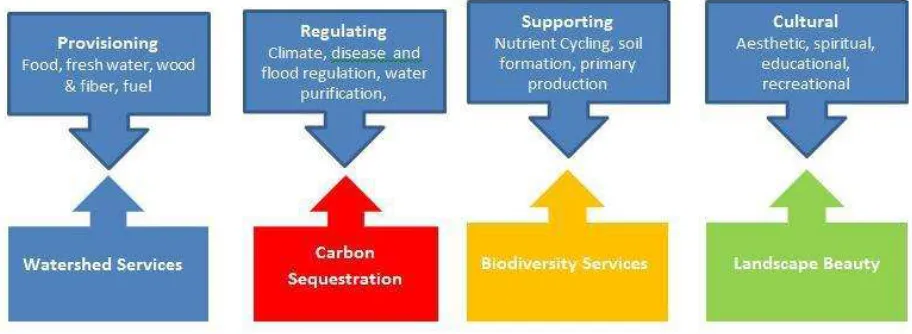
There is a diversity of models for ecosystem services. This thesis will use the Millennium Ecosystem Assessment’s model, which groups the services into supporting, provisioning, regulating and cultural. Using the Millennium Ecosystem Assessment Ecosystem Services model provides the best fit for the ecosystem services which are currently being incentivized based on demand in payment for ecosystem services programs (Mayrand and Paquin 2004).
Article 2 of the Convention on Biological Diversity (CBD) defines ecosystems as a “dynamic complex of plant, animal and micro-organism communities and their non-living environment interacting as a functional unit.” In 2005, the United Nations concluded a five-year
2
Ecosystem services is also referred to as environmental services in some literature. The differences between the two terms is defined in differing ways. One definition identifying the differences refers to ecosystems services as being the natural environment while environmental services refers to both the natural and built environment (Bulte, 2008, 2410. Another definition is that environmental services refers to specific, defined services while ecosystem services refers to systemic, synergies of services (Wunder, 2008, 2).
[image:13.612.70.526.348.515.2]global ecosystem assessment - the Millennium Ecosystem Assessment (MA). One of the key objectives of the assessment was to study the links between ecosystems and human well-being and identify the impacts that changes to ecosystems have on the well-being of humans (Millennium Ecosystem Assessment, 2005). Findings of the study found that 60-70% of the global ecosystems evaluated were being “degraded or being used unsustainably” with potentially dire consequences for the world’s poor particularly in terms of the provision of freshwater and arable lands (Millennium Ecosystem Assessment Synthesis Report 2005, 20).
1.3 Incentivizing Forest Protection and the Management of Ecosystem Services
Conservation strategies, specifically protected areas, have been implemented throughout Latin America as a key strategy for reducing deforestation rates and biodiversity loss. The results have been mixed in reducing forest cover and biodiversity loss. To strengthen the support of the public in avoiding deforestation strategies, incentivized strategies, including payment for ecosystem services program have become the frontline public policy tool. Due to the relation between deforestation and poverty, further pressures to implement sound strategies are being promoted by global agendas such as the Millennium Development Goals. Scaling up of PES has occurred in the establishment of REDD+ (Reducing emissions from deforestation and forest degradation in developing countries) which occurs at the country level (Pagiola 2011).
Constanza (1997) valued ecosystem services, estimated at between “$16 – 54 trillion with
the average being no less than $33 trillion, higher than the entire world gross national product”. A
2011 reassessment valued ecosystem services at an estimated US$125 trillion/year. Valuation of
ecosystem services is seen as critical to drive decision making and public policy development in the management of ecosystem services (Constanza 1997). Further validation for valuation is made
for these initiatives to be effective, the value of the ecosystems services must be properly accounted for.
Valuation of ecosystem services and incentivizing their management through payment for environmental services is not without criticism as literature presents another perspective of valuation as the commodification of ecosystem services (Huberman 2008; McCauley 2006; Kosoy and Corbera 2010). The opposition to valuation and payment for ecosystem services raises concerns of “property rights over ecosystem services” and failure to account for intrinsic or non-use value (Kosoy and Corbera, 2010, 1234).
Constanza et al. (2014) and Farley and Constanza (2010) disagree with the position that valuation equals commodification, positing that ecosystem services are public goods or common pool resources that do not fit the privatization or conventional market model and that valuation allows greater understanding of the importance of ecosystem services. As public goods, ecosystem services are non-rival and non-excludable meaning they can be consumed without affecting the opportunity for others to consume those same goods and services (Farley and Constanza 2010). Ecosystem services are also considered as common pool resources (rival but non-excludable) (Farley and Constanza 2010). Rival but non-excludable refers to ecosystem services that are not infinite but are not closed off from any groups to use (Farley and Constanza 2010). Significant implications for PES arise over differentiation in the category in which ecosystems services fits. Club resources are more likely to be managed by a private entity or within a User-managed PES program (Dunn 2011).
are club goods can be used amongst many people but there is not a deleterious effect on distribution to others (Dunn 2011). However, as in a “club” with members, “non-members can be prevented from using the services” (Dunn, 2011, 26).
Another concern raised overvaluation and creating market-based incentives as payment for ecosystem services is the potential for the increase in issues of inequity in accessing resources and further marginalization of the poor and indigenous people (Greig-Gran and Porras 2005). Further implications for poor communities may arise in a User-financed program should equity/fairness not be a high consideration in PES design
The issue of equity in payment for ecosystem services is explored further in this thesis as a critical component of payment for ecosystem services design.
Chapter 2
Literature Review
A purposive sample approach (Randolph, 2009, p. 4) was undertaken to conduct the literature review. The literature review is divided into two sections: (1) Payments for ecosystem services as a conservation tool, and (2) existing work in evaluating program structures for payment for ecosystem services with focus on research on decentralized or User-financed PES programs and Government-financed PES programs and (3) the inclusion of equity in the policy outcomes of PES.
2.0 Defining Payment for Ecosystem Services
Pagiola (2004) describes payments for ecosystem services “as a method of internalizing the positive externalities associated with a given ecosystem or a specific resource use”3.
Externalities are “the costs and benefits which arise when the social or economic activities of one group of people have an impact on another, and when the first group fails to fully account for their impact” (Europe Commission, 1995). Using a hypothetical scenario of Farmer A and B: Farmer A clears riparian forest upstream which results in increased sedimentation and turbidity in the source of drinking water for a downstream community. This would be considered to be a cost or a negative externality. In contrast, Farmer B decides to maintain a riparian buffer in a watershed which increases the water quality for the downstream community. Farmer B’s actions are considered as a benefit or a positive externality. Payment for ecosystem services targets the
3
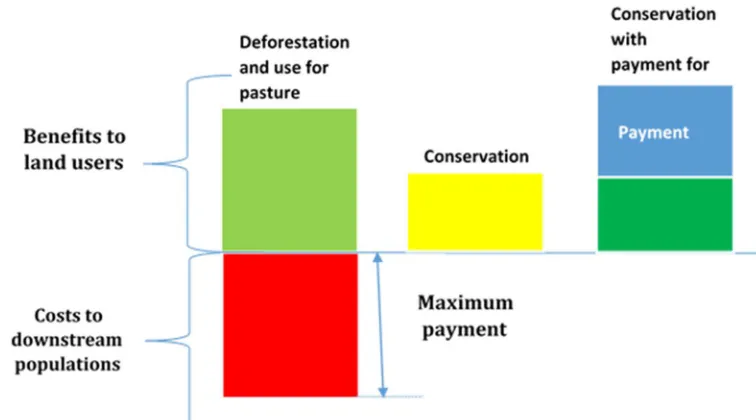
development of a positive externality through the “provision of ecosystem services” (Pascual, Muradian, Rodríguez and Duraiappah, 2009, 3). The underlying concept for PES is that without incentivizing the participation of landowners to change existing or potential land use behavior that
is degrading or damaging critical forests and their provision ecosystem services, a high risk exists
that those services would be lost (See Figure 3).
[image:18.612.127.505.241.451.2]
PES is one of the tools being used to correct the “failure of markets to value biodiversity and ecosystems” (The Economics of Ecosystems and Biodiversity, 2010, 15). The concept of PES is that the traditional markets do not account for ecosystem services. Indeed, the PES model is indicative of the shift in the attitude and decision making towards nature in general, and the benefits of ecosystem services in particular, as being a public good with no quantifiable value (Costanza, et. al. 1997).
PES is categorized as a market-based approach whereby a value is placed on the benefits of ecosystem services (in terms of payments made to provider), similar to any product being placed on the market, and then charging end Users4. The common ecosystem services (Chomitz, Brenes
and Constantino 1998,Wunder 2008) included within payment for environmental programs are: 1. watershed protection
2. biodiversity protection 3. carbon sequestration and,
4. preservation of intrinsic values, e.g. scenic/landscape beauty
Ecosystem services may be sold as a “bundled” of services in a payment program (Wunder, 2005, 2) whereby an enrolled area of land is considered to be delivering several ecosystem services (Mayrand and Pacquin 2004). “Bundling” is considered to be more efficient as the transactions costs are reduced. Contrastingly, “bundling” is considered less effective in meeting environmental targets compared with payments for individual services (Mayrand and Pacquin, 2004, 15).
2.1 The Economic Nature of Payment for ecosystem services
There is no single universally accepted definition of payment for ecosystem services. However, the definition of PES by Wunder (2005) is widely referenced in literature (Forest Trends, the Katoomba Group and UNEP 2008). The definition of PES by Wunder (2005) defines PES as:
1. a voluntary transaction where
2. a well-defined environmental service (or a land-use likely to secure that service) 3. is being ‘bought’ by a (minimum one) service buyer
4
4. from a (minimum one) service provider
5. if and only if the service provider secures service provision (conditionality).
The theoretical basis for Wunder’s five criteria and (generally speaking) the payment for ecosystem services framework, is the Coasean theorem. Coasean theorem states that paredo efficient (market efficiency) can be achieved where private individuals voluntarily reach an agreement to address an externality. However, an agreement that internalizes the externality can only be reached where property rights are clearly defined, there is an enforceable contract and the agreed transaction/negotiation are low. Government’s intervention is only required to define property rights.
However, the Coasean approach to PES is challenged as not being realistic to local realities. Further criticisms have arisen citing the definition produced by Wunder (2005) as being more a “theoretical reference point” (Vatn, 2010, 147) and that the “often perceived” Coasean approach to PES is not reflected in the literature analyzing existing PES structures (Lapeyre and Picard, 2013, 10).
silvopastoral program between Costa Rica, Nicaragua and Colombia (World Bank 2008). Non-voluntary contributions to PES for public goods may be necessary to prevent free riding (Jack, Kousky and Sims 2007)
Vatn (2010) suggests that PES programs on the ground are a “mixed between Coase and Pigou.” Ironically, the development of payment for ecosystem services was considered a shift from the Pigouvian theorem which prescribed subsidies or taxes to achieve positive externalities (Pattanayak, Wunder and Ferrano 2010).
Emerging from the discourse which describes PES as a mix of voluntary and non-voluntary buyers, is an attempt to reshape the concept of PES. Muradian et al (2010) define payment for ecosystem services as “a transfer of resources between social actors, which aims to create incentives to align individual and/or collective land use decisions with the social interest in the management of natural resources.”
It is highly relevant to discuss existing and emerging definitions of PES as the adoption of one definition over the other guides the analyses/evaluation of PES programs. Subscribers to the Coasean approach to PES are likely to determine that user-managed/private programs are more effective and efficient than Government-managed/public sector programs5 (Wunder, Engel,
Pagiola 2008). In addition, the Coasean approach to PES supporters are less likely to view equity as a critical part of the PES and more as a corruption of the efficiency of PES or as a “side objective” (Wunder, 2008, 2; Engel, Pagiola and Wunder, 2008, 9). As Pascual, Muradian,
Rodríguez and Duraiappah (2009) point out “Coasean policy approaches tend to disregard equity
5
issues since they are based on the premise that efficiency gains may be independent of the
allocation of property rights.”
Subscribers to a mixed approach to PES along the lines of the Muradian et al (2010) re-definition, give consideration to equity (poverty alleviation, protection of rights, etc.) into the design of PES (Vatn 2010) and of equal value as effectiveness and efficiency in measuring PES (Porras, Barton, Chacon-Cascante and Miranda 2013).
2.2 PES Framework
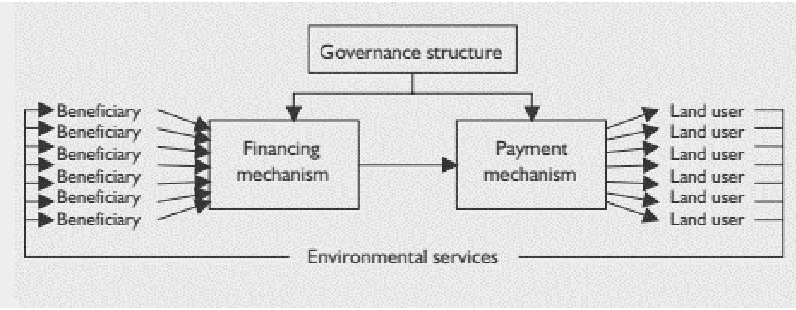
A PES program includes buyers/users, who are charged for the benefits that they derived from environmental service; service sellers/providers who are compensated/rewarded/incentivized for protecting forests which provide those ecosystem services (Wunder 2005) and intermediaries brokering the payment program. Commonly in Government-financed PES programs, the buyers are dispersed amongst a general population and financing for PES is indirect e.g. through water tax. In contrast, in user-financed programs, the buyer is a direct beneficiary and financing for PES is direct.
requirement for property rights or land ownership in PES programs has raised concerns over whether PES supports inequity by blocking poor farmers from entering into PES agreements or cause the displacement of poor farmers due to land grab by richer, larger scale farmers (Vatn 2010).
[image:23.612.123.521.347.502.2]Intermediaries are the third actors in PES programs. Their role may include acting as the go-between the buyer and seller and function in a range of positions including as negotiator, contractor, and administrator of the PES program (Huber-Stearns 2012). In national PES programs such as in Costa Rica and Mexico, the Government often acts as the intermediary. However, even in these programs, there are other smaller intermediaries which may act on the collective behalf of sellers (Chomitz, Brenes and Constantino 1998).
Figure 3: The Flow of Compensation from Beneficiaries to Land Users in Payment for Environmental Services. Source: Pagiola, S. and Platais, G. Environmental Strategy No. 2. The World Bank 2002.
Markets for Ecosystem Services
In developing countries, the concept of the market is localized without services being sold outside national boundaries. The exception is carbon sequestration. Carbon sequestration is traded as carbon credits through the international carbon market which is supported by the Kyoto Protocol of the United Nations Framework Convention on Climate Change (Arriagada and Perrings 2014).
2.3 Costs, Permanence, Leakage, Additionality
There are four major evaluative factors for payment for ecosystem services programs efficiency and effectiveness: costs, additionality, leakage, and permanence. Costs in a PES program includes (1) opportunity costs and (2) transaction costs.
Opportunity costs refer to the projected costs of a landowner forgoing economic activities e.g. agriculture, cattle raising for activities such as afforestation, shade agriculture or no action which protect the provision of ecosystem services. Transactions/implementation costs addresses expenses that include negotiations, contract development, conducting baseline studies, monitoring and enforcement and capacity building (Jack, Kousky and Sims 2007).
Measuring the effectiveness of a PES program requires the establishment of an accurate baseline. The baseline is critical to determining what provision of ecosystem services have occurred since the implementation of the PES, this baseline is called the counterfactual. A payment for ecosystem services should produce changes in land use supporting the provision of ecosystems services – which is called additionality. The determination of additionality means that without the implementation of PES, the land use change would not have occurred.
structured on a five-year participation period for participants. After this period, the goal is that the landowners would continue with the provision of ecosystem services in the long-term (Wunder, Engel and Pagiola 2008). When the long-term provision of ecosystem services is achieved, permanence of the PES is indicated.
2.4 The Issue of Equity in PES Programs
Land rights and access to resources create power asymmetries, changing the power structure by placing decision-making powers in the hands of those with resource rights (Kuponiyi 2008). Resource rights and access determines “allocation, costs and benefit sharing” (United Nations Environment Programme,2012,8) and can create unequal access and asymmetric power relations (Vatn 2010). The potential for marginalization and increasing inequities is ever present in natural resources management (Quesada-Aguilar and Franks 2014). Often times it is the poor or marginalized that bear the most costs and are displaced as they are the most resource dependent for subsistence use as well as economic livelihood.
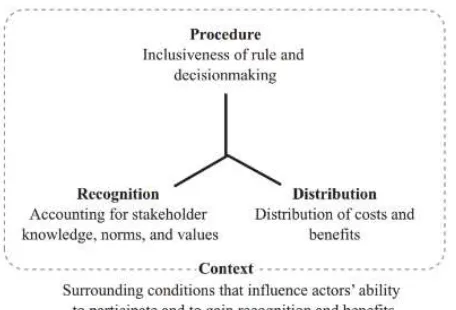
How is equity defined and is it important for PES to work? There is no single definition for equity as the perception of equity is not consistent across social groups (Quesada-Aguilar and Franks 2014), but equity frameworks commonly refer to four dimensions of equity and principles (McDermot, Mahanty and Schreckenberg 2012, Quesada-Aguilar and Franks 2014, Pascual, Phelps, Garmendia et al 2014). The four dimensions of equity are (1) procedure, (2) distribution, (3) recognition and (4) context. Figure 5 shows the principles for each dimension.
The inclusion of equity dimensions as an equal weight with environmental effectiveness and costs effectiveness can result in positive results including stronger legitimacy, improvement in compliance and participation (Pascual, Phelps, et al. 2014). Beyond the potential for equity actions in PES to support cost effectiveness, there is a moral obligation to protect the basic needs of all people, including the poor and marginalized.
[image:26.612.230.458.253.408.2]In the inception of PES as a conservation tool, the exclusion of equity was contrary to the theoretical understanding of the program’s purpose in totality (Corbera and Adger 2007). Payment for Ecosystem Services was envisaged as a conservation strategy that would not only be “more
economically efficient and environmentally effective than previous strategies”, but it was anticipated that PES’ that economic and social benefits would be fairly distributed (Corbera and Adger,2007, 1). According to Landell-Mills and Porras (2002), because payment for ecosystem services target is biodiversity conservation, the expectation is that the outcome would be positive both environmentally and economically. Further assumption made is that the marginalized would benefit. These assumptions have created a vacuum in the PES literature on “the issue of distribution” (Landell-Mills and Porras, 2002, 61). Rather than discussing distributional outcomes, the focus was on aggregate outcomes with the aim to “do no harm” to the poor.
The following section of this thesis expands the discussion on the varied positions on the trade-off between economic efficiency and equity is broadened.
2.5 Trading Equity for Efficiency
Payment for ecosystem services programs are implemented using varied institutional/program models (Appendix A), however, they share similar design elements which allow for analysis of models. This thesis’ area of interest is the analysis of the program structure of a Government -financed and User-financed program’s in their ability to deliver environmental effectiveness, cost-efficiency, and equity.
2.5.1 Existing Research
invariably approaches equity as a side objective that negatively affects the cost-effectiveness and environmental effectiveness of the PES program (Engel, Pagiola and Wunder 2008, Engel, Pagiola and Wunder 2008, Wunder and Alban 2008, Pattanayak, Wunder and Ferraro 2010). Wunder (2013) expounds on this theory and aligns equity as a side objective in Government-financed PES programs, asserting that User-financed PES programs are better able to be effective in meeting the PES goal. Government financed PES programs are determined to be “politically adrift into win-win spheres of multiple side-objectives, such as poverty alleviation, regional development, or electoral motives” (Wunder, 2013, 45).
There is a small, but growing discussion, on equity as critical to PES success (Leimona, Joshi and van Noordwijk 2007) in line with “Muradian” refocusing of PES. Pascual, Muradian, Rodriguez and Duraiappah (2009) advances the argument beyond the inclusion of equity, to the interdependency of cost effectiveness, and equity and its effect on PES (Martin, Gross-Camp, Kebede and McGuire 2014, Pascual, Muradian, Rodriguez and Duraiappah 2009). The theory underpinning the link is that perceived inequities in PES programs may lead to inefficiency that “undermine cooperative behavior and foster conflictive behavior” (Martin, Gross-Camp, Kebede and McGuire, 2014, 224;Fripp, 2014, 24).
Wunder, Engel and Pagiola (2008) have produced the most significant body of work in the analysis of PES design focus on the management structure, i.e., Government-financed versus User- financed. The comparative analysis is based on the “synthesis” of 12 case studies of PES in developed and developing countries (Wunder, Engel and Pagiola, 2008, 3).
User-managed programs indicated successful outcomes in achieving the “environmental objectives” including additionality, negligible leakage and meeting conditionality (Wunder and Alban, 2008, 696). Equity/fairness including poverty alleviation and other pro-poor initiatives are presented as “side objectives” (Wunder and Alban, 2008, 696).
The findings of the comparative analysis as it relates to equity/fairness follows the criticism that the Coasean approach looks at aggregate net gain and loss and not distributional outcomes (Pascual, Muradian, Rodriguez and Duraiappah 2009).
2.6 Limitations and Research Questions
The existing theory is that a User-financed PES program is better programmatically structured to be effective in meeting the PES goals than a Government-financed program. However, the existing theory is based largely on research which is limited to analyzing only effectiveness and efficiency outcomes without equal and comprehensive consideration given to equity. The argument put forward to not include equity consideration in the design of a PES program is that this can lead to a distortion or introduction of “side objectives” in the purpose of the PES (Wunder, 2008, 2; Engel, Pagiola and Wunder, 2008, 90). There has been growing research focusing on the inclusion of equity in the design of PES including linking equity and efficiency as interdependent outcomes, the impact of PES program on poor communities and landowners and measuring the distributional outcomes of PES6.
The purpose of this thesis is to use two case studies to investigate whether the program structure of a PES program determines its environmental effectiveness, cost-effectiveness, and
equity, and whether or not a PES program can be environmentally effective and cost effective and still be equitable.
Thus, the following inquiry will be made.
1. How does the program structure of a user-financed PES program differ from a Government-financed program in cost effectiveness, environmentally effectiveness, and equity?
Chapter 3
Methodology
The purpose of this thesis is to analyze the program structure of a user-financed and a Government-financed PES program in achieving environmental effectiveness, cost effectiveness, and equity. The case study design is used in this qualitative research. A case study is:
an empirical inquiry about a contemporary phenomenon, set within its real-world context—especially when the boundaries between phenomenon and context are not clearly evident (Yin, 2014, 16).
Further, a qualitative case study design was used to present the research. A qualitative case study is defined as “an intensive, holistic description and analysis of a bounded phenomenon such as a program, an institution, a person, a group or policy” (Merriam,1998, xii).
The qualitative case study design was the most appropriate research design as the study was done on the phenomenon in its natural setting without any intervention. Secondly, the qualitative case study method allowed for the collection of data from “multiple sources of evidence” (Yin, 2009,117), allowing for triangulation of data collected as well as reducing biases from informants, authors and myself as the researcher (Yin 2009). Thirdly, qualitative research advances the collection of descriptive data wherein the thesis focus area requires a detailed description to thoroughly understand the components of the cases being studied. Lastly, the qualitative case study design is appropriate as the cases being investigated through the case study design are “well-bounded and specific”, i.e. there are clear limits to the cases being studied and the data being collected (Stake, 2005, 443; Merriam,1998,27).
program are investigated. The multiple case design allows for studying the phenomenon using more than one case, fitting the scope of this thesis which focuses on two distinct program structure types implementing PES programs. One of the key advantages to using multiple cases versus using a single case study is that multiple case study allows for supporting the claim of “literal or theoretical replication” (Rowley,2002,21; Yin, 2009, 54). A literal replication refers to the “prediction of similar results” (Rowley,2002,21; Yin, 2009, 54) and a theoretical replication indicates “the prediction of contrasting results” (Rowley, 2002, 21; Yin, 2009, 54) with expected reasons for the differences.
Stake (1995) indicates that the pursuit of research through case study are underpinned by different end goals for researchers. Similarly, to Yin (2009), Stake (1995) notes the use of a multiple cases in research which he refers to as collective case study. A collective case study may include cases that are “similar or dissimilar” (Stake,1995,237). Further, the collective/multiple case study defined as being instrumental as it provides for an in-depth understanding of “an issue or refinement of a theory” (Stake, 1995, 237). The cases being studied are both similar in that they are PES programs and dissimilar as the buyers of the ecosystem services are not the Users in the Government-financed program, contrasting with that of the User-finance structure.
3.0 Case Study
Two case studies were purposively selected for the research (Patton, 1990, 169) based on their program structure: (1) Government-financed PES - Costa Rica’s National PES, and (2) User-financed PES – Bolivia. Purposeful sampling lends to the inclusion of cases that will provide comprehensive information on the phenomenon being studied. Various sampling strategies can be employed in purposeful sampling. The strategy implemented for Costa Rica’s PES program is a typical case sampling providing an “illustrative sample” (Patton, 1990, 173). In the selection of the Los Negros Valley, Bolivia’s PES program, intensity sampling was used (Patton, 1990, 171). In intensity sampling, the cases are “excellent or rich examples of the phenomenon of interest” (Patton, 1990, 171).
The selection of the cases was based on (1) location (Latin America), (2) established ≥10 years, and (3) program structure. Latin America was chosen as the site for the cases as the region is of critical importance to the provision of global ecosystem services and reducing Climate Change due to the high biodiversity in the region. The region also has high poverty rates and dependency on natural resources which creates a flash point for resource use and the implementation of conservation strategies. In addition, PES has increasingly become a policy tool in Latin America to protect the provision of ecosystem services.
provides a strong case for User-financed PES program. The reward system for the PES program is a direct result of negotiations between ecosystem services providers and downstream Users facilitated by an intermediary.
Using the cases of Costa Rica and Los Negros is appropriate to develop analytical generalization, in this case generalization by expanding on an existing theory.
3.1 Data Collection Methods
Data was proposed to be collected through a focused interview and document analysis. Primary documents analyzed for the Costa Rica case study were retrieved from links provided by Fondo Nacional de Financimiento Forestal - FONAFIFO (The National Forestry Fund) found at www.fonafiffo.go.cr and include legislation (decrees), financial and modality statistics. For the
Los Negros, Bolivia case study the document: Fundación Natura Bolivia: Achievements to Date and Scale Up Plans shared by Fundación Natura Bolivia was used. Other documentation was then used to verify data found in the informants’ documentation. Multiple sources of data collection support triangulation and increases internal validity and reliability of the research findings (Yin 2009, Stake 2010, Yazan 2015). Data triangulation is defined as using multiple source points to reach to a sort of “convergence of enquiry” (Yin,2009,115) to confirm or expand the researcher’s understanding of the data collected (Stake 2010).
the interview and forwarded the completed questionnaire. The second informant chose to not conduct the interview but forwarded documentation based on the questions in the questionnaire and fielded additional questions and clarifications through email. Both provided links to data on their organizational website which provided additional data.
The most appropriate corrective action that could have been implemented to address the non-participation in the questionnaire/interview process would be to select another case. However, time constraints and lack of another appropriate case selection did not allow for choosing another case. Two other cases in Ecuador had been selected as options 1 and 2 for the case study. However, an earthquake resulted in an informant from option 1 withdrawing from being a part of the research and option 2 was non-responsive.
As noted on the questionnaire (See Appendix B: Questionnaire), some of the data on the cases are widely and readily available through documentation. However, corroboration was required to ensure the data was up to date.
For the questionnaire, a mix of both open-ended and closed-ended questions were used. Closed-ended questions allowed for the collection of factual data such as a number of persons participating in the payment for ecosystems services. Open-ended questions were included to allow the free flow of discussion that may have provided additional insights. The questionnaire was standard for both case studies. Due to the predominant language used in the targeted region for the cases, the questionnaires were presented in both English and Spanish. The questionnaire was built based on Jack, Kousky and Sims (2008) which provides a blue-print for best practices for environmental effectiveness, cost-effectiveness and equity.
biases, primarily, documentation was accessed from the questionnaire responses and data sharing, and secondarily through an exhaustive review of available documentation on (1) PES design, (2) PES program case studies and (3) outcomes being analyzed.
Informants used for the case studies were Fundación Natura Bolivia and The National Forestry Fund (Fondo Nacional de Financimiento Forestal - FONAFIFO).
3.2 Data Analysis
Coding
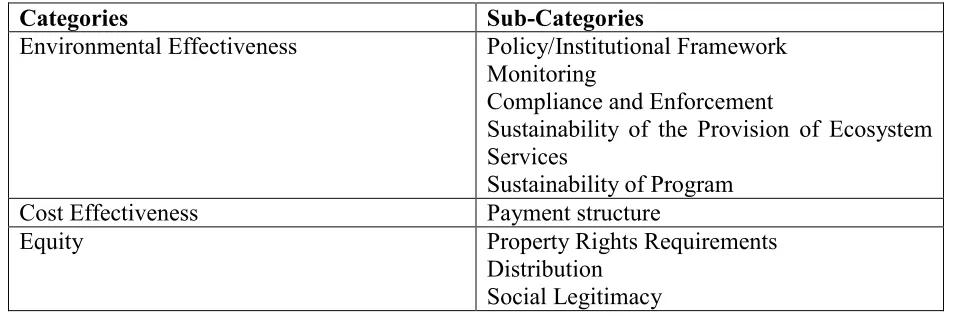
[image:36.612.68.548.554.712.2]The coding process was performed manually using descriptive coding (Saldana 2009) for questionnaire and email question responses. Using the manual process was suitable due to the small amount of data that was being coded. The questions had predefined codes which were synthesized to ensure they were mutually exclusive (Saldana 2009). Synthesizing the codes resulting in 3 categories and 9 sub-categories as presented in Table 2. Codes used were verified to be mutually exclusive (Saldana 2009). The definition for the categories and sub-categories was guided by Camhi (2012) and Jack, Kousky and Sims (2008), and are discussed further in the Findings section.
Table 1: Categories and sub-categories of the coding process
Categories Sub-Categories
Environmental Effectiveness Policy/Institutional Framework Monitoring
Compliance and Enforcement
Sustainability of the Provision of Ecosystem Services
Sustainability of Program
Cost Effectiveness Payment structure
Equity Property Rights Requirements
An example of the coding process is demonstrated below. The example used highlights that a question with predefined codes can elicit additional content that may fit predefined codes or emerging codes (Saldana 2009). In the discussed example, the content fits predefined codes as explained below.
Interview Question: Is there any [intentional targeting of the poor] in the RWA?
Code: social and economic data used for targeting
Interview Response: 1[No], we target poor communities in Bolivia, but the 2[critical criteria for
whether a farmer is eligible for voluntary participation is does the person have a piece of land that provides an environmental service].
1 Category: Equity
Sub-category: Distribution
Code: Socio-economic data not used for targeting
2 Category: Environmental effectiveness
Sub-category: Sustainability of the Provision of Ecosystem Services Code: targeted approach
Analyzing Categories
By summing up the 1s and 0s from each sub-category, a numerical value was determined for each category. A 9 point interval scale, demonstrated in Table 2, was used to produce a subjective determination of the level at which each case study achieved the individual category.
Table 2: 9-point scale for individual categories
Weights were then added to raw scores of specific sub-categories of the environmental effectiveness and equity categories. The addition of weights was used to increase the importance of specific sub-categories and compare those weighted scores for the user-financed case study and the Government-financed case study.
The cost-effectiveness category was analyzed differently from the other two categories. One sub-category was assessed under the cost effectiveness category, i.e., payment structure. In addition to the payment structure sub-category, indicators from the environmental effectiveness and equity categories were used as variables to assess the two case studies level of achieving cost effectiveness. Not all indicators were used; only indicators associated with bearing costs were used.
A table was created to assign selected indicators as either bearing high transaction costs or low transaction costs. The results from the payment structure category were included in the table as well. Indicators are appropriate to use as they “reflect changes in a particular context” (Church and Rogers,1996,44).
SCALE
0 1 to 3 4 to 6 7 to 9
3.3 Protection of Human Subjects
The questionnaire was reviewed and approved by the Institutional Review Board (IRB) through an expedited Review Procedure as it qualified as no more than minimal risk to human subjects.
Informants were forwarded a consent form (See Appendix C: Consent Form) and asked to indicate acceptance via email prior to the questionnaire being sent to them. The consent form informed them about (1) the scope, (2) risks and benefits, (3) confidentiality, (4) voluntary nature of their participation and (4) contact information for any questions or concerns about the questionnaire or overall research.
3.3 Limitations
Major limitations are noted in conducting the case study. Firstly, my inability to conduct in-person interviews with informants due to lack of resources made it challenging to lock-in informants to an interview schedule. The data collection methodology in the data collection procedure was amended to ensure that data would be received from the individual case informants. Amending the data collection decreased the robustness of the case study.
Chapter 4
Findings
Chapter 4 describes the findings of the data collected for the case studies. Table 3 provides a summary of the results for the categories of environmental effectiveness, cost-effectiveness, and equity.
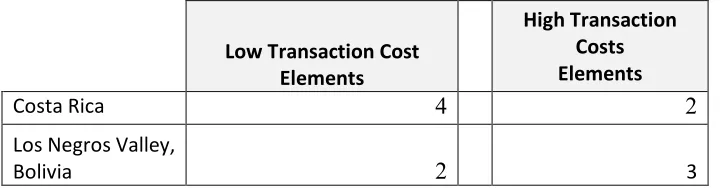
The Costa Rica PES indicated that the program structure enabled the program to have high environmental effectiveness and equity outcomes. For the Los Negros Valley, Bolivia Reciprocal Water Agreements Program (RWA) indicated the program structure enabled a medium level of environmental effectiveness, but a high level of equity outcomes (Table 3). The Government-financed program had a greater number of low transaction cost elements than high transaction cost elements indicating that the program structure is somewhat cost-effective. For the User-financed PES program, the high transaction cost elements were greater than the low transaction cost elements indicating a program structure that is less cost-effective than the Government-financed PES program (Table 4).
Table 3: Summary of Findings for Environmental Effectiveness and Equity - Costa Rica National PES and Los Negros Valley, Bolivia
Categories
Country
Environmental Effectiveness Equity
Costa Rica 7 7
Bolivia 4 7
Range
Table 4: Summary of Findings for Cost Effectiveness - Costa Rica National PES and Los Negros Valley, Bolivia
Low Transaction Cost Elements
High Transaction Costs Elements
Costa Rica 4 2
Los Negros Valley,
Bolivia 2 3
4.0 Case Study Context
4.0.1 Government-financed Payment for Ecosystem Services - Costa Rica National Payment
for Ecosystem Services Program
Costa Rica is situated in Central America and has forests of high biological diversity value (Committee on Noneconomic and Economic Value of Biodiversity and Commission on Life Sciences, 1999). A system of national parks has been established to protect the country’s diversity. However, during the period 1970 – the early 80’s, the country’s high biodiversity was being over-exploited by cattle ranching and agriculture, resulting in high deforestation. Agriculture, logging, cattle ranching and related commercial activities were being supported by Government policies which allowed for subsidies and loans directed at these industries. The result was forest cover decreasing to 20% from a high of 70% (Porras, Barton, Chacón-Cascante and Miranda, 2013,5). In 1997, Costa Rica’s National Payment for Ecosystem Services program (7Pago por
Servicios Ambientales – PSA) program was implemented as one of the policy responses to significant deforestation. Forestry Law No. 7575 of 1996, the legal framework for PES, was enacted allowing for the implementation of payment for ecosystem services in Costa Rica, marking
7 The literal English translation is Payment for Environmental Services, however to remain consistent with the
the first national PES program. The law prescribes for contracting land enrollment for the provision of four ecosystem services:
• Carbon sequestration
• Watershed protection
• Biodiversity protection
• Scenic beauty
The PES Program has a total of 68 thematic areas: (1) forest protection, (2) reforestation,
(3) agroforestry system, (4) forest management based on pre-determined conservation area, (5) natural forest regeneration and (6) existing forest plantations.
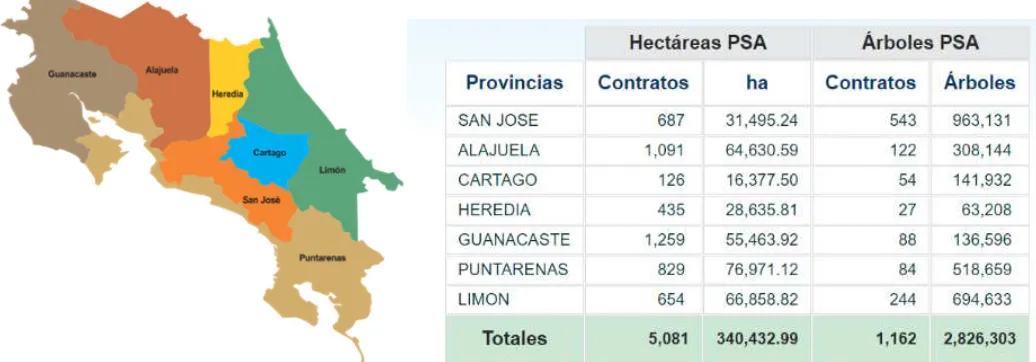
According to FONAFIFO, the “National Forestry Development Plan goal is to maintain land under PES in the low 300 thousand hectares” (email questionnaire response, FONAFIFO, May 4, 2016).
8 Each thematic area has 17 modalities: (1) forest protection, (2) water resource protection, (3) forest protection in conservation
[image:44.612.72.590.87.268.2]gaps, (4) protection within protected areas, (6) afforestation, (7) reforestation with native species endangered, (8) reforestation protection areas, (9) Second Harvests – management of existing forest plantation, (10) natural generation for Clean Development Mechanism, (11) natural regeneration, (12) natural regeneration of forests productive potential, (13) agroforestry systems, (14) agroforestry for coffee production, (15) agroforestry systems for endangered species of trees, (16) agroforestry systems for native species and (17) forest management. www.fonaifo.go.cr/psa
The PES program was designed through participatory consultation with various sectors including the forest and tourism sectors, indigenous people, Ministry of the Environment and Energy (MINAE), National System of Conservation Areas (SINAC) and National Forestry Office (ONF) and continues to be revised. Costa Rica’s PES Program is administered by The National Forestry Fund (Fondo Nacional de Financimiento Forestal - FONAFIFO), which falls within the Ministry of the Environment and Energy, a Government entity. FONAFIFO has established eight regional offices to serve PSA participants.
4.0.2 User-Financed Payment for Ecosystem Services - Los Negros Valley, Bolivia
PES/Reciprocal Watershed Agreement
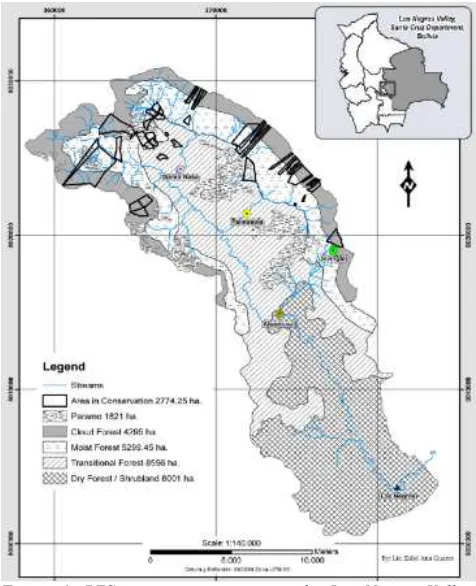
are a source of clean drinking water. In the Andean culture, water is held “as a universal and communal right” and its distribution should be equal based on the “needs, traditions and community norms that respect the water cycle.” Further, water is seen as free (common good) and should not be sold.
In 2003, the downstream community of Santa Cruz was at a crisis point after a long drought and low water flow and quantity, which made irrigation for crops challenging. The downstream users held the upstream farmers responsible for the changes to the water quantity and quality due to the clearing of riparian forests within the watershed. The non-Governmental organization, Fundación Natura Bolivia (Nature Foundation) assisted in the formation of a community-based PES program to protect the Los Negros Watershed. With funding from the US Fish and Wildlife Foundation, Fundación Natura Bolivia facilitated 6 downstream irrigators and upstream farmers to negotiate contracts to preserve cloud forests and protect their livelihoods. In
[image:46.612.187.425.71.364.2]exchange for every 10 hectares of forest not deforested, upstream landowners receive non-monetary rewards in a beehive, apiculture training and barbed wire for compliance.
An evolution of the initial PES program has resulted in the program being formally titled as Reciprocal Watershed Agreements (Acuerdos Recíprocos por Agua – ARA). Fundación Natura Bolivia asserts that the term “payment” should not be used in non-monetary schemes and promotes RWA as an “alternative to PES” (Asquith 2014). The purpose of the Reciprocal Watershed Agreements (RWA) is to protect the water supply through the protection of upstream forests and creating an enabling environment for downstream water users to contribute to such forest protection (Fundación Natura Bolivia). Currently, 95 farmers are enrolled to protect 4,500 hectares of forests.
4.1 Findings for Environmental Effectiveness Category
Environmental effectiveness is defined as the degree to which the contracted provision of ecosystem services is achieved (Porras, Barton, Chacón-Cascante and Miranda, 2013,5). There are five sub-categories used in this study to indicate environmental effectiveness in PES: (1) policy context/institutional framework, (2) monitoring, (3) compliance and enforcement, (4) sustainability of the provision of ecosystem services and, (5) sustainability of the program.
Table 5: Summary Findings for Environmental Effectiveness Category
4.1.1 Policy Context/Institutional Framework
Two indicators were used in the policy context/institutional framework sub-category: a) Legislative legitimacy - refers to the establishment of the PES by legislation, decree,
and other legal mechanisms giving authority for the management structure and other guiding principles for the PES.
[image:48.612.41.576.110.345.2]b) Political support – refers to tangible buy-in, recognition and support from decision-makers for the PES at the formal political level, e.g. national and local Governments.
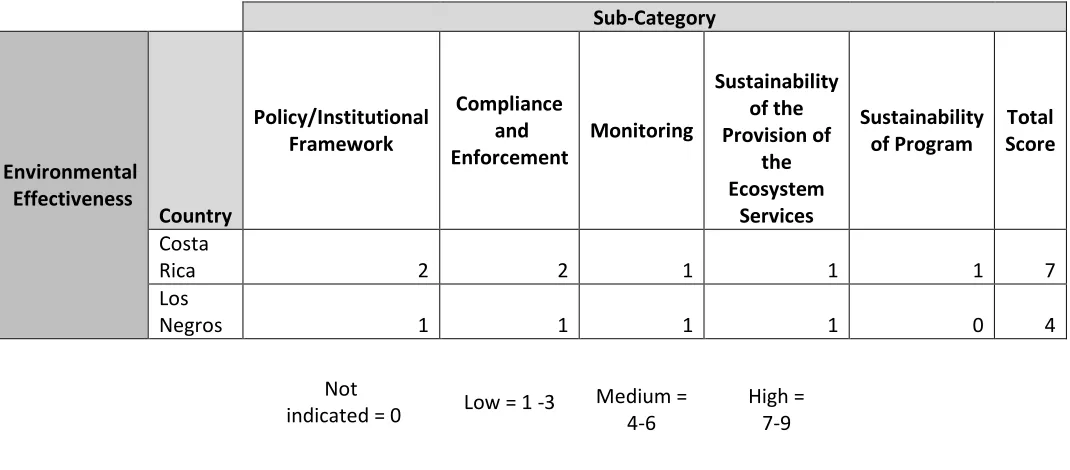
Table 6: Findings for Policy Context/Institutional Framework Category Sub-Category Environmental Effectiveness Country Policy/Institutional Framework Compliance and Enforcement Monitoring Sustainability of the Provision of the Ecosystem Services Sustainability of Program Total Score Costa
Rica 2 2 1 1 1 7
Los
Negros 1 1 1 1 0 4
Not
indicated = 0 Low = 1 -3 Medium = 4-6 High = 7-9
Indicators
Policy and Institutional
Framework
Country Political Support Legal Legitimacy
Costa Rica 1 1
a) Costa Rica’s National PES program (Score: 2)
Costa Rica’s PES Program has legal legitimacy through the enactment of Forestry Law No. 7575 of 1996. Forestry Law No. 7575 provides for the establishment of PES as a policy tool and for the institutional framework to operationalize the policy. The National Forestry Fund (FONAFIFO) is the implementing agency for the PES program. FONAFIFO is a component of the Ministry of the Environment and Energy (MINAE), a Government entity headed by a Minister of Government. The placement of the implementing agency for PES within a Government Ministry is critical to the long-term viability of the PES program and provides strong political support for the national PES program.
Amendments, through legal decrees, have been made to the legislation to address gaps and make the program more effective. A historical review of the PES program informs that amendments have included new modalities and a targeted approach that recognizes: (1) “heterogeneity in land productivity” (Alix-Garcia, de Janvry and Sadouletand, 2008), (2) the risk of deforestation, (3) the conservation value of land, and (4) poor landowners and non-traditional land possession.
b) Los Negros, Bolivia Reciprocal Watershed Agreements (RWA) (score: 1)
Los Negros Valley RWA is local in scope and is not directly supported by national or local legislation9. Funds for purchasing the program rewards (beehive, apicultural training, and
barbwire fencing) for participants in the RWA is disbursed through the Municipal Government. The inclusion of a Government entity as an integral actor in the disbursement process indicates
9 Scaling up of RWA is occurring across Bolivia amassing 36 municipalities implementing the program as well as in
that the Los Negros Valley RWA has significant political support, specifically at the Municipal Government level.
Municipal Governments have been given legislative power over natural resources management through the Law of Popular Participation 1581 of 1994 also known as the decentralization law. The legislation also formalized the relationship between civil society and the Government of Bolivia (Seemann 2004). Indirectly, the Law of Popular Participation gives a degree of legal legitimacy to the Los Negros RWA giving legal recognition of the role of civil society in resources management in Bolivia. However, there is no legislation dedicated to the operationalization of RWA in Bolivia.
Further, Fundación Natura Bolivia (10Nature Foundation of Bolivia) as a non-Governmental (non-profit) organization has acted as a facilitator for the program and has received international donor funding for the start-up costs and operations. The ability to attract funding and to operationalize the program, shows de facto legal legitimacy of the RWA program, however, this is the extent of any legal backing for the Los Negros RWA.
The lack of a legal framework for the Los Negros RWA is Bolivia’s unstable political environment and disjointed environmental policy context may have a direct influence on the non-existent enabling legal environment for RWA in Los Negros.
4.1.2 Monitoring
The monitoring category has two indicators:
a) Baseline: refers to the systematic collection of bio-physical data to establish the flow of ecosystem services against which any changes to ecosystems post-PES intervention can be measured.
b) Monitoring for the provision of ecosystem services: refers to a planned monitoring program to ensure participants are providing ecosystem services in accordance with the PES contract.
[image:51.612.76.540.393.506.2]A counter-factual baseline is critical to determining whether or not a PES program is working in obtaining additionality, i.e. the provision of ecosystem services that would not occur without PES. The counter-factual baseline hypothesizes a scenario without and with PES (Wunder, Efficiency of Payments for Environmental Services in Tropical Conservation 2007) feeding into the design and monitoring of the PES. Without the establishment of counterfactual baseline, the evaluation of the real impact of PES is weak and can negatively affect environmental and cost-effectiveness.
Table 7: Findings for Monitoring Category
a) Costa Rica’s National PES program (score: 1)
Thebaseline for the PES program was established in 1997 using Landsat imagery of forest cover. In the early stages of the PES program, a “static baseline” (Wunder, Efficiency of Payments for Environmental Services in Tropical Conservation 2007) was used where payment was being made for forest-cover without the determination of whether forest protection would occur without PES. Enrollment in the program was first-come, first accepted to match several criteria. The evolution of the Costa Rica Program has resulted in more targeted approach through establishing
Indicators
Monitoring
Country
Counter-factual baseline established
Monitoring f/ provision of ecosystem services
Costa Rica 0 1
national priorities for the selection of land to be enrolled in the program such as land to fill conservation of biodiversity gaps, land within biological corridors and land within critical watersheds. As noted in the Policy and Institutional Framework section, a targeted PES program increases the environmental cost-effectiveness of the program.
b) Los Negros, Bolivia Reciprocal Watershed Agreements (RWA) (score:1)
One known baseline data collection was done through Landsat imagery in 2001, similarly as was done in the Costa Rica Program. The image captured land use types for Los Negros. No hydrological baseline studies were conducted and the information used to initiate the program in 2003 was based on associating low water levels with upland deforestation.
Monitoring for ecosystem services provision is conducted in both programs through field visits to farms enrolled under PES as well as geospatial technology to track and monitor the PES Program. As discussed in the Compliance and Enforcement section, both programs use proxies to assess additionality - provision of ecosystem services. Proxies are contracted actions or non-actions, e.g. not cutting a certain hectare of forests or planting a specified number of trees, with the end goal being the additional provision of ecosystem services.
Monitoring is critical to ensuring adherence to the contract, and ostensibly the actual provision of ecosystem services, thus improving environmental effectiveness as well as building trust between seller and buyer. As one of the downstream irrigators in Santa Cruz said:
For us, it is very important that we have an environmental committee to monitor if they are really looking after the watershed or not. (RARE, Watershed Protection in Bolivia: Reciprocal Water Agreements 2010)
transaction). Contrastingly, a targeted PES can allow for a tailored monitoring program and reduce costs.
4.1.3 Compliance and Enforcement
PES has two models for payments: output based and input based payments. Output-based payments require direct measurement of additional provision of ecosystem services. Carbon sequestration is the only ecosystem services for which output based payments have been made. Input based or proxy based payments reward land owners for land-use behaviors such as not clearing forests, planting a number of trees etc. or outcomes from these actions such as increased forest cover. The theoretical underpinning is that these activities should provide ecosystem services as the opposite action degrades or causes loss to ecosystem services. Using proxies can be effective if a strong causal relationship can be ascertained between the proxy and the expected provision of ecosystem services (Jack, Kousky and Sims 2008).
Appropriate proxies contribute to the environmental effectiveness and cost effectiveness by improving the opportunity to secure additional ecosystems services. A direct relationship between the PES intervention and changes to ecosystems services can be better established.
The compliance and enforcement sub-category has three indicators:
a) Payment based on output based performance: refers to payment based on the measured provision of ecosystem services (additionality). For example, carbon sequestration can be calculated by the number of tress, types of species, age of trees etc.
proxies and the provision of ecosystem services desired (Jack, Kousky and Sims 2008, 9467).
[image:54.612.41.573.237.326.2]c) Enforcement of contract: refers to the administration of the contract signed through enrollment and the imposition of sanctions when the terms of the contract are violated.
Table 8: Findings for Compliance and Enforcement Sub-category
a) Costa Rica’s National PES program (score: 2)
Payment for land enrolled under PES is input based versus output-based. The Costa Rica PES program contracts land under PES based on priority areas with identified conservation values. An Executive Decree is issued indicating the priority modalities, the maximum hectares for each modality and the priority land-use types. Costa Rica’s PES program uses a targeted approach to PES participation which improves the certainty of the proxy.
FONAFIFO explained the enforcement of the PES contract:
All conditions of the contract are enforced and the contract compliance rate is 98%. Enforcement is through the control and scheduled payments, in addition to [the use of] all applicable legislation.
Sanctions may include the termination of contract and repayment of funds paid to seller and removal from the PES program.
b) Los Negros, Bolivia Reciprocal Watershed Agreements (RWA) (score:1) Indicators
Compliance and
Enforcement Country
Payment based on provision of ecosystem
services
Payment based on appropriate proxies
Enforcement of Contract
Costa Rica 0 1 1
The Los Negros Valley, Bolivia RWA is also input based. Enrollment of farmers into the RWA is dependent on the ability of their land to provide the desired ecosystem services. The process to determine the ecosystem services provision is untargeted as all farmers in the upstream area (Santa Cruz) are invited to enroll. Accepted lands are mapped after which a conservation area is set aside as land under PES. The untargeted approach decreases the certainty of the proxy.
The conditions of the contract are enforced. Sanctions for non-compliance include the return of the incentive or its value in cash.
4.1.4 Sustainability of the Provision of Ecosystem Services
Reforestation can take between 50 – 100 years. Using a minimum realistic timeframe for the growth of secondary forests into shrubs (Food and Agriculture Organization), a contract period of not less than 5 years was assigned for the indicator of Sustainability of the Provision of Ecosystem Services.
The sustainability of the provision of ecosystem services has one indicator:
[image:55.612.69.525.560.656.2]a) Contract term < 5 years: refers to the timeframe which the landowner has agreed to have their land under PES being greater than 5 years.
Table 9: Findings for Sustainability of Provision of Ecosystem Services Category
Indicators
Sustainability of the Provision of Ecosystem Services
Country Contract term < 5 yrs
Costa Rica 1