Copyright © 2000, American Society for Microbiology. All Rights Reserved.
Membrane Interface-Interacting Sequences within the Ectodomain of
the Human Immunodeficiency Virus Type 1 Envelope Glycoprotein:
Putative Role during Viral Fusion
TATIANA SUA´ REZ,1WILLIAM R. GALLAHER,2AITZIBER AGIRRE,1FE´LIX M. GON˜ I,1 ANDJOSE´ L. NIEVA1*
Unidad de Biofı´sica (CSIC-UPV/EHU) and Departamento de Bioquı´mica, Universidad del Paı´s Vasco, 48080 Bilbao, Spain,1and Department of Microbiology, Immunology and Parasitology, Louisiana State University
Health Sciences Center, New Orleans, Louisiana 701122 Received 27 March 2000/Accepted 30 May 2000
We have identified a region within the ectodomain of the fusogenic human immunodeficiency virus type 1 (HIV-1) gp41, different from the fusion peptide, that interacts strongly with membranes. This conserved sequence, which immediately precedes the transmembrane anchor, is not highly hydrophobic according to the Kyte-Doolittle hydropathy prediction algorithm, yet it shows a high tendency to partition into the membrane interface, as revealed by the Wimley-White interfacial hydrophobicity scale. We have investigated here the
membrane effects induced by NH2-DKWASLWNWFNITNWLWYIK-CONH2(HIVc), the membrane
interface-partitioning region at the C terminus of the gp41 ectodomain, in comparison to those caused by NH2
-AVGIGALFLGFLGAAGSTMGARS-CONH2(HIVn), the fusion peptide at the N terminus of the subunit. Both
HIVcand HIVnwere seen to induce membrane fusion and permeabilization, although lower doses of HIVcwere
required for comparable effects to be detected. Experiments in which equimolar mixtures of HIVcand HIVn
were used indicated that both peptides may act in a cooperative way. Peptide-membrane and peptide-peptide interactions underlying those effects were further confirmed by analyzing the changes in fluorescence of peptide Trp residues. Replacement of the first three Trp residues by Ala, known to render a defective gp41 phenotype
unable to mediate both cell-cell fusion and virus entry, also abrogated the HIVcability to induce membrane
fusion or form complexes with HIVnbut not its ability to associate with vesicles. Hydropathy analysis indicated
that the presence of two membrane-partitioning stretches separated by a collapsible intervening sequence is a common structural motif among other viral envelope proteins. Moreover, sequences with membrane surface-residing residues preceding the transmembrane anchor appeared to be a common feature in viral fusion proteins of several virus families. According to our experimental results, such a feature might be related to their fusogenic function.
The human immunodeficiency virus type 1 (HIV-1) relies on the fusogenic activity of the gp120/41 glycoprotein at the virion surface to enter and infect the CD4⫹host cells (7, 24).
Acti-vation of the HIV-1 envelope protein occurs after the binding of the surface gp120 subunit to CD4 and human chemokine receptors (4, 7, 8, 24). Subsequently, the transmembrane gp41 subunit supports structural rearrangements involving a coiled-coil domain (5, 12, 25, 39) that bring about the eventual expo-sure to the aqueous medium of the fusion peptide at its N terminus (12, 13, 24, 25). The fusion peptide is likely to insert into the target lipid bilayer, making gp41 capable of interacting simultaneously with the viral and cell membranes (5, 8, 12, 13, 25, 39). The involvement of this conserved hydrophobic seg-ment of about 25 amino acids in triggering fusion is supported by prediction (13, 15, 40), mutational analysis (2, 10, 11, 35), and in vitro studies carried out using synthetic peptides and model membranes (16, 20, 23, 27–31, 36). Fusion peptides inserted into the target membrane might drive the aggregation of gp41 trimers at initial sites of fusion as well (39). It has been argued that a higher-order envelope glycoprotein complex is involved in HIV-1 fusion as well as in analogous viral fusion processes (17, 19, 39).
Recent resolution of the atomic structure of the gp41 ectodomain demonstrates that this region is organized into a very stable helical bundle or “hairpin” (4, 5, 39). The core of this crystallized structure is constituted by a triple-stranded coiled coil. Three␣-helices oriented obliquely in an antiparal-lel sense pack hydrophobically against the core coiled coil. The resulting trimeric structure would locate both fusion peptides and transmembrane anchors at the same end of the molecule. Two main models have been developed to explain the involve-ment of the hairpin structure in the gp41-mediated membrane fusion process. In one model (4, 5, 12, 25, 39, 43) a transient intermediate exists between the native nonfusogenic and the fusogenic six-helix complex, termed by Chan and Kim (4) as the “prehairpin.” The alternative model postulates that the hairpin is already present in the prefusion state (38). Binding to CD4 and chemokine receptors would expose the hairpin in close vicinity to the target membrane. Both molecular models propose that this structure represents the fusion-active version of gp41. Thus, formation of a hairpin could be coupled to the apposition of the target cell and viral membranes provided that gp41 trimers interacted simultaneously with both membranes. The hypothesis of the hairpin structure as a fusion mediator has gained support from studies indicating that synthetic pep-tides corresponding to helical regions in the gp41 core struc-ture are inhibitors of HIV-1 fusion. The DP-178 synthetic peptide representing the hydrophobic ␣-helix that interacts with the coiled-coil core of the hairpin completely inhibits * Corresponding author. Mailing address: Unidad de Biofı´sica
(CSIC-UPV/EHU) y Departamento de Bioquı´mica, Universidad del Paı´s Vasco, Aptdo. 644, 48080 Bilbao, Spain. Phone: 34 94 6012615. Fax: 34 94 4648500. E-mail: [email protected].
8038
on November 9, 2019 by guest
http://jvi.asm.org/
virus-mediated cell-cell fusion and reduces infectivity (43). DP-178-induced inhibition occurs after receptor binding-induced activation and blocks the fusion process at a hemifusion state (12, 25). This peptide (also called T-20) has already been tested in clinical trials and has been shown to be an effective suppressor of HIV-1 replication in infected individuals (19a). In addition, based on the knowledge of this functional struc-ture new strategies for the development and identification of new anti-HIV compounds have recently been delineated (8a, 9a).
At this point it is unclear how hairpin-apposed membranes can fuse (4). Several findings indicate that the fusion peptide inserted into the target membrane would cause the distortion of the bilayer organization necessary for merging (6, 30). Hy-dropathy-at-interface plots elaborated according to the hydro-phobicity scale developed by Wimley and White (33, 42, 45) identify, in addition to the fusion peptide, a second region within the ectodomain of the fusogenic HIV-1 gp41 that shows high tendency to partition into the membrane interface. This tryptophan-rich region is located proximal to the viral mem-brane overlapping the DP-178 region at its C terminus and preceding the transmembrane anchor of gp41. Recent muta-tional analysis has revealed its importance for gp41-mediated fusion and infectivity. Salzwedel et al. (34) identified several mutations indicating that this gp41 stretch is dispensable for the normal maturation, transport, and receptor-binding ability of the protein but required for membrane fusion. Later func-tional characterization in cell-cell fusion assays by Mun˜oz-Barroso et al. (26) revealed three different phenotypes among the studied gp41 mutants: wild-type-like phenotypes showing reduced activity, defective variants unable to mediate fusion, and mutants able to assemble nonexpanding fusion pores.
Our results here demonstrate that, as for the N-terminal fusion peptide, HIVc, a sequence representing the pretrans-membrane region partitions into pretrans-membranes and induces the same type of perturbations. Moreover, the fusion peptide stim-ulates the activity of this second membrane-interacting se-quence. These observations would be consistent with the exis-tence of concerted action by both sequences that could simultaneously destabilize gp41-apposed membranes at the points of fusion. A mutation shown to inhibit cell-cell fusion and virus entry without affecting the maturation, transport, or CD4-binding ability of HIV-1 glycoprotein (34) caused the abrogation of both membrane fusion by the membrane-bound peptide and the ability to form complexes with the N-terminal fusion peptide. This finding provides a direct correlation be-tween the activity of the HIVcpeptide in vitro and the activity of gp41 in the virus and the transfected-cell context. Hydrop-athy analysis of several X-ray-solved ectodomain structures further indicates that, following the intervening protein se-quences involved in the hairpin formation and preceding the transmembrane anchor, an additional membrane-interacting domain is also present. Sequence analysis extended to other viral fusion proteins indicates that an unusual concentration of aromatic residues, just preceding the transmembrane anchor, is commonly found among several virus families including ret-roviruses, filoviruses, orthomyxoviruses, rhabdoviruses, alpha-viruses, and flaviviruses.
We propose that the existence of a membrane interface-residing sequence close to the transmembrane domain can be a general motif for a considerable number of viral fusion pro-teins and may be related to their fusion activity. Our study of the gp41 pretransmembrane region provides a mechanistic ba-sis for understanding its role in viral fusion and infection and might be important for devising new inhibitors based on this sequence.
MATERIALS AND METHODS
Materials.Dioleoylphosphatidylcholine (DOPC), dioleoylphosphatidylethanol-amine (DOPE), cholesterol (CHOL), and the fluorescent probesN -(7-nitro-benz-2-oxa-1,3-diazol-4-yl)phosphatidylethanolamine (N-NBD-PE) andN -(Lis-samine-rhodamine B-sulfonyl)phosphatidylethanolamine (N-Rh-PE) were purchased from Avanti Polar Lipids (Birmingham, Ala.). 8-Aminonaphthalene-1,3,6-trisulfonic acid sodium salt (ANTS) andp-xylenebis(pyridinium)bromide (DPX) were from Molecular Probes (Junction City, Oreg.). Octaethyleneglycol monododecyl ether (C12E8) and Triton X-100 were obtained from Sigma (St. Louis, Mo.). All other reagents were of analytical grade. The sequences
NH2-DKWASLWNWFNITNWLWYIK-CONH2(HIVc), DKAASLANAFNITNWL
WYIK-CONH2[HIVW(1–3)A], and NH2-AVGIGALFLGFLGAAGSTMGARS-CONH2(HIVn) were synthesized as their C-terminal carboxamides and purified (estimated homogeneity,⬎90%) by Quality Controlled Biochemicals, Inc. (Hop-kinton, Mass.). Peptide stock solutions were prepared in dimethyl sulfoxide (spectroscopy grade).
Vesicle preparation.Large unilamellar vesicles (LUV) consisting of DOPC, DOPE, and CHOL (molar ratio, 1:1:1) were prepared according to the extrusion method of Hope et al. (18) in 5 mM HEPES–100 mM NaCl (pH 7.4). Lipid concentrations of liposome suspensions were determined by phosphate analysis (3). The mean diameter of DOPC-DOPE-CHOL vesicles was 130 nm as esti-mated by quasielastic light scattering using a Malvern Zeta-Sizer instrument.
Fluorimetric assays for vesicle destabilization.All fluorescence measurements were conducted in thermostatically controlled cuvettes (37°C) using a Perkin-Elmer LS50-B spectrofluorimeter. The medium in the cuvettes was continuously stirred to allow the rapid mixing of peptide and vesicles.
Membrane lipid mixing was monitored using the resonance energy transfer (RET) assay described by Struck et al. (37). The assay is based on the dilution of N-NBD-PE and N-Rh-PE. Dilution due to membrane mixing results in an increase in N-NBD-PE fluorescence. Vesicles containing 0.6 mol% of each probe were mixed with unlabeled vesicles at a 1:4 ratio (final lipid concentration, 0.1 mM). The 7-nitro-benz-2-oxa-1,3-diazol-4-yl NBD emission at 530 nm was mon-itored, with the excitation wavelength set at 465 nm. A cutoff filter at 515 nm was used between the sample and the emission monochromator to avoid scattering interferences. The fluorescence scale was calibrated such that the zero level corresponded to the initial residual fluorescence of the labeled vesicles and the 100% value corresponded to complete mixing of all the lipids in the system. The latter value was set by the fluorescence intensity of vesicles labeled with 0.12 mol% of each fluorophore at the same total lipid concentration as in the fusion assay.
Release of vesicular contents to the medium was monitored by the ANTS-DPX assay. LUV containing 12.5 mM ANTS, 45 mM ANTS-DPX, 20 mM NaCl, and 5 mM HEPES (9) were obtained by separating the unencapsulated material by gel filtration in a Sephadex G-75 column eluted with 5 mM HEPES–100 mM NaCl (pH 7.4). Osmolarities were adjusted to 200 mosM in a cryoscopic osmometer (Osmomat 030; Gonotec, Berlin, Germany). Fluorescence measurements were performed by setting the ANTS emission at 520 nm and the excitation at 355 nm. A cutoff filter (470 nm) was placed between the sample and the emission mono-chromator. The 0% leakage corresponded to the fluorescence of the vesicles at time zero; 100% leakage was the fluorescence value obtained after the addition of Triton X-100 (0.5% [vol/vol]).
Peptide-membrane and peptide-peptide interactions.Peptide-vesicle and pep-tide-peptide interactions were investigated by monitoring the change in emitted Trp fluorescence. In order to produce an intrinsically fluorescent sequence, Phe8 was replaced by Trp within the HIVnpeptide. Control experiments demon-strated that the resulting fluorescent analog was equally active at inducing mem-brane destabilization (data not shown). The peptide-vesicle mixtures were incu-bated for 10 min at 37°C and then for 1 h at room temperature before data acquisition. Corrected spectra were recorded in a Perkin-Elmer MPF-66 spec-trofluorimeter with excitation set at 280 nm and slits of 2.5 nm (excitation) and 10 nm (emission). The signal was further corrected for inner-filter effects.
Peptide partitioning into DOPC-DOPE-CHOL LUV was estimated by phys-ically separating unbound and bound peptides. Unbound peptides were removed from the mixtures by gel filtration in a Sephadex G-75 column. Vesicles (1 ml; 1 mM total lipid) were incubated at 37°C for 15 min with peptides prior to gel filtration. Chromatographed peptide-lipid samples containing bound peptides were subsequently solubilized with 2 mM C12E8in order to minimize the scat-tering contribution to Trp fluorescence. The Trp signal at 333 nm (excitation at 280 nm) was normalized to the amount of coeluted lipid that was simultaneously quantified also by means of spectrofluorimetry. To that end, we used liposomes labeled with 0.1 mol% of N-NBD-PE and N-Rh-PE. In addition to lipid quan-tification, NBD and rhodamine fluorescence measurements confirmed complete vesicle solubilization by C12E8. With [L] and [W] as the molar concentrations of peptides in lipid and water, respectively, the apparent mole fraction partition coefficient was estimated as described previously (41, 42) using the following expression:Kapp⫽{([PT⫺[PF])/[L]}/([PF]/[W]) where [PT] is the molar
con-centration of peptide added to samples before chromatography and [PF] is the
peptide concentration in aqueous solution after incubation with vesicles. The latter can be determined from
关PF兴⫽关PT兴⫺共关PT兴兲/共F/F0兲
on November 9, 2019 by guest
http://jvi.asm.org/
whereF0andFrepresent Trp fluorescence emission intensities in the peptide-vesicle mixtures before and after chromatography, respectively.
RESULTS
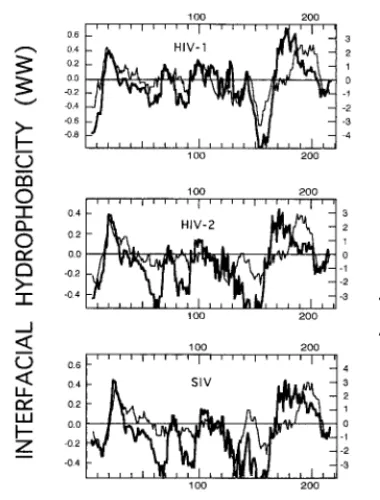
A classical way of detecting amino acid stretches bearing hydrophobic character in proteins is to plot their so-called average hydropathies (21, 42). As shown in Fig. 1, for gp41 ectodomains in primate lentiviruses, such a plot based on the widely used hydropathy scale of Kyte and Doolittle (21) clearly identified two conspicuous areas on the hydrophobic side above the zero midpoint line. The N-terminal hydrophobic
regions consisted of the fusion peptides, whereas the regions at the C terminus represented the transmembrane anchors.
The hydropathy index for each amino acid adopted by Kyte and Doolittle (21) was an estimate based on bulk phase par-titioning of side chain hydrophobicity alone. As recently pro-posed by White and Wimley (42), other contributions, specif-ically those arising from the peptide bonds and the bilayer effect, must be taken into account in order to compose a hydrophobicity scale that could be useful to detect membrane-interacting amino acid sequences. Thus, these authors elabo-rated a whole-residue scale based on the water-to-membrane interface transfer free energies for each amino acid (45). This “interface scale” was determined for 1-palmitoyl-2-oleoylphos-phatidylcholine bilayer interfaces using two types of oligopep-tides, which allowed the evaluation of both side chain and peptide bond hydrophobicities.
When average interfacial hydrophobicity was plotted for gp41 ectodomains of primate lentiviruses, two main hydropho-bic regions were also detected (Fig. 1). The region at the N terminus was coincident with that detected by the Kyte-Doolittle hydropathy plot, meaning that the interfacial hydro-phobicity plot identified the fusion peptide as well. However, at the C terminus a clear segregation between the hydrophobic region detected by the Kyte-Doolittle plot and that detected by Wimley-White interfacial hydrophobicity occurred. The latter was shifted closer to the N terminus. This finding is further illustrated by the data displayed in Table 1. For the three analyzed lentiviruses, the positions of the hydropathy-positive peaks at the gp41 N terminus coincided in both types of plots, the only difference being that the hydrophobic regions de-tected by the Kyte-Doolittle plot were somewhat wider. In contrast, the positive maxima detected by Wimley-White within the ectodomain C-terminal region were shifted 15 to 20 residues toward the N terminus.
[image:3.612.77.267.70.320.2]The position of the hydrophobic region at the C terminus in the Kyte-Doolittle plot (residues 681 to 707 in HIV-1) is al-most coincident with that of the putative transmembrane seg-ment of gp41 (residues 684 to 706 in HIV-1). We conclude that, at the C terminus of the gp41 ectodomain, there exists a wide nonpolar region (approximately 40 residues long) which is segmented into two domains: one located somewhat farther from the protein C terminus (residues 664 to 683 in HIV-1) showing high propensity to reside within the membrane inter-face and another one closer to the C terminus, which consti-tutes the membrane-spanning anchor. The hydrophobic-at-in-terface region (residues 664 to 683) detected within the C terminus of the gp41 ectodomain does not merely reflect the
FIG. 1. Hydropathy plots corresponding to sequences spanning the ectodo-mains of several Env transmembrane (TM) subunits of primate lentiviruses (top, HIV-1, BH10 isolate, residues 500 to 720 of the Env precursor; middle, HIV-2, SBLISY isolate, residues 490 to 710 of the Env precursor; bottom, simian im-munodeficiency virus (SIV), Mm142-83 isolate, residues 510 to 730 of the Env precursor). The stretches plotted include the fusion peptide and the TM anchor regions. Hydropathy plots (mean values for a window of 11 amino acids) were elaborated using the Kyte-Doolittle (KD) hydropathy index (21) (thin lines) and Wimley-White (WW) interfacial hydrophobicity (45) (thick lines) scales for in-dividual residues.
TABLE 1. Positions and lengths of hydrophobic regions within ectodomains of envelope transmembrane subunits of primate lentiviruses as detected by hydropathy analysisa
Viruse
C-terminal region N-terminal region
Maximum intensityb(peak range [aa]c) by:
Positiond Maximum intensity (peak range [aa]) by: Position
W-W K-D W-W K-D
HIV-1 0.73 (666–692) 2.6 (681–707) ⫺15 0.37 (516–528) 2.4 (515–538) ⫹1 HIV-2 0.44 (655–678) 2.8 (671–692) ⫺20 0.39 (507–519) 2.5 (507–528) 0 SIV 0.44 (680–716) 3.0 (696–719) ⫺19 0.44 (532–544) 2.6 (532–553) ⫺1
aHydropathy plots were elaborated according to Wimley-White (W-W) or Kyte-Doolittle (K-D) scales using a window of 11 residues. bMaximum intensity of the hydrophobic peaks.
cPeak range and position (aa, amino acids) determined by cutting off peaks at the level corresponding to 10% of maximum hydrophobicity.
dPosition of the peak maximum detected by W-W plot relative to the peak maximum detected by K-D plot. Negative values indicate that peaks detected by W-W plots are located closer to the N terminus of the protein sequence.
eSelected sequences comprise the following Env product precursors: HIV-1, BH10 isolate, GenBank accession no. M15654; HIV-2, SBLISY isolate, GenBank accession no. J04498; SIV (simian immunodeficiency virus), Mm142-83 isolate, GenBank accession no. Y00277.
on November 9, 2019 by guest
http://jvi.asm.org/
[image:3.612.53.550.592.671.2]common preferential localization of aromatic residues within the interfacial boundary regions that precede transmembrane segments (22, 32). Both the peak range and the intensity of the hydrophobic maximum indicate that, for this fusogenic viral subunit, the stretch of membrane surface-residing amino acids that precedes the transmembrane domain is uniquely elon-gated (compare Tables 1 and 3 and see Discussion below).
Figure 1 identifies a second membrane-partitioning domain within the gp41 ectodomain (residues 664 to 683) in addition to the fusion peptide (residues 512 to 534). Since the whole-residue interfacial hydrophobicity scale was composed on the basis of the partitioning into zwitterionic membrane interfaces (42, 45), we characterized the membrane-interacting capabili-ties of that second C-terminal region by using a representative synthetic sequence, HIVc, and electrically neutral LUV as tar-gets. Previous work by our group (28, 29) has shown that the partition of a sequence representing the fusion peptide at the N terminus of HIV-1 gp41 (HIVn) has the capacity to desta-bilize neutral liposomes composed of DOPC, DOPE, and CHOL (molar ratio, 1:1:1). These vesicles select for an ex-tended peptide structure that becomes fusogenic in a dose-dependent fashion. Morphological data reveal the formation of nonlamellar lipidic aggregates during the time course of lipid mixing (30). At subfusogenic doses the fusion peptide also causes the release of trapped contents from liposomes, indi-cating the existence of a peptide-mediated permeabilization process prior to and independent from the development of fusion (28, 29). For comparative purposes we explored the ability of HIVc and HIVn to perturb DOPC-DOPE-CHOL membranes. Assuming that both sequences would be present at an equimolar ratio within a potential fusogenic complex during gp41-mediated fusion, we also analyzed the membrane-perturbing abilities of a HIVc-HIVnmixture (1:1 mole ratio). The HIVcpeptide induced membrane fusion in the DOPC-DOPE-CHOL LUV system employed in this study, as evi-denced by the occurrence of membrane lipid mixing. Figure 2A presents comparative results of membrane lipid mixing for the three peptide samples, HIVc, HIVn, and HIVc-HIVn, as
mon-itored with the RET assay. The final extents of fusion were dependent on the peptide-to-lipid ratios in the three cases. However, data displayed in Fig. 2 readily demonstrate that, in terms of peptide added per lipid, the HIVcsequence was more efficient at inducing lipid mixing than HIVn. For HIVc we consistently found that the peptide-to-lipid ratio required to induce 20 to 30% lipid mixing was 1:1,000. In comparison, HIVninduced 10% lipid mixing at a 10-times-higher peptide-to-lipid ratio of 1:100. The mixture HIVc-HIVndid not achieve better results than HIVcby itself. These data strongly support the idea of HIVcbeing capable of destabilizing membranes and inducing them to merge. Moreover, they suggest that this sequence is a more potent perturbing agent than HIVn.
Analogous results were obtained when the three peptide preparations were assayed for their ability to release the ANTS-DPX probes from the aqueous interiors of the DOPC-DOPE-CHOL vesicles (Fig. 2B). Peptide-induced leakage was activated in all cases at peptide-to-lipid ratios lower than those that activated lipid mixing. In addition, HIVcwas again more potent than HIVnat lower peptide-to-lipid ratios. At a pep-tide-to-lipid ratio of 1:5,000 the extent of leakage induced by HIVcconsistently amounted to more than 30%, whereas, to obtain a comparable extent of fusion, the ratio had to be increased 10-fold. HIVninduced 10% leakage at a peptide-to-lipid ratio of 1:1,000, whereas a ratio of 1:100 was necessary to detect a comparable amount of lipid mixing. The mixture HIVc-HIVnparalleled the behavior of HIVcalone.
Taken together, results in Fig. 2 would be consistent with the existence of membrane perturbations caused by HIVc parti-tioning into DOPC-DOPE-CHOL vesicles that are qualita-tively similar to those caused by HIVnpartitioning. However, compared to HIVn, 10-times-less HIVcwas necessary to pro-mote comparable lipid mixing or leakage. This fact may reflect an inherently higher potency to perturb membranes for the HIVcsequence or else more peptide associated with vesicles in HIVc-treated samples. To clarify this issue, the peptide binding to vesicles was investigated next.
FIG. 2. Final extents of fusion (A) and leakage (B) as a function of increasing concentrations of HIVc(F), HIVn(E), and HIVc-HIVn(Œ). The peptide was
[image:4.612.349.514.466.693.2]added to DOPC-DOPE-CHOL LUV at different peptide-to-lipid ratios (Ri) and incubated for 1 h at 37°C before measuring the extents of lipid mixing and leakage. Lipid concentration, 100M.
FIG. 3. Fluorescence emission spectra of HIVcand HIVn(F8W analog) in
buffer (dotted lines) and incubated with DOPC-DOPE-CHOL LUV (solid lines). The peptide concentration was 1M, and, in vesicle samples, the peptide-to-lipid ratio was 1:100. au, arbitrary units.
on November 9, 2019 by guest
http://jvi.asm.org/
In Fig. 3 we show the fluorescence spectra obtained utilizing HIVcand the fluorescent F8W analog of HIVn. At a peptide-to-lipid ratio of 1:100 levels of intrinsic fluorescence emission in HIVcand in HIVnchanged significantly in the presence of DOPC-DOPE-CHOL LUV. Emission intensity was enhanced, and the maxima shifted to lower wavelengths: from 346 to 342 nm for HIVcand from 354 to 347 nm for HIVn. Both effects suggest that Trp residues in the presence of vesicles sense a less polar environment which is indicative of partition and the subsequent penetration of both peptides into the bilayer mil-lieu. We observed that the levels of Trp fluorescence of both peptides in solution decreased with time, an effect that may be related to self-aggregation due to their hydrophobic character. This process may compete with membrane association and, therefore, precludes correct determination of real partition coefficients (41). With this caveat in mind, and just for com-parative purposes, we determined apparent mole fraction par-tition coefficients (Kapp) for HIVc and HIVn(F8W analog). For a peptide-to-lipid ratio of 1:500, we obtained under our experimental conditions (see Materials and Methods) 93% of HIVccoeluting with vesicles whereas that value was reduced to 35% for HIVn. Therefore theKappvalues were 7.3⫻105for HIVcand 3.0⫻104for HIVn. Again, these values should not be taken as quantitatively reflecting the energetics of the pep-tide-membrane interaction process, but rather as descriptive of the ability of these peptides to associate with membranes un-der our particular experimental conditions. They further indi-cate that, after correcting for the difference in bound peptide, membrane-associated HIVnis as effective as HIVcat perturb-ing membranes (Fig. 2). Thus, in our in vitro assays, the activity displayed by HIVn is actually limited by the ability of the peptide to partition into vesicles, but this activity in the mem-brane-bound form would be comparable to that of HIVc.
The extents of fusion and leakage seem to indicate that the mixture HIVc-HIVnfollowed a membrane-perturbing pattern similar to that exhibited by HIVcalone. However those mea-surements were carried out after 1 h of incubation of peptides and vesicles. It is possible that the initial rates of membrane perturbation might be altered by the combination of both pep-tides. Thus, in search for a possible synergism in the mode of action of HIVcand HIVn, we carried out a kinetic character-ization of the initial stages of the perturbing processes induced by each of the peptides and by the HIVc-HIVnmixture. Initial rates of HIVc-induced lipid mixing increased with peptide con-centration (Fig. 4). We investigated the effect of coadding HIVnon the former process under conditions where this pep-tide alone did not induce lipid mixing or induced it just mar-ginally (i.e., at peptide-to-lipid ratios ranging from 1:1,000 to 1:100). As shown in Fig. 4, the initial rates of lipid mixing induced by the mixture HIVc-HIVnwere always higher than those induced by HIVcalone. At a ratio at which HIVn in-duced extensive lipid mixing by itself, i.e., 1:25, no additive effects of the HIVc-HIVnmixture were found. This indicates that, under most circumstances, synergism between these pep-tides in the mode of inducing fusion may occur. Similar results were obtained for the leakage assay, and again potentiation of peptide effects was more evident at lower peptide-to-lipid ra-tios (Fig. 5).
The existence of HIVc-HIVninteractions underlying their mutual synergism was confirmed by detecting changes of HIVc Trp fluorescence in the presence of the nonfluorescent HIVn. The data displayed in Fig. 6 reflect an increase in the emitted fluorescence intensity of HIVcin solution and a shift of the wavelength of maximum emission (max) from 346 to 340 nm when HIVcwas premixed with HIVnat a 1:10 HIVc-to-HIVn mole ratio. Results in this figure further indicate that the Trp
emission of HIVcpremixed with HIVn(curve 4) also increased and was slightly blue shifted from 342 to 338 nm when associ-ated with vesicles. This effect was clearly larger than the one detected for the fluorescent HIVcalone (curve 3). According to the estimated partition coefficients, under the experimental conditions in Fig. 6, ⬇60% of HIVcwas bound to vesicles. Thus, the polarity change caused by premixing with HIVn might be due to an increase in binding or might originate from a different bilayer localization of HIVc when interacting to-gether with HIVnand/or from the formation of HIVc-HIVn complexes within the vesicle membranes.
In order to confirm the relevance of the previous observa-tions, we also explored the effect of a sequence substitution on the ability of HIVcto perturb membranes and associate with HIVn(Fig. 7). The HIVW(1–3)Asequence with the first three Trp residues of HIVcreplaced by Ala represents the pretrans-membrane region of a mutant gp41 described by Salzwedel et al. (34) as reproducing the phenotype of deleting the sequence spanning residues 665 to 682. This phenotype consists of the specific abolition of cell-cell fusion and virus entry mediated by gp41 without affecting normal maturation and transport to the cell surface or CD4-binding ability of the envelope glycopro-tein. Our results in Fig. 7A show that, in contrast to HIVc, the HIVW(1–3)Apeptide was unable to induce membrane fusion at peptide-to-lipid molar ratios ranging from 1:1,000 to 1:100. Since the absence of an effect might be caused by the existence of defective binding, we also measured the partitioning of this sequence into vesicles. At a 1 mM lipid concentration approx-imately 50% of the added HIVW(1–3)Apeptide partitioned into DOPC-DOPE-CHOL membranes yielding aKappof⬇55,000. This means that for the fusion experiments in Fig. 7A the 1:100
FIG. 4. Kinetics of membrane lipid mixing of LUV of DOPC-DOPE-CHOL (1:1:1) induced by HIVc(F), HIVn(E), and HIVc-HIVn(Œ). The peptide was
added at the peptide-to-lipid ratios indicated. Lipid concentration was 100M in all cases.
on November 9, 2019 by guest
http://jvi.asm.org/
HIVW(1–3)A/lipid ratio condition is comparable to that of the 1:500 HIVc/lipid ratio. We conclude that HIVW(1–3)Abound to membranes was unable to induce the type of perturbations induced by the HIVcparental sequence.
The ability of HIVW(1–3)Ato associate with membranes may also be inferred from the emission spectra displayed in Fig. 7B. As for HIVc and HIVn(Fig. 3) the intrinsic fluorescence of HIVW(1–3)A increased in the presence of vesicles, indicating that Trp residues must be sensing a less polar environment. In contrast to the observed effects for HIVc(Fig. 6), under com-parable conditions the emission of HIVW(1–3)Adid not
expe-rience any change in the presence of the nonfluorescent HIVn (data not shown). The latter result seems to reflect the absence of HIVW(1–3)A-HIVninteractions.
[image:6.612.352.511.72.334.2]The existence of a membrane interface-residing sequence preceding the transmembrane anchor might represent a par-ticular characteristic of primate lentiviruses or else a structural motif shared by other retroviruses and other families. To ex-plore this hypothesis, we first performed on several viral se-quences a hydropathy analysis analogous to those described in Table 1 for primate lentiviruses. The selected fusogenic se-quences (or close homologous relatives) have been either pre-dicted or formally demonstrated to form hairpin structures. Data in Table 2 indicate that, with the single exception of Sendai virus F protein, there exists within the analyzed se-quences a hydrophobic-at-interface region preceding the trans-membrane segment. Paramyxovirus-mediated trans-membrane fu-sion does not require the sequences connecting the coiled coil and the transmembrane anchor and might take place according to a mechanism distinct from that proposed for the rest of the virus families analyzed (1) (see Discussion). As a control, a similar hydropathy analysis of transmembrane regions of sev-eral human type I membrane proteins (Table 3) revealed that segregation of the hydrophobic-at-interface domain from the transmembrane segment is not found in those proteins. The preferential occurrence of aromatic residues at the cytoplasmic boundary of transmembrane segments in the human proteins (22, 32) does not account for the position and length of the interfacially hydrophobic sequences detected in viral envelope proteins.
Elongation of sequences containing aromatic residues at the N termini of membrane-spanning regions is common in viral
FIG. 5. Kinetics of leakage of ANTS-DPX from LUV of DOPC-DOPE-CHOL (1:1:1) induced by HIVc(F), HIVn(E), and HIVc-HIVn(Œ). Conditions
otherwise were as described for Fig. 4.
FIG. 6. Trp fluorescence emission spectra of HIVcalone (0.2M) and
pre-mixed with HIVn(HIVc-to-HIVnratio, 1:10) in buffer and incubated with
DOPC-DOPE-CHOL LUV (HIVc-to-lipid ratio, 1:500). Curves: 1, HIVcin
buffer; 2, HIVc-HIVnin buffer; 3, HIVcin the presence of vesicles; 4, HIVc-HIVn
in the presence of vesicles. au, arbitrary units.
FIG. 7. (A) Kinetics of membrane lipid mixing of LUV of DOPC-DOPE-CHOL (1:1:1) induced by HIVc(F) and HIVW(1–3)A(E). The peptides were
added at the peptide-to-lipid ratios of 1:500 (HIVc) and 1:100 [HIVW(1–3)A].
Lipid concentration was 100 M. (B) Trp fluorescence emission spectra of HIVW(1–3)A(1M) in buffer (dotted line) and incubated with
DOPC-DOPE-CHOL LUV [HIVW(1–3)A-to-lipid ratio, 1:100] (solid lines). au, arbitrary units.
on November 9, 2019 by guest
http://jvi.asm.org/
[image:6.612.79.270.541.683.2]envelope proteins implicated in viral fusion. Figure 8 shows sequences from six virus families aligned with respect to the membrane-spanning hydrophobic region rich in aliphatic amino acids. The Retroviridaehave been further subdivided into their principal subfamilies,Lentivirinae, types B, C, and D, avianOncovirinae, and Spumaretrovirinae. A high degree of clustering of aromatic amino acids, most prominently trypto-phan, is found in the primate and ovine lentiviruses, mamma-lian oncoviruses of groups B, C, and D, the filoviruses Ebola virus and Marburg virus, the rhabdovirus vesicular stomatitis virus G protein, and the alphavirus Sindbis virus E1 protein. A lower level of clustered aromatics, but higher than expected for type I glycoproteins, is found in avian retroviruses, spumaret-roviruses, influenza A virus HA2, and the hepatitis C flavivirus E2 protein. Such an unusual concentration of aromatic amino
acids exists against a background of considerable sequence diversity and in different positions in the linear sequence, even among closely related viruses. There are notable exceptions to the pattern, however. As noted in Table 2, the frequency of preinsertion aromatic amino acids in Sendai paramyxovirus F glycoprotein does not exceed that expected for type I glyco-proteins. Likewise, Arenavirus GP2 (not shown) lacks any clus-tering of aromatics. Therefore, while aromatic and especially tryptophan-rich regions prior to membrane insertion have membrane-distorting properties that could be involved in fu-sion by many viruses, such regions would not appear to be indispensable.
DISCUSSION
Viral fusion proteins are designed to interact simultaneously with two membranes during the fusion reaction cycle. Interac-tion with the virion membrane is primarily mediated by the transmembrane anchor. In addition protruding ectodomains contain a conserved hydrophobic stretch of amino acids, the fusion peptide, which is thought to insert into the target mem-brane upon fusion activation (4, 13, 14, 17, 19, 33, 40). By using a hydropathy analysis based on the hydrophobicity-at-interface scale recently proposed by Wimley and White (45), we have confirmed the high propensity of the gp41 fusion peptide to partition into membranes (Fig. 1). According to our results (Table 1), within the HIV-1 fusion peptide region, the se-quence IGALFLGFLGAAG containing the conserved FLG motif (13), shows a high probability to localize at the bilayer interface. Despite the experimental limitations inherent to the hydrophobicity-at-interface scale (45), the Wimley-White hy-dropathy analysis appears to be clearly superior to others for detecting potential membrane-interacting sequences within overall soluble polypeptide domains (42). The most important advantage in comparison with bulk phase scales is that the Wimley-White scale takes into account the effect of the mem-brane interface on partitioning. This bilayer region consists of a complex mixture of water and chemically heterogeneous phospholipid groups (polar head groups, glyceryl, phosphoryl, carbonyl, and methylenes) in which significant changes in po-larity occur at short range (42). This results in the main dif-ference between the Wimley-White scale and scales such as the one proposed by Kyte and Doolittle (21): even in the absence of solid physical foundations (46), aromatic residues, namely, Phe, Tyr, and Trp, appear to be the most hydrophobic ones when located at interfaces.
An illustrative example of the differences between scales can be observed for the C-terminal region within the gp41 ectodo-main (Fig. 1). The Wimley-White hydrophobicity-at-interface scale identifies the region preceding the gp41 transmembrane anchor as having a high tendency to partition into the mem-brane interface. Its pronounced hydrophobic-at-interface char-acter is based on the presence of 1 Phe residue, 1 Tyr residue, and 5 Trp residues closely located within a 20-residue spanning sequence. The preference of Trp and Tyr residues for bound-ary regions that flank the transmembrane domains is a known feature shared by virtually all known membrane proteins (22, 32). The C-terminal region detected within the gp41 ectodo-main appears to be an elongation tail of membrane surface-residing domains. To test the functional significance that such a membrane interface-residing domain could have for gp41-mediated HIV-1 fusion, we characterized it as a membrane-interacting sequence. During the course of our studies, Sal-zwedel et al. (34) reported on the effect of mutations targeted to the same tryptophan-rich domain. More recently, Mun˜oz-TABLE 2. Positions and lengths of C-terminal hydrophobic regions
at ectodomains of precursors of envelope fusogenic subunits of different viruses as detected by hydropathy analysisa
Virusd
Maximum intensity of hydrophobic peak (peak range [aa]b) by:
Positionc
W-W K-D
MoMLV 0.35 (598–614) 3.3 (609–637) ⫺12
RSV 0.29 (538–549) 3.8 (546–579) ⫺25
Ebola 0.50 (644–654) 3.5 (656–677) ⫺17 Influenza 0.54 (523–549) 2.9 (526–551) ⫺12 Sendai 0.25 (505–523) 4.3 (501–526) ⫹2
aHydropathy plots were elaborated according to Wimley-White (W-W) and
Kyte-Doolittle (K-D) scales using a window of 11 residues.
bPeak range and position (aa, amino acids) determined by cutting off peaks at
the level corresponding to 10% of maximum hydrophobicity.
cPosition of the peak maximum detected by W-W plot relative to the peak
maximum detected by K-D plot. Negative values indicate that peaks detected by W-W plot are located closer to the N terminus of the protein sequence.
dProtein sequences for the viruses are as follows: MoMLV (Moloney murine
[image:7.612.53.293.102.191.2]leukemia virus), Env protein, GenBank accession no. J02255; RSV (Rous sar-coma virus), glycoprotein, Prague C strain, GenBank accession no. V01197; Ebola virus, glycoprotein, Zaire strain, GenBank accession no. U31033; influ-enza virus, hemagglutinin, strain A/Turkey/Oregon/71, GenBank accession no. M31689; Sendai virus, fusion protein, HVJ strain, GenBank accession no. M12396.
TABLE 3. Positions and lengths of transmembrane hydrophobic regions of several human type I membrane proteins as
detected by hydropathy analysisa
Proteind
Maximum intensity of hydrophobic peak (peak range [aa]b) by:
Positionc
W-W K-D
EGFR 0.30 (151–166) 3.4 (147–167) 0
CD4 0.57 (401–419) 2.9 (395–419) 0
GLPA 0.27 (96–113) 2.8 (91–114) ⫹10
ICA1 0.24 (495–501) 3.2 (477–498) ⫹12
ITB 0.45 (723–745) 3.2 (717–745) ⫹1
PVR 0.63 (343–369) 3.5 (342–366) ⫹9
aHydropathy plots were elaborated according to Wimley-White (W-W) and
Kyte-Doolittle (K-D) scales using a window of 11 residues.
bPeak range and position (aa, amino acids) determined by cutting off peaks at
the level corresponding to 10% of maximum hydrophobicity.
cPosition of the peak maximum detected by W-W plot relative to the peak
maximum detected by K-D plot. Negative values indicate that peaks detected by W-W plot are located closer to the N terminus of the protein sequence.
dProtein sequences were randomly selected from reference 22. EGFR,
epi-dermal growth factor receptor precursor; CD4, T-cell surface glycoprotein CD4 precursor; GLPA, glycophorin A precursor; ICA1, intercellular adhesion mole-cule 1 precursor; ITB, platelet membrane glycoprotein IIIA precursor; PVR, poliovirus receptor precursor.
on November 9, 2019 by guest
http://jvi.asm.org/
[image:7.612.52.293.533.631.2]Barroso et al. (25) have evaluated the effect of those mutations on the various stages of fusion. The mutational and functional analyses have confirmed its crucial role during gp41-mediated fusion.
Proposed molecular models for viral fusion processes high-light a role for coiled-coil structures, which were first observed for influenza virus HA2 (44) and which have been extended to the retroviruses (15) and filoviruses (14). Formation of those stable structures could be energetically coupled to membrane apposition (4, 39). It is generally accepted that both anchoring and apposition of the viral and target membranes are mediated by the ectodomains at the transmembrane subunits of enve-lope proteins such as the HIV-1 gp41. Following gp41-induced apposition, a membrane perturbation is likely to take place within the points of fusion, causing both membranes to merge (4, 39). Within this framework, the fusion peptide is postulated to anchor the fusion protein to the target membrane and per-turb subsequently apposed membranes. Our data indicate that the HIV-1 fusion peptide would be capable of both functions, given its tendency to partition into membrane interfaces and to perturb their architecture (29, 30). In addition, our experimen-tal data demonstrate that the sequence preceding the gp41
transmembrane anchor could be implicated in perturbing the apposed membranes as well. According to the leakage, lipid mixing, and binding assays, this sequence was even more po-tent at inducing membrane destabilization than the fusion pep-tide. The physiological relevance of our in vitro approach was supported by the fact that a mutation known to block gp41 activity in vivo completely impaired the ability of HIVc to perturb membranes (Fig. 7). Similarly, the in vitro membrane activity of the synthetic N-terminal fusion peptide has been also reported to be sensitive to sequence substitutions affecting gp41-mediated cell-cell fusion and viral infectivity (20, 29). Within the hairpin structure postulated to represent the fu-sion-competent version of gp41, both sequences would be closely located at the same end of the molecule. Moreover, if a higher-order envelope glycoprotein complex is involved in HIV-1 fusion, membrane perturbations induced by both se-quences might be confined to the point of fusion (25, 26).
The presence of two membrane-partitioning sequences sep-arated by a collapsible intervening sequence is a common motif shared by other viral envelope products. Results summarized in Table 2 demonstrate that, with the single exception of those of paramyxoviruses, known hairpin structures would locate two
FIG. 8. Clustering of aromatic amino acids amino-terminal to the membrane-spanning region of the transmembrane (TM) superfamily of glycoproteins. Sequences of TM glycoproteins implicated in fusion are hand aligned by their membrane-spanning regions, using the 20-amino-acid span of hydrophobicity indicated at the top and bottom by vertical lines and any apparently conserved amino acids wherever possible, without introducing any gaps. Selected sequences and GenBank accession numbers of TM superfamily glycoproteins are as described in Tables 1 and 2 with the following additional sequences: SA-OMVV, ovine lentivirus, M13646; EIAV, equine infectious anemia virus, M16575; MMTV, mouse mammary tumor virus, M15122; BLV, bovine leukemia virus, K02120; HumFoamy, human foamy spuma-retrovirus, U21247; Marburg filovirus GP2, U31033; VSV, vesicular stomatitis virus, Indiana strain, G protein, J02428; Sindbis virus E2 protein, J02363; HepC, hepatitis C virus, strain 1b, flavivirus E2 protein, AJ238800; MPMV, Mason-Pfizer monkey virus coat protein GP20, M12349.
on November 9, 2019 by guest
http://jvi.asm.org/
membrane interface-partitioning sequences in close proximity. Baker et al. (1) demonstrated that paramyxovirus-mediated membrane fusion does not require the flexible sequence con-necting the coiled coil and the transmembrane anchor. These authors suggested that conformational changes in paramyxo-virus F proteins may involve flexibility in other regions of the protein such as the intervening sequences connecting the N-and C-terminal heptad repeats. Thus, in contrast to what is found for the rest of the analyzed cases, flexibility between membrane-anchoring regions of the F protein would not suf-fice to allow hairpin formation.
Influenza virus hemagglutinin also appears to be unique in the sense that although hydrophobic-at-interface and hydro-phobic peaks are located at different positions, both regions span almost the same sequence of approximately 25 to 27 residues, i.e., they are not segregated. Clearly, in order to find a common mechanistic role for these membrane interface-seeking regions during fusion, more mutational and functional studies will be necessary. We believe that the new Wimley-White hydropathy scale will be a powerful predictive tool that will lead to the detection of functional domains implicated in protein-membrane interactions during viral fusion events.
The existence of the hydrophobic-at-interface region pre-ceding the transmembrane anchor appears to be a specific attribute of certain viral fusion glycoproteins rather than a general feature of type I membrane proteins (Table 3). In viral proteins, such a region appears to be an elongation of the short sequences containing aromatic residues at the cytoplasmic boundary of transmembrane anchors (22, 32). A survey of such regions in a number of virus families indicates that they are common and especially prominent in the retrovirus and filovi-rus families (Fig. 8). While it is difficult to accurately align highly divergent sequences, the aromatic amino acids do not occur with any reproducible periodicity, as one would expect in the␣-helical configuration suggested by Salzwedel et al. (34), even in closely related viruses. Any mechanism by which these regions participate in fusion must account for the positional variability.
An alternative explanation for the clustering of tryptophans in retroviruses relates to the genetic code, in that only the triplet UGG codes for tryptophan. Any G-to-A hypermutation by reverse transcriptase at any of five clustered UGG codons could generate a nonsense codon and premature stop in trans-lation just prior to membrane insertion. This could generate a population of truncated glycoproteins accumulating during chronic infections, along with other defective mutants, as sol-uble glycoproteins that might function as cellular and immu-nological decoys, as does sGP in filoviruses. However, this explanation would not apply to those viruses such as murine leukemia virus preferentially rich in phenylalanine. The more likely general explanation for such preinsertion aromatic clus-ters is that they promote fusion through their membrane-dis-torting properties.
Taken together, these observations point to the possibility that a number of viral fusogenic subunits might operate by putting into close contact within the fusion locus two perturbed membranes, that of the virus and that of the target cell, and/or two interacting perturbing sequences, the fusion peptide and the surface-residing tail that precedes the transmembrane an-chor.
ACKNOWLEDGMENTS
We are grateful to Maier Lorizate for technical assistance. T.S. and A.A. are recipients of predoctoral fellowships from the Basque Government. This work was supported by DGCYT (grant PB96-0171), the Basque Government (PI 96-46; EX-1998-28;
PI-1998-32), and the University of the Basque Country (UPV 042.310-EA085/ 97; UPV 042.310-G03/98). Support to W.R.G. includes senior fellow-ship 1F32AI08549 and grant 1R01DE10862 from the National Institutes of Health of the United States.
REFERENCES
1.Baker, K. A., R. E. Dutch, R. A. Lamb, and T. S. Jardetzky.1999. Structural basis for paramyxovirus-mediated membrane fusion. Mol. Cell3:309–319. 2.Bosch, M. L., P. L. Earl, K. Fargnoli, S. Picciafuoco, F. Giombini, F.
Wong-Staal, and G. Franchini.1989. Identification of the fusion peptide of primate immunodeficiency viruses. Science244:694–697.
3.Bo¨ttcher, C. S. F., C. M. van Gent, and C. Fries.1961. A rapid and sensitive sub-micro phosphorus determination. Anal. Chim. Acta24:203–204. 4.Chan, D. C., and P. S. Kim.1998. HIV entry and its inhibition. Cell93:681–
684.
5.Chan, D. C., D. Fass, J. M. Berger, and P. S. Kim.1997. Core structure of gp41 from the HIV-1 envelope glycoprotein. Cell89:263–273.
6.Colotto, A., and R. M. Epand.1997. Structural study of the relationship between the rate of membrane fusion and the ability of the fusion peptide of influenza virus to perturb bilayers. Biochemistry36:7644–7651.
7.Dalgleish, A. G., P. C. L. Beverley, and P. R. Clapham.1984. The CD4 (T4) antigen is an essential component of the receptor for the AIDS retrovirus. Nature312:763–767.
8.Doms, R. W., and S. C. Peiper.1997. Unwelcomed guests with master keys: how HIV uses chemokine receptors for cellular entry. Virology235:179–190. 8a.Eckert, D. M., V. N. Malashkevich, L. H. Hong, P. A. Carr, and P. S. Kim.
1999. Inhibiting HIV-1 entry: discovery of D-peptide inhibitors that target the gp41 coiled-coil pocket. Cell99:103–115.
9.Ellens, H., J. Bentz, and F. C. Szoka.1985. H⫹- and Ca2⫹-induced fusion and destabilization of liposomes. Biochemistry24:3099–3106.
9a.Ferrer, M., T. M. Kapoor, T. Strassmaier, W. Weissenhorn, J. J. Skehel, D. Oparian, S. L. Schreiber, D. C. Wiley, and S. C. Harrison.1999. Selection of gp41-mediated HIV-1 cell entry inhibitors from biased combinatorial librar-ies of non-natural binding elements. Nat. Struct. Biol.6:953–960. 10.Freed, E. O., D. J. Myers, and R. Risser.1990. Characterization of the fusion
domain of the human immunodeficiency virus type 1 envelope glycoprotein gp41. Proc. Natl. Acad. Sci. USA87:4650–4654.
11. Freed, E. O., E. L. Delwart, G. L. Buchschacher, and A. T. Panganiban.1992. A mutation in the human immunodeficiency virus type 1 transmembrane glycoprotein gp41 dominantly interferes with fusion and infectivity. Proc. Natl. Acad. Sci. USA89:70–74.
12. Furuta, R. A., C. T. Wild, Y. Weng, and C. D. Weiss.1998. Capture of an early fusion-active conformation of HIV-1 gp41. Nat. Struct. Biol.5:276–279. 13. Gallaher, W. R.1987. Detection of a fusion peptide sequence in the trans-membrane protein of the human immunodeficiency virus. Cell50:327–328. 14. Gallaher, W. R.1996. Similar structural models of the transmembrane
pro-teins of Ebola and avian sarcoma viruses. Cell85:477–478.
15. Gallaher, W. R., J. M. Ball, R. F. Garry, M. C. Griffin, and R. C. Montelaro.
1989. A general model for the transmembrane proteins of HIV and other retroviruses. AIDS Res. Hum. Retroviruses5:431–440.
16. Gordon, L. M., C. C. Curtain, Y. C. Zhong, A. Kirkpatrick, P. W. Mobley, and A. J. Waring.1992. The amino terminal peptide of HIV-1 glycoprotein 41 interacts with human erythrocyte membranes: peptide conformation, ori-entation and aggregation. Biochim. Biophys. Acta1139:257–274. 17. Herna´ndez, L. D., L. R. Hoffman, T. G. Wolfsberg, and J. M. White.1996.
Virus-cell and cell-cell fusion. Annu. Rev. Cell Dev. Biol.12:627–661. 18. Hope, M. J., M. B. Bally, G. Webb, and P. R. Cullis.1985. Production of
large unilamellar vesicles by a rapid extrusion procedure. Characterization of size distribution, trapped volume and ability to maintain a membrane po-tential. Biochim. Biophys. Acta812:55–65.
19. Hughson, F. M.1997. Enveloped viruses: a common mode of membrane fusion? Curr. Biol.7:565–569.
19a.Kilby, J. M., S. Hopkins, T. M. Venetta, et al.1998. Potent suppression of HIV-1 replication in humans by T-20, a peptide inhibitor of gp41-mediated virus entry. Nat. Med.4:1302–1307.
20. Kliger, Y., A. Aharon, D. Rapaport, P. Jones, R. Blumenthal, and Y. Shai.
1997. Fusion peptides derived from the HIV type I glycoprotein 41 associate within phospholipid membranes and inhibit cell-cell fusion. J. Biol. Chem.
272:13496–13505.
21. Kyte, J., and R. F. Doolittle.1982. A simple method for displaying the hydropathic character of a protein. J. Mol. Biol.157:105–132.
22. Landolt-Marticorena, C., K. A. Williams, C. M. Deber, and R. A. F. Re-ithmeier.1993. Non-random distribution of amino acids in the transmem-brane segments of human type I single span memtransmem-brane proteins. J. Mol. Biol.
229:602–608.
23. Martin, I., F. Defrise-Quertain, E. Decroly, M. Vandenbranden, R. Brasseur, and J. M. Ruysschaert.1993. Orientation and structure of the NH2-terminal HIV-1 gp41 peptide in fused and aggregated liposomes. Biochim. Biophys. Acta.1145:124–133.
24. Moore, J. P., A. J. Bradford, R. Weiss, and Q. J. Sattentau.1993. The HIV-cell fusion reaction, p. 233–289.InJ. Bentz (ed.), Viral fusion mecha-nisms. CRC Press Inc., Boca Raton, Fla.
on November 9, 2019 by guest
http://jvi.asm.org/
25.Mun˜oz-Barroso, I., S. Durell, K. Sakaguchi, E. Appella, and R. Blumenthal.
1998. Dilation of the human immunodeficiency virus-1 envelope glycopro-tein fusion pore revealed by the inhibitory action of a synthetic peptide from gp41. J. Cell Biol.140:315–323.
26.Mun˜oz-Barroso, I., K. Salzwedel, E. Hunter, and R. Blumenthal.1999. Role of the membrane-proximal domain in the initial stages of human immuno-deficiency virus type 1 envelope glycoprotein-mediated membrane fusion. J. Virol.73:6089–6092.
27. Nieva, J. L., S. Nir, A. Muga, F. M. Gon˜i, and J. Wilschut.1994. Interaction of the HIV-1 fusion peptide with phospholipid vesicles: different structural requirements for leakage and fusion. Biochemistry33:3201–3209. 28. Nieva, J. L., S. Nir, and J. Wilschut.1998. Destabilization and fusion of
zwitterionic large unilamellar lipid vesicles induced by a-type structure of the HIV-1 fusion peptide. J. Liposome Res.8:165–182.
29. Pereira, F. B., F. M. Gon˜i, A. Muga, and J. L. Nieva.1997. Permeabilization and fusion of uncharged lipid vesicles induced by the HIV-1 fusion peptide adopting an extended conformation: dose and sequence effects. Biophys. J.
73:1977–1986.
30. Pereira, F. B., J. M. Valpuesta, G. Basan˜ez, F. M. Gon˜i, and J. L. Nieva.
1999. Interbilayer lipid-mixing induced by the HIV-1 fusion peptide on large unilamellar vesicles: the nature of the nonlamellar intermediates. Chem. Phys. Lipids103:11–20.
31. Rafalski, M., J. Lear, and W. DeGrado.1990. Phospholipid interactions of synthetic peptides representing the N-terminus of HIV gp41. Biochemistry
29:7917–7922.
32. Reithmeier, R. A. F.1995. Characterization and modeling of membrane protein using sequence analysis. Curr. Opin. Struct. Biol.5:491–500. 33. Ruiz-Argu¨ello, M. B., F. M. Gon˜i, F. B. Pereira, and J. L. Nieva.1998.
Phosphatidylinositol-dependent membrane fusion induced by a putative fu-sogenic sequence of Ebola virus. J. Virol.72:1775–1781.
34. Salzwedel, K., J. T. West, and E. Hunter.1999. A conserved tryptophan-rich motif in the membrane-proximal region of the human immunodeficiency virus type 1 gp41 ectodomain is important for Env-mediated fusion and virus infectivity. J. Virol.73:2469–2480.
35. Schaal, H., M. Klein, P. Gehrmann, O. Adams, and A. Scheid.1995. Re-quirement of N-terminal amino acid residues of gp41 for human immuno-deficiency virus type 1-mediated cell fusion. J. Virol.69:3308–3314. 36. Slepushkin, V. A., S. M. Andreev, M. V. Sidorova, G. B. Melikyan, V. B.
Grigoriev, V. M. Chumakov, A. E. Grinfeldt, R. A. Manukyan, and E. V. Karamov.1992. Investigation of human immunodeficiency virus fusion pep-tides. Analysis of interrelations between their structure and function. AIDS Res. Hum. Retroviruses8:9–18.
37. Struck, D. K., D. Hoekstra, and R. E. Pagano.1981. Use of resonance energy transfer to monitor membrane fusion. Biochemistry20:4093–4099. 38. Turner, B. G., and M. F. Summers.1999. Structural biology of HIV. J. Mol.
Biol.285:1–32.
39. Weissenhorn, W., A. Dessen, S. C. Harrison, J. J. Skehel, and D. C. Wiley.
1997. Atomic structure of the ectodomain from HIV-1 gp41. Nature387:
426–428.
40. White, J.1992. Membrane fusion. Science258:917–923.
41. White, S., W. C. Wimley, A. S. Ladokhin, and K. Hristova.1998. Protein folding in membranes: determining energetics of peptide-bilayer interac-tions. Methods Enzymol.295:62–87.
42. White, S. H., and W. C. Wimley. 1999. Membrane protein folding and stability: physical principles. Annu. Rev. Biophys. Biomol. Struct.28:319– 365.
43. Wild, C., D. C. Shugars, T. Greenwell, C. McDanal, and T. Matthews.1994. Peptides corresponding to a predictive alpha-helical domain of human im-munodeficiency virus type-1 gp41 are potent inhibitors of virus infection. Proc. Natl. Acad. Sci. USA91:9770–9774.
44. Wilson, I. A., J. J. Skehel, and D. C. Wiley.1981. Structure of the haemag-glutinin membrane glycoprotein of influenza virus at 3 A resolution. Nature
289:366–373.
45. Wimley, W., and S. H. White.1996. Experimentally determined hydropho-bicity scale for proteins at membrane interfaces. Nat. Struct. Biol.3:842–848. 46. Yau, W., W. C. Wimley, K. Gawrisch, and S. H. White.1998. The preference
of tryptophan for membrane interfaces. Biochemistry37:14713–14718.