EFFECTIVENESS OF ROCKING CHAIR EXERCISE IN LEVEL OF BOWEL FUNCTION AMONG PATIENTS WHO
UNDERWENT ABDOMINAL SURGERY
BY
RAMAMURTHY PRIYA
A DISSERTATION SUBMITTED TO THE TAMILNADU DR.M.G.R.MEDICAL
UNIVERSITY, CHENNAI, IN PARTIAL FULFILMENT OF THE
REQUIREMENTS FOR THE DEGREE OF
MASTER OF SCIENCE IN NURSING
EFFECTIVENESS OF ROCKING CHAIR EXERCISE IN LEVEL OF BOWEL FUNCTION AMONG PATIENTS WHO
UNDERWENT ABDOMINAL SURGERY
Approved by the Dissertation Committee on : _____________________
Research Guide : _____________________
Dr. Latha Venkatesan,
M.Sc (N)., M.Phil (N)., Ph.D (N)., Principal cum Professor,
Apollo College of Nursing,
Chennai - 600 095.
Clinical Guide : ____________________
Mrs. Jaslina Gnanarani.J, M.Sc(N) Reader ,
Medical Surgical Nursing Department
Apollo College of Nursing,
Chennai - 600 095.
Medical Guide : _____________________
Dr. Rajkumar Palaniappan
MS,MMAS(UK),FICS(USA),DMAS,FMAS,FLS Consultant Gastro and Obesity
Apollo Main Hospital, Chennai- 6000020.
A DISSERTATION SUBMITTED TO THE TAMILNADU DR.M.G.R MEDICAL UNIVERSITY, CHENNAI IN PARTIAL FULFILMENT OF THE
REQUIREMENTS FOR THE DEGREE OF MASTER OF SCIENCE IN NURSING
DECLARATION
I hereby declare that the present dissertation entitled “Effectiveness of rocking chair exercise in level of bowel function among patients who underwent abdominal surgery” is the outcome of the original research work undertaken and carried out by me under the guidance of Dr. Latha Venkatesan, M.Sc (N)., M.Phil (N)., Ph.D (N)., Principal, Apollo College of Nursing, Mrs. Jaslina Gnanarani .J,
M.Sc (N)., Reader Medical Surgical Nursing Department, Apollo College of Nursing, Chennai. I also declare that the material of this has not found in any way, the basis for the award of any degree or diploma in this university or any other universities.
i
ACKNOWLEDGEMENT
I thank God Almighty for showering His everlasting love and blessings upon me and guidance in the matters at hand and for clearly showing me the way to conduct my work with a spirit of joy and enthusiasm throughout my study.
I dedicate my heartfelt thanks and gratitude to our esteemed leader Dr. Latha Venkatesan, M.Sc (N)., M.Phil (N)., Ph.D (N), Principal, Apollo College of Nursing for her tremendous help, continuous support, enormous auspice, valuable suggestions and tireless motivation to carry out my study successfully.
I extend my earnest gratitude to Prof. Lizy Sonia A, M.Sc (N), Vice-principal and Head of the Medical Surgical Nursing Department, Apollo College of Nursing, for her elegant direction, encouragement and timely help.
I take this opportunity to express my great pleasure and deep sense of gratitude to my guide Mrs. Jaslina Gnanarani .J, M.Sc(N), Reader, Medical Surgical Nursing Department, for her kind support, patience, valuable guidance, enlighting ideas and willingness to help at all times for successful completion of this research work.
I owe my special thanks to Prof. K. Vijayalakshmi M.sc (N), Research Coordinator, Apollo College of Nursing for her guidance in completing my study.
ii
My sincere gratitude to Dr. Rajkumar Palaniappan, Bariatric Surgeon, Apollo Main Hospital for his elegant direction, patience and continuous guidance and encouragement for performing and completing my study.
My genuine gratitude to Prof. Nesa Sathya Satchi, M.Sc (N). Course coordinator for her constructive ideas and enormous concern.
With the special word of reference, I thank all the experts for validating my tool and offering worthy suggestions to make it effective. I am thankful to all the
Head of the Departments, all Faculty members and my Colleagues who helped me directly or indirectly in carrying out my study.
A note of thanks to the Librarians at Apollo College of Nursing for their support and timely help throughout the study. My special gratitude to Mr. Kannan, Universal Computers, Vanagaram, for his constructive and creative efforts in typing the dissertation.
I would like to extend my heartfelt thanks to all my friends who supported me with helping hands a lot in the days of struggle and guided with their valuable advices..
I would also like to thank my loved one behind my scene. I am very much grateful to my husband Mr. Chandrasekhar, my loving Son. Master. Jaiharish, my
iii SYNOPSIS
An Experimental Study to Assess the Effectiveness of Rocking Chair Exercise in Level of Bowel Function Among Patients Who Underwent Abdominal Surgery in Apollo Main Hospital, Chennai.
The Objectives of the Study were,
1. To assess the level of bowel function before and after rocking chair exercise in the control and experimental group of patients who underwent abdominal surgery.
2. To determine the effectiveness of rocking chair exercise by comparing the level of bowel function in the control and experimental group of patients who underwent abdominal surgery.
3. To determine the level of satisfaction on rocking chair exercise among experimental group of patients who underwent abdominal surgery.
4. To find out the association between the selected demographic variables and the level of bowel function before and after rocking chair exercise in control and experimental group of patients who underwent abdominal surgery.
5. To find out the association between the selected clinical variable and the level of bowel function before and after rocking chair exercise in control and experimental group of patients who underwent abdominal surgery.
The conceptual framework for the study was developed on the basis of Wiedenbach’s Helping Art of Clinical Nursing Theory (1964), which was modified
iv
In this study post test research design was adopted for the experimental group. The present study was conducted at Apollo Main Hospital, Chennai among patient who underwent abdominal surgery with open or laparoscopic surgery. The study sample size for the present study was 60 patients who underwent abdominal surgery. Among the 60 patients, 30 patients were assigned to experimental group, 30 patients were assigned to control group who satisfied the inclusion criteria.
An extensive review of literature and guidance by experts laid to the foundation to the investigator for development of demographic variable proforma and clinical variable proforma for patients to obtain the baseline data. Gastro intestinal resumption indicator tool were used for assessing the bowel function and satisfaction checklist of patients on rocking chair exercise. The data collection tools were validated and reliability was established. After the pilot study, the data collection of the main study was conducted for a period of four weeks. The collected data was tabulated and analyzed by using appropriate descriptive and inferential statistics.
Major Findings of the Study were
Significant number of patients who underwent abdominal surgery were at age of 20 to 40 years(33.33%, 16.66%), 41 to 49 years (30.00%, 33.33%), male and female were equal (50%, 50%), most of the patient educational status were higher education (66.66%, 53.33%) and income were > 30,000 Rs. (53.33%, 50.00%) and majority of the patient were married (93.33%, 96.66%) and Hindu’s were (93.33%, 93.33%) in both control and experimental group
v
Most of the patients who underwent abdominal surgery had the body mass index of < 25 (56.66%, 46.66%), no habit of drinking (56.66%, 66.66%) and not underwent abdominal surgery previously (70%, 50%) in control and
experimental group respectively. Majority of them were non vegetarians ( 80%, 80%), had usual bowel pattern once in a day and not used any
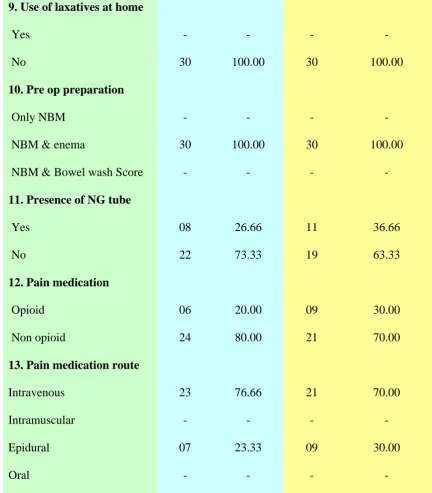
laxatives at home, pre operative bowel preparation of giving enema and keeping NBM were ( 100%, 100%), general anaesthesia were used (93% , 100%), NG tube present postoperatively for decompression (73.33%, 63.33%), received non opioid medication as an analgesic ( 80%, 70%), and underwent intestinal related surgery (13.33%. 20.00%), gastric related surgery (30%, 23.33%), liver and pancreas related (20%, 20%), reproductive related(36.66% , 36.66%) in control and experimental group.
Most of the patients (60%) had resumed partial function of bowel between the (14 to 28hrs) postoperatively in the control group whereas in experimental group 70% of patients had resumed complete bowel function (<13hrs) postoperatively. Absence of bowel function (>29hrs) after surgery in some of the patients (13.33%, 6.66%) in both control and experimental group respectively..
vi
All the patients in experimental group were highly satisfied (100%) with the rocking chair exercise.
There was an association between gender of the patient (χ2=9.37, df=1), (p<0.01) in control and (χ2=9.6, df=1), (p<0.01) in experimental group of patients who had undergone abdominal surgery and level of bowel function. But other demographical variables did not show any significance association with bowel function in the control group and study group. Hence null hypothesis Ho2 was partially rejected.
There was a significant association between the diseases (χ2=6.91, df=1), (p<0.01), the surgery that the patient underwent (χ2=6.91, df=1), (p<0.01), presence of NG tube for decompression postoperatively(χ2=5.10, df=1), (p<0.05) pain medication that was used(χ2=5.86, df=1), (p<0.05) and the route of medication of analgesic(χ2=7.95, df=1), (p<0.01) with the level of bowel function in control group.
vii
Recommendations
The researcher recommends the following studies
Rocking chair exercise must be mandatory to all postoperative patients after any type of surgery.
Rocking chair must be kept in all postoperative wards.
Awareness about the rocking must be initiated among health care professionals.
Rocking chair exercise could be included in preoperative teaching programme. The same study could be conducted on larger samples for better
generalization.
The study could be done in patients undergoing other surgeries and for various disease conditions.
viii
TABLE OF CONTENTS
Chapter CONTENTS Page No.
I INTRODUCTION 1-17
Background of the Study 1
Need for the Study 5
Statement of the Problem 8
Objectives of the Study 8
Operational Definitions 9
Assumptions 10
Null Hypotheses 10
Delimitations 11
Conceptual Framework 11
Summary 17
Organization of Research Report 17
II REVIEW OFLITERATURE 18 -31
Literature Review Related to Abdominal Surgery 18
Literature Review Related to Interventions for Initiating Bowel Movement
22
Literature Review Related to Use of Rocking Chair Exercise 27
III RESEARCH METHODOLOGY 32 -42
Research Approach 32
Research Design 33
ix
Research Setting 35
Population, Sample, Sampling Techniques 36
Sampling Criteria 37
Selection and Development of Study Instruments 37
Psychometric Properties of the Instruments 39
Pilot Study 39
Protection of Human Rights 40
Data Collection Procedure 40
Problems Faced during Data Collection 42
Plan for Data Analysis 42
IV ANALYSIS AND INTERPRETATION 43-63
V DISCUSSION 64 - 75
VI SUMMARY, CONCLUSION, IMPLICATIONS AND
RECOMMENDATIONS
76 - 85
REFERENCES 86 -88
x
[image:13.595.85.546.125.647.2]LIST OF TABLES
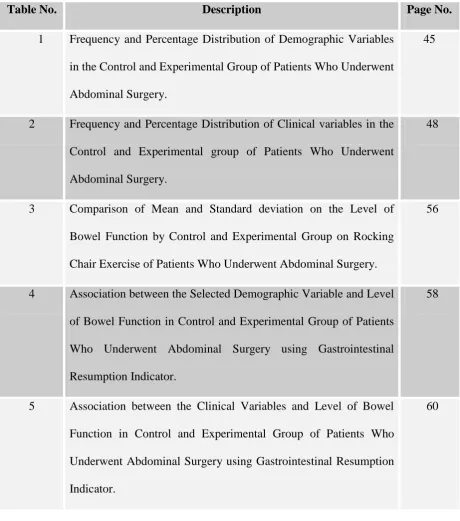
Table No. Description Page No.
1 Frequency and Percentage Distribution of Demographic Variables in the Control and Experimental Group of Patients Who Underwent Abdominal Surgery.
45
2 Frequency and Percentage Distribution of Clinical variables in the Control and Experimental group of Patients Who Underwent Abdominal Surgery.
48
3 Comparison of Mean and Standard deviation on the Level of Bowel Function by Control and Experimental Group on Rocking Chair Exercise of Patients Who Underwent Abdominal Surgery.
56
4 Association between the Selected Demographic Variable and Level of Bowel Function in Control and Experimental Group of Patients Who Underwent Abdominal Surgery using Gastrointestinal Resumption Indicator.
58
5 Association between the Clinical Variables and Level of Bowel Function in Control and Experimental Group of Patients Who Underwent Abdominal Surgery using Gastrointestinal Resumption Indicator.
xi
[image:14.595.83.539.127.399.2]LIST OF FIGURES
Fig. No Description Page No.
1 Conceptual Framework Based on Wiedenbach’s Helping Art Of Clinical Nursing Theory
16
2 Schematic Representation of Research Design 34
3 Percentage Distribution of Gender of Patients 47
4 Percentage Distribution of Diseases of Patients 52
5 Percentage Distribution of Nature of Surgery 53
6 Percentage Distribution of Level of Bowel Function 55 7 Percentage Distribution of Level of Satisfaction of Patient on
Rocking Chair Exercise
xii
LIST OF APPENDICES
Appendix Contents Page No.
I Letter Seeking Permission to Conduct the Study xiii
II Ethical Committee Permission to Conduct the Study xiv
III Letter Seeking Permission for content validity xvi
IV List of Experts for Content Validity xvii
V Content Validity Certificate xviii
VI Letter Seeking Consent from participant xix
VII Certificate for English Editing xxi
VIII Certificate for Tamil Editing xxii
IX Plagiarism Originality Report xxiii
X Demographic Variable Proforma of Patient Who Underwent Abdominal Surgery
xxiv
XI Clinical Variable Proforma of Patient Who Underwent Abdominal Surgery
xxviii
XII Assessing the Gastrointestinal Resumption Indicator of Patients Who Underwent Abdominal Surgery
xxxi
XIII Rating Scale of Level of Satisfaction on Rocking Chair Exercise of Patients Who Underwent Abdominal Surgery
xxxiii
XIV Data Code Sheet xxxviii
XV Master Code sheet xxxix
1
CHAPTER I
INTRODUCTION
Background of the Study
“The belly rules the mind”
- Spanish proverb
Health maintenance is an important activity of any individual, families and community with the intention of improving or restoring health or to treat or prevent disease. Self care is a personal health maintenance which includes the decision to stay physically and mentally fit. The most important aspect of health maintenance is eating well, of a healthy diet. A healthy diet involves consuming appropriate amounts of all essential nutrients and an adequate amount of water.
There is a tendency for all to consider the heart and brain as vital organs in the body, completely overlooking the gastrointestinal tract (GI tract). Even though the GI tract is not the most attractive organ in the body, they are certainly among the most important organ like any other organ and plays an important role in maintaining health by performing various functions. The 30 plus foot long tube that starts from the mouth to the anus which is responsible for many body functions. The GI tract is imperative for our well being and our life- long health. If GI tract is not functioning that will leads to many acute or chronic illnesses that will affect the day to day function level and the quality of life.
2
oesophagus, stomach, small intestine (duodenum, jejunum, ileum) and then into the large intestine or colon and extends to the rectum and anus.
The main causes for the extended length of hospitalization following abdominal surgery are postoperative ileus (POI), which is the temporary impairment of gastrointestinal motility characterized by abdominal distension, pain, delayed passage of the stool and gas, nausea, vomiting and decreased appetite. This postoperative ileus is a temporary condition in which part of the intestine becomes paralyzed and therefore does not function properly. This condition is most common after any type of abdominal surgery especially surgeries involving the movement of the intestines. This condition may delay patient ambulation, increasing the risk of pulmonary and thromboembolic complications, and it may delay enteral feedings or resumption of a solid diet, resulting in poor nutrition with delayed wound healing. The type of anaesthesia used during surgery as well as pain relief medications such as opioids often exacerbate POI.
A retrospective review of more than the 800,000 who underwent surgery in the United States in 2002 found a rate of postoperative ileus of 4.25% according to the International Classification of Diseases- Ninth Revision (ICD_9) codes.
3
anaesthetics and analgesics choices before, during, and after surgery, along with the avoidance of nasogastric tube feedings and the use of supportive therapies.
The symptoms of POI include nausea, vomiting, abdominal distension, abdominal tenderness, and delayed passage of flatus and stool. Prevention of POI will improve patient comfort, shorten the length of stay, limits the costs and also prevention of infection. The POI was first described by Cannon and Murphy in 1906, and is now commonly described as a transient postoperative period of gut motility dysfunction.
POI may be generally defined as a transient impairment in the gastrointestinal (GI) motility in the postoperative setting, however, no standard nomenclature or grading system exists. Postoperative hypo motility may affect all parts of GI tract but with differential recovery of normal function. Small intestine function generally normalizes first, often within several hours of surgery. Gastric motility usually returns to normal within 24 – 48 hours after surgery. The colon is usually the final portion of the GI tract to regain normal motility, which usually occurs within 48 – 72 hours after surgery. Motility normalizes in the proximal colon first and then progresses to the transverse and left colon (Massey et al. 2007).
4
early mobilization was observed to hasten recovery and reduce the incidence of postoperative complications.
Miedema & Johnson (2003) contend that although POI has been recognized as a post-operative phenomenon since 1899, little progress has been made towards its prevention and treatment during a century in which other significant advancements in surgical techniques and postoperative care were made. To date, physicians and nurses have little to offer patients other than reassurance that the incapacitating symptoms will resolve in time and bowel function will return. According to A.J. Bauer (2004) article that POI is contributed by three mechanisms: namely neurogenic, inflammatory and pharmacological mechanisms. In the acute postoperative phase, mainly spinal and supraspinal adrenergic and non-adrenergic pathways are activated. Recent studies, however, show that the prolonged phase of postoperative ileus is caused by an enteric molecular inflammatory response and the subsequent recruitment of leukocytes into the muscularis of the intestinal segments manipulated during surgery. This inflammation impairs local neuromuscular function and activates neurogenic inhibitory pathways, inhibiting motility of the entire gastrointestinal tract. Finally, opioids administered for postoperative pain control also contribute to a large extent to the reduction in propulsive gastrointestinal motility observed after abdominal surgery.
5
Rocking motion may be useful in resolving postoperative ileus in patients who have undergone abdominal surgery. Activities such as rocking are identified as stimuli that induce relaxation by moderating and mediating various stress response mechanisms and initiating what is described as the Relaxation Response (Benson, 1996). As previously discussed, rocking has been found by several researchers from 1993 to 2000 to offset the negative effects of stress, illness, and surgery and contribute to the resolution of POI. Previous studies of Thomas et al. (1990) used rocking in combination with medications as an intervention. This study evaluated the effects of rocking chair motion as the only intervention in order to reduce clouding of results due to co variation from other interventions.
Need for the Study
Postoperative ileus (POI) is a form of gastrointestinal dysfunction that commonly occurs in patients after abdominal surgery and results in absent or delayed gastrointestinal motility, food intolerance, gas retention, and pain. POI may last for four to five days and complicate the full and timely recovery of the patient. Literature suggests that the duration of POI is in part related to the degree of surgical trauma and is more severe following extensive surgeries of the colon.
6
problems contribute to prolonged hospitalization and significant burden on the health system.
According to Holte and Kehlet (2002) the factors that contribute to POI, its onset and persistence are due to the activation of the inhibitory reflexes, inflammatory mediators and various forms of anaesthesia used during surgery, and opioids given for pain control which extends the duration of ileus.
Luckey et al. (2003) studies suggest that there are multiple contributing causes of POI and to date no specific interventions have been discovered that prevent and successfully resolve POI. POI is a major health problem because it places post operative abdominal surgery patients at increased risk for development of circulatory and pulmonary complications associated with reduced physical activity due to pain and other immobilizing symptoms.
Research contributed by Barnes et al (1997), Clark (2002), provides overwhelming evidence that POI extends the affected patient’s post-surgical recovery
period of several days and significantly delaying the healing process and adds more than $1 billion annually to the costs of related health care to treat the problem.
7
Currently, clinical standards for determining the prevention, treatment, and resolution of POI continue to be as confounding as the multiple combinations of contributing factors that cause it. In addition, the agreement among practitioners regarding the assessment and evaluation of signs and symptoms of POI has been difficult to establish until the last decade. Today’s standard clinical practice protocols
recommend that the assessment of postoperative patients for POI include the daily auscultation of the patient’s abdomen for the return of bowel sounds, plus monitoring the patient for the passage of gas through the rectum; a phenomenon commonly called “surgeons’ music” (Prasad & Matthews, 1999). Historically, hearing bowel sounds
following surgery was thought to be proof that the POI was absent or resolved.
However, there remain inconsistencies in the research and clinical literature about whether or not the return of bowel sounds is indeed the most reliable indicator of complete and proper bowel function in postoperative abdominal surgery patients. Some researchers argue that the absence of abdominal distension and vomiting must also accompany the presence of bowel sounds and “surgeons music”
8
This study evaluated the effects of rocking chair motion as the only intervention in order to reduce clouding of results due to co variation from other interventions.
Despite conflicting research findings over the past several decades, the clinical community does agree that the standard measure to evaluate the resolution of POI is the actual passage of flatus from the rectum. While this standard provides clinicians with tools to assess and evaluate POI, more studies are needed that employ low-risk.
Although many studies related to paralytic ileus have been done abroad, in India, till date no research has been done on postoperative paralytic ileus and the role of nurses in assessing the bowel function and exercises to reduce the paralytic ileus. There will be a greater impact on nursing care if evidence based care is applied. The study will provide guidance for the nurses in the surgical settings. Hence the investigator felt the need of the study.
Statement of the Problem
An Experimental Study to Assess the Effectiveness of Rocking Chair Exercise in Level of Bowel Function Among Patients Who Underwent Abdominal Surgery in Apollo Main Hospital, Chennai.
Objectives of the Study
9
2. To determine the effectiveness of rocking chair exercise by comparing the level of bowel function in the control and experimental group of patients who underwent abdominal surgery.
3. To determine the level of satisfaction on rocking chair exercise among experimental group of patients who underwent abdominal surgery.
4. To find out the association between the selected demographic variables and the level of bowel function before and after rocking chair exercise in control and experimental group of patients who underwent abdominal surgery.
5. To find out the association between the selected clinical variable and the level of bowel function before and after rocking chair exercise in control and experimental group of patients who underwent abdominal surgery.
Operational Definitions
Effectiveness
In this study, effectiveness refers to the extent to which the rocking chair has improved the level of bowel function of patients who underwent abdominal surgery.
Rocking chair
10
Bowel functions
Abdominal sounds (bowel sounds) are made by the movement of the intestines as they push food through and heard by using a stethoscope on the abdominal wall indicate that the gastrointestinal tract is working.
Abdominal surgery
The term abdominal surgery broadly covers surgical procedures that involve opening the abdomen which can be minor procedures like laparoscopic assisted surgery or major surgery were the abdomen will be opened such as exploratory laparotomy, cholecystectomy, LSCS, total abdominal hysterectomy.
Assumptions
Patients undergoing abdominal surgery are at risk of developing paralytic ileus .
Accumulation of gas in the bowel aggravates the intensity of pain.
Postoperative ileus is a temporary impairment of gastrointestinal motility that commonly occurs after surgery.
Rocking chair exercise facilitates the relaxation. Rocking chair enhances the bowel function
Null Hypothesis
11
H02 There will be no significant association between selected demographic variables and level of bowel function before and after rocking chair exercise in control and experimental group of patients who underwent abdominal surgery.
H03 There will not be any significant association between selected clinical variables and level of bowel function before and after rocking chair exercise in control and experimental group of patients who underwent abdominal surgery.
Delimitation
The study is limited to patients who are admitted to Apollo Main Hospitals Chennai.
The study is limited to patients who had undergone abdominal surgery at the time of data collection.
The study period is limited to 4 weeks duration.
The study is limited to patients who are hemodynamically stable.
Conceptual Framework for the Study
The conceptual framework deals with the interrelated concepts that are assessable together in some rational scheme by virtue of their relevance to a common theme (Polit and Beck, 2010).
12
patient’s needs based on available resources and implementation. Finally the nurse
reconstructs the experience to ascertain the met needs and there after taking further appropriate action.
Wiedenbach’s views nursing as an art based and goal directed process. The
nurse presents the plan to the patient and the patient responds to it. Widenbach’s vision of nursing practice closely parallels the assessment, implementation, and evaluation steps of the nursing process Based on Wiedenbach, nursing practice consists of identifying a patient, need for help and validating that the need that was met according to this theory, factual and speculative knowledge, judgment and skills are necessary for effective nursing practice.
In Widenbachs theory, identification refers to determining a patient’s need for
help based on the existence of a need. Ministration refers to the provision of needed help. Validation refers to a collection of evidence that shows a patient’s needs have been met and that his/her functional ability has restored as a direct result of nurses action.
13
Identification
In the identification phase, the investigator identified the patient who underwent for abdominal surgery with paralytic ileus by assessing bowel sounds with the help of a stethoscope and asking the patient about the passing of flatus. Investigator selected both male and female patients in the age group of > 20 years. The study group patients were subjected to rocking chair exercise and the investigator identified the impact of rocking chair exercise on the resumption of gastrointestinal function.
Ministration
In the ministration phase, the patients in the study group received rocking chair exercise for 60 minutes in 30 minutes interval (30+30) two times a day. The control group received routine post-op care. Ministration is providing the needed help. In ministering the nurse performs the rocking chair exercise to the patient underwent abdominal surgery. It has the following two components:
Prescription Realities
Prescription
14
Prescription refers to the provision of rocking chair exercise in improving the bowel function. This includes assessing the bowel function of patient underwent abdominal surgery after rocking chair exercise till the patient gets discharged.
Realities
Realities are the situation that influences the fulfillment of central purpose. Wiedenbach defined five realities as:
Agent
The agent, the practicing nurse or delegate is characterized by the personal attributes, capacities and competencies in nursing. In this study, the investigator was the agent.
Recipient
The recipients, the patient are characterized by the personal attributes, problems and inability to cope with the concerns or problems being experienced. Patients who underwent abdominal surgery were the recipients in this study.
Goal
The goal is the desired outcome the expected wishes to achieve. The goal is the end result to be attained by the nursing action. The goal of this study is to improve the bowel function after the rocking chair exercise in terms of early return of bowel sounds, passing of flatus. Means and activity
15
In this study, means and activity refers to assessing the bowel function with the use of gastrointestinal resumption tool.
Framework
The framework consists of human, environmental, professional and organizational facilities that not only make up the context within which nursing is practiced but also constitute its currently existing limits. Framework of this study is Apollo Main hospital, Chennai.
Validation
16
IDENTIFICATION
MINISTRATION
VALIDATION
NURSE Patients subjected to abdominal surgery Resumption of gastro intestinal functions Realities
Agent: Nurse & investigator Recipient: Post abdominal surgery patient
Goal: Reduce duration of ileus
Means and activity: Use of indicator tool to assess the outcome
Framework: Hospital
Prescription
Rocking chair exercise
P
O
S
T
T
E
S
T
Discharge of patient from SHDU or ward after rocking chair exercise Postoperative ileus duration, discharge from surgical HDU or discharge from hospital are assessed Decreased postoperative ileus durationReduced number of days in surgical HDU or ward
Increased postoperative ileus duration
[image:31.792.12.792.39.517.2]Increased number of days in surgical HDU or ward.
17
Projected Outcome
The study will help to provide evidence based guidelines for improving bowel function for the postoperative patient who has undergone abdominal related surgery and increases the knowledge and practice among nurses regarding earlier ambulation and exercises that helps and prevent complications. Performing rocking chair exercise increases the satisfaction of patients and reduces the length of stay in hospital.
Summary
This chapter has dealt with the background, need for the study, and a statement of the problem, objectives, operational definitions, assumptions, null hypotheses, delimitations and conceptual framework.
Organization of the Report
Further aspects of the study are presented in the following five chapters.
CHAPTER – II : Review of literature
CHAPTER – III : Research methodology includes research approach, research design, setting, population, sample and sampling techniques, tool description, content validity and reliability of tools, pilot study, data collection procedure and plan for data analysis.
CHAPTER – IV : Analysis and interpretation of data
CHAPTER – V : Discussion
18
CHAPTER -II
REVIEW OF LITERATURE
A literature review is an organized written presentation of what has been published on a topic by scholars (Burns & Groove, 2004). The task of reviewing literature involves the identification, selection, critical analysis and reporting of existing information on the topics of interest. A review acquaints the researcher with what has been done in the field and it minimizes the possibilities of unintentional duplications. It justifies the need for replication provides the basis of future investigations and help to relate the findings of one study to another.
This chapter deals with a review of published and unpublished research studies and from related material for the present study. The review helped the investigator to develop an insight into the problem area. This helped the investigator in building the foundations of the study.
The review of literature for this study is presented under the following headings.
1. Literature Related to Abdominal Surgery
2. Literature Related to Interventions for Initiating Bowel Movement
3. Literature Related to use of Rocking Chair Exercise
I. Review Related to Abdominal Surgery
19
between August 2007 and June 2009 by using observational cohort study.. The proportion of patients in whom C difficile infection was diagnosed after the use of preoperative oral antibiotics was smaller than the proportion of patients with C difficile infection who did not receive oral antibiotics (1.6% vs 2.9%, P = .09). This multicenter study showed that the preoperative use of mechanical bowel preparation was not associated with increased risk of C difficile infection after colectomy.
An observational study by Forsgreng and Altman (2010) to describe present knowledge regarding the incidence, cause, and risk factors in patients undergoing hysterectomy. The reported incidence of pelvic organ fistula after hysterectomy ranges from 0.1 to 4% in different studies, and a higher incidence is generally reported after radical hysterectomy compared with hysterectomy on benign indications. Although rarely encountered in a general population, pelvic organ fistula disease may have a devastating effect on all aspects of quality of life.
20
group. These results suggest that mechanical massage of the abdominal wall may decrease postoperative pain and ileus after colectomy.
A cohort study was done by Robert et al. (2005) from National Health Service Medical Record Linkage Database. Among 8849 women who underwent open gynaecological surgery in 1986 was followed for the impact of adhesions over ten years. Readmissions following open gynaecological surgery(4.5%) were directly related to adhesions. 34.5% of patients were readmitted, for a problem potentially related to adhesions or for further intra-abdominal surgery that could be complicated by adhesions.. Operations on the ovary had the highest rate directly related to adhesions.
Baig and Wexener (2004) reviewed the literature from Medline Database, to explain the pathophysiology of postoperative ileus is and the duration of ileus which is correlated with the degree of surgical trauma. Postoperative ileus can develop after all types of surgery. A variety of treatment options have been used to decrease the duration of postoperative ileus. Currently, the important factors that could affect the duration and recovery from postoperative ileus include limitation of narcotic use by substituting alternative medications such as nonsteroidal and thoracic epidural with local anaesthetic. The selective use of nasogastric decompression and correction of electrolyte imbalances also considered as an important factor.
21
identified at three sites: upper gastrointestinal (13 definitions), hepatopancreaticobiliary (14) and lower gastrointestinal (29). The majority of studies used a combination of clinical features and radiological investigations to define and detect an anastomotic leak.
To assess the effect of epidural anaesthetics versus systemic opioids on postoperative ileus, Kehlet and Holte (2001) conducted randomized trials. Several treatment modalities have become accepted management options for Postoperative ileus (POI) those are nasogastric suction and prokinetic agents. However, data demonstrating that these agents reduce the duration of Post operative ileus are limited. Of current treatment modalities, use of epidural local anaesthetics appears to be the most effective means of reducing POI. Other potentially effective treatments include early enteral feeding and less invasive surgical procedures. Together, these techniques have reduced the length of stay after colonic surgery in 2 to 3 days. Future studies κ-opioid agonists and peripheral μ-opioid antagonists, into a multimodal regimen, may offer new
treatment options for the further impact POI duration.
22
and the mean length of stay in hospital. Based on this review it seems to be no clear advantage to keeping patients nil by mouth after elective gastrointestinal resection. Early feeding may be of benefit.
Brooks-Brunn (1997) did a prospective model building study about Predictors of postoperative pulmonary complications following abdominal surgery among 400 patients at Indiana University School of Medicine, Indianapolis, USA. Multicriteria outcome for postoperative pulmonary complication used to collectively assess atelectasis and pneumonia. Twenty-three risk factors were assessed. These results provided a framework for identifying patients at risk of developing a PPC following abdominal surgery. A reliable and valid risk index could be used clinically to guide preoperative and postoperative pulmonary care and target limited resources for patients at risk.
II. Literature Related to Intervention for Initiating Bowel Movement
23
and small bowel anastomosis for stoma closure are benefited by postoperative gum chewing.
An evidenced base report on Chewing Gum use and Duration of Postoperative Ileus in Patients Undergoing Abdominal Surgery and Creation of a Stoma. in this the researcher evaluated (1) time to passage of flatus, (2) time to passage of stool, or (3) length of hospital stay. Chewing gum was consistently found to reduce time to passage of flatus and stool and also found chewing gum reduced hospital stay but two found no difference bu Barbara et al.(2010). Analysis of studies reveal mixed results when chewing gum was compared to standard postoperative care in patients undergoing surgical reconstruction including ostomy surgery or creation of an orthotopic neobladder.
A systematic randomized meta analysis was done by Fitzgerald and Ahmed (2009), to assess the first flatus and bowel motion, length of stay and complications by using Medicine, Embase Cochrane controlled trial registers and reference test. Seven studies with 272 patients were included. There were no significant differences in complication rates and concluded that chewing-gum therapy following open gastrointestinal surgery is beneficial in reducing the period of postoperative ileus, although without a significant reduction in length of hospital stay. These outcomes are not significant for laparoscopic gastrointestinal surgery.
24
flatus, time to first passage of faeces, and length of hospital stay. Six trials including 244 patients were analyzed. Time to first flatus was significantly reduced with gum chewing and standard treatment compared to standard treatment alone Time to first passage of faeces was significantly reduced but the length of hospital stay was only marginally reduced with gum chewing and concluded in patients with ileus after colonic surgery, gum chewing in addition to standard treatment significantly reduces the time to first flatus and the time to first passage of faeces when compared to standard treatment alone.
Sara and Ronald (2009) conducted a comprehensive review of evidence-based strategies to prevent and treat postoperative ileus (POI). Preoperative strategies employed to prevent or limit the duration of POI include avoidance of preoperative fasting and mechanical bowel preparation, use of epidural-local anaesthetics, implementation of minimally-invasive surgical techniques, and modification of pain management strategies and concluded though many of these strategies have proven beneficial, no single approach has demonstrated the ability to prevent or treat POI. However, when these strategies are used in combination as part of a fast-track multimodal treatment plan, there is a significant decrease in time to return of normal bowel function and a shortened hospital stay.
25
postoperative introduction of fluids and food, (2) avoidance of positive fluid balance exceeding 1,000 ml, and (3) avoiding potassium elevations over a 3-day period. Clinical implications include the importance of encouraging early oral intake, monitoring fluid intake and output in postoperative patients, and identifying positive fluid balance early to prevent it from continuing.
Luckey et al. (2003) did a study on mechanisms and treatment of postoperative ileus in the University of California from a Medline database search. The factors include inhibitory effects of sympathetic input; release of hormones, neurotransmitters, and other mediators; an inflammatory reaction; and the effects of anaesthetics and analgesics. Numerous treatments have been used to alleviate postoperative ileus without much success the conclusion is the etiology of postoperative ileus can best be described as multifactorial. A multimodality treatment approach should include limiting the administration of agents known to contribute to postoperative ileus (narcotics), using thoracic epidurals with local anesthetics when possible, and selectively applying nasogastric decompression.
26
shortly after aortic surgery. However, the activity decreased in intensity and the fasting cycle differs from control subjects. The data predicted a high rate of enteral feeding intolerance early after surgery.
Separate meta-analyses were conducted by Barnes et al. (1997) for any homeopathic treatment versus placebo. This study includes homeopathic remedies of < 12C potency and> or = 12C potency versus placebo. Meta-analyses indicated a statistically significant (p < 0.05) weighted mean difference (WMD) in favour of homeopathy (compared with placebo) on the time to first flatus. No significant difference that compared with homeopathic remedies > or = 12C versus placebo. There is evidence that homeopathic treatment can reduce the duration of ileus after abdominal or gynaecologic surgery.
27
A study by Yukioka et al. (1987) on recovery of bowel motility after surgery. The time to first flatus (TFF) was noted in 20 patients aged 60 yr or older and measured simultaneously using carbon dioxide analyzers. After cystoscopy under general anaesthesia, 10 patients received nalbuphine 20 mg i.v., and 10 patients had placebo (normal saline). In 16 patients (80%) the two observed times coincided and there were no false reports. Two patients were asleep, and did not report TFF. In two others the sampling tube became obstructed. Therefore, both methods are of value; the carbon dioxide analyser, however, is a sensitive and accurate monitor of the initial passage of flatus which does not require patient co-operation. In the i.v. Nalbuphine group, the median TFF was more than three times as long (212 min) as that in the placebo group (64 min) (P less than 0.01).
III. Literature Related to use of Rocking Chair
28
Massey (2010), conducted as a randomized trial of rocking-chair motion on the effect of postoperative ileus duration in patients with cancer recovering from abdominal. Rocking-chair motion has shown promise in reducing postoperative ileus duration. Sixty-six participants were randomized into 2 groups. The experimental group received standard care plus the rocking-chair intervention; the control group received standard care. Participants in the experimental group had shorter duration of POI, no effect on medication use, and time to discharge.
A randomized controlled trial was done to assess the benefits of home-based rocking chair exercise for physical performance among community-dwelling elderly women by Niemela et al.(2010) at Kauniala Hospital and Rehabilitation Center .51 womens were randomly assigned to the Rocking Chair Group (RCG) and control group by drawing lots. The RCG carried out a six-week rocking chair training program at home including ten sessions per week, twice a day for 15 minutes per session, and ten different movements. The data showed significant interactions of group, maximal knee extension strength, and in maximal walking speed, which indicates that the change between groups during the follow-up period was significant.
29
30 min) extracted from both settings, rocking raised the average SBP from <100 mmHg to approximately 120 mmHg. These results are consistent with the hypothesis that rocking can increase BP and therefore, may enhance cerebral perfusion.
A quasi experimental study was conducted on 50 patients by Synder et al. (2009) to measures the effects of a glider swing on emotions, relaxation, and aggressive behaviors in a group of nursing home residents with dementia. Data were obtained during a 5-day baseline phase, a ten-day intervention phase, and a 5-day post treatment phase. Subjects were placed on the glider for 20 minutes each day during the intervention phase. The results of the study indicate that the glider intervention significantly improved emotions and relaxation. The most noted changes were found after 10 minutes of swinging. However, no differences were found in aggressive behaviors.
30
different to the constant values of the controls. They interpret the findings as improvements in muscle power by the oscillative muscle stimulation.
A sample of 34 patients was being studied, and data were being collected during a preadmission process and five postoperative days on investigating of rocking as a postoperative intervention to promote gastrointestinal motility by Moore et al. (1995). Using rocking as a moderator of the surgical stress response, the study hypothesizes a more rapid resumption of GI motility with decreased gaseous distention and associated pain, and less emotional distress for patients who follow a regimen of rocking in addition to ambulation
Waldhausen and Schirmer (1990) conducted a study on the effect of ambulation on recovery from postoperative ileus. Among 34 patients, ten of whom followed an ambulatory regimen beginning on postoperative day one. The other 24 patients (did not become ambulatory until postoperative day four. Group A was recorded before and after ambulation so comparisons could be made to determine if ambulation had an acute effect on myoelectric activity. Both the group recordings recordings were compared to judge whether there was an over-all effect of ambulation on myoelectric recovery. The data suggest that ambulation as a means to help resolve postoperative ileus and its accompanying cramps and bloating may be more perceived than real.
31
and slow rocking induced similar cardiac responses in younger infants; Cardiac acceleration was shown with motor activation and cardiac deceleration with motor quieting. In three month olds, cardiac deceleration appeared with both types of motor reaction. In older infants, cardiac deceleration to rocking stimulation appeared even when it produced concomitant behavioural arousal. Vestibulo kinesthetic stimulation is interpreted as having an important homeostatic effect on the young organism.
Nancy M. Watson School of Nursing, University of Rochester, New York conducted cross over design on the Rocking chair therapy for 25 dementia patients: Its effect on psychosocial well-being and balance. Despite significant cognitive impairment, most medically stable unrestrained residents accepted the chairs and learned to actively rock. During the six week program, residents were able to rock an average of 101 minutes per day. There were improvements in depression/anxiety and reductions in PRN pain medication significantly related to amount of rocking.
Summary
32
CHAPTER III
RESEARCH METHODOLOGY
The methodology of the research study is defined as the way the data is gathered in order to answer the questions to analyze the research problem. It enables the researcher to project a blue print for the research undertaken. The research methodology involves a systematic procedure by which the researcher had a start from the initial identification of the problem to its final conclusion.
This chapter deals with a brief description of the different steps undertaken by the researcher for the study. It involves research approach, research design, setting, population, sample and sampling technique, sampling criteria, selection and development of the instruments, validity and reliability of the instruments, pilot study, data collection procedure and plan for data analysis. The present study is conducted to assess the effectiveness of rocking chair exercise in level of bowel function among patients who underwent abdominal surgery.
Research Approach
33
study. These settings were randomly assigned to the control and experimental group. In this study, the investigator manipulated the independent variable i.e. Rocking chair exercise was given to the experimental group. The level of bowel function was assessed for both the control and the experimental group before and after the intervention. Then the level of satisfaction was assessed using a rating scale.
Research Design
According to Polit and Beck (2008), a research design is the overall plan for addressing a research question, including specifications for enhancing the study’s
integrity. A posttest design was adopted for conducting this study.
R - O1
R X O1
R - Randomization
O1 - Post test in control and experimental group X - Rocking chair exercise
34
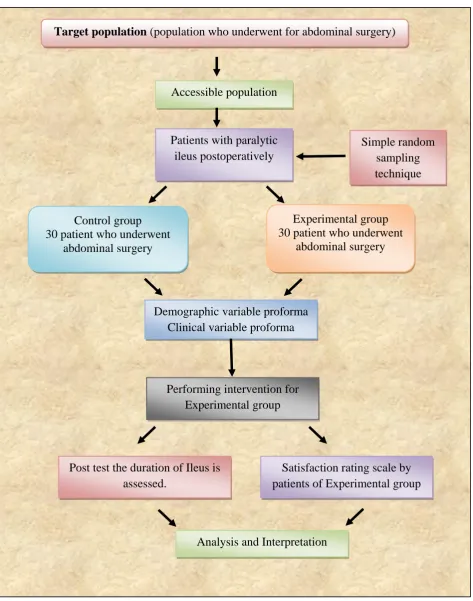
Fig.2 Schematic Representation of the Research Design.
Accessible population
Patients with paralytic ileus postoperatively
Control group 30 patient who underwent
abdominal surgery
Experimental group 30 patient who underwent
abdominal surgery
Demographic variable proforma Clinical variable proforma
Performing intervention for Experimental group
Post test the duration of Ileus is assessed.
Analysis and Interpretation
Satisfaction rating scale by
patients of Experimental group Simple random
sampling technique
35
Variables
Independent variable
The variable that is believed to cause or influence the dependent variable is the independent variable (Polit and Beck, 2008).
In this study the Rocking chair exercise was considered as independent variables.
Dependent variable
The variable hypothesized to depend on or be caused by another variable is the dependent variable (Polit and Beck, 2008).
In this study level of bowel function was considered as the dependent variable.
Attribute variable
Variables that describe the study sample characteristics are termed as attribute variables (Polit and Beck, 2008).
In this study the attribute variables were demographic variable proforma and clinical variable proforma of patients who underwent abdominal surgery.
Research Setting
36
Population
Target population is the group of population that the researcher aims to study and to whom the study finding will be generalized. In this study target population were patients who underwent abdominal surgery.
Accessible population is the list of population that the researcher finds in the study area. The accessible population in this study were patients who underwent abdominal surgery at Apollo Main Hospital, Chennai.
Sample
The sample is the subset of population, selected to participate in a study. (Polit and Beck, 2008). A sample consists of patient who underwent abdominal surgery at Apollo Main Hospital, Chennai who satisfied the inclusion criteria.
Sample size
Sample of this study were 60 patients who underwent abdominal surgery and satisfied the inclusion criteria. Among them 30 were taken for the control group and 30 were taken for study group.
Sampling Technique
37
Sampling Criteria
Inclusion criteria
Patients who are willing to participate in the study.
Patients who underwent for abdominal surgery at Apollo Main Hospital, Chennai
Patients both male and female above the age of 20. Patients who are able to follow the instruction.
Exclusion criteria
The study excludes
Patients who are not available at the time of data collection Patients who are on mechanical ventilation
Patients who are not willing to participate in the study.
Selection and Development of the Study Instruments
The data collection instruments were developed through an extensive review of literature in consultation with the opinion of experts and with the opinion of faculty members. The instruments used in this study are demographic variable proforma, clinical variable proforma, gastrointestinal resumption indicator and level of satisfaction of patient.
Demographic variable proforma of patients who underwent abdominal surgery
38
Clinical variable proforma of patients who underwent abdominal surgery
This proforma is used to measure the clinical variable of patients such as body mass index, habit of drinking, type of diet, previous history of abdominal surgery, disease of patient, surgery underwent, type of anaesthesia used, usual bowel pattern, use of laxatives at home, presence of NG tube, pain medication and type of surgery the patient underwent.
Gastrointestinal resumption indicator.
The investigator selects the tool to measure the level of bowel function by assessing the bowel sounds with stethoscope, and enquiring the patient about the time of flatus passed. The score from 8 hrs of postoperative was given as the score 1and every subsequent 2 hrs was given scores of 2,3,4…….. The score is given according to which hour patient passed flatus or bowel sounds heard. With that patient from study group was compared with the control group.
Score interpretation
Score <13 – complete bowel function Score 14 – 28 – partial function of bowel Score > 29 – absence of bowel function
Rating scale on level of satisfaction
39
Score Interpretation
<30% - Dissatisfied 31-65% - Satisfied >66% - Highly satisfied
Psychometric Properties of the Instruments
Validity
Content validity refers to the adequacy of the sampling of the domain being studied. The content validity of the tool was obtained by getting opinion from five experts in the field of medical surgical nursing as well as from medical guide. The validation has suggested some specific modifications in the objectives and rating scale. The modifications and suggestions of experts were incorporated in the final preparation of the tool.
Reliability
The reliability of the tool was elicited by using split half method. The ‘r’ was found to be 0.93 by using Karl pearson which shows highly positive correlation, indicates that the tool was highly reliable.
Pilot Study
40
The pilot study was conducted in Apollo Main Hospital at Chennai from 11.06.12 to 23.06.12. Six patient as control group and six patients as study participants were selected. The patients who underwent abdominal surgery were selected by simple random technique and rocking chair exercise was given for study group based on the type of surgery they underwent. Laparoscopic surgery patients were given rocking chair exercise after 6 hrs of shifting from recovery room, and open surgery patients were given rocking chair exercise 12 hrs after shifting from recovery room. Rocking chair exercise was given for 60 minutes per day until they are discharged from the ward or transferred out of high dependency unit. The control and study group was assessed for bowel function and was monitored and analysis was done and identified that rocking chair exercise study is feasible and brings better postoperative outcomes or reduces duration of POI.
Protection of Human Rights
The study was conducted after obtaining clearance from Ethical committee, Apollo Hospitals, Chennai and permission from the Research and Medical guide.
Consent was obtained from all the participants/bystander before the data collection.
Confidentiality was maintained throughout the study
Data Collection Procedure
41
Apollo Hospitals and got ethical clearance to precede the study. The investigator collected the data from Apollo Main Hospital after obtaining proper administrative permission from concerned authorities. The observation and intervention time schedule was from 7a.m-12 noon and 12.30 p.m-5.30 p.m and the data collection period was from June 18th to July 23rdth 2011.
A group of 60 patients who underwent for abdominal surgery were selected by simple random sampling method and consent was obtained from the patient. Among the 60 patients, 30 patients were belonging to control group and 30 patients were belonging to experimental group. The baseline data were collected through the demographic variable and clinical variable proforma.
Rocking chair exercise was given to the study group based on the nature of
surgery they underwent such as laparoscopic surgery, patients were given after 6 hrs of
transferred from recovery and open abdominal surgical patients were given 12 hrs after
transferred from recovery. The exercise was given for 60 minutes per day and continued
until the patients got discharged from the general ward or transferred out of high
dependency unit. Along with rocking chair exercise they were also given standard care
such as ambulation and range of motion exercise. Control group was given only
standard care. Bowel sounds, passing of flatus, initiation of oral fluids were assessed in
hours and compared with control group who received routine care. Analysis was done
and identified that rocking chair exercise reduced duration of ileus in experimental
group than control group. Also assessed the level of satisfaction of experimental group
42
Problems Faced during Data Collection
The problems faced during the data collection were, Difficult to get permission from each consultant.
Some consultant hesitated to perform the exercise for their patient. Few patients were scarred to perform the exercise.
Plan for Data Analysis
43
CHAPTER – VI
ANALYSIS AND INTERPRETATION
This chapter deals with analysis and interpretation of data collected on number of issues from various sources. Statistics is a field of study concerned with techniques or methods of data collection, classification, summarising, interpretation, drawing inferences, testing of hypothesis, making recommendations etc. (Mahajan 2004).
Data was collected from 60 patients who underwent abdominal surgery at Apollo hospital, Chennai, among them 30 in control group and 30 in experimental group to determine the effectiveness of rocking chair exercise on level of bowel function. The data were analysed according to the objectives and hypothesis of the study.
The data was analysed, tabulated and interpreted using descriptive and inferential statistics.
Organisation of the findings
The findings of the study were organized and presented under the following heading: Frequency and percentage distribution of demographic variable of patients who
underwent abdominal surgery in the control and experimental group.
44
Frequency and percentage on level of bowel function after rocking chair exercise of patients who underwent abdominal surgery.
Comparing of mean and standard deviation on level of bowel function in control and experimental group of patients who underwent abdominal surgery.
Frequency and percentage distribution on level of satisfaction of patients who underwent abdominal surgery on rocking chair exercise.
Association between the selected demographic variable and level of bowel function in control and experimental group using gastro resumption indicator. Association between the clinical variables and level of bowel function in control
45
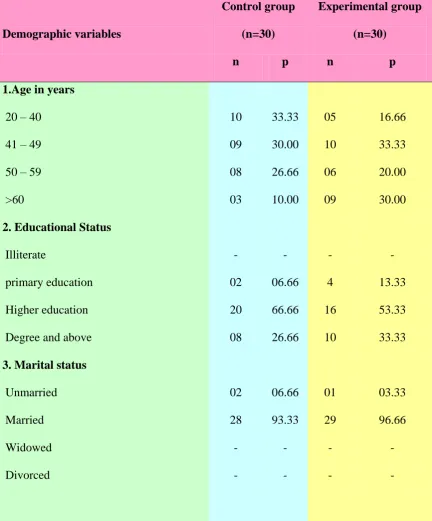
Table.1
Frequency and Percentage Distribution of Demographic Variables in the Control
and Experimental Group of Patients Who Underwent Abdominal Surgery.
Demographic variables Control group (n=30) Experimental group (n=30)
n p n p
1.Age in years
20 – 40 41 – 49 50 – 59 >60 10 09 08 03 33.33 30.00 26.66 10.00 05 10 06 09 16.66 33.33 20.00 30.00
2. Educational Status
Illiterate
primary education Higher education Degree and above
- 02 20 08 - 06.66 66.66 26.66 - 4 16 10 - 13.33 53.33 33.33
3. Marital status
46 4. Religion Hindu Muslim Christian Others 28 02 - - 93.33 06.66 - - 28 02 - - 93.33 06.66 - - 5. Income <30,000 30001 – 60000 >60000 16 13 01 53.33 43.33 03.33 15 10 05 50.00 33.33 16.33
[image:61.595.95.530.115.369.2]` The data from table 1 represents that significant number of patients who underwent abdominal surgery were at age of 20 to 40 years(33.33%, 16.66%), 41 to 49 years (30.00%, 33.33%), male and female were equal (50%, 50%), most of the patient educational status were higher education (66.66%, 53.33%) and income were > 30,000 Rs. (53.33%, 50.00%) and majority of the patient were married (93.33%, 96.66%) and Hindu’s were (93.33%, 93.33%) in both control and experimental group respectively.
47
50 50 50 50
0 10 20 30 40 50 60 70 80 90 100
Pe
rc
en
tage
Male Female
Gender
Control group Study group
[image:62.842.91.789.114.471.2]
48
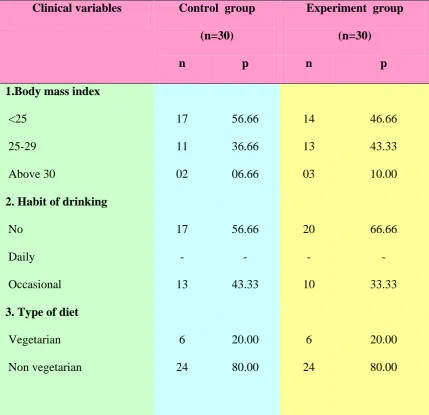
Table. 2
Frequency and percentage Distribution of Clinical Variables in the Control and
Experimental Group of Patients Who Underwent Abdominal Surgery
Clinical variables Control group
(n=30)
Experiment group
(n=30)
n p n p
1.Body mass index
<25 25-29 Above 30 17 11 02 56.66 36.66 06.66 14 13 03 46.66 43.33 10.00
2. Habit of drinking
No Daily Occasional 17 - 13 56.66 - 43.33 20 - 10 66.66 - 33.33
3. Type of diet
49
4.Previous H/O abdominal
surgery Yes No 09 21 30.00 70.00 15 15 50.00 50.00
5. Types of Surgery
Gastric related Intestinal related
Liver & pancreas related Reproductive related 07 06 06 11 23.33 20.00 20.00 36.66 09 04 06 11 30.00 13.33 20.00 36.66
6. Types of anaesthesia
General anaesthesia Spinal surgery 28 02 93.33 06.66 30 - 100.00 -
7. Co morbid illness
Diabetes Hypertension Heart disease Nil 08 02 03 18 26.66 06.66 10.00 60.00 8 10 04 17 26.66 33.33 13.33 56.66
8. Usual bowel pattern
Once in a day Once in 2 days
50
9. Use of laxatives at home
Yes No - 30 - 100.00 - 30 - 100.00
10. Pre op preparation