Iowa State University Patents
Iowa State University Research Foundation, Inc.
4-8-1997
Method of isolating an analyte using a solid phase
extraction medium
James S. Fritz
Iowa State University
Philip J. Dumont
Iowa State University
Donald F. Hagen
Craig G. Markell
Luther W. Schmidt
Follow this and additional works at:
http://lib.dr.iastate.edu/patents
Part of the
Analytical Chemistry Commons
This Patent is brought to you for free and open access by the Iowa State University Research Foundation, Inc. at Iowa State University Digital Repository. It has been accepted for inclusion in Iowa State University Patents by an authorized administrator of Iowa State University Digital Repository. For more information, please [email protected].
Recommended Citation
Fritz, James S.; Dumont, Philip J.; Hagen, Donald F.; Markell, Craig G.; and Schmidt, Luther W., "Method of isolating an analyte using a solid phase extraction medium" (1997).Iowa State University Patents. 193.
Method of isolating an analyte using a solid phase extraction medium
Abstract
A functionalized macroporous poly(styrene divinylbenzene) particle comprises at least one ionic functional
group covalently bonded thereto, the functionalized particle having sorptive capability towards an analyte,
said functional group being present in the range of 0.1 to 2.5 milliequivalents per gram of poly(styrene
divinylbenzene). The functionalized particles can be used in a packed column or enmeshed in a nonwoven
web for utility in solid phase extraction applications.
Keywords
Ames Laboratory, Chemistry
Disciplines
Analytical Chemistry | Chemistry | Physical Sciences and Mathematics
llllilllllllllllllllllllllllillllllillllllllllIlllliillllllllllllllllllll
005618438AUnited States Patent [19]
[11] Patent Number:
5,618,438
Fritz et a].
[45]’ Date of Patent:
Apr. 8, 1997
[54] METHOD OF ISOLATING AN ANALYTE 4,906,378 3/1990 Hagen et a1. ... .. 210/635
USING A SOLID PHASE EXTRACTION 4,935,142 6/1990 Stemberg . . . . . . .. 210/634
MEDIUM 4,971,697 11/1990 Douden et a1. . 210/502.1
4,971,736 11/1990 Hagen et a1. ... .. 264/22
. - . - - 5,009,869 4/1991 Weinberg 204/72 X
[75] Inventors‘ gzzgejfskigtziolsllglago?alfélglgggen 5,019,232 5/1991 Wilson et al. .. 204/1801 X
’. ’ . ' ’ 5,071,565 12/1991 Fritz et a1. . . . . . .. 210/692
WO‘Rdb‘KY’ Mum-i (5mg G- Markell’ 5,071,610 12/1991 Hagen et a1. 264/120
Wh?e Bear TOWIIShIP, Ramsey County, 5,104,545 4/1992 Means et a1. . 210/650
Minn; Luther W- Schmidt, Batesville, 5,114,591 5/1992 Patzelt et al. ... .. 210/663
Minn. 5,135,656 8/1992 Means et a1. ... .. 210/650
5,230,806 7/1993 Fritz et a1. ... ..
[73] Assignee: Minnesota Mining and Manufacturing Company, Minn Paul, 5,236,594 5,292,818 8/1993 O’Reilly et a1. 3/1994 Olshl et a1. ... .. 525/301 Ct
FOREIGN PATENT DOCUMENTS [21] Appl' No" 447’662 0346037 6/1989 European Pat. on. . [22] Filed; May 23, 1995 0556879 8/1989 European Pat. Off. .
2-126155 5/1990 Japan .
Related U_S_ Application Data 2024886 1/ 1980 United Kingdom .
_ , _ OTHER PUBLICATIONS
[62] Division of Ser. No. 238,364, May 5, 1994.
[51] Int. c1.6 ... .. B01D 15/04 ?gjlggcgghggécf?f‘f‘igg’f)’ 157-164 (1991»
U.S. ... ..
[58] Field Of Search ... .. 210/679; 428/281, 1 S_ Fritz et a!" ]_ chronL 641 (1993). 57_61_
428/283’ 323’ 327 Contemporary Practice of Chromatography, C.F. Poole & S.A. Schuette, Elsevier, NY, NY (1984) pp. 2-6.
[56] References Cited
(List continued on next page.)
US. PATENT DOCUMENTS '
.1 Primary Examiner—Kathleer1 Choi
Emmett; at a1~ --- - Attorney, Agent, or Firm—Gary L. Griswold; Walter N.
, , ee e . . . . . . .. - . -
4,208,194 6/1980 Nelson . ... .. 55/3854 X Kim’ Lorraine R‘ Sherman
4,265,768 5/1981 Beasley et al. .. ... .. 210/682 _ [57] ABSTRACT
4,331,541 5/1982 Akiyarna et a1. 210/679
4,373,519 2/1983 Errede et a1. ... .. 128/156 A functionalized macroporous po1y(styrene divinylbenzene)
4,382,124 5/1983 Meitzner et a1. . particle comprises at least one ionic functional group 4,450,287 5/ 1984 Paxson ' ... .. 560/241 covalently bonded thereto, the functionalized particle having 4,460,642 7/ 1984 Errede 61 a1, ... .. 428/283 sofptive capability towards an analyte, said functional group 4,512,897 4/1985 Crowder, 111 et a1. ... .. 210/656 being present in the range, of 0,1 to 2.5 milliequivalents per 4,537,683 8/1985 Isacoff et a1. ... .. 210/667 gram of POM/(Styrene divirwlbenzcney The functionalizcd 4,565,663 “1986 Enede 6‘ a1~ 264/120 particles can be used in a packed column or enmeshed in a
4’722’898 2/1938 Errede ct a1~ 435,182 nonwoven web for utility in solid phase extraction applica
4,810,381 3/1989 Hagen et al. . 210/502.1 norm
4,855,144 8/1989 Leong et a1. ... .. 424/487
4,871,671 10/1989 Errede et a1. ... .. 435/182 .
4,895,662 1/1990 Stevens ... .. 210/692 30 Claims, 1 Drawing Sheet
500
400
300
Capacity Factor (k')
100
5,618,438
Page 2
OTHER PUBLICATIONS
1.]. Sun and IS. Fritz, J. Chrom. 522 (1990) 95-105.
Design News, Feb. 9, 1987, Cahners Publishing Company.
L. A. Errede, Journal ofApplied Polymer Science, 31, 1986,
pp. 1749-1761.
L.A. Errede, et al., Chemically Modi?ed Surfaces in Science and Industry, 2, Proceedings of the Chemically Modi?ed
Surfaces Symposium, Fort Collins, Colo. (1987) pp. 91-104, Gordon and Breach Science Publishers, N.Y.
American Biotechnology Laboratory, Oct. 1988, pp. 26-32.
Chromatography
Electrophoresis
Immunochemistry
Molecular Biology, HPLC (BioRad), Price List 0, Mar.
1989.
Chromatography
Electrophoresis
Immunochemistry
Molecular Biology, HPLC (BioRad), Price List P, Mar.
1990. .
Life Science Research Products (BioRad), Price List Q,
Mar., 1991.
Life Science Research Products (BioRad), Price List R, J an., 1992.
Life Science Research Products (BioRad), Price List S,
1993.
Patent Abstracts of Japan, vol. 14, No. 349 (P-l084) &
JP,A,02 126155 (Mizunko Masako) 15 May 1990. Reactive Polymers, vol. 1, 1983, Amsterdam pp. 215-226,
R.E. Barron, “Reproducible Preparation of Low-Capacity
Anion-Exchange Resins”.
Chemical Technicians’ ready Reference Handbook, ed. by Shugan et al., McGraw-Hill Inc., New York 1990 (pp.
US. Patent
Apr. 8, 1997
5,618,438
500
400
Capacity Factor (k')
N
O
9
100
0 I I T I I I I
0.0
0.5
1.0
1.5
2.0
2.5
3.0
5,618,438
1
METHOD OF ISOLATING AN ANALYTE USING A SOLID PHASE EXTRACTION
MEDIUM
This is a division of application Ser. No. 08/238,364 ?led
May 5, 1994, pending.
FIELD OF THE INVENTION
This invention relates to particles useful for solid phase extraction (SPE) processes, which particles have been par tially chemically modi?ed under controlled conditions to
optimize sorptive properties. In another aspect, there are
disclosed methods of making the particles and using the particles in packed columns and in composite sheet-like
articles of the invention.
BACKGROUND OF INVENTION
Classical methods for separating analytes from water and other ?uids use liquid/liquid extraction (LLE) procedures wherein the analyte is preferentially partitioned from an aqueous based liquid into an immiscible extraction liquid
phase. E?iciency and selectivity of extraction of speci?c
analytes by LLE is dependent on the partition coe?icient of
the analyte between the two liquids and is limited by the type of extraction liquid that can be used. Recently, solid phase
extraction (SPE) procedures have been developed using
solid particulate phases which can interact with the analyte
by ion exchange, chelation, covalent bond formation, size
exclusion, sorption, and other mechanisms to bind and
remove the analyte from the ?uid. SPE processes are
described in Analytica Chirnica Acta, 236, 157-164 (1990) and LC/GC, 9:5, 332-337 (1991). Application of mixed mode SPE using copolymerized mixed-mode resins where
C18 (octadecyl) and sulfonic acid functional groups are in
closer proximity than on “blended” mixed mode resins is
reported in J. Chrom. 629 (1993) 11-21.
The type of SPE particulate chosen to effect separation of
speci?c analytes can be inorganic, inorganic with organic
coatings, inorganic with covalently bonded organic func
tional groups, polymeric organic resins and derivatives
thereof.
U.S. Pat. No. 4,895,662 describes a process for puri?ca
tion of aqueous e?‘luent from bleaching of wood pulp using macroporous adsorbent resins having been post-crosslinked
in the swollen state and functionalized with hydrophilic
groups prior to contact with the waste e?luent.
U.S. Pat. Nos. 5,104,545 and 5,135,656 describe a process
for removing water soluble metal salts of organic acids from
oil ?eld water using nonionogenic macroreticular adsorption
resins such as XAD-16TM from Rohm and Haas Co., Phila
delphia, Pa.
U.S. Pat. Nos. 5,071,565 and 5,230,806 describe neutral
functionalized resins which take up organics by adsorption
rather than ion exchange and teach that the amount of functional group relative to the amount of poly(styrene
divinylbenzene) is not critical. They teach that the functional
group must be neutral since anionic or cationic resins may
pick up undesirable materials that are present. Utility of these resins for SPE of phenols was reported by J. S. Fritz
et al. in J. Chrom. 641 (1993) 57-61.
U.S. Pat. No. 5,114,591 describes ion exchange resins for reducing organic material content of paint booth waste water
having functional groups that provide ion exchange activity
and also adsorb neutral molecules in varying degrees.
15
20
25
35
40
45
55
60
65
2
U.S. Pat. No. 5,236,594 describes a process for removing speci?c toxicants containing at least one carboxylate group from aqueous petroleum waste streams using non-ionic
macroreticular polymeric resins.
U.S. Pat. No. 4,537,683 describes anion exchange par ticles alone or anion exchange particles combined with cation exchange particles in the form of a ?oc. It is reported that the level of ion exchange functionality has only a
limited effect on the particles’ ability to remove trihalom ethane precursors.
U.S. Pat. No. 5,279,742 describes solid phase extraction
media and methods using sorptive particulate in particulate
loaded PTFE matrix sheet con?gurations wherein disks of
the same or different compositions can be stacked to achieve
separations.
A major requirement for particulate useful for SPE is that it has sufficient sorptive capacity to retain the analyte of interest. The retention characteristics of a speci?c analyte by a sorptive particulate is expressed numerically as its “capac ity factor (k')”, see “Contemporary Practice of Chromatog raphy”, C. F. Poole and S. A. Schuette, Elsevier, New York, N.Y. (1984) pp 2-6.
J. J. Sun and J. S. Fritz in J. Chrom. 522 (1990) 95-105 describe chemical modi?cations of polymeric resins to
increase analyte capacity factor (k') for high performance
liquid chromatography applications.
SUMMARY OF THE INVENTION
Brie?y, the present invention provides a functionalized
macroporous poly(styrene divinylbenzene) particle com
prising ionic (cationic or anionic) functional groups
covalently bonded thereto, the functionalized particle having
sorptive capability towards an analyte, the functional group
being present in a concentration range of 0.1 to 2.5 mil
liequivalents per gram of functionalized poly(styrene divi
nylbenzene). -
Preferably, the functionalized particle exhibits a maxi mum range in retentive capacity for selected analytes depen dent on the level of functional (i.e., substituted) group
present.
Preferably, the analyte exhibits a maximum value of
capacity factor (k') using functionalized poly(styrene divi nylbenzene) particles in the speci?ed exchange concentra
tion range compared to a lesser value of capacity factor (k') for the same analyte for similarly functionalized particles
present in an amount outside the ion exchange concentration
range. Surprisingly, the maximum in retentive capacity is
not coincident with the maximum possible concentration of
the functional group. The particles are useful in solid phase extraction applications, both when packed in columns and when incorporated in ?brous membranes.
In another aspect, the functionalized particles of the
invention comprising cationic or anionic functional groups
in the ion exchange concentration range designated above,
exhibit superior wetting properties towards liquids, prefer
ably aqueous-based liquids, compared to ?rnctionalized
particles comprising functional groups outside the desig
nated ion exchange concentration range. Aqueous-based liquids include water, optionally in combination with at least one of miscible organic liquids and inorganic species.
In a further aspect, the solid phase extraction particles of
the invention can be packed in a column or bed, or the
5,618,438
3
one or a stack of such media can be useful in applications in
separations science.
In yet another aspect, the present invention provides a
method of optimizing sorptive properties wherein the capac
ity factor (k') of an analyte to be sorbed by functionalized
poly(styrene divinylbenzene) particulate is maximized, the
method comprising the step of providing a poly(styrene
divinylbenzene) particle having covalently bonded thereto
in the ion exchange concentration range of 0.1 to 2.5 milliequivalents of cationic or anionic functional groups per gram of functionalization. The analyte exhibits a maximum
in capacity factor (k') with respect to poly(styrene divinyl
benzene) functionalized in the speci?ed concentration range compared to (k') of the same analyte for similarly function
alized poly(styrene divinylbenzene) outside the designated
concentration range.
In another aspect, the invention relates to a method of removing an analyte in a concentrated form from a solution
by contacting the functionalized particle of the invention
with the analyte for a time and at a temperature su?icient to bind the analyte to the particle. In a further step of the
method, the invention relates to regenerating the function
alized particle by removing the analyte in a concentrated form from the functionalized particle, preferably by eluting
the analyte with a suitable solvent. '
Functionalized particles are prepared from macroporous poly(styrene divinylbenzene) particulates, which are com
mercially available (see, for example, U.S. Pat. Nos. 4,501, 826, 4,382,124, 4,297,220, 4,256,840, and 4,224,415), and
the functionalization is achieved by methods known in the
art.
It is believed to be novel in the art that controlled levels
of chemical alteration (functionalization) of sorptive par
ticulate can provide optimum analyte retentive capacity and
optimum wetting capability for particles used in solid phase
extractions.
In this application:
“analyte” means the molecular species being isolated;
“capacity factor” (k') means a numerical measure of the
retention characteristics of a speci?c analyte by a sorptive particulate (stationary phase). It is de?ned as the ratio of the time spent by the analyte in the stationary phase to the time it spends in the mobile phase as expressed in Equation 1:
k'=(t,—t,,,)/t,,l Equation 1
where t, is the analyte retention time in a column and tm is the column dead time or the time of passage through the
column of an unretained species; (k') varies with particle size, surface area, chemical functionality of the sorbent
particulate, and composition of the mobile phase;
“degree of derivatization”, “ion exchange capacity”, and
“capacity” are used interchangeably;
“derivative of’ or “derivatized” or “functionalized” poly
(styrene divinylbenzene) means poly(styrene divinylben
zene) having covalently bonded thereto at least one func
tional group which accepts protons or donates protons, which accepts electrons or donates electrons, or which
shares electrons;
“hydrophilic” means having an a?inity for, attracting,
adsorbing, or absorbing water; preferably it means having a surface polarity of 0.5 or greater;
“hydrophobic” means lacking an affinity for, repelling, or
failing to adsorb or absorb water; preferably it means having a low surface polarity, for example, in the range of 0.1 to less
than 0.5; .
IO 25 30 35 40 45 50 55 60 65
4
“macroporous resin”, also known as “macroreticular
resin”, means a member of a class of highly crosslinked
polymer particles penetrated by channels through which
solutions can di?fuse; often used as ion exchangers. Pores are
regions between densely packed polymer chains. Pores less
than 50 Angstrom are referred to as micropores, pores
between 50 to 200 Angstroms are referred to as mesopores, and pores greater than 200 Angstrom are referred to as macropores;
“nonpolar compound” means molecules which have no
permanent electric dipole moment;
“normal phase system” means a process using a more
polar stationary phase with a less polar moving phase to effect separation of molecular species;
“particle” or “particulate” means a regular or irregular
shaped particle, having an average size in the range of 0.1 to
150 micrometers, preferably in the range of l to 30 micrometers, and more preferably in the range of 5 to 20
micrometers; also included is polymeric ?ber pulp having a
length in the range of 0.8 mm to 4.0 mm and an average
diameter in the range of less than 1 to 20 pm;
“polar compound” means molecules which contain polar covalent bonds; they can ionize when dissolved; polar
compounds includevinorganic acids, bases, and salts;
“reversed phase system” means a process using a less
polar stationary phase with a more polar moving phase to
effect separation of molecular species;
“solid phase extraction” (SPE) means a process employ
ing a solid phase for isolating classes of molecular species from ?uid phases such as gases and liquids by sorption, ion
exchange, chelation, size exclusion (molecular ?ltration), affinity, ion pairing, etc. mechanisms;
“sorptive” or “sorption” or “sorbent” means capable of
taking up and holding by either absorption or adsorption;
“wettability” means the ability of any solid surface to be wetted when in contact with a liquid; that is, the surface
tension of the liquid is reduced so that the liquid spreads
over the surface; and
“wetting” means treatment of hydrophobic particulate or medium with an organic solvent, usually methanol, to pro vide higher polarity to the surface making it more accessible
to high surface tension ?uids such as water.
One problem encountered in the prior art is that hydro
phobic sorptive particulate in packed columns or in particle
loaded web composites used for SPE of hydrophobic ana
lytcs in water require a preliminary “wetting” step with
solvents such as methanol. Wetting is necessary because the
low surface energy of the hydrophobic particles or compos
ite does not allow high surface tension aqueous solutions ef?cient access to the high surface area of the sorptive
particles’ internal pores.
A number of approaches have been evaluated to increase
the wettability or hydrophilicity of these particles and com posites. One approach to eliminating or minimizing the
wetting problem can be the addition of hydrophilic adju
vants such as micro-crystalline cellulose ?bers to composite
sheet articles comprising polytetra?uoroethylene polymer
(PTFE) or other hydrophobic ?brils and various sorptive
particulate, as described in US. Pat. No. 4,810,381. While
this approach increases the overall hydrophilic character of the composite, it does not address wetting of the internal
pores of entrapped sorptive particulate. Intramolecular intro
duction of hydrophilic groups, for example, on the
macroporous poly(styrene divinylbenzene) resin particles of
the invention provide “self wettability” of both external
surfaces and available internal pore surfaces.
No prior art of which we are aware discloses that con
5,618,438 4
5
modi?cation of poly(styrene divinylbenzene) taught by the
instant invention can provide optimized capacity factor (k‘)
for separations. There is no prior art evidence to suggest that speci?c concentration levels of functionalization of hydro
phobic particles with hydrophilic groups will provide opti
mum SPE properties especially with respect to non-ionic neutral analytes. Indeed, intuition would lead one of ordi
nary skill in the art to believe that more functionalization is
better. Surprisingly, the present invention shows that improved separations are realized at less-than-complete functionalizations/concentrations. While it is appreciated in the art that substitution of particles with hydrophilic groups improves particle wettability, it is an advance in the art to control the concentration of the hydrophilic groups to pro
vide optimum wettability and analyte capacity factor (k').
BRIEF DESCRIPTION OF THE DRAWING
FIG. 1 is a series of four plots of phenol capacity factor
(k‘) vs. ion exchange capacity of sulfonated poly(styrene divinylbenzene) resins.
DETAILED DESCRIPTION OF PREFERRED EMBODIMENTS OF THE INVENTION
The functionalized particles of the invention can be
prepared from poly(styrene divinylbenzene) particles. Par
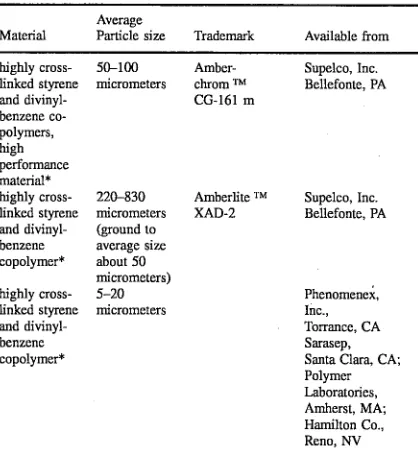
ticularly preferred particulate are:
Average
Material Particle size Trademark Available from
highly cross- 50-100 Amber- Supelco, Inc.
linked styrene micrometers chrom TM Bellefonte, PA and divinyl- CG—l6l m
benzene co
polymers,
high performance
material*
highly cross- 220-830 Amberlite TM Supelco, Inc.
linked styrene micrometers XAD-2 Bellefonte, PA
and divinyl- (ground to
benzene average size
copolymer* about 50
micrometers) '
highly cross- 5-20 Phenomenex,
linked styrene micrometers Inc., and divinyl- Torrance, CA benzene Sarasep, copolymer* Santa Clara, CA;
Polymer
Laboratories, Amherst, MA;
Hamilton Co.,
Reno, NV
*Disclosed in one or more of U.S. Pat. Nos. 4,501,826, 4,382,124, 4,297,220, 4,256,840, 4,224,415
The functionalized poly(styrene divinylbenzene) particles
can be cation or anion exchange particles. Strong cation
exchangers include the particles functionalized by, for
example, strong acid sulfonate (H503) groups which are
anionic; weak cation exchangers include the particles func tionalized by, for example, carboxylate (COOH) groups
which are anionic. Other functionalized poly(styrene divi
nylbenzene) particles can be strong anion exchangers which
include the base particles functionalized by, for example,
quaternary ammonium groups N"(R)3 wherein each R inde pendently can be C1 to C4 alkyl groups. Weak anion
exchangers include arninated groups N(R1)2 wherein each
R1 independently can be hydrogen, or C1 to C4 alkyl or
20 25 30 35 40 45 55 65
6
alkanol groups. Representative N (R1)2 groups include NHZ, N(C2H5)2, N(CH3)2, and N(C2H4OH)2, all of which are
cationic.
In a preferred embodiment, the invention relates to poly
(styrene divinylbenzene) particles which have been func
tionalized (i.e., chemically altered) by the addition of opti
mum levels of sulfonic acid groups to at least one of ortho
and para positions on the aromatic ring structure of the resin. Ring substitution by functional groups occurs in accordance with known rules of organic chemistry, see for example Carl. R. Noller, “Textbook of Organic Chemistry” W.B. Saunders
Company, Philadelphia, Pa. (1951) pp. 33l—35l. The func tionalized particle can be prepared from the base particle
which is mixed with glacial acetic acid and then reacted with
concentrated sulfuric acid. The reaction can be quenched with water when the desired degree of sulfonation is achieved. Details of this method are disclosed in Example 1, below.
It has been found that functionalization of the particles in the ion exchange concentration range of 0.1 to 2.5 mil
liequivalents of covalently bonded ionic functionality per
gram of functionalized polymer, preferably in the range of
0.15 to 2.0, more preferably in the range of 0.2 to 1.1 milliequivalents per gram, and most preferably in the ion exchange concentration range of 0.3 to less than 0.9 mil liequivalents per gram and even more preferred 0.3 to 0.8,
and the very most preferred about 0.3 to 0.6 milliequivalents per gram provides maximum retentivity of polar or semi
polar analytes in solid phase extractions.
In one embodiment, the range of sulfonate chemical
modi?cation levels to improve particle wettability coincides
with analyte capacity factor (k‘) enhancement to an optimum
[image:8.557.55.264.374.602.2]level of 0.6 milliequivalents per gram but further increased levels of sulfonate group substitution resulted in decreasing numerical values of the analyte capacity factor as shown in FIG. 1. This range of functionalization also provides opti mization of wetting characteristics of the particles. In SPE,
the sulfonate functionalized particles can be effective in the absence of a wetting agent.
In a second embodiment, carboxylate functional poly(sty
rene divinylbenzene) can be prepared for use in solid phase
extractions. In one method, poly(styrene divinylbenzene) resin particles can be chemically altered by oxidation of pendant groups such as aromatic vinyl or aromatic alkyl groups to form carboxylate functional groups. Such oxida
tion can be performed as is known in the art, using, for
example, oxidizing agents such as sodium hypochlorite,
potassium permanganate, or dilute nitric acid, in amounts so as to control the level of conversion to carboxylate groups.
See, for example, Lee, Donald G., ‘The oxidation of organic compounds by permanganate ion and hexavalent chro
mium", Open Court Publishing Company: La Salle, Ill.,
1980, p. 43-64, and J. March, “Advanced Organic Chem istry 3rd Ed”, Wiley-Interscience: New York, 1985. In a
second method, varying levels of carboxylate functionality can be obtained by copolymerization of styrene, divinylben
zene, and a suitable carboxylic acid functional monomer
such as methacrylic acid. This second method has been
described by R. Kunin in “Ion Exchange Resins”, 2nd
edition, Wiley: New York, (1958), p. 87, and by Meitzner et
al., U.S. Pat. No. 4,256,840.
The ability of organic resins to sorb certain analyte
molecules which are moderately water-soluble may be
directly related to the hydrophilic/hydrophobic nature of the
5,618,438
7
more SO3- substitution occurs but the effect on capacity
factor (k') is surprising because sulfonation above about 0.6 milli-equivalent/gram results in a decrease in the capacity
factor, (k'). Optimization of capacity factor (k') in the prior
art involved choosing among various functionalized particu late. This invention teaches modi?cation of the adsorptive character of a given particulate by controlled functionaliza tion of the particulate with appropriate levels of certain
functional groups.
Any of the particulate material may have a spherical shape, a regular shape or an irregular shape. Particulate
material which has been found useful in the invention has an average size within the range of 0.1 to about 150 microme ters, preferably in the range of 0.1 to 100 micrometers, more
preferably 1 to 100 micrometers, and most preferably 5 to 20
micrometers. It has been found advantageous in some
instances to employ particulate materials in two or more
particle size ranges falling within the broad range. As an
example, particles of the present invention having an aver age size in the range of 0.l—30 micrometers having solid phase extraction capability may be employed in combination
with particles having an average size in the range 1 to 150
micrometers acting as a property modi?er. Larger particulate
(e.g., 40 to 150 micrometers, even up to 4 mm or higher for
industrial applications) are particularly desirable for packed
columns and some nonwoven webs, particularly those dis closed in U.S. Ser. No. 07/929,985, now allowed, as U.S.
Pat. No. 5,328,758.
As noted above, more than one type of functionalized
poly(styrene divinylbenzene) particulate can be useful in
columns and membranes of the present invention. The
functionalized particles can be premixed in any proportion;
the total functionalized SPE particles of this invention can
be present in the range of more than 20 up to 100 weight percent of the total particles, preferably 35 to 100 weight percent, more preferably 50 to 100 weight percent organic polymeric particles, most preferably 90 to 100 weight per cent derivatized organic polymeric particles of this inven tion, and 0 to 80 weight percent of total particulate of any other SPE particles, preferablyO to 65 Weight percent, and more preferably 0 to 50 weight percent, and most preferably 0 to 10 weight percent of other SPE particles. Other SPE particles include porous organic-coated or uncoated par ticles, and porous organic polymeric particles which can be
functionalized or unfunctionalized.
In another aspect, the present invention provides an
improved SPE composite structure and method therefor, the
composite structure preferably being a uniformly porous composite sheet comprising sorptive particles of the inven
tion distributed uniformly throughout a ?brous matrix
formed of nonwoven ?bers. In such a structure almost all of
the particles are separate one from another and are entrapped
in a matrix of ?bers that restrains the particle. The preferred
sheet of the invention has a thickness in the range of 125 to
10,000 micrometers. The ratio of total particles to ?brous matrix is in the range of 40:1 to 1:4, preferably 19:1 to 4:1,
by weight.
In particle-loaded composite articles of the invention,
property modi?ers and adjuvants may be advantageously
added to the primary particulate material in the ?brous
medium to provide further improvement in or modi?cation
of properties. For example, modi?er particulate can include
inactive materials such as low surface area glass beads to act
as property modi?ers and processing aids. Coloring or ?uorescing particulate can be added at low levels (up to 10
weight percent of particulate) to aid in visualizing sample components to be separated. Chemically active particulate
15 30 35 50 55 60 65
8
adjuvants which indicate chemical activity or acidity of the sample components can be useful for diagnostic purposes.
When the present invention particles are incorporated into particle-loaded ?brous articles, which preferably are micro?brous articles, the articles comprise in the range of 20 to 80 volume percent ?bers and particulate, preferably 40 to 60 volume percent ?bers and particulate, and 80 to 20 volume percent air, preferably 60 to 40 volume percent air.
Fibrous matrices useful for incorporation of the particu
late of the invention include nonwoven webs, such as
nonwoven polymeric webs including polytetra?uoroethyl
ene (PTFE), polyole?ns such as polyethylene or polypro
pylene, polyararnid (e.g., Kevlar'l‘M, Dupont), polyamides
such as nylon 6 and nylon 66, polyurethanes, polyesters suchas polyethylene terephthalate, polyacrylonitrile (Cyanamid,
Wayne, N .J .); other nonwoven webs include glass ?ber webs
and ceramic ?ber webs.
PTFE provides a particularly useful ?brillated matrix for the present invention derivatized particulates. The compos ite article can be prepared, for example, by the methods disclosed in any of U.S. Pat. Nos. 4,810,381, 4,985,296,
5,071,610, 5,279,743, and 4,985,296.
Other webs useful for incorporating particles of the
present invention include nonwoven macro- and micro? brous webs such as melt-blown webs, spunbonded or air-laid webs, blown ?brous webs, as disclosed in U.S. Ser. No. 07/929,985, now allowed, as U.S. Pat. No. 5,328,758, which
is incorporated herein by reference for making and using
such webs. Pressing or fusing of the webs is generally not required in the articles of the present invention. Also useful
can be glass ?ber or ceramic ?ber webs. '
The particulate-containing ?brous webs of the invention
can be useful in a ?rst mode wherein the composite article
of the invention is used for preconcentration and isolation of
certain materials for further analysis by, for example, high
resolution column chromatography. In this mode, which is well known in the art and commonly called solid phase
extraction, solvent and sample ?ow are introduced at an
angle of about 90 degrees to the surface of the sheet. This is a conventional con?guration and the separation path length is equal to the thickness of the sheet. The path length can be
increased by stacking additional layers (media) which may
be the same or of different composition but the individual
layers need not be intimately bound together. This mode is effective for one step or multi-step adsorption-desorption
separations. This mode is effective using sorptive ion
exchange particulate in the normal or reverse phase modes. The article strongly adsorbs the analyte of interest onto the active particulate in the composite and undesirable compo
nents are washed out with a ?rst eluant. Conversely, unde~
sirable components can be strongly bound and the analyte
can be washed out with the ?rst eluant. A more effective
eluting solvent is then used to displace the desired compo
nent from the particulate allowing it to be recovered in a
more concentrated and uni?ed form.
The composite extraction articles of the invention can be of a variety of sizes and shapes. Preferably the articles can be sheet-like materials which, for example, can be in disk or
strip form.
This invention discloses a ‘solid phase extraction (SPE)
disk/sheet composite material and a method which is effec
tive, for example, in isolating polar, semipolar, and nonpolar organic contaminants from ?uids (gases and liquids). The
article can be used as a single self-supporting sheet, or a combination of sheets to form a stack, or as a composite ?lm
5,618,438
9
mers. The article is preferred for polar and semi-polar
analytes. In particular, residues of explosives, phenolic
compounds, and organic acids are common contaminants of
solids, air, and water, and can be e?iciently removed, concentrated, or isolated using the teachings of the present
invention. The isolations can be performed on an analytical
scale or in large scale applications.
Analytes which are nonpolar, i.e., minimal dipole moment, are hydrophobic and usually exhibit high capacity
factor (k‘) levels with hydrophobic sorptive particles such as
C18 bonded silica and neutral macroporous resins such as
poly(styrene divinylbenzene). Using the functionalized par ticles of the present invention, these non-polar analytes are
not expected to exhibit substantial increases in (k‘) values compared to those (k‘) increases found for polar and semi polar analytes. Some elevation of capacity factor (k‘) can
occur due to increased surface area available from access to
wetted internal pores.
Representative polar and semi-polar compounds (ana
lytes) which can be sorbed by the functionalized particles of the present invention include explosives such as l,3,5,7
tetranitro-l,3,5,7-tetraazacyclooctar1e (HMX), explosive
impurities such as dinitrotoluene, and phenolic compounds
such as phenol, 2-chlorophenol, 4-chlorophenol, o- or
p-cresol, 2- or 4-nitrophenol, 4,6-dinitro-o~cresol, 2,4-dini
trophenol, 2,4-dimethylphenol, 4-chloro-3-methylphenol,
2~methyl-4,6-dinitrophenol, pentachlorophenol, 2,4-dichlo
rophenol, 2,4,5-trichlorophenol, and 2,4,6-trichlorophenol,
and catechol, which are pollutants in water and which are of
environmental concern. Representative pesticides, generally
considered semi-polar compounds, which can be recovered
from aqueous liquids include atrazine, alachlor, and diazi
non. Representative drugs, generally considered semi-polar
compounds, include d-amphetamine, methamphetamine,
salicylate, ibuprofen, butalbital, acetaminophen, arnobar
bital, pentobarbital, secobarbital, glutethimide, phencyclid
ine (PCP), phenobarbital, naproxyn, methadone, methaqualone, propoxyphene, cocaine, irnipramine, desiprarnine,
phenytoin, codeine, morphine, and ?urazepam.
Neutral analytes such as ethyl pymvate and butanedione
exhibit a maximum capacity factor within the concentration
range of the invention. These compounds are commonly
extracted from water using liquid/liquid extractions (LLE),
described in EPA Method 608, 625, etc. It is highly desirable
to replace liquid-liquid extraction (LLE) methods with solid phase extraction (SPE) materials and methodology to reduce
or eliminate extraction solvent usage, extraction time, and
environmental hazards. This aspect of the invention dis closes using a hybrid of column particle and membrane technologies to provide a means of overcoming the de? ciencies of conventional methods with substantial savings in
time and cost.
It has been found advantageous where combinations of
contaminants are to be extracted to use a stack of disks (e. g.,
2 to 5 or more) with one or more types of particulate chosen,
each having optimum extraction or reaction e?iciency for individual contaminants. Choice of elution solvents depends
on contaminants and extraction particulate.
This invention is useful in the extraction of inorganic and organic substances from liquids and gases in a ?ow-through
or ?ltration mode. The invention can be used on an analyti
cal scale, as in the testing of water samples for environmen tal pollutants. This invention can also be used on a larger scale as in the remedial removal of contaminants or analytes
from liquid or gas sources.
After use, the article can be recycled by simply eluting the sorbed pollutants from the article using a liquid capable of
10 15 20 25 35 40 50 60 65
10
removing the sorbed materials from the sorbent. Heat or
supercritical ?uid displacement or elution of the sorbed
analyte can also be used.
Particles which can be loaded in a packed column and
composite articles of the invention have utility in a wide
variety of separations wherein the choice of the particulate
material is useful for size controlled ?ltration or steric
exclusion, for simple one step or multistep sorption-desorp tion separations of speci?c components, for applications
where sorptive particulate perform chemical or biochemical separations, for ion-exchange conversions of cations and
anions, for puri?cation of materials, and for chromato graphic separations and analyses in both passive and forced
?ow modes, for hydrophobic reverse phase and normal phase chromatography, all being processes which are known
to those skilled in the art.
Objects and advantages of this invention are further
illustrated by the following examples, but the particular
materials and amounts thereof recited in these examples, as well as other conditions and details, should not be construed to unduly limit this invention.
EXAMPLES
Example 1
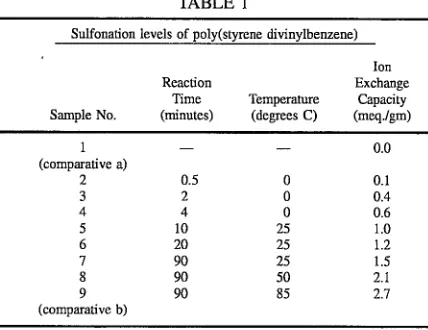
Chemical modi?cation of poly(styrene divinylbenzene) A ?rst procedure utilized 2 gram portions of 8 micrometer
poly(styrene divinylbenzene)(SDVB) resin particulate from
Sarasep, Santa Clara, Calif. Eight resin samples were each
mixed with 2 milliliters of glacial acetic acid to form a
slurry. Concentrated sulfuric acid was added sequentially in ?fty milliliter portions to each of these slurn'es and allowed
to react at different temperatures and for different times. The reactions were then quenched by dilution of the sulfuric acid in the mixture with water and the resin particles were
separated by ?ltration. After washing with water and drying,
the degree of sulfonation of each sample was determined by
titration with a standard solution of sodium hydroxide to
determine ion exchange capacity in milliequivalents per gram. Reaction times, temperatures, and "exchange capacity
in milliequivalents per gram are listed for these samples in
[image:10.557.291.505.537.702.2]Table 1.
TABLE 1
Sulfonation levels of poly(styrene divinylbenzene)
Ion
Reaction Exchange Time Temperature Capacity
Sample No. (minutes) (degrees C) (meqJgm)
l — — 0.0
(comparative a)
2 0.5 0 0.1
3 2 0 0.4
4 4 0 0.6
5 1O 25 1.0
6 20 25 1.2
7 90 25 1.5
8 90 50 2.1
9 90 85 2.7
(comparative b)
Sample 1 (comparative a) was unfunctionalized poly(sty
rene divinylbenzene) starting material and Sample 9 (com
5,618,438
11
A second procedure for chemically modifying poly(sty rene divinylbenzene) comprised mixing 5 ml of glacial
acetic acid and 5 ml of concentrated H2804 with a sample of the base resin. A 60-minute reaction at room temperature produced a dark orange resin, but it was not wettable. Finally a reaction time of 5-10 minutes was used with heating (100°—150° C.). These resins were dark brown and wettable
by aqueous solutions. The ?nal resin with a capacity of 0.7 mcq SO3'/g was made by the following conditions:
Two g. of macroporous poly(styrene divinylbenzene) resin (Sarasep, Inc.) were dried with gentle heat (100° C. for
5—1 0 minutes). Glacial acetic acid (5 mL) was added and the mixture was placed in an oil bath at 150° C. Concentrated
H2804 (5 mL) was added and the mixture was vigorously
stirred with a cross-shaped magnetic bar for 5 minutes. The
reaction was quenched by pouring the mixture into 100 mL
of cool H2O. The aqueous mixture was ?ltered and rinsed
with successive 100 mL portions of deionized water, acetone, and methanol. The functionalized polymeric resin
was then dried at approximately 100° C. for several hours. The resin was pre-wetted with methanol and then solid
phase extraction of several phenols was performed with this resin (50 mg of resin particles packed in a small SPE column
(20 mrn><2.l mm ID). Each phenol was present in 15 mL of H20. After SPE was performed, each phenol was eluted with 1 mL of methanol. Recoveries (average of three trials) are listed below in Table 2.
TABLE 2
SPE of Phenols Using Sulfonated Resin
Compound Percent Recovery phenol 95% 2-chlorophenol 96 4-chlorophenol 93 p-cresol 92 2,3-dichlorophenol 82
Example 2
Capacity factor (k') vs ion exchange capacity
Samples 1 through 9 listed in Table l were packed into a
column to evaluate the elIect of various levels of sulfonation
of the poly(styrene divinylbenzene) on sorptive capacity. A
series of relatively hydrophilic compounds including phe
nol, catechol, ethyl pyruvate (a neutral ester), and 2,3
butanedione (a neutral ketone) were then passed through the column without methanol pre-wetting to determine capacity factors (k'). Data obtained is listed in Table 3.
TABLE 3
Analyte Capacity Factors with
Unwetted Particles
Capacity Factor (k‘)
Ethyl Butane-' Sample Capacity* Phenol Catechol pyruvate dione
l 0.0 21 l 0 1
(compara
tive)
2 0.1 40 1 0 O
3 0.4 272 34 40 3
4 0.6 436 60 60 12
5 1.0 315 59 54 8
6 1.2 290 56 38 7
15
20
25 30
35
45
50
55
65
12
TABLE 3-continued
Analyte Capacity Factors with
Unwetted Particles
Capacity Factor (k')
Ethyl Butane
Sample Capacity* Phenol Catechol pyruvate dione
7 1.5 183 38 26 6
8 2.1 80 16 9 3
9 2.7 47 10 5 2
(compara
tive)
*SO3_ ion exchange capacity in milli-equivalents/gram from Table 1.
Example 3
Capacity factor (k') vs ion exchange capacity
Examination of data in Table 3 shows that the capacity
factor (k‘) in each case reached a maximum value when the
ion exchange capacity was about 0.6 milliequivalents per gram. A second trial was performed using the particulate
wetting procedure described by Hagen et al., Analytica
Chirnica Acta, 236 (1990) 157-164, and the results are
shown in Table 4.
TABLE 4
Analyte Capacity Factors With Wetted* Particles
lon Capacity Factor 0r’)
Exchange Ethyl Butane Sample Capacity** Phenol Catechol pyruvate dione
1 0.0 49 10 0 1
(eompara- ' ‘
tive)
2 0.1 124 32 4 2
3 0.4 350 45 49 4
4 0.6 457 90 79 14
5 1.0 381 70 55 8
6 1.2 324 78 57 7
7 1.5 209 45 34 6
8 2.1 127 25 16 4
9 2.7 55 12 6 2
*particulate wetted with methanol
**SO3_ ion exchange capacity in milli-equivalents/gram
Examination of data in Tables 3 and 4 show that the
capacity factor (k') for the ester, ketone and phenolics in
each case reached a maximum value when the ion exchange
capacity was about 0.6 milli-equivalents per gram of par
ticulate.
FIG. 1 illustrates graphically the optimization of the
capacity factor (k') by controlling the degree of sulfonation
of the particulate.
It is important to note that the unfunctionalized particulate gives a low value for the capacity factor (k‘). The poly(sty
rene divinylbenzene) particulate that was more highly sul~
fonated and is typical of a cation exchange resin of prior art
also gave a low value for the capacity factor (k'). The
maximum capacity factor (k') value occurred at about 0.6 milliequivalents/gram for the sulfonated particle but can
vary for other functional groups such as the acetyl or
hydroxyl groups which increase wettability.
More particularly, in the Drawing, FIG. 1 shows four plots from data of Table 6 of phenol capacity factor (k') vs. ion
5,618,438
13
More speci?cally, in each run the particles were 5-8 micrometer average diameter and were packed in a column 20 mm><2.l mm ID. Plot A shows data of a run using
methanol wetted sulfonated poly(styrene divinylbenzene)
particles (sample 4 of Table 1); plot B shows data of a run
using non-wetted sulfonated poly(styrene divinylbenzene)
particles (sample 4 of Table 1); plot C shows data of a run
using a mixture (sample 10b of Table 6) of sulfonated
poly(styrene divinylbenzene) particles (sample 9 of Table 1)
and unfunctionalized poly(styrene divinylbenzene) particles
(sample 1, Table 1), the particles having been wetted with
methanol before the run; plot D shows data of a run using a
mixture of non-wetted sulfonated poly(styrene divinylben zene) particles (sample 9 of Table 1) and unfunctionalized
poly(styrene divinylbenzene) particles (sample 1, Table 1).
Plots A, B, C, and D show that there is a maximum capacity factor (k') achieved when the ion exchange capacity of the
derivatized poly(styrene divinylbenzene) is in the range of
0.1 to 2.5 milliequivalents, preferably 0.15 to 2.0 mil
liequivalents per gram, and more preferably 0.2 to 1.1
milliequivalents. For wetted and non-wetted particles, there
is a maximum capacity for phenol achieved when the ion
exchange capacity of the functionalized poly(styrene divi
nylbenzene) is in the range of 0.1 to 2.5 milliequivalents per
gram of functionalized poly(styrene divinylbenzene), pref
erably 1.5 to 2.0 and most preferably 0.2 to 1.1 milliequiva
lents per gram. Wetted particles provide optimal capacity factor (k') of functionalized poly(styrene divinylbenzene)
particles. As shown by plots C and D, a mixture of func tionalized and non-functionalized particles provided very little increased capacity factor (k') with increase in ion
exchange capacity, although the wetted particles showed
some bene?t in capacity factor (k') compared to a mixture of non-wetted particles.
Example 4
PTFE composite membranes comprising 80% of sample 4 sulfonated poly(styrene divinylbenzene) (0.6 meq/gm ion
exchange capacity) and 20% by weight PTFE were evalu
ated for their ability to extract a series of phenolic com pounds listed in Table 5 below. The recoveries obtained were
compared to those obtained for PTFE composite membranes
comprising 20 weight percent PTFE and 80 weight percent
AmberChrome 71 resin, which was disclosed in US. Pat.
No. 5,279,742, as a desirable sorptive particle. One hundred parts per billion by weight of each phenol were prepared in
a 500 milliliter volume of deionized water. The pH was
adjusted to 2.0 with HCl and 10% by weight NaCl was added to help salt out the soluble phenols from the aqueous
phase to the sorptive solid phase. This procedure is well
known in the art. Lowering the pH assures that the phenols are protonated for better transfer to the hydrophobic SPE
media.
The water sample containing the phenolic analytes was pulled through the SPE membrane (47 mm diameter) using a standard ?ltration apparatus (Millipore Corp., Bedford,
Mass.) with water aspirator vacuum of 66 cm (26 inches) of Hg. After the extraction step, the phenolic analytes were
eluted from the membrane with 3 successive 3 mL aliquots
of tetrahydrofuran (THF). The 3 aliquots were combined and
THE was added to give a ?nal volume of 10 milliliters for
analysis by liquid chromatography. The analytical results
listed in Table 5 are an average of 4 determinations for the
sulfonated poly(styrene divinylbenzene) and 3 determina
tions for the AmberChrom 71.
15
25
35
45
50
55
60
65
14
TABLE 5
Recovery Data for the SPE of Phenols
Percent Recovery Sulfonated poly
(styrene divinyl
benzene)
Compound (0.6 meq/gm) AmberChrom 71
phenol 79.0 9.6
4-nitrophcnol 94.7 27.2 2,4-dinitrophenol 85.4 26.9 2-nitrophenol 65.8 16.7
2,4-dimethylpheno1 72.4 20.7
4—chloro»3>methylphenol 85.1 28.7
2<methyl—4,6-dinitrophenol 79.5 33.6
2,4,6-trichlorophenol 75.9 30.0
pentachlorophenol 96.1 37.2
The data show the recoveries obtained for the sulfonated
poly(styrene divinylbenzene) were considered very good for
these phenols compared to those obtainable using a conven
tional sorptive particulate, AmberChrom 71.
Example 5
Capacity factor (k') for phenol versus degree of sulfona
tion of poly(styrene divinylbenzene) sorbent
Data in Table 6 (which contains data of Tables 3 and 4,
columns 1-3 for samples 1-9) show that an optimum capacity factor (k') can be achieved by controlled function
alization of the poly(styrene divinylbenzene) polymer par
ticles. In additional trials, simple mixtures of the un-sul
fonated (neutral) particles and heavily sulfonated particles (strong cation exchange) as illustrated by samples 10a, 10b,
and 100 did not achieve optimization of the capacity factor (k') as shown by samples 1-9.
TABLE 6
Capacity factor (k') for
phenol vs. degree of sulfonation of
poly(styrens divinylbenzene) sorbent Ion Exchange
Capacity CH3OH
Sample (meq. S03“ Wetted Non-wetted number lgm) (k') (k')
l(“) 0.0 49 21
2 0.1 124 40
3 0.4 350 272
4 0.6 457 436
5 1.0 381 315
6 1.2 324 290
7 1.5 209 183
8 2.1 127 80
9”’ 2.7 .55 47
1011*“) 0.0 50 21
10b** 0.6 56 33
l0c*(“) 2.7 53 47
(“comparative
*second trial of samples 1 and 9'respectively to compare (k') of mixtures **mixture of portions of samples 10a and 10c give sample 10b with a net ion
exchange capacity of 0.6 meq SO3—/gm
Example 6
A. Samples of macroporous poly(styrene divinylbenzene)
5,618,438
15
al. in U.S. Pat. No. 4,256,840 wherein the ion exchange capacities were varied by changing the ratio of methacrylic acid, divinylbenzenc and styrene starting monomers. These
samples with ion exchange capacities ranging from 0 for non-carboxylated base poly(styrene divinylbenzene), to 0.3,
2.9, and 5.8 milliequivalents per gram for carboxylated
resins, were incorporated into 0.5 mm thick PTFE sheet
material comprising 20 percent PTFE and 80 percent by weight of each resin particulate using a process described in
U.S. Pat. No. 5,147,539. Forty seven millimeter diameter disks were cut from these sheet materials and the particle
loaded disks comprising particles with varying ion exchange capacities were individually tested for SPE e?iciency using
the phenolic analytes listed in Table 5.
In these trials, 500 milliliter test samples containing a mixture of 100 parts per billion (100 pg per liter) of each
phenolic analyte in distilled water were adjusted to a pH of
2 with hydrochloric acid. (Acidi?cation is often used to suppress ionization and keep the phenolic analyte in the protonated form to enhance extractability by reverse phase
particulate.) Samples were pulled through the disks mounted
in a standard MilliporeTM ?ltration apparatus using a
vacuum of 66 cm (26 inches) Hg. Phenolic analytes adsorbed from these water samples by the resin loaded disks were subsequently desorbed i.e., eluted from the disks using
2 sequential l0 milliliter portions of tetrahydrofuran (THF)
which were then combined and brought to 25 milliliter analytical volumes with THE. These eluant solutions were
analyzed by liquid chromatography to measure the phenolic
analyte content to determine the percent recovery obtained
[image:13.557.232.505.665.744.2]by the SPE process. The data is shown in Table 7A, below.
TABLE 7A 15
20
25
16
0.3 milli-equivalents per gram ion exchange capacity level of carboxylate group. Recovery levels for 4-nitrophenol subsequently decreased when higher levels of carboxyl
groups were present. Recoveries of the 2-nitrophenol isomer
were consistently high regardless of the level of carboxylate
group substitution. This is not unexpected since the close
proximity of the nitro and phenol groups favors intramo lecular hydrogen bonding and results in decreasing water solubility. The 2,4-dinitrophenol analyte recoveries were higher than those found for 4-nitrophenol but also decreased with increasing levels of carboxylate substitution of the
sorptive resin particulate.
B. In another set of trials, a series of partially carboxylated copolymer resin particulates were prepared via the method
as described by Kunin (see Example 6A) using various
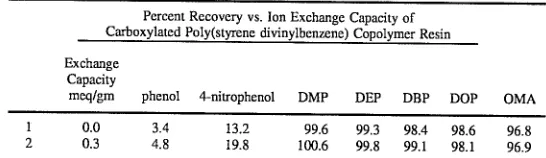
levels of methacrylic acid monomer. These resin particles were incorporated into PTFE membranes comprising 80 weight percent particles and 20 weight percent PTFE as described above. The resulting composite articles were
evaluated for sorptive properties using polar probe com
pound analytes; phenol, 4-nitrophenol, and neutral probe
analytes: dimethyl phthalate (DMP), diethyl phthalate
(DEP), dibutyl phthalate (DBP), dioctyl phthalate (DOP),
and o-methyl anisole (OMA) (an ether). Experimental procedure was the same as for Table 7A, except that the analytes were present at 5 parts per million (5 mg per liter) and methanol was present at two percent by volume due to
sample preparation procedures. The data of Table 7B show
the percent recoveries obtained. Maxirna occurred at the
level of 0.3 rnilliequivalent carboxylate functionality per
gram of copolymer resin for phenol and 4-nitrophenol. The
Percent Recovery of Phenols vs Ion Exchange Capacity of Carboxylated SDB Copolymer Resin
Exchange 4<chloro,
Capacity 4—nitro 2,4-dinitro 2»nitro 2,4-di methyl 3~methyl 2,4~dichloro 2,4,6-trichloro pentachl oro
(mcq/gm) phenol phenol phenol phenol phenol phenol phenol phenol phenol
0* 7.0 37.0 105.41’ 104.11‘ 108.31‘ 85.6 91.9 102.11‘ 93.2
0.3 16.4 94.1 99.7 98.0 104.9? 83.2 89.7 96.8 91.8
2.9 12.5 60.5 89.0 90.1 92.0 73.9 83.8 91.1 94.8
5.8 10.1 45.6 78.5 93.4 87.2 80.2 91.9 102.11‘ 93.2
Average % 13.4 3.0 2.6 2.7 4.0 5.4 4.3 4.6 3.6 RSD**
*represents comparative sample of unfunctionalized poly(stryene divinylbenzene) **relative standard deviation
'h'ccoveries above 100% represent experimental scatter
Data in Table 7A indicate that good recoveries were found
for the less polar phenolics tested (i.e., Z-nitrophenol, 2,4
dimethyl phenol, 4-chloro-3-methyl phenol, 2,4,6-trichlo~
rophenol, and pentachlorophenol) with little dependence on the level of carboxyl groups present on the poly(styrene
divinylbenzene)sorbent. Better recoveries were obtained for
the more polar phenolic analytes (phenol and 4-nitrophenol).
In particular, phenol and 4-nitrophenol exhibited a de?nite maximum percent recovery with the resin sample which had
50
phenol and 4-nitrophenol analytes are polar and showed low capacity factors (k‘) which gave lower percent recovery
levels using the poly(styrene divinylbenzene) copolymer
resin based particles. The phthalate esters and o-methyl anisole are neutral analytes and had high capacity factors (k')
as shown by the near 100 percent recovery levels, and no
effect on recovery levels was observed with di?‘erent levels
of carboxylate functionality.
TABLE 7B
Percent Recovery vs. lon Exchange Capacity of
carboxylated Poly(styrene divinylbenzene) Copolymer Resin Exchange
Capacity
meq/gm phenol 4-nitrophenol DMP DEP DBP DOP OMA
1 0.0 3.4 13.2 99.6 99.3 98.4 98.6 96.8
5,618,438
17
TABLE 7B-continued
18
Percent Recovery vs. Ion Exchange Capacity of
Carboxylated Poly(styrene divinylbenzcne) Copolymer Resin
Exchange
Capacity
meq/gm phenol 4-nitrophenol DMP DEP DBP DOP OMA
3 0.6 3.5- 14.3 100.1 99.2 98.7 98.2 96.2
4 0.9 3.3 14.4 100.0 99.6 98.9 98.3 96.6
5 1.5 4.1 16.3 99.3 99.3 98.0 97.4 95.8
It is recognized in the art that analyte capacity factor (k')
values are directly proportional to analyte recovery levels in
SPE processes. Data of Tables 7A and 7B show that con
trolling the level of carboxyl functionality on poly(styrene
divinylbenzene) copolymer resin can be used to maximize
extractability of certain analytes.
Example 7
Comprehensive Serum and Urine Drug Screens Disks comprising 20 percent PTFE and 80 percent sample number 4 from Table 3, Example 2 (poly(styrene divinyl
benzene) particulate functionalized with sulfonate func tional group at an ion exchange capacity of 0.6 meq/gm) were tested in a comprehensive drug screening procedure. The results were compared with data obtained using disks comprising 20 percent PTFE and 80 percent Clean ScreenTM
(CS) particulate from United Chemical Technology, Bristol,
Pa. (commercially available silica based particles coated
with a mixed phase comprising an octyl reverse phase group and a strong cation exchange functionality). Results were
also compared with data obtained using TOXI-TUBEs for
acidic and basic drug extractions from urine, commercially available from Toxi-Lab, Inc., Irvine, Calif.
Materials and Methods
Drug Standards
Stock standard solution used was 100 ug/mL of each of
the following drugs in methanol:
d-amphetamine naproxyn methamphetamine methadone
salicylate methaqualone
ibuprofen propoxyphene
butalbital cocaine
acetaminophen imipramine
amobarbital desipramine
pentobarbital phenytoin
secobarbital codeine
glutethimide morphine
phencyclidine (PCP) ?urazepam
phenobarbital
Internal standard solution used was 0.5 mg/mL cyhepta
mide in methanol.
Extraction Procedure——Extraction Disk Cartridges (3M Co.,
St. Paul, Minn), (Columns B and C in Table 8)
1. Samples were prepared as follows:
Urines: Sequentially were added 3 mL distilled water, 2
mL 0.1M phosphate buffer (pH=6.0), and 10 uL of internal
20
25
40
50 55
60
standard solution to 2 mL of urine (spiked with an appro- I
priate amount of drug standard). Samples were thoroughly
shaken.
Serums: Sequentially were added 4 mL distilled water, 2
mL 0.1M phosphate buffer (pH-=60), and 10 uL of internal
standard solution to 1 mL of serum (spiked with an appro 65
priate amount of drug standard). Samples were thoroughly
shaken.
2. The extraction disk cartridge was conditioned with sequential additions of one 3-mL volume of methanol, one 3-mL volume of distilled water, and one l-rnL volume of
0.1M phosphate buffer (pH=6.0). Each addition was aspi~
rated but the disk was not allowed to dry.
3. Sample was applied and aspirated at full vacuum. 4. Disk cartridge was washed with one 3-mL volume of distilled water followed by one l-mL volume of 1.0M acetic acid. Disk cartridge was dried at full vacuum for 5 minutes, then washed with one 2-mL volume of hexane.
5. Elution of acidic and neutral drugs was accomplished using one 3-mL volume of hexane/ethyl acetate (50/50); the
eluate was collected at less than 5 mL/minute, then trans
ferred into a conical bottom dry down tube.
6. The disk cartridge was washed with one 3‘mL volume of methanol and dried at full vacuum for 5 minutes.
7. Basic drugs were eluted with one 2-mL volume of
elution solvent (24 mL methylene chloride, 6 mL isopro
panol, and 0.9 mL ammonium hydroxide; made fresh daily).
Eluate was transferred into the same tube as the previous
eluate.
8. The eluate sample was concentrated by drying under a gentle stream of compressed air without heating. When completely dry, 150 pL of chloroform was added to the residue and the sample was thoroughly mixed.
9. Sample was analyzed by injecting l pL of chloroform solution containing the analytes into a chromatograph.
Extraction Procedure—Liquid-Liquid Extraction for Urines
(Columns D and E in Table 8)
1. Each extraction tube was prepared by adding 2 mL of urine (spiked with an appropriate amount of drug standard) and 10 uL of internal standard solution (described above) to
TOXI-TUBEs (basic and acidic extractions).
2. Contents of each extraction tube was mixed by gentle
inversion for a minimum of ?ve minutes.
3. The tube was centrifuged at high speed for 5 minutes. 4. The organic layer was transferred to conical bottom dry
down tube.
5. The sample was concentrating drying the organic layer
under a gentle stream of compressed air without heating. When completely dry, 150 uL of chloroform was added to
the residue and the tube was shaken.
6. The sample was analyzed by injecting l pL of chloro
form containing the analytes into a chromatograph. Extraction Procedure—Liquid-Liquid Extraction for Serum
(Column A in Table 8)
Stock Solution A:
Ammonium sulfate crystals were washed twice with methanol and dried at 100° C. for several hours. A super
saturated solution of the crystals was prepared in distilled
water. Twenty mL of concentrated hydrochloric acid was
then mixed with 250 mL of the supersaturated ammonium
5,618,438
19
1. Each extraction tube was prepared by adding 0.4 mL of Stock Solution A with 10 uL of internal standard (described
above), to 1 mL of serum (spiked with an appropriate
amount of drug standard). Nine mL of methylene chloride
extraction solvent were then added.
2. The tube was shaken for 5 to 10 minutes.
3. The tube was centrifuged at high speed for 5 minutes.
4. The methylene chloride layer was transferred to a
conical bottom dry down tube.
5. The sample was concentrated by evaporating the meth ylene chloride extraction solvent using a gentle stream of
compressed air. When completely dry, 150 1.1L of chloroform
were added to the extracted residue and the sample was
thoroughly mixed.
6. Analyze sample. One (1) pl, of chloroform containing
the analytes was injected into a chromatograph for analysis.
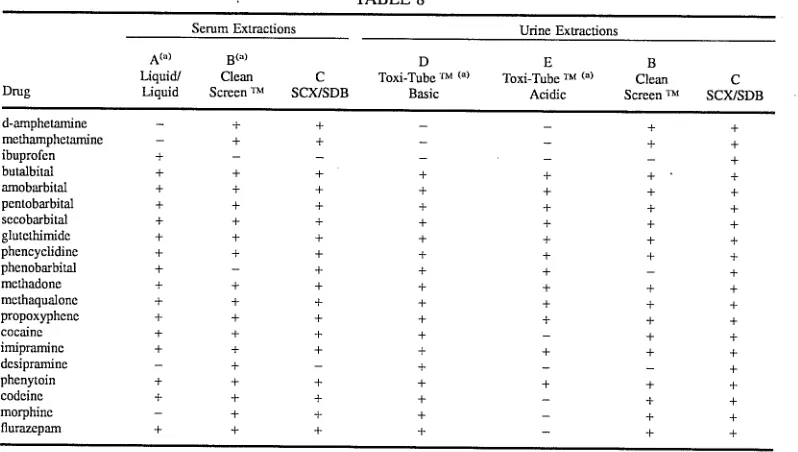
TABLE 8 15
20
mation using the present invention materials. Further, the present invention provides a lower detection limit for drugs.
Various modi?cations and alterations of this invention will become apparent to those skilled in the art without
departing from the scope and spirit of this invention, and it
should be understood that this invention is not to be unduly limited to the illustrative embodiments set forth herein.
We claim:
1. A method of isolating at least one analyte from a ?uid
comprising the step of:
passing a ?uid including at least one non-ionic neutral
analyte through at least one solid phase extraction
medium comprising
(a) a ?brous matrix, and
(b) sorptive particles enmeshed in said matrix compris
ing
Serum Extractions Urine Extractions
8(a)
Clean Screen TM
At“)
Liquid! Liquid
D C
SCX/SDB
Drug Basic
Toxi-Tube TM (a)
E Toxi»Tube W l“)
Acidic
B Clean
Screen “4
d-amphetarnine methamphetamine
ibuprofen
butalbital
amobarbital pentobarbital secobarbital glutethimide phencyclidinc phenobarbital methadone
methaqualone
propoxyphenc cocaine
irnipraminc desipramine
phenytoin codeine morphine
?urazepam
+|++|+++++++++++++|
++++++++++|++++++|++ ++++|++++++++++++1++
+++++++++++++++++|t
ll+l+l++++++++++|
++++|+++++|++++++|++ ++++++++++++++++++++
(“comparative
A Liquid/Liquid extraction - conventional method
B Clean Screen - particle loaded web as a disk in a cartridge format
C SCX/SDB > present invention particle loaded as web; a disk in a cartridge D Toxi-Tube Basic > (comparative) liquid/liquid extraction
E Toxi-Tube Acidic - (comparative) liquid/liquid extraction
The data of Table 8 show that the present invention particle-loaded membranes were at least as good and in most instances better as a screening device than conventional
devices for establishing the presence of 20 commonly tested
drugs.
Advantages of sulfonated poly(styrene divinylbenzene)
particles in a membrane format for comprehensive drug screening include eliminating the need for separate basic and acidic liquid/liquid extractions, and thus two injections for
chromatographic analysis. The present invention membrane
allows for one extraction (two elution solvents are used and
combined before dry down) and one injection for chromato graphic analysis, which saves time.
The present invention membrane allows more drugs to be detected in the screening method when compared to con
ventional liquid/liquid analyses [e.g., amphetamine, meth
amphetamine, morphine, codeine, cocaine (serum) and
amphetamine, methamphetamine, ibuprofen, phencyclidine,
phenobarbitol (urine)].
The present invention membrane saves time and money in
this screening mode. Also, there is the potential for auto
50
55
60
(1) in the range of more than 20 to 100 weight
percent, based on total particles, of functionalized
poly(styrene divinylbenzene) particles comprising
at least one ionic functional group selected from
the group consisting of sulfonate group, carboxy late group, quaternary ammonium groups N"(R)3 wherein each R independently is selected from C1
to C4 alkyl groups and aminated groups N(R‘)2
wherein each R1 is independently selected from
the group consisting of hydrogen, C1 to C4 alkyl
groups, and C1 to C4 alkanol groups covalently bonded thereto, the functionalized particles hav
ing sorptive capability towards said non-ionic
neutral analyte, the ionic functional group being
present in a concentration range of 0.1 to 2.5
milliequivalents per gram of poly(styrene divinyl benzene), and
(2) in the range of 0 to less than 80 weight percent,
based on total particles, of porous, organic-coated
[image:15.557.60.459.259.485.2]5,618,438
21
the ratio of sorptive particles to ?brous matrix being in the range of 40:1 to 1:4 by weight.
2. The method according to claim 1 wherein said analyte exhibits a maximum value in ion exchange capacity factor (k') toward said functionalized particles in said concentra tion range of 0.1 to 2.5 milliequivalents per gram of poly
(styrene divinylbenzene) compared to ion exchange capacity
factor (k') of the same analyte toward functionalized sul fonated, carboxylated, quaternary a