: THE DYNAMICS OF INFORMATION FLOW
Robert Bruce Lee
A Thesis Submitted for the Degree of PhD
at the
University of St Andrews
1974
Full metadata for this item is available in
St Andrews Research Repository
at:
http://research-repository.st-andrews.ac.uk/
Please use this identifier to cite or link to this item:
http://hdl.handle.net/10023/15139
COGNITIVE PROCESSING IN COMPLEX SITUATIONS : THE DYNAMICS OF
INFORMATION FLOW
by
ROBERT BRUCE LEE ' I
Doctor of Philosophy University of St. Andrews
August 1974
All rights reserved
INFORMATION TO ALL USERS
The quality of this reproduction is dependent upon the quality of the copy submitted.
In the unlikely event that the author did not send a com plete manuscript and there are missing pages, these will be noted. Also, if material had to be removed,
a note will indicate the deletion.
uest
ProQuest 10166200
Published by ProQuest LLO (2017). Copyright of the Dissertation is held by the Author.
All rights reserved.
This work is protected against unauthorized copying under Title 17, United States C ode Microform Edition © ProQuest LLO.
ProQuest LLO.
789 East Eisenhower Parkway P.Q. Box 1346
I hereby certify that Mr Robert Bruce Lee has completed nine
terms of research work under my supervision, has fulfilled the
conditions of the Resolution of the University Court, 1967,
No. 1, and that he is qualified to submit the accompanying
thesis in application for the Degree of Doctor of Philosophy.
Research Supervisor
DECLARATION
I hereby declare that this thesis has been
composed by myself, that the work of which it is a record has been done by myself and that it has not been accepted in any previous application for a higher degree in the University of St, Andrews or elsewhere.
Signed:
Robert Bruce Lee
14 August, 1974.
I
$
(i)
ABSTRACT
Cognitive processing performance in complex situations - the dynamics of information flow.
Ph.D. thesis by Robert B, Lee,
Department of Psychology, University of St. Andrews,
The thesis describes and develops a new theoretical approach to the study of human cognitive processing performance in complex situations. This approach utilises and integrates existing theoretical and empirical data from a number of traditionally
separate areas of information processing psychology, such as cognition, perception, memory, imagery, skill and vigilance.
Contemporary cognitive psychology considers perception,
memory and imagery as functionally inter-related and inter-dependent processes characterised by active, constructive, conscious information processing* In the present thesis the implications of this view are extended, in that this processing is considered to occupy the
cognitive processing capacity of the subject in qualitatively the same way as does normal decision-making, problem-solving, or conscious internalised thought processing of any kind. Existing research evidence accumulated over the past 20 years suggests that this conscious information processing capacity is limited.
In dual-task situations inter-task interference resulting from attention alternating between the information processing requirements of the two tasks, has been demonstrated in numerous experiments. If the above cognitive view of perception, memory and imagery is correct, such inter-task interference should take place between * externalised* and ’internalised* tasks, - i.e. thought processes should interfere with visual perception. There exists
(11)
'i some experimental evidence that this is the case in certain
situations. However, unlike the inter-task interference observed in typical dual-task situations, our ongoing conscious stream of perceptual awareness does not appear to be continually intermittently interrupted as information processing referent to some other
cognitive task * captures' the single channel.
There is evidence from one area of research that memory information concerning expected, over-learned familiar visual patterns may be incorporated into the perception of such patterns. Conversely, the recent increase in research investigation into the phenomena of mental imagery has demonstrated that real sensory information may be incorporated into internally synthesised images. Perceptual information emanating from real sensory information input and perceptual information emanating from memory, in the form of
images, may be phenomenally indistinguishable at the level of :1 conscious perceptual experience.
The present thesis re-appraises the possible function of the mechanisms of the imagery system. It is suggested that the role of imagery in human performance in familiar perceptual environments is to reduce the cognitive processing requirements referent to the analysis of real sensory information from these environments, thereby making available additional capacity for thinking, while moving about in these environments. The imagery system may be utilised in these situations to augment or enhance partially
processed real sensory information. In this way, conscious perceptual experience is not interrupted, but the total amount of information forming this experience may consist, at any instant, of a composite of information from memory and from the real environment. The relative amounts of real and memory-derived
Information may vary continuously according to such factors as the -1
(ill)
-I subjective focussing of attention of the perceiver, or the degree :;T of over-learning or expectation of the patterns involved* A
number of eminent investigators in somewhat different areas of
psychology (e.g. Bartlett, Welford, Bruner, Piaget, Neisser) have
4
4
put forward the idea that much of what is perceived is, in fact, '4 inferred. It is suggested that there exists a system by means
of which this may occur, and this is the imagery system.
The theoretical approach of the thesis stresses and accepts the functional inter-relationship and inter-dependence of the various higher mental processes, and is primarily concerned with the sustained dynamic performance properties of the total system.
The nature of the research emphasis and direction of the
thesis originates from the author’s direct concern with applied -f| problems resulting from the increasing cognitive load imposed upon
human operators in present complex man-machine systems, such as jet aircraft, for example. Performance failure of the human operator in these systems often has very serious consequences. There is a critical lack of knowledge regarding the fundamental nature and limitations of human information processing in such situations. The basic motivation behind the v/ork repc-it‘=*d in the thesis was that, in order to study meaningfully the relevant aspects of the applied situation, further pure research, both theoretical and empirical, had to be undertaken to clarify
(iv)
An experiment is described which utilises the known
indicative relationship of eye movement activity to the amount of processing of visual sensory information. This experiment
confirmed the theoretical prediction that such processing will be considerably reduced when subjects are engaged in thinking, and will be increased when they are not performing any stimulus- independent cognitive activity.
As a result of the factors outlined in the foregoing discussion, some of the experiments reported in the thesis are concerned with the recognition of expected, over-learned, complex visual patterns under conditions in which only partial attention may be dedicated to this task. The remaining processing capacity is utilised in the simultaneous performance of an internalised cognitive task, which involves no associated visual sensory input. The complex visual patterns used in these experiments are not the usual dot matrices or line drawings, but photographs of real, familiar perceptual environments. The experiments make use of the considerable power of picture memory, which enables pictures to be rapidly and effectively over-learned. The photographs are divided into heterogeneous categories, each category being
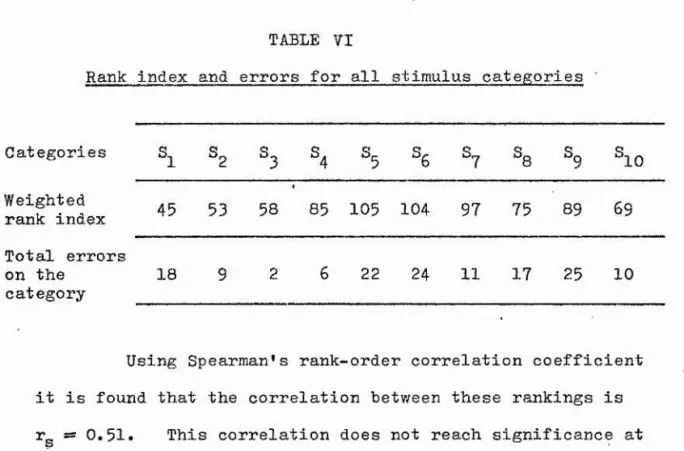
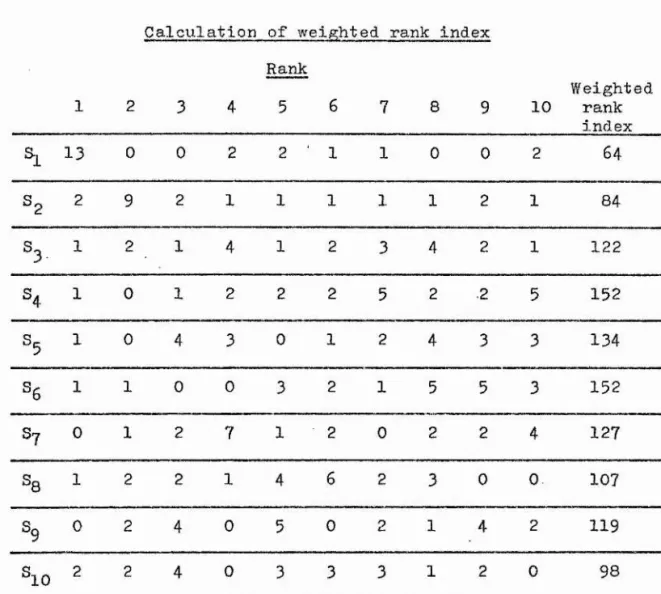
represented by a set of homogeneous pictures. Subjects* memory performance was evaluated in terms of two error indices, one
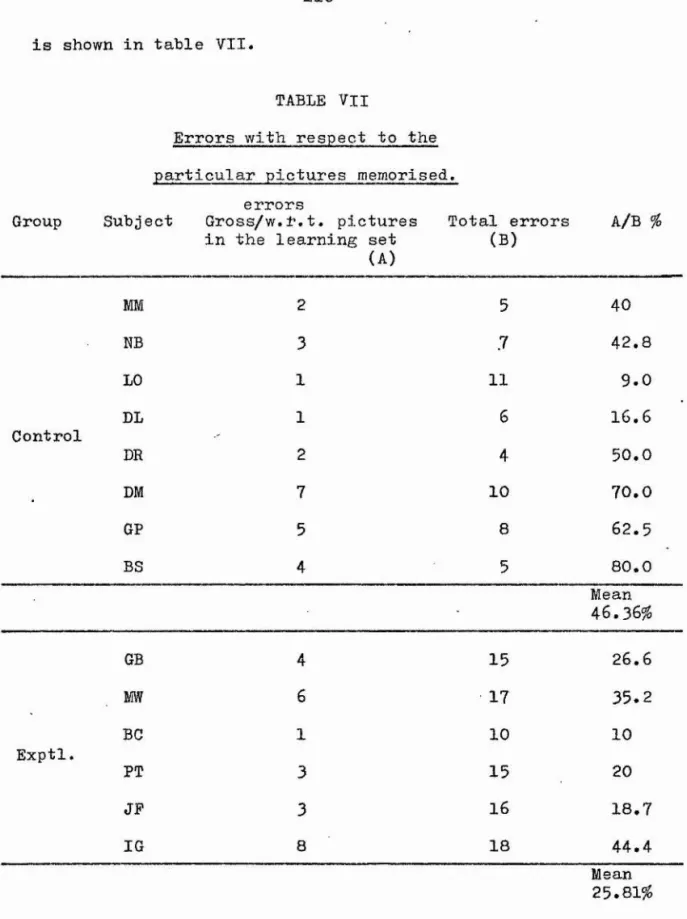
referent to the picture category, and one to the specific picture. Recognition was tested by exposing the pictures for short intervals while subjects were attempting to solve difficult mental problems. Some new and powerful effects have been demonstrated and replicated in these experiments which confirm, at a highly significant level, the particular empirical predictions derived from the theory.
There was nc performance difference in relation to the identification of the heterogeneous picture categories between the subjects tested
;
::
i
4
(v)
in the above situation, and a control group v/ho did not have to perform the mental task during recognition. However, there was a highly significant difference between the groups in relation to the identification of specific pictures.
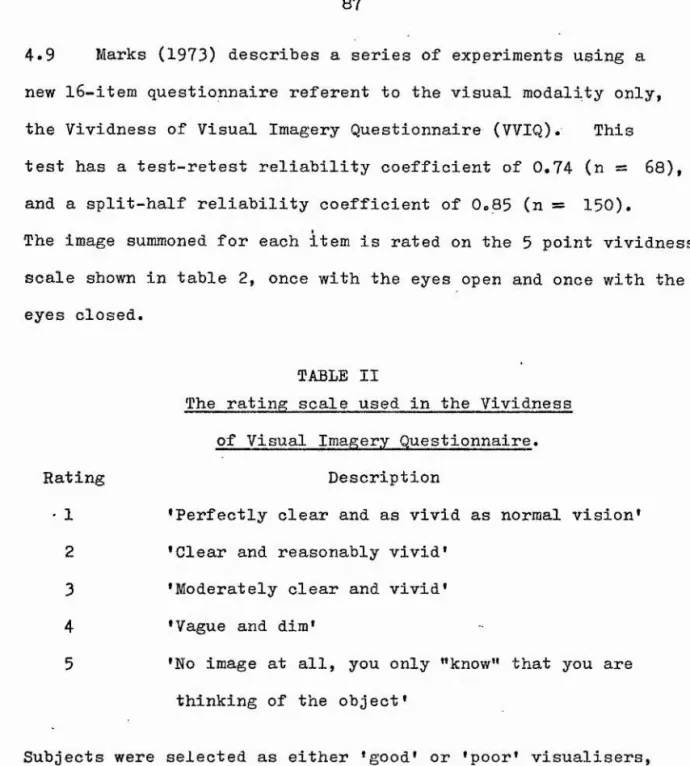
Individual performance characteristics and error patterns in the experiments were related to a questionnaire index of vividness of visual imagery. On the basis of the theoretical ideas developed, it was predicted that in situations where all conscious attention is dedicated to performance of the memory task, *high* imagers would perform better than ’low* imagers. In
contrast, in the divided attention case, the prediction was that ’high’ imagers would perform worse than ’low’ imagers. Both these separate theoretical predictions were empirically supported.
. A new conceptual approach to vigilance-type situations is suggested by the theory developed in the thesis. A task was devised in which the signals to be detected were clearly visible, but embedded at random in complex visual patterns (photographs). These patterns were presented on a television screen at regular intervals, over 600 times to subjects during a single tes king session. At each of these presentations subjects had to respond with respect to the identification of the picture shown, and to the presence or absence of a signal within it. Prom the theory it was predicted that where the complex pattern remained the same throughout the testing session, signal detection performance would show a typical vigilance decrement. However, when the set of possible pictures in which the signal may or may not be embedded is vastly increased, and the subject has to respond at each event in the manner described, it was predicted that signal detection performance would be significantly improved in relation to the single picture condition. These predictions were empirically
I
(vi)
ï i
i confirmed at a highly significant level, (On the basis of visual
signal - to - noise ratios only, a signal detection analysis of the | experimental situation would predict a result opposite to that
actually obtained in the experiment).
A computer simulation program based on fundamental theoretical ideas outlined in the thesis was developed. The program was used to simulate the vigilance experiment reported in the dissertation. The purpose and implications of the use of this technique as an applied research tool are discussed.
The final chapter discusses the results achieved, and outlines the proposed application of the theoretical ideas, and empirical results of the research to the cognitive load problems of human operators in real man-machine systems, in particular
aircrew flying advanced jet aircraft.
1
(vil)
A CXNOWLEDGEfæNT S
I express sincerest gratitude to my supervisor, Professor Mo A, Jeeves, for the contribution he has made towards the research reported in this thesis. His constant encouragement and advice, which was both constructive and critical, were of great value
both in guiding and maintaining the research on the path towards 1 its intended goals.
I thank Mr, Brian Sibbald for his considerable efforts in
■’1 translating my ideas into practical computer programs, I thank 4 also Miss Anne Parsons for her assistance with the recording of
video tapes, I thank Mr. Tony Toon and Mr. Gordon Patterson for their indispensable and willing help with the design, construction and development of the experimental apparatus.
I am grateful to the staff of the University Photographic Services Unit for the taking and printing of photographs, both
for the experiments and for the thesis. I thank Mrs, W. Mathewson, who typed the thesis.
I offer particular thanks to all those who participated as subjects in the research, both in the pilot studies and in the final experiments. These were often difficult, frustrating and time-consuming. However, the co-operation, interest and
enthusiasm shov/n by all subjects was uniformly of a very high order, and was greatly appreciated.
Finally, I wish to acknowledge with special gratitude, the contribution to the study of my wife Diane, whose continuing encouragement and understanding has enabled this thesis to be written.
Î
(viii)
CONTENTS
CHAPTER I : BACKGROUND. INTRODUCTION. AND DEVELOPMENT OF
the t h eo r e t i ca l APPROACH:
1.1 The complex interrelationship of cognitive processes.
1.2 The ’information processing* approach to psychological research
1.3 The importance of pattern recognition 1.4 Applied problems of the human operator
in complex man-machine systems and particular characteristics common to these systems.
1.5 Description of the purpose of the theory, 1.6 Feature analysis, feature extraction and
feature ’enhancement* in pattern recognition.
1.7 Concepts and history of the ’New Look’ in perception,
1.8 Functional similarity between perception and imagery.
1.9 Contemporary research into mental imagery. 1.10 Assimilation of sensory information into
images,
1.11 Some conclusions from the proceeding discussion,
1.12 The cognitive view of the active and constructive nature of the processes of perception and memory,
1.13 Evidence for the limited capacity of human information ' processing - the
’single channel’ hypothesis,
1.14 Theoretical integration of the concepts of ’active’ cognitjvR processing and single-channel operation,
1.15 Interference between ’internal’ and ’external’ tasks.
1.16 The definition of a ’pattern*.
11 20 25 27 28 30 34 34 38 40 41 CHAPTER II SUMMRY AND EXTENSION OF THEORETICAL CONCEPTS.
2.1 Perception of overlearned patterns, 47 2.2 Relationship to an accumulator model
of the emergence of perceptual
organization. 48
2.3 Theory of the role of memory information in perceptual experience of familiar
patterns, 50
2.4 Factors determining the relative
distribution of real and memory-derived
information, 52
2.5 Relationship and relevance of the present theory to perception in the ’normal’
environment, 56
2.6 Theoretical considerations in pattern
2.7 Preliminary comments on the experi mental investigation of the
theoretical ideas developed,
2.8 Confusion in recognition of similar patterns,
2.9 Reference to flow chart and use of computer simulation techniques. CHAPTER III : EXPERIMENT I.
3.1 3.2) 3.3) 3.4 3.5 3.6 Note
Derivation of the experimental hypotheses from the theory. Method
(i) Apparatus. (ii) Subjects. (iii) Procedure. (iv) Results. Discussion Conclusions
NOTE - regarding the pilot studies carried out in preparation for the later experiments. CHAPTER IV : EXPERIMENT II.
4.1 Relationship of typical laboratory experiments to normal perception - reasons for the use of photographs as visual stimuli.
4.2 Evidence for the power of picture memory, 4.3 Picture memory performance when
homogeneous pictures are used,
4.4 Recognition testing of heterogeneous pictures with large numbers of
alternatives.
4.5 The use of heterogeneous sets of homogeneous pictures.
4.6 Use of a two-stage identification task - the design of the experiment.
4.7 Relationship between ’vividness of visual’ imagery and picture memory performance,
4.8 A suitable questionnaire to measure image vividness,
4.9 The ’Vividness of Visual Imagery Questionnaire’ (VVIQ).
4.10 Use of the VVIQ in the experiment, 4.11 Specification and selection of a
suitable internalised cognitive task, 4.12 Note on the purpose of the inter
nalised cognitive task, 4.13 Method
(i) Apparatus (ii) Subjects (iii) Procedure Page 60 63 63 65 65 66 66 66 67 67
68
69 72 74 76 77 79 31 81 82 8586
87 88 89 91 92 92 93 93(x)
CHAPTER Y : EXPERIMENT III.
Page 4.14 Results and Preliminary Discussion 100
(i) Picture memory. 100
(ii) Analysis of error patterns in
picture memory performance. 103 (iii) Order of free recall of the
10 stimulus categories in relation to errors on those
categories, 106
(iv) Errors of recognition of the
overlearned pictures. 109
(v) The imagery data. 112
(vi) The internalised cognitive task, 118 4.15 Preliminary conclusions. 119
5*1 Note on outcome of experiment II. 120 5.2 Problems of control concerning the
internalised cognitive task, as
performed in experiment II. 120 5.3 Changes in methodology to facilitate
more powerful monitoring and control
of cognitive task performance. 122 5.4 Reasons for randomisation of pictures
in the recognition test. 124
5.5 Sex differences. 126
5.6 The purpose of experiment III. 126
5.7 Method 127
(i) Apparatus . 127
(ii) Subjects 127
(iii) Procedure 127
5.8 Results and preliminary Discussion. 131
(i) Picture memory. 131
(ii) Analysis of error patterns in
pictm^e memory performance. 133 (iii) Order of free-recall of the 10
stimulus categories in relation
to errors on these categories. 136 (iv) Errors of recognition of the
overlearned pictures. 138
(v) Sex differences. 141
(vi) The imagery data. 141 (vii) Sex differences (imagery). 145 (viii)The internalised cognitive task, 146
5.9 Conclusions. I46
CHAPTER VI : EXPERIMENT IV - VIGILANCE;A COGNITIVE APPROACH. 6.1 The application of the present theory
to vigilance situations. 148 6.2 Specific propositions derived from the
theory-outline of the aims of the
experiment. I54
6.3 Method 156
(i) Apparatus - (description of specifications and operational
development). I56
(ii) Subjects. I63
6.4 Results and Discussion.
(i) Method of analysis of the raw data. (ii) Signal detection results.
(iii) Picture identification results. (iv) Further analysis of signal
detection failures.
(v) Evaluation of interview data. (vi) Consideration of an alternative
interpretation of the experiment, (vii) A note on ’arousal*.
6.5 Conclusions.
170
170
171 177 179 189190
190
192 CHAPTER VII : DESCRIPTION AND DEMONSTRATION OF A COMPUTER• simulation TECHNIQUE INCORPORATING BASIC CONCEPTS OF THE THEORY.
7.1 Note on simulation. 194
7.2 Specification of the purpose of utilising
computer simulation techniques. 194 7.3 Method of operation of the simulation
program, 195
7.4 Theoretical concepts underlying the
simulation program. 197
7.5 Application of the simulation techniques to experiment IV (the vigilance
experiment). 199
7.6 The concept, function, and quanti
fication of a parameter of attention, ’k’. 200 7.7 Computer simulation of the vigilance
experiment. ' 205
(i) Apparatus. 205
(ii) Subjects. 205
(iii) Procedure. 205
7.8 Results and discussion. 216 (i) Signal detection performance. 216 (ii) Analysis of patterns of detection
failures for optimised simulation, 219 (iii) Comparison tables showing examples
of simulation results using ’k’ values other than the optimal
values. 222
7.9 Conclusions. 228
CHAPTER VIII : CONCLUDING REMARKS AND FUTURE PLANS. 8,1 8,2 8.3 8.4 8.5
8.6
Note on the content of the chapter. General conclusions drawn from the results of the research.
Value of methodology developed in the experiments.
The role of imagery.
Partial attention situations -alternative theoretical explanation of another experiment.
Application of the work to applied problems of aircraft pilots - in particular to considerations of "pilot error",
REFERENCES. APPENDIX I
APPENDIX IT
APPENDIX III APPENDIX IV
APPENDIX V
(xii)
8.7 Theoretical explanation of mis
perception of instrument displays by pilots.
8.8 Potential benefit of a cognitive
approach to existing applied vigilance situations,
8.9 Application of the computer simulation techniques to real situations, and brief outline of the next stage in the research.
8.10 Concluding statement.
Schematic flow chart showing dynamics of
pattern recognition component of the cognitive system in accordance with the theory.
The Vividness of Visual Imagery Questionnaire (VVIQ).
Pictures used in Experiments II and III, Examples of pictures and signals used in Vigilance experiment.
Computer simulation program.
Page
235
236
237
238
240
251
252 254
257 263
A-CHAPTER I
Background, Introduction, and development of the theoretical approach.
1.1 The late Sir Frederick Bartlett stated as long ago as
1932 that psychologists have persistently treated "every mental
process as presenting problems the answer to which can be found % without searching beyond the limits of the specific process
itself." (Bartlett, 1932, p.187). He pointed out that "it is impossible to understand any high level mental process if it is simply studied by and for itself" (ibid., p,186). It would seem plausible to argue that the reason for the continued (and continuing) persistence of "faculty psychology" is directly related to the unwillingness or inability of many investigators
to come to terms with the manifold complexities of these inter- 1.;
acting processes. Reitman (1970) has strongly argued that, if it is acknowledged that all behaviour is a function of a wholly integrated system, the various processes (e.g. perception,
memory etc.) may be too interrelated to separate, and the
investigation of such processes in isolation may involve no more than arbitrary and artificial problems.
The rapid and continuing technological advances of the last three decades have provided psychologists with powerful new tools with which to study the complexities of human behaviour.
Fundamentally, many conceptual areas of research interest have 1 'Î
not changed, however much the relevant descriptive terminology 4
-Î
may have altered. In spite of this basic adherence to the investigation of the same underlying phenomena, it has become to
%
some extent possible, by means of new analogies and languages associated with technological change, "to cope now with problems which psychology had put aside as too difficult a decade and more
ago," (BroadbenT, 1971, p«2). That psychologists can now cope
with such problems illustrates clearly the way in which increases in knowledge about a phenomenon "are inextricably a function of technical and methodological advances, as well as theoretical advances," (Yates, 1972, p,2)<>
Primarily, the greatest significance of these changes is that experimental psychologists can now acknowledge and investigate complexity. The most important single aspect of this new
technology for the study of human behaviour has been the advent of the readily available general purpose digital computer, and the continuing research and development leading to its increasing adaptability and refinement. Theories and models of complex behaviour patterns which are not necessarily simplistic can be developed and tested, often by computer simulation techniques. This has led to the claims of psychologists such as Ap'ter, for example, that the computer modelling of psychological processes may eventually provide the most important contribution tc man's knowledge of himself, (Apter, 1970, p.l), In addition to simulation of human behaviour, computers may also be used to generate complex visual displays for use in psychological experiments.
The specialised scientific and technical knowledge and expertise necessary to the realistic investigation of complex phenomena increasingly involves several of the traditional academic disciplines (Uhr, 1966), Investigators in different disciplines have not taken cognisance of the work of others in other disciplines, and are often totally unaware of it.
VI
5
■ 1
Fortunately, however, many psychologists are recognising this problem, and interdisciplinary research programs are now common#
To keep the evaluation of these advances in some perspective, it should be pointed out that the relative ease with which the predictions of complex theories can be calculated
on a computer has been called "a retrograde step" by Broadbent (1971, p.6)* He argues that psychology has, in general, come to concentrate on specialised theorising of particular cognitive and behavioural phenomena, in contrast to the all-embracing theoretical approach of Hull (1952), for example# Particular theories, however, are now able to become so elaborate that they
"outrun" the possibility of unambiguous experimental validation# I (Uhr, 1966, p.6).
A further valid criticism of the current state of much psychological theorising is that the formulation of theories may tend to become governed by the technological hardware they employ in their modelling# Some current extremes in the fashionable human brain - computer comparison which overlook the obvious
differences between them are cases in point (Apter, 1970, p.19). The once great enthusiasm for "machines which think like men" dissipated as the consequences of the differences between biological systems and digital computers became clear# (von Neumann, 1958),
Although such criticisms as those described above may well
be warranted in some instances, they do not discredit the serious ^ and considered analytical approach which utilises these new
facilities#
1.2 A new conceptual approach to psychological research, which, by its terminology and analogies clearly shows the direct
'h
communications engineering, is generally termed the "InformationProcessing approach." (e.g. Broadbent, 1971; Reitman, 1965), This approach stresses the value of "analysing human function in
terms of the flow of information within the organism," (Broadbent,
4
1971, p.7).The basic notions of this approach can be traced back to the publication of two papers by Craik (1947, 1948) and the appearance of three important books at the end of the 1940*s. These were "Cybernetics" by Weiner (1948); "The Mathematical Theory of Communication" by Shannon and Weaver (1949); and "Statistical Decision Functions" by Wald (1950). Weiner's book utilised mathematics to propose ideas for regarding man as a self-regulating mechanism and presented the basic conceptsof Information Theory. The notions of Information Theory were expanded and put forward as a set of theorems in Shannon's and Weaver's work. Wald's book laid the foundations for the
application of statistical decision theory to human performance. V The growth of research interest in what has been termed
Behavioural Cybernetics (Smith, 1966), where the basic assumption is that the organisation of motor performance and the pattern of learning are connected with the characteristics of closed-loop feedback control which an individual maintains over his own behaviour, and the rapid growth of Cognitive Psychology (Bower, 1970) can be attributed largely to the information processing approach to psychological problems.
1.3 Possibly the most potentially important and one of the most recent areas of research generated by
ago, and the Gestalt psychologists were very much concerned with the specific area of perception of geometric patterns). However,
ri
states Uhr, an increasing number of investigators are coming to V recognise that many of the central cognitive characteristics of
the human organism - intelligence, thinking, remembering, ^ perceiving, learning - are characteristics that involve patterns. |
In perception, for example, one of the critical problems has been to explain "why things look the way they do." (Vickers, 1971, p.l). Gestalt theory has been largely concerned with the
ability of the human perceptual system to organise information V from unfamiliar, ambiguous or meaningless stimulus arrays "into
perceptions that amount to clear and simple descriptions of what we see." (ibid.).
Virtually since the adoption of information concepts by psychologists (see Attneave, 1959) attempts have been made to
relate them to problems of pattern perception, but with limited
'4
success (Garner, 1962). Garner states that the attraction of%
the concepts of information theory in the study of patterns is that they are potentially capable of dealing with organisation and structure in a quantitative manner - "the very things which have seemed to be the essence of the nature of pattern
perception" (ibid., p.175). However, as Garner points out,
the application of these concepts has not met with great success V to date. There has been no satisfactory evolution of a
psychophysics of form. In particular, the informational v quantification of the intuitively appealing pattern perception
I
.1 interpretation, interrelations and applications of some of theseÏ Gestalt principles have become sufficiently clarified and precise f
• Î
to enable them to be evaluated experimentally* ^
1
In the related field of intelligence, after the pioneering
computer simulation of human problem solving by Newell, Shaw and I t Simon (1958 onwards - reviewed in Newell & Simon, 1972), a very
large literature developed. Hunt (1971) refers to "over a i thousand papers" on the computer simulation of aspects of human #
I intelligence. Importantly, he also notes that, although there i have been numerous reviews and collections of papers, with the
exception of Reitman (1965) there has been little effort directed V towards theoretical integration. In a major attempt to achieve
such a state. Hunt (1971) presents a model of man's cognitive processes based on an analogy between a human being and a
computing system; i.e. the analogy is to the organisation of the computing system and not to its components. Hunt puts forward his "Distributed Memory" model as a framework to guide research, but admits, in doing so, that his theoretical basis is incomplete. He acknowledges also that it would be difficult and potentially vastly expensive to test.
1.4 The investigation of the nature and properties of human information processing has become an increasingly important applied problem, Man has become a component of complex man-machine systems, such as modern jet aircraft, for example. The continued retention of the control functions of the human operator in such systems is almost entirely attributable to man's cognitive flexibility and decision-making capabilities (Pogel, (1964) - in Singleton, Easterby and Whitfield (1967%
-I.
:
,
■
1
j
; essential function as a source of mechanical power is now largely
redundant (Chapanis, 1965, p.11).
The relative lack of knowledge concerning the basic
information-processing properties, capabilities and limitations 4 of the human operator in relation to other machine components of
a system, and the consequent inability to make reliable predictions concerning operator performance constitutes the weakest link in the design of such systems, (de Sola Pool,
1964 - in Siegel and Wolf, 1969, p.vii). Because the con sequences of the failure of these complex systems can be
catastrophic, resulting in the loss of hundreds of human lives, it is obviously essential that the fundamental limiting
characteristics of human information-processing performance be defined as far as possible. It is necessary to avoid, both at the design and operational level, instances of human operators being placed in systems in which they cannot either perform at
their maximum efficiency when the system is fully serviceable, 5 or compensate for potential failures of other components of the
system - even though in the latter case they may function completely adequately when the system is fully serviceable.
There are a number of common characteristics in relation to the information-processing requirements of the human operator in a wide range of typical complex systems. This is so, even though the specific operator work environments may be quite different superficially, (e.g., an aircraft cockpit vs an electric power station control room). The primary shared characteristics of these situations are as follows
8
performance of a number of separate sub-tasks. His perception of this visual information must be accurate. 2) Coincident with the requirements of 1), there is also a
i
I
considerable and continuously variable internalised cognitive î;
load imposed on the operator by the necessity for correct recognition, analysis and integration of the visual sensory information patterns according to predetermined criteria and procedures contained in memory.
3) The correct visual pattern and cognitive processing strategies in relation to 2) which are appropriate to the possible set of definitive internal states and global physical configurations of the particular system are
thoroughly over learned by the qualified operator, i.e. they
are able to be completely specified from memory information | acquired during extensive training and practice.
In more general terms, the human operator is expecting the occurrence of sets of familiar, highly overlearned visual patterns according to the overall state of the system. For example, in the case of an aircraft, the pilot expects to see instrument patterns which indicate satisfactory states of internalised system components (e.g. the engines,
the functioning system, the human operator must hold accurately in memory a large repertoire of specialised control procedures which he may be required to rapidly and accurately implement in order to compensate either for
possible failures in other system components, or for unusual external physical forces acting on the whole system. The most appropriate of these procedures to implement is
dependent on the operator's evaluation of the particular
global state of the system at the time of the crisis situation. Further, the most appropriate procedure to select and
implement in an emergency situation may not be immediately obvious. In such situations a considerable additional cognitive loading relating specifically to the optimal
selection of the most suitable compensatory procedure is » imposed on the operator, while, at the same time, the re
quirement for accurate visual perception of the instrument and control displays is even more important than when the system is functioning normally,
1.5 The theoretical, experimental and simulation research to be reported in the present study is addressed primarily to the investigation of some of the fundamental aspects of human information-processing in complex situations characterised by the properties described in the previous section, A long term aim of the work is to utilise the theoretical and empirical findings in real applied man-machine situations.
The theory is concerned with the dynamics of the flow of Information within the organism, and it involves a reappraisal of some of the traditional psychological concepts involved. The theory is derived from several diverse areas in
information-I
10
4
processing psychology - areas which are still rapidly changing. As Reitman (1965) states, information processing theories
"examine the representations and processes involved in cognitive activity. They emphasise the functional properties of thought and the things it achieves." (ibid., p.l).
The present work firstly develops a theoretical model emphasising particular functional characteristics of the cognitive system which is intended to provide an organising framework for systematic thinking about certain theoretical and applied psychological problems. Secondly, new experimental procedures which test the predictions of the theory will be described, and the results reported and interpreted. However, as Reitman observes, (ibid., p.38), in theories which attempt to deal with the complexity of human cognitive processes it is unwise to make prediction the "sole touchstone." theory as yet has had much predictive significance in this area. Hence, part of the overall purpose of the work is that of exploratory information gathering. The evolution of the present conceptual approach will be illustrated in its description and, wherever possible, existing experimental and theoretical data from diverse areas of cognitive psychology, information theory, human performance, pattern recognition, perception, memory, etc.#. will be evaluated in terms of its degree of support for the present approach.
This overall approach is congruent with the "philosophy of information processing" outlined by Hunt (1971), which is
epitomised by the consideration of perception and memory as i constructive processes (Neisser, 1967) - i.e. "activity in view
of ends" (Mackay, 1969). The present approach is also in
that it considers that subjective conscious experience is a legitimate basis from which to derive and on which to test a psychological theory. The usefulness of such theories must ultimately be evaluated in these terms.
The following theoretical model deals with principles of organisation of the system, references being made to hypo-thesised system components without presenting detailed
descriptions of the physiological mechanisms underlying their % operation. (see also Hunt, 1971). Piaget (1969) has strongly
■;*
justified such abstract theoretical models on the grounds that, if such models lead to a system of well formulated laws, they constitute the "best preparation for a complete physiology whose elaboration has scarcely begun." (ibid., p.xxiii).
Kaneff (1972) states that the usual approach of information processing psychologists to the complex problems of human
behaviour has been to postulate block or flow diagrams in terms of selected functional processes, and then to investigate in detail only one, or very few, of these processes. However, like Reitman (1970), he argues that this method is subject to great
difficulties stemming from the fact that perceptual and
cognitive systems are integral entities with highly interactive and interdependent parts and "therefore need to be studied as such" (ibid., p.28). While still employing the useful
conceptual utilisation of flow diagrams, the present approach attempts to relate to the overall performance characteristics of
the total dynamic system in the particular type of situation |
1
described previously (p. 7 ).
1.6 Returning specifically to the field of pattern recognition,
(or "pattern cognition" (Kaneff, 1972)), much of the research iij reported in the literature to date has involved attempts to
12
construct theoretical or actual machines which recognise patterns
that resemble those recognised by humans - for example, the
recognition of letters and numerals, recognition of shapes etc....
The great proportion of the literature in this area is concerned
with aspects of pattern recognition in the visual sense modality.
Vickers (1972), Uhr (1966), Watanabe (1969) and Garner (1962)
provide useful and comprehensive reviews of this work.
Information from the environment impinges directly upon
human sensory receptors and is first transduced into an
electrical signal. Hunt (1971) states that, when this has been
done, it is found that the environment consists mainly of highly
redundant information which, if responded to in detail, ’’would
(Quickly swamp our minds” (ibid., p.60). The visual system alone
is capable of transmitting information to the brain at the rate of
4.3 X 10^ bits/second. In contrast, it has been estimated that
silent reading, intuitively one of man’s most rapid means of under
standing the environment, proceeds at about
45bits/second. If it
is assumed that the reader comprehends and recalls every word read,
one must still account for the fact that only one out of every
100,000 bits input to the brain remains there.
Data such as these well illustrate why one of the most
important problems in the field of pattern recognition is the,,
problem of feature extraction. Attneave (in Garner, 1962, p.200)
thus claims that the “major function of the perceptual process ...
is to describe or encode any stimulus in as economical form as poss
ible and that, basically, the problem of describing a figure is
determining the minimum number of parameters needed to
i
specify the figure, ” Selfridge (1955) has defined pattern
significant features from a background of irrelevant detail." Numerous attempts have been made to model this process, (which is clearly a fundamental aspect of selective attention (e.g. Broadbent (1958, 1971)), as it relates to visual perception* Most of this literature has considered *ad hoc* properties of 2-dimensional patterns, such as cusps, vees, straight lines, arcs, bays, etc... (Parker and Moore (1972)).
However, Parker and Moore (1972) have proposed a new
-
I
fundamental approach to the derivation of features in a pattern.i
5 It is claimed that "a feature can be simply defined as a
particular sort of non-random distribution of the points
defining the pattern. Thus structure in the pattern is a non- random statistical distribution of some kind" (ibid., p.59). Parker and Moore consider some limited examples of both global and local analyses of shape, showing how features can be
detected and extracted mathematically from patterns and how these features may then be enhanced in the patterns. Two global structure measures which can be used in the character isation of simple shapes are defined, these characterisations
being invariant to translations, rotations and dilations of the v| patterns. The precise details of the mathematical analyses
involved are not of immediate concern to the present study. Those areas of Parker's and Moore's research which are of importance to this thesis are the functional aspects and the psychological implications of the processes described.
In particular, the notion that the analysis of a pattern may lead to the * enhancement *, or subjective perceptual
:
Three pictorial examples of the process are shown in Fig. 1.From this conceptual approach to the structural analysis of patterns, Moore and Seidl (1972) have further extended the possibilities in a paper entitled "A Gestalt Theory of Machine Perception". Once again, although primarily a mathematical model, the psychological implications are extremely important,
especially as the research is claimed to be inspired by Gestalt principles. Wertheimer (1938) considered the perceptual process as the basic organisation of sensory data. This organisation was described in terms of a mapping from the unorganised sensory
input of the geographical environment to a "configuration." The concept of "configuration" was, in effect, an abstract representation of the coding and organisation of the sensory information.
Moore and Seidl examine the nature of this Gestalt concept from a new mathematically based standpoint, and proceed to define two types of automaton, named a perception automaton and an
association automaton. The function of the perceiving automaton Is-to organise the sensory data input into e configuration and to indicate what parts of this data contribute to that con figuration, in the manner proposed by Parker and Moore.
The association automaton is defined as a higher order processer which assesses these two basic functions of the
perception automaton to provide more sophisticated processing of the sensory data input. It incorporates the perception
automaton, but, in addition, has a memory and a facility with which to compare the content of its memory with the processed input pattern from the perception automaton. The nature of the pattern data in the memory store of the association automaton is in the form of stored configurations of sets of
m
■ m
m ■
■ m
A .
mr"
B Ê M
Ê ’
' V ’ ■
B
<«■) Original Pattern (b) Enhanced Pattern
m m m n
i
a B #,.a B
Ë
m ■■
f % n »
.
■ a
(a) Original Pattern (b) Enhanced Pattern
6*. B Kf
B
B
B
■
B
B
16
sensory patterns previously processed by the perception automaton.
In other words, the information regarding particular patterns
'$
which is stored in memory is not stored in the form of arepresentation of all the first-order physical characteristics « of the pattern, but in the form of a set of higher order
characteristics of the statistical structure of the patterns. Thus, the comparative analysis of input data in terms of the information held in memory takes the form of the determination of those characteristics of the configuration of the processed pattern obtained by the perception automaton which are maximally
shared with the various similarly derived pattern configurations
^
held in the memory store.Although these notions are primarily concerned with machine perception, it is considered by the present writer that they are clearly relevant to human information processing, particularly in the class of situations under consideration (p. 7 ). Any perception-memory system which operates not on the extracted higher-order complexity characteristics of patterns, but on a simple template matching of the direct physical
characteristics of perceived patterns with similar "unprocessed" | patterns held in memory, is inconceivable. For example, in
order to recognise a square in any orientation, the memory store of such a system would have to contain images of every possible transformation of such a figure for every possible size of that figure. The number of such transformations and dimensions is, of course, infinite. These suggestions are congruent with what Welford (1968, p.162), for example, has termed "economy of
perception", this requiring the "abstraction of constants" from the total input of sensory data encountered in space and over time in conjunction with the allocation of retention priorities
I
I
to these constants. Moore et. al. appear to have, at least,provided a potentially viable paradigm for the extraction of such constants (e.g. "squareness") from visual patterns, and a methodology for the pro-active feedback of such data from memory
to perception, 1;
Thus, for their model Moore and Seidl describe examples of how information held in memory is able to influence the
extraction and enhancement of particular features of a perceived
pattern. If a particular pattern is held in memory it Will a
J
enhance the perception of a similar pattern if that pattern is % I contained in a given stimulus field, even though that field may
contain other patterns - i.e. the model is ’seeing* what it is •looking for*, or what it is * expecting* to see. In particular,
this aspect of the model provides a plausible basis for the j consideration of individual (and cultural) differences in pattern
learning and pattern recognition, the characteristics of each being largely dependent upon existing information in the memory store relating both to processing strategies and the patterns themselves* In terms of Moore and Seidl* s notions, one can readily conceptualise * individual differences* in pattern
recognition performance between different association automatons, with different memory stores, in relation to their perception of the same visual information arrays.
An illustrative example of this process is shown in Pig. 2, According to Moore and Seidl, this nev/ type of automaton
illustrates the power of "a quite general conceptual framework for a theory of perception" (ibid., p,117). Although such statements must necessarily be treated with caution, the present writer considers that they are sufficiently worthy and
provocative to extend their most significant implications
18
(a)
(b)(c)
[S ^ g sa [g a SS
aiÉf.-Easi^xl
75g
:M
,^ ^
3 3 3
]:
3 3 3 2
^
:£
a
.M
ji
m
■;j
• ■.
wA diagramatic representation of the output of the association automaton when pattern (b) is “associated” with pattern (a).
Output of the association automaton with pattern A as input and pattern (c) as the memory element.
19
further in conjunction with concepts from other areas of cognitive psychology.
In the present context, the most significant implication concerns the reciprocal interaction of sensory perceptual
information with perceptual information held in memory, Piaget (1969), in his elaborate discussion of what he calls
•perceptual anticipations* states that if the characteristics of an •object• - for which may obviously be substituted the word »pattern* - are taken to be a, b, and c, then c will be "anticipated" if a and b are perceived. In recognising familiar objects, writes Piaget, that is, objects (patterns) about which information is stored in memory, the perceiver will bring pre-implications and anticipations into play: "For
instance, it would be very difficult to know if a subject had distinctly perceived the equality of the angles of a square or if the equality had been perceived only by implication from the global form ... above all, his explanations and transports will be guided by these implications when the perception is equivocal, for example, when the squareness of a figure is found to be in conflict with other factors." (ibid., p.l91).
The conceptual parallels between these notions of
Piaget*s and the role of the association automaton of Moore and Seidl are clearly apparent. The present writer considers that further propositions may be derived from ideas such as these, which implicitly (Piaget) and explicitly (Moore and Seidl), highlight the possible role of the memory function in the operation of the perceptual system. This point is made most succinctly by Welford (1968, p.174). He observes that a result which occurs throughout Bartlett*s work and a
substantial amount of proceeding and subsequent work is that;
I
20
"Much of the detail which is apparently perceived is in fact inferred* It seems as if a schema which is imposed on incoming data brings a considerable amount of detail with it and this is incorporated into the resulting perception,"
1.7 These notions are conceptually congruent with those of what is generally termed the "New Look" in perception, beginning
after World War II and inspired primarily by the theoretical and experimental work of Jerome S. Bruner (1957a, 1957b), Bruner* s
(1957b) important and influential paper titled "On perceptual
readiness" stressed the effect on perception of "readiness", 5 **expectancy", or "set", on the part of the perceiver. The
basic effect of set on perception is said to be as follows
In a situation in which a perceiver is given specific instructions 4 to attend to only one of several attributes of a stimulus display, l| or in which he subjectively expects to perceive a particular
attribute of a stimulus display (e.g. through previous experience), he is able to report his perception of that attribute more
accurately than he would be able to do otherwise.
The basic proposition of tne New Look perceptionists is ^ that tne perceiver*s cognitive processes greatly influence the
manner in which he perceives the world. According to Bruner (1957b, p.148), the "likelihood of occurrence of events learned by the person in the course of dealing with the real world of objects and events and the redundant sequences in which these are embedded" results in the person building a "model of the likelihood of events" (ibid), an activity seen as "achieving a minimization of surprise for the organism"(ibid.). Clearly, Bruner is placing great emphasis upon the existence and the role of a cognitive, constructive component in perceptual
cognition" in this context.
The more detailed aspects of Bruner*s ideas have been widely debated. For example, Neisser (1967, p.49) argues that "Bruner's claim that * all perception is necessarily the end
product of a categorisation process* must be rejected" because ÿ many cognitive processes, such as iconic storage, do not involve « categorizing "to any serious extent" (ibid.). |
Haber (1966) provides a comprehensive discussion of the
historical development of the theoretical and empirical research I into the nature of the effect of set on perception. However, «
•:l the primary purpose of Haber's paper is an examination of what
he argues are the two basic and dissimilar hypotheses that have been used to interpret the effect of set on perception.
The older of these two hypotheses, and the one most
favoured by the *New Look* perceptionists, (e.g. Dember, I960;
i
. . ' 'S
Postman, 1963), employs the concept of "perceptual enhancement"
û
or "tuning." Thus, attending to a particular stimulus Ii attribute "results in a clearer and more vivid perception of ^ 5 that attribute - it stands out more" (Haber, 1966, p.335).
The feature enhancement process of Moore and Seidl* s associ
ation automaton described previously (p.14 ) well illustrates % this notion.
The second hypothesis is that set "has no effect on
perception itself but only on some aspects of the memory trace ^ or on response to that perceptual experience" (ibid.).
Accord-I
I'a ing to Haber, there are three forms of this "response" hypothesis, #
'é
viz; "(a) the set facilitates relevant responses by S, # increasing the probability that S can identify the stimulus in
-i
his report; (b) the set causes S to report the emphasised22
allowing those attributes to be reported more accurately;
(c) the set modifies the organisation of the memory trace, so
t
that the important attributes are remembered more accurately,"
(ibid,), Haber points out that these two basic hypotheses
have wider application in perception and memory in addition to
;;
specific problems of set.
Relevant to this latter point, Gromulicki (1956),. for
example, considered remembering as an active, abstractive process «
and in a series of experiments on the immediate oral recall of
verbal passages of varying lengths found that, in recall, a
high degree of selectivity was shown in relation to omissions
from the material originally presented. "Items omitted were
regularly those which contributed least to the general meaning
of the passage" (ibid., p.92). Gomulicki related subsequent
recall of items to the distribution of attention during hearing
i;-of the original passage, stating that the items i;-of content
most attended to were those most clearly remembered.
Haber argues that the two iiypotheses reflect "one of
the most difficult distinctions in any-analysis of perceptual
behaviour." (ibid., p,^36). The usual procedure of
experimenters has been to assume that simply because the subject
was reporting immediately what he had perceived, he was therefore ,
performing a "perceptual" task. According to Haber, "there is
]
a crucial difference between reporting one*s experience and
reporting the attributes of stimuli that one remembers seeing.
One task is perceptual' and the other deals with a memorial
process" (ibid.). Haber emphasises that these must be concept- ^
ually differentiated and states that innumerable experimenters
have failed to make this distinction. Consequently, much of the
theoretical controversy in this area is a direct result of this
confusion.
However, after evaluating the available evidence Haber’s
final conclusion is that these two hypotheses, which can both
be supported by appropriate experimental evidence, are not
incompatible but only alternative and often complementary,
"There is no reason to doubt that both may be correct and
occurring together," (ibid).
Reitman*8 (1970) arguments that perceptual and memory processes
are too interrelated to separate and that the "conceptual
differentiation" espoused by Haber is arbitrary and contrary to
the functional nature of human information-processing performance
Certainly Haber’s very strong emphasis on the primary role of
verbal encoding strategies would be challenged by the more
recent work of Paivio and his collaborators (e.g. see Paivio,
1971), together with current work on the power of picture memory
(fStanding, 1972).
Some of Haber’s statements are questionable. For example:
"Introspectively, it might be very difficult for an S to diff
erentiate a rapidly, fading memory from an image that was
perceptually less clear." (Haber, 1966, p.551). If, as recent
research suggests (Sheehan, 1972), the "memory" itself at a
subjectively experiential level may well be an image, then there
is no necessity to distinguish these notions. Further, Haber’s
claim that there is a "crucial difference between reporting one’s
experience and reporting the attributes of stimuli that one
remembers seeing" is disputable for the reason that in order to
report one’s perceptual experience, or even to relate any
stimulus to an experiential category there must be a dynamic
memory component operating all the time.
Although the effects of set are well established, then,
considerable theoretical controversy exists. However, on the '
basis of all the available evidence, it can be stated that, in
information-processing terms, there is at least a two-way
continuous flow of information involving the integration of
information input from the visual sensory system and information
held in memory. Obviously, the specific dynamics of this
information flow may be dependent on a wide range of search,
retrieval, encoding and decoding strategies, for example, and
these may differ between subjects.
24
In a number of experiments (see Haber, 1966) there is
clear evidence that, at the level of subjective conscious t .1 experience, information concerning the anticipated character- ^
;
S
istics of a stimulus may be fused with partially processed sensory information from a stimulus display which does not physically contain some of these expected attributes. A good example of such a phenomenon is the experiment of Bruner and Postman (1949) on the perception of incongruity. In this experiment subjects expecting the tachistoscopic, presentation of normal playing cards were actually presented on occasion with cards In which the colours of the suits were changed. Most subjects reported perceiving the incongruous cards
normally, and, very significantly, some reported a "fusion" of the expected (e.g. black) and actual (e.g. red) colours for the particular card, seeing the card as "purple". Clearly, the visual characteristics of the expected playing cards can be completely specified from memory, having been overlearned through extensive previous experience.
Similar effects were shown in an important early experiment by Pillsbury (1897). In an extensive investi gation of word reading, Pillsbury found that under certain conditions of expectation and context, subjects would report accurate letter-by-letter perception of words which were actually either misspelt, or which contained a "shapeless blur" in place of an original letter. The blurring effect
was obtained by typing an »X* over the original (ibid., p.342). « For subjects in these, and in similar types of
experiments, to be able to consciously experience such
(otherwise subjects would not be able to identify correctly the pattern shown) and information about that pattern held in
memory (e.g. with regard to the appropriate colour of a playing card).
1.8 If information from internal and external sources is integrated in this way, then it is a logical step to consider in detail a system by means of which this might happen, rather than simply to postulate that it does. The subjective
phenomena of dreaming and hallucination provides irrefutable X evidence that 'normal' perceptual experiences may emanate
directly from the memory store. That is, subjects can experience clear, complete and dynamic 'pictorial* perceptions of their
external environment v/ithout any external input through the i visual sensory channels. Neisser (1967, p.120) states: "Even
without any stimuli at all, dreams and hallucinations result in experiences which are phenomenally just like other perceptions,"
The functional similarity of dream imagery and normal perception strongly suggests that, at the level of conscious experience, the two represent extreme ends of a continuum of
the same basic process. Dependent upon a wide range of factors, % such as time-sharing of attention, subjective probabilities of
expected patterns, and stimulus clarity, the total information content of perceptual experience may, at any instant, be made up of both 'real* information from the external world and information from the memory store, with the contributions of each information source to the total perceptual experience being phenomenally indistinguishable from each other.