Process parameters selection for friction
surfacing applications using intelligent
decision support
V.I. Vitanov
a,∗, I.I. Voutchkov
b,1aSchool of Industrial and Manufacturing Science, Cranfield University, Cranfield, Bedfordshire MK43 0AL, UK bComputational Engineering and Design Centre, School of Engineering Sciences, Mechanical Engineering,
University of Southampton, Southampton SO17 1BJ, UK
Received 15 May 2002; received in revised form 5 November 2003; accepted 5 November 2003
Abstract
Friction surfacing is an advanced manufacturing process, which has been successfully developed and commercialised over the past decade. The process is used for corrosion and wear resistant coatings and for reclamation of worn engineering components. At present the selection of process parameters for new coating materials or substrate geometries is by experiment requiring lengthy development work. The major requirement is for flexibility to enable rapid changes of process parameters in order to develop new applications, with variations of materials and geometries in a cost effective and reliable manner. Further improvement requires development of appropriate mathematical models of the process, which will facilitate the introduction of optimisation techniques for efficient experimental work as well as the introduction of real-time feedback adaptive control. This paper considers the use of combined artificial intelligence and modelling techniques. It includes a new frame of a neurofuzzy-model based decision support system—FricExpert, which is aimed at speeding up the parameter selection process and to assist in obtaining values for cost effective development. Derived models can then be readily used for optimisation techniques, discussed in our earlier work.
© 2003 Elsevier B.V. All rights reserved.
Keywords: Surfaces and interfaces; Metals and alloys; Materials engineering
1. Introduction
During the past decade the friction surfacing process has become well established with a number of commercial appli-cations. However, the existing models explaining the major relationships between process parameters are still generic. They are based on empirical rules and theoretical assump-tions that account for a limited number of cases of current commercial interest. Many of these assumptions are implicit and have not been tested by using appropriate analysis and design of experiments. Consequently there is no method of determining the accuracy and sensitivity when changes in the process parameters are made [1,2]. Research so far [3–5]has revealed that in friction surfacing the mechtrodeTM force (F), mechtrode rotation speed (N) and substrate
tra-∗Corresponding author. Tel.:+44-1234-754757. E-mail addresses: [email protected] (V.I. Vitanov), [email protected] (I.I. Voutchkov).
1Tel.:+44-23-80-597662.
verse speed (Vx) are of critical importance for the final quality of the coating and bond. In the present study, three state variables that reflect coating quality were considered as a subject for optimisation and in this context a target for process parameter selection. These are coating thick-ness (Ct), coating width (Cw) and coating bond strength
(Cbs). The optimisation procedure considered in this study
involved:
• Development of a methodology for in-process precision measurement of temperature, torque, bonding time, spin-dle rotation speed and force.
• Development of an empirical model involving process pa-rameters Vx, F, N and coating quality state variables Cbs,
Ct, Cw.
• Development of a FricExpert decision support system to utilise force (F), mechtrode rotation speed (N) and substrate traverse speed (Vx) as well as temperature (T), torque (M), and bonding time (tbt) to achieve the desired
values for coating thickness (Ct), coating width (Cw) and
coating bond strength (Cbs).
The importance of torque, temperature and bonding time for obtaining coatings with desirable quality parameters is identified in[5]. The significance of these factors has also been confirmed through performing more than 2800 friction surfacing screening experiments, using different materials and geometries for the mechtrodes and substrates. Several different types of stainless steel mechtrodes were used (303, 304, 316, 416, 431), ranging in diameter from 3 to 8 mm.
2.2. Temperature and bonding time
Because of the nature of the in-process measurements of the coating and the mechtrode/coating/substrate interface temperatures, a non-contact IR pyrometer, manufactured by IMPAC Electronic, was used. The accuracy of measurement is approximately 0.3% of the measured value. Two lenses were used, with focus distances of 80 and 250 mm, and a spot size diameter of 0.3 and 0.5 mm, respectively. The sampling rate was 1000 measurements/s enabling accurate determina-tion of bonding times for each coating cycle. No evidence has been found for any previous use of this technique in this area.
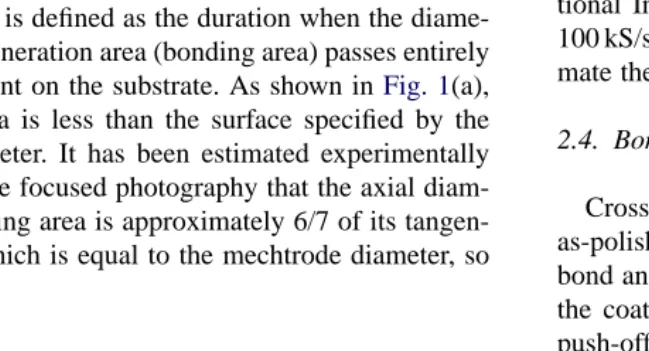
Bonding time is defined as the duration when the diame-ter of the heat generation area (bonding area) passes entirely over a given point on the substrate. As shown inFig. 1(a), the bonding area is less than the surface specified by the mechtrode diameter. It has been estimated experimentally and using a close focused photography that the axial diam-eter of the bonding area is approximately 6/7 of its tangen-tial diameter, which is equal to the mechtrode diameter, so that
db=0.875Md,
Fig. 1. (a) and (b) Bonding parameters. Vx
where Vxis the substrate speed.
Fig. 1(b) shows the recommended bonding times that have been obtained for the most popular mechtrode diameters and substrate speeds. Longer bonding time would logically mean, better bonding, since there is more time for the pro-cess to occur and complete. However, the heat energy flux, which is generated during this bonding time, has to be bal-anced, because when increased or decreased outside the rec-ommended boundaries, the quality of coating deteriorates. The most direct approach to control this energy flux is by altering the bonding time.
2.3. Torque and force
Torque was measured using a piezoelectric sensor manu-factured by Kistler Instruments with a measuring range for force of 0–14,000 N and±20,000 N cm for torque. The sen-sitivity of the equipment is pC/N,−2.03 and pC/N cm, 1.66. The acquired sets of data were stored into a database by using multifunction I/O board (AT-MIO-16E-10) from Na-tional Instruments capable of data acquisition at a rate of 100 kS/s. LabVIEW application software was used to auto-mate the data acquisition process.
2.4. Bond metallography and strength
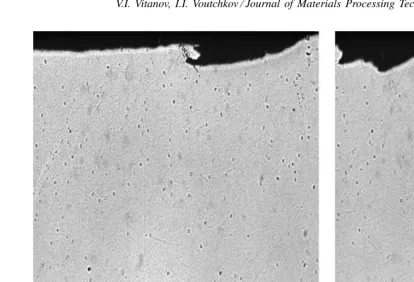
[image:2.842.165.490.525.700.2]Fig. 2. (a) and (b) Cross-sections showing coating/substrate interface, as-polished (50×).
hole, in the substrate, just under the deposit. The depth of the hole is accurately controlled to be exactly equal to the thickness of the substrate, i.e. the hole goes through the substrate and reaches the bonding area of the deposit. As the whole substrate is being clamped, a 3.95 mm pin is pushed into the prepared hole. Force and elongation are recorded as the deposit is being pushed away from the sub-strate. The repeatability of the result as measured by the variance is above 95%. More sophisticated testing based on a fracture mechanics approach is currently under develop-ment.
The metallography of a cross-section of a well-formed friction surfaced coating is shown as in Fig. 2(a) and (b). This clearly illustrates the undercut at the edge, which is an inherent feature of the process. Stages 2 and 3 of the optimisation process essentially extend the width of good bond and minimise the undercut at the edges. Materials used in these illustrations are 316 stainless steel coatings on mild steel.
3. General concept of FricExpert decision support system
The development process of FricExpert decision support system comprises the following key stages:
• Development of the empirical model based on control-lable, observable and quality parameters.
• Development of the inference mechanism engine logic.
3.1. Empirical relationship between process parameters and coating state variables
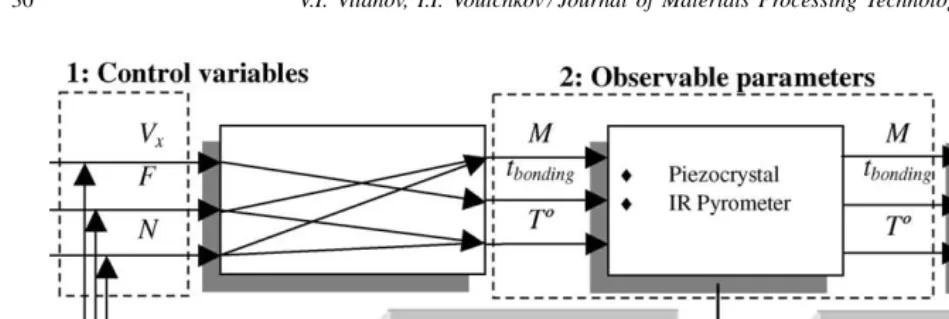
Fig. 3is a schematic representation of the adopted exper-imental approach and indicates dependencies between pro-cess parameters Vx, F, and N and coating state variables Cbs,
Ctand Cw.
Groups 1–3 represent the process itself. In most of the processes, the state variables can be monitored and observed during the process. However, in friction surfacing, the state variable can only be evaluated after the process has finished, and the coating has undergone various mechanical and ther-mal transformations. Hence, evaluation of the state variables is useful for gathering information about the process in its steady state, while the parameters of the second group can indicate various dynamical events during the coating itself. Dynamic modelling and real-time control, which are repre-sented inFig. 3in groups 2 and 4, have also been developed and the work on this matter will be published in the near future.
The work discussed in this paper, aims to represent the relationship between groups 1 and 3, and to show how this knowledge can be embedded into group 5—the knowledge based decision support system. These results form a foun-dation for reverse process designs.
[image:3.842.88.503.68.350.2]Fig. 3. Schematic representation of the experimentally established relationships, between controllable, observable and quality parameters in the friction surfacing process.
Fig. 4. The effect of spindle speed over thickness and strength.
no indication that spindle speed has effect on this variable. It is shown that variation of spindle speed can slightly affect the bond strength and the coating thickness. The following two logic rules can be derived:
• Increasing the spindle speed reduces the coating thickness slightly.
Fig. 5. (a) Coating thickness, Ct; (b) coating width, Cw; (c) bond strength, Cbs.
• Spindle speed is in weak second-order relationship with the bond strength.
Spindle speed becomes an important parameter when using different mechtrodes or substrate material. It has been found that Vx and F have much greater effect on the state variables. The following models were derived to represent the relationship between them and the state vari-ables:
Ct=b0+b1Vx+b2F +b11Vx2+b22F2+b12VxF,
Cw=b0+b1Vx+b2F +b11VFx +b22FVx+b12F
Vx,
Cbs=b0+b1Vx+b2F +b11Vx2+b22F2+b12VxF,
where the values of the b coefficients are shown inTable 1. Fig. 5(a)–(c) illustrates graphically the above equations.
[image:4.842.60.541.584.720.2]Table 1
State variables model coefficients
Ct Cw Cbs
b0 1.5398 1.7576 −1731.3
b1 −0.0015769 −0.0084871 −1.554
b2 −0.0015117 0.0059518 46.023
b11 −6.6242E−07 3.8045 5.6577E−05
b22 −5.6456E−06 2.6256E−05 −0.067033
b12 6.7868E−06 1.3044 −0.016273
Correlation coefficient,r2xy 0.87594 0.83866 0.75928
Logic rules drawn as a conclusion
Increasing force reduces
proportionally the coating thickness
Low values of Vx make the coating thicker
Increasing force increases proportionally the bond strength Increasing traverse speed reduces
proportionally the coating thickness
An increase of coating thickness weakens the bond
Increasing traverse speed decreases the bond strength by reducing the bonding time
The higher the mechtrode force the lesser the undercut
The faster the substrate movement the lesser the bonded area, the greater the undercut
and further more is most consistent throughout the whole length of the run.
3.2. Inference mechanism
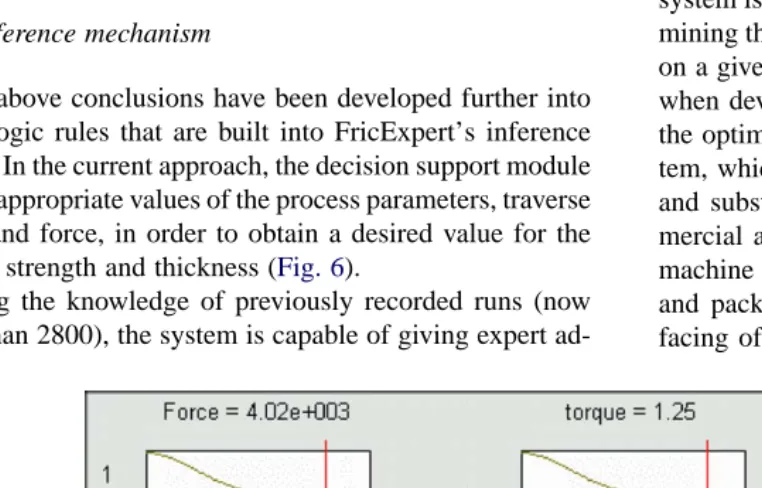
The above conclusions have been developed further into fuzzy logic rules that are built into FricExpert’s inference engine. In the current approach, the decision support module selects appropriate values of the process parameters, traverse speed and force, in order to obtain a desired value for the coating strength and thickness (Fig. 6).
Using the knowledge of previously recorded runs (now more than 2800), the system is capable of giving expert
ad-Fig. 6. Fuzzy logic based decision support system.
[image:5.842.103.484.473.717.2]manu-4. Conclusions
(1) Measurement and data analysis techniques have been successfully developed for the friction surfacing pro-cess.
(2) The introduction of the decision support system has shown to be promising for process parameter selection. (3) Fuzzy rules and membership functions have been estab-lished between quality state variables and process pa-rameters such that they allow for reverse engineering of the optimum friction surfacing process parameters.
Third International Charles Parsons Turbine Conference, Newcastle, April 1995, pp. 683–693.
[2] G.M. Bedford, R.P. Sharp, B.J. Wilson, L.G. Elias, Production of fric-tion components using steel MMCs produced by the osprey process, Surf. Eng. 10 (2) (1994) 118–122.
[3] E.D. Nicholas, W.M. Thomas, Metal deposition by friction welding, Weld. J. (August 1987) 17–27.
[4] T. Shinoda, Q. Li, Y. Katoh, T. Yashiro, Effect of process parameters during friction coating on properties of non-dilution coating layers, Surf. Eng. 14 (3) (1998) 211–216.