Lightweight Agent Framework for Camera Array
Applications
Lee Middleton, Sylvia C. Wong, Michael O. Jewell, John N. Carter, Mark S. Nixon School of Electronics and Computer Science, University of Southampton, UK
{ljm,sw2,moj,jnc,msn}@ecs.soton.ac.uk
Abstract. This paper describes a lightweight middleware agent framework (LAF)
for coordinating a large array of computers with attached cameras to construct high resolution video-rate image sequences. Compared to existing camera mid-dleware, LAF provides more than a remote sensor access API. The use of an agent framework allows reconfigurable and transparent access to cameras, as well as software agents capable of intelligent processing. It also eases maintenance by encouraging code reuse. Other features include an automatic discovery mecha-nism at startup, and multiple language bindings. Performance tests showed the lightweight nature of the framework while validating its correctness and scalabil-ity. Two different camera agents were implemented to provide access to a large array of distributed cameras. Correct operation of these camera agents was con-firmed via several image processing agents.
1
Introduction
Increasingly, large arrays of high quality cameras are used for capture and analysis of motion. Kanade et al. mounted 49 cameras in a room to capture motion for virtualised reality [1]. Wilburn et al. built a dense CMOS camera array to achieve high resolution and framerate capturing of image data [2]. Zhang et al. built a large self configuring camera array capable of rendering novel views of scenes in near real time [3]. In all these works multiple cameras are employed to produce a higher quality image than would be possible with a single camera. Specifically, we seek to deploy high resolution video-rate data captured from multiple cameras for the analysis of human gait.
Hori et al. [4] also implemented a middleware for networks of computers with at-tached cameras. Here, cameras were accessed as if they were a local device. This is similar to player/stage [5], which provides software abstraction for robot sensors. How-ever, these systems are not suitable for our application as their goals are to provide direct access to sensor data over a network. In contrast, we want intelligent agents in our framework, where researchers can provide agents that perform complex algorithms. Multi-camera tracking systems [6, 7] also study the same problem. Here, camera agents not only act as capture devices, but also perform processing on the image data. The middleware is highly focused on the task of tracking. Thus the messages are high level commands like location of objects. The middleware is also responsible for coordinating the movement and focus of the cameras to achieve a goal. In comparison, the middle-ware in our application has to be more general purpose. This is because researchers have different requirements from the image data. For example, in our research group, there are people who work with raw image data, silhouettes [8], and 2D and 3D mod-els [9]. A final approach to this camera coordination problem is to leverage an existing middleware such as CORBA [10] or XML-RPC [11]. However, both systems require lot of resources to run. Many features not required in our application are included by default, and they cannot be optionally switched off. Also, there is a steep learning curve before researchers can add their existing code to this framework.
Our proposed solution contains some of the features from all the approaches out-lined above, while being easy to use and lightweight. The paper is organised as follows: Section 2 provides an overview of the Lightweight Agent Framework (LAF). Section 3 introduces the two camera agents essential to our camera data acquisition system. Sec-tion 4 presents results from performance tests. Finally, SecSec-tion 5 describes applicaSec-tion agents that employ the services provided by the camera agents.
2
System Overview
Figure 1 shows an overview of LAF. The system has been simultaneously developed on C++, Java, and Python. Central to the system is the router. It is the main point of communication and coordination. All messages between components (except stream-ers) are sent via the router. Also, it acts as a broker for agents providing and requiring services. Agents are providers of services. Remote agents are clients of services pro-vided by agents. To use the service propro-vided by an agent, a remote agent requests a lock on the agent from the router. However, LAF is not restricted to a simple model of clients (remote agents) and servers (agents). An agent can contain one or more remote agents, thus allowing it to be both a client and a server at the same time. Ports are inputs and outputs of agents. Streamers are direct socket connections, mediated via the router. This allows video information to be sent directly between agents without the traffic passing through the router.
Ports and Streamers There are two types of ports in LAF: input and output. Input
reason, streamers were implemented. A streamer is a direct socket connection between an agent and a remote agent. The router is responsible for instigating this connection, so address information is not required ahead of time.
Messages LAF employs XML messages for communication between the router,
agents and remote agents. Broadly, there are three classes of messages – status, router and agent. Status messages give feedback about the success of an action. Router mes-sages are actions that only the router can perform. Agent mesmes-sages are communications, via the router, between agents and remote agents. They deal with control and commu-nication.
Router The router, agent and remote agent are implemented via a common class
hi-erarchy, as shown in Figure 2. The router is responsible for agent subscription, message re-direction, and agent selection. It employs a plugin system which makes it simple to extend its functionality. Upon starting, the router registers itself as a multicast DNS ser-vice (mDNS) in zeroconf. The mDNS serser-vice allows information to be passed to any subscriber of the service. In this case the port and IP address of the router are passed via mDNS. Essentially this means that connection to the router by any agent is potentially an automatic process.
The subscription process of an agent from the perspective of the router begins when aSUBSCRIBEmessage is received. This message contains the type of agent which is being subscribed. The type of an agent is purely a descriptive name describing the ser-vice it provides. When the subscription is received the router assigns a unique name for the agent. This is made up of the type and a unique id number. Once an agent is sub-scribed, it is added to two lists (connected agents and free agents) which are maintained in the router. If an agent unsubscribes or dies, the router removes it from both lists. All messages pass through the router. As a result of this the router can perform filtering of the messages. For example, some messages are permitted only if the sender has a lock on the target. If the sender does not have the required lock, the router returns anNOK
message to the sender. In most cases however the extent of the routers manipulation of the message is handling acknowledgements and passing it onward to the appropriate target. The last function of the router is the agent selection process. This is used when a remote agent attempts to lock an agent. The selection mechanism currently employed is a na¨ıve one. A handle to the first agent of the correct type on the free agent list is returned to the remote agent. The selected agent is also removed from the free agent list.
Agents and Remote agents Users writing agents for LAF will need to create a
derived class of Agent. The Agentclass provides the underlying networking and messaging required for all agents. The derived class will minimally need to (a) provide
Router Remote Agent
Agent
Streamer
Agent
[image:3.612.154.449.585.633.2]Input Port Output Port
Fig. 1. An overview of how the middleware and
agents fit together.
BaseAgent CommsThread
Router
Agent RemoteAgent
Fig. 2. Diagram showing the interrelation of the
Remote Agent
Service Index Param Value
Camera Agent Cameras
Router num Streamer
(a)
1 1 2 2 3 3 4 4 5 5 0
0 1
0 0 1 0 1 0 1 0101 frame
camera Camera 0
Camera 1
Camera
Agent
(b)
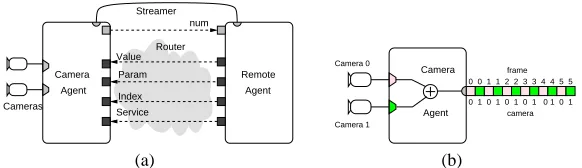
Fig. 3. (a) Configuration of camera agent. (b) Sending image data with a streamer.
type, ports, and streamers in the constructor, and (b) overwrite theaction()method. Type is a descriptive name of the service provided. Ports and streamers provide the inputs and outputs of this agent. Theactionmethod is the engine of the agent. The user writes their own action method to provide the agents’ functionality. Users writing remote agents will need to create a derived class ofRemoteAgent. The derived class will need to specify the name(s) of the agent(s) it wishes to lock, set the agent’s input ports and call theaction()method. Agents and remote agents can connect to LAF either automatically or manually. Automatic connection is performed using zeroconf while manual connection uses environment variables.
3
Camera Agents
Figure 3(a) illustrates the specific ports and general configuration for a camera agent. Only the service port is compulsory. The service port exposes the features of the cam-eras controlled by the agent, such as grab image and set shutter speed. The other input ports were employed to set required parameters. The streamer is used to transmit image data over the network directly to remote agents. The video data is sent a frame at a time with the frame from each camera interleaved as shown in figure 3(b).
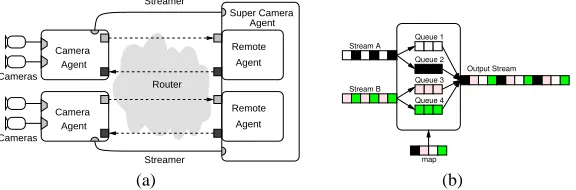
The camera agent provides access to the camera array on a per PC basis. However, accessing and controlling a large number of cameras can be cumbersome using camera agents alone. For instance to access 6 cameras which are connected in pairs to each of three PCs the user needs to maintain three separate camera agents. As a result, a su-per camera agent was written to provide a single collated image data stream to image processing applications. The configuration for a super camera agent is shown in Fig-ure 4(a). It contains a number of remote agents for locking camera agents connected to the router. Thus, the super camera agent is both a remote agent and an agent. Image data is transmitted to the super camera agent via a number of streamers. These are deman-gled into a single output stream for other other remote agents to consume (Figure 4(b)).
4
Performance Testing
[image:4.612.163.454.115.199.2]Camera Agent Cameras
Agent Camera
Cameras
Router
Streamer Streamer
Super Camera Agent
Remote Agent Remote
Agent
(a)
Stream A
Stream B
map Queue 2 Queue 1
Queue 4
Output Stream Queue 3
(b)
Fig. 4. (a) Configuration of super camera agent. (b) Demangling of image streams.
0 5 10 15 20 25
0 200 400 600 800 1000
time (in ms)
number of agents registered
connect disconnect
Fig. 5. Connection and disconnection time
against number of agents registered.
remote agents
agents C++ Python
C++ 943 1771
[image:5.612.166.454.118.213.2]Python 1596 2158
Table 1. Time (in ms) to perform 100 string
concatenation operations.
time (ms)
C++ agent 263
C++ remote agent 291
Python agent 512
[image:5.612.342.452.250.294.2]Python remote agent 604
Table 2. Startup time.
separate operations were invoked against an agent with two mandatory inputs and a single output. The result is shown in Table 1. The third test measures the average startup times of agents and is illustrated in Table 2. The slower start up times of the remote agents is the overhead due to locking. The messaging test and the startup time test demonstrate the lightweight nature of LAF. The fourth test examined the streaming performance. For a camera agent we achieved an average of 661 Mbit/s with a gigabit network. This means we can directly (640 ×480, 30fps) stream video data from 9 camera.
5
Application Agents
[image:5.612.137.309.257.380.2]Router Camera
Agent
Camera Agent
display GUI
Remote Agent Application
[image:6.612.138.480.114.199.2]Streamer
Fig. 6. Camera control application agent.
(a) (b)
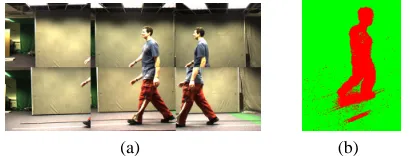
Fig. 7. (a) Creation of an uncalibrated image mosaic from six cameras on three PCs using the
image mosaicing agent. (b) Output from the background subtraction agent.
6
Conclusions
This paper described the development of a middleware, LAF, for the control of a large array of cameras. LAF consists of a router, and superclasses for agents (service providers) and remote agents (clients). Since agents can contain remote agents, LAF is not lim-ited to a simple client/server model. LAF provides transparent access to camera control. Additionally, it facilitates access and reuse of intelligent agents that provide a variety of image processing operations. Other features of LAF include minimal computational overhead, zeroconf for automatic discovery of components in the framework, locking, and multiple language support. This paper also presented performance tests and ap-plications of LAF. By measuring the connection and disconnection times of agents on an increasingly loaded router, scalability was demonstrated. Messaging tests showed the overhead of communication, in either C++ or Python, was small. Measured startup times showed the registration process to be short. Video streaming tests validated that the throughput in the designed system was sufficient to stream 9 cameras. Three ap-plication agents were also demonstrated in this paper. These apap-plications validated the correctness of the design and demonstrated the ease of implementation of image pro-cessing applications.
References
[image:6.612.206.411.234.312.2]2. Wilburn, B., Joshi, N., Vaish, V., Levoy, M., Horowitz, M.: High speed video using a dense camera array. In: Proceedings International Conference on Computer Vision and Pattern Recognition. (2004)
3. Zhang, C., Chen, T.: A self-reconfigurable camera array. In: Eurographics Symposium on Rendering. (2004)
4. Hori, T., Nishada, Y., Yamasaki, N., Aizawa, H.: Design and implementation of a reconfig-urable middleware for sensorized environments. In: Proceedings of the IEEE/RSJ Interna-tional Conference on Intelligent Robots and Systems. Volume 2. (2003) 1845–1850 5. Gerkey, B., Vaungan, R.T., Howard, A.: The player/stage project: Tools for multi-robot
and distributed sensor systems. In: Proceedings of the 11th International Conference on Advanced Robotics. (2003) 317–323
6. Sato, K., Maeda, T., Kato, H., Inokuchi, S.: CAD-based object tracking with distributed monocular camera for security monitoring. In: Proceedings of the Second CAD-Based Vi-sion Workshop. (1994) 291–297
7. Orwell, J., Massey, S., Remagnino, P., Greenhill, D., Jones, G.A.: A multi-agent framework for visual surveillance. In: International Conference on Image Analysis and Processing. (1999) 1104–1107
8. Veres, G., Gordon, L., Carter, J., Nixon, M.: What information is important in silhouette-based gait recognition. In: Proceedings of IEEE Computer Vision and Pattern Recognition conference. (2004)
9. Wagg, D.K., Nixon, M.S.: On automated model-based extraction and analysis of gait. In: Proceedings of 6th International Conference on Automatic Face and Gesture Recognition. (2004) 11–16
10. Henning, M., Vinoski, S.: Advanced CORBA Programming with C++. Addison Wesley (1999)