tactile.motion: An iPad Based Performance Interface For
Increased Expressivity In Diffusion Performance
Bridget Johnson Michael Norris Ajay Kapur
New Zealand School of Music Victoria University of Wellington
New Zealand School of Music
[email protected] Victoria University of Welling-ton [email protected].
nz
ABSTRACT
This paper presents recent developments in interface de-sign for the diffusion performance paradigm. It intro-duces a new custom-built iPad application tactile.motion, designed as a performance interface for live sound diffu-sion. The paper focuses its discussion on the intuitive nature of the interface’s design, and the ways it aims to increase expressivity in spatial performance. The paper also introduces the use of autonomous behaviors as a way to encourage live control of a more dynamic spatial field. It is hoped that this interface will encourage new aesthet-ics in diffusion performance.
1.
INTRODUCTION
The ascendance of the new interfaces for musical expres-sion (NIME) community has encouraged electronic musi-cians from all areas to question the performance inter-faces they use. Many performers are rejecting traditional interfaces and designing their own tools for performance. In the last ten years the paradigm of diffusion perform-ance has been greatly influenced by this trend. Tradition-ally, diffusion concerts are performed on a mixing desk or version thereof, with each fader mapped to the gain of a speaker, or group of speakers. Recently many diffusion artists have being experimenting with designing and per-forming on a range of new interfaces, these interfaces have often afforded a greater range of spatial trajectories. In light of this a new branch of the diffusion paradigm has emerged, focusing on designing interfaces for in-creased spatial expression and intuitive relationships be-tween performative gesture and spatial output. This paper presents a new contribution to this field.
The paper begins by identifying previous develop-ments in the field of interface design for diffusion per-formance. There is a focus on significant multi-touch interfaces for both touch tables and mobile devices. It then goes on to introduce tactile.motion, a new perform-ance interface designed for diffusion performperform-ance. The basic functionality, special features and wider spatialisa-tion system are all discussed. Secspatialisa-tion Four discusses the increasing use of autonomous behaviors in diffusion sys-tems and the way tactile.motion intuitively incorporates these behaviours. The fifth section discusses looks at how tactile.motion is used in a performance environment. The
paper concludes by proposing future directions for tac-tile.motion.
2.
RELATED WORK
There have being many new interfaces designed for dif-fusion performance, particularly in the past decade. A great number of these interfaces focus on the gestural relationships between the performer and the space. Multi-touch devices have emerged as an expressive and intui-tive platform for electronic music performance through-out the wider performance field.
The use of multi-touch platforms as a user interface in spatial rendering has being explored by a number of re-search teams. MTG’s Multi-touch Interface for Audio Mixing [1] was developed for the Reactable [2] as a graphical control interface. Spatial positioning of an audio file is possible in either stereo or surround space. The interface is designed as a studio-mixing tool and af-fords control of many parameters of the mixing process including reverb and E.Q. Spatial aspects of the interface are present however, they are only one feature and dy-namic spatialisation is not the primary goal of this inter-face. Evaluations of the user interface presented in [1] suggest that interacting directly with a multi-touch sys-tem is an intuitive way to control musical parameters.
A further graphical interface for studio mixing was presented in [3]. In a similar way to the first, this system focused on creating a more intuitive environment for audio mixing to occur. There was a focus on the use of tangibles as well as direct touch control, and specifically in this case on smart tangibles. The concept most relevant to diffusion interface design that is incorporated by both studio-mixing environments is that of the stage view. Originally proposed by Gibson [4] the stage view differs from the more traditional channel-strip view that was the common form for both studio mixing and diffusion per-formance environments. With the stage view, the user interacts directly with a graphical representation of the stage and a sounding object within. For diffusion inter-face design this same concept is easily adapted to have the performer interact with a representation of the concert hall, or the speaker array. The tactile.motion interface presented in this paper extends the concept of the stage-view to the diffusion performance paradigm.
The SoundScape Renderer was first introduced in 2008 as a spatial rendering system running on a touch table [5]. Since then the SoundScape Renderer has been ported to, and is available for, Android [6]. The system is capable
of higher-order ambisonic, binaural or VBAP rendering. Unlike the first two mixing-based applications presented, the SoundScapeRender is specifically designed for inter-facing with higher-level spatial scenes, however was still conceived as a rendering and collaborative interactive installation tool rather than a performance interface.
3.
TACTILE.MOTION
The interfaces previously discussed proved the multi-touch environment affords sufficient expressivity and warranted further and more specific development. tac-tile.motion is a new performance interface, currently un-der development by the authors. The application was ini-tially conceived as a mobile version of the author’s pre-vious work, tactile.space [7] developed for The Brickta-ble [8]. One of the main goals in porting to the iPad was to increase the accessibility of the user-interface. Running tactile.space involved extensive and somewhat expensive hardware, calibration of open source tool Community Core Vision1, compiling the main application built in
Processing, and manually loading audio files into a cus-tom built Max Patch. This process took valuable time and expertise, significantly restricting the number of perform-ers and institutions able to use the interface. Now running on the iPad, tactile.motion requires no calibration, is not affected by stage lighting, can be used by novice per-formers and will soon be available for free download from the Apple App Store. The iPad has a much lower cost then a touch table, and many people may already own the device. It is hoped that these factors, as well as new features, will ensure that the new app is much more accessible to a wider audience.
3.1 Basic Functionality
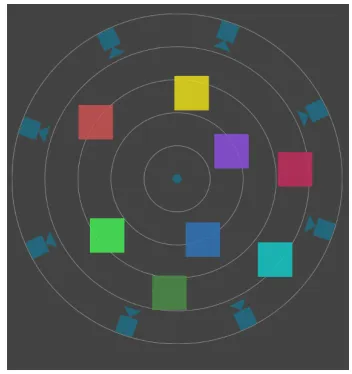
Figure 1. tactile.motion basic GUI
In its most basic form, tactile.motion (shown in Figure 1) allows a user to drag a visual representation of an audio file, an ‘audio object’, around the screen and place it within a speaker array. The positioning of audio objects in this way creates an intuitive and easily learned
1 ccv.nuigroup.com
sion interface. There is no limit to the number of audio objects that may be moved simultaneously. The user is able to perform any number of complex trajectories in real time simply by tracing the desired trajectory on the screen. The high frame rat, smoothing algorithms and accurate touch detection afford the user a remarkably natural feeling when dragging an object.
[image:2.595.323.522.254.441.2]The audio objects position is calculated in polar coor-dinates, in relation to the centre of the speaker array. The data is then sent over an ad-hoc network hosted by the computer, to be received by a custom built Max/MSP patch. The OSC [9] protocol was chosen for sending the data due to its flexibility and ease of use. The full spati-alisation system is displayed diagrammatically in Figure 2.
Figure 2. System Overview
In designing the OSC protocol the aim is to make it as generic as possible. The authors are currently developing a number of other diffusion performance interfaces and are aiming to create a modular spatialisation system, where any part of the system can be interchanged for an-other. The protocol used must be common amongst all user interfaces, and be intuitive enough to be incorpo-rated into other spatialisation systems. The OSC mes-sages sent when and audio objects position is updated are as shown in Figure 3.
Figure 3. Example of OSC message, the distance is in metres and the theta in radians
4.
AUTONOMOUS BEHAVIORS
[image:2.595.81.257.469.656.2]popular direction is to implement common motions from particle system behavioral patterns such as those intro-duced by Kim-Boyle [10] and apply them to spatial movement.
In a traditional diffusion set up, with a mixing desk as user interface, many desirable spatial trajectories are ex-tremely difficult to perform. Some systems through the late 90s began to introduce a capability of triggering cir-cular motions [11] and other spin based trajectories. Spin based trajectories are one area that was particularly diffi-cult to achieve in real time, with the standard configura-tions of a mixing desk. There are a number of examples of systems that allow the performer to trigger and control these trajectories [12], [13], however at this point the triggering has mostly occurred manually, and the behav-iors are controlled by inputting parameters directly into a computer, or through a mixing desk.
4.1 Spin Trajectories
[image:3.595.330.527.181.374.2]Tactile.motion aims to build on the concept of triggered autonomous motion, but also to add a performative ele-ment into the process. In order to do so, tactile.motion is able to recognize specific gestural trajectories on the iPad and translate them into spatial motion. For example drag-ging an audio object in a circular motion (shown in Fig-ure 4) around the sweet spot triggers a spin-based trajec-tory.
Figure 4. Spin motion trajectory
In order to be recognized as a spin motion the object must be moved at a constant rate and remain at a rela-tively constant distance from the centre point. If the ob-ject deviates from an ideal circles path too much it will be considered a standard ‘drag motion’. If the velocity changes to dramatically throughout the motion it will not be recognized. Once the motion is recognized the system deciphers the average velocity with which it was drawn and uses that velocity to continue the motion. The object continues along the path spinning around the centre, in
the circular motion until the user double taps it, causing it to stop2.
4.2 Drift Trajectories
[image:3.595.69.279.386.597.2]The spin-based trajectory is the first gestural triggered motion implemented by tactile.motion. At the time of writing a drift motion is under development. This motion uses similar algorithms to the circle recognizer in order to determine if the objects trajectory follows a straight path towards the speaker array (as shown in Figure 5).
Figure 5. Drift motion trajectory
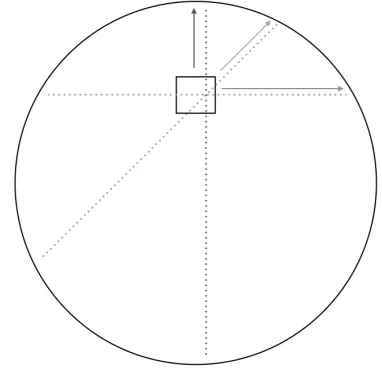
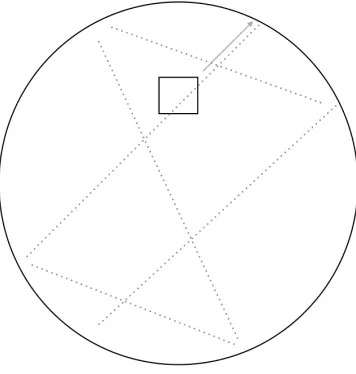
There are two proposed implementations of the drift mo-tion, one being a straight drifting path be it vertical, hori-zontal or angular (Figure 6.1). The other is a for a ping-pong like effect that would ricochet off the edge of the speaker array and continue to do so as it makes its way throughout the space (Figure 6.2).
Figure 6.1. Straight Drift Motion
[image:3.595.328.519.491.679.2]
Figure 6.2. Ping-Pong Drift Motion
A number of other autonomous behaviors derived from particle systems are planned for tactile.motion such as a random walker function and an attractor function. Also planned are the capabilities to group audio objects and have them be moved together, or respond to behaviors simultaneously. It is believed that the addition of these behaviors, whilst keeping their triggering and control as gesturally intuitive as possible, will encourage an increas-ing expressive range in diffusion performance.
5.
PERFORMANCE USE
Performing with tactile.motion creates a very different experience to a traditional diffusion concert. The mixing desk exhibits a problematic coupling of gesture to sonic output. This can leave the audience without a clear indi-cation of ways the performers actions affect the sound. The mapping of vertical faders directly to speaker gains, and the configuration of the faders greatly influences the potential trajectories. With the tactile.space interface the performer is manipulating phantom source positions rather than speaker gains. The ease of moving a sound source exhibited by the interface encourages the per-former to more actively create a dynamic sound field. This affords performers with a new range of potential trajectories, and spatial aesthetics.
The interface was featured in a piece called fine.tones. The main spatial concept of the piece was to have sine tones ‘chasing’ each other around the space. Slowly as-cending and desas-cending sine tones were moved slowly in a circular motion around the audience with the velocity of motion slowly increasing throughout the piece. With tac-tile.motion the circular movement was simple and gestur-ally intuitive to perform live.
Feedback from performers using the interface has so far being positive. A full user study is scheduled to take place later in the year where a group of around twenty acoustmatic composers will perform with and evaluate the interface and their experience using it.
As discussed in section 3.1 tactile.motion is designed with enough modularity to be incorporated into any diffu-sion system. However, there is also a custom Max patch that has been developed along side the application as its
audio driver. The patch uses a Vector Base Amplitude algorithm [14] to decipher and implement gain factors for each speaker in order to create phantom source positions. The patch can take up to 8 audio inputs, either live or audio files and works with up to 16 speakers. The patch is also designed with the goal of modularity, therefore whilst these values are the current ones it would be a very simple process to add a capability of more speakers, or inputs. The current design focus is on increased commu-nications between the patch and the app to further reduce set up times and reduce the expertise needed to run the system.
6.
CONCLUSIONS
The use of multi-touch user interfaces in music perform-ance has widely been received by the community. Artist driven developments of these interfaces have led to them being able to significantly increase the expressive range within sub-fields of electronic music. Recent trends in diffusion practice have embraced the design of new inter-faces for performance. The new tactile.motion interface aims to encourage diffusion performers to more actively engage with phantom source positions in the space. The ability to freely move audio objects around a speaker array means that complex spatial trajectories can be per-formed with ease and encourages performers to do so. The addition of intuitively triggered autonomous behav-iors further increases the aesthetic potential and allows the performer to dynamically control a much larger num-ber of sound sources at once.
At the time of writing the application is already ac-tively being used for performance. Many future develop-ments are proposed some of which were outlined in sec-tion 4.
Acknowledgments
The current version of the tactile.motion application uses the open source objective C library: VVOSC3 for sending
OSC messages. The Max patch uses the vbapan~ object.4
The authors would like to thank Owen Vallis, Jordan Hochenbaum and Blake Johnston for their support in the development of multi-touch performance interfaces.
7.
REFERENCES
[1] J. Carrascal and S. Jordà, “Multitouch Interface for Audio Mixing,” in Proceedings of New Interfaces For Musical Expression, Oslo, Norway, 2011. [2] S. Jordà, M. Kaltenbrunner, G. ̈nter Geiger, and R.
Bencina, “THE REACTABLE,” in Proceedings of New Interfaces For Musical Expression, Vancou-ver, Canada, 2005.
[3] S. Gelineck, D. Overholt, M. Buchert, and J. An-derson, “Towards an Interface for Music Mixing based on Smart Tangilbes and Multitouch,” in
3 https://github.com/mrRay/vvopensource
ceedings of New Interfaces For Musical Expres-sion, Daijon, Korea, 2013.
[4] P. Gibson, The Art of Mixing: A Visual Guide To Recording, Engineering, And Production. Artist Pro Press, 1997.
[5] K. Bredies, N. A. Mann, J. Ahrens, M. Geier, S. Spors, and M. Nischet, “The Multi-touch Sound-scape Renderer,” in Proceedings of the working conference on Advanced visual interfaces, New York, USA, 2008.
[6] M. Geier and S. Spors, “Spatial Audio with the SoundScape Renderer,” in Proceedings of 27th Tonmeistertagung - VDT International Convention, Cologne, Germany, 2012.
[7] B. Johnson, J. Murphy, and A. Kapur, “Designing Gestural Interfaces For Live Sound Diffusion,” in
Proceedings of International Computer Music Conference, Perth, Australia, 2013.
[8] J. Hochenbaum and O. Vallis, “BrickTable: A Mu-sical Tangible Multi-Touch Interface,” in Proceed-ings of Berlin Open Conference 09, Berlin, Ger-many, 2009.
[9] M. Wright, A. Freed, and A. Momeni, “Open Sound Control: State of the Art 2003,” in Proceed-ings of New Interfaces For Musical Expression, Montreal, Canada, 2003, pp. 153–159.
[10] D. Kim-Boyle, “Sound Spatialization with Particle Systems,” in Proceedings of the 8th International Conference of Digital Audio Effects, Madrid, Spain, 2005.
[11] B. Traux, “Composition and Diffusion: Space In Sound In Space,” Organised Sound Camb. Univ. Press, vol. 3, no. 2, pp. 141–146, 1999.
[12] J. Mooney and D. Moore, “Resound: Open-Source Live Sound Spatialisation,” in Proceedings of In-ternational Computer Music Conference, Belfast, Ireland, 2008.
[13] J. Harrison and S. Wilson, “Rethinking the BEAST: Recent developments in multichannel composition at Birmingham ElectroAcoustic Sound Theatre,” Organised Sound Camb. Univ. Press, vol. 15, no. 3, pp. 239–250, 2010.
[14] V. Pulkki, “Virtual source positioning using vector base amplitude panning,” J. Audio Eng. Soc., vol. 45, no. 6, pp. 456–466, 1997.
MASSEY UNIVERSITY
MASSEY RESEARCH ONLINE
http://mro.massey.ac.nz/
Massey Documents by Type Conference Papers