“I hereby declared that I have read through this report entitle “Fuzzy Logic Controller to Maintain Parabolic Dish (PD) Receiver Temperature Within Safe Operating Range” and found that it has comply the partial fulfilment for awarding the degree of Bachelor of Electrical Engineering.”
Signature : ……….
Supervisor’s Name : Datuk Prof. Dr. Mohd Ruddin bin Ab Ghani
MUHAMMAD FAEZ BIN ALI
A report submitted in partial fulfilment of the requirements for the degree of Bachelor of Electrical Engineering (Control, Instrumentation and Automation)
Faculty of Electrical Engineering
UNIVERSITI TEKNIKAL MALAYSIA MELAKA
I declare that this report entitle “Fuzzy Logic Controller to Maintain Parabolic Dish (PD) Receiver Temperature Within Safe Operating Range” is the result of my own research except as cited in the references. The report has not been accepted for any degree and is not concurrently submitted in candidature of any other degree.
Signature : ……….
Name : Muhammad Faez Bin Ali
ACKNOWLEDGEMENT
First of all, I am greatly thankful to ALLAH SWT on His blessing to make this project successful.
I would like to express my gratitude to my supervisor, Datuk Prof. Dr. Mohd Ruddin bin Ab Ghani for his valuable guidance, enthusiasm and motivation given throughout the progress of this project.
I would also like to thank my parents for always being there to support me at all times and for giving me the courage and strength that are necessary to carry on with this project. Thanks for their encouragement, love and emotional supports that they had given to me.
I would also like to thank all my friends who had given me the advice, courage and support in completing this Thesis. Their views and tips are very useful.
ABSTRACT
ABSTRAK
TABLE OF CONTENTS
CHAPTER TITLE PAGE
ACKNOWLEDGEMENT i
ABSTRACT ii
ABSTRAK iii
TABLE OF CONTENTS iv
LIST OF FIGURES vi
LIST OF TABLES ix
1 INTRODUCTION 1
1.1 Motivation 5
1.2 Problem Statement 5
1.3 Objective 5
1.4 Scope 5
1.5 Expected project outcome 5
2 LITERATURE REVIEW 7
CHAPTER TITLE PAGE
2.2 PD Receiver 12
2.3 Temperature Control System 13
2.4 Fuzzy Logic Controller 14
3 RESEARCH METHODOLOGY 19
3.1 Overview 19
3.2 Project Flow Chart 19
3.3 Process of Parabolic Dish System 21
3.4 PD Receiver in MATLAB 24
3.5 Fuzzy Controller Design 26
3.6 Fuzzy Design in MATLAB Simulink 30
3.7 Process of Tuning 31
3.8 Performance Set up 37
3.9 Project Gantt chart and key milestone 41
4 RESULT AND DISCUSSION 42
4.1 PD Receiver 42
4.2 Fuzzy logic controller design 43
4.3 Tuning of Membership Functions 45
4.4 Performance Analysis 50
5 CONCLUSION AND RECOMMENDATION 53
REFERENCES 54
LIST OF FIGURE
FIGURE TITLE PAGE
1.1 Photo of (a) Parabolic troughs system, (b) linear Fresnel system, (c) parabolic dish system and (d) power tower system.
2
1.2 Schematic of a PD system 4
1.3 The fuzzy control basic block diagram 4
2.1 Diagram of PD system with labelled components 12
2.2 Pressure commanded by the temperature control system 14
2.3 Block Fuzzy Logic Controller 16
2.4 Flow chart to design FLC 18
3.1 The project flow chart 20
3.2 Block diagram of PD receiver system 21
3.3 Concentrator and receiver block diagram 23
3.4 Block diagram of Receiver subsystem from the whole system 24
3.5 Block diagram of Receiver 25
3.6 Signal builder for DNI(W/m^2) 25
3.7 Input Signal for DNI for date 20th January 26
3.8 Fuzzy logic algorithm 27
3.9 The membership function input ‘Th’ 28
3.10 The membership function input ‘DQh’ 28
3.11 The membership function input ‘Th2’ 28
3.12 The Block diagram of Receiver with fuzzy logic controller 30
3.13 Flowchart of tuning Fuzzy Logic Controller 31
3.15 The membership function input with Gaussian type 32
3.16 The rule viewer of rules for the FLC 33
3.17 The membership function ‘warm’ move to right 34
3.18 The membership function ‘warm’ move to left 34
3.19 Scaling factor of membership function ‘warm’ reduce 34 3.20 The membership function ‘superhot’ move to the right 35 3.21 The membership function ‘hot’ move to the right 35 3.22 The membership function ‘superhot’ shift to right, ‘hot’ reduce scale
and move to the right
35
3.23 The range for membership function increase 36
3.24 The Block diagram of adding gain 0.1 36
3.25 The Block diagram of adding gain 0.01 37
3.26 Input Signal for DNI for date 21th January 38
3.27 Input Signal for DNI for date 22th January 38
3.28 Convection losses subsystem 39
3.29 Block diagram of Convection losses 40
3.30 Block diagram of Radiation losses 40
3.31 Block diagram of total losses 40
4.1 Output of the receiver temperature with and without FLC 43 4.2 The output for membership function with input trapezoidal type 44 4.3 The output for membership function with input Gaussian type 44 4.4 The output for membership function ‘superhot’ shift to right 45 4.5 The output for membership function ‘superhot’ shift to right and
‘hot’ shift to left
46
4.6 The output for membership function ‘superhot’ shift to right and ‘hot’ shift to right
46
4.7 The output for membership function ‘superhot’ shift to right, ‘hot’ reduce scale and shift to left
47
4.8 The output for membership function ‘superhot’ shift to right, ‘hot’ reduce scale and shift to right
4.12 The output for input signal for DNI for date 21th January 50 4.13 The output for input signal for DNI for date 22th January 50
4.14 Convection Losses 51
4.15 Radiation losses 51
LIST OF TABLES
TABLE TITLE PAGE
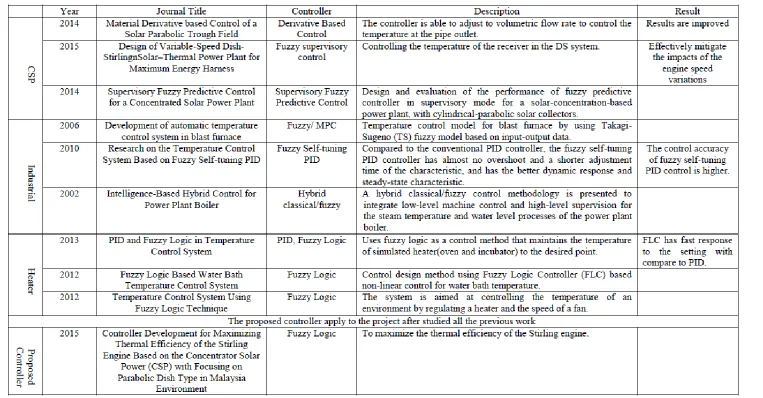
2.1 The summary of all the previous work related to the project and the proposed controller that implement to the project studied all the previous work
11
3.1 Yearly irradiation data for selected locations in Malaysia 21
3.2 Fuzzy rules for receiver temperature 29
3.3 Gantt Chart of this project 41
4.1 Summary of selection type of membership function. 44
CHAPTER 1
INTRODUCTION
This chapter will discuss on the background of the fuzzy logic controller to maintain PD receiver temperature within safe operating range; problem statement, objective and scope.
1.1Motivation
Solar, biomass and wind is the example of Renewable Energy (RE) resources has become increasing in production and make the future recourses less dependent on fossil fuel. Solar energy is the great potential of the RE because of the energy resource most plentiful on earth[1]. To convert solar energy to electrical energy, it can be done by Photovoltaic (PV) system or CSP system.
Interestingly, CSP can generate electricity even during cloudy or after sunset when equipped with thermal storage system. CSP technologies have four types which are Parabolic Troughs system, Linear Fresnel system, Parabolic Dish System and Power Tower system.
(a) (b)
[image:15.612.118.536.188.541.2]
(c) (d)
Figure 1.1: Photo of (a) Parabolic troughs system, (b) linear Fresnel system, (c) parabolic dish system and (d) power tower system. [2]
scale plant and they are measured. PD is suitable for small area with each unit commonly producing yield of 3 to 25 kW and can possibly get to become one of the least expensive sources of RE. In addition, the area of the CSP plant particularly the PD is littler than the area of the PV plant [1].
Parabolic dish system is one of the CSP technology, have been investigate and developed for global uses that permits to achieve maximum temperatures by concentrating the solar radiation in a centre [3]. Parabolic dish system tracks the sun and focus solar energy into receiver and transfers it to a generator for generates electrical power from the energy absorb. [3].
Figure1.2: Schematic of a PD system[4].
The overall efficiency of a PD system, the solar-to-mechanical efficiency, depends on the following parameters; Solar, radiation concentration, intercept factor, thermal receiver efficiency and engine efficiency[5].
Figure1.3: The fuzzy control basic block diagram[6].
1.2 Problem Statement
The input thermal energy from the sun is rather unpredictable and intermittent during daily operation. Meanwhile, the temperature must be kept high to exploit the thermal efficiency. Besides, the temperature increase will exceed the threshold safe operating will damage the receiver material. A fuzzy logic controller needed in order to maintaining the temperature to be within the safe region.
1.3Objective
The aim of this project is:
1) To develop fuzzy logic controller for PD receiver temperature. 2) To analyze the performance of PD receiver.
1.4Scope
The scopes for this project the fuzzy logic controller for temperature control system design by using Matlab Simulink. Then analyze the system response before and after implementing the controller. Beside, maintain the temperature within safe operating region in 1000 Kelvin.
1.5 Expected project outcome
CHAPTER 2
LITERATURE REVIEW
This chapter will discuss on research of preceding research related with the project, the concept of literature and suggested model.
2.1 Journal Literature
The comparison of the preceding research related to project such as temperature control system for CSP, industrial and heater application. All the previous work very useful, giving a great deal of though and information which can execute and apply to the project.
2.1.1 Temperature Control System for CSP
controller is able to adjust to volumetric flow rate to control the temperature at the pipe outlet. Results are improved and also show that the control system is able to compensate large sun power perturbations.[7]
In 2014, Raúl Morales, Felipe Valencia, Doris Sáez and Matías Lacalle [8] presented fuzzy predictive controller in supervisory mode for a solar-concentration-based power plant, with cylindrical-parabolic solar collectors. A model predictive control (MPC) is added in order to maximize the use of the available solar thermal energy for energy production. From the development, it is possible to conclude that the supervisory control enhance the plant performances. The improvement done in the achievement of higher temperatures in the outlet oil, and in the power produced increasing associated with the higher outlet oil temperature. From the control theory, by adding the supervisory control loop also provided some improvements in the closed-loop behaviour.[8]
In 2015, Y. Li, S. S. Choi, C. Yang, and F. Wei [9] advanced dynamic model of the dish-Stirling (DS) system through controlling the Stirling engine speed shows that maximum solar energy harness can be achieved. Besides, the adopted fuzzy supervisory control method is appeared to be compelling in controlling the temperature as the speed changes of the receiver in the DS system. A supervisory fuzzy control scheme has been recognized as a suitable means because it can successfully relieve the effects on the DS receiver temperature of the engine speed differences.[9]
2.1.2 Temperature Control System for Industrial Application
In 2010, Jiang Wei [11] proposed based on fuzzy self-tuning PID on the temperature control system of vacuum smelting process. The fuzzy self-tuning PID controller has nearly no overshoot and a shorter alteration time of the characteristic, and has the improved dynamic response and steady-state characteristic, compared with the conventional PID controller. The control precision of fuzzy self-tuning PID control is higher than and PID control.[11]
In 2014, Wei Wang, Han-Xiong Li, and Jingtao Zhang [12] presented power plant boiler control system by using intelligence-based hybrid control to incorporate low-level machine control and complex supervision of the power plant boiler for the steam temperature and water level procedures.[12]
2.1.3 Temperature Control System for Heater Application
In 2013, M. Alla [13] proposed using fuzzy logic as a means of retaining control of the heating temperatures, such as ovens and incubators simulate the desired spot. The Fuzzy Logic Controller (FLC) performance is assessed in a few circumstances in terms of speed of response to the desired setting value by comparing it with conventional PID controller, overshoot in static set point and robustness against interference. Compare to PID, FLC has quick response to the set, and more constant against external interference. Further, both of FLC and PID have eliminate overshoot value and steady state error, however FLC has discernible deviation in high set points.[13]
In 2012, Isizoh A. N., Okide S. O., Anazia A.E. and Ogu C.D. [15] recognized temperature control utilizing fuzzy logic method. The system is aimed at regulating the temperature of an state by adaptable a heater and the rate of a fan.[15]