Self-assessment in tertiary education
Dr. Roseanna Bourke and Dr. Carolyn Tait
Faculty of Education
Victoria University
Table of Contents
EXECUTIVE SUMMARY ... 1
INTRODUCTION ... 2
RATIONALE FOR SELF-‐ASSESSMENT IN TERTIARY EDUCATION ... 3
BACKGROUND TO THE STUDY ... 5
STUDENTS WITHIN THE NEW ZEALAND POLICE ... 7
THE RATIONALE FOR SELF-‐ASSESSMENT IN THIS COURSE ... 8
METHOD ... 8
RESULTS ... 11
SELF-‐ASSESSMENT TO ANALYSE SELF ... 11
SELF-‐ASSSESSMENT TO UNDERSTAND OTHERS ... 14
SELF-‐ASSESSMENT TO UNDERSTAND LEARNING ... 16
AN ANALYSIS OF THE RESULTS RELATING TO A SPECIFIC OCCUPATION ... 17
Opportunity for reflection ... 17
Exploring relationships with others ... 19
Connecting learning to the workplace ... 21
The Function of Self-‐assessment in Supporting Professional Thought and Action ... 22
DISCUSSION ... 26
CONCLUSION ... 28
Executive Summary
Tertiary education creates learning and assessment opportunities that invite students to challenge their thinking, ideas and beliefs, as well as developing their understanding, knowledge and skills in their areas of study. Increasingly, the assessment systems within tertiary environments examine ways to support and challenge students, through both summative and formative approaches. Traditionally, summative assessment in tertiary institutions has played a pivotal role in determining the level of student achievement and establishing what has been learned. Increasingly however, tertiary educators are incorporating formative assessment practices (assesment for and as, learning) to enable students (a) to
actively learn from their assessment experiences, and (b) to engage in the assessment culture in a more collaborative role with academic staff.
This report outlines what happened when a distance undergraduate course,
Understanding behaviour: Working with people introduced three self-assessment mandatory tasks alongside other summative and traditional forms of assessment. The self-assessment tasks were formative in action and function, but had a summative component in that students received 5% for completion of the submission alongside the written assignment during the course of study. This report describes how the self-assessment was introduced, and examines the associated effects on students and their learning.
The aim of the study is to understand how compulsory self-assessment in a course contributes to the learning of tertiary students who work in professional occupations. Sixty-two students chose to participate with each contributing three (n=3) 250-word
Introduction
As lecturers working at both the undergraduate and postgraduate levels in a tertiary education environment we were aware that students often undertake assessment tasks to ‘jump through the hoops’, rather than necessarily engage intentionally with their learning, in order to gain their credentials. We became increasingly interested in enabling students to have an active participation in their learning, as well as their assessment. As Race (2009) has argued, “Involving students in peer- and self-assessment can let them in to the assessment culture they must survive” (p. 57).
An opportunity to trial self-assessment as a mandatory exercise presented itself when the first author was asked to rewrite an undergraduate course, and having both taught the subsequent course over a semester, we realised that students had an interesting take on the self-assessment exercise. The following year, when neither was involved in teaching this course, we approached AKO Aotearoa for funding to research this assessment strategy to gain more understanding on how students engaged with self-assessment.
Predominantly, the students in the course were largely in the police profession working as probationary constables. Given that students in tertiary education programmes, undertaken concurrently while working in their profession, often have difficulty linking their real world of work to the more theoretical, conceptual studies in their university programme, we wanted to include a component that was meaningful and relevant to their own career. The assessment practices within universities, combined with prescribed curricula, encourage certain forms of mechanical responses to essay-type questions, references to a particular literature base and, at times, opportunities to self-reflect on their understanding. We faced tensions when, on the one hand, we actively supported students through their courses of study which can be prescriptive in content and have pre-determined assessment tasks, while on the other hand we aimed to
encourage independent thought and action (Boud & Falchikov, 2007).
Rationale for Self-assessment in Tertiary Education
In determining the range of assessment practices used within a course in a tertiary education setting, a combination of factors are taken into consideration including the time available for administering, marking and engaging in assessment tasks, the nature of the questions or field of study that requires an assessment and the type of understanding, skills and knowledge the lecturers want the students to demonstrate. These assessments may include written
summative statements (in the form of essays, short-tests), examinations, oral reports or presentations, explicit links to the field of study (through case studies). Students generally make intentional decisions about how they approach an assessment task in order to maximise their results from these assessments. For some, considerable energy is placed on engaging with assessment tasks in order to ‘play the game’ by reporting on, and responding to,
assessment requirements that are institutionally valued, graded and that provide their ticket to their qualification (Bourke, 2010; Ramsden, 1988). In other words, students become ‘test wise’ (Smith, 2011).
Self-assessment on academic and personal knowledge is premised on ‘knowing thyself’, and having an awareness of one’s own knowledge and the limitations of that knowledge. Undoubtedly, it requires more than this; a sense of vision with an ability to appreciate a wider or more encompassing knowledge base is critical, and self-assessment is enhanced when others provide feedback on an individual’s summary of their perceptions. Reflection in this frame is the ability to use that self-assessment to formulate some action and to act on those self-assessments. Unless acted upon, self-assessment becomes a summative process, and thus negates the potential of it being a formative process to support learning (Black & Wiliam, 1998; Tan, 2007).
In preparing students for professional practice, the notion of ‘self-reflection’ or the reflective practitioner, has been promoted as enabling, by giving the student a sense of constant renewal of learning, or learning-in-action, and reflection-on-action (Schön, 1987). Drawing on Schön’s earlier work, Mamede, Schmidt, and Penaforte (2008) showed that medical doctors who engaged with self-reflective techniques, increased their diagnostic accuracy of complex conditions.
responsibility (Dewey, 1933), the focus tends to centre on the ‘problem’ or the ‘action’ rather than the individual. In contrast, self-assessment is designed to focus the learner back onto their own learning in order to understand their role more clearly in that learning, and their subsequent applications of that learning.
Self-assessment can be conceptualised in a range of ways, from being a process of ‘self-grading’ or self-reporting, to one of developing self-knowledge (Peat, Franklin, & Lewis, 2001; Poon, McNaught, Lam, & Kwan, 2009). In this report, we take a conception of self-assessment that relies on students understanding their learning, and being able to comment on their learning, the aim being to “build the metacognition of learners” (Mok, Lung, Cheng, Cheung, & Ng, 2006, p. 416). In this way, self-assessment as a form of assessment in tertiary education is increasingly being used to encourage student learning beyond course
requirements, particularly those involved in professional programmes of study (Boud & Falchikov, 2007). However, in a tertiary setting, power and control are systematically and routinely expressed through enrolment procedures, grade averages, assessment requirements and course requirements, and lecturers experience their own form of assessment expectations within their own institutions. In these settings, the notion of self-assessment as a sustainable form of assessment (e.g., Boud, 2000; Boud & Falchikov, 2007) becomes a challenging ideal. Although many self-assessment studies have focussed on students’ accuracy with their
proposed scores and on self-grading rather than learning (e.g., Lew, Alwis, & Schmidt, 2010), this report concentrates on how students use self-assessment to describe and inform their learning, rather than to measure it. When research examines whether student self-assessment is ‘accurate’ or reliable (e.g., Sitzmann, Ely, Brown, & Bauer, 2010), the focus moves away from how those students use it as a process for their learning.
further consideration because there were specific constraints within the context of this study where self-assessments were introduced. For example, this was a distance course and submissions could not go online (they were posted or emailed with the assignment); the self-assessment questions had to be pre-determined prior to the start of the semester rather than formulated during the semester based on student need; and there was minimal variation in that the assessments were the same exercise after each assignment. These
self-assessments were provided with a mark or grade, and the lecturer had the power over determining that grade. Therefore, students did not have access to establishing their own goals regarding their assignment in order to base their individual self-assessment on those goals. Given that the self-assessment activities were new for the teaching staff, debate among staff centred around whether or not self-assessments should be mandatory and marked as part of the course requirements.
In his earlier work on differentiating aspects of student self-assessment
(teacher-driven self-assessment, programme-(teacher-driven self-assessment and future-(teacher-driven self-assessment), Tan (2007) identified future-driven assessment as the ultimate aim for incorporating self-assessment. While we agree that future-driven self-assessment is ideal, as a starting point for the purposes of this aspect of the course, teacher-driven assessment was used and all self-assessments were based on the same question: What is the most significant thing you have learned from the readings in the module? The rationale for this question was to ensure
students did not move into a self-grading exercise, but rather focused on their self-assessment of their own learning.
Background to the Study
In 2009, the first author re-developed an undergraduate course “Understanding behaviour: Working with people” within the Faculty of Education. This was an introductory 100-level course for those in education or involved in working with community groups. It was also an optional course for the Victoria University Police Education Programme for constables studying towards their Certificate in Contemporary Policing. The year after the
The aims of the course were expressed to students as:
By the end of the course, you should be able to:
1. Demonstrate a critical understanding of key theories and concepts underpinning the study of learning and behaviour.
2. Analyse and integrate literature on learning and behaviour, and relate the literature to real life experiences.
3. Demonstrate an awareness of the influences of social context and cultural perspectives on learning and behaviour, with particular reference to Aotearoa/ New Zealand.
4. Use your knowledge to enhance your understanding and affinity with a diverse range of individuals and communities.
In addition to these formal objectives, students were introduced to the idea that they would be “challenged to think about yourself and the many different roles you play….This course will help you understand yourself, your own roles and understand others in theirs” (Victoria University, EPSY 142, 2010, p. 3).
Two external factors impacted on the development of this course: it was a single semester course, and it was to be delivered totally by distance. There was no supporting online component other than tutor-student email contact. All assignments were sent in by email, and the full set of teaching and reading resources was posted out to students at the commencement of the semester. Given that this was a single semester course, time was an issue for both participating students and staff, especially in terms of assignments and
subsequent marking turn-around times, and for the students, the time to learn, understand and engage with the course content.
Students within the New Zealand Police
Since this course was written at a time when it would become a compulsory course for the New Zealand Police undertaking their Certificate of Contemporary Policing, a visit was made to the national training establishment for the New Zealand Police prior to the re-development of the course. This was undertaken to understand more clearly the type of training and
exposure students received while at the Royal New Zealand Police College (RNZPC). The training period involves 19 weeks of intensive site-based and live-in training, after which graduates become probationary constables for two years, and commence work in the community. During these first two years, the probationary constables work through their Probationary Constable Workplace Assessment Programme, involving 10 workplace
assessments, in order to progress to General Duties Constable. It is at this point that they can then continue their studies in specialised careers within the police force. During these initial two years of being a probationary constable, and while involved in their 10 workplace
assessments, these probationary constables concurrently embark on further study at university. After the visit to the RNZPC a further meeting was held at the central Police Station with a selection of recent graduates from the training (i.e., probationary constables) to gather ideas, feedback and an understanding of the types of material for their university study that would be most relevant and useful to them in the context of their work. At that meeting, it quickly became apparent that the 10 workplace assessments these probationary constables needed to undertake during their two years were complex, in depth, and time consuming. For these early career constables, understanding and meeting the standards set in these
assessments became a priority and necessity for them to learn front-line policing. They explained when ‘on the beat’ they encountered difficult situations that continually challenged their learning, although they had little time to reflect on these experiences, and certainly not in a formal or structured way.
The Rationale for Self-Assessment in this Course
When preparing the introduction to the course, the material was written to welcome students into the course and provide an overview about why the course was important. Students were also challenged to identify their own motivation for study (whether it was to meet course requirements, for promotion, an interest in educational psychology etc). As part of this, the introduction encourages students to think about how “…success is not a straight line and you have to get through that and if you know you’ve aimed for your personal best, you will reach that goal through hard work” (Lee, Shaw, Chesterfield, & Woodward, 2009, p. 310).
The importance of understanding self in the process of ‘being’ or ‘becoming’ a member of a community or a profession involves transformation of self (Dall’Alba, 2009). Because that self-assessment allows for reflection on understanding both knowledge and self in relation to that knowledge, the development of a self-assessment framework was seen as important to encourage this action, and to enable students to recognise their own
transformation ‘in action’.
Three assignments were designed – one for each module – that were linked to the course objectives. At the end of each assignment a self-assessment question seeking a response of 250 words (5%) was posed: What is the most significant thing you have learned from the readings in [this] module? All students received 5% for submitting the
self-assessment in conjunction with their written assignment. These three self-self-assessment tasks formed the basis of the data analysis.
Method
This qualitative study analysed the data without a preconceived framework, and resulted in the development of themes in a manner consistent with a grounded theory approach of allowing themes to emerge from the data (Charmaz, 2006). The data were generated within the parameters of the assessment of a 14-week, 100-level undergraduate course, in trimesters one and two of 2010. Charmaz cautioned that this data analysis process requires
consideration in terms of its parameters, its purposes and scope, the audience for which it was intended, and what was at stake for the authors (i.e., in this case the students) in producing the text.
Of the 417 potential students, 62 students gave permission for the course
research comprised 48 students enrolled in the Certificate of Contemporary Policing and who held positions in the New Zealand Police, and 14 students enrolled in a Bachelor of Arts in Education. The data were analysed specifically in terms of the course content and for this particular cohort of students in order to learn how self-assessment was used by these students. A further analysis of the self-assessment responses was undertaken with a sub-set of the sample involving those students working in the New Zealand Police (i.e., the 48 students enrolled in the Certificate of Contemporary Policing and who held positions in the New Zealand Police).
The students engaged in this distance course individually with their lecturers. There was no provision for online interactive forums or other means of interaction among the students, which arguably impacted on how the students engaged in their learning. For
example, it precluded the use of group work and the development of an online community of learners. Therefore, the issue of sovereign power (Tan, 2009) arises because students had minimal input into when and how they submitted their self-assessment, and the pre-determined format provided the authoritative framework. As Tan describes, “in invisible commodity… one is either an agent of power (authority) or a recipient who responds to power (subject)” (p. 362). To counter this, the self-assessment task was employed as a strategy for students to ‘talk’ through their learning in a justifiable and legitimate way through an assessment task.
At the end of the trimester, after the students had received their final grade, they were invited to participate in this study. The students were emailed information about the research and invited to allow the researchers to use their self-assessment tasks in the research. Ethical approval was granted by the Victoria University Faculty of Education Ethics Committee. Students were invited to participate only after the course had finished and grading was completed. This ensured that participation was entirely voluntary and no connection with the grading process could be implied.
self-assessment process. The focus of the analysis became one of identifying how these students used the self-assessments to enhance their learning because the researchers did not have ethical approval to compare the self-assessments of lower-achieving students.
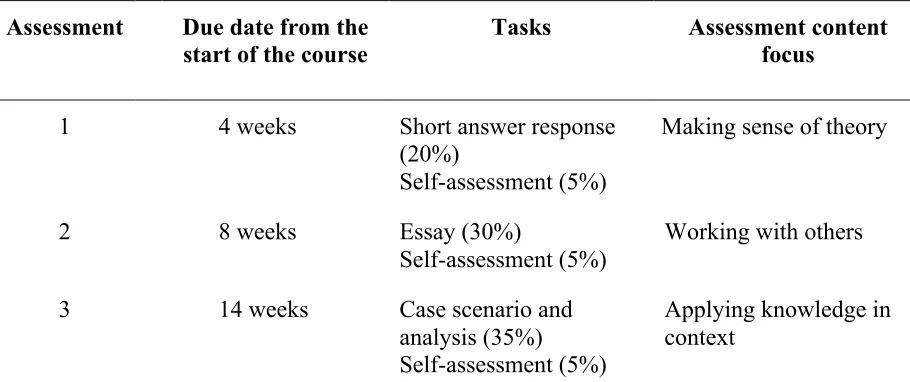
As noted above, each assessment included a self-assessment component of 250 words written in response to the following prompt: What is the most significant thing you have learnt from the readings in this module? The assignments were different in nature and content (see Table 1) and the purposes of the self-assessment activities were implicit and not explicitly stated in the course material.
Table 1: Description of Assessments
Assessment Due date from the
start of the course Tasks Assessment content focus
1 4 weeks Short answer response
(20%)
Self-assessment (5%)
Making sense of theory
2 8 weeks Essay (30%)
Self-assessment (5%)
Working with others
3 14 weeks Case scenario and
analysis (35%) Self-assessment (5%)
Applying knowledge in context
Each student was assigned a number as an identifier. The three self-assessments for each student were integrated into one Word document. The data were then entered into NVivo 8. Each student’s data were read by both researchers to generate initial codes from a line-by-line analysis. The researchers compared, discussed and refined the codes using individual
examples from the data. Active verbs were used to name the codes. These code names endeavoured to capture the processes that were happening for the students during the self-assessments rather than analysing content themes from the course.
[image:12.595.69.524.297.488.2]Results
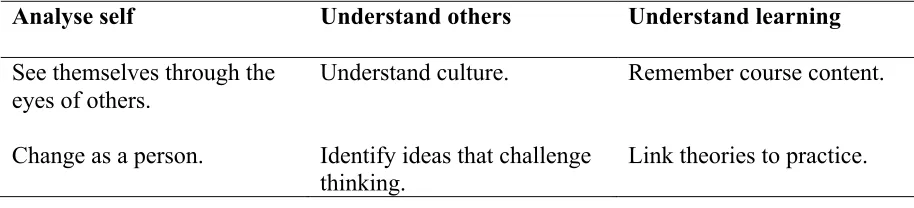
Nine categories emerged to describe how students used self-assessment in the course and these were sorted into three main themes. Students in this course used the self-assessment activities to analyse self, to understand others and to understand learning (see Table 2). Each of these will be discussed further in the following sections with indicative quotes.
Table 2: The use of Self-‐Assessment as a Tool
Analyse self Understand others Understand learning
See themselves through the eyes of others.
Understand culture. Remember course content.
Change as a person. Identify ideas that challenge
thinking. Link theories to practice.
The results also showed that when students used self-assessment in these ways, they could demonstrate their learning of the course content. When staff on this course met to moderate assignments, and also read the self-assessments of the students, one striking feature emerged. Staff observed how students appeared to articulate their understanding of the course content in a clear way through these self-assessments when freed from the structures of more formal essay-style assignments. Such understanding was not always evident through the formal aspect of the assignment. The students’ thoughts and ideas expressed through self-assessment were by nature more personal, and were clearly linked to their professional work, as well as to the theoretical positions they were introduced to. In contrast, the assignments that were completed in the more traditional style were often stilted, formal and descriptive rather than demonstrating in-depth analysis or critique of ideas.
Self-Assessment to Analyse Self
[image:13.595.66.523.253.357.2]understanding of text, and to increase their engagement with text, this was an unintentional outcome of the self-assessment process. The results showed that students wanted to use the
assessment opportunity to learn about themselves.
The first clear example of this category was provided by a range of students who used the self-assessment as a tool to inform their present and previous learning and they invariably situated themselves as learners within these examples. For these students, they looked beyond what they currently ‘knew’ in order to inform their prior experiences. In this way, a past event (revisited through a self-assessment activity) provided new understandings and became a catalyst for further learning. For example, a student wrote “I personally, have been able to seek out further comprehension of my experiences. I feel like an old wise man, advising a naïve youngster on human behaviour, even though that youngster is me”.
In the same way, self-assessment was used to reflect on how individual attributes contribute to learning and working with others. This provided another example of how students used self-assessment to understand their own reaction in a situation. One student examined how the use of non-verbal communication was important, and immediately linked this to showing ‘emotion’. This was then personally attributed to the way of working:
I have never really paid attention to the way we use non-verbal communication. But after reading [the set reading] I realise how effective it can be. I myself often fail to show emotion at times which I realise is like saying nothing. I sometimes think I have developed a sense of emotional hardness over time during my career in the Police.
Self-assessment spotlighted the effort required to be deeply reflective. The process of reflection was often future focused and impacted on personal goals. For some students, this meant articulating a possible change process. Self-assessment was a means for students to link personal and professional identity, and this provided impetus for changing themselves. In some cases, the self-assessment provided goals for the future:
The self-assessment provided a means for students to explore the interaction between their learning and their environment as part of analysing themselves. The process of understanding themselves was raised to a theoretical level when students used terms such as ‘identity’ from the course readings:
Self-reflecting on day-to-day occurrences is actually my identity testing itself within its current environment and that, within itself is a process of learning.
Students analysed themselves using a process of reflection, both on past actions and on future possibilities. This enabled some students to see how other people might view them. Being able to see another point of view in a conflict was a professional skill, especially for the police who could routinely encounter conflict.The self-assessment provided a way of reflecting on how the students’ own actions had an effect on others:
I can consciously accept my role in the conflict and can work towards resolving it in a positive way. Before I would have just chalked it up to them being wrong and me being right whereas now it's more of a partnership.
However, this understanding of others was not gained easily as it was founded upon reflection that brought an understanding of self:
It is necessary to understand one’s own feelings in order to be able to tune in with and understand other peoples’ feelings. This is a thought-provoking concept which inspired me to consider how looking inside oneself would not always be an easy undertaking and would often take courage, particularly when facing shortcomings. It made me realise that if we can recognise our own strengths and weaknesses we can better understand, have compassion for and help others who have similar traits.
Self-assessment provided a means of appreciating that there is more than one valid viewpoint. This was both a professional and personal skill. The reflection evident in this theme enabled students to consider not only themselves as individuals, but also how they related to situations in their environment and how others might see them:
In this research, we recognised that these self-assessment activities provided a starting point for encouraging students to engage in deeper reflection with the content of the course. While the readings assigned to the course were connected to the content for each module within the course, the self-assessment activities were used to provide the catalyst for students engaging with the material in ways other than ‘remembering’ or ‘regurgitating’ facts. In this way, the self-assessment activities required students to link their knowledge and
understanding to their actual work circumstances. The students used the self-assessment activities to analyse themselves within these contexts, which meant that they actively made the course content relevant to their own personal and professional contexts.
Given that the self-assessment exercises reflected the assignment content, and the associated readings, we believe these exercises also provided a means for the students to understand themselves through the course content. In this way, the course content is not depicted as knowledge ‘out there’ to be remembered and recalled; it recognises the interaction between the learner and the course content as being central to the knowledge within each individual.
Self-Asssessment to Understand Others
Self-assessment provided a way for the students to explore their understanding of others. This was a complex and multidimensional process. During this process, students compared
themselves to others by articulating similarities and differences, which was particularly evident in the dimension of cultural practices. This process of comparison both created stereotypes and challenged them. When referring to Māori, one student observed:
They use different cultural practice using verbal and non verbal language within one another and have very similar values to one another and morals such as having connections with the mountains, tapu, sacredness, spirits, marae welcomes and so on.
was seen as a “tool” to make links to workplace skills, such as understanding others, that had the potential to enable the students to do their job more effectively in the future. Students report that the understanding of others’ cultural dimensions facilitated rapport, relationships and negotiation in situations that they might encounter at work. Hence, the self-assessment process opened a space for the students to write about how they might use the knowledge gained from the readings to extend their understanding of others beyond the course.
Another dimension of understanding others related to re-evaluating stereotypes of those people who may be different to the individuals in the course. This was specifically mentioned in relation to values and beliefs. Hence, it was often associated with statements about being less judgemental. In the self-assessment, one student pointed out that “I can appreciate and value that people don’t all have the same world view as me and I accept that their world views are just as valid”. Expressions such as “[understand] where they are coming from” indicated how students were exploring their understanding of others. Some students used their self-assessments to describe or articulate their thinking about why other people might hold different perspectives to themselves. A student expressed this as “I’m not just dealing with them at this point in time but all their history about how they came to be”. This suggested that, while students may have initially been inclined to stereotype, the
self-assessment of learning provided a way for students to evaluate their own process of stereotyping through writing.
For some students, this process of understanding others had not only created a new way of appreciating that others viewed the world differently, but also how these views might have developed as different realities came into play for different people:
The realisation that people have such different perspectives on what appears to be the same scenario. However, the perspectives can be so different and people’s experiences can be so diverse that it’s almost as though the scenario itself changes through
different eyes.
Self-Assessment to Understand Learning
The students used the self-assessment process to articulate an understanding of learning. The data showed evidence of students explicitly recognising their own learning from the course content. Some students made links between theory and their own lives and used the self-assessment process to plan courses of action in the future. When self-self-assessment was used for reflection on personal and professional learning, it was associated with learning strategies such as endeavouring to apply theory to new situations, connecting with the ideas in the course, and planning for future opportunities to learn.
In many cases, the students used their self-assessment to reflect on particular concepts within the readings that promoted their learning, for example, ‘communities of practice’. The imperative to write 250 words in a compulsory self-assessment provided an impetus to move beyond describing the content of the readings. Theory was used as a lens for examining conditions for learning in this example:
Conflicts arise when other communities of practice come into contact with other overlapping communities of practice. In this light, conflicts can be very useful although they are not enjoyable. We need conflict to learn.
The alignment between the goals of the course and the content of the readings was evident when the students used self-assessment to understand their own learning. A common response to the self-assessment prompt was to identify the main ideas from the course readings as the students saw them (rather than as directed by an assignment question) and expressing the learning in their own words. For example, one student wrote, “The readings have provided a nucleus to open our minds to why humans behave as they do”. This statement encapsulated the course objectives.
The self-assessment process enabled the students to understand their own learning by providing opportunities for them to evaluate the content of their readings for new learning that could be applied in future in their workplace. This was particularly evident among the Police students who were taking this course for progression in their career. A typical comment in the self-assessment related the course readings to how a student now had a “unique insight” into understanding criminal behaviour.
experiences. The process of self-assessment may have assisted students to recognise the complexity of learning:
Realising that, with an understanding of past experiences, we are able to resolve so much when working with others, and finally, of everything that I have studied, seeing the close relationship between all these different aspects come together.
Reflection on the students’ own role in learning and the nature of learning in social situations such as in the workplace enabled students to explore the actual concept of learning.
Students were able to identify ideas that had challenged their own thinking. These challenges were key in stimulating the reflection on the past and action for the future. A common phrase used in these data were “I have come to understand…”. One future action reported in self-assessments was a commitment to lifelong learning and an awareness of how that learning might occur. In the case of one student, this came from reading and asking questions to learn from others around him. The purpose of these strategies was to “to better understand my learning.”
Within the theme of understanding learning, the data showed students making links to theory and course readings, aligning their learning to course objectives but making it their own by expressing it in their own way, identifying applications within their professional lives, and both reflecting on the past and planning for the future. All of the dimensions of this
theme indicated that the students were reflecting on the concept of learning.
An Analysis of the Results relating to a Specific Occupation
This section presents a sub-set of the data from students within the cohort that identified as working with the New Zealand Police (48 of the 62 students). This part of the analysis specifically focuses on how the outcomes from the self-assessment exercises were linked to professional work contexts. It also highlights how work contexts impact on exercises such as self-assessment. Three functions of self-assessment are identified (opportunity for reflection, exploring relationships with others, and connecting learning to workplace contexts). We then argue that there is a specific function of self-assessment in supporting professional thought and action.
Opportunity for reflection
Students used the assessment opportunity to analyse themselves. While the
purposes. At the most fundamental level, the process of completing self-assessments focused some individuals on the need and the opportunity for reflection, “a heightened need for self-awareness”. For the Police, this was a chance to explore their understanding of their own role as professionals and how this might impact on others. The prompt in the self-assessment focused the reflection process and encouraged the students to articulate links between the course and their practices. One student commented, “I immediately began to review (reflect) on previous experiences that for one reason or another were not as successful as they could have been.” Subsequently, this student went on to analyse the role of body language in professional interactions. Some students used self-assessment to explore their own attitudes in a safe space where answers were not going to be evaluated. This student grappled with the emotional dimensions that the assignment had raised and reported an opportunity to see “beyond those simple emotions, revealing other more complex feelings, like intimidation and loneliness.” Another student felt comfortable enough to articulate personal insight: “I was part of the problem. My racism was in fact deeply manifest and thinly veiled.” These revelations in the self-assessments were indicative of the power of the process of analysing self. However, students reported that this analysis went beyond ways of feeling and thinking. The students used this process to extend analysis into possibilities for future action within their professional lives:
It is very easy to get stuck into certain patterns and ways of being with people but acknowledging the different variables and contexts of a situation freed up the possibility of acting in a different way.
Self-assessment allowed the students within the New Zealand Police to reflect upon
themselves within their professional role. This role required them to have a sense of personal responsibility for their own actions, which included a responsibility to find ways to improve their practice:
I strongly believe that in my role as a Police Officer it is my responsibility to ‘set a good example’ and though I am not perfect and may not always set the best example, I always try to reassess and rethink how I could deal with a situation better.
The demands of working within the New Zealand Police require complex
I need to understand myself and my own behaviour before I can relate to other people effectively. I need to know my strengths and weaknesses, values and beliefs, and understand what has impacted upon me to make me the person that I am today. If I am aware of my own behaviour I should be able to relate to others and adapt to different situations easily.
The analysis of self that was evident in the self-assessments of those students in the Police was undertaken with a sense of purpose that related to their professional practice. The 250-word task provided a space that was mandatory and safe in that it was not evaluated using set criteria for the purposes of grading. There were examples of analysis of emotions, roles and behaviours in the students’ self-assessments.
Exploring relationships with others
As well as using their self-assessment to reflect upon themselves, some students from the New Zealand Police used that understanding to gain insight into their relationships with others. By being able to reflect on their own actions, students saw the complexity of situations, both in the circumstances in which a situation occurred and also in who was involved:
I thought I treated everyone the same no matter what situation I found myself. On reflection I found this not to be the case and I can now see a huge difference in the way I treat different people in different settings and circumstances.
This reflection provided a springboard for thinking about their understanding of other people. Comparing similarities and differences was one level of this, for example:
I have learnt that people's behaviour can be shaped by their identity, which can come as a result of different factors such as the way they were brought up, who they associate with and so on. Having this knowledge is a bonus in day-to-day Policing as we try to understand why people have done certain things. With this knowledge, I can now understand myself, and why I do the things I do.
An example of my somewhat uneducated views before commencing would be my ‘lock them up and throw away the key attitude’ to criminals. While I do not condone
murderous crimes, I can now try to understand them and the behavioural theories that explain their actions. I have worked with people for so long without much serious thought about my own behaviour or that of others but I will aim to do so now.
I am better informed to deal with a range of individuals through different cultures, ages, people brought up with a bad background and also people in uneducated communities.
For some students, the self-assessment was used to express a positive perspective on differences. Diversity among people was not viewed as a problem, rather something to be embraced, and even celebrated. In the words of this student, “people are all unique and this needs to be not only accepted but appreciated and respected”. There were indications that this might translate into a desire to act differently for some students:
I have learnt that being in situations of conflict has made me think about how I treat people and have gained an understanding on how people of different ethnic origins, class, culture, sexual orientation, work at their problems and are able to solve them without conforming to society’s norms.
There was recognition of the complexity of understanding people and a nuanced sense of how differences may be more than superficial. This student wrote about interaction in professional practice: “I now understand that individuals expand their own views of the world through their personal history which I personally can't relate to because I don’t know their
background.”
Some students make explicit links to their relationships in their own professional practice. One student wrote about seeing that “individuals are experiencing different aspects of life” and later commented that “If we all do make the effort to understand most of the variables, conflicts, regardless of external or internal, can be reduced.” Direct reference was made to the students’ desire to understand the position of other people in their work. A student commented that “What may seem incredibly unimportant to me may be of utmost importance to another.” The process of understanding others was explored through such statements as:
Students incorporated specific course content in their self-assessment task and made resolutions for the future based on the understanding of others. The task was used in a purposeful way to link theory and practice in the understanding of others and to explore actions that might result from this understanding:
I will be dealing differently with everyone individually, based on their body language and history (instead of one rule for all). By using this tool I will be able to adapt and understand individuals and better meet their needs.
Through understanding diversity I can help explain people and their behaviour and in the future this knowledge will help me to approach and deal with conflicting situations.
The use of self-assessment to understand others may have been stimulated by the course readings but the opportunity provided by the self-assessment enabled the students to consider their relationships with others by writing about the complexity of understanding other people and the way that understanding may affect their workplace and professional practice.
Connecting learning to the workplace
This theme was interconnected with the two previous themes. Students wrote about the connections between their own learning and their experience as professionals. Their understanding of learning encompassed learning from diversity, learning from experience, learning from reflection and then implementing that learning in the future. An awareness of diversity impacted on the students’ understanding of learning. Learning was not seen as a process that was universally the same for all:
I have learnt that people learn and process information differently and that one idea to fix an issue for one individual may vary greatly to another person in the same situation.
Reflective practice, a theme from some of the readings, was closely linked to the students’ understanding of their own learning, especially as it applied in their professional lives. This allowed some individuals to view experience as the grist for learning and to link past learning to future actions. The belief that personal learning could be built on for the future
consolidated the notion of lifelong learning, rather than being confined to particular situations such as a university course:
Now that I have read about the theory around the way I learn I can put this into practice even more so, and use the best way for me to learn in an attempt to make learning more successful.
Learning, job performance, and job satisfaction were associated together for this police student:
Although I am continuing my education through university studies and every day is a learning curve with the jobs I undertake, by being thrown into a situation I am
unfamiliar with I will have to learn by default if I want to succeed and be happy about how I perform.
By writing about their understanding of learning, the students were able to explore the connections between their professional lives and the course. The self-assessment process was used by the students to reflect on how they would be learning both on the job, through the job, and through academic study. This enabled them to personalise their learning. Most of these self-assessments were written in the first person. Although the prompt for the self-assessment was instrumental in this, the process of reflecting on learning was very personal and
individual. The course requirement to reflect on learning gave students room to write about the professional implications for them in the future.
The Function of Self-assessment in Supporting Professional Thought and Action
In this section, we examine the types of self-assessment received from one professional group (constables in their first or second year within the New Zealand Police) and identify how established belief systems manipulate self-assessment outcomes. The results showed that self-assessment became a means for these students to articulate their self-beliefs and
understandings, and that over time it increased their awarenss of their own beliefs when self-assessing their learning. It also showed that self-assessment can be an additional tool to analyse conflict in the workplace, in order to confront and resolve issues of tension.
The results from this analysis show that simply undertaking a one-off self-assessment does not increase a person’s awareness of themselves or others; it requires ongoing practise. As we observed in the data, even those in a professional occupation held a bias towards their own beliefs that impacted on how they viewed others. However, ongoing self-assessment tasks provided a structured means to challenge these deeply entrenched views. In the
circumstances and personal motivations (thus allowing a certain bias towards expectations around ‘gang members’ to come through). This self-assessment did not focus on what this constable had learned but rather what was observed:
I also have a better understanding of the behaviours, and the finer aspects of these behaviours, that I need to be aware of when working with others. In my job as a Police Officer, being receptive to other people’s behaviours towards change is very important. Being more responsive to an individual’s background, circumstances and conflicts can greatly assist in overcoming the challenges conveyed by the change process. (SA 1)
I was able to come to the conclusion that gang members act in the manner they do because of where they have come from (family backgrounds and circumstances), and what they perceive as obtaining their objectives to achieve a positive consequence in the way of praise from their peers and leaders.(SA2)
In the illustrations above, the constable self-assessed against an understanding of ‘others’. For example, “I was able to come to the conclusion….because of where they have come from..” and “being more responsive to an individual’s background” illustrates how students self-assessed their own learning in relation to others. Such comparison was neither requested nor intended in the course requirements, but these constables tended to use self-assessment to learn from their current work environments which inevitably involved other people. However, a more sophisticated use of self-assessment was evident when critical thinking of their own learning, relative to their own goals, was developed.
Further illustration of how self-assessment is used to think about one’s own beliefs and attitudes is presented in the next example. In contrast to the one above, this example demonstrates how the student did develop critical thinking and analysis in the
self-assessments, and was able to link these to learning. In this example, the first self-assessment reported: “as a policeman I serve the community and victims of crime, but also offenders by encouraging them to change for their own good. To do this I need to reflect on my
interactions with them and analyse whether I have been responsive to their needs”. Then by the next self-assessment the analysis moved from understanding that offenders needed to change for their own good, to one of taking into account their [the police officer’s] own actions, and recognising that their actions impacted (positively or negatively) on others:
important in my role as a Police Officer that I strive to make the right decisions as the outcomes often have a huge impact on people’s lives. The value of endeavouring to continually strive for improvement in my chosen profession cannot be over emphasised. To do this effectively it is essential that I regularly reflect on my experiences at work and have a framework for ideas, a theory, to apply to my practice in order to guide me effectively.
A potential benefit for encouraging professionals to engage in self-assessment (as distinct from self-reflection) is that such activities have the power to enable professionals to engage with their learning as it pertains directly to their practice. While there is limited evidence of this in the current study because it was not a focus of the research, we did identify some examples across the three self-assessments that tracked a distinct progression of thought and action. The following example highlights this possibility. We examined the role of power identified by this constable that shaped behaviour. While all self-assessments have been edited, the first self-assessment focussed on extrinsic reward/incentive, then the second self-assessment identified the person as playing a role (examining self, man-in-the-mirror), and by the third self-assessment the role of communication and power structures was identified in the way it enables or disenables people in their day-to-day work. Therefore, in the example below, from seeing cigarettes as a way to motivate offenders to seeing how power structures impact on themselves and their own motivations, this constable
demonstrates a greater awareness of how and why people act in the way they do:
Nicotine is one of the most addictive, easily obtainable commodities in society. Information relating to offending is easily elicited from offenders at the promise of a cigarette. This can assist in obtaining routine activities of offenders and understanding motivations and corridors of offending. (SA1)
I have noted some changes that I will be making to my work ethic and I will be
reflecting on this while carrying out my work to make me a better communicator and to work better with others. I found it difficult, at times, to come to grips with reflective practice and what it really meant in relation to working with others as opposed to a problem-solving tool. It wasn’t until I was listening to Michael Jackson and his song “man in the mirror” that it all fell into place for me. (SA 2)
Police the train of thought is that the senior members are all powerful and all knowing. I think this is due partly to the rank structure, which is important in the context of critical incidents, but also breaks down some lines of communication due to the junior member feeling that their opinion is not important. (SA3)
In this course, the self-assessment exercises were used as a means for the constables to express their views about a range of issues they face on a day-to-day basis, and which they struggle to negotiate with their formal study. While the above examples have shown how workplace contexts were widely used as expressions of the theoretical issues they were working through, such contexts were also used to examine why police are essentially in a conflict role. Linking conflict to their own and organisational learning enabled one constable to rationalise ongoing learning in a day-to-day situation that threw up novel and unique workplace events each day. The first example shows a constable attempting to identify where difficulties stem from, while by the next self-assessment there is evidence of an acceptance that conflict will remain an aspect of the work, but is nonetheless an integral aspect of
learning. In the second self-assessment (below) the constable’s view that criticism is a way of teaching one ‘how to behave’ perhaps reinforces a personal belief that there is a ‘one right way’ to act in society. It could be argued, that in this example the self-assessment component has not enabled the student to fully critique what has been learned, and that inherent beliefs about ‘control’ have remained unchallenged.
It occurred to me that many of the difficulties experienced by police were similar to those experienced by most people who find themselves in the third world. The specific problems are related to police work, however, these stem from the same issues that can be problematic for others, such as different attitudes to justice and violence, problems with feelings of superiority and inferiority, gender roles, language problems,
considerations on what is considered corrupt or acceptable. (SA1)
This study has highlighted that self-assessment exercises are a means to reflect on both theoretical positions and workplace learning but will not necessarily enable individuals to confront, consolidate, or necessarily resolve workplace conflict. Even so, the examples above do show that incorporating self-assessment exercises in professional academic courses
potentially provides the mechanism for students to articulate their self-beliefs and understandings, and is the first step in self-assessing those beliefs and their learning.
Discussion
Each category that arose from the data showed how students foregrounded ‘reflection’ as their key strategy (as opposed to say, recall information) to inform their self-assessment. This was an interesting finding, given the pivotal roles that students place on recall, remembering and memory play in other forms of assessment at tertiary level. The process was stimulated by the prompt for the self-assessment which requires the students to look back at their own learning. However, the prompt did not require the students to do anything beyond this. The mandatory self-assessment tasks with the requirement for 250 words created a space that the students could use for their own purposes even though the assessment was teacher driven. The three themes showing the use of self-assessment identified from the data were influenced by the course content; they also showed how the process of reflecting on course content was used by students for their own professional and personal development.
talked of change and seeing their work in a different way, while others expressed reflective doubt on how they handled a situation and what they would do differently in the future.
Given that the process of reflection builds metacognitive ability (Mok et al., 2006), finding ways to employ assessment practices that encourage reflection at tertiary level is worth exploring. As shown in the students’ responses within this research, through providing legitimate opportunities to articulate their understandings of the course without the quality of that process being quantified through a criteria or mark, their increasing ability and
preparedness to reflect was evident. If students had been graded based on explicit and pre-determined criteria of ‘worth’ for their self-assessment, they may have responded by being more test wise. By allocating a single mark of five points to each completed self-assessment, the students responded by being strategic and doing the self-assessment. Confronted by the need to write an extended paragraph, they turned inwards to reflect so they could justify the significance of what they had learnt for their personal and professional lives. The use of self-assessment in this situation required those teaching on the course to hand over the purposes of the self-assessment to the students. Staff did not have the power to evaluate these purposes and at times, this did create tension because they would have preferred to have explicit criteria to assign each student a mark on a pre-determined scale. In this example, the purpose of assessment was for students to identify their own learning, but for some staff, they felt it negated another purpose; the use of self-assessment to evaluate student learning.
The three interrelated themes that arose from the data indicated that self-assessment, as used in this study, had the potential to encourage sustainable assessment for these students. Each of the themes – using self-assessment to understand self, to understand others, and to understand learning – show how the learners made the assessment process their own (Boud, 2000). This is an essential aspect of sustainable assessment. These themes suggest that the self-assessment opportunity fostered reflectivity, built learner agency, and constructed active learners, characteristics of assessment tasks that promote lifelong learners (Boud &
Falchikov, 2006). This is an area that could be explored in further research, as one of the limitations of the study is that we could not follow up with these students after the course had been completed to ask them how they used self-assessment as a strategy in their everyday lives. Given that the sub-analysis in this research identified that those working in a
learning to workplace contexts) are integral aspects of ‘being’ and identifying with a
professional group. A specific function of self-assessment in supporting professional thought and action needs further consideration.
Implications of this for tertiary teaching and learning include: supporting students to make explicit links between content knowledge and work-based learning; enabling students to engage with assessment tasks that are meaningful, relevant and related to professional practice, foregrounding the ontological nature of knowledge, and providing students with choice around how they engage with an assessment task.
Conclusion
The study identified ongoing challenges in introducing mandatory self-assessment exercises in an undergraduate course. As shown in this report, self-assessment is a means to extend our capacity to assess student learning by encouraging students to explore their learning beyond course requirements, while drawing on their understanding created through the course content. These early indicators show that self-assessment can contribute to supporting students to engage in their academic work, while developing reflective, social, and critical skills, and can play a positive role in supporting professional learning within workplace settings.
This study highlighted that when given opportunities to practise self-assessment and self-reflection of learning in a legitimate and acknowledged way in tertiary education, students can be encouraged to think more consciously of the links between course content and their professional lives. As the study showed, students from the New Zealand Police actively used the self-assessment component to reflect on their professional lives. Clearly they valued the ability to have a framework and a legitimised process for such reflection. This is consistent with a student from Tan’s (2007) study who stated, “it is professionally
imperative for nurses, for doctors, for teachers, for everybody, that you’re able to realistically
self-assess ... that ability to self-assess is the springboard for your lifelong learning” (p. 120,
emphasis in original). By the third self-assessment, the students in this study moved towards a reflective notion of learning that expressed future-orientated actions and learning, and this has the potential to increase their academic performance. This is consistent with other research in the area, for example, Lew et al. (2010) argue, “as students’ metacognitive
The aim of the self-assessment in this course is to increase students’ ability to reflect intentionally on their course content and relate this to their own goals and working
experiences. The data in this study indicate that the students actively employed reflection as a strategy to self-assess. Developing self-reflective and self-assessment skills to apply in their professional lives outside of an academic course is exactly what we were aiming for in this course: sustainable assessment in action. Such learning had the potential to bridge the academic, professional and personal worlds of the students, and enables students to actively participate in the assessment culture of the tertiary environment.
References
Black, P., & Wiliam, D. (1998). Assessment and classroom learning. Assessment in Education: Principles, Policy and Practice, 5(1), 7–74.
Boud, D. (2000). Sustainable assessment: rethinking assessment for the learning society.
Studies in Continuing Education, 22(2), 151–167.
Boud, D., & Falchikov, N. (2006). Aligning assessment with long-term learning. Assessment & Evaluation in Higher Education, 31(4), 399–413.
Boud, D., & Falchikov, N (Eds). (2007). Rethinking assessment in higher education: Learning for the long term. London: Routledge.
Bourke, R. (2010). The chameleonic learner: Learning and self-assessment in context.
Wellington: New Zealand Council for Educational Research.
Charmaz, K. (2006). Constructing grounded theory: A practical guide through qualitative analysis. London: Sage.
Dall’Alba, G. (2009). Learning professional ways of being: Ambiguities of becoming.
Educational Philosophy and Theory 41(1), 34–45.
Dewey, J. (1933). How we think: A restatement of the relation of reflective thinking to the educative process. New York: D. C. Heath.
Lew, M. D. N., Alwis, W. A. M., & Schmidt, H. G. (2010). Accuracy of students’ self-assessment and their beliefs about its utility. Assessment & Evaluation in Higher Education, 35(2), 135–156.
Mamede, S., Schmidt, H. G., & Penaforte, J. C. (2008). Effects of reflective practice on the accurancy of medical diagnoses. Medical Education, 42(5), 468–475.
McTaggart, G. L., & Wilson, A. P. (2005). Promoting reflective thinking in teachers: 50 action stategies. Thousand Oaks, CA: Corwin Press.
Mok, M. M. C., Lung, C. L., Cheng, D. P. W., Cheung, R. H. P., & Ng, M. L. (2006). Self-assessment in higher education: Experience in using a metacognitive approach in five case studies. Assessment & Evaluation in Higher Education, 31(4), 415–433.
Moon, J. (2007). Critical thinking: An exploration of reflective and experiential learning.
London: Routledge Falmer.
Peat, M., Franklin, S., & Lewis, A. (2001). A review of the use of online self-assessment modules to enhance student learning outcomes: Are they worth the effort of production. In K. Kennedy, M. Keppell, C. McNaught & T. Petrovic (Eds.), Meeting at the crossroads: Proceedings of the 18th Annual Conference of the Australasian Society for Computers in Learning in Tertiary Education (pp. 137–140). Victoria, Australia: ASCILITE.
Poon, W.-Y., McNaught, C., Lam, P., & Kwan, H. S. (2009). Improving assessment methods in university science education with negotiated self- and peer-assessment. Assessment in Education: Principles, Policy & Practice, 16(3), 331–346.
Race, P. (2009). Designing assessment to improve Physical Sciences learning. University of Hull: The Higher Education Academy Physical Sciences Centre.
tp://www.heacademy.ac.uk/assets/ps/documents/practice_guides/practice_guides/ps0069_ designing_assessment_to_improve_physical_sciences_learning_march_2009.pdf
Ramsden, P. (Ed.). (1988). Improving learning: New perspectives. London: Kogan Page. Schon, D. A. (1987). Educating the reflective practitioner. San Francisco: Jossey-Bass. Sitzmann, T., Ely, K., Brown, K. G., & Bauer, K. N. (2010). Self-assessment of knowledge:
A cognitive learning or affective measure? Academy of Management Learning & Education, 9(20) 169–191.
Smith, C. (2011). Examinations and the ESL student: More evidence of particular disadvantages. Assessment & Evaluation in Higher Education, 36(1), 13–25.
Tan, K. (2009). Meanings and practices of power in academics' conceptions of student self-assessment. Teaching in Higher Education, 14(4), 361–373.
Victoria University. (2010). EPSY 142 Understanding behaviour: working with people.Study Guide. Unpublished document,Victoria University of Wellington Police Education
MASSEY UNIVERSITY
MASSEY RESEARCH ONLINE http://mro.massey.ac.nz/
Massey Documents by Type Reports