DISSERTATION ON
A STUDY TO ASSESS THE EFFECTIVENESS OF PSYCHO EDUCATION MODULE ON KNOWLEDGE REGARDING EARLY IDENTIFICATION OF CHILDREN WITH LEARNING DISABILITY AMONG PRIMARY SCHOOL TEACHERS IN 6(/(&7('6&+22/6$7&+(11$,´ ³
M. Sc (NURSING) DEGREE EXAMINATION BRANCH V- MENTAL HEALTH NURSING
COLLEGE OF NURSING MADRAS MEDICAL COLLEGE,
CHENNAI - 03.
A dissertation submitted to
THE TAMILNADU DR. M.G.R MEDICAL UNIVERSITY, CHENNAI - 600 032.
In partial fulfillment of the requirements for the degree of
CERTIFICATE
This is to certify that this dissertation titled a study to assess the effectiveness of psycho education module on knowledge regarding early identification of children with learning disability among primary school teachers in selected schools at Chennai is a bonafide work done by Ms.Amali Rani. B, M.Sc Nursing II year student, College of Nursing, Madras Medical College, Chennai, submitted to the Tamil Nadu Dr.M.G.R Medical University, Chennai, in partial fulfillment of the university rules and regulations towards the award of degree of Master of Science in Nursing, Branch-V, Mental Health Nursing, under our guidance and supervision during the academic period from 2014 -2016.
Dr. V. Kumari, M.Sc. (N), Ph. D Principal,
College of Nursing, Madras Medical College, Chennai-03.
Dr. R. Vimala, MD, Dean,
DISSERTATION ON
A study to assess the effectiveness of psycho education module on knowledge regarding early identification of children with learning disability among primary school teachers in selected schools at Chennai.
Approved by the Dissertation Committee on: 21.10 2014
RESEARCH GUIDE
Dr. V. Kumari, M.Sc.(N),Ph.D., _____________ Principal
College of Nursing,
Madras Medical College,Chennai-03.
CLINICAL SPECIALTY GUIDE
Mr. M. Nithyanantham, M.Sc (N), _____________ Lecturer,
Department of Mental Health Nursing, College of Nursing,
Madras Medical College,Chennai-03.
MEDICAL EXPERT
Prof. Dr. V. Venkatesh Madhan kumar, _____________ Professor of Psychiatry,
Institute of Mental Health, Chennai - 10.
A dissertation submitted to
THE TAMILNADU DR. MGR. MEDICAL UNIVERSITY, CHENNAI-600 032.
In partial fulfillment of the requirements for the degree of MASTER OF SCIENCE IN NURSING
ACKNOWLEDGEMENT
First, I thank my Lord Almighty for His Heavenly blessings and abundant grace, which strengthened me in each step throughout this Endeavour.
No work is successful without the proper assistance, co -operation and guidance from learned and responsible persons, I take this opportunity to extend my sincere gratitude to all those who have encouraged me in the successful completion of this research.
I wish to express my sincere thanks to Prof. Dr. R. Vimala, Dean, Madras Medical College for providing necessary facilitie s and extending support to conduct the study.
It is my pleasure and gratitude to Dr. Lakshmi, M.Sc. (N), Ph.D., JD (Nursing) for her valuable and expert guidance, motivation, and support for me to the successful completion of this dissertation.
I extend my immense thanks and gratitude to Dr. V. Kumari, M.Sc. (N), Ph.D., Principal, College of Nursing, and Madras Medical College for her support and encouragement that enabled me to accomplish this study.
I extend my immense thanks to Mrs.J.S.Elizabeth Kalavathy M.Sc. (N), Co-coordinator, College of Nursing, Madras Medical College for her support and encouragement that enabled me to accomplish this study.
It is my pleasure to thank my Guide Mr. Nithyanantham, M.Sc. (N), Lecturer in Mental Health Nursing, College of Nursing, Madras Medical College for his sincere efforts towards the study and for his guidance, suggestion, and encouragement in helping me to carry out this study.
,W¶V P\ GXW\ WR FRQYH\ WKDQNV WR DOO WKH H[SHUWV Prof. Dr. V.Venkatesh Madhan, Professor of Psychiatry, Mr. B. Sudhakaran, Clinical Psychologist, Mrs. K. Vijayalakshmi, Professor of Mental Health Nursing and Mrs. Grace Samuel, Professor of Mental Health Nursing who validated the research tool and guided me with valuable suggestions and corrections.
Corporation of Chennai, for granting permission to conduct the study in corporation primary schools at Chennai.
I render my deep sense of sincere gratitude to Tmt. D. Ranjini, M.A., M.Sc., B.Ed. Education Officer, Corporation of Chennai for granting permission and guiding me to select the samples.
Thank is such a small word, but when it comes from the heart, it carries a wealth of meaning and love with it. This is extended to all the headmasters/headmistress and teachers who worked in the various corporation primary schools who had enthusiastically participated in this study without whom it was not possible for me to comp lete this study.
I am immensely grateful to Mr.A.Vengatesan, M.Sc., M.Phil, (statistics) who has helped me in data analysis, and statistical scoring that helped in calculating the effectiveness of the research study
I express my thanks to all the Faculty Members of the College of Nursing, Madras Medical College for their support and assistance to complete this study.
I extend my thanks to Mrs. V. Latha, M.A.,(Eng), who edited the English version.
It is my response to thank our Librarian Mr. Ravi M.A.M.L for his support in my research study.
I extent my special thanks to my batch mates, friends and juniors who gave me support and immeasurable suggestions throughout the study.
My warm appreciation goes to all my family members, friends, and colleague helped me directly or indirectly to complete this study.
ABSTRACT
Title: A study to assess the effectiveness of psycho education module on knowledge regarding early identification of children with learning disability among primary school teachers in selected schools at Chennai .
According to :+2 ³FKLOGUHQ DUH SULFHOHVV UHVRXUFH and that any QDWLRQZKLFKQHJOHFWVWKHPZRXOGGRVRDVLWVSHULO´7KHUHDUHFKLOGUHQ who look normal and behave normally but academically they are not good as their peers. They suffer a lesser- known condition called Learning Disability (LD).
Need for the study
7HDFKHUV DUH WKH FKLOG¶V ILUVW FRQWDFW DIWHU VFKRRO HQWU\ DQG WKH ideal person to detect a learning problem. Unfortunately, most either LJQRUH WKH GHILFLHQF\ RU EODPH LW RQ WKH FKLOG¶V SHUVRQDOLW\ EUDQGLQJ LW as laziness, an attitude problem, or aggression. The child continues to graduate from one class to the other very inept at handling the pressure of the higher classes. This also leads to behavioral problems. Hence, there is a need to improve knowledge regarding the problem amongst teachers.
Objective
To identify the demographic variables of primary school teachers in selected schools.
To assess the knowledge of the primary school teachers before implementing psycho education module regarding early identification of children with learning disability.
To evaluate the knowledge of the primary school teachers after implementing psycho education module regarding early identification of children with learning disability.
To determine the effectiveness of psycho education module among primary school teachers by comparing pretest and post test scores.
To find out the association between posttest knowledge scores with selected demographic variables of primary school teachers.
Methodology
Research approach: Quantitative approach.
Study design: Pre experimental one group pre test-post test design
Sampling technique: Convenient sampling
Study population: Primary school teachers at selected schools, Chennai.
Data collection procedure: After pretest procedure, psycho education module should implemented by six sessions regarding four aspects of learning disability. On 8th day and posttest had conducted.
Data analysis:
Demographic variables were analyzed by descriptive statistics by using frequency, percentage, mean, and standard deviation. Knowledge variables were assessed by inferential statistics (chi-VTXDUHWHVWDQGSDLUHGµW¶WHVW
Study results:
The pretest knowledge score among teachers was 38.1% after psycho education posttest score was 76.1%. Therefore, the significant difference between the pre test and posttest knowledge score is 38%.
Discussion:
The above findings revealed that the psycho education module is effective in enhancing the knowledge of the primary school teachers and considerable association found between the demographic variables and posttest knowledge scores. Hence, the objectives had achieved and the research hypotheses were proved.
Conclusion:
CONTENTS
CHAPTER CONTENT PAGE No
I INTRODUCTION
1.1 Need for the study 1.2 Statement of the problem 1.3 Objectives of the study 1.4 Operational definition 1.5 Assumption
1.6 Hypothesis 1.7 Delimitations
1-7
II REVIEW OF LITERATURE
2.1 Review related to study 2.2 Conceptual framework
8-13 14-18
III RESEARCH METHODOLOGY
3.1 Research approach 3.2 Data collection period 3.3 Study setting
3.4 study design 3.5 Study population 3.6 Sample size
3.7 Criteria for sample selection 3.8 sampling technique
3.9 Research variables
3.10 Development and description of the tool 3.11 Ethical consideration
3.12 Pilot study
3.13 Reliability of the tool 3.14 Data collection procedure 3.15 Data entry and data analysis
19-27
CHAPTER CONTENT PAGE No
V SUMMARY OF THE RESULTS 45-48
VI DISSCUSSION 49-54
VII CONCLUSION AND RECOMMENDATIONS
7.1 Implication 7.2 Limitation 7.3 Recommendation
55-59
REFERENCES
LIST OF TABLES
TABLE No TITLE PAGE No
3.1 Description of scoring interpretation 24
3.2 Psycho education module 26
3.3 Method of data entry and analysis 27 4.1 Distribution of socio-demographic profile 30 4.2 Domain wise knowledge score in pre test 32 4.3 Level wise knowledge score in pretest 33 4.4 Domain wise and level wise knowledge score in
pretest
34
4.5 Domain wise knowledge score in post test 35 4.6 Level wise knowledge score in pretest 36 4.7 Domain wise and level wise knowledge score in
posttest
37
4.8 Domain wise comparison of mean knowledge score
38
4.9 Comparison of overall knowledge score 40
4.10 Level wise comparison of pre-test and post-test knowledge score.
41
4.11 Comparison of overall knowledge score 42 4.12 Effectiveness of psycho education module 43 4.12 Association between knowledge gain score and
demographic variables.
LIST OF FIGURES
FIGURE No TITLE
3.1 Modified conceptual framework based on CIIP Evaluation model.
3.2 Schematic representation of the study 4.1 Age distribution of the teachers 4.2 Gender
4.3 Educational qualification 4.4 Years of experience
4.5 Marital status
4.6 Child psychology as a subject in curriculum 4.7 Attended any in service education on problems of
learning
4.8 History of handling learning disability in classroom 4.9 Domain wise knowledge score in pre test
4.10 Level wise knowledge score in pre test 4.11 Domain wise knowledge score in post test 4.12 Level wise knowledge score in post test
4.13 Comparison of domain wise pre-test and post-test knowledge score
4.14 Box plot diagram showing comparison of overall pre -test and post--test mean knowledge score
4.15 Comparison of level wise pre-test and post-test percentage of knowledge score
4.16 Effectiveness of psycho education intervention 4.17 Association between level of knowledge gain score
and age of teachers.
4.18 Association between level of knowledge gain score and years of experience.
LIST OF APPENDICES
S. No TITLE
I Certificate for approval by Ethics Committee Study
II Certificate of Content Validity
III Letter seeking permission for conducting the study
IV Tool
1. Socio demographic tool
2. Self- Structured knowledge questionnaire regarding early identification of children with learning disability.
V Psycho education module
VI Informed consent
VII Coding sheet
LIST OF ABBREVIATIONS
ABBREVIATION EXPANSION
ADHD Attention Deficit Hyperactivity Disorder
ANOVA Analysis Of Variance
CBSE Central Board For Secondary Education
CI Confidence Interval
CIIP Evaluation model
Context Input Product Process Evaluation model
DF Degree Of Freedom
FIG Figure
H1 H2 Research hypothesis
LD Learning Disability
MHRD Ministry of Human Resource Development
NIMHANS National Institute of Mental Health And Neuro
Sciences
SD Standard Deviation
SSA Sarva Shiksha Abhiyan
WHO World Health Organization
CHAPTER I
INTRODUCTION
All Birds Find Shelter During Rain
But Eagle Avoids Rain By Flying Above The Clouds.
³3UREOHPVAre Common, But Attitude Makes 7KH'LIIHUHQFH´
DR. A.P.J Abdul Kalam
According to Mahatma Gandhi, "Education means all round drawing out of the best in child and men body, mind and spirit" .
Learning is a modification of behavior through experience and training. Therefore, it is a growth and development process. Learning is a process by which an individual acquires knowledge , attitudes, and skills that are necessary to meet the demands of life . Learning changes the behavior if an individual through experiences.
7RGD\¶V FKLldren arH WRPRUURZ¶V citizens. Around 35 to 45% constitutes the FKLOGUHQ RI WRWDO ZRUOG¶V SRSXODWLRQ 7KH IXWXUH RI RXU country depends on the health of young people.
Children spend most part of their working hours in school with teachers who play an important role in molding their future. A teacher is responsible for the integrated all round development of a child. Like a gardener, he provides all suitable conditions for their best growth. Only an efficient and an understanding teacher can identify the capaciti es, strength, and weakness innate in each student.
poor learning skills, have become a reality for an alarming number of children.
Research in the area of learning disorders in India began only recently. Students have experienced academic problems associated with learning disorders for a long time, but those problems were ignored in the crowded classrooms. The study of learning disorders is gradually gaining momentum as more and more students are experiencing problems in academic and non-academic areas.
Current literature indicates that 10-14% of the 416 million children in India have learning disorders making it the most widespread disorder. It is estimated that India has 5 students with learning disorders in every average-sized class.
Learning disorder refers to a heterogeneous group of disorders manifested by significant difficulties in the acquisition and use of skills such as listening, speaking, reading, reasoning, writing or mathematical skill. LDs are intrinsic to the individual and are due to central nervous system dysfunction.
Students with learning disorders may become so frustrated with their performance in school that by adolescent they may feel like failure want to drop out of school or may develop behavioral problems so learning disorders should be identified as early as possible during school years.
Many eminent people like Winston Churchill, Einstein, Isaac Newton, Thomas Alva Edison and many popular Hollywood actors were dyslexia in their childhood. If these children are not identified and remedied, we will be guilty of losing great men of eminence for future.
Identification of disorder prior to school a ge is difficult due to the instability of results obtained from formal testing procedures. Teachers are the first person to notice that the child is not learning as expected. They often exhibit some challenging behaviors also.
Many teachers lacking in the appropriate training and experience to identify a young child who is at risk. Although they should assess a child's problems every two to three months, they often delay frequent evaluation of a young child with reading difficulties until third or fo urth grade because they thinks that the problems are just temporary and that they will be outgrown.
1.1. Need for the study
³The best brains of the nation may be found on the last benches
of the class room´- Dr. A.PJ. Abdul Kalam
The United Nations Millennium Development Goal 2 is to achieve universal primary education by the year 2015, by which time they aim to ensure that all children everywhere regardless of race or gender, will be able to complete primary schooling.
The Sarva Shiksha Abhiyan (SSA) which means Education for All was launched in 2000. Under the SSA program, it is mandatory to provide education to children with any disability irrespective of the severity. Its goals also include early detection and identification, functional and formal assessment, educational placement, teacher and parent training, and strengthening of special schools .
According to MHRD statistics of school education (2011 -2012)
India Tamil
Nadu
Ch ennai
No of schools 1399185 44333 1494
No of primary schools 712437 29060 659 Enrolment of I-V
139869904
2923205 10949 4
Primary school teachers
2254000 137227 5336
Dropout rate I-VIII 40.8 1.58 1.50
failure etc. In this lack of interest and failures ma y present due to learning difficulties in children.
Parents and teachers, who are unaware about learning disability. Even in cities, schools are hostile towards learning disabilities at large and ignorant about characteristic features and specific academic difficulties. The lack of necessary facilities for identification, along with delay in referral and remediation results in severe damage to their self-esteem and motivation to study leading to a vicious cycle of academic, emotional and behavioral problems. There looms a large degree of ignorance among teachers about the diagnosis of learning disabilities, resulting in a hostile attitude towards the child.
Since the investigator belongs to postgraduate in Psychiatry and Mental Health Nursing instigate to select this topic and do the inquiry for the favor offering knowledge to primary school teachers for the bright future of children.
1.2. Statement of the problem
A study to assess the effectiveness of psycho education module on knowledge regarding early identification of children with learning disability among primary school teachers in selected schools at Chennai.
1.3. Objectives:
¾ To identify the demographic variables of primary school teachers in selected schools.
¾ To assess the knowledge of the primary school teachers before implementing psycho education module regarding early identification of children with learning disability.
¾ To evaluate the knowledge of the primary school teachers after implementing psycho education module regarding early identification of children with learning disability.
¾ To determine the effectiveness of psycho education module among primary school teachers by comparing pretest and post test scores.
¾ To find out the association between posttest knowledge scores with selected demographic variables of primary school teachers.
Assess:
It refers to the organized, systematic, and continuous process of collection of data from teachers in selected primary schools regarding early identification of children with learning disability.
Effectiveness:
It refers to determine the extent to which the information in the psycho education has achieved the desired out come as measured by gain in posttest knowledge scores.
Psycho education module:
It refers to planned and systematically organized information on early identification of learning disability among children for primary school teachers.
Knowledge:
It refers to the understanding ability of the primary school t eachers regarding early identification of children with learning disability in which aspects of concepts of learning disability, types of learning disability, early identifying signs, and symptoms of learning disability and management as measured by the knowledge part of self structured knowledge questionnaire.
Learning disability:
It refers to the primary school students who had inability to listen, speak, read, write, and do even a simple mathematical calculation.
Primary school:
It refers to the Chennai corporation primary school and children studying between the 1 to 5th Standard.
It refers to the qualified male and female teachers teaching between 1to 5th standard.
1.5. Assumptions
This study based on following assumptions:
1. The primary school teachers have inadequate knowledge regarding early identification of learning disability in primary school children.
2. The psycho education enhance their knowledge regarding early identification of learning disability among primary school teachers.
1.6. Hypothesis
H1 - There is a difference between the pretest & posttest knowledge scores among primary school teachers.
H2 - There is an association between the posttest knowledge scores with their selected socio demographic variables.
1.7. Delimitations
1. Samples selected by non-probability technique.
2. The study assessed only the knowledge aspects of primary school teachers.
CHAPTER II
REVIEW OF LITERATURE
The literature reviewed under the following categories:
I. Studies related to prevalence and incidence of learning disability
II. Studies related to teachers knowledge regarding learning disability
III. Studies related to effectiveness of teaching p rogram to improve the knowledge regarding learning disability
I. Studies related to prevalence of Learning Disability
According to American journal of psychiatry (2010), the world over 10 out every 100 schoolchildren said to suffer from learning disabilities. Nearly 3 million students receive special educatio n services and of those halves had diagnosed with learning disabilities.
According to Lalitha (2009), globally there are 4 million school age children have learning disabilities, 7.7% of children ever been told they had learning disability. Prevalence of learning disorder is conservatively estimated to range between 4% and 10% in the general school aged population in united states.
children with at least one learning disorder (LD -sample). A questionnaire on familial transmission has given to a sub sample of 256 parents of children with a learning disorder and 146 typically developing children. The rates of deficits in arithmetic, reading, or spelling were four to five times higher in samples already experiencing marked problems in one academic domain compared to the full population. Thus, co morbidity of learning disorders confirmed in a standard school population.
Smita et.al., (2009) conducted a study at Mumbai to assess the prevalence of learning disabilities and behavioral disorders. The purpose of this study was to collect data on the prevalence of learning disabilities and behavior disorders in a developing country like India. Epidemiological data obtained for a population of 333 children, ages 3 -14 years. An important referral complaint was speech and language delays. Almost half of the referred population (46%) diagnosed with learning disability and 10% with behavior disorder (mainly with Attention Deficit Hyperactivity Disorder) through use of developmental, neuropsychological, and psycho-educational assessments.
Karande (2008), reported that up to 5 ± RI³VHHPLQJO\ QRUPDO´ school children have this hidden disability in India. Dyslexia affects 80% of all those identified as learning disabled. Up to 15 ± 20% of children with specific learning disabilities have associated attention deficit hyperactivity disorder (ADHD).
Wadsworth et al.(2008) states that dyslexia is more common in males than females in the range from 1..5:1 to 4.5:1 but it is unclear whether this observation is a result of selection factors and /or bias.
Individuals with disabilities act in US (2003), has reported that 5% of school-aged population affected with learning disabilities
and 52.4% of all students with disabilities ages 6 ± 21 years.
II. Studies related to teachers knowledge about Learning Disability
Moothedath and Vranda (2015) assessed the knowledge of primary school teachers regarding identifying children with learning disabilities .The study sample consists of 200 samples in Bangalore. 7HDFKHU¶V NQRZOHGJH KDG DVVHVVHG E\ NQRZOHGJH TXHVWLRQQDLUH 7KH results revealed statistically significance in overall knowledge and various domains across gender, type of school, education, class being taught and years of experience.
Susantha kumar pudhyet.al., (2015) conducted a cross-sectional questionnaire-based study in the public schools located in the urban, rural and slum areas of Chandigarh to assess the Perceptions of teachers about learning disorder. Teachers had recruited from 20 randomly selected schools out of a total of 103 schools in the Union Territory by proportionate sampling. Eighty teachers of 3rd and 4th grades of these schools recruited using purposive sampling. 80 teachers were recruited, 87.5% were females, 57.5% had more than 5 years teaching experience; 56.3% of teachers thought that they were aware of LD, 67.5% of teachers perceived that they do encounter children with LD in the school, 43.8% endorsed educating such children in special schools, while 36.3% endorsed integration to regular schools.
Shukla and Agarwal (2014) attempts to investigate the knowledge and awareness of learning disabilities among primary school teachers. In this explorative research, 68 primary school teachers in 15 schools selected based on lottery method in Haridwar region. The study found 67% of teachers had no knowledge of learning disabilities , 20% teachers had little aware of learning disabilities and only11% teachers knew about the learning disabilities satisfactorily.
respondents (66.2%) were found to have low level of overall awareness about learning disabilities.
Saravanabhavan and Saravanabhavan(2010) attempts to determine the knowledge level of learning disabilities (LD) among teachers in India. A survey distributed among 144 teachers in two regular high schools, 38 teachers in two special schools, and 165 pre-service teachers at teacher education college in a southern state of India. Teaching experience and familiarity with persons with LD did not affect the knowledge level of the three groups of participants. The study makes recommendations on how to improve the knowledge level of learning disabilities among pre-service teachers in India, and the need to assess knowledge of LD among physicians, parents, paraprofessionals, educational administrators, and other stakeholders.
Khatib and Jamal (2007) investigated 405 regular teachers knowledge on learning disabilities and whether this knowledge differed as a function of selected variables. Teachers completed a 40 item s, test designed by the investigator. T tests and ANOVA used to analyze the surveyed data. Females had found to be significantly more knowledgeable than males 7HDFKHU¶V OHYHO RI NQRZOHGJH ZDV XQUHODWHG WRWHDFKHU¶VDJHWHDFKLQJH[SHULHQFHRUDFDGHPLFTXDOLILFDWLRQV
III Studies related to effectiveness of teaching program
Deepthi et all (2015) aimed to assess the effectiveness of structured teaching program on knowledge regarding specific learning disabilities among primary school teachers at Puducherry. True experimental pretest-posttest control group design was adopted. Samples (60) selected by simple random technique. The study findings revealed that majority of teachers had poor level of knowledge. The structured teaching program is an effective method to increase the knowledge of primary school teachers.
Pawar and Mohith (2014) aimed to assess the effectiveness of self-instructional module on knowledge regarding learning disorders among primary school teachers at Karad, Maharashtra. An evaluative research approach with 60 samples selected by convenient sampling technique. The study concluded that the self-instructional module significantly brought improvement in the knowledge of primary school teachers regarding learning disorders among children.
Lalitha and Padmavathi (2009) conducted a study to assess the effectiveness of structured teaching program on the level of knowledge and opinion of teacher trainees regarding learning disabilities among children in selected training institutions at Kolar district, Karnataka. 30 trainees were selected by census method. The paired differences between the pretest knowledge and the posttest knowledge showed the knowledge gain, DQG WKH YDOXH ZDV DQG WKH µS¶ YDOXH ZDV significant at 0.001. This indicated that the structured teaching program was effective in improving the knowledge of the teacher trainees on learning disabilities. The paired differences between the pretest opinion and the posttest opinion showed that the opinion changed towards favorable direction, and the value was DQG WKH µS¶ YDOXH ZDV significant at 0.001. This indicated that the structured teaching program was effective in changing the opinion of the teacher trainees on learning disabilities.
A quasi-experimental study conducted by NIMHANS Bangalore (2005), to assess the effectiveness of structured teaching program on the level of knowledge of teacher trainees towards learning disabilities. The samples were 32 teacher trainees from second year D. Ed. program at Shree Vijayendra D. Ed. College, Kolar Gold Fields. The pre-test knowledge mean score was 17.75, standard deviation was 4.19, and the post-test knowledge mean score was 28.78, standard deviation was 5.41. The paired difference between the pre -test knowledge and post-test knowledge showed the knowledge gain, DQG WKH YDOXH ZDV DQG µS¶ value was significant at 0.001. This indicated that study was effective in improving knowledge of teachers on learning disabilities.
and to conduct teaching program for teachers. This study used different methods like general intelligence and attitude test, general achievement and personality test. It suggested orientation program regar ding learning disability must arrange for the teachers.
2.2. Conceptual framework of the study
Conceptual framework is a conceptual approach to the study of problems that are scientifically based which emphasizes the selection, arrangement, and clarification of its concepts.
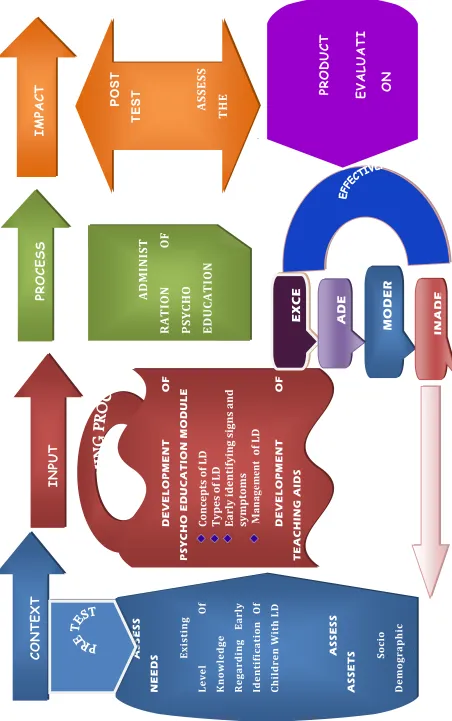
Daniel L. Stufflebeam developed the framework of the present study in (2003). The CIIP Evaluation module is a comprehensive framework for guiding evaluations of programs, projects, personnel, products, institutions, and systems. The CIIP Model focused on program evaluations, particularly those aimed at effecting long term, sustainable improvements. The model's main theme is that evaluations most important purpose is not to prove, but to improve.
In this decision-oriented approach, program evaluation defined as the ³V\VWHPDWLF FROOHFWLRQ RI LQIRUPDWLRQ DERXW WKH DFWLYLWLHV characteristics, and outcomes of programs to make judgments about the program, improve program effectiveness, and/or inform decisions about IXWXUHSURJUDPPLQJ´
The CIPP evaluation model is a framework for guiding evaluations of programs, projects, personnel, products, institutions, and evaluation systems (Stufflebeam, 2003). Designed to assist administrators in making informed decisions, CIPP is a popular evaluation approach in educational settings This approach, developed in the late 1960s, seeks to improve and achieve accountability in educational programming WKURXJKD³OHDUQLQJ-by-GRLQJ´DSSURDFK.
&RPSRQHQWVRI6WXIIOHEHDP¶V&,330RGHO
Major concepts
The major concepts of this model are
1. Context evaluation
Context evaluation assesses needs, assets, and problems within the defined environment.
2. Input evaluation
Input evaluation assesses competing strategies and the work plans and budgets of the selected approach.
In this study, input refers to planning and formulating learning objectives, psycho education program, teaching aids, schedule with date and time, venue for conducting the psycho education program by using teaching methods regarding early identification of learning disability.
3. Process evaluation
Process evaluation LQYHVWLJDWHV WKH TXDOLW\ RI WKH SURJUDP¶V implementation. In this stage, program activities should monitor, documented, and assessed by the evaluator.
In this study, it would carried out by
4. Impact evaluation
Impact evaluation assesses a program reach to the target audience. In this study, after implementation of psycho education module posttest conducted to identify the effectiveness of psycho education module regarding early identification of children with learning disability.
5. Product evaluation
It measures the outcome of the program.
It refers to the comparison of pre test and posttest scores on knowledge of early identification of learning disability among primary school teachers.
6. Effectiveness evaluation
Effectiveness evaluation assesses the quality and significance of outcome. In this study, the outcome will be either increase in knowledge, decrease in knowledge or no chang e in knowledge when the level quantified.
DE
VE
LOP
M
EN
T OF
PSY C H O ED UCAT IO N MOD U LE
Concepts of LD Types of LD Ea
rly identifyin
g signs
and
symptoms Managem
e nt of LD DE VE LOP M EN T OF T E ACHI NG AI DS AD MI NI ST R A TI ON OF PS YC HO ED UC ATI O N PRO D U C T EV A LU A T I ON POS T TES T AS SESS TH E MO D E R EX CE ADE INADE INPUT ASSESS NEED
S Ex
is
ting
Level Of Kn
owledge Regar d ing Ear ly Id entific a tio n Of Childr en W ith LD ASSESS ASSET
S Socio
Demogr
aphic f
IMPA CT PRO C E S S CON T EX T F IG 2. 1 M o dified C IIP Evalu ation M o del devel o
ped by D
a
niel L.
Stufflebeam
(20
[image:30.612.93.545.38.759.2]CHAPTER
±
III
METHODOLOGY
3.1. Research approach
A quantitative approach used in this study.
3.2. Duration of the study
Four weeks (17.07.2015 to 16.08.2015)
3.3. Setting of the study
The study conducted at selected corporation primary schools that are located in Chennai. The Chennai corporation education department had started with 40 primary schools in the year 1912. Now it functions with 659 primary schools with the enrollment of 109494 stude nts and the drop rate was1.50.
3.4. Study design
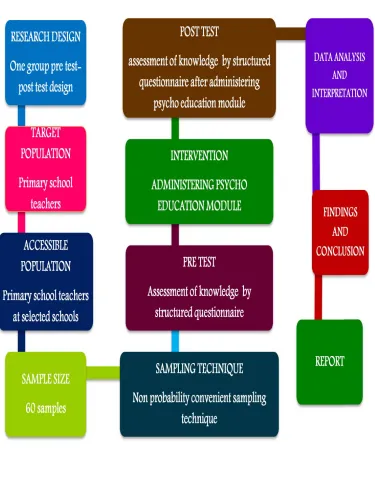
A pre experimental one-group pretest - posttest design has adopted to assess the effectiveness of psycho education module on early identification of learning disabilities among primary school teachers at Chennai.
The pre experimental design that is represent below.
GR OUP
PRE
TEST INTERVENTION
POST TEST
2Õ - Pretest to assess the level of knowledge regarding early identification of children with learning disability among primary school teachers.
X- Intervention, which was to be administer in the form of psycho education module.
Intervention protocol
Place : Selected Chennai corporation primary schools
Intervention :
Psycho education module Tool
:
Self structured knowledge questionnaire Duration
:
Four weeks Frequency
:
Once a day Time : 12pm to 1pm
Population : Primary school teachers
Protocol : Psycho education module consists of four domains
Concepts of LD Types of LD
Early identifying signs and symptoms of LD Management of LD
Teaching aids Pamphlet
Booklet Power point presentation
Participants
60 primary school teachers from four corporation primary schools. Each school consists of 15 teachers.
Teaching session
O2- Posttest to assess the level of knowledge regarding early identification of children with learning disabilit y among primary school teachers.
3.5. Study population Target population
The target population of this study was primary school teachers. Accessible population
The accessible population in this study was primary school te achers at selected corporation primary school at Chennai.
3.6. Sample Size
A sample of 60 primary school teachers who met sampling criterion.
3.7. Criteria for selection of samples 3.7.1. Inclusion Criteria:
Teachers who
are teaching I to V standard school children. are willing to participate in this study are present at the time of data collection. can speak and understand English and Tamil. 3.7.2 Exclusion criteria:
3.8. Sampling technique
Corporation officials allotted schools and the samples selected by convenient sampling technique.
3.9. Research Variables Independent variable
Psycho education module on early identification of children with learning disability.
Dependent variable
Level of knowledge of the primary school teachers regarding early identification of children with learning disability.
3.10. Development and description of the tool 3.10.1 Development of the tool
Tools developed after extensive review of literature from various textbooks, internet access, journals, discussion, and the guidance from the experts in the field of nursing, education, medical, statistician department of psychiatry. A structured questionnaire was used to collect the data from the primary school teachers who are taking class from I to V std in a selected primary schools.
3.10.2 Description of tool
It has two sections A and B as follows Section A: Demographic profile
3.10.2. Section B: Structured knowledge questionnaire
Consist of structured questionnaire regarding knowledge of primary school teachers on early identification of children with learning disability.
The self-administered knowledge questionnaire consists of 20 multiple-choice questions on four aspects.
Concepts of LD
Types of learning disability
Early identifying signs and symptoms of learning disability Management of learning disability.
Scoring procedure
The multiple-choice questionnaire had used to assess the knowledge on early identification of children with learning disability.
Each right answer has scored as one and each wrong answer scored as zero.
Interpretation
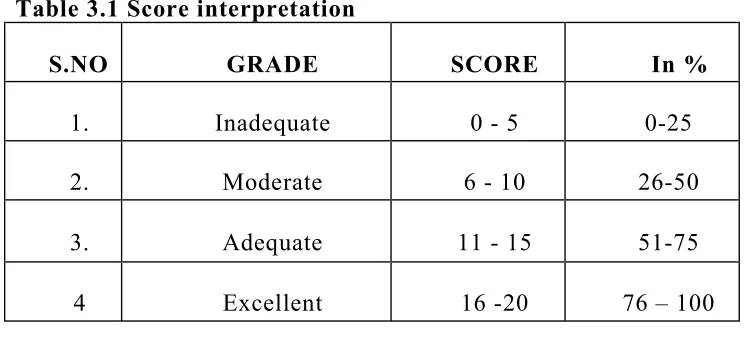
[image:36.612.137.509.171.342.2]To interpret the knowledge about early identification of children with learning disability among primary school teachers, the scores were classify into four categories as inadequate, moderately adequate, adequate, and excellent.
Table 3.1 Score interpretation
S.NO GRADE SCORE In %
1. Inadequate 0 - 5 0-25
2. Moderate 6 - 10 26-50
3. Adequate 11 - 15 51-75
4 Excellent 16 -20 76 ± 100
3.10.3. Content validity
Validity of the tool was assessed using content validity. Medical, nursing, and statistical experts evaluated content validity. Suggestions and modifications given by the experts incorporated in the tools.
3.11. Ethical consideration
The research and ethics committee of Madras Medical College, Chennai, approved the study objective, intervention and data collection procedure.
3.12. Pilot study
Pilot study conducted in a corporation primary school in Chennai for 1 week (22.06.15 to 27.06.15). For pilot study 10 teaches were selected by convenient sampling technique. Informed consent obtained and demographic data had collected from the primary school teachers.
early identification of children with learning disability by using same questionnaire.
3.13. Reliability of the tool
After pilot study, reliability of the tool was assessing by using Test-retest method. Knowledge score reliability correlation coefficient value was 0.78. This correlatio n coefficient is very high and it is good tool for assess the effectiveness of psycho education module among selected primary school teachers regarding early identification of
children with learning disability in selected primary schools at Chennai.
3.14. Data collection procedure
The study conducted in the various schools around Chen nai. The permission obtained from Deputy Commissioner of Education, Corporation of Chennai, Education officer, Corporation of Chennai and they gave the list of 13 schools in the Chennai Corporation, which are feasible for conducting study. From the list investigator select four corporation primary schools; this consists of 80 primary school teachers.
Each school head masters/ headmistress contacted for getting convenient time for data collection procedure. From the total no of 80 teachers, investigator selects 75 teachers initially b ased on sampling criterion. Among this, 8 of them dropped out due to attending in service program on activity based learning, 5 of them on leave and 2 of them are not willing to participate in the study. Finally, 15 teachers were available from each school and the total sample size consists of 60.
Before the data collection procedure, some informal discussion made with participants to establish rapport so that they would be relaxed. Teachers informed about the objectives of the study. The teachers assured that their responses and details kept confidential, and will be use only for the research purpose.
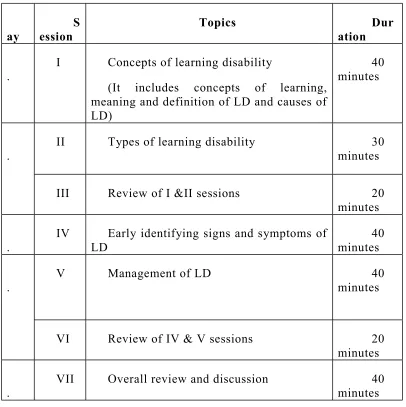
The pretest knowledge questionnaire administered to them and they had asked to give appropriate answers for all the items. After the pre test procedure, the psycho education module has implemented regarding early identification of children with learning disability in following topics and sessions.
ay
S ession
Topics Dur ation
.
I Concepts of learning disability
(It includes concepts of learning, meaning and definition of LD and causes of LD)
40 minutes
.
II Types of learning disability 30
minutes
III Review of I &II sessions 20
minutes
.
IV Early identifying signs and symptoms of LD
40 minutes
.
V Management of LD 40
minutes
VI Review of IV & V sessions 20
minutes
.
VII Overall review and discussion 40 minutes
After 1-week, posttest had conducted to assess their knowledge. At the end of the posttest teachers shared their opinion about the study that helps them to identify the children with learning disability and able to guide the parents about the children at home.
3.15. Data entry and analysis
[image:38.612.121.527.65.472.2]Descriptive and inferential statistics used for data analysis. The collected data tabulated and analyzed by using descriptive and inferential statistical methods.
S . No
Data analysis
Methods Remarks
1. Descrip tive statistics
Frequency, percentage,
mean, standard deviation
Describe the demographic variables
of primary school teachers.
2. Inferent ial statistics
3DLUHG µW¶ test
Compare pretest and posttest knowledge scores.
Chi square test
Compare the pretest and posttest knowledge scores.
CHAPTER IV
DATA ANALYSIS AND NTERPRETATION
This chapter deals with the analysis and interpretation of the data obtained from 60 primary school teachers who were working in selected corporation primary schools at Chennai. Statistical procedure enabled the investigator to analyze, summarize, evaluate, interpret, and communicate the numerical information. Statistical analysis is a method of rendering quantitative information meaningful and intelligible.
The collected data were tabulate and presented according to the objectives under the following headings.
SECTION ± I: Demographic variables of primary school teachers.
SECTION - II: Assess the knowledge of primary school teachers before implementing psycho education module.
SECTION - III: Assess the knowledge of primary school teachers after implementing psycho education module.
SECTION- I
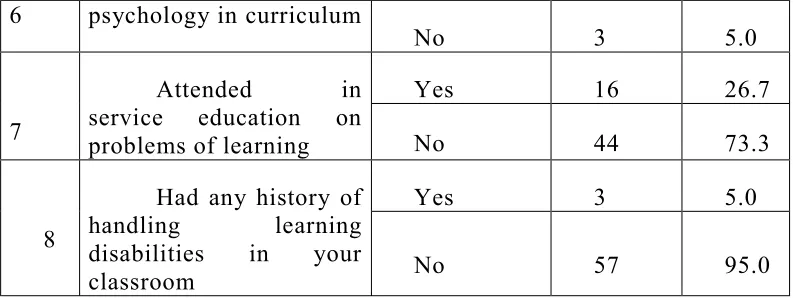
Table 4.1. Distribution of socio demographic variables of primary school teachers
N = 60
S
. No Demographic variables
Fre quency
In %
1 Age in years
20 -30 4 6.7
31 -40 33 55.0
> 40 23 38.3
2 Gender
Male 10 16.7
Female 50 83.3
3 Educational qualification
Teacher
s training program
32 53.3
B. Ed 28 46.7
4
Years of experience
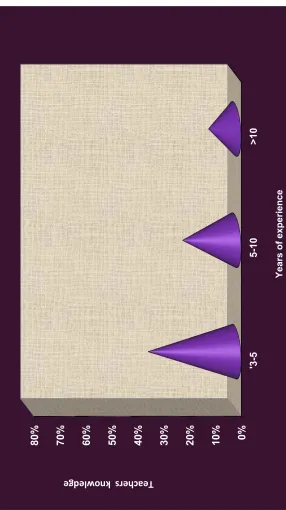
3-5 2 3.3
5±10 12 20.0
> 10 46 76.7
5 Marital status
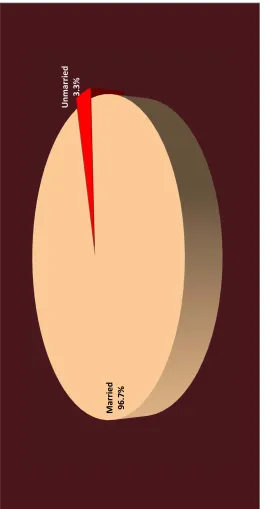
Married 58 96.7
Unmarried 2 3.3
6 psychology in curriculum
No 3 5.0
7
Attended in service education on problems of learning
Yes 16 26.7
No 44 73.3
8
Had any history of
handling learning disabilities in your classroom
Yes 3 5.0
[image:43.612.123.520.68.217.2]No 57 95.0
Table 4.1: Shows the demographic information of primary school teachers those who participated in this study .
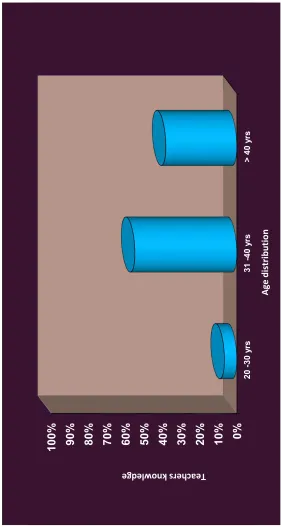
Age wise distribution of primary school teachers shows that higher proportion (55 %) of the teachers belongs t o the age group of 31- 40 years, 38% belongs to >40 years and only 7% of teachers belongs to 20 -30 years of age group.
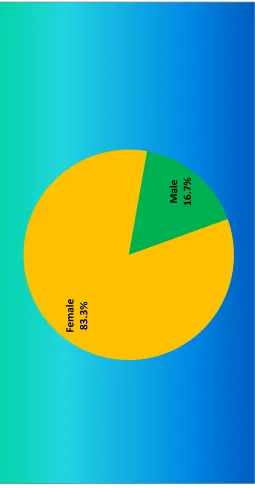
Gender wise distribution of primary school teachers shows that
83.3% of the primary school teachers were female and only 16.7% were male.
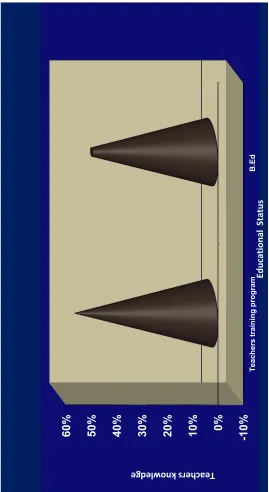
As far as the educational status of the primary school teachers are concerned, 53.3% of them had undergone the teacher-training program and around 47%had B. Ed qualification.
Years of experience wise distribution of primary school teachers
shows that most of them (76.7%) have more than 10 years of experience, 20% of them had 5-10 years of experience, and only 3% of them had 3-5 years of experience.
Marital status wise distribution of primary school teachers shows
that 97% of them were married and only 3% of them were not married.
Had child psychology in their curriculum wise distribution of
Distribution of attended previous in-service education on problems
of learning wise shows that 73% did not attend the previous in-service
education on problems of learning and only around 27% had attended.
Distribution of handling learning disability in their classroom wise
Fig
4.1
Age
w
ise dis
trib
utio
n o
f t
he
pri
mary
sc
hoo
l te
ach
er
s
0%
10%
20%
30%
40%
50%
60%
70%
80%
90%
100%
20
-30 y
rs
31
-40 y
rs
> 40 y
rs
Teachers knowledge
[image:45.612.110.391.72.599.2]Fig.
4.2.
Ge
nde
r w
ise di
stri
but
ion
of
the
pri
mary
sc
hoo
l te
a
cher
s
Mal
e
16.7%
F
emal
e
[image:46.612.96.351.119.607.2]
Fig 4.3 Ed
ucat
io
n
al stat
us
w
ise
di
stri
bu
tion of
the pri
mary
s
choo
l
te
ach
ers
-10%
0%
10%
20%
30%
40%
50%
60%
T
eachers traini
ng
program
B
.Ed
Teachers knowledge
Educationa
l
Fig
4.4
Yea
rs
of ex
p
erien
ce
w
ise di
str
ib
utio
n o
f th
e p
r
imar
y
schoo
l te
ach
ers
0%
10%
20%
30%
40%
50%
60%
70%
80%
'3-5
5-10
>10
Y
e
ars of experience
[image:48.612.94.380.104.614.2]Fig
4.5
Mar
ita
l st
at
us w
ise di
stri
but
ion
of
t
h
e p
r
imary
sc
ho
ol te
ach
ers
Marri
ed
96.7%
U
nmarri
e
d
[image:49.612.94.358.105.614.2]Fig
4.6
Ha
d
c
hild
ps
y
chology
i
n
th
eir
cu
rricu
lu
m w
ise dis
tri
buti
on
of
pri
mary
s
choo
l te
ach
ers
Ye
s
95%
[image:50.612.96.373.116.609.2]Fig
4.7
Att
end
ed
in
servi
ce t
rai
nin
g o
n
l
earn
ing
di
sor
der w
ise d
istr
ibu
tio
n o
f p
r
im
ary
sc
ho
ol t
eac
he
rs
0%
10%
20%
30%
40%
50%
60%
70%
80%
90%
100%
Ye
s
N
o
Teachers knowledge
In
service tra
[image:51.612.95.376.102.606.2]Fig
4.8
His
tory
of
h
andl
ing
le
arn
ing
di
sabil
ity
in
cla
ssro
o
m
w
ise distri
but
ion
of
pri
mary
sc
hool
te
ac
hers
0%
5%
10%
15%
20%
25%
30%
35%
Yes No
Te acher s know le dge
History
of
ha
ndling learning diffic
[image:52.612.93.369.102.623.2]SECTION - II
Table 4.2: Domain wise pre test knowledge score on early identification of children with learning disability
N= 60
Domains No. of
items
Min ±Max score
Mean D
% of mean score
Concepts of LD 3 0 -3 .28 .74 42.7
Types of learning disability 4 0 -4 .63 61 40.8
Early identifying
signs and symptoms of LD 7 0 -7 2.67 .05 38.1
Management of LD 6 0 -6 2.03 84
33.8
Overall 20 0 -20 7.62 .61 38.1
Fig 4.9 Pret
est do
mai
n w
ise of kno
w
ledge score of pri
mary
schoo
l teachers
0.0%
5.0%
10.0%
15.0%
20.0%
25.0%
30.0%
35.0%
40.0%
45.0%
Concepts
of LD
Types
of LD
E
a
rly
identifying
si
gns
and
sy
mpto
ms of LD
Manag
e
ment of
LD
Domain wise
kn
owledg
e score
in
pretest
Table 4.3: Level wise knowledge score in pretest
Table 4.3 shows pre test knowledge of the primary school teachers before implementing psycho education module regarding early identification of children with learning disability. In general, 10.0% of the teachers had inadequate knowledge score, 85.0% of them had m oderate knowledge score, and 5% of them had adequate score.
Level of knowledge
Frequency In %
Inadequate 6 10.0
Moderate 51 85.0
Adequate 3 5.0
Excellent 0 0.0
Fig 4.10 Pr
etest lev
el
w
ise know
ledge score of the pri
mary
school
teachers
0.0%
10.0%
20.0%
30.0%
40.0%
50.0%
60.0%
70.0%
80.0%
90.0%
Inadequate
M
o
dera
te
Adequate
Ex
cellent
Pretest level wise kn
owledge
score
Table 4.4: Domain wise and level wise knowledge score in pretest N= 60
Table 4.4 shows each domain wise and level wise assessment of the pretest level of knowledge score
SECTION - III Table4. 5: Domain wise knowledge score in posttest
N= 60
Domains No. of items Min score ±Max Mean SD
% of mean score
Concepts of LD 3 0 -3 2.45 .50 81.7
Types of LD 4 0 -4 3.03 .94 75.8
Early identifying signs and symptoms of LD
7 0 -7 5.23 1.24 74.7
Knowledge score
Inadequate Moderate Adequate Excellent
Frequency In % Frequency In % Frequency In % Frequency In %
Concepts of LD 4 6.7 52 86.6 4 6.7 0 0.0
Types of LD 4 6.7 52 86.6 4 6.7 0 0.0
Early identifying signs and symptoms of LD
7 11.7 51 85.0 2 3.3 0 0.0
Management of LD 9 15.0 49 81.7 2 3.3 0 0.0
Management of LD 6 0 -6 4.50 1.05 75.0
Overall 20 0 -20 15.22 1.76 76.1
4.11
Do
mai
n w
ise p
ostte
st
know
ledge
sc
ore o
f t
he
pri
mary
s
choo
l te
ach
ers
70.0%
72.0%
74.0%
76.0%
78.0%
80.0%
82.0%
84.0%
Concepts
of LD
Types
of LD
E
a
rly identifying
si
gns
and
sy
mpto
ms of
LD
Manag
e
ment of
LD
p
o
sttest
d
o
m
a
in
w
is
e
k
n
o
w
le
d
g
e
sc
o
re
Table 4.6: Level wise Percentage of Knowledge Score in Post Test
Table 4.6 shows posttest level knowledge of the primary school teachers after implementing psycho education module regarding early identification of children with learning disability. In general, none of the teachers is having inadequate knowledge score, none of them is having moderate knowledge score, 38.3% of them had adequate score, and 61.7% of them had excellent knowledge score.
Level of knowledge Frequency In %
Inadequate 0 0.0
Moderate 0 0.0
Adequate 23 38.3
Excellent 37 61.7
4.12
Le
vel w
ise p
ost
test
kn
ow
ledge sc
or
e of
the
pri
mary
s
c
h
ool t
eac
her
s
0.0%
0.0%
38.3%
61.7%
0%
10%
20%
30%
40%
50%
60%
70%
80%
90%
100% Inadequate Mod
e
rate
Adequate
E
xcell
e
nt
Tea ch ers
Posttest
levels
of knowledge score
Table4. 7. Domain wise and level wise knowledge score in posttest N= 60
Table 4.7 shows each domain wise and level wise assessment of the posttest level of knowledge score
Knowledge score
Inadequate Moderate Adequate Excellent
Frequency In
% Frequency
In
% Frequency
In
% Frequency
In %
Concepts of LD 0 0.0 0 0.0 33 55 27 45
Types of LD 0 0.0 0 0.0 34 56.7 26 43.3
Early identifying signs and symptoms
of LD
0 0.0 0 0.0 39 65 21 35.0
Management of LD 0 0.0 0 0.0 42 70 28 46.7
SECTION - IV
Table 4.8: Domain wise comparison of mean knowledge score
knowledge score
Mean Difference
6WXGHQW¶V Paired t-test
Pretest Posttest
Mean SD Mean SD
Concepts of LD 1.28 .74 2.45 .50 1.17
t=11.51 P=0.001
Types of learning
disability 1.63 .61 3.03 .94 1.40
t=9.92 P=0.001
Early identifying signs
and symptoms of LD 2.67 1.05 5.23 1.24 2.56
t=12.52 P=0.001
Management of LD 2.03 .84 4.50 1.05 2.47
t=13.69 P=0.001
Overall 7.62 1.61 15.22 1.76 7.60
t=25.10 P=0.001
6LJQLILFDQWDW3KLJKO\VLJQLILFDQWDW3YHU\KLJKVLJQLILFDQWDW 3
Table No 4.8 compares pretest and posttests mean knowledge score.
Considering concepts of LD aspects, in pretest, teachers had 1.28 score where as in posttest they had 2.45 score, so the difference is 1.17. This difference between pretest and posttest is large and it is statistically significant.
Considering types of learning disability aspects, in pretest, teachers had 1.63 score where as in posttest they had 3.03 score, so the difference is 1.40. This difference between pretest and posttest is large and it is statistically significant.
Considering early identifying signs and symptoms of LD aspects, in pretest, teachers had 2.67 score where as in posttest they had 5.23 score, so the difference is 2.56. This difference between pretest and posttest is large and it is statistically significant.
Considering overall aspects, in pretest, teachers had 7.62 score where as in posttest they had 15.22 score, so the difference is 7.6. This difference between pretest and posttest is large and it is statistically significant.
Fig
.
4.
13
Co
mpari
so
n
of
do
main
w
ise
prete
st
and
pos
tte
st
k
now
ledge
sco
re
o
f
th
e
p
r
im
a
r
y
scho
ol t
eac
her
s
0%
10%
20%
30%
40%
50%
60%
70%
80%
90%
100%
Concepts of
learning
disability
Types of
learning
disability
E
a
rly identifying
si
gns an
d
sy
mpto
ms
of LD
Manag
e
ment of
LD
Teachers knowledge
Domainwise pr
etest
and
po
stte
st Percentage of
kn
owledge
score
Pr
e
tes
t
P
o
Table4. 9: Comparison of overall Knowledge Score
Frequency Mean ± SD Mean
Difference 6WXGHQW¶VSDLUHGW-test
Pretest 60 7.62±1.61
7.60 t=25.10 P=0.001*** significant
posttest 60 15.22±1.76
YHU\KLJKVLJQLILFDQWDW3
Table 4.9 shows the comparison of overall mean knowledge score between pretest and posttest.
In the overall pretest score among primary school teachers are 7.62 score with standard deviation of 1.61. Moreover, the posttest they had scored 15.22 with standard deviation of 1.76. Therefore, the difference is 7.60.
Fig 4.14: Box-plot shows the comparison of mean pretest and posttest knowledge scores
posttest pretest
20
15
10
5