Theses
7-30-2019
Shadow Detection in Aerial Images using Machine
Learning
Prasanna Reddy Pulakurthi
Machine Learning
by
Prasanna Reddy Pulakurthi
A Thesis Submitted in Partial Fulfillment of the Requirements for the Degree of Master of Science in Electrical Engineering
Supervised by
Dr. Emmett J. Ientilucci
Chester F. Carlson Center for Imaging Science Rochester Institute of Technology. Rochester, New York
July 30, 2019
Approved by:
Dr. Emmett J. Ientilucci, Assistant Professor
Thesis Advisor, Chester F. Carlson Center for Imaging Science
Dr. Majid Rabbani, Visiting Professor
Committee Member, Department of Electrical and Microelectronic Engineering
Dr. Eli Saber, Professor
Committee Member, Department of Electrical and Microelectronic Engineering
Dr. Sohail A. Dianat, Professor
Rochester Institute of Technology Kate Gleason College of Engineering
Title:
Shadow Detection in Aerial Images using Machine Learning
I, Prasanna Reddy Pulakurthi, hereby grant permission to the Wallace Memorial Library
to reproduce my thesis in whole or part.
Prasanna Reddy Pulakurthi
Dedication
Acknowledgments
I like to thank my advisor Dr. Emmett Ientilucci for the regular meetings and guidance
through each and every stage of this journey and also for inspiring my interest in
developing algorithms related to this thesis. I would also like to thank my committee
members, Dr. Majid Rabbani and Dr. Eli Saber, for their ideas and insights which also
helped to develop this thesis. Finally, I would like to thank the RIT EE department head,
Dr. Sohail, and my professor, Dr, Rabbani, for recommending me to professor Ientilucci
who ultimately introduced me to this research project.
This research was sponsored by Oak Ridge National Laboratory, managed by UT-Battelle,
Abstract
Shadow Detection in Aerial Images using Machine Learning
Prasanna Reddy Pulakurthi
Supervising Professor: Dr. Emmett J. Ientilucci
Shadows are present in a wide range of aerial images from forested scenes to urban
environments. The presence of shadows degrades the performance of computer vision
al-gorithms in a diverse set of applications such as image registration, object segmentation,
object detection and recognition. Therefore, detection and mitigation of shadows is of
paramount importance and can significantly improve the performance of computer vision
algorithms in the aforementioned applications. There are several existing approaches to
shadow detection in aerial images including chromaticity methods, texture-based
meth-ods, geometric, physics-based methmeth-ods, and approaches using neural networks in machine
learning.
In this thesis, we developed seven new approaches to shadow detection in aerial imagery.
This includes two new chromaticity based methods (i.e., Shadow Detection using Blue
Illumination (SDBI) and Edge-based Shadow Detection using Blue Illumination
(Edge-SDBI) and five machine learning methods consisting of two neural networks (SDNN and
DIV-NN), and three convolutional neural networks (VSKCNN, SDCNN-ver1 and SDCNN
ver-2). These algorithms were applied to five different aerial imagery data sets. Results
Conclusions touch upon the various trades between these approaches, including speed,
List of Contributions
• We coded and delivered algorithms, as mentioned in this thesis, to our sponsor.
• In this thesis, we proposed and developed the following seven methods for shadow
detection in areal images:
– Shadow Detection using Blue Illumination (SDBI).
– Edge based Shadow Detection using Blue Illumination (Edge-SDBI).
– Shadow Detection Neural Network (SDNN).
– Division-based Neural network (DIV-NN).
– Variable Sized Kernels Convolutional Neural Network (VSKCNN).
– Shadow detect Convolutional Neural Network Version1 (SDCNN-ver1).
– Shadow detect Convolutional Neural Network Version1 (SDCNN-ver2).
Contents
Dedication . . . iii
Acknowledgments . . . iv
Abstract . . . v
List of Contributions . . . vii
1 Introduction . . . 1
2 Background . . . 2
2.1 Existing Approaches to Shadow Detection in Areal Imagery . . . 2
2.1.1 Chromaticity Methods . . . 2
2.1.2 Texture-based Methods . . . 5
2.1.3 Geometric Based Methods . . . 5
2.1.4 Physical Methods . . . 6
2.1.5 Existing Machine Learning Approaches to Shadow Detection . . . 7
2.2 Data . . . 8
2.2.1 DIRSIG . . . 8
2.2.2 WorldView-2 (WV2) . . . 10
2.2.3 University of Illinois at Urbana-Champaign (UIUC) Data . . . 10
2.2.4 Shadow Collect Data (SC data) . . . 10
2.3 Methods to Evaluate Success . . . 11
2.3.1 Completeness . . . 11
2.3.2 Correctness . . . 11
2.3.3 Quality . . . 12
2.3.4 Accuracy . . . 12
3 Shadow Collection Experiment . . . 13
4 New Approaches to Shadow Detection . . . 18
4.1.1 Shadow Detection using Blue Illumination (SDBI) . . . 18
4.1.2 Edge based Shadow Detection using Blue Illumination (Edge-SDBI) . . . 20
4.2 Neural Networks . . . 24
4.2.1 Choosing Input data for the Neural Networks . . . 24
4.2.2 Shadow Detection Neural Network (SDNN) . . . 28
4.2.3 Division-based Neural network (DIV-NN) . . . 30
4.3 Convolutional Neural Networks . . . 32
4.3.1 Image-Preprocessing for Brightness Matching . . . 32
4.3.2 Variable Sized Kernels Convolutional Neural Network (VSKCNN) 34 4.3.3 Shadow Detect Convolutional Neural Network Version1 (SDCNN-ver1) . . . 36
4.3.4 Shadow Detect Convolutional Neural Network Version2 (SDCNN-ver2) . . . 39
5 Results . . . 41
5.1 Qualitative Assessment . . . 42
5.1.1 Chromaticity Method Results . . . 42
5.1.2 Neural Network Results . . . 47
5.1.3 CNN Results . . . 47
5.2 Quantitative Assessment: Metrics . . . 50
5.2.1 Quantitative Assessment using DIRSIG Data . . . 50
5.2.2 Quantitative Assessment using WV2 Data . . . 53
5.2.3 Quantitative Assessment using UIUC Data . . . 54
5.2.4 Quantitative Assessment using SC Data . . . 57
5.2.5 Quantitative Assessment using All Data . . . 59
6 Conclusion . . . 62
7 Future Work . . . 64
List of Figures
2.1 DIRSIG generated image at 12:00am. . . 9
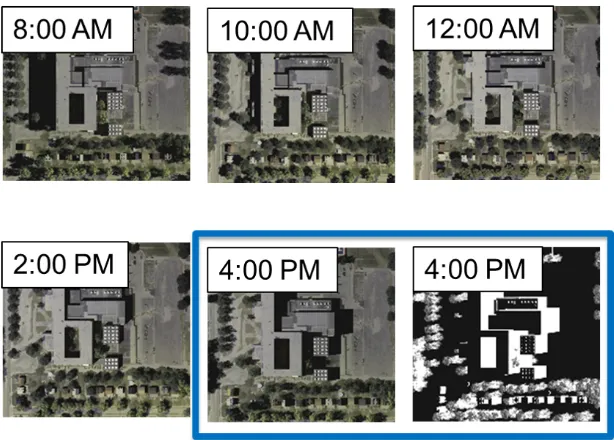
2.2 DIRSIG generated images at different times of the day. Example shadow mask at 4:00pm (bottom right). . . 9
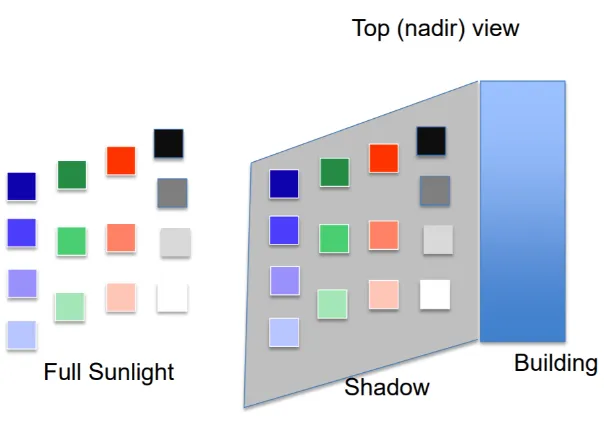
3.1 Notional layout of the shadow collection experiment. . . 13
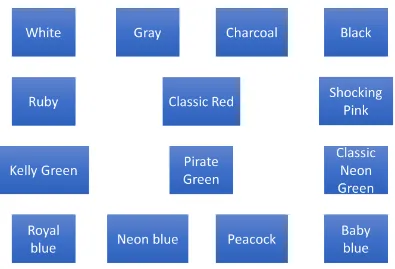
3.2 Various colored panels used in the shadow collection experiment. . . 14
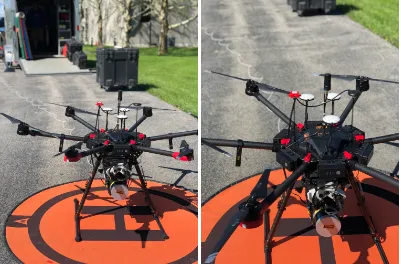
3.3 Drone used for the data collect. . . 15
3.4 Field images showing the target deployment and strong shadows from a tall building. . . 16
3.5 a) Nadir view of shadow collection experiment and b) zoomed in version showing the building and deployed targets in the shadow. . . 17
4.1 Example input image from the WV2 data-set. . . 20
4.2 SDBI output for the WV2 image of Figure 4.1. . . 21
4.3 Edges from performing Canny Edge Detection on the L band. . . 22
4.4 Initially selected seeds. . . 22
4.5 Region growing after 2 iterations. . . 23
4.6 Final output after region growing and filling process. . . 24
4.7 Example WV2 image used to illustrate data selection. . . 25
4.8 Data chosen using the random selection method. . . 26
4.9 (a) Shadows classified into six different classes using k-means. (b) Non-shadow regions classified into eight classes using k-means. . . 27
4.10 Data chosen using the Balanced data selection method. . . 28
4.11 SDNN architecture . . . 29
4.12 Division-based Neural Network (DIV-NN) . . . 30
4.13 Division Network added to our SDNN . . . 31
4.14 (a) Typical input image. (b) Reference image. . . 33
4.15 (a) Preprocessed image after brightness matching to the reference image. (b) Reference image . . . 34
4.16 VSKCNN architecture. . . 35
4.18 Chips for training SDCNN from a WV2 image. . . 38 4.19 SDCNN-ver2 architecture. . . 39
5.1 (a) DIRSIG image, (b) WV2 image, (c) Valencia image, (d) UIUC image, (e) SC data image. . . 43 5.2 Output shadow mask of the three existing chromaticity shadow detection
methods. . . 44 5.3 Output shadow masks of the two proposed chromaticity shadow detection
methods. . . 46 5.4 Output shadow masks of the two proposed neural networks. . . 48 5.5 Output shadow masks of different Convolutional neural networks. . . 49 5.6 Heat map of quantitative metrics verses all the algorithms on the DIRSIG
data. Values in parenthesis are standard deviations. . . 51 5.7 Example Image 1: DIRSIG data. . . 52 5.8 Heat map of quantitative metrics verses all the algorithms on the WV2 data. 54 5.9 Example Image 2: WV2. . . 55 5.10 (a) Input UIUC image. (b) Hand labeled ground truth. . . 56 5.11 Heat map of quantitative metrics verses all the algorithms on the UIUC
data based on 50 images. . . 57 5.12 Example Image 4: UIUC. . . 58 5.13 Heat map of quantitative metrics verses all the algorithms on the Shadow
Chapter 1
Introduction
In this thesis we would like to address the problem of shadows in aerial images. We are
interested in shadow detection as shadows can cause problems while performing image
registration and other computer vision applications. Therefore, we wish to detect shadows
in aerial images.
We started by doing a literature review on existing shadow detection methods and built
upon some of the basic concepts. We developed two chromaticity methods. Furthermore,
we used machine learning concepts to address this problem. Building on the fundamentals
of machine learning, we proposed five simple machine-learning algorithms. The neural
networks proposed in this thesis have high computational speed. We then compare the
performance of all the different methods proposed in the thesis using qualitative and
Chapter 2
Background
2.1
Existing Approaches to Shadow Detection in Areal Imagery
2.1.1 Chromaticity Methods
Chromaticity is one of the most popular methods to perform shadow detection. In this
method shadow detection is based on spectral information. That is, RGB (Red, Green and
Blue bands) and sometimes the Near IR bands. These methods work on the assumption
that the regions in shadows become darker and the shadowed regions preserve the
chro-maticity information of the underlying material. For instance, green vegetation in shadow
would sill contain the same spectral information but just look darker. This color model,
where the intensity reduces but the chromaticity remains unchanged, is generally referred
to as colour constancy [22] or linear attenuation [23]. Methods that use this approach
gen-erally use a different color space so as to have a better separation between chromaticity
and intensity than using RGB space (example color spaces include HSV[26], c1c2c3[30],
YUV[24]). These algorithms are generally simple to implement and computationally
in-expensive. However, these algorithms perform pixel-level analyses and are prone to noise
[25]. They are also sensitive to the strength of shadows, as shadows can be strong on a
sunny day with clear skys or weak on a cloudy day. The following subsections explain
Normalized Saturation Value Difference Index (NSVDI)
Ma et. al. [28] proposed a shadow detection method by working in Hue Saturation Value
(HSV) color space. First, an RGB image is converted to HSV space. We then find the
NSVDI as,
N SV DI = S−V
S+V (2.1)
where S and V are the normalized saturation and value components, respectively. A
positive threshold T is applied on NSVDI to create a binary shadow mask. This threshold
is set to be zero. The image pixel is labeled as a shadow pixel if the NSVDI is greater than
threshold T; else, it is non-shadow.
Shadow Detection Index (SDI)
The Shadow Detection index, proposed by Y. Mostafa [29], makes use of four bands: red,
green, blue and NIR. Here are the observations made by Y. Mostafa [29] in shadowed
regions.
1) In shadows, the intensity of the red band decreases sharply.
2) Intensity values of shadow and non-shadow areas have the smallest difference in the
blue band.
3) Smaller values for the term (G-B) in shadows.
4) Shadow pixels have low difference between green and blue bands. Larger differences
From these observations, the SDI is developed. For every pixel, the SDI is calculated
using
SDI = (1−PC1)+1
((G−B) ∗R)+1 (2.2)
where, R, G and B are the normalized values of the red, green and blue bands,
respec-tively. PC1 is the normalized first principal component. Principal component analysis is
performed on the red, green, blue and NIR bands. The first principal component contains
most of the information and gives a very good estimate for the brightness in the image. SDI
is formed from four different bands R, G, B and PC1. These are used in a way to
maxi-mize SDI in shadows with a minimum score in non-shadows. PC1 produces low values in
shadows; therefore,(1−PC1)is used in the numerator. From observations 1) and 3) above
((G − B) ∗ R)has low values in shadows, therefore we use this term in the denominator.
Then a one is added in the numerator and denominator for stability. Finally, the SDI output
is stretched to fit the range (0-255). Then a subjective threshold T is used to binarize and
create a shadow mask.
C3 Index
This algorithms is developed using a function on the ratio of bands. The C3 index from
[30] uses arctan on the ratio of the blue band and maximum of green and red bands. This
is seen in Equation (2.3).
C3=arctan
B
max(G,R)
Due to atmospheric Rayleigh scattering effects, shadow pixels are typically saturated
with short blue wavelengths. Therefore, the C3 index emphasises the blue component in
the numerator. Due to the high emphasis on the blue band, most of the blue regions, like
water and some blue objects, are misclassified as shadows.
2.1.2 Texture-based Methods
based methods exploit the fact that texture is retained in shadowed regions.
Texture-based methods generally are implemented in two steps: 1) Finding candidate shadow pixels
or regions, and 2) classifying them into either foreground or shadows. In the first step,
shad-ows are selected based on spectral features. Then each shadow candidate region is classified
as an object or shadow by checking the texture. If two regions have different spectral
char-acteristics but the same texture information, then we choose the region with lower intensity
as the shadowed region. Different types of correlation techniques are proposed (e.g. Gabor
filtering [1]), Markov or conditional random fields [2, 3], orthogonal transforms [4],
gradi-ent or edge correlation [5, 6, 7], normalised cross-correlation [8]). Texture-based methods
can be powerful because textures are highly distinctive. Also, these methods are robust to
change in illumination. However, texture-based methods are typically slow as they
com-pute several neighborhood comparisons for each pixel. Hence, we did not explore this
method as we are looking for methods that have faster run times.
2.1.3 Geometric Based Methods
With prior knowledge of source illumination and object shape, we can predict the
orien-tation, size and shape of the object. This information is used by some methods to split
directly with input frame data and does not rely on an accurate estimate of the background
reference. However, geometric based methods have scene limitations such as: they require
specific object types, vehicles [10, 13] or pedestrians [9, 11] and assume that the source
of light is unique [12] or the background surface is flat [10]. Moreover, current geometric
based algorithms cannot deal with multiple shadows from a single object. This method
is not applicable to aerial images as we do not have the prior knowledge related to the
direction of illumination or the objects in the scene.
2.1.4 Physical Methods
Linear attenuation models make an assumption that the illumination source is purely white
[14], which is often not true. In a typical outdoor environment, the two major sources of
illumination are the sun and the light reflected from the blue sky. The light from the sun
generally dominates any other light source. However, when the sunlight is blocked
(creat-ing shadows), the main source of light is the light from the sky, which is typically blue due
to the atmospheric Rayleigh scattering effect. A dichromatic model was employed in [14]
which takes into account both of these illumination sources to better estimate shadowed
re-gions. Other non-linear attenuation models are proposed [15, 16] which account for various
illumination conditions in a variety of indoor and outdoor scenarios. Alternatively, some
methods learn the appearance of all the pixels in shadows for shadow detection without
nec-essarily proposing any particular model [17, 18, 19]. These methods or models that try to
learn the appearance of the shadowed regions are referred to as physical approaches. These
methods are more accurate than chromaticity methods (comparisons reported in [17, 18]).
similar chromaticity to that of the fully illuminated objects. Hence we did not use this
approach.
2.1.5 Existing Machine Learning Approaches to Shadow Detection
Shadow detection, using visible light surveillance cameras, is proposed in [20]. This
method used a convolutional VGG Net-16 architecture for shadow detection. Fast shadow
detection using patched convolutional networks were used in [21]. This method uses
tex-ture and color featex-tures to produce a shadow prior map. This is then used along with the
RGB image to create an output shadow mask using RGBP CNN (RGBP is RGB stacked
with Prior map these are used as input for the RGBP CNN), as described in their work.
Shadow detection using conditional Generative Adversarial Networks (cGAN) was
pro-posed in [32]. GANs use a generator and a discriminator. A generator produces images to
fool the discriminator and the discriminator’s job is to correctly classify real images (i.e,
real input images) from fake ones (generated by the generator). The cGANs use an input in
the generator to produce the fake image. In this method, the authors used the generator to
create the shadow mask. The discriminator is given the input image along with the shadow
mask. The training is stopped when the discriminator cannot discriminate between real
and fake images. This is because the generator has become good in generating the shadow
mask, that is indistinguishable from the ground truth (GT). In the end, this generator is used
for shadow detection.
We have designed our Neural Networks and Convolutional Neural Networks, building
We did not test these machine learning algorithms in the literature against our proposed
ma-chine learning methods because we could neither obtain the source code of these algorithms
from the authors nor did we have enough time to write our own code for implementing these
methods.
2.2
Data
For analyzing and testing the performance of different algorithms, we used five different
data-sets which are described in the following sections.
2.2.1 DIRSIG
Working with neural networks demands data. We generated RGB synthetic images and
their corresponding shadow masks using the digital imaging and remote sensing image
generation (DIRSIG) model [33].
The DIRSIG model is a physics-driven synthetic image generation model developed by
the Digital Imaging and Remote Sensing Laboratory in the Center for Imaging Science
at Rochester Institute of Technology. The model can produce passive single-band,
multi-spectral or hyper-multi-spectral imagery from the visible through the thermal infrared region of
the electromagnetic spectrum. The model also has a very mature active laser (LIDAR)
capability and an evolving active RF (RADAR) capability. The model can be used to test
image system designs, to create test imagery for evaluating image exploitation algorithms
and for creating data for training image analysts.
A sample image produced using the DIRSIG model is shown in Figure 2.1. We used
Figure 2.1: DIRSIG generated image at 12:00am.
[image:21.612.156.463.435.655.2]can help produce different sized shadows. For instance, large shadows are produced during
dusk and dawn while short ones are produced during noon. A large portion of these images
contain vegetation while only a few regions contain large buildings. Any imagery used in
future sections of this document will be referred to as a DIRSIG image.
2.2.2 WorldView-2 (WV2)
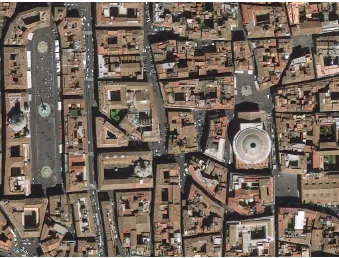
WorldView-2 is a commercial Earth observation satellite that captures aerial images. We
selected the RGB images produced by this satellite which were available to use [34]. We
obtained 20 images from WV2 and created shadow masks for 6 images. In the following
sections, we refer to all the WorldView-2 images as the WV2 image. This data consists of
a variety of regions containing vegetation, asphalt, buildings and cities.
2.2.3 University of Illinois at Urbana-Champaign (UIUC) Data
The University of Illinois at Urbana-Champaign has created an image data-set [35] along
with their corresponding masks. We used 50 aerial images from this data-set for testing
our algorithms. These data-sets contain varying textures as well as different materials in
shadow and non-shadowed regions.
2.2.4 Shadow Collect Data (SC data)
We performed a shadow collect consisting of different colored targets placed in shadow and
non-shadowed regions. Chapter 3 contains a detailed explanation of this shadow collect.
2.3
Methods to Evaluate Success
Other than visually analyzing the shadow detection output, it would be helpful to have a
quantitative metric to access the performance of an algorithm. For this research, we will use
Completeness, Correctness, Quality and Accuracy metrics, which were originally proposed
by Wiedemann et al. (1998) and adopted in [36]. These metrics will verify which approach
is best at finding shadows and also avoid misclassifications. Thus, we compare the detected
result with the ground truth, pixel-wise. All the quantitative metrics have a range of values
from zero to one (0 to 100 percent) and are utilized in Chapter 5 of this thesis.
2.3.1 Completeness
The fist metric, called completeness (Com), is the percentage of shadow pixels in the
ground truth (GT) that were properly detected. Completeness is found using,
Com= T P
T P+F N (2.4)
where, TP are true positives (number of shadow pixels correctly detected as shadow)
and FN are false negatives (which are the number of GT shadow pixels that are classified
as non-shadows). In signal processing, TP is often referred to as detects (D) and FN is
referred to as misses (M).
2.3.2 Correctness
The correctness (Cor) metric is the percent of shadow detects that are correctly identified
using the methods in reference to the GT. The correctness metric is given by,
Cor = T P
where, FP are false positives (number of non-shadow pixels that are classified as shadow).
FP are sometimes referred to as False Alarms (FA).
2.3.3 Quality
The Quality (Qua) metric combines both of the previous metrics and is given by,
Qua= T P
T P+F P+F N (2.6)
This metrics tells us how good the method is. Where a higher value reflects better
algorithmic performance with the highest achievable value being one.
2.3.4 Accuracy
The accuracy (Acc) metric is the percentage of shadows and non-shadows classified
cor-rectly and is given by,
Acc = T P+T N
T P+F P+T N+F N (2.7)
Chapter 3
Shadow Collection Experiment
The objective of the shadow experiment was to create a controlled shadow collection
con-taining different gradients of color in shadow and non-shadows, as shown in Figure 3.1.
This should create a very difficult shadow detection data-set since there are very bright
objects in shadows and very dark objects in full illumination.
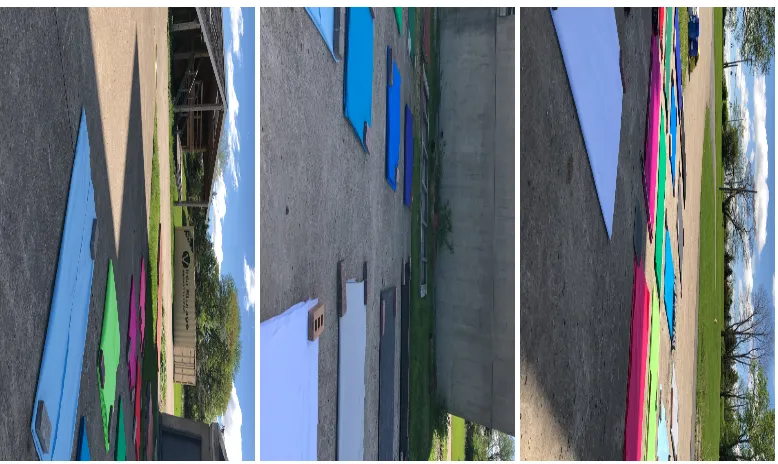
On May 21st 2019, with the help of the unmanned aerial system (UAS) data collection
team at the Rochester institute of technology, we conducted the actual data collect. We
[image:25.612.122.424.468.679.2]placed the first set of panels, containing 14 different colors, in shadows and another set of
Figure 3.2: Various colored panels used in the shadow collection experiment.
the same 14 colored panels in full illumination. A list of the colors used is shown in Figure
3.2. Additionally we placed two sets of felt on plywood (containing light grey, medium
grey and black) which were used for calibration.
The drone in Figure 3.3, is called the MX1 which is RITs multi-model UAS platform.
This system contains five different imaging systems namely Headwall nano, Mako G419,
Tamarisk 640, Velodyne lidar and multispetral Micasense camera. With these imaging
systems, we obtained RGB, multi-spectral, hyper-spectral, lidar and thermal images.
We flew two missions, one at 10:38 am another at 11:06 am local time. The weather
conditions were mostly sunny with a few fast moving clouds. The center of the scene
contained a three story building. This building produced strong shadows, as seen in Figure
Figure 3.3: Drone used for the data collect.
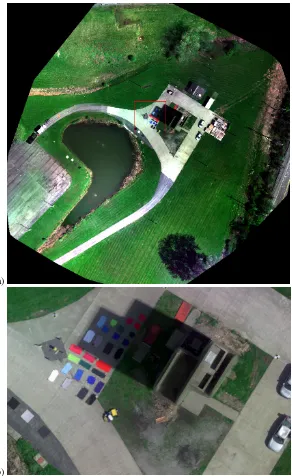
During mission 1106, all MX1 sensors recorded data. Spectral reflectance and radiance
measurements of the targets, both in full sun and shadow, were recorded. The raw data
was both geometrically corrected and calibrated to radiance. Figure 3.5 shows one of the
a)
[image:29.612.166.458.139.615.2]b)
Chapter 4
New Approaches to Shadow Detection
In this chapter, we propose and describe a total of seven different approaches to shadow
de-tection. This includes two chromaticity based methods (SDBI and Edge-SDBI), two
Neu-ral networks (SDNN and DIVNN) and three Convolutional NeuNeu-ral Networks (VSKCNN,
SDCNN-Ver1 and SDCNN Ver-2). These methods are presented in the following sections.
4.1
Chromaticity Methods
This section gives a detailed description of the proposed chromaticity methods entitled
SDBI and Edge-SDBI.
4.1.1 Shadow Detection using Blue Illumination (SDBI)
The Blue Illumination shadow detection method is built from a well established observation
that shadows contain a fair amount of blue light. The idea is to give high priority to the
blue band, at the expense of picking blue objects such as water or blue buildings. These
miss-classified (i.e. false alarm) blue pixels generally have a higher intensity than all of
the shadow regions, hence we use the the lightness component in the Lab color space to
remove these miss-classified pixels.
The idea is to output a high value for false alarmed blue pixels and low values for all
finally present our work on the best working formulation, as show in Equation (4.1).
SDBI = 1− B
max((1−b),R) (4.1)
where R andB are the normalized values of the Red and Blue channels respectively. bis
the b-component in CIE Lab space. That is, Lab space has three components, L* for the
lightness from black (0) to white (100), a* from green (-) to red (+), and b* from blue (-)
to yellow (+). The ratio of B band and the maximum of (1-b) and R produces low values
for shadow, therefore, one minus this term produces a high output value for shadow pixels.
We observe that the output of SDBI in the shadowed regions is very close to one.
There-fore, to classify we use the condition that, a pixel is a shadow if SDBI is greater than
thresholdTBI. Empirically we found the best results using a threshold of 0.9. When we
observe that some of the blue pixels are miss-classified as shadows, we remove these using
the L component of the Lab space. A threshold-based approach using the L component is
presented in [31], in which a pixel is classified as shadow if the L component is less than
TL. This thresholdTL is found using Equation (4.2) where a pixel is considered shadow if
it satisfiesSDBI > 0.9 and L <TL.
TL = µL −
1
3 ∗σL, (4.2)
Figure 4.1: Example input image from the WV2 data-set.
4.1.2 Edge based Shadow Detection using Blue Illumination (Edge-SDBI)
V. Arevalo [26] proposed a method of using both the chromaticity and edges for finding
shadows. Our implementation makes use of the SDBI given in Section 4.1.1 and edges
to guide the region growing. The steps of the algorithm are described below along with
example WV2 imagery.
1. Image-preprocessing: The WV2 image is shown in Figure 4.1. The following
com-ponents are computed and used in step 2 of the algorithm.
(a) RGB image is converted to Lab color space. ThresholdTL is found using
Equa-tion (4.2).
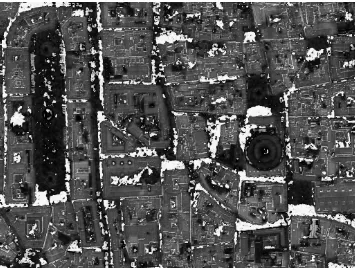
(b) SDBI is computed as described in Section 4.1.1. The computed SDBI is shown
Figure 4.2: SDBI output for the WV2 image of Figure 4.1.
(c) Perform Canny Edge Detection [27] on the L channel to obtain a edge component
E. The edges can be seen in the Figure 4.3.
2. Seed Selection: A pixel is selected as a seed if it has a high chance of being a shadow
pixel. The following conditions are used to label a pixel as a seed.
(a) The SDBI value of the pixel must be the local maximum of a 9×9 neighborhood.
(b) The mean of a 9×9 neighborhood of the L component is computed. This value
must be less than the thresholdTL.
(c) Only one seed can exist in a 9×9 neighborhood.
After applying the above conditions, initial seeds are selected. The results of this
Figure 4.3: Edges from performing Canny Edge Detection on the L band.
[image:34.612.132.489.403.672.2]Figure 4.5: Region growing after 2 iterations.
3. Region Growing and filling: After the initial seeds are selected, we start region
grow-ing. A pixel is considered shadow and added to the seed if it satisfies the following
conditions:
(a) The L value of the corresponding pixel must be less thanTL.
(b) The region stops growing when it reaches the edges.
Figure 4.5 shows the growing process in the second iteration. Regions are grown until
they reach convergence (next iteration produces the same result).
The final filling process is done using morphological image processing. We perform
a dilation followed by an erosion using a 3×3 filter. The final output, after complete
Figure 4.6: Final output after region growing and filling process.
4.2
Neural Networks
In this section, we describe the two neural network based methods namely, Shadow
De-tection Neural Network (SDNN) and Division-based Neural network (DIV-NN). However,
we first describe the input data used for these neural networks.
4.2.1 Choosing Input data for the Neural Networks
The inputs for the neural networks are the RGB values. We explored two ways of choosing
the data for training the Neural Networks, random selection and balaned data selection.
Random Selection
In this method we randomly choose RGB pixels from a given training image. This method
Figure 4.7: Example WV2 image used to illustrate data selection.
method is that, the data is more scene dependent. We want our data to have a lot of variance
and contain all the scenarios that we would experience in the real-world. For example,
consider a training image in which a majority of the image is covered by vegetation. By
randomly choosing the data (by data we mean RGB pixel values) we will have unbalanced
data with more emphasis on vegetation. To overcome this we can use a balanced data
selection technique as described in the next subsection.
We illustrate an example for random selection using the WV2 image as seen in Figure
4.7. From this image, 40,000 pixels are chosen with 20,000 in shadow and 20,000 in
non-shadowed regions (this is done with the help of ground truth (GT) shadow mask). For
visual representation, this data is reshaped into an image of size 200×200 and shown in
Figure 4.8: Data chosen using the random selection method.
Balanced Data Selection
Balanced data selection helps choose equal amounts of data from different regions in
shad-ows and non-shadshad-ows. We first divide the original image into shadow and non-shadow
images using the help of GT, then apply k-means clustering on the shadow image and
non-shadow imagery. Then we randomly choose from each class, this ensures that we pick
equal amounts of data from all of the regions.
Using the same WV2 image from Figure 4.7, we first divide the image into shadow and
non-shadowed images using the shadow mask (GT). The shadow image is further divided
into six classes using k-means clustering as shown in Figure 4.9 (a). The non-shadowed
regions are divided into eight classes as shown in Figure 4.9 (b).
6 Shadows classes
(a)
8 Non-Shadows classes
(b)
Figure 4.9: (a) Shadows classified into six different classes using k-means. (b) Non-shadow regions classified into eight classes using k-means.
4.10. This data should contain equal amounts of all the regions and hence excludes the
possibility of data being dominated by a particular type of data. We observe faster
conver-gence when training the neural network using data from this method. However, this method
is slow due to the high time complexity for running k-means clustering algorithms on large
Figure 4.10: Data chosen using the Balanced data selection method.
4.2.2 Shadow Detection Neural Network (SDNN)
The architecture of our Shadow Detection Neural Network is shown in the Figure 4.11.
Training process: The input image is first made to have zero mean and unit variance.
Then we select 40,000 input RGB pixels with equal split of shadow and non-shadow pixels
using the random selection method as discussed in Section 4.2.1.
This randomly selected data is then reshaped into a column vector, so as to produce
input data matrix X of size 40,000×3. This input is stored in matrix X. X is multiplied
with weightsw1 and added to a biasb1 to produce the hidden layer outputHwith 16 nodes.
A sigmoid activation function is applied on H to produce Hsig. The hidden layer Hsig is
Figure 4.11: SDNN architecture
is applied onY to produce the final outputYsig. This above description can be written as
Hsig(n,16) =sigmod[X(n,3) ∗w1(3,16) +b1(1,16)] (4.3)
Ysig(n,1) = sigmod[Hsig(n,16)∗w2(16,1)+b2(1,1)] (4.4)
where X(n,3) is the input RGB reshaped matrix, w1 and w2 are the weights of the first
and second layer respectively, b1 and b2 are the bias terms of the first and second layers.
Hsig is the hidden layer output after sigmoid activation is applied. Ysig is the final layer
output after sigmoid activation. The final output has values ranging from zero to one (one
A mean squared error cost function is used. To minimize this cost function, all the
derivatives are found. The weights and bias are updated using gradient descent.
Implementation: The given test image is normalized to have a mean of zero and
vari-ance of one. Then the data is reshaped into the matrix X. This matrix value is fed to the
network and produces Ysig as described in the training process. This output Ysig is then
thresholded at 0.5 (i.e classify as a shadow pixel ifYsig>0.5) to produce the final shadow
mask. This shadow mask is in column form. We then have to resize this to the original
image dimensions. Since the network is trained to output a one for shadow and zeros for
non-shadows, it is a good idea to choose the threshold in-between the two values, hence we
choose the threshold to be 0.5.
4.2.3 Division-based Neural network (DIV-NN)
Since most of the chromaticity methods used some kind of a ratio or division, we
exper-imented by using a division network, as shown in Figure 4.12. We would like to see if
adding this architecture to our network would help for shadow detection over our simple
SDNN (previously described in Section 4.2.2).
Division Network: The Division network shown in Figure 4.12 is a ratio of linear
com-bination of Red, Green and Blue components. The equation for our Division network is
Divnet = sigmodR∗w1+G∗w2+B∗w3 R∗w4+G∗w5+B∗w6
(4.5)
where w1 to w6 are the weights to be learned. This network is added to our SDNN with
[image:43.612.114.501.260.552.2]8 hidden layer nodes, as shown in Figure 4.13.
Figure 4.13: Division Network added to our SDNN
Training: The training procedure is similar to that of the SDNN. The mean normalized
unit variance data is given to the network. The hidden layer output consists of a
concatena-tion of both SDNN and the division network. These outputs are multiplied by weight w2
Ysig. Similar to the SDNN, a mean square cost function is used. All the derivatives are
found while the weights and bias are updated using gradient descent.
The same procedure, as described in the SDNN Section 4.2.2, is used for testing. The
image is mean normalized, reshaped and inputted to the network to get a probability output.
Similar to the SDNN method, we select a threshold of 0.5 to create a binary shadow mask
where one represents a shadow and zero represents a non-shadow.
4.3
Convolutional Neural Networks
In this section we describe three convolutional neural networks built for shadow detection
namely, Variable Sized Kernels Convolutional Neural Network (VSKCNN) and Shadow
detect Convolutional Neural Network Version1 and Version2 (ver1 and
SDCNN-ver2). However, we first describe the image preprocessing for matching the brightness for
all the training and testing images used in CNNs. The input images for CNNs are in the
scale from zero to one. We found through experimentation that this helps in faster training
of the CNNs.
4.3.1 Image-Preprocessing for Brightness Matching
Before we start the process, we identify one of the input images as a ‘reference image’
as shown in Figure 4.14 (b). This reference image has reasonable dynamic range (should
not have very high contrast and none of the regions should be clipped due to saturation)
and brightness. All other images are then scaled to match the mean and variance of this
reference image.
(a) (b)
Figure 4.14: (a) Typical input image. (b) Reference image.
like the reference image (in terms of mean and variance), as shown in Figure 4.14 (b), we
use,
Out put =
Input− µImg
σImg
×σr e f +µr e f (4.6)
where, µImgis the mean of the image, σImg is the standard deviation of the image, µr e f
is the mean of the reference image andσr e f is the standard deviation of the reference image.
In the case of RGB images we propose the following steps to be used:
Step 1: Change to YCbCr color space (the motivation in choosing YCbCr color space
is that, the Y band is a good representation of the illumination in the image. Moreover, any
operation performed on the Y band does not affect the spectral content of the image).
Step 2: Apply the above equation to the Y band.
Step 3: Convert back to RGB color space.
For the reference imagery in Figure 4.14 (b) which is re-scaled to fit a range (0,1), we
(a) (b)
Figure 4.15: (a) Preprocessed image after brightness matching to the reference image. (b) Reference image
we produce the preprocessed output image as shown in Figure 4.15 (a). We can observe the
preprocessed image has a higher brightness than the input image and matches in brightness
with the reference image.
4.3.2 Variable Sized Kernels Convolutional Neural Network (VSKCNN)
With this method, we used different size kernels to help capture different size features.
The architecture of “Variable Sized Kernels Convolutional Neural Network (VSKCNN)" is
shown in the Figure 4.16.
To explain the forward pass let us use an example image chip of size 240× 240×3
as shown in Figure 4.16. The first layer of this network contains four different size filters
7×7, 5×5, 3×3 and 1×1, eight filters each. Therefore, a total of 32 filters are used to
create the first layer output, called the hidden layer, which is of size 234×234× 32. A
leaky Rectified Linear Unit (ReLU) activation function is applied on this hidden layer. For
Figure 4.16: VSKCNN architecture.
The final layer output is created form a sum of up-convolutions of the first 8 hidden
layer outputs and 7×7×8 filter of the second layer. Next is 8 hidden layer outputs and a
5×5×8 filter followed by 8 hidden layer outputs and a 3×3×8 filter. The last 8 hidden
layer outputs is convolved by a 1×1×8 filter. The up-convolution operation produces a
similar dimension output as a deconvolution. In mathematics, deconvolution is a process
to reverse the effects of convolution. The way we produce the output is by resizing the
image such that the convolution output would produce the same output size as that of a
deconvolution. For example, if we perform a deconvolution on an image of size 234×234
using a filter of size 7×7, the output would be 230×230. Therefore in up-convolution, we
resize the image to be 246×246, so that when convolved with 7×7 produces an output of
size 230×230.
A sigmoid activation function is used on the final output to create an output shadow
probability which is in the range of zero to one. In this case, one represents shadows and
Training process: The input images are changed every 20 iterations. A input image
goes though the forward pass, as described above, and produces an output mask with the
same dimensions as that of the input image. A mean squared cost function is used and is
computed by taking the mean of the squared difference between the VSKCNN output and
the ground truth (GT). To minimize this cost function, the derivatives of all the variables
with respect to the cost function are found. The values of the different size filters are
updated using gradient descent.
Implementation: The input image is first brightness pre-processed, as described in
Sec-tion 4.3.1. This brightness pre-processed image is used as input to the VSKCNN
net-work which produces a probability output mask (values between zero to one, zero for
non-shadow and one for non-shadows). We then apply a threshold of 0.5 where a pixel is classified
as shadow if the VSKCNN output is greater than 0.5.
4.3.3 Shadow Detect Convolutional Neural Network Version1 (SDCNN-ver1)
This method consists of two convolution layers followed by max-pooling layers and a fully
connected convolutional layer. In all the hidden layers, ReLU is used as the activation
func-tion. However the final output layer uses sigmoid to produce an output shadow probability.
The architecture for SDCNN-ver1 is given in Figure 4.17.
For an example illustration of the forward pass, let us consider a 30×30×3 sized input
chip. The first layer convolution consist of a 3×3×3 filter, with four such filters. This is
followed by a ReLU activation. This produces an output of size 28×28×4. We then use
a max-pooling with a window of two and stride of two. The max-pooling output is of size
Figure 4.17: SDCNN-ver1 architecture.
a ReLU operation. The output produced after the second convolution and ReLu operation
is of size 12×12×4. The second max-pooling layer has a window of size two and stride of
two. This produces an output of 6×6×4 which is used as input to the next layer. Now we
implement a fully connected convolution layer. This is done by using eight filters of size
6×6×4, followed by a ReLU operation. The output of this layer is 1×1×8. The final layer
uses a kernel of size 1×1×8 to produce a single output followed by a sigmoid activation.
Hence, the final output is a shadow probability in which one represents shadows and zero
represents non-shadows.
Training process: The input image values are scaled to a range of values from zero to
one. We then create image chips for training. We created 450 chips of size 30×30 from
each image with the help of the Ground Truth (GT). The image chips created from the
WV2 image are shown in Figure 4.18.
In Figure 4.18, the shadow chips are shown on the left and non-shadowed chips are
Figure 4.18: Chips for training SDCNN from a WV2 image.
final output is a single value, as shown in the architecture. This value, along with the
ground truth, is used for the cost function. The mean squared cost function is calculated.
To minimize this cost function, all the derivatives are found. The weights (convolutional
kernels) are updated using gradient descent.
Implementation: The input image values are scaled to a have a range from zero to
one. This image is then used as input to the network. The only difference is that while
implementing the network for test images we set the max-polling stride to one. Once the
input flows thorough all the layers, the output mask is thresholded to 0.5 to create a shadow
mask.
Using convolution methods, the shadow regions tend to over extent into the non-shadowed
regions. Therefore to get rid of these miss-classifications we implemented our idea of
re-gion shrinking. Rere-gions shrinking is similar to the morphological erode operation.
This condition of brightness is found using the L space and thresholdTL, as described in
Section 4.1.1.
4.3.4 Shadow Detect Convolutional Neural Network Version2 (SDCNN-ver2)
This method is similar to SDCNN-ver1, which was described in Section 4.3.3. However,
the architecture is different with a higher number of filters in the hidden layers and the
method of training the network is also different. The architecture of the SDCNN-ver2 is
shown in Figure 4.19.
Figure 4.19: SDCNN-ver2 architecture.
For an example illustration of the forward pass, let us consider a 30×30×3 sized input
chip. The first layer convolution consist of a 3×3×3 filter, with four such filters, this is
followed by a leaky ReLU activation. This produces an output of size 28×28×4. Then we
use a max-pooling with a window of two and stride of two. The max-pooling output is of
size 14×14×4. The second convolution layer consists of four filters of size 5×5, followed
ReLu operation is of size 10×10×8. The second max-pooling layer has a window of size
two and stride of two, this produces an output of 5 ×5×8 which is used as input to the
next layer. Now we implement a fully connected convolution layer. This is done by using
24 filters of size 5×5×8, followed by a leaky ReLU operation. The output of this layer
is 1 ×1× 24. The final layer uses a kernel of size 1× 1× 24 to produce a single output
followed by a sigmoid activation. Hence, the final output is a shadow probability in which
one represents shadows and zeros represents non-shadows.
The difference between this network and the previous network, described in Section
4.3.3, is that ReLU is replaced by leaky ReLU. Instead of gradient descend, we used Adam
Optimize for faster convergence [37]. This new architecture of increased Kernels, increases
the performance of the network. Leaky ReLU and Adam Optimizer helps for faster
Chapter 5
Results
Results were assessed using both qualitative (visual shadow masks) and quantitative
(met-rics) techniques. Five data-sets, described in Section 2.2, were used on the three existing
chromaticity methods, as described in Section 2.1.1, and seven different methods proposed
in Chapter 4 of this thesis.
Since most of the algorithms produce floating point values, we often use a threshold to
create a binary mask. We used the same threshold across all the data-sets. The NSVDI
method had a threshold of 0.2 (i.e. a pixel is considered a shadow pixel if the NSVDI value
of the pixel is greater than 0.2). The SDI is rescaled to a range of zero to one and a threshold
of 0.85 is set. The C3 index used a threshold of 0.78. The SDBI method and Edge-SDBI
method produce binary output. All the machine learning methods have a threshold of 0.5,
since they all have a sigmoid activation function in the output. The sigmoid activation
function produces output in the range of zero to one therefore a threshold of 0.5 is ideal.
In the case of machine learning approaches, we exclude the images used for training from
the testing data-set. The output binary mask consists of shadows represented by one and
5.1
Qualitative Assessment
We analyzed the shadow output of each of the methods and drew conclusions on the
perfor-mance of each algorithm on different regions of the aerial images. We selected one aerial
image from each of the five existing data-sets described in Section 2.2. The five different
aerial images that were selected are shown in Figure 5.1.
As mentioned in Section 2.2, we will refer these images from their corresponding
data-sets. That is, a) DIRSIG image b) WV2 image c) Valencia image d) UIUC image e) DC
data image.
5.1.1 Chromaticity Method Results
The outputs of the three existing chromaticity methods on five example aerial images are
shown in Figure 5.2.
a) NSVDI method detects vegetation as shadow pixels, this is evident from the output of
the DIRSIG image. In the Valencia image, we observe bright shadows, for this test image
NSVDI fails to detect shadowed regions. In the output of the SC data image we observe
many misses and also false alarms on the vegetation.
b) The SDI method produces better results than NSVDI as it does not detect vegetation
pixels as shadows. However, similar to NSVDI we observe many misses in the Valencia
image as well as in the SC data image.
From the output of the UIUC image, we can observe that both of the above algorithms
had misses.
(a) (b)
(c) (d)
[image:55.612.95.522.137.632.2](e)
a) Input Image b) NSVDI c) SDI d) C3
WV2 image, the C3 output detected swimming pool as shadows. The C3 index method
performed better than the previous two methods in the UIUC image with less number of
misses but also produced many false alarms. We observe a lot of false alarms in SC data
image and also misses in the shadowed vegetation regions.
Overall observations: All the three methods discussed above are computationally very
fast. NSVDI false alarms on vegetation. SDI preforms better than NSVDI with a lower
number of false alarms. However both of the algorithms have misses. The C3 index had
fewer misses and more false alarms. One more observation from these chromaticity
meth-ods is that, these methmeth-ods do not produce homogeneous shadow regions.
Now we analyze the outputs of the two chromaticity methods developed and described
in the Section 4.1 on five example aerial images, as shown in Figure 5.3.
The SDBI method performs well on the DIRSIG image with high detects, low misses
and false alarms as it properly classifies vegetation as non-shadows. The output of the
Valencia image contains misses. We observe misses in the SD data image in the vegetation
shadowed regions.
The Edge-SDBI makes use of SDBI and edge information and uses regions growing,
hence this method produces homogeneous output shadows. Comparing to the previous
methods, this method seems to preform better with a good number of detects and low
misses and false alarms.
SDBI is computationally fast where as Edge-SDBI takes time because of the region
a) Input Image b) SDBI c) Edge-SDBI
5.1.2 Neural Network Results
Two neural networks discussed in Section 4.2, were applied on the five example images.
The input image, along with output shadow masks of the two methods, are shown in Figure
5.4.
The SDNN performs well by having good detects and low false positives as it can
dif-ferentiate vegetation from shadow pixels. It looks like the neural network performs better
in the Valencia image in terms of the number of detects. We also observe a good amount
of detects in the UIUC image but this method produces some false alarm, as seen from the
SC data output.
The DIV-NN produces results very similar to the SDNN. However, a small difference
can be seen in the SC data image. We observe that the DIV-NN detects one extra panel in
shadow and also reduces the false alarms.
Observation on neural networks: After visually analyzing both the networks, we see
only a small visual change. Quantitative assessment is a better way to analyze the
perfor-mance difference between these two networks.
Both of these neural networks consists of multiplications and non-linear activation,
hence they are computaionally fast.
5.1.3 CNN Results
Using the three convolutional neural networks described in Section 4.3, we produced output
shadow masks on five example aerial images. The inputs and outputs are shown in Figure
5.5.
a) Input Image b) SDNN c) DIV-NN
a) Input Image b) VSKCNN c) SDCNN-Ver1 d) SDCNN-Ver2
approach the output shadows are homogeneous. However, because of the convolution
op-eration the output is blurry and the final shadow regions in the shadow mask extend into the
non-shadowed regions. After visually analyzing different shaped shadowed regions we can
say that these methods produces many false alarms in regions like vegetation and produces
misses for small shadow regions.
We can observe the false alarms in the vegetation regions of the outputs of the DIRSIG
image and WV2 images. VSKCNN seems to have the highest detects on the Valencia
image amongst all the other methods. In the outputs of the UIUC image, VSKCNN has the
maximum detects with fewer false positives, where as the other two CNNs have misses. In
the SC data image, we see maximum detects using VSKCNN with a few false alarms, on
the other hand, both of the other algorithms have the least amount of false alarms and few
misses.
Since the VSKCNN Network is just two layers, this network produces results fast. Even
the other two CNNs produce results very fast. The time complexity increases if we use the
regions shrinking as disscussed in the Section 4.3.3.
5.2
Quantitative Assessment: Metrics
We use the four metrics explained in Section 2.3 for quantitative assessment of all the 10
algorithms. We produce heat maps for the four different types of data.
5.2.1 Quantitative Assessment using DIRSIG Data
Figure 5.6 shows a heat map of the four quantitative metrics verses all the algorithms on
DIRSIG images for all the 10 methods is shown in Figure 5.7. We use the heat-map for
quantitative results and use the reference outputs to try and justify the numbers that we
observe in the heat-map. The heat-map is produced by using the mean of the outputs from
[image:63.612.114.478.212.488.2]five DIRSIG images. The standard deviation is shown in parenthesis.
Figure 5.6: Heat map of quantitative metrics verses all the algorithms on the DIRSIG data. Values in paren-thesis are standard deviations.
We observe completeness (measure of detects) is very high in all the algorithms except
the C3 index, SDBI and Edge SDBI. We can observe this as misses in Figure 5.7. The
lower number in correctness is due to the false alarms in the outputs of the corresponding
methods. For example, NSVDI has a low number of 27.47 percent. This is due to the false
a) NSVDI b) SDI c) C3
d) Input Image e) SDBI f) Edge-SDBI
g) SDNN h) DIV-NN
[image:64.612.123.498.110.660.2]i) VSKCNN j) SDCNN-Ver1 k) SDCNN-Ver2
Overall, the quality metric is very good as it takes into account the detects, false alarms
and misses. From this heat-map we observe SDBI performing the best. This is also
re-flected in the accuracy as it has the highest accuracy of 95.57 percent.
5.2.2 Quantitative Assessment using WV2 Data
Figure 5.8 shows a heat map of the four quantitative metrics verses all the algorithms on
the WV2 data. The output of the WV2 images for all the 10 methods, is shown in the
Figure 5.9. The heat-map is produced by using the mean of the outputs from six WV2
images while the standard deviation is shown in parentheses. In the case of the WV2 data,
we observe a higher number of detects in the machine learning approaches as we observe a
higher percentage of completeness. Correctness is low for NSVDI because of the
vegeta-tion regions in the WV2 images. Correctness is low for C3 because this method produces
many false alarms (for example the swimming pool is detected as shadow). We observe
the quality and accuracy for the machine learning methods is higher than the chromaticity
methods.
Reasons for High Standard Deviation
From heatmaps shown in Figure 5.8 and Figure 5.11, we can observe high standard
devia-tion. The reasons for this high deviation are as follows:
• WV2 and UIUC data are hand labeled which are not highly accurate. We can see from
one of the UIUC image as shown in Figure 5.10, that none of the shadows cast from
the tress are labeled as shadows.
Figure 5.8: Heat map of quantitative metrics verses all the algorithms on the WV2 data.
the image is high, most of the methods fail and produce results close to zero. Except
for the CNN because we perform a brightness correction in the prepossessing step.
• Different sized shadows. CNN performs poorly for small shadowed regions.
• Different images have different types of materials in them (examples include water,
vegetation, asphalt, buildings, different textures in shadows etc). Therefore algorithms
produce different results over these different regions.
5.2.3 Quantitative Assessment using UIUC Data
Figure 5.11 shows a heat map of the four quantitative metrics verses all the algorithms on
a) NSVDI b) SDI c) C3
d) Input Image e) SDBI f) Edge-SDBI
g) SDNN h) DIV-NN
[image:67.612.124.498.85.499.2]i) VSKCNN j) SDCNN-Ver1 k) SDCNN-Ver2
Figure 5.9: Example Image 2: WV2.
5.12. The heat-map is produced by using the mean of the outputs from 50 UIUC images
while the standard deviation is shown in parenthesis.
Similar to the WV2 data, we observe higher values of completeness using machine
learning approaches. However, we observe machine learning approaches having lower
correctness which means they have false alarms. The best method for this data, according
(a)
[image:68.612.164.462.95.667.2](b)
Figure 5.11: Heat map of quantitative metrics verses all the algorithms on the UIUC data based on 50 images.
5.2.4 Quantitative Assessment using SC Data
Figure 5.13 shows a heat map of the four quantitative metrics verses all the algorithms on
the SC data. The output of SC data images, for all the 10 methods, is shown in Figure 5.14.
The heat-map is produced by using the mean of the outputs from three SC data images with
the standard deviation shown in parenthesis.
We observe the neural networks having the highest completeness followed by VSKCNN
and then CNNs and finally the proposed chromaticity methods. Highest correctness is seen
for SDCNN-Ver2 because of the least number of false alarms, as seen in Figure 5.14. We
can conclude that the two proposed chromaticity methods perform the best on this
a) NSVDI b) SDI c) C3
d) Input Image e) SDBI f) Edge-SDBI
g) SDNN h) DIV-NN
[image:70.612.125.497.105.658.2]i) VSKCNN j) SDCNN-Ver1 k) SDCNN-Ver2
Figure 5.13: Heat map of quantitative metrics verses all the algorithms on the Shadow Collect data.
Edge-SDBI.
5.2.5 Quantitative Assessment using All Data
Figure 5.15 shows a heat map of the four quantitative metrics verses all the algorithms on
all the data. The heat-map is produced by using the mean the of the outputs from the above
four data-sets. The standard deviation is shown in parenthesis.
We observe higher completeness for the machine learning methods. SDBI and
Edge-SDBI produce the highest correctness across all the data-sets. To decide on the best
algo-rithm we used the quality metric. Using the quality metric, we observe that SDCNN-ver2
has the highest quality of 57.89 percent across all data-sets followed by DIV-NN at 57.88
a) NSVDI b) SDI c) C3
d) Input Image e) SDBI f) Edge-SDBI
g) SDNN h) DIV-NN
[image:72.612.125.497.86.476.2]i) VSKCNN j) SDCNN-Ver1 k) SDCNN-Ver2
Figure 5.14: Example Image 5: Our Shadow Collect data.
In summery, the NSVDI method performs poorly in vegetation, the SDI method
per-forms better than NSVDI, however we observe misses in both the methods. The C3 index
performs poorly with high false alarms and misses. In SDBI and Edge-SDBI we observe
misses but we see fewer false alarms, and we observe that the Edge-SDBI being better than
SDBI in overall quality. We observe all the machine learning methods have lower misses
as the completeness metric is high. Also, all of the machine learning methods have good
Figure 5.15: Heat map of quantitative metrics verses all the algorithms on all the data.
Chapter 6
Conclusion
We explored the existing literature for shadow detection in aerial images and implemented
three of the best performing algorithms based on chromaticity approaches. These were
then compared with our proposed methods. We proposed seven different algorithms, two
of these used chromaticity methods and five used machine learning techniques. Our
ma-chine learning techniques consisted of two neural networks and three convolutional neural
networks.
As discussed in the results section, we ran all these algorithms on four different data sets.
SDCNN-ver2 seemed to perform the best across all the data sets, followed by DIV-NN and
Edge-SDBI. We can conclude that the methods proposed in this thesis perform better than
the chromaticity methods in the existing literature. We did not compare machine learning
algorithms in literature against our proposed machine learning methods because we could
neither obtain the source code of these algorithms from the authors nor did we have enough
time to implement these methods.
Chromaticity methods are faster, however because they perform pixel-level analysis they
are prone to noise and produce non-homogeneous shadow output regions. We can see
than the chromaticity methods. However training the network does take time.
In the machine learning literature, there is no definitive way to choose the network
architecture. We started with a smaller sized network and increased the number of layers
and the size of the kernels until we found the best working network.
When we used only DIRSIG data for training, we found that it did not produce adequate
results on the real-world data. This is because the DIRSIG data that we used did not contain
as much of a variation in the shadows as we expected to see in real-world scenarios. Perhaps
Chapter 7
Future Work
Future work could involve an improved version of VSKCNN. In this improved version, we
would resize the input image into smaller sized images and feed it to the network. Resizing
the input image is an approximation to changing the size of the convolution kernel. Thus,
the output image would be dependent on a huge neighborhood of pixels in the input image.
Future work would also involve testing our machine learning methods against existing
machine learning approaches.
We observed poor results for the chromaticity methods when they were applied on
im-ages with different brightness. We would like to analyze the effects of applying brightness
matching, as described in Section 4.3.1.
For training SDCNN we used 30 images, from which 450 image chips of size 30×30
from each image were selected. This was a total of 13,500 image chips. We would like
analyze the performance by using a larger number of training chips.
The CNNs find it hard to detect shadows in the edge regions. To possibly overcome this
we can first segment the input image into edge and non-edge regions, then use two different
CNN networks. One CNN would be trained for non-edges while a larger CNN would be
From the machine learning literature related to shadow detection, we observed GANs
produce good results and are more likely to learn complex features to aid in the detection
of shadows in imagery. Therefore, in the future the exploration of GANs could prove to be
Bibliography
[1] A. Leone, C. Distante, Shadow detection for moving objects based on texture analysis,
Pattern Recognition 40 (4) (2007) 1222-1233.
[2] R. Qin, S. Liao, Z. Lei, S. Li, Moving cast shadow removal based on local descriptors,
in: International Conference on Pattern Recognition, 2010, pp. 1377-1380
[3] Y. Wang, K.-F. Loe, J.-K. Wu, A dynamic conditional random field model for
fore-ground and shadow segmentation, IEEE Transactions on Pattern Analysis and Machine
Intelligence 28 (2) (2006) 279-289.
[4] W. Zhang, X.Z. Fang, Y. Xu, Detection of moving cast shadows using image orthogonal
transform, International Conference on Pattern Recognition, vol. 1, 2006, pp. 626-629.
[5] O. Javed, M. Shah, Tracking and object classification for automated surveillance,
Pro-ceedings of European Conference on Computer Vision, vol. 4, 2002, pp. 343-357.
[6] A. Sanin, C. Sanderson, B. Lovell, Improved shadow removal for robust person
track-ing in surveillance scenarios, in: International Conference on Pattern Recognition,
2010, pp. 141-144.
[7] D. Xu, X. Li, Z. Liu, Y. Yuan, Cast shadow detection in video segmentation, Pattern