Research Report DFE-RR172
Better
communication
research
programme: 2nd
interim report
Geoff Lindsay
1, Julie Dockrell
2, James Law
3Sue
Roulstone
41
CEDAR, University of Warwick
2
Institute of Education, University of London
3University of Newcastle
This research report was commissioned before the new UK Government took office on 11 May 2010. As a result the content may not reflect current Government policy and may make reference to the Department for Children, Schools and Families (DCSF) which has now been replaced by the Department
for Education (DFE).
The Research Team
Core Team: Geoff Lindsay1, Julie Dockrell2. James Law3, and Sue Roulstone4,11
Specialists: Anna Vignoles5, Jenni Beecham6, Steve Strand1, and Tony Charman5
Co-authors: Alison Bailey7,8, Gillian Baird10, Ioanna Bakapoulou1, Susan Goodlad12, Helen
Hambly4, Rosemarie Hayhoe11, Charles Hulme7, Victoria Joffe9 , Elena Meschi5, John
Micklewright5 Olympia Palikara2, Jessie Ricketts1, Vicky Slomins10, Margaret Snowling7,
Sarah Spencer3, Susan E Stothard7, Yvonne Wren11, Biao Zeng3
1Centre for Educational Development, Appraisal and Research (CEDAR, University of
Warwick
2 Department of Psychology and Human Development, Institute of Education, University of
London
3School of Education, Communication and Language Sciences, University of Newcastle, UK
4 University of West of England, Bristol
5 Department of Quantitative Social Science, Institute of Education, University of London
6 Personal Social Services Research Unit (PSSRU), London School of Economics
7 University of York
8 City of York Local Authority and Centre for Reading and Language, University of York
9 City University, London
10 Guys Hospital
11 Frenchay Hospital, Bristol
CONTENTS
Executive Summary 5
1. Introduction 13
2. Communication Supporting Classrooms Project
Julie Dockrell, James Law, Ioanna Bakapoulou and Sarah Spencer
17
2.1 Aims of the Study 17
2.2. What we have done 18
2.3 What we have found 22
2.4 What we are doing next 23
3. A further investigation of pupils with Speech, Language
and Communication Needs (SLCN) and Autism Spectrum Disorder (ASD)
Elena Meschi, John Micklewright and Anna Vignoles
24
3.1 Aims of the Study 24
3.2 What we have done 25
3.3 What we have found 26
3.4 Policy implications 31
4. Interventions for children with speech, language and communication needs (SLCN) in England: A survey of speech and language therapists
Geoff Lindsay, Yvonne Wren, Ioanna Bakapoulou, Susan Goodlad & Sue Roulstone
33
4.1 Aims of the Study 33
4.2 What we have done 33
4.3 What we have found 35
4.4 Discussion of findings 44
4.5 What we are doing next 45
5. Prospective longitudinal study – Phases 2 and 3
Julie Dockrell, Geoff Lindsay, Olympia Palikara, Jessie Ricketts, and Tony Charman
47
5.1 Introduction 47
5.2 Methods 48
5.3 What we have done 51
5.4 What we are doing next 64
6. Language and Literacy Attainment of Pupils during Early Years and through KS2: Does teacher assessment at five provide a valid measure of children’s current and future educational attainments?
Margaret Snowling, Charles Hulme, Alison M Bailey, Susan E Stothard, & Geoff Lindsay
66
6.1 Background 66
6.2 Aims of the Study 66
6.3 What we have done 67
6.4 Research Questions and Main Findings 68
6.5 Summary and Conclusions 73
7. Speech language and communication needs and behaviour
Julie Dockrelland Victoria Joffe(Study 1), and Gillian Baird (Study 2) and Vicky Slomins (Study 2)
76
7.1 Behaviour, emotional and social difficulties in secondary schools pupils with speech, language and communication needs
77
7.2 BESD and language difficulties in a clinical sample 90
7.3 Overall Summary 101
8. Preferred Outcomes: Online Survey of Parents’ Views
Sue Roulstone and Helen Hambly
103
8.1 Aims of the Study 103
8.2 What we have done 103
8.3 What we have found 104
8.4 Conclusions 106
9. Economic Effectiveness Programme
Jennifer Beecham, James Law and Dr Biao Zeng 107
9.1 Aims of the project 107
9.2 What we have done 107
9.3 What we have found 108
9.4 Conclusions 114
10. Prospective cohort study of SLT services for young children who stammer in England
Sue Roulstone and Rosemarie Hayhoe
115
10.1 Aim 115
10.2 Background 116
10.3 What we have done 116
10.4 Conclusions 118
References 119
EXECUTIVE SUMMARY
The Better Communication Research Programme is part of the Better Communication Action Plan, the government’s response to the Bercow Review1, published in 2008. The aims of the BCRP are to provide:
• An understanding of the cost-effectiveness of different interventions used to support children and young people with SLCN and the factors that influence their efficiency including: locational issues (e.g. special school, integrated resource, mainstream); pedagogic issues (e.g. specific programmes for specific needs); organisational issues (e.g. nature and deployment of support services, use of data informed developments); and employer base interaction issues (e.g. use of consultancy model verses direct teaching/therapy).
• Identification of good practice and developing recommendations that can be incorporated into guidance, future policy and commissioning frameworks to improve services for children and young people with SLCN.
The BCRP focuses on children and young people with speech, language and
communication needs (SLCN). This is the term used by the Department for Education to refer to pupils with primary language difficulties (as opposed to, for example, children with
language difficulties associated with hearing impairment). However, the Bercow Review used this term in a broader, inclusive sense to cover children with all forms of speech, language and communication needs from whatever cause. This issue is addressed in the report.
This 2nd Interim Report provides information on the work of the BCRP that mainly took place during the period July 2010 – July 2011. During this time we have built on the work in Year 1 and also undertaken new projects. The BCRP is designed so that the different strands will provide complementary evidence wherever possible and that subsequent work will be determined by the emerging evidence.
The report therefore provides a summary of the aims of each study, what was done and the results so far. In some cases work is ongoing and will end in March 2012, in others the project is now complete. The range of activities reported is wide and we essentially report
1 Bercow, J. (2008)
separate projects. We will be pulling the different results together for the final report in spring 2012 when we will be integrating the results from the different projects.
Communication Supporting Classrooms
• The first stage of this study is complete. A Communication Supporting Classroom Observation Checklist for Early Years and Key Stage 1 was devised following a review of the research literature and piloted in 24 schools in reception and Years 1 and 2.
• The Checklist comprises three scales:
o Language Learning Environment
o Language Learning Opportunities
o Language Learning Interventions
• The Checklist has good reliability
o 83% agreement between raters for the Language Learning Environment
domain. • In the next phase:
o The schools will be revisited to examine stability in these schools and new
schools will be visited to broaden the scope.
o Training will be provided to school staff in the use of the Checklist
o After training the staff will use the Checklist and its reliability when used by
front line staff (rather than researchers) will be examined.
Pupils with Speech Language and Communication Needs (SLCN) and Autism
Spectrum Disorder (ASD): Prevalence and academic progress
• This study extends that reported in the 1st Interim Report, testing out the
implementation and meaning of earlier findings and broadening the scope to include an ASD sample.
• The study utilised the national data sets: Pupil Level School Census (PLASC) and the National Pupil Database.
• The analysis focused particularly on transition made by pupils into and out of different categories of SEN and the factors associated with these.
• The findings include:
o The prevalence of pupils designated as having SLCN varies over time, with
o The pattern for pupils with ASD differs, showing a more consistent prevalence
across the ages, although rising gently to age 12 then reducing.
o Unlike SLCN, there is a consistently greater proportion of children with ASD
who have statements rather than support at School Action Plus (SAP).
o Being socially disadvantaged and having English as an Additional Language
were associated with pupils being identified as having SLCN, especially those at SAP but this was not the case for those pupils with ASD.
o Low achievement was a risk factor for both groups, but more so for those with
SLCN.
o There was substantial movement during secondary school into and out of the
SLCN and ASD categories, with most movement occurring at transition between primary and secondary school.
Of those with non-statemented SLCN (School Action Plus) at the start of KS3, a quarter move into non-SEN, just under a fifth remain in the non-statemented SLCN category and a further fifth move into another type of non-statemented SEN.
The most common categories they move into are Moderate Learning Difficulties (MLD) and Specific Learning Difficulties (SpLD).
o There is less movement for pupils with ASD
41% remain in this category at the end of Key Stage 3.
Those moving out of non-statemented ASD who moved into another SEN category are most likely to move into Behavioural, Emotional and Social Difficulties (BESD) and MLD.
For those initially with statement for ASD, the main moves out are into MLD, closely followed by SLCN
• Those who entered secondary schools with SLCN and also English as an additional
language (EAL) were much more likely to move out of SLCN by age 14 years.
• There were also important associations between moving out of an SEN category and school context, e.g.
o Pupils attending a higher achieving school are more likely to move from ASD
to non-SEN, but this does not apply to pupils with SLCN
o Attenders at a socio-economically deprived school (high percentage with
A survey of Speech and Language Therapists
• A National survey of the use of interventions by speech and language therapists (SLTs) working with children in England produced 576 responses.
• The main common patterns of interventions were
o With 5 – 7 year olds
o With primary language difficulties
o In mainstream schools
o But with a substantial range in all cases
• A total of 38 programmes were specified, the most common being: the Derbyshire Language Scheme (65% SLTs), Makaton (58%), Nuffield-dyspraxia (47%), Core Vocabulary (40%) and Hanen (39%).
• Eleven interaction activities were reported, the most common being phonological awareness tasks (67%), barrier games (66%), audiology dissemination activities (64%), audiology memory activities (62%) and narrative therapy (59%).
• Twenty six different principles/activities were reported, the most common being modelling (96%), forced alternatives (84%), repetition (84%), visual approaches to support language (83%), and reducing distractions (82%).
• Three quarters of SLTs delivered interventions regularly,
o 42% asking others (e.g. teachers, parents) to deliver it more frequently
between visits,
o 29% used this additional support less often.
• The most common frequency of delivery was once a week and the most common length was 6 weeks or more (89%).
Prospective Longitudinal Study – Phases 2 and 3
Our sample comprises four groups of children, initially 6, 8, 10 or 12 years of age, namely: those with specific language impairment (SLI), language impairment with low nonverbal ability (LI low NV) autism spectrum disorder (ASD), and autism spectrum disorder with low nonverbal ability (ASD low NV). We are investigating both similarities and differences in these children’s needs and the ways in which schools address those needs.
• With respect to language:
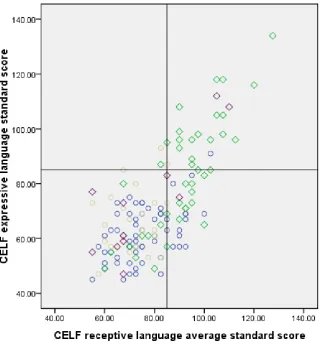
o All four groups had depressed receptive and expressive language scores
o On average children with ASD performed better in areas of structural
o There was a significant overlap between the groups, demonstrating the
variability within the groups and highlighting implications for teaching needs.
• With respect to literacy
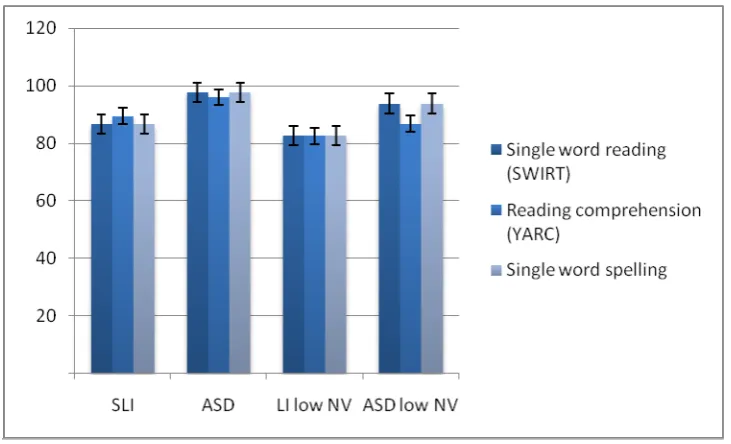
o Children with ASD had scores for single word reading, reading
comprehension and spelling within the average range.
o Children with SLI and those with LI low NV had depressed scores on all three
literacy measures.
o The ASD and the ASD low NV groups outperformed the SLI and LI low NV
groups on both single word reading and spelling.
o Performance for reading comprehension was significantly higher for the ASD
groups than all other groups, who did not differ between themselves.
o In the writing task, children with LI low NV produced the fewest words and
significantly fewer than children with ASD. • With respect to social communication
o The ASD group was significantly more impaired than the SLI and LI low NV
groups on measures of social interaction.
o The SLI group experienced significantly more difficulties in structural aspects
of language (speech syntax).
o The ASD group has significantly higher levels of social interaction deviance
than the SLI and SLI low NV groups.
Language and Literacy Attainment of Pupils during Early Years and through KS2
• The study examined whether teacher assessment at the end of the Early Years Foundation Stage (aged 5 years), based on ongoing observation, provides a valid measure of children’s current development and their educational attainment in future years.
• Three cohorts of children in 50 primary schools were followed up over 3 years (N = 5378).
• There were correlations between the Communication Language and Literacy scales of the Early Years Foundation Stage Profile and later reading and mathematics: explaining about 50% of the differences between children.
• The study showed that teachers can make valid judgments and accurately monitor their pupils’ progress in key reading skills.
Speech, Language and Communication Needs and Behaviour
• Two studies were carried out to examine the relationship between SLCN and behavioural, emotional and social difficulties
o A community, secondary school sample of 352 Year 7 pupils (age 12 years)
o A clinical sample of children who attended a specialist tertiary centre and had
been diagnosed with specific language impairment (SLI), autism spectrum disorder (ASD) or ASD with language impairment, and their unaffected siblings (total sample = 252).
• Both samples had significantly higher levels of BESD than a typically developing population
• Language ability was generally not associated with behavioural difficulties in either sample
• Behavioural difficulties were, by contrast, associated with low educational attainment. • Children with ASD, whether or not they also had a language impairment, had higher
levels of BESD than those with SLI or the unaffected siblings.
• This pattern of relationships found in two very different samples suggests that the key factors associated with behavioural difficulties are social communication (but not
structural language difficulties) and academic performance.
Parents’ Preferred Outcomes for their Children
• Ninety parents completed a survey to identify their priorities for their children who ranged in ages from 4 months to 19 year;
• The children had a variety of difficulties including ASD (57%), learning difficulties (44%), and expressive difficulties (40%); and attended a range of schools, including mainstream (34%), special school (35%) and either an ASD (10%) or language (6%) resource base.
• Over 90% of parents gave their priorities as independence, staying safe and
communication compared with only about a third specifying academic achievements. • These results may reflect the sample characteristics but there was no difference
between parents of children with different types of difficulty in terms of their prioritisation of independence and inclusion as important priorities.
Economic effectiveness
Four stands of work have been developed. Interim findings are as follows:
• Comparison of service provision and social disadvantage for children with SLCN
across health and education sectors.
o The number of children identified with SLCN was higher in the education
system than the number of children referred for speech and language therapy in the health system.
o The number of children with SLCN in primary but not secondary schools was
related to social disadvantage but use of NHS resources was related to social disadvantage for both age ranges.
o The number of speech and language therapy staff was associated with the
level of SLCN in primary but not secondary schools.
• Review of the cost effectiveness literature related to provision for children with
primary speech and language difficulties.
o There is a dearth of studies: only five were identified and most compared
clinic-based and parent-administered interventions.
o It is important to include both education and health service costs where
applicable and to take account of the ‘costs’ of parental involvement.
• Estimating unit costs of speech and language therapy for children with primary
speech and language difficulties.
o Unit costs are commonly under-estimated, e.g. considering only salaries
rather than full costs.
o We identify four challenges to estimating unit costs and why such an
approach is important.
providing detailed descriptors
identifying the activities of the service and relevant unit of
measurement
estimating cost implications of all service elements identified
calculating the unit costs by totalling the costs of each service and
dividing this by the number of ‘units’ of interest.
• ‘Dosage’ and provision for children with SLCN: the relationship of effect size to
intensity duration and amount of intervention.
o We reanalysed the data from the 2003 Cochrane review
o Our conclusions are tentative at present; data from more studies are
For interventions targeting phonology overall amount and intensity are associated with effect size but duration is not, suggesting that
intensive interventions are likely to perform better than those of long duration.
For improvements in syntax, the data suggest that duration is key; longer, more drawn out interventions are more effective.
For improvements in vocabulary a third picture emerges from the data: although longer duration brings better vocabulary outcomes, more intensive intervention does not necessarily do so. This suggests that regular short bursts of intervention over a longer period may be the optimum model of service delivery for those aiming to promote vocabulary development.
Prospective Study of SLT Services for Young Children who Stammer in England
• The study is just starting
• The difficulties of carrying out a complex study in a number of different health trusts are explored
o Although the ethical approval was reasonably satisfactory, meeting Research
and Development Governance requirements was often problematic • The experience so far suggests that there are major problems with the current
system which seriously weakens its fitness for purpose, reduces cost effectiveness and efficiency of the research process and ultimately undermines the carrying out of practice and policy relevant research.
Conclusions
1. INTRODUCTION
The 1st Interim Report was published in December 2010 and reported on the first phase of the research programme. Five projects were described and their initial findings reported. This 2nd Interim Report includes reports of the second phase of all five projects plus new projects begun during 2010-11. In each case we present summary reports of the work to date. In addition we have agreed with the Department for Education (DfE) to publish two substantial reports of completed work, which is summarised here (see Sections 3 and 6).
Each section reports on a specific project. At the end of the BCRP (March 2012) we will publish a final report which will comprise a thematic overview of results drawn from findings across projects. The amount and detail of each section varies to reflect the stage of
development of the project and what was reported in the 1st Interim Report. Consequently, Sections 3, 5 and 6 are more substantial.
Section 2 provides an interim report of the development of a checklist to identify
communication supportive classrooms. Based on a sound basis of research evidence, the checklist has been piloted and will be further examined in the autumn 2011.
Anna Vignoles and her team have produced a second report based on the analysis of the national education datasets (Pupil Level School Census and National Pupil Database). This builds upon that reported earlier to investigate the transition made by pupils identified as having SLCN or autism spectrum disorder (ASD) as they progress through the education system. Their work explores the movement of pupils into and out of each classification, or into another category of special educational needs (SEN) (e.g. moderate or specific learning difficulties), or no longer to be considered to have SEN. A summary is provided in Section 3.
These movements are substantial and occur mainly at the transition from primary to secondary school (key stage 2 to key stage 3). For example, of those who initially start secondary school with statemented SLCN approximately one quarter move into the non-SEN category, just under one fifth remain in the non-statemented SLCN category and a further fifth move into another type of non-statemented SEN by key stage 3. There is less movement, however, for those pupils identified as having ASD.
(EAL): pupils who were identified as having SLCN on entry to secondary school, and also
had EAL, were much more likely to no longer have SLCN by 14 years than those who did not have EAL. They tended to transfer out of SEN, into the non-SEN category, or to a lower level of need.
In Section 4 we present the findings of a study of speech and language therapists’ practice.
This report builds on the interview study (1st Interim Report) to provide evidence from a national survey of SLTs, focusing particularly on their interventions.
Section 5 presents more information from our prospective study of pupils with either primary language difficulties (specific language impairment (SLI)) or autism spectrum disorder (ASD). We are following children initially aged 6, 8, 10 and 12 over three years. In this report, we present evidence of their language, literacy, social communication and socio-emotional development. We also report on the support they are currently receiving in schools. Central to this study is the examination of the distinctiveness or similarity of the characteristics and needs of these groups of children and of the ways in which teachers then try to meet those needs.
The study by Maggie Snowling and Charles Hulme and their team examined language and literacy attainment during the Early Years Foundation Stage (EYFS) and key stage 1
(Section 6). Their focus concerns whether teacher assessment provides a valid assessment of children’s current and future educational attainments. This study was commissioned not only because of its intrinsic interest and importance but also because of the review of the Early Years Foundation Stage (EYFS) led by Dame Clare Tickell and the recent interest in early intervention exemplified by a number of reports addressing early intervention, e.g. two from the review by Graham Allen2,3.
This report by Maggie Snowling and her colleagues is both important as a research study and for what it contributes to the Government’s consideration of proposals for implementing the recommendations of Tickell Review. The team show clearly that the EYFS Profile was unnecessarily long and that a shorter version would be more appropriate. They also provide strong evidence for the usefulness of a measure, focusing on language and literacy, and show that language and literacy should be separate elements. We support the Tickell
2 Allen, G., (2011a), Early Intervention: The Next Steps; an independent report to Her Majesty’s Government, HM Government, London
Review in arguing for a system of monitoring the progress of children through the Early Years as a means of identifying those at risk of low educational attainment.
Early identification is important in order to ensure early intervention for children with developmental language difficulties. Many areas in the UK have programmes of screening combined with surveillance and monitoring over time, linked to intervention. This study reinforces the importance of both rigorously validated measures and a holistic system rather than a ‘one off’ screen. This is not about completing checklists for managerial and
accountability purposes. It is about supporting practitioners with well researched methods
and systems to optimise the support for young children.
Section 7 addresses the nature of behavioural, emotional and social difficulties (BESD) experienced by children with SLCN. We know from earlier research that there is a great prevalence of BESD among children with language difficulties but also that it is important to examine the nature of these difficulties and how they change over time4. For example, peer problems are a particular area for concern; hyperactivity is a concern with children at 8 years but this reduces considerably as they become more mature. In this section we present the findings from analyses of two different groups of children with SLCN, a mainstream
secondary school sample and a clinical sample to explore the issues. The main findings are that both samples had significantly higher levels of behavioural difficulties than typically developing children but these were not related to structural language, (vocabulary, syntax, morphology etc.) but rather to social communication and educational attainment.
In Section 8 we report the final phase of our study of parents’ preferred outcomes for their children. Importantly, we show that parents do not only stress academic outcomes: independence, for example, is also valued.
Section 9 summarises our work on cost-effectiveness. The first stage was reported in greater detail in our 1st Interim Report. We are now producing papers for publication in journals to report the current work. However, we will also produce a further account in the end of BCRP report next year.
Finally we report on the initial, setting up phase of a study of children who stammer (Section 10). Unfortunately, this was substantially delayed as a result of meeting the requirements of
the many different primary care trusts involved. This is a serious issue for this kind of practice-based research. As a result, we are most grateful to the DfE for allowing this study to continue to July 2012, beyond the March official end of the BCRP, so that it may be completed properly.
2. COMMUNICATION SUPPORTING CLASSROOMS PROJECT
Julie Dockrell, James Law, Ioanna Bakapoulou, and Sarah Spencer
2.1 Aims of the Study
The growing number of children identified with Speech, Language and Communication Needs (SLCN) has increased the demand on services, calling for a re-examination of the ways in which speech, language and communication are supported for children across health and education services. Although many children with difficulties continue to receive individual assessment and intervention from speech and language therapists and language specialist in schools, there is a move towards increasing the “communication friendliness” of the classroom environment to provide quality first language learning environments. By ensuring that classroom environments offer ‘quality first’ language learning opportunities, the
numbers of children identified with SLCN should be reduced and those referred to specialist services should then be reduced to those who experience needs which do not respond to good quality teaching. Such classroom environments should enhance the speaking and listening skills of all children. These changes have involved the introduction of modifications to classrooms and pedagogical techniques which are perceived to be of benefit to all children irrespective of whether they have difficulties or not. The use of the term ‘friendly’ signals that staff in classrooms have put a range of specific processes in place which are designed to support the development of communication skills.
The aim of this BCRP study is to capture evidence informed criteria which can be used to identify communication supporting classrooms. The project has four objectives:
1. To review the evidence base underpinning elements thought to support communication,
2. To identify key variables from the review and develop these into a Communication Supporting Classrooms (CSC) framework, an observational checklist designed to monitor classroom environments and learning spaces,
3. To test the extent it is possible to distinguish schools which purport to be communication friendly and those which make no such claims,
2.2 What we have done
The project is designed in four phases. The first phase (February 2011) included a review
of all relevant published outputs related to supporting oral language so as to identify what is already known about the concept of the communication supporting classroom. A two-stage review model was used in order to identify appropriate literature. The first stage consisted of identifying studies that met the review inclusion criteria (1. Study written in English; 2. Study related to Foundation Stage and KS1 classroom practices; 3. Study is empirical and evidence-based or a review of empirical studies). This narrowed the focus of the studies and ensured that only relevant papers were reviewed. The second stage consisted of in-depth review of selected studies in order to identify key elements and processes involved in classroom environments which enhance language development. In addition to the literature review, we also identified elements of supportive oral language practice highlighted in Ofsted reports.
The second phase (March-May 2011) involved the development of an observational
checklist based on the evidence identified from the literature review (see section below on Observation Checklist Development) and its piloting in a number of settings to ensure that it would capture in a reliable way those resources, opportunities and practices which contribute to the development of a language-rich environment for children. Pilot observation sessions also included interviews with SENCOs about the checklist and school practices.
The third phase (June-July 2011) involved an empirical study collecting data from a range of
schools using the criteria identified in phases 1 and 2. Schools were visited during Summer Term of the 2010-2011 academic year. The schools were identified through the Ofsted reports, the Greenwich Speech and Language Therapy Service and through the charity ICAN.
The fourth phase will repeat the observations in the autumn term of 2011-2012 academic
study; these are school settings which have either expressed interest in being involved in the study or settings that have been identified through the charity ICAN.
Table 1 presents details of the schools involved in the project to date and agreements from other schools for the next phase.
Table 2.1 - Communication Supporting Classrooms Project School Details
Area No of Schools No of Classroom Observations
Phase 2 – Pilot
London 9
1 Nursery Classroom Observation 9 Reception Classroom Observations 6 Year One Classroom Observations
Newcastle 6 4 Reception Classroom Observations
2 Year One Classroom Observations
Total Phase 2 15 22 Classroom Observations
From these inter-rater
reliability data were gathered in:
9
8 Reception Classroom Observations 5 Year One Classroom Observations Total: 13 Classroom Observations Phase 3 – Empirical Study 2010-2011
London 4
3 Reception Classroom Observations 3 Year One Classroom Observations 1 Year Two Classroom Observation
Newcastle 5
7 Reception Classroom Observations 5 Year One Classroom Observations 1 Year Two Classroom Observation
Total Phase 3 9 20 Classroom Observations
Phase 4 – Empirical Study 2011-2012
London 4
3 Reception Follow-up Classroom Observations
3 Year One Follow-up Classroom Observations
1 Year Two Follow-up Classroom Observation
Newcastle 5
7 Reception Follow-up Classroom Observations
5 Year One Follow-up Classroom Observations
1 Year Two Follow-up Classroom Observation
Additional Local Authorities TBA TBA
Total Phase 4
2.2.1 Phase Two - Observation Checklist Development
The Communication Supporting Classrooms Observation Checklist has been designed with
aims to provide schools with a profile of their strengths and, as appropriate, areas for improvement. The CSC Observation Checklist is applicable in Reception, Year 1 and Year 2 but could also be used in early years settings. As an observation checklist, it is designed to be used in an observation of a classroom or a learning space during a regular classroom session. The average length of time necessary to collect a representative sample of behaviour is one hour with an additional 20 minutes prior to the observation period to become familiar with the classroom setting and available resources.
The CSC Observation Checklist is divided into three dimensions:
• Language Learning Environment: This dimension involves items related to the
physical environment and learning context
• Language Learning Opportunities: This dimension involves items related to the
structured opportunities that are present in the setting to support children’s language development
• Language Learning Interactions: This dimension involves items related to the ways in
which adults in the setting talk with children
The CSC Observation Checklist includes elements which refer both to effective pedagogy, teaching and learning as well as language specific aspects. Both good classroom environments and effective pedagogy are seen as prerequisites for providing the appropriate context to support oral language. There is a brief guidance document with the CSC Observation Checklist which provides exemplars of the relevant categories.
The CSC Observation Checklist does not assess individual children and as such can provide an indication only that the language information collected meets what would be seen as good quality first practice and, as such, should capture a Tier 1 measure of a response to
intervention model for language and communication.
An expert advisory group was sent the CSC Observation Checklist, prior to piloting and provided feedback on the content and presentation of the tool. The advisory group included speech and language therapists, education staff and researchers. Their comments were taken into account to further refine the checklist before piloting.
2.2.2 Phase Two - Pilot
guidance that would facilitate education staff into using it appropriately. In the second phase of piloting, we examined issues of reliability of the checklist. Fifteen schools were visited in the second phase of the study, and data were gathered in nine of them to establish inter-rater reliability for each dimension of the CSC Observation Checklist both as per item as well as for the overall ‘score’.
Selection of Settings
The schools involved in the second phase of the pilot were selected based on the following criteria:
a) Exclusionary criteria – we excluded any schools with associated language unit resources, specialised centres (e.g. ICAN), Dyslexia friendly schools or schools under special measures (Ofsted),
b) Schools were chosen to reflect national averages for statements of SEN and educational attainments.
2.2.3 Phases Three and Four – Empirical Study
The third and fourth phases involve an empirical study collecting data from a range of schools using the criteria identified in phases 1 and 2.
- Nine schools were visited during Summer Term of the 2010-2011 academic year and twenty classroom observations were conducted. The schools have been identified as ‘good practice’ schools through the Ofsted reports, the Greenwich Speech and Language Therapy Service and through the charity ICAN.
- Repeated observations in the same twenty classrooms will be conducted in the autumn term of 2011-2012 academic year to examine changes within classroom environments and in order to ascertain whether the CSC Observation Checklist could capture all aspects of the classroom environment and the teaching and learning which occurs in these classrooms.
- In the Autumn Term of 2011-2012 academic year, training will be provided to school staff in using the Observation Checklist to examine the reliability of school staff in completing it.
Observation Checklist Reliability and Differentiation of Schools
The classroom observations listed above were planned as a way of ensuring that the CSC Observation Checklist is a reliable measurement of the communication environment but also in order to test the extent it is possible to distinguish schools which purport to be communication friendly and those which make no such claims. To that extent, observation checklist reliability and differentiation of school practices will be established in the following ways:
• Inter-rater reliability: As part of the pilot, inter-rater reliability was established for each dimension of the CSC Observation Checklist both as per item as well as for the overall ‘score’.
• Over time: As part of the empirical study, classroom observations will be repeated from Summer Term 2011 to Autumn Term 2011 and for the new settings involved in the study in September 2011, classroom observations will be repeated before and after half-term (Autumn Term 2011) in order to examine features of the environment that change.
• School v. Class: As part of the empirical study, observations took place in different classes from the same school to address consistency in settings.
• Between Professionals: As part of the empirical study, following training of school staff, classroom observations will be repeated by school SENCOs to examine reliability between professionals.
2.3 What we have found
language and communication. In Phase Three, twenty initial classroom observations were conducted and these will be repeated in the Autumn Term 2011 to address stability in the schools.
2.4 What we are doing next
1. Ranking the evidence. The CSC Observation Checklist is evidence informed. In
August 2011, the Senior Research Fellows working on the project will undertake an additional task of scaling the evidence underpinning the CSC Observation Checklist as per typical evidence based studies, and will subsequently highlight the items with a strong evidence base as key features.
2. Phase 4 Follow-Up Observations. From September 2011 to December 2011, we will
return to each of the nine schools to repeat the observations in order to address stability in the schools and the reliability of the CSC Observation Checklist.
3. Phase 4 New Schools. A number of new schools will be visited before half-term in
the Autumn Term 2011 to conduct classroom observations.
4. Phase 4 Follow-Up Observations of New Schools. We will return to the new schools
after half-term in the Autumn Term 2011 to repeat the observations conducted at the beginning of the term.
5. Phase 4 Staff Training. We will provide training to school staff in appropriate use of
the CSC Observation Checklist.
6. Phase 4 School Staff Conducting Observations. Following training, school staff will
3. A FURTHER INVESTIGATION OF PUPILS WITH SPEECH, LANGUAGE AND
COMMUNICATION NEEDS (SLCN) AND AUTISM SPECTRUM DISORDER (ASD)
Elena Meschi, John Micklewright and Anna Vignoles
3.1 Aims of the Study
We have carried out two studies of pupils with speech, language and communication needs. This second study also includes pupils with Autism Spectrum Disorder (ASD). This section summarises the second study, but also includes some material from the first study5. A full report of this second study will be published in parallel with the Final Report in 2012.
In this report we consider the transitions made by children who have been identified by the school system as having Speech, Language and Communication Needs (SLCN) or Autism Spectrum Disorder (ASD) as they progress through the education system. Specifically, we explore the following questions:
• How does the proportion of children identified as having SLCN vary over time and by age?
• How does the proportion of children identified as having ASD vary over time and by age?
• What are the characteristics of individuals who make transitions into and out of both the SLCN and the ASD category of need during secondary school?
• How does having English as Additional Language relate to the likelihood of a child having been identified as ever being SLCN, as well as the likelihood of them moving out of the SLCN category?
• Do different types of schools have very different proportions of children identified as having SLCN and ASD and do these pupils make different transitions in different school contexts?
Key Findings
• Although clinical studies have generally not suggested that having SLCN is strongly related to socio-economic background, we find that in the English school system, it is
5 Lindsay, G., Dockrell, J.E., Law, J., Roulstone, S., & Vignoles, A. (2010) Better communication research
programme 1st interim report. London: DfE.
certainly the case that young people who are socially disadvantaged are much more likely to be identified as having SLCN.
• We also found evidence of some conflation of Speech, Language and Communication Needs and the needs associated with having English as an additional language (EAL).
• Interestingly when pupils who initially had SLCN changed their category of primary need in secondary school, they were most likely to be identified as having moderate or specific learning difficulties NOT behavioural, emotional or social difficulties.
3.2 What we have done
In this report we analyse the characteristics and SEN status of multiple cohorts of children. We describe the characteristics of pupils who transition into and out of the SLCN and ASD categories of SEN over time and by age. This will be of interest in itself and will also improve our understanding of the relative achievement of these groups.
Methodological Approach
Our previous research shows that the dynamic nature of the special educational needs of pupils with SLCN and ASD is an important issue.
• At the age of 7 years, 3% of children have been identified as having Speech, Language and Communication Needs (SLCN), whilst 0.8% have been identified as having Autism Spectrum Disorder (ASD).
• Yet the proportion of pupils who have been identified as having these particular special educational needs changes markedly with age.
• The proportion identified with SLCN falls to around 0.6% of 16 year olds and the proportion with ASD increases to around 1% at the beginning of secondary school and falls to 0.7% by age 16.
This report specifically investigates these transitions made by pupils into and out of different categories of SEN (or indeed into and out of the no SEN category). We focus on a sample of pupils who have at some point in time been identified as having either SCLN or ASD.
category of special educational needs) as well as providing us with other important information on student and school characteristics.
We undertake multivariate analysis to determine the pupil level and school level factors that are statistically associated with making a positive transition from the SLCN category into another SEN category, such as a different primary special need, no special needs at all or a lower level of special need.
Caveats
Our data is administrative and collected for non research purposes6. This leads to some limitations in the analysis. Most crucially, we lack clinical information on the needs of children. We can therefore only determine whether the child has been identified as having particular special educational needs by the school system and we acknowledge that it is highly likely that some children with SLCN or ASD needs may not have had them identified in our data.
3.3 What we have found
3.3.1 The prevalence and characteristics of those with SLCN/ASD
In our 1st Interim Report we reported that the prevalence of reported SLCN reduced with age and that this occurred mainly during key stage 2 with a lower rate of decrease during key stages 3 and 4. Furthermore, this reduction was essentially a function of fewer pupils at school action plus: the prevalence of pupils with statements where SLCN was the primary need was relatively stable across the age range (Figure 3.1).
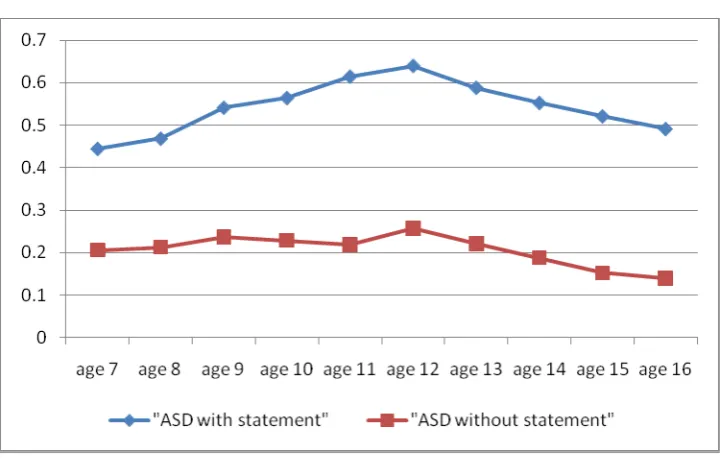
In this report we extend our analysis further to include pupils with ASD (Figure 3.2) and to examine the relationship between identification as having SLCN or ASD and several other factors including having English as an additional language (EAL).
Prevalence rates over ages 7 – 16 years
First we examine the patterns of prevalence by age. Figures 3.1 and 3.2 present these data for pupils with SLCN and ASD respectively for ages 7-16 years. These distinguish
6 State schools in England are required to complete the School Census each term. This includes specifying
whether a pupil has i) special educational needs with a statement or at School Action Plus, in which case the
category of SEN for the primary need must be specified (e.g. SLCN or ASD); ii) special educational needs at
prevalence of pupils with a statement of special educational needs from those at the lower level of School Action Plus, where support is provided from outside professional(s) but the pupil has not been made the subject of a statement. For SLCN, as reported in the 1st Interim Report, prevalence is just under 3 per cent of pupils at 7 years dropping to about 0.5 per cent at 16 years whereas for ASD overall prevalence is much lower and remains relatively stable at about 0.65 per cent.
Figure 3.1: Prevalence of SLCN across ages, by SEN status
Figure 3.2: Prevalence of ASD across ages, by SEN status
[image:28.595.118.480.467.702.2]whereas the rate for pupils with statements remains stable, that for pupils with SLCN at School Action Plus drops considerably between 7 and 12 years, before flattening. The prevalence for pupils with ASD is very different in that, first there are consistently more pupils with statements than at School Action Plus and second the School Action Plus trajectory increases between 7 and 12 years before reducing; the prevalence for pupils with statements is similar to that for the SLCN group, approximately flat with a small increase to 11-12 years and then a slight downward trend to 16 years.
Prevalence and social disadvantage and EAL
The likelihood of being identified as having SLCN or ASD differs amongst different types of children.
• Young people who are socio-economically disadvantaged or who have English as an additional language (EAL) are most at risk of being identified as having SLCN (at age 11, key stage 2). This is particularly true for non statemented SLCN. The risk of having SLCN is not high however, even for these groups, since only 3% of the school population are ever identified as having SLCN (at School Action Plus or with a statement).
• Other research has indicated that some conditions that result in SLCN are not socially graded, such as stammering. Yet in the school system, it is the case that the likelihood of being identified as having SLCN is socially graded. This discrepancy may therefore either reflect parents’ differing willingness to identify their child’s needs or a tendency for schools to be more likely to identify SLCN needs in low SES children (or both).
• By contrast, being socio-economically disadvantaged or having English as an Additional Language are not major risk factors for occurring identified as having ASD at key stage 2.
• Low achievement is a risk factor for both SLCN and ASD groups but pupils identified as having SLCN are lower achieving as compared to those with ASD.
3.3.2 Movement into and out of categories of SEN
• Of those who initially start secondary school with non-statemented SLCN, approximately one quarter move into the non-SEN category, just under one fifth remain in the non-statemented SLCN category and a further fifth move into another type of non-statemented SEN by key stage 3.
• Hence many pupils move from the SLCN category of need into another type of SEN category of need during secondary school. We found the most common categories for pupils to move into were the categories of Moderate Learning Difficulties (MLD) and Specific Learning Difficulties (SpLD).
We found less movement of pupils identified as having ASD. Those initially identified as having non statemented ASD are more likely to remain in that category by key stage 3 than was the case for pupils with SLCN.
• Of those who start secondary school identified as having ASD, 41% remain in this category of need by the end of key stage 3.
• Those initially identified as having non-statemented ASD and who move to another type of SEN category of need are most likely to move into Behavioural, Emotional and Social Difficulties (BESD) and Moderate Learning Difficulties (MLD).
• For those who initially had a statement for ASD, the most common category to move into is MLD, followed closely by SLCN.
Another striking result was that pupils who were identified as having SLCN on entry into secondary school, and also had English as an Additional Language, were much more likely
Perhaps unsurprisingly, we found that pupils who are succeeding at school and have higher achievement are more likely to make a positive transition from SLCN or ASD into either no special needs at all or unspecified school action SEN. Lower achieving pupils are by contrast more likely to exit SLCN and ASD into another different type of SEN.
3.3.3 The School Context
We wanted to determine whether pupils at certain types of school had a higher chance of making a positive transition during secondary school, moving out of the categories of SLCN or ASD for example.
Children who are identified as having SLCN or ASD may however, enrol in particular types of school. Certainly pupils with some special education needs may not have a genuine choice of school and rather than pupils choosing a particular secondary school, it may be that schools de facto select which pupils they admit.
Some but by no means all school characteristics were associated with statistically significant differences in the likelihood of pupils making positive transitions during secondary school. We focused particularly on the following school characteristics: a) total funding per pupil at the school, b) SEN funding per child identified as having SEN at the school and c) pupil achievement on entry into the school. We found that:
• Pupils identified as having SLCN and who attend better funded schools are not
more likely to make a positive transition out of SLCN, as compared to those attending less well resourced schools.
• Pupils identified as having ASD and who attend better resourced schools are slightly more likely to move out of SEN altogether or move to another category of SEN as compared to those who remain in the ASD category.
resources are available, use will be made of them. A third factor is that some schools receive additional funding to support specialist resources (‘units’) for pupils with specified categories of pupils including SLCN and ASD.
• Pupils attending higher achieving schools, with above average key stage 2 test scores, are somewhat less likely to make a positive transition out of the SLCN category. This may again mean that pupils with persistent SLCN who are less likely to make a positive transition are also more likely to choose schools that have higher achievement levels or, more likely, that such schools are more likely to identify pupils as having SLCN.
• Pupils attending higher achieving schools are however, more likely to make a positive transition from ASD to non-SEN. Attending a higher achieving school is associated with being more likely to make a positive transition for ASD pupils but not for pupils identified as having SLCN.
• Lastly, pupils in socio-economically deprived schools, with a larger proportion of pupils eligible for free school meals (FSM) for example, are no more or less likely to make positive transitions out of SLCN/ASD than those in socio-economically advantaged schools.
3.4 Policy implications
We shall be drawing together the policy implications from the BCRP in our final report; the following are specific to the present project at this stage.
Pupils’ special educational needs, particularly in the case of SLCN, are quite dynamic and in particular change during the course of secondary school. It is important that funding
decisions and indeed monitoring of pupils takes this fluidity of need into account.
Further research is needed into whether there is systematic misidentification of children’s needs in primary school, specifically if those with English as an Additional Language often have their needs mistakenly identified as SLCN. It could also be that their needs are underestimated in secondary education.
determine whether some common trajectories exist and hence enable better support for such pupils to be devised.
4. INTERVENTIONS FOR CHILDREN WITH SPEECH, LANGUAGE AND
COMMUNICATION NEEDS (SLCN) IN ENGLAND: A SURVEY OF SPEECH AND
LANGUAGE THERAPISTS
Geoff Lindsay1, Yvonne Wren2, Ioanna Bakapoulou1, Susan Goodlad1 and Sue Roulstone2 1 University of Warwick, 2Frenchay Hospital, Bristol
4.1 Aims of the Study
This survey is part of a large project within the BCRP to examine ‘best practice’. This comprises two parallel themes:
• A review of the research literature. The purpose of this stream was to identify the evidence available for interventions for children and young people with primary speech and language difficulties.
• A review of professional practice to explore intervention methods adopted by practitioners and the evidence base for these approaches.
4.2 What we have done
In the 1st Interim Report7 we reported on the initial stages of both streams. With respect to the second stream, we reported the interviews undertaken with managers from speech and language therapy services and educational psychology services in 14 areas of England. In this report we build upon the information produced and insights gained in Phase 1. We present the results of a national survey of speech and language therapists (SLTs).
Design
We used a sequential two phase combined methods design. Phase 1 comprised interviews, Phase 2 comprised an online survey. This report focuses mainly on the SLT survey: see the 1st Interim Report for the results from the interviews.
Methods
i) Interviews: Semi-structured interviews were conducted with 13 SLT and 10 school
psychological service managers from a 10% sample of local authorities/ health trusts, after
7 Lindsay, G., Dockrell, J.E., Law, J., Roulstone, S., & Vignoles, A. (2010) Better communication research
programme 1st interim report. London: DfE.
informed consent; average 90 minutes duration. We used main questions supported by probes for further exploration, optimising both detailed, locally relevant responses and consistent coverage of topics. The process was iterative; each interview was informed by those beforehand.
ii) Survey: Analysis of the interviews identified key themes which were used to construct the
online questionnaire for SLTs working with children. The survey aimed to provide a profile of practice and identify the range of interventions used. Distribution was facilitated by the Royal College of Speech and Language Therapists.
iii) Participants: A total of 576 SLTs responded to the survey, 27 of whom were filtered out
as they did not work with children and young people, nor did their role involve training others to work with children. A further 13 were excluded from the core questions; instead they were routed to a section specifically designed for those involved only in training others to work with children and young people with SLCN. Given the small number of respondents in this category, their data will be analysed separately and presented in the final report.
iv) Procedure: The main method used in the survey was to ask SLTs to think of the three
most commonly used interventions and then to drill down, one at a time, to examine these in
detail. We explored use of published programmes, intervention activities, and
principles/approaches. We are able to cross reference findings by age and primary need of
the children for whom these are used. Other data include delivery (frequency and timescale), the outcome data gathered and whether these were reported within their service, allowing overall monitoring of outcomes and effectiveness. Hence the data relate to each SLT’s most
frequent practice.
v) Analysis
Thematic analysis of interviews was shaped initially by pre-determined categories,
4.3 What we have found
4.3.1 Most common patterns of work:
Age: the most common age reported was 5-7 year old children (28% SLTs). Also, a total of
75% of SLTs reported their most common age ranges were within the broader 2-7 years range (Table 4.1).
Table 4.1 Age of child with whom the SLT most frequently worked (% SLTs)
Age group n %
Under 2 yrs 17 3.2
2-3 yrs 114 21.3
4-5 yrs 133 24.8
5-7 yrs (Key stage 1) 152 28.4
7-11 yrs (Key stage 2) 75 14.0
11-14 yrs (Key stage 3) 38 7.1
15+ yrs (Key stage 5) 7 1.3
N = 536
Primary need: Primary SLCN with language as the primary difficulty was the most common
Table 4.2 Primary need with which the SLT most frequently worked (% SLTs)
SEN category n %
Primary Speech Language and Communication needs with language as the primary difficulty
193 36.0
Primary Speech Language and Communication needs with speech as the primary difficulty
104 19.4
Autism Spectrum Disorder 61 11.4
Severe Learning Difficulties 39 7.3
Specific Learning Difficulties (e.g. dyslexia, dyspraxia) 31 5.8
Primary Speech Language and Communication needs with communication /interaction as the primary difficulty
30 5.6
Moderate Learning Difficulties 27 5.0
Profound and Multiple Learning Difficulties 17 3.2
Hearing Impairment 13 2.4
Physical Difficulties 9 1.7
Behavioural, Emotional and Social Difficulties 8 1.5
Multi-Sensory Impairment 4 0.7
N = 536
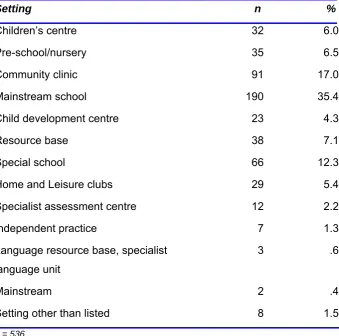
Main setting: Mainstream schools were reported most frequently (35%) followed by
Table 4.3 The setting in which the SLT most frequently worked
Setting n %
Children’s centre 32 6.0
Pre-school/nursery 35 6.5
Community clinic 91 17.0
Mainstream school 190 35.4
Child development centre 23 4.3
Resource base 38 7.1
Special school 66 12.3
Home and Leisure clubs 29 5.4
Specialist assessment centre 12 2.2
Independent practice 7 1.3
Language resource base, specialist language unit
3 .6
Mainstream 2 .4
Setting other than listed 8 1.5
N = 536
When respondents chose ‘Setting other than those listed’, they were asked to specify the setting. This generated 54 comments, almost half of them (22) mentioned working from home (either the child’s or practitioner’s). Where possible the comments were re-coded into the categories listed, leaving only 8 unclassified.
Prevalence of interventions
We explored the use of published programmes, intervention activities and principles or
approaches to intervention that SLTs use most often. We report here the percentages for
‘sometimes’ + ‘frequently’. The order of this combined prevalence closely matched that for ‘frequently’ alone.
Programmes: A total of 38 programmes were specified. These include a mixture of
those which comprise a published kit including a manual and others based on published papers in journals. The most frequently reported programmes used were:
• Derbyshire Language Scheme (65% SLTs)
• Nuffield –dyspraxia (47%)
• Core Vocabulary (40%) and
• Hanen (39%)
A full list of the programmes is provided in Appendix A1, Table A1.
Service developed programmes: In addition 126 programmes were specified that the
SLTs reported as having been developed by the service (or another service). Over a quarter of respondents (28%) reported using these. In addition, a further 163 ‘Other published programmes’ were also mentioned but with no specification by name.
Intervention activities: Eleven different intervention activities were used by the
SLTs.(see Appendix A2 for details) The main methods were: • Phonological awareness tasks (67%)
• Barrier games (66%)
• Auditory discrimination activities (64%) • Auditory memory activities (62%) • Narrative therapy (59%).
When asked to specify other intervention activities frequently used, 133 other activities were mentioned.
Principles/approaches: A total of 26 different principles/activities were specified. These
included broad approaches such as creating a language rich environment and differentiating the curriculum; general approaches such as use of signing and total communication; and more specific methods such as the use of forced alternatives. Overall, the most commonly used were:
• Modelling (95%)
• Forced alternatives (84%) • Repetition (84%)
• Visual approaches to support language (83%) • Reducing distractions (82%)
4.3.3 Prevalence of interventions by main types of SLCN
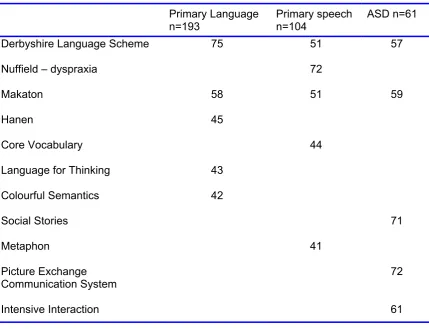
[image:40.595.71.501.183.513.2]Prevalence varied for children with different primary SLCN; the most commonly used programmes for children with primary language difficulties, primary speech difficulties and ASD are presented in Table 4.4.
Table 4.4 . Most commonly used programmes (% SLTs)
Primary Language n=193
Primary speech n=104
ASD n=61
Derbyshire Language Scheme 75 51 57
Nuffield – dyspraxia 72
Makaton 58 51 59
Hanen 45
Core Vocabulary 44
Language for Thinking 43
Colourful Semantics 42
Social Stories 71
Metaphon 41
Picture Exchange Communication System
72
Intensive Interaction 61
4.3.4 Intervention delivery
Model:
• 22% SLTs reported that they personally deliver the intervention most frequently but ask others to carry out follow up activities
• 42% SLTs deliver it most regularly but others deliver it more frequently between visits
• 29% SLTs deliver it occasionally for the purpose of demonstrating to other(s) how they should deliver the intervention on a more frequent basis
• 6% SLTs reported that others deliver it following SLT advice.
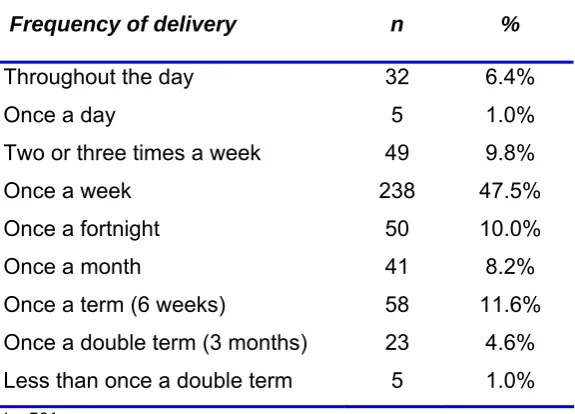
Frequency: The most common frequency of delivery of an intervention by the SLT was
common frequencies of once every 6 weeks (12%), once a fortnight (10%) and 2-3 times a week (10%) – see Table 4.5. (See Appendix A4 for more details).
Table 4.5 Frequency of delivery of intervention (% SLTs)
Frequency of delivery n %
Throughout the day 32 6.4%
Once a day 5 1.0%
Two or three times a week 49 9.8%
Once a week 238 47.5%
Once a fortnight 50 10.0%
Once a month 41 8.2%
Once a term (6 weeks) 58 11.6%
Once a double term (3 months) 23 4.6%
Less than once a double term 5 1.0%
N = 501
Timescale: The timescale over which interventions are delivered varied between SLTs.
However, as shown in Figure 4.1, six weeks or more was most likely for the large majority (89%) of the sample: 34% carried out an intervention for 6 weeks; 25% for 3 months and almost a third of SLTs (30%) carried out interventions lasting a year or more.
[image:41.595.71.526.480.685.2]4.3.5 Support for interventions
Those who indicated that they received support delivering interventions were asked who would usually provide the support. Responses in Table 4.6 show that it is usually provided by a teaching assistant (45%) or a parent (34%).
Table 4.6 Person providing support for the SLT for the intervention (% SLTs)
Supported by: n %
Parent 180 34.0
Teacher 59 11.1
Nursery nurse 32 6.0
Teaching assistant 238 44.9
Other 21 4.0
N = 530
The frequency of support varies in Table 4.7, but is most commonly provided throughout the day (41%), or two/ three times a week (34%).
Table 4.7 Frequency of support (% SLTs)
Frequency of support n %
Throughout the day 215 40.8
Once a day 78 14.8
Two or three times a week 181 34.3
Once a week 43 8.2
Once a fortnight 2 0.4
Once a month 3 0.6
Once a term (6 weeks) 4 0.8
Once a double term (3 months)
0 0.0
Less than once a double term 1 0.2
N = 527
4.3.6 Outcome data
Measures of broad outcomes: When undertaking their most frequently used