Coaching for teaching and learning:
a practical guide for schools
Guidance report
Rachel Lofthouse
David Leat
About the guidance report
This guidance report is designed to offer information and support for teachers and school leaders. It is based on a two-year research project, conducted by Newcastle University and funded by CfBT Education Trust and the National College. The full findings of the research project are available in the report ‘Improving coaching: Evolution not revolution’, published by CfBT. Further coaching resources are available from the National College website: www.nationalcollege.org.uk/coaching.
Welcome to CfBT Education Trust
CfBT Education Trust is a top 50 UK charity providing education services for public benefit in the UK and internationally. Established 40 years ago, CfBT Education Trust now has an annual turnover exceeding £100 million and employs 2,300 staff worldwide who support educational reform, teach, advise, research and train.
Since we were founded, we have worked in more than 40 countries around the world. Our work involves teacher and leadership training, curriculum design and school improvement services. The majority of staff provide services direct to learners: in nurseries, schools and academies; through projects for excluded pupils; in young offender institutions and in advice and guidance centres for young people.
We have worked successfully to implement reform programmes for governments throughout the world. Government clients in the UK include the Department for Education (DfE), the Office for Standards in Education, Children’s Services and Skills (Ofsted), and local authorities. Internationally, we work with educational ministries in Dubai, Abu Dhabi and Singapore among many others.
Surpluses generated by our operations are reinvested in educational research and development. Our research programme – Evidence for Education – aims to improve educational practice on the ground and widen access to research in the UK and overseas.
Visit www.cfbt.com for more information.
Welcome to the National College
The National College for Leadership of Schools and Children’s Services exists to improve the lives of children and young people. Formerly known as the National College for School Leadership (NCSL), our remit was extended in 2009 to include the training and development of Directors of Children’s Services.
The National College continues to support school leaders with a range of strategic initiatives, leadership development programmes and policy and research activities to enable them to develop into outstanding leaders.
Membership of the National College is open and free of charge to all leaders in schools, early years settings and senior leaders in children’s services in England. Anyone outside this group is invited to join the National College as an affiliate member. As of May 2010, the College has 74,000 full members and over 11,000 affiliate members.
Visit www.nationalcollege.org.uk for further information.
Welcome to Newcastle University and the
Research Centre for Learning and Teaching
Acknowledgements
We are grateful to the schools and teachers who have co-operated in the data collection, analysis and discussion in this project. We must also thank Lynn Wright, Lindsay von Elbing, Trish Elliston and Claire King for their assistance in data gathering and liaising with schools.
About the authors
All three authors are members of the Research Centre for Learning and Teaching (CfLaT) at Newcastle University, and in addition teach on the M.Ed in Practitioner Enquiry. Both areas of their work provide them with multiple opportunities to engage with and learn from teachers and educational leaders from schools, colleges and universities.
Rachel Lofthouse
Rachel Lofthouse is Head of Teacher Learning and Development (Education) in the School of Education, Communication and Language Sciences (ECLS) at Newcastle University, a role which draws on her experiences of, and responsibilities for, both initial teacher education and postgraduate professional development. She is the degree programmes director for both the M.Ed in Practitioner Enquiry and the Masters in Teaching and Learning, and course leader for PGCE Geography. Her research interests include professional learning, practitioner enquiry, and innovative pedagogies.
David Leat
David Leat is the Executive Director of the Research Centre for Learning and Teaching (CfLaT) at Newcastle University and Professor of Curriculum Innovation. His research interests include teaching thinking, enquiry based curriculum, coaching and school innovation. In addition to his academic publications he is the series editor for the Thinking Through… books, which include editions for many secondary subjects and the primary curriculum, and the award-winning Thinking Through School.
Carl Towler
Contents
1. Introduction 5
1.1 The research project 5
1.2 The purpose of this guide 5
1.3 Who this guide is for 5
1.4 How to use this guide 6
1.5 Background to coaching 6
1.6 Coaching versus mentoring 7
2. The case for coaching 9
2.1 Strategic CPD: the role of coaching 9 2.2 Teachers’ learning and students’ learning 9 2.3 Recognising the core tensions in developing
teacher coaching 10
2.4 Differences in coaching practices 11
3. Conducting a coaching review 12
3.1 Supporting coaching 12
3.2 Participation in coaching 12 3.3 Intended purposes of coaching 13 3.4 Practical arrangements for coaching 13
3.5 Experiences of coaching 15
3.6 Plans for coaching 15
4. Establishing coaching practice 16
4.1 Coaching partnerships and coaching cycles 16 4.2 Creating a climate for coaching 16
5. Using video to support coaching 19
5.1 Practical and legal advice for use of video 19
5.2 The value of video 19
5.3 Improving the use of video 19
6. Scaffolding coaching conversations 24
7. Understanding the different dimensions of coaching talk 26 7.1 Introduction to the dimensions 26 7.2 Typical coaching patterns 26 7.3 More productive coaching discourse 26
7.4 Co-construction 29
8. Developing the quality of coaching practice 30
9. Leading and sustaining coaching 33
9.1 Coaching as evolution not revolution 33 9.2 Balancing the needs of the individual and the institution 33
9.3 Qualitative outputs 34
9.4 Supporting the practical demands of coaching 34 9.5 Prioritising high quality coaching 34 9.6 Strategic planning of coaching within CPD 34
10. Conclusions 36
If all stakeholders
recognise the
characteristics
of coaching from
one another’s
perspectives it is
more likely that
coaching will
succeed.
1. Introduction
Teacher coaching in schools takes various forms, but is commonly conceived as a means of providing personalised professional support to teachers through discussion about their practice. Coaching takes time to organise and facilitate within any organisation, and as time is precious in all schools it is important that coaching, where used, works to maximum effect.
1.1 The research project
This guide, written following a two-year research project, undertaken by the Research Centre for Learning and Teaching at Newcastle University and funded by CfBT Education Trust and the National College, is intended to support the development and improvement of coaching in schools. The research is fully documented in the research report (Lofthouse et al, 2010). An intention shared by researchers and teachers participating in the research has been to consider what constitutes good quality coaching and how it can be achieved.
1.2 The purpose of this guide
The guide is designed to be of value both to schools who are planning to develop coaching to enhance teaching and learning as a new endeavour and to those where coaching already exists. It will provide guidance for establishing models of coaching which are:
• focused on enhancing teaching and learning
• beneficial to all coaching participants in terms of professional learning • sustainable over the long term.
It will indicate a series of approaches that can be used to develop coaching practices. These can be used as a step-by-step approach, providing a sequence of activities to support coaching development or selected to implement specific changes in coaching practice.
1.3 Who this guide is for
The guide will offer information and support for the following:
• Coaches who work with colleagues to provide them with support to develop their practice, often observing lessons and always creating opportunities for professional dialogue
• Coachees (the coached teachers) who engage with coaching and who usually suggest the focus for the coaching process
• Coaching co-ordinators who support and manage the work of coaches, acting to negotiate opportunities for individuals to be involved with coaching (as both coach and coachee), and to ensure the quality of the coaching provision
• School leaders (including governors) who through school improvement planning and budget management legitimise and are ultimately accountable for the outcomes of coaching within their schools.
1.4 How to use this guide
The guide initially provides information about the emergence of coaching and how it is different to mentoring. It argues a case for coaching in schools, and also indicates some of the core tensions that exist. It then becomes more practical, providing advice for facilitating and improving coaching practice. A number of steps are suggested for this, as follows:
• Conducting a coaching review • Establishing coaching practice • Using video to support coaching • Scaffolding coaching conversations
• Understanding the different dimensions of coaching talk • Developing the quality of coaching practice
• Leading and sustaining coaching.
Each step is introduced with a trigger question and concludes with review questions. These can act as prompts for thinking, and preferably for discussion amongst a coaching development group.
1.5 Background to coaching
It is not difficult to find individual schools, networks or even whole local authorities who have used models of coaching as part of their professional development programme. These models are often based on or influenced by one of the following:
• The National Strategy materials (DfES, 2003), which advocated coaching as a means to embed the developments in teaching and learning across the various strategy strands
• The National College for Leadership of Schools and Children’s Services, who use coaching models within a number of their programmes including Leading from the Middle, Leadership Pathways and NPQH
• CUREE (the Centre for the Use of Research and Evidence in Education), who have developed a suite of modules on Effective Coaching and Mentoring
• An array of commercial materials and programmes which indicate approaches to coaching which often have features giving some distinct profile
• Individual teacher or school engagement with a Higher Education provider of Masters-level professional development with a coaching element, which tend to draw on some of the above, providing theoretical and practical perspectives.
1.6 Coaching versus mentoring
In some contexts coaching and mentoring are used almost as interchangeable terms. Without doubt they are both valuable processes. It is true that the boundary between them is somewhat permeable and that often the same individuals in schools carry out or participate in both
processes. It is however valuable to define the term ‘coaching’ for the purposes of this guide and the research it is based on. A national framework for coaching and mentoring was developed by CUREE (2005) resulting from the Mentoring and Coaching CPD Capacity Building Project. The CUREE framework distinguishes between three related processes as follows:
• Mentoring is a structured, sustained process for supporting professional learners through significant career transitions.
• Specialist coaching is a structured, sustained process for enabling the development of a specific aspect of a professional learner’s practice.
• Collaborative (Co-) coaching is a structured, sustained process between two or more professional learners to enable them to embed new knowledge and skills from specialist sources in day-to-day practice.
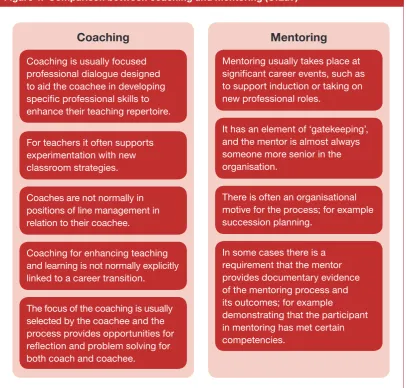
To further support the recognition of the differences between coaching and mentoring the CfLaT research team use the following defining features: see Figure 1 on page 8.
Figure 1: Comparison between coaching and mentoring (CfLaT)
Coaching
Mentoring
Coaching is usually focused professional dialogue designed to aid the coachee in developing specific professional skills to enhance their teaching repertoire.
Coaches are not normally in positions of line management in relation to their coachee.
Coaching for enhancing teaching and learning is not normally explicitly linked to a career transition.
Mentoring usually takes place at significant career events, such as to support induction or taking on new professional roles.
It has an element of ‘gatekeeping’, and the mentor is almost always someone more senior in the organisation.
There is often an organisational motive for the process; for example succession planning.
In some cases there is a requirement that the mentor provides documentary evidence of the mentoring process and its outcomes; for example
demonstrating that the participant in mentoring has met certain competencies.
The focus of the coaching is usually selected by the coachee and the process provides opportunities for reflection and problem solving for both coach and coachee.
[image:10.595.148.555.169.557.2]When teachers’
learning is based
on their genuine
assessment and
understanding of
pupils’ learning
they can start to
make adaptations
to their practice
which can lead to
real differences in
outcomes.
2. The case for coaching
This section starts with the ‘big picture’: coaching within strategic CPD, the levers and tensions that exist in developing coaching. It then outlines some of the common approaches to and tensions within coaching. As such it will help you to locate your school’s policies and practices in a broader context, and may provide indicators of alternative approaches that you may wish to trial.
2.1 Strategic CPD: the role of coaching
Teachers’ learning and development underpins school improvement and provides a vehicle for raising achievement and attainment. When teachers’ learning is based on their genuine assessment and understanding of pupils’ learning they can start to make adaptations to their practice which can lead to real differences in outcomes. It is possible to identify core principles which apply to the most successful CPD provision. In the Educational Practices series, Helen Timperley’s 2009 summary Teacher professional learning and development (based on a systematic best-evidence synthesis of published research) identifies these core principles. Amongst these is the need to create conditions which allow:
• teachers to experience and develop understanding of an integration of knowledge and skills • teachers to gain multiple opportunities to learn and apply information
• teachers’ beliefs to be challenged by evidence which is not consistent with their assumptions • teachers to have opportunities to process new learning with others.
Coaching can provide a means by which these and other key principles can be achieved and thus teacher learning can be enhanced. Coaching is a form of collaborative CPD and can thus be a strong dimension of teachers’ professional learning in school. As such it needs to be managed as part of a strategic approach to CPD. It is therefore a genuine alternative to what constitutes most teachers’ CPD, which has been found to be rarely collaborative or informed by research, but instead tends to involve passive forms of learning, and is poorly and embedded in work contexts (Pedder et al, 2008).
2.2 Teachers’ learning and students’ learning
The link between teachers’ learning and students’ learning acts as the main lever for the development of coaching in schools. Whatever the nature of the school there is a constant imperative to improve, both in terms of student attainment and wider outcomes (as exemplified by the
framework for Every Child Matters). The majority of the school day, both for students and teachers, is spent in lessons. What goes on in lessons is exceptionally complicated, influenced not just by the quality of planning, but also the relationships, learning environment and motivations of all participants. Teachers are frequently set performance management targets that are embedded in this complexity, and while targets help to focus attention they rarely act as the means for
improving practice. The performance management cycle as operated in most schools can thus act
Trigger
Teachers and
school leaders are
becoming more
acutely aware of
the relationships
between
engagement,
feedback and
learning for
students, as
exemplified by the
assessment for
learning agenda.
as another case for the implementation of coaching. When it works well, coaching starts to tackle the complexity of teaching and learning, providing opportunities for the interrogation of teachers’ practice and its consequences. As it is an individualised professional development activity, coaching can be finely tuned to the concerns of specific teachers working to support their own students.
Teachers and school leaders are becoming more acutely aware of the relationships between engagement, feedback and learning for students, as exemplified by the assessment for learning agenda. This was reiterated by John Hattie’s meta-analysis of influences on students’ learning, published in his book Visible Learning in 2009, which demonstrated the link between ‘challenge and feedback, two essential ingredients of learning’ (p38). The significance of this here is the parallel relationship between challenge and feedback in teachers’ learning. Teachers’ roles are challenging, but sometimes teachers focus on the burdensome nature of the job, rather than the intellectual and practical challenges it throws up. They tend to adopt set teaching routines and often wait for examination results, performance management and Ofsted inspections to indicate how well they are doing. The burdens of the role, and the relatively blunt instruments available for feedback, can lead teachers to overlook some of the fine detail of practice. Coaching is one way that teachers can redress this balance.
And just as every child matters, every teacher matters too. Employee well-being is a core concern of all effective school leaders. Teachers’ well-being is another complex dynamic, but largely influenced by their sense of worth and opportunity to make a significant contribution to the school community. In turn these are partly influenced by the nature of relationships between teachers, their colleagues and their students. Coaching creates opportunities for trusting, open professional relationships to develop and these help to develop the school’s social capital. As social capital contributes to the overall resource available to the school to successfully undertake its core business and continue to improve, this can provide a further case for the implementation of coaching.
More commonly
coaching is made
available to a small
number of teaching
staff who fall into
pre-determined
categories, or
offered on the CPD
agenda to any
colleagues who
wish to fit it into
their pre-existing
workload.
Another relationship to define in coaching development is between coaching and performance management structures and procedures. Good practice in our research schools allowed coaching to be a performance management tool, not a slave to performance management.
An additional difficulty is the relatively limited language available to teachers and school leaders when discussing coaching practices. While the organisation of coaching practice can be readily discussed, it is more difficult to define the precise nature of effective coaching conversations. Having taken the step to distinguish coaching from mentoring, the next step is to be familiar with ways of describing features of coaching conversations. This became a significant element of the research project.
2.4 Differences in coaching practices
Significant variability exists in the approaches taken to establishing coaching within schools. In a few instances coaching has developed into a universal entitlement, with all teaching colleagues expected to be involved as coach, coachee or both, during the course of a year. At the other end of the extreme, coaching is a relatively minority affair, initially carried out by a small number of staff almost under the radar of the school leadership. More commonly coaching is made available to a small number of teaching staff who fall into pre-determined categories, or offered on the CPD agenda to any colleagues who wish to fit it into their pre-existing workload. These differences in availability of coaching can be related to the extent to which coaching, performance management and school improvement are linked. They can also be related to the way that coaching is initiated and how the coaching partnerships are established. It can also be influenced by the expressed purpose of coaching in the school; in some cases there is a clear school agenda, in others the focus is deliberately left in the ownership of the participants. It is clear that coaching tends to evolve with time, often as new co-ordinators or school leaders take responsibility for it, although there is evidence that if core champions of coaching leave the school it can fizzle out. This pattern indicates the requirement that coaching is embedded in a systematic approach to CPD, capacity building in teaching and learning and school-wide succession planning. Once it is recognised that coaching acts as a significant CPD opportunity for the coaches themselves, some of the barriers to development are lifted, as the investment in developing coaching capacity becomes a virtuous cycle.
Review
questions
Given the current state of play in your school what case can you begin to make for coaching in your school?
Review
questions
It may be valuable
to set up a small
working group,
perhaps including
staff working at
different levels in
the school, and
possibly a member
of the governing
body.
3. Conducting a coaching review
In order to plan development of coaching it is useful to review the current context for coaching and the nature of existing coaching activity in school. It is worth making a decision about who undertakes the review. It may be valuable to set up a small working group, perhaps including staff working at different levels in the school, and possibly a member of the governing body. What follows are questions that can be asked in an initial review of coaching practices in school, categorised under key focus areas. The questions could form the basis of a systematic review, or an opportunity for discussion and may stimulate initial actions in the development of coaching in your school. Some of the questions are deliberately open, and further sections of this guide will indicate their significance.
3.1 Supporting coaching
These questions encourage you to explore the ways in which coaching is currently contextualised in the school’s CPD strategy.
• Is there a clear understanding of the differences between coaching and mentoring in the school? • What training has been offered to teachers relating to coaching? How many teachers have been
included in this? What models of coaching were promoted through the training?
• How is coaching led and managed? What key roles are there? Is there a reporting structure? What does this involve?
• Are the benefits of coaching established within the senior leadership team, and is there a clear rationale for coaching as a result?
• Is coaching in school focused on teaching and learning and/or on leadership development? • Are key colleagues and senior leaders modelling engagement in coaching as a positive, productive
CPD activity?
• At a school level is there an intention that coaching is aligned with strategies for CPD, performance management and/or school improvement? How is this operationalised?
3.2 Participation in coaching
These questions focus on the levels of engagement with coaching, and the patterns of participation across the teaching community of the school.
• How are opportunities to engage in coaching communicated to teachers?
• What is the level of participation? Are specific staff groups involved? If so, what is the pattern and is this coincidental or deliberate? If intentional what is the rationale for this?
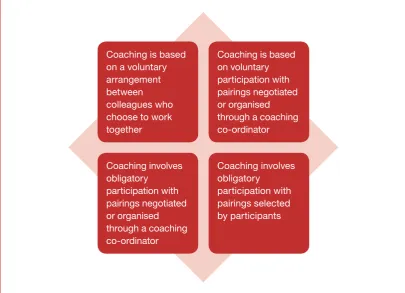
• What are the current arrangements for coaching? Four main patterns exist, as shown in Figure 2 opposite. Does your school adopt one of these approaches, a hybrid of approaches or an alternative?
Trigger
question
3.3 Intended purposes of coaching
These questions allow you to focus on the ways that coaching is used in your school, and may help you to distinguish between the range of possible purposes for coaching, identifying those which are most critical in your context.
• If there is coaching for teaching and learning, what is it being used for?
• Can the senior leadership team and colleagues involved in coaching distinguish between the more and less desirable purposes for coaching outlined in the boxes in Figure 3 (page 14)? • Do any of the purposes identified above dominate in your school? If so – are you happy that the
current scenario is the most appropriate one?
3.4 Practical arrangements for coaching
These questions allow you to reflect on the ways that coaching episodes are organised in your school, and may help you to determine alternative approaches worth exploring.
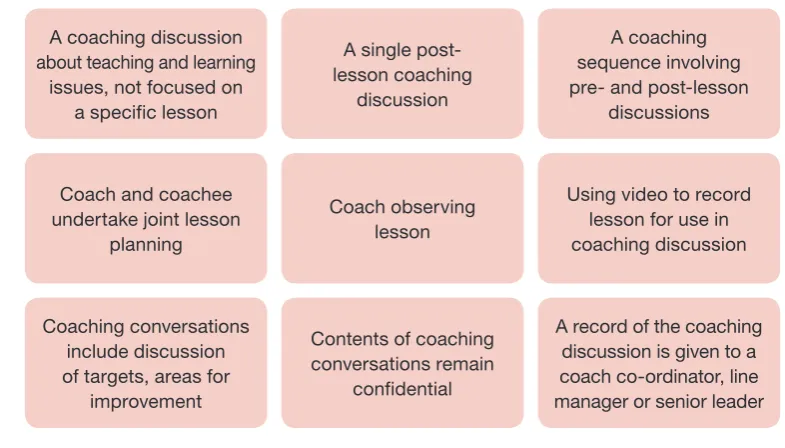
• How formal are the arrangements for coaching? Do all participants follow a similar process? • Which of the practices in Figure 3 best describe coaching structures in your school? How are
different approaches combined? Is the current situation the most desirable one?
Figure 2: Variations in the relationship between coaching and performance management
Coaching involves obligatory
participation with pairings selected by participants Coaching involves
obligatory participation with pairings negotiated or organised through a coaching co-ordinator Coaching is based on a voluntary arrangement between colleagues who choose to work together
[image:15.595.146.552.180.473.2]• Can the senior leadership team and colleagues involved in coaching distinguish between the more and less desirable coaching activities outlined in the boxes in Figure 4 below?
Figure 3: Purposes of coaching identified in the research project: including more and less productive purposes
Working towards a school or department
development priority
Supporting the teaching and learning
of a specified group of pupils
Trying out coaching and practising coaching skills
Supporting the development of a specific teaching skill
Supporting a professional development course
or Masters study
Working towards a performance management target Sharing classroom
practice with a colleague
Judging the quality of practice and seeking or giving
feedback
Supporting induction or career
transition
Figure 4: Practical arrangements for coaching identified in the research project: including more and less productive purposes
A single post- lesson coaching
discussion
Coach observing lesson
Contents of coaching conversations remain
confidential
A coaching sequence involving pre- and post-lesson
discussions
Using video to record lesson for use in coaching discussion
A record of the coaching discussion is given to a coach co-ordinator, line manager or senior leader A coaching discussion
about teaching and learning issues, not focused on
a specific lesson
Coach and coachee undertake joint lesson
planning
Coaching conversations include discussion of targets, areas for
[image:16.595.147.549.228.463.2] [image:16.595.148.541.523.747.2]What has this
coaching review
told you about
coaching in your
school? Are you
happy with the
current situation?
3.5 Experiences of coaching
The following questions are useful to test out the levels of actual and potential ‘buy in’ to coaching. Investigating them will help you to recognise the perceptions and experiences that your colleagues have of coaching.
• Do teachers show an interest in being involved with coaching?
• How are their experiences of coaching currently evaluated formally or informally? • Is there evidence that teachers perceive it to be beneficial? If so, in what ways? • Are teachers who have been coached interested in becoming coaches? • Do teachers experience any tensions when participating as coach or coachee?
• Do any colleagues who have worked in other schools have useful experience of coaching, and how can this be learned from?
3.6 Plans for coaching
These final questions will help you to consider the ways that coaching is, or could be, systematically planned for within the school.
• Does coaching appear in the school development plan?
• Are there any current plans for altering the way coaching is used or offered to teachers? • Who has been consulted in developing these plans, and have any key stakeholders been
missed out in these discussions?
Review
questions
What has this coaching review told you about coaching in your school? Are you happy with the current situation?
Review
questions
If you are keen to develop coaching further, who is best placed to lead coaching development; how will they be supported?
Review
questions
Are we facilitating
coaching that
is likely to make
a difference to
teaching and
learning?
4. Establishing coaching practice
4.1 Coaching partnerships and coaching cycles
One of the recurring discoveries within the research project was that every school has established a unique version of coaching, regardless of the initial stimulus for coaching. However, our research evidence indicates that coaching is most productive when it is offered as a cycle rather than a one-off event. Participants find that repeat cycles can be used to home in on identified areas for development and discussion. Most coaching cycles are focused around a specific event, often a lesson, although this event may be an alternative aspect of professional practice. This guide focuses on coaching for improving teaching and learning and thus emphasis is given to lessons as professional practice.
An essential element of successful coaching is the initial establishment of the coaching
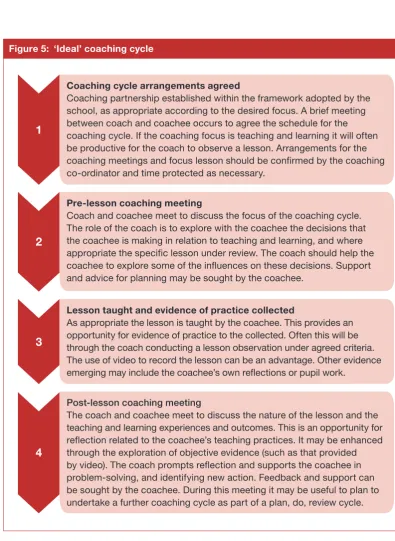
partnership. Schools vary in their approach to setting up coach and coachee pairs, as indicated in the previous section. Whatever the approach, feedback from research participants indicated that when they felt a sense of ‘ownership’ over the process of pairing colleagues, the process got off to a more satisfactory start. There is no evidence that basing coaching on line management structures or duration of teaching experience is ideal. Indeed good coaching often exists in a non-hierachical structure, drawing on individual teachers’ interests and specific expertise. In ideal situations coaching can be seen as a democratic and inclusive component of the school community. See Figure 5 on page 17.
4.2 Creating a climate for coaching
In the few schools identified in our research where coaching is systematically built into the CPD strategy and time allocated to it (within both the core timetable and directed time) coaching was found to flourish. This involved the strategic leadership of coaching by the SLT within the overall CPD strategy. It is obvious that for coaching cycles to involve the four elements shown in Figure 5 on page 17 and to include the potential for repeat cycles, significant thought must be paid to organising this within the school timetable and teachers’ workloads. Schools participating in the research project had a range of successful and less successful approaches to this. The most common request from coaching participants with regard to improving coaching was the provision of additional time to undertake coaching cycles and practise the skills of coaching.
In addition to the arrangements for partnership and the need to allocate sufficient time to coaching teachers engaging in coaching need to recognise the ideal form of coaching dialogue. In broad terms they need to pay attention to the nature of the contact they are engaging in. Most significantly they should understand the need to establish trust between each other. A core element of this is the degree to which the coaching conversation is deemed to be confidential. It is essential to ensure that coaching conversations and related lesson observations do not become the substance of staffroom gossip. If there is an explicit intention that coaching helps the school to identify excellent practice worth sharing there need to be agreed mechanisms by which this can be facilitated.
Trigger
Many schools are
still grappling with
the core tension
of the relationship
between
performance
management and
coaching.
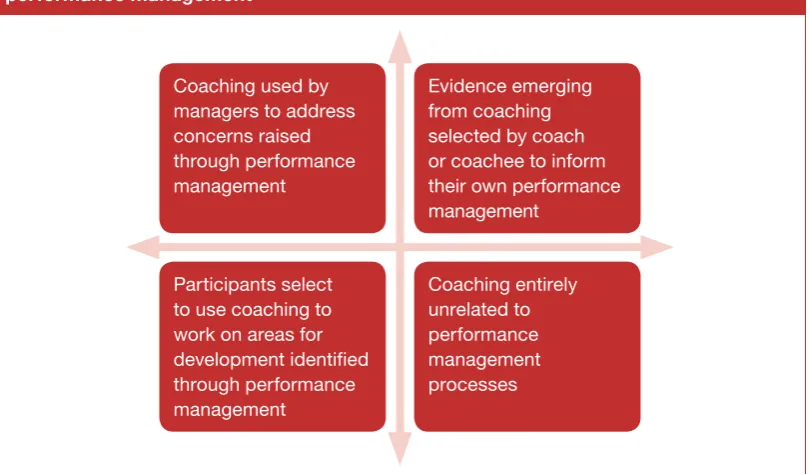
Many schools are still grappling with the core tension of the relationship between performance management and coaching. It is worth thinking very carefully about how your school will resolve this. Figure 6 on page 18 indicates the types of relationships between performance management and coaching indicated through the research.
When coaching is predominantly used to address concerns about weak teaching it is not surprising that it can become viewed unfavourably by the school community. Rather than becoming an
Figure 5: ‘Ideal’ coaching cycle
Coaching cycle arrangements agreed
Coaching partnership established within the framework adopted by the school, as appropriate according to the desired focus. A brief meeting between coach and coachee occurs to agree the schedule for the coaching cycle. If the coaching focus is teaching and learning it will often be productive for the coach to observe a lesson. Arrangements for the coaching meetings and focus lesson should be confirmed by the coaching co-ordinator and time protected as necessary.
1
Pre-lesson coaching meeting
Coach and coachee meet to discuss the focus of the coaching cycle. The role of the coach is to explore with the coachee the decisions that the coachee is making in relation to teaching and learning, and where appropriate the specific lesson under review. The coach should help the coachee to explore some of the influences on these decisions. Support and advice for planning may be sought by the coachee.
Lesson taught and evidence of practice collected
As appropriate the lesson is taught by the coachee. This provides an opportunity for evidence of practice to the collected. Often this will be through the coach conducting a lesson observation under agreed criteria. The use of video to record the lesson can be an advantage. Other evidence emerging may include the coachee’s own reflections or pupil work.
2
3
4
Post-lesson coaching meeting
[image:19.595.143.539.117.659.2]opportunity for school development, if it is seen by teachers as aggressive remedial action, it will not be actively sought out. This stigma can remain for some time, meaning that even if a new model of coaching is implemented in the school teachers can be unwilling to volunteer to participate. As well as the reality it is important to deal with any myths that evolve in the school relating to the relationship between the two. However, sometimes it is necessary to recognise that there are significant issues with teaching and learning in a school, and in these contexts the significance of line management and accountability for improvement need to be clarified and communicated. If coaching is to be used within this context, its purpose as a means of ‘coaching up’ teaching performance needs to be indicated and agreed as a suitable mechanism. An important message in this context is that coaching can support teachers who genuinely wish to improve to develop their practice, and can be used to improve teaching and learning across the school as a whole. This may encourage engagement from teachers who otherwise may feel picked out for special coaching attention.
Figure 6: Possible, but not entirely unproblematic, links between coaching and performance management
Review
questions
Are all those teachers who wish to participate in coaching able to? How is this facilitated within the timetable? Could the situation be improved?
Review
questions
In your school is the purpose of coaching clear? Is there clarity in the relationship between coaching and performance management? If not, how can this be resolved?
Review
questions
Are the most effective and respected teachers identified as both coaches and coachees in the school?
Coaching entirely unrelated to performance management processes
Evidence emerging from coaching selected by coach or coachee to inform their own performance management
Coaching used by managers to address concerns raised through performance management
[image:20.595.149.555.181.418.2]Do we make best
use of available
technology to
support coaching
practice?
5. Using video to support coaching
5.1 Practical and legal advice for use of video
While we recognise that for some teachers using video to support the coaching process is a particular challenge, there is evidence from our research that when initial anxieties have been overcome it is seen as beneficial. There is also evidence, however, that video is not used to its maximum potential.
Teachers making use of video footage of lessons should recognise that it is classified as ‘personal data’ under the Data Protection Act 1998. There are also implications of the use of video in relation to safeguarding requirements in schools. There may be some students for whom the school does not have permission to make video recordings. Most schools have clear policies in place in relation to the use of video-recording during lessons and watching it after lessons. If your school does not have an appropriate policy it is essential to establish this prior to making use of video for supporting coaching. This policy should act as guidance and reassurance to teachers, pupils and parents about the purpose and scope of the use of video.
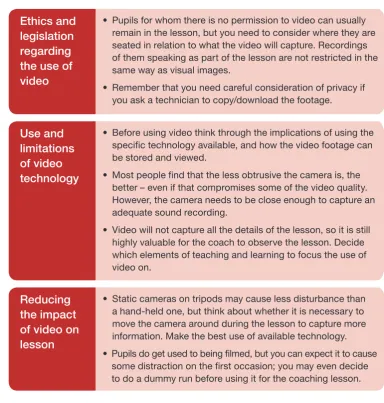
Any video of teaching should be seen as in the ‘ownership’ of the teacher. Without their consent, it should not be used for any purposes other than to support the coaching process. The video should only be seen by the coach and coachee, and care should be taken about where video files are stored to restrict access by others. These criteria are critical in maintaining the trust upon which coaching is based. See Figure 7 on page 20.
5.2 The value of video
What is gained from using video depends on how it is used before and during the coaching session. The normal practice is for both the coach and coachee to watch the video prior to the post-lesson meeting. A key outcome of this can be that it acts to promote recall of the features of the lesson, which can help the coaching conversation get under way more quickly. From the teacher’s perspective it gives them a unique view of their own practice, for example allowing the teacher to gain insight into how students were engaging with the lesson, allowing them to hear themselves provide instructions or explanations, and spotting individual students’ behaviours or evidence of learning missed while teaching. The video also acts as an objective witness to the lesson, so can be referred to if the coach and coachee have differing memories or perceptions of the lesson. Video can also be used by the coach to watch the recording of the lesson if they are unable to observe in person, thus helping to resolve issues of timetabling lesson observations. It is also possible to use video to remind the participants of the lesson from the previous coaching cycle, thus acting to link two cycles together.
5.3 Improving the use of video
As already suggested, while participants report the value of using video, our analysis of coaching transcripts indicates that it is rarely used to maximum benefit. In particular the number of times
Trigger
question
Pupils do get used
to being filmed,
but you can expect
it to cause some
distraction on the
first occasion…
that specific aspects of the video are played and replayed to enable close scrutiny of practice during the coaching conversation itself is limited. Coaching conversations often move with some pace, overlooking the opportunity to rewind the video and therefore re-frame the lesson experience. Essentially the video footage gives maximum potential for unpacking the lesson. It also allows the coachee to work in a more self-directed fashion to prepare for the coaching conversation.
Remember to use the video with discretion according to the focus agreed for coaching. It is the case that video will always provide more potential practice evidence than you have time to deal with in a single coaching cycle, and thus it can become a distraction from the agreed focus. Use the video in different ways when watching it before the meeting and during the coaching meeting itself. Before the meeting the coach and/or coachee may have time to replay the majority
Figure 7: Practical tips for using video for coaching
• Static cameras on tripods may cause less disturbance than a hand-held one, but think about whether it is necessary to move the camera around during the lesson to capture more information. Make the best use of available technology. • Pupils do get used to being filmed, but you can expect it to cause
some distraction on the first occasion; you may even decide to do a dummy run before using it for the coaching lesson.
Reducing
the impact
of video on
lesson
• Pupils for whom there is no permission to video can usually remain in the lesson, but you need to consider where they are seated in relation to what the video will capture. Recordings of them speaking as part of the lesson are not restricted in the same way as visual images.
• Remember that you need careful consideration of privacy if you ask a technician to copy/download the footage.
Ethics and
legislation
regarding
the use of
video
• Before using video think through the implications of using the specific technology available, and how the video footage can be stored and viewed.
• Most people find that the less obtrusive the camera is, the better – even if that compromises some of the video quality. However, the camera needs to be close enough to capture an adequate sound recording.
• Video will not capture all the details of the lesson, so it is still highly valuable for the coach to observe the lesson. Decide which elements of teaching and learning to focus the use of video on.
[image:22.595.152.537.181.585.2]The coaching
process supports
reflection on the
‘unknowns’, with
the aim to locate
more securely the
coachee’s practice
in the ‘known
knowns’.
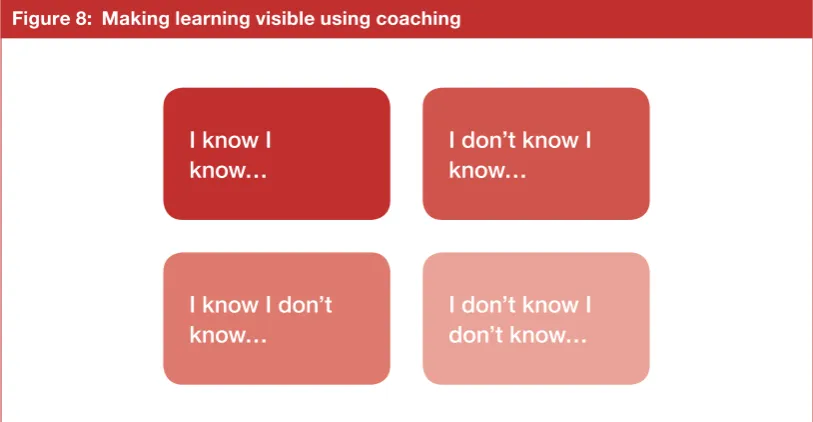
of the lesson (although selective fast-forwarding is appropriate). This allows them to select the critical moments they may wish to discuss during coaching. During the coaching meeting itself it is best to review short focused elements of the video rather than replay long sections. Use the selected extracts as exemplars of patterns of teaching or learning behaviours, or as specific focuses for discussion about key moments of the lesson. This will help to keep the coaching meeting dynamic while making best use of the video as evidence of practice. The desired outcome of any video-based coaching techniques is making both pupils’ and teachers’ learning visible. This allows for greater openness in the coaching conversation, and helps both coach and coachee to develop an improved understanding of evidence of both progress in, and barriers to, learning (teachers’ and pupils’). See Figure 8 below.
Exploring the relationships between things known and unknown in teachers’ professional practice provides potential moments of learning in coaching. The things unknown create both opportunities and barriers in professional development. The coaching process supports reflection on the ‘unknowns’, with the aim to locate more securely the coachee’s practice in the ‘known knowns’.
Depending on the confidence of participants in using video for this kind of fine detail review it may be appropriate to provide training opportunities or chances for coaches and coachees to share their developing practice. Listed below are some techniques that could be practised by coaches and coachees to develop the use of video to support coaching. The ideas provided are not an exhaustive list, and it would be worth gathering together additional suggestions generated by the coaching participants. Using video may act as a launch pad to the next coaching ‘act’. It may indicate that seeking specialist coaching to develop specific pedagogies would be of value. Overall it should increase the participants’ capacity to focus on the detail of teaching and learning. The key to improving the use of video is to refine the ways in which video evidence of practice is scrutinised. Questions, feedback and challenge from the coach, based around the concrete evidence from the video, help the coachee to develop more secure professional knowledge, and a problem solving attitude. See Figure 9 on page 22.
Figure 8: Making learning visible using coaching
I know I don’t
know…
I know I
know…
I don’t know I
know…
[image:23.595.146.553.535.746.2]Figure 9: Techniques for enhancing the use of video in coaching through the use of concrete evidence of practice to challenge teachers’ thinking
Before the meeting watch the video in full to determine the amount of time given to different lesson features, such as teacher talk, group work, whole class discussion, independent work. Be ready to discuss how this evidence relates to the plans for the lesson. Does the pattern have an impact on learning?
Use the video to make a record of the questions asked during the lesson by both teacher and pupils. What types of questions are they? How are they responded to? Who engages with questions? What impact do questions have on learning?
Use the video to look at pupils’ questions. What do pupils’ questions indicate about their learning? How much proactive questioning by pupils is stimulated during the lesson? Do pupils productively engage with their teacher and other class members?
If the coachee apparently lacks confidence in their practice use the video explicitly to identify positive features of teaching and learning, dwelling on the decisions that the teacher makes (during planning and the lesson itself) that result in positive behaviours or outcomes.
Look for critical incidents in the lesson (not necessarily negative). Use the video to replay the incident itself and identify what the triggers are that lead to it, and what the subsequent outcomes are. If the video extract is replayed more than once use each occasion to look at the events from alternative perspectives.
Focus on interaction and the nature of classroom talk: to what extent are the teacher and pupils paying close attention to each other, how receptive are they of each others’ contributions, what does their body language indicate? How effectively do lesson participants take turns and support each other in contributing to the lesson?
Listen to the language being used in the lesson. How is subject terminology or ‘thinking’ or ‘learning’ language used? To what extent do the teacher and pupils mirror each other in the use of language? What impact does this have on progression during the lesson?
What technology
is available for
developing the
use of video in
coaching? How
confident are
coaches and
coachees in using
the technology?
Is any technical
support required?
Review
questions
What technology is available for developing the use of video in coaching? How confident are coaches and coachees in using the technology? Is any technical support required?
Review
questions
Are the ethical issues fully understood in relation to using video? What further safeguarding procedures are needed?
Review
questions
Can we offer
guidance to
coaching pairs
focusing on
specific teaching
and learning
themes?
6. Scaffolding coaching conversations
Our research demonstrated that many areas of teaching and learning practice make fruitful themes for coaching cycles. For our sample of coaches and coachees, issues related to student engagement and motivation came top of the list. These were closely followed by classroom talk, student group work, starters and plenaries, assessment for learning and behaviour for learning. Clearly while there is an overlap between these elements of teaching and learning, finding opportunities to focus on specific practices was of benefit. Feedback from research participants also indicated that they would find it useful to have prompts to support their focused discussions. An area for development in many situations is specific pedagogic knowledge to support coaching. It is the case that in ideal scenarios coaches offer their coachee genuine enthusiasm for and experience of the focus area. This allows the coaching partnership to develop a level of expertise based on sharing practice and co-enquiry through discussion and use of evidence emerging from this. It is unlikely that coaches will always feel that they have significant expertise in the area, although it is possible that acting as coach supports the development of expertise.
The development of pedagogy-specific coaching prompts may support coaching participants to focus their conversations and identify relevant practice evidence. An example is given here, on the broad theme of assessment for learning. This focuses on possible areas for discussion and types of practice evidence that might usefully be collected. At a school level a coaching development group may find it useful to construct more of these. Ideally they would act as basic templates to which coaching participants would add further ideas based on their experience. These can then become a means by which effective pedagogic knowledge and ideas for associated coaching practice are disseminated and support offered to new and established coaches.
Example of Coaching Guide: Assessment for Learning (A4L)
Possible themes for discussion during coaching for A4L:
During the coaching cycle you may find the following themes for discussion useful. It is likely that one or more of these will be dovetailed with the coachee’s focus for development. The list is not exhaustive.
• What are we looking for in terms of positive student response? • What are the planning implications of A4L?
• How can we make practical strategies for A4L work to their full potential?
• What does progression look like in relation to A4L for both the teacher and the pupils?
• What specifically needs to be really understood about the subject in this context and how does A4L help?
What kind of evidence might be useful?
It is important to balance out a focus on teaching with the necessary focus on learning and as such the coach and coachee will particularly want to consider the lessons from the pupils’
Trigger
question
What are the
most common
teaching and
learning focuses
for coaching in
our school? Is
expertise evolving?
How can this be
captured and
shared?
perspective. It is not always easy to do this, and we all too often play the long game and wait for evidence of student outcomes from formal assessment opportunities. This may not always be helpful in coaching.
Alternative sources of evidence may include talking to pupils and looking in detail at their work
to investigate the following questions:
• What has been understood by pupils and how does it relate to the learning objectives?
• What were the students’ experiences during the A4L process and were these uniform or varied? • What classroom dialogue (in groups or between teacher and pupils) supported the A4L
process? How can this dialogue be characterised?
• How are students making sense of the information they are given and the language used in relation to A4L?
With time it may be useful to use the coaching process to add further information to the guide. For example this might include:
• Assessment for learning principles • Common misconceptions related to A4L • Good practical strategies
• Common problems/barriers in developing practice • Useful resources and how to access them
Review
questions
What are the most common teaching and learning focuses for coaching in our school? Is expertise evolving? How can this be captured and shared?
Review
questions
How can we
determine the
quality and impact
of the coaching
conversations?
7. Understanding the different dimensions
of coaching talk
As coaching is a talk-based form of professional development the nature of the coaching dialogue is a critical concern if it is to be effective. Of course to improve coaching conversations, some frameworks are needed to determine the nature of the talk and a language is needed to describe and define it.
7.1 Introduction to the dimensions
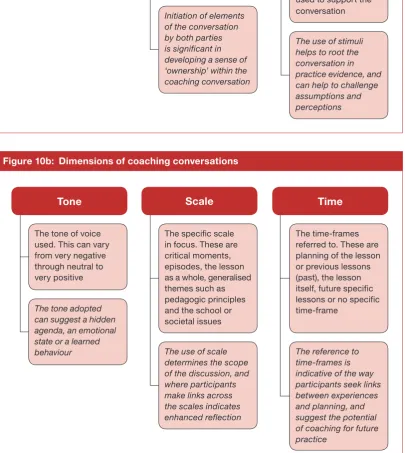
The characteristic features of coaching conversations were a focus area of our research. Evidence from coaching transcripts indicates that this also provides a key area for developing the quality of coaching practice. Through analysis of coaching transcripts it became evident that a number of significant dimensions of coaching talk existed. These are outlined here (see Figures 10a, 10b and 10c), with an explanation of their significance and suggestions for enhancing coaching dialogue. At first these may seem complicated, but many of our research partnership teachers readily internalised them, stating that the dimensions gave them a lens through which they recognised their coaching behaviours. With time, and an opportunity to review their own coaching practice, coaches indicated that the dimensions of coaching became more familiar and accessible to them. Indeed they became a tool that coaching participants (coaches in particular) were able to make conscious use of in their efforts to improve their coaching, and a language to talk about coaching practice with.
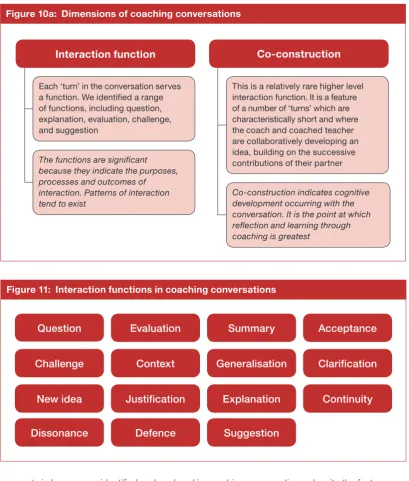
Coachees, coaches and co-ordinators wishing to focus on coaching dimensions as a means to develop their practice may find the complete list of interaction functions useful. See Figure 11 on page 28.
7.2 Typical coaching patterns
Our research indicated that much coaching is routine and follows set patterns. Initiation is predominantly by the coach, and this typically involves the coach asking the coached teacher questions about how they think either the whole lesson or particular parts of it ‘went’, leading the coachee to explain, justify, clarify and evaluate episodes in the lessons. Often the coach then evaluates the coachee’s self-evaluation. The selected episodes are frequently those parts that were the focus of discussion in the pre-lesson session, although it is rare for lesson planning and teaching to be explicitly linked through the conversation. Thus a number of lesson episodes are evaluated. There are relatively few extreme positive or negative comments. Most of the extremely negative comments come from the coached teacher where they are particularly unhappy with an aspect of the lesson. This is often balanced with positive comments from the coach. While this pattern represents a valid approach to evaluating practice, it can become repetitive and only infrequently leads to challenge or new ideas for developing practice.
7.3 More productive coaching discourse
As coaches and coachees become more familiar with the nature of their coaching conversations they can become more discerning participants. For example it is relatively rare that critical
Trigger
question
Figure 10b: Dimensions of coaching conversations
Scale
Tone Time
The specific scale in focus. These are critical moments, episodes, the lesson as a whole, generalised themes such as pedagogic principles and the school or societal issues The tone of voice
used. This can vary from very negative through neutral to very positive
The time-frames referred to. These are planning of the lesson or previous lessons (past), the lesson itself, future specific lessons or no specific time-frame
The tone adopted can suggest a hidden agenda, an emotional state or a learned
behaviour The reference to
[image:29.595.149.555.285.739.2]time-frames is indicative of the way participants seek links between experiences and planning, and suggest the potential of coaching for future practice
Figure 10a: Dimensions of coaching conversations
Initiation
Subject matter Stimulus
Which participant takes responsibility for each new element of the conversation The theme and
focus for discussion; frequently a specific pedagogic approach
How stimuli, such as video extracts, lesson plans, recall, or pupils’ work, are used to support the conversation
Initiation of elements of the conversation by both parties is significant in developing a sense of ‘ownership’ within the coaching conversation
The use of stimuli helps to root the conversation in practice evidence, and can help to challenge assumptions and perceptions
Figure 10a: Dimensions of coaching conversations
Co-construction Interaction function
Co-construction indicates cognitive development occurring with the conversation. It is the point at which reflection and learning through coaching is greatest
Each ‘turn’ in the conversation serves a function. We identified a range of functions, including question, explanation, evaluation, challenge, and suggestion
The functions are significant because they indicate the purposes, processes and outcomes of interaction. Patterns of interaction tend to exist
[image:30.595.148.553.165.401.2]This is a relatively rare higher level interaction function. It is a feature of a number of ‘turns’ which are characteristically short and where the coach and coached teacher are collaboratively developing an idea, building on the successive contributions of their partner
Figure 11: Interaction functions in coaching conversations
Question Evaluation Summary Acceptance
Challenge Context Generalisation Clarification
New idea Justification Explanation Continuity
Dissonance Defence Suggestion
moments in lessons are identified and explored in coaching conversations, despite the fact that these are potentially powerful indicators of student learning and the impact of the teacher’s pedagogic decision making. It is likely that greater scrutiny of video evidence as stimulus within the coaching conversation (for example) could lead to enhanced awareness of the critical moments in teaching and learning.
How can we
judge the quality
of coaching
conversations
without infringing
the confidentiality
of coaching?
productive. A response to a challenge would typically be defence, acceptance or dissonance. Dissonance is a state in which existing conceptions are challenged by experience or feedback, and as indicated in the introduction, teachers’ learning is triggered when their assumptions are challenged. Dissonance might be generated ‘internally’ by a teacher reflecting on experience, or it can be generated ‘externally’ by the coach if they provide a different interpretation of events, or evidence that contradicts the coached teacher’s perspective. An appropriate response to dissonance is considering how critical moments in practice are generalised to past experience and projected to future action.
7.4 Co-construction
While co-construction was rarely demonstrated in the coaching transcripts, where it occurs its impact is clear. It is a potential outcome of challenge and dissonance. Co-construction is a feature of a number of conversational ‘turns’ which are characteristically short and where the coach and coachee are collaboratively developing an idea, building on the successive contributions of their partner. This is the point at which coaching becomes a professional knowledge-creating process, which is likely to be advantageous to both the coach and coachee. It is possible that some coaches are holding back during coaching sessions, for fear of appearing too directive in the relationship. Good coaches use their skills to prompt their partner to challenge their own practice and work together with them to develop new suggestions for teaching and learning. This leads to new action in the classroom and an opportunity to review it. Co-construction is enhanced when the coach and coachee share a language to describe different pedagogical approaches and are willing to engage in predicting possible outcomes of altered practice.
7.5 Developing the use of coaching dimensions
In practical terms it is worth thinking through how your school can determine the quality of the coaching conversations being held, especially when issues of confidentiality are at stake. It seems most likely that a coaching co-ordinator working closely with coaching participants can determine strategies for diagnosing the nature of the coaching talk and supporting its development. Use of audio- or video-recording of coaching conversations for review by the participants is one possible approach, as is the use of a triad system, where an approved observer witnesses the coaching conversation and gives feedback to the participants. Another possible strategy is to establish development groups who are able to work with each other to practise coaching conversations before reflecting on or showcasing examples of their coaching within the group. Our experience through the research process suggests that focusing on coaching dimensions as a means to improve the quality of coaching is a particularly productive activity.
Review
questions
Why do few coaching conversations achieve co-construction? If co-construction is critical in coaching, can this also be developed through other approaches to teacher development in school?
Review
questions
From analysing
the dimensions we
have determined
that the most
productive
coaching
conversations
involve
co-construction, but
we also recognise
that this is relatively
rarely achieved.
8. Developing the quality of coaching practice
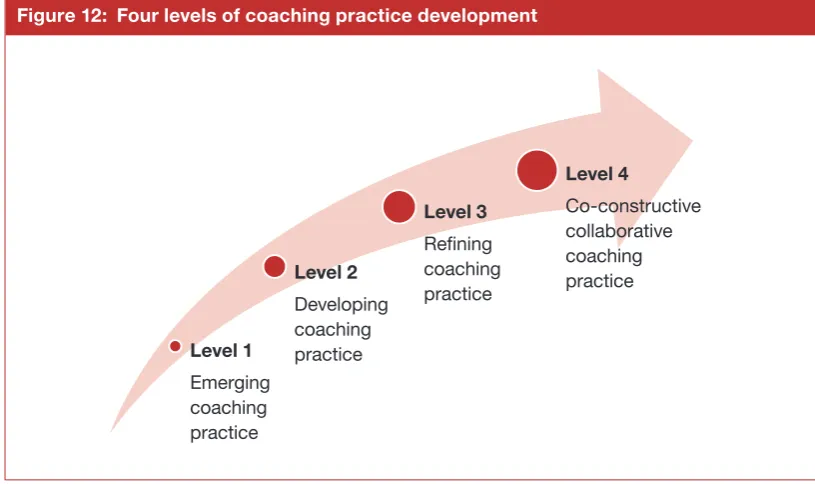
In working with teachers it became clear that in order to support them in improving coaching, a framework for understanding development in coaching practice was needed. While the dimensions provide individual descriptions of elements of coaching conversations, they do not indicate progression in practice per se. The question arises: what does progression in coaching practice look like? From analysing the dimensions we have determined that the most productive coaching conversations involve co-construction, but we also recognise that this is relatively rarely achieved. Key indicators of progression are the degree to which coaching triggers the coachee to analyse their practice critically and the extent to which reflection is prompted. The role of the coach is in scaffolding reflection, analysis and problem solving, but an ambition of the process is that once these habits become embedded the coachee achieves a degree of self-regulation. Thus four levels of coaching practice development were developed, based on analysis of transcripts of coaching conversations. These levels are indicated below in Figure 12 and in Table 1 (page 31).
[image:32.595.144.552.511.753.2]Each level of coaching development can be described and aligned with the coaching dimensions. As the coach and coachee take conversational turns an effective coach will actively guide the conversation through subtle twists and turns of questions, prompts, feedback and challenges. It is at this micro-scale that the dimensions become significant. When looking for tools with which to improve coaching practice these dimensions provide a means to make progress through the four levels of coaching development. The relationship between the levels and the dimensions is illustrated in Table 1.
Figure 12: Four levels of coaching practice development
Level 4
Co-constructive collaborative coaching practice Level 3
Refining coaching practice Level 2
Developing coaching practice Level 1
Emerging coaching practice
Trigger
Table 1: Levels of coaching practice development
Description of coaching conversation Characteristic dimensions of coaching conversation
Level 1: Emerging coaching practice
The coach asks questions which lead the coachee to give an account of episodes of the lesson by drawing on recall and anecdotal evidence, with a general focus on teaching. The conversation is largely descriptive. The lesson being discussed tends not to be considered in relation to wider educational contexts or the coachee’s professional development or learning. However some comparison may be drawn with the coachee’s past experiences.
Coaching is often ‘led’ by the coach (initiation) prompting coachee to recall elements of the lesson (stimulus). The coach’s questions lead to descriptions and explanations, perhaps with some evaluation of particular practice and outcomes shared (interaction function). Discussion tends to focus on the lesson as a whole or key episodes within it (scale), and reference to former or future teaching is relatively limited (time).
Level 2: Developing coaching practice
The coach asks the coachee to consider the impact of their teaching on pupils’ learning. The coachee describes the decisions they made before and during the lesson and how the pupils responded, drawing out links between teaching and learning. The coachee’s wider experiences may be considered and this may lead to specific problems or issues being discussed. The coach and coachee might begin to consider the lesson in relation to the wider educational contexts or the coachee’s professional development or learning.
Coaching triggers the coachee to start to justify their practice or the learning outcomes through clarification of intent (interaction function). This may be prompted by the coach’s observation notes, video or other lesson artefacts (stimulus). Specific episodes within the lesson (scale) are related to the focus derived through the pre-lesson coaching conversation and teaching objectives which may in turn be related to previous experience (time). Suggestions (interaction function) may be made for development of practice.
Level 3: Refining coaching practice
The coach and coachee discuss teaching and learning, making explicit use of evidence gathered during the lesson, focusing on learners’ progress. The coach’s questions prompt the coachee to begin to problem-solve, hypothesise and reflect on the significance of their actions or beliefs. The coach begins to challenge the coachee’s assumptions about teaching and learning, leading to critical reflection and analysis of experience, knowledge and wider educational contexts.
The coach and coachee engage in dialogue (initiation) during which they jointly review the lesson outcomes, the coachee’s reflections and/or video evidence (stimulus). Scrutiny of a range of ‘evidence’ at a variety of levels within and beyond the specific lesson (scales) allows them to challenge practice and begin to generalise (interaction function). Focus on future practice is productive and based on critical reflection (time and interaction function).
Level 4: Co-constructive collaborative coaching practice
The coach and coachee collaboratively develop ideas, building on the successive contributions of their partner. There is significant focus on enhancing learning opportunities. The questions that they ask each other allow them to successfully explore their own understandings. Through reflecting on, and responding to, each others’ contributions they identify alternative pedagogic approaches. This leads to exploratory talk related to opportunities for professional learning and development and the ways in which they might analyse the impact of this on pupils’ progress. As such this is a knowledge-creating process.
How can the
level of coaching
development
be judged – for
individuals and