D o r o t h y A n d r e w s
School Change and Development
T h e l n f l u e n c e o f a R e f l e c t i v e P r a c t i t i o n e r
lmpressum/lmprint (nur f0r Deutschland/ only for Germany)
Bib'iiografische Information der Deutschen Nationalbibliothek: Die Deutsche Nationalbibliothek verzeilhnet diese publikation in der Deutschen Nationalbibliografie; detaillierte bibliografische Daten sind im Internet 0ber http://dnb.d--nb'de abrufbar'
Alle in diesem euch genannien Marken und Produktnamen unterliegen warenzeichen-, marken-oder patentrechtlichem Schutz bzw. sind Warenzeichen oder eingetragene Warenzeichen der jeweiiigen Inhaber. Die Wiedergabe von Marken, Produktnamen, Gebrauchsnamen, ilandeisnamen, Warenbezeichnungen u.s.w. in diesem Werk berechtigt auch ohne besondere
Kennzeichnung nicht zu der Annahme, dass solche Namen im Sinne der Warenzeichen- und Markenschutzgesetzgehlng als frei zu betrachten wdren und daher von jedermann benutzt werden drirften.
Coverbi ld : www. purestoclo<.com
Verlag: VDM Verlag Dr. Miiller Aktiengesellschaft & Co- KG Dudweiler Landstr. 99, 661 23 Saarbrucken, Deutschland
Telefon +49 681 9100-698, Telefax +49 681 9100-988, Email: info@vdm-verlag de Zugl.: Brisbane, Univeristy of Queensland, Diss., 1999
Herstellung in Deutschland: Schaltungsdienst Lange o.H.G., Berlin Book on Demand GmbH, Norderstedt Reha GmbH. Saarbrtcken
Amazon Distribution GmbH, LeiPzig lSBN: 978-3-639-23286-8 lmprint (only for USA, GB)
Bibiiographic information published by the Deutsche Nationalbibliothek: The Deutsche Natioialbibliothek lists this publication in the Deutsche Nationalbibliografie; detailed bibliographic data are available in the Internet at http://dnb'd-nb'de '
Any biand names and product names mentioned in this book are subject to trademark, brand or paient protection and aretrademarks or registered trademarks oftheir respective holders. The use of brand names, product names, common names, trade names, product descriptions etc. even without a particuiar marking in this works is in no way to be construed to mean that such names tnay be regarded as unrestri-cted in respect of trademark and brand protection legislation and could thus be used by anyone.
Cover ima ge: vvww. Pu restockx.com Publisher:
VDM Verlag Dr. Mtiller Aktiengesellschaft & Co. KG Dudweif er Landstr. 99, 66123 Saarbr[icken, Germany
phone +49 681 9100-698, Fax +49 681 9100-988, Email: [email protected]
copyright o 2010 by the author and vDM Verlag Dr. Mtiller Aktiengesellschaft & co' KG and licensors
All rights reserved. Saarbrricken 2010 Printed in the U.S.A.
Printed in the U.K. by (see last page) f SBN : 978-3-63 9-23286-8
TABLE OF CONTENTS
CHAPTER 1 SCHOOL CHANGE. DEVELOPMENT AND TIM II\DIVIDUAL
Introduction
Purpose of the Research The Field of Action
The Person - The Self-Researcher The Research
The Research Period 1994-1996 The Structure of the Thesis
CHAPTER 2 LITERATURE REVIEW Introduction
The Social Context Discovered
Organisational Culture - Nature, Meaning and Change Transforming Culture - Models for Change
Crucial Elements in Changing Culture Individual as Organisational Beings Self-Development
Professional Development Programs
CHAPTER3 METHODOLOGY InEoduction
Common Elements of Qualitative research Value-based Research
Speaking for the Other, Speaking for Self Research Process
CHAPTER 4 DATAFROMTHEFIELDOFACTION Introduction
Structure of the Data Analysis The Anival of the Self Researcher
Period I - 1994-1995 Experience and Learning from Action
2
2
J
8
30
J +
35
3 8
39
64 78
90
9 l 100
109
1 1 8
l l 9
r20
r22
r28
Period 2 1996 - The Coming of Newcomer Two Period 2 1996 - Impact of the Invasion
CHAPTER 5 DTSCUSSION Introduction
Discussion on Action Learning from the Study
Organisational Culture - The Crucial Elements of Change New Understandings About the External Context The Second Context - The Self
CHAPfER6 CONCLUSION Introduction
Major Findings and Conclusions Research Method - Use of Informants Educational lmplications
Implications for Further Research
APPENDICES
Appendix I School Review - Extracts Appendix 2 Cultural Change Approaches
Appendix 3 Evaluation ofthe Effectiveness ofApproaches Appendix 4 Belief Systems - Structure and Influence Appendix 5 Types ofLeadership
Appendix 6 Process and Time Frame of Data Collection Appendix 7 Brief - First Focus Group Interview Appendix8 AdministrativeStructures
Appendix 9 Curriculum Vision Document (Outline) Appendix l0 Proposal for Formative Appraisal Process Appendix 1l Inservice Committee Document
REFERENCES
1 8 7 1 9 5
235 235
236
26r 278
297
298
303
304 3 1 5
3 1 8
3 1 8
319 320
321 322
3 Z J
J Z +
325 326
328
329
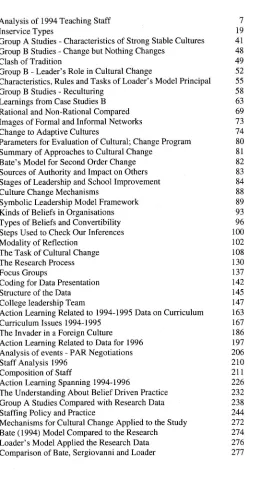
LIST OF TABLES Table l.l Tab\e 1.2 Table 2.1 Table2.2 Table2.3 Table2.4 Table 2.5 Table 2.6 Tabte2.7 Table 2.8 Table2.9 Table 2.10 Table 2. I I Table2.l2 Table 2.13 Table2.14 Table 2.15 Table 2.16 Table2.l7 Table 2.18 Table2.l9 Tab|e2.20 Table2.2l Table2.22 Table 3.1 Table3.2 Table 3.3 Table 4.1 Table 4.2 Table 4.3 Table 4.4 Table 4.5 Table 4.6 Table 4.7 Table 4.8 Table 4.9 Table 4.10 Table 4.11 Table 5.1 Table 5.2 Table 5.3 Table 5.4 Table 5.5 Table 5.6
Analysis of 1994 Teaching Staff 7
Inservice Types 19
Group A Studies - Characteristics of Strong Stable Cultures 41 Group B Studies - Change but Nothing Changes 48
Clash ofTradition 49
Group B - Leader's Role in Cultural Change 52 Characteristics, Rules and Tasks of Loader's Model Principal 55 Group B Studies - Reculturing 58 Learnings from Case Studies B 63 Rational and Non-Rational Compared 69 Images of Formal and Informal Networks 73 Change to Adaptive Cultures 74 Parameters for Evaluation ofCultural; Change Program 80 Summary of Approaches to Culnral Change 8l Bate's Model for Second Order Change 82 Sources of Authority and Impact on Others 83 Stages ofleadership and School Improvement 84 Culture Change Mechanisms 88 Symbolic Leadership Model Framework 89 Kinds of Beliefs in Organisations 93 Types of Beliefs and Convertibility 96 Steps Used to Check Our Inferences 100 Modality of Reflection 102 The Task ofCultural Change 108
The Research Process 130
Focus Groups 137
Coding for Data Presentation 142
Structure of the Data 145
College leadership Team 147 Action Learning Related to 1994-1995 Data on Curriculum 163 Curriculum Issues 1994-1995 167 The Invader in a Foreign Culture 186 Action Learning Related to Data for 1996 197 Analysis of events - PAR Negotiations 206
StaffAnalysis 1996 210
Composition of Staff 2ll
Action Learning Spanning 1994-1996 226 The Understanding About BeliefDriven Practice 232 Group A Studies Compared with Research Data 238 Staffing Policy andPractice 244 Mechanisms for Cultural Change Applied to the Study 272 Bate (1994) Model Compared to the Research 274 Loader's Model Applied the Research Data 276 Comparison ofBate, Sergiovanni and Loader 277
LIST OF FIGURES
Figure l.l Diagram on the Components of Human Action Figure 1.2 Conceptualised Map of the Research Questions Figure 2.1 An Image of School Culture
Figxe2.2 Norm, Belief and Myth Figure 2.3 Modelling Theories-in Use Figure 2.4 Ladder of Inference
Figure 4.1 Set I - The Self-researcher's Beliefs and Values Figtne 4.2 Set 2 - Their Beliefs and Values
Figure 5.1 Staffing
Figure 5.2 Images of Structure Figure 5.3 Lines of Communication Figure 5.4 Avoiding Defensive Routines Figure 6.1 Self Reflection Model Figure6.2 Self-Reflection
J I
34 40 70 98 103 222 223 243 266 267 285 313 314
ABSTRACT
The forces of change are a reality of today's world. The broad reality of change is impacting on every organisation including schools. Pressures for change will attempt to change the organisation in a particular way. More than often in a process of change there will be an input of an enormous amount of human energy and physical resources that results in change that in effect does not lead to improvement. Therefore, whilst the pressure for change is strong and inevitable, the question remains: How can we ensure that responses to change from managers and teachers within the organisation will lead to school improvement?
lThe study substantiates the importance of the individual acting in role and learning within a context. The individual, in a leadership role, deals with the reality of change that is part of the routine tasks of the organisation. This study argues that only attention to the individual will bring about long lasting change. People change themselves and people change organisations. Therefore, a model for the learning and development of an individual is described. This model establishes the @mponents of the individual in the action process. These components are described as the public knowledge, personal practical knowledge, the world view of the self-researcher and reflected practice. Learning is from action through reflectedpractice.
The context is significant as the actions of the individual can only be viewed in context. The @ntext of this study is a long standing stable educational organisation that has withstood and managed pressures for change. The nature of the organisation and the difficulties of changing culture are established. Models for implementing successful organisational change are discussed and the complexities of such a process are established. The elements of change are isolated. The role played and best practices by leaders in a cultural change process are determined. Effective change is measured as second order change, that is, changing beliefs, relationships and techniques related to effective practice.
the self-researcher's influence and practice. The learnings from this process as reflective practice are related as data and reflected in changed practice. The self-researcher's theories-in-use are examined and made known.
The main findings of the research study reveal the complexity of changing organisational culture. In particular the elements of the resilience of long standing organisational cultures to change are highlighted. The findings illustrate that first order change is achievable through well-planned and implemented action by a functional leader using a collaborative style. However, second order change in this context resisted the self-researcher's change processes even though they were well designed and managed. The findings indicate that achieving second order change that requires a change in an individual's belief systems and an individual's world view that may never be achievable. Leaders may be transformational for those who share the leader's vision for change, however for others change in practices and process can occur but it will not bring a change in people. The impact that this has then on managing a change process indicates that leaders need to be excellent managers. They need to employ a variety of styles and have the courage to follow their vision for change. They need to persist over time and use whatever opportunities arise to move the organisation forward to learn and grow in a process of change.
CHAPTER 1
SCHOOL CHANGE, DEVELOPMENTAND THE INDIVIDUAL
INTRODUCTION
We live in a rapidly changing world, and everyone is affected by this change. Without deliberately setting out to change anything, change will occur. This broader reality of change is impacting on every organisation, including schools. The future is unknowable as systems struggle to cope with change forces and effectively respond to these forces. This is the world, in which we live and work, and the secret of gtowth and development is learning how to contend with the forces of change - turning positive forces to our advantage, while blunting negative ones (Fullan 1993:vii).
In education the meaning of change is broad and often not well defined. Frequently, time and energy are spent on implementing a top down 'desired change based on a new theory, new idea', which at best has the impact ofbeing first order change (Milstein 1980). Hence reference to change in the literature often relates to deliberate structured change that has been designed to change the organisation in a particular way and so respond to perceived needs for change. However, the reality for rnanagers and teachers in today's schools is dealing with day to day issues. Change has become a daily event in their lives. The question remains, how do we ensure those responses to change within the organisation will lead to school improvement?
PURPOSE OF THE RESEARCH
can make a difference to individuals in the organisation. This learning develops an organisation 6at can deal with change as a daily event and can lead to school improvement.
THE,FMLDOFACTION
Tbe college the self-researcher entered is located in the Australian State ofQueensland. It is a long cstablished, inner city Catholic single sex college catering for students from yearsr 5 to 12. In Queensland, schooling is shucturally organised on a coeducational primary - secondary basis. The Prlmary years include years I to 7, while the secondary years cover years 8 to 12. There is a limited oumber of K (1) to 12 schools. In the private sector some of these general structures change. In this sector there exists a number of single sex schools with pupils from years 5 to 12. These schools often subdivide into "mini-schools", for example, junior school for years 5 to 7 students; middle scbool for years 8 to 10 and senior school for year ll and 12 students. The school the self-t€searcher entered has the latter stnrcture.
Apart from broad guidelines concerning compulsory education requirements (for example, school ege, equity and justice issues), the private school organisation is accountable to either its own 'system'
and, or, to its own community. Teachers in both the public and private systems in Queensland are required to be registered with the Board of Teacher Registration. Teachers' working conditions operate under an Industrial Award and a system of site-based enterprise bargaining agreements. Within the award, provision is made for conditions of people in promoted positions. These are called positions of added responsibility (PARs). Also in the agreement are positions of Advanced Skilled Teachers known as AST (QATIS 1993; eTU 1990).
hivate schools have operated in an external environment that has experienced pressure for change frrom a National Government as well as from a State Government level. Government policy has imposed changes in both structures and curriculum in the public school system, allowing the private s€ctor to choose to comply or to find its own way. In the case of curriculum the imposition on the private sector to implement change has been limited to a narrow range of curricula, namely that related to the senior years (years I 1 and 12). These requirements exist so that each student exiting year 12 can apply for entry into a tertiary institution. The qualifications for entry are prescribed by State Government legislation that is implemented by a Statutory Authority called the Board of Senior Secondary School Studies.
'
The term year refers to the years of schooling. Students in Queensland enter school at grade or year 1 and finish at the end of grade or yeat 12.