Micro
fl
uidic-assisted silk nanoparticle tuning
†
Thidarat Wongpinyochit,aJohn D. Totten,aBlair F. Johnstonaand F. Philipp Seib *ab
Silk is now making inroads into advanced pharmaceutical and biomedical applications. Both bottom-up and top-down approaches can be applied to silk and the resulting aqueous silk solution can be processed into a range of material formats, including nanoparticles. Here, we demonstrate the potential of microfluidics for the continuous production of silk nanoparticles with tuned particle characteristics. Our microfluidic-based design ensured efficient mixing of different solvent phases at the nanoliter scale, in addition to controlling the solvent ratio andflow rates. The totalflow rate and aqueous : solvent ratios were important parameters affecting yield (1 mL min1> 12 mL min1). The ratios also affected size and stability; a solvent : aqueous total flow ratio of 5 : 1 efficiently generated spherical nanoparticles 110 and 215 nm in size that were stable in water and had a high beta-sheet content. These 110 and 215 nm silk nanoparticles were not cytotoxic (IC50 > 100 mg mL1) but showed size-dependent cellular trafficking. Overall, microfl uidic-assisted silk nanoparticle manufacture is a promising platform that allows control of the silk nanoparticle properties by manipulation of the processing variables.
Introduction
Everyday silk from the silk moth (Bombyx mori) is used both in the textile industry and in medical applications (most notably as a surgical suture material).1Over the past 30 years, a renewed
interest has grown in the silk biopolymer for use in medical devices, including its recently approved use as a surgical scaffold for supporting and repairing so-tissue damage in humans.2 Silk is consistently viewed as a promising
biopolymer for biomedical applications across a broad range of applications.1
Silk has several important and exploitable characteristics, including (i) excellent mechanical properties, (ii) a long-term track record of its safe use in humans, (iii) broad biocompati-bility and biodegradabiocompati-bility, (iv) mild aqueous processing conditions, and (v) the ability to stabilize and protect thera-peutic payloads (e.g., proteins and small molecular drugs).3,4In
addition, a reversed engineered silk solution can be processed into numerous material formats, including hydrogels, scaffolds, lms, microspheres, and nanoparticles (reviewed in5,6). For
these reasons, silk nanoparticles are emerging as interesting carriers for drug delivery and are now oen proposed for solid tumor drug targeting.7–10Silk nanoparticles can be rened—for
example, by surface decorating with polyethylene glycol (PEG)— to further tailor their performance by improving their colloidal
stability and tuning their immune recognition.8,11Both native
and PEGylated silk nanoparticles have demonstrated high drug loading efficacy, pH-dependent drug release, and selective degradation by protease enzymes as well as byex vivolysosomal enzymes.12
Silk nanoparticles can be manufactured by a broad spectrum of methods (reviewed in ref. 6 and 13), including poly(vinyl alcohol) blending (size range 300 nm to 10mm),14emulsication
(170 nm),15capillary microdot printing (25–140 nm),16salting
out (486–1200 nm),17 supercritical uid technologies (50–100
nm),18ionic liquid dissolution (180 nm),19electrospraying (59–
80 nm),20vibrational splitting of a laminar jet (up to 400mm),21
electric elds (200 nm to 3 mm),22 milling technologies (200
nm),23 and organic solvent desolvation (35–170 nm).7,8,24,25
Among these methods, the desolvation method for manufac-ture of silk nanoparticles is a robust and reproducible tech-nique for the production of stable and uniform nano-sized particles. This method involves mixing an aqueous silk solution with a water-miscible organic solvent (e.g., methanol, iso-propanol, acetone,etc.) to cause the nanoprecipitation of silk and the formation of silk nanoparticles. However, the current desolvation methods used to generate silk nanoparticles are time-consuming batch processes that allow little in-process control for tuning nanoparticle characteristics such as particle size. The ability to control the particle size and polydispersity of nanoparticles designed for drug delivery applications is important, as these particle attributes affect performance factors such as loading capacity (and thus drug dosage), tar-geting capabilities, cellular uptake, and both whole body and cellular pharmacokinetic characteristics.26
Over the past decade, remarkable progress has been made in the development of microuidic-baseduid handling systems
aStrathclyde Institute of Pharmacy and Biomedical Sciences, University of Strathclyde,
161 Cathedral Street, Glasgow, G4 0RE, UK. E-mail: [email protected]
bLeibniz Institute of Polymer Research Dresden, Max Bergmann Center of Biomaterials
Dresden, Hohe Strasse 6, 01069 Dresden, Germany
†Electronic supplementary information (ESI) available: Polydispersity and zeta potential of silk nanoparticles over 42 days. See DOI: 10.1039/c8na00208h Cite this:DOI: 10.1039/c8na00208h
Received 12th September 2018 Accepted 9th November 2018
DOI: 10.1039/c8na00208h
rsc.li/nanoscale-advances
Advances
PAPER
Open Access Article. Published on 30 November 2018. Downloaded on 1/10/2019 12:19:00 PM.
This article is licensed under a
Creative Commons Attribution 3.0 Unported Licence.
that can be applied to particle production for drug delivery applications (e.g., lipid, solid, tuned shape, etc.). Microuidics enable the precise manipulation of liquids that allow the control of process parameters, such as the totalow rate,ow rate ratios between different phases, particle geometry, drug loading,etc.27–29
Nevertheless, despite the advantages of microuidics, few studies have exploited this technology to generate silk particles. Some approaches have included glass capillary-based microuidics (resulting in particles 145–200 mm in size),30 double junction
microuidics (10–200mm particles)31and single and double
T-junction droplet microuidics (colloids 5–80 mm).32 However,
these previous studies produced micro-sized particles that are too large in size for use as carriers in many drug delivery applications (e.g., tumor targeting following intravenous dosing, endocytic uptake, intracellular trafficking,etc.).
The aim of the current study was therefore to manufacture silk nanoparticles by desolvation using the NanoAssemblr™ microuidic setup. We investigated the impact of several
process parameters, such as the totalow rate,ow rate ratios (i.e., aqueous to organic solvent), and organic solvent choices (acetone and isopropanol) on silk nanoparticle physical char-acteristics (e.g., yield, particles size, polydispersity, zeta poten-tial, stability, secondary structure, and morphology). We manufactured bespoke silk nanoparticles to demonstrate the impact of silk nanoparticle size on uptake and intracellular trafficking.
Materials and methods
Manufacturing of silk nanoparticles by microuidics
Bombyx moricocoons were cut into approximately 5 5 mm pieces and degummed by boiling in 0.02 M Na2CO3for 60 min. The degummedbers were then rinsed in ultrapure water and air-dried. The drybers were dissolved in 9.3 M LiBr solution at 60C for up to 4 h and subsequently dialyzed (molecular weight cut off3500 g mol1) against ultrapure water for 48 h to remove the LiBr salt. The resulting aqueous silk solution was cleared by centrifugation. A visual protocol format showing reverse engi-neering of silk cocoons is available.25
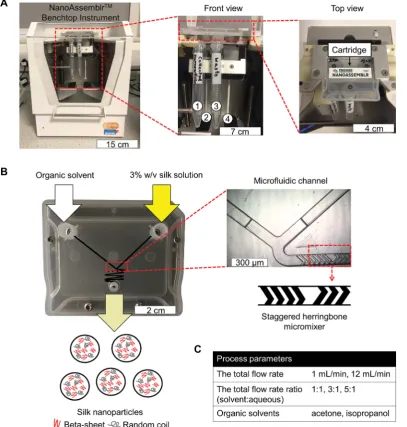
Silk nanoparticles were manufactured using a Nano-Assemblr™benchtop instrument version 1.5 (model number: SN: NA-1.5-16) (NanoAssemblr™, Precision Nano-Systems Inc. Van-couver, Canada) equipped with a microuidic cartridge (product code: NIT0012) (Fig. 1A). A 3% w/v aqueous silk solution and organic solvent (either acetone or isopropanol) were injected into separate chamber inlets, the silk nanoprecipitated in the micro-uidic mixer, and the resulting nanoparticles were collected in the outlet (Fig. 1B). The totalow rates of the organic solvent and silk solution were varied from 1 to 12 mL min1, and theow rate ratio was varied at 1 : 1, 3 : 1 and 5 : 1 (Fig. 1C). The collected silk nanoparticles were centrifuged at 48 400 g for 2 h and the supernatant was aspirated and discarded. The pellet was
resuspended in ultrapure water, vortexed, and subsequently sonicated twice for 30 s at 30% amplitude with a Sonoplus HD 2070 sonicator (ultrasonic homogenizer, Bandelin, Berlin, Ger-many). These centrifugation, washing, and resuspension steps were repeated at least twice more to produce thenal silk nano-particle suspension. The nanonano-particles were characterized as detailed below and stored at 4C until use.
The yield of silk nanoparticles
The total volume of the silk nanoparticle stock suspension was determined. Next, several 2 mL Eppendorf tubes were weighed before adding silk nanoparticles (W1). The manufactured silk nanoparticles were then added, frozen, and lyophilized over-night. The tubes containing the resulting freeze-dried silk nanoparticles were weighed again (W2) to determine the amount of silk nanoparticles and overall yield eqn (1).
Silk nanoparticle characterization and stability in water
The particle size, polydispersity index (PDI), and zeta potential of silk nanoparticles in ultrapure water were determined at 25C by dynamic light scattering (DLS, Zetasizer Nano-ZS Malvern Instrument, Worcestershire, UK). Particle size was determined using refractive indices of 1.33 for water and 1.60 for protein. The silk nanoparticles were stored in water at 4C and 37C and the size, PDI, and zeta potential were determined at days 0, 14, 28, 35, and 42. All measurements were conducted in triplicate.
Secondary structure measurements of silk nanoparticles
The silk nanoparticle suspension was frozen and then lyophilized overnight. The samples were subjected to secondary structure analysis by Fourier transform infrared (FTIR) spectroscopy (TENSOR II FTIR spectrometer, Bruker Optik GmbH, Ettlingen, Germany). Each measurement was run for 128 scans at a 4 cm1resolution over the wavenumber range of 400 to 4000 cm1. OriginPro 9.2 Soware was used to correct the baseline and peakt at the amide I region (1595– 1705 cm1), based on previous analyses.33Briey, the amide I
region was identied and deconvoluted: 1605–1615 cm1as side chain/aggregated strands, 1616–1637 cm1 and 1697– 1703 cm1 as beta-sheet structure, 1638–1655 cm1 as random coil structure, 1656–1662 cm1 as alpha-helical bands, and 1663–1696 cm1as turns. The second derivative was applied at the amide I region for peaknding. Gaussian line shapes were used for curvetting. Overtting of the data was avoided by xing the peak full width at half-maximum (FWHM) at 10 cm1.
Scanning electron microscopy of silk nanoparticles
The morphology of the prepared silk nanoparticles was assessed by scanning electron microscopy (SEM) using a
FE-%Yield of the silk nanoparticles¼ ðW2W1Þ total suspension volume
amount of silk passed through the microfluidic systemvolume of sample100 (1)
Open Access Article. Published on 30 November 2018. Downloaded on 1/10/2019 12:19:00 PM.
This article is licensed under a
SEM SU6600 instrument (Hitachi High Technologies, Krefeld, Germany) at 5 kV. Samples were pipetted onto a silicon wafer and lyophilized overnight. The specimens were coated with gold (15 nm thickness) using an ACE200 low vacuum sputter coater (Leica Microsystems, Wetzlar, Germany). The SEM images were processed using ImageJ v1.51j8 (National Institutes of Health, Bethesda, MD).34
Manufacture of silk nanoparticles forin vitroassays
Silk nanoparticles were manufactured by the automated microuidic NanoAssemblr™benchtop instrument, as detailed above. The totalow rate and ratio of isopropanol and 3% w/v
aqueous silk solution were varied depending on the formula-tions: (i) 5 : 1 at 1 mL min1for 110 nm size and (ii) 5 : 1 at 12 mL min1for 215 nm size.
Macrophage responses toward silk nanoparticles
The murine macrophage RAW 264.7 cell line was purchased from ATCC (Manassas, VA, U.S.A.). Cells were cultured in Dul-becco's Modied Eagle Medium (DMEM) (4.5 g glucose, 110 mg sodium pyruvate, 10% v/v FBS), grown in a humidied 5% CO2 atmosphere at 37C and routinely subcultured every 2–3 days by scraping cells offtheask and replating them at a split ratio of 1 : 10 on tissue culture treated polystyrene (Corning, New York,
Fig. 1 Schematic of silk nanoparticles manufacture using a microfluidic cartridge coupled with a NanoAssemblr™benchtop instrument. (A) NanoAssemblr™benchtop instrument with major components and arrangement. At front view, number 1 and 3 identify collection tubes for nanoparticles and waste, respectively. Number 2 and 4 are syringes containing an organic solvent and a 3% w/v silk solution, respectively. (B) Organic solvent and the silk solution are pumped into two inlets and rapidly three dimensional mixed, which leads to silk nanoparticle formation by nanoprecipitation. The microfluidic cartridge contains a micromixer channel, which is designed as a staggered herringbone structure. (C) The totalflow rate, totalflow rate ratio, and solvent choice were the process parameters for this study.
Open Access Article. Published on 30 November 2018. Downloaded on 1/10/2019 12:19:00 PM.
This article is licensed under a
[image:3.595.99.507.52.480.2]NY, U.S.A.). For cytotoxicity studies, cells were seeded in 96-well plates at a density of 1.5 104 cells per cm2and allowed to recover 24 h. Next, cells were treated with 2.5 to 100mg mL1of 110 nm and 215 nm silk nanoparticles. Aer a 48 h of incuba-tion, cell viability was determined using 3-(4,5-dimethylthiazol-2-yl)-2,5-diphenyltetrazolium bromide (MTT; 5 mg mL1 in phosphate buffered saline (PBS)); 20mL of MTT was added to each well and cultures were incubated for 5 h. The formazan product was solubilized with 100 mL of dimethyl sulfoxide (DMSO) and absorbance was measured at 570 nm. Untreated control cells represented 100% cell viability.
For tumor necrosis factor alpha (TNF-a) release, cells were seeded in Petri dishes at a density of 1.5104cells per cm2and allowed to recover overnight. Next, the culture medium was aspirated and replaced with fresh medium containing either (i) 15 ng of lipopolysaccharide (LPS, Sigma-Aldrich, St. Louis, MO, U.S.A.), (ii) 10mg mL1 and 500mg mL1 of either 110 nm or 215 nm silk nanoparticles, and (iii) control medium. Cultures were incubated for 24 h and then the medium was collected and centrifuged at 6000gfor 5 min. The supernatants were stored at80C until analysis. Culture supernatants were assayed for mouse TNF-ausing a DuoSet ELISA (R&D Systems, Minneap-olis, MN, USA) according to the manufacturer's instructions. All measurements were derived from three biological replicates.
Labeling silk nanoparticles withuorescent probes
A total of 3.5 mg of 110 and 215 nm silk nanoparticles were uorescently labeled as follows. First, the respective silk nano-particles were resuspended in 0.2 M NaHCO3at pH 8.3. Next, either 1 mg of Alexa Fluor 488 succinimidyl ester or Alexa Fluor 594 succinimidyl ester (Life Technologies, Carlsbad, CA, USA) was dissolved in anhydrous DMSO at 1 mg mL1. Then, 100mL of Alexa Fluor 488 and 100mL of Alexa Fluor 594 solution were added, respectively, to 110 nm silk nanoparticles and 215 nm silk nanoparticles in 0.2 M NaHCO3, pH 8.3. The samples were allowed to react overnight at room temperature in the dark with stirring. The labeled silk nanoparticles were then centrifuged, and the pellets were washed three times with acidied water (pH 4.6) to remove unbound dye, followed by three washes with ultrapure water. The samples were stored at 4C in the dark until use.
Cellular uptake and intracellular distribution of silk nanoparticles
RAW 264.7 cells were seeded and cultured in complete DMEM medium without phenol red. The cells were washed three times with PBS and the culture medium was replaced with either (i) control DMEM or (ii) 0.5 mg mL1mixed Alexa Fluor 488 (Life Technologies, Carlsbad, CA, U.S.A.) labeled 110 nm silk nano-particles and Alexa Fluor 594 (Life Technologies, Carlsbad, CA, U.S.A.) labeled 215 nm silk nanoparticles. The cells were either (i) incubated for 1 h or (ii) incubated 1 h followed by three washes with PBS and a 3 h chase in culture medium. The incubation was stopped by placing the cells on ice, aspirating all the medium, and washing three times with ice-cold PBS. The cells were then stained with 1mg mL1Hoechst 33342 (Thermo
Scientic, Waltham, MA, USA) for 10 min at room temperature in the dark, washed three times with ice-cold PBS, and live cells were imaged immediately with a Leica TCS-SP5 confocal laser scanning microscope (Leica Microsystems GmbH, Wetzlar, Germany) equipped with a 40magnication water objective with a numerical aperture of 1.25. The data were exported to ImageJ 1.51j8 (National Institute of Health, U.S.A.)34for image
analysis and colocalization.
Statistical analyses
Data were analyzed using GraphPad Prism 7.0 (GraphPad Soware, La Jolla, CA, U.S.A.). Sample pairs were analyzed with the Student's t-test. Multiple samples were evaluated by One-way and Two-One-way analysis of variance (ANOVA) followed by Bonferroni's multiple comparison post hoc test or Dunnett's post hoc tests to compare between the control and samples. Asterisks denote statistical signicance as follows:*P< 0.05,**P
< 0.01,***P< 0.001. All data are presented as mean values standard deviation (SD), and the number of independent experiments (n) is noted in eachgure legend.
Results
The yield of silk nanoparticles
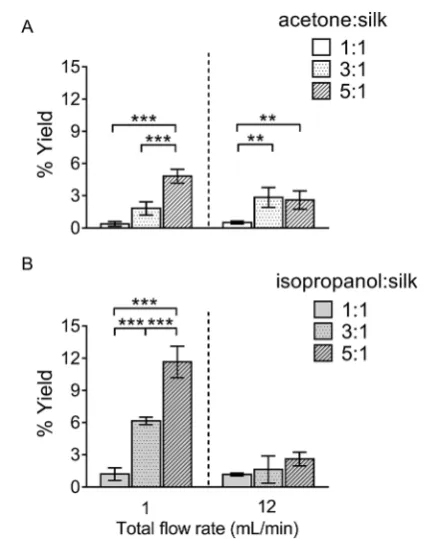
The percentage yield of silk nanoparticles was dependent on the totalow rate, the solvent ratio, and the actual solvent used. A solvent : aqueous total (ow rate) ratio of 5 : 1 gave
Fig. 2 Percentage yield of silk nanoparticles produced with a NanoAssemblr™ benchtop platform by varying the total flow rate and the flow rate ratios. The percentage yield of silk nano-particles using the organic solvents (A) acetone, and (B) iso-propanol. Error bars are hidden in the bar when not visible,SD, n¼3.
Open Access Article. Published on 30 November 2018. Downloaded on 1/10/2019 12:19:00 PM.
This article is licensed under a
[image:4.595.318.531.391.661.2]the best yield for both solvent systems (Fig. 2). The yield of silk nanoparticles was higher when prepared from iso-propanol than from acetone, especially at the 1 mL min1 ow rate. The highest silk nanoparticle yield (11.7% w/w of silk) was obtained from isopropanol with the iso-propanol : silk (i.e., aqueous phase) ratio of 5 : 1 and a 1 mL min1ow rate (Fig. 2B).
Silk nanoparticle characterization and their stability in water
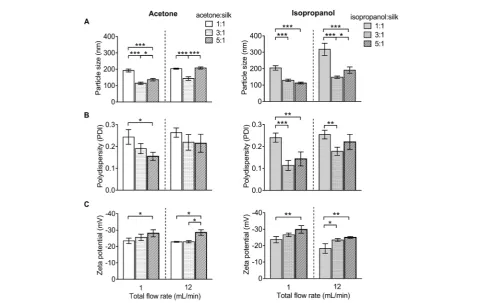
[image:5.595.56.543.390.693.2]For DLS measurement, the overall particle size of silk nano-particles ranged from 110 nm to 310 nm, with a poly-dispersity ranging from 0.1 to 0.25 and a negative surface charge ranging from20 mV to30 mV (Fig. 3). The aceto-ne : aqueous total ow rate ratio of 3 : 1 generated the smallest size (110 nm), while the acetone : aqueous totalow rate ratio of 1 : 1 generated larger particles (200 nm) (Fig. 3A). By contrast, the isopropanol : aqueous ratio of 5 : 1 at a 1 mL min1ow rate generated the smallest size (110 nm) and the isopropanol : aqueous totalow rate ratio of 1 : 1 at 12 mL min1 generated the largest particle size (310 nm) (Fig. 3A). However, a solvent : aqueous ratio of 1 : 1 showed higher polydispersity (>0.2), indicative of a wider particle size distribution (Fig. 3B). The solvent : aqueous total ow rate ratio of 5 : 1 generated higher negative charges of silk nanoparticles when compared with a lower ratio of solvents (Fig. 3C).
The particle size stability was also determined for up to 42 days. For the acetone system, all formulations were stable in water at 4C for up to 42 days. Silk nanoparticles generated with a ratio of solvent to silk of 5 : 1 at 12 mL min1showed a statistical signicant increase in particle size aer storage at 37C for 42 days (Fig. 4). The polydispersity of the silk nanoparticles did not change at 4C and 37C for up to 42 days (Fig. S1†). For the isopropanol system, silk nano-particles generated with the ratios of solvent : silk of 3 : 1 and 5 : 1 were stable at 4C and 37C for up to 42 days. However, silk nanoparticles generated with a isopropanol : silk ow rate ratio of 1 : 1, especially at the total ow rate of 12 mL min1, were not stable aer 14 days (Fig. 4). The poly-dispersity of the silk nanoparticles from an isopropanol : silk ow rate ratio of 5 : 1 slightly increased aer 28 days (Fig. S1†). The negative surface charges of the silk nano-particles from all formulations signicantly decreased aer 14 days at 37C (Fig. S2†).
Secondary structure measurement
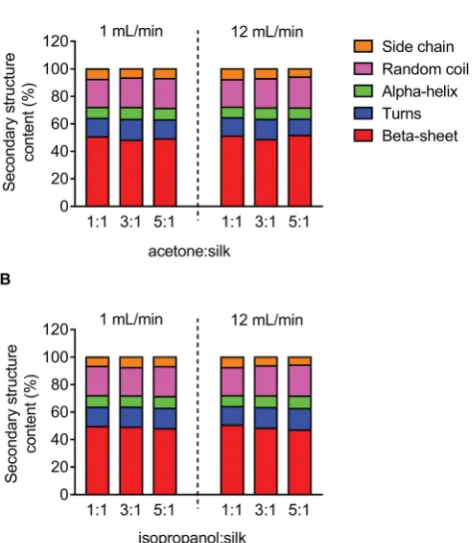
The secondary structure of the silk nanoparticles produced under different process conditions was determined by FTIR measurement following peak analysis. Overall, silk nano-particles manufactured using microuidics had a high beta-sheet content (48–51%), and changes in the microuidic parameters had no signicant effect on this content (Fig. 5).
Fig. 3 Characterization of silk nanoparticles produced with acetone and isopropanol using a NanoAssemblr™benchtop platform with different totalflow rates and ratios. (A) Particles size (nm), (B) polydispersity index (PDI), and (C) zeta potential of silk nanoparticles. Error bars are hidden in the bars when not visible,SD,n¼3.
Open Access Article. Published on 30 November 2018. Downloaded on 1/10/2019 12:19:00 PM.
This article is licensed under a
Scanning electron microscope of silk nanoparticles
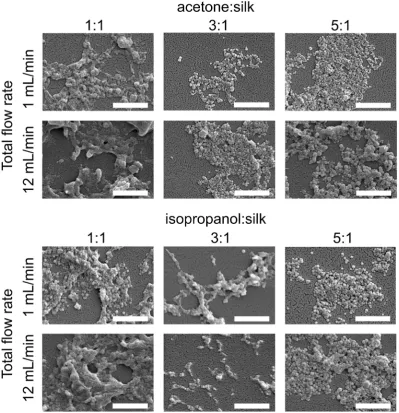
The morphology of silk nanoparticles was analyzed by SEM (Fig. 6). The silk nanoparticles generated by the solvent : aqu-eous totalow rate ratios of 3 : 1 and 5 : 1 had spherical shapes and uniform distributions, which correlated with the DLS measurements. Silk nanoparticles obtained using a totalow rate ratio of 1 : 1, especially at the total ow rate of 12 mL min1, showed larger sizes (up to 400 nm), irregular shapes,
and wide particle distributions (particles ranging from 200 nm to 400 nm) (Fig. 6).
In vitrocytotoxicity and macrophage responses to silk nanoparticles
For cytotoxicity studies, two different sizes of silk nanoparticles (110 and 215 nm) were generated. No signicant differences were noted in cytotoxicity between the two different sizes of silk
Fig. 4 Stability of silk nanoparticles manufactured with a microfluidic-based method by varying solvents, the totalflow rate, and theflow rate ratios. The particle size of the silk nanoparticles in water at 4C and 37C was measured over 42 days. Error bars are hidden in the plot symbols when not visible,SD,n¼3.
Open Access Article. Published on 30 November 2018. Downloaded on 1/10/2019 12:19:00 PM.
This article is licensed under a
[image:6.595.139.456.49.556.2]nanoparticles (Fig. 7A). The half maximal inhibitory concen-tration (IC50) of 110 nm and 215 nm silk nanoparticles toward RAW 264.7 cells was >100 mg mL1. The TNF-a release by macrophages exposed to silk nanoparticles and LPS (positive control) was also measured (Fig. 7B). TNF-arelease in response to 110 nm silk nanoparticles (at both 10mg mL1and 500mg mL1) did not differ signicantly from the release by control cultures. However, treatment of the cells with 500mg mL1of 215 nm silk nanoparticles caused a small, but statistically signicant, increase in TNF-arelease when compared to 110 nm nanoparticles at the equivalent dose (Fig. 7B). There was a statistical difference TNF-arelease between concentration of 10mg mL1and 500mg mL1of the silk nanoparticles (Student's
t-test).
Cellular uptake and intracellular distribution of silk nanoparticles in macrophages
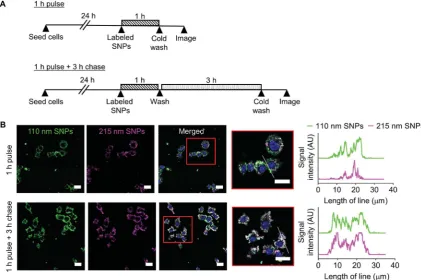
Cellular uptake and intracellular distribution of 110 nm and 215 nm silk nanoparticles were qualitatively studied using live-cell confocal microscopy (Fig. 8). Following a 1 h pulse, 110 nm silk nanoparticles and 215 nm silk nanoparticles were inter-nalized into different early endosome compartments. However, aer a 3 h chase, both sizes of silk nanoparticles were localized in the same late endocytic compartments. These results were corroborated by prole plots that showed high co-localization aer the 3 h chase (Fig. 8).
Discussion
Silk fromBombyx morihas a strong clinical track record1and is
currently emerging as a promising biomaterial for drug delivery (e.g., ref. 5, 6 and 35). The manufacture of silk nanoparticles is now increasingly reported (typically in the 100 nm size range), oen for (anticancer) drug delivery applications (e.g., ref. 10 and 36). Our use of silk nanoparticles has specically focused on drug loading and release,7surface modication,8intracellular
drug delivery,9 and the degradation of silk nanoparticles in
cells,12 as well as on the impact of these nanoparticles on
metabolism and blood compatability.11,37 However, in all of
these previous studies, we used 100 nm silk nanoparticles that we fabricated using a “conventional” nanoprecipitation method; i.e., manually adding the reverse-engineered silk solution to the organic phase.25 This production method is
a batch-based process and affords no in-process control tone tune the particle properties. Therefore, a manufacturing method that enables rapid silk nanoparticle production while providing control over the nanoparticle characteristics would represent a substantial improvement and would open up the use of these silk nanoparticles in a wider spectrum of biomed-ical applications.
Microuidic-based technologies have been successfully used for liposome and nanoparticle production (e.g., using 1,2-dipalmitoylphosphatidylcholine, phosphatidylcholine, poly-caprolactone-block-poly(ethylene oxide) and poly(lactide-co -gly-colide)-b-polyethyleneglycol), which allow scalable production and control over the particle characteristics.38–41Many different
microuidic platform designs have been introduced, but the most important feature is the mixer channel layout, which has included, for example, droplet based42as well as T and Y shaped
mixers.43,44 The staggered herringbone structure is a highly
efficient micromixer and is now one of the commonest designs, as it enhances the mixing of the aqueous and solvent phases due to chaotic advection phenomena.45The staggered
herring-bone micromixer is the most efficient passive mixer and could therefore be regarded as a “three dimensional” mixer. The staggered herringbone design shows higher mixing efficiency when the Reynolds numbers is in a range of 0 <NRe< 1000 (low
NRe). Therefore, mixing efficiency declined as Reynolds number increased with increasingow rate. In the present study, we used the fully automated NanoAssemblr™platform in combi-nation with a commercially available microuidic chip that incorporates the staggered herringbone structure design (Fig. 1).
We believe that this study is therst to report the continuous manufacture of silk nanoparticles. The production efficiency for generation of silk nanoparticles showed that the optimal conditions for achieving the highest silk nanoparticle yields were a totalow rate at 1 mL min1at a 5 : 1 solvent : aqueous ratio (Fig. 2). We speculate that this slower totalow rate (versus
12 mL min1) and high solvent concentration allows more time for interaction between the aqueous and solvent phases, thereby enabling a better removal of solvating water from the silk structure and ultimately resulting in silk nanoparticle
Fig. 5 Secondary structure analysis of silk nanoparticles produced by microfluidics by varying the totalflow rate,flow rate ratio, and solvents. Secondary structure content (%) of silk nanoparticles using (A) acetone and (B) isopropanol as the organic solvent.
Open Access Article. Published on 30 November 2018. Downloaded on 1/10/2019 12:19:00 PM.
This article is licensed under a
[image:7.595.50.288.60.332.2]Fig. 6 Scanning electron microscopy images of silk nanoparticles produced using the NanoAssemblr™benchtop platform with different total flow rates and ratios of organic solvents (scale bar¼1mm).
Fig. 7 In vitrocytotoxicity and TNF-arelease from macrophages (RAW 264.7 cells) in response to treatment with silk nanoparticles. (A) For cytotoxicity tests, 2.5 to 100mg mL1of 110 nm and 215 nm silk nanoparticles (SNPs) were incubated with the cells for 48 h. (B) The TNF-arelease into culture supernatants was quantified following a 24 h of exposure to 15 ng of LPS (positive control) or 10mg mL1and 500mg mL1of 110 nm and 215 nm silk nanoparticles and compared to release by untreated control cells (basal TNF-alevels). Dunnett's post hoc test was used to evaluate statistical differences between the basal and the samples. Error bars are hidden in the plot-symbol when not visible,SD,n¼3.
Open Access Article. Published on 30 November 2018. Downloaded on 1/10/2019 12:19:00 PM.
This article is licensed under a
[image:8.595.98.498.50.464.2] [image:8.595.128.475.517.663.2]formation through beta-sheet formation.46Therefore, solvents
with a high capacity to form hydrogen bonds with water are predicted to be good candidates for silk nanoparticle formation. We therefore selected isopropanol (a polar protic organic solvent), as it has a greater ability than acetone (or DMSO) (a polar aprotic organic solvents) to form hydrogen bonds with water. Previous batch-based studies have also successfully used isopropanol for silk nanoparticle formation (particle size ranging from 100 to 400 nm).46,47In the current study, the choice
of a lowow rate of 1 mL min1, the selection of isopropanol, and the use of a high organic solvent : aqueous ratio (i.e., 5 : 1) led to signicant improvements in yield (Fig. 2). Both the sol-vent : aqueous ratio and theow rate had a signicant impact on the particle size, PDI, and zeta potential (Fig. 3). The high solvent : aqueous ratio (i.e.,$3 : 1) generated small particles (110–200 nm) with a low polydispersity index (0.1–0.2) and high negative surface charge (23 to30 mV). Overall, these data highlight the importance of using sufficient amounts of solvent to extract the solvating water from the silk to initiate uniform nanoparticle nucleation and, ultimately, to narrow the particle size distribution. The zeta potential of silk nanoparticles produced using the microuidic setup was less negative (20 to 30 mV) when compared to those produced by a standard batch method (40 mV to50 mV,e.g., ref. 8 and 9). This compara-tively low negative zeta potential could be a consequence of the
continuous ow during particle formation, which could ulti-mately result in a different packing arrangement.
We also examined silk nanoparticle stability in water over 42 days, because (medical) applications of these silk nanoparticles requires them to have long-term stability during storage (Fig. 4, S1 and S2†). Silk nanoparticles generated from microuidics using a solvent : aqueous totalow rate ratio$3 : 1 were stable at 4 C and 37 C over the entire study period. This nding conrms the importance of the desolvating solvent concentra-tion for silk nanoparticle formaconcentra-tion and stability, because low solvent to silk concentration ratios resulted in nanoparticles with compromised stability. We therefore also expect to see differences in secondary structure, because silk nanoparticles with a low beta-sheet content have been reported.48However,
the silk nanoparticles prepared by microuidics had a compa-rable beta-sheet content (Fig. 5), indicating that this content was independent of the process parameters. Overall, all the silk nanoparticles generated were highly crystalline and essentially identical with respect to their secondary structure to nano-particles we have previously reported.8,9
Morphological assessment by electron microscopy indicated that the total ow rate and the ow rate ratio were the key parameters that inuenced the particle appearance (Fig. 6). Silk nanoparticles generated with a slow ow rate (1 mL min1) showed a more globular shape and appeared as discrete nano-particles when compared with those generated using aow rate
Fig. 8 Impact of silk nanoparticle size on trafficking in macrophages. (A) Experimental outline. Cells were either (i) pulsed with a mixture of 110 nm and 215 nm labeled silk nanoparticles for 1 h and imaged or (ii) pulsed with the labeled silk nanoparticles for 1 h and then chased for 3 h and imaged. (B) Live cell confocalfluorescence microscopy of the mixture of Alexa Fluor 488-labeled 110 nm silk nanoparticles (green) and Alexa Fluor 594-labeled 215 nm silk nanoparticles (magenta) in RAW 264.7 cells. The scale bars are 20mm. The white lines in the high magnification images are used in profile plots to highlight the colocalization of 110 nm and 215 nm silk nanoparticles in the cells.
Open Access Article. Published on 30 November 2018. Downloaded on 1/10/2019 12:19:00 PM.
This article is licensed under a
[image:9.595.85.507.50.330.2]of 12 mL min1, suggesting that the fastow rate could disrupt the spherical morphology during particle formation and result in a greater tendency of these particles to undergo a loose fusion. Due to the high molecular weight of the biopolymer silk (390 kDa), silk nanoparticle formation requires a sufficient amount of organic solvent for water removal in order to form packed silk nanoparticles. However, at a high totalow rate (i.e.
12 mL min1), one might speculate there was not enough time for efficient mixing of the two phases resulting in lower water removal. This in turn could results in “loosely” packed silk nanoparticles as evidenced by their irregular shape (Fig. 6) and low yield (Fig. 2). Overall, achieving a more discrete globular shape and uniformity required a solvent : aqueous ow rate ratio$ 3 : 1 (and a slowow rate). This minimum solvent to water ratio for the formation of silk nanoparticles is consistent with previous batch-based silk particle work.47
The nanosize range of silk nanoparticles is expected to result in solid tumor targeting in medical applications because the passive accumulation of nanoparticles (e.g., 100 to 200 nm) is facilitated by the tumor pathophysiology, which includes a leaky vasculature and impaired lymphatic clearance that results in enhanced permeation and retention (EPR) of nano-medicines.49 However, even EPR-mediated targeting typically
results in only a small fraction of the administered dose reaching the tumor,50 with most medicine accumulating in
other tissues, predominantly in macrophages of the mono-nuclear phagocytic system.51Macrophages are intimately
asso-ciated with solid tumor development;52 therefore, the
macrophage response toward nanomedicines is an important consideration. We have previously demonstrated that silk nanoparticles can prime macrophages toward an M1-like phenotype.37 Emerging evidence indicates that nanoparticle
size is important for macrophage recognition and subsequent particle internalization.53We therefore examined the
relation-ship of silk nanoparticle size to cytotoxicity, TNF-a release, cellular uptake, and intracellular distribution. Cytotoxicity was absent at the doses studied (i.e., keeping the amount of silk constant), with no obvious size-dependent cytotoxicity (Fig. 7A). We then selected low and high doses of 110 nm and 215 nm silk nanoparticles and monitored TNF-arelease. At the maximum tested concentration, only a small increase was noted, but a statistically signicant difference in TNF-a release was observed for 215 nm silk nanoparticles when compared to 110 nm particles (Fig. 7B). Nevertheless, the biological relevance of this difference is currently not known. Preliminary intracel-lular trafficking studies showed that 110 nm and 215 nm silk nanoparticles were both internalized by endocytosis within 1 h, but they were localized into different early endocytic structures. Following a 3 h chase, the silk nanoparticles of both sizes accumulated in late endosomal/lysosomal compartments, as suggested by their peri-nuclear localization (Fig. 8). The observed differences in trafficking at the early time point could suggest that endocytic compartments were size-selective, as reported previously for labeled erythrocytes.54However, more
detailed studies are needed to better characterize the intracel-lular trafficking of silk nanoparticles.
Conclusions
The use of a microuidic setup enabled the rapid, reproducible and controllable manufacture of silk nanoparticles. The total ow rate and the ow rate ratio were the two key process parameters that affected silk nanoparticle characteristics. A totalow rate of 1 mL min1and a solvent to aqueous phase ratio of 5 : 1 provided the smallest particle size, the highest yield, and best stability of silk nanoparticles. Subjecting the optimized silk nanoparticles to preliminary biological assess-ment indicated that they induced a particle-mediated macro-phage response. In summary, microuidic-assisted manufacturing enables thene tuning of silk nanoparticles.
Author contributions
T. W. acquired, analyzed, and interpreted data, and generated the manuscript dra. J. D. T. designed and performed confocal microscopy studies. All authors (T. W., J. D. T., B. F. J., and F. P. S.) designed research, discussed the results, and/or advised on the analysis. F. P. S. conceived the study and edited the manu-script with support from the other authors.
Con
fl
icts of interest
There are no conicts to declare.
Acknowledgements
We would like to thank Dr Richard Broadhead (Precision NanoSystems Inc, Vancouver, Canada) for providing training and technical advice. J. D. T.'s Ph.D. studentship was supported through the EPSRC Doctoral Training Partnership (EP/ M508159/1), University of Strathclyde. The authors thank the International Strategic Partnership between University of Strathclyde and Nanyang Technological University, Singapore for funding this work (T. W.). The authors acknowledge that this work was carried out in part at the EPSRC Future Continuous Manufacturing and Advanced Crystallisation (CMAC) Research Hub (EP/P006965/1), supported by a UK Research Partnership Fund award from the Higher Education Funding Council for England (Grant HH13054). All data created during this research are openly available from the University of Strathclyde-Pure, at http://dx.doi.org/10.15129/8763783e-813f-4753-a178-e81b4fd3011f.
References
1 C. Holland, K. Numata, J. Rnjak-Kovacina and F. P. Seib,Adv. Healthcare Mater., 2018, DOI: 10.1002/adhm.201800465. 2 M. Jewell, W. Daunch, B. Bengtson and E. Mortarino,Ann. N.
Y. Acad. Sci., 2015,1358, 44–55.
3 E. Wenk, H. P. Merkle and L. Meinel,J. Controlled Release, 2011,150, 128–141.
4 A. B. Li, J. A. Kluge, N. A. Guziewicz, F. G. Omenetto and D. L. Kaplan,J. Controlled Release, 2015,219, 416–430. 5 F. P. Seib,Ther. Delivery, 2018,9, 469–487.
6 F. P. Seib,AIMS Bioeng., 2017,4, 239–258.
Open Access Article. Published on 30 November 2018. Downloaded on 1/10/2019 12:19:00 PM.
This article is licensed under a
7 F. P. Seib, G. T. Jones, J. Rnjak-Kovacina, Y. Lin and D. L. Kaplan,Adv. Healthcare Mater., 2013,2, 1606–1611. 8 T. Wongpinyochit, P. Uhlmann, A. J. Urquhart and F. P. Seib,
Biomacromolecules, 2015,16, 3712–3722.
9 J. D. Totten, T. Wongpinyochit and F. P. Seib, J. Drug Targeting, 2017,25, 865–872.
10 Y. Tian, X. Jiang, X. Chen, Z. Shao and W. Yang,Adv. Mater., 2014,26, 7393–7398.
11 M. F. Maitz, C. Sperling, T. Wongpinyochit, M. Herklotz, C. Werner and F. P. Seib,Nanomedicine, 2017,13, 2633–2642. 12 T. Wongpinyochit, B. F. Johnston and F. P. Seib, ACS
Biomater. Sci. Eng., 2018,4, 942–951.
13 F. Mottaghitalab, M. Farokhi, M. A. Shokrgozar, F. Atyabi and H. Hosseinkhani,J. Controlled Release, 2015,206, 161– 176.
14 X. Wang, T. Yucel, Q. Lu, X. Hu and D. L. Kaplan,
Biomaterials, 2010,31, 1025–1035.
15 S. J. Myung, H. Kim, Y. Kim, P. Chen and H. Jin,Macromol. Res., 2008,16, 604–608.
16 V. Gupta, A. Aseh, C. N. R´ıos, B. B. Aggarwal and A. B. Mathur,Int. J. Nanomed., 2009,4, 115–122.
17 A. S. Lammel, X. Hu, S.-H. Park, D. L. Kaplan and T. R. Scheibel,Biomaterials, 2010,31, 4583–4591.
18 Z. Zhao, M. Xie, Y. Li, A. Chen, G. Li, J. Zhang, H. Hu, X. Wang and S. Li,Int. J. Nanomed., 2015,10, 3171–3181. 19 A. A. Lozano-perez, M. G. Montalban, S. D. Aznar-Cervantes,
F. Cragnolini, J. L. Cenis and G. Villora,J. Appl. Polym. Sci., 2015, 41702.
20 A. Gholami, H. Tavanai and A. R. Moradi,J. Nanopart. Res., 2011,13, 2089–2098.
21 E. Wenk, A. J. Wandrey, H. P. Merkle and L. Meinel, J. Controlled Release, 2008,132, 26–34.
22 Q. Lu, Y. Huang, M. Li, B. Zuo, S. Lu, J. Wang, H. Zhu and D. L. Kaplan,Acta Biomater., 2011,7, 2394–2400.
23 R. Rajkhowa, L. Wang and X. Wang,Powder Technol., 2008,
185, 87–95.
24 J. Kundu, Y.-I. Chung, Y. H. Kim, G. Tae and S. C. Kundu,Int. J. Pharm., 2010,388, 242–250.
25 T. Wongpinyochit, B. F. Johnston and F. P. Seib,J. Visualized Exp., 2016,116, e54669.
26 A. M. Smith, H. Duan, A. M. Mohs and S. Nie,Adv. Drug Delivery Rev., 2008,60, 1226–1240.
27 E. Kastner, R. Kaur, D. Lowry, B. Moghaddam, A. Wilkinson and Y. Perrie,Int. J. Pharm., 2015,477, 361–368.
28 M. Guimar˜aes, S. Correia, M. L. Briuglia, F. Niosi and D. A. Lamprou,Int. J. Pharm., 2017,516, 91–99.
29 A. Gdowski, K. Johnson, S. Shah, I. Gryczynski and J. Vishwanatha,J. Nanobiotechnol., 2018,16, 12.
30 D. N. Breslauer, S. J. Muller and L. P. Lee,Biomacromolecules, 2010,11, 643–647.
31 Z. Toprakcioglu, A. Levin and T. P. J. Knowles,
Biomacromolecules, 2017,18, 3642–3651.
32 U. Shimanovich, F. S. Ruggeri, E. De Genst, J. Adamcik, T. P. Barros, D. Porter, T. Muller, R. Mezzenga, C. M. Dobson, F. Vollrath, C. Holland and T. P. J. Knowles,
Nat. Commun., 2017,8, 1–9.
33 X. Hu, D. Kaplan and P. Cebe, Macromolecules, 2006, 39, 6161–6170.
34 C. A. Schneider, W. S. Rasband and K. W. Eliceiri, Nat. Methods, 2017,9, 671–675.
35 T. Yucel, M. L. Lovett and D. L. Kaplan,J. Controlled Release, 2014,190, 381–397.
36 M. G. Montalban, J. M. Coburn, A. A. Lozano-Perez, J. L. Cenis, G. Villora and D. L. Kaplan, Nanomaterials, 2018,8, 126.
37 R. Saborano, T. Wongpinyochit, J. D. Totten, B. F. Johnston, F. P. Seib and I. F. Duarte,Adv. Healthcare Mater., 2017,6, 1601240.
38 S. Joshi, M. T. Hussain, C. B. Roces, G. Anderluzzi, E. Kastner, S. Salmaso, D. J. Kirby and Y. Perrie, Int. J. Pharm., 2016,514, 160–168.
39 I. V Zhigaltsev, N. Belliveau, I. Hafez, A. K. K. Leung, J. Hu, C. Hansen and P. R. Cullis,Langmuir, 2012,28, 3633–3640. 40 Z. Xu, C. Lu, J. Riordon, D. Sinton and M. G. Moffitt,
Langmuir, 2016,32, 12781–12789.
41 J.-M. Lim, N. Bertrand, P. M. Valencia, M. Rhee, R. Langer, S. Jon, O. C. Farokhzad and R. Karnik,Nanomedicine, 2014,
10, 401–409.
42 S.-Y. Teh, R. Lin, L.-H. Hung and A. P. Lee,Lab Chip, 2008,8, 198–220.
43 R. Wang,J. Nanopart. Res., 2013,15, 2128.
44 G. Liu, X. Yang, Y. Li, Z. Yang, W. Hong and J. Liu, Adv. Mater. Sci. Eng., 2015, 160819.
45 A. D. Stroock, S. K. W. Dertinger, A. Ajdari, I. Mezic, H. A. Stone and G. M. Whitesides,Science (80-), 2002,295, 647–652.
46 Y.-Q. Zhang, W.-D. Shen, R.-L. Xiang, L.-J. Zhuge, W.-J. Gao and W.-B. Wang,J. Nanopart. Res., 2006,9, 885–900. 47 M.-R. Tudora, C. Zaharia, I.-C. Stancu, E. Vasile, R. Trusca
and C. Cincu,UPB Sci. Bull. Ser. B, 2013,75, 43–52. 48 L. Xiao, G. Lu, Q. Lu and D. L. Kaplan,ACS Biomater. Sci.
Eng., 2016,2, 2050–2057.
49 Y. Matsumura and H. Maeda,Cancer Res., 1986,46, 6387– 6392.
50 A. A. Nati, D. Ravishankar, H. M. I. Osborn and F. Greco,J. Pharm. Sci., 2017,106, 3179–3187.
51 H. H. Gustafson, D. Holt-Casper, D. W. Grainger and H. Ghandehari,Nano Today, 2015,10, 487–510.
52 A. Mantovani, F. Marchesi, A. Malesci, L. Laghi and P. Allavena,Nat. Rev. Clin. Oncol., 2017,14, 399–416. 53 T. Kusaka, M. Nakayama, K. Nakamura, M. Ishimiya,
E. Furusawa and K. Ogasawara,PLoS One, 2014,9, e92634. 54 E. P. Berthiaume, C. Medina and J. A. Swanson,J. Cell Biol.,
1995,129, 989–998.
Open Access Article. Published on 30 November 2018. Downloaded on 1/10/2019 12:19:00 PM.
This article is licensed under a