
Vol. 65,No. 12
Expression, Processing, and Assembly of Foot-and-Mouth Disease
Virus Capsid Structures in Heterologous Systems: Induction of
a
Neutralizing Antibody Response
in
Guinea
Pigst
SAMUEL A. LEWIS,t DONALD0. MORGAN, AND MARVIN J. GRUBMAN* Plum Island Animal Disease Center, NorthAtlantic Area, Agricultural Research Service,
U.S.Department of Agriculture, P.O. Box 848, Greenport, New York 11944 Received17 June1991/Accepted9September1991
Plasmids containing thefoot-and-mouth disease virus structural protein precursor (P1) and 3C protease
genes orthe P1 genealonewere expressedinEscherichia coli. A recombinant baculoviruscontainingtheP1
gene wasalso generated andexpressedinSpodopterafrugiperdacells.Expressionof the P1 and3CgenesinE.
coli resulted in efficient synthesis and processing ofthe structural protein precursor and assembly into 70S empty capsids. This material reacted with neutralizing monoclonal antibodies which recognize only
confor-mational epitopes and elicited a significant neutralizing antibody response in vaccinated guinea pigs. Expressionofthe P1genein E. coli resulted insynthesisofaninsolubleproduct, whereas in insect cells infected with the recombinant baculovirus a soluble productwas synthesized. Both soluble and insoluble P1 reacted witha12S-specificmonoclonalantibody,butonlysoluble P1 elicitedaneutralizingantibodyresponseinguinea
pigs.
Foot-and-mouth disease (FMD) is a major pathogen of ruminantsin manypartsof the world. The diseaseiscaused by members of theAphthovirusgenusof the Picornaviridae family. An inactivated virus vaccine is used in disease controlprograms, and it has been estimated that worldwide more than abillion doses of the vaccine are used annually (3). Concern about the safety of the vaccine exists, as outbreaks of FMD in Europe have been associated with
shortcomings invaccine manufacture (25). These concerns have led to efforts to develop subunit vaccines as safer alternatives. One ofthe virus capsid proteins, VP1, either
purified from virus particles or produced by recombinant
DNA technology, has been successfully used to protect cattle and swinefrom challenge(4, 26). Likewise, peptides eitherproduced by recombinantDNA technologyor chem-ically synthesized and representing limited regions ofVP1 havealso been successfully usedto protectcattleandswine against challenge with some serotypes of FMD virus
(FMDV) (8, 15, 30). However, relatively large amounts of
theseimmunogenswererequiredtoproduce protection, and
often induction of a neutralizing antibody response with these immunogens, asmeasured by in vitroassays, did not correlate withprotection ofthe hostanimal(7).
FMDVcontains 60 copies each of four proteins (VP1 to
VP4) that form anicosahedral particle encapsidating a pos-itive-sense, single-stranded RNA genome of approximately 8,500 nucleotides (3). Examinations of virus structure by
monoclonal antibody (MAb) analysis (5, 9, 42, 46), nucleic
acid sequencing ofneutralization-resistant mutants (6, 14,
44-47), and X-ray crystallographic analysis have revealed
thatthemajor immunogenic sitesonFMDV(1),aswellas on
other picornaviruses (22, 38), involve conformational epitopes.
*Correspondingauthor.
tIn memoryofourfriend andcolleagueDonald0.Morgan.
tPresent address: ImmuCell Corporation, 966 Riverside St., Portland, ME 04103.
Rweyemamu et al. (41) have shown that FMDV type A emptycapsids (subviral particles lackingnucleicacid)areas
immunogenic as virions in guinea pigs and that antisera raised against empty capsids have the same serological specificityinneutralizationtestsasdo seraprepared against virions. By MAb analysis,wehavedemonstratedthat empty virus capsids isolated from infected cells antigenically
re-semble virusparticles (21).Furthermore,weand others have shown that, in a cell-free translation system programmed
with FMDV RNA or subgenomic RNA transcripts, viral structural proteins self-assemble into various capsid inter-mediates(12, 18, 21). Onthe basis of theseresults,agoalof ours has been to utilize recombinant DNA technology to construct FMDV clones thatcanexpress, inan appropriate host, conformationallycorrectimmunogensthat lacknucleic acid and could make effective and safe vaccines.
Previously,wedescribed the constructionofrecombinant cDNA clones representing the complete FMDV coding region (34, 53). By utilizing theseconstructsin thisstudy,we produced additional clones containing either the structural
proteinprecursor (P1)geneor theP1gene and the viral 3C
gene,which encodes theproteaseresponsibleformostof the
cleavageswithin theP1protein.Theseclones,undercontrol of a bacteriophage T7 promoter, were expressed in an Escherichia coli system. The constructcontainingonly the
P1 gene wasalso used toproduceaninfectious baculovirus
recombinant. In this communication, the synthesis and
processing ofthese gene products are examined.
Further-more, theabilityof thegeneproductstoassemblecorrectly
and theirimmunogenicityinguinea pigs areevaluated.
MATERIALS ANDMETHODS
Enzymes and chemicals. Restriction endonucleases, T4 DNA ligase, the large fragment of DNA polymerase I
(Klenow fragment), and calfintestinal alkalinephosphatase were purchased from New England Biolabs, Inc., and BoehringerMannheimBiochemicals. E. coliBL21(DE3) (48) was kindly provided by J. Dunn, Brookhaven National
6572
JOURNALOFVIROLOGY, Dec. 1991, p. 6572-6580 0022-538X/91/126572-09$02.00/0
Copyright© 1991, American Societyfor Microbiology
on November 10, 2019 by guest
http://jvi.asm.org/
EXPRESSION OF FMDV CAPSID PROTEINS 6573
Ldu
11IVP2
IVP3
IVPI
I
2C
13A13
3C
0 1 2 3 4 5 6 7
. I
HkUdU XholI 8gm
CATATGGAATr507 NdsI
3180
TaI Pa I PutI Bwnu
6401B pTP123
p7P12B.pJP12B
*
~~~~~~~~~~~~~~pTP1ZX3P
Xho Xho Pat Pa
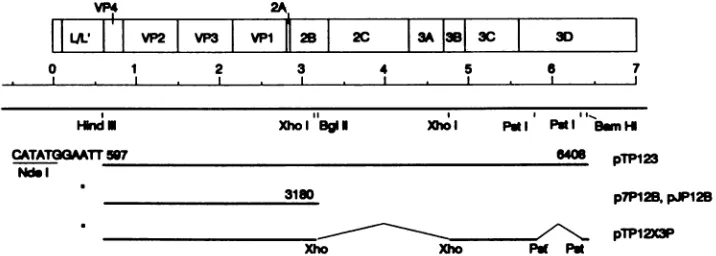
FIG. 1. Schematic representation ofFMDVexpressionplasmids.Amapof the codingregion of the FMDVgenome,using thepicornavirus nomenclaturesystem (40),is givenatthetop, andselected restriction sites usedto constructthe plasmidsareshown. ThelabeledpTPand p7Pplasmids containabacteriophageT7promoter and aShine-Dalgarnosequenceupstreamofthe FMDVcoding region,while plasmid pJP contains theFMDVsequence in baculovirus transfervectorpJV(NheI).pTP123containstheP1,P2, andP3coding regionsup to a BamHI siteatbase6408inthe 3D gene. p7P12B andpJP12BcontaintheP1and P2regionsup to aBglIIsiteatbase3180in the2B gene.pTP12X3P containstheP1 andP2regionsup to anXhoIsiteatbase3142 inthe2Bgeneandthe P3region fromanXhoIsiteatbase 4753 inthe3B gene to aPstI siteatbase5790 inthe3Dgene. Thus,pTP12X3Pcontains thecomplete3C protease gene. ThebridgedareasonpTP12X3Prepresent deletionsofthe FMDV codingregion, asdescribedinthe text.
Laboratories, andexpression vector pT7-7 was a gift of M.
Esteban, State University of New York Health Science
Centerat Brooklyn. Cells were grown in 2x YT (2) or M9
medium (2), each containing 100 ,ug ofampicillin per ml.
Autographa californica nuclear polyhedrosisvirus was
pro-vided by M. Summers, Texas A&M University, College
Station; pJV(NheI) was the gift of C. Richardson, McGill
University;
and Spodoptera frugiperda (Sf9) cells wereobtained from theAmerican TypeCulture Collection.
Construction of plasmids. Recombinant plasmids were constructedby standardcloning
procedures
(2)and used totransformHB101 or XL1-Blue cells. Relevant constructs are
diagrammed in Fig. 1. Plasmids were constructed from
pTP123 (53), which contains FMDV sequences from bases 592 to 6408(VPOtothemiddle of 3D) in T7 expression vector pET-3c (48). pTPlA was made bydigestion of pTP123 with BamHI andBglII and ligation.p7P12B was constructed by
digestion of pTP123 with NdeI and EcoRV, gelisolation of
the FMDVfragment(bases 592 to 3180), andligationofthis DNA into expression vector pT7-7 (50), which had been
digestedwith NdeI and SmaI and treatedwithcalfintestinal alkaline phosphatase. pTP12X3P was made by digestion of
pTP123 withXhoI, ligation,digestionwith PstI, and ligation. Both constructs p7P12B and pTP12X3P contain three codons upstream of the amino terminus of VP4 and a
methionine codonfor initiation of proteinsynthesis. p7P12B contains 21 codons of pET-3c downstream of the coding region of FMDV before an in-frame stop codon, and
pTP12X3P contains three codons downstream of the an-nealed PstI site. Plasmid DNA was recovered from
trans-formed HB101 cells and checked by restriction enzyme
analysis and nucleic acid sequencing of the5'junction bythe
dideoxy-chain termination method (43).
Construction of recombinant baculovirus. To construct
transferplasmid pJP12B, FMDV sequences were removed
frompTPlAbydigestionwith NdeI andEcoRV,blunt ended
with the Klenow fragment, gel isolated, and ligated into
,-galactosidase
gene-containing
vectorpJV(NheI)
(54), which had been digested withNheI,
blunt ended with theKlenow fragment, and treated with calf intestinal alkaline
phosphatase. Recombinant virus JP12B was made by cotransfectingpJP12B andA.californicanuclear
polyhedro-sis virus DNAs into Sf9 cells and plaque purifying the recombinant virus aspreviously described(49).
Induction in E. coli. BL21(DE3)cells containing plasmid
pTP12X3P orp7P12B were grown in 2x YT to an
A6.
of approximately 0.6. At this time, expressionwasinducedbyaddition of 125 ,ug of isopropyl-,-D-thiogalactopyranoside
(IPTG) per ml. Cells were harvested prior to and at various times afterinduction. Cellswerepelleted, washed twice with phosphate-buffered saline (PBS), suspended in sample prep-aration buffer(0.63MTris-HCl[pH6.8],2% sodiumdodecyl
sulfate [SDS], 0.68 M 2-mercaptoethanol, 10% glycerol,
0.005%bromophenol blue), boiled for 3 min, and pelleted.
The supernatant (total) was examined by
SDS-polyacryl-amide gel electrophoresis (PAGE) (28), and the gels were
analyzedby silver staining (55). To radiolabelproteins, cells
weregrown in M9 medium andat an
A6.
of 0.6theywereinduced withIPTGas described above. [35S]methionine (50
to 100 ,uCi/ml) wasaddedto0.5 ml of cells prior to andat
various times afterinduction, and labeling was continued for 30min. To inhibit E. coli protein synthesis, rifampin, at 200 ,ug/ml,wasadded 30min after induction and theradioisotope
was added 30 min later. Cells were pelleted and lysed in samplepreparation buffer as described above.Alternatively, cells werepelleted, washed twice in PBS, suspended in 100 ,ul of 10 mM Tris-HCl (pH8.0)-i mMEDTA (TE)plus 4% glycerol, incubated with 100 ,ug of lysozyme per ml at 37°C for 15min, and frozen at -70°C. The cell lysatewasthawed, adjusted to 10 mMMgSO4, treated with 25 ,ug of DNase per ml for 15 min at 37°C, and pelleted bycentrifugation in an
Eppendorf microcentrifuge for 5 min (37). The pellet was
suspended in 100pAl of TE-4%glycerol, andboth thepellet and supernatant fractions were analyzed by PAGE or
su-crose gradientcentrifugation.
Proteinsynthesis in Sf9 cells.Monolayers of Sf9 cellswere
infected at 0.1 PFU per cell with recombinant virus JP12B. Cells were harvested after5days (unless otherwise noted), pelleted,suspended in 0.15 MNaCl-0.002 M EDTA-0.01 M Tris-HCl (pH 7.5) (NET) containing 0.05% Nonidet P-40, andfrozen at -20°C.
Analysis of capsidstructures. Supernatant fractions from lysed pTP12X3P-containing E. coli were diluted to 1% Nonidet P-40 and 1% sodiumdeoxycholate andcentrifuged
VOL.65, 1991
on November 10, 2019 by guest
http://jvi.asm.org/
[image:2.612.143.501.82.210.2]6574 LEWIS ET AL.
on a10 to50%(wt/vol) sucrose gradient in NET buffer in an SW41 rotor at 17,000 rpm for 17 h at 4°C.
Preparation of FMDV-infected celllysates. Bovine kidney (BK) cells or baby hamster kidney (BHK-21) cells were infected with FMDV type A12 strain ll9abat amultiplicity ofapproximately 20 PFU per cell and labeled with [35S]me-thionine after the appearance of cytopathic effects. After labeling, the cells were washed and lysed as previously described (13).
In vitro translation. Preparation of rabbit reticulocyte
lysates and the conditions for in vitroprotein synthesiswere
aspreviously described (19).
Western blotting (immunoblotting). FMDV proteinswere
detected immunologically following Western blotting as de-scribed by Towbin et al. (51), by using a semidry blotter and nitrocellulose membranes. The blotswere blocked by using
3%nonfat dry milk in PBS and incubated overnight at 4°C with rabbit or bovine serum against inactivated FMDV or
bovineconvalescent serum(1:100 or1:200). Antibody bind-ing was detected by incubation for 2 h with approximately
500,000 cpm of 125I-labeled acid-treated FMDV per ml or
withiodinated recombinantprotein A/G (17, 33).
MAbs.TheMAbswereproducedatourCenterby follow-ing protocols previously detailed (31, 45, 46). In brief, the immune cells were elicited in BALB/cmice by either inoc-ulation of killed virus or virion fragments or by FMDV infection and fused with the 6X63-Ag8.653 myeloma cellsof
Kearney etal. (24). The MAbs were classified by epitope
location (5, 9, 42, 46), whichwasbased upondetermination of the least structurally complex particle with which the MAb reacted (i.e., the 140Svirion, the 12Sprotein subunit [12Sps], or individual viralproteins).
Sandwich enzyme-linked immunosorbent assay (ELISA).
Anti-FMDV antibodies were purified (i.e., by ammonium
sulfate precipitation and protein A-Sepharose affinity chro-matography) from the sera of rabbits that had been given four 100-,ug subcutaneous inoculations of
purified
FMDV A12 at 4-week intervals (26). Cross-reactions between the rabbit anti-FMDVand themouseMAbswereeliminatedby immunoadsorption. A 1:200 dilution of rabbit anti-FMDVantibodies (catcher) in 0.05 M Na2CO3-NaHCO3 (pH 9.6)
wasadsorbed onto plastic overnightat4°C(Nunc
Immuno-platesII; GIBCO-Europe Ltd). Theremaining protein-bind-ingcapacity of the plasticwassaturated withblockingbuffer
composedof3%bovineserumalbumin and0.05%Tween 20
inPBSfor 1 h at37°C. Antigenswere boundto the coated
plastic by incubation overnightat4°Candthenreacted with undiluted tissue culturesupernatantsofvariousMAbsfor 30 min at 37°C and 15 min at 4°C. The MAbs bound to the
plasticwere detectedbyanELISAprocedure performed as
previously described (45).
Vaccination. Mature Dunkin-Hartley guinea pigs were
vaccinated under the loose skinjust off the dorsal midline
over the rib cage with 2 ml ofan antigen preparation per animal. A booster vaccination was administered 96 days
after the primary vaccination. The antigen preparations containedequal volumes of lysed cells at aprotein concen-tration of 3 to 4 mg/ml, emulsified in Freund's complete
adjuvant. On the basis of the results obtained (see Fig. 3),
approximately 1%or lessof the total cell protein represents FMDVproducts.
Serologic evaluation. Blood samples were obtained by
cardiac puncture, and serum was prepared by standard procedures and stored at -20°C until tested. A50% mouse
protectivedose assaywasperformed with dilutions ofserum as
previously
described (46).RESULTS
ConstructionofplasmidscontainingFMDVgenes.To
study
theinvivo
expression, processing,
andassembly
ofFMDVproteins,
plasmids containing
cDNA from the type A12genomewereconstructedinseveralvectors. The
regions
of the FMDVpolyprotein
encodedby
theseplasmids
arerepresented
inFig.
1. Twoof theplasmids
wereconstructedby
placing
the FMDV sequences in anexpression
vectorunder thecontrol ofa
bacteriophage
T7promoter. PlasmidpTP12X3P contains the gene forthe FMDV structural pro-tein precursor
(P1),
the 2A gene, mostof2B and 3B genes, thecomplete
3C gene, and a smallportion
of the 3D gene, whileplasmid p7P12B
contains the P1 and 2A genes andmost of the 2B gene but lacks the3C gene. These
plasmids
were usedto transformBL21(DE3)cells which contain the T7 RNA
polymerase
geneinserted in the hostchromosome,
where its
expression
is inducibleby
IPTG(48).
PlasmidpJP12B
contains the same FMDV genesasp7P12B
clonedintobaculovirus transfervector
pJV(NheI)
under thecontrol of thepolyhedrin
promoter. PlasmidpJP12B,
along
withwild-type
A.californica
nuclearpolyhedrosis
virusDNA,
wasusedto cotransfect Sf9
cells,
and arecombinantvirus,
JP12B,
was selected(23,
49).
Expression ofFMDV proteins. Bacterial cells
containing
pTP12X3P
andp7P12B
were induced withIPTG,
andat1 hafterinduction
they
wereradiolabeled with[35]Smethionine.
Lysateswere
prepared
andanalyzed by
SDS-PAGE. Induc-tion of cellscontaining
pTP12X3P
resulted insynthesis
ofproteins
thatcomigrated
with FMDVproteins P1-2A,
P1,
VP3-VP1, VPO, VP3,
VP1,
and3C,
while induction of cellsharboring p7P12B
resulted insynthesis
of P1-P2'(presum-ably
the uncleavedprecursor)
and P1-2A(Fig. 2).
These results suggest thatFMDVproteins
areexpressed
in E. coliand that the presence of the 3Cprotease resulted incorrect
and efficient
processing
of the P1 precursor. E.coli-ex-pressed
VPOmigrates slightly
slower than markerVPO,
presumably
because of the presence of four additionalcodons in
plasmid
pTP12X3P,
including
aninitiating
methi-oninecodon,
upstream ofthe amino terminus of VP4(see
Materials andMethods).
Processing
between P1-2A and P2 is inefficient in E. coli cellscontaining
p7P12B,
while effi-cientprocessing
toP1-2Awasobserved inSf9 cells infected with recombinant baculovirus JP12B(Fig.
3,
4,
and5).
Host
transcription
can beselectively
inhibited withri-fampin,
adrug
thatinhibits E.coli
RNApolymerase
whilenot
affecting
T7 RNApolymerase (48).
Since FMDVpro-teins are translated from genes under the control ofa T7 promoter,their
synthesis
shouldcontinue in the presenceofthis
drug.
As shown inFig.
2,
proteins
thatcomigrate
with FMDVproteins
continueto besynthesized
whilesynthesis
ofmostotherproteins
is inhibited(lanes
5 and9).
The
expression
of viralproteins
inbacterial cells and in insect cells infected with recombinant baculovirus JP12Bwasalso examined
by
SDS-PAGE of celllysates
followedby
silverstaining.
As shown inFig. 3,
alowlevel ofP1-P2' is present upon induction of cellscontaining p7P12B
andproteins P1, VP3-VP1, VPO, VP3, VP1,
and 3C aresynthe-sized in
pTP12X3P-containing
cells. Aprotein
comigrating
with FMDVprotein
P1-2Ais observed after infection of Sf9 cells(Fig. 3B).
Immunological identification of FMDV
proteins.
Todem-onstratethat the
proteins synthesized
in induced cellscon-taining plasmids
pTP12X3P
andp7P12B
are virusspecific,
lysates
wereexaminedby
Westernblotting using
antiserumprepared against
either inactivated virus or convalescentJ. VIROL.
on November 10, 2019 by guest
http://jvi.asm.org/
pTP12X3P p7P128
o o
> .
C C
P1-2A _
_- m
3D- _m iJ
VP3-VP1 - _
Li-p0>*
USS
vPO- _,
IPTG Rif.
-P1-P2
C0N
2C- s o _
.A.
VP1,VP3- ._
3C- _t,_
L-
-
0-CO
m x
N N
NHN
P1-P2'- ~
jr-P1i
CCL-1it
4-VP3-VP1
Om teVPO
I!
3
'VP1,VP3
-3C
1 2 3
m
N
kw_
B
bai.4.
i...
bow-B-gal
-^j,,~,f
-P1-2AI_ W_
w _.
ft..-':
_ _
ar_
_ _ _
a
1 2 3 4 5 6 7 8 9 10
FIG. 2. Expression of FMDV proteins in E. coli cell lysates
containing plasmids pTP12X3P and p7P12B prior to and after induction with IPTG. Aliquots ofBL21(DE3) cells containing plas-midpTP12X3P or p712B wereradiolabeled with[35S]methioninefor 30minpriorto or at 1 hafterinduction withIPTG. To inhibit E.coli RNApolymerase-directedRNAsynthesis,200 ,ug ofrifampin(Rif.) permlwasadded 30minafter IPTG inductionand theradioisotope was added 30 min later. Cells were lysed in sample preparation buffer and examined by SDS-PAGE on a15% slab gel. Lanes: 1,
[35S]methionine-labeled FMDV A12-infected BK cell cytoplasmic extract;2, [35S]methionine-labeled FMD A12 virion RNA-directed in vitro protein synthesislysate; 3 to 6, lysates containing pTP12X3P radiolabeled without (-) orwith (+) IPTG or rifampin; 7 to 10, lysates containing p7P12B radiolabeled without or with IPTG or
rifampin. Truncated proteinsareindicated byaprime.
serum. Upon induction, cells containing pTP12X3P pro-duced immunologically reactive proteins comigrating with
P1, VP3-VP1, VPO, VP3, VP1, and 3C, while cells
contain-ing p7P12B produced reactiveP1-P2' and lesser amounts of P1-2A(Fig.4Aand B). InSf9 cells infected with JP12B, only
a protein comigrating withP1-2A was reactive byWestern blot analysis (Fig. 4A), although this recombinant virus contains the sameFMDVcoding region asp7P12B.
The kinetics ofinduction of FMDV proteins in E. coli and ininfectedSf9 cells wereanalyzedby Western blot analysis
(Fig. 5). FMDV proteins induced in E. coli containing pTP12X3P reproducibly accumulated for only 2 h, and
subsequently the cells eliminated this plasmid (data not
shown). FMDV proteins produced by cells containing p7P12B generally accumulated for at least 4 h (Fig. 5). In
Sf9-infected cells, P1-2A was first observed 3 days after
FIG. 3. Expression ofFMDVproteins in induced E. colicells and in recombinant baculovirus-infected cells. (A) Aliquots of BL21(DE3)cells containing p7P12B (lane 1)orpTP12X3P(lane3) wereinducedwithIPTG for4or 2h,respectively.Cells werelysed, andproteinswereexaminedbySDS-PAGEona12.5% slab gel after silver staining. Control cells containing plasmid pT7-7 lacking FMDV sequences(lane 2)wereinduced and examinedasdescribed in the text.(B) Sf9cells weremock infected(lane 1),infectedwith wild-type baculovirus(lane2), orinfectedwithrecombinant bacu-lovirusJP12B(lane3). Threedays after infection, cellswerelysed andcytoplasmicextractswereexaminedbySDS-PAGEon a7.5% slab gel after silverstaining. WT, wildtype;B-gal,p-galactosidase.
infection and accumulated for at least 2additional days (Fig. 5).
The solubility of theFMDV proteinsexpressedinE. coli and ininfected Sf9cellswasexamined(datanotshown). In cells containing pTP12X3P, P1, VPO, and 3C were mainly insoluble and VP3 and VP1 were mainly soluble, while in cells containing p7P12B, all of P1-P2' and P1-2A were
insoluble. In contrast, in Sf9-infected cells, P1-2A was
approximately50% soluble.
Assembly of FMDVstructuralproteincomplexes. To deter-mine whether theprocessedstructuralproteinsexpressedin E. coli cells containing pTP12X3Pareable to assemble into empty capsids, cells were radiolabeled 1 h after induction and the soluble fraction of cell lysates was examined by
sucrose gradientcentrifugation (Fig. 6). A peak of
radioac-tivity migrated in the region of the empty
capsid
marker(70S) (Fig. 6A). SDS-PAGE analysis of this peak showed thatit containedonlystructuralproteinsVPO, VP3,and VP1
(Fig.6B). The identities of theseproteinswereconfirmedby
Westernblotting(datanotshown).
Immunological demonstration ofcapsidassembly. A series of MAbs againstFMDV serotypes A12,A5, Asia-i,and 01
I I I- I
I + + +
on November 10, 2019 by guest
http://jvi.asm.org/
[image:4.612.76.312.76.410.2] [image:4.612.332.569.77.370.2]6576 LEWIS ET AL.
a.
CO
x c in °
. > aL >
A
-cl_
EL
CO cY4
X
ClM
0
Q
pTP12X3P p7P12B JP12B
[ 1 [
--1--
P1-P2'-P1- -t|1- IP L-2A
._
VP3-VP1- _w
Pl-P2'- *. mP1
P1- 1..r m-P1-2A
-_. i ._f, ....
8:1..I
VP3-VP1-
-go
'-.I
im
_ _
-VP3-VP1
-VPO
-VP..VP
'~P -VP1,VP3
VP1,VP3-.d'& J4L
3C
FIG. 4. Immunoblot analysis of FMDV proteins expressed in inducedE.coli cellsand inrecombinant baculovirus-infected cells. (A) Aliquots of BL21(DE3) cells containing pTP12X3Porp7P12B
wereinduced with IPTG for 4 or 2 h, respectively, and cells were lysed, while a cytoplasmic extract was prepared 4 days after infection of Sf9 cells with JP12B. Thesamples were separated by SDS-PAGEon a12.5%slabgel,blotted ontonitrocellulose,reacted with antiserumagainstinactivatedFMDV, anddetected with 1251_ labeled protein A/G. A [35S]methionine-labeled, FMD A12 virion RNA-directed in vitro protein synthesis lysate was used as a marker. (B) An aliquot of BL21(DE3) cells containing pTP12X3P wasinduced for 2h, lysed, analyzed bySDS-PAGEon a12.5%slab gel, blotted onto nitrocellulose, reacted with bovine convalescent antiserum against FMDV, and detected with 125I-labeled protein A/G.
Brugge have been characterized andclassified (5, 9, 21, 31,
35, 45, 46). Five classes of MAbs wereused foranalysis of
pTP12X3P-, JP12B-, and p7P12B-expressed products (9). Class I MAbsarespecificfor 140Svirus,classIIMAbsreact
with both 140S virus and 12Sps,class III MAb epitopes are on VP1 andare exposed on the virion and 12Sps, class IV
MAbsreactonly with 12Sps, and class V MAbs reactwith 12Sps and VP1. MAbs of classes I, II, and III are
neutral-izing antibodies. Epitopes recognized by class IV and V MAbs are not available on the virion, and thereby these MAbs are not neutralizing. The MAbs were used in a sandwich ELISA with total lysed cells or the soluble or
pellet fractions frominduced E. coli containing pTP12X3P or p7P12B and acytoplasmic extract from JP12B-infected Sf9
cells. Essentially identical results were obtained with all of thecellfractions of a particular antigen (data not shown). In initial assays, cell extracts were titrated at various dilutions and the highesttiters were obtained with undilutedantigen
*0
0 1 2 4 0 1 2 4 2 3 4 5
[image:5.612.54.288.75.387.2]Hr Hr Days
FIG. 5. Kinetics of synthesisof FMDV proteins in inducedE. coli and inrecombinant baculovirus-infected cells.BL21(DE3) cells containing pTP12X3Porp7P12BwereinducedwithIPTG, aliquots
wereremovedpriortoandat1, 2, or 4 hafterinduction, andcells were lysed. Sf9 cells were infected with JP12B, aliquots were removeddailyfrom 2 to 5days afterinfection,and cellswerelysed.
ExtractsfromE.coli induced cellswereanalyzedby SDS-PAGEon
a10%slabgel,whilecytoplasmicextractsfromJP12B-infectedcells wereanalyzed by SDS-PAGEona7.5% slab gelandsampleswere blotted onto nitrocellulose. FMDV proteins were reacted with antiserum against inactivated FMDV and detected by incubation with 1251-labeled,acid-treatedFMDV.
(data not shown). Therefore, all subsequent
experiments
wereperformed withundiluted antigen.
Products synthesized in the E. coli(pTP12X3P) system reacted with a class I neutralizing MAb, two class II
neu-tralizing MAbs, andtwoclass IVMAbs
(Table
1). All threeof these MAb classes react with
epitopes
whoseintegrity
requires complex viralorviral subunitstructure.Inaddition, several classIIIneutralizing antibodies(sequentialepitopes)
and a class V nonneutralizing
antibody
reacted with the products (Table 1). FMDV protein P1-2A produced inJP12B-infectedSf9 cells reacted withoneclass IVMAb
(and
weakly with a second)and also with aclass V MAb(Table
1). FMDVP1-P2' synthesized ininduced E. colicontaining
p7P12Breactedweakly with the sameclass IV and V MAbs
asP1-2A(Table 1).Aclass IIMAb, 23FB4,andtwoclassIV
MAbs, 12AF4 and 31IH7, were elicited with FMDV
sero-types A5 Spain, 01 Brugge, and Asia-1,
respectively.
Thestructuresrecognized bytheseMAbsarecommon to atleast several other serotypes (9, 44).
Vaccination ofguinea pigs. The fiveguinea pigs vaccinated
withlysed cells expressingpTP12X3P demonstrated a
neu-tralizing antibody response after one vaccination, and the titers of the surviving animals increased significantly after thebooster vaccination(Table 2). Onlytwo offive animals demonstrated a serologic response when vaccinated with lysedJP12B-infectedcells, and the titers also increased after theboostervaccination. Animals vaccinated withlysedcells
expressing p7P12B failed to seroconvert, even after the second vaccination.
DISCUSSION
ExpressioninE. coli ofa constructcontaining theFMDV
structuralproteinand3C protease genes resulted in efficient
synthesis and processing of the FMDV structural protein
precursorP1.Biochemicalandimmunological analyses dem-onstrated that variable portions of theprocessed structural
proteins were assembled into capsid intermediate
com-plexes, including70S particles, andwereable to reactwith
J. VIROL.
on November 10, 2019 by guest
http://jvi.asm.org/
[image:5.612.312.546.75.206.2]EXPRESSION OF FMDV CAPSID PROTEINS 6577
TABLE 1. Anti-FMDVMAb reactions in asandwich ELISA with the expressed FMDVproteinsa
ElicitingFMDV
~~~~~~~~~~~~~~~~~S/Cc
MAb antigen MAbclassb Specificity
antigen
~~~~~~~~~
~~~pTP12X3P
JP12B p7P12B2PD11.12.8.1 A12 I 140S 4.1 1.1 0.9
2FF11.1.4 A12 II 140S, 12Sps 3.1 1.2 1.2
23FB4.1.ld A5Spain II 140S, 12Sps 4.2 1.4 1.1
6EE2.1.2 A12 III 140S,12Sps, VP1 4.6 1.0 1.5
6HC4.1.3 A12 III 140S,12Sps,VP1 7.0 1.0 1.4
12AF4.1.le 01 Brugge IV 12Sps 8.7 4.8 2.7
31IH7.1.1f Asia-1 IV 12Sps 7.7 1.6 1.3
6AE9.1.1 A12 V 12Sps, VP1 9.6 2.9 2.1
aSamples include undilutedsupernatantfractions fromlysedE.colicontainingpTP12X3Por p7P12Bwhichwere inducedfor2 h orcytoplasmicextractsfrom lysed Sf9 cells whichwereinfectedfor 5 days withrecombinant baculovirusJP12B. Controls include undiluted supernatantfractions fromlysedE.colicontaining
pT7-7 induced for2 h orcytoplasmic extractsfrom lysed Sf9 cellsinfectedwith wild-typebaculovirus.
bSee reference9.
cSample-to-control ratio.
dReactswithserotypesA,0, and C. eReacts with serotypesAand 0. fReactswithserotypesAsia-1,A,andC.
conformation-dependent MAbs. Furthermore, these pro-teins-complexes induced a significant neutralizing antibody response inguinea pigs.
A second construct expressed in E. coli or as a recombi-nantbaculovirus in Sf9 cells contained only the P1 and 2A genesand partof the 2B gene. Expression in E. coli resulted in synthesis of an insoluble polyprotein, P1-P2', which was not efficiently processed at the 2A-2B cleavage site. In contrast, this construct wasexpressedas asolubleprotein in
insect cells and was very efficiently processed to P1-2A.
TABLE 2. Serologicresponseelicitedbyvaccination of guinea pigs with FMDV-expressed proteins
MPD50bonPVDC:
Antigena
39 126
pTP12X3P 2.0 2.4
pTP12X3P 1.4 >4.0
pTP12X3P 1.7 3.0
pTP12X3P 1.6
pTP12X3P 0.4
JP12B 0.9 1.0
JP12B 0.7 0.5
JP12B <0.3 2.9
JP12B <0.3 0.7
JP12B <0.3
p7P12B <0.3 <0.3
p7P12B <0.3 <0.3
p7P12B <0.3
p7P12B <0.3
p7P12B <0.3
aGroupsoffiveguinea pigswereeachvaccinatedwith adifferentantigen preparation that consisted of1ml oflysed cells, containing3 to 4 mgof total
cellprotein, emulsifiedin anequalvolume of Freund'scomplete adjuvant. Approximately 1%orlessof the total cell protein representsFMDVproducts.
bAntibody titersareexpressedasthe50%mouseprotectivedose(MPD50), derived as the log1oofthe reciprocal dilution protectinghalf of the mice inoculated with 100mouselethaldoses.
cGroupsoffiveguineapigswerevaccinatedonday1and boosted onday
96.Theanimalswerebled onpostvaccinationdays (PVD)39 and126,and the seraweresubsequentlytested inamouseprotectionassay.By
postvaccina-tionday 126,anumber of animalshad died.
dThe titers of thesurviving animalsbled atpostvaccination day126 do not
necessarily correspondtothoseofparticularanimalswithinanantigengroup atpostvaccinationday39.
Both products reacted with a class IV, 12S-specific MAb (Table 1), butonly the soluble product was abletoinducea
neutralizing antibody response inguinea pigs (Table 2). This is the first demonstration that a picornavirus structural protein precursor is able to elicit a neutralizing antibody
response in animals.
Assembly of picornavirus structural proteins into virus particles is a complex process involving many steps. The initial step is synthesis of a protomer which contains one
copyof each of the four structuralproteins. Five protomers then assembleintoapentamer. Itispostulated that
process-f z:
.--w
_wm _ _ -VPQO -vPo
--VP3VP'
....~
A
1rt.
1%S
~~~~~~~~~~~~~~~~~~~~~~~~~~~~~~~~~~~~~~~~~~~~~~~~~~~~~~~~~~~~~~~1
~~~~~~ ~~~~I
Frci'NTIe
Fractior Nu-r-er
1 2 3
FIG. 6. Formation of FMDV empty capsids in E. coli cells
containing plasmid pTP12X3P. An aliquot of BL21(DE3) cells
containing plasmidpTP12X3Pwasinduced with IPTG and
radiola-beled 1 h laterfor 30minwith[35S]methionine.Cellswerelysed,and
asupernatantfractionwasprepared,treated with Nonidet P-40 and
sodium deoxycholate, and centrifuged on a 10 to 50% (wt/vol)
sucrosegradientasdescribed in Materials and Methods. A [35S]me-thionine-labeled FMDV-infected BK cell cytoplasmic extract was
centrifuged on aparallel gradient and usedas a marker. Samples from each fraction were assayed for acid-insoluble radioactivity.
Fractions from the70S regionwerepooled(P),acetoneprecipitated,
andanalyzed by SDS-PAGE ona 15%slabgel. Lanes: 1,pooled samples (P) from the gradient; 2, [35S]methionine-labeled
FMDV-infected BK cell cytoplasmic extract; 3, [35S]methionine-labeled FMD virion RNA-directed in vitroprotein synthesis lysate. VOL. 65,1991
on November 10, 2019 by guest
http://jvi.asm.org/
[image:6.612.62.565.90.195.2] [image:6.612.326.562.418.586.2] [image:6.612.66.306.427.612.2]6578 LEWIS ET AL.
ing of theprotomer to VPO, VP3, and VP1 occurs
immedi-ately upon synthesis and, thus, prior to its assembly into a pentamer (39). Empty capsids are formed by assembly of
pentamers and entrance of an RNAmolecule andprocessing
of VPO to VP4 and VP2 results in formation of mature
virions. The role, if any, that an unprocessedprotomer, or perhaps an unprocessedpentamer,might have ininducing an
immune response in animals has not been evaluated. Our
results obtained with recombinant baculovirus JP12B
sug-gest that folding ofP1 occurs, since it was recognized in a
solid-phase radioimmunoassay by aMAb whichreacts only
with acid-derived 12S structures and not with any of the
individual structural proteins (45, 47). Furthermore, P1,
either as a protomer or as a more complex structure, was
able to elicit aneutralizing antibodyresponse inguinea pigs.
Ourresults obtained withthebacterial expression system
containing plasmid pTP12X3P demonstrate theassembly of
FMDV empty capsids and, perhaps, 14S pentamers.
How-ever, the process is clearlyinefficient. This is in contrast to
the efficient morphogenesis of FMDV in infected tissue culture cells. Thus, we have been unable to produce
suffi-cient amounts ofemptycapsids orothercomplexes toallow
us topurify theseantigensand directlyexamine their immu-nogenic potential in experimental animals.
There are a number of possible reasons for inefficient assembly ofFMDV capsid structures in the E. coli
expres-sionsystem. Forexample, it hasrecently been shown for all picornaviruses examined, includingFMDV, that the amino-terminal glycine of VP4 is myristoylated (11, 32). This modificationoccurs initiallyon the P1 precursor protein (11, 32). The importance of this modification has been examined withpoliovirusmyristoylation-negative mutants. In this sys-tem, the late steps of virus assembly are inhibited and the reduced level ofmature virions produced is not infectious (27, 29). Thus, ithas been speculated that myristoylation of P1 and VPO functions as an anchorage site for maintenance of a high concentration of protomers and pentamers at the membrane site where capsid assembly is believed to occur (10, 27, 29).
Our FMDV constructs contain four additional codons,
including an initiating methionine codon, upstream of the amino-terminal glycine of VP4. Thus, in these constructs, theproposed consensus myristoylation signal, glycine-X-X-X-Ser/Thr, where X represents any amino acid (11), has been altered. Furthermore, E. coli contains no detectable myristoyl-coenzyme A:protein N-myristoyltransferase ac-tivity, the enzyme responsible for protein myristoylation (16). Recently, however, Duronio et al. (16) have reconsti-tuted the Saccharomyces cerevisiae myristoyl-coenzyme A:protein N-myristoyltransferase system in E. coli. There-fore, it is now feasible to determine whether myristoylation ofFMDV P1, containing the proposed amino-terminal con-sensusmyristoylation signal, results in more efficient assem-bly of FMDV capsid intermediate structures in an E. coli expression system containing the S. cerevisiae myristoyl-coenzyme A: proteinN-myristoyltransferase gene.
The apparent toxic effect of the 3C protease in our bacterial expression system also clearly limits the level of synthesis and assembly possible. Alternative strategies to circumvent this problem include placing theP1 and 3C genes under the control of different promoters and expressing the 3C gene product only after substantial P1 has been synthe-sized. In addition, isolation of a recombinant baculovirus containing both theP1and3C genes may also result in higher levels ofproduction of FMDV empty capsids than possible in theE. colisystem. For example, poliovirus empty capsids
have been purified from Sf9 cells infected with a recombi-nant baculovirus containing the entire coding
region
ofpoliovirus type 3 (52). However, in contrast to the level of
productionof P1-2A inoursystem, Roosien et al. (36)have
been able to synthesize only very low levels of FMDV
capsidproteinsin their recombinant baculovirusexpression
system.
The concept ofutilizing biosynthetically produced
com-plex FMDV capsid structures as vaccines appears to be
worth pursuing. However, a number of fundamental ques-tions concerning virus assembly and the level of
capsid
complexity necessary to induce maximum production ofa
protectiveantibodyresponse inanimals remain unanswered.
Nevertheless, our initial studies suggest that
complex
FMDV antigens, including the unprocessed P1 structural
proteinprecursor,areabletoinducea
neutralizing antibody
response. Furthermore, results from
ongoing
challenge
ex-perimentswith swine indicate that animals vaccinatedwith
pTP12X3P-expressed
products
areprotected
against
virulentviruschallenge,while
JP12B-expressed
P1 is abletopreventFMDV-induced disease but not virus infection.
However,
p7P12B-expressed
P1-P2' affordsnoprotection
(20).
ACKNOWLEDGMENTS
WethankMarlaZellnerand BrendaRoddfor technical assistance andAdrieneCiuprykfortypingthemanuscript.
REFERENCES
1. Acharya,R., E. Fry, D.Stuart, G. Fox, D. Rowlands, and F. Brown. 1989. The three dimensional structure of foot-and-mouthdisease virus at2.9Aresolution. Nature(London)337: 709-716.
2. Ausubel,F. M., R.Brent,R. E. Kingston, D. D.Moore,J. G. Seidman, J.A.Smith,and K.Struhl. 1987. Current
protocols
in molecular biology. Greene Publishing Associates andWiley-Interscience, NewYork.
3. Bachrach, H. L. 1977. Foot-and-mouth disease virus: proper-ties, molecularbiology, andimmunogenicity. Beltsville
Symp.
Agric. Res. 1:3-22.
4. Bachrach, H. L., D. M. Moore, P. D. McKercher, and J. Polatnick. 1975. Immuneandantibodyresponsesto anisolated
capsid protein of foot-and-mouth disease virus. J. Immunol.
115:1636-1641.
5. Baxt, B.,D.0. Morgan,B. H. Robertson,and C. A. Timpone.
1984. Epitopes of foot-and-mouth disease virus outer
capsid
proteinVP1 involved in neutralization and cell attachment. J. Virol. 51:298-305.
6. Baxt, B.,V. Vakharia, D. M. Moore, A.J. Franke, and D.0. Morgan. 1989. Analysis ofneutralizing antigenic sites on the surface of type A12 foot-and-mouth disease virus. J. Virol. 63:2143-2151.
7. Bittle, J. L., R. A. Houghten, H. Alexander, T. M. Shinnick,
J. G. Sutcliffe, R. A. Lerner,D. J. Rowlands, and F. Brown. 1982. Protection againstfoot-and-mouth disease by immuniza-tion with a chemically synthesized peptide predictedfrom the viral nucleotide sequence. Nature(London)298:30-33. 8. Broekhuijsen, M., J. M. M. Van Run, A. J. M. Blom, P. H.
Pouwels, B.E. Enger-Valk, F. Brown, and M.J. Francis. 1987. Fusion proteins with multiple copies of the major antigenic
determinant of foot-and-mouth disease virus protect both the natural host and laboratory animals. J. Gen. Virol. 68:3137-3143.
9. Butchaiah, G., J. L. Card, and D. 0. Morgan. Antigenic
relationships of foot-and-mouth disease virus serotype Asia-1
isolatesdemonstratedbymonoclonalantibodies. Vet.Immunol.
Immunopathol., in press.
10. Caliguiri, L. A., and R. W. Compans. 1973. The formation of
poliovirus particles in association with the RNA replication
complexes. J. Gen. Virol. 21:99-108.
11. Chow, M., J. F. E. Newman, D. Filman, J. M. Hogle, D.J. J. VIROL.
on November 10, 2019 by guest
http://jvi.asm.org/
Rowlands, and F. Brown. 1987. Myristylation of picomavirus capsid proteinVP4and its structural significance.Nature (Lon-don) 327:482-486.
12. Clarke, B. E., and D. V. Sangar. 1988. Processing and assembly of foot-and-mouth disease virus proteins using subgenomic RNA.J.Gen. Virol. 69:2313-2325.
13. Devaney, M. A., J. Kendall, and M. J. Grubman. 1988. Charac-terization of a nonstructural phosphoprotein of two orbiviruses. Virus Res. 11:151-164.
14. Diamond, D. C., B. A. Jameson, J. Brown, M. Kohara, S. Abe, H. Itoh, T. Komatsu, M. Arita, S. Kuge, A. D. M. E. Osterhaus, R. Crainic, A. Nomoto, and E. Wimmer. 1985. Antigenic varia-tion and resistance to neutralization in poliovirustype 1. Sci-ence 229:1090-1093.
15. DiMarchi, R., G. Brooke, C. Gale, V. Cracknell, T. Doel, and N. Mowat. 1986. Protection of cattle against foot-and-mouth dis-easebyasynthetic peptide. Science232:639-641.
16. Duronio, R. J., E.Jackson-Machelsky,R.0.Heuckeroth, P. 0. Olins,C.S. Devine, W. Yonemoto, L. W.Slice,S. S. Taylor, and J. I. Gordon. 1990.Protein N-myristoylationinEscherichiacoli: reconstitution of aeukaryoticprotein modificationinbacteria. Proc. Natl. Acad.Sci. USA87:1506-1510.
17. Fraker, P. J., and J. C. Speck. 1978. Proteinand cell membrane iodinations with a sparingly soluble chloramide 1,3,4,6-tetra-chloro-3a,6a-diphenylglycoluril. Biochem. Biophys.Res. Com-mun.80:849-857.
18. Grubman, M. J. 1984. In vitro morphogenesis of foot-and-mouth disease virus.J. Virol.49:760-765.
19. Grubman, M. J., and B. Baxt. 1982. Translation of foot-and-mouth disease virion RNA and processing of the primary cleavage products in a rabbit reticulocyte lysate. Virology 116:19-30.
20. Grubman, M. J., S. A. Lewis, and D.0.Morgan. Unpublished data.
21. Grubman, M. J., D.0.Morgan, J. Kendall, and B. Baxt. 1985. Capsid intermediates assembled in a foot-and-mouth disease virus genome RNA-programmed cell-free translation system andininfectedcells. J. Virol. 56:120-126.
22. Hogle, J. M., M. Chow, and D. J. Filman. 1985. Three-dimen-sional structureof poliovirus at 2.9A resolution. Science229: 1358-1365.
23. Hooft van Iddekinge, B. J., G. E. Smith, and M. D. Summers. 1983. Nucleotide sequence of the polyhedrin gene of Au-tographa californica nuclear polyhedrosis virus. Virology 131: 561-565.
24. Kearney, J. F., A. Radbruch, B. Llesegang, and K. Rajewsky. 1979.A new mousemyeloma cell linethat has lost immunoglo-binexpression but permits the construction of antibody secret-ing hybridcelllines. J.Immunol. 123:1548-1550.
25. King, A. M. Q., B. 0. Underwood, D. McCahon, J. W.I. Newman, and F. Brown. 1981. Biochemical identification of viruses causing the1981outbreaksof foot-and-mouth diseasein theUK. Nature (London)293:479-480.
26. Kleid, D. G., D. Yansura, B. Small, D. Dowbenko,D. M.Moore, M. J. Grubman, P. D. McKercher, D. 0. Morgan, B. H.
Robertson, and H. L. Bachrach. 1981. Cloned viral protein vaccine for foot-and-mouth disease: responses in cattle and swine. Science214:1125-1129.
27. Krausslich, H.-G., C. Holscher, Q. Reuer, J. Harber, and E.
Wimmer. 1990. Myristoylation ofthepoliovirus polyprotein is required for proteolytic processing ofthe capsid andfor viral
infectivity. J.Virol. 64:2433-2436.
28. Laemmli, U.K. 1970.Cleavageof structuralproteins duringthe assembly ofthe head ofbacteriophage T4. Nature (London) 227:680-685.
29. Marc, D., G. Masson, M.Girard, and S. vander Werf. 1990. Lack ofmyristoylation ofpoliovirus capsid polypeptide VPO prevents theformationof virionsorresults in theassemblyof noninfectiousvirusparticles.J. Virol.64:4099-4107.
30. Morgan, D. O., and D. M. Moore. 1990.Protectionof cattle and swineagainst foot-and-mouthdiseaseusingbiosynthetic peptide
vaccines. Am. J. Vet. Res. 51:40-45.
31. Morgan, D.O.,B. H.Robertson, D. M.Moore, C.A.Timpone,
and P. D. McKercher.1984.Aphthoviruses:control of foot-and-mouthdisease withgenetic engineeringvaccines,p.135-145.In E. Kurstak (ed.), Control of virus diseases. Marcel Dekker,
Inc., NewYork.
32. Paul, A. V., A. Schultz, S. E. Pincus, S. Oroszlan, and E.
Wimmer.1987.Capsid proteinVP4ofpoliovirusis
N-myristoy-lated. Proc. Natl. Acad. Sci. USA 84:7827-7831.
33. Reay,P.1982. Useof N-bromosuccinimide for the iodination of proteins forradioimmunoassay. Ann. Clin. Biochem. 19:129-133.
34. Robertson,B.H.,M.J.Grubman,G. N.Weddell,D. M.Moore, J. D. Welsh, T. Fischer, D.J. Dowbenko, D. G. Yansura, B. Small, and D. G. Kleid. 1985. Nucleotide and amino acid sequence coding for polypeptides of foot-and-mouth disease virus type A12. J. Virol.54:651-660.
35. Robertson, B. H., D. 0. Morgan, and D. M. Moore. 1984. Location ofneutralizing epitopes definedby monoclonal anti-bodiesgeneratedagainsttheoutercapsid polypeptide, VP1,of foot-and-mouthdisease virus A12. VirusRes. 1:489-500. 36. Roosien, J., G. J. Belsham, M. D. Ryan, A. M. Q. King,and
J. M. VIak. 1990. Synthesis of foot-and-mouth disease virus
capsid proteins in insect cells using baculovirus expression vectors.J. Gen. Virol.71:1703-1711.
37. Rosenberg,A.H.,andW. F. Studier.1987. T7RNApolymerase can direct expression of influenza virus cap-binding protein
(PB2)inEscherichiacoli. Gene59:191-200.
38. Rossmann, M. G., E.Arnold, J. W. Erickson, E. A. Franken-berger,J.P.Griffith,H.J.Hecht, J.E.Johnson,G.Kamer,M. Luo,A.G.Mosser,R.R.Rueckert,B. Sherry,andG. Vriend. 1985. Structure ofahumancommoncoldvirus and functional
relationshiptootherpicornaviruses.Nature(London) 317:145-153.
39. Rueckert, R. R. 1989. Picornaviridae and theirreplication, p. 507-548. In B. N. Fields,D. M. Knipe,R. M. Chanock,J. L.
Melnick, B.Roizman,and R. E. Shope (ed.), Virology.Raven Press, NewYork.
40. Rueckert, R.R.,and E. Wimmer. 1984. Systematic nomencla-tureofpicornavirus proteins.J. Virol. 50:957-959.
41. Rweyemamu,M.M.,G.Terry,andT.W. F.Pay.1979.Stability
and immunogenicityof emptyparticles of foot-and-mouth dis-easevirus.Arch. Virol. 59:69-79.
42. Saiz, J. C., M. J. Gonzalez, D. 0. Morgan, J. L. Card, F. Sobrino, and D. M. Moore. 1989. Antigenic comparison of differentfoot-and-mouth disease virus typesusingmonoclonal antibodiesdefining multiple neutralizing epitopesonFMDVA5
subtypes.VirusRes. 13:45-60.
43. Sanger, F.,S.Nicklen,and A. R.Coulsen. 1977. DNA
sequenc-ing with chain-terminating inhibitors. Proc. Natl. Acad. Sci. USA74:5463-5467.
44. Sherry, B.,A. G.Mosser, R.J. Colonno,and R. R. Rueckert. 1986. Useof monoclonal antibodiestoidentifyfour neutraliza-tion immunogenson a commoncold picornavirus, human rhi-novirus 14. J.Virol. 57:246-257.
45. Smitsaart, E. N., J. C. Saiz, R. J. Yedloutschnig, and D.0. Morgan. 1990. Detection of foot-and-mouth disease virus(6/7
serotypes)in infectedtissuesbytheinhibitionofamonoclonal
antibodybased ELISA.Vet.Immunol. Immunopathol. 26:251-265.
46. Stave,J.W., J.L. Card,and D. 0.Morgan.1986. Analysisof foot-and-mouth disease virus type 01 Brugge neutralization
epitopes usingmonoclonal antibodies. J. Gen. Virol. 67:2083-2092.
47. Stave, J. W., J. L.Card, D.0. Morgan,and V. N. Vakharia. 1988. Neutralization sites of type 01 foot-and-mouth disease virus defined by monoclonal antibodies and neutralization-escape virus variants. Virology 162:21-29.
48. Studier,F.W.,andB.A.Moffat.1986. UseofbacteriophageT7 RNA polymerase to direct selective high-level
expression
of cloned genes. J. Mol. Biol. 189:113-130.49. Summers,M.D.,andG. E.Smith.1987. Amanual of methods forbaculovirusvectorsand insectcell cultureprocedures.Tex.
Agric. Exp. Stn. Bull. no. 1555.
50. Tabor, S., and C. C. Richardson. 1985. A bacteriophage T7
on November 10, 2019 by guest
http://jvi.asm.org/
6580 LEWIS ET AL.
RNA polymerase/promoter system for controlled exclusive expression of specific genes. Proc. Natl. Acad. Sci. USA 82:1074-1078.
51. Towbin, H., T. Staehelin, and J. Gordon. 1979.Electrophoretic transfer of proteins from polyacrylamide gels tonitrocellulose sheets: procedureandsomeapplications. Proc. Natl. Acad. Sci.
USA 76:4350-4354.
52. Urakawa, T., M. Ferguson,P. D. Minor, J.Cooper,M.Sullivan, J. W. Almond, and D. H. L. Bishop. 1989. Synthesis of immu-nogenic,but non-infectious,poliovirus particlesininsectcellsby
abaculovirusexpressionvector.J. Gen. Virol. 70:1453-1463. 53. Vakharia, V. N., M. A. Devaney, D. M. Moore, J. J. Dunn, and
M.J.Grubman.1987.Proteolytic processing offoot-and-mouth diseaseviruspolyproteins expressedinacell-freesystemfrom clone-derived transcripts. J.Virol. 61:3199-3207.
54. Vialard, J.,M.Lalumiere,T.Vernet,D.Briedis, G. Alkhatib,D.
Henning, D. Levin, and C. Richardson. 1990. Synthesisof the membranefusion andhemagglutinin proteins of measles virus, usinganovelbaculovirusvectorcontaining the B-galactosidase
gene. J.Virol. 64:37-50.
55. Wray, W., T. Boulikas, V. P. Wray, and R. Hancock. 1981.
Silver stainingofproteins in polyacrylamide gels. Anal. Bio-chem. 118:197-203.
J.VIROL.
![FIG. 2.extract;inrifampin.perlysatesRNAradiolabeledbuffercontaininginduction30midwas[35S]methionine-labeled vitro min Expression of FMDV proteins in E](https://thumb-us.123doks.com/thumbv2/123dok_us/1311704.84505/4.612.76.312.76.410/extract-inrifampin-perlysatesrnaradiolabeledbuffercontaininginduction-midwas-methionine-labeled-expression-proteins.webp)

