City, University of London Institutional Repository
Citation
:
Mojaddam, M. and Pullen, K. R. ORCID: 0000-0001-8501-9226 (2019).
Optimization of a Centrifugal Compressor Using the Design of Experiment Technique.
Applied Sciences, 9(2), 291.. doi: 10.3390/app9020291
This is the published version of the paper.
This version of the publication may differ from the final published
version.
Permanent repository link:
http://openaccess.city.ac.uk/21724/
Link to published version
:
http://dx.doi.org/10.3390/app9020291
Copyright and reuse:
City Research Online aims to make research
outputs of City, University of London available to a wider audience.
Copyright and Moral Rights remain with the author(s) and/or copyright
holders. URLs from City Research Online may be freely distributed and
linked to.
City Research Online:
http://openaccess.city.ac.uk/
[email protected]
sciences
Article
Optimization of a Centrifugal Compressor Using
the Design of Experiment Technique
Mohammad Mojaddam1,*,† and Keith R. Pullen2,*
1 Mechanical Engineering and Energy Department, Shahid Beheshti University, Tehran 167651719, Iran
2 School of Mathematics, Computer Science and Engineering, University of London, London EC1V 0HB, UK
* Correspondence: [email protected] (M.M.); [email protected] (K.R.P.); Tel.: +98-21-7393-2681 (K.R.P.)
† Current address: Shahid Beheshti University, Tehran 167651719, Iran
Received: 24 November 2018; Accepted: 8 January 2019; Published: 15 January 2019
Abstract:Centrifugal compressor performance is affected by many parameters, optimization of which can lead to superior designs. Recognizing the most important parameters affecting performance helps to reduce the optimization process cost. Of the compressor components, the impeller plays the most important role in compressor performance, hence the design parameters affecting this component were considered. A turbocharger centrifugal compressor with vaneless diffuser was studied and the parameters investigated included meridional geometry, rotor blade angle distribution and start location of the main blades and splitters. The diffuser shape was captured as part of the meridional geometry. Applying a novel approach to the problem, full factorial analysis was used to investigate the most effective parameters. The Response Surface Method was then implemented to construct the surrogate models and to recognize the best points over a design space created as based on the Box-Behnken methodology. The results highlighted the factors that affected impeller performance the most. Using the Design of Experiment technique, the model which optimized both efficiency and pressure ratio simultaneously delivered a design with 3% and 11% improvement in each respectively in comparison to the initial impeller at the design point. Importantly, this was not at the expense of sacrificing range, of critical concern in compressor design.
Keywords:centrifugal compressor; Design of Experiment (DoE); full factorial analysis; Box-Behnken design; response surface method
1. Introduction
Design and optimization of rotating machines by means of the numerical optimization methods has become an established technique in all industries for many decades.
In centrifugal compressors, the impeller plays a most important role in machine performance and this has attracted significant interest of researchers’ and developers over several decades. Not only will a good impeller design bring significant performance benefits itself, but a good impeller will deliver a more uniform flow to the diffuser hence improving the performance of the whole compressor.
In the preliminary design stage, inlet and outlet angles and the main dimensions of the impeller are obtained. This design will be followed by detail design where the complete gas path and the geometry are specified which includes hub and shroud contours and the blade curvature for the vaned components [1]. During detail design some adjustments are repeatedly necessary as the acceptable performance in a relatively wide design range is constrained by some limitations [2]. Thermodynamics and fluid mechanic principles, mechanical, vibration, and the manufacturing constraints and the cost dictate these limitations. Design and optimization of rotating parts by means of the numerical optimization methods has become an established technique for recent decades. Numerical optimization
techniques help compressor designers obtain optimum efficiency or maximum pressure ratio [3] or widener stable operating range [4].
Evaluating the effect of different aspects in the optimization process simultaneously imposes heavy computational cost, hence some techniques are developed to reduce the problem exploring space. The Design of Experiment (DoE) technique is one of this methods. The DoE technique helps the designer limit the calculations needed to find the effects of input variables on the output variables. In this technique the shortcoming of inaccuracy of using an approximation function is compensated by reducing the number of calculations. A combination of mathematical and statistical methods are used for constructing the design space [5].
Many researchers have targeted the optimization of centrifugal compressors. Many parameters are considered in this regard. For example optimization techniques were implemented to optimize the blade profile [6], meridional profiles [7,8], blade sweep angle [9], the splitter [10], the vaneless diffuser [11] and there are many others.
In the metamodeling technique to build a surrogate model, DoE can be employed to generate appropriate training samples [12]. Barsi et al. optimized the geometry of a return channel for a centrifugal compressor through the artificial neural network (ANN) method which is trained using a database of 3D CFD solutions created with a DoE technique [13]. Kim et al. also optimized the meridional geometry of an impeller. They used Latin-hypercube sampling of DoE to generate design points for implementing the Neural Network (NN) method [14].
Siemann and Seume designed a compressor diffuser using DoE to see the effects of four parameters and their interactions on the blade efficiency [15].
Bonaiuti et al. presented a parametric study for an optimization problem using DoE. They identified the most influential geometrical factors affecting impeller performance and optimized three different impellers [16]. Guo et al. optimized a centrifugal compressor impeller using DoE and response surface models to increase pressure ratio, isentropic efficiency and to reduce work input of a compressor [17].
Tang et al. introduced a response surface method for constructing a surrogate model to parametrize the design space for aerodynamic optimization of a transonic fan [18]. Wang et al. considered theβangle distribution to optimize a centrifugal compressor impeller. They implemented the Kriging interpolation to construct the approximation function [19].
In this article three main characteristics of an impeller are considered for investigation of their effects on performance. The meridional contour geometries, the angle distribution of the blades and the leading edge of main blades and splitters are parametrized in this regard. Parameterization of the meridional geometry also defines the vaneless diffuser including the level of pinch, vital ensure capture of the full compressor geometry. The Full Factorial method is used in each step to explore the most influential factors. The models are created and solved by implementing a three dimensional viscous solver and the CFD outputs are used to obtain each model performance including the pressure ratio and isentropic efficiency. The Box-Behnken method is used to construct the design space for the selected parameters. Second-order polynomial regression is used to construct the response surface for optimizing pressure ratio and efficiency simultaneously.
2. Bézier Curve
Bézier curves are selected for describing the geometry of curves. A Bézier curve of degreenis a polynomial curve which is expressed in the following form,
p(t) =
n
∑
i=0
ciBni(t) t∈[0, 1] (1)
in which, the ci are the control points and Bin is ith Bernstein polynomial of degree n, by
Bni(t) =
n
i
ti(1−t)n−i i∈[0,n] (2)
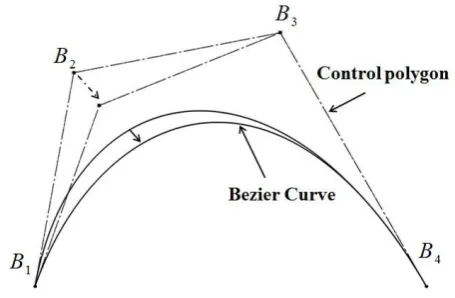
[image:4.595.183.411.227.376.2]Bézier curves allow control of the curves systematically and the derived curve is smooth with continuous derivatives [2]. The lines between consecutive control points are named the control polygon. The Bézier curve passes through only the first and the last control points and tangent to the control polygon at both ends. The most influential points are the end points and the middle control points have lower weight in creating the curve and can be used for modification the curve. Figure1shows the effect of changing a control point on a Bézier curve.
Figure 1.Bézier curve and the effect of control point position change.
3. Design of Experiment
3.1. Design Space
To investigate the effect of each factor on the objective function, the full factorial design technique can be used. A 2kfull factorial design space is built bykparameters each at two levels results in 2k design points. This type of design is helpful in early stages of design to recognize the most effective parameters in the results.
In the case withA,B,CandDas the factors, each at two levels, 24combinations are generated. Four of them are the main effects shown byA,B,CandDestimate the main effects of the related factors on the the result. In six of them, the two factor interactions considered are shown byAB, AC, AD, BC, BDandDC. The three parameters interactions areABC, ABD, ACDandBCD. The four factor interaction for this case isABCD. The main effect ofA, is the average of the results, in which the combinations withAat the high level are positive ones and the combinations withAat the low level are negative ones. For each parameter two levels are shown by+or−respectively. If the average response at the combinations in whichXat the high level is noted byyx+and the average response withXat the low level is noted byyx−, The effect ofXcombination on the objective function [5] will be,
EX =yx+−yx− (3)
To recognize the significant factors, a normal or half-normal probability plot analysis is the simplest tool. Normal probability plots show that whether sample data conform a normal distribution or not [5].
For constructing a normal plot, the effects are first ranked from smallest to largest,E1 <E2 <
...<En, Then the orderedEiare plotted versus:
100(i−0.5)
Then a straight line interpolated between the 25th and 75th percentile points. The factors that have negligible effect on the objective function have normally distributedEs and they fall along a straight line, whereas most effective factors are far from the straight line and hence normal distribution [5].
3.2. Box-Behnken Technique
Different types of designs are being used for creating the design space. The Full Factorial Technique is a useful technique for exploring all of the design space. Withnparameters, each atklevel, the full factorial createskndesign points. Two-level factorial techniques are very efficient but they result in first-order models and cannot detect curvature. At Three-level, the 3nfactorial, is not efficient
and generates huge design space points [20].
Box-Behnken is a technique which makes an efficient design space and it requires only the fraction of full factorial points to estimate the second-order effects of the response surface. ForA,BandC
[image:5.595.202.395.295.444.2]factors each at three levels{−1, 0, 1}, Box-Behnken design offers the points as shown in Figure2which can be compared with 27 design points obtained from the full factorial technique.
Figure 2.Box-Behnken design space for three factors [20].
3.3. Response Surface Model
After building the design space for each combination, the response (objective function) could be derived. The response surface is constructed as a surrogate model based on the most important effects. For instance ifX,YandXZcombinations show the largest effects on the objective function, the estimated response surface [21] is defined as follows,
b
y=β0+βxX+βyY+βxzXZ (5)
in whichβ0 is the average of the response for all combinations,βxis theEX/2 and so on. In this
relation theX,YandXZfactors are varied in [−1, +1] intervals which correspond to variations between low and high levels.
To find the relationship between the objective function and factor values, the following second-order polynomial model is used, in which{x1, ...,xk}are the factors andβis are the coefficients
andeis the approximation error.
y=β0+
k
∑
i=1
βixi+ k
∑
i=1
βiix2i +
∑ ∑
i<jβijxixj+e (6)
The low order polynomial models may not be a reasonable approximation for entire design space; however they work quite well over a relatively small part of the domain. The method of least squares is used to estimateβcoefficients in Equation (6). This method choosesβis coefficients so that the sum
L=
n
∑
i=1
e2i =
n
∑
i=1
yi−β0−
k
∑
j=1
βjxij
2
(7)
3.4. Creating the Design Space
[image:6.595.133.462.246.300.2]The parameters for the first three stages of the design space created are shown in Table1. The 2kfull factorial design technique is implemented in these stages for creating the design space. After performing stage I to III the most effective parameters are recognized for the design space created in stage IV.
Table 1.Stages I to III for recognizing the effective parameters.
Stage Concept Number of Factors Parameters
I Meridional Plane Geometry 5 M1−M5
II Blade Angle Distribution 4 B1−B4
III Blade Inlet Geometry and Splitter 4 I1−I4
3.4.1. Stage I
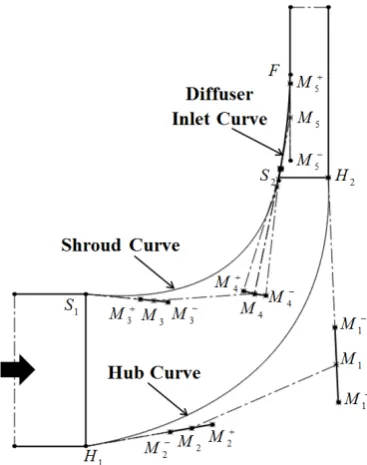
Each parameter levels at stage I of the effective parameter recognition are shown in Figure3. A hub curve control polygon was constructed between two fixed points H1andH2and two control
parametersM1andM2. Fixed points and control points for constructing a Bézier curve for shroud
profile areS1,S2andM3,M4respectively. The diffuser inlet curve is also built on a fixed pointsFand S2and two control points areEand the a point alongS2M4line (not shown in the Figure).
Figure 3.Parameters and their levels in Stage I.
3.4.2. Stage II
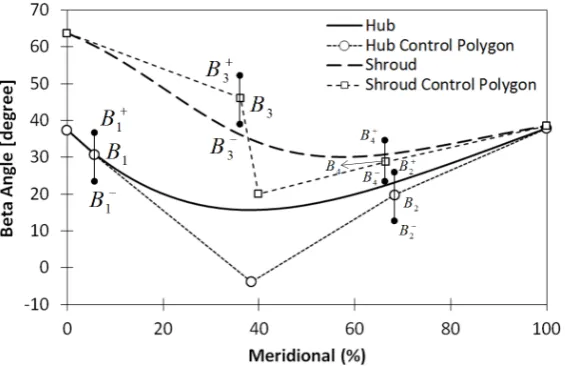
The blade angle (angleβ) distribution at hub and shroud is considered for parameter study in this stage. Theβangle is related to the azimuthal coordinate (angleθ) of blade curves through the following relation [1].
tanβ= rdθ
[image:6.595.208.392.413.646.2]in whichris the radial coordinate andsis the meridional coordinate. A five control point Bézier curve is fitted for eachβangle distribution at hub and shroud (Figure4). To build a domain space, the slope of the control polygon at both ends are varied. The range of variation of the slopes is set to be at maximum of 5 degrees from base case. Due toβdistribution variation at hub and shroud, the blade rake angle will change. The Blade Rake angle is the angle between the trailing edge and the tangential direction at impeller tip. A rake angle up to 45◦is commonly used [22] and the maximum value of rake angle is kept constant (around 54.2◦) in this study.
Figure 4.βangle distribution parametrization.
3.4.3. Stage III
The leading edge of main blades and splitters are supposed to be changed in this stage. The main geometry of meridional profile is held constant and the leading edge starting points,H1andS1, are the
lower limits for the leading edge. The upper limits for varying the position ofH1are toward the exit by
16% of hub curve length, and for the position ofS1are toward the exit by 10% of shroud curve length.
The leading edge position of splitter can vary±6.5% shroud profile length and±7.5% hub profile length related to their initial positions. Figure5shows the parameter bounds in this stage.
[image:7.595.193.410.513.750.2]3.4.4. Stage IV
In this stage the Box-Behnken technique is used to create the design space based on the selected parameters in the previous stages. An optimization process can take place in this stage regarding meridional geometry, angle distribution and inlet geometry for blades simultaneously.
4. Geometry
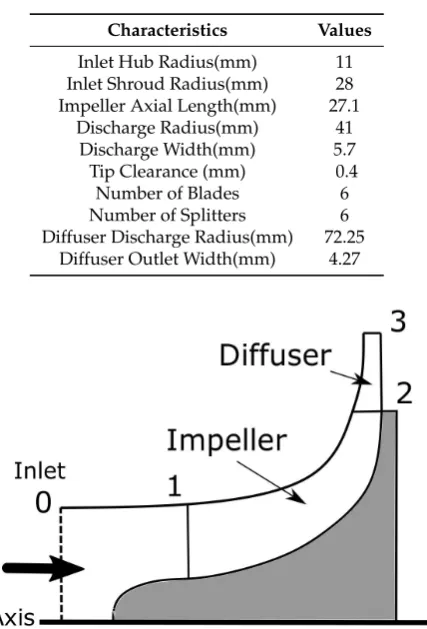
A turbocharger compressor is modeled in this research. The compressor impeller has six main blades and six splitters followed by a vaneless diffuser and an overhanging volute. The original impeller and diffuser characteristics are tabulated in Table2and the cross section numbering is shown in Figure6.
[image:8.595.194.408.296.611.2]The splitter leading edge starts at 47% hub and 29% shroud curve length from the inlet [23]. Through evaluating the effect of each parameter on the performance, all other parameters are kept unchanged.
Table 2.Geometry characteristics.
Characteristics Values
Inlet Hub Radius(mm) 11
Inlet Shroud Radius(mm) 28
Impeller Axial Length(mm) 27.1
Discharge Radius(mm) 41
Discharge Width(mm) 5.7
Tip Clearance (mm) 0.4
Number of Blades 6
Number of Splitters 6
Diffuser Discharge Radius(mm) 72.25
Diffuser Outlet Width(mm) 4.27
Figure 6.Cross section numbering in meridional view.
5. Modeling
At the inlet section the total pressure and temperature are set as the inlet boundary conditions to 1 bar and 300 K respectively and the mass flow rate is set at the diffuser outlet. The frozen rotor assumption is used between rotating and non-rotating mediums also explained in [24]. The shear-stress transport (SST) is used for turbulence modeling in which Reynolds stress terms are treated byk−ω model near-wall region and byk−emodel in the far field [25]. The energy conservation equation is solved and the solution convergence is checked by the reduction of all conservative equation residuals to the order of 1×10⁻⁵.
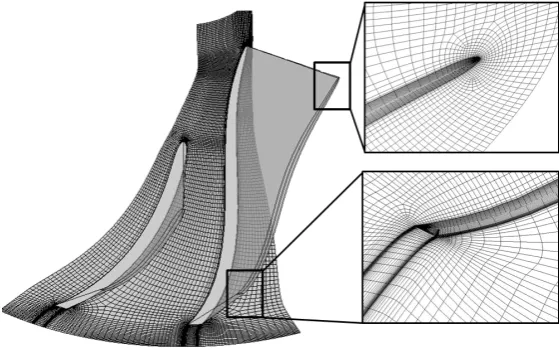
Figure 7. Original impeller grids at hub and shroud.
6. Results and Discussions
6.1. Effective Parameter Identification
The performance of each design point is evaluated by total pressure ratio and total to total isentropic efficiency from compressor inlet to the diffuser outlet. Pressure ratio is calculated by means of following relation:
Pr=
Z
P03dm˙/ ˙m/P00 (9)
In which the numerator is mass flow average of total pressure at the diffuser outlet. Using pressure ratio, the isentropic efficiency is calculated using Equation (10).
ηtt=T00 Pr(γ−1)/γ−1/(T03−T00) (10)
The normal probability plots for stage I contains 32 runs are shown in Figures8and9for the effects onηttandPrrespectively. Among the five investigating parameters in this stage, as is expected,
the impeller meridional geometry, as defined byM1toM4contains the main parameters. The diffuser
inlet curvature varied byM5, has a negligible effect on both efficiency and pressure ratio. However
the results shows that the two parametersM1andM4which adjust the hub and shroud profile at
the impeller outlet respectively have the most significant effect in comparison to the others. Among the two factor interaction effects, theM1M4is apart from line in Figure8. Both theM1M4andM2M3
points in Figure9show that they play an important role in total pressure ratio in this case. Generally the main effects and the low order interactions are dominant and the higher order interactions are usually negligible [5].
As theM1toM4main effects are positives, this means that each parameter at high level solely
high levels or both at the low level, efficiency and pressure ratio decrease as it has a negative value. The same analysis is true for bothM2andM3on the pressure ratio.
When bothM1andM4or bothM2andM3are considered at high levels, it means that respectively
the flow passage at the outlet or at the inlet, becomes wide and when they are at the low levels it narrows the flow passage. Therefore increasing or decreasing flow passage area by simultaneously changing the hub and shroud curves is deleterious to the performance.
Effects
-0.02 -0.01 0 0.01 0.02 0.03 0.04
Probability
0.01 0.02 0.05 0.10 0.25 0.50 0.75 0.90 0.95 0.98 0.99
M4
M1
M3
M2
[image:10.595.158.438.190.398.2]M1M4
Figure 8.Normal probability plots for stage I showing effects on efficiency (total to total).
Effects
0 0.05 0.1 0.15
Probability
0.01 0.02 0.05 0.10 0.25 0.50 0.75 0.90 0.95 0.98 0.99
M4
M1
M2
M3
M1M4
M2M3
Figure 9.Normal probability plots for stage I showing effects on pressure ratio.
In the same way, the normal probability plots for stage II, contains 16 runs, are extracted. Figures10
and11are shown to investigate the effects of blade angle distribution onηttandPrrespectively. As seen
in Figure10,B1,B2,B3B4and also all two-factor interactions withB2are apart from the straight line;
[image:10.595.156.439.438.647.2]Effects ×10-3
-3 -2 -1 0 1 2
Probability
0.02 0.05 0.10 0.25 0.50 0.75 0.90 0.95 0.98
B1
B2B3
B2B4
B2
B3B4
[image:11.595.157.438.89.307.2]B1B2
Figure 10.Normal probability plots for stage II showing effects on efficiency (total to total).
TheB1factor is representative forβangle distribution slope at the inlet for hub. The value of its effect on the isentropic efficiency (Figure10) is positive however its effect on pressure ratio (Figure11) is negative. This means that increasingB1, increases the efficiency and reduces the pressure ratio.
Increasing theB1value is equivalent to decreasing the blade curvature as it defines the angle variation
(Figure4). TheB2value also shows the same effect on the pressure ratio. By considering two-factor
interactionsB2B3andB3B4on the efficiency, it is clear that, the efficiency will improve when the hub
and shroud blade angle difference is small.
Effects
-0.06 -0.04 -0.02 0 0.02 0.04
Probability
0.02 0.05 0.10 0.25 0.50 0.75 0.90 0.95 0.98
B3
B1
B2
Figure 11.Normal probability plots for stage II showing effects on pressure ratio.
In conclusion for the case II investigation,B1andB2can be considered as the most dominant
factors and both efficiency and pressure ratio will improve by controlling the angle difference between hub and shroud in the defined ranges.
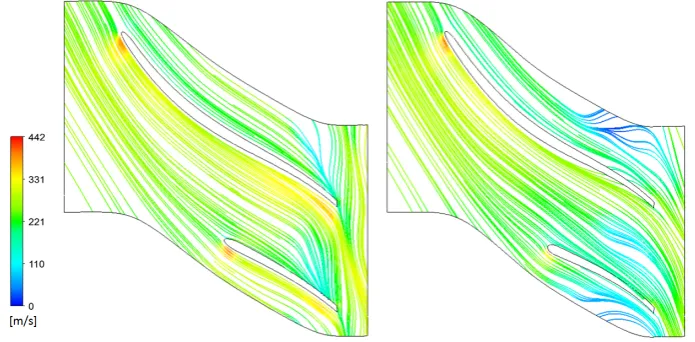
To better capture the effects of blade angle distribution on the fluid behavior, the streamlines for the original case and the case with{B+1B+2B+3B4−}which is shows the best efficiency are shown in Figure12. The streamlines for one main impeller and splitter passage are shown at span 0.8 where the effect of shroud curvature which is controlled byB3andB4could be realized. The streamlines show
[image:11.595.186.407.451.619.2]at hub and shroud for the case withB2+andB4−has the lowest difference among the test cases and it gives the most uniform flow in the span-wise direction.
Figure 12.Streamlines of the original case (left) versus case{B+1B2+B+3B−4}(right) at span = 0.8.
Similarly, the normal probability plots for isentropic efficiency and pressure ratio are shown in Figures13and14respectively for stage III. The plots show that movingI1along the hub curve toward
the outlet increases the pressure ratio and decreases the efficiency; however movingI3toward the outlet
results in pressure ratio and efficiency improvement. When bothI1andI2are moving simultaneously
toward the inlet or outlet, it also results in the performance increasing, whereas movingI2towards the
outlet leads to an unconventional incline at impeller inlet and reduces the pressure ratio. Figure15
shows passage streamlines for two cases namedAandBwhich their configuration are{I1+I2−I3−I4+}
and{I1−I2−I3+I4−}respectively. In CaseAwithI3−andI4+ the splitter at hub starts earlier and it has longer length but at shroud it has short length. CaseBhasI3+andI4−which means shorter hub and longer shroud in comparison with CaseA. It can be seen that in Case A the longer length at span 0.1 helps the flow to follow the splitter curvature earlier. At mid span (S=0.5) two cases show nearly the same behavior; however near the shroud, the flow cannot follow the blade curvatures in CaseA. The flow in CaseBis guided around the splitters with limited circulation. The flow structure describes how the losses in cases withI3+andI4−configuration i.e. Case B are minimized and how it results in higher efficiency. It should be mentioned that the splitter with longer length in Case A adds additional friction loss.
Effects ×10-3
-5 0 5
Probability
0.02 0.05 0.10 0.25 0.50 0.75 0.90 0.95 0.98
I3
I1I2
I1
Effects
-0.05 0 0.05 0.1 0.15
Probability
0.02 0.05 0.10 0.25 0.50 0.75 0.90 0.95 0.98
I1
I1I2
I3
[image:13.595.158.439.90.309.2]I2
Figure 14.Normal probability plots for stage III showing effects on pressure ratio.
Figure 15.Streamlines of the two cases at different spans.
6.2. Response Surface for Finding the Optimal Geometry
The above mentioned analysis for different cases show that the controlling point at the hub plays an important role in the objective functions which are the pressure ratio and isentropic efficiency. This result is may be due to following reasons:
• The wider ranges are considered for the parameters in the hub section
• The hub section variation has more effect on whole impeller geometry in comparison to the changes in the shroud section
[image:13.595.88.509.332.605.2]To find the optimal geometry which considers all the aforementioned analyses, just the parameters on the hub are considered for the next analysis. These areM1andM2in stage I,B1andB2in stage II
andI1andI3in stage III. The other factors are set in the values which show the best performance in
the previous case analysis. This leads to construction a design space for 13(=5+4+4)parameters. A full factorial design space with each parameter at two levels leads to 213runs whereas to better capture the design space, three levels for each parameter are more helpful. However, using the full factorial technique for six parameters each at three levels consequences 36runs which also imposes high computational cost.
In stage IV, as mentioned before, the Box-Benken technique is used which reduces the design space to 54 points. For each factor the levels are shown by−1, 0 and 1 in which the center value (0) is set the value was obtained by the previous results. For obtaining the desired values from the parametric study, both isentropic efficiency and total pressure ratio are considered as the objective functions by following relation [26],
f =C1(
1−ηtt
1−ηtti ) +C2(
Pri
Pr) (11)
in which the superscriptistands for the initial value and the coefficientsC1 andC2 are set to 0.5
for considering the same share for efficiency and pressure ratio. Minimizing f results in the best performance results in each case. Using the aforementioned objective function, in case I,M1M3M4
run, in Case II,B1B3run andI3effect show the best performance results. Pressure ratio, isentropic
[image:14.595.157.436.431.730.2]efficiency and also the value off for all design points are shown in Figure16. The design points with maximum efficiency and with maximum pressure ratio are also shown in Figure17. The results show that efficiency variation is about 1.2% and and pressure ratio variation in about 13.2% among all points.
The point with maximum efficiency shows a 0.4% improvement in comparison to initial run and the point with maximum pressure ratio has 2.5% increase in this ratio.
P r[-]
2 2.1 2.2 2.3
η
tt[-]
84.4 84.6 84.8 85 85.2 85.4 85.6
ηtt−max
f0
P rmax
[image:15.595.159.418.140.372.2]fmin
Figure 17.Isentropic efficiency versus pressure ratio for design space.
Second-order polynomial regression is used for pressure ratio,Pr, efficiency ,η, and for both simultaneously, f, using Equation (6), and the surrogate functions are noted by ˆyPr, ˆyη and ˆyf
[image:15.595.104.491.487.542.2]respectively. Response surface method analysis is used to find the variables{A,B,C,D,E,F} to maximize ˆyPrand ˆyηand to minimize the ˆyf. Table3shows the results.
Table 3.Optimum value for objective functions.
Function Reference Optimum A B C D E F
ˆ
yPr 2.245 2.336 0.091 −1.000 0.313 −1.000 1.000 1.000
ˆ
yη 85.15% 85.54% 1.000 1.000 −1.000 1.000 −0.616 0.838
ˆ
yf 1.00 0.972 −0.535 1.000 1.000 −1.000 0.939 1.000
Three extra performance analyses are performed to investigate the design parameter values
{A,B,C,D,E,F} in Table 3 on the efficiency and the pressure ratio. The CFD results show an additional 0.2% improvement for pressure ratio while optimum conditions are not changed regarding the efficiency and f function. Hence related to initial condition, f0, the isentropic efficiency improves
by about 0.4% and the pressure ratio could be increased by 2.7%.
Figures18and19show the performance curve for the optimized impeller and the original impeller. Results are derived for three different rotational speeds. The design point rotational speed is shown by
Nand other rotational speeds are 75%Nand 1.25%N. At the design point the optimized model shows 3.0% and 11.0% improvement in efficiency and pressure ratio respectively which are substantial.
The range of the optimized design is not falling off toward choke as is often the case when a new design gives greater design point performance but at the expense of range. Range improvement near surge must be determined by means of an unsteady simulation [27] of the entire compressor or by experiment; however the current results show no operating range deterioration in comparison with operating points at low and high mass flow rates.
comparison to optimized case and by increasing the mass flow rate the performance of optimized impeller increases (Figure19).
0 0.5 1 1.5 2 2.5 3 3.5
0 0.05 0.1 0.15 0.2 0.25 0.3 0.35 0.4 0.45 0.5
Pres su re Rat io [-]
Mass Flow Rate [kg/s]
[image:16.595.145.451.128.330.2]Optimized Case at N Original Case at N Optimized Case at 0.75N Original Case at 0.75N Optimized Case at 1.25N Original Case at 1.25N Poly. (Optimized Case at N)Curve Fit Optimized Cases Poly. (Original Case at N)Curve Fit Original Cases
Figure 18.Pressure ratio vs. mass flow rate for original and optimized case.
55 60 65 70 75 80 85 90
0 0.05 0.1 0.15 0.2 0.25 0.3 0.35 0.4 0.45 0.5
Is en tro p ic E ff ici en cy [% ]
Mass Flow Rate [kg/s]
Optimized Case at N Original Case at N
Optimized Case at 0.75N Original Case at 0.75N
Optimized Case at 1.25N Original Case at 1.25N
Poly. (Optimized Case at N) Poly. (Original Case at N) Curve Fit Optimized Cases Curve Fit Original Cases
Figure 19.Isentropic efficiency vs. mass flow rate for original and optimized case.
[image:16.595.144.454.360.564.2]Figure 20.Optimized and original cases meridional view and the pressure contours comparison at design point.
7. Conclusions
As described in this article, the geometry of meridional curves of the impeller, the angle distribution of the blade and the location of the main blade and splitter entrances were optimized. At the stage I, five parameters are considered for meridional geometry of impeller. Full Factorial analysis was performed and the most effective parameters were recognized which are the hub curve control points. The best points in this stage shows 2.5% and 7.24% improvement in efficiency and pressure ratio respectively.
The best point in the previous analysis is used was Stage II as an initial geometry to investigate the effect of theβangle distribution of the blade at hub and shroud by varying four selected parameters. Full Factorial analysis shows that the slopes at starting and at the end points of the fitted Bézier curve at hub are the effective factors. The highest pressure ratio in this stage shows 3.0% improvement and the distribution with the highest efficiency shows 0.34% increase as compared to the baseline geometry.
Considering the best performance in previous stages as an initial model in stage III, the function
f (Equation (11)) is used to simultaneously consider the effect of efficiency and pressure ratio. Full factorial analysis is performed for four parameters which are the starting point locations of the main blades and splitters.
Based on previous analysis, six parameters were selected for stage IV and for decreasing the number of runs the Box-Behnken method was used to construct the design space. The efficiency and the pressure ratio for all runs were obtained and second order polynomial functions were used to find the response surfaces. Response surface analysis introduces the best value of six variables to obtain maximum efficiency, maximum pressure ratio and a minimum forf function. The results were compared to the original impeller and by considering both factors simultaneously, the optimized model shows substantial improvement in both efficiency and pressure ratio at design point condition. A very encouraging result is at different operating conditions the performance has also improved in comparison with the original case rather than be sacrificed due to improved design point performance which is often the case.
Author Contributions:M.M. created the models, designed the optimization procedure; Both M.M. and K.R.P. analyzed the results and wrote the paper.
Funding:The financial support for this research, from the Shahid Beheshti University G.C. (Grant No. 600/640) is gratefully acknowledged.
Nomenclature
B Bernsein polynomial
B1−B4 Angle distribution parameters
c Control points
C1,C2 Constant coefficient
d Differential
E Effect of parameter(s)
f Objective function
H Hub
I1−I4 Inlet geometry parameters
L Sum of the squares of the errors
˙
m Mass flow rate
M1−M5 Meridional geometry parameters
n Polynomial degree
p Parametric curve equation
P0 Total pressure
Pr Pressure ratio
r Radial coordinate
s Meridional coordinate
S Shroud
t Control parameter
T0 Total temperature
x1, ...,xk Factors
b
y Response surface equation
yx Average response of x
X,Y Parameters, Factors
+,− Parameter levels
Greek Letters
β Blade angle
βi Response coefficient
γ Specific heat
e Approximation error
ηtt Total to total isentropic efficiency
θ Azimuthal coordinate of blade curves
ρ Density
Subscript
0 Compressor inlet
1 Impeller inlet
2 Impeller outlet
3 Diffuser outlet
min Minimum
max Maximum
Superscript
i Initial value
References
1. Aungier, R.H.Centrifugal Compressors: A Strategy for Aerodynamic Design and Analysis; American Society of Mechanical Engineers: New York, NY, USA, 2000.
2. Casey, M. A computational geometry for the blades and internal flow channels of centrifugal compressors.
3. Mojaddam, M.; Hajilouy-Benisi, A.; Moussavi-Torshizi, S.A.; Movahhedy, M.R.; Durali, M. Experimental and numerical investigations of radial flow compressor component losses. J. Mech. Sci. Technol.2014,28, 2189–2196. [CrossRef]
4. Mirzaee, S.; Zheng, X.; Lin, Y. Improvement in the stability of a turbocharger centrifugal compressor by tip leakage control. Proc. Inst. Mech. Eng. Part D J. Automob. Eng.2017,231, 700–714. [CrossRef]
5. Montgomery, D.C.Design and Analysis of Experiments; John Wiley & Sons: Hoboken, NJ, USA, 2017. [CrossRef] 6. Wahba, W.; Tourlidakis, A. A genetic algorithm applied to the design of blade profiles for centrifugal pump impellers. In Proceedings of the 15th AIAA Computational Fluid Dynamics Conference, Anaheim, CA, USA, 11–14 June 2001; Volume 11, p. 14. [CrossRef]
7. Kim, J.H.; Choi, J.H.; Husain, A.; Kim, K.Y. Design Optimization of a Centrifugal Compressor Impeller by
Multi-Objective Genetic Algorithm. In Proceedings of the ASME 2009 Fluids Engineering Division Summer Meeting, Vail, CO, USA, 2–6 August 2009; pp. 2–6. [CrossRef]
8. Mojaddam, M.; Torshizi, S.A.M. Design and optimization of meridional profiles for the impeller of centrifugal compressors. J. Mech. Sci. Technol.2017,31, 4853–4861. [CrossRef]
9. He, X.; Zheng, X. Mechanisms of Sweep on the Performance of Transonic Centrifugal Compressor Impellers.
Appl. Sci.2017,7, 1081. [CrossRef]
10. Torshizi, S.A.M.; Benisi, A.H.; Durali, M. Numerical Optimization and Manufacturing of the Impeller
of a Centrifugal Compressor by Variation of Splitter Blades. In Proceedings of the ASME Turbo
Expo 2016: Turbomachinery Technical Conference and Exposition, Seoul, Korea, 13–17 June 2016;
pp. V008T23A023–V008T23A029. [CrossRef]
11. Shaaban, S. Design optimization of a centrifugal compressor vaneless diffuser. Int. J. Refrigeration2015,60, 142–154. [CrossRef]
12. Ju, Y.; Zhang, C. Design Optimization and Experimental Study of Tandem Impeller for Centrifugal
Compressor. J. Propuls. Power2014,30, 1490–1501. [CrossRef]
13. Barsi, D.; Costa, C.; Cravero, C.; Ricci, G. Aerodynamic design of a centrifugal compressor stage using
an automatic optimization strategy. In Proceedings of the ASME Turbo Expo 2014: Turbine Technical
Conference and Exposition, Düsseldorf, Germany, 16–20 June 2014; p. V02BT45A017. [CrossRef]
14. Kim, J.H.; Choi, J.H.; Kim, K.Y. Surrogate modeling for optimization of a centrifugal compressor impeller. Int. J. Fluid Mach. Syst.2010,3, 29–38. [CrossRef]
15. Siemann, J.; Seume, J.R. Design of an Aspirated Compressor Stator by Means of DOE. In Proceedings of the
ASME Turbo Expo 2015: Turbine Technical Conference and Exposition, Montreal, QC, Canada, 15–19 June 2015. [CrossRef]
16. Bonaiuti, D.; Arnone, A.; Ermini, M.; Baldassarre, L. Analysis and optimization of transonic centrifugal
compressor impellers using the design of experiments technique. In Proceedings of the ASME Turbo Expo 2002: Power for Land, Sea, and Air, Amsterdam, The Netherlands, 3–6 June 2002; pp. 1089–1098. [CrossRef] 17. Guo, S.; Duan, F.; Tang, H.; Lim, S.C.; Yip, M.S. Multi-objective optimization for centrifugal compressor of
mini turbojet engine. Aerosp. Sci. Technol.2014,39, 414–425. [CrossRef]
18. Tang, X.; Luo, J.; Liu, F. Aerodynamic shape optimization of a transonic fan by an adjoint-response surface method. Aerosp. Sci. Technol.2017,68, 26–36. [CrossRef]
19. Wang, X.; Xi, G.; Wang, Z. Aerodynamic optimization design of centrifugal compressor’s impeller with
Kriging model. Proc. Inst. Mech. Eng. Part A J. Power Energy2006,220, 589–597. [CrossRef]
20. Mason, R.L.; Gunst, R.F.; Hess, J.L. Statistical Design and Analysis of Experiments: With Applications to
Engineering and Science; John Wiley & Sons: Hoboken, NJ, USA, 2003; Volume 474.
21. Montgomery, D.C.; Runger, G.C.Applied Statistics and Probability for Engineers; John Wiley & Sons: Hoboken, NJ, USA, 2010. [CrossRef]
22. Came, P.; Robinson, C. Centrifugal compressor design. Proc. Inst. Mech. Eng. Part C J. Mech. Eng. Sci.
1998,213, 139–155. [CrossRef]
23. Mojaddam, M.; Hajilouy Benisi, A.; Movahhedy, M.R. Optimal design of the volute for a turbocharger radial
flow compressor. Proc. Inst. Mech. Eng. Part G J. Aerosp. Eng.2015,229, 993–1002. [CrossRef]
24. Mojaddam, M.; Hajilouy-Benisi, A.; Movahhedy, M.R. Experimental and numerical investigation of radial
25. Mojaddam, M.; Hajilouy-Benisi, A. Experimental and numerical flow field investigation through two types of radial flow compressor volutes.Exp. Therm. Fluid Sci.2016,78, 137–146. [CrossRef]
26. Asgarshamsi, A.; Benisi, A.H.; Assempour, A.; Pourfarzaneh, H. Multi-objective optimization of lean and
sweep angles for stator and rotor blades of an axial turbine. Proc. Inst. Mech. Eng. Part G J. Aerosp. Eng.
2015,229, 906–916. [CrossRef]
27. Sundström, E.; Semlitsch, B.; Mih˘aescu, M. Generation Mechanisms of Rotating Stall and Surge in Centrifugal Compressors. Flow Turbul. Combust.2018,100, 705–719. [CrossRef] [PubMed]
c
![Figure 2. Box-Behnken design space for three factors [20].](https://thumb-us.123doks.com/thumbv2/123dok_us/1348803.88537/5.595.202.395.295.444/figure-box-behnken-design-space-factors.webp)