Rochester Institute of Technology
RIT Scholar Works
Theses Thesis/Dissertation Collections
9-9-2015
Modeling and Analysis of OR Nurse Scheduling
Using Mathematical Programming and Simulation
Clayton TontarskiFollow this and additional works at:http://scholarworks.rit.edu/theses
This Thesis is brought to you for free and open access by the Thesis/Dissertation Collections at RIT Scholar Works. It has been accepted for inclusion in Theses by an authorized administrator of RIT Scholar Works. For more information, please [email protected].
Recommended Citation
Rochester Institute of Technology
Modeling and Analysis of OR Nurse Scheduling Using
Mathematical Programming and Simulation
A Thesis
Submitted in partial fulfillment of the
requirements for the degree of
Master of Science in Industrial and Systems Engineering
in the
Department of Industrial and Systems Engineering
Kate Gleason College of Engineering
by
Clayton Tontarski
DEPARTMENT OF INDUSTRIAL AND SYSTEMS ENGINEERING
KATE GLEASON COLLEGE OF ENGINEERING
ROCHESTER INSTITUTE OF TECHNOLOGY
ROCHESTER, NEW YORK
CERTIFICATE OF APPROVAL
M.S. DEGREE THESIS
The M.S. Degree Thesis of Clayton Tontarski
has been examined and approved by the
thesis committee as satisfactory for the
thesis requirement for the
Master of Science degree
Approved by:
____________________________________ Dr. Michael E. Kuhl, Thesis Advisor
Abstract
Nurse scheduling is a complex problem. The act of assigning each nurse to a specific
shift for each day of a scheduling horizon, while ensuring to fulfill the demand of the operating
rooms (ORs) is very time consuming. Current methods used in practice often develop solutions
that are suboptimal, resulting in low nurse utilization, low nurse satisfaction, patient delays, or
overtime pay for nurses. In this paper we propose an approach that utilizes simulation,
simulation-based optimization, and mathematical programming as tools for solving complex
nurse scheduling problems. We discuss how the simulation-based optimization generates
multiple alternative shift plans, defined as the number of nurses required to work each shift. The
simulation, which replicates the processes within an OR wing of a hospital, uses each shift plan
for an extended period of time with variable patient arrival and surgery time. The results of each
run of the simulation provide performance metrics of cost and patient lateness to the
simulation-based optimization model, a way to compare the alternative shift plans. Next, an assignment
model developed using mathematical programming uses a chosen shift plan as an input and aim
to assign each specific nurse to the shifts described by that plan. The objective of this model is to
maximize the percentage of time that nurses have the same specialty required by the surgeries
and also maximize nurse satisfaction. Different objective functions, parameter weights, and time
horizons are applied to the model to evaluate its ability to fit the needs of different ORs. This
also allows for alternative shift assignments to be compared against each other, giving the
scheduler options when developing the final schedule. The result is a scheduling tool that
Acknowledgments
I would like to thank my parents, David and Susan, for supporting me throughout my
college career. Thanks also to my advisor, Dr. Michael Kuhl, and thesis committee member, Dr.
Ruben Proaño, for helping me though the development and completion of my Thesis. I would
also like to thank my girlfriend Laura who provided love and support while I completed my
Table of Contents
Abstract ... ii
Acknowledgments ... iii
Table of Contents ... iv
1. Introduction ... 1
2. Problem Statement... 5
2.1 Description of Real System ... 6
2.2 Goals and Objectives ... 9
3. Literature Review ... 12
3.1 General Nurse Scheduling ... 13
3.2 Mathematical Programming ... 14
3.3 Simulation ... 19
3.4 Discussion ... 22
4. Methodology ... 24
4.1 Scope ... 25
4.2 Inputs and Assumptions ... 25
4.3 The Two Phase Approach ... 27
4.4 Models... 29
4.4.1 Simulation ... 30
4.4.2 Simulation-based Optimization ... 34
4.4.3 Assignment model ... 38
4.5 Design of Experiments ... 44
4.6 Two Phase Example ... 46
4.6.1 Model Setup ... 46
4.6.2 Nurse Planning Phase – 6 OR Experiment ... 47
4.6.3 Nurse Assignment Phase – 6 OR Experiment ... 50
4.6.4 Preliminary Example Conclusion ... 52
5. Experimentation ... 54
5.1 Model Setup – 12 OR Experiment ... 54
5.2 Nurse Planning – 12 OR Experiment ... 56
5.2.1 Simulation-Based Optimization – 12 OR Experiment... 56
5.2.2 Variability Experimentation... 60
5.3 Nurse Assignment – 12 OR Experiment ... 61
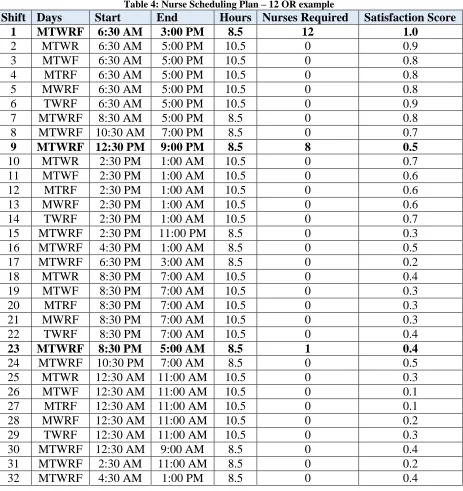
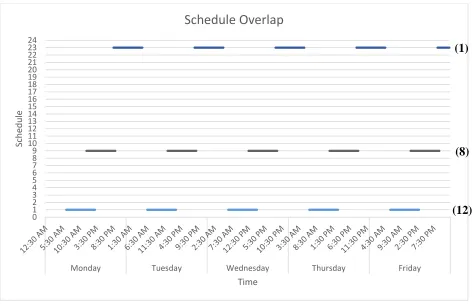
5.3.1 Nurse Planning Input ... 62
5.3.2 Various Parameter Testing – 20 Nurses... 72
5.3.2.1 Base Model with Objective Aw + Bw ... 73
5.3.2.2 Objective Aw + Cw ... 76
5.3.2.4 Objective Aw + Cw with α = 0.3 ... 81
5.4 Experimentation Conclusions ... 84
6. Conclusion & Recommendations for Future Research ... 86
6.1 Conclusion ... 86
6.2 Recommendations for Future Work... 88
References ... 90
Appendices ... 92
Appendix 1: AMPL Model file for Nurse Assignment model ... 92
Appendix 2: AMPL Data file for Nurse Assignment model ... 94
Appendix 3: Data tables for 6.3.1 graphs of “ρiwby 2 Week Time Horizon” ... 111
Appendix 4: Data tables for 6.3.2 graphs of “ρiwby _ Week Time Horizon” ... 114
Appendix 5: Simulation model ... 117
1. Introduction
The problem of scheduling nurses is one that affects most healthcare systems. In this paper,
we focus on the nurses being scheduled in an operating room (OR) area. Scheduling typically
consists of two parts: a “shift plan” determining how many nurses are required to work each
shift, then a “shift assignment” which assigns individual nurses to those shifts in the shift plan. In
this paper a “schedule” is defined as the combination of these two parts: a shift plan and a shift
assignment. With a large staff of nurses, creating a schedule that assigns desirable shifts evenly
while at the same time taking into account nurse skill level and training, legal restrictions, and
possibly requests from the nurses, is extremely difficult and time consuming for one person to
accomplish (Burke, De Causmaecker, Vanden Berghe, & Van Landeghem, 2004). This is where
a modeling approach may come in handy.
A simulation can model the OR while accounting for the variability in the system that comes
from patient arrival and surgery length (Shamayleh, 2010). This model may account for
variability in the system but finding results may be time consuming and may not lead to an
optimal solution. A simulation model adds variability and gives the user a good estimation of
how their choices will perform in the real world. In a system of low variability, there may not be
a need for simulation; a mathematical program could generate a solution more quickly. For
instance, a mathematical program that can assign nurses to shifts each day, maximizing the
overall quality of the roster while satisfying various constraints was implemented by Vanhoucke
and Maenhout (2009). A quality roster is described as when nurses have the training required for
the estimated demand of surgeries and that the total cost of hiring these nurses is as low as
possible. The constraints are typically specific to each hospital and can be adjusted accordingly.
error. Although these two methods, mathematical programming and simulation, have been tested
and implemented separately, the research that uses both modeling methods to solve the nurse
scheduling problem in an OR seems to be lacking in terms of robustness.
To account for the variability in patient arrival, surgery length, and the satisfaction of nurses,
we propose a two phase approach: a “Nurse Planning” phase and a “Nurse Assignment” phase.
In the “Nurse Planning” phase, we address the first problem of nurse scheduling: meeting the
demand and variability in demand of the OR while minimizing cost. We develop a shift plan
determining how many nurses should work each shift over a specified time horizon. Simulation
is an adequate approach to solving this problem as it is moderately stochastic in nature. Using a
simulation model, one can represent a real-world OR system, including variability, and
appreciate more realistically how each shift plan affects the patient care and the nurses’
workload. If the system is modeled correctly, one can simulate the performance of the shift plan
over an extended time period to evaluate how the system will react if the suggested changes were
implemented. Finding the optimal number of nurses to work each specific shift to minimize cost
subject to service level constraints will decrease the need for nurses to work overtime and
increase the utilization of the nurses as the amount of idle time will be reduced.
One reason it is important to develop tools to solve the nurse scheduling problem is to reduce
the hospital’s operational costs. OR departments can account for 40% of a hospitals revenue and
generally have high costs and low personnel utilization rates (Shamayleh, 2010). A
simulation-based optimization model can produce solutions in which cost is minimized while maintaining a
high service level even under highly variable patient arrival rates and surgery times. Using the
stochastic simulation model, a simulation-based optimization model can find the best shift plan
This model will produce a shift plan that meets the required service level set by the hospital
under the variable conditions described by the simulation. The result of the simulation-based
optimization is a solution with high nurse utilization and low cost of hiring nurses. Using this
method, a shift plan describing how many nurses are required to work each shift over some time
horizon can be found and used as an input to the Nurse Assignment phase.
In the Nurse Assignment phase, the goal is to solve the second nurse scheduling problem:
determining which specific nurses should work each shift. Mathematical programming is used to
develop a deterministic assignment model to address the problem. The assignment model
solution is based on matching the training of nurses to surgeries that require that training and the
nurses’ overall shift satisfaction. Considering nurse satisfaction as an objective of the assignment
model is important for many reasons. First, higher levels of nurse satisfaction can lead to savings
in labor costs due to reduced nurse turnover and higher nurse retention rates (Punnakitikashem,
Rosenberger, & Behan, 2008) . It can also help increase service level by resulting in greater
patient safety and health care quality because of greater nurse attentiveness as a result of her shift
satisfaction (Mobasher, 2011). The assignment model also adds to service level by maximizing
the percentage of time that a patient has a nurse who specializes in the surgery being performed.
This may also reduce surgery time; with a high level of training for a specific surgery type a
nurse may be able to complete her task more quickly and without error. The assignment model
will generate an assignment of nurses to shifts for a given length of time known as the
scheduling period. Multiple scheduling periods in succession will be defined as the scheduling
horizon, also known as the total length of time for which nurses will be scheduled. The
scheduling period in the scheduling horizon from the Nurse Assignment phase will result in a
2. Problem Statement
There are many problems associated with nurse scheduling that this paper aims to solve.
The first problem is the high costs associated with a poor nurse schedule. A schedule may have
too few nurses, resulting in patient surgery delays and overtime costs, or too many nurses,
resulting in low utilization and higher nurse cost than necessary. There is also a cost associated
with a low service level. The service level in this paper will be measured by the difference
between a patients scheduled start time for a surgery and his actual start time because of a lack of
available nurses, referred to as lateness. As lateness increases, service level decreases. This has a
negative impact on the hospital which has certain service level standards it must uphold. A
monetary value can be given to each cumulative hour that patients are late to their surgery due to
lack of available nurses.
Other issues associated with nurse scheduling include the time required to generate a
schedule, each nurse’s satisfaction with her shift, and the difficulty of accounting for nurse
training level, legal restrictions, and other hospital constraints. A problem this paper aims to
solve is ensuring nurses are satisfied with their shift assignments while still matching nurses to
shifts in which their training level will match the anticipated surgery types. To schedule a large
staff of nurses using the common method of scheduling by hand or with basic scheduling
software could take up to 2 weeks to find a feasible solution. This will take the scheduler, often a
head nurse, away from her other duties in the OR (Bell, 2013). Because the scheduling process
takes so long, it is often the case that the individual scheduling will stop once they come up with
any schedule that simply works. Using a manual method, it is prohibitively time consuming for
the scheduler to search for better solutions. Also, nurse satisfaction is an issue that affects patient
while at work which could adversely affect patient care. Also, if her dissatisfaction is not
addressed, she may leave the hospital requiring a replacement to be hired and trained to fill the
missing position. A schedule that accounts for nurse satisfaction can avoid these issues and lead
to higher patient care and nurse retention. Finally, the training level of nurses must be addressed
when developing a nurse schedule. When a nurse is working in a surgery for which she is not
well trained, there is a higher risk of error which could result in enormous costs to the hospital.
However, if nurses are matched with surgeries for which they are most comfortable with, there is
a very low chance of error and her knowledge of the surgery type may even result in a faster
completion of the surgery.
2.1 Description of Real System
The simulation developed will be based on an observation of an actual OR system,
including an interview with the head nurse Kathy Bell (2013). The surgical suite consists of a set
of ORs that are utilized to meet the demand of the patients. The demand of patients for this
system comes primarily from surgeries that are scheduled well in advance with only about 5% -
10% of cases being unscheduled or emergency cases. Some ORs are designated to be used for
specific operations such as Podiatry or Plastic surgery. This is because certain rooms have
specialized equipment to handle the specific surgeries better than other rooms. Besides the
specialized equipment, there is a set of standard equipment in each room, allowing for many of
the surgeries to be assigned one of several rooms.
The daily scheduling of patient surgeries to each OR is based upon a block schedule i.e.
Shamayleh (2010) in which a block of time is assigned to a surgeon; this is different from the
schedule developed for the nurses. The surgeon’s patients are assigned to a time slot in that block
released for other surgeries if not filled by the assigned surgeon at a specified time prior to the
block schedule’s start date. The surgeon is in charge of filling his block of time with his own
patients and can perform any surgery type he desires.
To begin a surgery, the nurse first transfers the patient into the OR to which the patient is
scheduled. If the room is occupied, the nurse must wait until the OR vacated and cleaned before
transferring her patient. In order to conduct the surgery, the doctor must have at least one nurse
in the OR at all times as well as an anesthesiologist. The anesthesiologist is scheduled
completely separate from both the block schedule and the nurse schedule. Typically, the surgeon
prefers to have two nurses and that the nurses do not leave for the duration of the surgery,
however in rare cases nurses may switch in the middle of a surgery. Once the surgery is
complete, the nurse must help clean the room. For this step there are OR techs to assist the
nurses. The techs ensure that tools are replaced and used tools are cleaned or removed from the
OR for cleaning. The nurse may then transfer the patient out of the system, either to another
section of the hospital or to an area where the patient is discharged.
It is important that there are enough nurses to cover all of the surgeries described by the
block schedule; however, the schedule to which the nurses are assigned is very different. The
nurse schedule is defined as a number of nurses required for specific hours of each day, known
as shifts, and a set of nurses assigned to work the required shifts for a scheduling horizon. First,
the amount of nurses required to work each shift is estimated. This shift plan is typically the
same for each day and doesn’t account for the variable patient arrival or variable surgery length
of the system. Next, the shift assignment is developed two weeks prior to its implementation and
describes the working hours of each of the nurses on staff for each day of the scheduling horizon.
service level. A schedule created for a longer time horizon would be ideal for the nurses,
however with the number of variables that need be considered, the current method of manual
scheduling does not allow for this. This nurse schedule does not take into account the number of
surgeries in the block schedule but rather anticipates the required number of nurses during each
hour of the day based on the system’s average requirements. Scheduling manually leads to
overcapacity or under capacity resulting in idle time for nurses or possible overtime. To prevent
this, the OR nurse scheduler, in this case a head nurse, posts a sign-up sheet for nurses to agree to
work what is called “designated late” shift or DL. This means that nurses agree to stay up to 4
hours past their assigned shift, if needed, to fulfill the demand. The nurses are still paid overtime
for the DL shift but at least they are aware that they may be required to stay the extra hours. If
there are not nurses available then an on-call nurse must be summoned to come to the hospital to
assist in a surgery. The on-call wage is higher than the DL wage, which is higher than scheduling
a nurse to work the same hours but allows for patients to be treated even if the nurse schedule
falls short and has no nurses available. Using the DL and on-call solution is not ideal for the
hospital because it results in much higher costs than if a regular nurse could be scheduled to
work. There are also legal restrictions which stipulate that a person may not work more than 16
hours in a 24 hour period, breaks of at least 30 minutes must be allowed for every 6 hours of
continuous work, and a worker cannot be scheduled for more than 40 hours in a 7 day period.
Scheduling in this manual manner also results in nurse dissatisfaction as some nurses may feel
that they are being given unfair shifts. This could result in a higher nurse turnover rate and lower
level of patient care.
Once the nurse schedule, the shift plan and shift assignment, is set and the nurses begin
each day and throughout the day as there is a need to support emergency surgeries and requests
from doctors. To decide which nurse will work each case, the head nurse considers the type of
surgery and the time at which it takes place. Nurses can have a specialty, which is a type of
surgery which they would prefer to work because they have more training and experience with
the operations involved in the surgery. For example, if a patient is scheduled for Neurosurgery, it
is best that a nurse who has a Neurosurgery specialty work with that patient to ensure the highest
level of care.
2.2 Goals and Objectives
This thesis has three goals. The first goal is to develop a method of generating a nurse
schedule: a shift plan and shift assignment, which fulfills three objectives. The first objective is
to minimize the total cost of the nurse schedule. This includes the cost of hiring nurses, cost of
nurses working overtime hours, and the cost assigned to patient lateness. Different shift plans
should be able to be tested and compared in terms of cost to help fulfill this objective. Assigning
cost to patient lateness will ensure that specific service level requirements are met while
fulfilling the cost objective; as lateness decreases so will total cost. However, to reduce lateness,
more nurses will need to be working which will increase the cost associated with hiring nurses.
Overall, this objective must minimize lateness and nurse cost.
The second objective is to increase nurse satisfaction. Satisfaction in this paper will be
measured by a 0 – 1 score given to each shift by the nurses. If a nurse is assigned to a shift with a
score of 1, she will have the maximum satisfaction possible. The shift assignment developed
should aim to maximize average nurse satisfaction, maximize each individual nurse’s
should be able to choose how they want to calculate nurse satisfaction and the assignment model
will aim to maximize satisfaction according to that choice.
The final objective of the first goal is to attempt to maximize the expected percentage of
time that a nurse works a surgery in which she has a matching specialty. This will lead to the
highest possible level of patient care allowing for the nurses with the most training in a specific
type of surgery to work that type as much as possible. Maximizing specialty match will result in
fewer nurse errors and greater surgeon satisfaction, as they prefer to have a nurse with a specialty
matching the surgery being performed. However, a nurse may be assigned to a shift with that
maximizes her surgery match but may also have a low satisfaction score. In the assignment
model, the trade-off between nurse satisfaction and specialty match should be accounted for to
increase both objectives as high as possible.
A second goal is to provide multiple alternative solutions that can be compared against
each other. The solution should provide different sets of shift plans and compare the output of
nurse cost and penalty cost associated with patient lateness amongst the plans. Using these costs
the best shift plan can be selected by the scheduler. Also, the shift assignment solution should
provide multiple alternatives so that different satisfaction objectives can be implemented and the
output from the different objectives can be compared. This gives the scheduler more flexibility
when assigning shifts in each scheduling period of the scheduling horizon and allows him to
adjust the solution as needed to meet the needs of the hospital.
The final goal of this paper is to ensure that both the shift plan and shift assignment
models are flexible, being able to adjust to any OR. The models should be able to find a nurse
schedule for a hospital with any number of ORs, shifts, and nurses. Also, the patient arrival and
For flexibility in the shift assignment solution, the same parameters, number of ORs, shifts, and
nurses, should be adjustable. Also, the objective function should be adjustable to give more
weight to what is important to the OR being modeled. If nurse satisfaction is the highest priority,
the objective function should reflect that by weighting satisfaction higher than other metrics such
as specialty match. This flexibility will give more options to the scheduler and allow him to
adjust the tools that generate the schedule to best represent the OR and develop the best nurse
3. Literature Review
In order to properly begin developing a solution to the problem, a review of what has
already been done in the field of nurse scheduling is required. This review considers how
different methods of nurse scheduling have been used. Much of the literature on the nurse
scheduling problem can be found in two papers: “State of the Art Nurse Rostering” by Burke et
al. (2004) and “Nurse Rostering Problems – a bibliographic survey” by Cheang et al. (2003),
which survey the major methodologies used to solve the nurse scheduling problem. Different
mathematical programming methodologies are discussed, including linear and integer
programming. They describe how weights on fairness level and nurse preferences can be added
to the model to increase nurse satisfaction. They also discuss how nurse specialty can be
accounted for in a linear or integer programming model to ensure nurses are assigned to shifts in
which they will be working on surgeries that they feel most comfortable with. Many different
variations of nurse scheduling models are discussed, each adding something different and
solving the problem in a different way. Also, similar solution methods are discussed, including
optimization of a mathematical program described by Cheang et al. (2003). They describe how
the typical approach is to develop a 4 to 6 week schedule that include hard constraints, confining
the possible set of schedules, as well as soft constraints, which can take into account nurse
satisfaction among other things. The short comings of these methods are that they do not account
for variability well. In the nurse scheduling context, there is variability in patient arrival and
surgery length that should be accounted for in order to generate a good nurse schedule. For this
aspect of the problem, a simulation model is used. Current research utilizing simulation to solve
3.1 General Nurse Scheduling
Typically, nurses are scheduled without the use of any mathematical programs or
simulations (Kellogg & Walczak, 2007). In this case, the head nurse, or whoever is in charge of
scheduling, must account for all of the variables and decide how many nurses are needed and
which nurses will work at which times. Factors affecting the schedule include arrival and service
time variability, nurse preference, and available information and experience of the scheduler
(Gupta & Denton, 2008). Often, the nurse has limited tools at her disposal and creates the
schedule using basic scheduling software that only tracks the possible shifts and does not suggest
how to create the schedule. This method of scheduling is the least expensive in terms of
knowledge and software required to implement but often the most costly in terms of
performance. In order to develop a proper schedule, one should consider “hard” constraints, the
restrictions that, if not met, will render the resulting schedule incomplete or unusable. Examples
of hard constraints are meeting the demand of patients, not exceeding the number of shift nurses
that are employed by the hospital, as well as legal restrictions on the number of hours a nurse can
work, and budget constraints. However, there are also “soft” constraints that are important to
consider (Jlassi, Chabchoub, & Mhamedi, 2011). Some examples of “soft” constraints include
requests for certain shifts, requests for vacation or sick days, and the number of times a nurse has
had a particular undesirable shift. Incorporating the “soft” constraints is done in order to keep
nurses happy and ensure a level of fairness so that a few nurses are not stuck working
undesirable shifts during every scheduling period. Trying to account for both types of constraints
without the use of mathematics is very time consuming and can lead to dissatisfied nurses.
Another nurse scheduling approach results from self-scheduling. This method allows for
“self-scheduling”, there are typically some limitations that require the nurses to work a certain
number of weekend or holiday shifts. These methods are plausible but rely heavily on the
cooperation and understanding of the scheduling scheme by the entirety of the staff. For this
reason, its implementation in some cases has led to limited success. In a case study done by
Bailyn, Collins, and Yang (2007), the number of change requests did decrease, as did the amount
of time required to set a schedule. The study also found that though the amount of time the nurse
manager spent making month-long nursing schedules decreased with the self-scheduling method,
her annoyance level with creating a schedule remained unchanged. Also, the benefits of the
proposed model would only be realized if there was strict adherence to the guidelines by the
nursing staff. The study found that many nurses began to see the schedules they chose as
entitlement and not as a joint agreement with the staff; the nurses put their personal needs ahead
of the needs of the hospital unit. If the guidelines of the self-scheduling model are followed,
nurses can have more control of their time and flexibility in the shifts that they work, thus
increasing nurse satisfaction and, according to this study, patient care in the unit. With larger
groups of nurses, 70 in the case study, it is difficult to ensure that everyone understands the
methodology and guidelines of self-scheduling which may contribute to the difficulty in
implementation. Many of the successful implementations of this technique have used much
smaller groups of nurses, thus it’s not a feasible solution for most ORs.
3.2 Mathematical Programming
A good example of how mathematical programming can be used to solve the nurse
scheduling problem is provided by Bard (2010) who proposes an integer linear program that
could give a solution for what is referred to as “Midterm scheduling” which essentially describes
looks at only 8 and 12 hour shifts to cover the estimated demand for nurses on each day and each
period of the day. The model assumes that nurses that are assigned different shifts on consecutive
days are unhappy and thus assigning many different shifts throughout the week is undesirable. It
also allows for outside nurses to be called into the system at a very large cost if there is a
shortage of nurses for any specific period of the day. This model allows flexibility in that the
period of the day can be defined differently for each system and the shifts to be assigned can be
changed to match the shifts available in the OR being modeled. However, in order to solve a real
world problem and account for the complexities of OR scheduling, the model Bard (2010)
provides must be improved upon by adding more constraints and parameters, as the current
model presented is too simplistic to represent a real OR. Also, the variability of demand for
nurses, which is a function of the variability in patient arrival and surgery length, is not
accounted for in the model.
Another model was developed to mimic the charge nurse, who assigns each patient to a
nurse at the beginning of a shift (Punnakitikashem, Rosenberger, & Behan, 2008;
Punnakitikashem, 2007). The model assumes that nurse assignments cannot be changed, direct
care must be performed within a given time period, and the number of patients is fixed. Using
these assumptions, a stochastic model for nurse assignment is developed, minimizing the
workload penalty on nurses, that is, ensuring nurses are not over-utilized, which may lead to
fatigue and possibly nurse burnout. To solve this model, Punnakitikashem, Rosenberger, and
Behan (2008) propose two algorithms: Benders’ Decomposition Algorithm and Greedy
Algorithm, each used to generate a separate solution that can be compared against the other. The
data on which the model was tested included: a shift partitioned at eight 1 hour time periods,
results describe how this model can save up to 1588 hours of excess workload on nurses per
year. A limitation of this solution is that it only tackles one portion of the nurse scheduling
problem; decisions made prior to the actual nurse assignment, such as how many nurses will be
working which shifts, can have a major impact on the nurse assignment and the overall nurse
schedule.
Some other methods of solving the scheduling problem include an integer program that
utilizes a branch-and-price algorithm, developed by Belien and Demeulemeester (2008). This
model aims at accounting for some of the variability in a standard operating room system. The
model assigns blocks of time to each OR for 5 days, with no time blocked on the weekend which
is common practice due to different patient loads; this nurse-to-patient ratio difference between
weekdays and weekends is discussed further by Behan (2010). A solution to this model identifies
the block schedule for each OR as well as the nurse workload requirements associated with that
schedule. The authors perform a marginal analysis, pointing out that it is possible for the
workload demands to slightly exceed the workforce of x nurses but are dramatically inferior to a
workforce of x+1 nurses. Typically hospitals in this situation will schedule x nurses who are then
overworked and resulting in a decrease in quality of care. Using this model, the difference
between x and x+1 nurse workforce can be quantified so that a hospital can make a more
informed decision on the tradeoffs between the two. Also, two forms of the model were tested:
flexible and hard constrained. The hard constrained scenario allowed a block of surgery time to
only be assigned within one shift and not cross into another shift. The flexible scenario allowed
blocks of surgery time to transition between different shifts. The results of testing found that a
flexible block schedule provides more benefits to the system, providing lower operating costs
the OR surgery schedule can be considered the main engine of a hospital and it impacts many
other resources other than just nurses. A downfall of this methodology is that integrating the
nurse and surgery schedule reduces the ability to easily change the surgery schedule. However, if
the schedule of other resources associated with the surgery schedule were integrated into this
model there are even more possible cost savings. This will also ensure that the demand of
patients will be met since the block schedule and nurse schedule are considered at the same time.
The branch-and-price algorithm is similar to the branch-and-bound methodology found in
a case study using integer programming for nurse scheduling by Jaumard, Semet, & Vovor
(1998). They incorporate column generation as a modeling strategy and then branch-and-bound
to solve their objectives. The model developed aims to solve a master problem which generates
the nurse schedule and then solve auxiliary problems that are specific to each nurse. The master
problem aims to satisfy the demand of patients while minimizing cost of hiring nurses and
maximizing quality of care. The auxiliary problems aim to account for specific needs of each
nurse such as requested time off, but only need to reach a feasible solution, not an optimal
solution. This methodology develops a schedule that minimizes cost while still meeting service
level and demand requirements of the hospital. It does try to account for nurse satisfaction
however it is not a requirement that the auxiliary problems, describing the needs of each nurse,
be solved to optimality and thus some nurses may be dissatisfied with the final nurse schedule.
The idea of combining a typical integer program (IP) that does not account for variability
well, with a model that can account for variability can be seen in Burke et al. (2010), which
schedules nurses for a 5 week period and applies to 16 nurses working 4 different types of shifts
(early, day, late, and night). The paper discusses how an IP model can be modified and then
to solve the problem with all hard constraints included; then, soft constraints are considered by
the VNS. The paper describes how the combination of mathematical programming models can
help to achieve high quality solutions where a single mathematical model would be too time
consuming. In this case, a VNS approach allows for solution improvement when the IP takes too
long to reach an optimal value. This method generates solutions more quickly but does not
guarantee optimality. Also, the example used in the paper only considers 16 nurses working 4
shifts which is much fewer than a typical OR system.
Another use of integer programming can be found in a paper by Mobasher (2011). In this
paper, an IP uses multiple weighted objectives to minimize cost, maximize nurse satisfaction,
and minimize patient dissatisfaction. Due to the complexity of the mathematics involved with
integrating several objectives with a complex formulation, Mobasher uses a variety of algorithms
to obtain solutions. The example used in testing this model considers an OR that hires 10 full
time nurses and at most 6 part time nurses. Nurses have different workload capacities,
compensation per shift, and maximum allowable night and weekend shifts. With patient
workload variability integrated into the model, the nurses assigned to shifts will be ensured to
provide adequate coverage resulting in no loss of service level due to understaffing. The paper
also considers the requirement for a lunch break. After a solution for the nurse assignment
problem is obtained, a nurse lunch model is run to determine what the optimal time for lunch
breaks on each day of the scheduling horizon is. This gives the initial assignment model
flexibility because it will not be constrained in terms of a lunch break needing to occur at a
certain period of time during each shift. Although this helps generate more cost effective
solutions, the nurse satisfaction could suffer; a nurse who is assigned a lunch break toward the
shift (Bell, 2013). The model does account for the variability associated with patient arrival
without the need for a simulation model.
3.3 Simulation
Another tool that has been used to solve the nurse scheduling problem is simulation. This
tool is useful because it accounts for the variability inherent in all operating rooms by imitating
the processes of an actual system. One way of modelling the system is using entities in the model
to act as patients that have attributes such as arrival time, admission time, and departure time.
The patient arrival time and surgery length for each patient are typically modeled as a Poisson
processes because the time between consecutive events can be fit to an exponential distribution
(Stomblad & Devapriya, 2012). Also, doctors, nurses, beds, and other required equipment are
typically modeled as resources. Modelling the system in this way, a nurse schedule can be tested
over a long period of time to see how the solution will perform in the variable environment
produced by the simulation.
In the case of one model developed by Evans, Gor, and Unger (1996), the goal was to
reduce the patients’ time in system by adjusting nurse schedules in an emergency department.
Their paper uses a set of 5 different schedules that place different numbers of nurses and
technicians on duty to cover 16 rooms in the simulated hospital throughout the day. Tests were
run for 14 day period to see how length of stay changes when using different schedules. To
account for variability, the model used probability distributions for patient arrival and length of
each treatment type that were gathered from actual data from emergency room nurses and patient
records (1996). The limitation of this study is that it cannot choose the optimal mix of nurses and
the user must input what he feels is the best schedule to reduce length of stay of the patients. To
“guess and check” methodology which could require several iterations before a good shift plan is
found. The scheduler must choose an input of nurses working each shift and then test the input in
the simulation model. Then, the scheduler can look at the output and decide how to adjust the
input to possibly get a better solution. This does not imply that one will find an optimal solution
and may be time consuming, but it does allow for alternative solutions to be generated and
compared against each other.
By developing various “what-if” scenarios, one can see how their system will react over
time using the simulation developed (Zheng, Shen, Liu, Fang, & Xiang, 2011). Zheng et al.
(2011) developed their simulation based on the complete surgery process of an OR. Both elective
surgeries and emergency surgeries were considered. Resources modeled were ORs, beds, nurses,
as well as other medical workers. When running experiments for this model, the authors came up
with different scenarios, each containing different values for the availability of each resource.
The metrics used to compare the different scenarios were the patients’ time in the system as well
as resource utilization. Some limitations of this model are that it only collects data for one day at
a time. Also, it is required for the user to generate the different allocation of resources to test,
making the solution only as good as what the user feeds the simulation. However, this model
does show the validity of using simulation to model an OR and how different metrics can track
the performance of the model.
In order to find an optimal solution, it is often necessary to use more than just a
simulation model. One example of this can be seen in a paper by Centeno, Giachettia, Linn, and
Ismail (2003). They combine a simulation model with an integer linear program, ILP, to generate
a staff schedule. The model aims to minimize the cost of scheduling nurses at certain times of the
number of patients that enter the system which is modeled as a Poisson process in the simulation;
in order to meet the service level requirements, the schedule must ensure there are enough nurses
to cover the varying inter arrival times of patients. The simulation model in this case utilizes a
variety of probability distributions to estimate patient arrival times, service times for different
activities, and nurse service times. A minimum number of nurses required for each of the 9
periods of the day described in this model is determined by running the simulation for 38
replications and using the average value. This output is then used as an input to the ILP which
determines how many nurses should work each shift to minimize cost while still meeting the
minimum requirement of nurses for each of the 9 periods of the day. The model utilizes five 12
hour shifts each with a different labor cost. By integrating the simulation and the ILP, the
variability of the system can be accounted for and the best combination of nurses and shifts can
be found. The simulation developed by Centeno et al. (2003) constrains the system to meet a set
service level and the result of testing is the minimum required nurses to meet that service level.
Using that information, their ILP assigned nurses to shifts to minimize cost subject to meeting
the minimum nurse requirement from the simulation. However, with a different patient flow, the
simulation may need major adjustments. Also, the model accounts for a distribution of arrival
rates for each period of the day but does not consider that arrival rates may differ by day. Finally,
the paper considers only five 12 hour shifts; with an increase in the number or length of the shifts
the ILP may become more difficult and time consuming to solve. However, the paper does show
how simulation and an ILP can be combined to capture the variability of a hospital setting while
reaping the benefits of finding a fast solution to nurse shift assignments using linear
Another paper by Shamayleh (2010) uses simulation to determine the best assignment of
blocks of time to 10 ORs. The model generates values for surgery time, clean up and set up time,
according to probability distributions. Although the model does not consider nurses, it does show
how simulation can be used to model the variability within an OR. Its solution looks to assign
specialties, certain categories of surgery, to each OR so that overtime cost is minimized. It does
this by changing the sequence in which cases are scheduled. The results show that modeling the
variability of patient arrival and surgery length in an simulation can help generate alternative
solutions with specific performance measures (in this case overtime, completion time, and
overlap time between surgical specialties) that can be compared and analyzed to help decide
which solution is best.
3.4 Discussion
This literature review has described several different methodologies that have been used
to solve the nurse scheduling problem. The limitations and successes of each method have also
been described. General nurse scheduling methodologies, those that do not utilize mathematical
programming or simulation, are often too time consuming and may lead to dissatisfied nurses.
Without the use of mathematical modeling it is very difficult to consider all of the hard
constraints of the problem and generate a near optimal nurse schedule within the required time
horizon (Gupta & Denton, 2008). Tools such as mathematical programming and simulation can
reduce the time it takes to generate a nurse schedule that is near optimal. Some successes of the
mathematical programming methods described in this review include nearly minimizing the total
cost of a nurse schedule (Bard, 2010), increasing nurse satisfaction (Mobasher, 2011), and
integrating the surgery block schedule with the nurse schedule to ensure that the demand of
developed to solve the nurse scheduling problem help to account for the variability in the system
by applying probability distributions to patient arrival and surgery length (Stomblad &
Devapriya, 2012). These models also allow for multiple alternative scenarios to be tested giving
the scheduler more flexibility when developing the final nurse schedule. Centeno et al. (2003)
combined simulation with and ILP to account for the variability in the system while still finding
a near optimal solution that aimed to minimize cost while still meeting service level
requirements. This combination of models applies the best of both methodologies and can
accommodate the addition of soft constraints, such as nurse satisfaction and specialty match
between nurse and surgery. This combination of models is similar to those described in this
thesis; however there are some methodological differences. For example, the models developed
by Centeno et al. (2003) use only five 12-hour shifts, 9 periods per day, and aims only to
minimize cost subject to service level. The models in this paper will develop a schedule using 32
shifts of 8 or 10 hours in length, describes 48 periods per day, and minimizes cost subject to
service level while also maximizing nurse satisfaction and specialty match. The models
described in this paper may also be used independently of one another whereas the models
developed by Centeno et al. (2003) are integrated and must be run together, limiting the
flexibility by not allowing the scheduler to test different input parameters for the models
separately to generate alternative solutions quickly. This thesis expands on the current research
by combining the cost minimization objective with the objectives of maximizing specialty match
and nurse satisfaction. The models account for variability using simulation and provide
4. Methodology
As previously stated, the goals of the thesis are to develop a shift plan that reduces cost
and patient lateness, provide a shift assignment that matches nurses to surgeries based on skill set
and satisfaction level, and that the models generating the solutions are flexible enough to test
many different nurse schedules in a relatively short period of time. Of course, the models must
ensure that patient care is of the highest importance and that at no time should a patient be turned
away or have their surgery postponed due to lack of capacity. The scheduler will be able to test
the different schedules effectiveness and choose the best within five days.
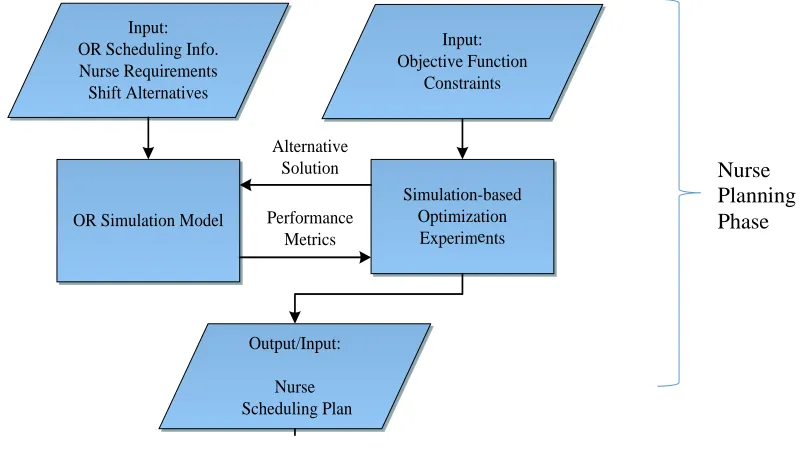
To achieve these goals, we suggest a two phase approach. In the first phase, the Nurse
Planning phase, several different shift plans are generated from a simulation-based optimization
model. The model generates scenarios that differ in the number of nurses working each shift with
the goal of finding the scenario that has the lowest total cost to the system; each scenario has a
different shift plan. These shift plans are used in a stochastic setting when applied to the
simulation model. Output from the simulation is analyzed to determine which shift plan provides
the minimum total cost to the OR while meeting some set service level. The best shift plan is
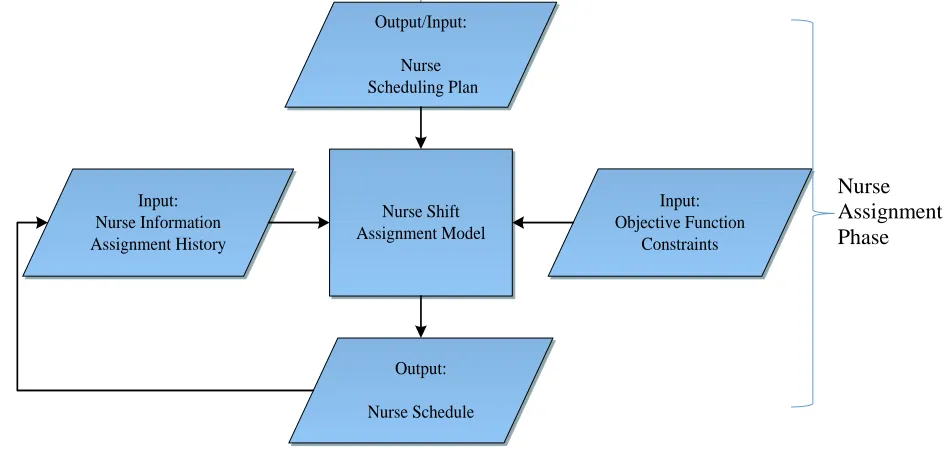
chosen from the simulation-based optimization and used as an input to the second phase. In the
second phase, the Nurse Assignment phase, a mathematical program will assign each specific
nurse to a shift. The Nurse Assignment objectives include maximizing nurse specialty match and
nurse satisfaction, taking into consideration which shifts the nurse has worked in the previous
scheduling periods. The model ensures that surgeries requiring a certain skill set, or specialty,
will have a nurse with that specialty by attempting to maximize the percentage of surgeries that
have such a nurse. The model also seeks to maximize the satisfaction of the nurses. The result is
4.1 Scope
In order to adequately solve a specific nurse scheduling problem, the scope of the
problem must be defined. Firstly, the models will be focused on operating rooms (ORs) only and
not include any other hospital setting such as emergency departments. Also, this OR system will
have approximately 5% - 10% of unscheduled or emergency cases. Another limiting factor of the
analysis will be that the schedules will pertain only to nurses and not doctors or other hospital
staff. The surgery schedule will be assumed to use a block scheduling mechanism for the patients
who are to enter the system. The block schedule in this paper will be defined as blocks of time,
between 8 and 12 hours based on a uniform distribution, for each OR in which scheduled
surgeries can be conducted. Each patient is given a scheduled start time within the allotted block
of time for an OR. The schedule of patients is developed for a 5 day period with the assumption
that each week repeats the same block pattern of demand of procedures. The block schedule will
be an input to the system. The random input factors of the problem are actual surgery duration
from when the surgery begins to when it will end, emergency patient arrival, and number of
surgeries per day. Distributions for these factors are assumed to be known. Number of rooms,
nurses, and shifts are given to the models as an input. The nurse scheduling process used in this
paper is as follows: first, the number of nurses required to work each shift is determined, the shift
plan, then, each specific nurse is assigned to a shift, the shift assignment.
4.2 Inputs and Assumptions
In order to model this system, we must first specify some assumptions. The model only
considers the scheduling of nurses in the system. That is, doctors, anesthesiologists, and OR
techs will not be considered in the model. Patients in the simulation are assumed to arrive prior
OR. Interferences could be due to a lack of beds, excessive or variable transfer times, or sudden
change in health causing the surgery to be changed or rescheduled. The amount of time that a
patient arrives early for his surgery is an input to the simulation and is known. It is also assumed
that when a nurse’s shift ends she is allowed to leave her surgery if there is another nurse
available to take her place. If not, she continues to work until the surgery is complete. This
assumption holds for the examples in this thesis, but can be changed in the model if needed so
that each nurse must complete the surgery she starts even if her shift ends. Emergency patients
arrive randomly to the system throughout the day and may be given a priority greater than that of
the patients already in the queue by being given a higher severity metric. The length of surgery
for each patient is modeled as stochastic; each patient will sample from a probability distribution
to determine his scheduled surgery length and his actual surgery length, not including waiting
time or lateness. Although a block schedule assumes that each surgery length is known, the
actual length of each surgery will be modeled to be stochastic. An average amount of time for
room preparation and clean-up is input to the simulation but the actual time for prep and clean-up
of each OR in the simulation will be sampled from a probability distribution. Also, the time for
the patient to transfer to the OR room will be negligible in the model.
The block schedule history will be analyzed and the average value of each type of patient
will be used to create the demand of the assignment model. The model does not account for any
seasonal effects and assumes that the block schedule repeats every two weeks. The minimum
number of nurses for each half hour period of the day to cover all specific surgery types is
generated by the analysis of the block schedule and is then used as a constraint in the Nurse
Assignment phase. Also, a set of shifts based on some of the typical hours of a day that nurses
hour lunch break. Nurse satisfaction is measured by a subjective score between 0 and 1, and is an
input to the assignment model. This score is an estimation based on what is believed to be the
desirability of the different shifts of the model. The model is capable of assigning different
scores to shifts based on each nurse’s preference; however this thesis assumes that all nurses give
each shift the same score. The number of surgical categories also referred to as specialties in this
paper, is an input to the assignment model. And the nurses’ training level for each specialty is
assumed to be known and input to the model as either trained, 1, or untrained, 0.
4.3 The Two Phase Approach
In the Nurse Planning phase, a simulation-based optimization determines the optimal
shift plan for the system in question. Then, the Nurse Assignment phase assigns each specific
nurse to a shift in the shift plan from the first phase using a mathematical programming model
which aims to optimize nurse satisfaction as well as specialty match. This model will match
nurses to surgeries in which they have the most training while accounting for the satisfaction of
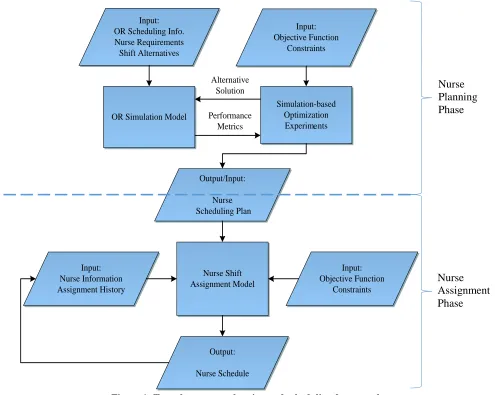
all nurses. As shown in figure 1, the inputs are first given to the OR simulation as well as the
simulation-based optimization. Then, the optimization model tests many different scenarios
where the number of nurses for each shift is adjusted for a minimum of 5 replications.
Replications differ due to the stochastic nature of the patient arrival and surgery length; each
time the simulation will draw different values for these parameters from the probability
distributions associated with them. Those shift plans are input to the simulation and tested under
the variability of the system. The output from the optimization is a shift plan defining the exact
number of nurses needed to work each shift so that cost is minimized while still providing the
Input: OR Scheduling Info. Nurse Requirements Shift Alternatives
OR Simulation Model
Simulation-based Optimization
Experimants Input: Objective Function
Constraints
Performance Metrics Alternative
Solution
Output/Input: Nurse Scheduling Plan
Nurse Shift Assignment Model Input:
Nurse Information Assignment History
Input: Objective Function
Constraints
[image:35.612.59.554.65.460.2]Output: Nurse Schedule
Figure 1: Two phase nurse planning and scheduling framework
Service level is measured by the total hours that patients begin their surgery beyond the
scheduled time. This is known as lateness. As lateness increases, the service level decreases; as
lateness decreases, the service level increases. Service level is ensured by adding a penalty cost
to patients whose surgery starts later than scheduled. This concludes the first phase of the model.
In the second phase, the Nurse Assignment phase, the assignment model is given inputs,
including a satisfaction score for each shift, the shift assignments from previous scheduling
periods, as well as the shift plan from the Nurse Planning phase, and assigns specific nurses to
shifts creating a shift assignment. Objectives, parameter weights, and the length of the Nurse Planning Phase
Nurse Assignment Phase
other. Once the best option is chosen, the combination of the shift plan and shift assignment will
complete the nurse schedule.
4.4 Models
The area in which this thesis expands on the nurse scheduling research that has been done
is in the modelling approach, using simulation-based optimization to minimize cost and feeding
that solution into an assignment model that accounts for nurse satisfaction and specialty match.
This is similar to the methodology described by Centeno et al. (2003) where a combination of
simulation and integer linear programming is also used. Both this paper and the one by Centeno
et al. (2003) use probability distributions to describe the interarrival time of patients as well as
the length of surgery in the simulation. Also, the output of the simulation is used as an input to
the ILP, which assigns nurses to shifts. However, there are some major differences in these two
methodologies. In Centeno et al. (2003), the models choose from five 12- hour shifts, each with
differing labor costs, as well as 9 periods of the day, scheduling for an emergency department.
They also aim to only find the minimum cost subject to service level constraints. In this paper,
the models have 32 shifts to choose from, each being 8 or 10 hours in length and summing to 40
hours per week in an OR. There are also 48 periods of the day, one each half hour, resulting in a
more specific solution. The model proposed in this paper will have the objective of minimizing
cost subject to some service level, but will also have the added objective of maximizing specialty
match as well as nurse satisfaction. The proposed model adds to the approach taken by Centeno
et al. (2003) by solving a more complex problem, testing a larger set of shifts and periods of the
day, and solving for multiple objectives, including cost minimization, nurse specialty match, and
nurse satisfaction. Incorporating nurse satisfaction into the two phase approach helps generate a
In order to ensure that the nurse schedule will apply to the real world system, a
combination of simulation-based optimization and a simulation model is implemented. The
simulation-based optimization tests a variety of shift plans by adjusting the number of nurses
working each shift. These shift plans are tested in a simulation model and provide feedback as to
where the shift plan could be improved. Once a shift plan is decided upon, an assignment model
will be utilized to give each specific nurse her shift for each scheduling period. The nurse
assignment from the current scheduling period provides a weighted nurse satisfaction for each
nurse which is used as an input to the assignment model of the next scheduling period. This
continues until each scheduling period in the scheduling horizon has a nurse assignment solution.
The scheduling horizon is the sum of all of the scheduling periods for which the model produces
a shift assignment. In this paper, a scheduling horizon of 12 weeks will be used for the
assignment model.
4.4.1 Simulation
The purpose of the simulation model is to test any set of shift plans in a dynamic setting
that accounts for the variability inherent in any operating room. Simio simulation software was
used to develop the simulation of the system. We propose a model that considers patients to be
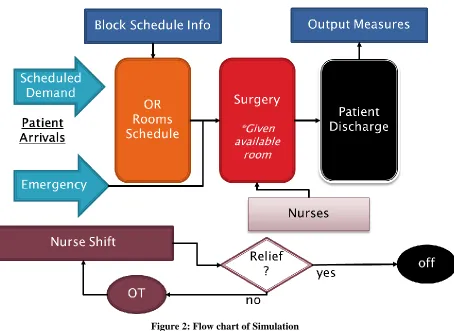
entities, and nurses and ORs to be resources. Each OR has some similar properties, such as set up
time, clean up time, and access to all nurses. Where the ORs differ are in the amount of time that
patient surgeries, or cases, can be scheduled each day and the exact length of surgery for each
patient. The patient arrival is generated at the beginning of each day for each of the ORs
according to a combination of two random distributions. First, an expected surgery length is
generated for a patient by a uniform distribution, for the simulation in this paper between 15
the surgery is determined by applying a Beta (α, β) distribution with parameters α = 1.5 and β =
3. This simulation first subtracts 10 minutes from the scheduled length of surgery and then adds
30 minutes multiplied by a Beta (1.5, 3) distribution. This combination of random distributions
produced a result that is similar to a real world operating room by generating surgeries that last
between 5 and 110 minutes, however any distribution can replace the ones suggested here (Bell,
2013). In addition to the surgery time, a cleanup time is required after each surgery which is
given by a uniform distribution between 10 and 20 minutes. Also, the expected amount of time
that the patients arrive prior to their scheduled start time is assigned at this time and is a constant
30 minutes.
To assign the next patient, the model adds the expected surgery duration and clean up
time to the current patients scheduled start time, giving the patient’s scheduled end time and also
the next patient’s scheduled start time. That next patient arrives 30 minutes prior to his scheduled
start time and if the previous patient is done and no emergency patients have arrived to take over
the OR, the next patient will start his surgery at the scheduled time. If the OR is being used, the
patient is delayed until the room is available and that delay time is added to the total lateness of
all patients, a performance metric for the model. There are also emergency patients added to the
model. Their length of surgery is calculated in the same way as the standard patients; however
their interarrival time is slightly different. An emergency patient enters the system with an
interarrival time based on Normal distribution with mean 3 hours and standard deviation of 0.25
hours, N (3, 0.25). When an emergency patient arrives, he is given the highest priority and goes
to the first available OR. If no OR is available then the emergency patient is assigned to any OR
and pushed to the front of the queue. In this paper all ORs are interchangeable however the
The simulation begins scheduling surgeries in each OR individually, starting each
morning at 7:00 AM and stopping after some value of time based on a uniform distribution
between 8 and 12 hours. This means that the exact number of procedures for each OR and on
each day is stochastic and unknown. The distribution of the number of procedures is based on the
scheduled surgery length of patients as described earlier in combination with the uniform
distribution which causes the scheduling to stop. The simulation runs for one week: 24 hours
each day for 5 days, but is capable of running for any specified time horizon. The length of time
that the simulation must run for depends on the demand distribution of patients. The assumption
in this paper is that demand does not change from week to week but may change from day to day
and thus the simulation must only run for one week. The result of the one week simulation can
be assumed to be the solution for all weeks as the demand of patients does not change from week
to week. The model also runs for 24 hours to accommodate any emergency patients that arrive
outside the hours of scheduled surgeries.
The nurses are a resource that must be allocated to the patient prior to the surgery. A
nurse begins a surgery by transferring a patient into their scheduled OR. This transfer time is
negligible in the simulation. In the simulation, a nurse who starts a surgery completes the surgery
unless her shift ends. If this happens, and another nurse is available, the nurse working is
interrupted. At this time, the remaining time of the surgery is calculated and the new nurse is
responsible for working that remaining time, including clean up time. The nurse originally
working the procedure ends her shift. This model logic is meant to prevent the nurses from
working overtime unnecessarily. This is an assumption of the model and can be seen as a
limitation as most hospitals would prefer continuity of care and that a nurse who starts a surgery