0022-538X/84/050657-05$02.00/0
Copyright © 1984,American SocietyforMicrobiology
Primary Structure of the Neutralization Antigen of Simian Rotavirus
SAil
as
Deduced from cDNA Sequence
CARLOSF. ARIAS,t* SUSANA
L6PEZ,t
JOHN R. BELL,+AND JAMES H. STRAUSSDivision of Biology, California Institute of Technology, Pasadena, California 91125
Received 18July 1983/Accepted 28 October 1983
DNA sequences complementary to the double-stranded RNA coding for the neutralization antigen (glycoprotein VP7) of simian rotavirus SAil have been cloned. The VP7geneconsists of 1,062nucleotides,
containinganuninterrupted codingsequenceof 978 nucleotides whichspecifiesaglycoproteinof 326amino
acids. The significance ofa second possible initiation site 30 nucleotides downstream from the first is discussed. Partial aminoacid sequenceofthisglycoproteinshowedunequivocallythatthe cloned segment
(segment 9) codes for glycoproteinVP7 of SAil. The resulting amino acid sequence contained only one
carbohydrateacceptorsite. Possible sites of membrane interaction andantigenicdeterminantsarediscussed basedonthe analysisof the hydrophobicity and hydrophilicity profilesof VP7.
The rotaviruses are principal etiological agents of acute
viral gastroenteritis in the youngofanumber
of
mammalianandavianspecies, including humans,andassuchtheyareof majormedical andveterinary importance (10, 13).
These viruses possessa genomethat consists of 11
seg-mentsof double-stranded RNA(dsRNA)
(28).
Inthe simian rotavirus SAl1,eachdsRNA segmentencodesasingle viral protein, five of whichareincorporated intothematurevirion as adouble capsid (1, 7). The major outer-capsid polypep-tide, VP7, isaglycoprotein (1)coded byRNA segment9(see below), which is thoughtto beresponsible for the induction and binding of neutralizing antibodies to the virus (17). Todefinetheantigenic properties of glycoproteinVP7of simian rotavirus SAl1,weclonedacDNA copyoftheglycoprotein
gene. The nucleotide sequence of this cDNA allowed us to
deduce theamino acidsequence ofthisglycoproteinand to predictseveral of its features. Two strategies wereusedfor cloningtheSAl genome. In the
first,
10 ,ugof viriondsRNA wasdenaturedin90%dimethyl sulfoxide at70°Cfor 10 min,precipitated with
2.5
volumes of ethanol, and used as a templatefor the reverse transcriptase-directed synthesis of cDNA,withDNaseI-digested calf thymusDNAusedastherandom primer (27). Single-stranded cDNAcopies of SAl dsRNAswere treated with0.1 N NaOH for60 minat
60°C
and separated from degraded RNA in a Bio-Gel A-5Mfiltration column (27). The single-stranded cDNA was
con-verted tothe double-stranded form by utilizingitsability to form3'-terminal hairpin loops which prime DNA polymer-ase I (31). Subsequent cleavage of the hairpin loop with nuclease S1(6)yielded noncovalently joined
double-strand-ed cDNA (dscDNA), which in turn was tailed with
poly-deoxycytidylic acid by using terminal transferase (29). In thesecond strategy, virion dsRNAwas denatured and
precipitatedasaboveandresuspended in150
[ul
of polyade-nylation reaction mixture containing 1 UofEscherichiacoli polyadenylic acid polymerase purified by the method ofSippel(32). An averageof30adenylate residues were added
*Correspondingauthor.
t Presentaddress: InstitutodeInvestigacionesBiomddicas, Uni-versidad NacionalAut6nomade Mexico, Mexico20, D.F.
tPresent address: Genentech, Inc., South San Francisco, CA 94080.
to each single-stranded RNA molecule. Polyadenylated
RNA was isolated on oligodeoxythymidylic acid-cellulose
and precipitated with ethanol (25). After redenaturation as described above, the polyadenylated RNA was transcribed
intocDNA byusing oligodeoxythymidylic acid12 18as prim-er (27). Subsequent to alkali digestion of the RNA and
separation of the degraded products as above, the
single-stranded cDNA was resuspended in 10 mMTris (pH 7.5),
heatdenatured at 100°C for2min, and self-annealed in0.25 MNaCI for6hat65°C.The dscDNAformedinthiswaywas
recovered by ethanol precipitation and, to increase the probability ofobtaining full-lengthdscDNA, was incubated for 12 hat14°C inafilling-inreactionmixture containing12 UofDNApolymerase I (31). ThisdscDNAwasC tailedas above.
ThetaileddscDNAobtainedby eitherof thetwomethods wasannealed(24) to pMT21,linearized withPstI,andtailed
with dGMPresidues. (pMT21, aderivative of pBR322, was obtained from H. Huang; the first 2,520 base pairs were deleted, and a polylinkerwas inserted which contained the
following 10 unique restriction sites: SacII, EcoRI, AvaI, SmaI, BamHI, Sall, PstI, BglII, XbaI, and HindlIl. The
PstI site in theampicillin resistance gene of pBR322 is not present in pMT21.) The hybrid plasmids were transfected intoE. coliMC1061 (4), andtransformants containing plas-mids with inserts were selected by screeningfor resistance
to ampicillin. Individual SAl1 dsRNA segmentsisolated by gel electrophoresis (1) were used to identify the gene
seg-ments represented in cloned recombinant plasmids. The
segmentsweredenaturedindimethyl sulfoxideasdescribed
above, spotted onto nitrocellulose strips, baked for 2 h at
80°C, and hybridized to
32P-labeled
recombinant plasmid (prepared by nick translation [21]) in 50% formamide-5xSSPE (0.9M NaCl,5 mM EDTA,50 mM NaPO4, pH 7.7)-0.1% sodium dodecyl sulfate-lx Denhardt solution(5)-100
,ug of salmon sperm DNA per ml at 42°C for 8 to 16 h.
Plasmid pSR9-3 selected in this way was used to screen a larger number of clones by colonyhybridization (11).
Sequencing oftheinsertsin the selected clones wasdone
by theprocedure of Maxam and Gilbert (23), startingfrom theEcoRI orHindIII sites ofthe plasmid, as described by
Rutheret al. (30).
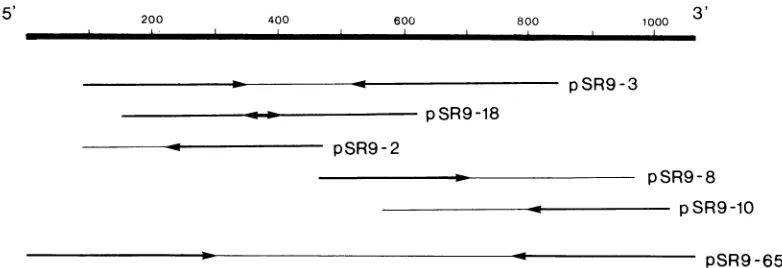
Five clonescontainingsequencesofRNAsegment9 were initiallyobtained by using the random primercloning
proce-657
on November 10, 2019 by guest
http://jvi.asm.org/
658 NOTES
5'
J. VIROL.
200 400 600
40
800 1000 3'
pSR9-3
pSR9-18
pSR9-2
No
pSR9-8
-- pSR9-10
00..0
pSR9-65
FIG. 1. Inserts of cDNA from the simian rotavirus SAl glycoprotein VP7 gene in the different clones used to obtain the complete nucleotide sequence of this gene. Scalebar.Positive strand numberedfrom the 5' to 3' end. The sequenced portions and theirdirection of reading in each clone are indicated by the heavy lines and the arrows, respectively.Clone pSR9-65 was obtained by theoligodeoxythymidylic acidprimingprocedure, whereas the other clones were products of the random primer cloning strategy.
1 0%7jY G I 4
1 ....TAAAAAGAGAGAATTTCCGTTTGGCTAGCGGTTAGCTCCTTTTA SA TAT GGTATT 60
5 E Y T T V L T F L I S T I L L N 20
61 GAATAT ACC ACA GTT CTA ACCTTT CTG ATA TCG ACT ATT CTA CTAAAT 108
21 Y I L K S L T R I r D F I I 0 3 6
109 TAC ATA CTTAAATCA TTA ACT AGA ATA|AGGAC TTT ATA ATT TAT AGA 156
37 F L F I I V I L S P F L R A Q N 52
157 TTT CTT TTT ATA ATTGTGATATTG TCACCA TTTCTTAGA GCACAA AAT 204
53 Y 0 I N L P I A G S M D T A Y A 68
205 TATGGTATT AAT CTT CCA ATC GCA GGC TCC ATG GAC ACTGCATAC GCT 252
69 N S T Q E E P F L T S T L C L Y 84
253 AAT TCAACGCAAGAAGAA CCA TTC CTCACT TCTACA CTTTGCCTA TAT 300
85 Y P T E A A T E I N D N S W K D 100
301 TAT CCG ACT GAGGCC GCGACTGAAATAAAC GATAATTCATGG AAA GAC 348
101 T L S Q L F L T K G W P T E S V 116 349 ACA CTGTCA CAA CTATTT CTTACG AAAGGG TGG CCA ACTGAATCC GTA 396
117 Y F K E Y T N I A S F S V D P Q 132
397 TAT TTTAAA GAATATACTAACATT GCA TCGTTTTCTGTT GAT CCG CAG 444
133 L Y C D Y N V V L M K Y D A T L 148
445 TTG TATTGT GATTATAAC GTAGTA CTAATG AAATAT GACGCGACG TTG 492
149 Q L D M S E L A D L I L N E W L 164
493 CAA TTG GAT ATGTCAGAA CTT GCG GAT CTA ATA TTAAAT GAA TGG TTG 540
165 C N P M D I T L Y Y Y Q C T D E 180
541 TGT AAT CCAATGGATATT ACT CTG TAT TATTAT CAG CAA ACT GAC GAA 588
181 A N K W I S M G S S C T I K v C 196
589 GCG AATAAA TGG ATATCAATG GGCTCATCATGTACA ATT AAA GTATGT 636
197 P L N T Q T L G I G C L T T D A 212
637 CCACTT AATACA CAA ACTCTT GGA ATT GGA TGC TTG ACA ACT GAT GCT 684
213 T T F E E V P T A E K L V I T D 228
685 ACAACT TTTGAA GAA GTG CCG ACA GCT GAA AAG TTG GTA ATT ACT GAC 732
229 V V D G V N H K L D V T T A T C 244
733 GTG GTT GAT GGC GTT AAT CAT AAG CTG GAT GTC ACA ACA GCAACG TGT 780
245 T I R N C K K L G P R E N V A V 260
781 ACTATT AGAAAC TGT AAG AAA TTG GGA CCA AGA GA0 AAC GTA GCC GTT 828
261 I Q V G G S D I L D I T A D P T 276
829 ATACAA GTT GGT GGT TCT GAC ATC CTC GAT ATAACTGCTGAT CCA ACT 876
277 T A P Q T E R M M R I N W K K W 292
877 ACTGCA CCA CAG ACA GAA CGG ATG ATG CGAATTAAC TGG AAA AAA TGG 924
293 W Q V F Y T V V D Y V D Q I Q 308
925 TGG CAA GTTTTT TATACTGTA GTA GAC TATGTAGATCAG ATAATA CAA 972
309 V M S K R S R S L N S A A F Y Y 324
973 GTTATG TCC AAA AGA TCA AGA TCA CTA AAT TCA GCA GCA TTTTAT TAC 1020
325 R V X 326
1021 AGA GTG TAGGTATAACTTAGGTTAGAATTGTATGATGTGACC 1062
FIG. 2. DNA sequence of the mRNA sense strand, and the deduced amino acid sequence for simian rotavirus SAl glycopro-teinVP7. Nucleotide residues are numbered from the 5' to 3' end. In clonepSR9-65, the 5'-terminal sequence presented did not extend to the 5'end of the mRNA (four nucleotides were missing; see text). The 3'-terminal sequence of this clone was followed by a polyadenylic acid tract connected with the vector DNA sequence through a polycytidylic acid tract, as expected from the cloning methodology employed, and thus represented the complete se-quence of this region. The predicted amino acid sequence is displayed above the nucleotidesequence,with the first of the two in-phasetermination codons denoted with an X. Amino acid residues are numbered beginning with the first methionine. Two possible initiator methionines are boxed. The asterisk marks the possible
dure. When these clones were subjected to nucleotide
se-quence
analysis,
it wasfoundthatthereported
sequencesfor the 5' and 3' ends of this gene (3) weremissing (Fig.
1).
To obtain themissing
sequences.
the secondcloning
strategy wasused. Afterselection,
the sizes of21clonespositive
for segment 9 wereanalyzed
in agarosegels.
Only
oneinsert,
thatin clonepSR9-65,
wasofalength
sufficienttorepresenta
full-length
copy of the gene. The sequence of this insertwasfoundtobe
missing only
four nucleotidesatthe 5'end of the plus strand (seebelow).
Theportion
of the clonesanalyzed
to obtain the nucleotide sequence of the gene is shown inFig.
1.Glycoprotein VP7 of simian rotavirus SAII is
thought
to be thepolypeptide
thatelicitsneutralizing
antibody.
Genetic studies with the human Wa strain and with the bovine UK strain have led to theassignment
of the genecarrying
the neutralization activity to dsRNA segment 9(17).
Northern blotanalysis
has shown that segment 9 in strainSAl1
corresponds
to segment 9 in strain Wa(5a).
Translationexperiments
in vitro with simian rotavirus SAlsuggested
that genome segment 9 encodes the precursor to the viral structuralglycoprotein (1, 22, 33).
Thedatawepresenthere confirms that segment 9 indeed encodesglycoprotein
VP7. Partial aminoacid sequence wasobtaineddirectly
from theglycoprotein
(seebelow).
Glycoprotein
VP7 frompurified
simian rotavirus SAl was isolatedby
preparative gel
elec-trophoresis.
NH2 terminal sequence of thepurified
protein
revealed that it wasblocked,
which was somewhatunex-pected
in view of the fact that the matureglycoprotein
isproduced
by
cleavage
of the precursor(see
below) (7a).
To obtain amino acid sequence data from theglycoprotein,
wetherefore
sequenced
afragment
obtained after V8protease
digestion.
The sequence obtained matched that of amino acids 221 to 237 ofthe deducedpolypeptide (underlined
inFig.
2). Thisfinding
showedunequivocally
that dsRNAsegment 9ofSAl codes for VP7 and identified the
coding
carbohydrate attachment site. The underlined amino acid sequence
(from amino acids 221
through
237) wasconfirmedby
directsequenc-ingofaV8
protease-produced peptide.
Toobtain this sequence, 10pLg
ofgel-purifiedVP7wasdigested
with 1p.g
of V8proteasefor 4.5 h at37°C. Thepeptides
produced
wereseparated
in a 15%acryla-midegelandelectroeluted
separately
(1, 15).Theprotein
sequencedetermination was done as
previously
described(2.
12). These-quenced peptide began at Val-218, but no
assignments
could bemadefor the first three
cycles.
-lk..
on November 10, 2019 by guest
http://jvi.asm.org/
[image:2.612.121.512.67.201.2]a
II
-'
i
A@rM4
A' V W 'IJ VvII - \ \
b
A,
I,,,
b~~~~~~~~~~~~
k\
AMINO ACID NUMBER
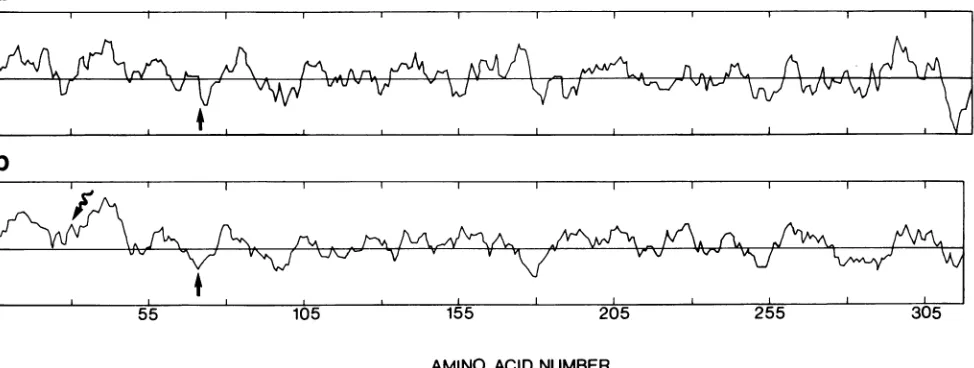
FIG. 3. Hydrophobic andhydrophilic regions ofthe SAl neutralization antigen.Theprimaryaminoacidsequenceofglycoprotein VP7 wascomputer scannedfor antigenicdeterminants withthe programofHoppand Woods(14)(a)orforregionsofhydrophobicity with the programofKyteandDoolittle (19)(b). The degree ofhydrophobicity increases abovethe horizontalline;that ofhydrophilicityincreaseswith distance below the horizontal line. The search length wassix amino acids for the Hoppand Woods program and nine for the Kyte and Doolittleprogram. Verticalmarksinthe horizontalaxescorrespondto25amino acid residues.Straightarrowsin(a)and(b), Position ofthe potential site ofglycosylation. Wavyarrow inb. Position ofthe secondpossible initiator methionine (seetext).
strand ofthe gene. The complete cDNA sequence (except forthe firstfour basesat the 5' end) is shown in
Fig.
2.The cDNA sequence at the 3' terminus matched exactly the terminal sequencepreviously reported forgene9,
includ-ingthe lasteight nucleotides, which have been showntobe conserved not only in the different segments ofSAl but also in the genes of differentrotavirus strains(3).In compari-sonwiththereported 5'-terminal sequence(3), clone pSR9-65 lacked the first four nucleotides of that end and also lacked the expected
deoxyribosyladenine-deoxyribosylthy-mine homopolymertract.
Fromthe sequencepresented inFig.2, the base
composi-tionfortheplus strand of dsRNA segment9 wasfoundtobe
33%A, 19% G, 31% U, and17%C. The lowGC contentof the gene is reflected in the scarcity of the CpG doublet, a featurethat has beenfound in RNA and DNAviruses with vertebrate hosts (9, 26).
The entirenucleotide sequence(includingthemissingfirst four bases) was found to be 1,062 base pairs long. The sequencecodingfor VP7consisted ofanopenreading frame of 978 bases which started at nucleotide 49 with the first
ATG and endedat nucleotide 1,025 with the first of two in-phase termination codons. Inthis reading frame, the usage for the possible codons for each amino acid was clearly nonrandom. The resulting amino acid sequence contained
onlyonecarbohydrate acceptorsite (Asn-Ser-Thr) atamino acid positions 69 through 71. The 5'- and 3'-noncoding
sequences were 48 and 36 nucleotides long, respectively.
The absence of the sequenceAAUAAA, present in eucary-otic polyadenylated mRNAs, fromthe 3'-noncoding region
of this gene is consistent with the lack ofpolyadenylationin the mRNAs ofReoviridae (16).
An openreadingframeof369nucleotideswasfound in the
minus strand; however, since the first ATG found in this
openregion was235 nucleotides downstream fromthestart
of the region, it isunlikely that it codes fora protein. The otherreading framesof both thecodingand the
complemen-tary strands contained numerousstopcodons, such that the longestpolypeptide that could be derived from them would be less than 50 amino acids long.
It is interestingto notethat the first ATG of the sequence
codingfor VP7 did nothave theconsensus sequence which wasdescribed by Kozak as being necessaryforan efficient initiation of translation (18)buthad,
instead, pyrimidines
inpositions +4 and -3. However, onepreproinsulin initiation codon engineered in vitro with these characteristics was
very efficiently used in translation (20). On the otherhand,
the secondATG,found 87 nucleotidesdownstream, had the
classical sequence for an initiatorATG. The
putative
poly-peptides resultingfrom initiation atthese twopossible
siteswould be 326 and 297 amino acids long with molecular
weights of 37,368 and 33,919, respectively. Because the reported molecularweight for the nonglycosylatedprecursor
ofVP7is37,000(7a), translationwould appearto start atthe
first ATG. However, several observations have indicated
that VP7 of SAl1 is polymorphic, and nonglycosylated
precursors ofVP7 of smaller molecular weight have been
observed (8). SAl1 strains with different buthomogeneous
VP7havebeenobtained afterplaquepurification ofthevirus
(8).The sequencereportedhere suggests thatpolymorphism might be the consequence ofthe existence of virus clones
whichuseeither the first or secondinitiation codonof RNA segment 9.
In an attempt to predict the possible antigenic determi-nantsandtofindhydrophobicsequenceswhichmightserve as signal sequences orotherwise interact with membranes,
we calculated the hydrophilicity curves alongthepredicted amino acid chain by the methods described by Hopp and Woods (14) and Kyte andDoolittle (19) (Fig. 3). The most hydrophilic peak, which according to Hopp and Woods
probably represents an antigenic determinant, was found around amino acid 313, closeto theCOOH terminus of the
glycoprotein (Fig. 3a). Other hydrophilic regions around amino acids 72 (near the recognition sitefor carbohydrate
255
305
55 105 205
on November 10, 2019 by guest
http://jvi.asm.org/
[image:3.612.62.549.78.262.2]660 NOTES
attachment) and 180 could also represent antigenic determi-nants. Knowledge of the antigenic determinants of glycopro-tein VP7 is important for the study of the neutralizable regions of the glycoprotein.
The hydrophobicities of the regions from amino acid 4 through 23 and from amino acid 29 through 48 (Fig. 3b), which have an average hydrophobicity of 1.61 and 2.25, respectively, indicate that these regions could be signal peptides or sites for interaction with the membrane or both. The cleavage of the signal peptide, with a size of about 1,500 daltons, from the 37,000-molecular-weight nonglycosylated precursor has been shown by using a plaque-purified virus which contains only one class of glycoprotein, with a molec-ular weight of 38,000 (7a). If initiation can also start at
thM
second ATG, the second hydrophobic region may alsofunction as a signal peptide. Hence, the polymorphism
observed in VP7 may be the result of the existence of two initiation and two cleavage sites in this protein. Sequencing of the 5'-terminal region of the coding strand of segment 9 from virus clones differing in VP7 would provide insight into this problem, which may be involved in virus adaptation.
We are grateful to C. Rice for helpful discussionsand advice on the sequencing and cloning experimentsandto R. Espejo for critical discussion of the manuscript. We thank H. Huang for the gift of his recently developed plasmidpMT21. The computer programs used in this work were written by T. Hunkapiller,and wethank him for their use.
This work was supported inpart by Public Health Service grants GM 06965 andAl 10793 from the National Institutes of Health and grant PCM 8022830 from the National Science Foundation. C.A. and S.L. were supported by a grant from the Universidad Nacional
Aut6noma de Mexico.
ADDENDUM
Just before this manuscript was submitted, the sequence
of VP7 appeared (G. W. Both, J. S. Mattick, and A. R.
Bellamy, Proc. Natl. Acad. Sci. U.S.A.80:3091-3095, 1983).
Our work confirms the coding assignments for VP7 by a
different method, the main features of the nucleotide
se-quence of gene 9, and the inferred protein sequence. Our
SAl was obtained from H. H. Malherbe in 1977, and
significant divergence from other preparations might be expected after continuous passage for more than 5 years.
However, comparison of the obtained sequences reveals
that they have been highly conserved: only 12 nucleotides werefound to differ in both strains. Sevenof thesemutations
represented a change in an amino acid, and the other five were silent. Three of the aminoacid changes werelocated in the hydrophobic regions proximal to theNH2 terminus, but allthree wereconservative. Only oneof the otherfour amino acid changes is significative, involving nucleotide 389 and changing Gly-114 to Glu-114. None of the nucleotide
muta-tions occurred at the two possible initiation sites.
After submitting this manuscript, a closely related paper describing the nucleotide sequenceof the gene encoding the neutralizing antigen of the bovine rotavirus UKappeared(T. C. Elleman, P. A. Hoyme, M. L. Dyall-Smith,I. H. Holmes, and A. A. Azad, Nucleic Acids Res. 11:4689-4701, 1983). The characteristics of the UK gene are strikingly similar to those reported here for the VP7 SAl gene: it is 1,062 base pairslong, with a long open reading frame of 326amino acids starting at the first of twoin-phase possible initiation codons at nucleotide positions 49 and 136. The hydrophatic profile
of thededuced protein showed two NH2-terminal hydropho-bic regions and the presence of a carboxy-terminal highly hydrophilic region that may represent a major antigenic determinant.
In addition tothe one possibleglycosylation site found in glycoproteinVP7 ofsimianrotavirus SAl1 at amino acid 69, there aretwomore putativecarbohydrate attachment sites in thebovineprotein atamino acids 238 and 318. Bycomparing
the UK and SAl1 sequences, we found a77% homology at
the nucleotide level and a 86% homology at theaminoacid
level.
LITERATURE CITED
1. Arias, C. F., S. L6pez, and R. T. Espejo. 1982. Gene protein products of SAl simian rotavirus genome. J. Virol. 41:42-50. 2. Bell, J.R., M.W. Bond, M. W. Hunkapiller, E. G. Strauss, J. H. Strauss, K.Yamamoto,and B.Simizu. 1983.Structuralproteins ofwestern equine encephalitis virus: aminoacidcompositions andN-terminal sequences. J. Virol. 45:708-714.
3. Both, G. W., A. R. Bellamy, J. E. Street, and L. J. Siegman. 1982. A general strategy for cloning double-stranded RNA: nucleotide sequence of the simian-11 rotavirus gene 8. Nucleic Acids Res. 10:7075-7088.
4. Casadaban, M. J.; and S. N. Cohen. 1980. Analysis ofgene control signals by DNA fusion and cloning in Escherichia (c/li.
J. Mol. Biol. 138:179-207.
5. Denhardt, D. T. 1966. A membrane filter technique for the detection of complementary DNA. Biochem. Biophys. Res. Commun. 23:641-646.
Sa.Dyall-Smith, M. L., A. A. Azad, andI. H. Holmes. 1983.Gene mapping of rotavirusdouble-strandedRNAsegmentsby North-ern blot hybridization: application to segments 7, 8, and9. J. Virol.46:317-320.
6. Efstratiadis, A., F. C. Kafatos, A.M. Maxam,and T. Maniatis. 1976. Enzymatic in vitro synthesisofglobingenes. Cell 7:279-288.
7. Ericson, B. L., D. Y. Graham, B. B. Mason, and M. K. Estes. 1982. Identification,synthesis, and modification of simian rota-virus SAl polypeptides in infectedcells. J. Virol. 42:825-839. 7a.Ericson, B. L., D. Y. Graham, B. B. Mason, H. H.Hanssen, and M. K. Estes. 1983. Two types ofglycoprotein precursors are
produced by thesimian rotavirusSAl. Virology 127:320-332. 8. Estes, M. K., D. Y. Graham, R. F. Ramig, and B. L. Ericson. 1982. Heterogeneity in the structural glycoprotein (VP7) of simian rotavirus SAl. Virology 122:8-14.
9. Fiers, W., R. Contreras, G. Haegeman, R. Rogiers, A. Van de Voorde, H. Van Heuverswyn, J. VanHerreweghe, G.Volckaert, and M. Ysebaert. 1978. Complete nucleotidesequence ofSV40. Nature (London) 273:113-120.
10. Flewett,T. H., and G. N. Woode. 1978. The rotaviruses. Arch. Virol. 57:1-23.
11. Grunstein, M., and D. S. Hogness.1975. Colonyhybridization:a methodforthe isolation of cloned DNAs thatcontain aspecific
gene. Proc. Natl. Acad. Sci. U.S.A. 72:3961-3965.
12. Hewick, R. M., M. W. Hunkapiller, L. E. Hood, and W. J. Dreyer. 1981. A gas-liquid solid phase peptide and protein
sequenator. J. Biol. Chem. 256:7990-7997.
13. Holmes, I. H. 1979. Viral gastroenteritis. Prog. Med. Virol. 25: 1-36.
14. Hopp, T. P., and K. R. Woods. 1981. Prediction of protein
antigenic determinants from aminoacid sequences. Proc. Natl. Acad. Sci. U.S.A. 78:3824-3828.
15. Hunkapiller, M. W., E. Lujan, F. Ostrander, and L. E. Hood. 1982. Isolation ofmicrogram quantities ofproteins from
poly-acrylamide gels for amino acid sequence analysis. Methods Enzymol. 91:227-236.
16. Joklik, W. K. 1981. Structure and function of the reovirus genome. Microbiol. Rev. 45:483-501.
17. Kalica, A. R., H.B. Greenberg, R. G. Wyatt, J. Flores, M. M. Sereno, A. Z. Kapikian, and R. M. Chanock. 1981. Genes of human(strain Wa) and bovine(strain UK)rotaviruses that code for neutralization andsubgroupantigens.Virology 112:385-390. 18. Kozak, M. 1981. Possible role offlankingnucleotide in
recogni-tion of the AUG initiator codon by eukaryotic ribosomes. Nucleic Acids Res. 9:5233-5252.
19. Kyte, J., and R. F. Doolittle. 1982. A simple method for J. VIROL.
on November 10, 2019 by guest
http://jvi.asm.org/
displaying thehydropathic character of a protein. J. Mol. Biol. 157:105-132.
20. Lomedico, P. T., and S. J. McAndrew. 1982. Eukaryotic ribo-somes canrecognizepreproinsulininitiation codonsirrespective of their position relative to the 5' end of mRNA. Nature (London)299:221-226.
21. Maniatis, T., A. Jeffrey, and D. G. Kleid. 1975. Nucleotide sequence of the rightward operator of phage X. Proc. Natl. Acad. Sci. U.S.A. 72:1184-1188.
22. Mason, B. B., D. Y. Graham, and M. K. Estes. 1980. In vitro transcription and translation of simian rotavirus SAl gene products. J. Virol. 33:1111-1121.
23. Maxam, A. M., and W. Gilbert. 1980. Sequencingend labeled DNA with basespecific chemical cleavage. Methods Enzymol. 65:499-560.
24. Okayama, H., and P. Berg. 1982. High-efficiency cloning of full-length cDNA. Mol. Cell. Biol. 2:161-170.
25. Ou,J.-H., E. G. Strauss, and J. H. Strauss. 1981. Comparative studies of the 3' terminal sequences of several alphavirus RNAs. Virology 109:281-289.
26. Porter, A. G., C. Barber, N. H. Carey, R. A. Hallewell, G. Threlfall, and J. S.Emtage. 1979. Completenucleotidesequence ofan influenzavirus haemagglutinin gene from cloned cDNA. Nature (London)282:471-477.
27. Rice, C. M., and J. H. Strauss. 1981. Synthesis, cleavage and sequenceanalysis ofDNAcomplementaryto the26Smessenger RNAofsindbisvirus. J. Mol. Biol. 150:315-340.
28. Rodger, S. M., and I. H. Holmes. 1979. Comparison of the genomes of simian, bovine, and human rotaviruses by gel electrophoresis and detection ofgenomic variation among bo-vine isolates. J. Virol.30:839-846.
29. Roychoudhury, R., E. Jay, and R. Wu. 1976. Terminallabeling and additionof homopolymertracts to duplex DNA fragments by terminal deoxynucleotidyltransferase. Nucleic Acids Res. 3:101-116.
30. Ruther, U., M. Koenen, K. Otto, and B. Muller-Hill. 1981. PUR222, a vectorfor cloning andrapidchemicalsequencingof DNA. Nucleic AcidsRes. 9:4087-4098.
31. Seeburg, P. H., J.Shine, J. A. Martial, J. D. Baxter, and H. M. Goodman. 1977. Nucleotide sequence andamplificationin bac-teria of structural gene for rat growth hormone. Nature (Lon-don) 270:486-494.
32. Sippel, A. E. 1973. Purification andcharacterizationof adeno-sine triphosphate: ribonucleic acid adenyltransferase from Escherichiacoli. Eur. J. Biochem. 37:31-40.
33. Smith, M. L., 1. Lazdins, and I. H. Holmes. 1980. Coding assignments ofdouble-stranded RNA segments ofSAl1 rota-virusestablished by in vitro translation. J. Virol. 33:976-982.