City, University of London Institutional Repository
Citation
:
Lee, D., Robinson, L. & Bawden, D. (2018). Global knowledge organization,
"super-facets" and music; universal music classification in the digital age. In: Challenges and
Opportunities for Knowledge Organization in the Digital Age: Proceedings of the Fifteenth
International ISKO Conference 9-11 July 2018 Porto, Portugal. Advances in Knowledge
Organization. (pp. 248-255). Baden-Baden: Ergon-Verlag. ISBN 978-3-95650-420-4
This is the accepted version of the paper.
This version of the publication may differ from the final published
version.
Permanent repository link:
http://openaccess.city.ac.uk/20091/
Link to published version
:
Copyright and reuse:
City Research Online aims to make research
outputs of City, University of London available to a wider audience.
Copyright and Moral Rights remain with the author(s) and/or copyright
holders. URLs from City Research Online may be freely distributed and
linked to.
facets. The paper finds three dimensions of universality within special classification schemes: coverage, mechanism and consumption. Furthermore, the “super-facet” is found to be a key part of universality, although its conception of universality is different from the universal classification scheme.
Discussions about universality in classification are an important part of recent knowledge organization (KO) discourse. For example, a call for a new universal classification by Dahlberg (2017) and a panel at the 2016 ASIST conference about global/local knowledge organization (Adler et al. 2016), are just a few examples showing the importance of these subjects to contemporary KO. This paper aims to look at a particular type of being universal: the need for, and development of central and universal classifications for a particular subject. In the case of this paper, music will be used as an example. As well as exploring the idea of a “universal classification” for a single subject (music), this paper will also deconstruct the idea of universality even further, by examining the idea of “super-facets”.
The paper starts with a brief review of universality within KO literature. The idea of a universal classification scheme for music is explored, and three dimensions of universality are posited. The idea of super-facets is then introduced, and three systems of super-facets for music are mined for information about how super-facets function. Finally, the relationship between universal classification schemes for music and super-facets is explored. So, while this paper focuses on what by some definitions of universal is impossible, “the universal special classification”, by doing so, further information about what exactly it means to be “universal” is laid out.
1. Literature review
2
classification – an opposition, it should be added, that Szostak (2010) attempts to breach in his paper.
However, theorists suggest that the term “universality” has a number of different meanings (Szostak, 2014; Satija & Martínez-Ávila, 2017); indeed, exactly what is “universal” even within a so-called universal scheme is not always explicit. In particular, Szostak (2014, p. 469), seeks to clarify what we mean by “universality” and outlines the difference between universality as the possibility of being able to “see the world in the same way” and being defined by “seeing the world in the same way”. (This idea links to discussions of universality in aesthetics, and whether universal aesthetic judgement is about the object’s potential or everyone having the same opinions about that object (McMahon, 2007, pp. 30-31).) The relationship between interoperability and universality is another important part of discussions (Gnoli and Szostak, 2014); especially important for this paper is their idea of “conceptual interoperability” (Gnoli and Szostak, 2014), in other words universality as a system of knowledge (as opposed to a technical mechanism) designed to work across different classification schemes. Also of interest is the part of universality which deals with the idea of global versus local classification (Adler et al, 2016); again, although the discussions might focus on general classification schemes, the overall principles of global classification practices versus local ones still has currency within domain-specific classification schemes.
So, this review of literature has shown that while the idea of universality is often seen as “… simply a system that seeks exhaustive coverage rather the treatment of a limited domain” (Szostak and Gnoli, 2014, p. [2]), there are also other possible conceptions of universality at play, such as the generic idea of the global, universality as conceptual interoperability, and “universal” representing a singular viewpoint.
2. Aspirations of a universal music classification
Examining music classification schemes yields an important phenomenon: the aspiration and attempted realisation of the “universal music classification scheme”. These could be seen as special-classification siblings to the general, universal classification schemes which dominated the late 19th century and much of the 20th
century. The ideal of being “universal” can also be seen as part of a wider movement, fitting into Gnoli and Szostak’s (2014, p. [1]) account of the popularity of the term “universal” in the 20th century.
classification scheme is clear. However, what does Pethes intend by the idea of “universal”? There are a number of places where Pethes describes universality or global ideas, and these are valuable insights into this elusive concept of universality.
First, Pethes directly mentions the idea of universality in conjunction with what we might consider as traditional ideas of universality: the global, general classification scheme. Pethes (1967, p. 2) opens his introduction by mentioning “… the great universal classification systems of the 19th and 20th centuries, prepared by Harris,
Cutter, Dewey, Brown, Bliss and Ranganathan …” and how these have the aim of “universality” (Pethes, 1967, p. 2). So, we can infer that when Pethes uses the term “universal” in conjunction with his own special scheme (i.e. not traditionally “universal”), he is aware of the ideas of universality perpetuated by schemes such as DDC and Bliss.
Second, Pethes (1967, p. 2) lays out various criteria of what should be included in an “internationally acceptable classification” system. There could be different ways of interpreting the term “internationally acceptable” in this context; however, we would argue that while he does not use the term “universal” at this specific juncture, we can assume that Pethes was equating his criteria with the “solution” to the problems of music classification – in other words, his creation of a universal classification scheme for music. Some of these criteria directly delineate aspects related to universality, and are worthy of discussion.
Criterion 1 (Pethes, 1967, p. 2) says that an internationally acceptable scheme should cover the whole field of music. So by this, we imply musicology, performance, analysis and so on. However, this could also mean music of all cultures and types. So, according to Pethes, to be a universal scheme, you have to cover all knowledge in the appropriate domain. Note how this could be perceived as a domain-specific version of the exhaustive, general scheme which usually is labelled as “universal”. Criterion 5, states that “it [the classification scheme”] should lend itself equally well for development by library, documentation and mechanical sorting” (Pethes, 1967, p. 2). So, the universal scheme is one which could be used equally for any type of music information collection or task. Consequently, this criterion is about collections of knowledge. Criterion 6 follows a similar theme: collection size. Pethes (1967, p. 2) states that an internationally acceptable classification scheme should be applicable to collections of any size.
4
universal. Furthermore, this link between decimal notation and universality is not new; for example, Hornbostel and Sachs (1992) borrow the decimal notation of DDC for their 1914 classification of musical instruments, for reasons including the notation’s perceived universality. Notation-as-universality also acts in a different dimension to the other criteria discussed so far, as it concerns the mechanism of a classification scheme.
Flexible is not the only writer to consider what shape a universal classification for music might take. For example, Chailley (1988) also writes about the need for a universal classification for music, with a different focus from Flexible. Chailley (1988, p. 244) wanted universal coverage in terms of the formats of musical materials. So, we can add another aspect to Pethes’ list: format of music materials as a prerequisite of universality in a classification scheme.
Finally, there is another interpretation of “universal” which is not stated explicitly but implied in Pethes’ writings: the universal usage of a scheme. We can consider this in terms of the reception-based idea of “consumption” (Lee, 2015), which looks at how often and where a classification scheme is used. So, while Flexible was designed to inspire international usage, there is little documentary evidence of its actual usage either contemporarily with its publication or the years since. Surely one part of being a universal and “internationally acceptable” classification scheme (such as Flexible), is for it to be used widely and internationally? This asks a challenging question about universality: can a scheme be universal if its usage is not universal? Flexible
demonstrates how universality in design and intention are not equivalent to universal usage.
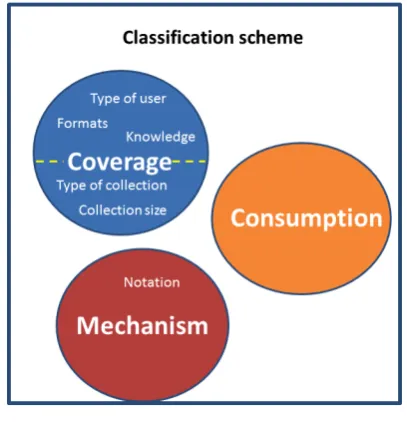
We can put together all the criteria together into a model of universality, and this model conceives of three dimensions of universality: coverage, mechanism and consumption – see Figure 1. Individual aspects are included within these dimensions, such as notation (in the mechanism dimension) and formats (in the coverage dimension). Furthermore, the aspects within coverage could be loosely divided into those which act at individual resource level (such as knowledge covered or format) and those which act at collection level (such as type of collection or collection size).
3. Super-facets for music
than what each system says about music. (More details about any of these systems of super-facets, a comparison of the systems, and facets of music classification more generally can be found in Lee (2017).)
The IAML facets were published in brief in Fontes Artis Musicae (Dorfmüller, 1975). From this document we have a skeletal idea of where these came from, albeit lacking the details of how every facet was born. The five facets (Dorfmüller, 1975, p. 48) are assumed to cover musical works and works about music. These facets appear to have been created to bring together existing thinking about music, and to solve standardisation issues within music classification. Interestingly, Dorfmüller (1975, pp. 48-49) notes how some facets were easy to agree upon such as medium and time period, whereas others such as purpose/occasion/effect/intension required discussion. So, we could ask is a super-facet more or less universal if it is easily agreed upon by its authors?
The Redfernfacets were designed for another reason: they appear as the inevitable result of facet analysis in a textbook about music classification (Redfern, 1978). Redfern (1978) gives a total of 13 facets, some of which apply to music and works about music, while others are only for works about music. This is an interesting variation on the idea of universality across different formats of musical materials. While Redfern (1978) narrates the creation of his facets as inductive reasoning from the analysis of 26 examples of music resources, it is assumed that he purposefully selected these examples in order to “uncover” the specific list of 13 facets. The small sample size and manner of presenting the facets suggests that Redfern believed that there is a “single truth” of facets of music which would be revealed through facet analysis of any
collection of musical knowledge. The Redfern facets imply that universal facets of music exist, and only await discovery, in contrast to the IAML facets which are derived from discussions about the multitudinous possibilities of music’s facets.
6
1994, p. 1270), as well as adding a facet of his own (Elliker, 1994, p. 1271), arguably creating “super-super-facets”.
Considering these three particular systems of music super-facets is useful for exploring the general idea of super-facets. To start, like a universal classification scheme for music, the presence of multiple systems of super-facets shows how there is no single set of universal facets. The different usages and intentions for the three sets of super-facets illuminate different approaches to universality. Redfern (1978) offers up facets of music, not super-facets; however, his assumption that these facets are the
facets of music, is what (arguably) makes them super-facets. Both the IAML facets and
Elliker facets are created for universality-as-interoperability; however, while the IAML facets appear to be created for a general ideal of standardisation, the Elliker facets have a prosaic and defined interoperability task awaiting their derivation (namely, the analysis of 24 music classification schemes). Finally, while these three systems of super-facets were created for bibliographic classification schemes in the 20th century,
the idea of super-facets also has value in a digital environment; for instance, Downie’s (2003) facets of music have arguably been adopted as a sort of unofficial set of super-facets by the music information retrieval community, while Madalli, Balaji and Sarangi (2015)’s selection and utilisation of facets for their faceted ontology of music, in some ways echoes the creation of the Redfern facets (although not in the decided facets).
4. The connections between super-facets and universality
This exploration of universal classification schemes and super-facets for music, also questions the connection between universality and super-facets. For example,
Flexible, a universal classification scheme for music, uses facets selected especially for
Flexible rather than a system of facets. Similarly, the three examples of super-facets for music do not lead directly to a universal, or indeed any, classification scheme. So, we can see that super-facets do not appear to be components of a universal classification scheme, and that super-facets exist outside of the framework of universal classification schemes. Actually, the super-facets and universal classification schemes discussed in this paper work at different levels: for example, Flexible is a single classification scheme, whereas the Elliker facets are devised from multiple classification schemes and represent the consolidation of classificatory ideas from multiple schemes. Using the above music examples as a guide, it can be posited that a universal classification scheme attempts to establish universality by being a single, universal classification system, whereas a system of super-facets works amongst different classification schemes to establish universality across multiple schemes. So, super-facets might be universal, but are not part of the concept of a universal
classificationscheme.
however, rather than being a feature of a single scheme, super-facets exist as the shared space between the coverage and mechanism dimensions across multiple classification schemes. Thus, it is shown that super-facets and universal classification schemes may be different phenomena, but are both parts of the same dimensions of universality.
5. Future work and concluding thoughts
[image:8.595.201.405.395.607.2]This paper has shown the value in considering universality in classification schemes within a specific domain. However, as this paper only discussed a small selection of schemes and super-facets within one particular domain, it would be interesting to see how and if they could be applied to other domains. Furthermore, it would be useful to see how the dimensions of universality articulated in this paper and the idea of super-facets, could be fitted into discussions about universality within general classification schemes. This paper asks, beyond anything else, what does “universal” really mean, using the environment of a specific domain to analyse unexplored parts of this concept. The answer, in part, complements existing literature about universal classification: even within a single domain, the concept of universality in classification is a significant concept, but its meaning and scope is anything but universal.
Figure 1: Three dimensions of universality in a classification scheme
References
Adler, M. et al. (2015). Global/local knowledge organization: contexts and questions. In Grove, A. et al. (Ed.), ASIST 2016: proceedings of the 79th ASIS&T annual meeting, 53. Retrieved from
8
Chailley, M.-N. (1988). Proposition de classification decimale pour les besoins des bibliotheques musicales de type multimedia. Fontes Artis Musicae, 35(4), 243-256. Retrieved from http://www.jstor.org/stable/23507943.
Dahlberg, I. (2017). Why a new universal classification system is needed. Knowledge Organization, 44(1), 65-71.
Dorfmüller, K. (1975). Working commissions: Subkommission für Klassifikation.
Fontes Artis Musicae, 22(1/2), 48-49. Retrieved from
http://www.jstor.org/stable/23506187.
Downie, J.S. (2003). Music information retrieval. Annual review of information science and technology, 37, 295-340. doi: 10.1002/aris.1440370108.
Elliker, C. (1994). Classification schemes for scores: analysis of structural levels.
Notes, Second Series, 50(4), 1269-1320. Retrieved from
http://www.jstor.org/stable/898291.
Gnoli, C. & Szostak, R. (2015). Universality is inescapable. In 25th ASIS SIG/CR
Classification Workshop. Advances in Classification Research Online. Retrieved from http://journals.lib.washington.edu/index.php/acro/article/view/14906. Hornbostel, E.M.v. & Sachs, C. (1992). Classification of musical instruments. In
Myers, H. (Ed.), Ethnomusicology: an introduction (pp. 444-461). London: Macmillan.
Lee, D. (2015). Consumption, criticism and Wirkung: reception-infused analysis of classification schemes. Knowledge Organization, 42(7), 508-521.
Lee, D. (2017). Modelling music: a theoretical approach to the classification of notated Western art music (Unpublished doctoral dissertation). City, University of London, London. Retrieved from http://openaccess.city.ac.uk/17445/.
Madalli, D.P., Balaji, B.P. & Sarangi, A.K. (2015). Faceted ontological representation for a music domain. Knowledge Organization, 42(1), 8-24.
McMahon, J.A. (2007). Aesthetics and material beauty: aesthetics naturalized. New York: Routledge.
Pethes, I. (1967). A flexible classification system of music and literature on music.
Budapest:Centre of Library Science and Technology.
Satija, M.P. & Martínez-Ávila, D. (2017). Mapping of the universe of knowledge in different classification schemes. International Journal of Knowledge Content Development & Technology, 7(2), 85-105.
Szostak, R. (2010). Universal and domain-specific classifications from an
interdisciplinary perspective. In Gnoli, C. & Mazzochi, F. (Eds.), Paradigms and conceptual systems in knowledge organization: proceedings from the 2010 conference of the International Society for Knowledge Organization, Rome, Italy
(pp. 71-77). Würzburg: Erlon Verlag.