• No results found

Flexibility to contingency changes distinguishes habitual and goal-directed strategies in humans

N/A
N/A
Protected

Academic year: 2019

Share "Flexibility to contingency changes distinguishes habitual and goal-directed strategies in humans"

Copied!
16
0
0

Loading.... (view fulltext now)

Full text

Figure

Fig 1. Schematic of the experimental design. (A) Each trial started from either the first-level state (S0), withstructure from the second-level states to terminal states repeatedly flipped after a random number of trials(every 3–14), in an unsignalled fash
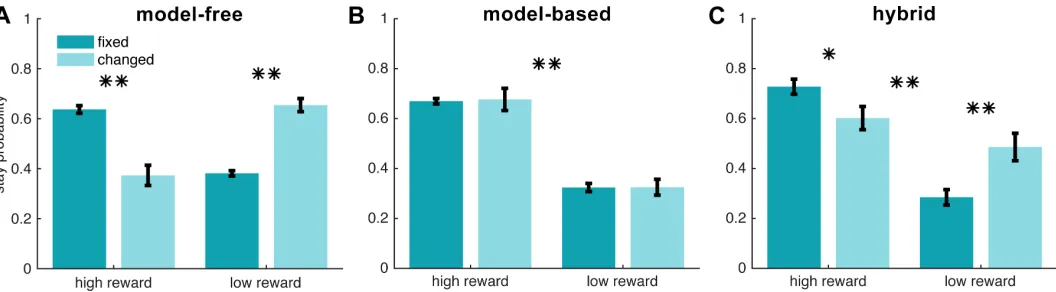
Fig 2. Stay probability patterns predicted by simulating model-free (A), model-based (B), and hybrid (C) reinforcement learning algorithms
Fig 3. Experimental results. (A) Stay probabilities from human subjects (N = 16) showed significant effects of both model-based (p < 0.01) and model-free (p < 0.01) strategies
Table).For both systems, values for the non-selected action were updated as well, assuming that

References

Related documents