Dynamic exergy analysis for the built environment: fixed or variable reference?
Valentina Bonetti
Energy Systems Research Unit (ESRU), University of Strathclyde Department of Mechanical and Aerospace Engineering
Abstract
Exergy is a combination of the first and second law of thermodynamics through a reference environment, also called “reference state” or “dead state”, and quantifies the quality of energy. Classically, exergy analysis is used for optimising stationary processes, and the reference state is defined as a set of constant properties corresponding to the average outdoor conditions. In the case of buildings, stationary models are not accurate and a dynamic analysis is often necessary. However, the choice of the reference environment for dynamic exergy assessments is critical and still highly controversial; the main dilemma is the selection between a fixed (constant in time) or a variable (fluctuating with the outdoor conditions) definition. Although a fixed-reference selection can be justified with analytical considerations, the vast majority of authors adopt a variable reference environment, coincident with the local climate. This research proposes an alternative fixed reference and compares the numerical impact of fixed and variable reference definitions on the dynamic exergy analysis of the built environment. The exergy stored in the building envelope and in a domestic hot water tank of a case study is assessed in typical winter and summer conditions. The main advantages and criticalities of different approaches found in literature are considered in the definition of the reference state that is finally proposed as the best option. Further debate, based on both theoretical and practical considerations, is needed to achieve a common agreement for the reference state of building exergy analysis.
KeywordsBuilding, dynamic exergy analysis, reference state.
I.
Introduction
Preamble.This is a true story. A hot but stormy afternoon, the thermometer indicated 41 degrees and dark clouds were in sight. Walking towards my temporary residence, I was carrying a heavy pack of six water bottles, accidentally re-mained for an hour under the burning sun. They were not extremely hot, but still probably around 30 degrees. I was coming back from the library and from my research about exergy - a function of state that quantifies energy quality - and its applications for buildings. The brain still full of calculations, I couldn’t help myself asking the question: ac-cording to exergy analysis, should I bring these bottles with me inside my studio flat or leave them on the balcony un-til they cool down? I was sun-till ten minutes away from the building so I could take my time to think about the trivial problem, and I felt relaxed. Considering the outdoor temper-ature as the reference state for the analysis, my bottles were under that point so what I was carrying was classifiable as ”cool exergy” for my room. It did not sound very intuitive, I had to admit, but that is why you spend so much time studying, I reassured myself. I was just about to enter when the storm kicked in and I rushed through the door before
heavy rain and wind changed the landscape completely. In-side my room, the air conditioning sensor was showing 28 degrees - to spare the little money I had left, the strategy was to resist and avoid to switch it on until 29. The outside temperature was dropping but still over 35 at the moment, and the instinct of throwing the bottles on the balcony was fighting with exergy considerations. Like the leaves, my pre-vious certainties were turning in a whirl of frustration: what should I do with these bottles now? The more I looked at them the more they seemed like a bomb ready to trigger the thermostat over the set-point and eat my residual savings. In praise of flight, I wore my vest and left for a long run under the rain, wishing the exergy reference was fixed.
buildings, the definition of the reference state is not trivial and highly impacts on the analysis results. Current guide-lines of building exergy analysis recommend the adoption of the fluctuating outdoor temperature as the referenceT0
for dynamic assessments, but there is analytical evidence that this choice leads to a quantity which is not a function of state. This research contributes by:
• defining, in section IV.2, an alternative reference state;
• calculating, through two different references (fixed and variable), the exergy stored in the domestic hot water tank and envelope of the case study described in IV.1;
• comparing and discussing the results and their utility in the context of building design, in section V.1;
• presenting, in section VI, the reasons behind each pos-sible choice, as found in the related literature;
• proposing a choice on the base of design utility (in VII).
Future work includes further discussion around the refer-ence state for the built environment and practical applica-tions of HVAC systems based on exergy consideraapplica-tions.
II.
The problem: a complicated framework
In “The Zen of Python” (Peters, 2010), there is an aphorism:
Simple is better than complex. Complex is better than complicated.
II.1. Exergy reference state requirements
Exergy is described as ‘the maximum theoretical useful work obtained if a system is brought into thermodynamic equilib-rium with the environment by means of processes in which the system interacts only with its environment’ (Sciubba and Wall, 2007). IfΣis an open system characterised by tempera-tureT, pressure p, velocitywand elevationz, its exergyexΣ
is a function of state and can be written (in specific terms, J/kg) as:
exΣ=h−h0+
w2−w20
2 +g(z−z0)−T0(s−s0) (1)
where the subscript 0 indicates the reference-state properties; for the sake of brevity, the chemical contribution is not
included here. If the system evolves from a state 1 to a state 2, the variation in exergy is:
∆ex1,2=h2−h1+
w22−w21
2 +g(z2−z1)−T0(s2−s1) (2)
and therefore the reference state plays a role not only in exergy values but also in their variations.
The choice of the reference environment is a largely de-bated issue. Many authors have highlighted characteristics and requirements of a proper selection:
1. the reference environment is the “ultimate sink” of energy exchanges occurring in the system under study (Baehr (2005), quoted in Torio (2012));
2. it must be in stable thermal, mechanical and chemical equilibrium (Dincer and Rosen, 2013b);
3. its thermodynamic properties should remain un-changed (the interactions with the analysed system have no impact);
4. it needs to be ‘directly available and ready to be used’ (Schmidt and Torio, 2011);
5. the reference should be defined in a way that assures that exergy is a function of state (Pons, 2009).
The problem with these requirements is finding a reference environment that matches them all. Some questions arise:
• where and when each requirement originated?
• which is the thermodynamic meaning of each?
• what happens if a certain requirement is not satisfied?
• how are these requirements ranked in terms of priority?
• which are the benefits and problems related to each suitable reference choice, if more than one choice is available?
II.2. The strange case of the built environment
reference, making their interpretation not straightforward and hardly reproducible.
Furthermore, buildings are better described through dy-namic assessments, but the definition of the reference state for dynamic exergy analysis is even more controversial. How should exergy be defined when the outdoor ambient tem-perature varies? The options are essentially two:
• variable reference state: the reference environment fol-lows temperature variations and is defined as instantly (generally for each hourly time step) coincident to the outdoor temperature, which means that the outdoor air has zero exergy;
• fixed reference state: the reference state is defined by a constant set of conditions, such as the references of other thermodynamic functions.
II.3. The variable reference state
The first approach - the fluctuating value of the outdoor local temperature - is the most widely adopted reference state in building dynamic exergy analisis and is also recom-mended by the IEA (International Energy Agency) Annex 49 Guidelines (Schmidt and Torio, 2011). The main advantages of this choice are the satisfaction of the requirements 1, 2, 3 and 4 listed in section II.1 and an (apparently?) increased accuracy if compared to the adoption of a fixed reference.
The main criticality of this selection, however, is that it does not satisfy the requirement 5 of II.1. Pons (2009) presents a theoretical discussion around the reference state choice when ambient temperature fluctuates, and concludes:
the most reliable way for combining entropy and total energy into an exergy function is a linear combination where entropy is multiplied by a constant temperature.
An exergy function based on a variable reference is not a function of state, because it is a non linear combination (calledexnl in the following expressions) of energyeand entropys:
exnl = (e−e0)−Ta(t)(s−s0) (3)
where ”nl” stands for ”non linear”. In differential terms:
dexnl=de−Ta(t)ds−dTa(t)(s−s0) (4)
The maximum work of a cycle between the system and the environment at the actual temperature is, therefore, ”path dependent”, because affected by the evolution ofTa(t).
On the other hand, if the reference has a constant valueT0,
exergy variationsdexdepend only on initial an final states:
dex=de−T0ds (5)
An additional problem of a variable reference state is that it is not particularly convenient: the analysis does not pro-duce intuitive results and the conclusions are often difficult to understand, because our instinctive idea of quality relies on a stable benchmark, and interpreting numbers that are based on a variable benchmark is confusing.
Simple is better than complex. Complex is better than complicated.
A handy guideline when you are designing something. (Kumaran, 2011)
III.
The idea: fixed reference related to comfort
Building exergy analysis requires its own theoretical frame-work, based both on thermodynamic principles and the specific needs of the built environment. The main idea of this research is that a fixed reference state based on com-fort conditions is a sound and useful definition for building exergy assessments.
III.1. Exergy is a function of state
The origins of the dead-state requirements listed in section II appear difficult to trace back; furthermore, determining which is essential or more important cannot be done just on the basis of history, because exergy was born with heat en-gines, which are deeply different from buildings. However, one requirement is clearly essential: exergy is a function of state, and every reference state that violates this property cannot be adopted.
a proper choice (for example 22◦C in the winter conditions presented in section IV.1).
III.3. Exergy based on thermal comfort
Exergy as a function of state that describes the quality of en-ergy in relation to a fixed approximation of thermal comfort can be a sound useful choice for the built environment. The reference state is defined as a fixed set of comfortable indoor conditions, which can be possibly changed depending on the particular case under analysis.
For the sake of simplicity, only the temperature T0 is
considered to describe the reference state in this research. The physical and chemical contributions are not included to avoid a worthless burden, since their inclusion does not change the exposed concepts. The comfort zone is signifi-cantly different in different seasons, and thus distinct ref-erence environments can be opportune depending on the period. For example, in the case study presented, the fixed reference states are adopted as:
• TemperatureT0,f ix =22◦C for winter conditions,
• TemperatureT0,f ix =26◦C for summer conditions.
III.4. Indoor comfort and indoor environment
The indoor environment as a reference state has been con-sidered in the past (as described in section VI) and rejected because it does not satisfy the requirements 1, 2 and 3 indi-cated in section II: it is not an infinite undisturbed sink in stable equilibrium. In this case, however, the reference pro-posed is not the indoor environment itself, but a model of an ideal indoor thermal comfort, not affected by the energy exchanges occurring in the building.
The other problem with a reference state that coincides with indoor set conditions is that the “exergy demand” of the building, calculated according to the International Energy Agency “IEA Annex 49” guidelines (Schmidt and Torio, 2011), is null. This is actually a problem in that kind of procedure, but considering the indoor comfort conditions as “zero quality” is not necessarily an obstacle, if different meanings and procedures are adopted.
III.5. The exergy demand
The concept of energy demandQzoneof a building thermal zone is familiar and comes from its energy balance: in order to maintain predefined indoor thermal conditions, the
incoming and outgoing thermal fluxes and internal gains need to be compensated with heat injection or extraction.
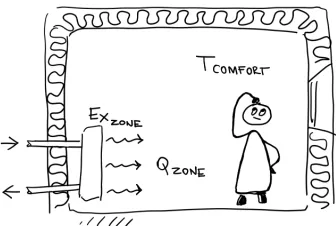
What then is the “exergy demand” of a building? The main idea presented in this article is that each thermal zone can demand exergy only if a distribution system (of any kind) is in place and an interface between the thermal zone and the rest of the building is clearly identifiable. Without an interface it is not possible for the thermal zone to emit requests and its exergy demanded is therefore null.
The exergy demandExzoneof the thermal zone (Figure 1) can thus be defined as:
Exzone=Qzone·QFdistribution
[image:4.612.364.532.343.456.2]in which QFdistribution is the quality factor of the energy emitted by the distribution system into the thermal zone, as commonly defined in the exergy literature - for example in Schmidt and Torio (2011) - and related to the fixed reference state proposed in III.3.
Figure 1:”What then is the exergy demand?”
III.6. Note: exergy needs to be understandable
IV.
Methods
The reference-state choice is investigated through virtual experiments conducted with the dynamic software ESP-r. The exergy stored in the envelope of a case-study house, described in IV.1, and in a domestic hot water tank are cal-culated with two different reference states: the fixed one proposed in section III and the fluctuating value of the out-door temperature (as recommended by current guidelines). The values are calculated and shown for a standard house in two typical situations: a winter day in a UK climate and a summer day in Rome, Italy. Exergy storage is chosen as a significant quantity for comparisons because definitely more intuitive and easy to visualise than other variables like exergy fluxes and exergy efficiencies.
IV.1. Description of the case study
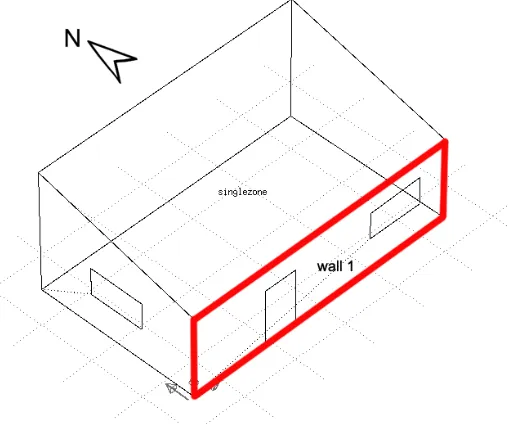
[image:5.612.317.574.133.226.2]The case study is a simple single-zone residential building, modelled with common construction materials from the standard ESP-r database; the complexity is intentionally kept to a minimum level in order to avoid unnecessary distractions.
Figure 2:ESP-r model of the case study.
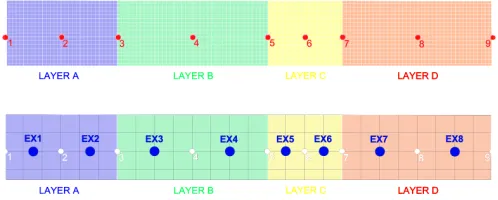
In the model, each external wall is composed of 4 layers (3 nodes per layer, 9 in total) as indicated in Figure 3. The exergy stored in each node of the South wall (”wall 1” in Figure 2) is calculated and presented for every hourly time
step, both with the fixed and the variable reference state defined in section III.
Figure 3:ESP-r description of external wall standard construction.
The same model is utilised in two different conditions:
• a typical winter day in the UK climate, the 6th of Febru-ary of the ”clm67” of ESP-r climate database
• a typical summer day in Rome, Italy (14th of August of the ESP-r ”ita-rome-iwec” climate file)
The HVAC system is operated with a basic control accord-ing to the schedule reported in table 1. In the summer case, a nocturnal natural ventilation is approximated by a 5 ACH (air changes per hour) infiltration from midnight to 6am.
Table 1:Model control details
period mode set-T set-T vent.
(hours) winter summer summer
00-06 free floating – – 5 ACH
06-08 basic control 22◦C 26◦C –
08-17 free floating – – –
17-24 basic control 22◦C 26◦C –
The casual gains are reported in the graph in Figure 4. A domestic hot water tank with the following characteris-tics is also considered:
• volumeVtank =250 litres;
• temperatureTtank=60◦;
• temperature distribution: uniform (fully mixed);
[image:5.612.39.293.397.609.2]Figure 4:Casual gains for the single-zone model.
IV.2. Definition of alternative reference states
The reference states used and compared in winter conditions are:
1. fixed referenceT0,f ix =22◦C (winter comfort T)
2. variable referenceT0,var=Tamb(hourly outdoor air T)
In the summer case, the fixed reference is adjusted to reflect typical comfort conditions:
1. fixed referenceT0,f ix =26◦C (summer comfort T)
2. variable referenceT0,var=Tamb(hourly outdoor air T)
To avoid unnecessary burden, only the reference-state tem-perature and thermal exergy are considered in this study; the physical and chemical contributions, although important in principle, do not change the general concepts expressed here.
IV.3. Exergy storage equations
Thermal exergy is related to the system temperature and occurring heat exchanges; as highlighted by Shukuya (2013), exergy can be distinguished in ”quantity of state” and ”quan-tity of flow”. In this investigation, the focus is limited to the exergy of state (or exergy stored) of a water tank and a por-tion of the building envelope, because it is easier to visualise and understand stored quantities rather than unfamiliar flows.
The enthalpy (H) and entropy (S) infinitesimal variations of a volume of matter, for example a portionVn around a generic noden, are expressed by:
( dHn =δQ=cnρnVndTn
dSn =cnρnVndTTnn
(6)
Therefore, the thermal exergy of state per unit volume can be calculated by integration fromT0toTn:
exn =cnρn
(Tn−T0)−T0ln Tn T0
(7)
which can be approximated by the expression:
exn = cnρn
(Tn−T0)2
2T0 (8)
Equation (8) demonstrates that the exergy of state of a vol-ume of matter is always positive. However, since the condi-tions ofTn >T0and Tn<T0have very different meanings,
a distinct definition is needed:
• ”warm exergy”: any exergy of state related to a temper-ature above the reference state,Tn>T0;
• ”cool exergy”: any exergy of state related to a tempera-ture below the reference state,Tn <T0(cool exergy is
indicated as negative in the graphs of Section V).
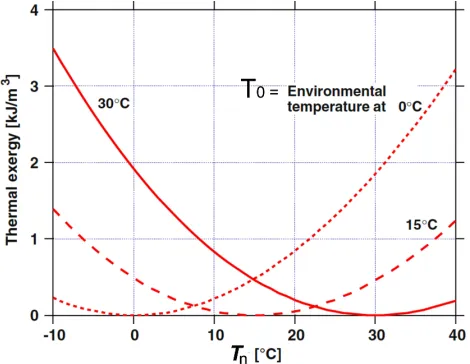
The graph in Figure 5 reports an example trend of the exergy per volume of matter for three static reference-state values (material: air at constant pressure). The left part of each curve represents cool exergy, the right part warm exergy.
Figure 5:Exergy contained in an air volume n for different reference states T0coincident with the environmental temperature in
[image:6.612.331.566.459.641.2]IV.4. Water tank exergy storage
For the sake of simplicity, the domestic hot water tank is represented by a single node at uniform and constant tem-peratureTtank (fully mixed). Even if this is not generally the case, a more accurate model would not add any useful information in the context of this study.
The exergy stored in the tank (Wh) is therefore calculated, for each time step of the simulation, with the expression:
Extank =cwaterρwaterVtank
(Twater−T0)2
2T0
(9)
in which:
• Twater=60◦
• cwater=4185 J/(kgK)
• ρwater=983kg/m3
• Vtank =0.250m3
Different choices of reference temperatureT0are considered,
as described in section IV.2.
IV.5. Envelope exergy storage
[image:7.612.40.289.469.569.2]The energy simulation, performed with the dynamic soft-ware ESP-r, provides the hourly temperature of each con-struction node of the case-study building. The sample wall investigated (described in section IV.1) is composed of 4 layers of different materials, as indicated in the upper part of Figure 6.
Figure 6:Energy simulation nodes from 1 to 9 (above) and interpolated nodes from EX1 to EX8 used for exergy storage calculations (below). Node 1: exterior surface; node 9: interior surface.
In the model used in this study, each layer is described through 3 nodes, one for each interface and one in the middle; the temperature is not uniform within each layer.
A first approximate exergy storage calculation could con-sider the middle node temperature as the uniform value of the entire related layer, even if exergy is not a linear function
of temperature and thus an error is certainly introduced with this procedure. An accurate method should include the expression of the envelope temperatureTenv(x)in function of a variablexalong the wall thickness and then integrate Equation (7) alongx. For the purpose of this study, a rea-sonable compromise is to consider 2 intermediate nodes per each layer and, if a greater accuracy is needed, just refine the ESP-r model with more nodes per layer. Each node is indicated in Figure 6 asEXiwithifrom 1 to 8 (one less than the number of nodes defined in the energy model).
The exergy stored in each nodeEXiis calculated accord-ing to Equation (8), multiplied by the thickness associated to the node (in this case, half of the layer thickness).
V.
Results
V.1. Winter case
Energy simulation results
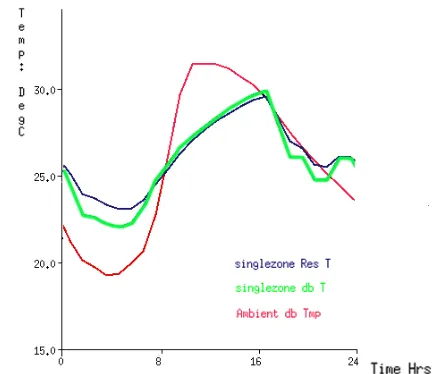
The dynamic energy simulation is performed to obtain real-istic temperature values for each construction node of the wall sample used as a case study. Climate data are also extracted in order to define the variable reference state. The indoor dry bulb and resultant temperature are reported in Figure 7.
Figure 7:Outdoor dry bulb air temperature, resultant indoor tempera-ture and indoor air dry bulb temperatempera-ture for the case study; UK climate, 6th of Feb.
tempera-tures within the South wall nodes vary as reported in the heat map of Figure 8. The map is a bilinear interpolation of the node temperatures obtained per node (on the horizontal axis) and time step (on the vertical axis, with the first time step on the top of the graph).
Figure 8:”Heat map” visualisation of the South wall temperatures for the winter day. Node 1: exterior wall surface; node 9: interior wall surface.
The temperature trend for a particular time step can be described with a graph like the one reported in Figure 9.
Figure 9:Temperature trend for the case-study South wall; UK climate, 6th of Feb, time step 00:00-01:00. Node 1: exterior surface; node 9: interior surface.
Exergy storage
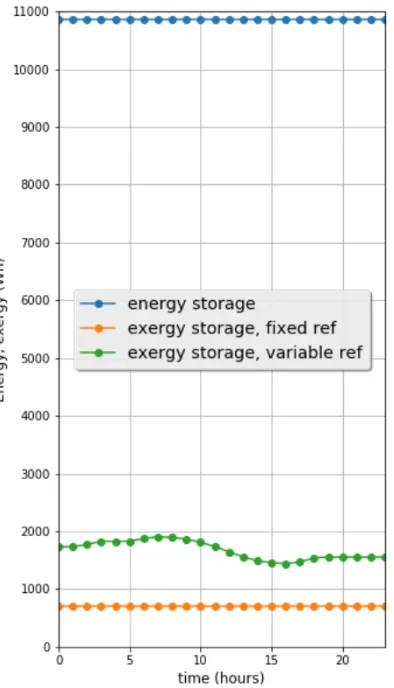
[image:8.612.351.548.173.517.2] [image:8.612.77.254.507.630.2]The exergy stored in the domestic hot water tank, calculated according to Equation (9) for the fixed and variable reference state indicated in section IV.2, is illustrated in the graph in Figure 10.
Figure 10:Exergy stored in the domestic hot water tank, winter case. The energy storage, referred to a temperature of 22◦C, is included as a comparison.
The exergy stored in the wall nodes EXi is reported in Figure 11 for both references. In this and the following graphs illustrating exergy storage, cool exergy is indicated as negative only in order to differentiate it from warm exergy, as already mentioned in Section IV.3.
Figure 11:Exergy stored in the South wall nodes; UK climate, 6th of Feb. Left map: fixed reference state (22◦C); right map: variable reference state.
Figure 12:Exergy stored in the South wall nodes; UK climate, 6th of Feb. Left map: fixed reference state (22◦C); right map: variable reference state. Legend zoomed on range (-0.1,0.1) Wh.
V.2. Summer case Energy simulation results
The summer case is virtually located in Rome, Italy. The hourly climate temperatures of the selected summer day, reported in Figure 13, are used as a variable reference state. The indoor air dry bulb and resultant temperatures are also shown in the same graph.
For the selected day of the summer season, the 14th of August of the climate file indicated in section IV.1, the
tem-Figure 13:Outdoor dry bulb air temperature, resultant indoor tempera-ture and indoor air dry bulb temperatempera-ture for the case study; Rome climate, 14th of Aug.
peratures in the South wall nodes vary as reported in the heat map of Figure 14. The map is a bilinear interpolation of the node temperatures; the nodes are indicated on the horizontal axis and the time steps on the vertical axis (the first time step, 00:00 to 01:00, is on the top of the graph).
Figure 14:”Heat map” visualisation of the South wall temperatures for the summer day. Node 1: exterior wall surface; node 9: interior wall surface.
[image:9.612.40.292.311.505.2] [image:9.612.339.547.418.618.2]and 16. In the summer case, the trend significantly depends on the time step as the daily variation of the external surface temperature is around 30 K.
Figure 15:Temperature trend for the case-study South wall; Rome cli-mate, 14th of Aug, time step 00:00-01:00. Node 1: exterior surface; node 9: interior surface.
Figure 16:Temperature trend for the case-study South wall; Rome cli-mate, 14th of Aug, time step 13:00-14:00. Node 1: exterior surface; node 9: interior surface.
Exergy storage
The exergy stored in the domestic hot water tank, calculated according to Equation (9) for the fixed and variable reference state indicated in section IV.2, is reported in Figure 17 for summer conditions. The energy stored in the tank can be considered approximately the same as the winter case and thus is not reported in the graph, in order to zoom on the exergy range.
[image:10.612.64.270.143.286.2]The exergy stored in the wall nodesEXifori from 1 to 8 is reported in Figure 18 for the fixed and the variable
Figure 17:Exergy stored in the domestic hot water tank, summer case.
reference. Since the nodes coloured in violet (cool exergy, just below the reference state) and blue (warm exergy, just above) can be difficult to distinguish on the heat map 18, a clearer differentiation of cool and warm exergy storage is presented in Figure 19, in which the legend is zoomed on the range (-0.1,0.1) Wh.
Figure 18:Exergy stored in the South wall nodes; Rome climate, 14th of Aug. Left map: fixed reference state (26◦C); right map: variable reference state.
[image:10.612.66.269.355.496.2] [image:10.612.321.572.405.596.2]Figure 19:Exergy stored in the South wall nodes; Rome climate, 14th of Aug. Left map: fixed reference state (26◦C); right map: variable reference state. Legend zoomed on (-0.1,0.1).
Figure 20:Interior surface node (9) T of South wall; Rome, 14th of Aug.
Figure 21:Exergy stored in node EX8 (interior side); Rome, 14th Aug.
V.3. Discussion
Exergy storage is easier to understand and visualise than exergy fluxes. In the context of this study, a commonly accepted meaning of warm and cool exergy is the following:
• warm exergy storage (temperature above the reference state): useful for space heating and domestic hot water;
• cool exergy storage (temperature below the reference state): useful for space cooling.
In view of this, the water tank and envelope exergy stor-ages obtained with the fixed and variable references are compared below.
Water tank
The domestic hot water tank, simplified as completely static (constant and uniform temperature), has an immutable value of use for the house occupants, especially within the same season.
When a fixed reference state is considered, the exergy of the water tank remains constant (699 Wh of warm exergy with the winter reference and 552 Wh with the summer reference). The exergy analysis based on a fixed reference agrees with the occupant (and the water heating control) that no action is required because the tank is fully charged and ready to use.
On the other hand, with the variable reference, the tank warm exergy fluctuates considerably, especially during the summer day:
• winter day tank:Exmin=1438Wh,Exmax =1904Wh
• summer day tank: Exmin=384Wh,Exmax =811Wh
The building occupant and its water-tank heating system do not perceive any daily variation in the tank energy quantity and quality; the exergy analysis based on the fluctuating out-door temperature only reflects external variations and thus it cannot be used for decision making inside the building.
Building envelope
[image:11.612.66.269.512.644.2]• Winter day
During the winter day, the envelope temperatures are under the comfort temperature set-point (22◦C) at any time for every node (Figure 8) and therefore the envelope does not store any energy useful for heating (or warm exergy).
This fact is properly described by the exergy analysis performed with a fixed reference state, as observable in Figure 11 and, more clearly, in Figure 12; the inside part of the envelope stores only cool exergy (blue parts of Figure 12), not useful for heating purposes, and indeed the zone resultant temperature is below the zone air temperature (Figure 7) because the envelope has a negative influence on the indoor thermal comfort.
The exergy calculated with a variable reference, illustrated in the same images, is classified as warm exergy (during the entire day for the inner layers) and, therefore, supposed to contribute to the indoor thermal comfort as a useful storage, a statement that is contradicted by the facts.
It is worth noting the zero-exergy nodes 5 and 6 (the white middle section in both parts of Figure 12, corresponding to the layer C of Figure 6): the inability of this layer to store exergy is due to its material (air) and not to its actual temperature.
• Summer day
In the summer day, the envelope (which is not particularly well designed) is not capable of releasing a great amount of heat during the nocturnal natural ventilation and its indoor surface temperature remains above the comfort set-point most of the time, and goes slightly below it between 5am and 10am approximately, as observable in Figure 14.
The exergy storage calculated with a fixed reference, shown on the left side of Figures 18 and 19, properly de-scribes the real utility of the envelope indoor surface for cooling: a neutral impact between 5am and 10am and a cooling load during the rest of the day (undesired warm exergy storage released into the thermal zone).
The exergy analysis carried out with the variable reference state suggests a cool exergy storage of the interior surface node in the middle part of the day (between 9am and 3pm, right side of Figures 18 and 19) and thus a useful contribu-tion of the envelope to the zone cooling, which does not really happen. It also declares warm storage during the early morning, in reality the only period in which the envelope shows a (little) cool exergy storage.
VI.
Current choices of reference state in the
built environment
Sciubba and Wall (2007) completed an extended history of exergy, from the beginnings to 2004. The debate around the reference state for the built environment had not reached its peak yet at that point; however, understanding the roots of exergy is important to reflect on the elements which affected the reference choice and to try to rank them in terms of their contribution to a robust theoretical framework. In the review it is stated that the definition of exergy implies that a variation in reference-state conditions causes a variation in the exergy of a static state (but there is no further discussion about the actual possibility of the reference state to fluctuate). Sciubba and Wall reported that Gouy and Stodola indepen-dently defined (in 1889 and 1898 respectively) the reference state as the ambient temperature, and that, although posed, the reference issue was not explored in the early years of exergy analysis (also because very few practical applications have been investigated before the 1970s).
In 1873, Gibbs defined the “medium”, ‘a large subsystem which has a constant temperature and a constant pressure’ (Gaggioli, 2012). The term “available energy” of an over-all system - composed of subsystems, one of which is the medium - is used by Gaggioli and Wepfer (1981) with the same meaning as exergy: the ‘useful energy derivable by bringing the substance into complete stable equilibrium with the surroundings (the dead state)’. The outdoor tem-perature is used as a reference in the second-law analysis of a building HVAC system (but the choice is not directly discussed).
In 1998, Gaggioli stated that the proper choice of the dead state in engineering applications depends on the specific system under study and the ones that interact with it, the modalities of these interactions and the spontaneous ex-changes occurring within each system, called ’constraints’ (Gaggioli, 1998).
VI.1. In recent years
Koca et al. (2008) used a fixed reference state in the exergy analysis of a latent heat storage system with phase change materials as an application for solar collectors.
constantly changing and a change in the reference state highly affects exergy values.
Tor´ıo et al. (2009) conducted an exergy analysis review for the case of buildings, focusing on heating and cooling systems based on renewable energies. They considered the adoption of a variable state in dynamic analysis as more accurate (but the option of a fixed reference is not assessed). In their work they highlighted that, since the reference-state selection highly affects the results, a clear common framework for the exergy analysis of the built environment is needed.
In the same year Pons (2009), in his article ”On the refer-ence state for exergy when ambient temperature fluctuates”, presented a theoretical discussion about the reference state of dynamic exergy analysis and concluded that a variable ref-erence state cannot be adopted, because exergy is a function of state only if energy and entropy are linearly combined through a constant reference.
Martinaitis et al. (2010) proposed the use of ”exergy de-gree days” as a benchmark, based on the idea that local climatic conditions dictate the minimum exergy that should be supplied to any building (corresponding to the exergy demand of an ideal building). The reference state adopted is the variable outdoor air temperature. However, any passive strategy is neglected in their work, and thus a real building can easily require less exergy than the ideal demand found with the proposed exergy degree days.
The International Energy Agency (IEA), within the An-nex 49 (2005-2010), investigated procedures and tools for the exergy analysis of the built environment and produced detailed guidelines (Schmidt and Torio, 2011). The reference choice impact is discussed through the steady-state analysis of four different selections:
• the universe (3 K)
• the indoor air of the building (294 K = 21oC)
• the undisturbed ground (281 K = 8oC)
• the outdoor air temperature (273 K = 0oC)
The final recommendation is to adopt the current value of the outdoor air temperature, because the outdoor environ-ment is not affected by the processes under analysis and it is directly available. The difference between selecting the analysed static value (273 K = 0oC) and the recommended current value (which is variable) is not discussed. The in-door air temperature is considered not suitable because not infinite - and therefore affected by the interactions with the
system under study - and not in thermodynamic equilib-rium.
Actually, the outdoor environment is not in thermody-namic equilibrium either, and Dincer and Rosen (2013b) proposed to adopt a simplified model to solve the contro-versy between theory and reality.
Another important reason adduced for avoiding the in-door temperature is linked to the procedure used for cal-culating the exergy demand: since the quality factor of the demand is given by the indoor temperature, if the same temperature is adopted as a reference the demand is null.
Gaggioli (2012) suggested general guidelines for the selec-tion of the reference state of exergy analysis, referring back to the underlying concept of “available energy” introduced by Gibbs in 1873.
Meggers and Leibundgut (2012) reported the ambiguity related to the reference state choice for the built environment and proposed the adoption of the ambient environmental condition surrounding the building. However, the examples reported are calculated in static cases, and the effect of variable outdoor conditions is not discussed.
Gaudreau et al. (2012) analysed the impact of the reference-state choice on the usefulness of exergy as a decision-making tool. Even if their investigation is focused on chemical aspects, the conclusions are interesting for the present research. In particular, ”exergy may better inform decision-making by returning to process dependent refer-ence states that model specific processes and situations for the purpose of engineering optimization.”
Angelotti et al. (2012) studied the differences in the steady and dynamic exergy analysis of an air source heat pump, adopting a variable reference state. Exergy exchanges were assessed dynamically with the software TRNSYS, and in-stantaneous, monthly and seasonal exergy efficiency were calculated. They concluded that, although performing a dynamic analysis is complex and time consuming, hourly values based on a variable reference state should be used during assessments of the cooling season (or for mild cli-mates) because of the high discrepancy with a steady-state analysis.
Shukuya (2013), in his book that presents and explains in depth exergy methods and applications for the built environ-ment, adopts the hourly values of the outdoor temperature as the variable reference state.
Dincer and Rosen (2013a) described the exergy analysis of thermal energy systems, and stated that it is particularly important to adopt a variable referenceT0(t)- which value
- when considering long storage periods, such as an interval of some months. For shorter analysis, the referenceT0can
be approximated by a constant value.
Ter´es-Zubiaga et al. (2013) investigated a social dwelling by means of dynamic exergy analysis based on a variable reference state as suggested by the International Energy Agency guidelines (Schmidt and Torio, 2011). Thermal stor-age effects are not evaluated.
Zhou and Gong (2013) investigated three improvements of a base case building in China. Exergy exchanges and efficiencies are referred to the variable outdoor temperature and humidity, and the chemical exergy is also included in the summer case.
L ´opez-Villada et al. (2014) simulated and performed an ex-ergy analysis of different solar absorption power-cooling sys-tems located in Sevilla (Spain); they reported the reference-state controversy and decided to adopt a constant reference temperature of 290 K.
Evola and Marletta (2014) investigated the exergy per-formance of water-cooled photovoltaic thermal collectors through a fixed reference suggested by Pons (2009), the minimum outdoor temperature during any month.
Baldi and Leoncini (2015) reported that linking the ref-erence state temperature to the weather data was more ap-propriate than adopting a constant value for their building model. They compared the results obtained by using three different selections of the local climate data (hourly outdoor temperatures, monthly average outdoor temperatures and the yearly average outdoor temperature) and concluded that the discrepancies are low if the temperatures of the energy flows are far from the reference temperature and high if close.
Alizadeh and Sadrameli (2016) adopted a variable refer-ence state to assess phase change materials storages for free cooling. The exergy efficiencies obtained are strongly related to the reference variation, and high energy performances correspond to low exergy efficiencies (and vice-versa).
Garcia Kerdan et al. (2016), in their exergoeconomic study of building retrofit strategies, mentioned the issues ex-pressed by Pons (2009), but then decided to follow the majority of researchers and adopted a variable reference state.
Martinaitis et al. (2017) reported the discussion around the reference state and the variable outdoor conditions for the exergy efficiency calculations of a ventilation heat recovery exchanger, because a constant value would ”fail to fit within the boundaries of thermodynamic laws”.
In conclusion, the variable reference state is currently the
widely accepted and adopted choice for building exergy analysis, but the theoretical concerns expressed by Pons (2009) have not been thoroughly addressed, to the best of the author’s knowledge. The present work aims to contribute to the exergy reference state discussion by proposing a different alternative (a fixed state based on thermal comfort) and presenting some practical implications of adopting a fixed or a variable reference state on the dynamic building analysis of thermal exergy storage.
VII.
Conclusions and future work
Exergy needs to be defined as a linear combination of energy and entropy through a fixed reference state in order to be a proper function of state and to provide useful result in the case of dynamic assessments of building thermal storages.
A fixed reference linked to the thermal comfort zone un-der consiun-deration seems to satisfy all the theoretical require-ments and to be a reasonable and convenient choice for the built environment. Since the indoor comfort is the ultimate focus of building design, at least from an HVAC perspective, a reference state that directly reflects the value of use of en-ergy interactions in relation to comfort allows the definition of straightforward indexes, easy to understand and useful for decision making. The time lag between the outdoor and the indoor conditions makes a reference based on the out-door variable temperature, apart from thermodynamically unacceptable, strategically inconvenient.
Further discussion and research on theoretical and practi-cal applications is needed to test this selection and compare it to alternative fixed reference choices. Future work is directed to the investigation of wider meanings and pro-cedures of a dynamic exergy analysis performed through the proposed reference state, such as the definition of a ”natural exergy budget” of a construction site and practical
applications based on exergy controls.
Acknowledgments
The author thanks the Engineering and Physical Sciences Research Council U.K. (EPSRC, Grant No.1586601) and the Building Research Establishment (BRE) for the financial support.
Sample Availability
Nomenclature
ACH air changes per hour (1/h) c specific heat (J/(kg K))
d infinitesimal variation of specified variable DHW Domestic Hot Water
e specific total energy (J/kg) E total energy (J)
ESP-r building performance simulation tool ex specific exergy (J/kg)
Ex exergy (J)
EXi exergy simulation nodes, withi∈[1, 8] g gravitational acceleration (m/s2) h specific enthalpy (J/kg)
H enthalpy (J)
HVAC heating, ventilation and air-conditioning p pressure (Pa)
Q generic heat transfer (J or Wh, as indicated) QF energy quality factor
s specific entropy (J/(Kg K))
S entropy (J/K)
set-T HVAC thermostat set point t time variable (s or h, as indicated) T temperature (K or◦as indicated) U U-value (W/m2K)
V volume (l)
w velocity (m/s)
x variable along the envelope thickness (m) z elevation (m)
α solar absorption coefficient
∆ finite variation in the specified interval ε IR emittance coefficient
ρ density (kg/m3)
Indexes:
a outdoor air
distribution building HVAC distribution system
env envelope
f ix fixed reference
nl non linear
tank DHW tank
var variable reference
water water at the specified conditions zone building thermal zone
Σ thermodynamic system 0 reference state
1, 2 generic states 1 and 2
References
M. Alizadeh and S. M. Sadrameli. Development of free cool-ing based ventilation technology for buildcool-ings : Thermal energy storage ( TES ) unit , performance enhancement techniques and design considerations – A review. Re-newable and Sustainable Energy Reviews, 58:619–645, 2016. ISSN 13640321. doi: 10.1016/j.rser.2015.12.168. URL
http://dx.doi.org/10.1016/j.rser.2015.12.168.
A. Angelotti, P. Caputo, and G. Solaini. Steady versus dy-namic exergy analysis: the case of an air source heat pump. International Journal of Exergy, 11(4):460–472, 2012.
H. D. Baehr. Thermodynamik Grundlagen und technische An-wendungen. Springer Verlag, Berlin, 5th edition, 2005. ISBN 9783540238706.
M. G. Baldi and L. Leoncini. Effect of Reference State Char-acteristics on the Thermal Exergy Analysis of a Building. Energy Procedia, 83:177–186, 2015. ISSN 18766102. doi: 10.1016/j.egypro.2015.12.208. URLhttp://linkinghub. elsevier.com/retrieve/pii/S1876610215028738.
I. Dincer and M. A. Rosen. Chapter 9 - Exergy Analy-sis of Thermal Energy Storage Systems. InExergy, vol-ume 8, pages 133–141. Elsevier, 2nd edition, 2013a. ISBN 9780080970899. doi: 10.1061/(ASCE)1076-0431(2002)8: 4(133).
I. Dincer and M. A. Rosen. Chapter 2 - Exergy and Energy Analyses. Exergy (Second Edition), pages 21–30, 2013b. doi: 10.1016/B978-0-08-097089-9.00002-4. URL
http://www.sciencedirect.com/science/article/ pii/B9780080970899000024.
G. Evola and L. Marletta. Exergy and thermoeconomic optimization of a water-cooled glazed hybrid photo-voltaic/thermal (PVT) collector. Solar Energy, 107(October 2015):12–25, 2014. ISSN 0038092X. doi: 10.1016/j.solener. 2014.05.041.
R. Gaggioli. The Dead State. International Journal of Ap-plied Thermodynamics, 15(4):191–199, 2012. ISSN 2146-1511. doi: 10.5541/ijot.1034000423. URL http://dergipark. ulakbim.gov.tr/eoguijt/article/view/1034000423.
R. a. Gaggioli and W. J. Wepfer. Second law analysis of building systems. Energy Conversion and Management, 21 (1):65–75, 1981. ISSN 01968904. doi: 10.1016/0196-8904(81) 90008-X.
I. Garcia Kerdan, R. Raslan, P. Ruyssevelt, and D. Morillon Galvez. An exergoeconomic-based parametric study to examine the effects of active and passive energy retrofit strategies for buildings, volume 133. 2016. ISBN 7867798730. doi: 10. 1016/j.enbuild.2016.09.029.
K. Gaudreau, R. A. Fraser, and S. Murphy. The character-istics of the exergy reference environment and its impli-cations for sustainability-based decision-making. Ener-gies, 5(7):2197–2213, 2012. ISSN 19961073. doi: 10.3390/ en5072197.
A. Koca, H. F. Oztop, T. Koyun, and Y. Varol. Energy and exergy analysis of a latent heat storage system with phase change material for a solar collector. Renewable Energy, 33 (4):567–574, 2008. ISSN 09601481. doi: 10.1016/j.renene. 2007.03.012.
S. Kumaran. What is the difference between complicated and complex?, 2011. URLhttp://gurulang.com/index/ show/38276.
J. L ´opez-Villada, D. S. Ayou, J. C. Bruno, and A. Coronas. Modelling, simulation and analysis of solar absorption power-cooling systems.International Journal of Refrigeration, 39(April 2014):125–136, 2014. ISSN 01407007. doi: 10.1016/ j.ijrefrig.2013.11.004.
V. Martinaitis, D. Bieksa, and V. Miseviciute. Degree-days for the exergy analysis of buildings. Energy and Buildings, 42(7):1063–1069, 2010. ISSN 03787788. doi: 10.1016/j. enbuild.2010.01.019. URLhttp://dx.doi.org/10.1016/ j.enbuild.2010.01.019.
V. Martinaitis, J. Bielskus, K. Januˇseviˇcius, and P. Bareika. Exergy efficiency of ventilation heat recovery exchanger for variable reference temperature. 3(March):1–12, 2017. ISSN 13921207. doi: 10.5755/j01.mech.23.1.17678.
F. Meggers and H. Leibundgut. The reference environment: utilising exergy and anergy for buildings. International Journal of Exergy, 11(4):423–438, 2012. ISSN 17428297. doi: 10.1504/IJEX.2012.050254. URL http://inderscience. metapress.com/index/B2221661N47381W4.pdf.
T. Peters. The Zen of Python, pages 301–302. Apress, Berkeley, CA, 2010. ISBN 978-1-4302-2758-8. doi: 10.
1007/978-1-4302-2758-8 14. URLhttp://dx.doi.org/10. 1007/978-1-4302-2758-8_14.
M. Pons. On the reference state for exergy when ambient temperature fluctuates. International Journal of Thermody-namics, 12(3):113–121, 2009. ISSN 13019724.
P. Sakulpipatsin, L. C. M. Ltard, H. J. Van Der Kooi, P. G. Luscuere, and E. C. Boelman. A reference environment for the calculation of the exergy value of air in build-ings. ASHRAE Transactions, 115 PART 1:10–15, 2009. ISSN 00012505.
D. Schmidt and H. Torio. ECBCS Annex 49: Low Exergy Sys-tems for High-Performance Buildings and Communities. Technical report, Fraunhofer IBP, 2011.
E. Sciubba and G. Wall. A brief commented history of exergy from the beginnings to 2004. International Journal of Thermodynamics, 10(1):1–26, 2007. ISSN 13019724. doi: 10.5541/ijot.184.
M. Shukuya. Exergy. Theory and Applications in the Built Envi-ronment. Springer, London, 2013. ISBN 9781447145721.
J. Ter´es-Zubiaga, S. Jansen, P. Luscuere, and J. Sala. Dynamic exergy analysis of energy systems for a social dwelling and exergy based system improvement. Energy and Build-ings, 64:359–371, 2013. doi: 10.1016/j.enbuild.2013.05.034.
URL https://www.scopus.com/inward/record.uri?
eid=2-s2.0-84879113277{&}partnerID=40{&}md5= 567881754b7e76af850433cd8115afb5.
H. Torio. Comparison and optmization of building energy supply systems through exergy analysis and its perspectives. Fraunhofer Verlag Stuttgart, 1st edition, 2012. ISBN 9783839604526.
H. Tor´ıo, A. Angelotti, and D. Schmidt. Exergy analysis of renewable energy-based climatisation systems for build-ings: A critical view.Energy and Buildings, 41(3):248–271, 2009. ISSN 03787788. doi: 10.1016/j.enbuild.2008.10.006.
Y. b. Zhou and G. Gong. Exergy analysis of the building heating and cooling system from the power plant to the building envelop with hourly variable reference state. Energy and Buildings, 56: 94–99, 2013. doi: 10.1016/j.enbuild.2012.09.041.
URL https://www.scopus.com/inward/record.uri?