Rochester Institute of Technology
RIT Scholar Works
Theses
Thesis/Dissertation Collections
2000
Numerical ODE solvers that preserve first integrals
Thuya Aung
Follow this and additional works at:
http://scholarworks.rit.edu/theses
This Thesis is brought to you for free and open access by the Thesis/Dissertation Collections at RIT Scholar Works. It has been accepted for inclusion
in Theses by an authorized administrator of RIT Scholar Works. For more information, please contact
.
Recommended Citation
NUMERICAL ODE SOLVERS
THAT PRESERVE FIRST INTEGRALS
By
Thuya Aung
A thesis submitted in partial fulfillment of the
requirements for the degree of
MASTER OF SCIENCE
m
Mechanical Engineering
Josef Torok (Thesis Advisor)
Professor
-Approved by:
Professor
-Hany Ghoneim
Professor
-Kevin Kochersberger
Professor
-Satish Kandlikar (Department Head)
Department of Mechanical Engineering
College of Engineering
ACKNOWLEDGMENTS
I
wouldlike
tothank
my
thesis
advisor, Dr. Josef S.
Torok,
for his time,
guidance andinput
onthis thesis.
This
thesis
itself
wouldbenefit
for
my further
research studies.Dr.
Torok
had
provided me withsupport,
encouragement,
and resourcesnecessary
tocomplete
this
thesis.
I
also wouldlike
to thankhim
for
being
such afun,
aknowledgeable
and anoutstanding instructor
ofmany
ofmy
classes.I
appreciatehim for
this
fun
andlearn
thesis.
I
also wishto thankmy
parents,
Mr.
Maung
Htay
andMrs. Khin
Thit,
andmy
relatives:Mrs. Khin
Htwe,
Mrs. Kyi K. P.
Tun,
Ms. Khin
Chit,
Mrs. Nu N.
Yee,
Mr. Ye
Myint,
Ven. U
Okegansa,
Mr. Khine T.
Kyaw,
Mr. Wilson
Tun,
Ms. Hla M.
Swar,
andMr. Zarni
Y.
Yint,
for
being
sosupportive, understanding,
andencouraging
asI
completedmy
TABLE OF
CONTENTS
Chapter
Page
1
.General
overview1
2.
Background
4
2. 1
Introduction
to
Lagrangian Dynamics
4
2.2
Introduction
to
Hamiltonian Dynamics
13
3.
Analytical
Prediction
ofConservative
Systems from
the
Hamiltonian
andFirst Integrals
25
3.1
Energy Preserving
Algorithms
25
3.2
First Integral from Euler-Lagrange Equations
40
4.
Numerical ODE
Solvers
that
Preserve First Integrals
42
3.1
Orbital Derivatives
andFirst Integrals
42
3.2
Integral-Preserving
Numerical Integrator Systems
48
5.
Summary
andConclusions
83
6.
References
86
CHAPTER
1
GENERAL
OVERVIEW
Quantity
measurement ofthe
changein energy
by
aforce
from
any dynamical
action
has been
usedfor
moderndynamical
mechanics.Newtonian
mechanics need afree
body
diagram
to
analyzepositions,
velocities, accelerations,
andforces acting
onany
dynamical
systems.From
afree
body diagram,
vectors are anotherthing
thatwehave
to
keep
track ofcross anddot
products,
soNewtonian
mechanicsis
required toknow
theanalysis of vectors or vectormechanics.
Momentum
andforces
are essentialfeatures in
vector mechanics.
Unlike Newtonian
mechanics,
analyzing energy
methods requiresknowledge
ofkinetic
energy
and potentialfunction.
Since
kinetic
energy,
potentialfunctions,
and work are scalarquantities,
wedo
nothave
to analyze vector mechanics.By
analyzing
energy
along
with variationalcalculus,
Lagrangian
Dynamics
andHamiltonian Dynamics have been
established.In
Chapter
2,
we review these twodynamics
systemsin
terms ofhow
they
weredeveloped
andhow
they
were usedin
mechanics.
Understanding
ofconstraint would alsohelp
in
moderndynamical
mechanics.In
Newtonian mechanics,
the constraintforces
such asboundary
conditions andinitial
conditions are required to
be
known
in
additionto
appliedforces.
Because
coordinatesused are
dependent
onthesystem,
we needto take
account of allthe
constraintforces.
However,
using
generalized coordinatesthat
areindependent
ofthe
system(we
will alsoreview
in
Chapter
2),
we can embed constraint equationsthat
willbe
seenin
Lagrange's
space
is different
than that
in
configuration space(collection
ofgeneralized coordinates).For
example,
afreely
moving
particlehas
threedegrees
offreedom in
space and sixdegrees
offreedom
for
generalizedcoordinates,
three
for
position andthree
for
orientation,
in
configuration space.Having
six equations of motionin
configurationspace rather than
three
equations of motion and constraintsin
space,
for
Newtonian
mechanics,
this particular exampleis embedding
the
constraint equationinto
the systemof equations.
Therefore,
it is
easierto
solvefor
the constraintsbecause
constraintsin
configuration space are adjoined
to the
problemformulation
as side conditions.Thus
we needto
discuss
briefly
the classification of constraints.There
arefour
kinds
ofconstraints:holonomic,
nonholonomic, rheonomic,
and scleronomic.There
aretwo
forms
ofequationsthat
will considerholonomic
constraints;
they
are either surfaceconstant ortime
dependent.
fix\,
x2,
X3)
=constant and/(xi,
x2, X3,
t)
=constant
Nonholonomic
constraints are constraints that cannotbe
expressedin form
ofholonomic
constraints.Some
examples ofthe
rate of changes areinequalities
andnonintegrable
differential
expressions.g(xx,
x2,
x3,
/)
>0
A\dxx
+A2dx2
+A-idxT,
+Aodt=0
Rheonomic
constraints are constraintsthat
time, t,
appearsexplicitly
atleast
in
aconstraint
for
agiven system of equations(like
nonautonomous equations).Scleronomic
constraints are constraints
that
time,
/,
does
not appearexplicitly in any
constraintfor
aall
kinds
of constraints that are embeddedinto
systems of equations and solvefor
themnumerically.
Once
we getthe
solutionfrom
Lagrange's Equations
ofMotion (Chapter
2),
theresult
describes
a single pointin
the
configuration space.Because analyzing energy
methods are
based
onkinetic energy
and potentialfunctions,
we shouldhave
scalarquantities suchasthe resultwas a single point.
An
infinite
number ofdifferent
solutionsmay be
encounteredwithdifferent
velocities at the same point.For
example,
a simplespring-weight oscillator can
have different
velocities at a single position(slower
andfaster
velocities willbe
encountered atthe
same pointin
the middle of aspring
whileoscillating).
Therefore considering
position andvelocity
independently
willbe
muchmore valuable.
The
motion ofa pointin
theplaneis
analyzedby having
one axisfor
theposition and the other
for
the velocity.This
is
called a phasespace,
andit is
thelogical
plane
for
analysis.In
later
Chapters
we willdiscuss
numerical solutions of a system ofequationsby
Lagrangian,
Hamiltonian,
andFirst Integral solutions,
like holonomic
constraint system(explained
in later Chapters).
Lagrangian
systems areholonomic
systemsfor
whichtheforces
arederivable
from
a generalized potentialfunction
V(q,q,t),
and so areHamiltonian
systems.Again,
since results are scalarquantities,
wecantake advantageofsolving
them numerically.When
compared with conventional numerical methodsthat
are applied
to
the equations of motion of classicalmechanics,
such quantities conservethe
total
energy
and momentaonly
in
the
order ofthe truncation
error;
round-off errorsCHAPTER 2
BACKGROUND
2.1
INTRODUCTION LAGRANGIAN
DYNAMICS
To
systematize equations ofmotion,
coordinates used shouldbe
independent
ofthe system.
Thus,
generalized coordinates areintroduced.
Although
afreely
moving
rigid
body,
as anexample,
has
three
degrees
offreedom,
it
canbe determined
by
sixcoordinates:
three
coordinatesis
for
the
position ofthe center ofmass ofthe
body
andthree
othersfor
the
orientation ofthe
body
in
space.Therefore,
afreely
moving
rigidbody
that
is like
two
independent
massesmoving
freely
in
space,
requires a total of sixcoordinate specifications.
The
details
of units arenotimportant
aslong
asthe six valuesuniquely describe
the configuration ofthe
system.The
collection of all possible pointswiththecoordinates
is
called configuration space.Before
we gointo Lagrangian
Dynamics,
we needto
discuss
about thekinetic
energy
of a systembecause both Lagrange
andHamilton
analyzeddynamics
based
onenergy.
A
singleparticlemoving in
spacehas kinetic energy
as,
T^^mj^xf
(2.1.1)
1=1
In
here,
xis
atotaltime
derivative.
If
we chooseqx, q2,
and qj, are generalizedcoordinates,
we musthave
transformationbetween
the
physical and generalizedcoordinates
as,
x, =
Taking
total
derivatives
to the transformation
withrespectto time
willbe,
dx.
dqj
ai
dxi
~dt
(2.1.3)
Substituting
absolutevelocity
of(2.1.3)
into
(2.1.1),
thekinetic energy
of aparticle
becomes
(using
tensor
analysis),
T
=\m
-m
dx,
.dx
-Qi + [
dq]
Jdt
. \
dx,
.dx,
dqk
dt
(2.1.4)
dxi dx,
. .dx,
.dx,
dx,
.dx,
-q,qk +
q,
+Qk
d<lj
Sqk
dq}
dt
dqk
'dt
Kdt j2\
sothat
where
=
\m
dx,
dx
i i
dq;
dqk
. .
dx, dx,
. .oqi
dt
dxt
3 3
T
=1Z
Z
ajk4j4k
+Z
PAi
+y
j=X k=X ;=i
dx, dx.
dx, dx,
a, --
fi.
-m "'"' ""' and
y
--\m
jk
dx,
~dt
dq;.
dqk
' 'dqj
dt
Thus,
thekinetic energy
is
transformed as a scalarfunction
ofthe generalizedcoordinates and velocities.
T
=T(q,q-,t)
(2.1.5)
Likewise,
for
anN
particle systemin
three-dimensionalspace,
absolute velocitiesofthe system are
x,
= '-=>
dt
%
dx.
1j
dx
+
^-
(2.1.6)
dt
dqj
Also,
the totalkinetic
energy
ofiV-particle systemin
terms ofthegeneralized coordinatesand velocities
is,
3jV 3AT 3iV
;=1 k=X j=X
again,
T
=T{qj,t)
(2.1.8)
which
has
total of3./V
generalized coordinates and3N
generahzed velocities.Grouping
with respectto the
powers ofthe
generalizedvelocities,
we can writethe total
kinetic
energy
as,
T=T2
+T!
+T0
(2.1.9)
Also
generalizedmomentum,
pt, is defined
as the rate of change of the totalkinetic energy
with respectto a particular componentofgeneralizedvelocity
qt
.P,=~
(2.1.10)
dq,
Both Lagrangian Dynamics
andHamiltonian
Dynamics
arebased
on analysis ofenergy along
with variational methods.Therefore,
instead
ofgenerating
the equations ofmotion
from free
body
diagrams,
we will analyzethe
variation ofenergy
and theminimum number of coordinates to characterize
the
dynamics
ofthe
system.The
formulation
ofthe
dynamics
problemsin
terms
of generalized coordinatesis
calledThe governing
equationin
vectorform for
the
i-th
particleis,
dp,
F
,= m
,a
dt
(2.1.11)
We
will now analyzethe
analytical mechanics.The
time rate of change ofthegeneralized momentum
corresponding
to
the-th-generalized
coordinateis,
d
. .d
Pk=~dt{Pk)
=Jt
r dT^
(2.1.12)
Because
ofthe total
kinetic
energy
of the systemfor TV-particles
systemsin
Cartesian
coordinatesis,
T
=^mi(xf+yf+zf)
(2.1.13)
Thus
pkbecomes,
Pk
=dT
Zw,
dqk
dqk
dqk
(2.1.14)
Using
the
transformationfrom
(2.1.6)
andtaking
partialderivatives
with respectto
q becomes
dx
,dx
,d4k
dak
Thus,
equation(2. 1
.14) becomes,
ffT
"p. = = / m
Pk
dqk
{
'Also,
taking
timederivative
becomes,
.
dx
dy,
.dzi
dqk
dqk
dqk
d_
dt
'
dT
"
^<ik
,(2.1.15)
(2.1.16)
Pk
=Z
mi
1=1N
..
dxi
..^v,
..dz,
x: -+
yi
-^-+ z.Z
w.
1=1$<lk
'dt
dqk
'dqk
dxi
KdakJ+
y,
d_
dt
\d(ikj+ z.
d_
dt
f
dz.^dq
\~ik j
(2.1.18)
According
to
Newton's
Second
Law,
the
first
summationof(2.1.18)
becomes,
m ,x;
F,
m,y,
F.
For
thesecond summationof(2.
1
.1
8),
we will again use equation(2.1.6)
dx
and
replacing
x within
theequation,
andits derivative
withrespect oftimewillbe
dlk
d_
dt
r dx,^dq
K^Vk J "d
z~
71
dl,
dx.
dq
ij
+ y^'ik jd_
dt
f
dx,^dq
\^ik j^
d2xt
.d2x,
V
'q
, +
-%
dq}dqk
dtdqk
d
dq,
J^
dx,
.dx,
y
-q
, +-%dq/J
dt
d_
dt
dxi
ydqk jd
r. ldx
lxi\
dq
&<li
where n
is
thecoordinates,
andTV is
number ofparticles.Thus,
equation(2.1.1
8)
becomes,
Pk
=d_
dt
rdT^
dq
Qk+Tmi
\^ikJ i=i
.
dx,
.dy,
.dy,
Qk
+d
dqk
Qk
+dT
Z *=1
2 2
+
^,
+ z>!)
3qk
Therefore,
the
Lagrange's Equation
ofMotion
becomes,
f dT^
dt
dT
\dqk)
dq
=Qk
(2.1.19)
We
will nowbriefly
discuss
three
different
types
ofLagrangian Dynamic's
systems.
They
areConservative,
Non-conservative
andDissipative Lagrangian
systems.Conservative Lagrangian Systems
For
a conservativesystem,
L
=T
-V
,whereFis
a generalized potentialfunction
usually
given asV =V{q)
(2.1.20)
Therefore,
Q,
dv
#qk
anddV
dqk
as we
have
usually
seen.Thus,
theLagrange's Equation
ofMotion
becomes,
d_
dt
d_
dt
d_
dt
d(T(q,lt)-V(q))
dqk
dT(q,lt)
dVjq)
-Sdk
~-<%
$qk
Therefore Lagrange's
equations of motionsare,
Pk
d(T
-V) _dL
dqk
dqk
d
d(T
-V) _dT
dV_
dL_
dt
dqk
dqk
dqk
dq
k(2.1.22a)
(2.1.22b)
Non-conservative Lagrangian Systems
For
a non-conservativesystem,
assuming
generalizedpotentialfunction
V
existsin
away
that
is
givenas,
Q
~-^
dt
dV(q,q,0
dqk
dV(q,q,t)
dqk
(2.1.23)
If
we substitutethegiven generalizedforce
into Lagrange's
equations(2. 1
.19),
wehave
d_
dt
dT(q,q,t)
dqk
dT(q,
q,t)
_d
dqk
dt
dV(q,q,t)
dqk
dV(q,q,t)
Sqk
(2.1.24)
Since
L(q,
q,
t)
=T(q,
q,
t)
-V(q,
q,
t)
,wegetd_
dt
dL(q,q,t)
dqk
dL{q,q,t)
dqk
(2.1.25)
We
cannotsay
the above equationis
conservative system although(2.1.25)
is
similar to
(2.1.21)
because
the generalized potentialfunction does
notdepend
onthe
generalized coordinates only.
Therefore
a conservative systemis
a special case of aLagrangian
system.For
the
general non-conservativesystem,
notassuming
the
generalized potentialfunction
as(2.1.23)
or notderivable from
a generalized potentialfunction,
we can splitQk
=Qlom +Q,
knonedv
dqk
+
Qk
(2.1.26)
wherethe conservative component
is
derivable from
apotentialfunction.
Thus,
constructing
the
Lagrangian
function L
=T
-V,
weformulate
the
Lagrange's
equations of motion
as,
d_
dt
SL(q,q,t)
Sqk
dL(q,q,t)
$qk
=Qn;
fc=\,2,...,n
(2.1.27)
where
Q"kc
are generalized
forces
whichis
notderivable from
apotentialfunction.
Dissipative Lagrangian
Systems
If
wehave dissipative
systems asFIX=~CXA
F
--c viy yiSi
F
=-c z.IZ Z, I
The
virtualworkdone
by
thesedissipative forces
undera set ofvirtualdisplacement
is,
5W
=YJF-br=
-Z(^i,^:, -r-c^fy,
+czi,&J
(2.1.28)
1=1
where
"
dx
5x,.
=V
-5^
and8r
=0
Also,
using
equation(2.1.15),
dx
,dx
dq
kdqk
thevirtualwork
done (2.
1.28)
becomes
5W
=-Yj
k=X
V
d
(
dq.
xf+cjf+cziz2)
k=\
^Hk
%tk
Therefore
in
general we can split more onQk
as,
dV
where
Qk=Qcr
+Qnr
+d=-^-+q:+d^k
D
=\jlcxx2+cyiy2+c2tz2)
k=X(2.1.29)
(2.1.30)
(2.1.31)
D
is
known
asRayleigh's Dissipation Function.
The Lagrange's
equations of motionthen
is,
d_
dt
dL(q,q,t)
&Lk
dL(q,q,t)
|dD(q,q,t)
dqk
dqk
(2.1.32)
where
Q*k
is
a generalizedforce
whichis
notderivable from
a potentialfunction
or a2.2
INTRODUCTION
HAMILTONIAN
DYNAMICS
Now
we showhow
to
transform
Lagrangian
Dynamics
into
Hamiltonian
Dynamics.
We
can reviewthe
Legendre
Transformation
for
the connectionbetween
Lagrangian
andHamiltonian functions.
If/(x)
atwice-differentiable
function
whichis strictly
convex,
/"(x)>0
(2.2.1)
and
let/? be
atangential
coordinatedefined
asP
=/'(*)
The Lagendre Transformation is
given asg(p)
=xp-f(x)
so that
dg
dx
df
dx
dp
dp
dx
dp
and
(2.2.2)
(2.2.3)
PX~
g(j>)
=px-(xp
-/(x))
=f{x)
Therefore,
Lagendre Transformation
has
aproperty
thatp
is
the tangential
coordinatefor
g(p)
andxis
the
tangential coordinatefor/(x).
Therefore
is
completely
symmetrical., -r- / x i i
dq>(x)
,. .1
.loge
,
As
anexample,
if(p{x)
=log
x, then
p
= =(loge)- so
that
x =and
dx
xp
<p(x)
=log
p
J
Thus
finally,
theLegendre
transformation
of(p{x) is
g(p)
=px-<p(x)
=log
e-log
=
log
Cx
\loge
r
e^
V
P
J
Now
we canapply
aLegendre
transformation to
afunction
of several variables.Let/(xi,
x2,
...,
xn;
y\,y2,...ym)
be
afunction
ofn+m variables wheredet
d2f
dy,dy
,.*
0
(2.2.4)
We
introduce
new coordinates/'=
1,2,
...,m 5 *~J '>
(2.2.5)
Now
we candefine
the
Legendre
transformation
of/
with respectto the
variablesji,^2,...^mas
g(xh
x2,...,xn;zi>z2,...,zm)=Z^,2!
-/ 1=1dg
dx
.IL
dx
.where k=
1, 2,...,
w.(2.2.6)
(2.2.7)
Also,
/(xi,
x2,
...,
xn;
zh zx
...,zm)
=
Z
>^,- " g"(2.2.8)
Again
the transformations arecompletely
symmetricallike in
one-dimensionalcase.
There
is
one moreproperty
that
is
the variablesxi, x2,...,
xndo
notactively
participate
in
the
transformation.Therefore,
the
dual
function
H,
the
Hamiltonian
function
transform
from
Lagrangian function
throughLegendre Transformation
thenis
H
=Xp,<ii-L
1=1Lagrangian function
canthen
be
rewritten withthe
Hamiltonian
as=
Zm,-#
(221)
i=iwhere
dq
,dq
.
Thus,
if
we want to write so-calledHamilton's Canonical
Equations,
similar toLagrange's
equations,
wehave
p. =
(2.2.12a)
P'
dq,
but for
the
q
i noticethe
generalized coordinatesqt
are not transformedby
(2.2.7),
thereforedH
,qt
=2.2.12b
dpt
Thus
wehave
atotalof2n
first-order differential
equations.An
example ofHamilton's Canonical Equation
ofMotion
is
givenbelow.
H
= + -PjLT+f".
2
-+
V(r,0J)
2m
2mr2 2mr2 sin29
v ' ,rjThe
canonical equationsare:=
cH=P^
cpr
m'
a
dH
pe
dpg
mr1
m
0
= :P
*
mr2sin2
6
dH
Pi
Pi
dV
dr
Pr
'dr
mr3 mr3sin26
dH
p}cos03V
For
the
Hamiltonian,
one moreproperty
canbe
observed.Since both Hamiltonian
and
Lagrangian both
were establishedfrom
kinetic energy expressing in
terms ofgeneralized momenta and generalized
velocities,
wewilllook
very
closely
ondistinguish
the
two
expression.Hamiltonian is
also aform
ofenergy
with expressionin
terms
ofthegeneralized momenta
instead
of generalized velocitiesbecause
generalized coordinatesare not
transformed
for
the
generalizedvelocities;
we can compare(2.1.22)
and(2.2.12).
Therefore,
T\
from
the
(2.1.9)
is
zero.Therefore
h
=YpA
-l=(t2
+T0)h
-(T2+T0 -V)l1=1
H=T2-T0+V
by
(2.2.
11)
Furthermore,
for
naturalsystems,
the
kinetic
energy
is
purely
quadraticin
the
velocities.That
is
T=T2
and sothe
Hamiltonian
is
and
To
=0
H=T+V
which
is
the total mechanicalenergy
ofthesystem.The
timerateofchange ofthe
Hamiltonian
is
(2.2.13)
dH
dt
dH
dH
.qt
+ ~zP.
dq,
dp,
+
dH
dt
The
summation represents theimplicit
dependence
ont through the
coordinatesand momenta.
The
last
term representsthe
explicitdependence
ofthe
Hamiltonian
ontime /.
If
we substitutethecanonicalequations,
dH
.dH
q,
dp,
and
Pt
=we
have
dH
"x . . . . -,
dH
-aT=Zx[-p-q- +
q'p^-dT
dH
dH
,-Ji-^r
(Z214)
The
total mechanicalenergy
is
conservedthat
is
a special casefor
theHamiltonian
(such
asthe
conservative systems are the special casefor
theLagrengian
Dynamics).
Conservative in here
meansthe
autonomoussystem, time
is
notexplicitly
express
in
the
system ofequationsthat
is
shownin (2.2.14).
Therefore
the
interesting
statement
is
thatthe
Hamiltonian
function H
is
a constantthroughout the
evolution ofthesystem.
That
is,
the
Hamiltonian
is
anintegral
ofthe
motion(also
calledfirst
integral
ofequation,
we willdiscuss
onlater
sections), representing
the
conservation of some portionoftotalenergy.
Furthermore,
sincet
is
not activein
the
Legendre
transformation, it follows
from
the
property
(2.2.7)
thatdH
dL
,^r--^r
(2215)
which means
that
thevariable t appearsin
theHamiltonian
if
andonly if
t
appearsin
theLagrangian
function.
If
we considerthe
Hamiltonian
asthe
velocity
field
offluid
in
the
Eulerian
description
suchthat the
vectorfields
are given as*i
=FM,Xi,()
The
collection ofcurvesthataretangent to the
velocity
field
atany fixed instant
oftime are calledsteamlineswhich can shown as =
Fx
F2
If
fluid is
incompressible,
there
is
no changein
volume ofparticles movesalong
theflow
field;
theshapemay
changeduring
themotion.Thus
theincompressibility
ofthefluid is
,. ,_
dFx
dF2
_div(y)
=L+
- =0
dxx
dx2
Therefore,
the
Hamiltonian
in
a streamfunction
for
the
flow
ofanimaginary
fluid
in 2-dimensional
spacebecomes
^v(v)
=Z^L+Z^L=0
(2-216)
,=i
dq,
~dp,
where
Fx
= q,=and
F2
=p,
=--dp,
dq,
sothat
tt
dp,dqf
i=xdq,dp,
Therefore using Liouville's
Theorem,
we canbuild
Hamiltonian (Example 2.2.2).
There
is
onething
to
be
notedthatdiv
(v)
=0
does
notnecessarily
meansthe
conservativesystemofHamiltonian;
it just
meansHamiltonian
canbe
easily
built
(Example 2.2.2).
In Chapter
3,
We
willdiscuss how
tocheckanalytically
whetherif
the
given
Hamiltonian
is
conservativeornot.Some
examplesoftransforming
from Lagrangian
to
Hamiltonian
orvisevisa,
verifying Hamiltonian
systemsusing Liouville's
Theorem,
andfinding
the
Hamiltonian
Example 2.2.1
If
the
Lagrangian
is
givenasusing (2.
1.22a)
L
= -*-x 2-\a>
2x2+ exx 2
-5x
dL
dL
. ./> = = x = =
2
x +2
xx<?# <?x
and
(2.2.9)
H-^PA
-L=pq-L=(2x
+2xx)x-\x2 +xx2
i=i
H=\x2 +\co2x2 +xx2
+3c3
Thus
theHamiltonian
canbe determined.
Analyzing
example2. 2.
1,
if
weassume wehave T
=\x2 +exx2
and
V
-\co2x2
+dx3 ,
conservativesystemwith
T2
andT\
=To
=0,
thenwe canclearly
define
Lagrangian
system,
L
= T-Fand Hamiltonian H
=T+V. See
example2.2.6.
Example 2.2.2
In
ordertodetermine if
system of equationsis
Hamiltonian,
we useLiouville's Theorem
onthat system of equations ofaparticle
in
twodimension.
ydq,
|
y
dp,
=dx,
|dx2_=l
1
=Q
Therefore Equations
in
example2.2.2 satisfy Liouville's Theorem
andit
is
aHamiltonian
system.Thus,
we can construct aHamiltonian
equationusing
potentialfunction
approach.xx=^Sr^=xx+x2
OX}
H(xl,x2)=xxx2A+F(xx)
and^^=x2+F(xl)
2
caq
Also,
Sf/fex,)
-x2=^r2l=-xx+x2
oq
Therefore,
F'(xl)
=-xx and
F(xx)=-^+C
Finally,
#(x1,x2)
=x1x2+|--'|+CWe
will usethis examplein later
sections.Example
2.2.3
x1=xx+2x2
*2~X, ~X2
Again using Liouville's Theorem
todetermine
if
thesystemofequations areHamiltonian,
tt
dq,
t=i
dp,
dxx
dx2
We
can also useLiouville's Theorem
for
nonautonomous systemsto
find
Hamiltonian
such as
Example
2.2.4.
Example
2.2.4
X,
=xxt-2x2
Again using
Liouville's
Theorem
todetermine
if
the
system of equationsareHamiltonian,
f^
+f^P=dxL+dx^=t
+(2^0
1=1
dqi
,=,dp,
dxx
dx2
Therefore
thegiven systemis
notaHamiltonian
systemExample 2.2.5
Xj
=xit+2x2
Again using Liouville's Theorem
to
determine if
the
system of equations areHamiltonian,
fdq^+ydpi_=dx^+dx^=t_t
=0
tt
dq,
,=xdp,
ax,
dx2
Therefore
the
given systemis
aHamiltonian
systemH(xx,x2)=xxx2t+x;+F(xl)
and*^=^+F(j<)
Also,
Therefore,
9>q
F'(x1)=-x1r2
and
F(xx)=-^-+C
Finally,
if
(x
Xj)
=x,x/
+x^
- +CExample
2. 2.
6
Consider
a massthat
only
aspring
attachesto the
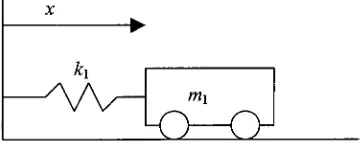
wall. [image:26.529.154.336.312.384.2]mx
Figure 2.2.1 A
massis
attachedto
thewallonly
by
aspring
Kinetic
andpotentialenergy
ofthe system willbe
T-\mx2
V^+^mx2
and
because
the systemis
conservative, the
Lagrangian
willbe
L
=T-V
=\
mx2l-mx2
or
for
ourconvenience,
L
=so
that
dL
.dL
p- =
mq
and p= =-mq
dq
"dq
H
=pq-L=mq2
~mq2)=
\mq2+\mq2
Therefore,
H=\mx2+\mx2=T+V
We
can also provethat
Hamiltonian
is kinetic
energy
plus potentialenergy for
conservative systems.
Example 2. 2.
7
If
oneofthecanonical equationsfor
asingledegree
offreedom Hamiltonian
systemis
givenas
p=p2-2q+2p
then,
we canfind
H because
dH
2 np=-=p2-2q+2p
dq
H(qp)=-p2q+q2-2pq+F(p)
and
q
=^-
=-2pq-2q+F'(p)
(2.2.17)
dp
Also,
we candetermine^
because
it's
aHamiltonian
system,
soLiouville's Theorem
has
to
satisfy
suchthat
dq
q
=-2pq-2q +
F(p)
(2.2.18)
Comparing (2.2.17)
and(2.2.18),
wefind
that
F'(p)=F(p)
sothat
F(p)
canbe
either exponential or zero.If
zerois
simple,
wecanchooseF(p)
to
be
ep.Therefore,
q
=-2pq
-2q
+epand
H(q,p)=-p2q+q2-2pq+ep
also
if
we wantto
convertH
to
L,
weneedqp
=-2p2q-2pq
+pepThus,
I{qp)
=qp-H=-2p2q-2pq+-pi+p2q-q2
+2pq-ep
CHAPTER
3
ANALYTICAL PREDICATION
OF
CONSERVATIVE SYSTEMS
FROM THE HAMILTONIAN AND FIRST INTEGRALS
3.1
ENERGY PRESERVING ALGORITHMS
For
theapplication ofthe
Hamiltonian,
we needto
introduce
the
energy
preserving
algorithms.The energy
preservation shows someinteresting
propertiesofconservation
in Hamiltonian. It is
given asMan+x+K(dn+x)
=Fn
(3.1.1)
dn+x=dn+^At{vn+vn+l)
(3.1.2)
v+i=v+!-Aa(a+0
(3.1.3)
(3.1.4)
(3.1.5)
(3.1.6)
where
U
is
thepotentialthatgeneratesK
,i.e.,
DU
=
K
.This
algorithm obeysthe
identity
E(dn+l,vn+1)
=E(dn,vn)
+^(dn+l
-dJ(Fn+l+Fn)
(3.1.7)
The
energy-preserving
algorithm(3.1. l)-(3. 1
.6) canbe
defined
for
ageneralHamiltonian
system(finite
orinfinite-dimensional)
aswell,
dp
dq
2
-
2[U(dn+x)-U(d)]
A
-'<?-
x~dn)WJ+K(dn)\
d0
=d
In
which:qn+l=q
^Si^J^kMA
(3.1.9)
AT(P+X-Pn)
i"
(qn+i-qn)
^
=^r{ccqn+x+(l-a)qn,/Jpn+x
+(l-P)pn)
(3.1.11)
and;
^
=(w+i +
(i-r)^,^+i
+a-^)A)
(3.1.12)
where
a,
/?,
/,
^are
arbitrarily
chosenin
the
interval
[0,1].
For
theproof of conservation ofenergy,
Equation
(3.
1.9)
becomes,
A
Take
transposeto
both
sidethen,
((^+i-l)-(P+i-A))
A/
Also
(3.1.10)
becomes
=
H(qn+1,pn+x)-H(qn+x,pn)
(3.1.13)
<H(qn+x,pn)-H(qn,pn))
At
=
subtracting
(3.1.14)
from
(3.1.13)
becomes
(fart
-g,)fori -Pn)J -{(Pr^X ~A)@^1 -qn)J _n_pre- v W--x
---"(4H.iAfi)--n(4,,/'J
so
that
H(fLvPn+x)=H(qn,pn)
Example 3. 1. 1
Example
in
simpleharmonic
Oscillator
since n=
1,
oneparticle,
.
#/
.a?/
,<i=-r=p
andp=-r-=-a>q
dp
dq
andwe want toshow
the
systemis
conservativeusing energy preserving
algorithms.So,
dH
*
=~r-(aq+1 +
(1
-a)qn,/3pn+x
+(1
-/?)/>)
dp
^
=/K+i+0
-/?)/> and^r=l
and
then,
dH
p
=^-(rqn+x +
0
-r)qn,^Pn+x
+0
-<?)/>
)
y"=
2(w+i
+0-r)?J
and // = /;qn+x
=qn
+At
f
^2^,2 _2'>\
<
qn+x
,ft+1
A
^,22 -2A
l+Al
Pn+X~Pn
qn+x
=qn
+2
Pn+X~Pn
At.
.qn+i
=qn+(pn+x+Pn)
(3.1.15)
ft+1
=p-to(H(qn+x,Pn)-H(qn,pn))
(qn+x-qn)
Pn+X
=Pn~Atf
2 2 2A
f 2 2 2"Ng gg
ft
2
2
4*+l
-?
ft+1
=ft
2
?+1
-?
ft+i=ft"
2-A/
(qn+x+qn)
(3.1.16)
Now
wehave
two
finite difference
equations such(3.1.15)
and(3.1.16)
2 2 2
If
we can proofH(qna,pnhl)=H(qn,pn)= +=constant, the system willbe
conservative,
andthephase curve will
be
elliptical.Thus,
^i,fti)=^+f
:
qn+^(PrX+Pn)
21
2
J
V
^
at-ti
CO-tor
s&+^-(fti+ft)
+-2
ft
fe
-i-^fom+ft)+^}
'
2
(A)2
^
+^(fti +ft)+^(ft,
+ft?
/
A,
^-fl?-A-A{22I-^(ftfl+jRl)}
4
^(A)2^
A
{2^^-(fti+ft)?
where (A)2 0Thus,
6J2 2o^to.qn
ql+-2
2
ft2 (Pml+Pn)+~Or-^-P^n-col(toyPn
(ft+1
+Pn)
again (A)20,
Therefore,
co22
dtStqn
co2Atq
p2, a
=
y^
+^p^
Jr~rp-2
'p"q-o? 2
,
^a^,
^qn,p2n
4^^^-ft)+4
andwe
know
from
(3.1.16)
that
ft+i
"ft <y2-A/(<7,i+i
+,)
Therefore
H(q^pn+x><Tn+-Y~ at-tt(*+,)
^
Pi
o} ,
<a\tof<L(
since(A)2
0,
3. 2
^q^P^ql
+y
=H(qn,pn)=constant.
Therefore
we provedthat the
given simpleHarmonic Oscillator Hamiltonian
system
is
conservative.We
will nowfind
out whetherthe
givenDuffing
equationis
conservative or notusing energy preserving
algorithms.Example 3.1.2
We
know
the
givenDuffing
equationdoes
nothave
damping
sothat
x+x3+x=0
So
wecan writex=y
y=-x-x3
By
using Liouville's
Theorem,
Y^l
+v
^
=^+^Uo
+o
=o
tt dq,
tt dp,
dx
dy
The
systemis
Hamiltonian.
Thus,
dH
dH
y2x=
q
= ==p
=y
andH(x,y)=^-+F(x)
dp
dy
2
M
F'(x)
also
ax
, .
dH
dH
y
-X + -X ~
-p =
Thus,
F'(x)
= x+x:
x2 x4
and F(x)- 1
2
4
Finally,
TT.
y2 x2 x4
H(x,y)=+ +
2
2
4
or
for
our convenienceset,
where,
H(q,p)Ml+l
2
2
4
.
dH
.dH
,v=t:=p
and -p=^-=q+qdp
dq
We
nowshowthat the
systemis
conservativeusing
energy preserving
algorithms.So,
*
=~{ctqn+x+(\-a)qnJpn+x+(\-(3)pn)
dp
^
=/?ft+i+0-/?)ft
and X7 =Xand
air
/" =
(j?,+)
+0
-r)q,#pn+x
+0
-)ft)
/"=rfe+i+?l,)+0-r)(^+^) and /" =/*
then.
qn+x
=qn+At(H(qn+l,Pn+x)-H(qn+x,pn))
(ft+i
-ft)(2 4 2
^
^n+1
.^+l
,ft+1
v
2
'4
'2
;
-^2 4 2
>
#n+l
,^n+l
.ft
In+X
qn
+^HpIx-pI)
2
ft+,
-ftqn+X=qn+(Pn+X+Pn)
(3.1.17)
In
here,
do
nottry
to
solve ln+X _ lAt
V
qn
+(ft+i
+ft
)
and set (At)20
.qn+x
andpn
2
J
areto
be
solved simultaneously.Pn+x=Pn-At-
(H(qn+X,pn)-H(qn,pn))
(qn+i-qn)
Pn+X
=Pn~At(
2 4 2"\^n+i
.q+\
.fti
,242,
-/ 2 4 2>
q*
+qn +pn
V2
'
4
'
2y
ft+1
=ft
A4fe+i)-fc)l
A/[fe+i)-fa)j
2
^+i-<?
4
?+1-tf
ft+i
=P*~Y
(q"+l
+q")~~^
(^"+1
+q"
)(^+1
+^"
}
(3 l 1
8)
Now
wehave
two
finite
difference
equationssuch(3.1.17)
and(3.1.18).
Using
these twoequations
for
thenext pointin
H,
H(q^Pn+x)=^
<L
+,<L
,Pr
L
2
4
2
substituting (3
.1
.1
7)
and(3
.1
.1
8)
into
(3.1.19)
(3.1.19)
f
to
Y
J
f
q+^iPn+X+Pn)
+i
(\
2
;
V&+r(ftl+#l)
A
A
A
A
T
A
Y
2ft
(,+^-(fti
+ft)+^)--fe+^(fti +ft)+^)k
+^(fti
+ft)J
+)
setting
(A/)2
ite
+toq,(Pn+x +p))+i(q2 +Atq,(p^x
+pn)f
+-,
Pn
~(H)~Q4ni{
+toqn(Pn+l
+Pn)}+C)
lk
+toq,(p^
+Pn))+ik
+TH<P*A +ft))
At I2
ft
~toq --qn(2ql+tiq,(pn+x
+pjj
-4
=|fe
+^4(fti
+ft))+ife
+2A^fe+1 +A))-4(r.
"*4-^f
=
I
fe
+**(?,,
+ft))+i
(qi
+2&&P,*
+ft))+l
(ft2
-2AM-2A^)
=I^+-^>^i+ft)+i44+Y^(fti+ft)+ift2-Aft^-A^?^
Now,
we substitute equation(3.1.18),
soweget,,
A
4^+~4
ft
"-(4+i
+4)--(4+i
+4)(42+,
+42)+ft
1w*
ft
~(4+i
+4)
--(4+i
+4)(42+i +4") +ft
+i4
HPl-topAn-Atpd
again,
setting
(A/)2
0
=i42+y4[2^J+i44+Y43[2ft]+lft2-A^^-A7J^
Wn+topqn+H+topdHpl-top^-^pd
Therefore,
2 4 2^242
L/Y^ \
^"-1
i^l
ift+!
4
.4
.ft
rr/ x ,^+i>ft+i)=+ +=y+
+Y=^(4>ft)=co5to/?/
Therefore
we proofthe
givensystemofDuffing
equationsis
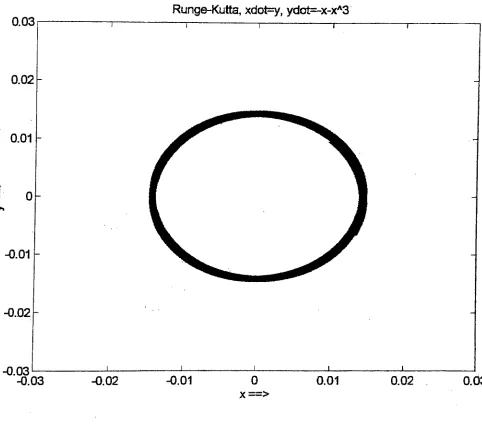
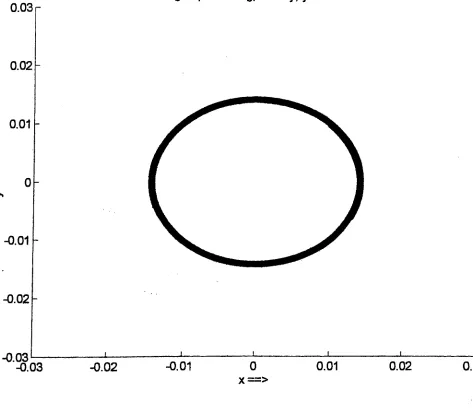
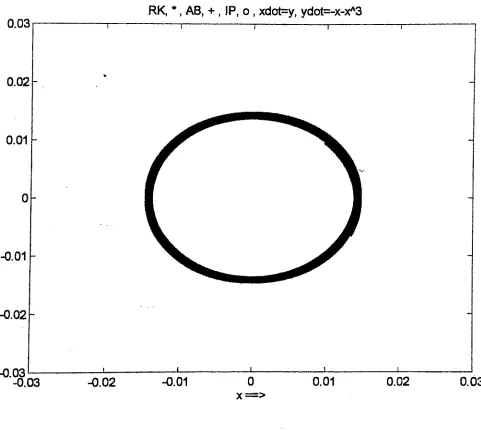
conservative.The
Runge-Kutta,
xdot=y,
ydct=-x-xA30.03
r0.02
0.01
-0.01
-0.02
-0.03
[image:38.529.20.502.178.613.2]Example 3. 1.
3
From
example2. 2.
2
H(xx,x2)
=xxx2+^-5-+CFor
ourconvince,
let C
=0,
H(qp)=qp+^--^-To
showthe
aboveHamiltonian
is
conservative ornot,
we can again useenergy
preservation
algorithms,
So,
it
follows
that:and,
Then,
m
q==q+p
anddp
dH
.dH
-p==-q+pdq
A
= (aqn+l+(l-a)qn,fi>n+l+(l-j3)pn)dp
*
=4+i
+0
-a)qn
+/K+i
+(1
-P)pn
with XT =X
dq
m
= -m+1 -(i
-r)4
+SPn,x
+0
-^)ft
with pr-p
4+i=4+A>(H(qn+X,pn+X)-H(qn+X,pn))
(ft+i
-ft) 4+i=4+^f
2 2 >t/+l Fn+X
-'
V
I I j
-(
2 2^4'ft-^f
+v
V
l l j4+i
=4
+AKftVft2)
2
ft+i
-ftAt
r4+i
=4+y(ft+i+ft)
(3.1.20)
In
here,
do
nottry
to
solve tn+X _ iA*
V
4
+(ft+i
+ft
)
and set (Ar)2 *0
.qn+x
andp+1
1
J
are
to
be
solved simultaneously.Hence
. AAH(qn+x,Pn)-H(qn,pn))
(4+1-4)
ft+1
=Pn~AtVf
2 2> A 2 2Al4+i
ft
4
+
ft
4,+,
ft,-4,
ft-v
2
2
J
v2
2
J
'n+l
ft
+4+i
-4
Mfc+J-fe)]
A,(4+i~4)ft2
4i+i
-4i
!-A^-fn+l
4
Aft
N Aft+i
=ft+y(4+i+4)-A*ft
ft+i
=ft+y((4+i+4)-2ft)
(3.1.21)
Now
wehave
twofinite
difference
equations such(3.1.20)
and(3.1.21).
Using
these
two equationsfor
the
next pointin H.
H(qn+x,pn+x)=q,x-pK+x+^-Y
(3.1.22)
substituting (3.
1.20)
and(3.
1.21)
into
(3.
1.22)
(
to
V
A/
4+-(fti+ft)
ft+-((4+i+4)-2ft)
2
)\
2
(
a
y
r
a
ft+-((4+i+4)-2ft)
4
4+-(fti+ft)
2
;
v
2
4
1Y
setting
(At)20
=4
P
+-4((4+i
+4)~2ft)+-ft(fti
+ft)
+lfc +Atpn{(qnX
+qn)-2pn))-l(ql +Atq,(pn+X
+pjj
We
again substitute(3.3.20),
A
=4
'ft+4
A
4
+^(fti +ft)+4
-2ftl+-ft(fti
+ft)
A
+:
/
A
A
+top!
4
+-(#*, +ft)+4
-2ftI
-\(ql+toqn(PnA
+pjj
V 2
A
(
=4
-ft+4
+:
A^
^ ^1
to
,H
+~^(Pmi
+Pn)-2Pn\+Pn(Pn+X +ft)
A
/
+%[
24
+-(fti +ft)-2ft
j
Ufe
+toq(pMX
+Pjj
setting
(Ar)20
A
=4
'ft +A-42-AtqnPn
+-pn(pn+x
+p)
+\(pl +2JstqnPn
-2Atf)-\(+lq,(pM
+pjj
A
=4
'ft+^
-A-4P+-ft(ft+i
+ft)
We
now substitute(3.
1.21),
so we get=4
-ft+A4 +p
pn
+-((4+i +4)-2ft)+ft
2 V 2
ft
41
A/.
A,
+f
"
A^
-|
-dfl+-((4+!
+4)
-2ft)+ft
=4
'ft+A^
+-/J
2p
+-((qnhX +qn)~2pn)
Pn
to.
At,
+f
"
A^
-|
4l2ft
+-((4+i +4)
-%Jagain,
setting
(Ar)2
0
2 2
--qn-Pn+toql+topl+^-titi-^-Atm
2 2
:4-ft+^f+A/4(4"ft)
Therefore
22 22
#(4+i,ft+i)
=4+i
"ft+i+^y
-Y
=4
-ft+y
-|
+A^fe
-a)*#(4,ft)
^constantTherefore
we proofthe
given systemofequationsis
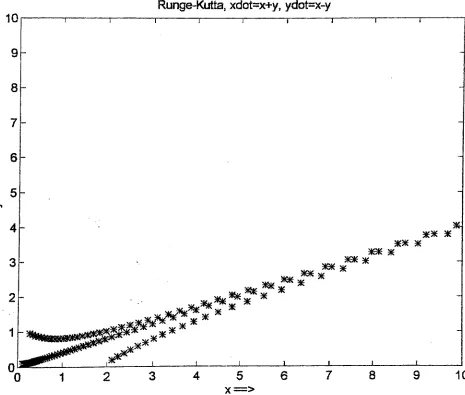
not conservative.The
phasecurve will not
have
closed contours.In
this example,
we showedthat
conservativesystems are a special case of
Lagrangian
orHamiltonian
systems.Not
allHamiltonian
10
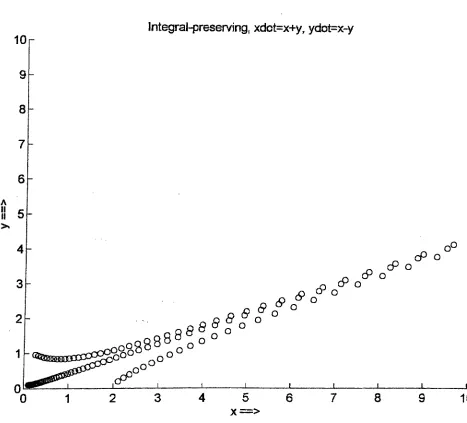
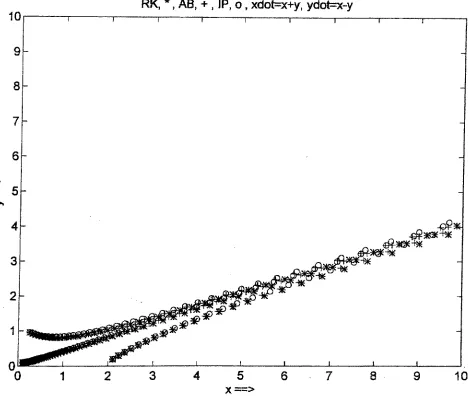
Runge-Kutta,
xdot=x+y,
ydot=x-y
-i 1 r -i 1 r
8
7
6-A II II O
3fc
as*. ^ *
5l6if *
ae* *
2K* * 5K* *
ftjtf****
J I 1 I 1 L
3456789
10
[image:43.529.33.498.188.583.2]x=>
3.2
FIRST INTEGRAL FROM EULER-LAGRANGE EQUATION
From
Euler-Lagrange
equation,
wehave
dy
dx
dy'where
F is
afunctional,
afunction
ofafunction,
such asF=F(x,y,y')
andwe
have
second orderequationdy
fdF^
dx
dy
dx
+-fdF^
\"s J
dy
\dy jdy
+dy'
^dF^
dy
dy'Vvy
There
aretwo
special casesfrom Euler-Lagrange
equations.Case I
If
F is
afunctional
offunction
xandy
'
,
F
=F(x,y')
then
the
Euler-Lagrange
equationbecomes
'(x,
dy
dF(x,y')
= constantbecause
dF(x,y')
dy
=
0
Case II
If ftis
afunctional
offunction
v andy'
,
F
=F(y,y')
then
the Euler-Lagrange
equationbecomes
(3.2.1)
F(y,y')-y,<9F(X'y>}
=constant
(3.2.3)
dy'
Equation
(3.2.2)
and(3.2.3)
arefirst-order differential
equations.One less
equation
has
to
be integrated.
Physically,
afirst
integral
representsthe
conservation ofacertain quantity.
The
left-hand
sides of equation(3.2.2)
and(3.2.3)
represent theCHAPTER
4
NUMERICAL ODE SOLVERS THAT PRESERVE FIRST INTEGRAL
4.1
ORBITAL
DERIVATIVES
AND FIRST INTEGRAL
As
wehave discussed
on page2
ofChapter
1,
equationsin
whichtheindependent
variable
/
does
not occurexplicitly
are called autonomous equations.A
vector equationofautonomous can
be
written asx =
f(x)
(4.1.1)
In
here,
we call equation(4.1.1)
an autonomousdifferential
equationbecause
tdoes
notexplicitly
appearin
the
equation.A
pointin
phase space with coordinates xi(t),
x2(t),
..., xn
(t)
for
certaint, is
called a phase point.
In general, for
increasing
t,
a phase point shall movethrough
phase-space.
In carrying
outthe
projectioninto
phasespace,
wedo
notgenerally know
the solution curves of equation
(4.1.1),
but it is
simple toformulate
adifferential
equation
describing
the
behavior
ofthe
orbitsin
phase space.Equation
(4.1.1)
canbe
writtenoutin
components asx,
=/,(x)
;/'=1,
...,We
now use one ofthe
components ofx,
such asxi,
as a newindependent
variable.
In
orderto
getx\to
be
suchindependent
variable,
fx
(
x)
*0
.Therefore
^=/,W
and%=/*(*)
dt
dt
and
dividing
dxx
into
dxk
, wehave
dxk
=dfk(x)
dxx
fx
(x)
k
=2,...,n
Example 4. 1. 1
Harmonic
oscillator x + x =0
The
equivalentvectorequationin
with x =xx
, x =x2
The
orbitsofgiventwo
dimensional Phase
space aredescribed
by
dxx
x2
Integration
yieldsx2
+
x2
=constant
Or using Liouville's
Theorem,
fdq^
+fdP=^+^=0_0
=0
ttdq,
ttdp,
dx,
dx2
Therefore
the systemis
aHamiltonian
system_dH(xx,x2)_
m,*d=^+m
and^^=F(xi)
2
oq
Also,
Therefore,
_dH(xl,x2)_
-Xi--\
a^
x2
//(x1,x2)=|+|+C
H(x,x)-C=^-+~
2
2
Solutions
of system(4.1.2)
in
phase space are called orbits.In
equation(4.1.2),
time
has been
eliminated,
soit
canbe integrated
in
a number ofcases,
producing
arelation
between
the
components of the solution vector.Since
simpleharmonic
oscillator
is conservative,
H(xh
x2)
=C
is constant,
differentiation
withrespectto
tgives,
xx+xx=
x(x+x)
=0
Now
we willintroduce
the
concept of orbitalderivative.
Let
ft
be
the
orbitalderivative.
Consider
the
differentiable
function
T
R"^
R
andthe
vectorfunction
x:R-*
R".
The
derivative
L,
ofthe
function
/ along
the
vectorfunction
x,
parameterizedby
/,
is
T T
dl
.dl
.dl
.dl
LJ = x = x, + x. +
... +
dx
dx,
<3x,dx
"
l L n
If
we considertheequation x =f(x)
, x eD
aR";
andif
ft/
=0,
then
I(x)
is
calledfirst integral
of equation.In
example4. 1. 1
_ __
dH
.dH
, x
LtH
=Xj
+x2
=XjXj
+x2x2
= xx+x(-x)
=0
dxx
dx2
Therefore,
H in
example4. 1. 1
willbe
afirst integral
ofequation/.
If
a surfaceis
constant or
if
the
rateofchanges areintegrable,
it
meansthe
systemofequationsinvolve
Example 4. 1. 2
Let
us consider so-calledVolterra-Lotka
equationsx= ax
-bxy
y
=bxy
-cy
The
equationfor
theorbitsin
the
phaseplaneis
dy
_x a-by
dx
y
bx
cThus
the equationis
separable andintegration
yieldbx
-cln x+
by
-a
In
y
=C
=I(x,y)
We
willnowcheckwith orbitalderivative,
, .
dl
.dl
.Lti
= xhy
=dx
dy
\-<-"(ax
-bxy)
+f
b- a Vy)
(bxy
-cy)
V
xj
=
(bx
-c)(a
-by)
+(by
-a)(bx
-c)
=0
Therefore
resultant7
(x,
y)is afirst integral
ofthe
equation.This may
alsoinvolve holonomic
constraints.However,
Volterra-Lotka has
someinteresting
propertiesthat
if
we nowlet/?
=In
x> x=epand
q
=In
v-
y
=e?the equations canbe
observedas
Hamiltonian
x = ^- =
epp
=(a-beq)ep
-p
=(a-beq)
dp
dt
V r V 'y
=^^-
=eqq
=(bep
-^q =
(bep
-c)y
dq
dt
V r V 'H(q,p)
= bep-cp
+ beq-aq
dH
and
q
=dH
dq
'
dp
Another
approach offinding
afirst
integral
is
rather simplefor
conservativeproblems.
Consider
example3.1.2
and rewritetwo
system of equationsinto
x+ x+
x3
=0
Where
weintroduce/^)
= x+x3
So
that
multiplying
by
xbecomes
xx+x(x+
x3)
=0
or \2x2)+\(x
+x3)dx=0
dt
dt
-fex2)+-dtX2 'dt
(2 4\ X X +2
4
Therefore
thefirst
integral
ofthe
equationis
then1 C-2
x2 x4
I
=~x h 1- =constantThat
is just
the
advantage offinding
the
first integral
equationin
conservative systems.Example 4. 1. 3
Let
usnowlook
atthree-dimensional systemofequationsAx
=(B
-C)yzBy
=(C-A)zx
Cz
=(A-B)xy
The
equationsfor
the
orbitsin
thephase plane aredx_y(B-CV
B
^
dy
xA
.
C-A_
((C
-A)A)x2
+
(B(C
-B))y2 =
Ix
(x,
y)
'c-aY
c
^->
((C
-A)A)xdx
=(B(B
-C))ydy
dz
y
B
J
A-B
->
((A
-B)B)ydy
=(C(C
-A))zdz
((B
-A)B)y2
+
(C(C
-A))z2 =
Now
wehave
to
constructin
athree-dimensional
differentiable function /
=I(x,
y,
z),
so wehave
to
usethe
so calledLyapunov
function
construction..If
welet
y
=z=
0,
thenx
becomes
arbitrary
such as x0.Then, I\
orL(x,
y)-I\(x0,
0)
is
not signdefinite in
aneighborhood of
(x0, 0,
0)
andI2
is
semidefinite.One
ofthe
ways to construct aLyapunov
function is
I(x,y,z)
=[lJx,y)-IJx0,0)]2+I2(y,z)
=
[AC-A)^
+B(C-B)y2-A(C-A)x$
-^B^B-A)/ +C(C-A)z2 2."4 27(x,
y,
z)
-2A2(C-A)2^x\+B2(C-B)2y
+A2(C-Afx4
+5(5-^/
+C(C-A)zWe
willnow checkwithorbitalderivative,
T T
dl
.dl
.dl
.LtI
= xhy
H zdx
dy
dz
(4.1.3)
x=[4^2(C-y4)2x3
+ 4A(C-A)B(C-B)xy2-4A2(C-A)2xx20\^-^-dx
\
A
y=
\AA(C-A)B(C-B)^
v-4^(C-5)V -4ARC-A)(C-B)^y+2B(B-A)y\
^^
dy
\
B
yz
zx
z=
2C(C-A)z
dz
((A T>\\
xy
(A-B)
V
C
jLJ.
=4A(B-Q(C-A)2x3yz+4B(C-A)(C-B)(B-C)xy3z-4A(C-A)2(B-C)xx2xyz+4A(C-B)(C-A)2x3yz-4B(C-A)(C-B)2xy3z -4A(C-A)2(C-B)xxlyz
+
2(C-A)(B-A)xyz+ 2(C-A)(A-B)xyz
=
0
Indeed,
the
resultant/ in
(4.1.3)
is
afirst
integral
ofthe
equation and give4.2
INTEGRAL-PRESERVING
NUMERICAL
INTEGRATOR
SYSTEMS
In
the
last
section we showedthat the
first
Integral
of theequation,
I(x)
is
aconstant
(4.2.1),
andit is
typically
aholonomic
constraint.A
system of equationsthat
involves
damping
canbe
thought
of asembedding
of scleronomicconstraints,
because
time t
is
implicitly
involved. Consider:
I(x)
=constant(4.2.
1)
Taking
the time
derivative
givesdl
dl dx
cldxn
d
dxn
= i-4-
-+ +
-=
0
dt
dxx
dt
dx2
dt
dxn
dt
_ =(v7). =
(V/)-F(x)
=0
:-I(x)
=constant(4.2.2)
dt
dt
If
weknow
I
(xn)=constant,
we shouldbe
ableto
constructI(xn+X )
similar to theenergy preserving
algorithmsin Chapter 3.
Therefore,
as afirst step
we need tofind
askew symmetric
matrix,
S,
that
has
property
(ST=
-S),
i.e.,
-S=
S2X
0
Now
we canconvertthe
systemto
skew-gradientform:
[S(x)]\vi(x)]=^
=F(x)
(4.2.3)
Multiplying
with(V7)r
to
both
sideswillgive(V/)r
[s\VI)
= (V/)rF(x)
=(VI) F(x)
(4.2.4)
Taking
the
transposeofboth
sides((V/)r
[S](VI))T =(VI)T[S]T
(VI)
=(VI) F(x)
where
((VI)TJ
=(VI)
is
obvious.Also because
ST
=
(VI)T[S](VI)
=(VI).F(X)
or
(VI)T[s](VI)
=-iVI)-F(x)
Thus comparing
(4.2.4)
and(4.2.5),
wehave
(4.2.5)
VI-F(x)=-VI-F(x)
orV/F(x)
=0
(4.2.6)
Equation
(4.2.6)
is
the
same as equation(4.2.2).
Therefore
the
skew symmetricmatrix
does
not changethe
meaning
ofthe
first
integral
ofthe
equation thatis
/
is
constant.
Therefore,
we wantto
find
suchS,
skew-symmetricas afirst
step.The
nextstep
is
splitting.The
n-dimensional
vectorfields
F
=YFk
k=x
dxk
is
split,
using
theskew-symmetry
ofS,
into