R E S E A R C H
Open Access
Characterization of a malaria outbreak in
Colombia in 2010
Pablo Chaparro
1,2*, Julio Padilla
3, Andrés F Vallejo
4,5and Sócrates Herrera
4,5Abstract
Background:Although malaria has presented a significant reduction in morbidity and mortality worldwide during the last decade, it remains a serious global public health problem. In Colombia, during this period, many factors have contributed to sustained disease transmission, with significant fluctuations in an overall downward trend in the number of reported malaria cases. Despite its epidemiological importance, few studies have used surveillance data to describe the malaria situation in Colombia. This study aims to describe the characteristics of malaria cases reported during 2010 to the Public Health Surveillance System (SIVIGILA) of the National Institute of Health (INS) of Colombia.
Methods:A descriptive study was conducted using malaria information from SIVIGILA 2010. Cases, frequencies, proportions, ratio and measures of central tendency and data dispersion were calculated. In addition, the annual parasite index (API) and the differences between the variables reported in 2009 and 2010 were estimated.
Results:A total of 117,108 cases were recorded by SIVIGILA in 2010 for a national API of 10.5/1,000 habitants, with a greater number of cases occurring during the first half of the year. More than 90% of cases were reported in seven departments (=states): Antioquia: 46,476 (39.7%); Chocó: 22,493 (19.2%); Cordoba: 20,182 (17.2%); Valle: 6,360 (5.4%); Guaviare: 5,876 (5.0%); Nariño: 4,085 (3.5%); and Bolivar: 3,590 (3.1%).Plasmodium vivaxrepresented ~71% of the cases;Plasmodium falciparum~28%; and few infrequent cases caused byPlasmodium malariae.
Conclusions:Overall, a greater incidence was found in men (65%) than in women (35%). Although about a third of cases occurred in children <15 years, most of these cases occurred in children >5 years of age. The ethnic
distribution indicated that about 68% of the cases occurred in mestizos and whites, followed by 23% in Afro-descendants, and the remainder (9%) in indigenous communities. In over half of the cases, consultation occurred early, with 623 complicated and 23 fatal cases. However, the overall incidence increased, corresponding to an epidemic burst and indicating the need to strengthen prevention and control activities as well as surveillance to reduce the risk of outbreaks and the consequent economic and social impact.
Keywords:Colombia, Malaria surveillance, Epidemiology,Plasmodium vivax,Plasmodium falciparum
Background
Malaria is caused by one or more of the five species of Plasmodium that can infect humans (Plasmodium vivax, Plasmodium falciparum, Plasmodium malariae, Plasmo-dium ovale, Plasmodium knowlesi) after transmission by
the bite of malarial female Anopheles mosquitoes.
Al-though P. falciparum is highly prevalent worldwide, P. vivaxhas a wider distribution [1] and is the prevalent spe-cies outside the African continent.Plasmodium ovale and
P. malariae are mainly transmitted in tropical areas of Africa and some islands of Southeast Asia [2], whereas P. knowlesi seems to be restricted to Southeast Asia [3]. Between 2005 and 2009, the estimated global number of malaria cases decreased from 237 million to 222 million, while the estimated number of malaria deaths during the same period decreased from >800,000 cases in 2005 to 691,000 cases in 2009 (~14%) [4].
In the American continent, malaria affects 23 countries, where about 20% of the population is at some risk of dis-ease [5]. Brazil and Colombia are the major contributors of malaria cases in the region, accounting for 67% of the * Correspondence:[email protected]
1
National Institute of Health of Colombia, Bogotá, Colombia 2National University of Colombia, Bogotá, Colombia
Full list of author information is available at the end of the article
total malaria cases, followed by Haiti, Peru and Venezuela. Altogether the five countries accounted for 91% of the cases reported in the American continent in 2009 [5,6]. In gen-eral,P.vivaxis responsible for most of the malaria cases of the continent (70%), which have been estimated to range between 1.9 million in 2005 and 1.1 million in 2009.
During the last decade several countries of the continent have presented a significant and stable decrease in malaria incidence: Peru and Ecuador in South America; and Guatemala, Honduras, El Salvador, Costa Rica, and Panama in Central America (decreased by >60% malaria transmis-sion). However, in Colombia, during the same period, mor-bidity has remained high, with malaria cases fluctuating between 231,000 and 66,000 cases per year [5].
About 85% of the Colombian rural territory is at an alti-tude less than 1,600 m above sea level, and thus presents climatic, geographic and epidemiological conditions suit-able for malaria transmission. It is estimated that approxi-mately a quarter (~11 million people) of its current national population, estimated at 45 million people, live permanently at risk of infection [7]. This portion of the na-tional population reside in areas where environmental fac-tors such as temperature, humidity, precipitation, latitude and altitude, as well as social, cultural, economic and polit-ical factors compromise the effectiveness of prevention and control programs. Despite the relatively higher rate of mal-aria transmission in Colombia, it is still considered unstable with endemic-epidemic patterns and focal variables in dif-ferent eco-epidemiological regions [8].
In general, during the last seven years, the Colombian National Malaria Control Programme (NMCP) has targeted its activities on reducing the interaction among vectors, parasites and human hosts through strategies such as case management, prevention and surveillance [9,10]. Malaria case management is focused on early detection, i.e., diagno-sis of malaria cases and prompt and effective treatment of symptomatic patients. This is based on an extended diag-nostic network with >1,700 laboratories and 1,195 microsco-pists where most cases are detected by passive surveillance using thick blood smears (TBS), although there is a growing use of rapid diagnostic tests (RDT) [11]. Treatment is based on the use of artemether/lumefantrine for P. falciparum and chloroquine + primaquine for P. vivax, according to the respective parasite sensitivity to these anti-malarials. Prevention activities cover a wide variety of strategies, ran-ging from preventive health education to vector control measures, including the use of insecticide-impregnated nets (ITNs) and in-door residual spraying (IRS) with long-lasting insecticides, particularly DDT, deltametrin and lambda-cyhalotrin. Monitoring includes passive case detec-tion performed by a network of community collaborators that contribute with diagnosis, monitoring and evaluation of the NMCP, whereas active detection of malaria cases is only performed during epidemic outbreaks [9,10].
Besides the usual activities of the NMCP, a project sponsored by the Global Fund (GF) for AIDS, tubercu-losis and malaria between 2005 and 2010 was directed at reducing malaria transmission at adjacent country borders (PAMAFRO) that included Peru, Ecuador, Colombia, and Venezuela. This project significantly contributed to a decline in malaria transmission, par-ticularly in bordering departments such as Nariño in the south-western region of Colombia. Moreover, since 2010, a new five-year GF project is being conducted in the five departments (=states) that contribute >80% of malaria cases in Colombia: Cordoba, Antioquia, Chocó, Valle del Cauca, and Cauca. The strategy of this on-going GF project is to train community workers who will be responsible for leading disease prevention pro-cesses: organization of surveillance committees, ensur-ing notification and promotensur-ing access to RDT-based diagnosis and immediate treatment.
In spite of the significant national efforts against mal-aria, the impact of all these activities has been hampered by situations such as armed conflicts, illegal agriculture and mining, social inequality, climate change, and the ra-ther cumbersome administrative structure of the NMCP [12]. The latter includes decentralization of the NMCP, which has been attempting to transfer control activities to the social security system (SSS) since 2000. The SSS is composed of health provider enterprises (EPS) and health provider institutions (IPS) with relatively low malaria tech-nical and operational capacity in some departments and municipalities, together with a general lack of political will and social responsibility.
Because of the paucity of reports that describe the current national malaria situation, the aim of this study was to describe the characteristics of malaria cases reported in Colombia during 2010 as a starting point for prioritizing a prevention and control agenda.
Methods
Study design and case definitions
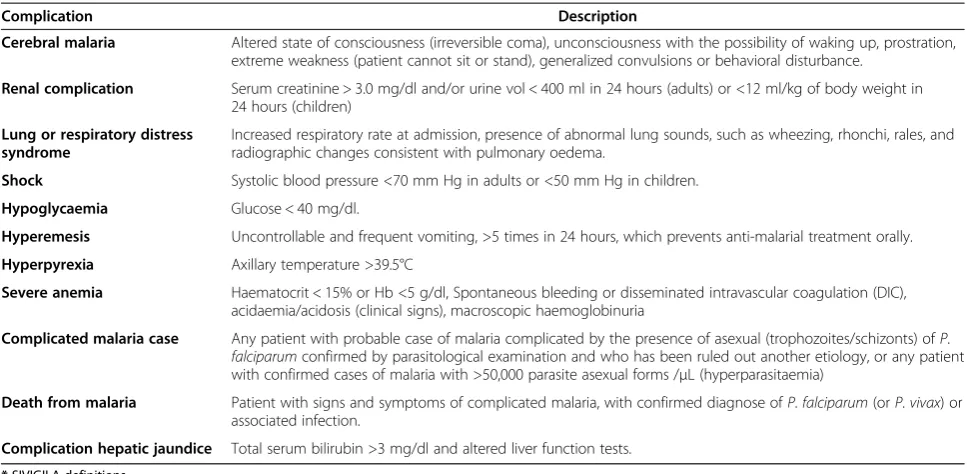
A descriptive study was conducted using data from SIVIGILA 2010. Definitions established by this surveil-lance system were adopted for laboratory-confirmed un-complicated malaria cases, probable cases, and severe and complicated malaria [8], as described in Table 1.
Descriptive variables
Variables considered in the descriptive analysis were: para-site species, number of uncomplicated malaria and lethal cases during the year, department and municipality of ori-gin, duration (months) of consultation, age, gender, type of health regime, and ethnicity. Additionally, “time between
symptoms and consultation” was included as a variable
Database mining
Databases were refined taking into account the recom-mendations of the monitoring system. In general, these recommendations address validation rules that take into account the variable code, date of service, epidemiological week, type identification, identification number, primary data generating units (PDGU) and information units (IU), which emphasize the assessment of repeated and duplicate cases [13].
Statistical methods
Information was processed using spreadsheets and Microsoft Excel for analysis, using Tableau statistical package, version 6.0. Univariate analyses were per-formed for all variables included. The proportions, vivax/falciparum ratio, and measures of central ten-dency and dispersion were calculated. The API was cal-culated by relating the total number of malaria cases (117,108) in 2010 with the population at mid-term risk for the same year (10.2 million), multiplied by a thousand. The chi-square test was used to assess differences between the variables reported in 2010 compared with the previous year, and to calculate P values; which was considered sta-tistically significant when <0.05.
Results
A total of 117,108 diagnosed malaria cases were recorded during 2010 by SIVIGILA; 77,586 of which, equivalent to 66.3% of all cases for the year, were reported during the first half of the year. These numbers corresponded to a 32.6% increase from the 78,498 cases reported in 2009 (p < 0.001), which constituted an epidemic year (Figure 1).
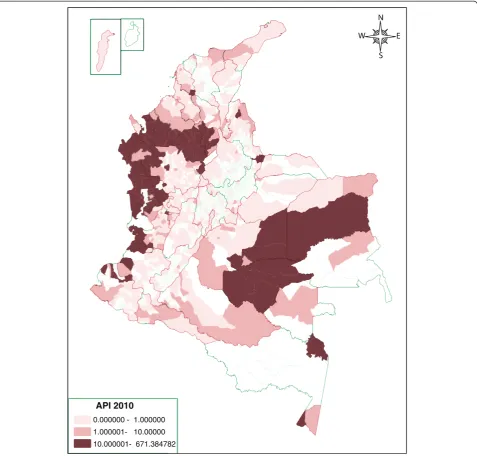
Twenty percent (7/32) of the Colombian departments, represented by the departments of Antioquia, Cordoba, Chocó, Guaviare, Vichada, Valle del Cauca and Amazon, presented an IPA above the national average of 10.5 cases/ 1,000 habitants (Figure 2). Additionally, stratification by territorial entity (departments and districts) according to the IPA indicated that in these seven states, 27.7% of the rural population presented 87.9% of cases, leading to an IPA >10/1,000, and representing areas of high malaria transmission risk. As shown in Table 2, most cases were reported in Antioquia (39.7%), followed by Chocó (19.2%), Córdoba (17.2%), Valle (5.4%), Guaviare (5.0%), Nariño (3.5%), and Bolivar (3.1%) cases. Another 14 departments accounting for 33.2% of the rural population recorded 11.0% of cases and, therefore, displayed an IPA between 1-9 /1,000, and were classified as medium-risk regions. In the remaining 15 entities, with 39.1% of the rural population, reported only 0.9% of the cases, presented an IPA <1.0/ 1,000, and were, therefore, considered of low risk. Table 2 shows the specific increase in the number of malaria cases observed in the period 2009-2010 by territorial entity. Des-pite the fact that not all of the territorial entities reported an increase in malaria, five of the most endemic (Antioquia, Chocó, Cordoba, Guaviare and Valle) reported an average increase of 44%.
[image:3.595.56.540.99.336.2]Most cases were caused by only one parasite species. Plasmodium vivaxwas identified in 82,856 (70.8%) cases,P. falciparum in 32,777 (28.0%) cases, andP.malariae in 47 (0.04%) cases. Additionally, 1,428 cases of mixed infections (P.falciparumandP.vivax, 1.2%) were reported. The ratio ofP.vivaxtoP.falciparumcases was 2.5 to 1. Most of the territorial entities had a higher proportion of P. vivax, Table 1 Definitions used in this study*
Complication Description
Cerebral malaria Altered state of consciousness (irreversible coma), unconsciousness with the possibility of waking up, prostration, extreme weakness (patient cannot sit or stand), generalized convulsions or behavioral disturbance.
Renal complication Serum creatinine > 3.0 mg/dl and/or urine vol < 400 ml in 24 hours (adults) or <12 ml/kg of body weight in 24 hours (children)
Lung or respiratory distress syndrome
Increased respiratory rate at admission, presence of abnormal lung sounds, such as wheezing, rhonchi, rales, and radiographic changes consistent with pulmonary oedema.
Shock Systolic blood pressure <70 mm Hg in adults or <50 mm Hg in children.
Hypoglycaemia Glucose < 40 mg/dl.
Hyperemesis Uncontrollable and frequent vomiting, >5 times in 24 hours, which prevents anti-malarial treatment orally.
Hyperpyrexia Axillary temperature >39.5°C
Severe anemia Haematocrit < 15% or Hb <5 g/dl, Spontaneous bleeding or disseminated intravascular coagulation (DIC), acidaemia/acidosis (clinical signs), macroscopic haemoglobinuria
Complicated malaria case Any patient with probable case of malaria complicated by the presence of asexual (trophozoites/schizonts) ofP. falciparumconfirmed by parasitological examination and who has been ruled out another etiology, or any patient with confirmed cases of malaria with >50,000 parasite asexual forms /μL (hyperparasitaemia)
Death from malaria Patient with signs and symptoms of complicated malaria, with confirmed diagnose ofP.falciparum(orP.vivax) or associated infection.
Complication hepatic jaundice Total serum bilirubin >3 mg/dl and altered liver function tests.
except in Nariño, whereP.falciparum was the predomin-ant species (P.vivax/ P.falciparum= 1:5) (Figure 3). Like-wise, most cases (75,636 = 64.6%) occurred in men and 41,472 = 35.4% in women. Age ranged from the first day of life to 101 years (median age, 22 years). The IPA distribu-tion by sex and age was higher for men, with similar distri-bution for all age groups (Figure 4). The higher API values converged on the group of 20 to 24 years: 72.9% in men and 27.1% women.
Of people affected by malaria, 73,805 (63.0%) were from rural areas; 24,779 (21.2%) from small villages and 18,508 (15.8%) from municipalities. Regarding the social security system, nearly two-thirds of the participants were enrolled (68,029, 58.1%), while 49,070 (41.9%) cases were not. The ethnic group analysis showed that 27,382 (23.4%) occurred in groups of African descent; 9,311
(8.0%) in Native Americans; 299 (0.3%) in raizales; 98
(0.1%) in Gypsy; 22 (0.02%) in palenqueros; and 79,988
(68.3%) in white/mestizopopulation. In terms of occupa-tion, 75.4% of the reported cases were categorized as fol-lows: 29,294 (25.0%) students; 16,769 (14.3%) miners; 15,072 (12.9%) housewives; 10,264 (8.8%) children; 8,077 (6.9%) farmers; 5,329 (4.6%) soldiers; 3,494 (3.0%) forest workers. In relation to the time between the symptoms onset and the time of diagnosis, there was a median of two days (range: 0-309). 54.2% of the cases consulted within 48 hours after symptoms onset (Table 3). Eight departments had clinical care percentages that exceeded
the national average, including Antioquia and Cordoba, which qualified as high risk according to the API with 57.0 and 64.5%, respectively.
Malaria in children under 15 years of age
Of the 117,108 cases reported in 2010, 35,458 (30.3%) oc-curred in children under 15 years; 840 (2.4%) were aged under one year; 11,917 (33.6%) belonged to the group of one to four years; 9,838 (27.7%) were in the group of five to nine years; and 12,863 (36.3%) were in the ten to 14 year-age group. Parasite species distribution in this group was 26,142 (73.7%) withP.vivaxand 8,998 (25.4%) withP.falciparum. The proportion ofP.vivaxcases in the group ≤15 years was 1.25 times higher than in ≥15 (95% CI = 1.21-1.29, p = 0.000). Malaria cases in children <15 years were concentrated in three territorial entities, 67,292 (82.5%) with an API ≥10: Antioquia: 12,204 (34.4%); Chocó: 9,033 (25.5%); Cordoba: 8,030 (22.6%). About half of the cases (54.7%) in this age group consulted within the first 48 hours after symptom onset.
Malaria during pregnancy
A total of 29,345 malaria cases occurred in women of re-productive age (ten to 54 years); 251 (0.9%) of which were pregnant, with >70% of gestational malaria cases concentrated in a few departments. Antioquia reported 45.8% of the cases (115/251; p = 0.016); followed by
Córdoba: 11.6% (29/251; p = 0.005); Choco: 8.4%
0 2000 4000 6000 8000 10000 12000 14000 16000 18000
Jan Feb Mar Apr May Jun Jul Aug Sep Oct Nov Dec
M
a
la
ri
a
Ca
se
s
[image:4.595.56.541.90.370.2]Month
(21/251; p = 0.01); Guaviare: 7.6% (19/251; p = 0.011). Almost half of the cases (45.8%) consulted within the first 48 hours after symptom onset and no significant difference was observed in the parasite species presented by pregnant and non-pregnant women.
Complicated malaria
A total of 623 (0.5%) complicated malaria cases were reported, caused almost equally byP.vivaxandP.
falcip-arum with most patients (70.1%) in the age group of 15
to 64 years, and the remainder (27.9%) occurred in chil-dren <15 years old. Liver failure (39.2%) and renal failure
(26.8%) were the most frequently reported complications (Table 4).
Deaths from malaria
Twenty-three (0.02%) deaths attributable to malaria were produced in equal proportion byP.vivax(47.8%) andP. falciparum(47.8%), with most cases (69.6%) occurring in patients aged 0 to 29 years, although the range varied between ten months to 80 years old (median age, 27 years) These deaths occurred in 15 (65.2%) women and 8 (34.8%) men. The most frequent complications were brain (47.8%) and lung (30.4%) diseases, and sur-prisingly, 43.5% of the cases were recorded as having
API 2010
[image:5.595.60.538.89.545.2]Table 2 Distribution of malaria cases by parasite species and department (=state)
Territorial entity 2009 2009 Rate of
change
P.vivax P.falciparum P.vivax P.falciparum
n % n % n % n % %
Antioquia 26.341 33,42 6.059 7,69 36.620 31,27 9.463 8,08 29,7
Córdoba 10.248 13 3.008 3,82 14.281 12,19 5.696 4,86 33,6
Chocó 5.180 6,57 2.931 3,72 12.543 10,71 9.608 8,2 63,4
Guaviare 1.065 4,3 1.184 1,5 4.940 4,22 877 0,75 21,4
Nariño 3.388 1,35 4.505 5,72 693 0,59 3.381 2,89 -36,7
Valle del Cauca 991 1,26 913 1,16 5.061 4,32 1.213 1,04 69,7
Meta 1.427 1,81 265 0,34 1.069 0,91 372 0,32 -17,4
Cauca 149 0,19 1.730 2,19 151 0,13 708 0,6 -118,7
Amazonas 1.729 2,19 82 0,1 747 0,64 33 0,03 -132,2
Vichada 1.226 1,56 246 0,31 535 0,46 269 0,23 -83,1
Risaralda 1.010 1,28 29 0,04 1.053 0,9 139 0,12 12,8
Bolívar 849 1,08 65 0,08 2,6 2,22 755 0,64 -20,6
La Guajira 955 1,21 24 0,03 315 0,27 42 0,04 -174,2
Putumayo 721 0,91 6 0,01 236 0,2 11 0,01 -194,3
Norte Santander 237 0,3 1 0 346 0,3 2 0 31,6
Caquetá 169 0,21 44 0,06 220 0,19 33 0,03 15,8
Sucre 182 0,23 27 0,03 177 0,15 23 0,02 -4,5
Vaupés 100 0,13 24 0,03 205 0,18 4 0 40,7
Caldas 26 0,03 28 0,04 201 0,17 21 0,02 75,7
Magdalena 104 0,13 61 0,08 35 0,03 7 0,01 -292,9
Guainía 105 0,13 14 0,02 72 0,06 4 0 -56,6
Quindío 76 0,1 11 0,01 83 0,07 22 0,02 17,1
Boyacá 62 0,08 4 0,01 118 0,1 5 0 46,3
Outside 102 0,13 7 0,01 55 0,05 10 0,01 -67,7
Cundinamarca 40 0,05 4 0,01 97 0,08 8 0,01 58,1
Tolima 55 0,07 9 0,01 67 0,06 11 0,01 17,9
Santander 53 0,07 16 0,02 61 0,05 8 0,01 0,0
Without information 42 0,05 16 0,02 50 0,04 13 0,01 7,9
Cesar 24 0,03 3 0 65 0,06 2 0 59,7
Casanare 33 0,04 10 0,01 36 0,03 7 0,01 0,0
Huila 22 0,03 4 0,01 22 0,02 3 0 -4,0
Arauca 30 0,04 3 0 13 0,01 0 -153,8
Atlántico 23 0,03 6 0,01 10 0,01 1 0 -163,6
Santa Marta 0 0 38 0,03 2 0 100,0
Cartagena 0 0 16 0,01 12 0,01 100,0
Bogotá 16 0,02 0 5 0 5 0 -60,0
Barranquilla 0 0 15 0,01 4 0 100,0
San Andrés 0 1 0 5 0 3 0 87,5
Total 56.780 72,04 21.340 21.340 82.856 70,75 32.777 27,99
consulted within the first 48 hours after symptom onset. These deaths occurred in non-pregnant women (15) and men (eight) from Chocó (seven); half in Antioquia, Córdoba, Valle del Cauca and Risaralda departments which reported three deaths each. In about half of the fatal cases (47.8%), self-medication was associated to the case reported.
Discussion
Although a decreasing trend in the number of annual mal-aria cases has been reported in Colombia since 2001, trans-mission peaks were observed in 2007 and 2010, the latter representing a 32.6% increase from the previous year
(2009). Such an increase corresponds to a seasonal epi-demic transmission outbreak that coincided with thepara -quinquenalmalaria transmission peak period described in areas of low transmission [14]. This outbreak was more evident in the traditionally highest transmission regions, i.e., departments of Antioquia, Córdoba, Chocó, Valle, Guaviare, Nariño, and Bolivar. Although this cyclical behaviour is considered to be due mainly to climatic changes induced by the El Niño phenomenon, several other determinants may have contributed to the malaria trans-mission increase. Social factors such as increased popula-tion migrapopula-tion through high malaria transmission areas occurred during the same period due to illegal agriculture 0
5000 10000 15000 20000 25000 30000 35000 40000
Antioquia Chocó Córdoba Valle Guaviare Nariño Bolívar Meta Risaralda Others
Ma
la
ri
a
C
a
s
e
s
[image:7.595.60.539.89.303.2]P.vivax P.falciparum
Figure 3Distribution of malaria by department, Colombia, 2010.
0.0 5.0 10.0 15.0 20.0 25.0
0 t
o
4
5 t
o
9
10 t
o
14
15 t
o
19
20 t
o
24
25 t
o
29
30 t
o
34
35 t
o
39
40 t
o
44
45 t
o
49
50 t
o
54
55 t
o
59
60 t
o
64
65 t
o
69
70 t
o
74
75 t
o
79
80 and m
o
re
API
Age Groups
Men Women
[image:7.595.57.540.510.720.2]and mining, which both resulted in environmental degra-dation. In addition, significant community displacement was forced by the growing presence of both legal military corps and insurgent troops through areas of high malaria transmission.
Because of its geographical location, most regions of Colombia present interposed rainy and dry seasons during the entire year, leading to relatively constant malaria trans-mission without the classical epidemic peaks observed in other latitudes [15,16]. It is not clear why most cases (66.3%) presented during the first half of the year during which the most endemic regions presented a dry behav-iour associated with El Niño, followed during the second half by La Niña (rainy season). This could have been due in part to inadequate administrative infrastructure at NMCP, as well as to the political instability that was most evident in endemic regions. First, it appears like there were deficiencies in providing timely diagnosis and treat-ment due to administrative issues that led to insufficient recruitment and hiring of microscopists in rural areas. Second, the staffing constraints in NMCP appeared to be further complicated by limitations placed on routine per-formance of prevention and control activities due to se-curity concerns arising from the intensification of social conflict in the most endemic areas [7]. Indeed, the most endemic departments, Antioquia, Córdoba, Chocó, Valle, Guaviare, Nariño and Bolivar, presented IPA above the national mean, 10.5 cases/1,000 inhabitants; and all are known to be affected by the conditions described above. In these regions, mining and illegal agriculture usually
leads to environment damage, and establishment of tem-porary settlements with poor households. Third, although records indicate that two-thirds of cases were reported in individuals who in theory had social security (EPS, IPS), in reality, under the social conditions described, access to health care is not adequate when these communities are left in the hands of a debilitated NMCP.
Antioquia and Cordoba corresponded to the highest risk according to the API with 57.0 and 64.5%, respectively, and together with Chocó, accounted for the greatest per-centage (82.5%) of cases in children <15 years of age, which correlates with high malaria transmission in these areas [17]. The parasite species distribution did not present any change in this epidemic year as compared with the proportion over the last decade where most cases (~74%) were produced byP.vivax. This higher prevalence of P. vivax was even greater in the group ≤15 years old (1.25 times) than in older individuals. As expected, the most endemic departments presented a greater number of cases in children and in pregnant women.
It is interesting to note that in spite of the epidemic be-haviour during this period, and that most cases (63.0%) were from rural areas where there is inadequate access to diagnosis and treatment, over half of the malaria cases consulted early after symptoms onset (first 48 hours). This early consultation may explain the low frequency of com-plicated (0.5%) and lethal (0.02%) cases. In addition, the high prevalence of acute but clinically benign cases may also be due to the fact that most cases (70.8%) were
[image:8.595.55.545.100.211.2]caused by P. vivax with only 1.2% of reported cases
Table 3 Time between onset of symptoms and time of consultation
Time P. vivax P. falciparum Mixed infections P. malariae Total
n % n % n % n % N %
24 hours 29.276 35,3 11.904 36,3 388 27,2 19 40,4 41.587 35,5
48 hours 15.612 18,8 6.043 18,4 278 19,5 5 10,6 21.938 18,7
72 hours 13.213 15,9 4.995 15,2 226 15,8 8 17,0 18.442 15,7
More than 96 hours 24.753 29,9 9.828 30,0 536 37,5 15 31,9 35.132 30,0
Don’t know 2 0,0 7 0,0 0,0 0,0 9 0,0
Total 82.856 100,0 32.777 100,0 1.428 100,0 47 100,0 117.108 100,0
Colombia, 2010. Source: SIVIGILA.
Table 4 Complicated malaria cases by parasite species Parasite species
P.vivax(n = 293) P.falciparum(n = 282) mixed (n = 32) P.malariae(n = 6) unreported (n = 10) Total (n = 623)
Cerebral 44 (7,1%) 59 (9,5%) 6 (1,0%) 1 (0,2%) 0 110 (17,7%)
Renal 66 (10,6%) 88 (14,1%) 10 (1,6%) 2 (0,3%) 1 (0,2%) 167 (26,8%)
Liver 130 (20,9%) 99 (15,9%) 14 (2,2%) 1 (0,2%) 0 244 (39,2%)
Pulmonary 34 (5,5%) 31 (5,0%) 1 (0,2%) 2 (0,3%) 0 68 (10,9%)
unreported 19 (3,0%) 5 (0,8%) 1 (0,2%) 0 9 (1,4%) 34 (5,5%)
[image:8.595.57.540.630.725.2]corresponding to mixed infections. The low frequency of complications and mortality may also be due to the popu-lation displacements that occurred within endemic regions and that probably involved communities that had already been significantly exposed to malaria.
It is of concern that about one-third of the cases (37%) were reported as originating in urban and peri-urban settings. It is extremely important to determine if there were actually 15% of urban cases or if these corresponded to inaccurately recorded cases. Despite the great risk of maintaining urban malaria transmission, little is known about the potential vector species in such localities. A total of 21 municipalities with well-defined urban areas were reported as having such cases. Even if the cases are occurring in less formally urbanized areas, increased at-tention must be devoted to elucidate the origin of these cases, as well as on intervening in such settings, which would not only decrease the risk of transmission, but would also prove to be more cost effective. Although, transmission may be occurring in urban areas recently colonized, where mosquito vectors are becoming adapted [18,19], it might also be that patients report false addresses or case origin, just to avoid being associated to illegal ac-tivities. In any case, a high proportion of the urban popu-lation lives in extreme poverty, with limited access to health and education [20] and have higher risk of severe disease due to the lack of protective immunity.
Although most cases (64.6%) occurred in men with higher API values converging in the group 20 to 29 years of age, one third (30.3%) occurred in children under 15 years old. In contrast to holo-endemic and hyper-endemic regions in Africa and Asia (PNG) where greater morbidity and mortality occur in children and infants, only a limited proportion of the cases presented in children <5 years of age. In this case, one-third of the cases occurred in children <15 years/age, which may in-dicate transmission in the household and school neigh-borhood. Fewer malaria cases were reported in women, although ~26% of these occurred in women of repro-ductive age (ten to 54 years), <1% of them were pregnant at the time of diagnosis. Previous studies conducted in areas of high risk for the disease had indicated a higher number of malaria cases during pregnancy in Colombia with prevalences between nine and 10.4% [21,22]. The contrast of these figures to the ones reported here may be due to the fact that those studies were performed in areas of highest transmission, whereas here we have in-cluded surveillance data of the entire country. Indeed > 65% of the cases were reported from Antioquia (45.8%); Córdoba (11.6%); and Chocó (8.4%).
Another possible explanation for these contrasting figures is an inaccurate or incomplete recording of the gestational status at the time of malaria diagnosis, where information on the pregnancy status of malarial women
of child-bearing age might have not been properly recorded resulting in a reduction in the number of reported malaria cases in pregnant women. This has been observed in Brazil and other countries of the region, where the actual frequency of malaria and preg-nancy is unknown [23]. Additionally, studies focused on malaria and pregnancy, have focused more attention to properly recording the study data. In a previous patient capture - recapture study conducted in Urabá, of esti-mated a that SIVIGILA presented underreporting of 80% of pregnant women with malaria [24]. This stresses the need of better training for staff performing data col-lection by implementing regular courses, strengthening awareness and reporting procedures.
Neither the malaria distribution by ethnic group nor the distribution by occupation appears to have changed from that reported in 2009. Almost 70% of cases
oc-curred in white and mestizo populations, followed by
[29,30]. One could speculate that there was poor compli-ance with the official anti-malarial therapy, particularly in those fatal cases where self-medication was reported.
This paper presents constraints arising from taking in-formation from a secondary source with possible notifi-cation mistakes, presence of ignored or uncompleted fields, and lack of consistency in some variables. There may also be errors in the digitization of information that could lead to underestimating the real number of malaria cases [31]. In addition, there may be misclassification of cases given by errors in diagnosis and lack of adherence to case definitions used for surveillance. The lack of special units for analysis of complicated malaria or malaria deaths at the NMCP and the reluctance of the SSS to assume the responsibility of malaria diagnoses and treatment are cur-rently limiting the quality of information. Curcur-rently, the Ministry of Health is articulating different information sys-tems and ongoing studies are being complemented with in-formation from other sources, such as from individual records services (known as RIPS = Registros Individuales de Prestación de Servicios de Salud), as well as from mor-tality records and from entomological surveillance data. Quantitative and descriptive studies could help to better establish the real magnitude of the events and analytical studies could determine other factors associated with the presence of the disease.
During the last two years (2011-2012), there has been a significant malaria decrease (~61,000 cases/year), despite the fact that major determinants, such as population mi-gration, illegal agriculture and mining appears to be grow-ing as well as the presence of both legal military corps and insurgent troops. This indicates the great efforts of the country to decrease malaria transmission, during the last couple of years a more timely diagnosis and treatment as well as prevention and control activities are being deployed jointly between the NMCP and the GF project, which ap-pear to be producing a beneficial impact.
These local factors may explain why whereas countries like those of Central America or Peru and Ecuador are substantially reducing malaria transmission, Colombia remains with significantly greater transmission. However the evolution during the last decade has brought trans-mission from ~200,000 cases/year [32], to ~61,000 cases in 2012 (SIVIGILA 2013), and currently, greater efforts are being invested to maintain the decreasing trend, al-though permanent monitoring to avoid epidemic out-breaks is still required i.e. by prioritizing critical control activities such as effective vector management and edu-cational activities as well as greater efforts to overcome administrative hurdles that limit a more robust diagnosis and treatment system. In the context of the GF project, the COMBI strategy (social mobilization for behaviour change) is successfully leading to community participa-tion in prevenparticipa-tion and control activities that therefore
become more efficient and cost-effective [20,33-35]. Moreover, in the framework of national and inter-national research projects such as Malaria Research Network sponsored by the Colombian government, and (International Centers of Excellence for Malaria
Re-search–ICEMR) sponsored by the US National Institutes
of Health (NIH) the NMCP has been involved in transla-tion malaria research projects, including studies leading to define the etiology and potential co-morbidities of complicated and lethal P. vivaxcases as well as the real intensity of urban malaria transmission. These new ini-tiatives are likely to generate new strategies to force the malaria incidence downwards in the following years.
Competing interests
The authors declare that they have no competing interests.
Authors’contributions
JP and PC conceived and designed the study. SH, AV and PC wrote the manuscript. All authors read and approved the final manuscript.
Acknowledgements
We thank the support of the Sub-dirección de Vigilancia y Control en Salud Pública-INS and to SIVIGILA for making the data available. This work was supported by the Ministry of Health of Colombia, as well as by Colciencias (research grant 360-2011) and the NIAID/ICEMR (research grant
U19AI089702).
Author details
1
National Institute of Health of Colombia, Bogotá, Colombia.2National University of Colombia, Bogotá, Colombia.3Ministry of Health and Social Protection of Colombia, Bogotá, Colombia.4Caucaseco Scientific Research Center, Cali, Colombia.5Latin American Center for Malaria Research, Cali, Colombia.
Received: 20 July 2013 Accepted: 11 September 2013 Published: 17 September 2013
References
1. Centers for Disease Control and Prevention:Malaria surveillance–United States, 2009.MMWR2011,60:1–15.
2. Rojo Marcos G, Cuadros González J, Gete García L, Gómez Herruz P, López Rubio M, Esteban Gutiérrez G:Infección porPlasmodium ovale: descripción de 16 casos y revisión del tema.Enferm Infecc Microbiol Clin
2011,29:204–208.
3. Martínez-Salazar E, Tobón-Castaño A, Blair S:Malaria en humanos por infección natural conPlasmodium knowlesi.Biomedica2012,32:121–130. 4. World Health Organization:Global health observatory data repository.2011.
http://apps.who.int/gho/data/view.mainwho int/ghodata2011.
5. WHO:World malaria report.Geneva: World Health Organization; 2010. Availabe http://www.who.int/malaria/world_malaria_report_2010/en/
6. Instituto Nacional de Salud Pública:Manual para la vigilancia y el control del paludismo en Mesoamérica.Méjico: Subdirección de Comunicación Científica y Publicaciones del INSP; 2008.
7. Padilla J, Peña S:Situación epidemiológica de la malaria en Colombia.Inf Quin Epidemiol Nac2002,7:333–346.
8. Instituto Nacional de Salud:Protocolo de vigilancia en salud pública de la malaria.http://www.ins.gov.co/temas-de-interes/Documentacin%20Malaria/ 01%20Protocolo%20Malaria.pdf.
9. Guerra C, Snow R, Hay S:Defining the global spatial limits of malaria transmission in 2005.Adv Parasitol2006,62:157–179.
10. Malaria control and community systems strengthening consultation.http://www. rollbackmalaria.org/toolbox/tool_CommunitySystemsStrengthening.html. 11. Ospina O, Cortés L, Cucunubá Z, Mendoza N, Chaparro P:Caracterización
de la red nacional de diagnóstico de malaria, Colombia, 2006-2010.
12. Padilla J, Piñeros J:Situación de la malaria en el Pacífico nariñense durante el año 2001.Informe preliminar Informe Quincenal Epidemiológico Nacional2001,6:269–273.
13. Instituto Nacional de Salud:Depuración de las bases de datos: algoritmos y diagnóstico inicial.Bogotá: Grupo Sivigila: Pública SdVyCeS; 2010. 14. Gabaldón A:Malaria incidence in the west Indies and South America.In
Malariology.M B Philadelphia: WB Saunders Co; 1949:764–787.
15. Pabón JD, Nicholls RS:El cambio climático y la salud humana.Biomedica
2005,25:5–8.
16. Poveda G, Rojas W:Evidencias de la asociación entre brotes epidémicos de malaria en Colombia y el fenómeno El Niño-Oscilación del Sur.Revista de la Academia Colombiana de Ciencias1997,21:421–429.
17. Brown W:Risk factors of malaria incidence in Ghana: a case study of Obuasi Government Hospital.Am J Gov Polit2013,3:50–54. 18. Martens P, Hall L:Malaria on the move: human population movement
and malaria transmission.Emerg Infect Dis2000,6:103. 19. Sawyer D:Economic and social consequences of malaria in new
colonization projects in Brazil.Soc Sci Med1993,37:1131–1136. 20. Robert V, Macintyre K, Keating J, Trape JF, Duchemin JB, Warren M, Beier JC:
Malaria transmission in urban sub-Saharan Africa.Am J Trop Med Hyg
2003,68:169–176.
21. Franco S, Blair S, Aristizábal M, Gómez J, Cañas L, Posada A:Malaria congénita.Medellín: Informe final Facultad de Medicina y Centro de Investigaciones Médicas, Universidad de Antioquia; 1985.
22. Carmona-Fonseca J, Maestre AB:Incidence of gestational, congenital and placental malaria in Urabá (Antioquia, Colombia), 2005-2007.Rev Colomb Obstet Ginecol2009,60:19–33.
23. Chagas ECDS, Nascimento CTD, Santana Filho FSD, Bôtto-Menezes CH, Martinez-Espinosa FE:Impact of malaria during pregnancy in the Amazon region.Rev Panam Salud Publica2009,26:203–208.
24. Arismendi MJ:Magnitud de la malaria gestacional en el Urabá Antioqueño 2000-2005. PhD thesis. Universidad de Antioquia.Facultad Nacional de Salud Pública Héctor Abad Gómez; 2009.
25. Tan LK, Yacoub S, Scott S, Bhagani S, Jacobs M:Acute lung injury and other serious complications ofPlasmodium vivaxmalaria.Lancet Infect Dis
2008,8:449–454.
26. Nurleila S, Syafruddin D, Elyazar IR, Baird JK:Serious and fatal illness associated with falciparum and vivax malaria among patients admitted to hospital at West Sumba in eastern Indonesia.Am J Trop Med Hyg2012,87:41. 27. Barcus MJ, Basri H, Picarima H, Manyakori C, Elyazar I, Bangs MJ, Maguire JD,
Baird JK:Demographic risk factors for severe and fatal vivax and falciparum malaria among hospital admissions in northeastern Indonesian Papua.Am J Trop Med Hyg2007,77:984–991. 28. Mendis K, Sina BJ, Marchesini P, Carter R:The neglected burden of
Plasmodium vivaxmalaria.Am J Trop Med Hyg2001,64:97–106.
29. Herrera S, Solarte Y, Jordan-Villegas A, Echavarria JF, Rocha L, Palacios R, Ramirez O, Velez JD, Epstein JE, Richie TL, Arevalo-Herrera M:Consistent safety and infectivity in sporozoite challenge model ofPlasmodium vivax in malaria-naive human volunteers.Am J Trop Med Hyg2011,84:4–11. 30. Herrera S, Fernandez O, Manzano MR, Murrain B, Vergara J, Blanco P,
Palacios R, Velez JD, Epstein JE, Chen-Mok M, Reed ZH, Arévalo-Herrera M: Successful sporozoite challenge model in human volunteers with
Plasmodium vivaxstrain derived from human donors.Am J Trop Med Hyg
2009,81:740–746.
31. Erhart A, Thang N, Xa N, Thieu N, Hung L, Hung N, Nam N, Toi L, Tung N, Bien T:Accuracy of the health information system on malaria surveillance in Vietnam.Trans R Soc Trop Med Hyg2007,101:216–225. 32. Rodríguez JCP, Uribe GÁ, Araújo RM, Narváez PC, Valencia SH:
Epidemiology and control of malaria in Colombia.Mem Inst Oswaldo Cruz
2011,106:114–122.
33. Newman RD, Parise ME, Barber AM, Steketee RW:Malaria-related deaths among U.S. travelers, 1963-2001.Ann Intern Med2004,141:547–555. 34. Saeed IE, Ahmed ES:Determinants of malaria mortality among displaced
people in Khartoum state, Sudan.East Mediterr Health J2003,9:593–599. 35. Dürrheim DN, Frieremans S, Kruger P, Mabuza A, De Bruyn JC:Confidential
inquiry into malaria deaths.Bull World Health Organ1999,77:263–266.
doi:10.1186/1475-2875-12-330
Cite this article as:Chaparroet al.:Characterization of a malaria outbreak in Colombia in 2010.Malaria Journal201312:330.
Submit your next manuscript to BioMed Central and take full advantage of:
• Convenient online submission
• Thorough peer review
• No space constraints or color figure charges
• Immediate publication on acceptance
• Inclusion in PubMed, CAS, Scopus and Google Scholar
• Research which is freely available for redistribution