http://eprints.whiterose.ac.uk/145993/
Version: Published Version
Proceedings Paper:
Hanafiah, Z.M., Mohtar, W.H.M.W., Hasan, H.A. et al. (3 more authors) (2019)
Diversification of temporal sewage loading concentration in tropical climates. In: IOP
Conference Series: Earth and Environmental Science. 2018 3rd International Conference
on Environmental Engineering and Sustainable Development (CEESD 2018), 30 Nov - 02
Dec 2018, Penang, Malaysia. IOP Publishing .
https://doi.org/10.1088/1755-1315/264/1/012026
[email protected] https://eprints.whiterose.ac.uk/ Reuse
This article is distributed under the terms of the Creative Commons Attribution (CC BY) licence. This licence allows you to distribute, remix, tweak, and build upon the work, even commercially, as long as you credit the authors for the original work. More information and the full terms of the licence here:
https://creativecommons.org/licenses/
Takedown
If you consider content in White Rose Research Online to be in breach of UK law, please notify us by
PAPER • OPEN ACCESS
Diversification of Temporal Sewage Loading Concentration in Tropical
Climates
To cite this article: Z M Hanafiah et al 2019 IOP Conf. Ser.: Earth Environ. Sci. 264 012026
Content from this work may be used under the terms of theCreative Commons Attribution 3.0 licence. Any further distribution of this work must maintain attribution to the author(s) and the title of the work, journal citation and DOI.
Published under licence by IOP Publishing Ltd 1
Diversification of Temporal Sewage Loading Concentration in
Tropical Climates
Z M Hanafiah1, W H M W Mohtar1*, H A Hasan2, H S Jensen3, M Z Abdullah1 and H Husain4
1
Department of Civil and Structural Engineering, Faculty of Engineering and Built Environment, Universiti Kebangsaan Malaysia, 43600 UKM Bangi, Selangor, Malaysia
2
Department of Chemical and Process Engineering, Faculty of Engineering and Built Environment, Universiti Kebangsaan Malaysia, 43600 UKM Bangi, Selangor, Malaysia
3
Department of Chemical and Biological Engineering, The University of Sheffield, Sheffield, UK
4
Sewerage Services Department (JPP), Consulting & Technical Services Sector, Ministry of Energy, Green Technology and Water, Malaysia
*
Corresponding Author: [email protected]
Abstract. The efficiency of the wastewater treatment is highly influenced by the characteristics of incoming raw wastewater into the treatment plant. The improper design resulted in inefficient treatment, of which consequently leading to the pollution and contaminant release to nearby water streams. High concentration of untreated or inefficiently treated effluent poses significant impacts to the health of both human and aquatic life. Wastewater characteristics based on real-time monitoring measurement in a catchment area, in particular at the inlet chamber of a sewage treatment plant (STP) not only provides precise data and information of pollutant loading behavior but also hypothesis the lifestyle and waste habit in the specific locations. In this research, the parameters of Chemical Oxygen Demand (COD) and Ammonia Nitrogen (NH3-N) incoming raw wastewater samples were temporally monitored. The
measurement campaign was conducted at two locations, at a Network Pumping Station (NPS) and connected STP with Population Equivalent (PE) of 1000 and 60000, respectively. The temporal variation for COD shows a regular pattern with distinct peaks, i.e., at morning and evening were identified. However, no temporal variation was observed for parameter NH3-N.
The strength of the wastewater influent has a fairly low concentration of COD between 57 mg/L to 313 mg/L at NPS and 117 mg/L to 612 mg/L at STP. This value is lower than the commonly influent designed STP of COD concentration at 500 mg/L (Malaysian Sewerage Industry Guidelines (MSIG), Volume IV, Section 3). Comparison of wastewater pattern with temperate climate of South Korea showed a discrepancy in terms of peak time and concentration pattern.
1. Introduction
demand for oxygen to degrade, whereby most of the sewage treatment plants (STPs) are designed to remove organic matter and ammonia. As the population and industrial continue growth, the quantities of sewage to be treated also escalated and subsequently increase the chances of inefficiently treated water into the ecosystem. Overly enriched nutrient such as nitrogen and phosphate not only direct impact on the environment, but also affect the river, lakes, and seas through eutrophication due to excessive growth plants and algae bloom [1]. Sewage pollution also poses a risk to human health due to the presence of disease-causing organisms such as E-coli that can cause various health problems such as diarrhea, severe abdominal pain and vomiting [2,3].
In today’s world, sewage water pollution is one of the major issues facing many developing countries, including Malaysia. It has been reported that 46 out of the 477 monitored rivers in Malaysia were found to be highly polluted as published by the Department of Environment Malaysia (DOE) in the year 2016. Many of these rivers suffered from the high concentration of Biochemical Oxygen Demand (BOD), Ammonia Nitrogen (NH3-N) and Suspended Solids (SS). As stated in the DOE report year 2016 [4], sewage has been identified as the significant contributor to the river’s pollution, which is also supported by other work of [2], [5] and [6]. It is estimated about 49% and 83% of total daily concentration BOD and NH3-N found in the rivers were generated by the sewage respectively.
The sewage quality into the STPs temporally varies, and the characteristics depend on the local lifestyle and climate. The characteristics of wastewater quality also significantly changed by the physical factors such as infiltration of groundwater, the leakage of water treated pipes and stormwater discharges [7]. The quality of sewage influenced by the BOD (amount of organic waste) produced per person varies from country to country, and the differences are in quantity and quality of sullage rather than body waste [8]. Thus, in general, it is crucial for any planning of new or expansion of a treatment plant facility to determine the local mass loading of the pollutant. Real-time water quality monitoring is crucial to avoid the overestimation of plant size as well as an effective treatment depends on the range of accurate wastewater strength. Parameters of Biochemical Oxygen Demand (BOD) and Chemical Oxygen Demand (COD) are the usual indicator of organic and inorganic contents representing the water quality parameters.
This study aims to determine the temporal inflow urban wastewater characteristics, paying attention to the COD and NH3-N concentrations of the STP inflow. The results are then compared to
previous sampling data in different Malaysian’s STP inlet and Korean wastewater. The comparison is done to observe the variation of spatial Malaysian wastewater, whereas the Korean sewage provides an evaluation of similarity between temperate climates. In addition, real-time temporal data verifying with the design of water quality parameter in Malaysia (MSIG). This paper gives valuable information on recent and real-time of urban Malaysian raw wastewater strength.
2. Methodology
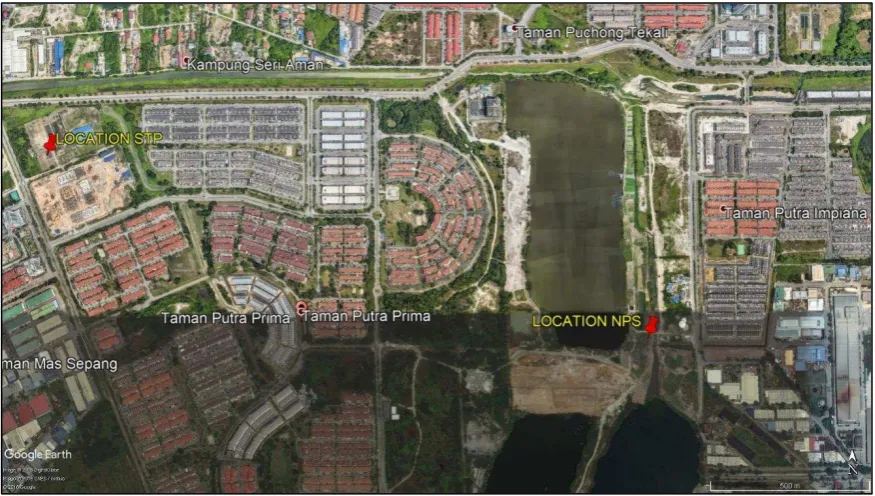
2.1 Study Location
3
Figure 1. Location STP and NPS Marked as Red Pin (Source: Google Earth Pro)
2.2 Sample collection
An arrangement with the wastewater operators was conducted to select the date and suitable locations for the measurement campaign. 24 hours of sampling were collected using an autosampler ISCO 6700 which was located at the NPS and ISCO 3700 was installed at STP. ISCO 3700 has smaller size samples capacity (500 ml) compared to the ISCO 6700 (1000 ml). Regardless of the autosampler size, the volume was set at 300 ml for all sampling events. The polyethylene made bottles were sterilised and pre-cleaned with distilled water prior sampling day. Both autosamplers were constantly set at an interval of one hour. Sample collections were done from April to August 2018 and were consistently conducted during weekdays. After a cycle of 24 hours was completed, the samples were brought to the laboratory as soon as possible. Upon arriving at the laboratory, samples were transferred to 50 ml sterile centrifuge tube and stored in the refrigerator until taken for analysis. The COD and NH3-N experiments were conducted on the same day after arrival in the laboratory.
2.3 Analytical Method
The concentration of COD was measured by the closed reflux, the colorimetric method using HACH vial high range Reactor Digestion Method. The adopted method able to measure COD in the range of 20 mg/L to 1500 mg/L using the standard protocol from the manufacturer (Method 8000). Meanwhile, NH3-N concentrations were measured using HACH Nitrogen, Ammonia Test ‘N Tube vials salicylate method high range. The method can measure NH3-N in the range of 0.4 mg/L to 50.0 mg/L using the standard protocol from the manufacturer (Method 10031). Both methods were viewed using a UV spectrophotometer HACH DR6000.
2.4 Comparison of the study location
of STP and NPS. To assist the discussion, the STP and NPS henceforth denote as location E and F, respectively. Figure 2 shows the location of STP, NPS and the four locations A, B, C, and D.
Table 1. Detail Locations for Urban Malaysian STPs
Locations STP Details PE
A STP Jalan Kuching KL 1000
B STP PKNS B 5000
C STP Taman Wahyu 1 9600
D STP Magna Park 37,800
E STP Taman Putra Prima 60,000 F NPS Taman Putra Impiana 1000
The temporal COD concentration for Korean wastewater was studied referring to the concentration as presented in Jin et al. (2010)[9]. The researcher selected few manholes or accessible sewer pipes for 18 hours of continuous sampling and the time interval remained 2-6 hours at low flow period. Samples were collected from four different sewer pipes located in two separate urban areas (city A and B) where the population represents cities A and B are approximately 140,000 and 200,000 respectively. Sampling was done on different dates from November 2008 to February 2009. Mean temporal COD concentration data were then calculated and plotted to compare with results from both locations STP and NPS.
Figure 2. Location A, B, C, and D Compare to Location STP and NPS Marked as Red Pin (Source: Google Earth Pro)
3. Results and Discussions
[image:6.595.76.541.393.658.2]5
Both COD concentrations for STP and NPS shows a similar trend with two distinct peaks at the same time interval where the highest concentration was observed at either early morning or an early night. The highest peak was observed between 8:00 am to 9:00 am while the second peak was at around 8:00 pm. The range of COD concentrations in STP and NPS ranging from 117 mg/L to 612 mg/L and 57 mg/L to 313 mg/L, respectively as shown in Figure 3(A). The early morning peak has considerably higher concentration, ranging between 50 to 100 mg/L more than the evening peak. The lowest COD concentration was found at late night around 0:00 am to 5:00 am for both STP and NPS. However, the observed concentration of COD for NPS is not as distinctive as the concentration at the STP, whereby, the night fluctuation at NPS is more visible than the STP. Data shows the STP obviously has stronger wastewater strength with the highest concentration is 612 mg/L compared to NPS with 313 mg/L. This is expected as the PE for STP is 60 times more than the NPS.
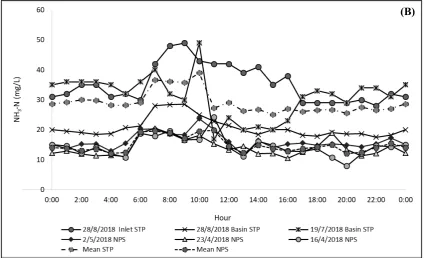
In contrast, when comparing the temporal pattern of NH3-N concentration, the trend for ammonia was somewhat irregular with no common feature observed for both sampling locations STP and NPS, except slightly higher concentration in the early morning around 7:00 am to 10:00 am. The highest NH3-N concentrations in STP and NPS are 49 mg/L and 24.2 mg/L, respectively and these values were observed in early morning. As shown in Figure 3(B), the lowest NH3-N concentrations in STP and NPS are 17.0 mg/L and 7.9 mg/L, respectively. Similar to the COD concentration, the concentration of NH3-N for STP was always higher than the NPS, reflecting the greater population of STP compared to NPS. The irregular trend of concentrated ammonia in wastewater is due to the natural formation of nitrogen in wastewater. Most of the nitrogen in wastewater are present as ammonia (NH3) and organic nitrogen [1]. Organic nitrogen is in the form of the amino group (NH2
-), which converts to NH3 in the process called ammonification as the organic matter goes biodegradation. Nitrification occurs with the presence of oxygen causing ammonia to convert to nitrite (NO2
-) and subsequently nitrate (NO3
-). The unstable form of nitrogen in wastewater cause the concentration of NH3-N not to be affected by the flow.
Figure 3. Temporal variation for (A) concentration COD at STP and NPS (B) concentration NH3-N at STP and NPS for six days.
From the available hourly COD and NH3-N concentrations, statistical analysis was performed for both STP and NPS wastewater, and the results are shown in Table 2. The fluctuation factor, is calculated by the standard deviation ) over the mean value (x), . Results show the for COD and NH3-N for both STP and NPS wastewater is nearly the same. Despite higher PE of STP compared to its feeder NPS (by 60 times), the fluctuation of the STP is similar to the NPS. The previous study mentioned fluctuation for smaller STP (less than 20,000 PE) will fluctuate more compared to the bigger size of STP [10]. This study, however, showed that the bigger STP would have similar fluctuation envelope as the smaller catchment.
Table 2. Daily Mean, Standard Deviation and Ratio Standard Deviation to Daily Mean for STP and NPS
Variable STP NPS
COD
Daily Mean (mg/L) 217 153
StDev. 18.31 19.75
ƒ 0.08 0.13
NH3-N
Daily Mean (mg/L) 29.1 14.9
StDev. 7.51 1.12
ƒ 0.26 0.08
3.2 Comparison of temporal COD concentration between Malaysian and Korean Wastewater
The comparison with the other Malaysian wastewater characteristics will be first discussed. Locations A, B, C, and D were selected due to similar characteristics with the STP discussed here. All STPs are within the Kuala Lumpur catchment (which classified as urban wastewater), and the STPs are located in the inner radius 30KM from the assets E and F. These STPs represent middle class of urban community, which has similar characteristics with the community of E and F. Mean COD concentrations from STPs A, B, C and D were calculated, plotted and compared to the mean COD concentrations for assets E and F. Figure 4 shows the comparison of temporal COD concentration
[image:8.595.123.477.553.649.2]7
among the four locations with assets E and F. The plot evidently indicates that the 6-hours sampling time is insufficient to be able to capture the real wastewater characteristics. Each sampling hour falls at the time where the COD concentration is low compared to the peak COD concentration. These were supported by comparing to COD concentration at locations E and F during the same time of 0:00 am, 6:00 am, 12:00 pm and 6:00 pm, the COD was at low and medium concentration. The coarse interval time sampling noticeably missed the peak time and accurate highest wastewater strength at the specific location cannot be obtained.
[image:9.595.160.438.347.515.2]We now look into the variation of tropical and temperate climate. As the wastewater characteristics for the Korean four locations were relatively similar, to assist in the discussion, the averaged COD concentrations were calculated and plotted in Figure 5. COD concentration of Korean sewer pipes also exhibits a typical pattern of hourly variation. The highest peak is in the early afternoon between 14:00 to 16:00 pm with the maximum COD concentration is 629 mg/L. The lowest COD concentration found was between 2:00 to 4:00 am with a concentration of 105 mg/L. The lowest COD concentration at night shows a comparable pattern to locations E and F, where low COD was also observed within the period of 0:00 to 5:00 am. In contrast to the locations E and F, Korean temporal pattern showed only one peak, occurred in the early afternoon. The dissimilarity of temporal pattern among locations E and F compared to the Korean wastewater is believed due to the different lifestyle and waste habit of the community.
Figure 4. The Mean Temporal COD concentration in Malaysian Wastewater (A) KLR358 Jalan Kuching KL (B) KLR138 PKNS B (C) KLR303 Taman Wahyu 1 (D)KLR281 Magna Park (E) STP
GSG194 STP Taman Putra Prima and (F) GSG119 NPS Taman Putra Impiana.
[image:9.595.155.438.564.724.2]3.3 Comparison averaged COD and NH3-N concentration to Malaysian Design Standard
[image:10.595.156.441.224.566.2]This section dedicates to evaluate the current wastewater characteristics to the values set by the Malaysian design standard (MSIG, Volume IV, Section 3)[11]. Averaged COD and NH3-N concentration for Malaysian STPs as per locations A, B, C, D, and E were compared to the established design value of 500 mg/L and 30 mg/L, respectively. As shown in Figure 6, the lowest averaged concentration of COD is 43.00 mg/L at location B; meanwhile, the highest averaged COD concentration is 217.85 mg/L at STP E. However, the measured averaged COD concentration is considerably much lower (about 50-90% less) than the design value.
Figure 6. Average COD and NH3-N Concentration in Malaysian STPs Inlet at Location (A) KLR358 Jalan Kuching KL (B) KLR138 PKNS B (C) KLR303 Taman Wahyu 1 (D)KLR281
Magna Park and (E) GSG194 STP Taman Putra Prima
Applying the similar procedure to evaluate the NH3-N profile, the lowest averaged concentration is 14.82 mg/L at location B, while the highest averaged concentration is 29.1 mg/L at STP E. The discrepancy between measured and design NH3-N values are not as apparent as the COD. STP with high PE (such as E) is close to the design value, although the variation can go up to 50% for lower PE (as for B).
9
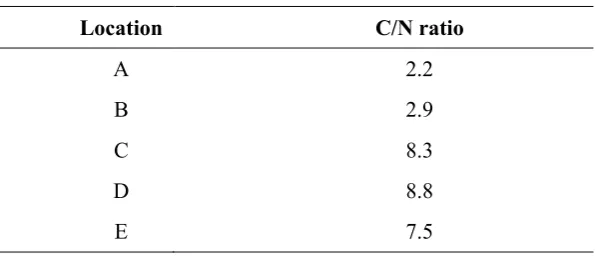
[image:11.595.150.448.205.333.2]into three, i.e. high, medium and low. High C/N ratio is between 12 to 16, medium ranges between 8 to 12 and low C/N ratio in domestic wastewater is below than 8 [12,13]. Based on data (shown in Table 3), Malaysian wastewater can be classified as low C/N ratio. Low C/N ratio major challenges for achieving complete removal of the ammonia in denitrification process due to limiting amount of carbon sources. Hence, appropriate modification may needed in the process in order to get efficiently effluent release to waterways.
Table 3. C/N ratio for STP Inlet
Location C/N ratio
A 2.2
B 2.9
C 8.3
D 8.8
E 7.5
4. Conclusion
A similar hourly trend for COD concentration was observed in the inflow to sewage treatment plant and network pump station. From the observation of COD concentration, there are two distinct peaks in a day, which are early morning between 8:00 to 9:00 am and early night around 8:00 pm. However, temporal changes in NH3-N concentrations were rather irregular for both sampling locations except it shows slightly higher concentration in the early morning. Fluctuation ratio (ƒ) for STP and NPS for COD of 0.08 and 0.13 meanwhile 0.26 and 0.08 for NH3-N respectively, which means high catchment and low catchment wastewater have the similarity in the fluctuation pattern.
For an accurate representation of wastewater characteristics, coarse time sampling is not suggested, as the highest wastewater input might not be picked up. Hourly sampling time is essential to obtain the highest strength of the wastewater. Wherever such measurement is not possible, preferable sampling times are proposed to be at early morning, late evening or early night for any future planning of monitoring the quality of wastewater.
Results show that the Malaysian wastewater strength is much lower than the design values, particularly for COD, which directly translated into a low C/N ratio. As this study is considered as preliminary, the wastewater characteristics at another urban catchment area would provide a collective data of Malaysian wastewater before any implication on the design values.
References
[1] Grady C P L, Glen T, Nancy G L, and Carlos D M F 2011 Biological wastewater treatment
(NewYork: CRC Press) Chapter 2 p 33 -75
[2] Mariani A and Siti N 2015 Regulating Sewage Pollution of Malaysian Rivers and Its Challenges
J. Procedia Environmental Sci. 30 168-173
[3] Rafia A and Ataur R 2017 Health Impact of River Water Pollution in Malaysia J. Advance and applied sci. 4(5) 78-85
[4] Department of Environment: Chapter 5-Pollution Sources Inventory- Malaysian Environmental
Quality Report 2016 Report 2016. Putrajaya: DOE; 2016 Chapter 5 p 105 -110
[5] Tamara G A, Ozgul I, Nouho K O, Adriana A, Michel A V and Nat P S 2014 Seasonal Variations and Resilience of Bacterial Communities in a Sewage Polluted Urban River J.PLOS one 9(3)
[7] Lawrence B C and Marc H H 2017 Rainfall effects on inflow and infiltration in wastewater treatment systems in a coastal plain region J. Water Sci. & Technol.75(8) 1909-1921
[8] Mara D 2003 Domestic Wastewater Treatment in Developing Countries (London: Earthscan
Chapter 7 p 74
[9] Jin H, Bo M L, Tae H L and Dae H P 2010 Estimation of Biological Oxygen Demand and Chemical Oxygen Demand for Combine Sewer Systems Using Synchronous FluorescenceSpectra J. Sensor10 2460-2471
[10] Massimo R, Vincenzo T and Giordano U 2013 Influence of Strong Diurnal Variations in Sewage Quality on the Performance of Biological Denitrification in Small Community Wastewater Treatment Pants (WWTPs) J. Sustainability 5 3679-3689
[11] MSIG (Malaysian Sewerage Industry Guidelines) (2009) Volume IV, Section 3 p 29-34
[12] Sheng P S, Carles P i N, Brian M, Qi Z, Si Q X, Dian H Y, Jian H S and Barth F S 2010 Effective Biological Nitrogen Removal Treatment Processes for Domestic Wastewaters with Low C/N Ratios: A Review J Environmental Engineering Science27(2)
[13] Mogen Henze 2008 Biological Wastewater Treatment: Principles, Modelling and Design
(London: IWA publishing) Chapter 3 p 33-52