I
MPACT
A
SSESSMENT IN THE
EU
T
HE
S
TATE OF THE
A
RT
AND THE
A
RT OF THE
S
TATE
A
NDREAR
ENDAresearch leading to constructive solutions to the challenges facing Europe today.
The views expressed in this report are those of the author writing in a personal capacity and do not necessarily reflect those of CEPS or any other institution with which he is associated.
Andrea Renda is a Senior Research Fellow at CEPS, where he is head of the Regulatory Affairs Programme.
ISBN 92-9079-600-6
© Copyright 2006, Centre for European Policy Studies.
All rights reserved. No part of this publication may be reproduced, stored in a retrieval system or transmitted in any form or by any means – electronic, mechanical, photocopying, recording or otherwise – without the prior permission of the Centre for European Policy Studies.
Centre for European Policy Studies Place du Congrès 1, B-1000 Brussels Tel: 32 (0) 2 229.39.11 Fax: 32 (0) 2 219.41.51
T
C
Foreword ... i
Executive Summary...1
1. Impact Assessment Models...7
1.1 The US impact assessment model: The polar star...8
1.1.1 The Reagan and Bush (Sr.) Administrations...10
1.1.2 RIA under the Clinton Administration...12
1.1.3 RIA under George W. Bush...14
1.1.4 US initiatives on administrative simplification ...16
1.1.5 The US RIA model ...19
1.1.6 The US experience: Main lessons for the EU debate...22
1.2 The UK experience: From ‘light touch’ to ‘limited touch’ regulation ...26
1.2.1 The 2001 Regulatory Reform Act and the 2002 Regulatory Reform Action Plan...31
1.2.2 Latest developments: The 2005 Action Plan and the creation of the Better Regulation Executive ...33
1.2.3 The UK RIA model ...38
1.2.4 Main lessons from the UK experience ...39
1.3 EU impact assessment: Panacea or Pandora’s box?...43
1.3.1 The early years: The BIA system...45
1.3.2 The 2001 White Paper and the Mandelkern Report...48
1.3.3 Away from RIA: Building the Integrated Impact Assessment...52
2. Putting EU Integrated Impact Assessment into Practice...57
2.1 How good is the Commission at impact assessment? An updated scorecard...61
2.1.1 Overall results of the scorecard ...62
2.1.2 Has the quality of ExIAs increased over time? ...66
2.2 Strengthening inter-institutional dialogue: Towards a new European Impact Assessment? ...70
3.1 Roadmap 1 – Improving methodology and introducing cost-benefit
analysis ...83
3.2 Roadmap 2 – Understanding and applying proportionality ...91
3.3 Roadmap 3 – Sector-specific impact assessment...96
3.4 Roadmap 4 – Internal consistency and cost-effectiveness ...101
3.5 Roadmap 5 – Increase the clarity of presentation ...103
3.6 Roadmap 6 – Boosting cultural change...105
3.7 Roadmap 7 – Strengthening ex post monitoring and evaluation tools ...106
3.8 Roadmap 8 – National RIA models: A new Koine dialectos?...112
3.9 Roadmap 9 – Issue guidelines on competitiveness-proofing and competition assessment...119
3.10 Roadmap 10 – Create a regulatory watchdog ...124
4. Conclusion: It’s a long way to Lisbon ...133
Selected References ...136
Appendices A. List of ExIAs Analysed...149
B. List of Scorecard Items ...155
C. Scorecard Results...158
D. Summary of Recommendations...162
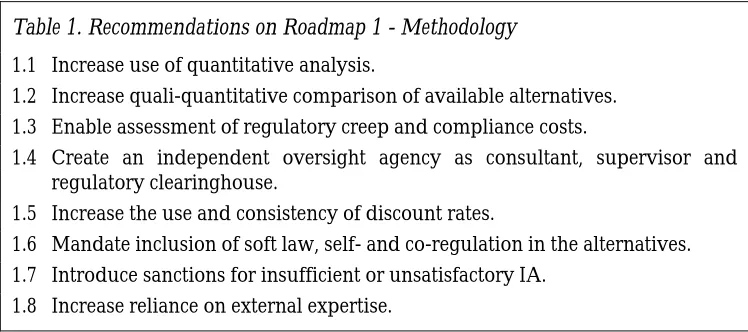
List of Tables 1. Recommendations on Roadmap 1 – Methodology ...90
2. Recommendations on Roadmap 2 – Proportionality ...95
3. Recommendations on Roadmap 3 – Sector-specific impact assessment ...99
4. Recommendations on Roadmap 4 – Internal consistency ...102
5. Recommendations on Roadmap 5 – Clarity of presentation ...103
6. Recommendations on Roadmap 6 – Promoting cultural change ...104
7. Recommendations on Roadmap 7 – Ex post monitoring and evaluation...110
8. Recommendations on Roadmap 8 – Subsidiarity...117
9. Recommendations on Roadmap 9 – Competitiveness-proofing ...122
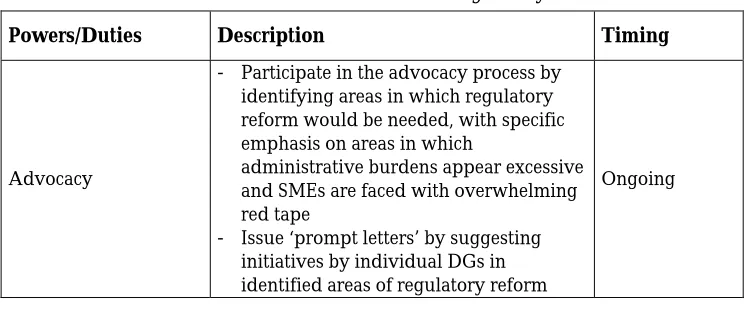
10. Powers and duties of an ideal centralised regulatory unit for IIA...128
1. The US RIA model...21
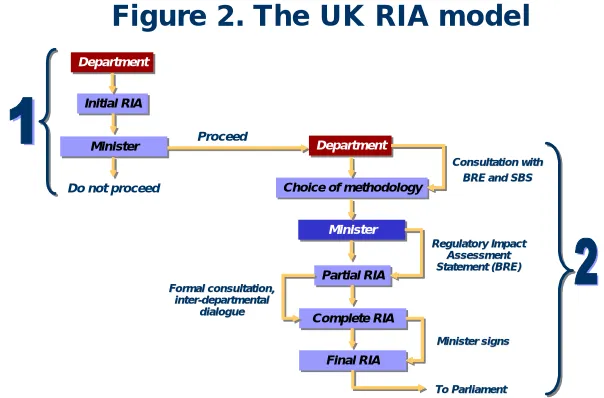
2. The UK RIA model...38
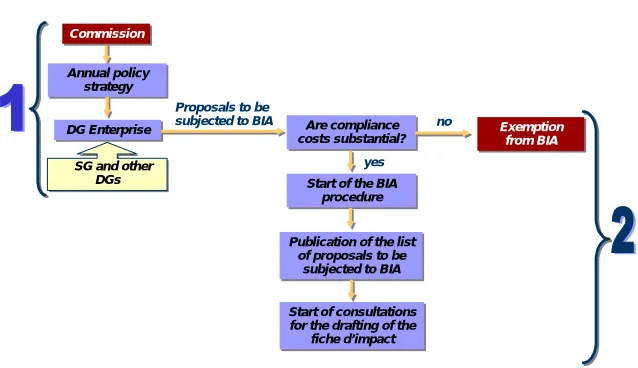
3. The BIA procedure...45
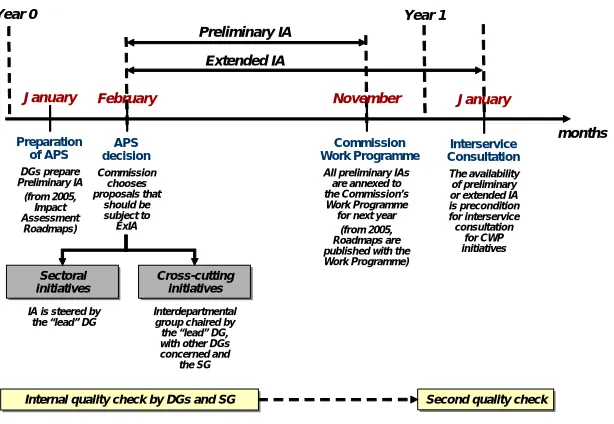
4. IIA in the Commission’s SPPC ...55
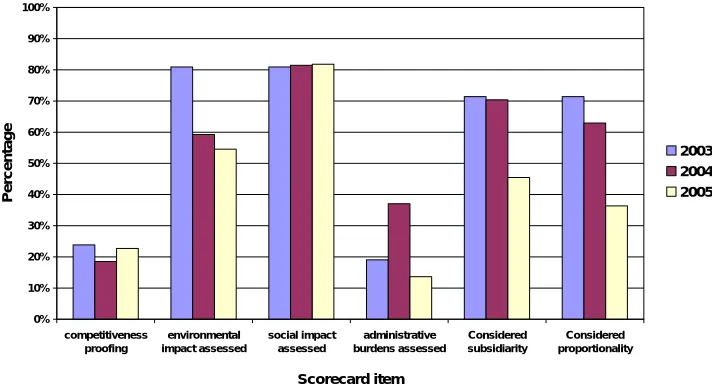
5. Quality of ExIAs in 2003, 2004 and 2005 selected scorecard items on cost assessment...65
6. Quality of ExIAs in 2003, 2004 and 2005 selected scorecard items on benefit assessment ...66
7. Quality of ExIAs in 2003, 2004 and 2005 selected items on overall impact assessment...67
8. Quality of ExIAs in 2003, 2004 and 2005 selected items on comprehensiveness of assessment ...68
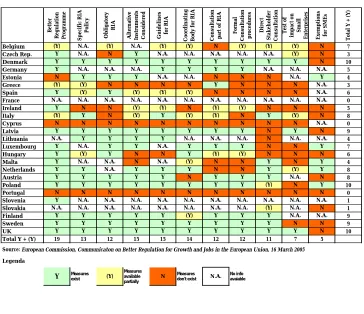
9. Overview of measures in the area of better regulation and impact assessment...115
List of Boxes 1. Elements of the Action Plan for Better Regulation ...51
2. The debate on CBA in the US ...84
| i
FOREWORD
Like computer systems and like all human beings, policy-makers always use proxies. Examples are countless. On the one hand, competition authorities take consumer welfare as a proxy for social welfare, perfect competition as a proxy for the maximisation of consumer welfare, market shares as a proxy for market power and evidence of price parallelism as a proxy for collusion. And sometimes they are wrong. On the other hand, regulators, striving to mimic the functioning of perfectly competitive markets, infer from market failures the need to abandon laissez-faire principles and to regulate, using proxies to assess the impact of future and existing regulations. Increasingly, they are required to assess the past, present and future direct and indirect costs and benefits of regulations, and to justify intervention on the basis of such estimations. In so doing, they sometimes err.
their inherent limit. The Socratic motto ‘γνωθι σεαυτον’, here, is to be kept on the desk, always. This is, indeed, the difficult ‘Art of the State’.
In this monograph, I focus on the latest EU experience in developing methods for ex ante assessment of the economic, social and environmental impacts of major proposed regulations. My work aims at stimulating discussion amongst scholars and policy-makers on the upcoming review of the EU integrated impact assessment model, scheduled for early 2006. I offer it, however, with a caveat: like computers, policy-makers and all other human beings, I also used a number of proxies throughout the work – in choosing scorecard items, relying on previous streams of literature, formulating roadmaps and, more generally, in my attempt to provide a static picture of an inherently dynamic process. Hence, I also may be wrong, and apologise if some readers find my conclusions insufficiently firm.
I have been thinking about a monograph on impact assessment for quite a long time. The idea did not materialise, however, until Daniel Gros and Karel Lannoo offered me the opportunity to start and manage the Regulatory Affairs Programme at the Centre for European Policy Studies, in Brussels. From such a privileged position, I have had the chance to fully appraise the features and paradoxes of EU better regulation, and apply my previous theoretical studies to the field observation of impact assessment practices in the EU, the US and the UK. For this reason, my first acknowledgment goes to Daniel and Karel for giving me this opportunity. I also would like to thank Jacques Pelkmans for his valuable comments and suggestions, Davide Cortesini for drawing an outstanding Möbius strip, which adorns the cover, and Anne Harrington and Els Van den Broeck for patient and creative editorial advice. Needless to say, some useful hints in this monograph are not mine, unlike all errors and imperfections.
| 1
E
XECUTIVE
S
UMMARY
In the frantic environment surrounding the European Union after the French and Dutch ‘no’ votes on the Constitutional Treaty, EU policy-makers are striving to identify the key drivers that will lead Europe back on track. ‘Competitiveness’ is the keyword in Brussels now, and one of the recognised drivers of competitiveness is ‘better regulation’. As a matter of fact, the EU Better Regulation Action Plan is perceived as one of the most crucial milestones for achieving the ambitious Lisbon Goals.1 The European
Commission itself recently acknowledged that Europe’s “disappointing economic performance” calls for further action in the field of better regulation, in order to stimulate growth and employment by streamlining the regulatory environment, with stronger emphasis on the principles of proportionality and subsidiarity in developing more cost-effective regulatory tools, and enhanced focus on cutting red tape.2
Recently, efforts to improve the quality of EU regulation have relied on the full implementation of the new EU Integrated Impact Assessment (IIA) model introduced in 2002,3 in the wake of the Mandelkern Report.4
1 The European Commission Action Plan on simplifying and improving the
regulatory environment (COM(2002) 278) was part of a wider better regulation package launched in June 2002.
2 See the European Commission Communication, “Better regulation for growth
and jobs in the European Union”, COM(2005)97, 16 March 2005. In the press release, the Commission introduced the equation of “Less red tape = more growth” (see Press Release, IP/05/311, 16 March 2005). For a description of the Commission’s new approach, see section 2.3.
3 The IIA model was introduced on 5 June 2002, with a European Commission
The 2003 Interinstitutional Agreement on Better Regulation, the joint Letter of the Irish and three incoming presidents of ECOFIN filed on January 2004, the ‘Doorn motion’ within the Legal Affairs Committee of the European Parliament and the joint statement issued on December 2004 by the Irish, Dutch, Luxembourg, UK, Austrian and Finnish Presidencies on “Advancing Regulatory Reform” are all evidence of a growing interest in linking impact assessment to competitiveness at the EU level.5 The
Commission itself reacted by launching a new strategy for the simplification of the regulatory environment and by issuing a new Communication on Better Regulation in March 2005, as well as new Guidelines on Impact Assessment three months later. More recently, Commission Vice-President Günther Verheugen stated that in the coming years all EU regulatory initiatives will have to pass muster under the IIA model, announcing that the Commission “will only put forward proposals that have undergone an impact assessment” and that “this approach should guarantee that we know the full costs and benefits of future legislation”.6
So far, so good. But can Europe really live up to the promise? Does the EU impact assessment model truly possess the salvific virtues ascribed to it by EU policy-makers? Piercing the veil, available evidence reveals that the way in which the procedure has been implemented to date has resulted in a sea of disappointment. The quality of extended impact assessments appears to be low and is even decreasing over time. Commission DGs in charge of performing the assessment seem quite far from enabling greater awareness of “the full costs and benefits of future legislation”. As will be explained in more detail below, of the 70 extended impact assessments completed before July 2005, only a few quantified or monetised the expected costs and benefits arising from the proposal. Only in a limited number of cases were business compliance costs assessed, and the same Assessment in the Commission - Guidelines“ and “A Handbook for Impact Assessment in the Commission - How to do an Impact Assessment“, recently replaced by new “Impact Assessment Guidelines”, SEC(2005)791, 15 June 2005.
4 Mandelkern Group, Final Report, 2001 (available at http://europa.eu.int/ comm/secretariat_general/impact/docs/mandelkern.pdf).
5 All these recent initiatives are described in more detail below, in section 2.2. 6 See Verheugen’s speech at the UK Presidency Conference on Better Regulation,
Edinburgh, 23 September 2005 (available at http://www.cabinetoffice.gov.uk/
regulation/documents/better_regulation_conference_speeches/pdf/050923_verheugen.pdf –
applies to administration costs. And when it comes to justifying the viability of a proposed new piece of legislation, things get even worse. As a matter of fact, the cahier de doléances is long enough to leave few beacons of hope: the gap between the sein and the sollen of EU impact assessment is, in one word, huge.
Against this worrying backdrop, the UK Presidency, which ran from July to December 2005 (a period coinciding with the completion of this monograph), has taken a significant departure in its approach to impact assessment from previous EU policy. But this should come as no surprise. Past evidence reveals that many of the most important steps towards the introduction and refinement of impact assessment procedures at EU level have occurred under UK Presidencies, and have heavily borrowed from the UK experience, undoubtedly the avant-garde of impact assessment at member state level.7 The ambitious integrated impact assessment model
adopted in 2003 is currently being replaced by a new approach, which mostly focuses on the need to ‘cut red tape’.8 In doing this, the UK
Presidency is drawing heavily on its national ‘better regulation’ strategy, which led to drastic changes and, most recently, to a consultation for the enactment of a revolutionary Better Regulation Bill, as well as a cross-government initiative to measure and then cut administrative costs.9
In particular, the UK Presidency has put strong emphasis on the simplification of the existing regulatory environment and the reduction of administrative burdens. Following the so-called ‘Hampton Review’ in March 2005, the UK Government established a new Better Regulation Executive with the specific purpose of identifying areas for reducing regulatory burdens, under the motto ‘less is more’ which directly recalls the goal of achieving ‘more value with less money’ that lied at the core of the whole ‘New Public Management’ revolution in the UK in the early
7 See section 1.3.
8 See Advancing Better Regulation in Europe, discussion paper prepared by the UK,
Austrian and Finnish Presidencies for consideration at the (ECOFIN) Council on 6 December, available at http://register.consilium.eu.int/pdf/en/05/st15/st15140.en05.pdf (visited on December 30, 2005).
9 A description of the new UK initiative on better regulation is contained in section
1980s.10 The UK Presidency has attempted to replicate such an initiative at
the EU level, by focusing on the creation of a common methodology for assessing administrative burdens, based on the Standard Cost Model successfully implemented in the Netherlands, and on the promotion of the risk-based approach adopted after the UK ‘Hampton Review’.
What remains to be seen and discussed, however, is whether this new approach will ultimately lead EU policy-makers to succeed in disentangling the conundrum of procedures and overlapping pieces of legislation that characterise most sectors of the EU economy, or whether further refinements will be needed in order to help EU and national administrations in the successful implementation of ex ante and ex post assessment. If anything, the changing landscape of impact assessment in the EU will require yet another effort for EU officials in charge of impact assessment. If a wholly new model is put in place, DGs in charge of impact assessment will have to become familiar with a new procedure, and this will slow down the process further – like in the myth of Sisyphus, condemned to an eternity of rolling a boulder uphill, to watch it roll back down again.
As the Commission has scheduled a comprehensive review of its impact assessment model for early 2006, the time has come to take stock of the results achieved so far in assessing the impact of legislation, and to look forward to the changes and refinements that would help the Commission to live up to the promise of setting up an efficient, transparent, effective and accountable impact assessment system. The ambition of this paper is to contribute to the identification of the steps to be followed in order to get the best out of impact assessment and better regulation at EU and member state level.
Chapter 1 briefly describes the state of the art in impact assessment, contrasting some of the most successful models implemented at national level – most notably, the US and UK experiences – and the EU Integrated Impact Assessment model. Chapter 2 contains a scorecard analysis of the 70
10 The ‘new public management’ revolution in the UK was inspired by a stream of
literature that advocated a more performance-oriented culture amongst public bureaucrats and a wider use of outsourcing, market-type mechanisms and public-private partnerships for the delivery of public services. See Jan Erik Lane, New
Public Management, London: Routledge, 2000; and most notably Christopher Pollitt
| 7
1.
Impact Assessment Models
The use of impact assessment tools has become widespread in OECD countries over the past two decades. Countries that successfully introduced a culture of impact assessment in their regulatory processes include, most notably, the US, UK, Canada, Australia and New Zealand – all of which share, not surprisingly, common law legal systems.11 The first, complete
procedure for assessing the costs and benefits of a proposed regulation was introduced in 1981 in the US, under the administration of President Ronald Reagan, although other attempts had been made in previous years with the ‘Quality of Life Review’ and the ‘Inflation Impact Assessment’ performed by the Council on Wage and Price Stability (CWPS).12 The US model of
impact assessment is nowadays so pervasive in US administrations that every year the US Office of Management and Budget (OMB) publishes a comprehensive calculation of the costs and benefits of regulations enacted over the previous year, the so-called “Yearly Report on the Costs and Benefits of Federal Regulations”.13 And, although a fierce debate has
emerged both on the quality of government calculation of costs and benefits and on the soundness of the methodology adopted in performing
11 See e.g. OECD, Regulatory Impact Analysis: Best Practice in OECD Countries, Paris,
1997; and more recently, Regulatory Impact Analysis (RIA) Inventory, Note by the Secretariat, 29th Session of the OECD Public Governance Committee, 15-16 April
2004, International Energy Agency, Paris.
12 The ‘Quality of Life Review’ was introduced under the Nixon Administration
with an OMB memorandum on “Agency regulations, standards, and guidelines pertaining to environmental quality, consumer protection, and occupational and public health and safety”, 5 October 1971 (available at http://www.thecre.com/
ombpapers/QualityofLife1.htm – last visited 5 December 2005). Subsequently, the
Inflation Impact Assessment procedure was officially launched by Gerald Ford on 27 November 1974, with Executive Order 11,821 (available at http://www.thecre.com/
ombpapers/ExecutiveOrder11821.htm – last visited 5 December 2005).
13 See the OMB draft Report on the Costs and Benefits of Federal Regulations
ex ante assessments, the US experience is still to be considered the ‘polar
star’ for EU policy-makers.14
Attempts to provide a comprehensive review of the EU economy have recently proliferated, especially after 2003 when the European Commission started developing a list of structural indicators of member states’ progress towards the Lisbon goals.15 More recently, the Commission
has attempted to detect more specific links between ongoing sectoral reforms and overall progress, particularly in its 2005 report on the ‘cost of non-Lisbon’.16 However, a lot still needs to be done in devising new tools
for ex post monitoring of the costs of EU regulations. Accordingly, it is worth taking stock by providing a brief description of some of the most relevant and insightful international experiences in ex ante and ex post assessment of the impact of regulations, most notably in the US and UK, before looking forward to next developments at Community level.
1.1 The US impact assessment model: The polar star
The United States was the first country to adopt a model of regulatory impact assessment. The earliest evidence of rules requiring the calculation of prospective costs and benefits of new regulations dates back to the Nixon administration, when US firms started complaining about the costs of regulation and uncontrolled ‘regulatory creep’, mostly as a result of newly passed environmental legislation.17 The administration reacted with
the so-called ‘Quality of Life Review’, which mandated a preliminary calculation of firms’ costs resulting from compliance with new environmental rules as a fundamental pre-condition of good-quality
14 See Box 2 in chapter 3, for a description of the current debate on the merits and
soundness of current quantitative estimates provided by US federal agencies and, more generally, of quantitative benefit-cost analysis.
15 The 2003 and 2004 reviews of the EU economy are available at http://europa.eu.int/comm/economy_finance/publications/the_eu_economy_review_en.htm
– last visited 5 December 2005.
16 See European Commission Staff Working Paper, The Economic Costs of Non-Lisbon, SEC(2005)385, 15 March 2005.
17 For a short illustration of the major waves of regulatory reform in the US, see
“The Role of Economic Analysis in Regulatory Reform”, chapter 1 of OMB Report to Congress on the Costs and Benefits of Federal Regulations (available at
regulation.18 The Review, conceived as a privileged channel for public
consultation, soon ended up enhancing the risk of regulatory capture, leaving legislative initiatives in the environmental field prey to aggressive and well-organised interest groups.19
Under the Ford administration, the US government showed an increased interest in promoting the use of cost-benefit analysis in assessing the prospective impact of proposed regulations. Executive Order 11,821, issued in 1974, mandated an Inflation Impact Assessment by federal agencies. Such procedure introduced an ex ante assessment of the expected impact of new regulatory measures on the inflation rate.20 The creation of
the Council on Wage and Price Stability aimed at ensuring that proposed regulations that were likely to exert a significant upward impact on nominal prices could be rejected in case they carried an incomplete or insufficient assessment of the inflationary impact.21
The Inflation Impact Assessment procedure can indeed be considered as a first version of what would later become the US Regulatory Impact Assessment (RIA) model. As a matter of fact, economists in the Council on Wage and Price Stability gradually transformed the mere estimation of the inflationary impact into a real cost-benefit analysis, to be used as a ‘counter-argument’ during public consultation processes mandated by the 1946 Administrative Procedure Act.22 US President Gerald Ford amended
18 “Quality of Life Review”, op. cit.
19 See L. Rodriguez, “Constitutional and Statutory Limits for Cost-Benefit Analysis
Pursuant to Executive Orders 12291 and 12498”, Boston College Environmental Affair
Law Review 505, 512, 1988. See also, for a short description, Robert W. Hahn and
Robert E. Litan, “Counting Regulatory Costs and Benefits: Lessons for the US and Europe”, Journal of International Economic Law, Vol. 8, No. 2, 2005, p. 474.
20 See e.g. M. Weidenbaum, Regulatory Process Reform from Ford to Clinton, CATO
Institute, 2000 (available at www.cato.org/pubs/regulation/reg20n1a.html – visited 5 December 2005).
21 See J. Morrall III, “Ebbs and Flows in the Quality of Regulatory Analysis”, speech
at the Weidenbaum Center Forum on Executive Regulatory Analysis: Surveying the Record, Making It Work, National Press Club, Washington, D.C., 17 December 2001 (available at http://wc.wustl.edu/ExecutiveRegulatoryReviewTranscripts/
Morrall.pdf – visited 5 December 2005).
22 See J. Morrall III, “An Assessment of the U.S. Regulatory Impact Assessment
the inflation Impact Assessment model by issuing EO 11,949, and stating that “[t]he title of Executive Order No. 11,821 of November 27, 1974 is amended to read ‘Economic Impact Statements’”.23
A few years later, during the Carter administration, the 10 most relevant new regulations in each year’s US government agenda were made the subject of extended ex ante assessment by a specialised ad hoc group of economists called the ‘Regulatory Analysis Review Group’.24 But the
introduction of a more comprehensive regulatory impact assessment procedure only occurred under the Reagan administration.
1.1.1 The Reagan and Bush (Sr.) Administrations
Under the Reagan administration, with EO 12,291, issued in 1981, federal agencies were obliged to adopt a real regulatory impact analysis.25 The
Executive Office mandated a thorough reassessment of the existing regulation in force, for the purpose of identifying norms to be abolished or simplified. The evaluation and oversight of agencies’ behaviour, previously performed by the CWPS, was taken on by OIRA (Office of Information and Regulatory Affairs), which was created within the Office of Management and Budget for the purpose of implementing the 1980 Paperwork Reduction
Act. OIRA was given the power to suspend regulations by sending them
back to the sponsoring agency until a satisfactory cost-benefit analysis was performed. The OMB, as a result, became a sort of regulatory clearinghouse.
Since then, more than 1,000 proposed regulations have been scrutinised by the OMB. Possible contrasts between OMB and agencies were addressed with the help of a new Task Force on Regulatory Relief, chaired by then Vice-President George Bush, Sr.26 The Task Force was also
23 See Executive Order No. 11,949 of 31 December 1976 (available at http://www.thecre.com/ombpapers/ExecutiveOrder11949.htm – visited 5 December
2005).
24 See Weidenbaum, op. cit.
25 The text of EO 12,291 is available at http://www.thecre.com/pdf/EO12291.PDF (last
visited 5 December 2005).
26 The other members were the Secretary of the Treasury, Attorney General,
asked to estimate the savings that could follow from a full implementation of the new RIA procedure. The result was striking: according to the administration, the new procedure produced yearly cost savings as high as $10-20 billion. This calculation was heavily criticised, however.27 Similarly,
the activity of the Task Force was subject to fierce opposition. The Reagan administration was accused of having drastically reduced the budget and personnel of federal agencies, achieving substantial decreases in the cost of regulation, but also a dramatic reduction in the number of proposals issued by federal agencies. As a consequence, in 1983, the Task Force was abolished and the OMB was given back its dominant role in the US RIA procedure.28
A second Executive Order, in 1985, required agencies to provide the OMB with detailed information on their regulatory agenda at the end of each year. This eventually paved the way for what has been termed the ‘grand experiment’, i.e. the OMB Report to Congress on the Costs and Benefits
of Federal Regulations, a yearly publication that constitutes a unique example
of a comprehensive, yearly calculation of total costs and benefits of the
corpus of existing regulations.29
Under the Bush Sr. administration, the role formerly played by the Task Force on Regulatory Relief was assigned to the Council on Competitiveness, chaired by Vice-President Richard Quayle, which was given a mandate to abrogate all federal rules that could hinder the
pdf/Reagan_RegainInitiatives.pdf – last visited 5 December 2005). President Reagan
identified regulatory relief as one of the four key elements for the recovery of the US economy. The results were nevertheless quite disappointing. See Reagan’s Memorandum on the “Comprehensive Review of Federal Regulatory Programs”, 15 December 1986; and the commentary by William A. Niskanen, “The Weak Fourth Leg of Reaganomics”, The Wall Street Journal on 30 June 1988.
27 See Weidenbaum, op. cit., and S. Breyer, “Regulation and Deregulation in the
United States”, in G. Majone (ed.), De-regulation or Re-regulation? Regulatory Reform
in Europe and the United States, London: Pinter Publishers, 1990.
28 See A. Morrison, “OMB Interference with Agency Rulemaking: The Wrong Way
to Write a Regulation”, Harvard Law Review, Vol. 99, No. 1059, 1986, p. 1062 (describing Reagan’s EO as implicitly designed to ensure that regulation was only a ‘last resort’ option).
29 See the description provided by Robert W. Hahn and Mary Beth Muething, “The
competitiveness of US firms.30 The main goal was to minimise regulatory
burdens faced by the economy. Such a revolutionary attempt was strongly criticised by the Democrats and a number of economists, but also by federal agencies, Congressional Commissions and environmentalist associations, which lamented that the OMB (and in particular, the OIRA) exercised an excessive and unchallenged veto power on proposed regulations. Some commentators complained that OIRA and the White House had been captured by powerful interest groups, which inspired their intervention to stifle and repeal needed regulations, thus decreasing the transparency and accountability of federal rule-making. Institutional tension reached a peak when Congress refused to confirm a politically appointed agency director.31
According to an authoritative commentator, the excessive centralisation of the RIA procedure and the consequent critiques contributed to an institutional void and a lack of legal certainty that led to an increase in the burden of regulation, particularly in the fields of public health, environment and public safety.32 At the end of the Bush mandate,
the US RIA model appeared at once as a pioneering experience worldwide and a problem ‘in search of a solution’, in strong need of careful redressing, mostly aimed at reducing regulatory burdens for US firms.
1.1.2 RIA under the Clinton Administration
A tentative reaction to this impasse was the enactment of Executive Order No. 12,866 in 1993, under the Clinton administration.33 Within the more
general context of ‘reinventing government’ and the National Performance
30 See Weidenbaum, op. cit.
31 See e.g. the 1992 Report by the OMB Watch and Public Citizen, Voodoo Accounting: The Toll of President Bush's Regulatory Moratorium, stating that claims of
huge public savings resulting from the announced regulatory moratorium were hardly substantiated. See also B.D. Friedman, Regulation in the Reagan-Bush Era: The
Eruption of Presidential Influence. Pittsburgh, PA: Pittsburgh University Press, 1995;
and B. Woodward and D.S. Broder, “Quayle’s Quest: Curb Rules, Leave ‘No Fingerprints’”, Washington Post, 9 January 1992.
32 See R.W. Hahn, Regulatory Reform: Assessing the Government’s Numbers,
AEI-Brookings Center for Regulatory Studies, Working Paper No. 99-06, Washington, D.C., July 1999. See also W.F. West, “The Institutionalization of Regulatory Review: Organizational Stability and Responsive Competence at OIRA”, Presidential Studies
Review, EO 12,886 attempted to ‘cut red tape’ by providing OMB with the power to adjudicate conflicts over proposed regulations within a strict 90-day deadline from presentation of the RIA form by the federal agency. If, after the deadline has expired, the conflict between OIRA and the sponsoring agency had not been solved, the President or the Vice-President entered the stage to solve the controversy.34 The unconditional veto power
previously awarded to the OMB was then transformed into a conditional opposition with limited potential to infinitely delay entry into force of newly proposed regulations. Furthermore, the Vice-President’s power to directly influence administrative policy was replaced with a milder role of ‘default’ mediator in case the agency and OIRA failed to negotiate a mutually satisfactory solution. This escamotage significantly increased the transparency of regulatory reforms in the US.35
One of the major problems to be solved was undoubtedly OMB’s overwhelming workload in the regulatory review process. Before the Clinton mandate, the OMB, with just 40 employees, had reviewed on average more than 2,200 federal regulations every year.36 In order to avoid
the inevitable inefficiency that followed from such a drastic centralisation, EO 12,866 introduced a minimum threshold, specifying that only regulations whose expected impact was greater than $100 million were
34 See ibid., at section 7: “[t]o the extent permitted by law, disagreements or
conflicts between or among agency heads or between OMB and any agency that cannot be resolved by the Administrator of OIRA shall be resolved by the President, or by the Vice President acting at the request of the President, with the relevant agency head (and, as appropriate, other interested government officials).”
35 Executive Order 12866: Regulatory Planning and Review, Federal Register 58,
Washington, D.C.: The White House, 30 September 1993. EO 12866 also required that all written communications to OIRA or the White House from non-governmental parties should be placed on the public record. Moreover, the EO ordered that only the OIRA administrator or the deputy administrator could receive oral communications from parties outside the government, and mandated docketing of all conversations between OIRA and agencies as well as between White House officials and private interests.
subject to mandatory ex ante impact assessment.37 In October 1994, OIRA
produced a report entitled “The First Year of Executive Order No. 12866”, finding that the number of significant rules reviewed by OIRA had fallen to 900 per year, 60% lower than the 2,200 per year average reviewed under the previous Executive Order, and that about 15% of the rules were found to be ‘economically significant’. The report also found that the 90-day review period had been generally respected, and concluded that the new openness and transparency policy had served to defuse, if not eliminate, the criticism of OIRA’s regulatory impact analysis and review programme.
1.1.3 RIA under George W. Bush
Although the overall US impact assessment model has remained unchanged since George W. Bush took office, a number of relevant changes have been introduced to the institutional setting of RIA. In particular, these concern the role and powers attributed to the OIRA and the Vice President. As is happening in the EU, the regulatory pendulum in the US shifted patently in the direction of reducing administrative burdens and ensuring least-costly new regulations.
First, EO 13,258, issued on 26 February 2002, removed the Vice President from the regulatory review process.38 Such removal responded to
critiques that hinged on the excessive powers granted to the executive in shaping bureaucrats’ decisions, as well as to growing concerns that the involvement of the Vice President could significantly raise procedural costs. At the same time, the Bush administration tried to grant enhanced powers to OIRA. Its structure was consolidated into only four branches – Health, Transportation and General Government; Information Policy and Technology; Natural Resources, Energy and Agriculture; and Statistical and Science Policy. OIRA had six branches in 1992, and five under the
37 More precisely, ‘significant regulatory actions’ under EO 12,866 rules were those
that: i) had an annual effect on the economy of $100 million or more or adversely affect in a material way the economy, a sector of the economy, productivity, competition, jobs, the environment, public health or safety, or State, local, or tribal governments or communities; ii) created a serious inconsistency or otherwise interfered with an action taken or planned by another agency; iii) materially altered the budgetary impact of entitlements, grants, user fees, or loan programmes or the rights and obligations of recipients thereof; or iv) raised novel legal or policy issues arising out of legal mandates, the President's priorities or the principles set forth in EO 12,866.
Clinton administration. Such consolidation was aimed at revitalising OIRA, as testified to by its increased staffing level. OIRA had 90 staff members in 1981, but the size had decreased to 69 under Reagan, 60 under Bush Sr. and 47 during the Clinton administration. The George W. Bush administration started out by hiring seven new members and is gradually increasing the staff, hiring also scientists and engineers, and thus bringing skills that OIRA had never had before.39 OIRA administrator John Graham started
issuing ‘prompt letters’, which suggest that agencies give priority to specific issues – a novelty that was welcomed with enthusiasm by authoritative scholars such as Bob Hahn and Cass Sunstein.40
More generally, the removal of the office of the Vice President from its oversight role seems to have led to a more aggressive confrontation between OIRA and federal agencies. Along with some other commentators, the US General Accounting Office remarked that the role played by OIRA vis-à-vis federal agencies has shifted from a ‘collaborative, consultative’ role under Clinton to that an ‘adversarial gatekeeper’ model in the Bush administration.41 Data on the number of rules returned or withdrawn by
OIRA confirm this shift. West reports that an annual average of 106 rules were either returned or withdrawn during the last two years of the Bush Sr. administration, whereas the corresponding figure was only 20.5 under Clinton and jumped again to 172 during George W. Bush’s first year in office.42
OIRA’s strengthened role also led to increased attention to standards applied in performing cost-benefit analyses and to a marked reduction in
39 See West, op. cit.
40 The list of issued ‘prompt letters’ under the George W. Bush Administration is
available at http://www.whitehouse.gov/omb/inforeg/prompt_letter.html (visited 5 December 2005). For positive comments on the introduction of prompt letters, see R.W. Hahn and Cass R. Sunstein, Regulatory Oversight Takes Exciting New Tack, Working Paper No. 01-25, AEI/Brookings Joint Center Policy for Regulatory Studies, Washington, D.C., September 2001.
41 See the report by the General Accounting Office on OMB’s Role in the Reviews of Agencies’ Draft Rules and the Transparency of these Reviews, September 2003. See also
West (op. cit.), finding that the review has become “less invasive and less confrontational”. This new pattern of relationships is sometimes referred to as a ‘hot-tub approach’, after a definition given by Sally Katzen, Clinton’s first OIRA administrator.
the estimated dollar cost of new rules. The average annual cost of new rules decreased from $8.5 billion under the first Bush administration to $5.7 billion under Clinton and down to $1.5 billion in the first three years after George W. Bush took office. And, although the total regulatory burden appears to have continued to grow, its growth rate appears to have significantly declined over the past few years.43 This was also the result of
the proliferation of government initiatives on administrative simplification, aimed at streamlining the regulatory environment, facilitating dialogue with small businesses and, more generally, cutting red tape.
1.1.4 US initiatives on administrative simplification
The reform of US RIA, as mentioned above, was not conceived as a stand-alone salvific tool to remedy the mounting burden of US regulatory costs. Already in 1980, Congress responded to the disappointing results contained in the Final Report of the Commission on Federal Paperwork by enacting the Paperwork Reduction Act – which required agencies to request OMB approval before collecting information from the public and led to the creation of the OIRA – and the Regulatory Flexibility Act – which mandated special analysis of rules affecting small businesses and small governments and created the Chief Counsel for Advocacy as a separate, presidentially appointed officer within the Small Business Administration.44 In 2001, the
House of Representatives passed by a unanimous vote the Small Business
Paperwork Relief Act, aimed at strengthening the dialogue between the
OMB, federal agencies and small businesses, with a specific focus on firms with less than 25 employees. An inter-agency task force was also created, in charge of exploring ways to streamline and consolidate federal paperwork requirements for small businesses. 45
43 See e.g. the testimony of James L. Gattuso to the Subcommittee on Energy Policy,
Natural Resources and Regulatory Affairs Committee on Government Reform, US House of Representatives, on “What is the Bush Administration’s Record on Regulatory Reform?”, 17 November 2004 (available at http://www.heritage.org/
Research/Regulation/tst111604a.cfm – visited 5 December 2005).
44 See the text of the 1980 Paperwork Reduction Act at
http://www.thecre.com/pdf/Carter_PaperworkRedAct1980.PDF (visited 5 December
2005); and the 1980 Regulatory Flexibility Act, at http://www.thecre.com/pdf/
Carter_RegFlexAct1980.PDF (visited 5 December 2005)
Important steps towards No. 12,866 must be historically contextualised in an era of major reforms, which also affected Congressional activities, until then exempted from external scrutiny. For example, the 1993 Government Performance and Result Act (GPRA) required departments to present yearly agendas, which listed prospective regulations, the major goals pursued, the strategies enacted to achieve such goals and all available data on the costs and benefits associated with such proposals.46 Moreover, the 1995 Unfunded Mandates Reform Act (UMRA)
prescribed that the Congressional Budget Office provide an estimate of the costs resulting from all new proposed regulations and required federal agencies to identify the preferred regulatory option by following a cost-effectiveness criterion.47
But perhaps the most important initiative undertaken during the last two decades is the National Performance Review (NPR) (later named the National Partnership for Reinventing Government), launched in 1993 under the supervision of Vice President Al Gore.48 The NPR, inspired by
the seminal contribution of Osborne and Gaebler, published a report aimed at streamlining and improving the efficiency of federal government activity, which led to cutting as many as 252,000 government jobs in the US administration.49 The NPR later launched a page-by-page review of existing
46 See http://www.whitehouse.gov/omb/mgmt-gpra/gplaw2m.html#h1. The 1993 GPRA
set the objective to “improve Federal program effectiveness and public accountability by promoting a new focus on results, service quality, and customer satisfaction”.
47 The text of the Unfunded Mandates Reform Act of 1995 is available at http://www.sba.gov/advo/laws/unfund.pdf. A good example of the attention paid to
impact analysis in the US is the commentary to the UMRA published by the Congressional Budget Office, and available at ftp://ftp.cbo.gov/18xx/doc1891/
umra00.pdf (visited 3 August 2005).
48 On the experience of the NPR led by Al Gore, see J. Kamensky, The US Reform Experience: The National Performance Review (available from the US Government
archive at http://govinfo.library.unt.edu/npr/library/papers/bkgrd/kamensky.html). The NPR was introduced with the objective of “creating a government that works better and costs less” based on four principles: putting customers first, cutting red tape, empowering employees and cutting back to basics.
49 On ‘reinventing government’, see D. Osborne and T. Gaebler, Reinventing Government: How the Entrepreneurial Spirit is Transforming the Public Sector,
Addison-Wesley Publishing Co., 1992. See also Al Gore, From Red Tape to Results: Creating a
regulation, leading to the identification of 31,000 pages of the federal code to be modified and 16,000 pages to be completely eliminated. 50
As a result of all these measures, the OMB is now able to publish yearly estimates of the costs and benefits of federal regulation as well as a report on the “Federal information collection burden”, which sets yearly burden-reduction targets for individual agencies.51 Currently, the goal of
cutting red tape is the competency of a number of administrative and politically appointed bodies, ranging from the OIRA to the Chief Counsel on Advocacy to the National Ombudsman and individual agency Ombudsmen.52 Recent attempts to reduce paperwork requirements include
technology-driven initiatives such as the creation of the FirstGov.gov website, electronic docketing, filing and reporting requirements and the creation of other one-stop shops; the introduction of new time limits for Review, September 1993. The reinventing government approach was recently re-launched in Positive Outcomes: Raising the Bar on Government Reinvention by Ted Gaebler, John Blackman, Linda Blessing, Raymond Bruce, Wallace Keene and Paul Smith, Chatelaine Press, 1999.
50 In his introductory remarks to the National Performance Review of 3 March 1993,
President Clinton specified that: “Our goal is to make the entire federal government both less expensive and more efficient, and to change the culture of our national bureaucracy away from complacency and entitlement toward initiative and empowerment. We intend to redesign, to reinvent, to reinvigorate the entire national government.” The effects of the staff downsizing of US public administration were analysed in detail by the US Office of Personnel Management (available at http://www.opm.gov/studies/downsize.pdf).
51 See OMB, Report to Congress on Costs and Benefits of Federal Regulations, op. cit. 52 Programme Ombudsmen have become widespread in the US administration. In
1990, the Administrative Conference of the US had already issued a recommendation that urged agencies with significant interaction with the public to consider establishing an agency-wide or programme-specific Ombudsman. With the 1993 National Performance Review, the Ombudsman role was promoted throughout federal agencies, for the purpose of increasing public participation in agency proceedings and improving customer service. Currently active programme Ombudsmen include the Small Business Administration Ombudsman, the US Customs Service Trade Ombudsman, the Federal Deposit Insurance Corporation Office of Ombudsman, the Environmental Protection Agency (programme-specific) Ombudsmen, the Food and Drug Agency Office of the Ombudsman and the Security and Exchange Commission’s Ombudsman of Municipal Securities. See also OECD, From Red Tape to Smart Tape. Administrative Simplification in OECD
administrative decision-making, not included in the original text of the
Administrative Procedure Act, and in a few cases of the ‘silent is consent’
rule; and the mandatory consideration of alternatives to command and control regulation, with specific emphasis on market-driven, de-regulatory options.
Increased attention on small businesses led to the Small Business
Regulatory Enforcement Fairness Act (SBREFA), which amended the Regulatory Flexibility Act by requiring covered agencies to perform a ‘small
business impact’ test unless the agency head certifies to the Chief Counsel on Advocacy that the proposed rule will not affect a substantial number of small entities. Such certification is published in the Federal Register and subject to judicial review. Under the SBREFA, federal agencies are also required to issue guidelines and provide assistance to small businesses in complying with new regulations. Initiatives undertaken for this purpose include the creation of the RegFair hotline and website by the Small Business Administration and the appointment of the US Business Advisor, a one-stop-shop providing access to Government information, services, and transactions.53
Finally, an impressive number of other initiatives are in place to link federal rule-making to individual constituencies and to strengthen dialogue in the advocacy and post-regulatory stage. These include an increased dialogue with standard-setting organisations, the ‘tiering’ of regulations, the organisation of ‘problem-solving days’, the creation of the Citizen Advocacy Panel and many others.54
1.1.5 The US RIA model
Overall, the new RIA model introduced with EO 12,866 has set a new benchmark for policy-makers worldwide in the field of ex ante policy evaluation. This does not mean, however, that RIA sceptics have left the stage. According to some commentators, the rapid transition away from traditional command and control regulation created a shock for US firms, and the comprehensive reform package has not fully met the initial goals. According to others, the OMB, having survived the sharp criticism levelled against it for exercising excessive discretion, today is granted insufficient powers to require agencies to provide a formal demonstration of the
positive impact expected by a new regulation.55 Finally, the approach
adopted by the OMB to cost-benefit analysis was heavily criticised on grounds of being anti-regulatory, non-neutral, overly ambitious and methodologically incorrect.56
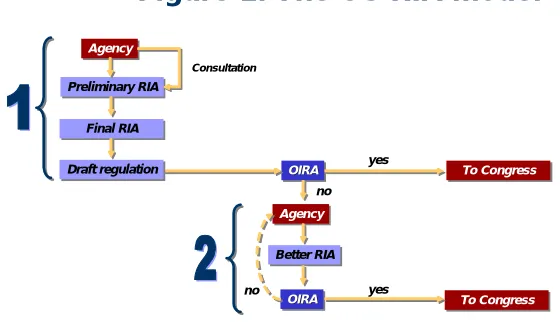
The institutions that are most heavily involved in the RIA procedure are the proposing agencies and the OIRA. As shown in Figure 1, in the initial stage the proposing agency drafts a preliminary RIA form, comparing different regulatory options – which must include the so-called ‘zero option’ (leaving the existing regulation unchanged) – and providing a rough estimation of benefits and costs associated with each alternative option and an indication of the relevance of the expected impact of the proposed regulation, which is the conditio sine qua non for the activation of the RIA procedure.57 The RIA form is then subject to a 60-day notice and
comment period, in which interested parties can file their comments and suggestions regarding the regulatory option chosen by the agency.58 After
the notice and comment period, the final RIA form is completed as an obligatory step before a final proposal can be drafted and submitted for approval. At this stage, the OIRA has 90 days to approve or reject the proposed regulation on the basis of the quality of cost-benefit analysis performed by the agency. If the proposal is approved, the proceedings go forward. If not, negotiations between OIRA and the proponent agency ensue.
During this second stage, OIRA can call upon its power to reject proposals at will, until the proposal is accompanied by a sufficiently detailed and precise regulatory impact analysis. As recalled in section 1.1.3, the number of rules returned or withdrawn by OIRA has dramatically
55 See, inter alia, R.W. Hahn, J. Burnett, Chan Yee-Ho, E. Mader and P. Moyle,
“Assessing Regulatory Impact Analysis: The Failure of Agencies to Comply with Executive Order 12866”, Harvard Journal of Law and Policy, Vol. 23, No. 3, Summer, 2000.
56 See Box 2 below in chapter 3, for a more detailed discussion of this critique. 57 See EO 12,866, op. cit.
58 The 1946 Administrative Procedure Act already recognised the citizen’s right to
participate in the consultation process. The 60-day notice and comment period was in any event considered only partially satisfactory, as it often results in a mere procedural step, more than a real opportunity to collect valuable views from the general public and targeted groups. See OECD, The OECD Review of Regulatory
increased under the current Bush administration, as a result of the new ‘gatekeeper’ role assumed by OIRA after the removal of the Vice President’s oversight role.
Figure 1. The US RIA model
OIRA OIRA
OIRA To CongressTo Congress
Agency
Agency
Better RIA Better RIA
To Congress
To Congress
OIRA OIRA
OIRA
yes
no
yes no
Agency
Agency
Preliminary RIA Preliminary RIA
Final RIA Final RIA
Draft regulation Draft regulation
ConsultazioneConsultation
But the oversight activities introduced during the Clinton administration were not limited to Presidential oversight. In 1996, the
Congressional Review Act prescribed that all sponsoring agencies were
bound to send their proposals to the Congress for an evaluation. The US Congressional Budget Office can repeal any draft regulation within 60 days from receipt of the proposal.59 Such an oversight mechanism also extends to
Congressional bills, thus completing the framework of controls over the cost-effectiveness of federal legislation. Nonetheless, a number of commentators have recently advocated the extension of the RIA model to independent agencies.60 Given the highly ‘political’ nature of the US RIA
model, however, such an extension would significantly undermine the independence of such agencies from the executive.
59 The Congressional Review Act is part of the Small Business Regulatory Enforcement Fairness Act of 1996 (available at http://usgovinfo.about.com/library/bills/blcra.htm – last
visited 5 December 2005).
1.1.6 The US experience: Main lessons for the EU debate
The US impact assessment model is undoubtedly at the forefront of international success stories in policy evaluation. The US is close to being defined as a ‘cost-benefit state’, with all the advantages and shortcomings that such a definition entails.61 A close look at the problems that have
occurred in the implementation of the US RIA model over the past two decades is of great help in identifying the next steps that may be taken at EU and member state level.
A first lesson to be drawn is related to the remarkable transparency of RIA in the United States, thanks also to the public availability of proposals, comments, complaints and communications between OIRA and agencies, and to a massive use of notice and comment procedures, deeply rooted in the US tradition since the end of World War II.62 Opening the door to
mandatory public consultation is, a double-edged sword, as it enables increased participation by the general public in the early stages of the regulatory process, but at the same time exposes regulators to risks of lobbying and capture. This is what occurred in the US following the Quality
of Life Review, and continued at least until EO 12,866.63
An important feature of the US model, that still represents an unattainable frontier – at least in the short run – for EU institutions, is the diffusion of an evaluation-oriented culture within US administrations. On the one hand, the conceptual heritage of ‘reinventing government’ led to a gradual transformation of the US bureaucracy, with the introduction of performance as the ultimate goal of the bureaucrats’ visible hand. On the other hand, the unmatched pervasiveness of US RIA enables OMB to publish yearly estimates of the costs and benefits of federal regulation, as mandated by the 1997 Treasury and Government Appropriations Act.64 The
yearly publication of estimated costs and benefits of federal regulations
61 For a summary of the current debate on cost-benefit estimates, see Box 2 below.
See also C.R. Sunstein, The Cost-Benefit State, Working Paper No. 39, University of Chicago Law School, John M. Olin Center for Law and Economics, May 1996.
62 The public consultation procedure was introduced by the 1946 Administrative Procedure Act.
63 For an insightful illustration, see OECD, The OECD Review of Regulatory Reform in the United States, Paris, OECD, 1999.
certainly fosters the transparency of government regulation, stimulating the political and economic debate.65
Another remarkable feature of the US system is the large number of
institutional entities involved in the regulatory process. While the role
played by the Congressional Budget Office complements OIRA’s oversight activity, creating an inter-institutional competition that is normally considered virtuous for the quality of regulation, most regulations must pass muster under regulatory flexibility procedures and regulatory burden reduction screens, and are subject to review by an impressive number of constituencies, with specific regard to consumers and small businesses.66
Moreover, the US procedure seems to have generated significant cost
savings. Under the Reagan administration, yearly savings were estimated at
roughly $10-20 billion. Non-governmental estimates can however be very different. According to one authoritative economist, the cost of regulations even increased after the introduction of compulsory RIA for federal agencies, and has never stopped mounting since then.67
On the other hand, relevant critiques have been addressed to the current implementation of RIA in the US. A 2000 study by Bob Hahn and Bob Litan on 48 proposed regulations subject to RIA between 1996 and 1999 showed that in 27% of the cases agencies had not considered alternative options, and only in 31% of the cases had agencies quantified both expected costs and benefits of proposed regulations. Moreover, only in 63% of the cases had the proponent agency calculated all identified costs, whereas only in 28% of proposals had the agency calculated the net present value of
65 On the reliability of government cost-benefit estimates, see Box 2, chapter 3. 66 Institutional competition becomes virtuous whenever different entities intervene
in the same procedure, but with different and sharply defined roles. In this case, creating a network of competing regulators and oversight agencies produces beneficial effects both in terms of overall transparency and efficiency. See e.g. R. Lutter, Economic Analysis of Regulation in the U.S.: What Lessons for the European
Commission?, AEI-Brookings Joint Center for Regulatory Studies, Washington,
D.C., 2001.
67 R.W. Hahn and R. Litan, An Analysis of the Third Government Report on the Benefits and Costs of Federal Regulation, AEI-Brookings Joint Center for Regulatory Studies,
the regulatory intervention.68 More recently, in 2004 Bob Hahn and Pat
Dudley analysed 55 cases of RIA performed by federal agencies between the Reagan, Bush Sr. and Clinton administrations, with similar results.69
Accordingly, economists have stressed the need for further improvements in the accuracy of cost-benefit estimates by federal agencies as a necessary measure for improving the quality of ex ante evaluation. Robert Hahn and Robert Litan have also issued recommendations on how to improve the quality of US RIA, by enhancing the soundness and pervasiveness of the model.70
Furthermore, besides critiques addressed towards the quality of RIAs performed by federal agencies, some disagreement has emerged as regards the scope of application of the US RIA model. As of today, the US impact assessment procedure only involves federal agencies, not independent authorities, i.e. the authorities that normally deal with the most relevant part of economic regulations.71 And, while it is certainly true that such
authorities ought to be left independent of the executive, many commentators have criticised the decision to limit the application of RIA scrutiny to all new rules except core economic and social rules enacted by giant regulators, such as the FCC (Federal Communications Commission), the FTC (Free Trade Commission) or the SEC (Securities and Exchange Commission).72
68 Ibid.
69 R.W. Hahn and P. Dudley, How well does the government do cost-benefit analysis?,
Working Paper 04-01, AEI-Brookings Joint Center for Regulatory Studies, Washington, D.C., January 2004.
70 See R.W. Hahn and R.E. Litan, “Counting Regulatory Benefits and Costs: Lessons
for the U.S. and Europe”, Journal of International Economic Law, Vol. 8, No. 2, 2005, pp. 473-508 (see in particular pp. 496-499, suggesting that “Congress pass a law requiring that all federal regulatory agencies submit annual cost and benefit estimates of major regulations to OMB”, and that “OMB issue a scorecard assessing the overall quality of regulation and ask the agencies to complete a scorecard for each major regulation”).
71 R.W. Hahn and C. Sunstein, “New Executive Order For Improving Federal
Regulation? Deeper and Wider Cost-Benefit Analysis”, University of Pennsylvania
Law Review, Vol. 150, No. 1489, May 2002; T.O. McGarity, “Regulatory Analysis
and Regulatory Reform”, Texas Law Review, Vol. 65, No. 1243, 1987. See also R.H. Pildes and C.R. Sunstein, “Reinventing the Regulatory State”, University of Chicago
Law Review, 62, 1, 1995.
Finally, the US regulatory review model has been the subject of extensive study by game theorists and political scientists, as its peculiar institutional setting lends itself to applications of principal-agent models and raises issues of political control over the bureaucracy.73 For example,
Lazer (2004) finds evidence that, although the staff at OIRA has remained quite stable between Bush Sr. and Clinton administrations, the White House has radically redistributed its attention and political support towards OIRA members with compatible political viewpoints. The appointment of John Graham as the OIRA head and the gradual strengthening of OIRA’s role as gatekeeper are seen as consistent with the removal of the Vice President from the review procedure, a solution aimed at ensuring that the White House keeps control over federal agencies and at the same time economising on its fairly limited capacity to gather information on proposed new rules.
This finding is compatible with a competitive agent model of control, and suggests that, in the regulatory review model adopted in the US, presidential influence is exerted mostly through an institutionalisation of the conflict and competition between the anti-regulatory OIRA and activist regulatory agencies, such as the Environmental Protection Agency or the Occupational Safety and Health Administration. In this model, the President has a clear incentive to exert heavy control on the bureaucracy also because the White House competes with the Congress in controlling bureaucrats.74
73 See, inter alia, T. Moe, “Regulatory performance and presidential
administration”, American Journal of Political Science, 26(2), pp. 197-224, 1982; T. Moe, “Control and feedback in economic regulation: The case of the NLRB”,
American Political Science Review, 79, 1985, pp. 1094-1016; T. Moe, “The new
economics of organization”, American Journal of Political Science, 79, pp. 1094-1117. See also William A. Niskanen, Bureaucracy and Representative Government, Chicago, IL: Aldine, 1971.
1.2 The UK experience: From ‘light touch’ to ‘limited touch’ regulation
The UK experience on impact assessment is starkly different from that in the US, and can be considered as the expression of Europe’s ‘state of the art’ as well as a possible reference model for the past and current EU impact assessment models. Compared to the US model, the UK model exhibits peculiar features, mostly related to: i) the choice to provide for a gradual introduction of the procedure; ii) the peculiar attention to compliance costs borne by target firms; iii) a strong emphasis on the impact of regulation on small and medium-sized firms; and iv) the type of regulations that are subject to impact assessment (in the US proposed regulations by federal agencies, in the UK draft bills presented to the Parliament).
The first attempts to introduce a culture of impact assessment and an
ex ante evaluation of the expected impact of proposals examined by the
Parliament can be traced back to the Thatcher administration. The UK Government, however, decided to proceed with caution, initially mandating only a simplified procedure, which entailed that sponsoring administrations estimated only the impact of proposed legislation on the costs borne by firms to comply with the new rules (so-called ‘Compliance Cost Assessment’ or CCA). The CCA procedure, introduced in 1986, clearly aimed at reducing administrative burdens that were found to be skyrocketing – just as in most other EU countries – as a result of regulatory creep.75 The slogans used at that time – such as ‘building businesses – not
barriers’ and ‘lifting the burden’ were self-explanatory.76
The introduction of CCA must be contextualised within the more general reform of UK public administration that led, during the early 1980s, to a true, disruptive cultural revolution in UK administration, transforming a procedure-oriented bureaucracy into a more performance-oriented, efficiency-driven branch of the government. The so-called ‘new public management’ wave led to a significant improvement in the efficiency of the UK administration, achieved through a reform of contractual arrangements with CEOs, but also through a growing use of market-type mechanisms (MTMs), an increased outsourcing of functions inefficiently performed by
75 See R. Boden, J. Froud, A. Ogus and P. Stubbs, Controlling the Regulators, London:
MacMillan Press, 1998.
the state and more generally though stronger emphasis on performance and citizens’ satisfaction in the delivery of public services.77
The UK CCA model relied heavily on the coordination and oversight of an ad hoc government task force, whose main role was to coordinate ‘anti-red tape’ initiatives and to assist sponsoring administrations in drafting CCA forms. In 1986, following the ‘Building businesses – not barriers’ initiative, the agency was given the name of Enterprise and Deregulation Unit and was nested in the Department of Employment. In 1987 it was renamed the Deregulation Unit and moved to the Department of Trade and Industry, where it was assisted by a task force of business representatives. The Deregulation Unit conducted its activities in an ‘adversarial, inquisitorial’ way, challenging administrations by setting ambitious yearly targets for the reduction of administrative burdens, paving the way for a massive deregulatory effort. In 1992, most departments had gone a long way towards reducing regulatory creep, but the real target of reducing administrative burdens seem not to have been achieved.78 Commentators and politicians highlighted that a further
cultural shift was needed in UK administrations in order to drive the process of cutting red tape and facilitating business activities. The ‘new wave’ of reforms launched in 1992 maintained the same ‘gatekeeper’ model and led to the creation of new ad hoc, sector-specific bodies similar to the US federal agencies. Seven new task forces were created in 1992 alone – including a Deregulation Task Force – for the purpose of facilitating the deregulation initiative launched by John Major’s administration. These task forces spawned as many as 605 deregulatory initiatives, which led, inter alia, to: i) the 1994 Deregulation and Contracting Out Act, which introduced legislative means to abrogate regulatory burdens; ii) the ‘think small first’ initiative, which forced administrations to award top priority to the impact
77 For an illustration of the ‘new public management’ approach, see Jan Erik Lane, New Public Management, London: Routledge, 2000; and Christopher Pollitt and
Geert Bouckaert, Public Management Reform. A Comparative Analysis, Oxford: Oxford University Press, 2000. The approach survived the 1980s and 1990s and is still considered to provide significant guidance for policy-makers in the modernisation of government. See e.g. OECD, Modernising Government: The Way Forward, Paris, 2005, p. 85 and p. 181.