Available for free downloading from the CEPS website (http://www.ceps.be) © CEPS 2005
Thinking ahead for Europe
Climate Change in the US Government Budget
Funding for Technology and Other Programmes,
and Implications for EU-US Relations
Thomas L. Brewer*
Abstract
With increasing Congressional support for funding climate change technology programmes, as reflected in passage of the Hagel/Pryor amendment to the energy policy bill in June 2005, issues about the climate change budget are becoming more salient. In this Policy Brief, Congressional and Presidential actions on several recent budgets are examined for the four principal areas of the climate change budget: technology, science, international and tax credits. The emphasis is on energy technology in particular, because of its salience in current policy discussions and its relative size in financial terms. Highlights of the findings include the following: Congress imposed substantial (63.3%) increases over the administration’s climate change technology proposals for 2004 and then small increases for FY2005. For 2006, the administration has proposed reductions compared with the Congressionally-enacted levels in the technology component – reductions in both nominal and inflation-adjusted terms (-4.1% and -5.6%, respectively). The administration has also proposed cuts for fiscal 2006 in the science and international programmes (-2.9 and -19.0% in real terms). These and other differences in Presidential and Congressional approaches to funding climate change programs provide further evidence that the Presidential-Congressional divide on climate policy is continuing to widen. There is an emerging bi-partisan Presidential-Congressional coalition in favour of increased spending on a wide range of climate change programmes. This shift will affect EU-US relations on climate change issues for the remainder of the current administration until 2008, and beyond as well.
Thomas L. Brewer is Associate Professor at Georgetown University and Associate Fellow at CEPS. This CEPS Policy Brief is derived, in part, from a larger study of “The Political Economy of US Responses to Climate Change Issues”, undertaken in cooperation with CEPS. The study was funded by the Economic and Social Research Institute (ESRI), Cabinet Office, Government of Japan. I am indebted to Christian Egenhofer for his comments on a draft of this paper. Of course, the author is entirely responsible for the contents, including the collection and interpretation of the data.
Policy
1.
IntroductionUS government spending for energy technology and other programmes is an important element of overall US climate change policy. Support for the technology element of climate change policy has become especially salient and controversial in recent years, as the administration has given greater emphasis in its stated policy to subsidies for research and development of technology, and as Congress has taken an increasing interest in the subject. The implementation of such programmes requires resources that must be provided in the annual budget decision-making process. Thus, the patterns and priorities in the allocation of resources for these programmes provide an empirical basis for observing tangible evidence of policy commitments.
Despite their importance, budgeting issues associated with US climate change policies have not previously been subjected to extensive empirical analysis. There are discussions of budget issues, administration policies and Congressional actions during the 1990s available in Anderson (2002), Bryner (2000), and Rosencranz (2002). Those studies, however, do not systematically focus on the patterns and trends in the entire climate change budget, and they do not include the period since the change in administrations in 2001. Other studies, such as those by Bierly & Eden (2005) and the National Commission on Energy Policy (2004) provide detailed data on selected aspects of current and future climate change budgets within the context of policy advocacy.1
The best single source of data on climate change budgets is the administration’s annual Report to Congress entitled “Federal Climate Change Expenditures”, which is required by legislation and which is submitted by the Office of Management and Budget as part of the regular budget cycle.2 For FY2006, see also Marberger (2005).
The fiscal year begins on 1 October and ends on 30 September. Because of the lead times in the decision process and the lags in the data publication process, the budget submission in any given calendar year contains data for: ‘actual’ expenditures by the agencies in the recently completed fiscal year, previously ‘enacted’ expenditures passed by Congress and agreed by the President for the then current fiscal year, and the
1
For an analysis of the politics, economics and administration of the US government budgeting process more generally, see for instance, Schick (2000). On the procedural and legal details, see especially Congressional Quarterly (2003); US, House of Representatives (2001); US, Congressional Research Service (2003a, 2003b, 2004); and US, Congressional Budget Office (2004).
2
In the past three years, it has been submitted increasingly early in the budget cycle (August 2003 for FY2004; May 2004 for FY2005; and March 2005 for FY2006). See US Government, Office of Management and Budget (2003, 2004, 2005a).
administration’s ‘proposed’ expenditures for the forthcoming fiscal year.3
2. Overview of Recent Administration and
Congressional Actions
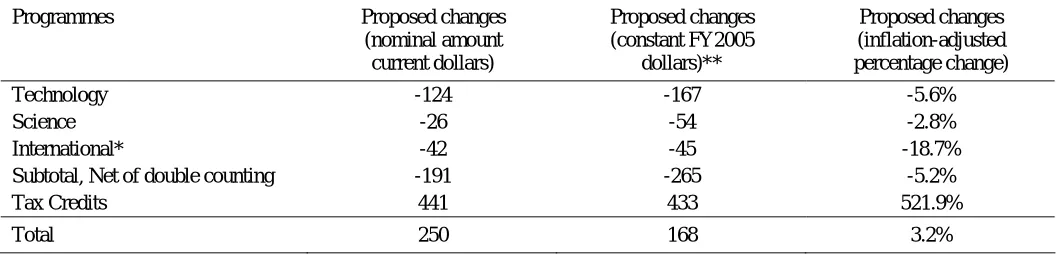
Table 1 presents summary data on the principal climate change programmes for fiscal years 2004, 2005 and 2006. In that table, there is an important distinction between the programmes in the top three lines, which involve direct expenditures by government agencies, and the fourth programme, in which tax credits represent foregone revenues. The amounts for the first three programmes are directly controlled by annual appropriations. The amounts for tax credits are estimates made on the basis of existing or anticipated tax laws that create the credits and on the basis of forecasts of the economic activities that entitle producers and/or consumers to the credits. For instance, estimated amounts of the lost revenues from tax credits for the purchase of hybrid fuel automobiles depend on the mandated amount of the credit per vehicle and the estimated number of vehicles sold that will qualify for the credit in the fiscal year. As a result of these differences, a subtotal for the three direct-expenditure programmes has been computed, and the tax credits are presented separately.
As can be seen in the first line of Table 1, the administration’s proposed amounts for technology were substantially increased by Congress for FY2004 and slightly increased for FY2005 (63.6% and 0.2%, respectively). As for science programmes, after large increases over the President’s proposal for FY2004, the Congress imposed small decreases on the President’s proposals for FY2005. Congressional action on international programmes, however, followed the opposite pattern: first Congressional cuts in the President’s proposed amounts for FY2004 and then increased them for FY2005.
Table 2 presents the administration’s FY2006 proposed amounts in relation to the FY2005 amounts enacted by Congress. The comparisons are expressed in real, constant dollar terms and the associated percentage change terms, as well as the nominal amounts indicated in the budget documents. The administration has proposed cuts of 5.6% for technology programmes, 2.8% for science and 18.7% for international programmes. At the same time, it has estimated an increase of more than 500% in tax credits (estimates that are discussed below in section 4).
3
Table 1. Principal climate change budget programmes, fiscal years 2004, 2005 and 2006 ($ millions)
Programmes FY2004 Proposed
FY2004 Enacted
FY2004 Actual
FY2005 Proposed
FY2005 Enacted
FY2006 Proposed
Technology 1759 2878 2868 2982 2989 2865
Science 1747 1996 1976 1956 1918 1892
International* 271 260 252 229 240 198
Subtotal, Net of double counting 3770 5128 5090 5161 5140 4949
Tax Credits 552 0 0 680 83 524
Total 4322 5128 5090 5841 5223 5473
* In the source documents, ‘International’ includes some items that are also in ‘Technology’ and/or ‘Science’. The subtotal, which has been computed by the author, excludes the double-counted amounts. The amount of this double counting has been computed by the author as follows: Double-counted Amount = (Subtotal of Technology + Science + International) - (Total [which does not include double counting in original source] - Tax Credits). The double counting has been $6-7 million per year.
Sources: Compiled by the author from US Government, Office of Management and Budget, Federal Climate Change Expenditures:
Report to Congress [FY 2004] (August 2003); Federal Climate Change Expenditures: Report to Congress [FY 2005] (May
2004); Federal Climate Change Expenditures: Report to Congress [FY 2006] (March 2005); Table 1 in each source. Downloaded on 23 June 2005 from:
http://www.whitehouse.gov/omb/legislative/fy04_climate_chg_rpt.pdf http://www.whitehouse.gov/omb/fy05_climate_chg_rpt_to_cong.pdf http://www.whitehouse.gov/omb/fy06_climate_chg_rpt.pdf.
Table 2. Comparisons of administration proposals for FY2006 with FY2005 Congressionally-enacted amounts ($ millions)
Programmes Proposed changes
(nominal amount current dollars)
Proposed changes (constant FY2005
dollars)**
Proposed changes (inflation-adjusted percentage change)
Technology -124 -167 -5.6%
Science -26 -54 -2.8%
International* -42 -45 -18.7%
Subtotal, Net of double counting -191 -265 -5.2%
Tax Credits 441 433 521.9%
Total 250 168 3.2%
* In the source documents, ‘International’ includes some items that are also in ‘Technology’ and/or ‘Science’. See Table 1 for further information.
** Assumes 1.5% inflation, which is the estimate of the Congressional Budget Office for the GDP price index change for FY2006 compared with FY2005.
Sources: Compiled by the author from US Government, Office of Management and Budget, Federal Climate Change Expenditures:
Report to Congress [FY 2006] (March 2005); Table 1 (downloaded on 23 June 2005 from: http://www.whitehouse.gov/omb/
fy06_climate_chg_rpt.pdf). Real constant dollar changes computed by the author using 1.5% forecast GDP price index change from Congressional Budget Office, The Budget and Economic Outlook: Fiscal Years 2006 to 2015, January 2005, Table E-1 (downloaded from http://www.cbo.gov/showdoc.cfm?index=6060&sequence=10#tableE-1 on 27 March 2005).
3. Technology
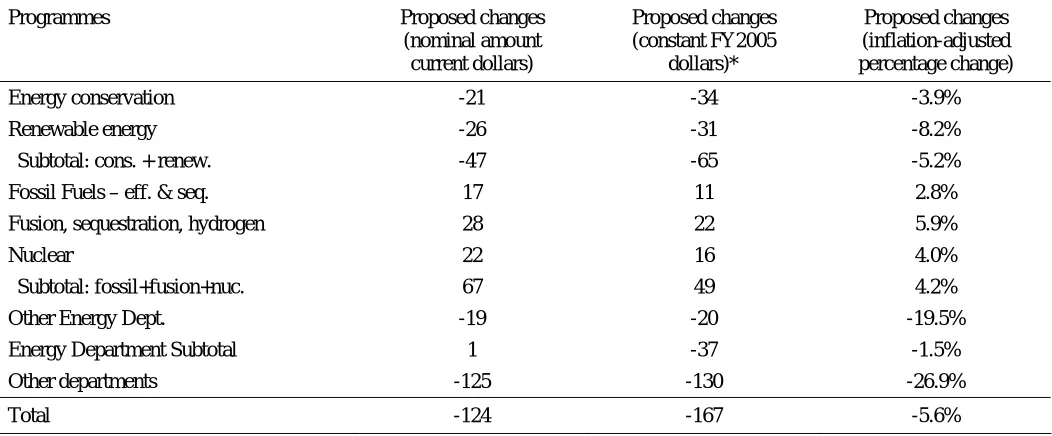
In Table 3, the data for technology programmes reveal differences in Presidential and Congressional priorities for the allocation of funds for particular energy sources and R&D projects among technology programmes. For instance, for FY2005 Congress cut $53 million from the President’s proposed amounts for fossil fuel efficiency and sequestration (‘clean coal’ programmes) but increased the amount requested for nuclear by $81 million. Meanwhile, for the same fiscal year the Congress made only marginal changes in the President’s requests for energy conservation and renewable energy sources – decreasing the former by $8 million and increasing the latter by $5 million.
[image:3.595.33.561.366.493.2]Table 3. Climate change technology programmes ($ millions)
Programmes FY2004 Proposed
FY2004 Enacted
FY2004 Actual
FY2005 Proposed
FY2005 Enacted
FY2006 Proposed
Energy conservation 876 878 868 876 868 847
Renewable energy 444 375 352 375 380 354
Subtotal: cons. + renew. 1320 1253 1220 1251 1248 1201
Fossil Fuels – eff. & seq. 184 464 455 541 388 405
Fusion, sequestration, hydrogen 47 337 333 362 371 399
Nuclear [12]* 292 309 313 394 416
Subtotal: fossil+fusion+nuc. 243 1093 1097 1216 1153 1220
Other Energy Dept. 70 62 73 90 104 85
Energy Department Subtotal 1633 2408 2390 2557 2505 2506
Other departments 126 470 478 425 484 359
Total 1759 2878 2868 2982 2989 2865
* This amount appears not to be comparable to amounts on the same line for subsequent years.
Sources: Compiled by the author from US Government, Office of Management and Budget, Federal Climate Change Expenditures:
Report to Congress [FY 2004] (August 2003); Federal Climate Change Expenditures: Report to Congress [FY 2005] (May
2004); Federal Climate Change Expenditures: Report to Congress [FY 2006] (March 2005); Table 4 in each source. Downloaded on 23 June 2005 from:
http://www.whitehouse.gov/omb/legislative/fy04_climate_chg_rpt.pdf http://www.whitehouse.gov/omb/fy05_climate_chg_rpt_to_cong.pdf http://www.whitehouse.gov/omb/fy06_climate_chg_rpt.pdf.
Table 4. Administration’s proposed changes in technology programmes for FY2006 ($ millions)
Programmes Proposed changes
(nominal amount current dollars)
Proposed changes (constant FY2005
dollars)*
Proposed changes (inflation-adjusted percentage change)
Energy conservation -21 -34 -3.9%
Renewable energy -26 -31 -8.2%
Subtotal: cons. + renew. -47 -65 -5.2%
Fossil Fuels – eff. & seq. 17 11 2.8%
Fusion, sequestration, hydrogen 28 22 5.9%
Nuclear 22 16 4.0%
Subtotal: fossil+fusion+nuc. 67 49 4.2%
Other Energy Dept. -19 -20 -19.5%
Energy Department Subtotal 1 -37 -1.5%
Other departments -125 -130 -26.9%
Total -124 -167 -5.6%
* Assumes 1.5% inflation, which is the estimate of the Congressional Budget Office for the GDP price index change for FY2006 compared with FY2005.
Sources: Compiled by the author from US Government, Office of Management and Budget, Federal Climate Change Expenditures:
Report to Congress [FY 2006] (March 2005); Table 4. Downloaded on 23 June 2005 from: http://www.whitehouse.gov/omb/
[image:4.595.35.561.447.665.2]4. Tax Credits
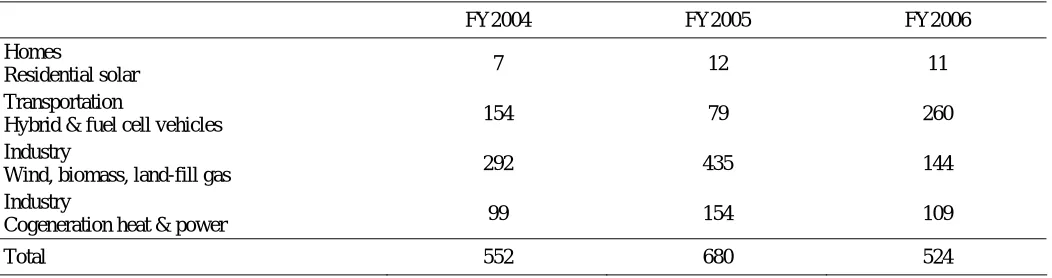
As Table 5 indicates, the administration’s estimated tax credits for energy efficiency have remained at similar levels for several years (about $500-$700 million). For FY2006, increased credits for the purchase of hybrid vehicles constitute the biggest change, as sales of such vehicles continued to increase. The administration anticipated a total of $260 million for such credits, and an overall total of $524 million for solar, wind, biomass and combined heat & power programmes.
[image:5.595.38.564.233.372.2]However, these are only estimates, and they have been substantially higher than the amounts estimated by Congress and the amounts actually spent, at least in the years for which there are data in Table 5. The unreliability of the estimates is partly a result of changing provisions in the tax laws. With the prospect of continuing uncertainties and changes in tax legislation, this is likely to remain a relatively unpredictable component of the climate change budget.
Table 5. Climate change tax credit programmes – Administration’s proposed amounts ($ millions)
FY2004 FY2005 FY2006
Homes
Residential solar 7 12 11
Transportation
Hybrid & fuel cell vehicles 154 79 260
Industry
Wind, biomass, land-fill gas 292 435 144
Industry
Cogeneration heat & power 99 154 109
Total 552 680 524
Sources: Compiled by the author from US Government, Office of Management and Budget, Federal Climate Change Expenditures :
Report to Congress [FY 2004] (August 2003); Federal Climate Change Expenditures : Report to Congress [FY 2005] (May
2004); Federal Climate Change Expenditures: Report to Congress [FY 2006] (March 2005); Table 6 in each source. Documents were downloaded on 23 June 2005 from:
http://www.whitehouse.gov/omb/legislative/fy04_climate_chg_rpt.pdf http://www.whitehouse.gov/omb/fy05_climate_chg_rpt_to_cong.pdf http://www.whitehouse.gov/omb/fy06_climate_chg_rpt.pdf.
5. Conclusion: Diverging Presidential and
Congressional Priorities – and the Implications for the EU
Congress preferred greater expenditures than the President requested for climate change technology programmes in both FY2004 and FY2005. In view of the Senate’s passage of the Hagel/Pryor amendment to the energy policy bill in June 2005 – an amendment that calls for an expansion of climate change technology programmes – it is likely that the gap between Congressional and Presidential priorities will increase during the next few years. For FY2006, in particular, the administration is proposing to reduce funding of technology programmes by 5.6% below FY2005 Congressionally-enacted levels in inflation-adjusted terms. Differences in Presidential and Congressional priorities for the allocation of funds for particular energy sources and R&D projects among technology programmes are also evident.
Despite a stated desire to reduce uncertainties about climate change through scientific research, the administration is also proposing to reduce the funding of climate science programmes, and it is proposing to reduce international programmes as well. These proposals for reductions occur, of course, in the context of budget constraints arising from the large budget deficits of recent years. However, the
budget proposals for the government as a whole for FY2006 provide for real, inflation-adjusted increases in total government outlays and in discretionary outlays (not including expenditures for the wars in Afghanistan and Iraq).
Thus, while the administration is proposing a path of reduced government expenditures for climate change technology, science and international programmes, the Congress is on a path of increasing expenditures. The increasing Congressional support for more action to address climate change and the natural political appeal of subsidies will likely further isolate the administration from the new climate change consensus in the US.
poses new opportunities and challenges for them. Finally, US government pressures on other governments and the EU to increase their funding of climate change programmes in technology, science and international assistance may increase.
References
Anderson, Kai S. (2002), “The Climate Policy Debate in the US Congress”, in Stephen H. Schneider, Armin Rosencranz and John O. Niles (eds.), Climate Change Policy: A Survey, Washington, D.C.: Island Press, chapter 7, pp. 221-234.
Bierly, Eugene W. and H. Frank Eden (2005), Atmospheric Sciences and Climate Change Programs in the FY 2006 Budget (downloaded from the website of the American Association for the Advancement of Science, www.aaas.org/spp/rd/06pch16.pdf, on 26 July 2005).
Bryner, Gary (2000), “Congress and the Politics of Climate”, in Paul G. Harris (ed.), Climate Change and American Foreign Policy, New York: St. Martin’s Press, chapter 6, pp. 111-130.
Congressional Quarterly (2003), “The Budget Process in Brief”, Guide to Current American Government, Washington, D.C.: Congressional Quarterly, pp. 119-120.
Marburger, John H. (2005), “Statement of Dr. John H. Marburger, III”, President’s Science Adviser and Director, Office of Science and Technology Policy, to the United States House of Representatives, Committee on Science, Fiscal Year 2006 Federal R&D Budget, February 16, 2005 (downloaded on
27 March 2005 from www.house.gov/science/hearings).
National Commission on Energy Policy (2004), Ending the Energy Stalemate: A Bipartisan Strategy to Meet America's Energy Challenges (available at http://www.energycommission.org).
Rosencranz, Armin (2002), “U.S. Climate Change Policy”, in Stephen H. Schneider, Armin Rosencranz and John O. Niles (eds), Climate Change Policy: A Survey, Washington, D.C.: Island Press, chapter 7, pp. 221-234.
Schick, Allen (2000), The Federal Budget: Politics, Policy, and Process, Washington, D.C.: Brookings Institution.
US, Congressional Budget Office (2004), “Glossary of Budgetary and Economic Terms” (downloaded from www.cbo.gov on 11 August 2004).
US, Congressional Budget Office (2005), “The Budget and Economic Outlook: Fiscal Years 2006 to 2015”, January 2005, Table E-1 (downloaded on
27 March 2005 from http://www.cbo.gov/showdoc.cfm?index=6060&se
quence=10#tableE-1).
US, Congressional Research Service (2003a), “The Congressional Budget Process Timetable”, CRS Report for Congress, by Bill Heniff Jr., Washington, D.C.
US, Congressional Research Service (2003b), “Overview of the Executive Budget Process”, CRS Report for Congress, by Heniff, Bill, Jr., Washington, D.C.
US, Congressional Research Service (2004), “The Congressional Budget Process: A Brief Overview”, CRS Report for Congress, by James V. Saturno, Washington, D.C.
US, House of Representatives, Committee on the Budget (2001), “Basics of the Budget: A Briefing Paper”, Washington, D.C.
US, House of Representatives, Committee on Science (2005), Hearing Charter: An Overview of the Federal R&D Budget for Fiscal Year 2006, Wednesday February 16, 2005 (downloaded from www.house.gov/science/hearings on 28 March 2005).
US, Office of Management and Budget (2003), Federal Climate Change Expenditures: Report to Congress [FY 2004], Washington, D.C.
US, Office of Management and Budget (2004), Federal Climate Change Expenditures: Report to Congress [FY 2005], Washington, D.C.
US, Office of Management and Budget (2005a), Federal Climate Change Expenditures: Report to Congress [FY 2006], Washington, D.C.
Website:
www.ceps.be
Bookshop:
http://shop.ceps.be
About CEPS
Founded in 1983, the Centre for European Policy Studies is an independent policy research institute dedicated to producing sound policy research leading to constructive solutions to the challenges facing Europe today. Funding is obtained from membership fees, contributions from official institutions (European Commission, other international and multilateral institutions, and national bodies), foundation grants, project research, conferences fees and publication sales.
Goals
• To achieve high standards of academic excellence and maintain unqualified independence. • To provide a forum for discussion among all stakeholders in the European policy process. • To build collaborative networks of researchers, policy-makers and business across the whole of
Europe.
• To disseminate our findings and views through a regular flow of publications and public events.
Assets and Achievements
• Complete independence to set its own priorities and freedom from any outside influence. • Authoritative research by an international staff with a demonstrated capability to analyse policy
questions and anticipate trends well before they become topics of general public discussion. • Formation of seven different research networks, comprising some 140 research institutes from
throughout Europe and beyond, to complement and consolidate our research expertise and to greatly extend our reach in a wide range of areas from agricultural and security policy to climate change, JHA and economic analysis.
• An extensive network of external collaborators, including some 35 senior associates with extensive working experience in EU affairs.
Programme Structure
CEPS is a place where creative and authoritative specialists reflect and comment on the problems and opportunities facing Europe today. This is evidenced by the depth and originality of its publications and the talent and prescience of its expanding research staff. The CEPS research programme is organised under two major headings:
Economic Policy Politics, Institutions and Security
Macroeconomic Policy The Future of Europe
European Network of Economic Policy Justice and Home Affairs
Research Institutes (ENEPRI) The Wider Europe
Financial Markets, Company Law & Taxation South East Europe
European Credit Research Institute (ECRI) Caucasus & Black Sea
Trade Developments & Policy EU-Russian/Ukraine Relations
Energy, Environment & Climate Change Mediterranean & Middle East
Agricultural Policy CEPS-IISS European Security Forum