L E T T E R
Phosphatase activity and nitrogen fixation reflect species
differences, not nutrient trading or nutrient balance,
across tropical rainforest trees
Sarah A. Batterman,1,2,3*
Jefferson S. Hall,3,4
Benjamin L. Turner,3
Lars O. Hedin,2J. Kimiko LaHaela Walter,5Pete Sheldon5and Michiel van Breugel3,6,7
Abstract
A fundamental biogeochemical paradox is that nitrogen-rich tropical forests contain abundant nitrogen-fixing trees, which support a globally significant tropical carbon sink. One explanation for this pattern holds that nitrogen-fixing trees can overcome phosphorus limitation in tropical forests by synthesizing phosphatase enzymes to acquire soil organic phosphorus, but empirical evi-dence remains scarce. We evaluated whether nitrogen fixation and phosphatase activity are linked across 97 trees from seven species, and tested two hypotheses for explaining investment in nutrient strategies: trading nitrogen-for-phosphorus or balancing nutrient demand. Both strategies varied across species but were not explained by nitrogen-for-phosphorus trading or nutrient balance. This indicates that (1) studies of these nutrient strategies require broad sampling within and across species, (2) factors other than nutrient trading must be invoked to resolve the paradox of tropical nitrogen fixation, and (3) nitrogen-fixing trees cannot provide a positive nitrogen-phosphorus-carbon feedback to alleviate nutrient limitation of the tropical nitrogen-phosphorus-carbon sink.
Keywords
Biodiversity, biogeochemical niche, biogeochemistry, nitrogen, nutrient acquisition, nutrient limi-tation, nutrient strategy, phosphorus, tropical carbon sink.
Ecology Letters(2018)21: 1486–1495
INTRODUCTION
The observation that nutrients may limit the ability of tropical forests to serve as a sustained sink for atmospheric carbon dioxide underscores the importance of resolving the mecha-nisms and plant strategies that govern how tropical trees acquire nutrients (Wurzburger & Hedin 2016). Two strategies in particular–symbiotic nitrogen fixation and the synthesis of extracellular phosphatase enzymes – have received attention as they may be linked in a way that could: (1) allow trees to acquire nitrogen from the atmosphere via symbiosis with nitrogen-fixing bacteria (Jenny 1950; Vitousek & Howarth 1991) and/or phosphorus from the soil by hydrolyzing other-wise biologically unavailable organic phosphorus (Harrison & Pearce 1979; Duffet al.1994; Treseder & Vitousek 2001), and (2) explain why nitrogen-fixing trees are common in tropical forests despite the predominance of nitrogen-rich, phospho-rus-poor soils (Houltonet al.2008). (A third acquisition strat-egy, mycorrhizal phosphorus uptake, falls outside the scope of this study; Baribaultet al.2011.)
Recent studies have indicated that the capacities to produce phosphatases and fix nitrogen may be associated – and per-haps even mechanistically linked –in nitrogen-fixing tree spe-cies. High rates of phosphatase activity can occur in soils
associated with nitrogen-fixing trees (Houltonet al.2008) and on the root surfaces of some nitrogen-fixing tree species in the field (Nastoet al.2014; Pnget al.2017) or in greenhouse con-ditions (Olde Venterink 2011; Nasto et al.2017). Nasto et al. (2017) further showed that phosphatase activity can increase as a function of increased fixation.
It is unclear, however, whether these patterns reflect a link between fixation and phosphatase production that is wide-spread across nitrogen-fixing species. Alternatively, the ability to fix nitrogen may allow for higher biomass growth rates and thus also trigger phosphatase production. This distinction matters for resolving whether nitrogen fixers have a unique ability to trade fixed nitrogen for enhanced competitive suc-cess (relative to non-fixers) in low phosphorus and high nitro-gen soils. Such a mechanism can be central for resolving the distribution of fixers across soil conditions in tropical forests (Houltonet al.2008).
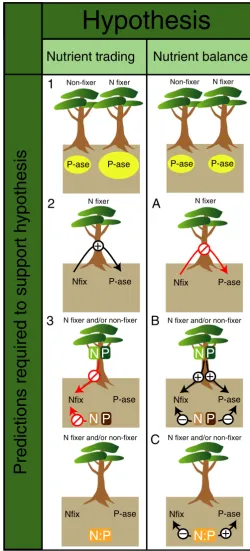
Two alternative hypotheses could explain why trees would vary their investment in nitrogen fixation and phosphatase activity. The nutrient trading hypothesis proposes that fixation and phosphatase activity are closely linked, with fixers able to use fixed nitrogen to invest in nitrogen-rich phosphatase enzymes. This mechanism would give fixers the unique com-petitive advantage of acquiring phosphorus from organic
1School of Geography and Priestley International Centre for Climate,
Univer-sity of Leeds, Leeds, UK
2Department of Ecology and Evolutionary Biology, Princeton University,
Princeton, NJ, USA
3Smithsonian Tropical Research Institute, Ancon, Panama
4ForestGEO, Smithsonian Tropical Research Institute, Ancon, Panama
5University of Freiburg, Freiburg, Germany 6Yale-NUS College, Singapore
7Department of Biological Sciences, National University of Singapore,
Singapore
*Correspondence: E-mail: [email protected]
compounds in phosphorus-poor soils (Houlton et al. 2008) and can thus explain why fixation has evolved within phos-phorus-poor tropical forests despite the apparent abundance of nitrogen. Three predictions (Fig. 1) are required to be met to support the hypothesis: prediction 1– for fixers to have a competitive advantage and thus become more abundant in phosphorus-poor tropical forests, phosphatase activity must be higher in fixers than non-fixers. Prediction 2 – for these traits to be linked mechanistically as a result of natural selec-tion over evoluselec-tionary time, individual plants must possess a positive relationship between phosphatase activity and the rate of fixation. And, prediction 3 – for fixation to underpin the production of phosphatase enzymes rather than soil nitrogen, fixation rates must be insensitive to the nitrogen balance of the plant.
Support for the nutrient trading hypothesis has derived from observations of a subset (but not all) of the predictions and has been indirect (as noted above) or demonstrated across a range of phosphorus substrates (Nasto et al. 2017). Two studies did not detect a link between fixation rate and phos-phatase activity (Battermanet al.2013a; Nastoet al.2014).
The nutrient balance hypothesis proposes that trees adjust their nutrient acquisition strategies to satisfy any plant nutri-ent demand in excess of soil supply (Fig. 1; e.g. Gutschick 1981; Bloomet al.1985; Treseder & Vitousek 2001). This per-spective identifies the tree growth rate as a fundamental con-trol on strategies of nutrient acquisition. In conditions of high biomass growth rate where both nitrogen and phosphorus demand are high relative to supply, fixation could correct a deficiency in soil nitrogen for plants capable of fixation, while investment in phosphatase activity could correct a phosphorus deficiency for both fixers and non-fixers. The nutrient strate-gies would respond to either nitrogen limitation or phospho-rus limitation, and therefore both strategies would not both be up-regulated at the same time (unless plants were co-lim-ited, discussed below). Thus, the nutrient balance hypothesis contrasts with the nutrient-trading hypothesis, requiring no positive relationship between phosphatase activity and nitro-gen fixation (prediction A; Fig. 1). The nutrient balance hypothesis would instead require prediction B – increased phosphatase and fixation activities with increasing plant demand (or decreasing soil supply) of phosphorus and nitro-gen, respectively. These nitrogen and phosphorus acquisition strategies would be sensitive to the stoichiometric ratios of nitrogen and phosphorus, consistent with the type of limita-tion, with increased fixation with decreasing levels of soil available nitrogen relative to phosphorus (N:P) and increased phosphatase activity with increasing soil available N:P (pre-diction C).
No study has explicitly examined the nutrient balance hypothesis for both fixation and phosphatase, although there is indication that fixers can adjust fixation to both nitrogen and phosphorus supply (Barron et al. 2011; Batterman et al. 2013a; Menge et al. 2017) and that plants can alter phos-phatase activity to match soil phosphorus supply (Treseder & Vitousek 2001; Olde Venterink 2011; Turner & Wright 2014; Zalameaet al.2016).
It is possible that nitrogen fixers display both high fixation and high root phosphatase activity, simply because biomass
Hypothesis
si
s
e
ht
o
p
y
h t
r
o
p
p
u
s
ot
d
eri
u
q
er
s
n
oit
ci
d
er
P
P-ase Nfix
Nfix P-ase
P-ase Nfix
+
P-ase
2
A
Nfix
1
3
B
N P
N:P
+
+
+
–
Nutrient trading Nutrient balance
–
–
P-ase P-ase
Non-fixer N fixer
N fixer N fixer
N fixer and/or non-fixer
N fixer and/or non-fixer
C
P-ase P-ase
Non-fixer N fixer
P-ase Nfix
N:P
N fixer and/or non-fixer
P-ase Nfix
N P
N P
N P
[image:2.595.310.561.55.608.2]N fixer and/or non-fixer
Figure 1 Conceptual diagram of the nutrient trading and nutrient balance
growth causes demand forboth nitrogen and phosphorus and plants are co-limited (Vitousek & Howarth 1991; Binkley et al.2003). The co-occurrence of high fixation and high root phosphatase activity thus does not necessarily imply a nitro-gen-for-phosphorus trading strategy (i.e. nutrient trading hypothesis), but rather could reflect high growth demand for both nitrogen and phosphorus (consistent with the nutrient balance hypothesis). A key consideration is whether species within a given functional group– fixer or non-fixer – show a consistent response, or behave individually. Each group is diverse, with species that may have evolved to function in dif-ferent ways, thereby filling distinct functional niches. We should therefore expect some inherent variability across spe-cies within each group, and an examination of the degree to which species vary within versus across groups would resolve whether fixer species have a uniquely and coherently evolved strategy. Indeed, three studies have demonstrated that fixation rates differ at the species level within the fixer functional group (Batterman et al. 2013a; Wurzburger & Hedin 2016; Nasto et al. 2017). Analogously, two studies found that legume fixers display species-specific differences in phos-phatase activity with some species having similar activity to non-fixer species (Olde Venterink 2011; Nasto et al. 2017). Finally, a recent global synthesis indicates that belowground traits are particularly phylogenetically conserved, suggesting we may expect a degree of similarity across closely related fixer species and difference from less closely related non-fixer species (Valverdes-Barranteset al.2017).
However, no study has systematically and simultaneously examined either hypothesis for phosphatase and fixation activ-ity across a large number of individual trees from several tropi-cal fixer and non-fixer species grown in a natural landscape.
We here use our conceptual framework developed above (Fig. 1) to evaluate two hypotheses for the expression of phosphatase and fixation activity in tropical trees. Although a thorough evaluation would require dozens of species and indi-viduals to evaluate inter versus intra-specific variation within and across functional groups, we provide a first test by mea-suring the nutrient acquisition strategies in 6–13 young trees in each of four common species of fixers and three common species of non-fixers (total 97 trees), grown across soil nutrient gradients in a reforestation experiment in Panama. Our com-mon garden approach allowed us to control both abiotic and biotic factors. Because phosphatase activity and fixation rates can vary across individual trees and because we sought to resolve these variables within versus between species, we designed our study to have high within-species replication. After 3 years of growth, we measured phosphatase activity on roots, nitrogen fixation activity, soil nitrogen and phosphorus availability, and plant nitrogen and phosphorus demand. Our findings suggest that species differ widely in both phosphatase and nitrogen fixation activity, but that plants do not appear to adjust these strategies to meet their nutrient balance. Fur-thermore, we found no positive relationship between fixation and phosphatase activity within individual trees, implying that tropical nitrogen fixers may not have evolved a nitrogen-for-phosphorus trading strategy to overcome nitrogen-for-phosphorus con-straints and that a unique access to phosphorus by fixers may not resolve the paradox of tropical nitrogen fixation.
MATERIALS AND METHODS
Site description and experimental design
We conducted our experiment at the Agua Salud Project experimental plantation, Panama (Mayoralet al.2017), where rainfall is 2700 mm, temperature ranges daily from 23 to 32 °C (Ogdenet al.2013), and soils are closely related Oxisols and Inceptisols (Mayoral et al. 2017; Turner, Baillie & Hall, unpublished data). Our 97 trees comprised part of a reforesta-tion experiment established in 2008 in which 100 000 seedlings were planted in treeless pastures (van Breugel & Hall 2008; Mayoral et al. 2017). In this experiment using a natural envi-ronment setting we controlled for a large number of factors, including competition, land use history, soil physical and chemical properties, slope, light and climate (see Supplemental Information for further details).
Nutrient acquisition strategies
During the August-September wet season of 2011 when physi-ological activity was highest, we quantified root phosphatase activity and nitrogen fixation on 6–13 trees from each of four tree species capable of nitrogen fixation (Inga punctataWilld., Caesalpinioideae; Gliricidia sepium (Jacq.) Kunth ex Walp., Papilionoideae;Erythrina fusca Lour., Papilionoideae; Dalber-gia retusa Hemsl., Papilionoideae; Legume Phylogeny Work-ing Group 2017) and three tree species without the ability to fix nitrogen (Tabebuia rosea (Bertol.) DC., Bignoniaceae; Ter-minalia amazonia (J.F. Gmel.) Exell, Combretaceae; Pachira quinata (Jacq.) W.S. Alverson, Malvaceae) (Batterman et al. 2018). See Table 1 and Table S1 for exact numbers of trees and species for each measurement.
Phosphatase activity was measured on five replicate fine root samples from the base of 6–10 trees per species. Phos-phomonoesterase activity was measured on each root sample using para-nitrophenyl phosphate (pNP) as an analogue sub-strate for phosphomonoesterase (see Supplemental Informa-tion for details), and calculated as the mean across samples for each tree, expressed inlmolpNP g 1 dry mass roots h 1.
We determined per-area nitrogen fixation rate for each tree by multiplying per-area nodule biomass by per-nodule bio-mass nitrogen fixation rate, determined by acetylene reduction assay (ARA) and isotopically labelled 15N incubations. To quantify per-area nodule biomass, we excavated active nod-ules at the base of each tree (Supporting Information). Nitro-gen fixation activity was measured on nodules using ARA on a subset of 11–13 trees for each of our four species (following Batterman et al. 2013a) and 15N2 incubations on a further subset of 4–5 trees per species (following Shearer & Kohl 1988 and Andrewset al.2011) to estimate a C2H4:N2 conver-sion ratio (Supporting Information; Tables S1 and S2).
Demand and supply of nutrients
equations (Sinacore et al. 2017), and the tissue-specific nitro-gen and phosphorus demand was determined by multiplying growth rates by species-specific nutrient contents from the lit-erature (Supporting Information).
We quantified the availability of soil nutrients to each tree by measuring nitrate, ammonium and Bray-1 extractable phosphorus in a soil core from the top 10 cm at the base of each tree (Supporting Information). N:P was considered as the ratio of available nitrogen and Bray phosphorus.
Statistical analyses
We used analysis of variance (ANOVA) to determine whether functional groups differed in phosphatase activity, including species as a nested random variable. We then usedANOVAand Tukey post-hoc test to identify specific differences in phos-phatase and fixation activity. We further used multiple linear regression with the independent continuous explanatory vari-able of interest (nitrogen demand, phosphorus demand, soil available nitrogen, soil available phosphorus, N:P or nitrogen fixation rate) plus species as a fixed variable to test effects on phosphatase and fixation activity and to examine any relation-ship between fixation and phosphatase; we also evaluated any variable-by-species interaction. All analyses were performed in R (R Core Team version 3.1.1 2014-07-10; Supporting Infor-mation).
RESULTS
We found that plant nutrient acquisition strategies, plant nutrient demand and soil nutrients varied widely across trees and species in our study sites (Table S3). Here we discuss nitrogen fixation rates, but we found similar results when con-sidering nodule biomass as an alternative measure of nitrogen fixation potential (Supporting Information).
Species-specific variation in nutrient strategies
We first considered whether functional groups differed in phosphatase activity and if species showed consistent nutrient acquisition strategies within a functional group, or if there was significant variation across species. We found some
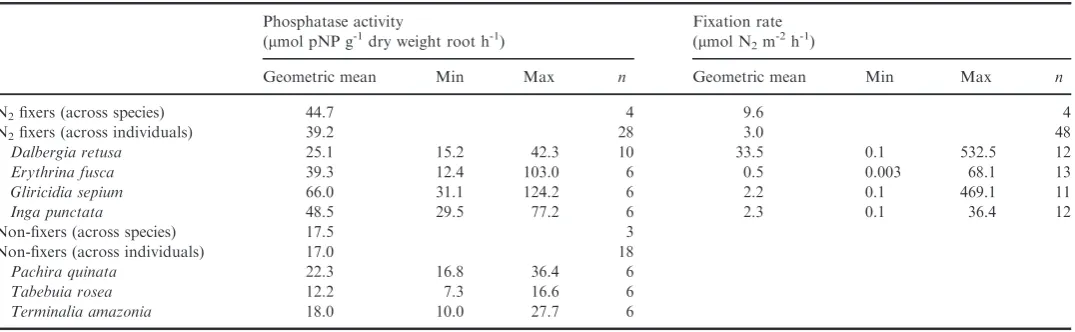
evidence that trees capable of nitrogen fixation differ in phos-phatase activity from non-fixing trees (ANOVA with functional type as a fixed variable and species as a nested random vari-able for n= 6–10 trees for each of our seven species: F(1,5)=7.6, P< 0.05). On average, phosphatase activity was more than two times higher in nitrogen-fixing than non-fixing species (mean of 44.7 lmol pNP g 1 dry weight root h 1 for fixer species vs. 17.5 lmol pNP g 1 dry weight root h 1 for non-fixers; Table 1). A similar range of difference was found whether considering the mean of either all species or all trees within a functional group (Table 1).
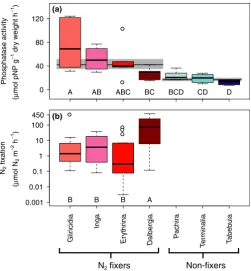
However, this difference in phosphatase activity between fix-ers and non-fixfix-ers appeared to be driven by one fixer species (Gliricidia sepium), which possessed high phosphatase activity. When we excluded this species, the difference disappeared (ANOVA with functional type as a fixed variable and species as a nested random variable forn= 6–10 individuals for each of six species: F(1,4)=6.5,p>0.05). Furthermore, we found sub-stantial variation across individuals within species, and across all species within and across the functional groups such that species differed significantly in both phosphatase and fixation activity (Fig. 2, Table 1; ANOVA for phosphatase activity: F(6,39)=10.49, P< 0.0001, n =6–10 trees per species; ANOVA for fixation rate: F(3,44)= 4.91, P <0.01, n=11–13 trees per species). The fixer species that possessed high phosphatase activity (G. sepium) differed significantly from another fixer species, Dalbergia retusa, as well as the non-fixer species. Three fixer species (Inga,Erythrina and Dalbergia) were simi-lar to most of the non-fixer species (see Fig. 2a). Fixation rates also varied within and across species within the fixer functional group, withDalbergiafixing at more than 14 times the rate of other species (34 vs. 0.5–2.3 lmol N2 m 2h 1, respectively; ANOVA: P <0.01, F(3,44)=4.91, n= 11–13 trees per species; Fig. 2b). This result does not support the exis-tence of a functional link between fixation and phosphatase activity, as described below.
Evaluating the nutrient trading hypothesis
[image:4.595.31.569.77.243.2]We examined whether our data followed the predictions (Fig. 1) for the hypothesis that phosphatase activity was enhanced by nutrient trading within the fixer functional
Table 1 Mean, minimum, maximum and number of samples (n) of phosphatase and fixation activities across functional groups and species. For the
func-tional group summary across species, we calculated the mean of species from the geometric mean from individual trees for each species
Phosphatase activity
(lmol pNP g-1dry weight root h-1)
Fixation rate (lmol N2m
-2
h-1)
Geometric mean Min Max n Geometric mean Min Max n
N2fixers (across species) 44.7 4 9.6 4
N2fixers (across individuals) 39.2 28 3.0 48
Dalbergia retusa 25.1 15.2 42.3 10 33.5 0.1 532.5 12
Erythrina fusca 39.3 12.4 103.0 6 0.5 0.003 68.1 13
Gliricidia sepium 66.0 31.1 124.2 6 2.2 0.1 469.1 11
Inga punctata 48.5 29.5 77.2 6 2.3 0.1 36.4 12
Non-fixers (across species) 17.5 3 Non-fixers (across individuals) 17.0 18
Pachira quinata 22.3 16.8 36.4 6
Tabebuia rosea 12.2 7.3 16.6 6
group. While we found support for our prediction 1 – that nitrogen fixers have higher phosphatase activity, this result nevertheless depended on a single high-phosphatase but low fixation species, as described above (Fig. 2a). In addition, we found no support for prediction 2, in that phosphatase activ-ity did not increase with fixation rate at the species or individ-ual level (Fig. 3; linear regression: t= 0.49, d.f. =21, P>0.1).Dalbergia retusa fixed at a rate 14 times higher than the other fixer species, but had phosphatase levels that were similar to the non-fixing species.
Instead, our results point to a different determinant for soil phosphatase activity. High phosphatase activity was only found when fixation rates were low, consistent with phospho-rus limitation of growth and fixation rather than fixation rates determining the ability of plants to overcome phosphorus lim-itation. However, prediction 3 – that fixation rate should be insensitive to the plant nitrogen balance – was supported in our data (Fig. 4d; linear regression: t=0.53, d.f. =46, P>0.1 for n=11–13 trees for each of 4 species). For all sta-tistical tests, we included species as a random variable; neither
species nor its interaction with fixation (in prediction 2) signif-icantly changed these results.
Evaluating the nutrient balance hypothesis
For our second hypothesis, that plants adjust nutrient strategies to accommodate the plant nutrient balance, our results sup-ported prediction A (Fig. 1): we found no clear relationship between phosphatase activity and fixation (Fig. 3). Further-more, 15% of fixers lacked detectable nodule biomass, consis-tent with facultative fixation. In contrast to prediction B, however, (1) phosphatase activity did not increase with increas-ing phosphorus demand (Fig. 4a; linear regression: t=0.40, d.f.=44,P >0.1,n=6–10 trees each for 7 species) or decrease with increasing soil phosphorus availability (Fig. 4b; linear regression:t= 0.68, d.f. =44,P >0.1,n=6–10 trees each for 7 species), and (2) nitrogen fixation activity did not increase with increasing nitrogen demand (Fig. 4d; linear regression:t=1.48, d.f.=46,P>0.1,n =11–13 trees each for 4 species) or decrease with increasing soil nitrogen availability (Fig. 4e; linear regres-sion:t=0.04, d.f.=46,p>0.1,n= 11–13 trees each for 4 spe-cies). We found a similar result–that neither nutrient strategy could be explained by plant demand–even when controlling for available soil nutrients (multiple linear regression of phatase activity with plant phosphorus demand and soil phos-phorus availability or nitrogen fixation with plant nitrogen demand and soil nitrogen availability:P>0.1).
We found some support for prediction C (Fig. 1)–that fix-ation decreased with increasing soil available N:P (Fig. 4f; lin-ear regression: t= 2.41, d.f.=46, P <0.05, n =11–13 trees each for 4 species) – in support of the idea that fixation is responsive to differences in soil nitrogen levels, although phos-phatase activity did not correlate with available N:P (Fig. 4c; linear regression: t= 0.61, d.f.=44, P >0.1, n=6–10 trees each for 7 species).
0 40 80 120
Phosphatase activity
(
µ
mol pNP
g
−
1dr
y w
eight
h
−
1)
A AB ABC BC BCD CD D
(a) Mean fixer species
Mean non−fixer species
Glir
icidia Inga
Er
ythr
ina
Dalbergia P
a
chir
a
T
e
rminalia Tab
e
b
u
ia
0.001 0.01 0.1 1 10 100 450
(
µ
mol
N2
m
−
2h
−
1)
N2
fixation
B B B A
(b)
[image:5.595.32.284.297.569.2]N2 fixers Non-fixers
Figure 2Phosphatase activity (a;lmol pNP g 1dry weight root h 1) and
nitrogen fixation activity (b;lmol N2m 2h 1) of nitrogen-fixing (reds)
and non-fixing (blues) tree species in a Panamanian tropical moist forest. Boxes represent the median, first and third quartiles, lower and upper whiskers and outliers for n=28 nitrogen-fixing and n=18 non-fixing trees for phosphatase activity and n=48 trees for nitrogen fixation.
ANOVAs on log-transformed data indicates a significant difference between
species for phosphatase: P<0.0001, F(6,39)=10.49, n=6–10 trees per
species; and, a significant difference between species for fixation:P<0.01,
F(3,44) =4.91,n=11–13 trees per species. Significant differences between
species determined with a Tukey post-hoc test are noted with letters. Black lines and grey shading in the background of (a) represent the mean
standard error of the mean of species-level phosphatase activity, which was calculated as the geometric mean for individuals of fixers and non-fixers. Colours for each species match Figs 3 and 4.
0 150 300 450
0 40 80 120
N2 fixation (µmol N2 m−2 h−1) Phosphatase activity (µmol pNP g
−
1 dr
y weight h
−
1)
[image:5.595.313.564.473.649.2]Dalbergia Erythrina Gliricidia Inga
Figure 3 Evaluation of the nutrient trading hypothesis: relationship
between phosphatase activity on roots (lmol pNP g 1 dry weight
root h 1) and nitrogen fixation activity (lmol N
2m 2h 1). Linear
regression indicates no significant relationship between N2fixation activity
The interaction of species and the nutrient-related explana-tory variables was not significant (P >0.1) across trees in any of these models, but we did find non-significant trends in one species responding to nutrients.Erythrina fuscatrees displayed a marginally positive increase in phosphatase activity in response to either available nitrogen or phosphorus, and a decrease in response to increasing available soil N:P ratios (Table S4; Fig. 4). In contrast, nitrogen fixation rate did not respond to differences in soil nutrients for individuals of any species (Table S4; Fig. 4).
DISCUSSION
By studying 6–13 trees each of four nitrogen-fixing and three non-fixing species in the lowland moist tropical forests of Panama, we examined (1) whether nitrogen-fixing trees have higher phosphatase activity than non-fixers, and (2) which mechanisms govern tree investment in two important nutrient acquisition strategies: nitrogen fixation and root phosphatase
activity. Our results do not support the idea that phosphatase is categorically higher in nitrogen fixers compared to non-fix-ers at either individual or species levels. One species of fixer displayed significantly higher phosphatase activity than the other fixer and non-fixer species, suggesting that species may have evolved distinct strategies. In addition, neither the nutri-ent trading nor the nutrinutri-ent balance hypotheses could explain the observed high variation in strategies that we observed within and across individual plants, species and functional groups. Most broadly, our results are consistent with a model of high species-specific variability in nutrient acquisition strategies, independent of functional group.
Mechanisms promoting nutrient acquisition strategies
Nutrient trading hypothesis
We found little evidence that the tropical trees examined in this study use nitrogen fixation to increase activity of phos-phatase enzymes and thus their phosphorus supply, as
Nitrogen fixers: Non−fixers: Dalbergia
Erythrina Gliricidia Inga
Pachira Tabebuia Terminalia
0.000 0.005 0.010 0.015
0 40 80 120
Phosphatase activity
(
µ
mol pNP
g
−
1 dr
y w
eight
h
−
1 )
Plant phosphorus demand
(kg year−1)
(kg year−1)
0.0 0.2 0.4 0.6
Soil available phosphorus
(Bray P, mg kg−1)
20 60 100 140
Nitrogen : Phosphorus
0.00 0.02 0.04 0.06
0.001 0.100 10.000 1000.000
N2
fixation
(
µ
mol
N2
m
−
2 h
−
1 )
Plant nitrogen demand
0 5 10 15 20
Soil available nitrogen
(Extractable NH4−N + NO3−N, mg kg−
1
)
20 60 100 140
Nitrogen : Phosphorus
(b) (c)
(a)
(e) (f)
[image:6.595.51.550.52.423.2](d)
Figure 4Evaluation of the nutrient balance hypothesis: Relationships between nutrient acquisition strategies root phosphatase activity (lmol pNP g 1dry
weight root h 1; a
–c) and nitrogen fixation activity (lmol N2m 2h 1; (d–f) and plant nutrient demand (phosphorus or nitrogen; kg y 1), soil available
Bray extractable inorganic phosphorus (mg P kg 1; b), soil available nitrogen (nitrate
+ammonium; mg N kg 1; e), and soil available N:P (c and f). Each
point represents a tree that is either a fixer (reds) or non-fixer (blues), with the colour and shape representing individual species (see figure legend). Linear regression indicates no relationships were significant (P>0.1), with the exception of a negative effect of soil N:P on fixation rate (t= 2.41, d.f.=46,
P<0.05). Lines represent untransformed linear regressions of transformed data. Most regression lines were not significant for species, with the exception
expected in the first prediction of the nutrient trading hypoth-esis. Our extensive sampling within species revealed that indi-viduals and species differed significantly in investment in phosphatase, and one species of fixer had particularly high fix-ation activity. While nitrogen fixers displayed on average more than twice the phosphatase activity on their roots than non-fixers, across either individual trees or species, the statisti-cal significance of these differences disappeared when we removed this species. We therefore cannot conclude that phos-phatase activity primarily differs due to the fixation status of an individual tree or species.
We considered whether sampling bias could have caused this result. While a larger selection of fixing and non-fixing species would be desirable, such comparison would be logisti-cally difficult to accomplish in the experimental forest condi-tions that we used. Nevertheless, we can quantitatively infer that phosphatase activity is highly variable across species within each functional group, and that, in the case of our combination of species, we observe no consistent difference save for one high-phosphatase fixer species.
We also found no support for the second prediction, in that phosphatase activity did not increase with fixation activity. Finally, our findings were consistent with the third prediction
–fixation rates did not change across nitrogen availability or demand; however, tropical fixers did not always fix nitrogen, corresponding to a facultative fixation strategy, discussed below, that may be sensitive to soil nitrogen in some instances. When considered together, our findings therefore do not support the idea that nutrient trading is a major mech-anism in our phosphorus-poor tropical forests.
Our result is supported by two recent studies that also examined, but found no evidence for, a positive relationship between fixation rate and phosphatase activity (Batterman et al. 2013a; Nasto et al. 2014). However, they differ from inferences made from previous studies that used different methods. First, a greenhouse study of two Inga species reported a positive correlation between fixation rate per unit of nodule mass (instead of per unit soil area) and phosphatase activity per unit soil volume across different types of soil phosphorus substrates (Nasto et al. 2017). In addition, phos-phatase activity has been reported to be higher in either the soil (Houlton et al. 2008) or roots (Olde Venterink 2011; Nastoet al.2014, 2017; Pnget al. 2017) of plant species cap-able of fixation. It is less clear, however, whether these obser-vations indicate a systematic effect caused by an intrinsic difference between fixer and non-fixer species, or a sampling effect that depends on the exact species considered.
Nutrient balance hypothesis
Our evaluation of the nutrient balance hypothesis indicated that, across our trees, nutrient balance was not a major factor determining plant investment in nutrient strategies. Phos-phatase activity did not decrease with increasing phosphorus availability, and fixation activity did not decrease with increasing nitrogen availability, in contrast to prediction B. There was some indication that phosphatase activity may increase with phosphorus availability, although this relation-ship was only statistically significant in one species,Erythrina fusca. Such a positive relationship contrasts with prediction B,
but could emerge if phosphatase activity increases in response to higher substrate availability. Furthermore, we found a sig-nificant but weak negative effect of soil available N:P on fixa-tion across all trees (predicfixa-tion C), consistent with the idea that fixation rates should be higher when nitrogen availability is low relative to phosphorus (Wurzburger & Hedin 2016).
These findings differ from previous studies that pointed to soil nutrients as the major influence on both fixation (McHar-gue 1999; Barron et al. 2011; Batterman et al.2013b; Sheffer et al. 2015) and phosphatase activity (Treseder & Vitousek 2001; Marklein & Houlton 2012; Zalamea et al. 2016). How-ever, they support the idea that species differ in their ability to regulate fixation in response to nutrients in Mediterranean (Menge et al. 2015) and tropical forest ecosystems (Wurzbur-ger & Hedin 2016). Despite the lack of response to nitrogen balance, our observation that not all trees were actively fixing would be expected by a facultative fixation strategy (Barron et al. 2011; Batterman et al. 2013a,b; Bauters et al. 2016), in which individual trees do not always fix nitrogen at the same rate.
Our lack of support for the nutrient balance hypothesis might be due to the phosphorus-poor soils (<0.7 mg kg 1) in our study sites relative to soils in other tropical forests in the region (0.2-24.6 mg kg 1, mean 2.2 mg kg 1; Turner et al. 2018 or elsewhere (e.g. Clinebell et al. 1995; Quesada et al. 2010; Nasto et al.2014). Generally low phosphorus may have caused our trees to routinely invest in phosphatase activity, even when their measured soil phosphorus was relatively high. However, based on laboratory studies (Olde Venterink 2011; Batterman et al. 2013a) we would expect trees to most strongly produce phosphatase enzymes in soils with lowest available phosphorus, but most of our species did not show high phosphatase activities on their roots (compared to e.g. Zalameaet al.2016).
Alternatively, our trees may all have had relatively high nitrogen demand since they were small (<20 cm DBH) and growing rapidly in high light conditions. Our observation that the majority of fixers examined (85%) were actively fixing supports this interpretation. However, the early period of growth when trees have the highest nitrogen demand should best reveal sensitivity of the nutrient strategies to variations in nutrient balance. Our experiment should therefore be ade-quate for testing the response in nutrient acquisition across our species and soil conditions.
A final possibility is that our metrics and experimental setup may not have been able to fully capture the plant nutrient balance. Our measures of aboveground biomass nutrient demand are relatively precise, but, however unlikely, it may be that belowground biomass investment is not proportional to aboveground investment, thus introducing an unmeasured bias.
Do tree species function as either nitrogen fixer or non-fixer functional groups?
nitrogen above our detection limit and with one species, Dal-bergia retusa, displaying significantly higher fixation rates than other species. These findings indicate that treating either fixers or non-fixers as a single homogeneous functional group would mask interspecific differences in both phosphatase and fixation activity.
Our results instead reinforce the idea that individual species
– whether classified as fixers or non-fixers – possess species-specific strategies for phosphorus acquisition and nitrogen fix-ation (in the case of the fixer group). These species differences could be explained if species have evolved to fill distinct bio-geochemical niches, with some specializing on high nutrient conditions and others on low nutrient conditions and with investment in phosphatase activity or fixation appropriate to the soil nutrients for which the species are competitive (e.g. Condit et al. 2013). Species may also differ in the degree of plasticity in adjusting their nutrient strategies, causing non-consistent responses in either phosphatase activity or nitrogen fixation as a function of changing growth and soil nutrient conditions. A third explanation could be that some species invest in alternative strategies to phosphatase activity, such as mycorrhizal colonization (Nasto et al. 2017) or higher root biomass, to acquire phosphorus when in conditions of phos-phorus limitation. Finally, species could have phylogenetically conserved nutrient strategies based on their evolutionary his-tory (e.g. such as in leaf traits; Givnish 1987; Fyllas et al. 2009; Goldsmithet al.2016). Indeed, a recent review suggests that belowground traits may be particularly conserved across the phylogeny relative to aboveground traits (Valverde-Bar-ranteset al.2015; 2017).
The finding of high species-specific variation supports find-ings from previous studies that have examined the relative contribution of environment versus species identity to the variation in traits. Species identity rather than any measured environmental condition determined much of the variation in fixation activity and mycorrhizal colonization in nitrogen-fix-ing trees in a nearby Panamanian forest (Wurzburger & Hedin 2016), and fixation strategies across Mediterranean fixer species (Mengeet al. 2015). Gei & Powers (2013) found that species identity mattered more for tropical tree effects on soil properties than whether a tree belonged to the fixer or non-fixer functional group.
Future work should examine a broader selection of species representing both fixer and non-fixer functional groups with sufficient replication of individual trees (e.g. minimum 6–10) per species to more definitively resolve whether the appropri-ate model is one of broad functional group differences or of species-specific niche differentiation in the case of nutrient acquisition strategies.
Implications for numerical models
Our findings provide two guidelines for the incorporation of these critical nutrient strategies into conceptual and numerical models. First, our results indicate that, because of the clear difference between nitrogen fixers and non-fixers in the ability to acquire nitrogen from fixation and similarity of both tree types to use phosphatase, models (e.g. Wanget al.2007; Goll et al.2012; Wieder et al. 2015) should include fixer and
non-fixer plant functional types that can explicitly acquire nitrogen and phosphorus through the fixation and phosphatase ent strategies. Second, our findings of high variation in nutri-ent strategies in both individual trees and across species indicate that models should not, however, generalize the posi-tive feedback between the fixation and phosphatase traits across the entire fixer functional group. Our results suggest that, at least for our species, the fixation-for-phosphatase nutrient trading mechanism does not act to allow fixers to remain competitive relative to non-fixers in high nitrogen, low-phosphorus soils. Excluding a fixation-for-phosphatase trading feedback in models is critical because such a feedback could erroneously lead to a perpetual alleviation of both nitrogen and phosphorus limitation and a continuous carbon sink in tropical forests. Given that this feedback is necessary for some models (e.g. Houlton et al. 2008) to explain the otherwise counter-intuitive persistence of fixers in high nitro-gen low phosphorus tropical forest soils, another mechanism must explain the paradoxical abundance of nitrogen-fixing trees in tropical forests.
CONCLUSIONS
Our study examined two hypotheses of plant investment in nutrient strategies. We found no clear support for the nutrient trading hypothesis, including that we could not identify a pos-itive feedback between fixation and phosphatase activity. Fur-thermore, we found weak to no support for the nutrient balance hypothesis, when analyzed across individual trees or species. Our analysis provides evidence of differences in plas-ticity among species in phosphatase activity and nitrogen fixa-tion, reinforcing the idea that a homogeneous functional group of ‘fixers’ and ‘non-fixers’ is not appropriate to charac-terize the functional role of species within tropical tree com-munities. Our conceptual framework should therefore be tested across a wide range of fixer and non-fixer species. The lack of evidence for the nutrient trading mechanism does not support the proposal that higher ability to acquire phosphorus by nitrogen-fixing trees can explain the paradox of abundant nitrogen-fixing trees in nitrogen-rich tropical forests. Most broadly, our results indicate that there may be substantial lim-its to the acquisition of new nitrogen and phosphorus by trop-ical trees as nutrient demand increases with rising atmospheric CO2.
ACKNOWLEDGEMENTS
World Institute Fund, Smithsonian Institution’s Competitive Grants for Science, Smithsonian Institution’s Grand Chal-lenges, the Hoch family, National Science Foundation (NSF grant EAR-1360391), National University of Singapore, STRI and Yale-NUS college. Princeton University, Princeton Envi-ronmental Institute, Princeton Carbon Mitigation Initiative (with funding from BP), the STRI short term fellowship pro-gram, University of Leeds and a United Kingdom Natural Environment Research Council (grant NE/M019497/1) pro-vided support for SAB.
AUTHORSHIP
SB, LH, JH and BT developed the ideas; SB, JH, BT and MvB designed the study; JH and MvB set up the experiment; KLW, PS, SB and BT collected data; SB analyzed the data and wrote the manuscript; BT, LH, MvB and JH provided comments on the manuscript.
DATA ACCESSIBILITY STATEMENT
Data is archived at the Environmental Information Data Centre (http://eidc.ceh.ac.uk), with DOI 10.5285/3578bae2-4b88-4b2e-93e1-6965dfe1348c.
CONFLICT OF INTEREST
The authors declare no conflict of interest.
REFERENCES
Andrews, M., James, E.K., Sprent, J.I., Boddey, R.M., Gross, E. & Bueno dos Reis, F. (2011). Nitrogen fixation in legumes and actinorhizal plants in natural ecosystems: values obtained using 15N
natural abundance.Plant Ecol. Divers, 4, 131–140.
Barron, A.R., Purves, D.W. & Hedin, L.O. (2011). Facultative nitrogen fixation by canopy legumes in a lowland tropical forest.Oecologia, 165, 511–520.
Baribault, T.W., Kobe, R.K. & Finley, A.O. (2012). Tropical tree growth is correlated with soil phosphorus, potassium, and calcium, though not for legumes.Ecol. Monogr., 82, 189–203. https://doi.org/10.1890/11-1013.1. Batterman, S.A., Wurzburger, N. & Hedin, L.O. (2013a). Nitrogen and
phosphorus interact to control tropical symbiotic N2fixation: A test in
Inga punctata.J. Ecol., 101, 1400–1408.
Batterman, S.A., Hedin, L.O., van Breugel, M., Ransijn, J., Craven, D.J. & Hall, J.S. (2013b). Key role of symbiotic dinitrogen fixation in tropical forest secondary succession.Nature, 502, 224–227.
Batterman, S.A., Hall, J.S., Turner, B., Hedin, L.O., LaHaela Walter, J.K., Sheldon, P. & van Breugel, M. (2018). Nitrogen fixation and phosphatase activity of 97 nitrogen-fixing and non-fixing trees in Panama. NERC Environmental Information Data Centre. https://doi. org/10.5285/3578bae2-4b88-4b2e-93e1-6965dfe1348c
Bauters, M., Mapenzi, N., Kearsley, E., Vanlauwe, B. & Boeckx, P. (2016). Facultative nitrogen fixation by legumes in the central Congo basin is downregulated during late successional stages. Biotropica, 48, 281–284.
Binkley, D., Senock, R. & Cromack, K. (2003). Phosphorus limitation on nitrogen fixation byFacaltariaseedlings.For. Ecol. Manage., 186, 171– 176.
Bloom, A.J., Chapin, F.S. & Mooney, H.A. (1985). Resource limitation in plants–An economic analogy.Annu. Rev. Ecol. Evol. Syst., 16, 363– 392.
vanBreugel, M. & Hall, J.S. (2008). Experimental design of the “Agua Salud” native timber species plantation. 2008. http://biogeodb.stri.si.ed u/bioinformatics/sigeo/aguasalud/data/docs/Design_Native%20Species_ Plantations_05052008.pdf
Clinebell, R.R., Phillips, O.L., Gentry, A.H., Stark, N. & Zuuring, H. (1995). Prediction of neotropical tree and liana species richness from soil and climatic data.Biol. Conserv., 4, 56–90.
Condit, R., Engelbrecht, B.M.J., Pino, D., Perez, R. & Turner, B.L. (2013). Species distributions in response to individual soil nutrients and seasonal drought across a community of tropical trees. Proc. Natl
Acad. Sci. USA, 110, 5064–5068.
Duff, S.M.G., Sarath, G. & Plaxton, W.C. (1994). The role of acid phosphatases in plant phosphorus metabolism.Physiol. Plant., 90, 791– 800.
Fyllas, N.M., Patino, S., Baker, T.R., Nardoto, G.B., Martinelli, L., Quesada, C.A. et al. (2009). Basin-wide variations in foliar properties of Amazonian forest: phylogeny, soils and climate. Biogeosciences, 6, 2677–2708.
Gei, M.G. & Powers, J.S. (2013). Do legumes and non-legumes tree species affect soil properties in unmanaged forests and plantations in Costa Rican dry forests?Soil Biol. Biochem., 57, 264–272.
Givnish, T.J. (1987). Comparative studies of leaf form: Assessing the relative roles of selective pressures and phylogenetic constraints. New
Phytol., 106, 131–160.
Goldsmith, G.R., Bentley, L.P., Shenkin, A., Salinas, N., Blonder, B.
et al. (2016). Variation in leaf wettability traits along a tropical
montane elevation gradient.New Phytol., 214, 989–1001.
Goll, D.S., Brovkin, V., Parida, B.R., Reick, C.H., Kattge, J., Reich, P.B.
et al. (2012). Nutrient limitation reduces land carbon uptake in
simulations with a model of combined carbon, nitrogen and phosphorus cycling.Biogeosciences, 9, 3547–3569.
Gutschick, V.P. (1981). Evolved strategies in nitrogen acquisition by plants.Am. Nat., 118, 607–637.
Harrison, A.F. & Pearce, T. (1979). Seasonal variation of phosphatase activity in woodland soils.Soil Biology and Biogeochemistry, 11, 405–410. Houlton, B.Z., Wang, Y.-P., Vitousek, P.M. & Field, C.B. (2008). A unifying framework for di-nitrogen fixation in the terrestrial biosphere.
Nature, 454, 327–330.
Jenny, H. (1950). Causes of the high nitrogen and organic matter content of certain tropical forest soils.Soil Sci., 69, 63–69.
Legume Phylogeny Working Group (2017). A new subfamily classification of the Leguminosae based on a taxonomically comprehensive phylogeny.Taxon, 66, 44–77.
Marklein, A.R. & Houlton, B.Z. (2012). Nitrogen inputs accelerate phosphorus cycling rates across a wide variety of terrestrial ecosystems.
New Phytol., 193, 696–704.
Mayoral, C., van Breugel, M., Cerezo, A. & Hall, J.S. (2017a). Survival and growth of five Neotropical timber species in monocultures and mixtures.For. Ecol. Manage., 403, 1–11.
McHargue, L.A. (1999). Factors affecting the nodulation and growth of tropical woody legume seedlings. PhD Thesis, Florida International University, Miami, FL.
Menge, D.N.L., Wolf, A.A. & Funk, J.L. (2015). Diversity of nitrogen fixation strategies in Mediterranean legumes.Nature Plants, 1, 15064. Menge, D.N.L., Batterman, S.A., Hedin, L.O., Liao, W., Pacala, S.W. &
Taylor, B.N. (2017). Why are nitrogen-fixing trees rare at higher compared to lower latitudes?Ecology, 98, 3127–3140.
Nasto, M.K., Alvarez-Clare, S., Lekberg, Y., Sullivan, B.W., Townsend, A.R. & Cleveland, C.C. (2014). Interactions among nitrogen fixation and soil phosphorus acquisition strategies in lowland tropical rain forests.Ecol. Lett., 17, 1282–1289.
Nasto, M.K., Osborne, B.B., Lekberg, Y., Asner, G.P., Balzotti, C.S., Porder, S. et al. (2017). Nutrient acquisition, soil phosphorus partitioning, and competition among trees in a lowland tropical rain forest.New Phyt, 214, 1506–1517.
peak storm runoff in the seasonal tropics of Central Panama.Water
Resour. Res., 49, 8443–8462.
Olde Venterink, H. (2011). Legumes have a higher root phosphatase activity than other forbs, particularly under low inorganic P and N supply.Plant Soil, 347, 137–146.
Png, G.K., Turner, B.L., Albornoz, F.E., Hayes, P.E., Lambers, H. & Laliberte, E. (2017). Greater root phosphatase activity in nitrogen-fixing rhizobial but not actinorhizal plants with declining phosphorus availability.J Ecology, 105, 1246–1255.
Quesada, C.A., Lloyd, J., Schwarz, M., Patino, S., Baker, T.R., Czimczik,
C. et al. (2010). Variations in chemical and physical properties of
Amazon forest soils in relation to their genesis.Biogeosciences, 7, 1515– 1541.
R Core Team (2014). R: A language and environment for statistical computing. R Foundation for Statistical Computing, Vienna, Austria. URL http://www.R-project.org/.
Shearer, G. & Kohl, D.H. (1988). Natural15N abundance as a method of
estimating the contribution of biologically fixed nitrogen to N2-fixing
systems: Potential for non-legumes.Plant Soil, 110, 317–327.
Sheffer, E., Batterman, S.A., Levin, S.A. & Hedin, L.O. (2015). Biome-scale nitrogen fixation strategies selected by climatic constraints on nitrogen cycle.Nature Plants, 1, 15182.
Sinacore, K., Hall, J.S., Potvin, C., Royo, A.A., Ducey, M.J. & Ashton, M.S. (2017). Unearthing the hidden world of roots: Root biomass and architecture differ among species within the same guild. PLoS ONE, 12, e0185934.
Treseder, K. & Vitousek, P. (2001). Effects of soil nutrient availability on investment in acquisition of N and P in Hawaiian rain forests.Ecology, 82, 946–954.
Turner, B.L. & Wright, S.J. (2014). The response of microbial biomass and hydrolytic enzymes to a decade of nitrogen, phosphorus, and potassium addition in a lowland tropical rain forest.Biogeochemistry, 117, 115.
Turner, B.L., Brenes-Arguedas, T. & Condit, R. (2018). Pervasive phosphorus limitation of tree species but not communities in tropical forests.Nature, 555, 367–370.
Valverde-Barrantes, O.J., Smemo, K.A., Blackwood, C.B. & Norden, N. (2015). Fine root morphology is phylogenetically structured, but nitrogen is related to the plant economics spectrum in temperate trees.
Funct. Ecol., 29, 796–807. https://doi.org/10.1111/1365-2435.12384.
Valverde-Barrantes, O.J., Freschet, G.T., Roumet, C. & Blackwood, C.B. (2017). A worldview of root traits: the influence of ancestry, growth form, climate and mycorrhizal association on the functional trait variation of fine-root tissues in seed plants. New Phytol., 215, 1562– 1573. https://doi.org/10.1111/nph.14571.
Vitousek, P.M. & Howarth, R.W. (1991). Nitrogen limitation on land and in the sea: How can it occur?Biogeochemistry, 13, 87–115.
Wang, Y.P., Houlton, B.Z. & Field, C.B. (2007). A model of biogeochemical cycles of carbon, nitrogen, and phosphorus including symbiotic nitrogen fixation and phosphatase production. Global
Biogeochem. Cycles, 21, GB1018.
Wieder, W.R., Cleveland, C.C., Lawrence, D.M. & Bonan, G.B. (2015). Effects of model structural uncertainty on carbon cycle projections: biological nitrogen fixation as a case study. Environ. Res. Lett., 10, 044016.
Wurzburger, N. & Hedin, L.O. (2016). Taxonomic identity determines N2
fixation by canopy trees across lowland tropical forests.Ecol. Lett., 19, 62–70.
Zalamea, P.-C., Turner, B.L., Winter, K., Jones, F.A., Sarmiento, C. & Dalling, J.W. (2016). Seedling growth responses to phosphorus reflect adult distribution patterns of tropical trees.New Phyt, 212, 400–408.
SUPPORTING INFORMATION
Additional supporting information may be found online in the Supporting Information section at the end of the article.
Editor, Lingli Liu