Int. J. Electrochem. Sci., 7 (2012) 6070 - 6083
International Journal of
ELECTROCHEMICAL
SCIENCE
www.electrochemsci.orgDevelopment of Electrochemical Biosensor for Formaldehyde
Determination Based on Immobilized Enzyme
Nur Indang Marzuki1, Fatimah Abu Bakar1,2,*, Abu Bakar Salleh1,3, Lee Yook Heng4, Nor Azah Yusof5, Shafiquzzaman Siddiquee6,*
1
Institute of Bioscience, Universiti Putra Malaysia, 43400 Serdang, Selangor, Malaysia
2
Faculty of Food Science and Technology, Universiti Putra Malaysia, 43400 Serdang, Selangor, Malaysia
3
Faculty of Biotechnology and Molecular Science, Universiti Putra Malaysia, 43400 Serdang, Selangor, Malaysia
4
Faculty of Science and Technology, Universiti Kebangsaan Malaysia, 43600, Bangi, Selangor, Malaysia
5
Faculty of Science, Universiti Putra Malaysia, 43400 Serdang, Selangor, Malaysia
6
Biotechnology Research Institute, Universiti Malaysia Sabah, JLN UMS, 88400 Kota Kinabalu, Sabah, Malaysia
*
E-mail: [email protected]; [email protected]
Received: 26 April 2012 / Accepted: 7 June 2012 / Published: 1 July 2012
The newly formaldehyde biosensor developed that is based on coupled with enzyme (nicotinamide adenine dinucleotide, NAD+) and formaldehyde dehydrogenase (FDH) for the detection of formaldehyde in fish samples. To maximize the reaction rate, the enzyme acts as biorecognition immobilized with Nafion membrane which chemically modified on gold electrode. The enzyme required nicotinamide adenide dinucleotide (NAD+) as a cofactor which then reduced to NADH during enzymatic reaction. In the system, 0.1 M of potassium phosphate was used as the supporting electrolyte and 0.5 mM of NAD+ was added as the coenzyme. The optimum scan rate was found at 0.1 V/s while the optimum pH was at 8 via cyclic voltammetry. A linear response was ranged from 1 to 10 ppm of formaldehyde, with correlation coefficient (R2) equals to 0.9865 (RSD < 3.05%). The response time was found less than 1 min. Formaldehyde biosensor showed reproducibility with no significant different (p > 0.05) at 1, 5 and 10 ppm of formaldehyde (n = 10). For interferences study, it was showed that the biosensor response retained its specificity for formaldehyde and did not respond to equivalent additions of methanol and also ethanol and gave the percentage of formaldehyde recovered ranging from 99.0% to 99.8%. Thus, formaldehyde biosensor is a promising tool and has a potential application for simple, fast, reusability, reproducibility, sensitivity, storage stability, validity, interferences and convenient method for the determination of formaldehyde in fish samples.
1. INTRODUCTION
Formaldehyde (37%) is well-known as formalin. It has been used as preservatives in fish and seafood to prevent microbial spoilage and prolong the storage time by fishermen or traders before distribution and marketing the fish to consumers. Although it keeps pleasant look of the fish, also cause protein denaturation of fish which is characterized as tough, dry and loss of its juiciness as well as organoleptic mouth-feel. Moreover, it affected the food qualities such as unacceptable texture, undesirable flavour, odour, colour and can even be harmful to consumers as formaldehyde residues are retained in the fish muscles although it has been roasted, cooked and boiled [1,2].
Excessive usage of formaldehyde to treat the fish can lead to adverse effect to consumers as reported by Yanagawa and co-workers [3], where ingestion of formaldehyde residues at certain level in food can cause ulceration, inflammation of lining of the throat as well as necrosis of mucosal lining of gastrointestinal tract. In more severe cases, it can induce apoptosis or retardation of cell proliferation of tumorous cells. Also formaldehyde has been classified “as carcinogenic to humans” by International Agency for Research on Cancer (IARC) in Group 1 [4].
The determination of formaldehyde in foods especially fish and seafood required a fast, simple and sensitive method than the conventional methods which have many disadvantages such as time consuming, suffered of toxic reagent (acetylacetone, trichloroacetic acid, 2,4-dinitrophenylhydrazine) as well as easily interrupted by various interferences (methanol, aldehyde, ethanol). Methods such as Nash, HPLC, gas chromatography and fluorescence have been used before. In these methods have many disadvantages which involved the usages of toxic reagent in the procedure, suffer a lot of interference, time-consuming, expensive and required well-train operator [5,6].
Currently, electrochemical biosensor has attracted attention to determine formaldehyde concentration as it fulfilled desired criteria such as real-time measurement, high sensitivity and selectivity toward the substrate. Several sensors have been developed for the determination of formaldehyde including optical, polarographic, potentiometric, capacitance, impedance and amperometric as the most method being used especially to monitor redox reaction [7-10]. Dehydrogenase enzyme is the second class of enzymes as the most being used in the construction of amperometric biosensor for countless applications. There are more than 250 NAD+-dependent dehydrogenase enzyme has been found recently. NAD+ plays a vital role as electron transporter for the redox reaction of substrate catalysed by enzyme. The advantage, using dehydrogenase enzyme is that molecular oxygen never involved in the enzymatic reaction hence not hinder with the result of the detection [11-13].
2. MATERIALS AND METHODS
2.1 Reagent
Formaldehyde dehydrogenase [EC 1.2.1.46] from Pseudomonase putida (specific activity 1.6 U/mg), β- nicotinamide adeninde nucleotide, reduced β- nicotinamide adenine nucleotide, potassium hydrogen phosphate and potassium hydroxide were purchased from Sigma, USA. Formaldehyde (37%), Nafion® 117 solution and acetylacetone were purchased from Merck. Other chemicals were of analytical grade and used as received without further purification. All aqueous solutions were prepared with deionized water.
2.2 Instrumentation
Voltammetric measurements were carried out using an µAutolab III (EcoChemie, Netherland). The electrochemical cell consisted of a platinum electrode as the counter electrode (CE), an Ag|AgCl electrode (3 mm) as the reference electrode (RE) and a gold electrode (WE) as a working electrode. The data was collected using a computer connected with the analyser.
2.3 Immobilization of enzyme in Nafion
A 50 mg/mL of formaldehyde dehydrogenase solution was made as the stock solution. Adding phosphate buffer was prepared different concentrations of enzyme loading study. Nafion film was prepared by drop-coating the gold electrode with 4 μl 0.25% of Nafion solution and then was dried in air at room temperature (28 OC) for at least 1 h before proceeding to enzyme immobilization. A 0.25 μl of FDH coated on the surface of gold electrode or the nafion coated gold electrode, which were referred to herein as FDH/AuE and FDH/Nafion/AuE (enzyme deposited within nafion membrane), respectively. The resulting electrodes were thoroughly washed and stored in pH7.0 PBS at 4 OC when they were not in use.
2.4 Preparation of formaldehyde biosensor
2.5 Statistical analysis
All the experiments were performed in triplicate and standard deviation for all the values were <5%. The measurements were calculated using software Minitab version 14. The statistical analysis used to evaluate the result of ANOVA and General Linear Model (GLM).
3. RESULTS AND DISCUSSIONS
3.1 Monitoring the development formaldehyde biosensor
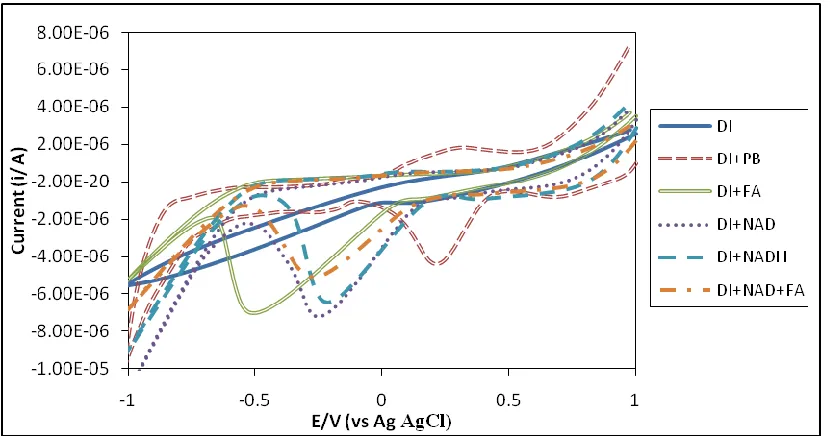
Each component in the electrochemical system was analysed using cyclic voltammetry in order to determine their peak’s potential to be applied for formaldehyde detection. The component tested were formaldehyde, phosphate buffer, NAD+, NADH and deionized water (DI). This experiment was carried out at potential ranging from -1 to 1 volt. Determination of formaldehyde was done by monitoring the current changes of the reduction of NAD+ to NADH. Besides, this reaction was interrelated with the concentration of formaldehyde.
Figure 1. Cyclic voltammetry (CV) of each component in the electrochemical system by using bare gold electrode at potential range of -1 to 1. (DI: deionized water, PB: phosphate buffer, FA: formaldehyde, NAD: nicotinamide adenine dinucleotide, NADH: reduced nicotinamide adenine dinucleotide)
According to Garret and Grisham [14], the typical half-cell reaction and their respective standard reduction potential for NAD+ to NADH is at -0.32 V vs. NHE which occurs directly. The enzymatic reaction and its half-cell reaction equations are shown below:
[image:4.596.93.508.374.592.2]
HCHO + NAD+ + H2O FDH HCOOH + NADH + H+
Half-cell reaction:
NAD+ +2H+ +2e- NADH + H+
In the reaction, formaldehyde dehydrogenase acts as the electron transfer to facilitate the addition of one hydrogen atom to NAD+ and reduced it to NADH, whereas formaldehyde will be converted to formic acid. The experiment was conducted by using bare electrode to monitor the potential peak of NAD+ with and without formaldehyde, NADH and also to determine whether formaldehyde, phosphate buffer and deionized water might coincide with NAD+ /NADH peak. As featured in Fig. 1, the potential of NAD+, NADH and NAD+ with addition of formaldehyde was at range of -0.3 to -0.2 V which close to the potential cited from the literature previously described by Garret and Grisham [14]. For deionized water, it did not exhibit any peak, while phosphate buffer (0.25 V) and formaldehyde (-0.5 V) peaks were appeared outside the range of NAD+/NADH potential. Therefore, such electrochemical electrolyte was applied to construct formaldehyde biosensor after certifying the components in the system did not interfere with each other.
3.2 Effect of redox reaction
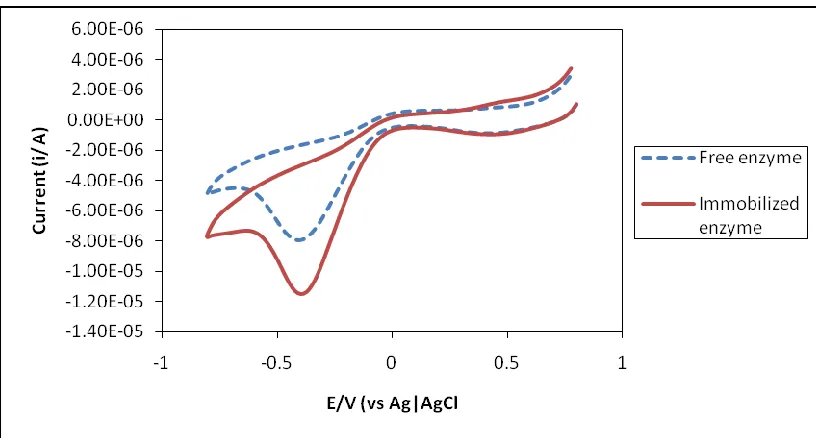
Figure 2. Redox reaction of free and immobilized enzyme by using CV (-1 to 1 volt) in the present of formaldehyde
[image:5.596.94.502.412.631.2]
catalytic activity of enzyme to occur maximally. By retaining its position with strong adherent with Nafion, the enzyme was recovered easily to its original form by detaching from the substrate and product, so that it can be used continuously. Beside, immobilization of enzyme can minimize denaturation of the enzyme during the operation and improve the stability of enzyme and also give effect to the changes of enzyme kinetic [15]. Some researchers [16,17] reported of Nafion as an effective protector to the coated electrode from fouling agent which existed in biological and food sample, and also prohibited from anionic interferences.
In addition, Soldatkin et al. [18] have drawn attention to the fact that addition of Nafion membrane can reduce the effects of buffer concentration on the sensor response significantly. By using CV, the potential was shifted to more negatively region at -0.45 V. This scenario occurred due to the effect of Nafion polymer properties for immobilization of the enzyme.
3.3 Effect of supporting electrolyte
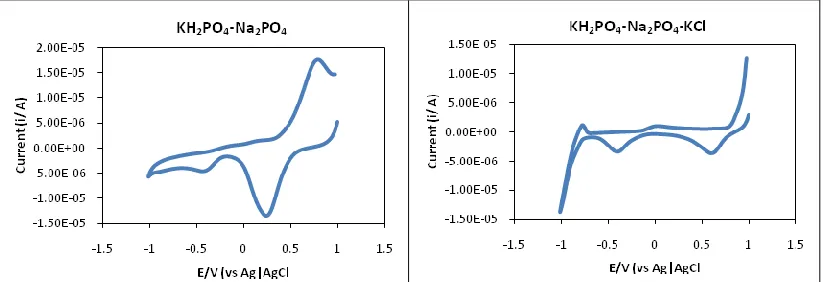
Figure 3. CV method on the effect of supporting electrolyte to redox reaction of NAD+ using immobilized enzyme in the presence of formaldehyde
Supporting electrolyte such as buffer is an important as it influenced the activation of the enzyme effectiveness in aqueous condition without interrupting their catalytic activity. Buffer played a vital role to maintain the native conformation of the enzyme and prevented inactivation of enzyme resulting from surrounding factors [19]. Several compositions of buffer such as phosphate buffer (potassium and sodium), Tris and KCl salt were carried out using cyclic voltammetry analysis in the presence of formaldehyde using coated electrode.
As shown in Figure 3, the usage of phosphate buffer is mainly investigated as it has interesting properties such as stability at various temperatures, non-toxic to enzyme protein (from structural alteration), microbial resistance and can be stored for several weeks. K+ and Na+ phosphate buffer can give effect to the diffusion coefficient across the polymer since Nafion acted as a cationic-exchange polymer that attributably from the inside of the polymer (sulfonate groups that have negatively charge). This polymer reduced the diffusion of total proton flux through the Nafion with the ‘carrier-mediated’ mechanism and created potential barrier for negatively charged buffer ions (PO4-3 that may
also form HPO4-2 and H2PO-4) [18,20]. Phosphate buffer is also crucial to produce two hydrogen ions
in the second enzyme reaction for reduction of NADH [21].
The addition of K+ and Na+ phosphate and the mixture of both cationic buffers were carried out but yielded several distinctive peaks (undesired peaks) that may interfered with the determination which came from many possible ions effect (e.g. OH-, H+ and PO43-). Besides, the addition of KCl salt
did not improve the supporting electrolyte system. Although some of the experiments showed well shape (only one peak of anodic and cathodic) response but the peaks were due to buffer redox reaction which misinterpreted as NAD+ reduction. This is proven by an experiment conducted in the absence of formaldehyde that showed the similar voltammogram.
[image:7.596.94.506.71.212.2]
as mentioned in section 3.1. Thus, K+ phosphate buffer with KOH without salt is used as supporting electrolyte in the development of formaldehyde electrochemical system.
3.4 Effect of multiple cycling
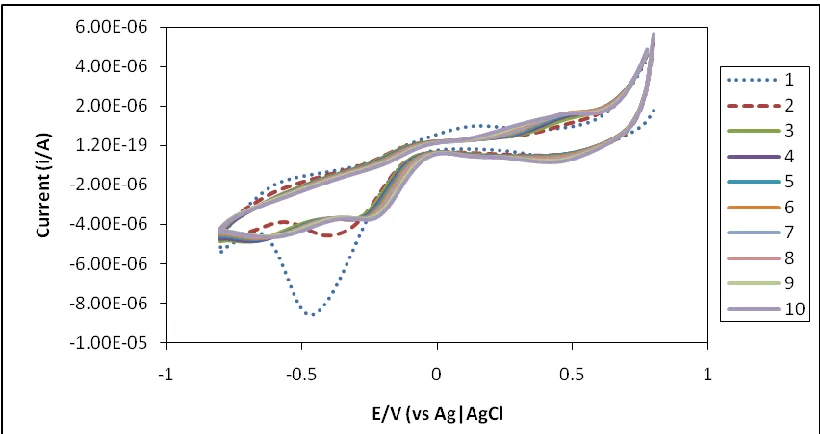
Figure 4. CV method on the effect of multiple cycling to redox reaction of free enzyme in the presence of formaldehyde
Multiple cycling was performed the redox reaction rate using 5 ppm of formaldehyde by cyclic voltammetry measurement. The multiple cycling was scanned for ten times within the potential range of -1 to 1 V as shown in Fig. 4. A gradual decreased of reduction peaks was observed, indicating the behaviour of enzymatic reaction that took place at the coating electrode declined as there was no further interaction at active site of the enzyme occurred efficiently with the analyte. The condition of which free enzyme did not embedded in matrix to retain its movement, made it floating freely or ‘suspended’ in electrochemical electrolyte might contributed to this matter. As can be seen, only the first scan showed well developed voltammogram and the following cycles was a similar response and the potential altered to the positively region a bit indicating irreversible enzymatic reaction.
3.5 Effect of pH
[image:8.596.93.503.158.375.2]
increased maximally up to pH 8.0 with the increasing of pH buffer but decreased after that. Besides, the obtained result is similar as reported by Herschkovitz et al. [6]. As explained by González-Sáiz and Pizarro [22], this phenomenon could be described by the changes of ionization state which resulted from the different consequence of the activity as the enzyme did not go through hydrolysis reaction in the pH range study. From this study, it showed that the enzyme activity preferred to an alkaline microenvironment of pH 8.0 rather than acidic or neutral pH with current changes measurement of 6.7 nA with RSD value of 8.16% (n=3).
3.6 Response range using enzyme
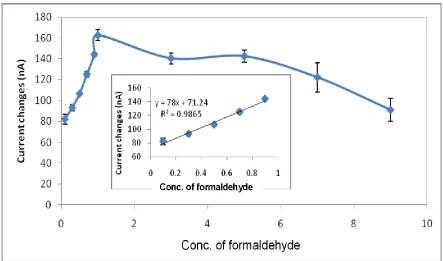
Figure 5. Response range of formaldehyde determination by using free form enzyme via DPV method (0.1 M phosphate buffer, pH 8, 0.5 mM NAD+, 50 mg/ml FDH, Ep = -0.4 V).
[image:9.596.76.519.245.506.2]
of formaldehyde responses which would give significant impact to the performance of the biosensor such as stability, efficiency and flexibility.
3.7 Reproducibility test
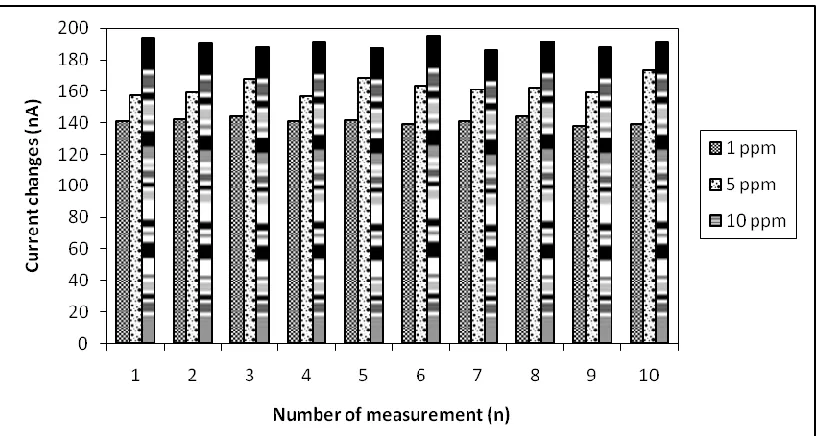
The reproducibility of formaldehyde biosensor using different working electrode that fabricated via the same set of procedure for formaldehyde determination for ten times yielded varying signals or current changes measurement (supplementary Fig. 2S). However, from the statistical analysis there were no significant differences at the 0.05 probability level which indicated a good reproducibility response without having a big variation in current changes with p-value of 1 ppm (0.988), 5 ppm (0.995) and 10 ppm (1.000). Reproducibility was related with precision especially to obtain calibration data from a large set of fabricate coated electrode. Therefore, in order to achieve that the aspects such as producing the same layer thickness of coating, handling with packaging, cleanliness to avoid redundant contamination, condition of workplace and the psychological state of the person in charge should be given attention. There is problems probability the reasons why the reproducibility of formaldehyde biosensor had a bit fluctuation in the current measurements.
3.8 Repeatability assay
Repeatability is defined as the degree of single coated sensor that could be used continually for a series of measurement under the similar operating conditions which can be produced the same result using the same concentration of the substrate. From the results, the current changes were decreased after the subsequent measurement for the different concentrations of formaldehyde (1, 5 and 10 ppm) (supplementary Fig. 3S). In fact, repeatability essentially depends on the stability of immobilization of enzyme in Nafion for enzymatic reaction. In this experiment, the current changes dropped gradually after used the same working electrode and shown by high percentage of RSD (1 ppm: 26.68%; 5 ppm: 39.10% and 10 ppm: 38.37%). This was related with the weakness of the interaction between enzyme coating and formaldehyde and caused the leaking of enzyme. Perhaps, this problem could be enhanced by the addition of mediator or electron transporter (such as ferrocene) that might be able to make the enzyme reaction become reversible and reusable for further enzymatic reaction by reoxidized the NADH again. Thus, the generating stable biosensor could be used repetitively.
3.9 Interferences studies by ratio
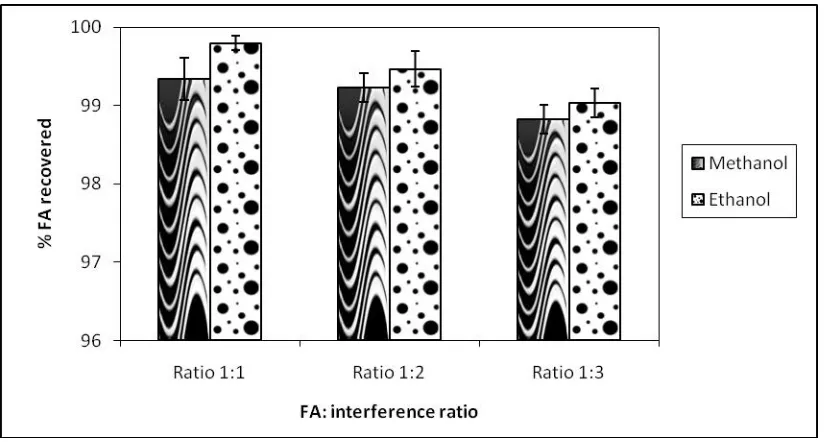
percentage of formaldehyde recovered which gave 99.3 to 99.8 % (ethanol) and 99.0 to 99.8 % (methanol), respectively.
In spite of that, the biosensor response was not significantly affected by the presence of the interferences in the system. In concluded that the formaldehyde biosensor retained its specificity towards formaldehyde and the addition of methanol or ethanol did not give immense response.
3.10 Storage stability
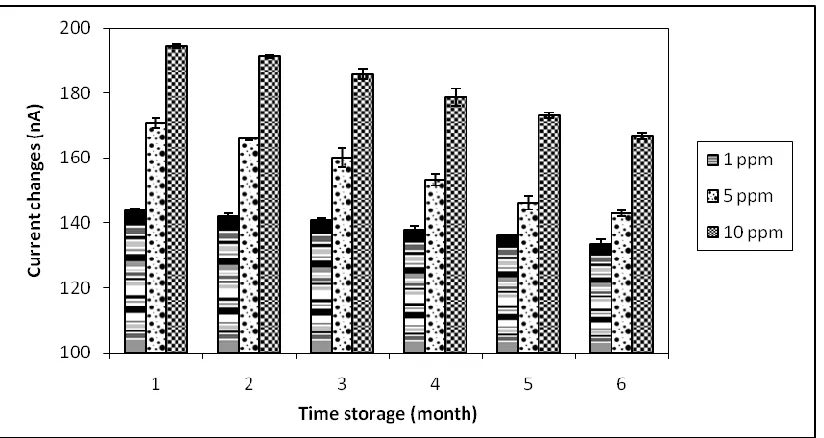
This study was conducted by period of time, where the slurry of the enzyme immobilized in Nafion was stored at 4oC for determination of formaldehyde monthly using DPV method. From the results, the current changes measurements for storage shelf life of formaldehyde biosensor were still 90% although exceeded to six months at three different concentrations of formaldehyde (1, 5 and 10 ppm).
Figure 6. Storage stability of formaldehyde biosensor in monthly periods (mean values ± % RSD, n=3) using DPV method.
As featured in Fig. 6, the current changes measurements were decreased slightly possibly due to the changes of the enzyme immobilization composition and the loss of protein chain of enzyme flexibility. There also might be due the distinction of microenvironment existed surrounding the enzyme molecule within the polymer.
[image:11.596.95.507.321.540.2]
to monitor their stability lifetime. Therefore, it was important to determine its due date before it perished and became ineffective [24].
4. CONCLUSION
The developed formaldehyde biosensor used with free form enzyme and immobilized in Nafion polymer due to improve its stability and then deposited on the gold electrode. Both condition yielded current changes which is correlated with the concentration of substrate. Using free enzyme, the peak’s potential reduction of NAD+ has found at -0.2 V. A limit of detection is 0.016 ppm of formaldehyde in aqueous solution and a response time less than 1 min. It also showed a high reproducibility, repeatability, storage stability and interferences for the determination of formaldehyde in fish samples.
ACKNOWLEDGMENTS
The authors are grateful for the financial support provided by the Malaysian government through Ministry of Science, Technology and Innovation (MOSTI) and Malaysian Genome Institute (MGI) under research project no. 001-002-0027.
References
1. 1. I. Kolodziejska, C. Niecikowska, Z.E. Sikorski, Food Chem. 50 (1994) 281. 2. Z. Sikorski, J. Olley, S. Kostuch, Cric. Rev. Food Sci. Technol. 8 (1976) 97.
3. Y. Yanagawa, N. Kaneko, K. Hatanaka, T. Sakamoto, Y. Okada, S. Yoshimitu, Clin. Toxicol. 45 (2007) 72.
4. F. Bianchi, M. Careri, M. Musci, A. Mangia, Food Chem. 100 (2007) 1049.
5. F. Bianchi, M. Careri, C. Corradini, M. Musci, A. Mangia, Curr. Anal. Chem. 1 (2005) 129. 6. Y. Herschkovitz, I. Eshkenazi, C.E. Campbell, J. Rishpon, J. Electroanal. Chem. 491 (2000) 182. 7. W.H. Chan, T.Y. Xie, Anal. Chim. Acta 339 (1997) 173.
8. Y.I. Korpan, M.V. Gonchar, A.A. Sibirny, C. Martelet, A.V. El’kasaya, T.D. Gibson, A.P. Soldatkin, Biosens. Bioelectron. 15 (2000) 77.
9. K.P. Rindt, S. Scholtissek, In: R.D. Schmid, F.W. Scheller, (eds.) Environmental Protection and Process Control, GBF Monographs, Vol. 13, VCH, Weinheim, (1989) pp. 405.
10.B. Winter, K. Cammann, Fres. J. Anal. Chem. 334 (1989) 718.
11.K. Ito, M. Takahashi, T. Yoshimoto, D. Tsuru, J. Bacteriol. 176 (1994) 2483. 12.M.J. Lobo, A.J. Miranda, P. Tuñón, Electroanalysis 9 (1997) 191.
13.S. Ogushi, M. Ando, D. Tsuru, J. Biochem. 96 (1984) 1587.
14.R.H. Garrett, C.M. Grisham, Electron transport and oxidative phosphorylation, In Biochemistry, 3rd ed., Thomsom Brooks/Cole, Singapore, (2005) pp. 640-645.
15.M.D. Busto, Biochem. Educ. 26 (1998) 304.
16.F. Mizutani, S. Yabuki, T. Katsura, Anal. Chim. Acta 274 (1993) 201. 17.J.A. Cox, T. Gray, B.K. Das, J. Electroanal. Chem. 247 (1988) 315.
18.A.P. Soldatkin, A.V. El’skaya, A.A. Shul’ga, A.S. Jdanova, S.V. Dzyadevich, N. Jaffrezic-Renaul, C. Martelet, P. Clechet, Anal. Chim. Acta 288 (1994) 197.
19.Y. Murakami, R. Hoshi, A. Hirata, J. Mol. Catal. B: Enzym. 22 (2003) 79.
21.M. Elmgren, S.-E. Lindquist, M. Sharp, J. Electroanal. Chem. 362 (1993) 227. 22.J.M. González-Sáiz, C. Pizarro, Eur. Polymer J. 37 (2001) 435.
23.D.S. Ballantine, R.M. White, S.J. Martin, A.J. Ricco, E.T. Zellers, G.C. Frye, H. Wohltjen, In: M. Levy, R. Stern, (eds.), acoustic wave sensors: theory, design, and physico-chemical applications, (1997) pp. 222-320. San Diego, California: Academic Press.
Supplementary Figures:
Figure 1S. CV method on the effect of pH to redox reaction of free enzyme in the present of formaldehyde (mean values ± % RSD, n=3)
[image:13.596.96.508.180.397.2] [image:13.596.95.508.465.683.2]
Figure 3S. Repeatability of formaldehyde biosensor at different concentrations of formaldehyde using DPV method.
Figure 4S. Percentage of formaldehyde recovery for interferences studies (DPV) carried out at different ratio using immobilized enzyme (mean values ± % RSD, n=3).
[image:14.596.94.504.71.288.2] [image:14.596.94.508.355.576.2]