IMPLEMENTING QUALITY MANAGEMENT IN
DEVELOPMENT BUREAUCRACIES
Mohamed Asim
A thesis submitted for the degree of Doctor of Philosophy
of The Australian National University
DECLARATION
Except where cited in the text, this thesis is the result of my own original research carried out as a Ph.D. student at the Australian National University.
Mohamed Asim
ACKNOWLEDGEMENTS
The completion of this research has been made possible through the generous
assistance of several parties and individuals.
First and foremost I would like to express my gratitude to the Government of
Maldives for granting me a three-year scholarship. The fieldwork for this research
was made possible with the permission granted by the Malaysian government to
conduct research in the Malaysian public service. In this regard I would like to thank
the Economic Planning Unit of the Prime Minister’s Department in Malaysia for
granting the necessary research permit. I am indebted to Dr. Halim Shafie, the
Director of the National Institute of Public Administration (INTAN), and to Dr. P.
Manogran, Mr. Sirajuddin Salleh, and to numerous other managerial and non-
managerial staff, at both the Bukit Kiara and Jalan Elmu campus, for their invaluable
assistance in obtaining documents, distributing questionnaires and arranging
interviews. I am also deeply indebted to numerous other Malaysians who have
assisted me in this research while in the field and through electronic mail while in
Canberra. My gratitude also goes to Ms. Norlin for translating the relevant Malay
documents and to Ms. Yong Lee Fen for accommodating my requests for information
in filling the gaps I discovered while writing this thesis.
In the list of those individuals I am indebted, the staff at the National Centre for
Development Studies (NCDS) at the Asia Pacific School of Economics and
Management at the ANU require separate mentioning. Dr. Michael Hess, was a
constant source of inspiration and support, as the chair of my thesis advisory panel
and as a friend. His continuous guidance, and the subtle ways he utilises to
positively encourage the student during the most difficult times contributed towards
the timely completion of this thesis.
I would like to thank Dr. Peter Larmour too for his guidance in the initial stages of my
study, and also for his willingness to discuss difficult issues whenever I approached
him. Equally helpful was Dr. Christine Sylvester, who provided invaluable assistance
in terms of research methodology and data presentation. My gratitude also goes to
Ms. Maurette MacLeod, our Program Administrator, for keeping the ‘needs of the
students first’ and to Ms. Jennie Colman and her efficient staff in the administration.
For editing the final draft of this thesis, my gratitude goes to Ms. Mamie at the
Publications Unit at NCDS. In sorting out the intricacies of bibliographic style and
referencing I am deeply appreciative of the advice of Ms. Alison Cumming Thom.
I would also like to thank fellow Ph.D. and Graduate Diploma and Masters students
at NCDS. I have greatly benefited from their thoughtful comments and insights while
lecturing in the Strategic Human Resource Management and the Management and
Organisational Change courses.
Outside the NCDS, I sincerely thank the other members of my advisory panel, Dr.
Harold Crouch from the Research School of Pacific and Asian Studies at the ANU
and Dr. Chris Fisher from the Faculty of Management at the University of Canberra.
As a keen observer of the Malaysian political system, Dr. Crouch provided me with a
‘balanced’ perspective in studying the Malaysian public service, while Dr. Fisher
meticulously read the entire manuscript and provided invaluable suggestions.
My gratitude also goes to Mr. Ross Cunningham at the Statistical Consulting Unit of
the ANU for his advice and guidance on simple statistical methods that were clear
and understandable.
Last, but not the least important, I would like to thank my wife and daughter for their
love, patience, understanding and support during my three years of study in
ABSTRACT
Focus on gauging the needs of the customers and tapping the human resource
potential is increasingly evident in both public and private organisations. Such
practices have been associated with the managerial discipline of quality
management, popularly referred by the acronym of TQM.
This thesis fills a gap in existing literature on quality management in public sector
organisations by examining the application of quality management in a development
bureaucracy. The Malaysian public service is examined to identify the effects of
quality management on human resources and organisational change in development
bureaucracies.
The research methodology focuses on two levels of research. The first provides a
macro perspective through a review of Government policies and guidelines and the
views of two selected groups of public service employees. The second level of
research, which is the case study of the National Institute of Public Administration
(INTAN), provides a detailed analysis of the main operational mechanisms of quality
management, namely the Quality Control Circles (QCCs), Work Teams and the
Client’s Charter. The case study also includes the perceptions of managerial and
non-managerial employees on the impact of quality management on several
organisational aspects. These are employee training; work skill and knowledge; work
changes; team work; job satisfaction; work recognition; employee relations and
morale; employee involvement and impact on the customer; employee performance
and organisational performance.
This study concludes that there is a well-established quality management framework
in the Malaysian public service. Public service employees in general portrayed a high
degree of awareness of the concepts and practices of quality management. At the
organisational level too, the perceptions of employees at INTAN on the impact of
quality management were positive on many of the organisational aspects selected.
However, the case study indicated that QCCs were not assimilated as a routine work
process and there were criticisms of QCCs specifically with regard to the
bureaucratic layer it added and on the triviality of issues tackled in QCCs. This was
also reflected in the perceptions of employees on the benefits and usefulness of
teamwork. The aspects of work recognition, employees’ impact on customers,
employee performance and organisational performance too received less positive
responses compared to the other organisational aspects studied.
This study has shown that the application of quality management principles and
practices has provided a focus of change in the Malaysian public service. For
development bureaucracies in general, quality management may represent an
approach that may be adopted in reform programs to involve employees and to bring
about greater customer focus in public service organisations.
CONTENTS
DECLARATION ii
ACKNOWLEDGEMENTS iii
ABSTRACT vi
LIST OF FIGURES xi
LIST OF TABLES xiii
LIST OF ACRONYMS xv
Chapter 1
INTRODUCTION 1
Subject background 2
Study area and scope 10
Research questions and methodology 13
Limitations of the study 17
Organisation of the study 17
Chapter 2
THEORY AND PRACTICE OF QUALITY MANAGEMENT:
REVIEW OF LITERATURE 20
Theories propagated by quality management scholars 20
W. Edwards Deming 21
Joseph Juran 29
Kaoru Ishikawa 33
Philip B. Crosby 37
Quality management in practice: cases from
private sector organisations 44
Impacts and implications for public service organisations 55
Applicability in the public service 55
Impacts on public service organisations and implications
for development bureaucracies 60
Conclusions 71
Chapter 3
PARADIGMS, PRACTICES AND QUALITY MANAGEMENT CONCEPTS
IN PUBLIC SERVICE REFORM PROGRAMS 74
Managerial paradigms and practices underpinning public service
reform initiatives in developed countries 76
Quality management concepts in public service3
reform programs of developed countries 84
The American case 85
The Canadian case 91
The British case 95
Salience of quality management concepts in
public service reform programs 108
Quality management concepts in East Asian public services 111
Conclusions 116
Chapter 4
RESEARCH METHODOLOGY 120
The macro perspective 122
The case study 126
Review of documents 129
Survey questionnaires 129
Interviews 133
Data analysis and presentation 135
Constraints of field research 136
Chapter 5
QUALITY MANAGEMENT IN THE MALAYSIAN
PUBLIC SERVICE 139
Overview of administrative reforms in the
Malaysian public service 142
Administrative reforms in the seventies and eighties 143
Administrative reform in the nineties and the introduction
of quality management 151
Review of three main programs on quality management 158
Guidelines on Quality Control Circles 158
Guide on Total Quality Management 165
Guidelines on the Client’s Charter 171
Perceptions from the Training Groups 174
Conclusions 182
Chapter 6
ORGANISATIONAL IMPACT OF QUALITY MANAGEMENT:
THE CASE OF INTAN 185
Overview of INTAN 187
Quality management at INTAN 189
Organisational changes and their impacts 191
QCCs 193
Work Teams 199
The Client’s Charter 203
Employees’ views on the impact of quality management 209
1. Employee training 214
2. Work skill and knowledge 218
3. Work changes 219
4. Teamwork 222
5. Job satisfaction 226
6. Work recognition 229
7. Employee relations and morale 232
8. Employee involvement and impact on the customer 234
9. Employee performance 238
10 Organisational performance 240
Discussion of employee perceptions 242
Conclusions 249
Chapter 7
CONCLUSIONS, IMPLICATIONS AND PROSPECTS
FOR DEVELOPMENT BUREAUCRACIES 253
Summary and discussion of research findings 255
Policy implications for the Malaysian public service 267
Prospects for development bureaucracies 270
Research and other policy implications 276
REFERENCES 281
APPENDIX 1
TRAINING GROUPS’ QUESTIONNAIRE 293
APPENDIX 2
INTAN SURVEY QUESTIONNAIRES
Head of section/unit questionnaire 299
Staff member questionnaire 306
Soalselidik kakitangan (Malay translation of
staff member questionnaire) 311
APPENDIX 3
LIST OF INTERVIEWEES 318
LIST OF FIGURES
Figure 2.1. The Production Process 22
Figure 2.2. Quality Improvement Cycle Proposed by Deming 23
Figure 2.3. The Juran Trilogy Diagram 30
Figure 2.4. Theoretical Perceptions of Quality Compared 42
Figure 2.5 Potential Impact of TQM on Features of the
Organisation Culture 43
Figure 3.1. Components of the New Public Management 79
Figure 3.2. Charter Mark Trends 1992-1996 100
Figure 4.1. The Research Design 121
Figure 5.1. The Concept of Total Quality in the Malaysian Public Service 141
Figure 5.2. Structure for Quality and Productivity 156
Figure 5.3. The Quality Control Circle Structure 160
Figure 5.4. The PDCA Approach 161
Figure 5.5. Phases of a Circle’s Life 165
Figure 5.6. Model of Continuous Improvement 167
Figure 5.7. Impact of TQM on Selected Organisational Aspects:
Perceptions from Training Groups 177
Figure 5.8. Effectiveness of TQM on Improving Employee and
Organisational Performance: Perceptions from
Training Groups 178
Figure 6.1. Organisation Structure of the National Institute of Public
Administration 188
Figure 6.2. The ‘5W and 1H’ Method 195
Figure 6.3. ‘Fish Bone Chart’: Paper Wastage in the Printing Process 196
Figure 6.4. Work Teams at INTAN 200
Figure 6.5. INTAN’s Client’s Charter 204
F ig u re 6.6. R e s p o n s e s o f E m p lo y e e s w ith V e ry L ittle T Q M T ra in in g a nd S u b s ta n tia l TQ M T ra in in g on th e S e le c te d
O rg a n is a tio n a l A sp e c ts 247
F ig u re 6.7. R e s p o n s e s o f Q C C P a rtic ip a n ts and O th e rs on th e S e le c te d
O rg a n is a tio n a l A s p e c ts 248
LIST OF TABLES
Table 1.1. Principles, Practices and Techniques of Total Quality 5
Table 2.1. Average Rating of TQM Principles, Procedures and Tools 47
Table 2.2. Summary of Studies Reviewed on the Impact of
Quality Management in Private Sector Organisations 54
Table 2.3. Functions of General Management 58
Table 3.1. Programs Initiated or Significantly Revised as Reported
by OECD Countries 1987-92 81
Table 3.2. Service Quality Initiatives in Selected OECD Countries 84
Table 3.3. Change in Civil Service Culture 92
Table 3.4. Performance Measures of Urban Ambulance Service
in Britain 102
Table 3.5. Functional Committees of PS21 and their Terms of
Reference 113
Table 3.6. Progress of the Performance Pledge Initiative in
Hong Kong 115
Table 4.1. Number of Questionnaires Distributed and Received
by Program 133
Table 5.1. Development Administration Circulars Issued by the
Malaysian Government 154
Table 6.1. Distribution of Respondents by Age Groups 211
Table 6.2. Distribution of Respondents by Period in Public Service 212
Table 6.3. Distribution of Respondents by Period Employed at
INTAN 213
Table 6.4. Distribution of Respondents by Educational Qualification 213
Table 6.5 . Respondents Views on Training on TQM, Training on
Vision and Objectives of the Organisation, and the
Opportunity to Practice Skills Acquired in Training 216
Table 6.6. Respondents Views on Whether they were Getting
Enough Training 217
Table 6.7. Respondents Views on Whether they were Working with
Greater Skill and Knowledge with TQM Implementation 219
Table 6.8. Respondents Views on Work Changes as a Result
of TQM 221
Table 6.9. Usefulness of Group Involvement for the Organisation 223
Table 6.10. Impact of Groups on the Organisation 224
Table 6.11. Benefits of Group Participation 224
Table 6.12. Level of Job Satisfaction 227
Table 6.13. Overall Mean Job Satisfaction Levels 227
Table 6.14. Factors that Would Make Job More Satisfying 228
Table 6.15. Work Recognition by Senior Management 231
Table 6.16. Effectiveness of TQM in Improving Employee Relations 233
Table 6.17. Morale of Employees in the Unit 233
Table6.18. Effectiveness of TQM to Involve All Employees 236
Table 6.19. Say or Influence on Decisions Made in the Unit 236
Table 6.20. Employees’ Impact on the Customer 237
Table 6.21. Employee Performance Improvement with TQM 239
Tabie 6.22. Performance improvement at the Unit Level 241
Table 6.23. Performance Improvement at the Organisational Level 241
Table 6.24. Cumulative Positive Responses from INTAN Employees 243
Table 6.25. Employees’ Perceptions on Selected Organisational Aspects 243
LIST OF ACRONYMS
A S Q A m e ric a n S o c ie ty fo r Q u a lity
A T & T A m e ric a n T e le p h o n e and T e le g ra p h C o m p a n y
BA B en e fits A g e n c y
C E O C h ie f E xe cu tive O ffic e r
D A C D e v e lo p m e n t A d m in is tra tio n C irc u la r
DAU D e v e lo p m e n t A d m in is tra tio n U nit
E PU E c o n o m ic P lanning U n it
G .O .F 10 G ro u p o f Ten
IBM In te rn a tio n a l B u sin e ss M a c h in e s
IN T A N In stitu t T a d b ira n A w a m N e g a ra (N a tio n a l In stitu te o f P u b lic A d m in is tra tio n )
IR Inland R e ve nu e
IS IS Institu te o f S tra te g ic and In te rn a tio n a l S tu d ie s
IS O In te rn a tio n a l O rg a n is a tio n fo r S ta n d a rd is a tio n
M A M P U M a la ysia n A d m in is tra tiv e M o d e rn is a tio n and M a n a g e m e n t P la nn in g U nit
N E P N ew E c o n o m ic P olicy
N IS T N a tio n a l In stitu te o f S ta n d a rd s and T e c h n o lo g y
N PM N ew P u b lic M a n a g e m e n t
O E C D O rg a n is a tio n fo r E c o n o m ic C o -o p e ra tio n and D e v e lo p m e n t
P D C A Plan, Do, C h e c k and A c t
P O S D C O R B P la nn in g, O rg a n isin g , S ta ffin g , D ire ctin g , C o o rd in a tin g , R e p o rtin g and B u d g e tin g
PS21 P u b lic S e rvice fo r th e 2 1 st C e n tu ry
Q C C Q u a lity C o n tro l C ircle
Chapter 1
INTRODUCTION
The objective of this thesis is to expand the understanding of the impact of quality
management in development bureaucracies by examining the effects of quality
management on human resources and organisational change in the Malaysian
public service. The inherent arguments in this thesis are that quality management
with its roots in the manufacturing sector, has brought forth several concepts and
practices that are increasingly been applied in the public sector. This is evident in
the public service reform programs of the USA, Britain, Canada, Australia and in
newly developed nations such as Singapore. Among the developing countries in
East Asia, the Malaysian public service represents an example of a development
bureaucracy that has implemented quality management concepts in its
administrative reform programs. As such, findings of this research will provide
significant lessons for development bureaucracies in general attempting to
implement customer orientation and team work within their administrative reform
programs.
The thesis will fill a gap in existing literature on quality management in public
service organisations, recognising that most of the research available has been
conducted in the context of developed countries (James, 1997; McDaniel, 1997;
Park, 1997; O’Donnell, 1996; McGowan, 1995; Redman et al., 1995; Morgan and
Murgatroyd, 1994; Offner, 1993; Bunning, 1992).
This chapter will introduce the thesis by first providing a brief synopsis of quality
management and its relationship to public service reform. It will then outline the
study area and the scope of this research followed by the research questions and a
brief overview of the research methodology. The chapter will conclude with
discussions on the importance of the study, its limitations and how the thesis will be
organised.
Subject background
Quality management in simple terms could be expressed through the meaning of
the term ‘quality’. According to the Cambridge International Dictionary of English,
the word quality means the ‘characteristic or feature of someone or something’ or,
the ‘standard of excellence of something, often a high standard.’ Hence, a quality
product means a product of high standard or quality. The same meaning is
conveyed in the context of service delivery. Quality management in an
organisational context, then is the application of certain practices and techniques
which ensure that the end product or output of an organisation, whether a product
or a service, is of a high standard. At the organisational level, the variables that
affect the quality of the product or service comprise those factors that influence the
organisation internally as well as externally. Variables such as the work process,
human resources, and the management of the organisation could be included as
factors internal to the organisation, while variables such as the organisation’s
approach to the customer or the recipients of the product or service could be
considered as external factors that may have a direct impact on determining a
quality product or service. Accordingly, quality management in simplistic terms
represents a managerial discipline that fosters the transformation or restructuring of
all of these internal and external variables that impact upon the organisation. This
change has to come about in relation to the requirements or needs of the
customers, as the judge of a quality product or service would be the user of that
product or service.
The literature on quality management indicates that the contemporary application of
quality management concepts has its roots in statistical quality control methods
started in the United States of America (USA) and Europe, with the onset of the
industrial revolution and mass production (Bendell et al., 1994:14; Tuckman,
1995:55; Lindsay and Petrick, 1997:62). Hence, modern quality control techniques
began in the 1930s with the invention of the control chart by Walter Shewhart of the
Bell Laboratories in the USA (Ishikawa, 1985:14). Shewhart, however, adopted into
manufacturing the methods of statistical quality control used in agricultural research
in Britain by R.A. Fisher (Green, 1994:16).
Statistical quality control basically identifies variations in the production process
through statistical methods and redesigns the system to reduce such variations, so
as to ultimately improve the quality of the product (Bank, 1992:63). The process of
statistical quality control has often been confused with the process of quality
assurance, which ensures the quality of the product at the very final stage of the
product, assuring standards of quality set, by weeding out products that do not
conform (Thompson and Koronacki, 1993:2). The basic paradigm for quality
focuses on the elimination of conceivable problems at the design stage and
extensive pilot testing before actual production of the product (Thompson and
Koronacki, 1993:13).
The Second World War provided the Americans with the testing grounds for the
application of Shewhart’s techniques and quality control techniques proved to be an
effective method of manufacturing military supplies efficiently and cheaply
(Ishikawa, 1985:14). The concepts of controlling the quality of products
manufactured had been perfected at a very early date. For example, the adoption
of quality standards in Britain, labeled then as ‘British Standards 600’ started as
early as 1935 (Ishikawa, 1985:14).
Although quality management has its roots in statistical quality control, quality
management as a managerial discipline appeared after the Second World War in
Japan when the Japanese aggressively pursued the ideas of quality improvement
in products and company performance in the 1950s. This was done with the
assistance of two Americans, W. Edwards Deming and Joseph Juran. A Japanese
scholar, Kaoru Ishikawa also needs be noted here for popularising the concepts of
quality circles and the use of statistical tools in problem solving, which became one
of the crucial practices in the implementation of total quality management.
Subsequent development of quality management practices took place in Japan and
in the seventies the quality movement was carried back to the USA by Deming,
Juran and by other scholars such as Philip Crosby (Lindsay and Petrick, 1997:73).
More recently, quality management has become an established element of
managerial discipline. This has not meant, however, that it has been universally
accepted. While it has been hailed for its many achievements (Green, 1994:1-4), it
has also been seen as a passing management fad (O’Donnell, 1996:259). There is
also concern among academics about whether quality management in its ‘orthodox’
form could be applied in the public sector (Swiss, 1992:360).
Amidst the various viewpoints, however, several academics and practitioners have
presented specific managerial concepts drawn from the writings of the major quality
theorists, and have termed these concepts as total quality management,
popularised in the acronym of TQM (Hackman and Wageman, 1995; Dean Jr. and
Bowen, 1994; Grant et al., 1994). As will be outlined in detail in the next chapter,
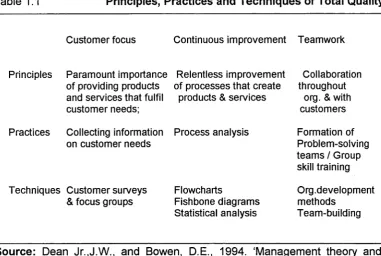
three major principles encompass quality management: customer focus; continuous
improvement and team work. The practices and techniques associated with these
principles have been summarised by two theorists reproduced here as Table 1.1.
Table 1.1 Principles, P ractices and T ec h n iq u es of Total Q uality
Customer focus Continuous improvement Teamwork
Principles Paramount importance of providing products and services that fulfil customer needs;
Relentless improvement of processes that create
products & services
Collaboration throughout
org. & with customers
Practices Collecting information on customer needs
Process analysis Formation of Problem-solving teams / Group skill training
Techniques Customer surveys & focus groups
Flowcharts
Fishbone diagrams Statistical analysis
Org.development methods
Team-building
S ource: Dean Jr.,J.W., and Bowen, D.E., 1994. ‘Management theory and total quality: improving research and practice through theory development’, The Academy of Management Review, 19(3): 395.
The principle of customer focus is geared towards restructuring the organisation to
meet the needs and requirements of the customers that the organisation serves.
The practices and techniques commonly associated with customer focus are
primarily customer surveys to collect data to determine needs and expectations.
The principle of team work focuses on collaboration of employees at all levels of the
organisation through the formation of teams and the use of problem solving
methods. Finally, to sustain the quality of a product or service there needs to be
continuous improvement of organisational procedures.
These concepts have been applied in both public and private sector organistions to
improve the quality of products and services delivered and to improve the human
resource potential in organisations. The potential effects of quality management at
[image:20.527.75.457.125.381.2]the organisational level could be highlighted through outcomes of some of the
studies that are available in the context of private organisations (Lam, 1995; Shea
and Gobeli, 1995; Hodgetts, 1994; Fisher, 1993; Fisher and Davis, 1992; Fisher,
1990). The details of these studies are provided in Chapter Two. Positive effects
reported in these studies included fewer defects in manufacturing, reduced waste,
and increased profits (Fisher, 1993:188). Positive improvements of group
involvement and work satisfaction were also reported (Fisher and Davis, 1992:132).
Negative aspects reported in these studies included the need for more training,
poor relations between departments, diminished work satisfaction, and increased
work load (Fisher and Davis, 1992:132; Lam, 1995:98).
Similarly, the studies reviewed on the application of quality management in public
organisations reported both positive and negative effects (James, 1997; McDaniel,
1997; Park, 1997; O’Donnell, 1996; McGowan, 1995; Redman et al., 1995; Zayed,
1994). Positive effects in public organisations included raising awareness of
employees, focusing on customer satisfaction, improving teamwork, and reducing
customer complaints (Redman et al., 1995:27). Other studies showed that
employee involvement through teams brought about positive effects associated with
employee participation resulting in improvements in job satisfaction, skill variety and
co-worker social support (James, 1997: 226). More critical studies, however,
showed that quality management cannot be imposed on existing management
structures (McGowan, 1995:330), and will not work if it conflicts with existing
management practices (O’Donnell, 1996:259).
In general, however, reported research results claims that the application of quality
management has the potential to bring about positive changes at the organisational
level in both public and private organisations. These include positive perceptions by
organisation itself. Perhaps due to the successes reported in the application of
quality management in private organisations, concepts that are inherent in the
quality management literature have begun to be applied in public service reform
programs in several developed countries.
A review of the literature on public service reform programs in developed countries
reveal that the concept of quality service seems to be high on the reform agenda
(National Performance Review, 1995:2; Offner, 1993:6; Treasury Board of Canada,
1993:4; Singapore Prime Minister’s Office, 1996:1; OECD, 1995:22; OECD, 1996a;
OECD, 1997:78). Out of the three main principles of quality management already
mentioned in defining quality management, the principle of customer orientation is
perhaps most evident in public service reform programs of developed countries
such as the USA, Britain and in newly industrialised countries such as Singapore.
The context of quality management in the emerging paradigms and practices of
public service reform will be outlined in Chapter Three. Here, a brief overview of key
concepts inherent in public service reform programs of developed countries will be
presented.
In the USA, public service reforms implemented under the National Performance
Review in 1993 focused on ‘cutting red tape; putting customers first; empowering
employees to get results; and producing a better government overall by fostering
excellence’ (Gore, 1993:xl-xli). The reforms initiated under the National
Performance Review encompassed quality management principles and to the point
that the American Vice President Gore could state that ‘quality management is the
official policy of the United States government’ (National Performance Review,
1995:2).
In Britain, the implementation of the ‘next steps’ initiative under Prime Minister
Margaret Thatcher signified the importance accorded by the government to quality
service delivery. This initiative, which separated the policy execution from policy
formulation, entrusted the tasks of policy execution and service delivery to the so-
called ‘next-step’ agencies (Savoie, 1994:205). The chief executives placed in
charge of the newly created ‘next step’ agencies were to be provided with
considerable managerial independence in the execution of all managerial functions
(Ridley, 1995:23). The concept of the Citizen’s Charter introduced by Prime Minister
John Major in 1991, emphasised the importance of citizens as service recipients
and highlighted the significance of quality management practices in the public
service. The reforms initiated with the Citizen’s Charter carried through a
comprehensive program designed to improve the quality of public services and to
make public service organisations more accountable and answerable to the public
(Offner, 1993:6).
The emphasis towards developing a quality service culture is also apparent in public
service reform programs adopted in the newly industrialised countries of East Asia.
The East Asian region is being targeted in this discussion because this research will
be examining the case of one of the rapidly industrialising countries in this region,
that is Malaysia. The cases of Singapore and Hong Kong will be cited in particular
because they have been involved in implementing quality management as part of
their public sector reform programs.
In Singapore, the establishment of the Service Improvement Unit, in 1991, was one
of the major steps taken by the government to improve and sustain the quality of
services delivered by the public service. The Service Improvement Unit was formed
with the objective of measuring, reviewing and auditing the speed of services
delivered by all government agencies, and more generally to consider all
suggestions from the public for service improvement (Quah, 1995:339).
In its initial two years, the Service Improvement Unit, focused on increasing
organisational efficiency and effectiveness, and maximising human resource
training to enable civil servants to perform better. Other measures pursued included
office automation, encouragement of statutory boards to assess quality of service,
and monitoring of feedback received from the public by analysing the nature of the
requests, complaints and suggestions regarding various public agencies (Quah,
1995:340).
In Mong Kong, a similar mechanism, the Efficiency Unit, was set up with the aim of
securing improvements in the formulation of policy objectives and priorities,
management and motivation of staff, control over the use of resources, and the
efficient delivery of services to customers (Sankey, 1995:22). The public sector
reform objectives in Hong Kong have also addressed the need to improve efficiency
by making the best use of the resources available, providing a better service to the
community, and bringing about greater job satisfaction in the civil service (Tsang,
1995:5).
In general then it can be concluded that, the application of quality management
concepts such as customer orientation and teamwork has been a significant factor
in public sector reform programs. So when the Government of Malaysia
implemented its quality management program with the objective of reforming the
administrative structures of the bureaucracy and instilling a positive work culture
among the public service employees it was following examples in both western and
newly industrialised countries.
The study area and scope
The Malaysian bureaucracy has been well-established since the colonial times.
Scholars have argued that when Malaya gained independence in 1957, it had a
‘highly sophisticated and unquestionably efficient bureaucratic apparatus (Tilman,
1964:63). One result of the colonial inheritance was evident in the bureaucracy’s
pre-occupation with system maintenance and adherence to rules and regulations
(Esman, 1972:98). As stated by Esman,
Order and regularity were the pride of the system. Precedents were highly prized. The administration was files-oriented, and few officers were prepared to determine and legitimise their decisions. The present generation of officers was taught by their expatriate mentors to respect and be guided by regulations and precedents and to perpetuate routines. They were not encouraged to deviate or to experiment. The purpose of administration was to keep things going along established and approved lines, not to change them, and this applied equally for administrators as well as for clerks (Esman, 1972:98).
However, the Malaysian public service not only reflected its colonial origin but also
the nature of its plural society (Esman, 1972:8). Hence, in the Malaysian context,
one’s place in the social system, status differences and respect for authority are
prominent features in human relationships (Esman, 1972:120; Puthucheary,
1978:87). The interpretations of rules and regulations and decisions taken are
‘watered’ down depending on who the person is in society. Hence, these aspects
are reflected in the functioning of the bureaucracy. For example Puthucheary stated
that,
Informal personal communications are usually more effective than the formal, impersonal channels. This is generally true in all systems of administration but in Malaysia personal contacts are especially important. It is the most effective way of getting things done (Puthucheary, 1978:89).
Furthermore she stated that,
When a decision has to be taken it is important that the person taking the decision is fully aware of the ‘background’ of the applicant so that the ‘right’ decision may be made. Great pains are taken therefore to ensure that one gets a sympathetic hearing by using whatever contact channels that are available. The usual method if one does not know the person directly is to find out who has influence with him and speak to his person ... Even in cases where no special favour is being requested it is found necessary to use one’s influence to expedite matters (Puthucheary, 1978:89-90).
Given the bureaucratic nature of the government machinery and the work culture of
a plural society, administrative reform in Malaysia has been a challenging
phenomenon for the Government.
The task of reforming the administrative machinery of the Government was initiated
at a very early stage. The Montog ornery-Es man Report of 1966 and the Training for
Development in West Malaysia Report of 1969, pointed the direction of Malaysia’s
administrative modernisation program (Chapter Two).
From the inauguration of Dr. Mahathir as the Prime Minister in 1981, one of the
main targets of policies with regard to administrative reform was to change the work
culture of public service officials. Several initiatives were undertaken which included
the use of the punch clock system and the compulsory wearing of the name-tag for
public service employees. The inception of the quality management movement in
the Malaysian public service is evident in the Excellent Work Culture Movement of
1989. And in 1991, several executive orders titled Development Administration
Circulars (DACs) were issued by the Prime Minister’s office which officially launched
the quality management initiative (Chapter Five). The objective of these initiatives
was a conscious effort on the part of the Government to change the bureaucratic
paradigm from a ‘rule bound and bureaucratic tradition to a more proactive, flexible
and adaptable paradigm’ (Sarji, 1996:21).
With respect to this research, there are two main reasons why the Malaysian case
may provide a meaningful model to draw lessons for developing countries with
respect to quality management. One is that the Malaysian public service perhaps
represents a model for developing countries in the area of public service reform
because the Malaysian government has over the years ‘boldy’ attempted to adopt
managerial principles hitherto attempted in the developed countries and in private
sector organisations. A case in point is the implementation of quality management
concepts in public service organisations, which is very new to most developing
countries (public service programs in the developing countries in East Asia,
discussed in Chapter Three, will shed light on this issue). More recently, in 1996,
the implementation of ISO 9000 quality standards in the Malaysian public service
also supports this contention because the concept of ISO 9000 is totally new to
public service organisations in general. The ISO 9000 in the Malaysian context
represents,
...a written set of standards which describes the basic elements of the quality system for an organisation. These elements encompass organisational
structure, responsibilities, procedures, processes and resources for
implementing quality management (Government of Malaysia, 1996a:12)
It is envisaged that an organisation that had received the ISO 9000 certification will
possess a quality system where the product or service will continuously meet the 1
requirements of the customers that the organisation serves.
For accounts of the application of the ISO 9000 quality systems in the public sector see: Bendell et al., 1994. The application of BS 5750, ISO 9000 and quality systems in the public sector’, in Implementing Quality in the Public Sector, Pitman Publishing, London:202-223. A brief account of the International Organisation for Standardisation and ISO 9000 and its implications is available in H. Michael Hays, 1994. ‘ISO 9000: the new strategic consideration’, Business Horizons, May-June:52-60.
The second reason why the Malaysian case represents a good example is because
quality management has now been implemented for a substantial period in the
public service. At the time of this research it was almost seven years from the date
of the official implementation of the Development Administration Circular outlining
the strategies for quality improvement in the public service. As the findings of
another study indicates, the outcomes of successful implementation of quality
management programs will not be evident ‘over night’ (Navratnam and Harris,
1994:47). This may be particularly true where these practices are being introduced
into a public sector of a developing country where organisational culture and history
may be significant constraints to ideas emanating from the private sector.
Although the Malaysian public service defines the scope of this study, it must be
pointed out that this is not a comprehensive study of the implementation of quality
management in the Malaysian public service. The main focus of this research was
on the case study of one organisation. In addition, no attempt has been made to
determine or measure the effectiveness of quality management in the organisation
selected. Rather the analysis has been on processes and perceptions of
employees. The study is not a representative analysis rather an indicative
illustration of the effects of quality management in the Malaysian public service.
Research questions and methodology
Emphasis on changing work cultures is increasingly targeted by public service
reform programs in both developed and developing countries. In the case of
developed countries, changing work cultures and focusing on releasing the
potential of human resources are key aspects of public service reform programs.
Such reform themes are evident in reforms in Canada, the USA, and Singapore,
which will be discussed in detail in Chapter Three. In developing countries such as
Malaysia, ‘inculcation’ of positive values among employees seems to be one of the
key objectives of public service reform that is identifiable in government rhetoric.
In addition, the case of development bureaucracies is more significant in one
specific aspect. This is the salience of work cultures that are deeply rooted in
traditional and cultural values of the society. Whether these traditional work cultures
are detrimental to the effective functioning of development bureaucracies is an
issue that is beyond this thesis. In this situation of complexity the relatively simple
prescriptions of quality management may gain an additional appeal. A further
attracting factor in quality management for public service organisations is perhaps
the emphasis of quality management on the aspects of human resources which in
an era of budgetary constraints has become increasingly a target when attempting
to reform the public service. In the words of two academics, writing on why-
government managers should adopt a total quality management approach,
... in this era of resource scarcity one great untapped resource is every worker’s knowledge and ingenuity applied to the process of performing work. Government’s performance can be improved if human capital is leveraged more effectively through continuous process improvement of operating processes and more efficient group processes (Cohen and Brand, 1993:11).
The second focus is on organisational change and transformation to meet the
needs of the customer, and establishing a customer service culture within the
organisation. This concept of customer orientation has brought forth a new element
of public service reform hitherto not addressed, that is, consideration of the service
recipients as customers and delivering services according to the needs of the
customers. Furthermore, studies on capacity building in the public sector of
developing countries have also shown that effective public sector performance is
more often driven by strong organisational cultures, good management practices
and effective communication networks, than by the traditional bureaucratic
emphasis on rules and regulations or procedures and pay scales (Grindle and
Hilderbrand, 1995:441). Here again quality management may be seen to have
significant potential.
It is the objective of this thesis to examine the application of quality management in
the Malaysian public service through government policies, guidelines and the
operational mechanisms and to gauge the perceptions of public service employees
on organisational aspects of these changes. The organisational aspects selected
for discussion were employee training; work skill and knowledge; work changes;
team work; job satisfaction; work recognition; employee relations and morale;
employee involvement and impact on the customer; employee performance; and
organisational performance. Analysis of the impact of quality management on these
ten organisational aspects will provide an insight into the organisational impact of
quality management, focusing on human resources and organisational change
(Chapter Six).
Within the objectives identified above, this thesis will be guided by the following
research questions to be addressed in the subsequent chapters of this thesis.
1. What are the quality management concepts and practices evident in the writings of the quality management theorists?
2. Where does quality management theory fit in the context of the emerging paradigms and practices in public service reform and what are the quality management practices that are prevalent in the public services of developed and developing countries?
3. What is the nature of quality management in the Malaysian public service?
4. What are the general impressions of employees on the impact of quality management in the Malaysian public service?
5. Have the concepts of team work and customer orientation been institutionalised through QCCs, Work Teams and the Client’s Charter?
6. How do employees perceive the impact of quality management on employee training; work skill and knowledge; work changes; team work; job satisfaction; work recognition; employee relations and morale; employee involvement and impact on the customer; employee performance; and organisational performance?
The methodology will utilise qualitative and quantitative approaches to address the
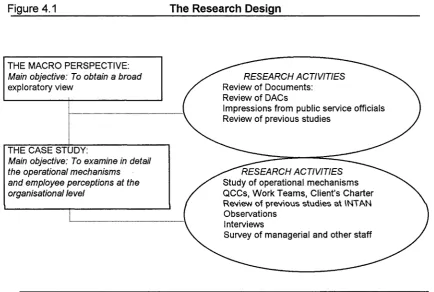
research questions and is detailed in Chapter Four. The research design consists of
two levels - the macro perspective and the case study. The macro perspective will
provide a broad and exploratory view of policies, guidelines and operational
mechanisms of quality management in the Malaysian public service. This level of
research will also focus on gauging the impressions of two groups of Malaysian
public service officials on their views on the implementation of quality management
in the public service. The two groups of employees were Malaysian public service
employees who were attending two training courses at INTAN. Hence, they were
titled as Training Groups. A total of 42 Malaysian public service officials participated
in answering a short questionnaire distributed among these two groups.
The second level of field research is the case study of the National Institute of
Public Administration (INTAN). The objective here was to analyse in depth the
operational mechanisms of quality management and the subsequent outcomes
through employee perceptions and pre-existing studies. Employee perceptions
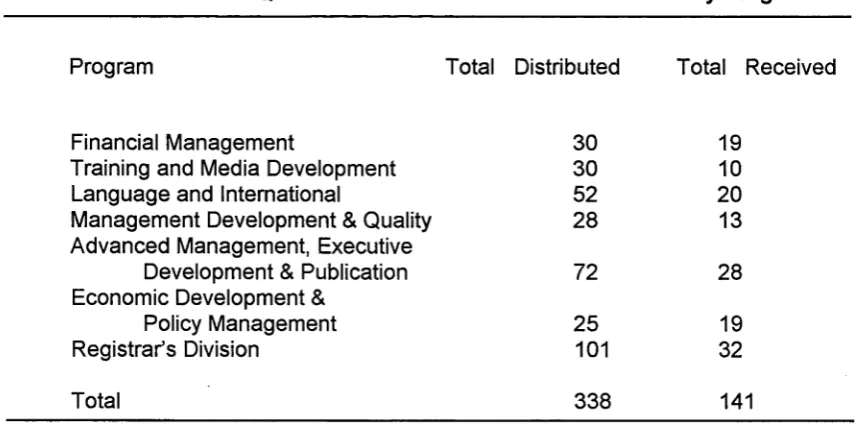
were obtained through a structured questionnaire distributed to the managerial and
non-managerial employees of INTAN. A total of 338 questionnaires were
distributed and 141 were received, with 139 useable questionnaires applied in the
data analysis. The response rate in terms of the number of questionnaires
distributed was 42 percent.
Limitations of the study
The main limitation of this study arose from the limited nature of the case study. As
the case study chosen was primarily a training institution, a similar analysis needs
to be made with respect to an organisation that may be considered as a typical
public service organisation, where the functions of service delivery and ‘closeness’
to citizens are a significant political factor that will govern the implementation of the
customer orientation concept.
The second limitation is reflected in the macro perspective presented in this study
which utilised views of selected Training Groups to gauge the general impressions
of quality management in the Malaysian public service. These groups were not
representative samples of the public service, and were chosen at the convenience
of the researcher. They comprised public service employees who were attending
two of the training courses conducted at INTAN during the course of the
researcher’s stay at INTAN. Although not representative, these two groups of
employees were from various government departments and ministries and
represented an indicative sample of the views that may be obtained from Malaysian
public service employees in general.
Organisation of the study
This chapter has set the framework against which the research questions that are to
be studied in this thesis will be examined. The next chapter will present the
theoretical foundations of quality management by outlining the concepts of quality
management proposed by the theorists Deming, Juran, Ishikawa and Crosby. The
chapter will outline the theoretical framework of the issues studied in the thesis and
the outcomes of selected research on quality management in private and public
sector organisations. It will also discuss several concerns that have been raised by
academics with regard to the implementation of quality management in the public
sector.
Having identified the theoretical contexts of quality management, Chapter Three will
identify the context of quality management theory in the emerging paradigms of
public service reform. The chapter will also examine the nature of quality
management initiatives in the industrialised countries of the USA, Britain, and
Canada, and review service quality initiatives in the newly industrialised countries of
the East Asian region, hence identifying the context of quality management in
public service reform programs.
Chapter Four will present the research design and methodology used to conduct
research in the Malaysian public service. Chapter Five will place in context the
Malaysian case, by presenting an overview of the Malaysian public service and its
reform process. It will also review the literature on the methods and techniques
used in the adoption and implementation of quality management concepts in the
Malaysian public service. This review will specifically focus on the Development
Administration Circulars issued by the government, which in effect will identify the
rhetoric with regard to quality management in the public service. Against this
background the views of selected employees from the Malaysian public service will
be obtained to gauge their general impressions on the impact of quality
management.
Chapter Six will present the case study of INTAN. It will review existing studies at
INTAN, and the working of the operational mechanisms of quality management
be complemented through the perceptions of employees at INTAN through a survey
of managerial and non-managerial employees, and through interviews with heads
of programs, teaching staff and members of QCCs.
The concluding chapter will summarise the main research findings and will discuss
the research findings in light of the existing research. The chapter will also present
policy implications for the Malaysian public service and examine the prospects for
development bureaucracies in general.
Chapter 2
THEORY AND PRACTICE OF QUALITY MANAGEMENT:
REVIEW OF LITERATURE
This chapter will examine the theoretical literature on quality management by
reviewing the writings of selected scholars in the field and identifying the concepts
and techniques of quality management as applied in practice in private and public
sector organisations. The objective is to determine the effects and implications of
the application of quality management in public service organisations. This chapter
will also present the concerns raised by academics on the application of quality
management techniques in public service organisations, and briefly discuss the
implications for ‘traditional’ organisation structures in development bureaucracies.
Theories propagated by scholars of quality management
Rather than attempting to cover all that has been written on the subject of quality
management, this chapter starts by identifying the leading writers and scholars from
whose work subsequent writings on quality management are largely derived. This
will lay the basis for a discussion of the theoretical background of quality
management. From an historical perspective, the origins of quality management as
evident today, could be traced mainly to two American scholars, W. Edwards
2
Deming and Joseph Juran. Their early work in Japan in the 1950s seems to have
played a major role in the development of the concept and in the application of
Detailed accounts of the history of the so called quality movement are provided in Cole, Robert E. (ed.), 1995. The Death and Life of the American Quality Movement, Oxford University Press, New York. See also, Wiele, A.V.D., 1998. The history of quality and quality management’, in Beyond Fads: management fads and organisational change with reference to quality management, Eburon, Delft. The Netherlands:25-42, and, Rimington, R.V.J., 1991. ‘Developments in total quality management’, in An analysis of the adaptation of quality management techniques by U.K. electronic companies, Ph.D. Thesis, University of Keele:77-162.
quality management. During this period, a Japanese scholar, Kaoru Ishikawa, was
also instrumental in the development of quality circles and statistical problem
solving tools which have become important components of quality management in
practice. Their ideas were later transferred and popularised in the USA, where they
have been augmented by other American scholars of whom Philip Crosby is chosen
here as representative. An additional reason for choosing Crosby’s writings as
representative for the purpose of this study is that his teachings seem to have been
particularly influential in the Malaysian public service.3 The writings of these
academics will be outlined with the initial aim of identifying what they mean by
‘quality’ and their approaches to achieving a quality product or service.
W. Edwards Deming
W. Edwards Deming has a doctorate in mathematical physics, but considers himself
a statistician. Deming’s early work, done mostly in Japan, was based on advanced
statistical quality control methods. His teachings became so influential in Japan that
since 1965 the ‘Deming Award’ has been the most coveted award given for quality
in the Japanese manufacturing industry. In the USA, he was recognised as a
substantial player in the turn-around of the Japanese industry when in 1980, one of
the major national television broadcasting stations, the NBC, in a documentary
named ‘If Japan Can, Why Can’t We?’, named him as the ‘father of the third wave
of industrial revolution’ (Bank, 1992:62).
According to Deming, ‘a product or service possesses quality if it helps somebody
and enjoys a good and sustainable market’ (Deming, 1993:2). Under Deming’s
A personal interview with a senior official at the Malaysian Administrative Modernisation and Management Planning Unit (MAMPU), revealed that much of the circulars on TQM had been influenced by the writings of Crosby (Interview 6).
approach, production is seen to improve with the improvement of the system,
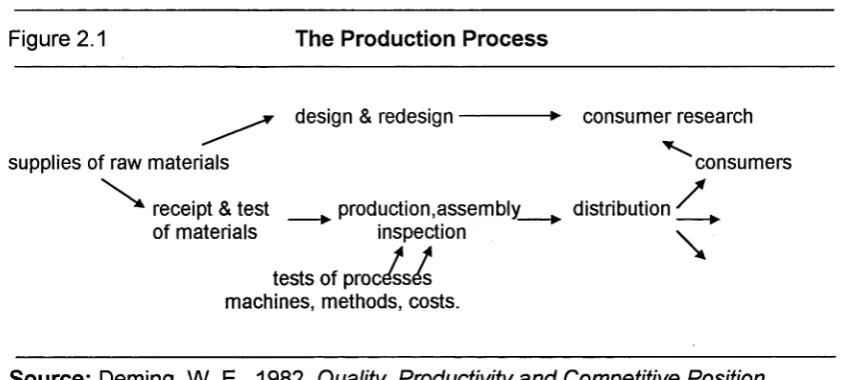
because the production process is viewed as the whole system. The chart
duplicated in Figure 2.1 was first used by Deming in Japan in 1950 to indicate this
point (Deming, 1982:103).
Figure 2.1 The Production Process
design & redesign
supplies of raw materials
X
receipt & testof materials
production,assembly__ inspection
tests of proc^ss^s machines, methods, costs.
consumer research
consumers
distribution
/
\
Source: Deming, W. E., 1982. Quality, Productivity and Competitive Position, MIT Center for Advanced Engineering Study, Cambridge: 103.
Figure 2.1 shows Deming’s conceptualisation of the relationships between the
various components of the production process. Production and assembly as the
central functions and supply of materials, distribution, consumer research, testing
and product design and redesign are seen as the supporting functions. Not only is
production seen as a total process but also one that is focused on the consumer,
with consumer research, and the design and redesigning of the product to satisfy
the customer being crucial in achieving a quality product. According to Deming, all
these processes need to be improved if a quality product is desired.
Deming’s teaching has therefore stressed the significance of the production
process in achieving quality products. In his words,
Quality is achieved by improvement of the process. Improvement of the process increases uniformity of output of product, reduces rework and mistakes, reduces waste of manpower, machine-time, and materials, and thus increases output with less effort. Other benefits of improved quality are lower
[image:37.527.64.487.159.349.2]costs, better competitive position, and happier people on the job, and more jobs, through better competitive position of the company (Deming, 1982:1).
He furthermore states that,
Improvement of quality transfers waste of man-hours and of machine-time into the manufacture of good product and better service. The result is a chain reaction - lower costs, better competitive position, happier people on the job, jobs, and more jobs (Deming, 1986:2).
Deming points to the case in Japan, during 1948 and 1949, when management in
some Japanese companies observed that improvement of quality inevitably leads to
improvement of productivity. According to Deming, by 1950, the chain reaction
depicted in Figure 2.2, was on the blackboard of every meeting of top management
in Japanese manufacturing industry (Deming, 1986:2). Hence, it was Deming’s
belief that this system was the cornerstone of Japanese management strategy in
[image:38.527.64.490.420.625.2]the 1950s (Deming, 1986:23).
Figure 2.2 Quality Improvement Cycle Proposed by Deming
Costs decrease because
Improve of less rework, fewer mis- Productivity
> quality — ► takes, fewer delays, snags; ---► improves --- ►
better use of machine-time and materials
Capture the
> market with --- ► Stay in business--- ► Provide jobs
better quality and more jobs
and lower price
Source: Deming, W. E., 1986. Out of the Crisis, MIT Centre for Advanced Engineering Study, Cambridge^.
According to Deming, his proposals to completely transform managerial style is
applicable to all industries, both manufacturing and service (Deming, 1986:xi).
Subsequently, he became concerned with the style of American management that
he claimed was leading to a decline in the American industry. Deming felt that a
total transformation was required in American management techniques, with
management declaring a policy for the future to stay in business and to provide
more jobs (Deming, 1986:xi). Deming’s theories on transforming the style of
American management are proposed in his ‘fourteen points’, which are essentially
his prescription for achieving quality and productivity, in the manufacturing or the
service sector. The fourteen points stated by Deming are:
1. Create constancy of purpose for improvement of product and service, with the aim to become competitive, stay in business, and provide jobs;
2. Adopt the new philosophy, that we are in a new economic age, created by Japan;
3. Cease dependence on mass inspection, by building quality into the product in the first place;
4. End the practice of awarding business on the basis of price tag alone;
5. Improve constantly and forever the system of production and service;
6. Institute training;
7. Adopt and institute leadership;
8. Drive out fear;
9. Breakdown barriers between staff areas;
10. Eliminate slogans, exhortations, and targets for the workforce, that urge to increase productivity;
lla . Eliminate numerical quotas for the workforce;
llb . Eliminate numerical goals for people in management;
12. Remove barriers that rob people of pride of workmanship;
13. Encourage education and self-improvement for everyone;
14. Take action to accomplish the transformation (Deming, 1986:24-86).
Deming’s first point, that is, establishment of constancy of purpose, was outlined
with the objective of creating an organisational environment with long term goals
where resources are allocated to planning, research and education of all
employees, and the establishment of an organisational framework that fosters the