Int. J. Electrochem. Sci., 7 (2012) 6799 - 6806
International Journal of
ELECTROCHEMICAL
SCIENCE
www.electrochemsci.org
Characterization of a New Zn
2+-Selective Electrode Based on
Schiff-base as Ionophore
Qiongyao Fu, Shiyun Qian, Na Li, Qianfeng Xia*, Yuxiang Ji*
School of Tropical and Laboratory Medicine, Hainan Medical College, Haikou 571101, China *
E-mail: [email protected]; [email protected]
Received: 9 June 2012 / Accepted: 27 June 2012 / Published: 1 August 2012
A new Zn2+-selective electrode based on Schiff-base as ionophore was prepared. Potentiometric responses revealed that this new electrode has good selectivity to Zn2+ relative to a wide variety of other cations. The effect of plasticizers and ion-exchanger on the performance of electrode was also studied. With the optimal membrane compositions, the electrode based on this new ionophore reveals a good Nernstian behavior over a wide concentration ranges of 1.0×10⁻⁶—1.0×10⁻³ M with a detection limit of 7.4×10⁻⁷ M Zn2+. The electrode possesses advantages of low resistance, very fast response time and long lifetime. The potentiometric responses are independent of the pH of the test solution in the pH range 3.4–5.8. The electrode can be used as indicator electrode for the potentiometric titration of Zn2+ in spiked water.
Keywords: Ion-selective electrode, Zn2+, Schiff-base
1. INTRODUCTION
Zinc is widely used in galvanising of steel, batteries, brass metallurgy, die casting and chemical compounds for a broad range of industries [1]. It is the second most abundant transition metal ion in the human body and plays significant role in many biological processes such as brain function and pathology, immune function, gene transcription. However, a major problem is the subsequent pollution and harm to the environment and humans because of its frequent use [2]. Excessive Zn2+ intake can lead to many diseases such as fever, nausea, anaemia and renal failure. As a consequence, the quantification of Zn2+ is of great interest to many different areas.
Howerver, it is a pity that only a few of Zn2+-ISEs have been reported compared to Cu2+ [6], Hg2+ [7], Ag+ [8], et al. Thus, it is still an urgent work to develop new highly Zn2+-selective ISEs [9-13]. In this work, a new Zn2+-selective electrode based on a new Schiff-base was characterized, and study shows that this new ISE has good selectivity and sensitivity towards Zn2+.
2. EXPERIMENTAL
2.1. Reagents and instrumentation
2-nitrophenyl octyl ether (o-NPOE), bis (2-ethylhexyl) sebacate (DOS), dibutylphthalate (DBP), dioctyl phthalate (DOP), sodium tetrakis [3, 5-bis (trifluoromethyl)phenyl]borate (NaTFPB) and poly (vinyl chloride) (PVC) were purchased from Sigma-Aldrich. All other reagents used were purchased from Sinopharm Chemical Reagent and of analytical grade purity or better. Deionized water with specific resistance of 18.2 MΩ cm was obtained by a Pall Cascada laboratory water system.
Melting points were taken on a WRS-1B digital melting-point apparatus and were uncorrected. Infrared (IR) spectra were recorded on KBr pellets using Perkin–Elmer 1430 spectrometer. Nuclear magnetic resonance (NMR) spectra were measured with a Brucker WM-300 instrument and chemical shift were given in ppm from tetramethylsilane (TMS). Mass (MS) spectra were recorded on a Thermo TSQ Quantum Access Agillent 1100. Elemental analyses were performed with a Vario Elementar(III).
The synthesis route was shown in Scheme 1.
Scheme 1. Synthesis route of L.
2.2. Synthesis of Schiff-base L
2.2.1. Synthesis of compound 2
2.2.2. Synthesis of compound L
Under N2 atmosphere, 20 mL absolute ethanol containing 2 (1.52 g, 0.01 M) was added dropwise to 20 mL 2-pyridinecarboxaldehyde (2 µL, 0.02 M) absolute ethanol solution. The mixture was refluxed for 4 h and then cooled to room temperature. The precipitate so obtained was filtered and washed by water and ethanol in turn and dried in vaccum. The crude product was purified by recrystallization from absolute ethanol to give compound L as dark yellow solids. Yields: 90%. M.p.: 201.2-203.0 ºC. MS: m/z 329.06 [M]+. IR (KBr tablet, cm-1): 3313.1 (s, 1H), 2912.0 (Ar-H), 1681.6 (C=N); 1H NMR (δ: ppm, CDCl3): 9.04 (s, 1H, NH), 8.63 (d, 1H, J = 5.00), 8.61 (d, 1H, J = 5.00), 8.04 (d, 1H, J = 8.00), 8.00 (d, 1H, J = 8.00), 7.73 (t, 1H, J = 7.50), 7.60 (t, 1H, J = 7.75), 7.28 (t, 3H, J = 7.00), 7.20 (t, 1H, J = 6.25), 6.86 (t, 1H, J = 7.50), 6.70 (d, 1H, J = 8.50), 6.37 (s, 1H), 5.83 (s, 1H). 13C NMR (δ: ppm, CDCl3): 161.33, 157.64, 153.91, 150.27, 149.97, 149.53, 145.24, 137.01, 136.45, 134.29, 129.13, 124.28, 123.45, 121.24, 120.74, 119.82, 116.15, 115.35. MS: m/z 329.06 (M+). Anal. Calcd. for C19H15ON5 (329.3): C, 69.29; H, 4.59; N, 21.26. Found: C, 69.24; H, 4.63; N, 21.20.
2.3. Membrane preparation
The membrane components (totaling 250 mg) were dissolved in 3.0 mL of THF and shaken vigorously for at least 2 h, and then poured into a glass ring (30 mm i.d.) fixed on a glass plate. The solvent was allowed to evaporate overnight at room temperature to give a transparent membrane of 180 µm thickness. For each ISE, a disk of 7 mm diameter was punched from the membranes and glued to a plasticized PVC tube (i.d. 6 mm, o.d. 9 mm) with THF/PVC slurry. Electrodes were conditioned with 1.0×10⁻³ M Zn(NO3)2 overnight.
2.4. Potential measurements
Activity coefficients were calculated according to the Debye–Hückel approximation and EMF values were corrected for liquid-junction potentials with the Henderson equation. Membrane potentials were measured with a Model PXSJ-216 digital ion analyzer (Shanghai Instruments) in magnetically stirred solution at room temperature in the galvanic cell: SCE׀sample solution׀ISE membrane׀inner solution (1.0×10⁻³
M Zn2+)׀AgCl/Ag.
2.5. Selectivity measurements
The electrodes were conditioned in 1.0×10⁻³
3. RESULTS AND DISCUSSION
3.1. Influence of membrane composition
The compositions of membranes have great effect on the characteristics of ISEs [15]. Therefore, membranes with different compositions have been prepared and their potentiometric response characteristics were evaluated, and the amounts of ion-exchanger and the polarity of various plasticizers on the potentiometric response of Zn2+-ISE were discussed in detail.
Table 1. Potentiometric responses of Zn2+-ISEs based on ionophore L with different amounts of ionexchanger.
Electrode No.
Compositions of membrane w% Liner range, M Detection limits, M
Slope mV/dec. PVC Plasticizer Additive L
L1 32.83 65.70, o-NPOE 1.36 1.01 3.0×10⁻⁶–1.0×10⁻⁴ 1.3×10⁻⁶ 25.6
L2 32.81 65.50, o-NPOE 1.70 1.00 1.0×10⁻⁶–1.0×10⁻⁴ 9.8×10⁻⁷ 23.4
L3 32.14 64.27, o-NPOE 2.62 0.97 1.0×10⁻⁶–1.0×10⁻³ 7.4×10⁻⁷ 30.1
[image:4.596.40.558.263.343.2]As we all known, lipophilic anionic additives (NaTFPB) can act as a charge compensating counter ion in the membrane and thus facilitate the process of ion charge transduction [15]. Accordingly, the effects of the amount of NaTFPB in Zn2+-selective membranes on the electrode characteristics were investigated. The amount of NaTFPB was altered while maintaining the same amounts of other membrane compositions (Table 1). The results show that the electrode based on ionophore L and NaTFPB in a mole ratio of 4:1 present the best potential responses. Thus, according to the reported results [16], compound L coordinate with Zn2+ in a mole ratio of 1:1 in membrane phase.
Table 2. Potentiometric responses of Zn2+-ISEs based on ionophore L with different plasticizers.
Electrode No.
Compositions of membrane w% Liner range, M Detection limits, M
Slope mV/dec. PVC Plasticizers Additive L
L3 32.14 64.27, o-NPOE 2.62 0.97 1.0×10⁻⁶–1.0×10⁻³ 7.4×10⁻⁷ 30.1 L4 32.14 64.27, DBP 2.62 0.97 3.0×10⁻⁶–1.0×10⁻⁴ 1.2×10⁻⁶ 27.8
L5 32.14 64.27, DOP 2.62 0.97 1.0×10⁻⁵–1.0×10⁻³ 6.8×10⁻⁶ 22.8
L6 32.14 64.27, DOS 2.62 0.97 6.0×10⁻⁶–1.0×10⁻³ 2.0×10⁻⁶ 26.0
[image:4.596.42.562.566.660.2]
exchanger sites mobility to give highest possible selectivity and sensitivity. With the best membrane compositions (PVC:NPOE:Additive:L=32.70:65.39:0.92:0.99 (w:w), total: 250 mg, sensor No. L3),
this Zn2+-ISE show a good Nernstian response over a wide concentration range of 1.0×10⁻⁶—1.0×10⁻³ M with a detection of 7.4×10⁻⁷
[image:5.596.184.409.166.354.2]M Zn2+ (Fig.1).
Figure 1. Potentiometric responses of Zn2+-selective electrode based on ionophore L (sensor No. L3).
3.2. Potentiometric selectivity of Zinc electrodes
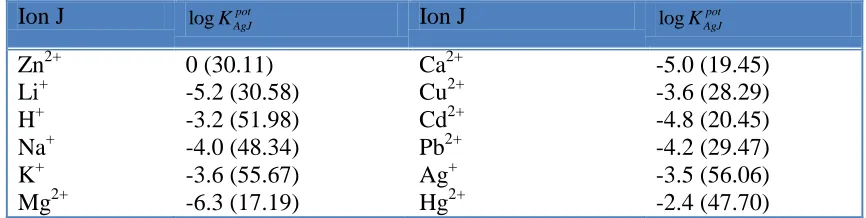
The influence of interfering ions on the response behavior of the ISE is usually described in terms of selectivity coefficients. The selectivity coefficients, logKAgJpot, of Zn
2+
-ISE were determined by using Bakker’s method to eliminate the influence of the inherent sensitivity limit on the response toward discriminated ions [17]. Table 3 shows the selectivity coefficients of Zn2+-ISE based on L
(sensor No. L3). It can be seen that the electrode based on L gives the best selectivity and sensitivity toward Zn2+ than other cations.
Table 3. Potentiometric selectivity coefficients, log pot AgJ
K , obtained with membrane based on ionophore
L (sensor No. L3).
Ion J log pot
AgJ
K Ion J log pot
[image:5.596.81.514.618.727.2]
3.3. Effect of pH
The influence of the pH on the response of Zn2+-ISE based on ionophore L(sensor No. L3) was
studied. The pH effect is illustrated in Fig.1 by varying the pH test solutions with 0.1 M HNO3 and 0.1 M NaOH for 1.0×10⁻³
M and 1.0×10⁻⁴ M Zn(NO3)2, respectively. It is clear from Fig.2 that the operational pH range was 3.4-5.8 for the electrode based on ionophore L. At higher pH, Zn2+ will form precipitate with OH-, thus cause the potential reduction. However, when the pH was low, the concentration of H+ shows obvious disturbance on the potentiometric response of Zn2+-ISE.
Figure 2 pH effect on the potentiometric responses of Zn2+-selective electrode. (■) 1.0×10⁻³ M Zn2+; (●) 1.0×10⁻⁴
M Zn2+ (sensor No. L3).
[image:6.596.186.413.216.400.2]3.4. Dynamic response of Zn2+-ISE based on L
[image:6.596.182.409.500.687.2]
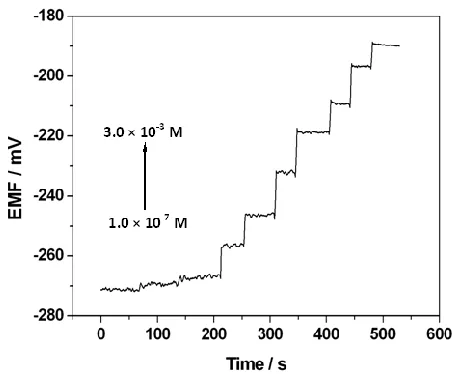
For analytical purposes, response time is one of the most important factors that are taken into account. In this work, the practical response time was recorded by immediate and successive changing of Zn2+ concentration from 1.0×10⁻⁶-1.0×10⁻³ M and the results are shown in Fig. 3. As it can be seen, in the whole concentration range, the Zn2+-ISE based on ionophore L (sensor No. L3) need a very short time to reach equilibrium response. Lifetime studies show that this new electrode can be used for at least two months without obvious potential change.
3.5. Analytical application
The study suggested that this newly characterized Zn2+-ISE (sensor No. L3) could work well under the laboratory conditions. It was effectively applied as indicator electrode to the potentiometric titration of a spiked 1.0×10⁻⁴ M Zn(NO3)2 solution with 0.01 M EDTA as titration reagent. The results demonstrate that the Zn2+ amount in this solution can be determined with good accuracy.
4. CONCLUSIONS
A Zn2+-ISE based on a newly synthesized Schiff-base as ionophore was prepared. The results show that this sensor showed a wide linear range of 1.0×10⁻⁶–1.0×10⁻³
M with a detection limit of 7.4×10⁻⁷
M Zn2+.
ACKNOWLEDGEMENTS
This work was financially supported by the Research and Training Fundation of Hainan Medical University (No. HY2010-004), the Natural Science Foundation of Hainan Province (No. 812188) and Hainan Provincial Department of Education Subject (Hjkj2012-33 and Hj2010-20).
References
1. F. Degryse, E. Smolders, D. R. Parker, Eur. J. Soil Sci., 60 (2009) 590.
2. A. L. Nolan, M. J. McLaughlin, S. D. Mason, Environ. Sci. Technol., 37 (2003) 90. 3. E. Bakker, P. Bühlmann, E. Pretsch, Chem. Rev., 97 (1997) 3083.
4. F. Faridbod, M. R. Ganjali, R. Dinarvand, P. Norouzi, S. Riahi, Sensors, 8 (2008) 1645.
5. M. R. Ganjali, P. Norouzi, M. Rezapour, F. Faridbod, M. R. Pourjavid, Sensors, 6 (2006) 1018. 6. C. De Stefano, A. Gianguzza, A. Pettignano, S. Smamartano, S. Sciarrino, J. Chem. Eng., 55
(2010) 714.
7. F. Faridbod, P. Norouzi, R. Dinarvand, M. R. Ganjali, Sensors, 8 (2008) 2331.
8. S. J. Wu, J. Zhang, W. J. Lu, H. Y. Zhang, D. Z. Shen, K. Qi, D. W. Pan, Int. J. Electrochem. Sci., 7 (2012) 3567.
9. M. B. Gholivand, M. Shahlaei, A. Pourhossein, Sens.Lett., 7 (2009) 119.
10.V. K. Gupta, M. R. Ganjali, P. Norouzi, H. Khani, A. Nayak, S. Agarwal, Crit. Rev. Anal. Chem., 41 (2011) 282.
13.M. F. Al-Asousi, A. F. Shoukry, A. H. Bu-Olayan, Talanta, 94 (2012) 184. 14.R. Gup, E. Giziroglu, Spectrochim. Acta, Part A, 65 (2006) 719.
15.S. S. Sang, C. W. Yu, N. Li, Y. X. Ji, J. Zhang, Int. J. Electrochem. Sci., 7 (2012) 3306. 16.Z. N. Yan, Y. Q. Lu, X. Li, Sens. Actuators B,122 (2007) 174.
17.E. Bakker, J. Electrochem. Soc., 143 (1996) L83.