Int. J. Electrochem. Sci., 7 (2012) 6951- 6958
International Journal of
ELECTROCHEMICAL
SCIENCE
www.electrochemsci.org
Effects of Carbon Coating on the Structure, Morphology and
Electrochemical Performance of Li
3V
2(PO
4)
3Cathode Material
Prepared by Solid State Method
C. Deng1,*, S. Zhang2,*, Z. Dong1, Y. Gao1, Y. Shang1, Y. H. Sun1
1
Key Laboratory of Photonic and Electronic Bandgad Materials, Ministry of Education; College of Chemistry and Chemical Engineering, Harbin Normal University, Harbin, 150025, Heilongjiang, China
2
College of Material Science and Chemical Engineering, Harbin Engineering University, Harbin 150001, Heilongjiang, China
*
E-mail: [email protected]; [email protected]
Received: 19 June 2012 / Accepted: 10 July 2012 / Published: 1 August 2012
Li3V2(PO4)3/C cathode material was prepared by a solid-state method with sucrose as carbon source.
The effects of carbon coating on the structure, morphology and electrochemical performance of Li3V2(PO4)3 were investigated. Both the pristine and the carbon coated materials were characterized by
X-ray diffraction (XRD), scanning electron microscopy (SEM), transmission electroscopy (TEM) and electrochemical tests. Both samples have similar XRD patterns without extra reflections, which indicates that carbon coating doesn’t affect the structure of Li3V2(PO4)3. SEM and TEM images
confirm that a thin carbon layer is formed on the surface of the Li3V2(PO4)3 particles. Electrochemical
testing results reveals that Li3V2(PO4)3/C has better rate capability and higher discharge capacity than
the pristine Li3V2(PO4)3. Indicated by the EIS results, the improvements can be attributed to the
increased conductivity and charge transfer capability induced by carbon coating.
Keywords: Li3V2(PO4)3; carbon coating; cathode material; lithium ion battery
1. INTRODUCTION
The need for large-scale batteries impels the development of new materials for lithium ion batteries. Recently, lithium transition metal phosphates such as LiFePO4, LiMnPO4 and Li3V2(PO4)3
have been extensively studied [1-5]. In comparison with the conventional lithium transition metal oxides (e.g. LiCoO2), the phosphate based materials exhibit many advantages such as low cost,
lithium ions based on the V3+/V4+ redox. All the three lithium ions can be completely extracted when it was charged to a higher voltage of 4.8 V, which results in a high theoretical capacity of 197 mAh·g-1
. Therefore, Li3V2(PO4)3 has been proposed as a highly promising cathode material for lithium ion
batteries [6-9].
However, the major drawback of the phosphates and the ployanion materials is the low conductivity and poor ionic mobility [10-13]. The inherent conducting properties greatly affect its electrochemical performance and inhibit the further use in commercial applications. Fortunately, this problem can be largely solved by coating the particles with a thin conductive layer. Many conductive materials have been employed to build conductive layer for the phosphates [14-16]. Among these conductive materials, carbon is characterized by the fast electron transport and regarded as the excellent coating material [17-20]. Therefore, it is expected to build carbon coating on the Li3V2(PO4)3
particles for superior electrochemical performance.
X. H. Rui et al prepared carbon coated Li3V2(PO4)3 by a solid state reaction process with
different carbon sources of citric acid, glucose, PVDF and starch. The largest reversible capacity of 118 mAh∙g-1 in the voltage region of 3.0-4.3 V is obtained for the sample with the citric acid as carbon source [21]. L. Wang et al prepared carbon coated Li3V2(PO4)3 by a wet coordination method, and the
material exhibits discharge capacity of 128 mAh∙g-1 between 3.3 and 4.3 V and good reversible performance under a current density of 95 mA∙g-1 [22]. M. M. Ren et al prepared core-shell Li3V2(PO4)3/C composite via a sol-gel route followed by hydrothermal treatment. Both enhanced
electrochemical Li ion intercalation performance and electrical conductance are observed for the composite compared with the pure Li3V2(PO4)3 [23]. In this study, we investigated the impacts of
carbon coating on the physical and electrochemical characteristics of Li3V2(PO4)3. The Li3V2(PO4)3/C
was prepared by solid state method with sucrose as carbon source, and both pristine and the carbon coating Li3V2(PO4)3 materials were characterized and compared in detail.
2. EXPERIMENTAL
The pristine Li3V2(PO4)3 was prepared by a solid-state method. Stoichiometric amount of
LiOH∙H2O, NH4VO3 and NH4H2PO4 was mixed with oxalic acid and acetone, and the mixture was put
into a high speed planetary mill. The milling lasted for several hours and then the resulting powder was collected and dried under vacuum. The mixture was then grounded and calcinated at 800°C for 8h in flowing argon. The carbon coated Li3V2(PO4)3 was prepared by mixing the pristine Li3V2(PO4)3 with
desired amount of sucrose, and then mixture was calcinated at 800 °C for 4h in flowing argon to synthesize Li3V2(PO4)3/C.
Powder X-ray diffraction (XRD, Bruker D8/Germany) employing Cu Kα radiation was used to identify the crystalline phase of the samples. The morphology was observed with a field emission scanning electron microscope (SEM, HITACHI S-4800). The surface of the sample was observed with a transmission electron microscopy (TEM, JEOS-2010 PHILIPS). The coin cells were prepared as described in Ref. [24]. The composite electrode was made from a mixture of the active material, acetylene black, and Polyvinylidene Fluoride in a weight ratio of 80:10:10. The 1 mol∙L-1
LiPF6
electrolyte. Galvanostatic charge-discharge measurements were performed in a potential range of 3.0-4.8 V at ambient temperature. The electrochemical impedance measurements were carried out with a CHI 660 C instrument.
3. RESULTS AND DISCUSSION
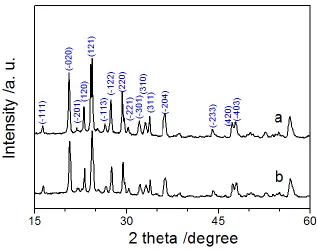
The XRD patterns of the pristine and carbon coated Li3V2(PO4)3 samples are shown in Figure
1. Both of the samples exhibit single phase structures based on monoclinic unit cell in space group P21/n. There is no peaks indexed to carbon was observed for Li3V2(PO4)3/C, which may be attributed
to the amorphous state of carbon coating. The lattice parameters of both samples were calculated and the results are shown in Table 1. The cell parameters of both samples were close to each other within experimental errors, which confirms that carbon coating doesn’t affect the structure of Li3V2(PO4)3.
[image:3.596.136.453.306.556.2]Figure 1. XRD pattern of the pristine (a) and carbon coated (b) Li3V2(PO4)3.
Table 1. Lattice parameters of the pristine and carbon coated Li3V2(PO4)3.
Sample a (Å) b (Å) c (Å) β
Pristine 8.5471 8.5732 11.9701 90.3450
Carbon coating 8.5483 8.5744 11.9689 90.3395
The SEM images of the pristine and carbon coated Li3V2(PO4)3 samples were shown in Figure
smooth particles with clear surfaces were observed for the pristine sample. However, the surfaces of the particles became coarse after carbon coating. In the SEM images, the carbon phase was not observed as a separate morphological feature. In order to characterize the carbon phase, the TEM observation was carried out on the Li3V2(PO4)3/C and the results are shown in Figure 3. A thin surface
[image:4.596.90.510.177.491.2]layer is observed for carbon coated sample, which confirms the presence of carbon layer on the surface of particles.
Figure 2. SEM images of the pristine (a,b) and carbon coated (c,d) Li3V2(PO4)3 in different magnitude
Figure 3. TEM image of carbon coated Li3V2(PO4)3
[image:4.596.177.426.539.722.2]
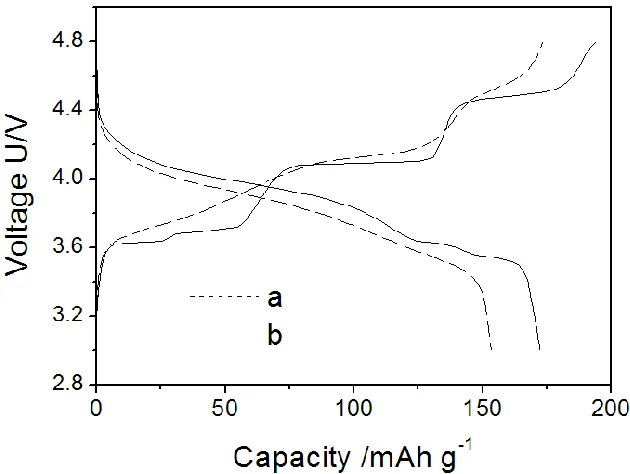
Figure 4 shows the initial charge/discharge curves of the pristine and carbon coated Li3V2(PO4)3 samples at the 0.2 C rate in the voltage range of 3.0 V-4.8 V. For the carbon coated
Li3V2(PO4)3, four plateaus at around 3.63, 3.70, 4.10 and 4.50 are observed in the charge curve, which
corresponds to a sequence of phase transition processes between the single phases LixV2(PO4)3. The
first lithium ion is extracted in two steps, 3.63 V and 3.70 V, which is because of the presence of an ordered phase Li2.5V2(PO4)3. Subsequently, the second lithium ion is extracted in one single plateau of
4.10 V to form Li1.0V2(PO4)3. These initial three plateaus are related to the two lithium ions extraction
which associated with the V3+/V4+ redox couple. Finally, the third lithium ion is removed in the plateau of 4.50 V, which indicates that one switches from the V3+/V4+ redox couple to the V4+/V5+ redox couple. However, for the pristine sample, all the plateaus become indistinguishable and the initial two plateaus combined to one slope. The lower capacity and decreased plateaus of the pristine Li3V2(PO4)3
indicate its poor electrochemical performance than the carbon coated one. Therefore, the result indicates that carbon coating improved the electrochemical performance of Li3V2(PO4)3 in the initial
[image:5.596.135.450.343.580.2]cycle.
Figure 4. Initial charge/discharge curves of the pristine (a) and carbon coated (b) Li3V2(PO4)3
The electrochemical impedance spectroscopy of the pristine and carbon coated samples were compared in Figure 5. Both samples exhibit a semicircle at the high frequency, which corresponds to charge transfer resistance; and a sloping line at the low frequency, which corresponds to the solid-state diffusion resistance. The carbon coated sample exhibits much smaller high frequency semicircle than the pristine one, which indicates its lower charge transfer resistance than the pristine sample. The decreased charge transfer resistance of Li3V2(PO4)3/C is associated with the conductive carbon coating
electrode material. Therefore, the Li3V2(PO4)3/C sample exhibits improved electrochemical kinetic and
[image:6.596.168.426.120.353.2]enhanced electrochemical property.
Figure 5. EIS spectroscopy of the pristine (a) and carbon coated (b) Li3V2(PO4)3
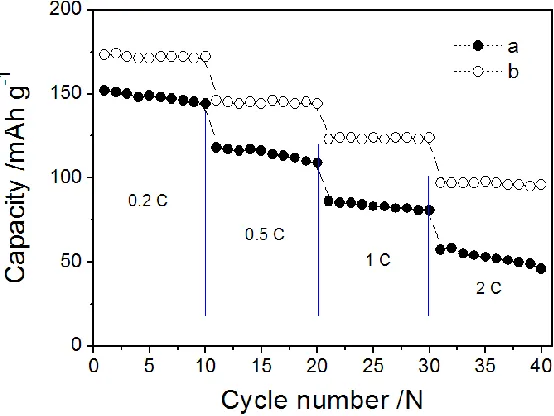
Figure 6 shows the rate capability of both samples. Both cells were charge/discharged at different current densities, i. e. 0.2 C, 0.5 C, 1 C and 2 C in the voltage range of 3.0 and 4.8 V. The discharge capacity of each sample declines with an increase in current density. When the same current density is applied, the carbon coated sample exhibits larger capacity than the pristine one. The result indicated that the carbon coating enhanced the rate capability of the Li3V2(PO4)3. The improvement
[image:6.596.157.434.531.739.2]may be associated with the decreased charge transfer resistance, increased conductivity and enhanced electrochemical kinetic induced by conductive carbon coating.
4. CONCLUSIONS
The pristine and carbon coated Li3V2(PO4)3 materials was prepared by solid state method and
their physicochemical characteristics were compared in detail. XRD results show that both samples have similar structure and lattice parameters, which indicates that carbon coating doesn’t affect the structure of Li3V2(PO4)3. SEM images show that the carbon coated sample has much coarse surface
than the pristine one. TEM observation confirms the thin carbon layer exists on the surface of the Li3V2(PO4)3 particles. Electrochemical testing results reveal that improved charge/discharge capacities
and high rate capability are obtained for the carbon coated sample compared with the pristine one. Indicated by the EIS results, the improvements can be attributed to the decreased charge transfer resistance and enhanced conductivity induced by carbon coating.
ACKNOWLEGEMENT
This work is supported by the National Natural Science Foundation of China (No. 21001036, 50902041), Innovation Foundation of Harbin City (No. 2009RFQXG201), Program for outstanding Young Teachers in Harbin Normal University (11KXQ-03) and Program for Scientific and Technological Innovation Team Construction in Universities of Heilongjiang (No. 2011TD010).
References
1. J. Barker, R. K. B. Gover, P. Burns, A. Bryan, J. Electrochem. Soc., 154 (2007) A307. 2. M. Ren, Z. Zhou, Y. Li, X. P. Gao, J. Yan, J. Power Sources, 162 (2006) 1357.
3. J. Wolfenstine, J. Read, J. L. Allen, J. Power Sources, 163 (2007) 1070.
4. J. Ni, Y. Kawabe, M. Morishita, M. Watada, T. Sakai, J. Power Sources, 196 (2011) 8104-8109. 5. S. M. Oh, H. G. Jung, C. S. Yoon, S. T. Myung, Z. Chen, K. Amine, Y. K. Sun, J. Power Sources,
196 (2011) 6924.
6. C. Deng, S. Zhang, S. Y. Yang, Y. Gao, B. Wu, L. Ma, B. L. Fu, Q. Wu, J. Phys. Chem. C, 115 (2011) 15048.
7. S. Y. Yang, S. Zhang, B. L. Fu, Q. Wu, F. L. Liu, C. Deng, J. Solid State Electrochem., 15 (2011) 2633.
8. Y. G. Mateyshina, N. F. Uvarov, J. Power Sources, 196 (2011) 1494.
9. J. Barker, M. Y. Saidi, J. L. Swoyer, J. Electrochem. Soc., 150 (2003) A684. 10.S. C. Yin, P. S. Strobel, H. Grondey, L. F. Nazar, Chem. Mater., 16 (2004) 1456. 11.C. Deng, S. Zhang, S. Y. Yang, B. L. Fu, L. Ma, J. Power Sources, 196 (2011) 386.
12.C. Deng, S. Zhang, Y. Gao, B. Wu, L. Ma, Y. H. Sun, B. L. Fu, Q. Wu, F. L. Liu, Electrochim. Acta, 56 (2011) 7327.
13.S. Zhang, C. Deng, B. L. Fu, S. Y. Yang, L. Ma, Electrochim. Acta, 55 (2010) 8482.
14.C. Delacourt, C. Wurm, L. Laffont, J. B. Leriche, C. Masquelier, Solid State Ion., 177 (2006) 333-341.
15.Y. Lin, M. X. Gao, D. Zhu, Y. F. Liu, H. G. Pan, J. Power Sources, 184 (2008) 444-448. 16.A. Vu, A. Stein, Chem. Mater., 23 (2011) 3237-3745.
17.J. Moskon, R. Dominko, R. C. Korosec, M. Gaberscek, J. Jamnik, J. Power Sources, 174 (2007) 683.
18.C. Deng, Y. H. Sun, S. Zhang, H. M. Lin, Y. Gao, B. Wu, L. Ma, Y. Shang, G. Dong, Int. J. Electrochem. Sci., 7 (2012) 4550.
20.B. Huang, X. D. Zheng, M. Lu, S. Dong, Y. Qiao, Int. J. Electrochem. Sci., 7 (2012) 437. 21.X. H. Rui, C. Li, C. H. Chen, Electrochim. Acta, 54 (2009) 3374-3380.
22.L. Wang, X. Li, X. Jiang, F. Pan, F. Wu, Solid State Sci., 12 (2010) 1248-1252.
23.M. M. Ren, Z. Zhou, X. P. Gao, W. X. Peng, J. P. Wei, J. Phys. Chem. C, 112 (2008) 5689. 24.C. Deng, S. Zhang, S. Y. Yang, Mater. Chem. Phys., 120 (2010) 14.