Int. J. Electrochem. Sci., 10 (2015) 4314 - 4323
International Journal of
ELECTROCHEMICAL
SCIENCE
www.electrochemsci.org
Template Control Preparation of High-Density and Large-Area
Ag Nanowire Array and H
2O
2Determination
Min Zhang, Yan Zhang, Peng Liu, Meiqiong Chen, Zhiquan Cai, Faliang Cheng*
Dongguan University of Technology, Guangdong Engineering and Technology Research Center for Advanced Nanomaterials, Dongguan, Guangdong, 523808, China
*
E-mail: [email protected]
Received: 23 December 2014 / Accepted: 1 March 2015 / Published: 23 March 2015
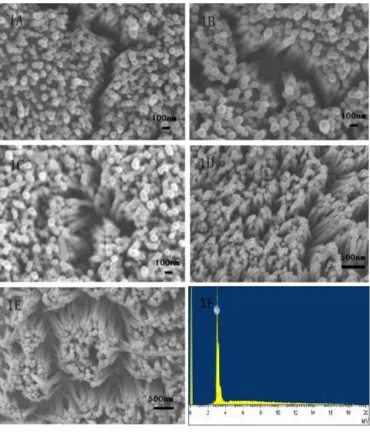
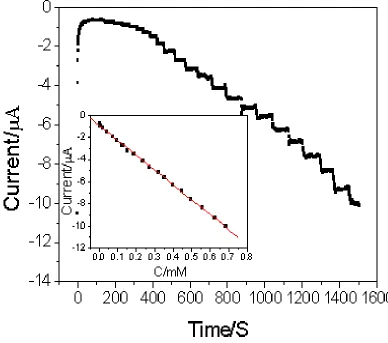
Highly ordered Ag nanowire arrays were prepared by template-electrodeposition method using anodic aluminum oxide template. The length of Ag NW arrays were controlled by electrodeposition time and characterized by scanning electron microscope (SEM) and Energy Dispersive Spectrometer (EDS). Different length Ag NW arrays modified electrodes for H2O2 detection were studied by cyclic voltammetry (CV). The results showed that the about 250 nm length Ag NW arrays exhibited the highest electrocatalytic activity for H2O2 with a wide linear range (1 to 750µM), low detection limit (0.28 µM) (S/N = 3) and short response time (within 3 s). The proposed sensor had high sensitivity (13.4 μΑ mmol-1
L cm-2). The sensor also had good selectivity toward H2O2 in the presence of electrochemical interferences such as ascorbic acid, uric acid and glucose.
Keywords: Ag NW arrays, Template control preparation, H2O2 determination
1. INTRODUCTION
H2O2, one of the powerful oxidation reagents, can be applied as disinfection, sterilization, albefaction and so on in chemical industry, textile industry, papermaking, food, medicine, electron field and environmental protection. Hence, it is important for developing rapid, sensitive methods to monitor trace levels of H2O2 concentration. Various analytical methods, such as photometric, [1-3] chromatographic [4] and electrochemical method [5-9] have been reported to determine H2O2. Compared with spectroscopic analysis and chromatographic determination, sensors have merit of low cost, simplicity, sensitivity and present-operation. With superior characteristic, sensors were widely applied for determination H2O2 concentration.
sensitivity[10-15]. Compared with other metal nanomaterials, silver may facilitate more efficient electron transfer due to the highest conductivity. The sensors based on silver nanomaterial were broadly researched. For instance, Qin, et al. [5] reported on preparation of Ag NPs-decorated polypyrrole colloids (Ag NPs-PPyCs) by heating an AgNO3 aqueous solution and pre-formed PPy colloids solution in the presence of any external reducing agent. The sensor showed a fast amperometric response time less than 2s, and the corresponding linear range and detection limit were estimated to be from 0.1 mM to 90 mM and 1.05 µM. Li et al. [16] prepared a novel amperometic biosensor based on AgNPs/MWCNTs-IL modified glass carbon electrode. The constructed electrode exhibited good catalytic activity toward the reduction of H2O2, and obtained a linear response to logarithm of the H2O2 concentrations ranging from 1.2 × 10⁻⁸ to 4.8 × 10⁻⁶ M with a limit of detection (LOD) of 3.9 × 10⁻⁹ M. Lu, et al. [17] introduced the first preparation of well-defined SiO2-coated grapheme oxide (GO) nanosheets without prior GO functionalization by combining sonication with sol-gel technique. The functional SiO2/GO nanocomposites obtained by surface functionalization with NH2 group were subsequently employed as a support for loading Ag nanoparticles to synthesize AgNPs/F-SiO2/GO. The prepared sensor had a fast amperometric response time of less than 2 s. The linear range was estimated to be from 0.1 to 260 mM and the detection limit was estimated to be 4 µM. Although enzymatic sensors exhibit high sensitivity and good selectivity, they often suffer from chemical and thermal instabilities, because the activity of enzymes is easily affected by temperature, pH-value, humidity and toxic chemicals. The non-enzymatic sensors were prepared to solve this problem. Jamal et al. [18] reported a non-enzymatic amperometric H2O2 sensor based on Pd nanoparticle modified gold nanowire array electrode. The sensor showed a linear response up to 2 mM of H2O2 with a sensitivity of 530 μA mM−1 cm−2. Huang et al. [19] introduced a novel non-enzymatic H2O2 biosensor based on the CuO-SiNWs electrodes. The resulted sensor exhibited excellent performance for H2O2 determination with a wide linear range 0.01 to 13.18 mM and a comparable detection limit of 1.6 µM (3S/N). Gao et al. [20] prepared the Pt nanowires for hydrogen peroxide detection. The sensor displayed higher electrocatalytic response with a sensitivity of 171 μA mM−1 cm−2 and linear dynamic range up to 35 mM.
This work reveals that Ag NW arrays probably work as an advanced nanoelectrocatalyst for enhancing the detection of target molecules. In this paper, we developed a simple and rapid strategy for synthesizing Ag NW arrays via electrodeposition method by anodized aluminum oxide (AAO) template. The length of Ag NW arrays could be controlled by electrodeposition time. The Ag NW arrays (about 250nm length) were used for detecting H2O2. The proposed sensor had a high sensitivity excellent selectivity, and quick response to H2O2.
2. EXPERIMENTAL 2.1 Materials and reagents
NH4[Ag(S2O3)] was obtained from the Hongkong Yuhua Noble Metal Chemical Engineering Electroplating Company (Hongkong, China). All chemicals were of analytical grade and were used without further purification. All solutions were prepared with double-distilled water.
2.2 Apparatuses
A PARSTAT 2273 electrochemical workstation (Princeton, USA) was used for amperometry measurements and cyclic voltammetry measurements at 25 °C. Pt electrode was employed as counter and Ag/AgCl (saturated KCl) was used as reference electrodes. Scanning electron microscope analysis was performed with a Hitachi S-5200.
2.3 Preparation of Ag NW array electrodes
A glassy carbon electrode (GCE) was polished and thoroughly cleaned. A piece of as-prepared AAO template in our laboratory [21] was attached to the polished surface of the GCE by epoxy curing agent. Electrodeposition was carried out in an aqueous solution containing NH4[Ag(S2O3)]. The chosen pH value was 6.4. The Ag NW arrays electrode was prepared at -0.34 V. In the end, the Ag NW arrays electrodes were dipped into H3PO4 solution (10%) for 1 h to completely remove the AAO and then they were washed with distilled water several times. About150, 250, 400, 600 and 750 nm length Ag NW arrays were obtained by setting deposition time at 5, 7, 10, 13 and 15 min, respectively.
3. RESULTS AND DISCUSSION 3.1 Characterization
Figure 1. A-E. The SEM of Ag NW array; Fig. 1F EDX of Ag NW arrays
3.2 Electrochemistry of the sensor
[image:4.596.110.480.69.503.2]
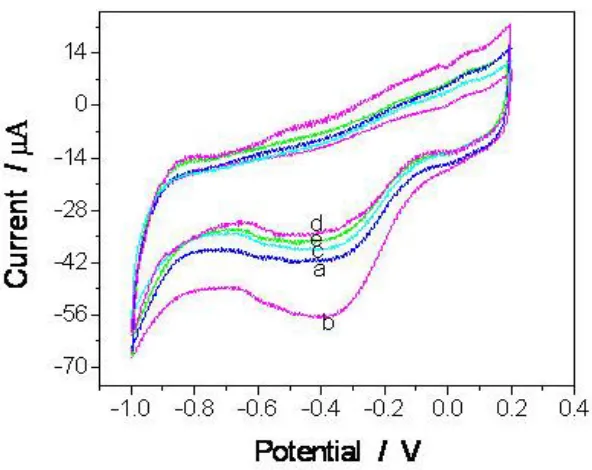
Figure 2. Cyclic voltammograms of 1 mM H2O2 in 0.1M PBS solution at about150nm (a), 250 nm(b), 400 nm(c), 600 nm(d),750 nm(e) length Ag NW arrays electrode.
Fig.3 shows the CV curves of bare electrode, Ag film electrode and about 250 nm length Ag nanowire arrays electrode in a 0.1 M PBS solution in the presence of 1mM H2O2.
Figure 3. Cyclic voltammograms of 1 mM H2O2 in 0.1M PBS solution at bare electrode (a), Ag film electrode (b) and about 250nm length Ag NW arrays electrode(c).
[image:5.596.150.446.72.307.2] [image:5.596.160.438.432.653.2]
attributed to the reduction of H2O2. On the other hand, about 250 nm length Ag nanowire arrays electrode exhibited a remarkable catalytic current peak (57.4µA) at -0.43V which indicating that Ag NW arrays could greatly increase the catalytic current toward the reduction of H2O2, this was important for improving sensor sensitivity.
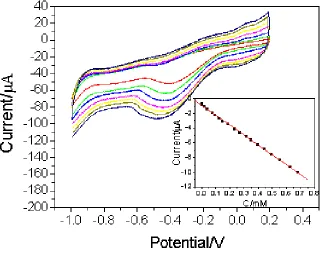
Fig. 4 shows the CVs of the proposed sensor in 0.1 M PBS solution in the presence of 5 mM H2O2. The scan rate was 20, 40, 100, 140, 170, 200 and 250 mV/s, respectively. The peak current versus the square root of the scan rate(inserted in Fig. 4)exhibited a linear relationship (R= 0.9977), indicating a diffusion controlled electrode process.
Figure 4. Cyclic voltammograms of 5 mM H2O2 in 0.1M PBS solution on about 250nm length Ag NW arrays electrode with different scan rates (inset: the relation of the anodic peak current for square root of scan rate).
[image:6.596.137.458.238.492.2][image:7.596.102.490.83.426.2]
Figure 5. Current-time response of the sensor for successive addition of 0.01 M H2O2 in 0.1M PBS solution. The applied potential is -0.4 V. (inset: the calibration curve of the amperometric response).
Table 1 Comparison of various nonenzymatic H2O2 sensor
Nonenzymatic H2O2 sensor Linear range (mM)
Detection limit (µM)
Reference
AgNPs-PPyCsa/ GCE 0.1-90 1.05 [5]
AgNPsb/MWCNTs-ILc /GCE 0.1-260 4 [16]
PdNP/AuNAEd - 5 [18]
CuO-SiNWs/GCE 0.01-13.18 1.6 [19]
n-Ag /GCE 0.05-6.5 27 [22]
PVP-Ag NWse /GCE 0.02-3.6 2.3 [23]
Graphene-AgNPLsf/GCE 0.02-10 3 [24]
MnO2-Ag hybrid nanowire/GCE 0.1-4 0.24 [25]
Ag NWs arrays/GCE 0.001-0.75 0.28 This work
[image:7.596.87.517.522.707.2]
3.3 Sensor selectivity
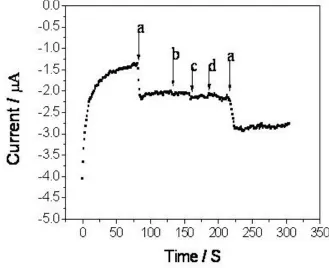
[image:8.596.131.460.247.515.2]As is known, some coexist electroactive biomolecules (UA, DA, glucose, etc.) generally show serious interference for electrochemical detection of H2O2, which limit the real application of the sensor. Herein, it is essential to investigate the interferences introduced by common electrochemically active interferents during H2O2 detection. Fig 6 shows amperometric responses of the sensor to successive additions of 1mM H2O2, 5mM of AA, 5mM of UA, 5mM of glucose, and 1mM H2O2 at an applied potential of -0.4 V. No obvious current changes were observed after adding AA, UA and glucose. Hence, at -0.4V, this sensor exhibited higher electrocatalytic activity towards H2O2 while AA, UA and glucose show negligible interference to H2O2 detection.
Figure 6. Amperometric response of about 250 nm length Ag NW arrays electrode to (a) 1 mM H2O2, (b) 1 mM AA, (c) 1 mM UA and (d) 1 mM glucose in 0.1 M PBS solution. The applied potential is -0.4 V
3.4 Reproducibility and stability of the sensor
4. CONCLUSIONS
This work revealed that prepared Ag NW arrays using the template method are promising electrocatalysts for H2O2. The reported H2O2 sensor worked without using enzyme/mediator as an electron-transfer element. Electrochemical investigation was performed for about 150, 250, 400, 600 and 750 nm length Ag NW arrays modified electrodes in 1mM H2O2 solution. It could be found that about 250 nm length Ag NW electrode exhibited the highest catalytic activity. Moreover, the H2O2 sensor could detect H2O2 in the presence of AA, UA, and glucose. In addition, the H2O2 sensor exhibited a fast response time, high sensitivity, and a wide linear range.
ACKNOWLEDGEMENTS
We would like to thank the National Natural Science Foundation of China (No. 21375016, No.21475002), the Natural Science Foundations of Guangdong Province (No.S2013010014324).
References
1. J. C. Yuan and A. M. Shiller, Anal. Chem., 71(1999) 975.
2. F. R. P. Rocha, E. R. Torralba, B. F. Reis, A. M. Rubio and M. D. I. Guardia, Talanta, 67(2005)673.
3. J. Odo, M. Inoguchi, S. Ohira, S. Tsukikawa, M. Aramaki, S. Matsuhama, M. Taito and A. Takayama, Anal. Sci., 29(2013)1041.
4. S. M. Steinberg, Environ. Monit. Assess., 185 (2013)3749.
5. X.Y. Qin, W. B. Lu, Y. L. Luo, G. H. Chang and X. P. Sun, Electrochem. Commun., 13(2011)785. 6. L. A. Ticha, P. G. L. Baker, H. S. Abbo, S. J. J. Titinchi and E. I. Iwuoha, Int. J. Electrochem. Sci.,
12(2014)7335.
7. M. Shamsipur, M. Asgari, M. F. Mousavi and R. Davarkhah, Eletroanalysis, 2(2012)357. 8. J. Zhang, J. Li, F.Yang, B. L. Zhang and X. R.Yang, J. Electroanal. Chem. 638(2010)173. 9. W. Wang, Y. B. Xie, C. Xia, H. X. Du and F. Tian, Microchim Acta, 181(2014):1325.
10. P. H. C. Camargo, Y. Xiong, L. Ji, J. M. Zuo and Y. J. Xia, J. Am. Chem. Soc. 129(2007)15452. 11. Y. Xia, Y. Xiong, B. Lim and S. E. Skrabalak, Angew. Chem. Int. Ed. 48(2008)60.
12. J. Yan, S. Liu, Z. Q. Zhang, G. W. He, P. Zhou, H. Y. Liang, L. L. Tian, X. M. Zhou and H. J. Jiang, Colloid. Surface. B., 111(2013)392.
13. R. Y. Li, J. J. Zhang, Z. P. Wang, Z. J. Li, J. K. Liu, Z. G. Gu, G. G. L. Wang, Sens. Actuators, B: Chem., 208(2015)421.
14. Y. L. Du, X. Gao, X. L. Ye, Z. X. Zheng, Q. L. Feng, C. M. Wang and K. F. Wu, Sens. Actuators, B: Chem., 203(2014)926.
15. S. Thatai, P. Khurana, S. Prasad, D. Kumar, Microchem. J., 113(2014)77.
16. X. Y. Li, Y. X. Liu, L. C. Zheng, M. J. Dong, Z. H. Xue, X. Q. Lu and X. H. Liu, Electrochim. Acta, 113(2013)170.
17. W. B. Lu, Y. L. Luo, G. H. Chang and X. P. Sun, Biosens. Bioelectron., 26(2011)4791.
18. M. Jamal, M. Hasan, A. Mathewson and K. M. Razeeb, J. Electrochem. Soc., 159(2012): 825. 19. J. F. Huang, Y. H. Zhu, H. Zhong, X. L.Yang and C. Z. Li, ACS Appl. Mater. Interfaces,
6(2014)7055.
20. F. Gao, Z. Y. Li, D. J. Ruan and Z. Y. Gu, J Nanosci. Nanotechno., 14(2014)6599. 21. C. W. Xu, H.Wang, P. K. Shen and S. P. Jiang, Adv. Mater., 17(2007)4256.
23. X. J. Yang, J. Bai, Y. H. Wang, X. E. Jiang and X.Y. He, Analyst, 137 (2012) 4362.
24. L. J. Zhong, S. Y. Gan, X. G. Fu, F. H. Li, D. X. Han, L. P. Guo and L. Niu, Electrochim. Acta, 89(2013)222.
25. Q. Han, P. J. Ni, Z. R. Liu, X. T. Dong, Y. Wang, Z. Li, Z. L. Liu, Electrochem.Commun., 38(2014)110.