Playing projects: Identifying flow in the ‘lived
experience’
Abstract
The purpose of this paper is to contribute to the ‘lived experience’ of projects discourse. The research study uses an arts-based research method (musical improvisation on a xylophone and/or glockenspiel) to access the participant's perception of their experience of managing a project. Participants are then asked to explain their improvisation and therefore their experience. Key findings were that participants described their ‘lived experience’ of project managing as having ‘ups and downs’, including challenges and issues, and as experiencing variations in emotions over the project lifecycle. Csikszentmihalyi's flow theory is used to show that these ‘lived experience’ findings support a Heideggerian paradigm and personal perspective of what a project is. Projectness is not a characteristic of the activity itself. A project is a personal phenomenon defined in terms of the relationship between the individual or organisation and activity. It is dependent on capability versus the challenge presented by the activity.
1. Introduction
This research study aims to contribute to the ‘lived experience’ of projects literature, highlighting how this perspective can bring new insights to fundamental project concepts. The motivation for the research is to contribute to the diversification of our understanding of projects beyond the knowledge captured by positivist scientific research. This impetus is driven by the suggestion that the often positivist and Cartesian foundations that underpin much existing traditional project management research and practice are not sufficient to improve project outcomes. It is posited that through enriching our understanding of the phenomena of projects, which includes an understanding of the personal ‘lived experience’, we will further our knowledge of projects-in-practice. It is from this understanding of the ‘lived experience’ that we may derive new insights that improve project outcomes.
The ‘lived experience’ approach to project research is focused on capturing what actually happens in projects (Cicmil et al., 2006). This ‘lived experience’ stream of inquiry sees project management as social conduct, and that there is a need to understand what project managers actually do in concrete situations, the social processes, thinking in action and the actual experience of practitioners in situ (Cicmil et al., 2006).
In order to capture a ‘lived experience’ perspective, this study leverages an arts-based inquiry research method. The selected method echoes Whitty's (2010) artefacts and emotions study that required project managers to characterise the concept of a project in the form of a line drawing and provide a subsequent explanation of their
representation. This study draws on musical improvisation as a device to access the ‘lived experience’ rather than drawing. The improvisation is followed by a semi-structured discussion between researcher and participant regarding the meaning behind the improvised sounds played. In the analysis priority and weight are given to the discussion rather than the actual improvisation. The musical instrument is simply a methodological device for creating a musical improvisation that enables a discourse to take place that discloses a personal perspective of managing a project. It facilitates an exploration of the perceived ‘lived experience’ of managing a project.
The paper firstly provides an outline of the research problem. An overview of the literature is then provided from which the research question is derived and into which a contribution is made. A description and justification of the selected research
approach and the findings of the study follow this. The discussion considers the implications for the findings, and particularly draws on the concept of flow theory to highlight how the personal ‘lived experience’ (such as that described by the
participants in this study) can challenge fundamental discipline concepts such as ‘what is a project?’. Limitations and constraints of the research are provided, and recommendations for further research are noted.
2. Research problem
this foundation continues to underpin the project management tools and techniques that are in prevalent use today (Bredillet, 2004). Bredillet (2004) argues that these positivist underpinnings may be contributing to the challenges experienced in project delivery.
As such, there have been calls to adopt alterative perspectives when researching and conceptualising the phenomena of projects. This includes the call for a ‘lived
experience’ perspective of projects (Cicmil and Hodgson, 2006, Cicmil et al., 2006, Hodgson and Cicmil, 2006, Lineham and Kavanagh, 2006 and Smyth and Morris, 2007). A similar, more recent call is to utilise a Heideggerian paradigm (which has a focus of ‘being-in’, a contextualised, personal experience) to provide the ontological underpinning for project research and practice (van der Hoorn and Whitty, in press). Literature capturing the ‘lived experience’ of projects is increasing, however there is still relatively little literature that takes a particularly personal, contextualised view of project work. This research study will contribute to this area of the ‘lived experience’ literature.
3
. Literature review
The following literature review is divided into three sections. Firstly, the extant discourse on project management delivery failure and disappointment is provided. This includes the proposition that the current dominant paradigm underpinning much project research and practice is problematic. The call to consider alternative
paradigms to underpin the discipline and lenses through which to explore projects are then discussed. Finally, previous studies that have explored the particularly personal aspects of the ‘lived experience’ of managing a project are reviewed.
3.1. Dissatisfaction with project management
There has been significant discourse in the project literature, that despite the growth of formalised project management methodologies, projects continue to fail to meet expectations (Geraldi et al., 2011, McHugh and Hogan, 2011, Thomas, 2006, Winter et al., 2006 and Zwikael and Bar-Yoseph, 2004). For example,Geraldi et al.
(2011) highlight that whilst organisations and individuals are seeking to improve project performance, such improvements are not being realised; and this is despite many organisations adopting ‘best practice’ project management methods. Zwikael and Bar-Yoseph (2004) posit that there is still significant disappointment regarding the realities of project delivery, suggesting this is possibly due to a strong focus on technical management components. We would suggest that this highlights the positivist foundations of much practice.
Extant commentary suggests that much of the prevalent project research and ‘best practice’ methods are underpinned by positivism (Bredillet, 2004, Pollack,
2007 and Smyth and Morris, 2007). Positivism is of the natural sciences tradition. It is an ontological approach that positions the researcher external to the phenomena being researched; objectivity and detachment are valued; universals are sought; and often the phenomena being observed are divided into discrete components for examination (Saunders et al., 2009). Bredillet (2004, pp. 1–2) argues that it may be this positivist (or hard paradigm) grounding that may be leading to the problems experienced in project delivery and is a “barrier to effective understanding and communication of the true nature of project management”. Cicmil and Hodgson (2006) also recognise that there may be problems with the positivist foundations of much project research.
3.2. Calls to consider projects from new perspectives
Having discussed the ‘under delivery’ of project management and the likelihood that this is contributed to by the positivist ontology underpinning much existing research and project management tools, it is pertinent to consider the calls to revise the lenses through which the discipline is examined.
For example, Cicmil et al. (2006) propose the need for research of the ‘lived
experience’ of projects (as introduced in Section 1). Their proposition is based on the outcomes of the Rethinking Project Management Network which called for a stronger focus on project management practice in research. Cicmil et al. (2006) provide a discussion of the ontological, epistemological and methodological assumptions that would underpin such a perspective. Hodgson and Cicmil (2006) propose a danger in establishing a blind acceptance of universal techniques and therefore published a book on considering project managing through alternative perspectives, including
discussions challenging the status quo (based in its positivist ontology).
A further example, is that a key theme that emerged during the UK's Association of Project Management's Courageous Conversation event in 2012: “We really need to talk about knowledge”, was the necessity to consider knowledge and perspectives outside the currently accepted body of knowledge.
The commentary, Novel approaches to organizational project management
research (Drouin et al., 2013), provides a similar perspective; challenging the bodies of knowledge and the current approaches to project research, and proposing
alternative research perspectives and tools. For example, Leigh (2013) proposes the use of simulations (such as war games, role play etc.) to capture the uncertainty, complexity and turbulence of organisational life. Novel approaches to organizational project management research also highlights the potential benefits of considering the models and frameworks of other disciplines, such as the behavioural sciences and strategic management (Doloi, 2013 and Killen et al., 2013). This commentary highlights the acknowledgement of the value in considering diversified perspectives of the phenomena of projects.
projects’ approach to research. Blomquist et al. (2010) do not dismiss the value of the more prominent research styles, but suggest that there is value in expanding research perspectives/methodologies. This concept is built upon by Hällgren and Soderholm (2011). They suggest a need to adopt approaches that consider the actual behaviours of practitioners in context (praxis), rather than focusing on the formal project
management formal tools, techniques and methods (Hällgren and Soderholm, 2011). van der Hoorn and Whitty (in press) have also contributed to the discussion on calls for new perspectives in project inquiry. They posit a Heideggerian paradigm as the ontological foundation to explore the ‘lived experience’ of projects. Key
Heideggerian concepts discussed include being-in-the-world and modes-of-being. Juxtaposed to a positivist, Cartesian perspective, Heidegger proposes the concept of being-in-the-world. This concept sees human beings (Dasein) as being shaped by and shaping their environment and highlights the risks associated with a reductionist approach (Heidegger, 1962). Also, the (mode-of-being) concept that no object is inherently ‘fit’ or ‘unfit’, but that it is it's context that will determine its suitability, highlights the criticality of context when examining projects (van der Hoorn and Whitty, in press).
3.3. The personal ‘lived experience’ of projects
Empirical studies of the personal experience remain rare. An exceptions is Whitty’s (2010, 2011) exploration of project managers' responses to, and relationships with project artefacts. As part of this study, participants were asked to characterise their experience of managing a project in the form of a line drawing. Following this, the participants provided the researcher with an explanation of the representation. Participant comments when explaining their drawings included:
“It's like playing the board game, snakes ‘n’ ladders. On good days you land on a square and shoot up a ladder. On bad days you might get bitten and slide down a snakes (Whitty, 2010, p. 28)”.
Others explained wavy lines that they drew, indicating “there's an adrenaline rush when things are going right… and then there's that sick feeling knowing there's a big fall coming (Whitty, 2010, p. 28).” Another participant commented “managing a project is like playing Russian roulette with work (Whitty, 2010, p. 28).” The article highlights that it is highly plausible that “[p]roject managers obtain an emotional affect from aspects of the PM experience” (Whitty, 2010, p. 36). His research also included comments by project managers on their perspectives, feelings regarding project artefacts (such as the iron triangle and Gantt chart).
Cerny (2007) does not provide original empirical research regarding the experience of project management. However, she does highlight the criticality of including
emotions in our exploration of the managing of projects. This reiterates the criticality of understanding the personal perspectives of the project phenomena.
Specifically, Cerny (2007) proposes the management of emotions as a success factor in projects, and that project teams require emotional competencies. Cerny
(2007) also states that those managing projects need to analyse expected emotions and establish strategy and action to respond accordingly.
Aitken and Crawford (2007) undertook a quantitative study to explore project managers' responses to stressful situations within their projects. In their surveying of 71 participants they found that project managers have a tendency to consider stressful situations as controllable (or as requiring more information). Furthermore, those project managers use Active and Planning coping strategies to respond to stressful situations.
Finally, Leigh (2013) recognises the value-laden, pluralistic nature of projects and that whilst technical issues dominate the current research activity, that ‘non-technical’ issues also require attention. In response, she proposes the use of simulation (“an abstraction of reality for a purpose” (Leigh, 2013, p. 200)) as a useful tool in project management research. She posits that such methods (including role playing, and war games) are ideal methods for supporting research in contexts that are unclear or emergent.
In summary, it has been established that there is a requirement to consider alternative perspectives when researching the phenomena of projects, and there is a sustained call for this to occur. Finally, work that has already been undertaken in the personal or ‘lived experience’ aspects of project managers has been briefly reviewed. No music-based elicitation has been identified as having been used in project research for this purposes and this capturing of ‘lived experience’ descriptions in the literature is considered to be in its infancy. As such the opportunity to add further empirical exploration to this area, and to leverage a new research method is evident.
4. Research question
The literature review has highlighted that there is an opportunity to contribute to the capturing of descriptions of the ‘lived experience’ of projects. Such research can build upon and provide validation to the small body of existing ‘lived experience’ research. It is suggested that the value of the contribution can be increased through using a new research method to validate existing findings gathered through alternative methods (the research method is described in Section 6). ‘Lived experience’ research is in its infancy. Subsequently, when considering the implications of the elicited descriptions it is relevant to focus on fundamental concepts such as ‘what is a project?’. The research question for this study is:
What can descriptions of the ‘lived experience’ of project work say about ‘what is a project?’.
5. Methodology
structured interviews (Saunders et al., 2009). In addition to such interviewing
techniques, arts-based inquiry methods are emerging as a qualitative research method or device (Bagnoli, 2009, Brearley and Darso, 2008 and Rolling, 2010). Additionally, it is highlighted that this study is positioned as exploratory research. The relative infancy of research in this area makes it unlikely that this study could provide explanatory (causal) outcomes. Only descriptions of the ‘lived experience’ are being sought. And these descriptions have an intrinsic value which could move the
knowledge area forward.
This research project is focused on revealing project participants' ‘lived experience’ of managing a project. This necessitates a research method that avoids the research participants providing generic, instructed, or indoctrinated responses that are based on a theory of what projects should be like or taught definitions. We are looking for a more personal, concrete description of the perceived experience. Arts-based research methods (introduced above) can be used to elicit information from research
participants that is beyond verbal and cliché responses (Allett, 2010, Bagnoli, 2009, Crilly et al., 2006 and Leavy, 2008). Rolling (2010, p. 110) posits that arts-based research is “[c]apable of yielding outcomes taking research in directions that sciences cannot go.” Brearley and Darso (2008), p. 3 state:
“There are some experiences in organizational life that are so intense and multilayered that traditional forms of densely
referenced academic text cannot adequately evoke their texture and complexity. Artful approaches complement existing qualitative research methods by inviting us to develop insights that would otherwise be inaccessible, because these approaches encourage us to see more clearly and feel more deeply as well as to express ourselves in multiple and diverse ways.”.
Examples of the new insights that can be derived from arts-based research methods (i.e. drawing a concept) are evident in Whitty’s (2010, 2011) study, which has already been discussed. Mitchell et al. (2011), highlights that from as early as 1935,
psychologists utilised drawing (and a subsequent discussion about the illustration) to facilitate rich exploration on personal views and perception.
The use of music is a relatively emerging and underexploited elicitation method in social research (Allett, 2010 and Rolling, 2010). However, the following are two examples of music being utilised as an elicitation method. The first is Clennon's (2012) experiment which involved a group of participants collectively using their voices musically to respond to a question regarding their experience of a conference. Clennon commenced the session by workshopping various methods of noise creation through the instrument of voice. Once the group was comfortable using this
instrument (the voice), Clennon asked one of the participants to conduct the group (who would use the broader group's voices as instruments) to respond to the research question.
A key benefit of music as an elicitation method is its suitability for describing themes where flow, dynamism and gestalts are relevant (Allett, 2010 and Bresler, 2008). Similarly, Clennon (2012) highlights that musical elicitation is beneficial for extracting tacit knowledge as it can be used as a metaphor for experiences that are normally intrinsic. Time, change, complexity and integration of parts to the whole are common themes in project management discourse (Project Management Institute, 2013, Shenhar and Dvir, 2007 and Skyttner, 2001). Bauer and Gaskwell (2000) would summate these benefits through indicating that the musical medium can be a
reflection of our social world. Despite these benefits, Daykin (2004) cautions of the challenges in interpretation of musical output. It is problematic to assume that music has a set meaning; the meaning of a musical piece can vary from person to person. However, it is suggested that this limitation can be overcome by complementing arts-based elicitation with a discussion or explanation; i.e. use mixed methods in data collection to ensure that the actual meaning of the music for the participant is
accurately understood (Mitchell et al., 2011). In this way the use of music is largely a device for accessing new information that may not be accessible through a standard interview process.
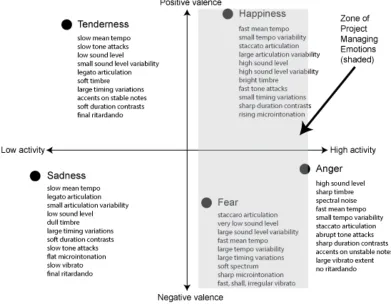
There is established commentary on how musical variables can be manipulated to express emotion (Bresin and Friberg, 2011, Gabrielsson and Lindstrom,
2011 and Mohn et al., 2011). For example, whilst there is not definitive agreement on the precise ordering of relative importance, the following musical variables are considered to be key determinants of a musician's expression of emotion: tempo, mode, articulation, pitch level, loudness, rhythm patterns, phrasing, timbre, attack level and interval content (Bresin and Friberg, 2011, Eerola et al.,
Fig. 1.
Musical characteristics and their relationship to the experience of project managing.
Adapted from: Juslin (2001, p. 315).
In summary, Leavy (2008, p. 110) claims “[m]usic-based methods can help researchers access, illuminate, describe and explain that which is often rendered invisible by traditional research practices.” Given the call for new research paradigms and methods in project management research (Cicmil et al., 2006 and Drouin et al., 2013), music-based elicitation is deemed suitable as a method of enquiry for furthering the exploration of the ‘lived experience’ of projects.
6. Research method
The research method for the study can be summarised as a semi-structured interview in which an arts-based elicitation activity is used as a device to access a ‘lived
experience’ description of managing a project. Specifically the participant is asked to improvise (play) the experience of managing a particular project on a xylophone and/or glockenspiel, and then to explain to the researcher the meaning of their improvisation. This is their description of their ‘lived experience’.
sounds that could be made on the xylophone and glockenspiel. This includes ‘open’ experimentation, a request to play three different emotions (happiness, scariness and sadness) and to express an experience such as playing ‘a day at the beach’. The participant is not asked to explain their improvisations of these ‘warm-up’ activities, and the only commentary by the researcher is assurance that there is no right or wrong and that their improvisations were great.
Following the ‘warm-up’ activities, the participant is asked to bring a particular project to mind. The only requirement is that they can clearly remember the project. The participant is then asked to play on the xylophone and/or glockenspiel their experience of managing the project. There is no direction regarding the length of the piece. A second audio recording device records the participant's improvisation of managing the project. Having played their project managing experience, the semi-structured discussion continues. Firstly, the participant has replayed (from the second audio recorder) their improvisation and is asked to explain the meaning of their piece. The researcher takes the position of an interested observer, passing no judgement on the comments made, neither challenging nor affirming their experience. In closing, the participant is asked what type of project they were playing (e.g. construction, IT etc.), how long they had been working in project management, whether their
improvisation is typical of most projects they have been involved with (why/why not), and their age bracket; their gender was also noted.
In this study the research participants were drawn from a group of postgraduate project management students. Participation was voluntary. The only requirement was that they had experience in project managing. The study received ethical clearance from the sponsoring institution. The participants were made aware of the opportunity through email and an in-class announcement of the opportunity. No incentives were offered for participation.
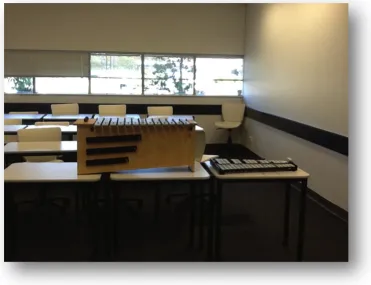
Fig. 2.
Set-up of xylophone and glockenspiel.
6.1. Methods of analysis
The transcripts from the audio recordings were loaded into NVivo for analysis. Common themes in the participants' explanations regarding their improvisation were tagged. An inductive approach was adopted; specifically, tagging any comments that could be related to the ‘lived experience’ of project management; no particular themes were pre-supposed.
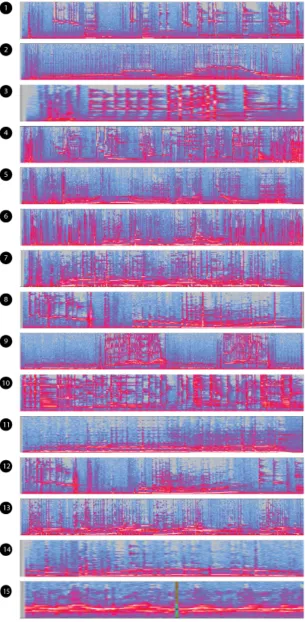
The improvisations (on the instruments) of managing projects were also analysed through audio software: Sonic Visualiser and Audacity. This included digitised analysis of the wave-form (loudness/amplitude across time), mode pattern (major and minors) of each improvisation and their spectrograms. Spectrograms are based on a Fourier representation, converting an audio signal into a visualised form, with time shown along the x-axis and frequency along the y-axis. The prominence
(loudness/amplitude) of any given frequencies at a given time is indicated through the intensity of colour (Costa et al., 2011). Spectrograms have been established as
valuable tools in understanding and analysing music and enabling classification (Costa et al., 2011 and Thibeault, 2011).
7. Findings
The findings of this study will be discussed in three sections:
7.1. Participant demographic/statistical information
Fifteen participants were engaged in the research study. Of these participants, 12 were male and three were female. The participants' ages ranged from 18–24 through to 45– 54. Of note, there was significant diversity across the type of projects managed by the participants (including IT, retail, construction, defence and policy). There was also a strong diversity in project managing experience; from 2 years to 15 + years. Four participants reported instrumental capability (although only two of these were percussionists/drummers). The length of improvisations varied from 12 to 76 s, the mean length being 39 s.
7.2. Transcripts: explanations of the improvisations by the participants Eight of the participants indicated that they had played a full project/traditional project lifecycle in their improvisation. Ten of the participants spoke of the beginning of the project; overall participant's reported positive feelings or a ‘building-up’ at this stage of the project:
“Yep, that's the start of the project, generally pretty good, getting warmed up, it's a new project, you're happy…generally, good emotions”
“At the start it was great, you know, I was excited, happy to be involved and whatever, and was up really high.”
Nine of the participants spoke of the middle of the project. Their references were centred on the period being a speeding up, experiencing ups and downs, managing challenges and resolving issues:
“Once you do get started all the challenges that are put in front of you, and trying to deal with them.”
“And then you have highs and lows throughout it. You have good when you start make productivity [sic], it's pretty good and then you definitely always have some serious challenges”
Eight of the participants spoke of management influence, issues or conflict. For example:
“…he [referring to a manager] is only just concerned about the money side of things, the cost, so he wasn't really concerned about timeframes, but, he told me at the start it was more about the timeframe.”
“So when that thing happened, we wanted support, but we couldn't get it.”
experience; challenges, issues, conflicting opinions, messiness, frustration, stress and pressure.
“it was very very hectic… very intense… very manic…” “it was so demanding, the workload… And then we hit a lot of financial challenges… so hard… so yeah, that's where it gets really hard as well…”
“everything just clashes together, starting to get eighteen things happening at once.”
“… then things just fall out of the sky, and they need to be dealt with… so while they might be a bit scary…”
Eleven of the participants commented on positive emotions as part of their experience of managing the project; happiness, good, pleased, up pretty high, satisfied, enriching, enjoyed:
“I ended on at a high note.... like a separate high note, so… so ‘bang’, I'm happy now…”
“…sometimes you feel happy, and sometimes, professionally, you feel satisfied with your job.”
“…personally, and professionally that was enriching for me.”
Interestingly, nine of the participants, commented specifically on an up and down cycle in their experience, words such as “bitter and sweet”, “mixed emotions” and “rollercoaster” were used.
“It has bitter sides as well as some sweet sides. Ups and downs.” “So, it was a lot of ups and downs…”
“Yeah, it was a stop, start, stop, start of feeling successful and feeling unsuccessful.”
Six of the participants referred to their experience drawing on game or play-related terms, for example: “goes off track”, “running on the spot, and not getting very far”, “for a thrill” and “the goal was that it wouldn't be…”. A third of participants linked their experience with learning, for example:
“Yeah, I think as far as my professional development, I learnt a lot through it…”
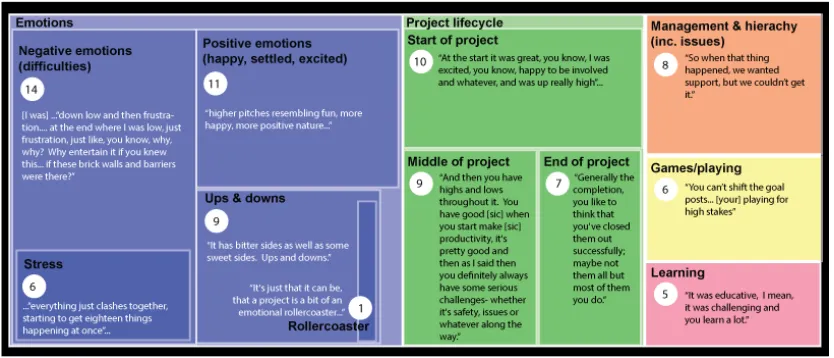
Fig. 3 provides a tree map indicating a series of themes identified in the participant's discussions of their improvisations. The number against each theme indicates the number of participants that made a comment that has been classified as relating to the theme. The size of the area allocated to the theme is relative to the number of
participant's associating with the theme. An example of a participant's comment against each theme is provided to create clarity in the theme name.
Fig. 3.
Three map showing number of participants (n = 15) who identified with a theme.
7.3. Participants' improvisations of the experience of project managing
As suggested above, the improvisations themselves cannot be weighted as heavily in their validity as the explanations provided by the participants of their
xylophone/glockenspiel playing. Ultimately, the improvisations are simply a device to encourage participants to speak in a less indoctrinated or detached manner.
Fig. 4.
7.4. Summary of findings
The most consistent finding of the study (and it is recognised that this is a sample of fifteen participants and this limitation is discussed further in Section 8.4) is that 93% of participants included in their description of the ‘lived experience’ negative
emotions or challenges, difficulties, frustration etcetera and 73% reported positive emotion. Additionally, 60% of participants spoke directly of ups and downs and 86% of the musical improvisations reflected this sentiment when viewed as spectrograms (i.e. they have a wave/cyclical pattern).
It is highlighted that there was minimal, and where it was present, inconsistent reference to the use of project management tools or techniques, or the day-to-day tasks associated with managing projects in the participants' explanations. Rather, participants' predominately described their experience in terms of an emotional imprint (refer to Section 7.2) that they had or were experiencing. This can possibly be attributed to the effectiveness of the musical elicitation method (as suggested by the literature) to encourage participants to consider their experience from a
non-traditional, non-linguistic, personal perspective. It enabled the participants to access their ‘lived experience’ of managing a project.
8. Discussion
The findings are now considered with reference to the research question. Limitations of this research study are noted and the implications for further research are also provided.
8.1. The personal ‘lived experience’ of project managing
It is clear from Section 7.4, that this study has enabled us to access some descriptions of the ‘lived experience’ of managing a project. Unlike much extant project
management research that focuses on more positivist, detached perspectives of the project phenomena, this study has captured more personal perceptions of the experience.
Study participants spoke of this personal perspective in terms of the challenging nature of work. They also described up and down emotional states, and periods of greater and lesser challenges. Generally, they reported a feeling of satisfaction at project completion; a sense of achievement. They spoke of project work causing stress and pressure and of the demanding, manic nature of project environments. Some participants described this type of work as having a strong learning element, which they found enjoyable and spoke of the experience using game or sport terminology. Before considering the implications of these descriptions of the ‘lived experience’ of project managing we will briefly contrast these findings to the discussions provided by Whitty, 2010 and Whitty, 2011 and Cerny (2007). 8.2. Comparison to the extant literature regarding projects and emotions
drew a rollercoaster and the board game snakes ‘n’ ladders when illustrating the managing of projects. Whitty (2010) also highlights that projects are reported by practitioners as having both challenges and difficulties, but there was also a positive emotion associated with the experience: “even the really bad ones. I get a buzz out of it, and I keep going back for more” (Whitty, 2010, p. 29). He terms this as a “duality” (Whitty, 2010); and this duality was certainly evident in the improvisations and explanations of the participants in this study.
In Cerny's (2007, p. 349) paper, she quotes Eskerod, Blichfeldt and Toft (2004): “…project work may be very exhausting due to high time pressures; many parallel tasks; ambiguity and uncertainty; many parties with conflicting interest [sic] to deal with; and a lot more, even though many people at the same time find project work very stimulating and exciting as it gives the person in question opportunities to put many different competencies into use and to grow personally.”
In this study one participant directly quoted the enrichment and growth that can result from projects: “So, personally, and professionally that [the experience of the project] was enriching for me”. Similarly, a participant commented on being “flat out” (exhausted), and another commented “I'll just feel bad or I'm a bit stressed at times”. Cerny (2007) also notes the close relationship between projects and change, and this was a strong theme in one participant's improvisation and explanation; “so projects generally involve change”. Cerny (2007) draws on elements of the ‘accepted’ project lifecycle as sources of emotion. Again, this research study found that many of the participants did reference their emotions/experience in relation to these phases (refer to Section 7.2).
In summary, there is an alignment between this previous work exploring the ‘lived experience’ of projects and the findings of this study. It suggests that these
descriptions of the more personal experience of managing projects may be
representative of the broader experience of project managers. Obviously, this would require far more extensive exploration before such a statement could be definitively claimed. However, for the purposes of considering the implications of these findings, we will tentatively assume that this is somewhat representative of the ‘lived
experience’ of managing a project.
8.3. Implications for research and practice
Findings such as those in this study provide us with a richer understanding of the phenomena of projects. This enhancement of our understanding is useful in
8.3.1. Flow theory
Csikszentmihalyi's (1975) concept of a state of flow that can be experienced by people when certain conditions are met is useful in assisting us in understanding the implications of our findings. Whitty (2010) prompts us to consider the link between project managing and flow theory and it is suggested that this study lends support to this suggestion. The flow theory concept was founded by Csikszentmihalyi (1975, p. 36) and was defined by him as “the holistic experience that people feel when they act with total involvement.” The experience of flow is associated with feelings of
absorption, exhilaration and enjoyment (Csikszentmihalyi, 1990, 1992). Eight components are considered to be necessary for an individual to experience flow (Chen, 2007):
1. Challenging activity requiring skill 2. A merging of action and awareness 3. Clear goals
4. Direct, immediate feedback 5. Concentration on the task at hand 6. A sense of control
7. A loss of self-consciousness 8. Altered sense of time
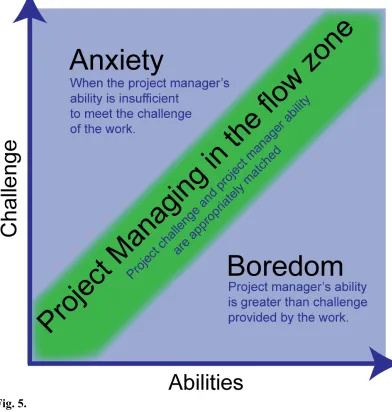
Fig. 5.
The project managing flow zone: a balance between challenge and ability. Adapted from: Chen (2007, p. 32).
We would argue that the ‘lived experience’ of project managing reported by the study participants aligns with operating in the ‘flow zone’. For example, aligned with component 1 of the flow experience, many of the participants reported the experience of project managing as a challenging activity requiring them to apply their skills. They balance this with a reporting of positive emotion (i.e. satisfaction, success etc.). This suggests that the emotional experience of project managers may be similar to that of game-play and experiencing flow. They are balancing on the edge of over challenged (and anxiety) and boredom; they are participating in a challenging activity requiring skill. It could perhaps be drawn that when project managers are managing their projects they are operating on the edge of their inherent capability (which includes the resources available to them) and this results in a positivity associated with operating ‘in flow’.
example, it is posited that a key component of most work associated with the term project has some form of goal or objective (component 3 for flow – clear goals – to be experienced). Component 4 – direct, immediate feedback – is also considered to be prevalent in many project environments. This can either be in formal processes such as tracking performance against baselines, or more informal in terms of ad hoc stakeholder feedback. Project managers are also likely to perceive that they have some sense of control, ability to influence the situation, or at least that they are expected to attempt this control. This would align with component 6 — a sense of control. In summary, whilst we have not been able to definitively defend that work that we call project work can invoke a sense of flow. We have, illustrated the likelihood that this is a plausible notion.
Also of relevance to this application of flow theory to the study is the participants' association of their experience to games or sport and learning. Interestingly, six of the participants actually used game or sport language to describe their ‘lived experience’ of managing a project. We would suggest that this adds credence to the concept that there is a perceived game or ‘challenge to succeed’ element in the experience of project managing. Additionally, a third of participants identified a learning
component in their experience of project managing. Similarities again could be drawn between this experience and the experience of progressing through the levels of a computer game. The participant's capability is being progressively built so they are able to pursue greater and greater challenges (or in this case, more and more challenging projects).
It has been confirmed through this study that the project managers participating in the study experience this sense of being challenged within their ability (component 1). If we then draw on flow theory, we can infer that this sense of an ‘achievable challenge’ is a sign to a balanced function of ‘pushing capability’ versus the challenging work activity. This identification of project work as being a function of activity versus capability is a foundation for reconceptualising our understanding of ‘what is a project?’.
8.3.2. Reconceptualising ‘what is a project?’
In the literature review reference was made to the use of a Heideggerian paradigm (van der Hoorn and Whitty, in press) to underpin exploration of the ‘lived experience’ of projects. Within their discussion of the implications of the adoption of a
Heideggerian paradigm they propose an alternative conceptualisation of ‘what is a project?’. The proposal is that a project is the situation that arises when there is a disruption (or dissatisfaction) within a current set of conditions, and an attempt is being made to resolve this situation, but there is not an inherent capability to resolve the situation. Clearly, part of their definition is that what is a project is based on an individual's or an oganisation's capability (or lack thereof) to undertake an activity. What is a project is not definable in terms of a specific activity, it is in the relationship that a person or group of people has (in terms of capability) to an activity. This
the project managers in the study (and in similar research of the ‘lived experience’ of project managing) experience certain emotions and challenges that align with
operating in ‘flow’. The experience of ‘flow’ per Csikszentmihalyi (1975) is a function of capability in terms of the activity being undertaken. However, the ‘flow’ occurs because of the relationship of the person to the activity. Not just because of the activity. An activity that causes flow for one person may create boredom or angst for another. Similarly, ‘what is a project?’ is not in the activity itself. ‘What is a project’ is in the relationship between the individual or organisation and the activity.
Specifically, for an activity to be perceived as a project, completion of the activity must be at the edge of one's (the individual or organisations) inherent capability. For many of the project managers in this study, operating at this edge of capability was satisfying.
8.4. Limitations and constraints
This research study is not proposed to provide a population-valid perspective of descriptions of the ‘lived experience’ of managing projects. In fact, given the nature of the question it is not expected that findings will ever be able to be deemed
universally-applicable. However, a larger sample population would increase the general validity of the findings and therefore potentially support the posited
implications. Further, the validity of our understanding of the ‘lived experience’ of project managing is also likely to be revealed through the ongoing use of alternative research methods (including those offered by the arts-based methods).
A further limitation can be grounded in the conception of the memory–experience gap. Kahneman (2007) and Kahneman and Riis (2005) argue that the ‘experienced’ and the ‘remembered’ are two different measures that will have different results. For this study, it highlights that the findings cannot be assumed to reflect the ‘living’ experience (i.e. the experience in the moment). However, they can be categorised as the ‘lived’ experience (i.e. a recollection of the past; a memory). This is not
necessarily considered problematic, but it is raised to highlight the perspective of the explanations provided by participants of their experience, which is that they are the remembered experience not the in-the-moment experience.
8.5. Implications for future research
There is an opportunity for further exploration of the components required for the experience of flow in the project environment. Specifically, the gathering of empirical data to examine the presence of components two through eight within the project environment. Additionally, the experience of flow in understanding the people who are attracted to project work and how they can be supported and developed could be explored.
9. Conclusion
This paper has added to the discourse regarding the personal ‘lived experience’ of project managing. It has also been established that the music-based research method is effective in eliciting results that provide a ‘lived experience’ perspective to the
phenomena of projects. It has been particularly effective in revealing the emotions experienced by those managing projects. The participants in this study described their experience of managing a project as challenging, having ups and downs, a sense of satisfaction at completion, involving learning, and having periods of stress and pressure. There is a dynamism in emotions when we are experiencing activities that we label as project work.
It has been proposed that if this described experience is considered through the lens of flow theory, then we can begin to see a conceptualisation of projects aligned with that of the Heideggerian paradigm of projects. That is, project managers report a sense of satisfying challenging that is characteristic of operating ‘in flow’. Csikszentmihalyi (1975) describes flow as being a function of activity being undertaken versus the capability of the participant. This capability variable is key to van der Hoorn and Whitty's (in press) Heideggerian proposal that ‘what is a project?’ is dependent on an individual's or organisation's ability to undertake the activity.
Acknowledgement
References
Aitken and Crawford, 2007
Coping with stress: dispositional coping strategies of project managers Int. J. Proj. Manag., 25 (7) (2007), pp. 666–673
Allett, 2010
Sounding Out: Using Music Elicitation in Qualitative Research, Realities/Morgan Centre
(2010) (viewed 27 August 2014, <http://eprints.ncrm.ac.uk/2871/) Australia, 2006
Standards Australia
HB 280-2006 Case Studies: How Boards and Senior Management Have Governed ICT Projects to Succeed (or Fail)
Standards Australia, Australia (2006) Bagnoli, 2009
Beyond the standard interview: the use of graphic elicitation and arts-based methods Qual. Res., 9 (5) (2009), pp. 547–570
Bauer and Gaskwell, 2000
Qualitative Researching With Text, Image and Sound: A Practical Handbook Sage Publications, London (2000)
Bloch et al., 2012
Delivering Large-scale IT Projects on Time, on Budget, and on Value McKinsey & Company (2012) (viewed 15 March 2014,
<http://www.mckinsey.com/insights/business_technology/delivering_large-scale_it_projects_on_time_on_budget_and_on_value)
Blomquist et al., 2010
Project-as-practice: in search of project management research that matters
Proj. Manag. J., vol. 41 (1) (2010), pp. 5–16 (viewed 22 March 2014, EBSCOhost, Business Source Complete, item: 48329762)
Brearley and Darso, 2008
Business studies: vivifying data and experience through artful approaches
J.G. Knowles (Ed.), Handbook of the Arts in Qualitative Research: Perspectives, Methodologies, Examples, and Issues, Sage Publications, Los Angeles (2008), p. 700 Bredillet, 2004
Beyond the positivist mirror: towards a project management ‘gnosis’
International Research Network for Organizing by Projects—IRNOP VI (2004) Bresin and Friberg, 2011
Cortex, 47 (9) (2011), pp. 1068–
1081 http://dx.doi.org.ezproxy.usq.edu.au/10.1016/j.cortex.2011.05.009(viewed 15 April 2014, ScienceDirect, item)
Bresler, 2008 The music lesson
J.G. Knowles (Ed.), Handbook of the Arts in Qualitative Research: Perspectives, Methodologies, Examples, and Issues, Sage Publications, Los Angeles (2008), p. 700 Cerny, 2007
Emotions in projects
Proceedings of the 21st IPMA World Congress Cracow, 21st IPMA World Congress, Poland (2007)
Chen, 2007
Flow in games (and everything else)
Commun. ACM, 50 (4) (2007), pp. 31–34 (viewed 22 April 2014, EBSCOhost, Computer and Applied Sciences Complete, item: 24522717)
Cicmil and Hodgson, 2006
Making projects critical: an introduction
D. Hodgson, S. Cicmil (Eds.), Making Projects Critical, Palgrave Macmillan, China (2006), pp. 1–25
Cicmil et al., 2006
Rethinking project management: researching the actuality of projects Int. J. Proj. Manag., 24 (8) (2006), pp. 675–
686http://dx.doi.org.ezproxy.usq.edu.au/10.1016/j.ijproman.2006.08.006 viewed 21 June 2013, SciVerse, ScienceDirect
Clennon, 2012
Performative Social Science: Generating New Data Through Music-based Research Methodology
(2012) viewed 7 March, <http://www.cheshire.mmu.ac.uk/dca/downloads/research-downloads/Performative-social-science.pdf
Costa et al., 2011
Music genre recognition using spectrograms
Proceedings of the Systems, Signals and Image Processing (IWSSIP), 2011 18th International Conference (2011), pp. 1–4
Crilly et al., 2006
Graphic elicitation: using research diagrams as interview stimuli Qual. Res., 6 (3) (2006), pp. 341–366
Csikszentmihalyi, 1975
Beyond Boredom and Anxiety
The Psychology of Optimal Experience Harper & Row, New York (1990) Csikszentmihalyi, 1992
Flow: The Psychology of Happiness Random House, London (1992) Csikszentmihalyi, 2006
A Life Worth Living Contributions to Positive Psychology
Oxford University Press, New York (2006) (viewed 22 April 2014,
<http://ezproxy.usq.edu.au/login?url=http://www.usq.eblib.com.au.ezproxy.usq.edu.a u/EBLWeb/patron?target=patron&extendedid=P_270875_0)
Daykin, 2004
The role of music in arts-based qualitative inquiry Int. J. Qual. methods, 3 (2) (2004)
Doloi, 2013
Application of behavioural science and cognitive mapping in project management research
N. Drouin, R. Muller, S. Sankaran (Eds.), Novel Approaches to Organization Project Management Research, Copenhagen Business School Press, Norway (2013)
Drouin et al., 2013
N. Drouin, R. Muller, S. Sankaran (Eds.), Novel Approaches to Organizational Project Management Research, Copenhagen Business School Press, Copenhagen (2013)
Eerola et al., 2013
Emotional expression in music: contribution, linearity, and additivity of primary musical cues
Front. Psychol., 4 (2013), pp. 1–12 viewed 18 April 2014, EBSCOhost, Academic Source Complete, item: 89748345
Eskerod et al., 2004
Too Many Good Projects: Managing Emotions regarding project over-load
pmdays'04 Projects & emotional Intelligence: Research Conference, Vienna (2004) November 24th, 2004
Gabrielsson and Lindstrom, 2011
The role of structure in the musical expression of emotions
,in: P. Juslin, J. Sloboda (Eds.), Handbook of Music and Emotion: Theory, Research, Applications14, Oxford University Press, Oxford (2011), pp. 367–400
Geraldi et al., 2011
Now, let's make it really complex (complicated): a systematic review of the complexities of projects
Projects-as-practice: new approach, new insights
P. Morris, J. Pinto, J. Soderlund (Eds.), The Oxford Handbook of Project Management, Oxford University Press, Oxford (2011), pp. 500–519 Heidegger, 1962
Being and Time, Translated by J Macquarrie & E Robinson Basil Blackwell, Oxford (1962)
Hodgson and Cicmil, 2006
Are projects real? The PMBOK and the legitimisation of project management knowledge
D. Hodgson, S. Cicmil (Eds.), Making Projects Critical, Palgrave Macmillan, China (2006), pp. 29–50
Johnson and Wiles, 2003
Effective affective user interface design in games Ergonomics, 46 (13–14) (2003), pp. 1332–1345 Juslin, 2001
Communicating emotion is music performance: a review and a theoretical framework ,in: P. Juslin, J. Sloboda (Eds.), Music and Emotion: Theory and Research14, Oxford University Press, Oxford (2001), pp. 309–337
Kahneman, 2007
Explorations of the Mind-well-being: Living and Thinking About It UC Berkeley Graduate Council (2007) (viewed 14 April 2014, <http://uctv.ucsd.edu/search-details.aspx?showID=12302) Kahneman and Riis, 2005
Living, and thinking about it: two perspectives on life
F. Huppert, N. Baylis, B. Keverne (Eds.), The Science of Well-being, Oxford University Press, Oxford (2005)
Killen et al., 2013
Translational approaches: applying strategic management theories to OPM research N. Drouin, R. Muller, S. Sankaran (Eds.), Novel Approaches to Organizational Project Management Research, Copenhagen Business School Press, Copenhagen, (2013), pp. 348–380 (ch 13)
KPMG, 2013
Project Management Survey Report 2013 (2013) (viewed 22 March 2014,
<http://www.kpmg.com/NZ/en/IssuesAndInsights/ArticlesPublications/Documents/K PMG-Project-Management-Survey-2013.pd)
Leavy, 2008
Method Meets Art: Arts-based Research Practice Guilford Press, New York (2008)
Simulations for project management research
N. Drouin, R. Muller, S. Sankaran (Eds.)Copenhagen Business School Press, Copenhagen (2013), pp. 199–219 (ch 7)
Lineham and Kavanagh, 2006
From project ontologies to communities of virtue
D.E. Hodgson, S. Cicmil (Eds.), Making Projects Critical, Palgrave Macmillan, Basingstoke England (2006), pp. 51–67
McHugh and Hogan, 2011
Investigating the rationale for adopting an internationally-recognised project management methodology in Ireland: the view of the project manager Int. J. Proj. Manag., 29 (5) (2011), pp. 637–
646http://dx.doi.org.ezproxy.usq.edu.au/10.1016/j.ijproman.2010.05.001 viewed 21 June 2013, SciVerse, ScienceDirect
Mitchell et al., 2011
Drawings as research method
L. Theron, C. Mitchell, A. Smith, J. Stuart (Eds.), Picturing Research, Sense Publishers (2011), pp. 19–36 ch 2
Mohn et al., 2011
Perception of six basic emotions in music Psychol. Music, 39 (4) (2011), pp. 503–
517 http://dx.doi.org.ezproxy.usq.edu.au/10.1177/0305735610378183 viewed 15 April 2014, Sage Publications, Sage Journals
PlanIT, 2013
Industry Stats: Project Outcomes by Industry and Causes of Failure
(2013) (viewed 27 March 2014, <http://www.planit.net.au/resource/industry-stats-project-outcomes-by-industry-causes-of-failure>)
PM Solutions Research, 2011 Strategies for Project Recovery
http://www.pmsolutions.com/collateral/research/Strategies%20for%20Project%20Rec overy%202011.pd(2011) (viewed 27 March 2014)
Pollack, 2007
The changing paradigms of project management Int. J. Proj. Manag., 25 (3) (2007), pp. 266–274 Article
Project Management Institute, 2013
A guide to the Project Management Body of Knowledge 5th, Project Management Institute, Newtown Square Pa (2013) Rolling, 2010
Saunders et al., 2009
Research Methods for Business Students (5th ed.)Prentice Hall, Harlow England (2009) Shenhar and Dvir, 2007
Reinventing project management: The diamond approach to successful growth and innovation
Harvard Business School Press, Boston (2007) Skyttner, 2001
General systems theory ideas & applications
World Scientific, Singapore (2001) (viewed 21 March
2014, http://ezproxy.usq.edu.au/login?url=http://site.ebrary.com.ezproxy.usq.edu.au/li b/unisouthernqld/Doc?id=10255868)
Smyth and Morris, 2007
An epistemological evaluation of research into projects and their management: methodological issues
Int. J. Proj. Manag., 25 (4) (2007), pp. 423–436 Thibeault, 2011
Learning from looking at sound: using multimedia spectrograms to explore world music
Gen. Music. Today, 25 (1) (2011), pp. 50–55 (viewed 20 April 2014, EBSCOhost, Education Research Complete, item: 74975659)
Thomas, 2006
Problematising project management
D. Hodgson, S. Cicmil (Eds.), Making Projects Critical, Palgrave Macmillan, China (2006), pp. 90–110
van der Hoorn and Whitty, in press
A Heideggerian paradigm for project management: breaking free of the disciplinary matrix and its Cartesian ontology
Int. J. Proj. Manag.
(2014) http://dx.doi.org.ezproxy.usq.edu.au/10.1016/j.ijproman.2014.09.007 (in press)
Weeson and Boniwell, 2007
Flow theory — its application to coaching psychology Int. Coach. Psychol. Rev., 2 (1) (2007), pp. 33–43 Whitty, 2010
Project management artefacts and the emotions they evoke Int. J. Manag. Proj. Bus., 3 (1) (2010), pp. 22–
45http://dx.doi.org.ezproxy.usq.edu.au/10.1108/17538371011014017 viewed 14 June 2013, Emerald
Whitty, 2011
Proceedings of the PMOz 2011 Incorporating the PMI Australia National Conference: Project Management at the Speed of Light Sydney Australia. (2011)
Winter et al., 2006
Directions for future research in project management: the main findings of a UK government-funded research network
Int. J. Proj. Manag., 24 (8) (2006), pp. 638–
649http://dx.doi.org.ezproxy.usq.edu.au/10.1016/j.ijproman.2006.08.009 viewed 14 June 2013, SciVerse, ScienceDirect
Zwikael and Bar-Yoseph, 2004
Improving the capabilities of project team management using the Gestalt cycle of experience