
Multinucleating Ligand Frameworks as Models of Biological Active Sites
Thesis by Emily Yuan Tsui
In Partial Fulfillment of the Requirements for the degree of
Doctor of Philosophy
CALIFORNIA INSTITUTE OF TECHNOLOGY Pasadena, California
2014
To hell with dignity! I’ll leave when the job’s done.
My time at Caltech over the past several years has been an experience that will stay with me for the rest of my life, primarily due to my interactions with a number of very special individuals. Although it is entirely inadequate to express my feelings for them in words, I will try, briefly, below:
Theodor Agapie, my advisor, is the root of it all. His excitement about all kinds of chemistry is what first drew me to Caltech and has been representative of most of my interactions with him and the other members of the chemistry department throughout my time here. Thank you, Theo, for always pushing me out of my intellectual comfort zone and for asking hard questions about the research in order to extend the limits of what we think we can accomplish. I really appreciate that, despite your constant eagerness for new chemistry and new results, you have always been patient with me when the going’s been tough. I aspire to achieve your standards of excellence someday, at long last!
The members of my committee, Nate Lewis, Jim Heath, and Jonas Peters, have all been helpful in discussing research, propositions, and career plans. Many thanks to John Bercaw for allowing us all to run amok through your labs and for showing me how to use the Toepler pump. I would also like to thank Harry Gray and Jay Winkler for being willing to discuss my research and to provide new ideas. Bruce Brunschwig was a great help with the SQUID measurements.
intact sense of humor.
were fellow members of the first class of students in the Agapie group and have been there for the past five and half years. It was exciting to set up the lab with you all and we made it through all the growing pains with each other’s support. Paul, you are a synthetic inspiration; I wish I had half of your ligand synthesis abilities. Thanks also for going to Taco Bell with me – other people have no taste! Maddy, thank you for always being positive and upbeat. I have been very impressed with your dedication and organization. You are one of the most effective people I know. Sibo, thank you for always being around during the late night shift and for being perhaps the strangest person I have ever met. You’ve always been there to provide a unique perspective (when you’re awake).
The undergraduates have been an important part of the lab environment. Alexandra Velian was the very first Agapie group member and provided a cheerful presence when we were first setting up the labs. Best of luck to Eva Nichols and Jade Shi in their graduate school careers; I learned a lot from them. Special thanks to Christine Cheng, who worked with me for two summers and has a truly incredible tolerance both for my nonsense and for ethanol (and mercury poisoning?).
was a great help with stopped-flow measurements.
Many thanks to the staff at Caltech who make the department what it is. In particular, Larry Henling, thank you for spending many hours in the X-ray facility helping me mount my terrible crystals. I have learned a lot from you. Dave VanderVelde, thank you for helping me with NMR experiments.
Parts of this thesis have been adapted from articles co-written by the author.
The following articles were reproduced in part with permission from the American Chemical Society:
“Oxygen Atom Transfer and Oxidative Water Incorporation in Cuboidal Mn3MOn
Complexes Based on Synthetic, Isotopic Labeling, and Computational Studies” Jacob S. Kanady, Jose L. Mendoza-Cortes, Emily Y. Tsui, Robert J. Nielsen, William A. Goddard III, and Theodor Agapie. J. Am. Chem. Soc. 2013, 135, 1073-1082.
“Synthetic Cluster Models of Biological and Heterogeneous Manganese Catalysts for O2 Evolution” Emily Y. Tsui, Jacob S. Kanady, and Theodor Agapie. Inorg. Chem.
2013, 52, 13833-13848.
The following article was reproduced in part with permission from Wiley-VCH:
“Trinucleating Copper: Synthesis and Magnetostructural Characterization of Complexes Supported by a Hexapyridyl 1,3,5-Triarylbenzene Ligand” Emily Y. Tsui, Michael W. Day, and Theodor Agapie. Angew. Chem. Int. Ed. 2011, 50, 1668-1672. The following article was reproduced in part with permission from The Royal Society of Chemistry:
Association for the Advancement of Science:
“A Synthetic Model of the Mn3Ca Subsite of the Oxygen-Evolving Complex in
Photosystem II” Jacob S. Kanady, Emily Y. Tsui, Michael W. Day, and Theodor Agapie. Science 2011, 333, 733-736.
The following article was reproduced in part with permission from Nature Publishing Group:
“Redox-Inactive Metals Modulate the Reduction Potential in Heterometallic Manganese-Oxido Clusters” Emily Y. Tsui, Rosalie Tran, Junko Yano, and Theodor Agapie. Nat. Chem. 2013, 5, 293-299.
The following article was reproduced in part with permission from the National Academy of Sciences of the United States of America:
Much of the work described in this thesis is the result of collaborative efforts. Specific notes are included for compounds not synthesized by the author; some general comments are given here.
Many of the studies of multimetallic clusters were carried out in close collaboration with Mr. Jacob S. Kanady. He synthesized and characterized the trimanganese(II) triacetate complex that served as a precursor to most of the heterometallic manganese oxido clusters, as well as the structurally related tricobalt(II) triacetate and trinickel(II) triacetate complexes for which magnetic susceptibility data are presented in Chapter 2. Mr. Kanady was the first to isolate and characterize structurally and with NMR spectroscopy the [CaMn3O4] cubane cluster 6-Ca discussed in Chapter 4 as well as the {[Mn3O]2Ca}2+
cluster 3 discussed in Chapter 3. Additionally, the PMe3 studies of the oxidized
This dissertation describes efforts to model biological active sites with small molecule clusters. The approach used took advantage of a multinucleating ligand to control the structure and nuclearity of the product complexes, allowing the study of many different homo- and heterometallic clusters. Chapter 2 describes the synthesis of the multinucleating hexapyridyl trialkoxy ligand used throughout this thesis and the synthesis of trinuclear first row transition metal complexes supported by this framework, with an emphasis on tricopper systems as models of biological multicopper oxidases. The magnetic susceptibility of these complexes were studied, and a linear relation was found between the Cu−O(alkoxide)−Cu angles and the antiferromagnetic coupling between copper centers. The triiron(II) and trizinc(II) complexes of the ligand were also isolated and structurally characterized.
water oxidation.
Chapter 5 presents studies of the effects of the redox-inactive metals on the reactivities of the heterometallic manganese complexes discussed in Chapters 3 and 4. Oxygen atom transfer from the clusters to phosphines is studied; although the reactivity is kinetically controlled in the tetraoxido clusters, the dioxido clusters with more Lewis acidic metal ions (Y3+ vs. Ca2+) appear to be more reactive. Investigations of hydrogen atom transfer and electron transfer rates are also discussed.
Acknowledgements ... iv
Preface ... viii
Respective Contributions ... x
Abstract ... xi
Table of Contents ... xiii
Chapter 1: General Introduction ... 1
Structural and mechanistic studies of the OEC ... 3
Heterogeneous metal oxides as water oxidation catalysts ... 6
Synthetic manganese clusters ... 6
This work ... 12
Chapter 2: Synthesis, Structure, and Magnetic Susceptibilities of Trinuclear Transition Metal Clusters of a Hexapyridyl 1,3,5-Triarylbenzene Ligand Framework ... 21
Abstract ... 22
Introduction ... 23
Results and Discussion ... 24
Ligand synthesis and NMR studies ... 24
Synthesis and structure of tricopper complexes ... 28
Magnetic susceptibility and EPR studies of tricopper(II) complexes ... 35
Trinuclear complexes of other first row transition metals ... 42
Conclusions ... 48
Experimental Details ... 49
References ... 73
Chapter 3: Heterometallic Manganese Dioxido Complexes: Reduction Potential Modulation by Lewis Acidic Redox-Inactive Metals ... 77
Abstract ... 78
Introduction ... 79
Results and Discussion ... 81
Synthesis of [CaMn3O2] clusters ... 81
Synthesis of [MMn3O2] complexes ... 86
Magnetic susceptibility and X-ray absorption studies ... 90
Electrochemical studies of [MMn3O2] complexes ... 94
Conclusions ... 100
Experimental Section ... 100
References ... 123
Chapter 4: Synthesis, Structure, and Electrochemical Studies of Heterometallic Manganese Tetraoxido Cubane Clusters ... 127
Abstract ... 128
Introduction ... 129
Results and Discussion ... 131
Synthesis of a [CaMn3O4] cluster ... 131
Synthesis of [MMn3O4] complexes ... 135
Electrochemical studies ... 148
Conclusions ... 152
Experimental Section ... 152
References ... 162
Chapter 5: Reactivity Studies of Heterometallic Manganese Oxido Clusters 165 Abstract ... 166
Introduction ... 167
Results and Discussion ... 170
Oxygen atom transfer reactions of [MMn3O4] complexes ... 170
Phosphine reactivity of dioxido complexes ... 176
Hydrogen atom transfer to dioxido clusters ... 180
Electron transfer rates ... 182
Conclusions ... 183
Experimental Section ... 184
References ... 190
Appendix A: Bimetallic Complexes of a Dinucleating Bis(N-heterocyclic Carbene) Framework ... 193
Abstract ... 194
Introduction ... 195
Results and Discussion ... 196
Conclusions ... 208
Experimental Section ... 209
References ... 220
Appendix B: Synthesis and Preliminary Metallation Reactions of an Asymmetric Multinucleating Ligand Framework ... 223
Abstract ... 224
Introduction ... 225
Results and Discussion ... 226
Ligand design and synthesis ... 226
Metallation of monooxime ligand ... 228
Conclusions ... 231
Experimental Section ... 232
References ... 237
Appendix C: Side Products and Other Structures ... 239
Introduction ... 240
Results and Discussion ... 240
Trinuclear complexes ... 240
Tetrametallic monooxo complexes ... 246
Complexes derived from dioxido clusters ... 249
Products derived from tetraoxido cubane clusters ... 254
Conclusions ... 259
Experimental Section ... 260
References ... 265
C h a p t e r 1
GENERAL INTRODUCTION
The text for this chapter was reproduced in part from:
Introduction
Photosynthesis, the sunlight-powered process by which plants, algae, and cyanobacteria convert carbon dioxide and water into carbohydrates and O2, is responsible for the
dioxygen in Earth’s atmosphere.1 Light-driven water oxidation occurs at photosystem II
(PSII), a membrane protein assembly that absorbs four photons to sequentially oxidize a CaMn4O5 cluster, known as the water oxidizing complex (WOC) or the oxygen-evolving
complex (OEC), through a sequence of Sn states called the Kok cycle.2 At the most
oxidized state, S4, dioxygen is released. Water acts as the source of the electrons that are
transferred through a series of cofactors and stored as NADPH.1 The reducing equivalents
and proton gradient generated by photochemical water oxidation power carbon dioxide fixation and other processes of life. Overall, solar energy is converted and stored as chemical bonds. Many efforts have been devoted to structural, spectroscopic, and biochemical studies of the OEC because understanding how plants form oxygen from water will have implications for designing artificial catalysts for solar fuels. Heterogeneous metal oxide water oxidation catalysts have been proposed to perform their function at discrete multimetallic sites reminiscent of the OEC.3 Artificial water oxidation catalysts have been prepared from Ca-doped manganese oxide materials to mimic the composition of the OEC, despite the limited structural understanding.3c, 4 Other mixed metal oxides have intriguing catalytic properties, both for water oxidation and oxygen reduction.5 Metal oxides are also
1.1 Structural and mechanistic studies of the OEC
X-ray absorption spectroscopy (XAS)7 and electron paramagnetic resonance (EPR)8 methods have been employed to identify oxidation state, electronic structure, and coordination environment changes during the S-state progression. Recent single crystal X-ray diffraction (XRD) studies have shown that the OEC consists of a CaMn3O4 cubane
cluster with the fourth “dangler manganese” center bridged via oxide moieties (Figure 1).9 Subsequent computational studies, however, have suggested that this structure corresponds to a more reduced manganese cluster due to X-ray damage,10 consistent with previous studies on X-ray-induced reduction,11 or to an equilibrium of multiple structural forms at
similar energies.12 More open cubane structures of the S2 state have been proposed by
[image:17.612.203.448.415.646.2]calculations that are consistent with OEC geometries advanced from EPR and XAS studies (Figure 2).7e, 8c, 12b, 13
Figure 2. Proposed structure of the OEC from single crystal XRD studies (top left)9 and more open structures proposed from XAS and computational studies (top middle, right).12
Proposed structure of catalytic sites in calcium manganese oxide water oxidation catalysts (bottom left)3c, 3d and of cobalt oxide water oxidation catalysts (bottom right).3a
Due to these uncertainties in the structural details of the S states of the OEC, the mechanism of O–O bond formation during water oxidation remains controversial. Isotopic labeling studies using mass spectrometry and magnetic resonance techniques have been used to analyze substrate water exchange rates with bulk water within the OEC.14 Based on these studies and spectroscopic data, several mechanisms for O–O bond formation have been proposed. These proposals differ in the nature and location of the substrate oxo moieties that undergo O–O bond formation to generate O2. Early proposals, such as the
manganese-only adamantane and the double-pivot mechanisms, proved incorrect based on structural grounds.15 Heterolytic pathways involve a water or hydroxide ligand bound to Ca2+ attacking a Mn(V) oxo or Mn(IV) oxyl.16 Other mechanisms have suggested that a terminal oxyl reacts with a bridging oxido moiety via a radical mechanism (Figure 3).13a, 17 Distinguishing the different mechanisms through computational and experimental studies remains a challenge.
Figure 3. Recent proposed mechanisms of O–O bond formation in the OEC,16a, 18 with sites of substrate incorporation highlighted in red.
The role of calcium, which is known to be necessary for activity, is an unclear aspect of water oxidation at the OEC.19 In particular, the association of Ca2+, a redox-inactive metal, with an active site that performs a multielectron redox transformation is puzzling and departs from other roles of Ca2+ in biological systems. XAS and XRD studies have revealed that Ca2+ is bridged by oxido moieties to the manganese centers in the OEC, but does not function solely as a structural component. Substitution of other metal ions for Ca2+ leads to inhibition of catalysis, except for Sr2+, which recovers activity, albeit to a lower extent (ca. 40%).1c, 19a, 20 The Sr2+-substituted OEC shows subtle changes in geometry
(XAS)21 and electronic structure (EPR)22 compared to the native CaMn4Ox cluster. The
ability of Sr2+ and Ca2+ to maintain catalysis has been explained in terms of their similar Lewis acidities in the context of binding and activating a water substrate.16a, 16c, 23 Size or charge effects were deemed secondary, as Cd2+, an ion with the same ionic radius as Ca2+, does not support water oxidation.1c, 23a Others have proposed that Ca2+ affects proton
O Mn O Mn O Mn Ca O Mn O OH2 IV IV IV IV HO O
+2H2O
-4H+ -4e-O Mn O Mn Mn Ca O Mn O H2O
III III IV III HO OH2 b) O Mn O Mn O Mn Ca O Mn O O
H2O
OH IV IV IV IV O Mn O Mn O Mn Ca O Mn O H2O
OH2
IV III
III III
-O2, -H+
+2H2O
-3H+
-4e-a)
coupled electron transfer and the redox properties of the cluster, possibly via interactions through a H-bond network with the neighboring tyrosine residue or by affecting the protonation state of a coordinated water molecule.7c, 24 Despite detailed biochemical and spectroscopic studies, the role of calcium in the OEC remains under debate. Synthetic models to complement these investigations were extremely scarce and not structurally accurate, until recently.
1.2 Heterogeneous metal oxides as water oxidation catalysts
Heterogeneous manganese-containing materials have been studied for their water oxidation activities, and parallels have been drawn to the biological system. Although undoped manganese oxides have been demonstrated to catalyze water oxidation at low efficiencies, addition of calcium greatly increases the reaction efficiency, raising the possibility that the mechanism of dioxygen formation is related to that of the biological OEC.4a, 4d XAS studies of these materials determined that the Mn centers are of the +3 and +4 oxidation state, and that the redox-inactive ions may be bridged to the Mn centers by oxido moieties in similar MMn3O4 cuboidal subsites as in the OEC.3c, 3d These results
suggest that further understanding of PSII may allow for the rational design of more efficient heterogeneous water oxidation catalysts. Beyond manganese water oxidation catalysts, the proposed catalytic site of cobalt oxide has been illustrated with redox-inactive cations at positions reminiscent of the Ca2+ position in the OEC (Figure 2),3a, 3b (although
alkaline metals were not detected by EXAFS).25
1.3 Synthetic manganese clusters
exploring the possibilities of catalysis. Structural and functional modeling of the OEC has been challenging, in particular due to the propensity of the oxido moieties to bridge and generate oligomeric structures in uncontrolled fashion. Many mononuclear, dinuclear, trinuclear, and tetranuclear manganese complexes have been prepared as models and have been extensively reviewed in the literature.1b, 26 These high oxidation state manganese oxido complexes are often synthesized by spontaneous self-assembly by oxidation of manganese(II) salts; for these compounds, the choice of oxidant is crucial. Bridging oxides are known to stabilize higher oxidation state Mn centers, but also to significantly affect the geometry, Mn–Mn distance, and magnetic exchange of these compounds.26a A second
important aspect is the choice of ancillary ligands. These ligands, often polydentate O- or N-donors, are chosen to limit aggregation and to stabilize certain oxidation states. Manganese carboxylate chemistry especially has been heavily studied, due to the carboxylate-containing residues in the OEC binding site.26d In the following section, selected examples of manganese oxide clusters will be discussed, with emphasis on tetramanganese complexes and heterometallic complexes as they are particularly relevant to the composition of the OEC.
Mixed-valent MnIII,IV2 bis(µ-oxo) dimers stabilized by polydentate N-donor ligands
a structural perspective, a dimer-of-dimers model was proposed for the S2 state OEC based
on these observations,7c, 30 and synthetic models were prepared (Fig. 4, B).31 The dimer-of-dimers model was later shown to be inconsistent with EPR spectroscopic measurements that support a 3+1 arrangement of the manganese centers.8c From a functional aspect,
Brudvig and co-workers have used a terpyridine-supported MnIII,IV2 bis(µ-oxo) complex for
water oxidation using oxone or hypochlorite as the oxidant.32 Based on kinetic and isotope-labeling studies, a terminal MnVO moiety was proposed as an intermediate for dioxygen formation.33
One of the earliest high oxidation state tetramanganese oxido clusters, prepared by Christou and co-workers, was a [Mn4O2] complex in which the Mn centers are in a
“butterfly” arrangement (Fig. 4, C).34 This structure was proposed to participate in the Kok cycle through a “double-pivot” mechanism to rearrange to more cubane-like structures.15b Tetramanganese cubane structures had previously been proposed as intermediates in the water oxidation pathway of the OEC,15b, 15c but were not synthetically accessed until Christou and coworkers isolated an acetate-bridged tetramanganese trioxido chloride cubane complex (Fig. 4, D).35 A diarylphosphinate-supported tetraoxido [Mn4O4]n+ cubane
Figure 4. Selected examples of di- and tetramanganese oxido clusters.27a, 31a, 34b, 35-36, 39a
One of the most important, but least explored, problems in preparing accurate structural models of the OEC has been the incorporation of calcium in the clusters. Heterometallic manganese clusters are relatively rare, and have been isolated as molecular species only in recent years.40 The first high oxidation state manganese cluster with incorporated calcium, [Mn13Ca2O10(OH)2(OMe)2(O2CPh)18(H2O)4]⋅10MeCN (Fig. 5, G) was prepared by
B D A C O O O Mn Mn Mn O O Mn O
N H N N N H N NH N N N NH 4+ N N N N N H N N N N H H H H N N N N N Cl Cl Cl Mn Mn Mn Cl Cl Cl O O O Mn O O O O O O Me Me Me N 2– N NH Cl Cl Cl Cl Me Me Me O P O P Mn Mn Mn O O O O Mn O O O O O O Ph P P P Ph Ph Ph Ph Ph O O P Ph Ph O Ph Ph O Ph Ph P P P P P P Ph Ph Ph Ph Ph Ph Ph Ph Ph Ph Ph Ph N N N N Mn N N N N Mn O O 3+ N N N N N N N N O O O Mn O Mn O Mn Mn N N O O Me O O Me O Me Me O O Me O O Me O O Me N N + F E
[MnIVMnIIIO 2]
[MnIV 4O6] [MnIII
4O2] [MnIVMnIII3O3Cl]
[MnIV 2MnIII2O4]
N Mn Mn Mn Mn O O O O N N N O N N N N N N O N N 4+ N N
N N N
N N N N N N N [MnIV 4O4]
H
Christou and coworkers from calcium salts such as Ca(NO3)2⋅4H2O, Ca(ClO4)2, or
Ca(O2CPh)2 and (NBu4)[Mn4O2(O2CPh)9(H2O)].40a Although this is a high nuclearity
[Mn13Ca2] cluster much larger than the [Mn4Ca] motif found in PSII, one portion
resembled the OEC in that it had a CaMn3O4 cubane subunit with a fourth manganese
center bridged to the cluster via an oxide moiety. A similar compound with Sr2+ rather than
Ca2+ was also later isolated and studied.40b, 41 Powell and coworkers used a chelating Schiff base ligand to generate CaMn4 clusters, though with only one incorporated oxide moiety
(Fig. 5, H).40c, 40d A heterometallic polymeric material with a Mn3O unit in proximity to a
Ca2+ center was isolated (Fig. 5, I).42 To the authors’ knowledge, only three other Mn/Ca clusters had been reported and characterized by crystallography prior to 2011, all with no bridging oxido ligands: a Mn4 metallacrown moiety with a Ca2+ center coordinated to one
side of the crown and chelated by carboxylates;43 a MnII4Ca2 cluster with bridging
alkoxides;44 and a Mn3NaCa coordination polymer.45 The oxidation state of Mn in these
Figure 5. Structurally characterized heterometallic calcium-manganese clusters with
bridging oxide or hydroxide moieties.40a, 40c, 40e, 42
A complementary approach reported concurrently with our work on clusters investigated the effects of Ca2+ and other redox-inactive metals in heterometallic binuclear complexes. Borovik and co-workers exploited a tripodal tris(sulfonamide) ligand framework to access complexes of transition metals such as Mn, Fe, and Co associated via a bridging hydroxide with Ca2+, Sr2+, and Ba2+ centers that are also coordinated by two
sulfonamide oxygen donors (Fig. 5, J).40e, 40g, 46 The redox-inactive metal was reported to affect the reduction potentials of the complexes as well as the rate of reaction with O2.
Although not structurally characterized, Sc3+ association to MnIVO moieties have been reported by Fukuzumi, Nam et al. to affect the reduction potential as well as reactivity,
Mn N N N N S S S O O O O O O Mes Mes Mes O Ca O O O O O H + H J I MeO O O N Me Cl
Mn Mn Mn Mn O N O O O Cl O O N O O Cl Me Me Me O Me Ca Me H2O OH2 Cl Cl Cl N N N Me Me Me Me Me Me G
[CaMnIII(OH)]
[CaMnIII 3MnIIO]
[Ca2MnIII6O2]
including the rates of electron transfer, O-atom transfer, and H-atom abstraction.47 Related effects have been observed for FeIVO moieties coordinated with redox-inactive metals, the Sc3+ version being structurally characterized.48 Valence tautomerism was reported by Goldberg, de Visser, et al. for MnVO-porphyrinoid complexes upon addition of Zn2+, which
affected redox and H-atom transfer chemistry.49 These elegant studies show clearly that redox-inactive metals significantly affect the chemistry of transition metal-oxo species. Implications to the chemistry of the OEC have been proposed; however, more structurally accurate cluster models of the OEC remain very desirable to interrogate the effects on the physical properties and chemical reactivity of the complexes by changing various aspects such as structure, oxidation state, nature of redox-inactive metal, and number of oxido moieties.
1.4 This work
Access to models of the active sites in biological and heterogeneous catalysts for water oxidation represents a significant synthetic challenge for several reasons, including the relatively large number of atoms, the presence of two types of metals, metal lability, and cluster asymmetry. In one possible strategy for modeling the OEC, outlined in a retrosynthetic fashion (Scheme 1), the “dangler” is attached late in the synthesis to a CaMn3O4 cubane structure. Accessing the simpler and higher-symmetry CaMn3O4 cubane
Scheme 1. Retrosynthetic analysis for the synthesis of an OEC model.
This synthetic approach is reminiscent of Holm’s methodology for the preparation of site-differentiated cuboidal iron-sulfur clusters.50 Site-differentiated Fe4S4 cubanes are
found in several metalloenzymes, with one of the supporting cysteinyls bridged to another metal fragment. In order to model such moieties, a semirigid tris-thiolate ligand was employed to support three of the four metals of the cubane moiety. Incomplete iron sulfur clusters, Fe3S4, supported by this trinucleating ligand could be isolated and utilized as
precursors to homo- and hetero-metallic Fe3MS4 moieties (Scheme 2).
Scheme 2. Metal incorporation into subsite-differentiated Fe3MS4 clusters.50e
Toward heterometallic manganese oxido complexes, pre-formed trimanganese clusters were targeted that could be oxidized with concomitant addition of a fourth metal center. A multinucleating ligand based upon a semi-rigid 1,3,5-triarylbenzene framework was synthesized, with the three peripheral aryl groups functionalized by a dipyridylmethanol moiety. The lability of the dipyridylalkoxymethyl moiety is well documented in the coordination chemistry of dipyridylketone and the gem-diol or hemiacetal form thereof,
S S S S S Fe Fe S S S S Fe Me Me S S S S [M]
[Mn]
which chelate and bridge metal ions in a wide variety of binding modes.51 Such coordinative flexibility was expected to support the formation of different types of clusters on the ligand architecture. Additionally, these donor moieties were expected to support high oxidation state metal centers and be relatively stable to oxidative reaction conditions.
Chapter 2 describes the design and synthesis of this trinucleating ligand framework, as well as NMR studies of its temperature-dependent solution behavior. Tricopper(I) and tricopper(II) complexes of this ligand were synthesized and can be interconverted using proton- and electron-transfer reagents, demonstrating the structural versatility of the different donor moieties of the ligand. Additionally, variation of the counterions of the tricopper(II) complexes results in small structural changes in the [Cu3(OR)3] cores of these
complexes and allows tuning of the antiferromagnetic exchange interactions between neighboring copper(II) centers. The syntheses and structural characterization of trinuclear complexes of this ligand using other divalent first row transition metals, including manganese(II), iron(II), cobalt(II), nickel(II), and zinc(II), further demonstrates that this ligand is a useful framework upon which to build larger inorganic clusters that may serve as bioinorganic models.
The trimanganese(II) triacetate complex of the trinucleating ligand framework is a useful precursor for the synthesis of site-differentiated tetrametallic complexes. Chapter 3 describes the synthesis of a series of isostructural heterometallic trimanganese dioxido complexes in which a redox-inactive metal is bridged to the basal trimanganese core via a
µ4-oxido and a µ2-oxido bridge. Chapter 4 describes the synthesis of heterometallic
the OEC. These complexes demonstrate the utility of this synthetic strategy in modeling complicated structures that are difficult to achieve using self-assembly methods.
The ability to use this synthetic method to incorporate different redox-inactive metals in isostructural manganese oxido clusters allows systematic study of the roles of redox-inactive metal ions in the chemical properties of larger clusters. Electrochemical studies of the complexes described in Chapters 3 and 4 show that the reduction potentials of these manganese clusters are dependent upon the Lewis acidity of the incorporated redox-inactive metals. Despite the structure and oxidation state differences between the dioxido and tetraoxido clusters, the linear correlations between Lewis acidities and reduction potentials are the same, suggesting that Ca2+ may play a role in modulating the redox potentials of the OEC for water oxidation. Chapter 5 describes some preliminary studies investigating the roles of redox-inactive metal ions in the reactivity behavior of these complexes, including oxygen atom transfer, hydrogen atom transfer, and electron transfer rates.
The studies described in this work are primarily of fundamental interest because the biomimetic complexes presented herein allow spectroscopic and reactivity studies that help to improve our understanding of more complicated biological architectures. Ultimately, however, these studies may lead to practical applications in the design of new homogeneous and heterogeneous catalysts for water oxidation or oxygen reduction.
References
2. (a) Joliot, P.; Barbieri, G.; Chabaud, R. Photochem. Photobiol. 1969, 10, 309-329; (b) Kok, B.; Forbush, B.; Mcgloin, M. Photochem. Photobiol. 1970, 11, 457-475.
3. (a) Symes, M. D.; Surendranath, Y.; Lutterman, D. A.; Nocera, D. G. J. Am. Chem. Soc. 2011, 133, 5174-5177; (b) Risch, M.; Klingan, K.; Ringleb, F.; Chernev, P.; Zaharieva, I.; Fischer, A.; Dau, H. Chemsuschem 2012, 5, 542-549; (c) Zaharieva, I.; Najafpour, M. M.; Wiechen, M.; Haumann, M.; Kurz, P.; Dau, H. Energy Environ. Sci.
2011, 4, 2400-2408; (d) Wiechen, M.; Zaharieva, I.; Dau, H.; Kurz, P. Chem. Sci. 2012; (e) Zaharieva, I.; Chernev, P.; Risch, M.; Klingan, K.; Kohlhoff, M.; Fischer, A.; Dau, H. Energy Environ. Sci. 2012, 5, 7081-7089.
4. (a) Najafpour, M. M.; Ehrenberg, T.; Wiechen, M.; Kurz, P. Angew. Chem. Int. Ed.
2010, 49, 2233-2237; (b) Najafpour, M. M.; Nayeri, S.; Pashaei, B. Dalton Trans.
2011, 40, 9374-9378; (c) Shevela, D.; Koroidov, S.; Najafpour, M. M.; Messinger, J.; Kurz, P. Chem. Eur. J. 2011, 17, 5415-5423; (d) Najafpour, M. M.; Pashaei, B.; Nayeri, S. Dalton Trans. 2012, 41, 4799-4805.
5. (a) Suntivich, J.; May, K. J.; Gasteiger, H. A.; Goodenough, J. B.; Shao-Horn, Y.
Science 2011, 334, 1383-1385; (b) Smith, R. D. L.; Prévot, M. S.; Fagan, R. D.; Zhang, Z.; Sedach, P. A.; Siu, M. K. J.; Trudel, S.; Berlinguette, C. P. Science 2013, 340, 60-63; (c) Liang, Y.; Wang, H.; Zhou, J.; Li, Y.; Wang, J.; Regier, T.; Dai, H. J. Am. Chem. Soc. 2012, 134, 3517-3523; (d) Suntivich, J.; Gasteiger, H. A.; Yabuuchi, N.; Nakanishi, H.; Goodenough, J. B.; Shao-Horn, Y. Nat Chem 2011, 3, 546-550; (e) Hamdani, M.; Singh, R. N.; Chartier, P. Int. J. Electrochem. Sci. 2010, 5, 556-577. 6. (a) Goodenough, J. B.; Kim, Y. Chem. Mater. 2009, 22, 587-603; (b) Whittingham, M.
S. Chem. Rev. 2004, 104, 4271-4302; (c) Reddy, M. V.; Subba Rao, G. V.; Chowdari, B. V. R. Chem. Rev. 2013, 113, 5364-5457; (d) Melot, B. C.; Tarascon, J. M. Acc. Chem. Res. 2013, 46, 1226-1238.
7. (a) Kirby, J. A.; Robertson, A. S.; Smith, J. P.; Thompson, A. C.; Cooper, S. R.; Klein, M. P. J. Am. Chem. Soc. 1981, 103, 5529-5537; (b) Kirby, J. A.; Goodin, D. B.; Wydrzynski, T.; Robertson, A. S.; Klein, M. P. J. Am. Chem. Soc. 1981, 103, 5537-5542; (c) Yachandra, V. K.; Sauer, K.; Klein, M. P. Chem. Rev. 1996, 96, 2927-2950; (d) Sauer, K.; Yano, J.; Yachandra, V. Photosynth Res 2005, 85, 73-86; (e) Yano, J.; Kern, J.; Sauer, K.; Latimer, M. J.; Pushkar, Y.; Biesiadka, J.; Loll, B.; Saenger, W.; Messinger, J.; Zouni, A.; Yachandra, V. K. Science 2006, 314, 821-825.
8. (a) Messinger, J.; Nugent, J. H. A.; Evans, M. C. W. Biochemistry 1997, 36, 11055-11060; (b) Messinger, J.; Robblee, J. H.; Yu, W. O.; Sauer, K.; Yachandra, V. K.; Klein, M. P. J. Am. Chem. Soc. 1997, 119, 11349-11350; (c) Peloquin, J. M.; Campbell, K. A.; Randall, D. W.; Evanchik, M. A.; Pecoraro, V. L.; Armstrong, W. H.; Britt, R. D. J. Am. Chem. Soc. 2000, 122, 10926-10942; (d) Dismukes, G. C.; Siderer, Y. Febs Lett 1980, 121, 78-80; (e) Dismukes, G. C.; Siderer, Y. P Natl Acad Sci-Biol 1981, 78, 274-278; (f) Dismukes, G. C.; Ferris, K.; Watnick, P. Photobioch Photobiop 1982, 3, 243-256.
9. (a) Ferreira, K. N.; Iverson, T. M.; Maghlaoui, K.; Barber, J.; Iwata, S. Science 2004,
303, 1831-1838; (b) Umena, Y.; Kawakami, K.; Shen, J. R.; Kamiya, N. Nature 2011,
473, 55-U65.
Krewald, V.; Cox, N.; Messinger, J.; Lubitz, W.; Neese, F. J. Am. Chem. Soc. 2011,
133, 19743-19757.
11. Yano, J.; Kern, J.; Irrgang, K.-D.; Latimer, M. J.; Bergmann, U.; Glatzel, P.; Pushkar, Y.; Biesiadka, J.; Loll, B.; Sauer, K.; Messinger, J.; Zouni, A.; Yachandra, V. K. Proc. Natl. Acad. Sci. USA 2005, 102, 12047-12052.
12. (a) Kusunoki, M. J. Photochem. Photobiol., B 2011, 104, 100-110; (b) Pantazis, D. A.; Ames, W.; Cox, N.; Lubitz, W.; Neese, F. Angew. Chem. Int. Ed. 2012, 51, 9935-9940. 13. (a) Siegbahn, P. E. M. Chem. Eur. J. 2008, 14, 8290-8302; (b) Grundmeier, A.; Dau, H.
Biochim. Biophys. Acta Bioenergetics 2012, 1817, 88-105.
14. (a) Messinger, J.; Badger, M.; Wydrzynski, T. Proc. Natl. Acad. Sci. USA 1995, 92, 3209-3213; (b) Hillier, W.; Messinger, J.; Wydrzynski, T. Biochemistry 1998, 37, 16908-16914; (c) Rapatskiy, L.; Cox, N.; Savitsky, A.; Ames, W. M.; Sander, J.; Nowaczyk, M. M.; Rögner, M.; Boussac, A.; Neese, F.; Messinger, J.; Lubitz, W. J. Am. Chem. Soc. 2012, 134, 16619-16634.
15. (a) Dasgupta, J.; van Willigen, R. T.; Dismukes, G. C. Phys. Chem. Chem. Phys. 2004,
6, 4793-4802; (b) Vincent, J. B.; Christou, G. Inorg. Chim. Acta 1987, 136, L41-L43; (c) Brudvig, G. W.; Crabtree, R. H. Proc. Natl. Acad. Sci. USA 1986, 83, 4586-4588. 16. (a) Pecoraro, V. L.; Baldwin, M. J.; Caudle, M. T.; Hsieh, W. Y.; Law, N. A. Pure
Appl. Chem. 1998, 70, 925-929; (b) Vrettos, J. S.; Limburg, J.; Brudvig, G. W.
Biochim. Biophys. Acta Bioenergetics 2001, 1503, 229-245; (c) Vrettos, J. S.; Stone, D. A.; Brudvig, G. W. Biochemistry 2001, 40, 7937-7945.
17. (a) Siegbahn, P. E. M.; Crabtree, R. H. J. Am. Chem. Soc. 1999, 121, 117-127; (b) Siegbahn, P. E. M. Philos. Trans. R. Soc. London, Ser. B 2008, 363, 1221-1228.
18. (a) Sproviero, E. M.; Gascón, J. A.; McEvoy, J. P.; Brudvig, G. W.; Batista, V. S. J. Am. Chem. Soc. 2008, 130, 3428-3442; (b) Siegbahn, P. E. M. Acc. Chem. Res. 2009,
42, 1871-1880.
19. (a) Ghanotakis, D. F.; Babcock, G. T.; Yocum, C. F. Febs Lett 1984, 167, 127-130; (b) Boussac, A.; Zimmermann, J. L.; Rutherford, A. W. Biochemistry 1989, 28, 8984-8989; (c) Yocum, C. F. Biochim. Biophys. Acta Bioenergetics 1991, 1059, 1-15; (d) Yocum, C. F. Coord. Chem. Rev. 2008, 252, 296-305.
20. Boussac, A.; Rutherford, A. W. Biochemistry 1988, 27, 3476-3483.
21. Pushkar, Y.; Yano, J.; Sauer, K.; Boussac, A.; Yachandra, V. K. Proc. Natl. Acad. Sci. USA 2008, 105, 1879-1884.
22. Cox, N.; Rapatskiy, L.; Su, J.-H.; Pantazis, D. A.; Sugiura, M.; Kulik, L.; Dorlet, P.; Rutherford, A. W.; Neese, F.; Boussac, A.; Lubitz, W.; Messinger, J. J. Am. Chem. Soc.
2011, 133, 3635-3648.
23. (a) Lee, C.-I.; Lakshmi, K. V.; Brudvig, G. W. Biochemistry 2007, 46, 3211-3223; (b) Yachandra, V. K.; Yano, J. J. Photochem. Photobiol., B 2011, 104, 51-59.
24. (a) Riggs-Gelasco, P. J.; Mei, R.; Ghanotakis, D. F.; Yocum, C. F.; Penner-Hahn, J. E.
J. Am. Chem. Soc. 1996, 118, 2400-2410; (b) Lohmiller, T.; Cox, N.; Su, J.-H.; Messinger, J.; Lubitz, W. J. Biol. Chem. 2012, 287, 24721-24733.
25. Kanan, M. W.; Yano, J.; Surendranath, Y.; Dincă, M.; Yachandra, V. K.; Nocera, D. G. J. Am. Chem. Soc. 2010, 132, 13692-13701.
2008, 252, 395-415; (d) Christou, G. Acc. Chem. Res. 1989, 22, 328-335; (e) Pecoraro, V. L.; Baldwin, M. J.; Gelasco, A. Chem. Rev. 1994, 94, 807-826; (f) Manchanda, R.; Brudvig, G. W.; Crabtree, R. H. Coord. Chem. Rev. 1995, 144, 1-38; (g) Yagi, M.; Kaneko, M. Chem. Rev. 2000, 101, 21-36; (h) Mukhopadhyay, S.; Mandal, S. K.; Bhaduri, S.; Armstrong, W. H. Chem. Rev. 2004, 104, 3981-4026; (i) Wu, A. J.; Penner-Hahn, J. E.; Pecoraro, V. L. Chem. Rev. 2004, 104, 903-938; (j) Mullins, C. S.; Pecoraro, V. L. Coord. Chem. Rev. 2008, 252, 416-443.
27. (a) Plaksin, P. M.; Stoufer, R. C.; Mathew, M.; Palenik, G. J. J. Am. Chem. Soc. 1972,
94, 2121-2122; (b) Cooper, S. R.; Calvin, M. J. Am. Chem. Soc. 1977, 99, 6623-6630; (c) Cooper, S. R.; Dismukes, G. C.; Klein, M. P.; Calvin, M. J. Am. Chem. Soc. 1978,
100, 7248-7252.
28. Kirby, J. A.; Robertson, A. S.; Smith, J. P.; Thompson, A. C.; Cooper, S. R.; Klein, M. P. J. Am. Chem. Soc. 1981, 103, 5529-5537.
29. Dismukes, G. C.; Siderer, Y. Proc. Natl. Acad. Sci. USA 1981, 78, 274-278.
30. Guiles, R. D.; Zimmermann, J. L.; McDermott, A. E.; Yachandra, V. K.; Cole, J. L.; Dexheimer, S. L.; Britt, R. D.; Wieghardt, K.; Bossek, U. Biochemistry 1990, 29, 471-485.
31. (a) Chan, M. K.; Armstrong, W. H. J. Am. Chem. Soc. 1991, 113, 5055-5057; (b) Chen, H.; Faller, J. W.; Crabtree, R. H.; Brudvig, G. W. J. Am. Chem. Soc. 2004, 126, 7345-7349; (c) Philouze, C.; Blondin, G.; Girerd, J.-J.; Guilhem, J.; Pascard, C.; Lexa, D. J. Am. Chem. Soc. 1994, 116, 8557-8565.
32. (a) Limburg, J.; Brudvig, G. W.; Crabtree, R. H. J. Am. Chem. Soc. 1997, 119, 2761-2762; (b) Limburg, J.; Vrettos, J. S.; Liable-Sands, L. M.; Rheingold, A. L.; Crabtree, R. H.; Brudvig, G. W. Science 1999, 283, 1524-1527.
33. Limburg, J.; Vrettos, J. S.; Chen, H.; de Paula, J. C.; Crabtree, R. H.; Brudvig, G. W. J. Am. Chem. Soc. 2000, 123, 423-430.
34. (a) Vincent, J. B.; Christmas, C.; Chang, H. R.; Li, Q.; Boyd, P. D. W.; Huffman, J. C.; Hendrickson, D. N.; Christou, G. J. Am. Chem. Soc. 1989, 111, 2086-2097; (b) Vincent, J. B.; Christmas, C.; Huffman, J. C.; Christou, G.; Chang, H.-R.; Hendrickson, D. N. J. Chem. Soc., Chem. Commun. 1987, 0, 236-238.
35. Li, Q.; Vincent, J. B.; Libby, E.; Chang, H.-R.; Huffman, J. C.; Boyd, P. D. W.; Christou, G.; Hendrickson, D. N. Angew. Chem. Int. Ed. 1988, 27, 1731-1733.
36. (a) Ruettinger, W. F.; Campana, C.; Dismukes, G. C. J. Am. Chem. Soc. 1997, 119, 6670-6671; (b) Dismukes, G. C.; Brimblecombe, R.; Felton, G. A. N.; Pryadun, R. S.; Sheats, J. E.; Spiccia, L.; Swiegers, G. F. Acc. Chem. Res. 2009, 42, 1935-1943.
37. Brimblecombe, R.; Swiegers, G. F.; Dismukes, G. C.; Spiccia, L. Angew. Chem. Int. Ed. 2008, 47, 7335-7338.
38. Hocking, R. K.; Brimblecombe, R.; Chang, L.-Y.; Singh, A.; Cheah, M. H.; Glover, C.; Casey, W. H.; Spiccia, L. Nat. Chem. 2011, 3, 461-466.
39. (a) Wieghardt, K.; Bossek, U.; Gebert, W. Angew. Chem. Int. Ed. 1983, 22, 328-329; (b) Dubé, C. E.; Wright, D. W.; Pal, S.; Bonitatebus Jr., P. J.; Armstrong, W. H. J. Am. Chem. Soc. 1998, 120, 3704-3716.
2650-2652; (d) Nayak, S.; Nayek, H. P.; Dehnen, S.; Powell, A. K.; Reedijk, J. Dalton Trans.
2011, 40, 2699-2702; (e) Park, Y. J.; Ziller, J. W.; Borovik, A. S. J. Am. Chem. Soc.
2011, 133, 9258-9261; (f) Mukherjee, S.; Stull, J. A.; Yano, J.; Stamatatos, T. C.; Pringouri, K.; Stich, T. A.; Abboud, K. A.; Britt, R. D.; Yachandra, V. K.; Christou, G.
Proc. Natl. Acad. Sci. USA 2012, 109, 2257-2262; (g) Park, Y. J.; Cook, S. A.; Sickerman, N. S.; Sano, Y.; Ziller, J. W.; Borovik, A. S. Chem. Sci. 2013, 4, 717-726. 41. Mishra, A.; Pushkar, Y.; Yano, J.; Yachandra, V. K.; Wernsdorfer, W.; Abboud, K. A.;
Christou, G. Inorg. Chem. 2008, 47, 1940-1948.
42. Kotzabasaki, V.; Siczek, M.; Lis, T.; Milios, C. J. Inorg. Chem. Commun. 2011, 14, 213-216.
43. Koumousi, E. S.; Mukherjee, S.; Beavers, C. M.; Teat, S. J.; Christou, G.; Stamatatos, T. C. Chem. Commun. 2011, 47, 11128-11130.
44. Jerzykiewicz, L. B.; Utko, J.; Duczmal, M.; Sobota, P. Dalton Trans. 2007, 825-826. 45. Li, N.; Wang, M.; Ma, C.-B.; Hu, M.-Q.; Zhou, R.-W.; Chen, H.; Chen, C.-N. Inorg.
Chem. Commun. 2010, 13, 730-732.
46. Lacy, D. C.; Park, Y. J.; Ziller, J. W.; Yano, J.; Borovik, A. S. J. Am. Chem. Soc. 2012,
134, 17526-17535.
47. (a) Chen, J.; Lee, Y.-M.; Davis, K. M.; Wu, X.; Seo, M. S.; Cho, K.-B.; Yoon, H.; Park, Y. J.; Fukuzumi, S.; Pushkar, Y. N.; Nam, W. J. Am. Chem. Soc. 2013, 135, 6388-6391; (b) Yoon, H.; Lee, Y.-M.; Wu, X.; Cho, K.-B.; Sarangi, R.; Nam, W.; Fukuzumi, S. J. Am. Chem. Soc. 2013, 135, 9186-9194.
48. (a) Fukuzumi, S.; Morimoto, Y.; Kotani, H.; Naumov, P.; Lee, Y. M.; Nam, W. Nat. Chem. 2010, 2, 756-759; (b) Morimoto, Y.; Kotani, H.; Park, J.; Lee, Y. M.; Nam, W.; Fukuzumi, S. J. Am. Chem. Soc. 2011, 133, 403-405.
49. Leeladee, P.; Baglia, R. A.; Prokop, K. A.; Latifi, R.; de Visser, S. P.; Goldberg, D. P.
J. Am. Chem. Soc. 2012, 134, 10397-10400.
50. (a) Stack, T. D. P.; Holm, R. H. J. Am. Chem. Soc. 1987, 109, 2546-2547; (b) Venkateswara Rao, P.; Holm, R. H. Chem. Rev. 2003, 104, 527-560; (c) Stack, T. D. P.; Holm, R. H. J. Am. Chem. Soc. 1988, 110, 2484-2494; (d) Ciurli, S.; Carrie, M.; Weigel, J. A.; Carney, M. J.; Stack, T. D. P.; Papaefthymiou, G. C.; Holm, R. H. J. Am. Chem. Soc. 1990, 112, 2654-2664; (e) Zhou, J.; Raebiger, J. W.; Crawford, C. A.; Holm, R. H. J. Am. Chem. Soc. 1997, 119, 6242-6250.
C h a p t e r 2
SYNTHESIS, STRUCTURE, AND MAGNETIC SUSCEPTIBILITIES OF TRINUCLEAR TRANSITION METAL CLUSTERS OF A HEXAPYRIDYL
1,3,5-TRIARYLBENZENE LIGAND FRAMEWORK
The text for this chapter was reproduced in part from:
Tsui, E. Y.; Day, M. W.; Agapie, T. Angew. Chem. Int. Ed. 2011, 50, 1668-1672.
Abstract
Introduction
Multimetallic active sites are common in enzymes responsible for the catalysis of challenging multielectron chemical reactions such as O2 activation, H2O oxidation, CO2
reduction, and N2 reduction.1 In the context of reproducing the activity of such enzymes
and understanding the electronic structure and reactivity of the active sites, the design of ligand architectures capable of nucleating several metal centers is of interest. The active sites of oxidases (laccase, ascorbate oxidase) and oxygenases (particulate methane monooxygenase), which are known or proposed to contain multicopper centers, have been appealing synthetic targets due to the potential applications in fuel cell technology, functionalization of organic substrates, and liquefaction of methane.2 Treatment of mononuclear copper diamines with O2 was found to generate a self-assembled Cu3O2
moiety; reduction, however, causes the loss of the trinuclear core.3 Multinucleating ligands represent an appealing alternate approach for accessing multinuclear copper complexes.4 Of the variety of trinucleating ligands designed and investigated,5 most are rather flexible
and do not enforce cooperative trinuclear reactivity or a well-defined arrangement of the metal centers. Macrocyclic frameworks have shown promise for forming tricopper(II) complexes, but reactivity with O2 has yet to be reported for most of these systems.6
Results and Discussion
2.1 Ligand synthesis and NMR studies
We envisioned that building a ligand upon a 1,3,5-triarylbenzene core would impart rigidity to the framework that would help maintain the proximity of the three copper centers, as only rotation about the aryl-aryl bonds would be allowed. Pyridyl donors were incorporated due to their relative oxidative stability in comparison to donor groups connected to sp3 C−H bonds that might be oxidized or oxygenated by reduced dioxygen intermediates. In addition to three bidentate dipyridyl copper binding sites, the ligand variant discussed here (H3L, Scheme 1) contains three hydroxyl moieties that may serve as
shuttles for the protons necessary for dioxygen reduction to water.
The compound H3L was prepared in two steps from commercially available materials
(Scheme 1). 1,3,5-tri(2ʹ′-bromophenyl)benzene7 was prepared by acid-promoted condensation of 2ʹ′-bromoacetophenone. Lithium-halogen exchange followed by addition of three equivalents of di(2-pyridyl)ketone yielded H3L in moderate yield (ca. 60%). This
synthetic route can be reproducibly run on a multi-gram scale.
The solution behavior of H3L was studied using 1H NMR spectroscopy. Variable
temperature 1H NMR studies were conducted on solutions of H3L in C6D6 (Fig. 1) and
CD2Cl2 (Fig. 2). At room temperature, the 1H NMR signals are broad, indicating site
exchange due to fluxional behavior. These broad signals sharpen at higher temperature, indicating faster exchange of the different conformational isomers of H3L (Fig. 1). The
spectrum at −50 °C has 24 signals corresponding to an isomer of H3L with one dipyridyl
freezing of rotational isomers about the aryl−alkyl bonds (Scheme 2). The 1H NMR spectrum of H3L was assigned using gCOSY NMR studies at room temperature and at −50
°C (Figs. 3 and 4).
Scheme 1. Synthesis of H3L.
Scheme 2. Fluxional processes and conformational isomers of H3L.
OH N N HO N N HO N N
H3L
Br O Br Br Br 3 TfOH Δ N N O 1. t-BuLi (6 equiv) 2.
(3 equiv)
Et2O, –78 ºC→RT
Figure 1. High temperature variable temperature 1H NMR spectra of H3L in C6D6.
Figure 3. gCOSY NMR spectrum of H3L in CD2Cl2 at 25 °C.
2.2 Synthesis and structure of tricopper complexes
Addition of three equivalents of a copper(I) salt such as [Cu(CH3CN)4]OTf or
[Cu(CH3CN)4]BF4 to H3L (Scheme 3) forms the yellow compounds [Cu3(H3L)]•3X (X =
OTf, BF4), 1•3X. The copper centers are each expected to bind two pyridyl nitrogens and
solvent molecules or anion. Variable temperature 1H NMR spectra of 1•3BF4 are indicative of fluxional processes in solution similar to those of H3L; the three copper centers are not
constrained to remain together and likely have rotational freedom about both aryl-aryl and aryl-alkyl bonds. At low temperatures, 1•3OTf likely adopts the same conformation as free H3L, with one copper center located on the opposite face of the central aryl ring from the
other two copper ions. Addition of excess dioxygen to a propionitrile solution of 1•3OTf at −78 °C does not result in a reaction within 24 h. However, the reaction of 1•3OTf with dioxygen in acetonitrile over 15 h at room temperature forms a green compound [Cu3L]•3OTf (2•3OTf) quantitatively, as determined by 1H NMR spectroscopy using an
internal standard.
In the reaction with O2, complex 1•3OTf formally acts as a source of both protons and
electrons for the reduction of between 0.75 and 1 equivalent of O2 (Toepler pump
measurement). The product derived from O2 in the oxidation of 1•3OTf has not been
identified to date, but a peroxotitanyl test indicates that H2O2 is not present in solution
when the conversion to 2•3OTf is complete.8 In the absence of dioxygen, oxidation of
1•3OTf in acetonitrile with three equivalents of silver(I) triflate in the presence of
2•3OTf can be converted to 1•3OTf upon addition of three equivalents of cobaltocene in
the presence of an acid such as triethylamine hydrochloride or upon treatment with benzoin.
Scheme 3. Synthesis and reactions of tricopper complexes.
Compound 2•3OTf was independently prepared by deprotonation of H3L with three
equivalents of base followed by addition of three equivalents of Cu(OTf)2. The solid-state
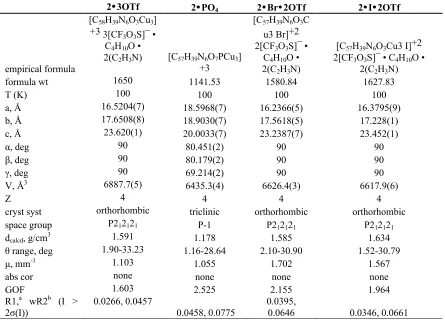
structures of 2•3OTf and of a phosphate analogue, 2•PO4, show that the trinuclear complexes are pseudo-C3 symmetric alkoxo-bridged trinuclear copper clusters capped by a
triflate or phosphate anion (Fig. 6).9 The copper(II) centers and the alkoxo oxygens are linked in a chair-like [Cu3(OR)3] core and each copper(II) center is further coordinated by
two pyridyl nitrogens from neighboring dipyridyl moieties. The Cu−O (alkoxide) and
OH N N HO N N HO N N
H3L
O O O Mn Mn N N N N N N O O O Mn Mn Cu Cu Cu P O O O O N N N N N N Mn Cu Cu Cu OH HO HO N N N N N N Cu Cu Cu 3+ 3+
2•PO4
Cu2(OH)PO4 (1.5 equiv),
H3PO4
[Cu(CH3CN)4]OTf
CH3CN
1•3OTf
1. Li[N(SiMe3)2] (3 equiv) 2. Cu(OTf)2
(3 equiv) CoCp2, Et3N•HCl (3 equiv)
excess O2 or AgOTf, Et3N
(3 equiv)
2•3OTf [Cu] = Cu(CH3CN)2
Cu−N distances are typical of other CuII compounds (1.91–2.01 Å), although the Cu−O (anion) distances are longer (ca. 2.4 and 2.2 Å respectively), indicating weaker coordination of the triflate or phosphate.
[image:44.612.177.474.160.392.2].
Figure 5. 1H NMR spectra of the reactions mixtures of the addition of AgOTf and Et3N to
1•3OTf.
NMR spectroscopy data suggest that the [Cu3O3N6] geometry observed in the
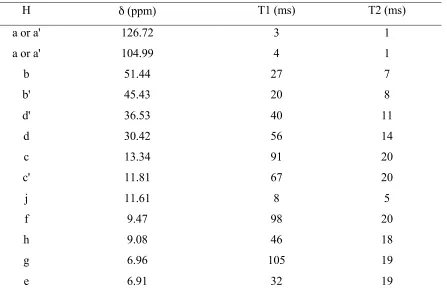
solid-state structures remains intact in solution allowing for three potentially accessible coordination sites on the same face of the tricopper unit. The 1H NMR spectra of both 2•3OTf and 2•PO4 contain thirteen signals (Fig. 7), indicating that the molecules are C3
(Table 1), as well as using gCOSY experiments (Fig. 8) and NMR spectra of complexes with a deuterium labeled ligand.
Figure 6. Solid-state structure of 2•3OTf as 50% thermal ellipsoids. Outer-sphere triflate
anions and solvent molecules omitted for clarity. Truncated view of solid-state structures of b) 2•3OTf, c) 2•PO4, d) 2•Br•2OTf, and e) 2•I•2OTf. Selected bond lengths (Å): b) Cu−Cu 3.4426(3)−3.4624(3), Cu−O(alkoxide) 1.9087(9)−1.954(1), Cu−N 1.9350(9)−1.986(1), Cu−O(OTf) 2.425(1)−2.508(1). c) Cu−Cu 3.2948(5)−3.3309(5), Cu−O(alkoxide) 1.931(2)−1.994(2), Cu−N 1.972(2)−2.014(2), Cu−O(PO4)
Figure 7. 1H NMR spectrum of 2•3OTf in CD3CN at 25 ºC.
Table 1. Signal assignments, shifts, and relaxation times of the 1H NMR spectrum of
2•3OTf.
H δ (ppm) T1 (ms) T2 (ms)
a or a' 126.72 3 1
a or a' 104.99 4 1
b 51.44 27 7
b' 45.43 20 8
d' 36.53 40 11
d 30.42 56 14
c 13.34 91 20
c' 11.81 67 20
j 11.61 8 5
f 9.47 98 20
h 9.08 46 18
g 6.96 105 19
Figure 8. gCOSY NMR spectra of 2•3OTf in CD3CN at 25 °C.
To test the lability of the coordinated anions, a solution 2•3OTf in CD3CN was titrated
gradual changes in the 1H NMR spectra of the mixture. After the addition of one equivalent of nBu4NX, the spectra of the mixture remain unchanged even upon adding three
equivalents of halide. This behavior suggests that only one halide ion can bind to the [Cu3(OR)3] cluster. X-ray diffraction studies of single crystals of 2•Br•2OTf and 2•I•2OTf
confirm that a single halide atom bridges the three copper centers of each cluster, with the triflate anions remaining outer sphere (Figs. 9 and 10). Based on the 1H NMR spectra, it is likely that these halide-capped structures are preserved in acetonitrile solution. Similar halide-bridged clusters have previously been observed in tricopper(II) complexes of other ligand systems.11
Figure 9. Room temperature 1H NMR spectra of reactions mixtures upon addition of nBu4NBr to a CD3CN solution of 2•3OTf. Four broad signals downfield of 70 ppm not
Figure 10. 1H NMR spectra taken at 65 °C of reaction mixtures upon addition of nBu4NI to
a CD3CN solution of 2•3OTf. Two broad signals downfield of 60 ppm not shown for
clarity.
Scheme 4. Synthesis of 2•X•2OTf (X = Br, I).
2.3 Magnetic susceptibility and EPR studies of tricopper(II) complexes
Alkoxo-bridged tricopper(II) clusters with similar [Cu3(OR)3] motifs are known, but
generally form via self-assembly of mononuclear copper(II) moieties.11a, 12 The magnetic
O
O O N
N
N
N
N N
Mn
Cu Cu Cu
3+
2•3OTf
O O O N
N
N
N
N N
Cu
Cu
Cu
X 2+
nBu4NX (1 equiv)
CH3CN X = Br, I
behavior of these complexes has been studied because spin frustrated triangular complexes may exhibit interesting ground states. It has been shown that varying the anion bridges of linear13 and triangular14 trinuclear copper(II) complexes changes the magnetic coupling, but no systematic study has been made of these effects on µ-alkoxo-bridged trimers lacking a
strongly µ3-coordinated ligand.11a, 15 Since the synthesis of anion variants of the
tricopper(II) complexes supported by the trinucleating ligand L described above is facile, a magnetostructural investigation of the effect of the capping anion the [Cu3O3N6] core was
performed.
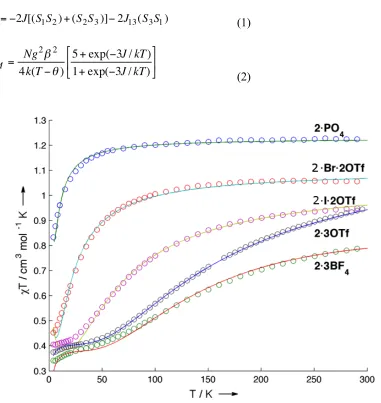
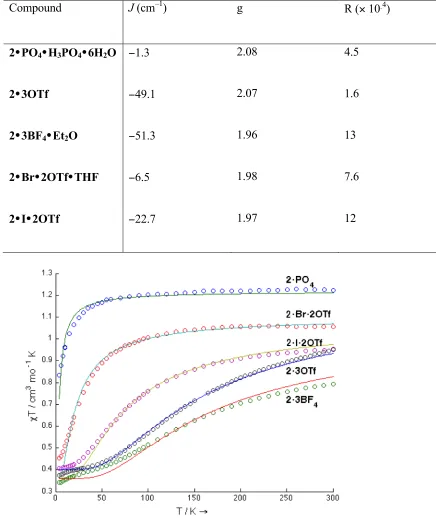
The variable temperature magnetic susceptibilities of compounds 2 were studied, and plots of χMT vs. T are shown in Figure 11. For 2•PO4, the χMT value at 300 K is close to
1.2 cm3 mol–1 K as expected for three nearly independent S = 1/2 centers. The room temperature χMT values for the other complexes are below 1.2 cm3 mol–1 K due to
antiferromagnetic exchange between the copper centers. The slope of these curves decreases at low temperatures, with most approaching a plateau around χMT = 0.4 cm3 mol– 1 K, which agrees with the spin-only value for an S = ½ system. When cooled below 20 K,
2•3OTf and 2•3BF4 have χMT values below 0.4 cm3 mol–1 K, indicating intermolecular
antiferromagnetic interactions.6d, 11c, 12b
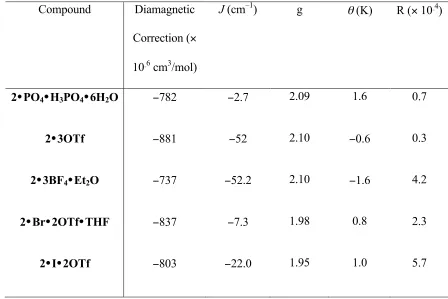
The intramolecular exchange coupling was modeled for a triangle of S = 1/2 centers, and the energies of the spin states of the systems were calculated using the isotropic spin Hamiltonian (Eq. 1). The fits were not significantly improved by varying two coupling constants. As a result, it was assumed that J = J13 in an approximately equilateral
each complex are shown in Table 2. Except for 2•3BF4,17 the fits (R ~ 10–4)18 were obtained by varying only J, g, and the Curie-Weiss parameter θ.19
(1)
[image:51.612.123.504.118.521.2](2)
Figure 11. Plots of χMT vs. T for compounds 2 at an applied field of 0.5 T. Solid lines
represent the best fits obtained.
The above data show that the antiferromagnetic exchange between spins varies considerably with the character of the coordinated anion. Triangular copper(II) complexes that couple through µ3-hydroxy or µ3-oxo groups display the strongest antiferromagnetic
planar.14a, 14b, 15, 20 Since compounds 2 contain more weakly coordinated capping anions, exchange between copper(II) centers is expected to occur primarily via the µ-alkoxo
moieties. This is consistent with the fact that complexes 2•Br•2OTf and 2•I•2OTf display antiferromagnetic exchange and have longer Cu–halide bond lengths (by ~0.4 Å) compared to trinuclear copper complexes with µ3-halide ligands in which ferromagnetic exchange is
proposed to occur via the µ3-halide.14b Furthermore, the complexes containing the least
coordinating anions in the series, 2•3OTf and 2•3BF4, show the largest exchange. The facially coordinated capping ligand distorts the geometry of the [Cu3(OR)3] core and
changes the Cu−O−Cu angles (Table 2). As the capping ligand binds more strongly, the [Cu3(OR)3] core distorts from a planar geometry by decreasing the Cu−O−Cu angles; this
correlates with a weakening of antiferromagnetic exchange. Table 2. Magnetic susceptibility and structural parameters.
Compound Cu−O−Cu Angle [°]
J
[cm−1]
g θ [K]
2•PO4 114.6–118.5 −2.7 2.09 1.7
2•3OTf 125.9–126.5 −52.0 2.10 −0.6
2•3BF4 -- −52.2 2.10 −1.6
2•I•2OTf 116.7–120.8 −22.0 1.95 1.0
This behavior is consistent with the solid- and solution-state EPR spectra of compounds 2. The EPR spectrum of 2•3OTf in ethanol solution at 10 K (Fig. 12) shows a feature at
Figure 12. Experimental (—) and simulated (- -) X-band EPR spectra of 2•3OTfand 2•PO4 in ethanol solution at 10 K. Simulated parameters: 2•3OTf: g⊥ = 1.98, g|| = 2.24, and A|| = 0.015 cm–1. 2•PO4 was simulated as two systems: a) g⊥ = 2.08, g|| = 2.24, A⊥ = 0.011
cm–1, A|| = 0.014 cm–1 and b) g⊥ = 3.40, g|| = 2.00, A⊥ = 0.007 cm
–1, and A
|| = 0.001 cm–1.
A linear dependence of the exchange interactions of di-hydroxo-bridged copper(II) dimers with the Cu−O−Cu angles has been reported.22 Similar trends extended to more complex systems have been complicated by the presence of multiple exchange pathways. Nevertheless, a non-linear trend has been reported for the Cu−(µ3-X)−Cu angle for µ3
-bridged trimers.14b, 14c The present compounds allow systematic magnetostructural study. When the exchange parameters of compounds 2 are plotted against the average Cu−O−Cu angle in the respective structure, the data indeed follow an approximately linear trend (Fig. 14). This dependence also holds when the available structural and magnetic data from other
µ-alkoxo and µ-hydroxo copper(II) trimers of pseudo-C3 symmetry are included.6d, 11a, 12b, 23
This behavior reflects the exchange through the µ2-O donors rather than the weakly
coordinated capping ligands; the exchange parameters for tricopper systems with µ3
-hydroxy or µ3-oxo ligands do not lie along this trend. It is noteworthy that the linear trend
Figure 14. J vs. bridge angle (φ) for a series of alkoxo- or hydroxo-bridged copper(II) trimers. () This work. (♦) (a) Ref. 11a (b) Ref. 6d (c) Ref. 12b (d) Ref. 23. Straight line was calculated from J = –3.41φ + 386 cm–1.
2.4 Trinuclear complexes of other first row transition metals
To further investigate the metal coordination potential of H3L and its control over
cluster nuclearity, trinuclear complexes of L containing other first row transition metals were targeted. Metallation studies were initiated with the acetate salts of the first-row metals FeII, CuII, and ZnII in the presence of base (Scheme 5). Addition of three equivalents of solid MII(OAc)2•xH2O to a suspension of H3L in acetonitrile or a mixture of
Scheme 5. Synthesis of trinuclear complexes of FeII, CuII, and ZnII. Related complexes of MnII, CoII, and NiII also synthesized by Mr. Jacob Kanady.
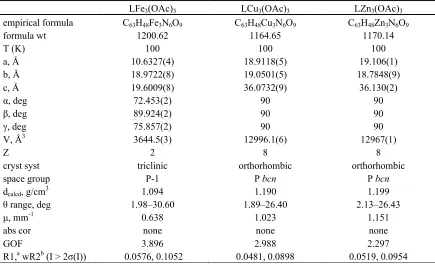
Single crystal X-ray diffraction (XRD) studies demonstrate the trinucleating nature of the deprotonated H3L framework to give complexes generally formulated as LM3(OAc)3
(Figs. 15−17). The three metal centers are bridged by three alkoxides forming a six membered ring, and the pendant pyridines coordinate with the two pyridines of each dipyridyl moiety bound to adjacent metal centers. The coordination environment is completed by acetate counterions. Systematically changing the nature of the metal centers does not disrupt the trinuclear core, but changes the binding mode of the acetates. Three capping acetates are present for LFe3(OAc)3; two acetates bind in monodentate and one in
bidentate fashion (Fig. 15). The bidentate acetate bridges two or three metal centers via a
µ2-oxygen atom. For M = Cu and Zn, single crystal XRD studies show two acetates bound
to the trimetallic core (Figs. 16, 17). However, a third outer sphere acetate required for charge balance could not be located due to disorder. This change in coordination mode may be due to the smaller size of Cu(II) and Zn(II) hindering the binding of a third acetate.
1H NMR spectroscopy and mass spectrometry studies confirm that the trinuclear cores
of the complexes are maintained in solution. The 1H NMR spectra of LMII3(OAc)3 (M =
Fe–Zn) display fourteen resonances, with chemical shifts between –20 and 160 ppm for the
OH N N HO N N HO N N
H3L LMII
3(OAc)3
O O O Mn Mn N N N N N N O AcO AcO O Me Mn Mn M M M
MII(OAc) 2•xH2O
(3 equiv) base MeCN or MeCN/H2O
paramagnetic species.24 Thirteen peaks correspond to protons on framework L, consistent with the C3-geometry observed in the solid-state. The single peak assigned to the acetate
counterions is indicative of fluxional processes that exchange the capping ligands on the NMR time scale.
Figure 15. Structural drawing of LFe3(OAc)3 with 50% thermal probability ellipsoids.
One acetate is disordered over two populations, denoted A and B.


![Figure 2. Solid-state structure of [4-Ca(DME)(OTf)]2+ as 50% thermal ellipsoids. Outer-](https://thumb-us.123doks.com/thumbv2/123dok_us/15114.1076/98.612.218.433.423.630/figure-solid-state-structure-dme-thermal-ellipsoids-outer.webp)