
PP: Calculating and Using Float
11
0
0
Full text
(2) Published in PM World Today – November2009 (Vol XI, Issue XI). -. Float - Is It Real?3 The Cost of Time - or who's duration is it anyway?4. The purpose of this paper is to support the concepts discussed in these earlier papers by analysing the various types of float that have been defined in the last 50 years and considering how they may be used in modern scheduling practice. CPM scheduling originated in the late 1950s as a computer based process using the Activity-onArrow (or ADM) technique with its roots in linear programming and operational research. Most of the initial work on float was based on ADM schedules and constrained by the limitations of early mainframe computers in the days of punch cards and tabulating machines. In the late 1960s Dr. John Fondahl’s precedence networking (PDM) came to prominence, initially as a ‘noncomputer’ approach to scheduling which sought to simplify calculations, and later as a computer based methodology. Consequently, PDM has never had the same disciplined view of float as ADM which may be detrimental to the practice of scheduling today.. Float in ADM Networks The biggest difference between ADM networks and PDM networks is the importance of the events (nodes) at the beginning and end of each activity. Events and Activities: Structurally, the key feature of an ADM network is that the Start Event (i) for the activity in focus in Figure 1 is the end event (j) for the preceding activities and also the start event for the second activity shown angling downwards. Similarly, the end event (j) for the activity in focus is the start event for the succeeding activities. Events occupy no time. The Event Early (EE) and Event Late (EL) times are calculated from time analysis as follows:. 3 4. -. Forward Pass: An event is not achieved until all of its preceding activities are complete. Consequently EE = the latest early finish of its preceding activities. An activity cannot start until its preceding event is achieved.. -. Backward Pass: The Event Late (EL) time is the earliest of the late start times for its succeeding activities.. Float - Is It Real?: www.mosaicprojects.com.au/Resources_Papers_043.html The Cost of Time - or who's duration is it anyway?: www.mosaicprojects.com.au/Resources_Papers_009.html. PM World Today is a free monthly eJournal - Subscriptions available at http://www.pmworldtoday.net. Page 2.
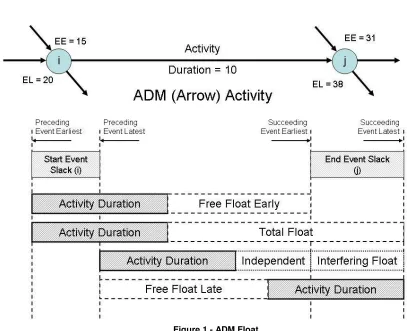
(3) Published in PM World Today – November2009 (Vol XI, Issue XI). ADM float Calculations In an Activity on Arrow network, the computers calculate data for both the events at the end of the arrows and the activity itself (the arrow). As a consequence, a rich data set is available to define: - the scheduling flexibility at the start of the activity, - the scheduling flexibility of the activity itself and - the scheduling flexibility at the end of the activity.. Figure 1 - ADM Float. The options are outlined in Figure 1. In this portion of a network, the two events are fixed by activities other then the one in focus; ie, you could remove the activity and the schedule times for the events would not change (this is necessary to allow all of the float types to be visible - Figure 1 is not to scale).. PM World Today is a free monthly eJournal - Subscriptions available at http://www.pmworldtoday.net. Page 3.
(4) Published in PM World Today – November2009 (Vol XI, Issue XI). The calculations of the Event Slack times are: - Start Event Slack: - End Event Slack:. EL – EE = 20 -15 = 5 EL – EE = 38 -31 = 7. The calculations of the activity’s Early and Late, Start and Finish Times are a factor of the event start and finish times shown in the diagram and the activity’s duration: -. Early Start Time (EST) = EE(i) = 15 Early Finish Time (EFT) = EST + Dur = 15 + 10 = 25 Late Finish Time (LFT) = EL(j) = 38 Late Start Time (LST) = LFT - Dur = 38 - 10 = 28. If the activity is scheduled at its Early Start Time (EST) Free Float Early and Total Float can be calculated: - Total Float (TF): The time the activity can be delayed without delaying the end of the schedule or an imposed constraint. TF = LFT - EST - Dur = 38 -15 - 10 = 13 - Free Float Early (FFE): The time the activity can be delayed without delaying the start of any succeeding activity (this is determined by the EE of the (j) node). FFE = EE(j) - EFT = 31 - 25 = 6 Three other types of float were considered/calculated5: - Independent Float (IF): The amount of scheduling flexibility available on the activity without displacing any other activity (before or after). It is the float available to the activity regardless of the timing of either node. This is calculated as EE(j) - EL(i) - Dur: IF = 31 - 20 - 10 = 1. 5. -. Free Float Late (FFL): The amount of scheduling flexibility available on the activity when every operation is scheduled at its latest possible time. This is the ‘free float’ used for resource levelling on the ‘back pass’.. -. Interfering Float: This is the same value as End Event Slack but calculated as TF - FF. The reason Interfering Float was calculated was so that it was part of the activity record (with punch cards, etc it was very difficult to include data from different record types in a report).. Planning by Network H.S. Woodgate. Brandon/Systems Press, New York. 1964. PM World Today is a free monthly eJournal - Subscriptions available at http://www.pmworldtoday.net. Page 4.
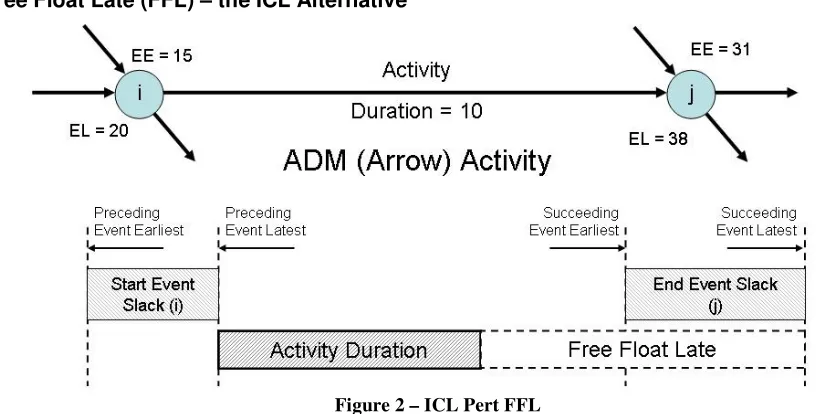
(5) Published in PM World Today – November2009 (Vol XI, Issue XI). Free Float Late (FFL) – the ICL Alternative. Figure 2 – ICL Pert FFL. The representation of FFL used in Figure 1 is based on the published work of H.S. (Sam) Woodgate5. The British computer company ICL (now part of Fujitsu) developed a range of mainframe and mini computer scheduling tools from the 1960s through to the early 1980s. The ICL Pert programs used a different definition for FFL based on all activities being scheduled at their preceding event late time EL(i). The ICL version of FFL is shown in Figure 2. The calculation of the value of FFL would yield the same value in both the Woodgate and ICL representations; The calculation is: FFL = EL(j) - EL(i) - Dur: FFL = 38 - 20 - 10 = 8 The only difference between ICL and Woodgate is the positioning of the activity and consequently the float in the diagrams. Negative Float. Negative float is created when the earliest times an activity or event can occur are later than an imposed constraint. In this circumstance, the late dates calculated during the back pass are earlier then the early dates. From a practical viewpoint this tells the scheduler the schedule logic needs modification or the constraint will not be met. Whilst theoretically negative float can be calculated for any of the floats described above, in practice it is only calculated for Total Float and Event Slack.. Float in PDM Networks Precedence networks position the activities on the ‘node’ (ie, the event in an arrow network) and connect the activities with ‘arrows’ called links. The PDM methodology does not attempt to. PM World Today is a free monthly eJournal - Subscriptions available at http://www.pmworldtoday.net. Page 5.
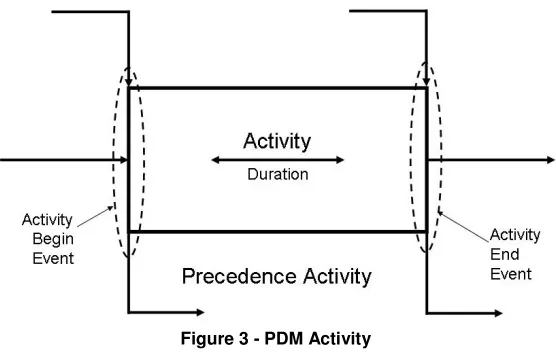
(6) Published in PM World Today – November2009 (Vol XI, Issue XI). calculate any values for its links; each link merely defines a logical relationship between two activities6. However, given links can be connected to or from the start and the end of a precedence activity, the issues of the existence of pseudo start and end events independent of the activity duration remain; refer Figure 3. But, whereas Arrow diagrams had discrete components and precise rules as to how these were calculated, the PDM methodology has never defined an agreed set of calculations to deal with the same issues.. Figure 3 - PDM Activity. Logical Inconsistencies. As previously mentioned, the use of links other than Finish-to-Start can cause unexpected problems. Figure 4 represents the dry walling work on Level 5 of a high rise block of units (one complete floor):. 6. •. Task A is the erection of the framing. This 10 day activity involves 2 days to set out the walls and fix the head and floor tracks and 8 days to fix the rest of the studs and frames. •. Task B is the in-wall services rough-in. This involves a total of 3 days work by electricians, plumbers and others to run their pipes and cables inside the wall ready to connect to fixtures and fittings at a later date. This task can start 4 days after Task A has started (this allows time for the framers to have installed around 25% of the studwork) but cannot finish until 1 day after all of the framing is installed. By its nature this work is intermittent requiring several short visits to the floor by each of the services trades.. •. Task C is the fixing of the wall sheeting. This can start one day after the ‘in-wall services rough-in’ has started and needs 3 days to finish after the last of the services are installed in the wall. The three days allows sufficient time to fix the last sheets, finish setting the. For more on links see, Links, Lags & Ladders: www.mosaicprojects.com.au/PDF/Links_Lags_Ladders.pdf. PM World Today is a free monthly eJournal - Subscriptions available at http://www.pmworldtoday.net. Page 6.
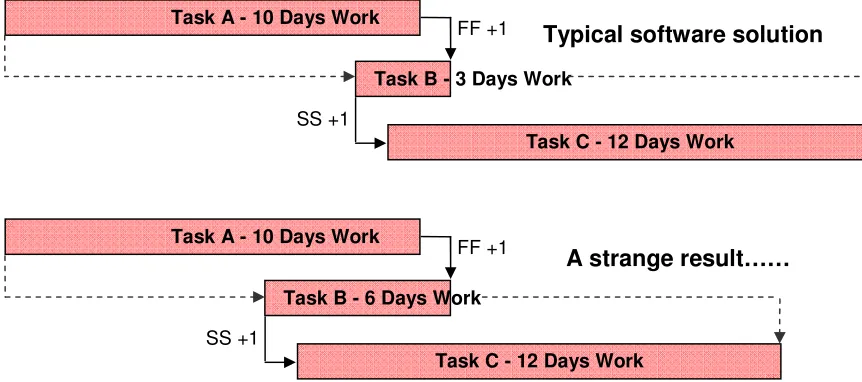
(7) Published in PM World Today – November2009 (Vol XI, Issue XI). joints and on the final day complete the sanding of the joints. However, fixing, setting and sanding the wall sheeting will take 12 days overall. Progress on the wall sheeting is only partly dependent on the in-wall services because not every wall has services inside it and as long as the service trades have access to one side of the walls where there are internal services, the sheeting can be installed on the other. The sheeting also needs at least 3 days after the completion of the framing (Task A) before it can finish. FF +1. Task A - 10 Days Work SS +4. FF +3. Task B - 3 Days Intermittent Work SS +1. Task C - 12 Days Work Figure 4 - Wall Framing Level 5. The situation in Figure 4 represents the optimum situation. Task B starts 4 days after Task A allowing Task C to start one day later. Task B finishes 1 day after Task A allowing Task C to complete 12 days after it started. The overall duration of this work is 4 days at the start of Task A, plus 1 day at the start of Task B plus the full 12 days for task C equalling 17 day work. Task A - 10 Days Work. FF +1. Typical software solution. Task B - 3 Days Work SS +1 Task C - 12 Days Work. Task A - 10 Days Work. FF +1. A strange result……. Task B - 6 Days Work SS +1 Task C - 12 Days Work. Increasing the duration of ‘critical’ Task B reduces the overall duration of the work! Figure 5 - Some typical software induced problems. The calculation of Float in this situation is interesting! Only the first 4 days work of Task A are actually critical, and only the first day’s work of Task B is critical. Looking at the completions, Task B can finish on Day 11 (10 days work on Task A plus one day to finish off Task B). However, Task B has a Finish-to-Finish relationship to Task C of FF+3. This means Task B does PM World Today is a free monthly eJournal - Subscriptions available at http://www.pmworldtoday.net. Page 7.
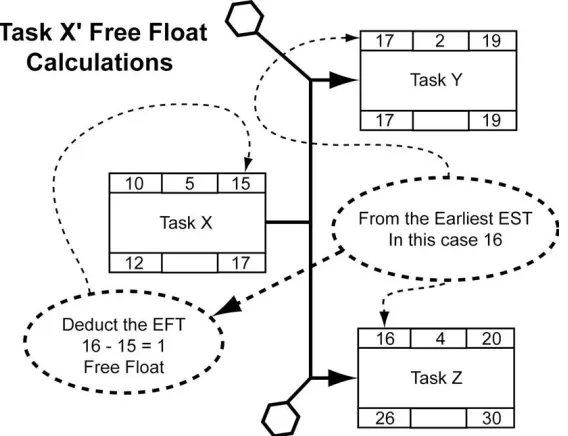
(8) Published in PM World Today – November2009 (Vol XI, Issue XI). not have to finish until Day 14, which would still allow the 3 days (day 15, 16 and 17) needed to complete the wall sheeting. Given Task B can finish on Day 11, but its finish could be delayed until Day 14, and this delay will have no effect on any other work, arguably the completion of Task B has 3 days Free Float (but not the whole task). A similar conundrum exists with Task A; it can finish up to 3 days late and will only delay the finish of Task B which has 3 days float. All of the above ‘floats’ have relevance but are rarely considered. To provide a complete picture, the calculations in a standard Precedence network should assess the situation at the start of the activity (the Start Event) and the completion of the activity (End Event). Unfortunately, very few of today’s software tools will resolve the situation in Fig. 12 satisfactorily. Most will delay Task B to comply with its finish link and schedule Task B from Day 9 to Day 11. The consequence of this is to push the start of Task C to Day 10 and the end of the three tasks to Day 21. This effect is described as ‘lag drag’. Paradoxically, in this situation the whole of Task B is critical, but increasing the duration of Task B actually reduces the overall time for the three tasks to complete (Ref: Fig. 5). PDM float Calculations. As a consequence of these limitations, the only two ‘floats’ that can be reliably calculated in a PDM schedule are the Total Float that is calculated from data contained within the activity/task and Free Float which is calculated by measuring the time gap between the Early Finish of the preceding task and the earliest of the Early Starts of its successors; refer Figure 6. Calculating the other floats, described in the ADM network above, for a PDM network depend on whether the activity is allowed to stretch, split or is schedule contiguously to meet the latest of the ‘early start’ conditions imposed by different link types (sometime causing ‘lag drag’7). As already stated, the calculation of Total Float in a PDM network is contained within the activity and is basically the same as for an ADM activity. The calculation of TF is either: -. LFT - EFT or more universally correct, LFT - EST - Dur.. The calculation of Free Float in a PDM network is more complex! The three tasks shown in Figure 4 are part of a larger network. There are tasks after Y and Z, before X, and where both of the hexagons are shown. The calculation of Free Float for Task X defines the time gap between the early finish of the task and the earliest start of any of its successors.. 7. For more on ‘lag drag’ see, Links, Lags & Ladders: www.mosaicprojects.com.au/PDF/Links_Lags_Ladders.pdf. PM World Today is a free monthly eJournal - Subscriptions available at http://www.pmworldtoday.net. Page 8.
(9) Published in PM World Today – November2009 (Vol XI, Issue XI). Figure 6 - PDM Free Float Calculation. The calculation requires data from all of the task’s successors (which is an unknown, unconstrained number – there can be many succeeding links). This complication is probably the reason FF was not regularly calculated by many early PDM software tools, only after the processing power of computers improved dramatically in the 1990s has the calculation of FF become routine. The calculation shown in Figure 6 is the simplest option. As soon as some of the successors to Task X are connected using Start-to-Start or Finish-to-Finish links the amount of free float becomes dependent on how any conflicting schedule information from the different links is interpreted by the software and the rules set by the scheduler. The last time I had the privilege to hear Dr. John Fondahl speak, shortly before his death in 2008, he was still opposed to the use of SS and FF links because of the analytical issues of lag drag, etc. But if you create a PDM schedule using FS links exclusively, you effectively have an ADM schedule! It’s just arguably easer to edit the logic by changing links.. Practical Considerations The predominance of PDM is absolute, well over 95% of the software used by schedulers today cannot create an ADM schedule8 and probably 99% of schedulers under the age of 40 have never seen or used an ADM schedule. What’s needed to advance the practice of scheduling is a 8. The Micro Planner range is one notable exception – the origins of this software was the ICL Pert mainframe software. See: http://www.microplanning.co.uk/. PM World Today is a free monthly eJournal - Subscriptions available at http://www.pmworldtoday.net. Page 9.
(10) Published in PM World Today – November2009 (Vol XI, Issue XI). standardised way of dealing with calculation conflicts in PDM schedules; the problems are well known9, but the solution has been elusive. To date a standardised solution has not been achieved and consequently, with the exception of total float, float in a PDM schedule is uncertain. From a practical perspective this creates two issues of paramount importance: -. Resources levelling and smoothing is completely reliant on having access to accurate and understandable float values. The absence of these means the scheduling algorithms are likely to be less efficient.. -. Contract management relies on clearly defining critical and non-critical activities and knowing how much flexibility (float) is reasonably available on the non-critical activities.. The lack of defined calculations for most of the float values in a PDM schedule must reduce the overall value of the schedule model compared to more rigorous approaches. How important this reduction in schedule integrity is, is questionable. Certainly there has to be some loss of value, what’s not determined is, is the loss of value generally significant? If scheduling is a modelling process designed to affect the future behaviours of people working on the project (ie, persuade them to work to the plan), other factors may be more important10. However, from an analytical view point, any loss of accuracy is undesirable and this paper has clearly demonstrated PDM has less rigour in its float calculations than ADM.. 9 10. See, Links, Lags & Ladders: www.mosaicprojects.com.au/PDF/Links_Lags_Ladders.pdf For more on this topic see: Scheduling in the Age of Complexity: www.mosaicprojects.com.au/Resources_Papers_089.html. PM World Today is a free monthly eJournal - Subscriptions available at http://www.pmworldtoday.net. Page 10.
(11) Published in PM World Today – November2009 (Vol XI, Issue XI). About the Author:. Patrick Weaver Author. Patrick Weaver, PMP, PMI-SP, FAICD, FCIOB, is the Managing Director of Mosaic Project Services Pty Ltd, an Australian project management consultancy specialising in project control systems and a PMI Registered Education Provider. Patrick is also the business manager of Stakeholder Management Pty Ltd. He is a Fellow and Regional Council Member of the Chartered Institute of Building, Australasia (FCIOB) and a Fellow of the Australian Institute of Company Directors (FAICD). He is a member of the PMI College of Scheduling, College of Performance Management and the PMI Melbourne Chapter (Australia), as well a full member of AIPM and the APM (UK). Patrick has over 35 years experience in Project Management. His career was initially focused on the planning and managing of construction, engineering and infrastructure projects in the UK and Australia. The last 25 years has seen his businesses and experience expand to include the successful delivery of project scheduling services and PMOs in a range of government, ICT and business environments; with a strong focus on project management training. His consultancy work encompasses: developing and advising on project schedules, developing and presenting PM training courses, managing the development of internal project control systems for client organisations, and assisting with dispute resolution and claims management. He is a qualified Arbitrator and Mediator. In the last few years, Patrick has sought to ‘give back’ to the industry he has participated in since leaving college through contributions to the development of the project management profession. In addition to his committee roles he has presented papers at a wide range of project management conferences in the USA, Europe, Asia and Australia, has been part of the organising committee for two PMI Congresses in the AsiaPacific region, and has an on-going role with the PMOZ conference in Australia and World Project Management Week. Patrick can be contacted at [email protected] or at www.mosaicprojects.com.au.. PM World Today is a free monthly eJournal - Subscriptions available at http://www.pmworldtoday.net. Page 11.
(12)
Figure
+2
Related documents