. . . .
. . . .
Research article
Exercise intensity while hooked is associated with
physiological status of longline-captured sharks
Ian A. Bouyoucos
1,*, Brendan S. Talwar
1, Edward J. Brooks
1, Jacob W. Brownscombe
2, Steven J. Cooke
2,
Cory D. Suski
3and John W. Mandelman
41
Shark Research and Conservation Program, Cape Eleuthera Institute, Rock Sound, PO Box EL-26029, The Bahamas 2
Fish Ecology and Conservation Physiology Laboratory, Department of Biology and Institute of Environmental Science, Carleton University, Ottawa, ON K1S5B6, Canada
3Department of Natural Resources and Environmental Sciences, University of Illinois at Urbana-Champaign, Urbana, IL 61801, USA 4
Anderson Cabot Center for Ocean Life, New England Aquarium, Boston, MA 02110, USA
*Corresponding author: ARC Centre of Excellence for Coral Reef Studies, James Cook University, Townsville, QLD 4811, Australia; Tel:+61 (0)7 4781 5219. Email: [email protected]
Some shark populations face declines owing to targeted capture and by-catch in longlinefisheries. Exercise intensity during longline capture and physiological status may be associated, which could inform management strategies aimed at reducing the impacts of longline capture on sharks. The purpose of this study was to characterize relationships between exercise inten-sity and physiological status of longline-captured nurse sharks (Ginglymostoma cirratum) and Caribbean reef sharks (Carcharhinus perezi). Exercise intensity of longline-captured sharks was quantified with digital cameras and accelerometers, which was paired with blood-based physiological metrics from samples obtained immediately post-capture. Exercise intensity was associated with physiological status following longline capture. For nurse sharks, blood pH increased with capture dur-ation and the proportion of time exhibiting low-intensity exercise. Nurse sharks also had higher blood glucose and plasma potassium concentrations at higher sea surface temperatures. Associations between exercise intensity and physiological sta-tus for Caribbean reef sharks were equivocal; capture duration had a positive relation with blood lactate concentrations and a negative relationship with plasma chloride concentrations. Because Caribbean reef sharks did not appear able to influence blood pH through exercise intensity, this species was considered more vulnerable to physiological impairment. While both species appear quite resilient to longline capture, it remains to be determined if exercise intensity during capture is a useful tool for predicting mortality or tertiary sub-lethal consequences. Fisheries management should consider exercise during cap-ture for sharks when developing techniques to avoid by-catch or reduce physiological stress associated with capcap-ture.
Key words:by-catch, elasmobranch, experimentalfishing gear,fisheries, physiological stress, sub-lethal effect
Editor:Prof. Craig Franklin
Received 7 August 2018; Revised 8 November 2018; Editorial Decision 27 November 2018; accepted 29 November 2018
Cite as:Bouyoucos IA, Talwar BS, Brooks EJ, Brownscombe JW, Cooke SJ, Suski CD, Mandelman JW (2018) Exercise intensity while hooked is associated with physiological status of longline-captured sharks.Conserv Physiol6(1): coy074; doi:10.1093/conphys/coy074.
Introduction
Globally, some shark populations are in decline as a result of
fisheries overexploitation and by-catch (Dulvy et al., 2014).
Longline fisheries are the predominant source of shark by-catch (Molina and Cooke, 2012;Oliveret al., 2015) and can contribute to shark mortality owing to a suite of physiological perturbations that result from exhaustion during capture
(Butcher et al., 2015; Dapp et al., 2016a). In addition to mortality, longline-caught sharks can experience numerous sub-lethal consequences associated with capture such as acid–base disruptions (Brooks et al., 2012; Wilson et al., 2014). Characterizing sub-lethal outcomes of capture is important because sub-lethal outcomes may result in population-level consequences, including reduced repro-ductive output (Skomal and Mandelman, 2012; Guida et al., 2017b;Adamset al., 2018). Defining sub-lethal out-comes of longline capture on sharks caught as by-catch is, therefore, of great value tofisheries management by inform-ing strategies to mitigate stress.
Sharks exhibit species-specific physiological responses to longline capture (Gallagher et al., 2014). This is well estab-lished in the literature; even congeneric species exhibit dispar-ate physiological responses to longline capture (Mandelman and Skomal, 2009; Fricket al., 2010;Marshall et al., 2012;
Butcheret al., 2015). The mechanisms underlying inter-specific variability in the magnitude and intensity of the physiological response have not been characterized (although it may be related to aerobic metabolic scope), but this variability has been useful in identifying vulnerable species (Skomal and Bernal, 2010;Gallagheret al., 2014). Sharks also exhibit intra-specific variability in physiological responses to capture, where differ-ences in metrics have been generally attributed to capture dur-ation, with mention of individuals’respiratory physiology and struggling behaviour (Manireet al., 2001;Jeromeet al., 2018). Laboratory evidence also demonstrates that acute physiological responses to a standardized experimental capture protocol are repeatable across days, suggesting that individuals exhibit unique physiological responses (Frick et al., 2009). While physiological responses are cryptic and may be difficult to translate to conservation practices (Cooke and O’Connor, 2010), relating physiology to easily observable responses like exercise intensity or reflexes could produce valuable diagnostic tools for predicting an animal’s condition and informing species-specific management (Gallagher et al., 2017;Jeromeet al., 2018).
Similar to physiological outcomes, the exercise intensity of sharks caught on longlines appears to be species-specific. Laboratory studies using experimental capture techniques have observed contrasts in exercise intensity during longline capture between species. Lemon sharks (Negaprion breviros-tris) exposed to experimental longline capture did not rest and swam more than unhooked animals (Bouyoucos et al., 2017). Port Jackson sharks (Heterodontus portusjacksoni) caught on experimental longlines rested following an initial bout of struggling (Frick et al., 2010). Gummy sharks (Mustelus antarcticus) caught on longlines in thefield rested throughout most of the capture event, whereas animals caught on experimental gear in the laboratory were nearly continuously active (Frick et al., 2010; Guida et al., 2016,
2017a). Intra-specific variation in responses to capture have received far less attention, although recent evidence of per-sonality in sharks suggests that individuals exhibit unique,
repeatable behaviours, including responses to capture and handling (Wilsonet al., 2015;Byrnes et al., 2016a,2016b;
Fingeret al., 2018). Laboratory studies have been instrumen-tal in providing preliminary insights into species-specific responses to capture, but there is a need forfield-based stud-ies to define intra- and inter-specific differences in exercise intensity of sharks during longline capture, especially given apparent contradictory responses between wild and captive studies.
Exercise intensity during longline capture may predict relative physiological status. Of the few studies that have quantified exercise metrics of captured sharks in various gear types, several have tested for associations between exercise intensity and physiological status at various points in time after the capture event. First, Fricket al. (2009) found no evidence of a relationship between peak whole-blood lactate concentrations and the amount of time Port Jackson sharks and Australian swellsharks (Cephaloscyllium laticeps) struggled in gill nets. Second,Guidaet al.(2016) suggested that gummy sharks’response of resting throughout demersal longline capture was responsible for the absence of an effect of capture duration on physiological status. These studies, however, do not support the idea that intra-specific variation in exercise intensity during capture is related to physiological status. Recently, Gallagher et al.(2017)provided evidence of an association between an acceleration-based metric of fight intensity and blood lac-tate concentrations across three shark species, although this trend likely reflects inter-specific variation, where nurse sharks (Ginglymostoma cirratum) generally had the lowest acceleration and blood lactate concentrations, and blacktip sharks (Carcharhinus limbatus) had the highest acceleration and blood lactate concentrations. In light of these three stud-ies, there is a clear knowledge gap whether sharks’exercise intensity during capture predicts physiological status.
The purpose of this study was to quantify why individual sharks fare better than others after longline capture. Our pri-mary objective was to quantify associations between exercise intensity and physiological status of two shark species during longline capture, the nurse shark and Caribbean reef shark (C. perezi). Because behavioural (i.e. exercise intensity) and physio-logical responses of sharks appear to be repeatable at the level of individuals, we predicted that these species should exhibit intra-specific variation in exercise intensity that explains vari-ation in physiological status. Our secondary objective was to compare associations between exercise intensity and physio-logical status between nurse sharks and Caribbean reef sharks. We predicted that relationships between exercise intensity and physiological status would differ in nature between the two study species because these species rely on different respiratory modes (stationary respiration and ram ventilation, respectively) that are generally associated with different levels of fisheries mortality among elasmobranchs (Dapp et al., 2016b). Thus, our data have application for species-specific management, by identifying exercise intensity levels that predict ‘good’relative physiological status, or a lack thereof that suggests a general
species response. Finally, data on the nature of relationships between exercise intensity and physiological status can inform technical alterations to longline gear that serve to modify exer-cise intensity and reduce stress.
Materials and methods
Ethical treatment of sharks was in accordance with permits MAF/FIS/17 and MAF/FIS/34 issued by the Bahamian Department of Marine Resources, and the permission to cap-ture sharks within the Bahamian Shark Sanctuary was estab-lished in accordance with the Bahamian Department of Marine Resources Form 20 A, Regulation 36D (3), permit-ting fishing, possession and exportation of sharks or shark tissue. Animal care protocols were based on guidelines from
the Association for the Study of Animal Behavior and the Animal Behavior Society (Rollin and Kessel, 1998).
Experimental longline
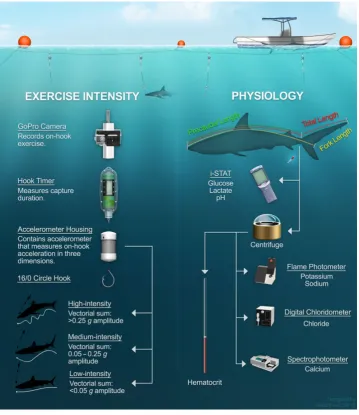
[image:3.612.128.488.265.681.2]Sharks were caught in coastal waters on experimental long-lines (Fig. 1) between January 2012 and December 2013 around Cape Eleuthera, Eleuthera, The Bahamas (24.54°N, 76.12° W). Longlines were configured as mid-water sets based on the target species and habitat. Experimental long-lines were 125.0 m long with six evenly spaced modified gangions. Each gangion was 1.3 m long and equipped with a digital camera (GoPro Hero 1 and 3 Silver, Woodman Labs Inc., Half Moon Bay, CA, USA), a hook timer (LP Hook Timer HT 600, Lindgren Pittman, Pompano Beach, FL, USA) and a tri-axial accelerometer (Hobo Pendant G Data
Figure 1: Diagram of experimental longline gear,in situbehavioural observation and assessment of physiological stress parameters.
Logger, Onset Computer Corporation, Bourne, MA, USA; 1 Hz recording frequency,±3.0grange,±0.105gaccuracy, 0.025gresolution) (sensuGraceet al., 2010). Gangions con-sisted of a longline snap crimped to 0.15 m of monofilament attached to 1.0 m of braided polyester line, which was crimped onto 0.15 m of steel leader terminating in a 16/0 cir-cle hook. Attachment points were conjoined with 8/0 swi-vels. Hook timers were rigged between monofilament and line sections, and accelerometers were set in a 7.6×3.8 cm polyvinylchloride capsule 15.0 cm above the circle hook on a steel leader. Longlines were checked every 30 min to assess the condition of sharks and monitor capture duration. Capture durations were limited to 4.5 h and intentionally manipulated to promote a broad range in capture durations (Brooks et al., 2012). Before release, all sharks were restrained in the water alongside a boat for morphometric measurement, identification with dart tags and rototags, phlebotomy and hook removal. Sea surface temperatures (SSTs) were measured using a digital thermometer from mid-line at the beginning of each set.
Assessment of physiological stress
A suite of secondary stress metrics were measured to charac-terize the acute physiological status of longline-captured sharks, including blood acid–base status (i.e. blood pH), lac-tate and glucose concentrations, haematocrit and plasma ion (sodium, potassium, chloride and calcium) concentrations. Blood was drawn from the caudal vasculature (i.e.viacaudal puncture) using 38-mm 16 or 18 gauge needles and 3.0-ml syringes that were washed with sodium heparin. Following phlebotomy, whole blood was immediately transferred to an i-STAT CG4+ cartridge that was inserted into an i-STAT point-of-care device (Abbot Point of Care Inc., Princeton, NJ, USA) to measure blood pH and blood lactate concentration (Stootet al., 2014;Harteret al., 2015). Because the i-STAT system measures blood pH at 37 °C (i.e. for use in homo-eothermic animals), pH values were corrected to reflect SSTs—a proxy of body temperature—using species-independent conver-sion equations (Mandelman and Skomal, 2009;Brooks et al., 2012). It should be noted, however, that the current‘ best-practice’ approach for measuring blood pH in elasmo-branchs with the i-STAT system is by using the temperature correction function of the i-STAT itself rather than the species-independent conversion equations that were con-sidered appropriate at the time of our study (Harteret al., 2015). Blood was also transferred to an Accu-Chek portable blood glucose meter (Roche Diagnostics, Basel, Switzerland) to measure blood glucose concentration (Brookset al., 2012). Remaining blood was transferred to a vacutainer coated in lithium heparin and was stored on ice for 2 h until blood could be analysed for additional physiological stress metrics at a laboratory facility.
To measure haematocrit, a small volume of whole blood was transferred to a 75-mm micro-haematocrit tube and spun at 4400gfor 5 min in a micro-haematocrit centrifuge (Brooks
et al., 2012). Remaining whole blood was spun at 10000gfor 5 min, and plasma was aliquoted into 1.5-ml microcentrifuge tubes (Brooks et al., 2012). Plasma samples were stored at
−20°C prior to storage in liquid nitrogen and transport to an off-site laboratory, where samples were stored at −80°C. Plasma sodium and potassium were measured using a single-channel digital flame photometer (Model 2655-00, Cole Parmer, Vernon Hills, IL, USA), plasma chloride was quantified with a digital chloridometer (Model 4435000, Labconco Corporation, Kansas City, MO, USA), and plas-ma calcium was quantified using a commercially available kit (QuantiChrom Calcium Assay Kit, DICA-500, Bioassay Systems, Hayward, CA, USA) and analysed in a commer-cially available spectrophotometer (Spectra Max Plus 384, model 05362, Molecular Devices, Union City, CA, USA).
Assessment of exercise intensity in hooked
sharks
Acceleration data were analysed to distinguish exercise intensity levels during capture and generate acceleration-based metrics of exercise intensity. Raw acceleration data in each axis were con-verted to vectorial sums using HOBOware Graphing and Analysis Software (Onset Computer Corporation, Bourne, MA, USA). To generate accelerometric criteria to distin-guish exercise intensity levels, time series of vectorial sum data (VS= x2+y2+z2) were analysed using k-means
clustering (Sakamotoet al., 2009) to identify distinct exer-cise intensity levels for both species. Accelerometer-derived vectorial sum data were selected as a proxy for exercise intensity because variation in body acceleration is asso-ciated with metabolic energy expenditure (Gleiss et al., 2011). Furthermore, vectorial sum is the preferred metric to overall dynamic body acceleration when the orientation of the data logger cannot be standardized across animals (e.g. hooking location), as was the case with gangions in this study (Qasemet al., 2012).
Vectorial sum data from each individual were clustered across three groups. Characteristics (amplitude and cycle of the acceleration signal) of the three discrete clusters were visually inspected across all individuals to identify cutoff cri-teria for defining three exercise intensity levels:‘ high-inten-sity’exercise had an amplitude>0.25 gand a< 5-s cycle,
‘medium-intensity’exercise had an amplitude<0.25gbut> 0.05 g, or an amplitude > 0.25 g with a> 5-s cycle, and
‘low-intensity’exercise referred to any signal with an ampli-tude<0.05g. After defining cutoff criteria, individuals’ clus-ters were each assigned an exercise intensity level as detailed above. Therefore, although acceleration data from all ani-mals were clustered into three groups, not all aniani-mals exhib-ited all three exercise intensity levels. As such, this approach accounted for any biases that would occur from k-means clustering across individuals. Analysis of video data corrobo-rated acceleration data: high-intensity exercise referred to burst swimming and/or strong contortions, medium-intensity exercise referred to brief aggravated movement, and slow
directional or circular swimming and low-intensity exercise referred to sharks resting on the bottom or suspended verti-cally on a gangion.
Data analysis
One exercise metric was generated from accelerometric data: the proportion of the capture event that sharks exhibited low-intensity exercise (plow). Proportion data were log-ratio
transformed to account for the fact that raw proportions sum to one and are, therefore, not independent (Aebischer et al., 1993). Including metrics for the proportion of time sharks exhibited medium- (pmed) and high-intensity (phigh)
exer-cise was considered, but data exploration indicated that plow
andpmedwere highly correlated (Fig.2a), and variation inphigh
would logically be mirrored by variation inplow, despite these
transformed variables not being correlated. Other exercise metrics were considered (e.g. the frequency of bouts of high-intensity exercise or averagefight intensity), but these metrics have previously been demonstrated to not be associated with stress markers (lactate, glucose and pH) and were both corre-lated with capture duration in this study (Fig.2b) and elsewhere (Brownscombeet al., 2014;Gallagher et al., 2017). Notably, capture duration is often associated with stress markers for sharks (Skomal, 2006; Danylchuk et al., 2014; Dapp et al., 2016a;Whitneyet al., 2017). Therefore, capture duration was chosen as a proxy of sharks’fight intensity, where longer cap-ture durations were associated with lower averagefight intensity (Brownscombe et al., 2014). Capture duration was also an appropriate metric because it was not correlated withplow.
Linear models were used to investigate relationships between exercise metrics and physiological metrics. Separate models were analysed for each species in anticipation of
species-specific stress responses (Mandelman and Skomal, 2009). Physiological metrics (plasma calcium, plasma sodium, plasma potassium, plasma chloride, blood glucose, blood lac-tate, blood pH and haematocrit) werefit as response variables withplow, capture duration, SST and total length (TL, in cm)
as covariates. Statistical significance was determined by gener-ating 95% confidence intervals of effect size from 1000 pos-terior simulations of factors in our linear models (Nakagawa and Cuthill, 2007). A factor was considered to be significant if the 95% confidence interval did not overlap zero (Hasler et al., 2016). Models were validated with Q–Q plots of model residuals to assess normality and plotting fitted/predicted values against model residuals to assess homogeneity of var-iances. All analyses were conducted in R using the R Stats Package (R Core Team, 2018). Posterior simulations were generated using the‘arm’package (Gelman and Su, 2018).
Results
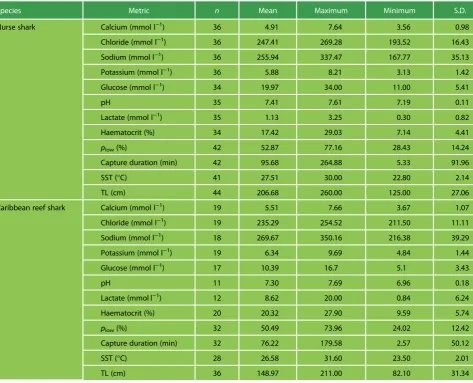
Between 15 June 2012 and 13 January 2014, 36 Caribbean reef sharks and 44 nurse sharks were captured on experi-mental longlines. Physiological data,plow, capture duration,
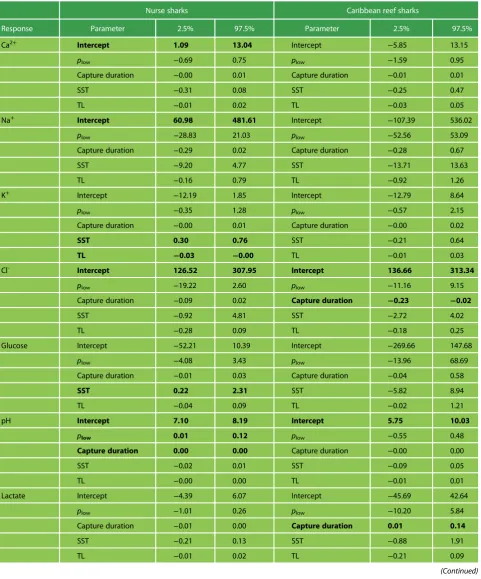
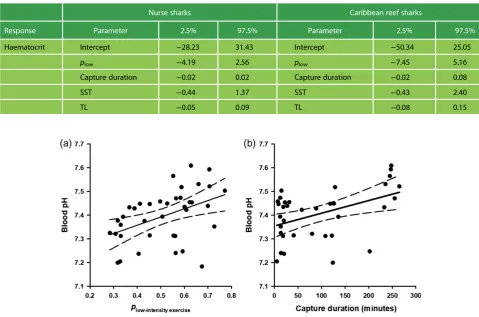
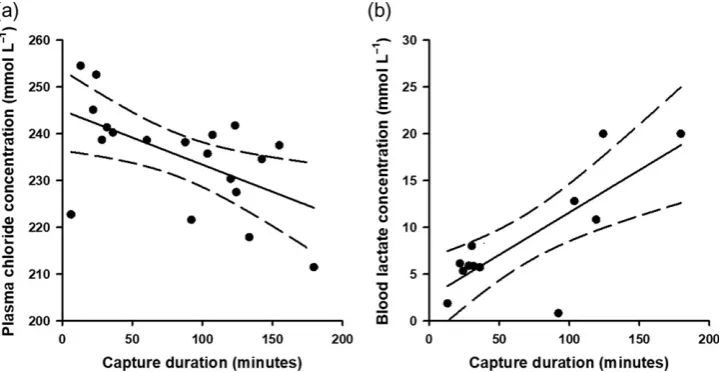
SST and TL of all sharks in this study are summarized in Table1. Capture durations varied from 2.57 to 264.88 min. Variations in physiological stress metrics were associated with variation in exercise metrics for nurse sharks and Caribbean reef sharks (Table2). For nurse sharks, blood pH increased withplowand capture duration (Fig.3). Blood
[image:5.612.126.486.460.629.2]glu-cose and plasma potassium concentrations increased with SST (Fig.4), and plasma potassium concentrations decreased with increasing TL. For Caribbean reef sharks, plasma chlor-ide concentrations decreased with capture duration, and
Figure 2: Correlations between possible explanatory exercise metrics. Proportions (a) of the total capture event when sharks exhibited low-(plow-intensity exercise) and medium-intensity (pmedium-intensity exercise) exercises were correlated (Linear regression,R2=0.84,F
1, 55=290.96,P< 0.001) and are presented as log-ratio transformed proportions. Meanfight intensity (b; ingmin−1whereg=9.81 m s−2) is measured as the sum of acceleration values recorded during a capture event divided by capture duration and had a negative linear relationship with capture duration (Linear regression,R2=0.14,F1, 55=9.54,P=0.003). Data are pooled for nurse sharks (Ginglymostoma cirratum) and Caribbean reef sharks (Carcharhinus perezi).
blood lactate concentrations increased with capture duration (Fig.5).
Discussion
This study sought to better quantify the relationship between the exercise intensity of sharks while hooked on longlines and their physiological status upon landing. We found that nurse sharks that exhibited low-intensity exercise more fre-quently had higher blood pH relative to more active indivi-duals, and blood pH increased with capture duration. Nurse sharks are a mostly sedentary species, possibly owing to this species’low metabolic rates, and it follows that nurse sharks have been documented to rest on the substrate throughout a capture event (Whitneyet al., 2016;Gallagheret al., 2017). Previously, it has been demonstrated that the number of
burst swimming events during exercise has a positive linear relationship with the energetic cost of resolving physiological disruptions (e.g. acidosis) (Svendsen et al., 2010). During intense activity in elasmobranchs, blood pH drops because of a combination of metabolic acidosis (release of metabolic protons from the white muscle following anaerobic lactate production) and respiratory acidosis (dissociation of protons and bicarbonate following carbon dioxide accumulation) (Wood et al., 1983; Mandelman and Skomal, 2009). For nurse sharks, it is possible that fewer burst events during capture (i.e. a higherplow) resulted in a smaller magnitude of
[image:6.612.73.547.108.491.2]physiological disturbance (i.e. less pH decline or higher pH). Given capture duration’s inverse relationship with meanfight intensity, it is likely that more anaerobically fuelled strug-gling (i.e. high mean fight intensity or more high-intensity exercise) is associated with low blood pH. Furthermore, this relationship suggests that struggling occurs early in the
Table 1: Descriptive statistics of response variables (blood-based physiological data) and explanatory variables for nurse sharks
(Ginglymostoma cirratum) and Caribbean reef sharks (Carcharhinus perezi). The proportion of time sharks exhibited low-intensity exercise (plow) refers to periods of inactivity or resting.
Species Metric n Mean Maximum Minimum S.D.
Nurse shark Calcium (mmol l−1) 36 4.91 7.64 3.56 0.98
Chloride (mmol l−1) 36 247.41 269.28 193.52 16.43
Sodium (mmol l−1) 36 255.94 337.47 167.77 35.13
Potassium (mmol l−1) 36 5.88 8.21 3.13 1.42
Glucose (mmol l−1) 34 19.97 34.00 11.00 5.41
pH 35 7.41 7.61 7.19 0.11
Lactate (mmol l−1) 35 1.13 3.25 0.30 0.82
Haematocrit (%) 34 17.42 29.03 7.14 4.41
plow(%) 42 52.87 77.16 28.43 14.24
Capture duration (min) 42 95.68 264.88 5.33 91.96
SST (°C) 41 27.51 30.00 22.80 2.14
TL (cm) 44 206.68 260.00 125.00 27.06
Caribbean reef shark Calcium (mmol l−1) 19 5.51 7.66 3.67 1.07
Chloride (mmol l−1) 19 235.29 254.52 211.50 11.11
Sodium (mmol l−1) 18 269.67 350.16 216.38 39.29
Potassium (mmol l−1) 19 6.34 9.69 4.84 1.44
Glucose (mmol l−1) 17 10.39 16.7 5.1 3.43
pH 11 7.30 7.69 6.96 0.18
Lactate (mmol l−1) 12 8.62 20.00 0.84 6.24
Haematocrit (%) 20 20.32 27.90 9.59 5.74
plow(%) 32 50.49 73.96 24.02 12.42
Capture duration (min) 32 76.22 179.58 2.57 50.12
SST (°C) 28 26.58 31.60 23.50 2.01
TL (cm) 36 148.97 211.00 82.10 31.34
Table 2: Linear model outputs (95% confidence interval limits) for the effect of exercise intensity (plow), capture duration, SST and TL on physiological stress parameters for nurse sharks (Ginglymostoma cirratum) and Caribbean reef sharks (Carcharhinus perezi). Bolded factors denote statistical significance, where the 95% confidence interval does not include zero.
Nurse sharks Caribbean reef sharks
Response Parameter 2.5% 97.5% Parameter 2.5% 97.5%
Ca2+ Intercept 1.09 13.04 Intercept −5.85 13.15
plow −0.69 0.75 plow −1.59 0.95
Capture duration −0.00 0.01 Capture duration −0.01 0.01
SST −0.31 0.08 SST −0.25 0.47
TL −0.01 0.02 TL −0.03 0.05
Na+ Intercept 60.98 481.61 Intercept −107.39 536.02
plow −28.83 21.03 plow −52.56 53.09
Capture duration −0.29 0.02 Capture duration −0.28 0.67
SST −9.20 4.77 SST −13.71 13.63
TL −0.16 0.79 TL −0.92 1.26
K+ Intercept −12.19 1.85 Intercept −12.79 8.64
plow −0.35 1.28 plow −0.57 2.15
Capture duration −0.00 0.01 Capture duration −0.00 0.02
SST 0.30 0.76 SST −0.21 0.64
TL −0.03 −0.00 TL −0.01 0.03
Cl- Intercept 126.52 307.95 Intercept 136.66 313.34
plow −19.22 2.60 plow −11.16 9.15
Capture duration −0.09 0.02 Capture duration −0.23 −0.02
SST −0.92 4.81 SST −2.72 4.02
TL −0.28 0.09 TL −0.18 0.25
Glucose Intercept −52.21 10.39 Intercept −269.66 147.68
plow −4.08 3.43 plow −13.96 68.69
Capture duration −0.01 0.03 Capture duration −0.04 0.58
SST 0.22 2.31 SST −5.82 8.94
TL −0.04 0.09 TL −0.02 1.21
pH Intercept 7.10 8.19 Intercept 5.75 10.03
plow 0.01 0.12 plow −0.55 0.48
Capture duration 0.00 0.00 Capture duration −0.00 0.00
SST −0.02 0.01 SST −0.09 0.05
TL −0.00 0.00 TL −0.01 0.01
Lactate Intercept −4.39 6.07 Intercept −45.69 42.64
plow −1.01 0.26 plow −10.20 5.84
Capture duration −0.01 0.00 Capture duration 0.01 0.14
SST −0.21 0.13 SST −0.88 1.91
TL −0.01 0.02 TL −0.21 0.09
(Continued)
capture event, with less intense activity occurring over longer durations. Alternatively, if fight intensity is not related to blood pH, nurse sharks could be recovering over long dura-tions of longline capture by resting (Brooks et al., 2012;
Brownscombeet al., 2014;Gallagher et al., 2017). Gummy sharks were documented to remain stationary for ~90% of a longline capture event, such that blood pH (among other metrics) was not influenced by capture duration (Guida et al., 2016). The presence or absence of an effect of capture duration on blood pH in two sharks that rest during capture could be related to differences in metabolic rates; nurse sharks are estimated to have lower metabolic rates than gummy sharks at comparable temperatures (Skomal and Mandelman, 2012; Morash et al., 2016; Whitney et al., 2016). Therefore, nurse sharks appear to be quite resilient to stress.
The physiological status of nurse sharks was also asso-ciated with changes in water temperatures. Nurse sharks caught at higher water temperatures had higher blood
[image:8.612.65.545.87.404.2]glucose and plasma potassium concentrations than animals captured at lower water temperatures. Positive relationships between SST and blood glucose have previously been reported for Atlantic sharpnose (Rhizoprionodon terraeno-vae), gummy and blacktip reef sharks (C. melanopterus) (Hoffmayer et al., 2012; Guida et al., 2016; Bouyoucos et al., 2018). Variation in water temperature ranging from 23.0 to 30.0°C has previously been demonstrated to infl u-ence metabolic rate in nurse sharks and increases in blood glucose concentrations at higher temperatures may reflect increased energetic demand (as an oxidative fuel source), or increased rates of anaerobic glycolysis if an increased stand-ard metabolic rate reduces the available aerobic scope (Whitneyet al., 2016). This study found evidence of a posi-tive relationship between water temperatures and plasma potassium concentrations following capture, while a negative relationship has been reported elsewhere (Guida et al., 2016). Contrasting trends in plasma electrolytes appear to be common in studies of elasmobranch stress (Skomal and Table 2: continued
Nurse sharks Caribbean reef sharks
Response Parameter 2.5% 97.5% Parameter 2.5% 97.5%
Haematocrit Intercept −28.23 31.43 Intercept −50.34 25.05
plow −4.19 2.56 plow −7.45 5.16
Capture duration −0.02 0.02 Capture duration −0.02 0.08
SST −0.44 1.37 SST −0.43 2.40
TL −0.05 0.09 TL −0.08 0.15
Figure 3: Relationship between exercise intensity (a) and capture duration (b) of longline-caught nurse sharks (Ginglymostoma cirratum) and physiological status. The proportion of time sharks exhibited low-intensity exercise (plow-intensity exercise) refers to periods of inactivity or resting. Proportion data were log-ratio transformed for analyses and were back-transformed for presentation. Dashed lines represent 95% confidence intervals.
Mandelman, 2012). High plasma potassium concentrations are generally associated with muscle tetany and, eventually, mortality in elasmobranchs (Moyeset al., 2006;Skomal and Mandelman, 2012). Indeed, studies have reported tetany or poor subjective condition when plasma potassium concentra-tions exceeded the threshold for hyperkalemia (7.0 mmol l−1) in gummy (>7.0 mmol l−1), sandbar (C. plumbeus; >8.7 mmol l−1) and dusky sharks (C. obscurus;>9.3 mmol l−1) (Fricket al., 2010;Butcheret al., 2015). Sharks in our
study generally had plasma potassium concentrations below 7.0 mmol l−1 (mean=5.8±1.4 mmol l−1), and sharks with
plasma potassium concentrations eclipsing 7.0 mmol l−1
were typically caught at over 28°C. Thus, while it is possible that nurse sharks may be more vulnerable to experiencing hyperkalemia at higher water temperatures, this claim war-rants additional research.
[image:9.612.126.489.73.271.2]Associations between exercise intensity and physiological status were equivocal for Caribbean reef sharks. Blood lac-tate concentrations increased with capture duration, while capture duration correlated negatively with plasma chloride concentration. Averagefight intensity and the frequency of
Figure 4: Relationships between sea surface temperature and physiological status of longline-caught nurse sharks (Ginglymostoma cirratum). Glucose concentrations (a) were measured from whole blood, and potassium concentrations (b) were measured from plasma. Dashed lines represent 95% confidence intervals.
Figure 5: Relationships between capture duration of longline-caught Caribbean reef sharks (Carcharhinus perezi) and physiological status. Chloride concentrations (a) were measured from plasma, and lactate concentrations (b) were measured from whole blood. Dashed lines represent 95% confidence intervals.
[image:9.612.127.488.330.516.2]high-intensity exercise decrease with increasing capture dur-ation because high-intensity exercise (e.g. peak accelerdur-ation values) typically occurs only during thefirst few minutes of hook-and-line capture (Frick et al., 2010; Brownscombe et al., 2014; Guida et al., 2016, 2017a; Gallagher et al., 2017). Furthermore, exhaustive chasing protocols implemen-ted in laboratory settings to simulatefishing capture last only several minutes and result in increasing blood lactate and decreasing pH over several hours (Brooks et al., 2011a;
Bouyoucos et al., 2017). Together, these data suggest that longer capture durations allow for appreciable amounts of time for lactate to leak from the muscle into the blood, thereby making it possible to record high lactate concentra-tions despite sharks having low mean fight intensity values (Brooks et al., 2011a;Hoffmayer et al., 2015). Alternatively, these data also suggest that continued activity over longer capture durations supports continued lactate production as appears to be the case for rod-and-reel capture (Frenchet al., 2015;Whitney et al., 2017). We could not replicate an effect of capture duration on blood pH for Caribbean reef sharks as we accomplished for blood lactate concentration, although this is likely the result of low sample sizes owing to high CG4+ cartridge failure rates (~60% failure rate) of the i-STAT system (Brookset al., 2012;
Harter et al., 2015). Overall, Caribbean reef sharks appear to exhibit consistent exercise intensity levels during longline capture, and that other extrinsic factors (e.g. environmental conditions) may be important for influencing physiological status.
In this study, Caribbean reef sharks also exhibited lower plasma chloride concentrations as capture duration increased. Effects of capture duration on plasma chloride concentrations are equivocal for elasmobranchs (Skomal and Mandelman, 2012); studies have documented no variation in plasma chloride concentrations with capture duration in bronze whaler (C. bra-chyurus), dusky and Caribbean reef sharks (Cliff and Thurman, 1984; Brooks et al., 2012; Dapp et al., 2016a), while others have reported negative relationships for dusky and sandbar sharks (Butcheret al., 2015). Decreases in plasma chloride con-centrations with increasing capture duration could be indicative of recovery over long capture durations (Brookset al., 2012). Alternatively, changes in plasma chloride concentrations can be explained in the context of capture duration’s inverse relationship withfight intensity (Brownscombeet al., 2014). It is possible that plasma chloride concentrations increased with meanfight inten-sity because of increased anaerobic activity resulting in an acidosis that drives chloride out of the white muscle cells and into the plasma (Skomal and Mandelman, 2012). Additional research is warranted into the utility of plasma electrolytes as valuable stress markers for elasmobranchs.
Caribbean reef sharks appear to be more vulnerable to physiological impairment from longline capture than nurse sharks. Specifically, Caribbean reef sharks, unlike nurse sharks, did not exhibit associations between exercise metrics and blood pH. Sufficient declines in blood pH can ultimately be responsible for exercise-induced mortality offishes (Wood et al., 1983;Skomal and Mandelman, 2012), although this
was not the case in our study, as we observed no at-vessel mortalities. Contrasting exercise intensity levels appear related to species’general activity levels, ventilation strategies and metabolic rates, which influence species’ physiological status following fisheries interactions (Dapp et al., 2016b;
Gallagheret al., 2017). Caribbean reef sharks likely exhibit metabolic rates characteristic of other sub-tropical carcharhi-nid sharks (e.g. lemon sharks or blacktip sharks), which are higher than for nurse sharks at comparable temperatures (Learet al., 2017). Caribbean reef sharks can buccal pump like nurse sharks (observed by gangion cameras), but their probable high metabolic rates likely require ram ventilation for effective gas exchange during and after exercise (Brooks et al., 2011a). It should be noted that while we suggest Caribbean reef sharks are more vulnerable to changes in physiological status owing to longline capture, both species had 100% at-vessel survival and are generally considered to be physiologically resilient to capture (Brookset al., 2012,
2013; Gallagher et al., 2017; Jeromeet al., 2018). In add-ition, other studies have documented very high post-release survival estimates following longline capture for Caribbean reef sharks (Brooks et al., 2011b;Shipleyet al., 2017). We are unaware, however, of the potential for Caribbean reef sharks or nurse sharks to experience negative long-term sub-lethal consequences (i.e. a tertiary stress response) from long-line capture, and the extent to which exercise intensity could influence outcomes.
In conclusion, our results suggest that sharks’exercise inten-sity during longline capture plays an influential role in affecting physiological status upon release. However, for the two species studied here, their apparent physiological resilience to short durations of longline capture suggests that such activities are not overly detrimental (i.e. no at-vessel mortality). It is possible that the negative consequences of capture could be magnified given the context specificity of fisheries interactions with other gear type or configurations (e.g. hook type, gangion length) or deployment conditions (e.g. longer set times, presence of preda-tors, water quality) (Rabyet al., 2015). Based on our data, strat-egies that minimize capture duration (gear that is easily depredated by sharks) or allow for sharks to engage in low-intensity exercise during capture may improve physiological sta-tus upon release. As our data also demonstrate, exercise intensity can be determined during capture as a meaningful predictor of physiological status upon release, although future research is warranted to establish whether exercise intensity is a useful pre-dictor of post-release outcomes (e.g. mortality, recovery or ter-tiary sub-lethal responses). Ultimately, studies aimed at elasmobranch conservation will require a multi-disciplinary approach, including the integration of exercise and behaviour with physiology (seeCookeet al., 2014).
Acknowledgements
The authors are grateful for the tremendous effort from Shark Research and Conservation Program staff and interns,
and Cape Eleuthera Island School students from Fall ’12, Spring’13 and Fall’13 semester shark research classes. Read Frost designed Fig. 1. The authors wish to thank two anonymous reviewers for their constructive feedback that improved the quality of our manuscript.
Funding
This work was supported by an anonymous research gift to E.J.B. and J.W.M. and by the Cape Eleuthera Foundation. I.A.B. was supported by an Australian Government Research Training Program scholarship. S.J.C. was supported by NSERC and the Canada Research Chairs Program.
References
Adams KR, Fetterplace LC, Davis AR, Taylor MD, Knott NA (2018) Sharks, rays and abortion: the prevalence of capture-induced par-turition in elasmobranchs.Biol Conserv217: 11–27.
Aebischer NJ, Robertson PA, Kenward RE (1993) Compositional analysis of habitat use from radio-tracking data.Ecology74: 1313–1325. Bouyoucos IA, Suski CD, Mandelman JW, Brooks EJ (2017) The
ener-getic, physiological, and behavioral response of lemon sharks (Negaprion brevirostris) to simulated longline capture. Comp Biochem Physiol Part A Mol Integr Physiol207: 65–72.
Bouyoucos IA, Weideli OC, Planes S, Simpfendorfer CA, Rummer JL (2018) Dead tired: evaluating the physiological status and survival of neonatal reef sharks under stress.Conserv Physiol6: coy053. Brooks EJ, Sloman KA, Liss S, Hassan-Hassanein L, Danylchuk AJ,
Cooke SJ, Mandelman JW, Skomal GB, Sims DW, Suski CD (2011a) The stress physiology of extended duration tonic immobility in the juvenile lemon shark,Negaprion brevirostris(Poey 1868).J Exp Mar Bio Ecol409: 351–360.
Brooks EJ, Sloman K, Sims D, Danylchuk A (2011b) Validating the use of baited remote underwater video surveys for assessing the diver-sity, distribution and abundance of sharks in the Bahamas.
Endanger Species Res13: 231–243.
Brooks EJ, Mandelman JW, Sloman KA, Liss S, Danylchuk AJ, Cooke SJ, Skomal GB, Philipp DP, Sims DW, Suski CD (2012) The physiological response of the Caribbean reef shark (Carcharhinus perezi) to longline capture.Comp Biochem Physiol Part A Mol Integr Physiol162: 94–100. Brooks EJ, Sims DW, Danylchuk AJ, Sloman KA (2013) Seasonal
abun-dance, philopatry and demographic structure of Caribbean reef shark (Carcharhinus perezi) assemblages in the north-east Exuma Sound, The Bahamas.Mar Biol160: 2535–2546.
Brownscombe JW, Marchand K, Tisshaw K, Fewster V, Groff O, Pichette M, Seed M, Gutowsky LFG, Wilson ADM, Cooke SJ (2014) The influence of water temperature and accelerometer-determined fight intensity on physiological stress and reflex impairment of angled largemouth bass.Conserv Physiol2: cou057.
Butcher PA, Peddemors VM, Mandelman JW, McGrath SP, Cullis BR (2015) At-vessel mortality and blood biochemical status of elasmo-branchs caught in an Australian commercial longlinefishery.Glob Ecol Conserv3: 878–889.
Byrnes EE, Pouca CV, Chambers SL, Brown C (2016a) Into the wild: developingfield tests to examine the link between elasmobranch personality and laterality.Behaviour153: 1777–1793.
Byrnes EE, Vila-Pouca C, Brown C (2016b) Laterality strength is linked to stress reactivity in Port Jackson sharks (Heterodontus portusjack-soni).Behav Brain Res.doi:10.1016/j.bbr.2016.02.033.
CliffG, Thurman GD (1984) Pathological and physiological effects of stress during capture and transport in the juvenile dusky shark,Carcharhinus obscurus.Comp Biochem Physiol Part A Physiol78: 167–173.
Cooke SJ, O’Connor CM (2010) Making conservation physiology rele-vant to policy makers and conservation practitioners.Conserv Lett
3: 159–166.
Cooke SJ, Blumstein DT, Buchholz R, Caro T, Fernández-Juricic E, Franklin CE, Metcalfe J, St. O’Connor CM, Clair CC, Sutherland WJ,
et al (2014) Physiology, behavior, and conservation. Physiol Biochem Zool87: 1–14.
Danylchuk AJ, Suski CD, Mandelman JW, Murchie KJ, Haak CR, Brooks AML, Cooke SJ (2014) Hooking injury, physiological status and short-term mortality of juvenile lemon sharks (Negaprion beviros-tris) following catch-and-release recreational angling. Conserv Physiol2: cot036.
Dapp DR, Huveneers C, Walker TI, Drew M, Reina RD (2016a) Moving from measuring to predicting bycatch mortality: predicting the capture con-dition of a longline-caught pelagic shark.Front Mar Sci2: 126. Dapp DR, Walker TI, Huveneers C, Reina RD (2016b) Respiratory mode
and gear type are important determinants of elasmobranch imme-diate and post-release mortality.Fish Fish17: 507–524.
Dulvy NK, Fowler SL, Musick JA, Cavanagh RD, Kyne PM, Harrison LR, Carlson JK, Davidson LN, Fordham SV., Francis MP, et al(2014) Extinction risk and conservation of the world’s sharks and rays.
Elife3: 1–35.
Finger JS, Guttridge TL, Wilson ADM, Gruber SH, Krause J (2018) Are some sharks more social than others? Short- and long-term con-sistencies in the social behavior of juvenile lemon sharks.Behav Ecol Sociobiol72: 17.
French RP, Lyle J, Tracey S, Currie S, Semmens JM (2015) High sur-vivorship after catch-and-release fishing suggests physiological resilience in the endothermic shortfin mako shark (Isurus oxy-rinchus).Conserv Physiol3: cov044.
Frick LH, Reina RD, Walker TI (2009) The physiological response of Port Jackson sharks and Australian swellsharks to sedation, gill-net capture, and repeated sampling in captivity. North Am J Fish Manag29: 127–139.
Frick LH, Reina RD, Walker TI (2010) Stress related physiological changes and post-release survival of Port Jackson sharks (Heterodontus portusjacksoni) and gummy sharks (Mustelus
antarcticus) following gill-net and longline capture in captivity.
J Exp Mar Bio Ecol385: 29–37.
Gallagher AJ, Serafy JE, Cooke SJ, Hammerschlag N (2014) Physiological stress response, reflex impairment, and survival of
five sympatric shark species following experimental capture and release.Mar Ecol Prog Ser496: 207–218.
Gallagher AJ, Staaterman ER, Cooke SJ, Hammerschlag N (2017) Behavioural responses to fisheries capture among sharks caught using experimentalfishery gear.Can J Fish Aquat Sci74: 1–7. Gelman A, Su Y-S (2018) arm: Data analysis using regression and
multilevel/hierarchical models. R package version 1.10-1. https:// CRAN.R-project.org/package=arm
Gleiss AC, Wilson RP, Shepard ELC (2011) Making overall dynamic body acceleration work: on the theory of acceleration as a proxy for energy expenditure.Methods Ecol Evol2: 23–33.
Grace MA, Watson J, Foster D (2010) Time, temperature, and depth profiles for a loggerhead sea turtle (Caretta caretta) captured with a pelagic longline.Southeast Nat9: 191–200.
Guida L, Walker TI, Reina RD (2016) Temperature insensitivity and behavioural reduction of the physiological stress response to long-line capture by the gummy shark,Mustelus antarcticus.PLoS One
11: e0148829.
Guida L, Dapp DR, Huveneers CPM, Walker TI, Reina RD (2017a) Evaluating time-depth recorders as a tool to measure the behaviour of sharks captured on longlines.J Exp Mar Bio Ecol497: 120–126. Guida L, Awruch C, Walker TI, Reina RD (2017b) Prenatal stress from
trawl capture affects mothers and neonates: a case study using the southernfiddler ray (Trygonorrhina dumerilii).Sci Rep7: 46300. Harter TS, Morrison PR, Mandelman JW, Rummer JL, Farrell AP, Brill
RW, Brauner CJ (2015) Validation of the i-STAT system for the ana-lysis of blood gases and acid–base status in juvenile sandbar shark (Carcharhinus plumbeus).Conserv Physiol3: cov002.
Hasler CT, Midway SR, Jeffrey JD, Tix JA, Sullivan C, Suski CD (2016) Exposure to elevated pCO2 alters post-treatment diel movement patterns of largemouth bass over short time scales.Freshw Biol61: 1590–1600.
Hoffmayer ER, Hendon JM, Parsons GR (2012) Seasonal modulation in the secondary stress response of a carcharhinid shark.
Rhizoprionodon terraenovae. Comp Biochem Physiol Part A Mol Integr Physiol162: 81–87.
Hoffmayer ER, Hendon JM, Parsons GR, Driggers WB, Campbell MD (2015) A comparison of single and multiple stressor protocols to assess acute stress in a coastal shark species,Rhizoprionodon ter-raenovae.Fish Physiol Biochem41: 1253–1260.
Jerome JM, Gallagher AJ, Cooke SJ, Hammerschlag N (2018) Integrating reflexes with physiological measures to evaluate coastal shark stress response to capture.ICES J Mar Sci75: 796–804. Lear KO, Whitney NM, Brewster LR, Morris JJ, Hueter RE, Gleiss AC
(2017) Correlations of metabolic rate and body acceleration in
three species of coastal sharks under contrasting temperature regimes.J Exp Biol220: 397–407.
Mandelman JW, Skomal GB (2009) Differential sensitivity to capture stress assessed by blood acid-base status in five carcharhinid sharks.J Comp Physiol B179: 267–277.
Manire C, Hueter R, Hull E, Spieler R (2001) Serological changes asso-ciated with gill-net capture and restraint in three species of sharks.
Trans Am Fish Soc130: 1038–1048.
Marshall H, Field L, Afiadata A, Sepulveda C, Skomal G, Bernal D (2012) Hematological indicators of stress in longline-captured sharks.Comp Biochem Physiol A Mol Integr Physiol162: 121–129. Molina JM, Cooke SJ (2012) Trends in shark bycatch research: current
status and research needs.Rev Fish Biol Fish22: 719–737.
Morash AJ, Mackellar SRC, Tunnah L, Barnett DA, Stehfest KM, Semmens JM, Currie S (2016) Pass the salt: physiological conse-quences of ecologically relevant hyposmotic exposure in juvenile gummy sharks (Mustelus antarcticus) and school sharks (Galeorhinus galeus).Conserv Physiol4: cow036.
Moyes CD, Fragoso N, Musyl MK, Brill RW (2006) Predicting postrelease survival in large pelagicfish.Trans Am Fish Soc135: 1389–1397. Nakagawa S, Cuthill IC (2007) Effect size, confidence interval and
stat-istical significance: a practical guide for biologists. Biol Rev 82: 591–605.
Oliver S, Braccini M, Newman SJ, Harvey ES (2015) Global patterns in the bycatch of sharks and rays.Mar Policy54: 86–97.
Qasem L, Cardew A, Wilson A, Griffiths I, Halsey LG, Shepard ELC, Gleiss AC, Wilson R (2012) Tri-axial dynamic acceleration as a proxy for animal energy expenditure; should we be summing values or calculating the vector?PLoS One7: e31187.
R Core Team (2018)R: a language and environment for statistical com-puting. R Foundation for Statistical Computing, Vienna, Austria. URLhttps://www.R-project.org/
Raby GD, Hinch SG, Patterson DA, Hills JA, Thompson LA, Cooke SJ (2015) Mechanisms to explain purse seine bycatch mortality of coho salmon.Ecol Appl25: 1757–1775.
Rollin BE, Kessel ML, (1998) Guidelines for the treatment of animals in behavioural research and teaching.Anim Behav55: 251–257. Sakamoto KQ, Sato K, Ishizuka M, Watanuki Y, Takahashi A, Daunt F,
Wanless S (2009) Can ethograms be automatically generated using body acceleration data from free-ranging birds?PLoS One4: e5379. Shipley ON, Howey LA, Tolentino ER, Jordan LKB, Ruppert JLW, Brooks
EJ (2017) Horizontal and vertical movements of Caribbean reef sharks (Carcharhinus perezi): conservation implications of limited migration in a marine sanctuary.R Soc Open Sci4: 160611. Skomal GB (2006) The physiological effects of capture stress on
post-release survivorship of sharks, tunas, and marlin. Boston University. Skomal G, Bernal D (2010) Physiological responses to stress in sharks. In Carrier JC, Musick JA, Heithaus MR, eds. Sharks and Their
Relatives II: Biodiversity, Adaptive Physiology, and Conservation. CRC Press, Boca Raton, pp 457–488.
Skomal GB, Mandelman JW (2012) The physiological response to anthropogenic stressors in marine elasmobranchfishes: a review with a focus on the secondary response.Comp Biochem Physiol A Mol Integr Physiol162: 146–55.
Stoot LJ, Cairns N a, Cull F, Taylor JJ, Jeffrey JD, Morin F, Mandelman JW, Clark TD, Cooke SJ (2014) Use of portable blood physiology point-of-care devices for basic and applied research on verte-brates: a review.Conserv Physiol2: cou011.
Svendsen JC, Tudorache C, Jordan AD, Steffensen JF, Aarestrup K, Domenici P (2010) Partition of aerobic and anaerobic swimming costs related to gait transitions in a labriform swimmer.J Exp Biol
213: 2177–2183.
Whitney NM, Lear KO, Gaskins LC, Gleiss AC (2016) The effects of tem-perature and swimming speed on the metabolic rate of the nurse
shark (Ginglymostoma cirratum, Bonaterre).J Exp Mar Bio Ecol477: 40–46.
Whitney NM, White CF, Anderson PA, Hueter RE, Skomal GB (2017) The physiological stress response, postrelease behavior, and mor-tality of blacktip sharks (Carcharhinus limbatus) caught on circle and J-hooks in the Florida recreational fishery. Fish Bull 115: 532–543.
Wilson ADM, Brownscombe JW, Krause J, Krause S, Gutowsky LFG, Brooks EJ, Cooke SJ (2015) Integrating network analysis, sensor tags, and observation to understand shark ecology and behavior.
Behav Ecol26: 1577–1586.
Wilson SM, Raby GD, Burnett NJ, Hinch SG, Cooke SJ (2014) Looking beyond the mortality of bycatch: sublethal effects of incidental capture on marine animals.Biol Conserv171: 61–72.
Wood CM, Turner JD, Graham MS (1983) Why dofish die after severe exercise?J Fish Biol22: 189–201.