i
MEDICATION MANAGEMENT SYSTEM
NORHAZWINA BINTI MOHD NOOR
This report is submitted in partial fulfillment of the requirements for the award of Bachelor o Electronic Engineering (Computer Engineering) With Honours
Faculty of Electronic and Computer Engineering Universiti Teknikal Malaysia Melaka
ii
UNIVERSTI TEKNIKAL MALAYSIA MELAKA
FAKULTI KEJURUTERAAN ELEKTRONIK DAN KEJURUTERAAN KOMPUTER
BORANG PENGESAHAN STATUS LAPORAN
PROJEK SARJANA MUDA II
Tajuk Projek : MEDICATION MANAGEMENT SYSTEM
Sesi Pengajian : 2008/2009
Saya NORHAZWINA BINTI MOHD NOOR
(HURUF BESAR)
mengaku membenarkan Laporan Projek Sarjana Muda ini disimpan di Perpustakaan dengan syarat-syarat kegunaan seperti berikut:
1. Laporan adalah hakmilik Universiti Teknikal Malaysia Melaka.
2. Perpustakaan dibenarkan membuat salinan untuk tujuan pengajian sahaja.
3. Perpustakaan dibenarkan membuat salinan laporan ini sebagai bahan pertukaran antara institusi
pengajian tinggi.
4. Sila tandakan ( √ ) :
SULIT*
(Mengandungi maklumat yang berdarjah keselamatan atau kepentingan Malaysia seperti yang termaktub di dalam AKTA RAHSIA RASMI 1972)
TERHAD* (Mengandungi maklumat terhad yang telah ditentukan oleh organisasi/badan di mana penyelidikan dijalankan)
TIDAK TERHAD
Disahkan oleh:
__________________________ ___________________________________
iii
“I hereby declare that this report is result of my own effort except for works that have been cited clearly in the references.”
Signature :
Name : NORHAZWINA BINTI MOHD NOOR
iv
“I hereby declare that I have read this report and in my opinion this report is sufficient I in terms of the scope and quality for the award of Bachelor of Electronic Engineering
(Computer Engineering) With Honours
Signature :
v
ACKNOWLEDGEMENT
Firstly, I would like to be grateful to Almighty Allah for giving me the strength in my life.
Special thanks to my beloved parents, En Mohd Noor b. Ali and Pn. Halimah bt. Ishak whose always by my side. They gave me unconditional love when I needed it most. Thanks for showing me the real meaning of love and life and also always encourage me to do well in my studies. The same love goes to all my siblings.
To finish the project properly, I would like to thanks and give the appreciation to my supervisor, En. Zulkifli Bin Shariff for the guidance and knowledge.
Last but not least, I would like to thank to all my friends especially my housemates. They all very kind and so helpful when I needed. May our friendship will last ever and after.
vi
ABSTRACT
vii
ABSTRAK
viii
TABLE OF CONTENT
Chapter Item Page
PROJECT TITLE i
PSM II PROJECT STATUS ii
DECLARATION iii
DEDICATION v
ABSTRACT vi
ABSTRAK vii
TABLE OF CONTENT viii
LIST OF TABLE xii
LIST OF FIGURE xiii
I INTRODUCTION 1
1.1 Introduction 1
1.2 Objectives 3
1.3 Problem Statement 3
1.4 Scope of Project 4
1.4.1 Software 4
ix
II LITERATURE RIVIEW 7
2.1 Literature Review 7
2.1.1 Visual Basic.Net 8
2.1.2 Microsoft Access 9
2.1.2.1 Features and protection 11 2.1.3 Background Study/Research 13
2.1.3.1 RFID Research 13
2.1.3.2 RFID Tag 15
2.1.2.3 Types of RFID tag 16
2.1.3.3.1 Passive 16
2.1.3.3.2 Active 17
2.1.3.4 Related Previous Project 19 2.1.3.4.1 Comparison between previous
Projects 21
III METHODOLOGY 22
3.1 Introduction 22
3.2 Software Development 24
3.2.1 Microsoft Access Development 25
x
3.2.1.1.1 Table Login 27
3.2.1.1.2 Table Patient 27
3.2.1.1.3 Table Medicine 28
3.2.1.1.4 Table Record 28
3.2.1.2 Applying Database In VB.Net 29 3.2.2 Visual Basic.net Development 31
IV RESULTS 36
4.1 Software System/Development 36
4.1.1 The Login Page 37
4.1.2 The Main Page 39
4.1.2.1 The Patient Page 40
4.1.2.2 The Pharmacy Prescription Page 44 4.1.2.3 The Change Password Page 45
4.2 Discussion 46
V CONCLUSION 48
5.1 Introduction 48
5.2 Conclusion 48
xi
REFERENCES 51
APPENDIX 52
Appendix A 52
xii
LIST OF TABLE
No Title Page
2.1 Difference between Two types Of Card 18
xiii
LIST OF FIGURE
No Title Page
1.1 Flowchart of Methodology 5
2.1 Microsoft Access Screenshot 11
2.2 Example of RFID Applications 13
2.3 Smart RFID Tag 15
3.1 Project Design and development 23
3.2 Programming Flowchart of Project 24
3.3 The Database Wizard 26
3.4 Table of Login 27
3.5 Table of Patient 27
3.6 Table of Medicine 28
3.7 Table of Record 28
3.8 Configuration Wizard 29
3.9 Data Source Add Connection 30
3.10 Resource in Solution Explorer 30
xiv
3.12 Window of VB.Net 32
3.13 Toolbox Application 33
3.14 Properties Window 34
3.15 Window with Code 34
4.1 The Login Page 37
4.2 The Login Page with Alert Message 38
4.3 Main Form 39
4.4 Patient Register form 40
4.5 Register Patient Filled Up 41
4.6 Medicine Prescription 42
4.7 The Patient History 42
4.8 Patient’s Record 43
4.9 The Pharmacy Prescription 44
1
CHAPTER I
INTRDUCTION
Chapter 1 gives an overview of Medication Management System. The objectives
of the project are stated clearly. There are few problem statements that explain about the
existing problems which is eventually lead to this project development. The
methodology explains briefly about the project flow from the beginning which is the
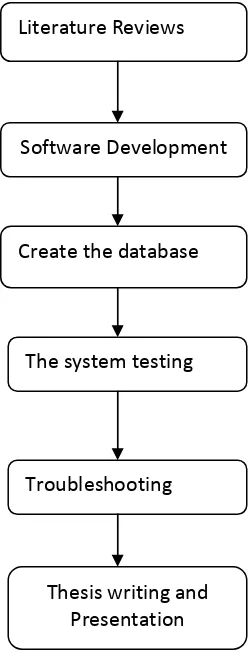
literature review, the database and the software development, the database testing, the
system testing, the troubleshooting and finally the thesis writing and the presentation.
The scope of work which consisting of software development is being discussed in this
chapter as well.
1.1 Introduction
Nowadays, the wards were used a pieces of paper as for documentation purpose.
When the medical staffs are doing their routine, they recorded the details of the patients
in the selected files. These piled papers will be kept in their old conservative way and
will be extracted manually whenever needed. However, if the files were managed badly,
the missing data from the file could causes medical negligence. Details of health
2
Therefore, this project is developed so that every details change is saved by the
system and it is updated with the specific date and time. Thus, it will reduce error is
probability by endorsing the right details into the system. Furthermore, the system
integrates with the department within the hospitals.
For this project implementation, each patient is required to register and the
medical staff will filled their details into the system. So, whenever they are in wards or
not, all the data will be kept in the system.
To start a registration, the nurse must fill the form of patient’s detail and so on
when they come to the ward another time. The patients just only gave their id number
and the staff will search the records. Each patient carries their own identity (ID number)
that is assigned to a particular patient upon registration. When the information is added,
an every log is uploaded. This event log about the patients will be display on the PC and
can be changed/update by the authorized person only. This is to prevent any authorized
person access the event log and might accidentally adjust or edit any information
without permission. By having only restricted staff access, the confidentially of data
maintain as private viewing and only for medical purpose.
Once registered, all changes in health history from the moment the patients was
in wards is recorded to the software system and saved. Later, any authorized person will
have an access (password for the security purpose) to get a view of an updated medical
information. So, all the patient data or information is saved in high security system of
3
1.2 Objectives
The objectives of this project are:
i. To develop a software using Graphic User Interface (GUI)
ii. To save time and increase the service efficiency
iii. To develop the user friendly software that minimizes paper usage
iv. To create a better file management system in wards where information about
patient in ward
v. To integrate database and software and ensure both of it working properly as
planned
vi. To create a standard of data security whereas only authorized medical staffs are
allowed to access the patient’s medical record, this is very private and
confidential information.
1.3 Problem Statement
1. Set up certain security purpose for critical medical information, thus the
information could be kept for monitoring purpose and medication schedule. This
will protect the privacy of the patient as medical record is private and
confidential.
2. Mishandling medical documentation in hospital. Reduces error in information of
medical and registration records
3. Waste a lot of time, cost and energy. The medical staff would have been able to
extract and saved the relevant details in system via a personal computer.
4
1.4 Scope of Work
This medical management system project purpose is to integrate the medical
management system better than before. Software that will be fully-developed in this
project is use Visual Basic.Net and the database storage is Microsoft Access. The
software will be displaying an event log of health information when the system is
applying in the wards.
The system consist of registration for patient, prescribe new medicine, view the
prescribe medicine before and view the payment record. The system is to be accessed by
the medical staff only as they had the right username and password to access the system.
The system is a platform of independent and a Stand-alone system that will be located in
the ward (Registration Room).
1.4.1 Software
For the whole software development, it will use a Graphical User Interface via a
Visual Basic.Net. this software are expected to be a user friendly programming as the
user varies from nurses to medical doctor which had minimum exposure on the
programming-based software. This programming is used to integrate with the reader,
which act as input. The medical staff would have basic understanding of the event log
and how to make use of it when they put particular card to be assigned reader. All the
data is created in Microsoft Access. There are certain tables will specific names that will
be link to Visual Basic.Net. All related data and information will be exported to
Microsoft Access as data information. These information are saved in the system and
may be extracted and being displayed in Visual Basic.Net graphic user interface. Once
the database has been created, the software development were mainly focus on the
5
Thesis writing and Presentation Software Development
Troubleshooting Literature Reviews
The system testing Create the database
[image:19.612.240.364.155.481.2]1.5 Methodology
6
Literature reviews
• Collect information on hardware, GUI and database
The database and software development
• The database is designed according to the data required
• The appropriate GUI for the system is also developed
The database testing
• Once the database development work completed, the system is tested whether it
is working successfully
The system testing
• The entire system is then tested
• Any errors will be modified and tested to ensure the system functions well
Troubleshooting
• If the system does not work, the troubleshooting has to be done to identify the
problem
Thesis writing and presentation
7
CHAPTER II
LITERATURE RIVIEWS
Chapter 2 consists of theories and a brief explanation about Visual Basic and
Microsoft Access which is the parts of the system, respectively the database software.
This is followed by background study on RFID reader and RFID tags as the hardware
that will be using in my future work or recommendation. The facts about RFID versus
Barcode implementation and how the RFID may overcomes the barcode deficiency is
discussed in this chapter too.
2.1 Literature Reviews
For the literature review contents, the brief explanations about the Visual
Basic.net and the Microsoft Access 2007 will be discussed in detail. All the related
theories and their function of the software also will be discussed in this part.
8
2.1.1 Visual Basic.Net
Visual Basic .NET (VB.NET), is an object-oriented computer language that can
be viewed as an evolution of Microsoft's Visual Basic (VB) implemented on the
Microsoft .NET framework. Its introduction has been controversial, as significant
changes were made that broke backward compatibility with older versions and caused a
rift within the developer community. The Microsoft .NET Framework is a software
framework available with several Microsoft Windows operating systems. It includes a
large library of coded solutions to prevent common programming problems and a virtual
machine that manages the execution of programs written specifically for the framework.
The .NET Framework is a key Microsoft offering and is intended to be used by most
new applications created for the Windows platform.
Visual Basic is one of the most popular languages used in the software
development industry. Its popularity comes from simplicity and efficiency. The new
version of Visual Basic.NET builds upon these attributes and introduces the following
useful new features:
• namespace
The namespace feature includes functions and properties to do a lot of complex
things in a rapid manner. Think of this as shortcut syntax to get things done with
less code. It groups commonly required information and functionalities for easier
access.
• partial classes
Partial classes define a class in multiple files. This separation is useful when we
want to have functionality of a class coded with different concerns and using
inheritance might not be appropriate. Partial classes are used in Visual
Studio.NET 2005 for auto-generated code. When we create a windows form. For
example, the Visual Studio.NET 2005 IDE creates a lot of auto-generated code.
9
event-handling code. In Visual Studio.NET 2005, auto-generated code is
separated from event-handling code by defining it in a separate source file as a
partial class.
• generics
Generics enable the program to adapt itself to different types. The concept of
generics is used in the implementation of collections in the new framework
• operator overloading
Operator overloading enables when to specify what operators such as + or –
should do when invoked with objects of classes that have been defined.
2.1.2 Microsoft Access
Microsoft Access is a computer application used to create and manage
computer-based databases on desktop computers and/or on connected computers (a network).
Microsoft Access can be used for personal information management (PIM), in a small
business to organize and manage data, or in an enterprise to communicate with
servers. Microsoft Access, is a relational database management system from Microsoft
that combines the relational Microsoft Jet Database Engine with a graphical user
interface and software development tools.
Microsoft Access is part of the Microsoft Office suite and is the most popular
Windows desktop database application. It is targeted for the information worker
market, and is the natural progression for managing data when the need for a relational
database arises or after reaching the limits of Microsoft Excel. Microsoft Access is
used by programmers and non-programmers to create their own database solutions.
10
integrity. Access also includes a very intuitive query interface, forms to display and
enter data, and reports for printing. The underlying Jet database which contains these
objects is multiuser aware and handles record locking and referential integrity
including cascading updates and deletes. Microsoft Access is very popular among
non-programmers who can create visually pleasing and relatively advanced solutions
on their own. It is also easy to place a database on a network and have multiple users
share and update data without overwriting each other’s work. Data is locked at the
record level which is significantly different from Excel which locks the entire
spreadsheet.
Database solutions created entirely in Microsoft Access are well suited for
individual and workgroup use across a network. The number of simultaneous users
that can be supported depends on the amount of data, the tasks being performed, level
of use, and application design. Generally accepted limits are solutions with 1 GB or
less of data (Access supports up to 2 GB) and 50 or fewer simultaneous users. This is
appropriate for workgroup and department solutions where the total number of users