Abstract
Purpose – To create a ‘refined’ (with unnecessary elements removed) definition of the term
stakeholder, thereby removing confusion surrounding use of this term from the general and project management arenas.
Design/methodology/approach – A method of deriving refined definitions for a group of terms by ensuring there are no unnecessary elements causing internal conflict or overlap is adopted and applied to resolve the confusion.
Findings – The refined definitions of stake and stakeholder are in terms of an interest and activity. This avoids all extensions of meaning introduced by defining particular types of stakeholders and/ or their degrees of impact. It also resolves the multiplicity of conflicting meanings possible when silent or assumed qualifiers of a word are ignored, restricting definition to, for example project
stakeholders or stakeholders of a firm. These definitions are carried forward into a mapping of the stakeholder locus of interest on an activity rather than a company base, enabling generic
categorisation of stakeholders to be proposed for use in both private and public sectors. A governance difficulty with the term customer also emerged and a resolution to this is proposed.
Research limitations/implications – Resolution of the academic contention around the definition of stakeholders will facilitate future research endeavours by removing confusion surrounding the term. It can also provide clarity in governance arrangements in public and private sectors. Verification of the method used through its success in deriving this ‘refined’ definition suggests its suitability for application to other contested terms.
Practical implications – Projects and businesses alike can benefit from removal of confusion around the definition of stakeholder in the academic research they fund and attempt to apply.
Social implications – A refined definition of the stakeholder concept will facilitate building social and physical systems and infrastructure, benefitting organisations, whether public, charitable or private.
Originality/value – Clarity resulting in the avoidance of confusion and misunderstanding together with their consequent waste of time, resources and money.
Keywords ‐ stake, stakeholder, define, refined definition
Paper type ‐ Conceptual paper
Introduction
Stakeholder management has provided a linkage between ethics and management since Freeman (1984) broadened its remit beyond its previous confines of company shareholders. There has been increasing usage of the concept of stakeholders since that time with Fassin (2009) noting its popularity. There has also been considerable contention over what the term actually means
(Eskerod & Huemann 2013; Littau, Jujagiri & Adlbrecht 2010; Mainardes, Alves & Raposo 2011; Miles 2012) and this contention remains unresolved. Resolving this contention would remove the need for future academic definitional effort and potentially result in clarity of use benefitting practitioners as well.
definitions are then taken forward into a mapping of the stakeholder locus of interest, starting with a project management reference point and progressing to genericity.
This process highlights the previous dependency of stakeholder theory upon the joint‐stock company model. Category and role definitions are proposed to resolve this.
Adoption of the definitions proposed can remove confusion surrounding the term and potentially result in clearer project governance arrangements, remove confusion and potentially achieve improved project, organisational, individual and research outcomes. The findings have implications for stakeholder theory and for project management as well as for government and private sector organisations that initiate projects.
Definitional
confusion
regarding
stakeholders
The importance of definition of terms was recognised by Socrates, Plato and Aristotle, as noted by Smith (2014, p. 316) who wrote “The definition was an important matter for Plato”, “Concern with answering the question “What is so‐and‐so?” are at the centre of the majority of Plato’s dialogues” and “Aristotle himself traces the quest for definitions back to Socrates” (Smith 2014). Nearly 2,000 years later, Hobbes wrote “To conclude, the light of humane minds is perspicuous words, but by exact definitions first snuffed, and purged from ambiguity; reason is the pace; increase of science, the way; and the benefit of mankind, the end” (Hobbes 1996, p. 32). Accepting this view, we seek to provide some benefit to mankind and science in general and both project and general management in particular by removing ambiguity from the meaning of the term stakeholder. The need to do this was pointed out by McGrath and Whitty (2015).
Eskerod, Huemann and Savage (2015) documented development of stakeholder management, noting definitions going back to the 1960s. Fassin (2009) noted that “Stakeholder management has become an important tool to transfer ethics to management practice and strategy” and Huemann, Eskerod and Ringhofer (2016, pp. 24‐7) point out the need to consider management “for” rather than “of” stakeholders. The stakeholder area has also been elevated in importance in the Guide to the Project Management Body of Knowledge (PMBOK guide), fifth edition 2013) Guide to Project Management Body of Knowledge (PMBOK), having been added as a new knowledge area, whereas it had previously been covered under communications.
Miles (2012) concluded that stakeholder is an essentially contested concept as defined by Gallie (1956), noting:
The concept of the ‘stakeholder’ has become central to business, yet there is no common consensus as to what the concept of a stakeholder means, with hundreds of different published definitions suggested. Whilst every concept is liable to be contested, for
stakeholder research, this is problematic for both theoretical and empirical analysis (Miles 2012, p. 285).
(Miles 2012, p. 285) also noted “Miles (2011) analysis of 435 different definitions from 493 articles: a new definition every 1.13 articles published”. Others have similar observations:
Despite this widespread usage, many who adopt the term neither define the concept nor provide any particularly clear understanding of what they mean as regards what a
stakeholder actually is. Even in academic circles, countless definitions of ‘stakeholder’ have been put forward without any of those suggested ever gaining consensus, and hence there is no single, definitive and generally accepted definition (Mainardes et al. 2011, p. 228):
stake in the actions of their children or fans having a stake in the actions of celebrities. They concluded:
… one question requiring resolution is that of the stakeholder term itself. The profusion of definitions hinders understanding as to what the term actually represents. Establishing boundaries to the concept would go a long way towards resolving a series of issues posed by researchers in this field. (Mainardes et al. 2011, p. 242).
Eskerod and Huemann (2013, p. 45) also noted there are many definitions of stakeholders and considered ‘it is important to consider in the future the pros and cons of a project stakeholder definition that is inclusive, i.e. includes many stakeholders regardless of their power to influence the project process or project results’. This paper addresses that issue by developing an inclusive
stakeholder definition.
The
theoretical
frame
of
stakeholder
theory
The motivation for development of the stakeholder concept is set out in Mainardes et al. (2011) as follows:
The origin of the stakeholder concept lies in the business science literature (Freeman, 1984), and may be traced back even as far as Adam Smith and his The Theory of Moral Sentiments. Its modern utilization in management literature was brought about by the Stanford Research Institute, which introduced the term in 1963 to generalize and expand the notion of the shareholders as the only group that management needed to be sensitive towards (Jongbloed et al., 2008). Within this perspective, Freeman (1984) argued that business organizations should be concerned about the interests of other stakeholders when taking strategic decisions. (Mainardes et al. 2011, p. 227)
In broadening the stakeholder concept from its previous meaning that was restricted to
shareholders, (Freeman 1984) argued that there are other parties involved including customers, employees, suppliers, governments, competitors, consumer advocates, environmentalists, special interest groups and the media.
Littau et al. (2010, p. 17) focused on stakeholders in relation to project management and noted “Cleland (1986) introduced stakeholders and stakeholder management processes to the project management canon by highlighting the importance of stakeholder identification, classification, analysis, and management approach formulation”. (Littau et al. 2010, p. 18) also:
concluded that the understanding of the term stakeholder is moving toward a more
comprehensive and multilateral view. Stakeholders are considered as more important in the context of project management. And finally we found that the drivers of stakeholder theory development are from articles related to the context of project evaluation and project strategy
Littau et al. (2010, p. 21) further stated:
we searched for definitions in all 116 articles. Among 116 articles, 28 articles mentioned a definition for stakeholder in their articles, which represents 24% of the total stakeholder articles. Among 28 definitions, 22 were unique definitions, either defined by the author himself or by some other author.
These definitions were characterised into three groups, an interest‐in or stake‐in group, an affects or is affected by group and hybrids of both. Littau et al. (2010) also found that usage within project management has fluctuated over time with the interest‐in definitions having significance over their surveyed range of 25 years to 2009.
Cleland also offered several project management definitions; “Other clientele who have a vested interest in the outcome of the project” in Cleland (1985), “. . . individuals and institutions who share a stake or an interest in the project” in Cleland (1986, p. 36), and “Stakeholders are those persons or organisations that have, or claim to have an interest or share in the project undertaking” in Cleland (1989, p. 31). So these project management definitions progressed from “vested interest” to “stake or an interest” to “interest or share”, with interest remaining through all three.
So there is therefore confusion over the meaning of the term stakeholder generally and also some confusion within the field of project management. Furthermore the attention the concept has received has been within an organisational context.
Research
questions
We seek to clarify and resolve this confusion by developing definitions that are applicable generally and not restricted to any single field or to the organisational ambit. We approach this by proposing the following research questions:
1. What is the essence of the term stakeholder that can define its meaning across all fields of study and without restriction to an organisational ambit?
2. How does this definition affect categorisations of stakeholders?
Our approach and method for addressing the first research question will be explained in the following sections. We will then address the second research question by depicting the stakeholder locus of interest, then considering the implications for project stakeholders, government and business.
Approach
McGrath and Whitty (2015) demonstrated the pitfalls of defining single intellectual conceptual terms within the bounds of one single field and in isolation from other terms. Their approach had
objectivist epistemology with a positivist theoretical perspective that seeks to define objective content without claiming that the derived definitions describe anything existential. McGrath and Whitty (2015) simply defined concepts non‐normatively, producing definitions which, if agreed and adopted, have the potential to remove unnecessary debate and confusion. They took the view that while there may be no absolute truth, to be productive as a society, a discourse that is inclusive and removes confusion is necessary, one that all can participate in, with shared understanding of meaning, removing accidental and undetected differences. This position is therefore midway between (or partly both) realist and post‐modernist, as this apparatus (ensuring consistency and universality of terminology), can replace chaos with order. We will therefore use their method to address research question 1 and determine the essence of the stakeholder term.
Method
The McGrath and Whitty (2015) definitional refining method is set out below:
Group rules pre definition:
1. Select the group of terms to be defined. 2. Determine the order of definition as follows:
a. Identify any inconsistencies within the group that may require one term to be defined before another.
b. Where a compound term is to be defined, define the component terms first. c. Where a derivative term is to be defined, define the root term first.
3. Consider any terms that are likely to be used in definition that may themselves require prior definition.
Steps to determine a connotative (intensional) conventional definition of each term:
1. Define derivative or component terms using the root or component definitions that have previously been defined by this process or are clear and accepted in their meaning. (This obviates the need to proceed through the remaining definitional steps unless there is other reason to do so, such as confusion in the meaning of the compound or derivative term itself).
2. Survey lexical usage (This and the following two steps may be omitted if there is a known comprehensive academic review of definitions of the term).
3. Analyse this to determine the main contenders for inclusion in the definition (and show these in pale grey highlight).
4. Develop a connotative (intensional) conventional definition. (This may be synonymous, operational or by genus and difference).
5. Report and analyse any known academic review of definitions of the term 6. Remove unwarranted inclusions.
7. Remove divergence of meaning resulting from mixing content and process by removing any reference to content (for generic conceptual terms).
8. Remove any remaining divergence of meaning and for operational definitions, consider the need for additional inclusions, by checking against the following, as appropriate to the particular term:
a. Historical usage
b. Field/ specialty usage ‐ the definition most generic to as many fields as possible will be selected
c. Practitioner usage (via practitioner literature, considering the influence of opinion and marketing)
d. Competing concepts & frameworks (considering the influence of opinion and marketing)
9. Check any resulting definitions by genus & difference against the Copi and Cohen (1990) five rules and discard any which do not satisfy them.
10. Report the adopted derived definition. (Note; this change corrects what appears to have been a typographical error in the source paper, in which all applications of the method used the word ‘derived’)
Group rules post definition:
1. Cross‐check terms defined in this group for any inconsistency and resolve.
2. Cross‐check any terms defined in this group known to be used interchangeably with other terms outside the group and resolve any inconsistency.
The five rules for checking a definition by genus and difference, sourced from Copi and Cohen (1990, pp. 151‐5) are as follows:
1. States the essential attributes of the species 2. Avoids circularity
3. Neither too broad nor too narrow
4. Avoids ambiguous, obscure or figurative language 5. Affirmative rather than negative.
Lexical usage will be sourced from the following dictionary sources:
1. A range of dictionaries that have been well known for many years that were available (in 2013/ 14) online (Cambridge ; Collins ; Longman ; Macmillan ; Macquarie ; Merriam‐Webster ; Oxford) 2. A range of various online dictionaries (BusinessDictionary.com ; Dictionary.com ;
TheFreeDictionary ; Wiktionary) and
3. The Concise Oxford Dictionary (Fowler & Fowler 1964) ‐ as a comparator for how these definitions may have changed over the last 50 years.
Group
rules
pre
definition
Group pre‐definition rule 1 – Select the group of terms to be defined
Although stakeholder management provides a linkage between ethics and management, its
definition is independent of these other terms, and so the term stakeholder can be defined without reference to any other terms.
Group pre‐definition rule 2 ‐ Determine the order of definition
Rule
2
(a)
–
Identify
group
term
inconsistencies
None present.
Rule
2(b)
‐
Compound
terms
There are no compound terms in the group.
Rule
2(c)
–Derivative
terms
The term stakeholder has the word stake as its root and stem. Stake will therefore be defined first.
Rule
2(d)
‐
Define
verb
form
of
term
before
the
noun
form
There are no verbs in the group.
General
The order of definition will therefore be as follows: stake, stakeholder.
Define
“stake”
and
“stakeholder”
Step 1 Define derivative or component terms
Stakeholder is a compound term and so the word stake will first be defined.
Step 2 Survey lexical usage
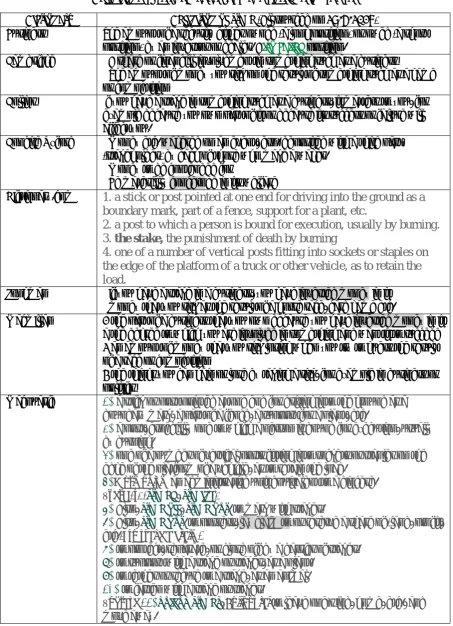
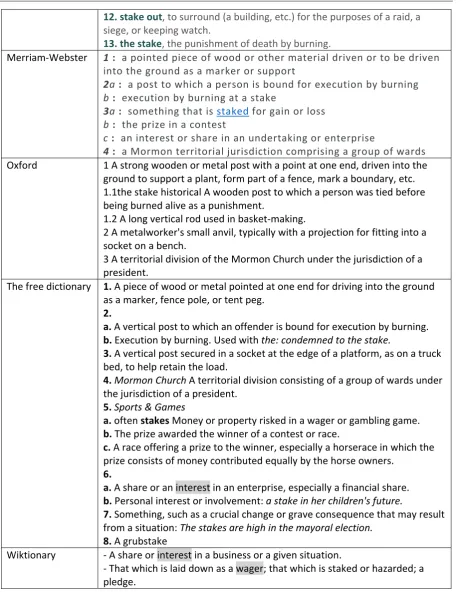
Lexical usage is surveyed in Tables 1a and 1b.
Step 3 Analyse lexical usage
While the term stake is still used to mean a pointed stick or post or peg driven into the ground, it is the conceptual term we are defining here, not the physical term.
Words used to define the concept denoted by the word stake in Table 1a are interest, wager, risk, share, concern, connection and claim, in decreasing order of occurrence. Except for risk, all the words following interest are particular types of interest. Risk has a management connotation and is not really an appropriate word for describing a fan’s stake in a celebrity’s behaviour or a parent’s stake in their child’s behaviour. Interest is the most generic word and will be selected.
Step 4 Develop a connotative (intensional) conventional definition
Stake will be tentatively defined as an interest and stakeholder will be consequently defined as an entity with a stake (interest) in the subject activity.
The ease of determining these definitions from the lexical usage belies the academic difficulty that prompted the need to define these terms in the first place.
Step 5 Report academic review of definitions
Clarkson (1994) undertook a similar exercise to define stake and stakeholder and concluded that definition should be based on risk. We have rejected that on the grounds that risk is not as generic as interest. So our definition is not the same but does not conflict, as if one has risked something, one will have an interest. This definition led him into categorising stakeholders as voluntary or involuntary. We note that this approach did not achieve the subsequent general agreement that it potentially could have in the years since, as evidenced by the subsequent documentation of ongoing confusion mentioned earlier (Littau et al. 2010; Miles 2012).
Fassin (2009, p. 116) also reviewed definitions of stakeholders and their categorisations, concluding that “A stakeholder refers to any individual or group that maintains a stake in an organisation in the way that a shareholder possesses shares”. While this definition does acknowledge the root term “stake”, it restricts the definition to companies and so is not suitable for generic use. It also poses problems for usage of the terms “stakewatcher” and “stakekeeper”. Within the project management field, these are both referred to as stakeholders, and labelling those with formal roles or direct responsibility as the “real stakeholders” would simply double up on governance roles and cause confusion. Interestingly, using companies as the starting point also parallels the difficulty that resulted from a section of governance theory also presuming the joint‐stock company model, as noted in McGrath and Whitty (2015, p. 783). This led to the concept of “public governance”
developing to accommodate government organisations. This highlights the confusion that can arise when definitions are determined without regard to other fields or disciplines.
In (Bourne 2005) assessment of the definitions of the term settles on the definition of “stake” as “an interest, a right or ownership”. This definition of “stake” is inclusive of Freeman’s definition given in Miles (2012), as whoever or whatever “affects or is affected by” the activity in question will have an interest when that affect becomes apparent. While “interest” here was intended to mean something less than a right or ownership, both of these latter terms can also be described as an interest and so do not need to be included in a generic definition.
Fassin (2009) noted “claimant”, “influencer” definitions and also the combinatory definition:
any group or individual that ‘can affect or is affected by the achievement of an
organisation’s objectives’ (Freeman, 1984, p. 46). This, now classical, definition “has become the most accepted of the definitions of a stakeholder, and has greater precision than the shorter version ‘those who can affect or can be affected by the firm’ (Fassin 2009, p. 116).
However, as noted above, while this is restricted to a company situation and is not sufficiently generic to be used here, it does not conflict with the proposed definition. If one seeks to influence or make a claim, one has an interest.
p. 116). While these classifications cannot form any part of our definition, which is by intension rather than by extension, they all nevertheless fall within the ambit of the proposed definition.
(Bourne 2005) says “Stakeholders are individuals or groups who have an interest or some aspect of rights or ownership in the project, can contribute in the form of knowledge or support, or can impact or be impacted by, the project.” The stakeholder concept is wider than just projects. So de‐ selecting the extensions from the Bourne definition and qualifying it with the way it arises produces the following definition of a stakeholder as “an individual or group with a stake (interest) in the subject activity”. This avoids the sub‐classification issue and accords exactly with the proposed definition. It is suitable for application to both projects and organisations (both private and government) and to activities that are not projects, such as changing regulations (although the activity of making such changes can, of course be managed as a project). It accommodates the clusters of definitions mentioned in (Miles 2012) which include Freeman (1984) “affects and affected by”, Clarkson (1995) “primary”, “secondary” and “at risk”, Mitchell, Agle and Wood (1997) “power ‐ legitimacy – urgency”, and the Stanford Research Institute. (1963) “without whose support”
definitions. Two further categories of definitions are mentioned in (Fassin 2009), namely Kaler (2002) “claimant and influencer”, and Phillips, Freeman and Wicks (2003)2003 “normative and derivative”, which are also accommodated in the proposed definition.
Eskerod and Huemann (2013) examined three project management standards and found that two of them, PMBOK and PRINCE2, have definitions of the type ‘affect or are affected by’, with the International Competence Baseline having an ‘interested in or constrained by’ definition (Eskerod & Huemann 2013, p. 42).
An emerging trend in stakeholder management can be identified from Eskerod and Huemann (2013, p. 36) who considered ‘putting stakeholder management in the context of sustainable development would ask for a paradigm shift in the underpinning values’. There is nothing in the proposed
definition that would preclude this. Huemann, Weninger, Cardoso de Oliveira, Mendonça Barros Filho and Weitlaner (2013) also considered:
Integrating economic, ecologic, and social interests of project stakeholders …
Broadening the time perspective to consider not only current stakeholders but also future stakeholders of the investment initialized by the project.
Broadening the spatial perspective to consider local, regional as well as global impacts of the project for stakeholders.
They also considered stakeholders such as the project personnel, suppliers, partners, communities, as well as economic, social and ecological perspectives. All of these are accommodated by the proposed definition which also does not preclude greater emphasis of management for rather than of stakeholders or the inclusion of sustainable development within stakeholder management.
While we make no comment in this paper on any stakeholder management techniques, it is perhaps worthwhile noting that, in practical project management terms, competitors, terrorists,
blackmailers, fraudsters and thieves, all of whom could be said to have an interest and are therefore included in the tentative definition, would typically be introduced to consideration via risk
management (as per Office of Government Commerce (2009)) rather than being elevated to
stakeholder status under stakeholder management, or communications (as per Project Management Institute (2008)). So the differing categorisation of stakeholders in both these standards identified in Eskerod and Huemann (2013) do not conflict with the tentative definition; they simply add
specification by extension. The tentative definition therefore seems robust and neither precludes nor proscribes any method of classifying or dealing with stakeholders.
which focuses on the essential meaning of an English language word. The fact that different types or categories can be defined differently is unsurprising as they are effectively definitions of a phrase containing the word stakeholder rather than definitions of a single word. The different qualifying words are needed to convey a different meaning, otherwise the qualification would be unnecessary. The mistake is in either not recognising, or inadvertently omitting, the qualifying word(s) in the phrase and seeking supremacy for the accepted usage of the word in one particular field or section of it over all others.
Practically all of the academic definitions have the word interest or some equivalent, and so, amongst the apparent disagreement, the agreement on the meaning of the single word actually seems quite strong and is also in accordance with the lexical usage.
This discussion therefore finds no reason to alter the definitions derived from lexical usage.
Step 6 Remove unwarranted inclusions
There are no such inclusions remaining.Step 7 Remove mixed content/ process meanings
None present.Step 8 Reduce divergence/ consider additional inclusions
Checks (a) and (b) are appropriate for this term.Step
8(a)
Consider
historical
usage
While it is the conceptual noun form we are concerned with here, it provides useful context to include the etymology of both the noun and the verb forms of the word stake in both physical and conceptual versions of the terms.
The etymology of physical noun stake (n.1) is as follows:
"pointed stick or post," Old English staca "pin, stake," from Proto‐Germanic *stakon (source also of Old Norse stiaki, Danish stage, Old Frisian stake, Middle Dutch stake, Dutch staak, German stake), from PIE root *steg‐ (1) "pole, stick." The Germanic word has been borrowed in Spanish (estaca), Old French (estaque), and Italian stacca) and was borrowed back as attach. Meaning "post upon which persons were bound for death by burning" is recorded from c. 1200. Meaning "vertical bar affixed to the edge of a platform of a truck, rail car, etc., to hold boards to keep the load from falling off" is from 1875; hence stake‐body as a type of truck (1907). In pull up stakes, "The allusion is to pulling up the stakes of a tent" [Bartlett] (Harper 2017, p. P77).
The etymology of physical verb stake (v.1) is as follows:
early 14c., "to mark (land) with stakes," from stake (n.1). Hence, to stake a claim (1857). Meaning "to maintain surveilance" (usually stake out) is first recorded 1942, American English colloquial, probably form earlier sense of "mark off territory." Related: Staked; staking. Old English had stacung "piercing of an effigy by a pin or stake" (in witchcraft); staccan "pierce with a stake, spit" (Harper 2017, p. P77).
The etymology of conceptual noun stake (n.2), which is the term we are concerned with here, is as follows:
lose" (1784). Plural stakes, "sum of money to be won in a (horse) race," first recorded 1690s (compare sweepstakes). To have a stake in is recorded from 1784 (Harper 2017, p. P77).
The etymology of conceptual verb stake (v.2) is as follows:
"to risk, wager," 1520s, perhaps from notion of "post on which a gambling wager was placed" (see stake (n.2)), though Weekley suggests "there is a tinge of the burning or baiting metaphor" in this usage. Meaning "to maintain surveillance" (usually stake out) is first recorded 1942, American English colloquial, probably form earlier sense of "mark off territory." Related: Staked; staking (Harper 2017, p. P77).
It is therefore evident that reference to the physical object has developed into a conceptual term representing various applications of the physical term.
The etymology of the noun stakeholder is as follows: 1708, from stake (n.2) + agent noun from hold (v.). Originally one with whom bets are deposited when a wager is made (Harper 2017, p. P77).
In summary, a stake has been understood to be an interest since 1784, an amount of money risked or gambled, which accords with the derived definition above. Similarly since 1708 a stakeholder has been understood to hold an interest, while previously it had referred to an uninvolved person who simply held the money on someone else’s behalf. So this consideration of etymology provides no reason to alter the proposed definitions.
Step
8(b)
Consider
field/
speciality
usage
Use of the word “entity” in the stakeholder definition includes the natural living environment (flora and fauna) without relying on governments or pressure groups providing a mouthpiece. It could also be construed to include the more esoteric concept of the “spirit” of inanimate objects.
Step 9 Check against the five rules
The definition of “stake” is synonymous and that of stakeholder is by genus and difference and satisfy Rules 1 to 5.
Step 10 Report the derived definition
The derived refined definitions are as follows: Stake = an interest
Stakeholder = an entity with a stake (interest) in the subject activity.
Group
rules
post
definition
Cross check 1 Consistency within group
The definitional method has not resulted in any inconsistency between terms in this group.
Cross check 2 Consistency with terms outside the group
There is no known overlap of meaning of any of the above group of terms with any other term outside the group that would prevent the definitions being accepted.
Summary
of
definitions
The derived refined definitions are as follows:
Stake: an interest
The
stakeholder
locus
of
interest
and
its
categorisation
Having addressed Research Question 1, defining stakeholder in terms of interest in an activity, we can now approach Research Question 2 by mapping the stakeholder space.
We also note that by doing so we are partly accommodating the following statement in the
literature; “However, very few scholars go onto link their analysis to the graphical scheme, and thus avoid analysing the inconsistencies that may exist between their definitions and the graphical model” (Fassin 2009, p. 118). While we will not use the graphical representations of Freeman referred to by Fassin, all of those elements find a place within our representation, albeit under different names.
In developing our representation, we have used and/or accommodated terminology from the previously considered competing definitions and distinguished only between categories of stakeholders and not categories of stakeholder management techniques. We seek to clarify the former and exclude the latter, as we do not here wish to comment on any particular stakeholder management technique.
These previously considered competing definitions and categorisations can all be seen as dealing with some particular interest ‐ relating to a particular type of activity or content area, or to a particular type of relationship to the activity, as noted by Miles (2012, p. 295) in saying “Different stakeholder definitions highlight core themes and give weighting to components that are relevant to the context and situation in which they are developing or using the construct”.
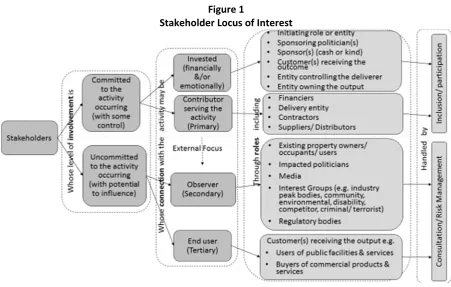
Stakeholders become important as soon as we undertake some form of activity and so, taking the lead from the derived definition, we depict categories of stakeholder interest relative to a single generic activity. This also seemed to be an obvious starting place when considering that all projects are temporary and activity based; that any activity can potentially affect someone and in ways we may not initially expect. We then simply depicted the space in a logical way, arranging terms
associated with the word and iterating to remove inconsistencies until there was no contradiction in the words used and the depiction accommodated individual, government and commercial activities. Figure 1 is the result.
Figure 1
Stakeholder Locus of Interest
Note that the particular activity may be a task, a project, a program, an undertaking of a corporation or government entity or even a particular instance of a person’s behaviour. In the latter case, not all of the roles come into play, but the diagram has been drawn to accommodate stakeholder
circumstances for the most complex activities, for otherwise, the diagram would be incomplete.
The key to the diagram is the identification and separation of both the level of involvement and the type of connection that various stakeholders may have. It shows two levels of involvement
(committed and uncommitted to the activity occurring) and then two types of connection with the activity for each of these. Note that the terms primary and secondary come from the literature while the depiction itself suggests the tertiary category, which we have sub‐labelled as such. The time scale is different for each level of connection; the contributor or primary roles are affected immediately, observer or secondary roles may be affected immediately or once the activity is completed and tertiary end users are impacted by the completed activity (aside from any adverse impacts during activity implementation, which are covered under existing users in the secondary category). Also a particular person may find themselves in more than one role and others may transition between roles over time, from top to bottom e.g. from affected landholder or occupant or contributor to user. So the diagram depicts roles rather than persons; it also covers an extended timescale and relates only to a single activity or a single aggregation of activities.
We now propose definitions of the four categories of stakeholders shown in Figure 1, based upon their connection to the subject activity. In doing so, we will also demonstrate that these categories and their definitions accommodate the most common definitions given by Miles (2012, p. 293), and those reported in (Huemann et al. 2016, p. 25). Our proposed category definitions are as follows:
An invested stakeholder is one who has some control of the activity. This accommodates Clarkson (1994, p. 5) ‘‘bear some form of risk as a result of having invested some sort of capital, human or financial, something of value, in a firm’’.
[image:12.595.71.523.78.365.2]It also aligns with Stanford Research Institute. (1963) ‘‘those groups without whose support the organization would cease to exist’’;
An observer (secondary) stakeholder is one whose acceptance or compliance is required to sustain the activity. This is based upon Clarkson (1995, p. 107) ‘‘secondary stakeholder groups are defined as those who influence or affect, or are influenced or affected by, the corporation, but they are not engaged in transactions with the corporation and are not essential for its survival. …however such groups can cause significant damage to a
corporation’’. “Acceptance or compliance” has the connotation of both influence and being affected by, does not mean agreement and avoids the need to include reference to damage. A tertiary stakeholder is one who uses the output of the activity.
In basing these definitions on previous literature, we have covered all the definitions listed as popular by Miles (2012, p. 293) with the exception of one, whose definition was:
classes of stakeholders can be identified by their possession or attributed possession of one, two, or all three of the following attributes: the stakeholder’s power to influence the firm, the legitimacy of the stakeholder’s relationship with the firm, and the urgency of the stakeholder’s claim on the firm Mitchell et al. (1997, p. 854).
This was more a classification than a definition, as the quotation actually states. Our depiction is for definitional purposes and accommodates the power to influence as well as legitimacy but does not accommodate urgency. Urgency may be important in determining the necessary speed of resolution of a stakeholder issue, but this is activity dependant and has no bearing on which of the above four categories a particular stakeholder happens to be in. The classification actually depicted in Mitchell et al. (1997, p. 874) shows eight classifications, but these incorporate aspects of stakeholder management, beyond simply defining and are not just restricted to the connection with the activity as outlined in Figure 1. They were concerned with classifying both who and what really counts, as stated in their publication title. Urgency does not relate to who; it relates to what might need to be done and how quickly. We are concerned only with defining who. Their classifications of dangerous, definitive, dependent and demanding stakeholders all fit within our secondary stakeholder category and many of the roles shown in Figure 1 can at times require urgent attention. They also
acknowledged “The theory of stakeholder identification and salience developed in this article in no way discredits this search for a legitimate normative core for stakeholder theory” (Mitchell et al. 1997, p. 882). So there is no conflict here, although we seek a non‐normative core.
A similar issue arose in Clarkson (1995) who said:
I propose that corporate social performance can be analyzed and evaluated more effectively by using a framework based on the management of a corporation's relationships with its stakeholders than by using models and methodologies based on concepts concerning corporate social responsibilities and responsiveness (Clarkson 1995, p. 92).
He develops a classification of management strategies that he refers to as a RDAP Scale, meaning reactive, defensive, accommodative or proactive (Clarkson 1995, p. 109). All of these are ways of managing various categories of stakeholder and we have categorised on a completely different basis, which is silent on and therefore accommodates any method of management, none of which relates to definition of categories of stakeholders.
Some of the definitions in Miles (2012) were based upon Freeman’s 1984 definition:
The full definition given by Freeman (1984)is “any group or individual who can affect or is affected by the achievement of the organization’s objectives” (Freeman 1984, p. 46). The stated restriction to an organisation, and the unstated further restriction to one with a joint‐stock company structure (as detailed in the next section), both unnecessarily limit the ambit of the base term and invite
conclusions to be drawn that may not be generic to other circumstances. However the key “affects and is affected by” element is generic and can be applied to all four categories defined above; it is just not as succinct as the definition derived above. If one has an interest in an activity then one may be affected by it or seek to have an effect upon it.
This deals with all of the ‘most popular’ definitions listed in Miles (2012, p. 293) who also mentions a further issue:
Sternberg (1997, p. 4) states: ‘The widely used Freeman characterization of
stakeholder…transforms everyone into a stakeholder. It not only includes those who have a stake in the organization as well as those in whom the organization has a stake, but it excludes all criteria of materiality, immediacy and legitimacy’. This is echoed by Phillips (1997, p. 63) ‘one example that has troubled some is the problem of whether terrorists are a stakeholder group. Although many of our considered judgments lead us to say “no”, earlier versions of the theory would have to say “yes” due to the fact that they can certainly affect the firm’ (Miles 2012, pp. 293‐4).
The definitions of stakeholder categories proposed above accommodates these views without precluding the handling of supportive and antagonistic observer stakeholders in completely different ways. The activity used for the depiction in Figure 1 is generic and so can apply to law enforcement, which does not have a joint‐stock company organisational structure. Law enforcement activities are directly affected by criminals and terrorists who fall into the observer (secondary) category, and not into the invested category; it is the community that receives the beneficial outcome of offenders being locked up, and it is the victims of their activities that are the (unwilling) end users or output customers. However if we consider one individual criminal act by a person, that person is invested and will receive an outcome from it, the police and courts are observer stakeholders and the victim is again the (unwilling) output customer, receiving the detrimental output in whatever nefarious form it may take.
Finally, Miles also refers to a claimant definition for business ethics:
According to Kaler, three types of stakeholder definitions are prevalent within business ethics: influencer definitions ‘‘requiring only a capacity to influence the workings of the business’’, claimant definitions ‘‘requiring some sort of claim on the services of a business’’ and combinatory definitions ‘‘allowing for either or both of these requirements’’ (Miles 2012, p. 291).
Kaler further states:
It is argued that for the purposes of business ethics, stakeholding has to be about improving the moral conduct of businesses by directing them at serving more than just the interests of owners. On that basis, influencer definitions are eliminated on the grounds that they only concern morally neutral strategic considerations and combinatory definitions on the grounds that the combining of ethical and strategic considerations they promise can be less
We adopt a strictly non‐normative approach and have categorised in terms of connection rather than influence, thereby avoiding the issues associated with power imbalance and moral
consequences. The moral duties owed by a business to claimants are covered under primary, secondary and tertiary categories, which cover various aspects of liability. We strive to avoid normativity in addressing any definitional question because of its potential to distort, confuse and polarize.
To conclude this section of analysis, Miles (2011, p. 29) listed all the terms that had been used in all 563 definitions and found there were 36. These included interest and 12 others that we have considered above and excluded. The remaining 23 terms were reviewed and none were suitable candidates for expressing the generic essence of the term. They related to particular types of interest or to normative matters.
Huemann et al. (2016, p. 25) lists examples of stakeholder definitions in the literature. Some of these have been mentioned above and there is a group of six definitions mentioned, all of which are accommodated under the invested or contributing (primary) categories. These are “claimants who have contracts” attributed to Cornell and Shapiro (1987, p. 5), “Have a stake in or claim on the firm” (Evan & Freeman 1988, pp. 75‐6), “Groups in a relationship with an organisation” (Thompson, Wartick & Smith, p. 209), “Those who have or claim ownership, rights or interests in a corporation and its activities” (Clarkson 1995, p. 106), “Persons or groups with legitimate interests in procedural and/ or substantive aspects of corporate activity” (Donaldson & Preston 1995, p. 67) and “Persons or groups of persons [who] voluntarily accept the benefits of a mutually beneficial scheme of
cooperation requiring sacrifice or contribution on the part of the participants” attributed to Phillips et al. (2003, p. 92). The one remaining definition is “Individuals or groups who are directly and/ or indirectly involved in the selected scales and beyond, and whose lives, environment, or business are affected by the three spatial scales and beyond the adopted constructs”. The scales referred to here are categories of sustainable urban development ranging from global down to a building element. The individuals or groups referred to are accommodated in the observer (secondary) and end user (tertiary) stakeholder categories.
This analysis therefore indicates that the proposed definition and categorisation accommodates all the definitions drawn from (Huemann et al. 2016, p. 25) as well as those mentioned by Miles.
We will now address some further aspects of Figure 1. If it were not for previous usage of Clarkson (1995), we could have considered just labelling primary stakeholders as contributing stakeholders and the remaining two categories of observer and end user as primary and secondary rather than secondary and tertiary. This could have been justified in project management terms where stakeholder management is mainly concerned with what we have here labelled as observer
stakeholders and there are formal organisational processes and prescribed roles for contributing or primary stakeholders.
However it could equally be argued that those financially and emotionally invested are the primary stakeholders and should be labelled as such. However this would leave those that project
management is principally concerned with managing through stakeholder management as tertiary stakeholders, with end users being quaternary stakeholders. This would take us one step further away from the whole purpose of determining who the observer stakeholders are. In any activity, it is usually relatively easy do identify who is actually carrying out the activity whereas it may be quite difficult to determine who may affect, or be affected by the activity, which is the whole purpose of the theory and so we reject both these options and accept that the primary/ secondary/ tertiary classification as the most practical. It reflects power to influence the initiators of the activity. It also addresses the circumstance of managements not considering their staff and suppliers as
The alternative would be to drop any such attempted numbering, referring only to two categories within each of committed and uncommitted stakeholders and this is what we propose, although we have shown both in the definitions and in the depiction in Figure1 because of the labelling simplicity of the numbered alternative. This enables the proposed nomenclature to not contradict or attempt to alter any existing usage or definition (of primary and secondary) with the exception of the
position of the customer and government/ regulatory bodies, which receives special consideration in the following section.
We also considered whether the observer or secondary category should be split but made the deliberate decision not to as it requires normative considerations before being able to categorise them, such as having to determine whether a particular stakeholder is for or against, “dangerous” (Mitchell et al. 1997, p. 873), or a “grumbler” (Jepsen & Eskerod 2009, p. 337). This is impractical as some impacted stakeholders may be either for or against, depending upon their circumstances and their view of the potential financial accommodation that may be made. This is confirmed by comments of the project managers of the four sample projects in Jepsen and Eskerod (2009) who:
pointed out that it is not possible to make a detailed front end stakeholder analysis. They did not have the cognitive capacity to consider all stakeholders in detail, nor did they find such a detailed analysis worthwhile. Firstly, it is impossible to foresee interactions with
stakeholders in the distant future. Secondly, the contributions needed from each stakeholder may vary in different stages in the course of the project and due to unforeseeable events in the project.
Further, the project managers spent quite a long time conducting the stakeholder analysis mainly because they had difficulty in getting access to important stakeholders. In some cases, the result was that they had to decide on and implement a stakeholder management strategy without having the proper information to do so because the project needed to get in motion. (Jepsen & Eskerod 2009, p. 340).
There is one further issue that needs to be addressed regarding the definition of contributor or primary stakeholder given above. While it has been based on Clarkson (1995), following his definition he went on to say “Primary stakeholder groups typically are comprised of shareholders and investors, employees, customers, and suppliers, together with what is defined as the public stakeholder group” (Clarkson 1995, p. 106). However, Figure 1 excludes customers from the contributor or primary category. This is a difference to previous practice that requires special consideration which is given in the two following sections.
Stakeholder
theory
–
a
company
or
an
activity
base?
The issue of the base for stakeholder theory arises because the base of the theory to date has been the company whereas Figure 1 uses an activity base. Stakeholder theory has concentrated upon the joint‐stock company model. This is evidenced by Freeman’s original depictions (Freeman 1984, pp. 59, 121‐2) which show the company at the centre of the diagram. Fassin also includes similar
depictions and even explicitly presents a “Stake model of the firm” which has company management at the centre (Fassin 2009, pp. 115‐24), and also shows customers as internal rather than external stakeholders. While Freeman was aware of its wider application, he said “I shall concentrate on the applications of the stakeholder concept to corporations, and in particular, for profit corporations” (Freeman 1984, p. 28). 33 years later he said ”In stakeholder theory, we need more cases of real companies and real stakeholders interacting with each other” (Freeman 2017).
using terminology generic to that field which may not be applicable outside it, such as in projects and in government. To be truly generic, it must be possible to represent stakeholder theory in a way that accommodates other forms of entity and organisation. Using an activity basis achieves this.
There are a number of factors supporting use of an activity base:
1. If a company’s activities change, some of its stakeholders will change. This means the activity is more fundamental than the company.
2. Representing stakeholder theory in terms of a company centric view of the world invites an absolute answer for the question of who stakeholders might be, which is unattainable and bound to fail as activities change.
3. The whole imprecision of ignoring minor definitional issues and the niggling little question regarding how this applies exactly to government or projects and whether the translation is fully valid or not is avoided.
4. It can be applied to activities that produce some result or output from the effort expended but the output or result is not a product or service. Examples include a parents’ stake in their children’s behaviour or exercise or training for example which produces an output of a better functioning and or more skilled body which may or may not have end users interested in the competitive result.
5. There are niggling inconsistencies in the application to companies anyway because of the inclusion of customers within both Clarkson’s primary and Fassin’s internal stakeholder groups.
The following section addresses the last factor given above and highlights duality of terminology in relation to use of the term customer.
What
type
of
stakeholders
are
customers?
In Figure 1, the term customer is used in two different places; one where the person is committed to the activity occurring, and one where the person is not. The former has a stake in the activity of producing a product or service and the latter has a stake simply in using or consuming the product or service that the activity produces. Both are customers and from a producing company perspective, both are of primary commercial importance and so could be legitimately labelled as primary. However drawing Figure 1 from an activity perspective facilitates recognising that there are two different roles here, requiring one at the top and one at the bottom of the activity based diagram; one sort of customer is an invested stakeholder and the other is an end user or tertiary stakeholder. There are different roles played by these two different types of customer and these have been shown in Figure 1 as output and outcome customers. Depicting Figure 1 using an activity base highlighted this issue and also highlighted potential confusion in terminology among invested stakeholders regarding which one to label as the customer.
Support for identifying these various interests comes from Winch (2007, p. 323) in noting: “the
interests of financiers, clients, and sponsors may be divergent”. We will further illustrate the need for identifying these through giving examples of complex activities the authors have had experience with as follows:
1. Government reform programs or programs to improve social welfare or some aspect of
indigenous life: These may be initiated from outside government or by politicians or a government entity. Funding will come from government. The entity receiving the outcome (outcome customer) is the person or group within government who will have to administer or deal with the developed system and live with the consequences if the measures
controlling the deliverer. The output customers are those using the facility or service provided.
2. Providing channel markers to a particular destination. This may be done for a local
initiating agitator, developer or politician, and the local community receives the outcome of increased safety and marine traffic but it may be funded and most likely owned (and therefore maintained) by the maritime authority with jurisdiction of the area. So while the facility provided is actually used by local residents and their suppliers who are the output customers, the entity providing the money is not necessarily the customer of the (non‐ financial) outcome.
3. Design and construction of the above channel markers: This is going down to a more detailed activity level. In this case requirements will be set by the maritime authority on the basis of end users or output customers being vessels of varying sizes rather than people. The authority will either directly let the construction contracts or will have functional
requirements it can impose upon the local authority or developer that may arrange the construction for it. Whoever lets the contracts, the marine authority with jurisdiction over the area will be an outcome customer irrespective of who pays.
4. Parents buying a drum‐set or violin on request from their child: The child plays the
initiating role and will be the end user (output customer). The parents will be the sponsors in both cash and kind (practice space). They will also be the recipients of the outcome; the initially dreadful noise and the satisfaction of seeing the personal development of their child. The neighbours affected by the practice noise are observer stakeholders who may exert an influence.
5. Purchase or use of a product or service that generates dependence: Uncommitted (output) customers may become dependent and subsequently committed to the ongoing (and different) activity of continued production of the product, but this will still only mean they will then fit into two categories; observer as well as end user, for that later activity.
Again, it is important to remember that the right‐hand side of Figure 1 details roles and not
individuals. Individuals may play multiple roles. In some of the above examples, the person or entity funding the activity is not the outcome customer. Similarly, a well‐intentioned group with influence can impose impractical arrangements on other areas of government through government not realising the need for this internal governance distinction between who pays and who is lumbered with the outcome. The conclusion from this is that a truly generic stakeholder governance model cannot be based on financial arrangements, even though it must, of course, accommodate them.
We will now give our reasoning for choosing the customer labelling shown in Figure 1.
Customer
labelling
Firstly we have used the term customer rather than client as a client generally pays (Winch 2007, pp. 321‐2) whereas a customer may or may not. The latter can occur in government.
The resolution for labelling customers that did not lead to contradiction was to separate the output from the outcome. Two other options were considered and rejected. Distinguishing between contracted and un‐contracted does not accommodate the circumstance where the person receiving the outcome has no money or authority to undertake the activity and so there is no contract, except possibly for some vague “social contract”. It also does not accommodate the circumstance where organisational authority or rank prevails and the activity gets its authority from some accepted organisational practice for which there is either no contract or some general clause in an
difficulties but still does not accommodate the circumstance that can occur within government where the person or group receiving the outcome has no money or authority to undertake the activity and may be external to it. So both these options lead to other unnecessary debates and were rejected in favour of demarcation in terms of output and outcome.
Reliance on the joint‐stock company model also presumes there will be a monetary price for the product or service. This leads to the conclusion that a customer is always one who pays. As mentioned above, this is not necessarily the case for government. Government has many people using its services, both willingly and unwillingly and many of these do not make a monetary payment for the service and some, in fact, receive money. These are all (output) customers of government; There is some sort of service provided to the public, so what else can the people who use those services be called that might be non‐normative? Consequently any definition of a customer that requires there to be a monetary payment is inappropriate for government. Government services provide some sort of value to somebody and so there is some sort of value exchange; one that is more complex than the simple exchange of a product for monetary consideration. So it would be preferable to make the concept generic by defining a customer in terms of the value exchange rather than restricting it to a user of a product or service who happens to pay for it. This can be done quite simply by describing a conventional (output) customer as one who receives the product or service.
Customer
terminology
The above discussion leads us to develop customer terminology that accommodates both government and the joint‐stock company model as follows:
A customer is one who receives some value from an activity An output customer is one who receives the output of an activity. An outcome customer is one who receives the outcome of an activity.
The joint‐stock company customer who pays for the product or service that the activity produces is simply a sub‐set of the term which we have qualified as an output customer, namely one who pays, or a paying customer. These definitions also accommodate government usage, in which it is possible that either category of customer may not pay. It allows government to effectively use the theory that developed within the private sector environment without becoming confused by the different organisational structure or appearing disingenuous when labelling those hostage to it as customers.
We will consider the application of the definitions and model to two further and quite different complex activities with which the authors are familiar to check its veracity.
1. Operating a driver licencing system. Potential young drivers desiring a licence are the output customers of the activity, but they are also captive to the system for which the government has a monopoly. The rest of us are the outcome customers, invested in driving on the roads, who may receive whatever safety and insurance premium outcomes that may result. So the value that learner drivers get from being captive to such a system is their own safety. In this case, the output customer also pays for the piece of paper or card they receive. Of course the circumstance can occur where a private company effectively has a similar monopoly over a particular product or service, in which case its customers are effectively captive. So whether the customer is captive or not makes no difference to the fact that they are a customer.
positive or negative customer. However it does make sense to refer to the value they receive as positive, zero or negative. The fact that they received negative value does not mean they are not a customer. They just happened to end up with an additional descriptor of victim. There has still been a value exchange.
Given that the examples above have not invalidated Figure 1, and that it accommodates
circumstances that current stakeholder theory does not, we propose this figure as an alternative representation of stakeholder theory. As John Stuart Mill said:
It would, however, be a complete misunderstanding … to think that because a name has not at present an ascertained connotation, it is competent to anyone to give it such a
connotation at his own choice. The meaning of a term actually in use is not an arbitrary quantity to be fixed, but an unknown quantity to be sought. … To fix the connotation of a concrete name, or the denotation of the corresponding abstract, is to define the name. When this can be done without rendering any received assertions inadmissible, the name can be defined in accordance with its received use (Mill 1874, pp. 469,70).
Findings
Considering output c