Engineering Phenomenography
Peter Gibbings
Associate Professor, University of Southern Queensland, Toowoomba, Australia
Corresponding Author
Telephone: Australia 0746312553
John Lidstone
Professor, Queensland University of Technology, Brisbane, Australia
Christine Bruce
Professor, Queensland University of Technology, Brisbane, Australia
Engineering Phenomenography
This chapter extends the phenomenographical research method by arguing the merits of engineering the outcome space from these investigations to effectively communicate the outcomes to an audience in technology-based discipline areas. Variations discovered from the phenomenographical study are blended with pre and post tests and a frequency distribution. Outcomes are then represented in a visual statistical manner to suit the specific target audience. This chapter provides useful insights that will be of interest to researchers wishing to present findings from qualitative research methods, and particularly the outcomes of phenomenographic investigations, to an audience in technology-based discipline areas.
INTRODUCTION AND BACKGROUND
This chapter contributes to the phenomenographic research method by
describing its use and extension with emphasis on how the results may be presented in a
manner that is meaningful for a specific community, in this case educators and
researchers in the engineering community. The title of the chapter points to
phenomenography as a research method, and it is deliberately ambiguous: is the chapter
about how to engineer phenomenography, or is it about phenomenography in an
engineering context? The answer is both. It explains a process of designing and
constructing the outcome space, a key element of the depiction of variation, in a
particular way, and this is done in the context of engineering education in order to
communicate easily with the community of engineering educators. It also details a
specific example of the blending of approaches used in a phenomenographical study to
engineer the outcome space to suit that audience. Since this context addresses a
knowledge area that is not commonly referenced in educational literature, it provides
(valuable) insights that will be of interest to researchers wishing to present qualitative
an audience in technology-based discipline areas. Although many phenomenographic
studies have been conducted in technology education (for examples see Baillie et al.,
2001; Berglund, 2002; Booth, 1992; Ingerman, 2002) we believe this is the first time
that potential disciplinary influences have been explicitly discussed.
The aim of this chapter is therefore to describe the extension of qualitative
research methods, and particularly the outcomes of phenomenographic investigations, to
present outcomes in a convincing manner to an audience in technology-based discipline
areas. The chapter outlines a personal odyssey taken by the lead author whilst
completing a professional doctorate. At the time Gibbings was heavily involved with
educational research in a Faculty comprising mainly Engineers and later became
Associate Dean (Learning and Teaching) in that Faculty. He was researching a question
aligned to qualitative research methods and these were largely unused, and viewed with
some suspicion, in his Faculty. Therefore, he was keen to legitimise qualitative, and
specifically phenomenographic, research within his sphere of influence. This led to the
need to adopt and argue for particular approaches to analysing and reporting findings so
they were considered acceptable to this technology-based community, as well as to
enhance prospects of publication in the engineering education conferences and journals.
The chapter opens with a brief description of relevant epistemological and ontological
aspects of phenomenography and variation theory. It is then argued that a
quantitative-positivistic approach has benefits when presenting qualitative research (particularly
phenomenographical) outcomes to a technology-based audience, and this argument is
then illustrated with an empirical example. The argument is further reinforced by a
description of the challenges associated with publishing such work in the technology
Researchers’ Philosophical Perspectives
Of importance to the ensuing discussion is an analysis of the authors’
philosophical views. Prior to his doctoral study, the first author was in a position
similar to that described by Åkerlind (2005) in Chapter 6 of the edited book by Bowden
and Green (2005). Coming from a positivist background, his research until that time
had been mainly focussed on quantitative methods. Like Åkerlind, he also was of the
opinion that the content examination and general thematic analysis he had previously
carried out on various survey-based and open-ended responses to specific questions,
constituted qualitative research.
During the course of his doctoral research, he became oriented towards an
essentialist/foundationalist ontology incorporating a belief in some objective truth. In
accordance with this ontology and a realist epistemology, inclined towards critical
realism, he believes that knowledge can be both created and constructed, that
experiences are important to this knowledge creation/construction, and that the manner
of creating or constructing this knowledge can be studied empirically.
Given the initial stance of the first author, he sought a research methodology for
his doctoral study that was participant-centred and explored participants’ world views,
and that could be communicated to his peers in a convincing manner. His personal
stance is in accord with the non-dualist stance adopted by phenomenography, where the
outer world is not constructed internally by an individual, nor is it imposed on an
individual from the outside – rather it is considered that there is only one world that
includes the individual and the ‘real world’ around them - as described by Marton and
Booth (1997, p. 13), ‘There is only one world, but it is a world we experience, a world
in which we live, a world that is ours.’ Phenomenography adopts this stance through
experience it. Nevertheless, phenomenography can take different forms and can be
interpreted in different ways.
The authors had a fundamental desire for the research to focus on understanding
and explanation, an important trait of educational qualitative research, rather than
simply reporting empirical findings or underlying mechanisms that might then lead to
prediction or generalisations as is conventional in the research of the technology
disciplines. The outcomes needed to be useful, and the knowledge gained needed to
have a purpose and not simply be knowledge for knowledge sake (essentially an applied
axiology). Developmental phenomenography (Bowden, 2000) was chosen as a suitable
research approach since it aligns with the first author’s personal orientation and is
sympathetic with this applied axiology (knowledge must have a purpose).
Although the prime audience for the research outcomes were those in
technology-related fields, there was a realisation that the method needed to develop a
theory about the phenomenon under investigation from the data that would ultimately
be acceptable to a much wider audience than represented by any individual’s
philosophical stance. In particular, the presentation of the qualitative research outcomes
needed to appeal to a broad section of practitioners in technology-related disciplines.
As described later in the example case, the vehicle developed to achieve this was a
before-and-after analysis and frequency distribution superimposed on the outcome
space from the developmental phenomenographical study. The broader context and
relationship to previous research (for example, Enbenezer & Fraser, 2001;
Minasian-Batmanian et al., 2005; Prosser & Trigwell, 1999) is discussed in more detail later in
this chapter.
While the co-authors shared many aspects of the first author’s position, they had
precluded the use of frequency analyses. They also had not previously privileged the
dominant perspectives of the research discipline audience in their work. They were
accustomed to working with alternate paradigms as they affiliated with the
developmental purpose of the work.
PHILOSOPHICAL INTERPRETATION OF PHENOMENOGRAPHY
AND VARIATION THEORY
Over the last thirty years phenomenography has come to be interpreted in
different ways to align with different philosophical views of researchers. Several
authors have critiqued phenomenography through different philosophical lenses. For
example, Denzin and Lincoln (2000, p. 20) placed phenomenographical research into
four interpretive paradigms: positivist/post-positivist; constructivist/interpretivist;
critical; and feminist/post-structural. Similarly, Lincoln and Guba (Lincoln & Guba,
2000) noted phenomenography had evolved to include: positivism, post-positivism,
critical theory, and constructivism. Lupton (2008, p. 40/41), acknowledging these
earlier works, suggested different approaches to phenomenography belonged to a
continuum from ‘positivist-objectivist’ approaches on one side to
‘interpretivist-subjectivist’ approaches on the other. Lupton carried out her work on information
literacy to highlight curriculum implications with the intention that the results would
influence academics and policy makers. This is consistent with Bowden’s
developmental phenomenography, which he used to describe contexts where the
phenomenographical research is undertaken in a clear attempt to achieve something,
such as bring about a change in the way the world operates, and where there is a
In the example case described later in this chapter, the large majority of the
intended audience for the research study publish their own technology-related research
using a quantitative research paradigm and may therefore be considered to commonly
have an essentialist/foundationalist ontology and a logical empiricist epistemology. We
believe this aligns with Lupton’s description of the positivist-objectivist approach to
phenomenography. Similarly, staff adhering to an anti-foundationalist ontology may
align with Lupton’s interpretivist-subjectivist approaches. Consequently, we use
Lupton’s continuum as a useful framework to demonstrate different philosophical
stances and approaches taken by the authors on the phenomenographical study provided
as an example later in this chapter.
THE TECHNOLOGY-RELATED RESEARCH COMMUNITY
Given the focus of this chapter, it is necessary to further explore the typical
philosophical stances of the academy in technology-related fields. Although it is
difficult to generalise, it may be considered that those with quantitative orientations
might commonly reflect an essentialist/foundationalist ontology and an empiricist
epistemology. On the other hand, researchers espousing the qualitative paradigm might
commonly adhere to an anti-foundationalist ontology and a realist or idealist
epistemology (either direct or critical realism) (Grix, 2002). It is clear then that some
tension may be exposed when outcomes from a phenomenographical study are
presented to those who adhere to a strict quantitative research paradigm.
The logical empiricist (positivist) epistemology often associated with
quantitative research has traditionally been seen as the dominant research paradigm,
with qualitative research being seen as somewhat less prestigious (Åkerlind, 2005), and
community. In these disciplines, statistical analysis is usually the research tool of
choice and it seems this reflects the situation that has long persisted because, due to
their ‘ubiquitous reverence to numbers’, they see ‘empirical science [and] quantitative
measurement’ as the ‘mark of validity in educational research’ (Lagemann, 1997, p. 7).
Lagemann noted that this situation had continued (supposedly up until around
1997 when her work was published) despite going through several stages of
development. From around this time Paul and Marfo (2001) noted some weakening in
the dominance of quantitative research, at least partly due to publications challenging
the epistemology of logical empiricism and logical positivism. Nevertheless, it is
difficult to present qualitative research findings in a convincing manner to those who
will judge the research from a positivist world view such as colleagues in
technology-related fields like engineering.
It is not our intent to pass judgement on this philosophical stance, we point this
out simply to explain potential difficulties of presenting outcomes originating from a
different philosophical stance (as outlined by Paul & Marfo, 2001).
As alluded to earlier, we believe it is possible to present qualitative research
findings from a phenomenographical study, in such a way that it is more likely to be
seen as valid and acceptable to peers in technology-related disciplines. This can be
done by presenting the outcomes in a positivist-objectivist style that is considered
conventional in their own research domains. This is now illustrated by an empirical
example.
EXAMPLE
This example provides a reflective analysis of a phenomenographical study carried out
two supervisors (co-authors) acting as research mentors and collaborators.
This research study sought to discover the qualitatively different ways students
experienced problem-based learning (PBL) in virtual space. The study was undertaken
in the context of an Engineering course offered in the distance education (off-campus)
mode by the Faculty of Engineering and Surveying at the University of Southern
Queensland (USQ). In operation since 1967, USQ is a small regional university that
has developed an international reputation for offering high quality academic programs
in the on-line delivery mode. The phenomenographic approach was adopted for the
study that frames this example due to its epistemological and ontological underpinnings
as discussed earlier, and because of its capacity to reveal qualitative variations in the
ways that external students experience learning, and the differences in these variations
that are brought about as a consequence of a PBL course.
The purpose of the research was to create a balanced theoretical and empirical
report on variation in the student experience of PBL engineering education in virtual
space. In keeping with the applied axiology of the study, the outcomes were intended
to: contribute to improved design and delivery of PBL courses; make a significant
contribution to existing theory with respect to the emerging problems associated with
offering PBL in virtual space; and influence policy and practice with respect to
subsequent similar course development at USQ.
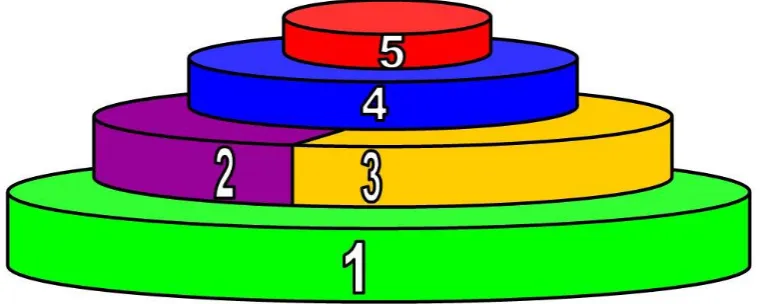
The outcome space from the study is represented in graphical form in Figure 1.
The numbers represent categories of description that were discovered by the
researchers, each representing a qualitatively distinct manner in which people voice the
way they experienced PBL in virtual space. Five categories of description were
discovered from which it was revealed that PBL in virtual space may be seen as:
to understand, evaluate, and solve technical Engineering and Surveying problems’;
Category 3: ‘Developing skills to work effectively in teams in virtual space’; Category
4: ‘A unique approach to learning how to learn’; or Category 5: ‘Enhancing personal
growth’. The range of categories represent increasing awareness of certain aspects of
[image:10.595.94.475.247.399.2]the phenomenon as outlined in other studies (Gibbings, 2008; Gibbings et al., 2009).
Figure 1. Structural relationship and expanding awareness associated with categories (Gibbings, 2008; Gibbings et al., 2009).
The range of categories represent increasing awareness of certain aspects of the
phenomenon. The expanding awareness is not obvious from Figure 1: those aspects are
clearly described in Gibbings, et al. The explanation of expanding awareness is not
central to our arguments in this chapter though a short summary is provided in the next
paragraph, the key point is that the diagram provides a familiar (and therefore
acceptable) mechanism for communicating with the engineering community. Figure 1
represents the metaphor of a series of terraces. The higher levels represent higher level
awareness and conceptions at these levels would normally be expected to include those
awareness from category two only, or from category three only, or from both categories
two and three.
The following summarises the critical dimensions that vary across the categories.
In category one, there is an awareness that team work in virtual space is necessary
to solve the PBL scenarios (realistic situation or case used to present the PBL ‘problem’) in order to successfully submit assessment items.
In category two this fundamental awareness expands to realising the need to develop
skills to help the team solve technical problems.
In category three this fundamental awareness expands to realising the need for better
use of communication and other technology to aid team work in virtual space. In category four, students understand that the learning in virtual space is quite a
different experience from on-campus study, and that working in virtual space is seen as important for their future professional careers.
In category five, successful mastery of the challenge of studying effectively through
PBL in virtual space is deeply rewarding at a personal level and an experience from which they gain a great sense of accomplishment.
Other aspects that demonstrate expanding awareness across the categories are:
How students view the use of their time to undertake the course;
How students use their team with respect to communication, mentoring, critiquing,
and evaluation;
how students see and relate to their team in the context of a learning community and how they interact with the team;
How students use self-reflection and feedback;
How students connect their academic programs and future professional careers; and How as individuals they consider social responsibility and personal ethical values.
Presentation of the Research Outcomes
The large majority of the first author’s peers (from a regional university in
Australia) publish using the quantitative research paradigm. As a consequence of this
logical empiricism, there seems to be a feeling, particularly amongst senior staff, that
research) is the same as the scientific research in their core discipline areas: that is the
standard of good science based on the traditional logical empiricist epistemology.
To overcome this tension the phenomenographic research method was used in a
manner that was unusual in several respects. A key feature was that the qualitative
phenomenographic process was combined with a before-and-after quantitative
frequency analysis of the number of student responses falling into each category of
description, which were part of the outcome from the phenomenographical study. The
superimposition of a frequency analysis on the discovered categories of description is
not common practice, although is observable in some of the literature and is associated
with learning studies.
It is noted that some researchers have in the past successfully combined
phenomenography with quantitative approaches (Prosser, 2002) a classic example of
which involves the superimposition of a frequency distribution over the categories of
description (Minasian-Batmanian et al., 2005). Prosser and Trigwell (1999) have
carried out a form of frequency analysis to establish correlations, for example between
conceptions of teaching and conceptions of learning. Magub (2005) quoted percentages
of quotations falling into categories of description. Marton and Pang (2006) took this
further and used a distribution of the conceptions in a target group compared with a
comparison group and reported the numbers and percentages of occurrences in each of
the categories (or conceptions). In a study by (Ebenezer et al., 2010) once the
categories of description from a phenomenographical study were generated, students’
responses were expressed in a single word, a string of words, or a statement, and then
placed into the broad descriptive categories. These were then counted and a frequency
distribution was used to compare between the pre- and the post-tests. In this case the
attempt was made to look for the highest category evident from the full response.
However, the approach we are discussing in this example is different. The key point of
departure is that, in this study, the response frequency analysis required relating each
individual student response back to the conceptions using the highest discernible
conception from the response. We believe this is an important distinction because it
more justifiably represents a variation in perception than word counts, particularly when
used in conjunction with a before/after analysis. We believe this pushes the boundaries
enough and to go further may invalidate the research method, particularly with respect
to presenting the collective voice! Adoption of this approach later proved essential to
the acceptance of the research outcomes within the engineering (technology-based)
education community.
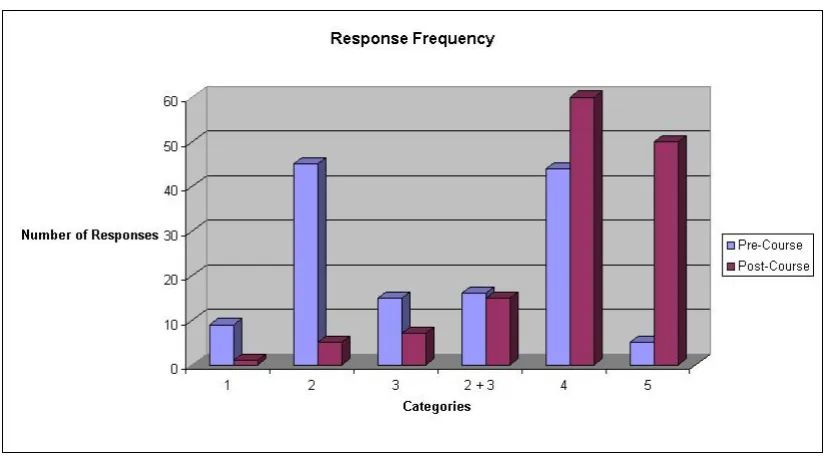
To aid the interpretation of the outcomes from the phenomenographical study,
the response frequency analysis presented in Figure 2 provided a visual statistical
interpretation. In accordance with normal practice, discovery of the categories of
description required interpretation of student responses to questions. Carrying out the
response frequency analysis required relating each individual student response back to
the conceptions using the highest discernible conception from the responses: a process
described by Marton, Dall'Alba, and Beaty, as ‘priority rule’ (1993, p. 295). Although
this sort of response frequency analysis had been applied in the past (Magub, 2005;
Marton & Pang, 2006; Minasian-Batmanian et al., 2005; Prosser, 2002), it is not
Figure 2. Pre and post response frequency (Gibbings et al., 2009)
The explanation following Figure 1, made clear that level four may include
aspects of awareness from category two only, or from category three only, or from both
categories two and three: in this graph ‘2+3’ represents the latter.
The evidence of the existence of a range of students’ conceptions presented in
the outcome space, augmented with this response frequency analysis, provided some
indication as to why these conceptions might be present. This represents a further
departure from accepted practice in phenomenographical research. Phenomenography
does not normally seek reasons why phenomena are experienced in particular ways, but
for this study, reasons why were considered a logical extension. The frequency analysis
provided a mechanism to at least carry out cursory investigations into reasons why
particular ways of experiencing might be present.
Importantly though, such insights represent the type of research output that
engineering education researchers are generally expecting, due to their background in
technology-based engineering fields. Thus, the presentation of the frequency analysis
in ways that made sense to them: it facilitated the presentation of outcomes from
quantitative research in their language. This meant the outcomes were more easily
identified with what they interpret as ‘good science’ and thus the validity and reliability
of the research were more readily accepted.
So, how successful was this approach in the example case? To the great surprise
of the first author, the study and outcomes were accepted as valid and reliable when
presented to senior members of his Faculty.
DISCUSSION
Positivist vs Interpretivist Phenomenography
The different world views of the authors (doctoral candidate and supervisors in
this case) meant that during the doctoral study and subsequent publications many
aspects had to be negotiated between the authors. The following three instances are
highlighted to demonstrate some of the tensions that may come about due to different
orientations:
1. In accordance with the first author’s positivist-objectivist background, he
established the need to carry out an inter-coder reliability check (Dall'Alba, 1994;
Prosser, 1994; Säljö, 1988) that involved an independent second researcher
analysing a subset of transcripts and comparing categories from the outcome
space. In accordance with the supervisors’ interpretivist-subjectivist stance, they
would have been more comfortable restricting this to a dialogic reliability check
involving more than one researcher discussing and critiquing the categories and
agreeing on the most suitable outcome space (John A. Bowden, 1994, 1996;
Prosser, 1994). In this study the inter-coder check was used and was key to
2. Superimposing a frequency analysis onto the outcome space facilitated the
presentation of the research outcomes in graphical form. This proved much more
acceptable for Faculty staff and was sympathetic to the first author’s
positivist-objectivist background. However, it did not sit well with the supervisor’s
interpretivist-subjectivist stance and negotiations ultimately led to the frequency
analysis being placed in a separate chapter entirely in the doctoral thesis. The
frequency analysis did remain, and again proved vital to acceptance of the work in
the engineering education community.
3. The before-and-after graphical presentation allowed readers to easily see at a
glance that there were significant differences being noted before the course
compared to after the course. Although subservient to the prime research
outcomes of the categories of description and dimensions of variation, it did at
least provide a good science hook for the staff who were used to quantitative
research and adhered to a positivist-objectivist stance. Similar to point 2,
subsequent to discussions with the supervisors, the before-and-after analysis was
placed in a separate chapter with the frequency distribution.
Over the last decade or so, researchers have successfully combined
phenomenography with quantitative approaches (for example Prosser, 2002). Marton
and Pang (2006) took this further and used a distribution of the conceptions in a target
group compared with a comparison group and reported the numbers and percentages of
occurrences in each of the categories (or conceptions). In all of these cases, researchers
used positivist-objectivist approaches to present outcomes from phenomenographical
studies.
None of these cases replicated the blending of approaches used in the
engineered to suit a specific audience. The qualitative phenomenographic process was
combined with a before-and-after quantitative frequency analysis of the number of
responses falling into each category of description. This was done to aid interpretation
of the outcomes, and also to overcome the tension evident when outcomes from the
phenomenographical study were presented to those who are used to outcomes from
quantitative research.
CONCLUSIONS
The aim of this chapter was to describe the extension of qualitative research
methods, and particularly the phenomenographic research method, to present outcomes
in a persuasive manner to an audience in technology-based discipline areas. To do this
we discussed the benefits of presenting the outcomes in a positivist-objectivist style that
may be more familiar to the intended audience.
This was demonstrated with an example involving the superimposition of a
before-and-after response frequency analysis on the outcome space from a
phenomenographical study to provide a visual statistical interpretation. These response
frequencies offer a visual analysis of statistics and allow the data to be presented in a
manner that would be more readily acceptable to a discipline-based audience.
This treatment of the research outcomes is not commonly used in association
with the outcome space from a phenomenographical study. However, we believe this
has emphasized the potential to extend the phenomenographical research method
beyond its current boundaries. But we have pushed those boundaries enough, and we
believe to go further may not be valid, nor consistent with the phenomenographical
The authors have also noted that it has been much easier to have results
published in the Engineering Education field than general higher education journals.
This may be because the subject matter relates to Engineering, or perhaps it is because
of the appeal the before-and-after analysis and the frequency distribution has to the
technology audience. In the words of Greene (1994, p. 459), ‘The labels ought not
matter.’, what does matter is an acceptance of tension and conflict shared in a common
quest for meaning and understanding. If the engineering of phenomenography
described in this chapter has proven useful, then it ought to be acceptable to those
subscribing to both the interpretivist-subjectivist and positivist-objectivist stances,
because after all it is a pragmatic approach suited to developmental phenomenography
and based on a need to communicate within a specific discipline.
REFERENCES
Åkerlind, G. S. (2005). Learning about phenomenography: Interviewing, data analysis and the qualitative research paradigm. In J. Bowden & P. Green (Eds.), Doing Developmental Phenomenography (pp. 63-73). Melbourne: RMIT University Press.
Baillie, C., Emanuelsson, J., & Marton, F. (2001). Building knowledge about the interface. Composites Part A: Applied Science and Manufacturing, 32(3–4), 305-312. doi: http://dx.doi.org/10.1016/S1359-835X(00)00111-1
Berglund, A. (2002). On the understanding of computer network protocols. LD Dissertation, Department of Computer Systems, Uppsala University, Uppsala, Sweden.
Booth, S. (1992). Learning to program: A phenomenographic perspective. (Doctoral Thesis), ACTA Universitatis Gothoburgensis, Gotenborg. Retrieved from https://gupea.ub.gu.se/handle/2077/16224
Bowden, J. A. (1994). Some experiences of using phenomenographic research
methodology in the context of research in teaching and learning. In J. Bowden & E. Walsh (Eds.), Phenomenographic Research: Variations in Method (pp. 44-55). Melbourne: Educational Quality Assurance, Research and Development Unit (EQARD), RMIT Universtiy Press.
Bowden, J. A. (1996). Phenomenographic research - Some methodological issues. In G. Dall'Alba & B. Hasselgren (Eds.), Reflections on Phenomenography (pp. 49-66). Goteborg, Sweden: ACTA Universitatis Gothoburgensis.
Bowden, J. A. (2000). The nature of phenomenographic research. In J. A. Bowden & E. Walsh (Eds.), Phenomenography. Melbourne: RMIT University Press.
Dall'Alba, G. (1994). Reflections on some faces of phenomenography. In J. Bowden & E. Walsh (Eds.), Phenomenographic Research: Variations in Method.
Melbourne: Educational Quality Assurance, Research and Development Unit (EQARD), RMIT Universtiy Press.
Denzin, N. K., & Lincoln, Y. S. (2000). The discipline and practice of qualitative research. In N. K. Denzin & Y. S. Lincoln (Eds.), Handbook of qualitative research. Thousand Oaks: Sage.
Ebenezer, J., Chacko, S., Kaya, O. N., Koya, S. K., & Ebenezer, D. L. (2010). The Effects of Common Knowledge Construction Model Sequence of Lessons on Science Achievement and Relational Conceptual Change. Journal of Research in Science Teaching, 47(1), 25-46.
Enbenezer, J. V., & Fraser, D. M. (2001). First Year Chemical Engineering Students' Conceptions of Energy in Solution Processes: Phenomenographic Categories for Common Knowledge Construction. Science Education, 25, 509-535.
Gibbings, P. D. (2008). Experience of Problem-Based Learning (PBL) in Virtual Space: A Phenomenographical Study. (Doctor of Education), Queensland university of Technology, Brisbane.
Gibbings, P. D., Bruce, C., & Lidstone, J. (2009). Problem-Based Learning (PBL) in virtual space: Developing Experiences for Professional Development.
Saarbrucken, Germany: VDM Verlag Dr Muller Aktiengesellschaft & Co KG. Greene, M. (1994). Epistemology and Educational Research: The Influence of Recent
Approaches to Knowledge. Review of Research in Education, 20, 423-464. Grix, J. (2002). Introducing Students to the Generic Terminology of Social Research.
Politics, 22(3), 175-186. doi: 10.1111/1467-9256.00173
Ingerman, Å. (2002). Exploring two facets of physics: Coherent current transport in superconducting structures. Phenomenographic studies of sense-making in physics. (Doctoral Thesis), Chalmers University of Technology, Göteborg. Retrieved from http://publications.lib.chalmers.se/publication/509
Lagemann, E. C. (1997). Contested Terrain: A History of Education Research in the United States, 1890–1990. Educational Researcher, 26(9), 5-17. doi:
10.3102/0013189x026009005
Lincoln, Y. S., & Guba, E. G. (2000). Paradigmatic controversies, contradictions, and emerging confluences. In N. K. Denzin & Y. S. Lincoln (Eds.), Handbook of qualitative research (pp. 163-188). Thousand Oaks: Sage.
Lupton, M. (2008). Information literacy and learning. Blackwood, South Australia: Auslib Press Pty Ltd.
Magub, A. (2005). The Use of the Internet for Information Sharing on Construction Projects. (PhD), Queensland University of Technology, Brisbane.
Marton, F., & Booth, S. (1997). Learning and Awareness. Mahwah, New Jersey: Lawrence Erlbaum Associates.
Marton, F., Dall'Alba, G., & Beaty, E. (1993). Conceptions of learning. International Journal of Educational Research, 19(3), 277-300.
Marton, F., & Pang, M. F. (2006). On Some Necessary Conditions of Learning. The Journal of the Learning Sciences, 15(2), 193-220.
Minasian-Batmanian, L. C., Lingard, J., & Prosser, M. (2005). Differences in Students’ Perceptions of Learning Compulsory Foundation Biochemistry in the Health Sciences Professions. Advances in Health Sciences Education, 10(4), 279-290. Paul, J. L., & Marfo, K. (2001). Preparation of Educational Researchers in
Prosser, M. (1994). Some experiences of using phenomenographic research
methodology in the context of research in teaching and learning. In J. Bowden & E. Walsh (Eds.), Phenomenographic Research: Variations in Method (pp. 31-43). Melbourne: Educational Quality Assurance, Research and Development Unit (EQARD), RMIT Universtiy Press.
Prosser, M. (2002, 27-30 November). Combining phenomenography and quantitative approaches. Paper presented at the Current Issues in Phenomenography, Australian National University (ANU), Canberra Australia.
Prosser, M., & Trigwell, K. (1999). Understanding Learning and Teaching: The experience in higher education. Buckingham: Open University Press.