The Evolution of the TIPA Framework: Towards the
Automation of the Assessment Process in a Design
Science Research Project
Béatrix Barafort1, Anup Shrestha2, Stéphane Cortina1
1 Luxembourg Institute of Science and Technology, 5 Avenue des Hauts-Fourneaux, L-4362 Esch-sur-Alzette, Luxembourg
{beatrix.barafort, stephane.cortina}@list.lu
2 School of Management & Enterprise, Faculty of Business, Education, Law & Arts, University of Southern Queensland, Toowoomba, QLD 4350 Australia
Abstract. Managing processes remain a key challenge for most organizations which need to preserve competitiveness. Process assessment frameworks can help by providing instruments guiding process improvement and regulation alignment. Several process assessment frameworks such as TIPA are based on the ISO Process assessment standard series ISO/IEC 15504, currently revised in the ISO/IEC 330xx family of standards. Following a Design Science Research methodology, this paper visits the TIPA Framework evolution throughout iterative cycles in terms of design, rigour and relevance. It investigates how current and new artefacts are developed and improved, in particular with the path towards the automation of the assessment process.
Keywords: TIPA framework, automation, process assessment, TIPA method, ISO/IEC 33000 Process Assessment standards series, Design Science Research.
1 Introduction
In the software engineering community, back at the beginning of the nineties, several initiatives were introduced for process assessment: the emergence of the Capability Maturity Model (CMM) [1] originally developed as a tool for objectively assessing the ability of government contractors' processes to implement a contracted software project, and at the International Standardization Organization (ISO) level where a Study Group [2] established in 1991 reported on the needs and requirements for a software process assessment standard. With many process assessment initiatives emerging at that time, and increasing needs for such measurement instruments on the market, the development of a process assessment standard series started: the ISO/IEC 15504. After a first set of published standards dedicated to software process assessment as Technical Reports, validated throughout Trial Phases [3, 4], a full set of International Standards [5] was developed and published between 2003 and 2006, generalizing the process capability assessment approach to any kind of process, whatever the type and size of organization. Exemplars process assessment models for software (Part 5) and system (Part 6) lifecycles were part of the standard series [5]. Aligned with the ISO standards revision policy, the ISO/IEC 15504 standards series have been reconsidered and revised: the ISO/IEC 33000 family of standards have been developed and started to be published from 2014 [6]. This major revision encompasses harmonization and rigour aspects, generic requirements for building new measurement frameworks and for addressing characteristics other than process capability, along with more guidance and process assessment models in the new domains.
In parallel to the ISO standards for process assessment development, CMM became CMMI (Capability Maturity Model Integrated) in 2002 [1], to address the following areas: Product and service development with CMMI for Development (CMMI-DEV), Service establishment, management with CMMI for Services (CMMI-SVC), and Product and service acquisition with CMMI for Acquisition (CMMI-ACQ).
In the software community, several initiatives have been developed over the years targeting various sectors: Automotive SPICE [7] for software development in the automotive industry, SPICE4SPACE [8] in the space industry, and MDevSPICE [9] in the medical device industry to quote a few ones which are based on the ISO/IEC 15504/33000 process assessment family of standards. From a general organizational perspective, the international Enterprise SPICE [10] initiative also gave birth to a process assessment model that has been published as a Publicly Available Specification (PAS) at ISO [11]. Other examples of non-IT application of the ISO process assessment standards can be cited for innovation, knowledge and technology transfer purposes with innoSPICE [12] and Operational Risk Management [13].
published handbook [16], supported by further guidance (a toolbox), and commercially disseminated to the market through the TIPA training and certification scheme.
The evolution of the TIPA framework followed a Design Science Research (DSR) approach [17] during the development and evaluation of the assessment artefacts (process models, method, training course, toolbox). We have iteratively applied the three cycle activities of DSR [18] into our TIPA journey of over a decade. With a longstanding history of research and commercial activities, we are now in a position to present our design cycle in terms of artefact development and evaluation; backed up with the rigour cycle (grounding of the scientific methods and related work) and the relevance cycle (alignment with the international standards, industry and best practices).
In the context of incremental scientific innovation (rigour cycle) as well as responding to the market demands for effective and less costly instruments for quality products and services (relevance cycle), this paper investigates the evolution and improvement of the TIPA framework for creating and improving artefacts and supporting TIPA practitioners. After this introduction, section 2 presents a background introduction to the DSR approach; section 3 is associated with the rigour cycle with an explanation of scientific foundations and related works in this area; and section 4 relates to the relevance cycle with key discussions on the state of practices regarding ISO/IEC 33000 requirements and the TIPA framework alignment. Section 5 discusses how the design cycle has enabled the TIPA evolution - the development and ongoing improvements within the TIPA community; then section 6 presents the conclusion with future research and impact of the ongoing TIPA initiatives.
2 Design Science Research
The Design Science Research (DSR) methodology [19] focuses on the development of a new artefact which is particularly suitable for the process assessment discipline being a practice-based research since DSR “…should not only try to understand how the world is, but also how to change it” [20]. A DSR project can follow different guidelines including the use of kernel theories [21], case studies [22] or systematic literature reviews [20]. Moreover, in a socio-technical context the artefact is influenced by the environment in which it operates. Using the extant knowledge, an artefact can be represented as a practical solution so that its contribution to the body of knowledge can be supported. As a result, artefacts with superior utility can be reinvented in an iterative cycle[23]. Along the same lines of thought, Hevner [18] reinforced the need to maintain a balance between academic rigour and industry relevance while representing the artefact as a major outcome of any DSR project.
artefacts (collectively referred as the TIPA framework) into real-world application. The rigour cycle develops the methods (assessment frameworks and methods) along with resources and expertise from the body of knowledge (ISO/IEC 330xx standards series and research team expertise) for the research. The design cycle supports the loop of research activities that provides the development, evaluation and improvement of the research artefacts. During the research journey of TIPA evolution, we also used DSR insights from Peffers et al. [24] for additional guidance. The three research cycles that demonstrates the evolution of the TIPA framework are discussed next.
3 Rigour Cycle: Scientific Foundations and Related Works
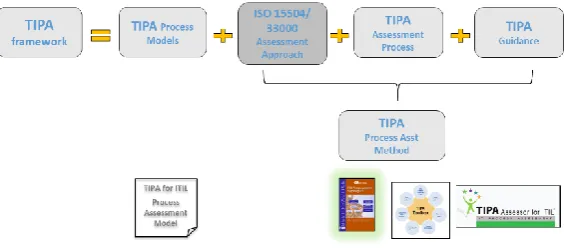
[image:4.595.164.450.444.568.2]The DSR background associated with our TIPA evolution were explained in section 2. The TIPA framework development following the DSR method comprises a set of artefacts that contribute to and support process assessment. A process assessment framework can be composed of process models, process assessment method, training courses, certification scheme for assessors and lead assessors, and a software tool for supporting the method as potentially valuable artefacts. In order to exemplify the rigour cycle of the DSR method, the TIPA Framework is based on ISO/IEC 15504-33000 standards series in terms of the requirements and guidance. The TIPA journey for rigour cycle is represented in Figure 1, with a focus on the TIPA for ITIL application in the domain of ITSM. The reason to highlight TIPA for ITIL application is due to the longstanding history and commercial success of this application during our TIPA journey.
Figure 1: The TIPA Framework components with TIPA for ITIL artefacts
The ISO/IEC 15504-33000 standards requirements are grounded in Quality Management theories for structuring the capability and maturity scale and on Measurements theories for the assessment of practices [2].
Engineering (GORE) techniques [25, 26] have been applied in order to obtain the TIPA for ITIL Process Assessment Model. The model has been validated throughout various improvement loops with mechanisms including ITIL and ISO/IEC 15504/33000 expert reviews, experimentations with early adopters and real life process assessment projects. The TIPA Process assessment method published in the TIPA handbook and supported by a toolbox, along with the TIPA for ITIL Assessor and Lead Assessor training courses have also been developed in a rigourous cycle with feedback collected from early adopters and real process assessment projects accumulated over the period of ten years. With a view to discuss related work, besides TIPA, several process assessment frameworks and tools that are based on ISO/IEC 15504-33000 requirements and guidance, in both IT and non-IT application domains are explained next.
One of the first process assessment frameworks were SPICE for SPACE (S4S) and Automotive SPICE. S4S was developed in the year 2000 and supported the Space industry in Europe for enabling the European Space Industry to select suppliers mastering their processes up to a certain targeted capability level. The S4S Process Model was based on the ISO/IEC 15504-5 Exemplar process assessment model for software lifecycle processes, with specific adaptations and processes dedicated to the Space industry needs [8].
Automotive SPICE was developed throughout the support of car industry stakeholders [27, 28]. The Automotive SPICE process assessment and process reference models have initially been developed under the Automotive SPICE initiative by consensus of the car manufacturers within the Automotive Special Interest Group (SIG), a joint special interest group of Automotive Original Equipment Manufacturers, the Procurement Forum and the SPICE User Group. It has been revised by a Working Group of the Quality Management Center (QMC) in the German Association of the Automotive Industry with the representation of members of the Automotive Special Interest Group, and with the agreement of the SPICE User Group [29]. Besides the Automotive SPICE Process Model, a certification scheme has been developed with training courses which enabled to train a community of SPICE competent assessors and lead assessors under the authority of the INTACS association for certifying assessors. Some consultants have automated the assessment process with software tools. The community of interests of both S4S and Automotive SPICE contributed to the validation and improvement of various artefacts within their respective framework.
More recently, the MDevSPICE initiative has been developed: it aims at proposing a Process Assessment Framework for the Medical Device community, aligned with many regulations of the sector. A set of artefacts compounds the framework [30]. A Brazilian initiative developed by researchers and applied in the software engineering market in Brazil is also proposing a framework, with a process model, a method, a supporting tool and competence development support related to process assessment [31, 32].
development and validation of the model [10]. This model has been introduced, positively voted and then published in ISO as a Publicly Available Specification [11].
In the IT Service Management community, an Australian Public-Private Partnership has enabled the development of a software-mediated process assessment approach for IT service management processes, which is based on the ISO/IEC 15504-8 Exemplar process assessment model for IT service management and using ITIL for process improvement [33]. It provides sound insights both from a scientific background and practitioner’s point of view, as it proposes an automated framework, which meets TIPA Framework evolution concerns, as later discussed in section 5.
4 Relevance Cycle: Process Assessment Standard and TIPA
Framework alignment
The relevance cycle of the DSR method is demonstrated with a detailed account of our involvement with the ISO community during the development and revisions of the process assessment standard and how we aligned our TIPA framework with the standard using the experience within the ISO community as well as in industry.
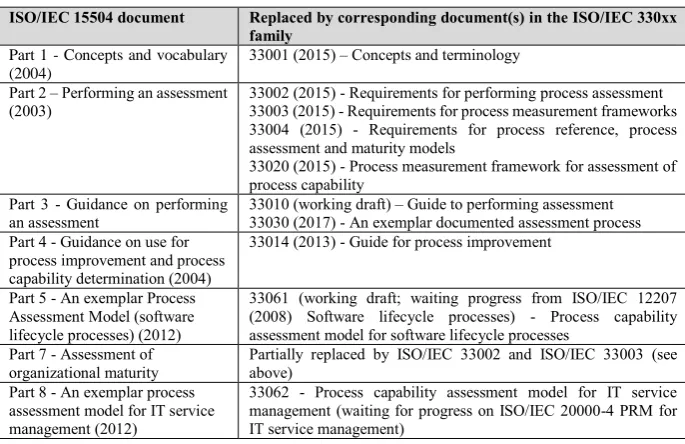
[image:6.595.126.469.464.686.2]The ISO/IEC 15504 standards series [5] has been revised and is progressively replaced [34] by the ISO/IEC 33000 family of standards [35]. The generic features of the process assessment mechanisms are emphasized in order to enable, inter alia, the definition of new measurement frameworks, and to target quality characteristics other than capability. The correspondence between the ISO/IEC 15504 series and the ISO/IEC 33000 is summarized in Table 1, by citing the main documents which are of direct interest for the TIPA Framework.
Table 1 – Correspondence table between ISO/IEC 15504 and ISO/IEC 33000
ISO/IEC 15504 document Replaced by corresponding document(s) in the ISO/IEC 330xx family
Part 1 - Concepts and vocabulary (2004)
33001 (2015) – Concepts and terminology
Part 2 – Performing an assessment
(2003) 33002 (2015) - Requirements for performing process assessment 33003 (2015) - Requirements for process measurement frameworks 33004 (2015) - Requirements for process reference, process assessment and maturity models
33020 (2015) - Process measurement framework for assessment of process capability
Part 3 - Guidance on performing an assessment
33010 (working draft) – Guide to performing assessment 33030 (2017) - An exemplar documented assessment process Part 4 - Guidance on use for
process improvement and process capability determination (2004)
33014 (2013) - Guide for process improvement
Part 5 - An exemplar Process Assessment Model (software lifecycle processes) (2012)
33061 (working draft; waiting progress from ISO/IEC 12207 (2008) Software lifecycle processes) - Process capability assessment model for software lifecycle processes
Part 7 - Assessment of organizational maturity
Partially replaced by ISO/IEC 33002 and ISO/IEC 33003 (see above)
Part 8 - An exemplar process assessment model for IT service management (2012)
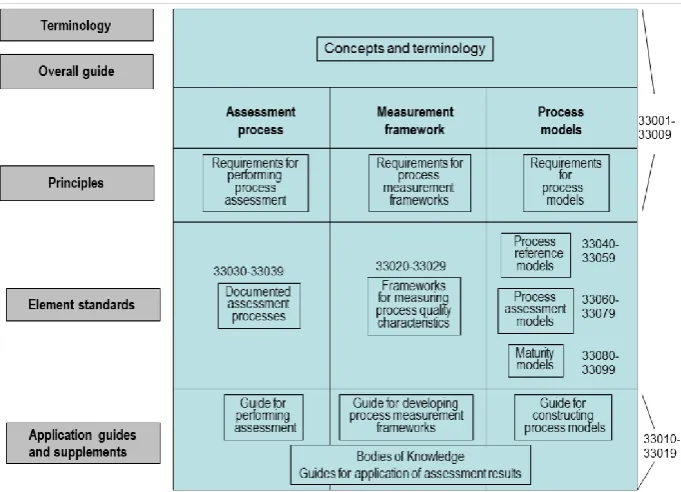
Below Figure 2 depicts the global structure of the ISO/IEC 33000 family of standards.
Figure 2 – Structure of the set of standards for process assessment (source: ISO/IEC 33001)
With the revision of the ISO/IEC 15504 series resulting in the new ISO/IEC 33000 series, several changes and adaptations were undertaken. We have systematically compared the ISO/IEC 15504 and ISO/IEC 330xx corresponding parts, and checked how they are currently reflected in the TIPA Framework, making necessary changes as we revise the updates. As several team members of the TIPA framework are actively involved with the relevant ISO standards development and revision, most changes are organic and streamlined. Here is an overview of the mapping between the TIPA for ITIL artefacts and the corresponding ISO standard documents. The revisions were taken into account by aligning with the standards when published by ISO and/ or anticipating the revised published documents where possible while working with the ISO community.
Table 2 – Mapping between the TIPA for ITIL artefacts and the corresponding ISO/IEC 15504/330xx standard documents TIPA for ITIL
component
ISO/IEC 15504 Part
ISO/IEC 330xx document
Comment
TIPA for ITIL Process assessment model
Part 2 clauses for describing PRM and PAM, and Part 5 for
[image:7.595.125.472.636.694.2]the Measure-ment Frame-work dimension
techniques for designing PRMs and PAMs provided a reliable, structured and systematic approach for quality results. TIPA Method
(described in published handbook)
Part 2 and Part 4 33002, 33004, 33014
Classes of Assessment were added and described in a published whitepaper and factsheets (a new version of the handbook has not been re-published yet); a significant part of the TIPA Method is embedded in a SaaS tool, currently being developed. TIPA for ITIL
Office Toolbox Parts 2, 3, 4 33002, 33004, 33014 The TIPA for ITIL Toolbox had been upgraded with classes of assessment; the current major upgrade is the provision of the SaaS Tool replacing the Office Toolbox. TIPA for ITIL
Training Course Parts 2, 3, 4 33001, 33002, 33004, 33014 Classes of Assessment were added with all impacted tools of the Office Toolbox; the SaaS Tool will support assessment training in near future.
TIPA for ITIL Assessor and Lead Assessor Certification scheme
Part 3 33002 TIPA is making a clear distinction between the skills required by the Lead Assessor (the one accountable for the assessment results), and those required by the Assessors.
5 Design Cycle: Evolution of the TIPA Framework
While reporting the TIPA evolution, it is important to highlight that the iterative nature of the design cycle ensured that the TIPA framework built after several “build-evaluate” cycles has utility and validity.
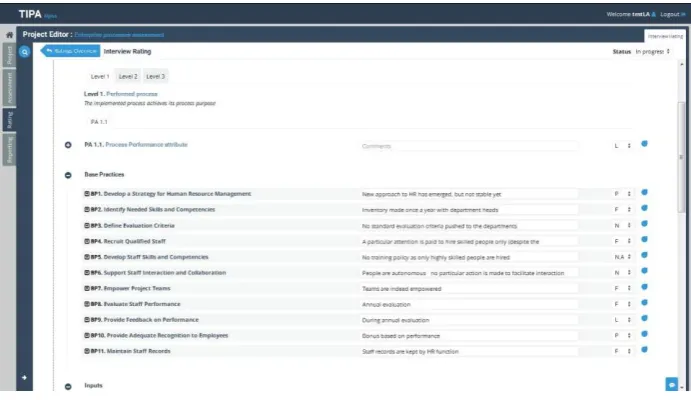
The TIPA Framework has been used by trained TIPA assessors and Lead assessors over the years. Originally, guidance for supporting assessment projects has been provided via static documents (typically using the Microsoft Office files – Word, Excel and PowerPoint). While the structure and guidance provided by this solution was effective, it was not comprehensive, predominantly due to the lack of maintainability and security of the files. To address these weaknesses, we worked on a major evolution of the TIPA Framework to develop a cloud-based software-as-a-service tool in order to automate and support the assessment process as well as for the storage of assessment data for benchmarking and trend analysis.
Table 3 – Design activities of the SaaS Tool
1. Problem identification and motivation.
Design Science approach: This activity aims at defining the specific research problem and justifying the value of a solution. The problem definition will be used to develop an artefact that can provide a solution. In order to motivate the value of a solution, this set of activities includes knowledge of the state of the problem and the importance of its solution.
SaaS Tool: All relevant business and market constraints were investigated during this stage. This was done via interviews of business practitioners (mainly LIST assessors and Lead assessors, and TIPA certified TIPA assessors and Lead assessors) and by benchmarking existing similar tools on the market. The outcome was a cartograph that we mapped from the TIPA business activities in order to represent business problems that highlight the importance of the solution (tool). 2. Define the objectives for a solution
Design Science approach: This activity aims at inferring the objectives of a solution from the problem definition and knowledge of what is possible and feasible.
SaaS Tool: In order to define the objectives for the future solution, a methodological approach based on User Experience (UX) principles was followed. An experience map was produced with a service design mind set in order to determine “pain” points demonstrating what brings value – by answering what are the positive and negative points and why? Personas were created to assist in solution design. A Persona, in user-centered design and marketing, is a fictional character created to represent a user type that might use a site, brand, or product in a similar way. In our case, personas were used as part of the user-centered design process to design the software (we referred them as “ProtoPersonas” which are an adaptation of the real world users). The personas enabled us to create archetypes of users, with a focus on the users who are bringing the most value to the product (from a financial value perspective).
A questionnaire was sent to the current users of the TIPA toolbox in order to validate Personas, and to prioritize the usage of the twenty tools of the initial toolbox (it is important to quote that some tools are compulsory because they rely on ISO/IEC 15504-33000 requirements but others are “nice to haves”).
3. Design and development
Design Science approach: This activity aims at creating the artefact(s). A design research artefact can be any designed object in which a research contribution is embedded in the design.
SCRUM development method was applied, with twice-monthly Sprints during tool development.
4. Demonstration(ongoing)
Design Science approach: This activity aims at demonstrating the use of the artefact to solve one or more instances of the problem. This can be done via the experimentation of the artefact’s use.
SaaS Tool: After a first real-life experimentation which enabled us to provide a first level validation and refinements of the tool, an Alpha version of the tool is currently being experimented by early adopters. These volunteer partners were interested in demonstration so as to become more competitive on the market. The partners are committed to provide us feedback on the time saved during each phase of their assessment projects (scope definition, data collection, analysis and particularly reporting) as well as on their perceptions regarding user experience with the tool. A Beta version and more experimentations are expected by the end of this year 2017. 5. Evaluation(planned)
Design Science Approach: This activity aims at observing and measuring how well the artefact supports a solution to the problem. This activity involves comparing the objectives of a solution to actual observed results from use of the artefact in the demonstration. It requires knowledge of relevant metrics and analysis techniques.
SaaS Tool: Using a survey approach, feedback will be sought from early adopters of the tool in terms of its effectiveness and usability. A systematic analysis of the collected feedback information will allow us to act accordingly in order to improve the SaaS Tool. Ongoing evaluation rounds are planned in order to collect feedback not only from the Alpha Version, but also from the next Beta one, and the definitive product once delivered to the market.
6. Communication
Design Science Approach: This activity aims at communicating the problem and its importance, the artefact, its utility and novelty, the rigour of its design, and its effectiveness to researchers and other relevant audiences such as practicing professionals, when appropriate.
SaaS Tool: This paper is part of the communication activity to disseminate information about the tool. Social networks and TIPA training courses provisioning are our mainstream mediums to spread the news related to the new artefact supporting the TIPA method. Our TIPA website plays an important role in our communication plan. The ISO standardization community will also be part of the communication channel to demonstrate effective use and commercialisation of the process assessment standard.
Figure 3 – Example of a screen of the TIPA Framework SaaS Tool
6 Conclusion
The TIPA Framework is flexible in the sense that it can support any business according to the selected process models. This TIPA Factory mindset stresses the generic mechanisms of process assessment with a measurement framework. With the TIPA for ITIL instantiation of the TIPA Framework, a continuous improvement loop is in place, with mechanisms for gathering feedback from the TIPA for ITIL community (more than 260 TIPA Assessors and Lead Assessors have been trained worldwide). Feedback on the adoption of the TIPA framework come from diverse sources, including the training courses and social media networks (LinkedIn, Facebook and the like). The added value of the toolbox has been emphasized with the development of SaaS tool. In order to better support TIPA adoption and to deploy the TIPA framework more broadly, we believe that the SaaS tool will play an indispensable role in the TIPA journey. Moreover, the SaaS tool is expected to simplify and optimize the assessor and lead assessor performance along with the storage of structured data on process assessments.
allowed us to explain how our TIPA artefacts and the new SaaS tool in particular represent valid contribution to the body of knowledge. We expect this will enable practitioners and other researchers to access trustworthy and authentic design knowledge in the discipline of process assessment.
References
1. Paulk, M.C., et al., Capability Maturity Model (CMM) for Software, Version 1.1
Technical Report. 1993, Software Engineering Institute, Carnegie Mellon University:
Pittsburgh, PA, USA
2. ISO/IEC JTC1/SC7 SC7N944R, Report of the Study Group on the Needs and Requirements for a Standard for Software Process Assessment, June 1992
3. SPICE Trials. 1999. Phase 2 SPICE Trials Final Report, Vol. 1, ISO/IEC JTC1/SC7/WG10
4. Jung, H. W., Hunter, R., Goldenson, D. R., & El‐Emam, K. (2001). Findings from Phase 2 of the SPICE Trials. Software Process: Improvement and Practice, 6(4), 205-242.
5. ISO/IEC ISO/IEC 15504:2003, 2012, Information technology — Process assessment, Parts 1-10
6. ISO/IEC 33001. (2015). Information Technology — Process assessment — Concepts and terminology.
7. Automotive Spice, http://www.automotivespice.com/fileadmin/software-download/Automotive_SPICE_PAM_30.pdf
8. Cass, A., Völcker, C., Ouared, R., Dorling, A., Winzer, L., & Carranza, J. M. (2004). SPICE for SPACE trials, risk analysis, and process improvement. Software Process:
Improvement and Practice, 9(1), 13-21.
9. MDevSPICE, http://www.mdevspice.com/
10. Enterprise SPICE, http://enterprisespice.com/page/publication-1
11. ISO/IEC 33071. (2015). Information Technology — Process assessment — An integrated process capability assessment model for Enterprise processes.
12. innoSPICE, http://innospice.ning.com/
13. Di Renzo, B., et al. "Operational risk management in financial institutions: Process assessment in concordance with Basel II." Software Process: Improvement and Practice 12.4 (2007): 321-330.
14. TIPA for ITIL, https://www.list.lu/fileadmin//files/projects/ TIPA_T10_ITIL_PAM_r2_v4.1.pdf
15. Renault A., Barafort B., “TIPA for ITIL – from genesis to maturity of SPICE applied to ITIL 2011”, Proceedings of the 21th European System & Software Process Improvement and Innovation Conference 2014. Luxembourg, 2014.
16. Barafort B., Betry V., Cortina S., Picard S., St-Jean M., Renault A., and Valdés O. “ITSM Process Assessment supporting ITIL® - Using TIPA to Assess and Improve your Processes with ISO 15504 and Prepare for ISO 20000 Certification”, Van Haren Publishing, The Netherlands, ISBN 978-90-8753-564-3, 2009
17. Barafort, B., Rousseau, A., & Dubois, E. (2014, June). How to Design an Innovative Framework for Process Improvement? The TIPA for ITIL Case. In European Conference on Software Process Improvement (pp. 48-59). Springer Berlin Heidelberg.
19. Hevner A.R., March, S. T., Park, J., & Ram, S. (2004). Design science in information systems research. MIS quarterly, 28(1), 75-105.
20. Carlsson, S. A., Henningsson, S., Hrastinski, S., & Keller, C. (2011). Socio-technical IS design science research: developing design theory for IS integration management. Information Systems and e-Business Management, 9(1), 109-131.
21. Walls, J. G., Widmeyer, G. R., & El Sawy, O. A. (2004). Assessing information system design theory in perspective: how useful was our 1992 initial rendition?. JITTA: Journal of Information Technology Theory and Application, 6(2), 43.
22. Van Aken, J. E. (2006). The nature of organizing design: both like and unlike material object design. Eindhoven Center for Innovation Studies (ECIS), (06-13).
23. Venable, J., Pries-Heje, J., & Baskerville, R. (2012, May). A comprehensive framework for evaluation in design science research. In International Conference on Design Science Research in Information Systems (pp. 423-438). Springer Berlin Heidelberg.
24. Peffers, K., Tuunanen, T., Rothenberger, M. A., & Chatterjee, S. (2007). A design science research methodology for information systems research. Journal of management information systems, 24(3), 45-77.
25. Rifaut A., Dubois E., Using goal-oriented requirements engineering for improving the quality of iso/iec 15504 based compliance assessment frameworks. In International Requirements Engineering, 2008. RE ’08. 16th IEEE, 2008
26. B. Barafort, A. Renault, M. Picard, S. Cortina, A transformation process for building PRMs and PAMs based on a collection of requirements – Example with ISO/IEC 20000, in: Proceedings of the International Conference SPICE 2008, Nuremberg, Germany, 2008
27. Mueller, M., Hoermann, K., Dittmann, L., & Zimmer, J. (2008). Automotive SPICE in Practice: surviving implementation and assessment. " O'Reilly Media, Inc.".
28. Fabbrini, F., Fusani, M., Lami, G., & Sivera, E. (2007). A SPICE‐based software supplier qualification mechanism in automotive industry. Software Process: Improvement and Practice, 12(6), 523-528.
29. The SPICE User Group, http://ww.spiceusergroup.org
30. Lepmets, M., McCaffery, F., & Clarke, P. (2016). Development and benefits of MDevSPICE®, the medical device software process assessment framework. Journal of Software: Evolution and Process, 28(9), 800-816
31. Alves, A. M., Salviano, C. F., Stefanuto, G. N., Maintinguer, S. T., Mattos, C. V., Zeitoum, C., ... & Reuss, G. (2014, September). CERTICS assessment methodology for software technological development and innovation. In Quality of Information and Communications Technology (QUATIC), 2014 9th International Conference on the (pp. 174-177). IEEE.
32. Silva, D. C., Raldi, A., Messias, T., Alves, A. M., & Salviano, C. F. (2014, August). A Process driven software platform to full support Process Assessment Method. In Software Engineering and Advanced Applications (SEAA), 2014 40th EUROMICRO Conference on (pp. 135-136). IEEE.
33. Shrestha, A., et al. Software-mediated Process Assessment for IT Service Capability Management. In Twenty Second European Conference on Information Systems (ECIS 2014). 2014. Tel Aviv, Israel.
34. ISO/IEC JTC1/SC7 WG10 N1099, 2017. Transition from ISO/IEC 15504 to ISO/IEC 330xx