Evaluating the Foundation Phase:
Update and Technical Report
2012/13
Ymchwil gymdeithasol Social research
Evaluating the Foundation Phase: Update and Technical Report 2012/13
Chris Taylor1, Trisha Maynard2, Rhys Davies1, Sam Waldron1, Mirain Rhys1, Sally Power1, Laurence Moore1, David Blackaby3 and Ian Plewis4 (1Wales Institute of Social and Economic Research, Data and Methods (WISERD), Cardiff University)
(2Canterbury Christ Church University)
(3Wales Institute of Social and Economic Research, Data and Methods (WISERD), Swansea University)
(4University of Manchester)
Views expressed in this report are those of the researchers and not necessarily those of the Welsh Government
For further information please contact: Launa Anderson
Knowledge and Analytical Services Welsh Government
Cathays Park Cardiff
CF10 3NQ
Tel: 029 2082 5274
Email: [email protected]
Welsh Government Social Research, 2014 ISBN: 978-1-4734-1000-8
Table of contents
Glossary of Acronyms ... i
EXECUTIVE SUMMARY ... ii
1 Introduction to the Evaluation ... 6
2 Programme of Work for Stage II ... 18
3 Next Steps 2013/14 ... 28
References... 51
Glossary of Key Terms... 52
Index of Figures
Figure 1: Overview of Stepped Wedge Design for Evaluating the Foundation
Phase ... 9
Figure 2: Design and Main Elements of Evaluation ... 10
Index of Tables
Table 1: Indicative Timeline for Three-Year Evaluation ... 19Table 2: Indicative Detailed Programme of Work for 2012/13 ... 20
Table 3: Summary of Case Studies by Region ... 23
Table 4: Summary of Case Study Schools by Phase of Implementation ... 24
Table 5: Example Case Study School Visit ... 25
Table 6: Summary of Inter-Rater Reliability (IRR) for Classroom Observations ... 27
Table 7: Final Sample Size in Stage I and Stage II ... 27
Glossary of Acronyms
BERA British Educational Research Association
DECIPHer Centre for the Development and Evaluation of Complex Interventions for Public Health Improvement
ESRC Economic and Social Research Council
Estyn Estyn is the office of Her Majesty’s Chief Inspector of Education and Training in Wales
FP Foundation Phase HE Higher Education
KS1 Key Stage 1 National Curriculum KS2 Key Stage 2 National Curriculum MCS Millennium Cohort Study
NPD National Pupil Database
PLASC Pupil Level Annual Schools Census SEN Special Educational Needs
EXECUTIVE SUMMARY
Introduction and Aims of Report
1. In this report we outline the progress of the evaluation during the past year (August 2012 to July 2013). We also provide details about Stage II of the evaluation design, which has largely involved the collection of detailed information about the implementation of the Foundation Phase in forty-one schools and ten funded non-maintained settings from across Wales.
2. The Foundation Phase is a Welsh Government flagship policy of early years education (for 3 to 7-year old children) in Wales. Marking a radical departure from the more formal, competency-based approach associated with the previous Key Stage 1 National Curriculum, it advocates a developmental, experiential, play-based approach to teaching and learning. The policy has been progressively 'rolled out' over the last seven years so that by 2011/12 it included all 3 to 7-year-olds in Wales.
3. In April 2011 the Welsh Government, on behalf of Welsh Ministers, invited tenders for a three-year independent evaluation of the Foundation Phase. Following a competitive tender process, a multi-disciplinary team of researchers, led by Professor Chris Taylor from Cardiff University and the Wales Institute of Social & Economic Research, Data & Methods (WISERD), were appointed to undertake the evaluation in July 2011.
4. The three year evaluation (2011-2014) has four main aims, as outlined by the Welsh Government in its original research tender specification:
to evaluate how well the Foundation Phase is being implemented and highlight ways in which improvement can be made (the process evaluation)
to evaluate what impact the Foundation Phase has had to date (the outcome evaluation)
to put in place an evaluation framework for the future tracking of outputs and outcomes of the Foundation Phase (the evaluation framework).
5. The first annual report of the evaluation for 2011/12 (Taylor et al. 2013 set out the work of the evaluation during its first year and provided a summary of the research and findings from Stage I of the evaluation design. It also outlined the approach and methodology of the
evaluation.
6. This report sets-out the programme of work for the final year of the evaluation, which includes Stage III of the evaluation design and an analytical framework that provides the basis for how the evaluation will organise its analysis and reporting.
Summary of Progress
7. The evaluation continues to progress well. 2012/13 was largely spent developing and undertaking Stage II of the evaluation design. This involved the selection of and visits to 41 case study schools and 10 case study funded non-maintained settings.
8. During 2012/13 three evaluation reports were published (Maynard et al. 2013, Taylor et al. 2013 and Davies et al. 2013).
9. The evaluation and its preliminary findings were regularly presented to the Welsh Government Advisory Group, the Evaluation Team Advisory Group, and the All Wales Foundation Phase Advisors (AWFPA) Group. During the year the evaluation team also presented at three academic seminars/ conferences and at the National Eisteddfod.
10. Finally, the evaluation team welcomed Alyson Lewis, an ESRC-funded PhD research student who began an associated exploratory study investigating and capturing children’s social and emotional wellbeing in Foundation Phase classrooms (3-7 year olds).
Stage II of the Evaluation
non-maintained settings. Schools were selected using stratified random sampling in order to ensure the following:
Different regions of Wales
Different stages when the Foundation Phase was introduced in to schools
English- and Welsh-medium schools
12. Case study visits tool place between January and June 2013. A typical school visit took two days and involved the following elements:
Observation of children and staff in Nursery, Reception, Year 1 and Year 2 classes
Classroom teacher survey
Interviews with Head Teachers and Foundation Phase lead practitioners
Interviews or focus groups with Teaching and Learning Assistants Survey of Year 2 pupils
Programme of Work for 2013/14
13. The programme of work for the evaluation during 2013/14 will be divided into three parts: (I) Stage III of the evaluation design, (ii) an analytical framework, and (iii) reporting and communication.
14. The fieldwork involved in Stage III of the evaluation design has three main elements. These are:
Parent/carer survey;
Year 3 teacher interviews; and Activities with children
15. The aim of the parent/carer survey is to gather the perceptions of parents and carers towards the Foundation Phase, in principle and in practice. This will involve the circulation of a survey to all
parents/carers of children in the Foundation Phase and Years 3 and 4 at case study schools.
principle and in practice, with a focus on the transition for children from the Foundation Phase into Key Stage 2 (KS2).
17. Year 3 teachers who have been teaching for several years from all the case study schools will be invited to participate in a telephone
interview.
18. The main aim of undertaking further activities with children will be to, firstly, conduct a series of Year 2 Focus Groups and Year 1 Classroom Tours so that children's views and experiences of the Foundation Phase can better inform our evaluation. And secondly, to assess
whether Year 2 children from schools that appear to have implemented the Foundation Phase fully have better group problem solving/thinking skills than in schools that appear to have not implemented the
Foundation Phase to a strong degree.
19. This will involve children from seven of the case study schools and will involve, with theirs and their parent’s consent, video recording of their responses, discussions and activities.
20. Another major part of the 2013/14 programme of work will be in the analysis and reporting of findings. An analytical framework has been developed that identifies a number of key topics and themes that are expected to form the basis of the Final Evaluation Report.
21. The evaluation expects to produce a series of Working Papers on these topics.
22. The Welsh Government published Evaluation Reports will use this detailed analysis in order to outline the key findings from the evaluation.
1
Introduction to the Evaluation
1.1 The Foundation Phase appears to mark a radical departure from the more formal, competency-based approach to early childhood education that has sometimes been associated with the National Curriculum. Drawing on evidence from good early years programmes in
Scandinavia, Reggio Emilia and New Zealand (Te Whãriki) that indicate the adoption of an overly formal curriculum and extensive formal teaching before the age of six or seven can result in lower standards of attainment in the longer term, it promotes an experiential, play-based approach to learning for children aged 3 to 7-years-old. It emphasises the centrality of the child and the significance of children’s wellbeing and advocates a balance of child-initiated and practitioner-directed (or practitioner-initiated) activities within stimulating indoor and outdoor environments.
1.2 In April 2011 the Welsh Government, on behalf of Welsh Ministers, invited tenders for a three-year independent evaluation of the Foundation Phase. Following a competitive tender process, a multi-disciplinary team of researchers led by Cardiff University and in conjunction with the Wales Institute of Social & Economic Research, Data & Methods (WISERD) were appointed to undertake the evaluation in July 2011. The cost of the evaluation is £986,500.
1.3 The research team includes leading experts in their respective fields and from a number of different universities in Wales and England:
Professor Chris Taylor (Director) (Cardiff University and WISERD)
Professor Trisha Maynard (Co-director) (Canterbury Christ Church University)
Mr Rhys Davies (Cardiff University and WISERD) Dr Sam Waldron (Cardiff University and WISERD) Dr Mirain Rhys (Cardiff University and WISERD)
1.4 The evaluation began in August 2011 and is due to be completed by July 2014.
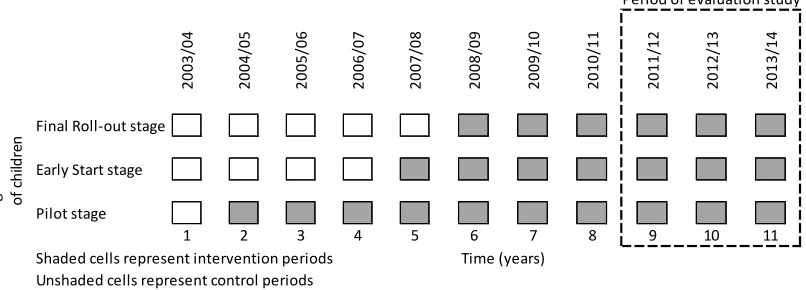
1.5 The evaluation employs a stepped wedge design to exploit the sequential roll-out of the Foundation Phase across a number of different schools and settings at different time periods. In particular, much of the evaluation focuses on comparing successive cohorts of children who have been through three sets of school settings at
different stages of the implementation: Pilot Stage settings, Early Start Stage settings and Final Roll-out Stage settings. The evaluation also utilises a range of methods to ensure it captures as many aspects of the implementation, delivery and impacts of the Foundation Phase programme.
1.6 The first annual report (Taylor et al. 2013) outlined the evaluation design and methodology in detail and reported the work of the
evaluation during its first year, for the period August 2011-July 2012. This coincided with Stage I of the evaluation design. The report summarised the work that had been completed in that time and highlighted the key findings during that period.
1.7 In this Chapter we introduce the evaluation and its overall design very briefly. Further details can be found in Taylor et al. (2013).
Aims and Objectives of the Evaluation
to evaluate how well the Foundation Phase is being
implemented and highlight ways in which improvement can be made (the process evaluation)
to evaluate what impact the Foundation Phase has had to date (the outcome evaluation)
to assess the value for money of the Foundation Phase (the economic evaluation)
to put in place an evaluation framework for the future tracking of outputs and outcomes of the Foundation Phase (the evaluation framework).
1.9 The Process Evaluation is primarily concerned with evaluating the implementation of the Foundation Phase. The Outcome Evaluation is primarily concerned with the outcomes or impacts of the Foundation Phase on the capabilities of children in the Foundation Phase. The Economic Evaluation attempts to undertake a cost-benefit analysis of the Foundation Phase. The final key output from the evaluation will be the development of an Evaluation Framework to support future
evaluations of the Foundation Phase.
1.10 The evaluation is committed to producing a range of outputs, produced at regular intervals, to disseminate the research and findings to the Welsh Government, schools, practitioners and the wider public. These have been designed and written with different audiences in mind, and include:
an evaluation website for the dissemination of findings and the engagement of interested individuals or stakeholders
(www.wiserd.ac.uk/foundationphase)
annual reports: including summaries and more detailed research reports
reports on particular aspects of the Foundation Phase, including examples of good practice
the development of a ‘programme theory’ underpinning the implementation of the Foundation Phase for the purpose of its evaluation and
the production of an Evaluation Framework for the future monitoring and evaluation of the Foundation Phase in Wales.
Design and Methodology
1.11 In developing the methodology and research design for this evaluation, a number of considerations relating to the implementation of the
[image:13.595.102.505.474.619.2]Foundation Phase were influential. The principle characteristic from which the evaluation has been designed is the way in which the Foundation Phase was rolled-out sequentially over time. In this evaluation we therefore distinguish between schools/settings at three phases of implementation (Figure 1). Other key characteristics of the Foundation Phase are outlined in Taylor et al. (2013).
Figure 1: Overview of Stepped Wedge Design for Evaluating the Foundation Phase
1.12 The overarching structure of this evaluation follows a stepped wedge design (Brown and Lilford 2006; Hussey and Hughes 2007). This exploits the sequential roll-out of the Foundation Phase across a
number of schools/settings at three different phases of implementation,
2 0 0 3 /0 4 2 0 0 4 /0 5 2 0 0 5 /0 6 2 0 0 6 /0 7 2 0 0 7 /0 8 2 0 0 8 /0 9 2 0 0 9 /1 0 2 0 1 0 /1 1 2 0 1 1 /1 2 2 0 1 2 /1 3 2 0 1 3 /1 4
Final Roll-out stage
Early Start stage
Pilot stage
1 2 3 4 5 6 7 8 9 10 11
Shaded cells represent intervention periods Time (years)
Unshaded cells represent control periods
Each cell represents a possible data collection point
Period of evaluation study
referred to as Pilot, Early Start, and Final Roll-out settings (see Figure 1). This allows us to compare clusters of children who received the early introduction of the Foundation Phase against control clusters of children who did not follow the Foundation Phase from within the same cohort. This contributes to the outcome evaluation.
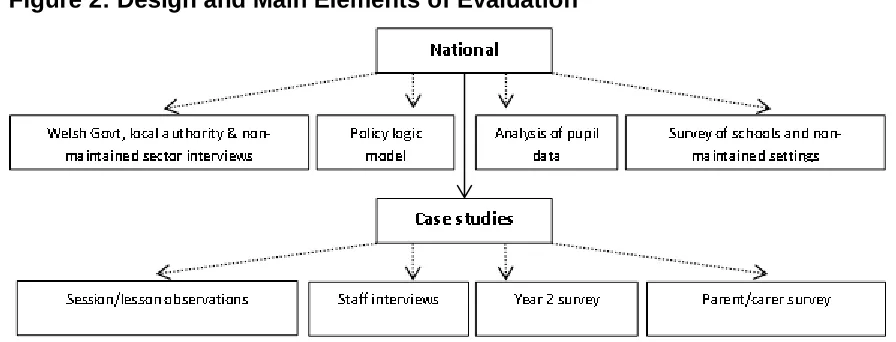
1.13 The evaluation utilises a wide range of data and evidence, both quantitative and qualitative, and based on primary data collection and using existing data (administrative and other). This has been organised at two geographical scales: at a national level, and at the level of
[image:14.595.86.534.328.499.2]individual case study schools (see Figure 2).
Figure 2: Design and Main Elements of Evaluation
1.14 Data collection has been organised in three stages during the course of the evaluation: Stage I (Jan 2012-Sept 2012); Stage II (Sept 2012-June 2013); and Stage III (Sept 2013-April 2014).
1.15 Stage I of the evaluation involved (a) documentary evidence relating to the design, delivery and implementation of the Foundation Phase: This encompassed a wide range of materials, such as policy documents, guidance documents, training materials and curriculum materials. A theoretical framework was developed to analyse the extant
teachers, centre managers and Foundation Phase lead practitioners covering all Foundation Phase settings: this collected information on, and responses to, staff qualifications, staff-pupil ratios, use of
classroom assistants, use of outdoor environments, stumbling blocks to implementation, financial expenditure, obstacles to implementation, attitudes towards the Foundation Phase; (c) interviews with key Welsh Government and local authority personnel: this invited participants to discuss support for teachers, Welsh-medium provision in the
Foundation Phase, monitoring and evaluation strategies, and data sharing; (d) an initial analysis of administrative educational data (Pupil Level Annual Schools Census (PLASC) and the National Pupil
Database (NPD)): this considered the apparent impact of the introduction of the Foundation Phase on attendance, teacher
assessments at the end of Key Stage 1 and the Foundation Phase, and teacher assessments at the end of Key Stage 2.
1.16 Further details relating to Stages II and III of the evaluation are discussed respectively in Chapters 3 and 4.
Organisation and Administration
1.17 The lead researcher and director of the evaluation is Professor Chris Taylor, based in the Wales Institute of Social & Economic Research, Data & Methods (WISERD) in Cardiff University. Professor Taylor is supported by the co-director, Professor Trisha Maynard (Canterbury Christ Church University). Alongside the director and co-director are a group of senior academics based at various universities in England and Wales that provide necessary support in their respective disciplines and fields of expertise as required.
1.19 The Welsh Government convenes and coordinates a Foundation Phase Evaluation Advisory group for the evaluation, with members of the group from the Department for Education and Skills (DfES), including colleagues responsible for the Foundation Phase, and colleagues from Knowledge and Analytical Services in the Welsh Government. The advisory group also includes representatives from Estyn and local authorities. The terms of reference for this group are outlined in Taylor et al. (2013).
1.20 During 2012/13 (Stage II of the evaluation) the Welsh Government Foundation Phase Evaluation Advisory Group met twice: 18 October 2012 and 17 May 2013.
1.21 In addition, the evaluation team has its own Evaluation Team Advisory Group independent of the Welsh Government. The membership of this Group includes head teachers, practitioners, parents/carers, key
stakeholders from the HE sector (including leading academic researchers and Initial Teacher Education providers), and representatives from the non-maintained sector. The terms of reference for this group can also be found in Taylor et al. (2013).
Ethics
1.23 The lead researcher is a member of the British Educational Research Association (BERA), and the evaluation adheres to the BERA 2004 Ethical Guidelines for Educational Research and the BERA Charter for Good Practice in the Employment of Contract Researchers (2001). Prior ethical approval for all components of the evaluation is adheres to the Research Ethics Framework of Cardiff University and all
researchers have been subject to an initial Criminal Record Bureau (CRB) check.
1.24 Throughout the evaluation detailed information sheets have been produced (in English and Welsh) for all potential participants inviting them to participate. For the case study observations (see Chapter 3) opt-out consent1 was offered to all parents/carers.
1.25 Ethical approval for Stage III of the evaluation design will be sought during September 2013.
1.26 The team adheres to the ethical guidelines for research laid down by the Cardiff University Research Ethics Committee and BERA and all work is carried out in accordance with the requirements of the Data Protection Act 1998. All participating schools and respondents are assured of confidentiality in the presentation of results. No staff will be named individually in reports, and where case study techniques are used particular care will be taken to avoid identification of the schools etc.
1.27 In accessing and analysing data from the National Pupil Database, the Welsh Government have provided anonymous individual pupil data with only variables that ensure identification of the individual pupil is not possible and cannot be linked to other data that might identify the
1All parents/carers were sent a letter home to inform them of the nature of the research and
individual pupils. The analyses of pupil level data will be presented for cohorts and specific groups and anonymity and confidentiality of individual named data will be strictly observed.
Communication and Dissemination
1.28 The Foundation Phase Evaluation has its own webpages on the WISERD website. The URL link for these pages is:
www.wiserd.ac.uk/foundationphase. The evaluation team can be
contacted via email ([email protected]) or by telephone (029 2087 9338).
1.29 During the final year of the evaluation the research team expect to produce a series of Working Papers (see Chapter 5) which will form the basis of final evaluation reports that will be published by the Welsh Government.
1.30 All final reports published by the evaluation are available from the Welsh Government website: http://wales.gov.uk/statistics-and-research/evaluation-foundation-phase/?lang=en and further details
about the evaluation can also be found on the Welsh Government website:
http://wales.gov.uk/topics/educationandskills/earlyyearshome/foundatio
n_phase/eval/?lang=en
Progress during 2012/13
1.31 Progress during the second year of the evaluation (2012/13) has been good. The evaluation continues to be on track to be completed by
August 2014 when a final evaluation report is expected to be produced.
this the evaluation team have been undertaking other activities relating to the evaluation, which are summarised here.
1.33 Three reports by the evaluation team were published by the Welsh Government during 2012/13 and subsequently made available from the Welsh Government website. These were:
Maynard, T., Taylor, C., Waldron, S., Rhys, M., Smith, R., Power, S. and Clement, J. (2013) Evaluating the Foundation Phase: Policy Logic Model and Programme Theory, Social Research No. 37/2012, Cardiff: Welsh Government.
Taylor, C., Maynard, T., Davies, R., Waldron, S. Rhys, M., Power, S., Moore, L., Blackaby, D. and Plewis, I. (2013) Evaluating the Foundation Phase: Annual Report 2011/12, Social
Research No. 43/2012, Cardiff: Welsh Government.
Davies, R., Taylor, C., Maynard, T., Rhys, M., Waldron, S., and Blackaby, D. (2013) Evaluating the Foundation Phase: The Outcomes of Foundation Phase Pupils (Report 1), Social Research No. 47/2012, Cardiff: Welsh Government.
1.34 To ensure our analysis, interpretation and findings are robust and are warranted we believe it is important to seek formative feedback on our research from our academic peers. During 2012/13 we successfully applied to organise a session on the evaluation of the Foundation Phase for the British Educational Research Association (BERA) Annual Conference at the University of Sussex, Brighton, September 3-5 2013. This proposed four presentations from the evaluation.
1.35 Further academic presentations have also been made at the following: Cardiff University School of Social Sciences Education Policy
WISERD Annual Conference – University of South Wales (25 July 2013)
1.36 The evaluation team have also attended and presented the research to the All Wales Foundation Phase Advisors (AWFPA) Group twice during the year – 28 November 2012 (Cardiff) and 11 July 2013 (Cardiff).
1.37 An introduction to the aims and research design of the Foundation Phase was also presented at the National Eisteddfod (8 August 2013) – Gwerthuso polisi Cyfnod Sylfaen ar gyfer addysg y blynyddoedd cynnar (Evaluating a Foundation Phase policy for early years education).
1.38 A planned seminar on the use of the outdoor environment, special educational needs and the Welsh language in the Foundation Phase for practitioners, policy-makers and other key stakeholders did not go ahead. Instead, a future set of workshops are planned for 2013/14 and details are provided in Chapter 3.
1.39 Finally, during the first year of the evaluation the research team were successful in competing for an ESRC-funded PhD research
studentship. The studentship covers tuition fees and provides a stipend to the successful student for three years. This is a highly prestigious studentship that is based in the all-Wales ESRC Doctoral Training Centre (the student is registered and supervised in Cardiff University). Following an open competition the successful candidate was Alyson Lewis.
To demonstrate and argue that the concept of children’s social and emotional wellbeing (SEWB) is complex in both theory and practice;
To explore and develop tools that capture children’s SEWB in Foundation Phase classrooms;
How is wellbeing understood, documented and assessed by Foundation Phase staff in two different schools and how is it embedded in the classroom?
What characteristics are present in new or existing tools that make them more reliable in capturing a specific domain of SEWB? and
What barriers exist in developing new and existing tools that capture domains of SEWB?
2
Programme of Work for Stage II
2.1 All the activities indicatively listed for the first 12 months of the evaluation have largely been met. This included Stage I of the evaluation design.
2.2 In the first annual report (Taylor et al. 2013) we set-out detailed
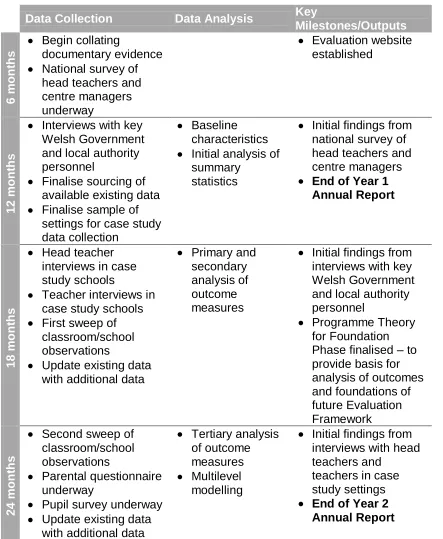
proposals for the design and content of Stage II of the research and the subsequent programme of work for the second year of the evaluation. This is summarised in Table 2 and includes our intended key
milestones and outputs for that period.
2.3 A number of changes were made to this indicative programme of work. Due to the sizeable content and importance of three of the reports their eventual publication was delayed until later in the year. This had a number of implications. The main implication of this was we decided to delay the second analysis of NPD data until the final year of the
evaluation. This would have included a further year of administrative data that complements the initial analysis (Davies et al. 2013). Instead a second and third iteration of this is intended to be published in 2014 (see Chapter 3).
2.4 We also decided not to prepare separate reports for analysis of the national survey of primary head teachers and funded non-maintained settings and the analysis of local authority interviews. Instead analysis and findings from these two elements (of Stage I of the evaluation) will be integrated with analysis and findings from Stage II of the evaluation and will feature in our reporting schedule for the final year of the
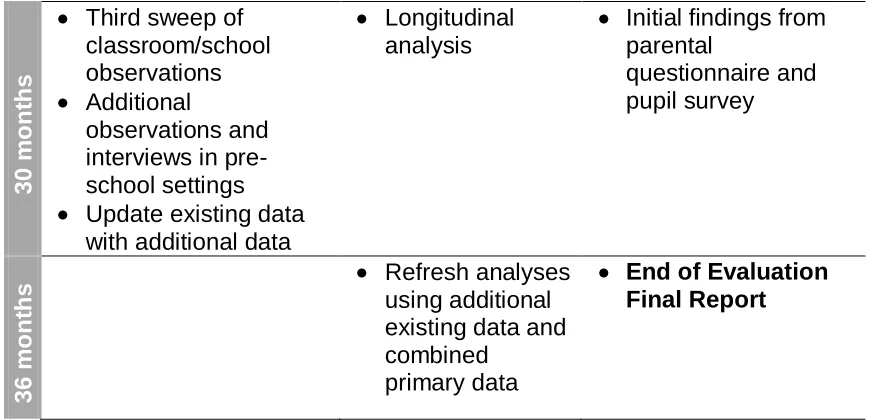
Table 1: Indicative Timeline for Three-Year Evaluation Data Collection Data Analysis Key
Milestones/Outputs 6 m o n th s Begin collating documentary evidence National survey of
head teachers and centre managers underway Evaluation website established 1 2 m o n th s
Interviews with key Welsh Government and local authority personnel
Finalise sourcing of available existing data Finalise sample of
settings for case study data collection
Baseline characteristics Initial analysis of
summary statistics
Initial findings from national survey of head teachers and centre managers End of Year 1 Annual Report 1 8 m o n th s Head teacher interviews in case study schools
Teacher interviews in case study schools First sweep of
classroom/school observations
Update existing data with additional data
Primary and secondary analysis of outcome measures
Initial findings from interviews with key Welsh Government and local authority personnel
Programme Theory for Foundation Phase finalised – to provide basis for analysis of outcomes and foundations of future Evaluation Framework 2 4 m o n th s
Second sweep of classroom/school observations
Parental questionnaire underway
Pupil survey underway Update existing data
with additional data
Tertiary analysis of outcome measures Multilevel
modelling
Initial findings from interviews with head teachers and
3 0 m o n th s
Third sweep of classroom/school observations Additional
observations and interviews in pre-school settings Update existing data
with additional data
Longitudinal analysis
Initial findings from parental questionnaire and pupil survey 3 6 m o n th
s Refresh analyses using additional existing data and combined
primary data
[image:24.595.83.521.72.282.2]End of Evaluation Final Report
Table 2: Indicative Detailed Programme of Work for 2012/13 2012/13
September 2012
Pilot data collection instruments for case study visits Finalise case study sample
Resend national survey of schools/settings
October 2012
Finalise ‘Policy Logic Model Report’ for publication Draft ‘2011/12 Annual Report’
Draft ‘First Data Analysis Report’ Draft ‘Local Authority Advisors Report’ Begin contacting 20 case study schools
November 2012
Complete 5 case study school visits
Finalise ‘First Data Analysis Report’ for publication Publish ‘Policy Logic Model Report’
December 2012
Complete 7 case study school visits
Finalise ‘2011/12 Annual Report’ for publication
Finalise ‘Local Authority Advisors Report’ for publication Publish ‘First Data Analysis Report’
Initial analysis of national survey responses
Receive new PLASC/NPD data from Welsh Government
January 2013
Contact remaining 20 case study visits Complete 7 case study school visits
Call for papers for Foundation Phase Research Conference Publish ‘2011/12 Annual Report’
Publish ‘Local Authority Advisors Report’
Present initial findings from national survey of schools/settings to Welsh Government
Complete remaining stakeholder interviews Begin analysis using new PLASC/NPD data
February 2013
Complete 7 case study school visits Draft ‘National Survey Report’
March 2013
Complete 7 case study school visits
Finalise ‘National Survey Report’ for publication
Present findings from initial analysis of updated PLASC/NPD data
April 2013
Select and contact additional funded non-maintained settings Finalise programme for Foundation Phase Research Conference
May 2013
Draft ‘Second Data Analysis Report’
June 2013
Complete additional funded non-maintained setting visits
July 2013
Complete additional funded non-maintained setting visits Foundation Phase Research Conference (Cardiff)
Begin analysis from Stage II case study visits
Finalise ‘Second Data Analysis Report’ for publication
2.5 Despite these changes, the data collection involved for Stage II of the evaluation design proceeded as expected. This largely involved the first sweep of case study visits to schools and funded non-maintained settings. The first five months of the year involved the development and careful piloting of all the research instruments that were used in the case study visits. The final case study visits began in January 2013 and took six months to complete.
Case Study Sample
2.6 Stage II of the evaluation largely involved the first sweep of case study
visits. We intended to visit 40 schools and 10 funded non-maintained
settings. These were to be selected through stratified random sampling – stratified by educational consortia region of Wales and stage of
implementation and then randomly selected. A minimum number of
Welsh Medium schools were identified prior to selection with additional
Welsh Medium schools to be randomly selected if this number was not
met. We originally intended to select funded non-maintained settings on the basis of being ‘feeder’ settings in to the case study schools (see
2.7 In total, 73 schools were asked to participate. Two agreed to participate but later had to withdraw from the evaluation due to pending Estyn inspections. One school was due to close during the year. A further 24 schools declined to participate. In most cases the next randomly selected school agreed to participate. In a very small number of cases the second randomly selected school also declined to participate, which meant that a third school had to be randomly selected. Obviously this has implications for how ‘random’ the case study schools were, but given the process of randomisation was at the regional level we are confident that there is minimal self-selecting bias in the final sample. Further descriptive analysis of the final sample will be presented in later evaluation reports (see Chapter 3).
2.8 In total 41 schools and 10 funded non-maintained settings agreed to be
case studies. The final sample of case study schools and funded
non-maintained settings is summarised in Table 3 and Table 4.
Table 3: Summary of Case Studies by Region
Sector and medium of instruction
Regional Consortia
North Wales1
South West and
Mid Wales2
Central South Wales3
South East Wales4
Maintained schools 10 14 10 7
Welsh Medium 5 5 4 0
English Medium* 5 9 6 7
Funded
Non-Maintained Settings 4 2 3 1
Welsh Medium 2 2 1 0
English Medium 2 0 2 1
TOTAL 14 16 12 9
1. Flintshire, Conwy, Wrexham, Gwynedd, Isle of Anglesey, Denbighshire Local Authorities 2. Swansea, Neath Port Talbot, Carmarthenshire, Pembrokeshire, Powys, Ceredigion Local
Authorities.
3. Bridgend, Cardiff, Merthyr Tydfil, Rhondda Cynon Taff, Vale of Glamorgan Local Authorities.
Table 4: Summary of Case Study Schools by Phase of Implementation Stage of implementation Regional Consortia Total number North Wales1 South West and Mid Wales2
Central South Wales3 South East Wales4
Pilot 1 2 1 1 5
Early Start 1 2 1 1 5
Final Roll-out 8 10 8 5 31
TOTAL 10 14 10 7 41
1. Flintshire, Conwy, Wrexham, Gwynedd, Isle of Anglesey, Denbighshire Local Authorities 2. Swansea, Neath Port Talbot, Carmarthenshire, Pembrokeshire, Powys, Ceredigion Local
Authorities.
3. Bridgend, Cardiff, Merthyr Tydfil, Rhondda Cynon Taff, Vale of Glamorgan Local Authorities.
4. Caerphilly, Monmouthshire, Newport, Blaenau Gwent, Torfaen Local Authorities.
2.9 Within the schools that declined or could not participate there were
three Early Start schools and two Pilot schools.
2.10 The selection of funded non-maintained settings always intended to use purposive sampling – i.e. they were to be selected because they were deemed to be a ‘feeder’ in to one of the case study schools.
However, the majority of case study schools had their own nursery
classes or attached maintained units. This meant that only seven of the
funded non-maintained settings could be selected on this basis. The
remaining three funded non-maintained settings were selected on the
basis of recommendations and to ensure there was a suitable
geographical spread.
Case Study Visits
2.11 Visits to all the case study schools and funded non-maintained settings took place between January and July 2013. A typical school visit took
two days, although for some smaller schools this only took one day.
Each school visit included the following elements:2
2
Observation of children and staff in Nursery, Reception, Year 1
and Year 2 classes
Classroom teacher survey
Interviews with Head Teachers and Foundation Phase lead
practitioners
Interviews or focus groups with Teaching and Learning
Assistants
Survey of Year 2 pupils
2.12 Funded non-maintained settings usually included observations and interview with the setting manager.
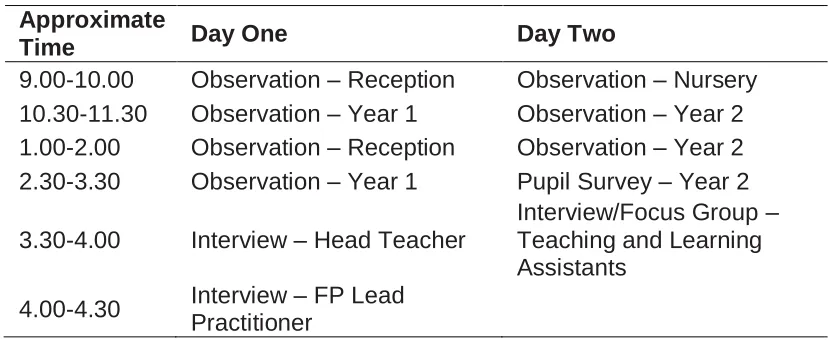
2.13 A typical schedule for a case study school visit is presented in Table 5. This shows that observations of most classes (for Reception, Year 1
[image:29.595.95.511.426.596.2]and Year 2) were undertaken in a morning and an afternoon.
Table 5: Example Case Study School Visit
Approximate
Time Day One Day Two
9.00-10.00 Observation – Reception Observation – Nursery
10.30-11.30 Observation – Year 1 Observation – Year 2
1.00-2.00 Observation – Reception Observation – Year 2
2.30-3.30 Observation – Year 1 Pupil Survey – Year 2
3.30-4.00 Interview – Head Teacher
Interview/Focus Group – Teaching and Learning Assistants
4.00-4.30 Interview – FP Lead
Practitioner
2.14 Observations were designed to provide a snap-shot of how a Foundation Phase class/activity is being designed and delivered.
Observations were largely of the children in order to gauge (a) the
pedagogic and curricula activities they were engaged in, (b) to measure
their engagement with that activity or activities, and (c) to provide an
2.15 In addition to the pupil observations, the researchers made
observations of the classroom layout and of the staff in each classroom
to examine their role and relationship with the pupils. Pupil
observations were undertaken systematically of a randomly different
pupil every two minutes. For each pupil observed a measure of their
involvement and wellbeing was taken using Leuven Scales (Laevers,
2005).
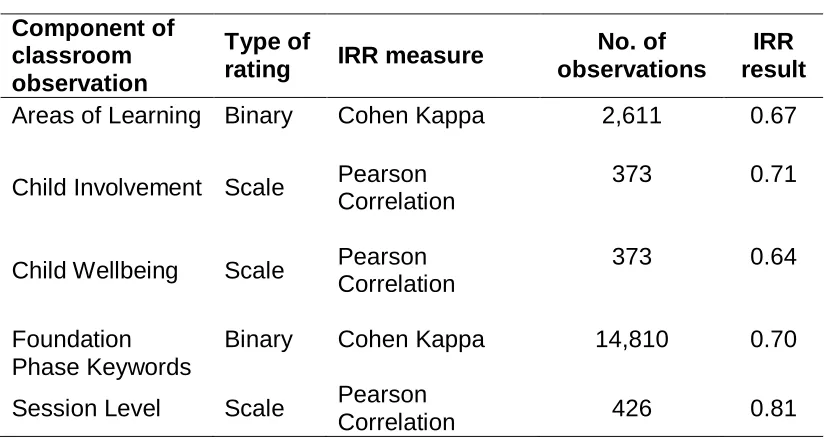
2.16 Two researchers were involved in collecting observational data systematically. To ensure inter-rater reliability both researchers were involved in the development of the tools and in piloting them. They then undertook simultaneous observations in the first five case study school visits of children and classrooms. Table 6 provides a summary of the inter-rater reliability for several components of these classroom
observations. In all components the inter-rater reliability scores would suggest there was ‘substantial agreement’ between the two
researchers (Landis and Coch 1977).
2.17 In addition to the classroom observations the researchers administered a short classroom teacher survey. This was complemented by
interviews with the Head Teacher (or acting Head Teacher), the lead
Foundation Phase practitioner (if different to the Head Teacher) and a
number of Teaching and Learning Assistants.
2.18 Lastly, each case study school visit included a self-completion survey by Year 2 pupils (age 6/7 years). This survey was designed to be
similar to the age seven child survey of the Millennium Cohort Study
(MCS). Usually children completed these surveys in groups of five with
the support of the researcher. In some cases a Teaching and Learning
Assistant was also present.
Table 6: Summary of Inter-Rater Reliability (IRR) for Classroom Observations
Component of classroom observation
Type of
rating IRR measure
No. of observations
IRR result Areas of Learning Binary Cohen Kappa 2,611 0.67
Child Involvement Scale Pearson Correlation
373 0.71
Child Wellbeing Scale Pearson Correlation
373 0.64
Foundation Phase Keywords
Binary Cohen Kappa 14,810 0.70
Session Level Scale Pearson
[image:31.595.90.505.122.342.2]Correlation 426 0.81
Table 7: Final Sample Size in Stage I and Stage II
Respondents, Participants & Observations Sample number*
Stage I
National Survey of Head Teachers 361 National Survey of Funded Non-Maintained Providers 243 Local Authority Foundation Phase Advisor Interviews 19 Local Authority Training and Support Officer Interviews 18 Non-Maintained Umbrella Organisation Interviews 4
Stage II
Child Observations 3,343 Classrooms Observed 131 Sessions Observed 239 Practitioners Observed 824 Year 2 Pupil Survey 671 Head Teacher Interviews 41 Teacher Interviews 118 Lead FP Practitioner Interviews 37 Non-Maintained Leader Interviews 10 Non-Maintained Teaching and Learning Assistant Interviews 14 School Teaching and Learning Assistant Interviews 121 * This does not include any observations and participants from the piloting of the data
3
Next Steps 2013/14
3.1 The programme of work for the evaluation during 2013/14 will be
divided into three parts:
i. Stage III of the Evaluation Design
ii. Analytical Framework
iii. Reporting and Communication
Stage III of the Evaluation Design
3.2 During 2013/14 the evaluation team will complete Stage III of the
evaluation design. This involves the further collection of data from case
study schools and funded non-maintained settings.
3.3 The main elements of Stage III fieldwork will be:
Parent/carer survey;
Year 3 teacher interviews; and
Activities with children.
3.4 Each of these three elements is discussed below. The research tools
for each of these areas will be developed and piloted during the
Autumn Term 2013. And all elements will be approved by the Cardiff
University School of Social Sciences Ethics Committee.
Stage III: Parent/Carer Survey
3.5 We feel that the best way to consult with parents/carers about their
views on the Foundation Phase is via a self-completed bilingual postal
survey that will be taken home by Foundation Phase, Year 3 and Year
4 children (in each of our 41 case study schools). We decided to wait
until the final year of the evaluation so that questions relating to the
children's transition from the Foundation Phase into Years 3 and 4
would apply to the national roll-out schools as well as Early Start and
3.6 The aim of the parent/carer survey is to gather the perceptions of parents and carers towards the Foundation Phase, in principle and in
practice.
3.7 Each of the 41 case study schools (and the 10 case study
non-maintained settings) will be invited to send surveys home to
parents/carers via Foundation Phase, Year 3 and Year 4 pupils. We will
cover all costs by sending printed surveys (with pre-paid
self-addressed return envelopes) to the schools for distribution to
parents/carers. Parents/carers can then either return the completed
survey to the school or directly to WISERD (using the pre-paid
self-addressed envelope). There will also be a prize draw as an incentive to
complete the survey.
3.8 In analysing the parent/carer survey, we will be looking to examine the
following:
How much do parents/carers know about the Foundation Phase
(as an education policy), what were their information sources,
and how does this vary across schools and settings?
To what extent do parents/carers agree with the principles of the
Foundation Phase, and does this vary according to the type of
Foundation Phase implementation in the case study schools and
settings?
What do parents/carers think about the experiences of their own
children who have been recipients of the Foundation Phase
(including transition into KS2), does this vary across the year
groups, and does it depend on the way the Foundation Phase is
being implemented in the case study schools and settings?
3.9 We will be able to analyse the above questions in the context of
whether their children are eligible for free school meals, their language
3.10 If a parent/carer returns a completed survey (either to the school or direct to the evaluation team) their consent to take part will be
assumed, and all participants will be told they can withdraw their data
at any time. When finalising the survey, we will ensure that the
language used is as accessible as possible. However, we are aware
that a small proportion of parents/carers (e.g. those with reading/writing
difficulties in English/Welsh) will find this difficult. Therefore, we will
include our contact details with a note in case parents/carers would
prefer to share their views on the Foundation Phase over the
telephone. We will also be asking all schools/settings to direct
parent/carers to us in the event of this scenario. Participants will only
be required to write their name on the survey if they wish to be entered
into the prize draw as a survey completion incentive. This information
will not be linked with the data they provide within the survey, and will
not be included in any publications from this project.
3.11 This survey is due to be conducted during Autumn Term, 2013.
Stage III: Year 3 Teacher Interviews
3.12 As with the parent/carer survey, we decided to wait until the final year of the evaluation to gather the views and perceptions of Year 3 (KS2)
teachers, because this will maximise the experience Year 3 teachers
have had in receiving and working with children who have been
through the Foundation Phase.
3.13 The main aim of the Year 3 teacher interviews will be to gather the perceptions of Year 3 teachers towards the Foundation Phase, in
principle and in practice, with a focus on the transition for children from
the Foundation Phase into Key Stage 2 (KS2).
with KS2. The questions have been generated from the themes that
emerged from Stages I and II that require further focus.
3.15 We will be contacting all of our 41 case study schools to arrange to speak with the Year 3 teacher that has received the cohort of Year 2
children that were observed in Phase II. We will then conduct the full
telephone interview with approximately 20 Year 3 teachers that have
been teaching in Key Stage 2 for the longest (i.e. those most able to
compare the new cohorts of Foundation Phase children with previous
cohorts of Key Stage 1 children).
3.16 In analysing the Year 3 teacher interviews, we will be looking to examine the following:
Knowledge and understanding of Foundation Phase policy and
pedagogy - and how this varies from school to school.
What sort of (if any) training the Year 3 teachers have received
in relation to the roll-out of the Foundation Phase.
Whether the Year 3 teachers feel the children who come up from
the Foundation Phase have changed in any way (when
compared to KS1 children), as well as looking at how they as
teachers have changed their pedagogy in any way.
How transition from Foundation Phase into KS2 has been
implemented within particular schools and if this has had any
effect on resources and classroom locations.
What impact the Foundation Phase might be having on
outcomes.
3.17 We will be able to look at these results in the context of Stage II
observation data, as well as staff interviews conducted with Foundation
Phase staff and head teachers in the case study schools.
interviews, and standard participant rights will be explained (e.g. ability
to withdraw data at any time etc.).
3.19 The telephone interviews are due to be organised and conducted during the Autumn Term, 2013.
Stage III: Activities with Children
3.20 Although we conducted a Year 2 Pupil Survey (and also a large number of observations of children in their Foundation Phase
classrooms) in Stage II, we feel that the evaluation would benefit from
more direct (and participative) work with children.
3.21 The main aim of this part of the evaluation is to, first, conduct a series of Year 2 Focus Groups and Year 1 Classroom Tours so that children's
views and experiences of the Foundation Phase can better inform our
evaluation. And secondly, to assess whether Year 2 children from
schools that appear to have implemented the Foundation Phase fully
have better group problem solving/thinking skills than in schools that
appear to have not implemented the Foundation Phase to a strong
degree.
3.22 The rationale for this is two-fold. First, the Year 2 Pupil Survey conducted in Stage II suggested that it would be worth talking to
children in more detail about their experiences in school, and how this
might be affected by the Foundation Phase. Secondly, the constraints
of evaluating the effect of the Foundation Phase on educational
outcomes led us to consider assessing the impact of different
Foundation Phase pedagogies on group problem solving and thinking
3.23 It is proposed to conduct this direct work with children in seven of the 41 case study schools: three ‘high’ Foundation Phase schools, three
‘low’ Foundation Phase schools and one Welsh Medium school3
.
3.24 This element of the evaluation will allow us to examine whether children's perceptions of the Foundation Phase, and their group
problem solving skills, are affected by the type and degree of
Foundation Phase pedagogy they are experiencing at school. In other
words we intend to examine:
whether children from ‘high’ and ‘low’ Foundation Phase
classrooms experience and talk about their learning in different ways, and
whether children from ‘high’ and ‘low’ Foundation Phase classrooms have developed different levels of group problem solving and/or thinking skills.
3.25 Preceding these activities the researchers will spend some time in the classroom before commencing the activities to allow the children to get used to who the researchers are and why they are there.
3.26 Each of the seven schools will need to have at least twenty children in Year 1 and at least twenty children in Year 2 to ensure that we can
obtain consent from at least six Year 1 and six Year 2 children (and their parents/carers). We also intend to video the children’s activities,
and therefore we will require parents/carers to give signed informed
consent for their child to take part (i.e. opt-in consent). Parents/carers
will also be asked to give their consent for the research team to use the
recorded videos for dissemination purposes.
3 ‘High’ and ‘low’ Foundation Phase schools will be based on analysis of the observational
3.27 To help this process, we will be asking the seven schools participating in this part of our research to identify a member of staff (e.g. teacher or
teaching assistant) to help ask for consent from at least eight Year 1
and eight Year 2 parents/carers at drop-off/pick-up time. School staff
will be provided with all of the required information and consent sheets.
They will then be able to approach parents/carers a week or two before
our scheduled visit to ensure sufficient consent forms have been
signed.
3.28 Of the children whose parents/carers have given signed consent, we intend to 'randomly' choose three boys and three girls willing to take
part from Year 1 and three boys and three girls willing to take part from
Year 24. The researcher will clearly explain the activity and the reason
for filming to these children and give all of them the opportunity to
decline if they don't want to take part. Ideally, the same group of Year 2
children will take part in both the Focus Group Discussion and the
Group Problem Solving Task.
3.29 We aim to conduct all of the direct work with children between January and February 2014. Therefore, we intend to finalise the group activities
and procedures by November 2013 and begin recruiting our
sub-sample of seven schools and arranging for parental consent in
December 2013.
Stage III: Year 2 Focus Groups
3.30 The main aim of these focus groups will be to find out more about Year 2 children's perceptions of their learning and school, and how these are
influenced by the type of Foundation Phase implementation they are
experiencing in their classroom. We will also be able to follow up on
key findings from the Year 2 Survey conducted in Stage II.
4
3.31 Preliminary analysis of some of the Year 2 survey data from Stage II suggests that children's attitudes towards certain elements of learning
may be influenced by the way in which the Foundation Phase is being
implemented in their classroom (e.g. more or less adult/child initiated
etc.). Year 2 focus groups will allow for a more in-depth qualitative
discussion with the next cohort of Year 2 children about whether their
classroom environment and pedagogy influences their experience of,
and attitudes towards, school and learning. We will have observed
these children in Phase II of the evaluation, whilst they were in Year 1.
Therefore, we will know what kind of pedagogy they were experiencing
then, and we will also talk with their Year 2 teacher to find out what kind
of pedagogy they are experiencing now.
3.32 When analysing these qualitative focus group discussion data, we will be looking for common themes that tell us more about how Year 2
children perceive the following, and how these factors may be
influenced by the type of Foundation Phase implementation they have
been experiencing in their school:
Enjoyment of school, reading, writing, number work and outdoor
learning;
Confidence, behaviour, peer relationships, wellbeing and
independence; and
The role of the teacher and additional classroom practitioners
Stage III: Year 1 Classroom Tours
3.33 The main aim of the classroom tours will be to explore how different Foundation Phase classroom layouts can affect how Year 1 children
perceive and describe their learning environment.
environments. Participatory classroom tours will allow us to learn more
about how children perceive their learning environment, and how this
might be affected by the way it is set out and used by the teacher and
additional practitioners.
3.35 For this purpose one group of six Year 1 children will be chosen from each of the seven schools taking part. The researchers will explain to
the selected children that they would like the children to take them on a
tour of their classroom and outdoor learning environment, showing
them what they do in their space and why they do it. The researchers
will also explain that they would like to video the classroom tour and
obtain their consent for this.
3.36 The researchers will let the children lead the classroom tour (with a time limit of 15 minutes), but a set of standard prompts (for
consistency) will be used when needed:
‘So, what's the first thing you'd like to show me in your
classroom? What do you do here? What is it for? What do you learn about here?’
‘And what's the next thing you'd like to show me in your
classroom (repeated …)? What do you do here? What is it for?’ ‘What does your teacher normally do? And any other adults in the classroom?’
3.37 When analysing the qualitative classroom tour data (video and field notes), we will be looking to see if there are any differences between the ‘high’ and ‘low’ Foundation Phase school groups in terms of how
the children conceptualise their learning environments (e.g. use of key
words such as 'work' and 'play'), how the children describe the role of
the teacher and additional practitioners, how enthusiastic the children
are when showing the different areas of provision, and how well the
group work together to share ideas and include each other in the tour.
How confident were the children in working with a stranger and
initiating the tour (without teacher support)?
How did each group work together? Did they listen to each
other's point of views and work together as a group?
What areas of the classroom/activities featured the most in each group's discussion?
How did each group conceptualise and describe the various
activities and areas of provision they chose to talk about?
Were there differences in how the groups talked about their
indoor and outdoor spaces?
What areas of learning did the groups like/dislike the most?
Stage III: Year 2 Group Problem Solving and Thinking Skills Assessment
3.38 The main aim of this element of the evaluation is to observe children engaging with three tasks designed to reveal whether the type of
Foundation Phase implementation in classrooms appears to have any
effect on children's group problem solving, creativity and thinking skills.
3.39 It could be argued that the Foundation Phase was partly designed to help children develop generic problem solving and thinking skills
(Maynard et al. 2013). However, these areas of cognitive development
are not directly assessed in the End of Foundation Phase Outcomes.
Therefore, the aim of these three tasks is to examine whether Year 2 children in high Foundation Phase schools display ‘higher’ group
problem solving, creativity and thinking skills, when compared to Year 2 children from ‘low’ Foundation Phase schools.
3.40 Ideally, the same six children from each of the seven participating schools who take part in the Year 2 focus group discussions will also
take part in these group problem solving activities. A comfortable and
familiar place for the Year 2 children in the school will be chosen to
have introduced themselves they will explain the purpose of these
activities. The researchers will also explain that they would like to video
the activities, and ask the children for their consent.
3.41 All these activities have been chosen to encourage the children to verbally discuss their ideas with each other, as well as record ideas for
review at the end of the time limit. All tasks will be video recorded, and
the qualitative data will be analysed for relevant themes relating to how
the children discuss ideas, what sort of thinking language they use, and
how they work together as a group. All tasks will be timed, and based
on previous research using these assessments, quantitative data for
the children's responses will be obtained and analysed using
standardised measures in order to evaluate their desired outcomes. Overall, we will be looking to see if children in ‘high’ and ‘low’
Foundation Phase schools differ consistently in children's creativity,
group problem solving and thinking skills.
Analytical Framework
3.42 Another major part of the evaluation’s activities during 2013/14 will be to complete the analysis required for the final evaluation report. Given
the complex nature of the Foundation Phase and the evaluation, a
mixed methods approach has been adopted (Gorard and Taylor 2004).
Therefore the evaluation design includes many features, and will have
collected a range of quantitative and qualitative data. Therefore the
analysis required will draw upon a range of data sources and types
collected during Stages I, II and III of the evaluation.
3.43 To do this the evaluation team have identified a number of analytical themes and associated analytical working papers that will be
developed. The resulting analytical framework and timeline (Table 8)
will be used to guide the analysis and provide the basis for the final
Table 8: Foundation Phase Evaluation Analytical Framework Analytical Theme Analytical Working Paper
A. Implementation 1. Management and leadership 2. Training, support and guidance 3. Staffing
4. Children and families
B. Practice 5. Pedagogy and understanding 6. Environment (indoor/outdoor) 7. Welsh language
8. Literacy and numeracy 9. Exemplars of FP practice C. Impact 10. Reported impacts
11. Child involvement and wellbeing 12. Transitions and assessment
13. Future development of the FP D. Outcomes 14. NPD Report 1 (Stage I)
15. NPD Report 2 (Stage II) 16. NPD Report 3 (Stage III) E. Technical 17. Methodology
Working paper 1: Management and Leadership
3.44 This working paper will examine the role of management and leadership in the introduction and establishment of the Foundation Phase. This includes the role of the Welsh Government, local authorities, Foundation Phase Advisors, head teachers, centre
managers and senior teaching staff involved in the implementation of the Foundation Phase in schools. In particular it will be interested in:
How the introduction of the Foundation Phase was experienced
by these various groups of practitioners;
Their attitudes towards the implementation of the Foundation
Phase;
Their expectations for the Foundation Phase during the early
What changes, if any, there have been in the schools'
organisation and management;
What relationships, if any, there are between initial attitudes and
subsequent practice of the Foundation Phase; and
Barriers to and challenges of implementation, including lessons learnt.
3.45 As well as mapping the roles and contributions of these different
stakeholders in its implementation, it will also consider what patterns, if
any, there are in the implementation of the Foundation Phase by:
Geography (urban/rural, local authority/regional consortia)
Type of school (WM/EM, size, intake composition)
Stage of roll-out (Pilot, Early Start, Final Roll-out)
Staff characteristics (experience of Head Teacher)
Working paper 2: Training, Support and Guidance
3.46 This working paper will focus on the training, support and guidance provided and made available to schools and practitioners. In particular,
it will be interested in the way any materials for these purposes have
been received, interpreted and used. There will also be a key focus on
the role of local authorities and the Welsh Government in the
implementation and practice of the Foundation Phase.
Working paper 3: Staffing
3.47 This working paper is primarily concerned with issues relating to staffing for the Foundation Phase. A key feature of the Foundation
Phase is the additional resource to improve adult:pupil ratios in the
Foundation Phase years. This working paper will attempt to map
adult:pupil ratios from the national surveys and case study school
visits. It will then consider what relationships this has, if any, on
3.48 This working paper will also consider the impact of teaching experience and qualifications of all staff, where possible, on Foundation Phase
practice in schools and classrooms. It will also examine the
recruitment, role and attitudes of Teaching and Learning Assistants in
the Foundation Phase. Key themes of this Working Paper will therefore
be:
Mapping adult:pupil ratios across the sector;
Mapping qualifications and teaching experience of all staff;
Use of staff in the delivery of the Foundation Phase
(activities/responsibilities by staff);
Use of sustained interaction, observation and reflection (as
related to qualifications and experience);
Recruitment of Additional Teachers;
Role of Additional Teachers;
Examine issues of funding relating to staffing for the Foundation
Phase; and
Professional values amongst practitioners.
3.49 From the mapping exercise of adult:pupil ratios and the qualifications and teaching experience of classroom staff it will also consider what
patterns, if any, there are in the implementation of the Foundation Phase by:
Geography (urban/rural, local authority/regional consortia);
Category of school (WM/EM, size, intake composition)
Stage of roll-out (Pilot, Early Start, Final Roll-out); and
Typology of practice (see Pedagogy and Understanding Working
Paper).
Working paper 4: Children and Families
children and their parents/families to the Foundation Phase and the extent to which the ‘voices’ of children and parents are seen as
important to the way the Foundation Phase is implemented by practitioners. It therefore incorporates, for example, children’s views
about the Foundation Phase and how far schools/teachers are taking into account children’s interests and ideas when planning activities. It
will also explore the relationships with parents, families and
communities in the context of the Foundation Phase.
3.51 This is distinct from the working paper on child involvement and wellbeing which is more concerned with the impact of the Foundation Phase on children’s involvement in learning activities and their
wellbeing. However, we expect that these will be closely related and it
will be important to see to what extent child-initiated approaches in
Foundation Phase practice are associated with levels of involvement,
objective and subjective wellbeing and attitudes to learning.
3.52 The issues highlighted in this working paper will be given particular attention during Stage III of the evaluation. Nevertheless, it is still possible to begin to identify how far children’s and parents’ views were
taken into account in the implementation of the Foundation Phase in
schools from the national survey and in the case study visits.
Working paper 5: Pedagogy and Understanding
3.53 This working paper is a core part of the analytical framework and evaluation. It attempts to establish how the Foundation Phase has
been understood, interpreted and enacted by practitioners in schools
and settings. This will be contrasted with the way the Foundation
Phase is understood and presented in the official discourse (see an
earlier evaluation report on the Policy Logic Model and Programme
3.54 It will also provide a detailed descriptive account of Foundation Phase practice in classrooms and settings. In particular it will compare and
contrast the pedagogy and practice of the Foundation Phase in the
following key ways:
Morning versus afternoon;
By year group;
By 'categories' of children (e.g. gender, SEN, ability matched);
By 'categories' of school (e.g. stage of roll-out, school size,
medium of instruction); and
By 'categories' of classroom teachers (e.g. teaching experience,
adult:pupil ratios).
3.55 In providing a descriptive account of how the Foundation Phase is being enacted it will also explore the relationships between different
aspects of pedagogy. In particular it will explore how the twelve
dimensions of the FP, which the evaluation has used in its classroom
observations, relate to different types of implementation in order to
develop an advanced typology of Foundation Phase practice that
extends beyond the observed characteristics of the Foundation Phase
found in schools. For example, this will consider whether a typology of
practice can and should be developed for the classroom- or
school-level.
3.56 The working paper will also explore possible explanations for any patterns or variations in the interpretation, understanding and
enactment of the pedagogy and content (curriculum) of the Foundation
Phase, drawing upon interviews with practitioners. Further analysis will
involve comparing the results of this analysis with the results found in