full text research
abstracts of all titles
monthly updates
Ma Manda Phonology
Ryan Pennington
2015
Published by LINCOM GmbH 2015.
LINCOMGmbH Hansjakobstr.127a D-81825 Muenchen
[email protected] www.lincom.eu
webshop: www.lincom-shop.eu
All rights reserved, including the rights of translation into any foreign language. No part of this book may be reproduced in any way without the permission of the publisher.
Bibliographic information published by the Deutsche Nationalbibliothek
The Deutsche Nationalbibliothek lists this publication in the Deutsche Nationalbibliografie; detailed bibliographic data are available in the Internet at http://dnb.dnb.de
Printed in E.C.
Printed on chlorine-free paper
Download link for the media and text files:
Dedicated to Crystal, my bride,
ACKNOWLEDGMENTS
No work of value is accomplished alone. I have been the beneficiary of numerous
encouragements, prayers, financial gifts, and other acts of kindness. God has blessed me
with a team of family, friends, and colleagues who loyally support my endeavors, ask me
the tough questions, and provide me with comfort and strength in times of distress. These
people keep pushing me toward greater heights and new challenges, and I aspire to
continue to meet their expectations through the perseverance and peace that only come
from Jesus Christ.
I would like to thank a few people in particular. First, I am grateful to my friends
and colleagues in SIL PNG who have stood by my side during the foundational years of
my academic research. I am especially grateful for the academic mentorship and friendly
encouragement of Rene van den Berg.
I thank SIL PNG, GIAL, and CanIL for scholarships and grants that have enabled
me to pursue my Master's degree.
I am forever indebted to the hospitality and graciousness of the Ma Manda people,
who have accepted my family into their homes, babysat my children so that my wife and
I could do language lessons, taken me on hikes through mountain rainforests, and who
even built us a house in just two weeks' time. They have tirelessly con-ected our mistakes
and ignored a myriad of cultural faux pas. I would like to thank Doyang Yambalum,
Tuboin Bangam, Iosep Pange, and especially Garambon Magu. These men have spent
enormous amounts of time helping me to fill out paradigms, record stories, and ask
questions. Yengulon kaalin shnhk!
I would like to thank my wife Crystal, as well as our two children, Chloe and
Caedmon. I have spent many late nights in front of the computer instead of with them,
and I am grateful for their patience and love. Crystal always believes in me, which has
sometimes been the only reason I have kept moving forward. She has also made
corrections on my thesis along the way. I could not have done any of this without her.
Finally, I would like to thank the advisors on my committee. Michael Boutin and
Mike Cahill offered their time and energy to improve my thesis. I am grateful that they
were willing to share their expertise in order to help me become a better linguist. Steve
Parker, the chair of my committee, has spent many hours with me over the course of this
process. I am grateful for the time he spent mentoring me, connecting me with resources,
listening to recordings with me, and correcting my mistakes. All of my committee
members have made me more confident and competent, and therefore they share in any
future successes I have in the field of linguistics.
12 April 2013
TABLE OF CONTENTS
ACKNOWLEDGMENTS ... IX LIST OF MAPS ... XIV LIST OF FIGURES ... XV
LIST OF TABLES ... XVI ABBREVIATIONS ... XVIII
1 INTRODUCTION .......................................... 1
1.1 OBJECTIVE.··· ... 4
1.2 MOTIVATIONS ... 5
1.3 SCOPE ... 6
1.4 METHODOLOGY ... 7
1.5 INFORMED CONSENT ... 10 2 THE MA MANDA LANGUAGE ....... 13
2.1 LOCATION ... 13
2.2 GENETIC CLASSIFICATION ... 15
2.3 LANGUAGE VITALITY ... 17 2.4 MORPHOSYNTAX OVERVIEW ... 18
3 LITERATURE REVIEW .......................... 23
3. I RELATED LANGUAGES ... 23
3.1.1 Finisterre-Huon fainily ... 24
3 .1.2 Papuan languages ... 26
3 .1.3 Erap languages ... 27
3.1.4 Summary of sources ... 28
3.2 EPENTHESIS AND NASAL AGREEMENT ... 31
3 .2.1 Barred-i epenthesis ... 31 3.2.2 Long distance nasal agreement ... 32
3.3 SONORJTY AND PERCEPTIBILITY ... 33
3.3.1 Sonority and the Syllable Contact Law ... 33
3.3.2 Perception-based phonology ... 37
4 SEGMENTAL PHONOLOGY ................ 41
4.1 CONSONANT PHONEMES ... 41
4.1.1 Voiceless plosives ... 43
4.1.2 Voiced plosives ... 46
4.1.3 Labialized velar plosives ... .48
4.1.4 Nasals ... 49
4.1.5 Fricatives ... 52
4.1.6 Liquid ... 53
4.1. 7 Glides ... 54
4.2 VOWEL PHONEMES ... 59
4.2. l High vowels ... 60
4.2.2 Mid vowels ... 62
4.2.3 Low vowels ... 63
4.3 SUMMARY ... 65
5 THE SYLLABLE AND PHONOTACTICS ... 67
5.1 SYLLABLE TEMPLATE ... 67
5 .2 CONSONANT SEQUENCES ... 72
5.3 VOWEL SEQUENCES ... 75
5.4 SUMMARY ... 78
6 SUPRASEGMENTAL FEATURES ... 80
6.1 STRESS ... 80
6.2 lNTONA TION ... 90
6.3 SUMMARY ... 94
7 HIGH VOWEL REDUCTION AND EPENTHESIS ... 96
7 .1 .HIGH VOWEL REDUCTION ... 98
7 .2 EPENTHESIS ... 103
7.3 SUMMARY ... 112
8 LONG DISTANCE NASAL AGREEMENT ... 113
8.1 OVERVIEW AND DEFINITIONS ... 113
8.2 NASALIZATION IN RELATED LANGUAGES ... 116
8.3 T AUTOMORPHEMIC NASAL AGREEMENT ... 117
8.4 HETEROMORPHEMIC NASAL AGREEMENT ... 122
8.4.l Triggers, targets, and transparent segments ... 122
8.4.2 Directionality and domain ... 126
8.5 FURTHERCHARACTERISTICSOFNASALAGREEMENT ... 128
8.5.1 Blocking of nasal agreement.. ... 128
8.5.2 Blocking of /b/-lenition ... 129
8.5.3 Interaction of nasal agreement with epenthesis ... 129
8.6 SUMMARY ... 131
9 MORPHOPHONEMIC ALTERNATIONS ..... 132
9.1 HETEROMORPHEMIC CONSONANT INTERACTIONS ... 132
9.1.1 Voiceless plosive interactions ... 135
9.1.2 Voiced plosive interactions ... 137
9.1.3 Fricative interactions ... 138
9 .1.4 Nasal interactions ... 139
9.1.5 Approximant interactions ... 143
9 .1.6 Summary of heteromorphemic consonant interactions ... 151
9.2 HETEROMORPHEMIC INTERACTIONS INVOLVING VOWELS ... 152
9.3 REDUPLICATION AND COMPOUNDS ... 154
10
9.3.1 9.3.2 9.4
Reduplication ... 155
Compounds ... 160
SUMMARY ... 163
CONCLUSION ... 165
APPENDIX 1: ALPHABETIZED WORDLIST ... 169
APPENDIX 2: PHONEME FREQUENCY COUNTS ... 181
APPENDIX 3: NOMINAL POSSESSION PARADIGMS ... 184
APPENDIX 4: VERBAL TAM PARADIGMS ... 186
APPENDIX 5: lNTERLINEARIZED STORY ... 192
APPENDIX 6: HETEROMORPHEMIC CONSONANT INTERACTIONS ... 196
REFERENCES ... 202
LIST OF MAPS
Map 1: Erap location within PNG (Hiley et al. 2008:7) ...... 14 Map 2: Erap group (adapted from Hiley et al. 2008:7) ... 15
LIST OF FIGURES
Figure 1: Erap group genetic classification (Ross 2005) ... 16
Figure 2: Proposed revision of Erap family ... 17
Figure 3: Spectrogram and waveform of /jgIJen/ ... 57
Figure 4: Spectrogram and waveform of /ijgl)en/ ... 57
Figure 5: Falling pitch contour of a statement.. ... 91
Figure 6: Spectrogram and waveform of [nan.du: .la.lgt] ... 110
Figure 7: Spectrogram and waveform of [nan.di.la.lgt] ... 111
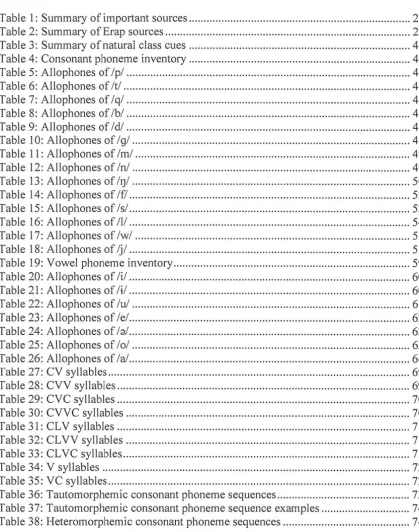
LIST OF TABLES
Table 1: Summary of important sources ... 29
Table 2: Summary ofErap sources ... 29
Table 3: Summary of natural class cues ... 40
Table 4: Consonant phoneme inventory ... 42
Table 5: Allophones of Ip/ ... 44 Table 6: Allophones of IU ... 44
Table 7: Allophones of /qi ... 45
Table 8: Allophones of lb/ ... 47
Table 9: Allophones of Id/ ... 47
Table 10: Allophones of /g/ ... 47 Table 11: Allophones of Im/ ... 49
Table 12: Allophones of /n/ ... 49
Table 13: Allophones of /fJ/ ... 50
Table 14: Allophones of /fl ... 52
Table 15: Allophones of Isl ... 52
Table 16: Allophones of Ill ... 54
Table 17: Allophones of lw/ ... 55
Table 18: Allophones of /j/ ... 55
Table 19: Vowel phoneme inventory ... 59
Table 20: Allophones of Iii ... 60
Table 21: Allophones of Iii ... 60
Table 22: Allophones of /u/ ... 61
Table 23: Allophones of /el ... 62
Table 24: Allophones of/~/ ... 62
Table 25: Allophones of lo/ ... 63
Table 26: Allophones of la! ... 64
Table 27: CV syllables ... 69
Table 28: CVV syllables ... 69
Table 29: CVC syllables ... 70
Table 30: CVVC syllables ... 70
Table 31: CLV syllables ... 71
Table 32: CL VV syllables ... 71
Table 33: CLVC syllables ... 71
Table 34: V syllables ... 72
Table 35: VC syllables ... 72
Table 36: Tautomorphemic consonant phoneme sequences ... 73
Table 37: Tautomorphemic consonant phoneme sequence examples ... 74
Table 38: Heteromorphemic consonant phoneme sequences ... 74
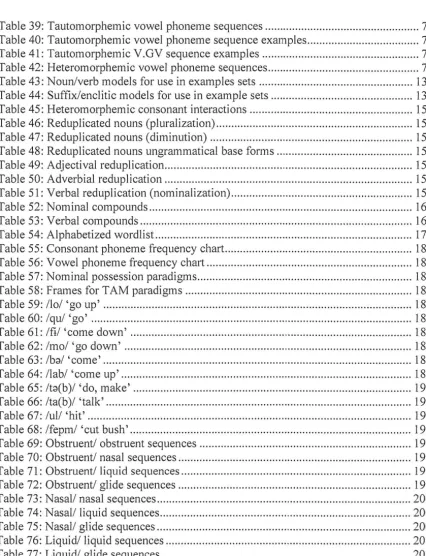
[image:15.600.127.547.198.730.2]Table 39: Tautomorphemic vowel phoneme sequences ... 75
Table 40: Tautomorphemic vowel phoneme sequence examples ... 76
Table 41: Tautomorphemic V.GV sequence examples ... 76
Table 42: Heteromorphemic vowel phoneme sequences ... 77
Table 43: Noun/verb models for use in examples sets ... 134
Table 44: Suffix/enclitic models for use in example sets ... 134
Table 45: Heteromorphemic consonant interactions ... 152
Table 46: Reduplicated nouns (pluralization) ... 155
Table 47: Reduplicated nouns (diminution) ... 157
Table 48: Reduplicated nouns ungrammatical base forms ... 157
Table 49: Adjectival reduplication ... 158
Table 50: Adverbial reduplication ... 159
Table 51: Verbal reduplication (nominalization) ... 159
Table 52: Nominal compounds ... 161
Table 53: Verbal compounds ... 162
Table 54: Alphabetized wordlist. ... 170 Table 55: Consonant phoneme frequency chart ... 183
Table 56: Vowel phoneme frequency chart ... 183
Table 57: Nominal possession paradigms ... 184
Table 58: Frames for TAM paradigms ... 186
Table 59: /lo/ 'go up' ... 187
Table 60: /qui 'go' ... 187
Table 61: /fi/ 'come down' ... 188
Table 62: Imo/ 'go down' ... 188
Table 63: /b'J/ 'come' ... 189
Table 64: /lab/ 'come up' ... 189
Table 65: /t'J(b)/ 'do, make' ... 190
Table 66: /ta(b)/ 'talk' ... 190
Table 67: /ul/ 'hit' ... 191
Table 68: /fepm/ 'cut bush' ... 191
Table 69: Obstruent/ obstruent sequences ... 197
Table 70: Obstruent/ nasal sequences ... 198
Table 71: Obstruent/ liquid sequences ... 199
Table 72: Obstruent/ glide sequences ... 199
Table 73: Nasal/ nasal sequences ... 200
Table 74: Nasal/ liquid sequences ... 200
Table 75: Nasal/ glide sequences ... 200
Table 76: Liquid/ liquid sequences ... 201
Table 77: Liquid/ glide sequences ... 201
ABBREVIATIONS
affix boundary LW loanword
*
ungrammatical MED medial verbII phonemic representation ms milliseconds
[ ] phonetic representation MSC morpheme structure constraint
free variation n noun
+
join morphemes NOM nominative casefused morpheme NFUT near future tense
=
clitic boundary NPST near past tense-
becomes, surfaces as NV nasal+
vowel s.equence0 null morpheme 0 bound object pronoun
1 1st person OPD Organised Phonology Data
2 2nd person PART participle
3 3rd person PFV perfective aspect
adj adjective PL plural
adv adverb PNG Papua New Guinea
CAT cataphoric pronoun POSS possessive
CAUS causative PRES present tense
COMPL completive aspect RPST remote past tense
DAT dative pronoun SBN subjunctive mood
DS different subject medial verb SCL Syllable Contact Law
DU dual SG singular
EMPH emphatic pronoun SIM same subject simultaneous medial
H heavy syllable verb
HAB habitual aspect SS same subject medial verb
Hz Hertz SSP Sonority Sequencing Principle
IMP imperative mood TAM tense, aspect, modality
ITER iterative aspect v verb
L light syllable VOT voice onset time
LLG Local Level Government YNQ polar question
LOC locative case
1 INTRODUCTION
This thesis is a phonological description of Ma Manda (ISO 639-3: skc), a
Finisterre-Huon language of the Trans-New Guinea family. It is one of eleven languages
that form the Erap subgroup, a subdivision of the broader Finisterre-Huon family that is
spread across the Huon peninsula of northeastern Papua New Guinea (PNG).
The phonology of Ma Manda is particularly interesting in several ways. First of
all, the high peripheral vowels /i u/ are prone to reduction to the high central [t] in
unstressed environments, as well as in words of three syllables or longer. This can be
seen when the first person possessive suffix is attached to /nimin/ 'cousin'.
(1) a. /nimin/
b. /nimin-n;;)/
[nf.min]' [ni.mi.n~]
'cousin'
'cousin-1 SG. POSS'
Related to this process of vowel reduction is the process of barred-i epenthesis,
whereby [i] is inserted between disallowed consonant clusters, as well as word-finally
after voiced plosives lb d g/, the liquid 111, and fricatives /f s/. Diachronically, epenthesis
has arisen from the reanalysis of [i] as an epenthetic segment rather than a reduction of
the full high vowels. Ma Manda is in a state of transition with regard to this vowel: Often
the full high peripheral vowels are recoverable in careful speech and thus reanalysis is
shown not to have occurred, while in many other cases morphological evidence reveals
1
that this vowel is not underlyingly present. As an example, the following pair of forms
shows /nol/ 'brother' both in isolation and with the first person possessive suffix /-ng/:
(2) a. /no!/
b. /nol-nG/
[no.Ju]
[n6t.nG]
'brother'
'brother-I SO.POSS'
Word-finally in (2a), the epenthetic vowel is realized as [u] after /I/ (harmonized in
roundness and backness with the [o] earlier in the word). When attached to the
nasal-initial suffix, however, /I/ undergoes a predictable alternation: /l+n/-t[tn]. This
alternation shows that the high vowel is not phonemically present here.
A second unique characteristic of Ma Manda phonology is the phenomenon of
long distance nasal agreement, whereby nasal+vowel sequences initiate the
prenasalization of a following tautomorphemic voiced plosive. Interestingly,
heteromorphemically both voiced and voiceless plosives are prenasalized in this
environment. Ma Manda is the only language in the world known to exhibit such a
pattern. Nasal agreement among both voiced and voiceless plosives is seen in the
following verbal paradigm (where (3) shows a regular verb root and ( 4) shows a verb root
composed of an NV sequence).
(3) a. /lo/ 'go.up'
+
/-got/ 'lSG:RPST'b. /lo/ 'go.up'
+
/-de/ '2DU:IMP'c. /lo/ 'go.up'
+
1-qGI 'SS'2
[16.got] 'I went up'
[16.de] 'go up (2Du)!'
(4) a. /mo/ 'go.down' + /-got/ ' lSG:RPST' b. Imo/ 'go.down' + /-de/ '2DU:IMP'
c. /mo/ 'go.down'
+
1-q<:il 'SS'---
[m61J.got] [m6n.de] 'go 'I went down (2DU)!' down' [ m6N .qa] 'go down and .. .'A final unique characteristic of Ma Manda phonology is the complex
morphophonemic alternations that are seen when consonants-especially sonorants-are
brought into contact with other consonants across morpheme boundaries. For example,
the liquid changes to a voiceless stop when adjacent to any nasal (e.g., /l+m/~(tm] and
/m+ll~[mt]/[mp]), and the liquid and labiovelar glide coalesce to form [g]. These
alternations can be seen in (5).
(5) a. /lo/ 'go.up' + /-lat/ '1 SG:PRES'
-
[lo.l:5t] 'I am going up' b. /blam/ 'carry' + /-lat/ 'lSG:PRES'-
[blam.tat] 'I am canying it' c. /mona/ 'secondborn.son' + I= Iii 'NOM'-
[m6.rn;i.li] 'Secondborn son did .. .' d. /qaqon/ 'uncle'+ l=W 'NOM'-
[qa.qon.ti] 'Uncle did ... 'e. /nam/ 'brother-in-law' + I= Iii 'NOM'
-
[nam.pi] 'Brother-in-law did ... ' f. lull 'hit' + /-nelJ/ '2PL:IMP'-
[ ut.neIJ] 'hit him (2PL) ! 'g. lull 'hit'+ /-warn/ 'lPL:PRES'
-
[u.gam] 'we are hitting him'The remaining portions of this chapter are structured as follows: First, in § 1.1 I
discuss the objective and structure of this thesis; in § 1.2 I lay out my four primary
motivations for this study; § 1.3 addresses the scope of the thesis, including the limitations
I am aware of; § 1.4 provides a description of the methodology that has been undertaken;
and § 1.5 provides an overview of the informed consent protocol that was followed during
the data collection phase of the research.
1.1 Objective
The objective of this thesis is to describe the phonology of the Ma Manda
language. This is accomplished through analyses of the segmental phonology (Chapter 4),
syllable structure and phonotactics (Chapter 5), suprasegmental features (Chapter 6), and
morphophonemic alternations (Chapter 9). Particular focus is given to three phenomena:
reduction of high vowels (§7.1), epenthesis of the high central (barred-i) vowel (§7.2),
and long distance nasal agreement (Chapter 8). I describe the behavior of these processes
in detail and discuss their possible historical origins. Finally, the appendices provide lists
of the words upon which the analysis in this thesis is based (including numbers that
cross-reference the audio files on the attached disc). Appendix 1 is a general wordlist,
composed primarily of monomorphemic nouns and adjectives. Appendix 2 provides
frequency counts of ail Ma Manda phonemes based on 1448 morphemes. Appendix 3
provides a list of ten nouns, each inflected in six separate possessive forms. These
illustrate the variety of morphophonemic alternations that are seen in nominal suffixation.
Appendix 4 provides a group of ten separate verbs in morphological paradigms. These
are simple paradigms that fully illustrate the variety of morphophonemic behaviors that
can occur when TAM (tense, aspect, mood) suffixes are attached to verb stems. Appendix
5 provides an interlinearization of a short story about planting yams. Finally, Appendix 6
is a supplement to §9.1 that provides a structured list of all interactions that occur when
heteromorphemic consonants concatenate.
1.2 Motivations
The present study has four primary motivations. First, it serves as a building block
upon which future analyses can take place. Out of necessity, a basic understanding of the
phonology of a given language is required before an attempt can be made at wrestling
with syntactic analysis. Often though, a finalized statement on the sound system can only
be made after all other pieces of the puzzle have been put into place. This thesis is the
starting point in my analysis of the Ma Manda language. Second, this study addresses
three particular phonological phenomena-reduction of high vowels, epenthesis of the
high central vowel, and prenasalization of voiced plosives-which have been analyzed in
various ways within the Erap subgroup and across the Trans-New Guinea family of
languages as well. A thorough treatment of these processes in Ma Manda should shed
light on identical or similar processes attested in several related languages. Third, a
deeper analysis of these processes will be helpful for linguistic theorists and typologists.
For example, to my knowledge, no other language is known to exhibit long distance nasal
agreement among both voiced and voiceless plosives across morpheme boundaries, while
only among voiced plosives tautomorphemically. Finally, a thorough phonological
analysis is paramount in the development of an effective writing system. Without, at the
very least, a basic grasp of the various phonological phenomena at work in a language,
many of the decisions in the development of an orthography would be made blindly and
might lead to unnecessary revisions and frustration.
1.3 Scope
The analysis throughout a majority of this thesis is presented in a purely
descriptive light. This means that the description is divorced from theory wherever
possible. It is my goal that this thesis be accessible to a variety of people doing basic
linguistic research among PNG languages, many of whom may not be familiar with the
latest theoretical advancements in the field of phonology. It is true though that linguistic
analyses often betray one's allegiance to particular theories and models. In dealing with
the various intricacies of Ma Manda phonology, I utilize concepts from Generative
Phonology (Chomsky & Halle 1968), Optimality Theory (Prince & Smolensky 2004),
Metrical Phonology (Hayes 1995), Autosegmental Phonology (Goldsmith 1976),
Evolutionary Phonology (Blevins 2004), and Phonetically Based Phonology (Hayes et al.
2004). It is important that the data be presented with clarity, in order that fieldworkers,
typologists, and theorists can use it to substantiate, modify, and/or disqualify their own
hypotheses.
Generally speaking, the syntax of Ma Manda is not addressed in this paper. That
would lead to a much longer thesis, and would detract from the limited and focused scope
of the present phonological study. Syntactic information is provided insofar as it may aid
in the understanding of the processes described herein. Though morphology, likewise, is
not a primary focus of this work, it is handled more than syntax due to its relevance in the
various complex morphophonemic alternations. An overview of the morphological
paradigms is necessary, though they are not dwelled upon, as their grammatical analysis
is not ge1mane to the present study (although two sets of paradigms are presented as
appendices). For a brief overview of the morphosyntax, however, see §2.4.
Finally, it is important to note that, for the purpose of consistency, only one
dialect is in focus throughout this thesis. The Erap family2 is part of a complex dialect
chain, where the language of each successive village gradually morphs into different
dialects and, subsequently, different languages. The boundaries that are drawn are often
rather arbitrary. This means that the border villages within any particular "language" are
fuzzy and often incorporate linguistic patterns and phenomena from neighboring
languages. Ma Manda is no exception in this regard. The dialect under study is that which
is spoken in and around the two Ma Manda villages of Saut and Lemang. This dialect
was chosen because it is more distant from a main road, and therefore it is less affected
by pidginization. Additionally, due to the increased isolation of Saut and Lemang, fewer
outsiders are present, and therefore the effects of code-switching are reduced. Dialectical
differences are observed, however, especially when they are relevant for potential
differences of opinion regarding a particular analysis.
1.4 Methodology
This thesis is based upon research primarily conducted during six months of
living in the village of Saut. This time was spread out over a period of three years, from
2 This group is often referred to as a "family" in Papuan literature, even though it is a small group within
the Finisterre-Huon family, which in turn belongs to the massive Trans-New Guinea family. I use "group"
and "family" interchangeably throughout the thesis.
2009-2012. In addition, at several points speakers from Saut have joined me at
Ukarumpa, SIL's main center in Papua New Guinea. This has probably encompassed two
additional months.
The data has been gathered from a number of sources. The primary method of
collecting language data has been simply living and interacting with the Ma Manda people while carrying around a simple data notebook. Upon hearing something new, I
would re-elicit the data and ask questions to unveil paradigmatic relationships,
collocations, and disallowed utterances. The data in these data notebooks was always
confirmed at a later date with multiple people, and when deviations were discovered,
these were noted alongside the originals. Finally, each finished data notebook has been
scanned, electronically catalogued, and backed-up on the internal server of SIL PNG in
Ukarumpa.3
In addition, many oral discourses of various genres have been recorded, including
narratives, procedural discourses, expository discourses, prayers, and dialogues. A
majority of these were recorded by audio recorder, while several were captured by video
camera as well. A good portion of these have been re-collected in careful speech, and
many of those have been orally translated.4 These "careful speech" and "oral translation"
recordings were recorded with the original speaker when possible. These stories have
3
SIL PNG's internal server is not accessible to the public; it is used solely as a backup.
4 Utilizing the BOLD (Basic Oral Language Documentation) method first espoused by Gary Simons
(Simons 2008; Reiman 2009, 2010). This method involves an initial audio recording, followed by a careful
re-speaking, and a subsequent oral translation.
been elicited from both males and females, from twelve to seventy years old, from many
education levels. The analysis undertaken in this thesis, however, is based on the
wordlists and stories as spoken by only two men: Garambon Magu and Tuboin Bangam.
Finally, various paradigms and wordlists have been collected over the years. Most
often these elicitation sessions have simply been confirmations of data that had
previously presented itself in informal speech or in recorded stories. These were
generally written into data notebooks as well. Recently, I undertook the project of
recording a collection of wordlists and paradigms, both for posterity and to substantiate
my own analyses. This has resulted in a collection of over 300 monomorphemic words
spoken both in isolation and in a carefully selected frame. These words were selected to
illustrate every possible phonetic variant and phonotactic combination that I know to
exist. 5 Additionally I previously collected approximately 850 words, all spoken in
isolation and from a combination of speakers. I have also collected recordings of verb
paradigm in frames, as well as nouns in possessive paradigms.
The recorded data upon which these descriptions are based are provided (in wav
format) in a disc at the front of the thesis. The numbers alongside the examples
throughout the paper cross-reference the media files (the absence of a number means that
there is no recording for that word). An alphabetized wordlist is also provided in
5
These recordings are 16-bit/48 KHz PCM files recorded on an Olympus LS-20M recorder with a Shure SMlOA headset microphone.
Appendix 1. This list contains every word used within this thesis, transcribed both
phonemically and phonetically.
1.5 Informed consent
A few comments are in order regarding the informed consent protocol that has
been followed. First of all, the collection of written and recorded data was discussed with
the various village leaders of Saut. No one expressed any aversion to this process at any
time. Unfortunately, no official record of that consent was made with these leaders.
Instead, signatures have been obtained for all the people who have allowed themselves to
be recorded. Each form contains a statement of full disclosure about the ways that their
language data may be used. This statement was written in Tok Pisin, the national
language of Papua New Guinea.6 This brief statement is provided below, followed by an
English translation.
6Tok Pisin, or Melanesian Pidgin, is one of three national languages of PNG (the other two being English
and Hiri Motu). It is the linguafranca for most people ofMorobe Province. A vast majority of Ma Manda speakers are fluent in this language.
Mi laik harim tokples bilong yu. Mi bai putim toktok bilong yu long rikoda na bihain bai mi putim em i go insait long komputa. Mi bai no inap kisim moni bilong dispela. Mi bai givim em i go long wanpela pies we ol i save lukautim dispela kain samting long en (olsem universiti). Dispela toktok bat stap long ples klia (Internet) na husait lain laik harim nau o bi/win taim, em ol i ken harim. Bihain, sapos ol tumbuna pikinini bilong yu o ol arapela manmeri i gat laik long kisim sampela save bilong tokples na kalsa bilong yu o pasin tumbuna bilong yu, orait ol i ken harim dispela toktok bilong yu. Em bai yu tok orait Ion~ dispela o nogat? Sapos yu tok orait, orait raitim nem bilong yu long dispela lain.
I want to hear your language. I will put your speech on a recorder and later I will put it into a computer. I will not be able to get money for this. I will give it to a place where they look after this kind of thing (like a university). This speech will be freely accessible (Internet) and whatever group wants to hear it now or later can listen. Later, if your descendants or other people want to get some knowledge about your language and culture or your ancestral customs, they can hear your speech. Will you say "okay" to this or not? If you say "okay'', write your name on the line.
I took great care to provide my informants with as much information as possible.
For many Ma Manda people, however, the concepts of recorders, computers, the Internet,
and archives are foreign. I searched to find the balance between overloading people with
too much unhelpful information, and providing insufficient background for them to make
an informed decision. It is an important ethical consideration to find an appropriate
method of helping people to be adequately informed, and l feel that I have been faithful
to the Ma Manda people in this endeavor.
It was never the case that the people were forced to read the form and sign
without any discussion. Rather, I would spend a fair amount of time in discussion with
7 I owe thanks to John Hatton and Malinda Ginmaule for their help in writing this statement in Tok Pisin. I
based this on a consent statement that John had crafted, and it was refined through discussion with Malinda, a Papua New Guinean who is fluent in Tok Pisin.
the informants, helping them to understand the various issues involved. Generally, I
would bring along someone who I had already informed, and they would help to translate
into Ma Manda. This was often done not with a sole informant, but with a group of
would-be informants.