This is the
Accepted Version
of a paper published in the
International Journal of Auditing:
Siriwardane, Harshini, Hu, Billy Kin Hoi, and Low, Kin
Yew
Skills, knowledge, and attitudes important for
present-day auditors.
International Journal of Auditing. (In Press)
http://dx.doi.org/10.1111/ijau.12023
Skills, Knowledge and Attitudes Important for Present Day Auditors
Harshini P Siriwardane a* Billy Kin Hoi Hub
And KinYew Lowb
a
James Cook University
600 Upper Thomson Rod, Singapore 574421
* Corresponding Author
E-mail: [email protected] Telephone: +1 937 241 3302
Facsimile: +65 6455 2833
Acknowledgements
Data for the project were obtained as part of an honors research project at the Nanyang Business School, Nanyang Technological University, Singapore. Authors are grateful for research assistance from Han Shu Hui, Lim Xiao Wei, and Loke Yongli Dawn of the Nanyang Business School.
Authors’ Mini Profiles
Harshini P Siriwardane is an accounting lecturer at the James Cook University. She has a Ph.D. in Engineering Management from the Missouri Science and Technological University. Her current research interests are in accounting education and management controls.
Billy Kin Hoi Hu is a course instructor for accounting at the Nanyang Technological University. His research interests include accounting education and managerial accounting issues.
Kin Yew Low is an Associate Professor in Accounting at the Nanyang Business School of Nanyang Technological University. He has a Bachelor of Accountancy degree from the National University of Singapore and a Ph.D. in accounting from the University of Illinois at Urbana-Champaign. His research interests lie in audit and accounting judgment and decision making. He has published in The Accounting Review, Accounting Horizon, Auditing: Journal of Practice & Theory and International Journal of Auditing.
ABSTRACT
Recent accounting scandals have challenged and transformed the present day auditors’ role, making it timely and important to re-examine the skills, knowledge, and attitudes (SKAs) required of auditors in today’s business environment. While prior studies have examined SKAs of accountants and internal auditors, and personal attributes of auditors, there is little research on auditors' SKAs. We propose and examine 20 SKAs important to present day auditors. We survey experienced auditors in Singapore about the importance of these SKAs. Our participants rate professional integrity, assessing audit evidence, and having a questioning mind (indicative of professionalism competency) as the three most important SKAs. The participants also assess entry-level auditors' (ELAs) performance for each SKA. The difference between their importance and performance ratings is the largest for the business competency, particularly for knowledge of client’s business. Our findings have implications for various accounting constituencies in terms of developing auditors’ competencies.
Key words: Skills, knowledge, attitudes, competencies, importance-performance gap, auditors
1
INTRODUCTION
Every year since the turn of the millennium, at least one highly publicized accounting scandal has been reported somewhere in the world. While the epicentre of these scandals is in the U.S. in the 2001-2002 time period (with the Enron and WorldCom scandals), many other countries have witnessed at least one scandal during the current millennium. Some examples of accounting scandals that occurred outside the U.S. are One.Tel (Australia), Parmalat (Italy), Royal Ahold (Netherlands), Nortel (Canada), ComRoad AG (Germany), Satyam Computer Services, (India), Sino Forest (Canada/India), La Polar (Chile), and Olympus (Japan). Often, accounting scandals are associated with audit failures.
2
regulated and the society places higher expectations and responsibilities on auditors than it has ever before. We are also interested in knowing the order of importance for the SKAs examined. Another question that our study aims to answer is, "How well do the entry-level auditors (ELAs) perform in each of the SKAs?"i
Given the fluidity of audit-related regulations and the frequency of accounting scandals, one would think that these questions must have been addressed before. To our surprise, we find that auditing literature is void of studies on auditors’ SKAs; accounting literature contains only competency studies of accountants, internal auditors, and management accountants. Auditing research has focused on topics to be covered in a university’s auditing courses and on personal attributes (also referred to as personality traits or personal characteristics) of expert auditors. Needless to say that accounting competency studies do not examine auditors’ SKAs. Furthermore, we believe that extant audit attribute studies will not undermine the importance of our study for two reasons. Firstly, all auditor-attribute studies are conducted before Enron and other major accounting scandals, and regulatory changes that followed. Therefore, these studies may not reflect the demands that the new auditing environment has placed on the auditing profession. Secondly, personal attributes considered in prior studies are built on an inventory of psychological characteristics of experts developed by Shanteau (1987). Medical research clearly distinguishes the difference between innate abilities (produced by the mind or inherent) and acquired skills (Suksudaj et al., 2012 and Hollandar et al. 1988). Personal attributes considered in prior studies are largely innate abilities. Tan and Libby (1997) also agree that personality attributes are nearly immutable. Since the intended contribution of this study is to provide information useful to higher education institutions for curriculum design, and professional bodies and firms for training program design, we focus on attributes that can be acquired (learned), developed and improved skills, knowledge, and attitudes.
Reasonably or unreasonably, society expects higher education institutions to shoulder the responsibility of developing the SKAs that are important for the auditing profession. Reporting on a survey of curriculum, course content, and instruction
i
3
methods at 188 U.S. universities and colleges, Johnson et al. (2003: 262) state that "...the evidence from current course syllabi suggest that change in auditing education is occurring more slowly and less comprehensively than the demands of both academic reformers and recent events affecting the profession would dictate." Higher education institutions’ ability to deliver what the profession expects depends on the academics’ understanding of "customers' needs". Before understanding the customers' needs, it is important to identify the customers. Quinn et al. (2009) argue that a major barrier to improvement efforts in higher education is actually defining the higher education system’s customers. Crawley et al. (2007) identify four primary constituencies in engineering education: students, university faculty, industry, and society. Even though Crawley et al. (2007) specifically refer to engineering education, the four constituencies are applicable to other disciplines as well. Although students are the immediate customers of higher education, they may not be fully aware of what is expected of them in their future professions. Thus, we consider it useful to view the auditing profession (i.e., industry) as the ultimate customer in our study. One can also argue that the clients (of the auditing firm) are the ultimate customers. Chaffey et al., (2011: 154) highlight the importance of understanding the industry needs as "coming to an understanding of what professional and experienced auditors see as being important can lend guidance to such teaching changes as deciding what material is most important and identifying the best methods by which to encourage learning." In their opinion, studies that seek the views of professionals may contribute to what is important for auditing education from an "outcome" perspective.
4
It follows then, who is responsible for developing which SKAs in auditors? There are just too many unanswered questions to be left to speculation. Therefore, it is obvious that a global study of auditors’ SKAs is timely, if not overdue. However, given that there are no prior studies on auditors’ SKAs, we start by developing a preliminary list of SKAs and test it in a questionnaire administered on a group of auditors in Singapore. Our study being a preliminary investigation, future research will be needed to refine the identified SKAs and test their generalizability to different contexts.
5
Quality Improvement System) as well as various professional accounting bodies in Singapore, the United Kingdom (U.K.), and Australia.
Findings of our study can contribute to various auditing constituencies in the following manner: higher education institutions can develop pedagogies and curriculum to focus on the most important SKAs identified in the study, auditing firms and professional bodies can develop training programs to develop auditors' SKAs in areas where there are significant gaps between importance and performance, accounting students can take steps to acquire and improve the SKAs that are identified as most important. The general public may, ultimately, see a decrease in audit failures with improved auditors’ competencies when all constituencies make efforts to improve teaching and learning related to auditors' SKAs.
6
In the next section, we review extant studies on accounting competencies, audit experts’ attributes as well as topics considered important in auditing education. The next two sections discuss our research questions and methodology. We conclude with a discussion of our findings and their implications.
LITERATURE REVIEW
The concern about how well does the accounting education prepares students for professional careers in accounting has been expressed as early as more than half a century ago. Palmer et al. (2004) review a few of the studies on this topic conducted in the 1960s and 1970s. They also compare eight accounting competency studies published in the late 1980s to early 2000s. Of the eight studies, three examine the competencies of management accountants (Siegel & Sorensen, 1994; Siegel & Kulesza, 1996; Siegel & Sorensen, 1999) and one studies the competencies of internal auditors (IAA, 1999), while the others study the generic competencies of accountants. In addition to the eight studies mentioned by Palmer et al. (2004), Deppe et al. (1991) examine new competencies required of accountants given the advancing technology, proliferating regulations, increasing commercial globalization, and increasing transaction complexity. Lee and Blaszczynski (1999) survey Fortune 500 companies to study the relative importance of five skills to accountants. Kavanagh and Drennan (2008) report an Australian study on accounting students' and employers' perceptions about the attributes and skills that are important for a career in accounting.
7
pattern recognition, problem solver, quick thinker, research skills, and task analysis). In addition, based on an open-ended questionnaire, 32 commonly listed attributes are identified. These attributes included judgement/technical expertise as well as personality/social attributes. Knowledge is identified as the most important attribute, but specific knowledge areas are not identified. Even with the expanded list, most of the attributes in Abdolmohammadi et al.’s (2004) study are behavioural traits.
Tan and Libby (1997) expand the concept of expertise to include managerial dimensions and examine the importance of managerial and technical knowledge, and problem solving ability to audit experts at different organizational levels. According to Tan and Libby (1997: 100), "(m)anagerial knowledge is tacit; it is largely unarticulated, is not directly taught in school, and is presumably learned from experience". They have not identified any specific SKAs.
Tan (1999) examines auditors’ attributes that are important for superior performance at different organizational levels. Note that Tan’s (1999) study is not an audit expert attribute study. He examines 20 attributes, of which nine are adopted from Abdolmohammadi and Shanteau (1992) study and the rest are selected based on the performance measurement criteria adopted by Big-Six accounting firms in Singapore. McKnight and Wright (2011) also examine the characteristics of relatively high-performance auditors. Reporting on a US-based study, they confirm that high performing auditors have superior technical knowledge, better client interaction skills, and superior professional attitudes and behaviours compared to their peers. They do not identify any specific knowledge, skills, or attitudes. McKnight and Wright also report that high-performance auditors rely less on standard audit procedures and have an internal locus of control. The results of their study are based on CPA-firm reported and self-reported job performance evaluations. Crawford and Helliar (2011) examine the generic skills that ought to be covered in audit education. They report perceptions of academics' and members of three professional bodies in the UK.
8
first one, Armitage (2008) identifies significant changes in the importance of topics. According to Armitage (2008: 957), "(t)he five most important topics identified in the 2005 survey are audit risk, understanding internal control structures, types and sources of evidence, standard audit reports, and financial statement assertions. The five most important topics identified in the 2000 survey are types and sources of evidence, audit risk, standard audit report, materiality, and understanding internal control structures." He also summarizes findings of three other audit topic studies that examine auditing professors' perception (Engle & Elam, 1985; Bryan & Smith, 1997; Johnson et al., 2003). Interestingly, the findings of five audit topic studies do not reveal a consistent pattern. Except for internal controls and types and sources of audit evidence, no other topic appears on the top in all five studies. Even internal controls and audit evidence have different importance rankings in different studies. Armitage and Poyzer (2010) extend Armitage's 2005 study to capture practitioners' perspective of the same 41 topics. The five most important topics identified by practitioners are audit risk, documentation, ethics, internal controls and analytical procedures. Audit evidence, which appears on the academics' top five topics in all five audit topic surveys, is not in the top five topics identified by practitioners.
Given that the accounting scandals in the new millennium have raised doubts about trust worthiness and competency of the auditors, resulted in increased demands on auditors’ responsibility and accountability, and led to more auditing standards and regulations (especially in the U.S. and U.K.), it is surprising that there are no studies on the SKAs that are important to the auditors in the new millennium (except for one study done in Turkey). To fill the void, we develop a list of SKAs that are specifically important to the present day’s auditors instead of just relying on the generic inventory of SKAs used in prior accounting attribute and audit topic studies.
RESEARCH QUESTIONS
Research Question 1: What SKAs are regarded as critically important for the
effectiveness of auditors?
9
identified as important for accountants (communication, interpersonal, general business knowledge, accounting knowledge, problem solving skills, information technology, and attitudes, capabilities and professionalism) to see if those SKAs are relevant for the scope of our study. All seven SKAs mentioned above are also included in Tan’s (1999) study of attributes necessary for superior audit performance.ii Of the seven SKAs that have been previously examined, only the first six are included in our study with some terminology modifications.iii We exclude attitudes, capabilities, and professionalism as we plan to replace it with more specific professional attitudes and capabilities that are important for auditors. Note that the six SKAs that we have selected from prior studies are also among the competencies identified in Perspectives on Accounting Education: Capabilities for Success in the Accounting Profession (Kullberg et al., 1989). In addition to these six SKAs, our study includes ten new SKAs, which are discussed next.
New SKAs Examined
1. Professional Integrity: Integrity and ethics are often mentioned together in business literature (Pritchard, 2006). The Association to Advance Collegiate Schools of Business (AACSB) has stipulated that the undergraduate degree should include lessons on ethical understanding and even stated the areas of focus (Beggs & Dean, 2007). Becker et al. (2005:13) note that "(a)uditors have allegedly helped clients hide unfavourable financial information, ignored evidence of fraudulent financial reporting, and broken their own Code of Professional Conduct, among other transgressions" and discuss the importance of continuing education in ethics to improve the professional conduct of auditors. Professional integrity encompasses attitudes and professionalism, but it excludes capabilities. Neither integrity nor ethics is included as an attribute in prior audit expert studies.
2. Professional Scepticism: According to ISA 200, auditor should plan and perform audit with professional scepticism, recognizing that circumstances
ii In his study, Tan (1999) includes attributes like adaptable, decisive, drive, which falls under the
category of attitudes, capabilities and professionalism.
iii The term critical thinking skills is used instead of problem solving skills; financial accounting theory
10
might exist that may cause the financial statements to be materially misstated (IFAC-ISA 200, 2010, pp.78). According to Beasely et al. (2001), 60 percent of Securities and Exchange Commission’s (SEC) enforcement actions in the U.S. between 1987 and 1997 are a result of a lack of professional scepticism. Similarly, a Public Company Accounting Oversight Board’s review notes that deficiencies in the eight largest U.S. accounting firms are due to a lack of professional scepticism (PCAOB, 2008). The importance of professional scepticism is evident in other countries as well. The Auditing Practices Board of the UK Financial Reporting Council (FRC) has released a discussion paper on professional scepticism (FRC, 2010). Sections A18-A22 of Australian Accounting Standards Board’s (AASB) Auditing Standard Australia (ASA) 200 is on professional scepticism (AASB, 2009).
Even though there are no reports on lack of professional scepticism in Singapore, according to the 2009 annual Practice Monitoring Program (PMP) report published by the Accounting and Corporate Regulatory Authority (ACRA) of Singapore, in response to the challenging times facing corporate governance community, Singapore auditors have lifted their professional scepticism, extended audit procedures, and identified key concerns in financial audits (ACRA, 2009). Therefore, professional scepticism is an important skill for auditors in Singapore and many other countries.
According to both U.S. and international auditing standards, professional scepticism comprises both a questioning mind and a critical assessment of audit evidence (PCAOB, n.d.; IFAC-ISA 200, 2010). As mentioned earlier, all five prior studies on audit topics have identified audit evidence as an important topic in auditing education; but none has included questioning mind. Perhaps, this is because questioning mind is not a piece of knowledge that can be effectively imparted through a course. Since the scope of our study is broader (covering skills and attitudes, not merely knowledge), we include both dimensions of professional scepticism in our survey: (1)
questioning mind and (2) ability to assess audit evidence.
11
Nalebuff, 1991). While auditor-client negotiations usually occur between audit partners or managers and chief financial officers, auditors of all hierarchical levels may have situations where they need to negotiate with their clients (or their appointed managers). This is especially so when there is a need to improve audit efficiency or when time pressures are involved (Gibbins et al., 2007). Thus, we include negotiation skills as one SKA that auditors should possess in order to conduct audits effectively.
12
5. Risk Assessment Knowledge: Traditionally, auditors have used a risk-based approach in order to minimize the possibility of issuing an inappropriate audit opinion. Owing to the new emphasis on business and process risks, auditors are now urged to consider a broad array of risks potentially affecting a client organization (Bell et al., 1997; Eilifsen et al., 2001). ISA 315 identifies three risk assessment procedures: making inquiries of management and others within the client’s organization, performing analytical procedures, and making observations and inspection (IFAC-ISA 315, 2010: 265). Risk assessment has been recommended as an integral audit procedure to increase the chances of fraud detection (Loebbecke et al., 1989; Shibano, 1990; Knap & Knapp, 2001). While the importance of risk assessment knowledge is nothing new in auditing, its importance may have been augmented by the frequency of accounting scandals. It continues to be an important SKA for auditors.
13
There is no doubt that internal control knowledge is critical not only for auditors in Singapore but around the world too. The more interesting question is how important is it as a SKA relative to other SKAs.
7. Forensic Accounting Knowledge: Forensic accounting involves investigating financial transactions and business situations to develop an expert opinion with regards to possible fraudulent activities. It is a field that integrates accounting and auditing knowledge and investigative skills. While external auditors' duty is limited to finding out material misstatements regardless of whether they are arise from fraud or error, forensic accountants’ duty is to deliberately find out fraudulent misstatements. Forensic accounting is a distinct career--an emerging and popular career path within the accounting profession. While currently it is not a mandatory requirement, having forensic accounting knowledge may give an auditor an added advantage. According to Iwata (2003), there have been signs of a growing demand for auditors trained in forensic accounting – the Big Four accounting firms have been hiring many corporate auditors who are trained to spot crimes involving fraud. Therefore, we like to find out whether forensic accounting knowledge is important to auditors in the new business environment that has been tainted by too many accounting scandals.
14
the completion of the audit. While SAS 99 imposes a significant burden on the auditor, suggesting that fraud detection skills may be important to auditors, this may only be true for U.S. auditors. The international auditing standard, ISA 240, explicitly states that the responsibility of fraud detection rests with the management and those in charge of corporate governance of the business entity (IFAC-ISA 240, 2010: 157). ISA 240 limits auditors’ responsibility in fraud detection to obtaining reasonable assurance that the financial statements are free from material misstatements. Therefore, in jurisdictions that follow international auditing standards, fraud detection skills may not be as important. According to the inaugural KPMG Audit Committee Institute report, fraud is a pervasive and a serious threat in Singapore–nearly one out of four companies in Singapore has experienced at least one fraud incident. Based on a survey of directors and senior executives of the top 1,000 organizations in Singapore, the proportion of respondents who have suffered from financial reporting frauds has grown from nine percent to 24 percent during the survey period (KPMG-ACI, 2009). On the other hand, according to the Transparency International’s 2010 Corruption Perceptions Index (CPI), Singapore is tied for the least corrupt country (with Denmark) with a score of 9.3 (10 is perceived to have low level of corruption) (Transparency International, 2010). If financial reporting fraud is so common in the country perceived to be the least corrupt in the world, the situation might be worse in other countries. In summary, we feel that fraud detection skill is of growing importance as a SKA for auditors but this may vary in different jurisdiction or geographical location.
15
decision making skills to be effective as an auditor. Tan (1999: 82)’s study includes "decisive", referring to making "decisions quickly, clearly and emphatically.” We also include this SKA in our study.
10. Project Management Skills: The auditor in charge of an audit, who acts as project manager, needs good project management skills to plan, implement, manage and complete audits. Project management skills are useful to keep planned audit scope and objectives on track (Sinason, 2002). According to Sinason et al. (2002), project management techniques such as Program Evaluation and Review Technique (PERT) and Critical Path Management (CPM) can help auditors to effectively allocate staff and resources. Based on the literature, project management skills seem to be more useful later in the audit career. Since we are interested in identifying SKAs that are critical for auditors (irrespective of the career stage), we include it in the study.
In total, we have selected 17 SKAs that we think are important for the success of an auditor.iv
Research Question 2: Do the SKAs map into a set of competencies for auditors?
How do the ELAs fare in each SKA and audit competency?
The objective of research question 2 is to develop a set of key competencies based on the list of SKAs identified in research question 1. In addition, we seek to determine the gaps in ELAs’ performance (as perceived by the supervisor) against the importance (as perceived by the supervisor) for each identified SKA and competency set.v Identifying key competency sets, and how ELAs fare in each SKA and competency set is an important initial step in improving auditors’ capabilities and performance. This will help various audit constituencies (such as higher education institutions, accounting firms, professional bodies and regulators) to be cognizant of the critical SKAs and competencies still lacking in accounting graduates upon completing their university training and education. We hope the awareness will lead
ivProfessional scepticism is separated in to two: questioning mind and ability to assess audit evidence. vThe term audit supervisors will be used to include audit seniors, audit managers, and audit partners
16
to more concerted effort among the various stakeholders to continuously develop the important SKAs in auditors.
RESEARCH METHOD
Survey Questionnaire
We used a survey questionnaire to gather data. The questionnaire consisted of three parts. In the first part, questions were designed to capture participants' importance ranking for each SKA. A five-point Likert-type scale (1 = “Not at all important”, 5 = “Very important”) was used. In the second part, respondents were asked to rate the ELAs performance on each SKA, based on their impressions of the accounting graduates when they first joined the respondents’ firm. A five-point Likert-type scale (1 = “Very low”, “Very low competency” or “Not at all knowledgeable”, 5 = “Very high”, “Very high competency” or “Very knowledgeable” respectively) was used here as well. The final part of the questionnaire gathered participants’ demographic information.
The original questionnaire that we drafted included the 17 SKAs previously described. We then sought suggestions from an audit partner of a Big Four accounting firm in Singapore to refine the questionnaire. Based on the suggestions of the audit partner, financial accounting theory knowledge was separated into three items: fair value accounting knowledge, accounting standards knowledge, and double-entry accounting knowledge. Communications skill was separated into two items: oral communication skills and written communication skills. Therefore, Parts 1 and 2 of the survey questionnaire had 20 questions each. We also pre-tested the questionnaire with two accounting faculty members from a Singapore public university, both specializing in auditing research and curriculum. Their suggestions were incorporated in the final version of the questionnaire.vi
Participants
Audit supervisors of local as well as multinational accounting firms located in Singapore were targeted as survey population. A total of 440 questionnaires were distributed to the following three convenient samples: 1) Nanyang Technological University alumni who were working in an accounting firm, and had at least five
17
years’ accounting experience (via mailed survey); 2) public accountants who were attending continuing education workshops conducted by the Institute of Certified Public Accountants of Singapore (ICPAS) (via administered survey), and 3) auditors of a Big-four accounting firm who were attending an in-house staff training (via administered survey). A total of 177 responses were received, resulting in a response rate of 40%.vii,viii
More than 50 percent of the participants (101) had more than six years of public accounting work experience; 45 percent had degrees in accounting while the rest had a professional qualification or a diplomaix; 47 percent of the respondents were above the age of 30; 62 percent were female; 67 percent of the respondents were educated in Singapore higher education institutions and 28 percent studied in overseas higher education institutions (five percent did not indicate where they were educated).
RESULTS AND DISCUSSION
Research Question 1
Mean importance rating of each SKA as well as its importance ranking is shown in Table 1. The mean importance ratings for all SKAs are above the mid-point (with 17 SKAs having a mean rating above 4.0). The data suggest that the SKAs selected for this study, except for fraud detection skills, information systems knowledge, and forensic accounting knowledge, are perceived as highly important to be successful as an auditor.
According to the mean importance ratings, professional integrity is the most important SKA with a mean importance rating of 4.89. Interestingly, of the prior accounting competency studies, only Kavanagh and Drennan (2008) have identified ethics as a critical SKA. Surprisingly, in two worldwide surveys of audit topics from the audit professors' perspective (conducted in 2000 and 2005), professional ethics
vii One response was deleted because more than 15% of the required data was missing in the completed
questionnaire.
viiiAnalyses, not reported in the paper, showed that there was no significant difference in the mean
score for each SKA across the three samples, except for forensic accounting and fraud detection, where the means of the two administered samples were higher than the mailed sample (for forensic accounting, 3.69 vs. 3.06 (p = 0.001) and 3.57 vs. 3.06 ( p < 0.001); and for fraud detection, 3.95 vs. 3.44 (p = 0.005) and 3.93 vs. 3.44( p < 0.001), respectively). There was no significant difference between the means of the two administered samples (p = 0.11). As the findings are substantially the same across the three samples for all but two SKAs noted previously, we combined the data of the three samples in all our subsequent analyses.
ix In Singapore, education requirement to become a public auditor can be fulfilled through an
18
was ranked as the eighth most important topic in an auditing course in 2000 and the tenth most important in 2005 (Armitage, 2008). Neither professional integrity nor ethics has been identified as one of the top five auditing course topics in three other studies (Engle & Elam, 1985; Bryan & Smith, 1997; Johnson et al., 2003). On the other hand, practitioners have ranked ethics as the second most important topic that should be included in an auditing course (Armitage & Poyzer, 2010). None of the extant audit expert attribute studies examined the importance of professional integrity or ethics.
The ability to assess audit evidence and having a questioning mind, both of which relate to professional scepticism, are the next most important SKAs. Five prior studies involving academics have identified assessing audit evidence as one of the top five auditing course topics (Engle & Elam, 1985; Bryan & Smith, 1997; Johnson et al., 2003; Armitage, 2008; Armitge & Poyzer, 2010). However, practitioners in a 2008 audit topic survey did not select this as one of the top five audit topics (Armitage & Poyzer, 2010), even though the same 41 topics were rated by academics as well as practitioners. Questioning mind on the other hand, has not appeared in any of the prior surveys as an important audit topic. It might be because developing a questioning mind is not an audit topic, rather a transferable skill. Neither professional scepticism nor questioning mind has been examined in any extant expert auditing attribute studies. Interestingly, both Abdolmohammadi and Shanteau (1992), and Abdolmohammadi et al. (2004) studies have included "inquisitiveness" as a distracter term. Inquisitiveness, however, is identified as an important attribute by survey participants in the open questionnaires in both those studies. Tan (1999) has not included questioning mind or inquisitiveness in his study.
In summary, the three SKAs that received the highest mean importance ratings in our study are not included in any of the prior studies on accounting competencies or auditor attributes. Auditing topic studies have examined professional ethics and ability to assess audit evidence. However, perceptions of academics and practitioners are divided about the importance of these two SKAs.
19
(1999), client knowledge is ranked as the 15th in importance for audit assistants, first for audit seniors, seventh for audit managers, and third for audit partners. Its average importance rank across all organizational levels is mediocre (ninth out of 20).
Double-entry accounting knowledge is ranked by our participants as the fifth most important SKA. Prior accounting competency studies have examined the importance of accounting knowledge, without decomposing it further. Auditing expert attribute studies examine technical knowledge, without decomposing further. Auditing topic studies only consider auditing but not accounting topics. As a result, we cannot compare our findings with those of prior studies on double-entry accounting knowledge. Interestingly, the average importance rating of knowledge on fair value accounting is substantially lower than that of double-entry accounting knowledge and financial accounting standards knowledge. It is also important to note that double-entry accounting knowledge and financial accounting standards knowledge receive higher importance rankings than auditing specific knowledge areas such as risk assessment knowledge and internal control knowledge. Internal control knowledge is ranked (by academics and as well practitioners) as one of the top five topics in all previous auditing topic surveys. One possible explanation is that auditing topics surveys only consider audit-specific knowledge areas. As our survey includes broader skills, knowledge (both auditing and other knowledge), and attitudes, we may be highlighting other SKAs that are relatively more important than audit-specific knowledge to succeed as an auditor. Our study contributes to extant literature on auditing SKAs by examining a broader and potentially more complete set of SKAs in a single study.
20
Research Question 2
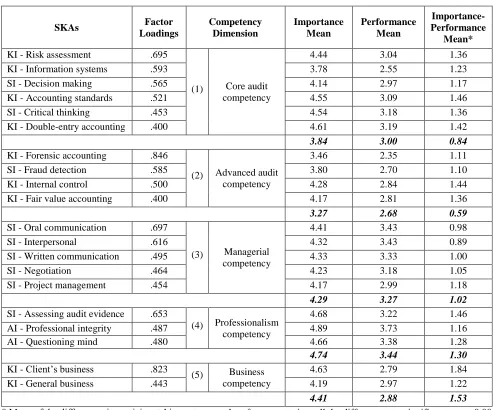
Research question 2 seeks to identify auditors’ key competencies and examine audit supervisors’ perceived performance of ELAs in the identified SKAs and key competencies. We perform an exploratory factor analysis on the participants’ importance ratings of the 20 SKAs using Varimax rotation with Kaiser Normalization. The SKAs load onto five distinct dimensions as shown in Table 2. Based on the nature of the SKAs that load into each dimension, the five dimensions appear to relate to (1) basic auditor competency, (2) advanced auditor competency, (3) managerial competency, (4) professionalism competency, and (5) business competency. For each competency, we compute a mean importance score based on the importance ratings for the SKAs that load into that competency. We also analyse the performance-importance gap, which is the difference between a supervisors’ mean perceived performance and importance ratings, for each SKA and competency. A positive importance-performance gap indicates that the ELAs’ performance falls below the required level and vice-versa. The results of the importance-performance gap for the identified SKAs and competencies are reported in Table 2.
21
not adequately equip accounting graduates with the necessary competency levels required by the auditing profession, particularly for some of the critical SKAs, given that the majority of the RGAs in Singapore would have had a tertiary education in accounting or business. Some of the SKAs and competencies such as the ability to understand a client’s business are best developed via on-the-job training as each client's business is unique and an in-depth understanding will require time on the part of the auditors.
CONCLUSION
Our study seeks to contribute to extant auditing literature by examining a broader and more comprehensive set of skills, knowledge and attitudes that are essential to succeed as auditors. Our survey is confined to participants in Singapore. However, the study findings and implications may be generalizable as Singapore accounting profession closely adheres to the international accounting and auditing standards as well as practices.
22
developers of accounting curriculum face the challenge of finding a right balance among imparting knowledge, nurturing skills, and raising professional conscientiousness. Our study finds that some skills and attitudes received relatively higher importance ratings than knowledge. Therefore, developers of accounting curriculum need to pay careful attention to the combination of SKAs to inculcate in their students. Several studies have examined the use and effectiveness of novel and active pedagogies (DeBerg & Chapmon, 2012; Watts & McNair, 2008; Cornick, Bhamornsiri & Malmgren, 2003). Accounting curriculum developers can use the results of these studies and ours to explore pedagogies that can help to build up the critical SKAs in students.
Our findings also highlight the value of a holistic approach to accounting education. Some of the knowledge areas that are acquired in general business and accounting courses received higher importance ratings than knowledge acquired in auditing courses. For example, ability to understand client's business, double-entry knowledge, and financial accounting standards knowledge received higher importance ratings than risk assessment and internal control knowledge. These findings are significant because the ability to understand client's business and specific financial accounting knowledge areas have not been examined before. The high importance of the entry accounting is especially interesting because the relevance of double-entry accounting has been debated (Fisher, 1997). Hunton (2002) argues that many traditional accounting tasks can be reliably automated, which might then undermine the accountants' role and contribution. However, information systems perform accounting tasks in a mechanical manner and are not capable of exercising judgments that are increasingly needed in (new) accounting standards. Therefore, accounting students need to be aware of the importance of having a thorough knowledge of double-entry accounting and financial accounting standards. Furthermore, Arens and Elder (2006) report that many accounting majors lack respect for "soft material" covered in non-accounting courses. However, our results suggest otherwise and getting a holistic and broad accounting education is very important to succeed as public accountants.
23
and/or accounting curriculum committee, not just auditing professors. After all, the SKAs required to succeed are not acquired through auditing courses alone.
The findings on our second research question indicate that the 20 SKAs examined in our study can be categorized into five sets of auditor competencies— basic, advanced, managerial, professionalism, and business. Future research is needed to validate these competencies and their generalizability to other countries and hierarchical levels (e.g., audit seniors, managers, and partners). In the immediate, the findings may be particularly important for professional bodies and auditing firms. According to the International Education Standard 8 developed by the International Federation of Accountants (IFAC, 2006), the education and development required to become an audit professional can be obtained at different points along the education cycle. The standard indicates that education pursued at academic institutions, on-the-job training, employer or professional organization training, and continuing professional development are all vital to becoming an audit professional. In this context, our findings (especially the vital importance of skills and attitudes) can be used by professional bodies such as Institute of Singapore Chartered Accountants (ISCA) and Certified Practising Accountants Australia (CPA Australia), which are the dominant professional accounting bodies in Singapore, to improve the quality of their members. For example, professional bodies could focus on helping ELAs develop their ability to understand clients’ businesses through sharing by industry experts at seminars, training sessions, and conferences. Such training can provide significant leverage for ELAs in their initial years in the profession, and lift their competency levels.
Similarly, accounting firms and professional bodies can develop SKA training programs, prioritizing by their importance and assessed importance-performance gaps. In addition, Tan (1999) reports variations in the relative importance of audit attributes across organizational levels. Thus, accounting firms will need to combine their own assessments and findings from this study and Tan’s (1999) study in developing and customizing their training programs for different audit ranks.
24
the perceived performance of ELAs only reflects the quality of Singapore undergraduate accounting training and curriculum. However, the accounting curriculum in Singapore universities closely resembles that in many developed countries. Being a cosmopolitan city, Singapore accounting firms also employ accounting graduates from other overseas universities. Consequently, our findings on ELAs’ performance may not be country-specific, pertaining only to the effectiveness of Singapore accounting training and curriculum. Future research can look into these issues. Another avenue for future research is to examine changes in the relative importance of SKAs and competency sets across audit ranks. Extending the examination across hierarchical levels provides a potentially better understanding of the roles and contributions of on-the-job training, continuous professional education, and even post-graduate qualifications.
Another limitation of our study is that the participants do not have the option to indicate other attributes that they think are important to succeed as an auditor. While we have conducted an extensive literature review, the SKAs examined in our study may not necessary be exhaustive. In addition, we have not defined the SKAs in our survey instrument. Consequently, our participants could have different notions of the identified SKAs. Future research can include more detailed explanations and context of the SKAs examined in this study, and other relevant SKAs. For example, internal control knowledge can be examined in greater details. New governance requirements have placed more emphasis on documenting and testing internal controls over financial reporting and required other good corporate governance controls and practices to be adopted (Arens & Elder, 2006). Equally important, future studies should include internal control skills, not merely knowledge. Skills of linking internal control strengths and weaknesses to both financial statement assertions and (the nature and extent of) substantive testing are especially worthy of investigation.
25
26
REFERENCES
Abdolmohammadi, M. J., Searfoss, D. G., & Shanteau, J. (2004). 'An investigation of the
attributes of top industry audit specialists', Behavioural Research in Accounting, vol.16,
pp.1-17.
Abdolmohammadi, M. J., & Shanteau, J. (1992), 'Personal attributes of expert auditors',
Organizational Behaviour and Human Decision Processes, vol.53, no.2, pp.158-158.
Accounting and Corporate Regulatory Authority (ACRA) (2007), Registration document for
public accountants. Available at http://www.acra.gov.sg/NR/rdonlyres/4C5D29D8
-A7BC-4216-B951-D47EAF0789/9855/TheRegistratioFrameworkforPublicAccountants
Pathto.pdf
Accounting and Corporate Regulatory Authority (ACRA) (2009), Practice Monitoring
Programme. Available at http://www.acra.gov.sg/ NR/rdonlyres/C6F3 67C7-
0655-4136-9812-22961AD536A0/9835/PracticeMonitoringProgrammeThirdPublicReportAugust.pdf
Alsop, R. (2003), 'Right and wrong: Can business schools teach students to be virtuous? In
the wake of all the corporate scandals, they have no choice but try', The Wall Street
Journal, (17 September 2003), R9.
Antle, R. & Nalebuff, B. (1991), 'Conservatism and Auditor-Client Negotiations', Journal of
Accounting Research, vol. 29, pp.31-53
American Institute of Certified Public Accountants (AICPA) - Statement of Auditing
Standards (SAS) 99 (2002). Available at http://www.aicpa.org/InterestAreas/Foresnsic
AndValuation/Resources/FraudPreventionDetectionResponse/Pages/Summary%20of%20
SAS%20No.aspx
Arens, A.A. and Elder, R.J. (2006), 'Perspectives on Auditing Education after
Sarbanes-Oxley', Issues in Accounting Education, vol.21, no.4, pp. 345-362.
Armitage, J. (2008), 'Changes in the importance of topics in auditing education: 2000-2005',
Managerial Auditing Journal, vol.23, no.9, pp.935-959
Armitage, J., & Poyzer, j. K, B.K.D., L.L.P. (2010), 'Academicians' and practitioners' views
on the importance of the topical content in the first auditing course', American Journal of
Business Education, vol.3, no.1, pp. 71-81.
Auditing and Assurance Standards Board (AASB) (2009). ASA 200, 'Overall Objectives of
the Independent Auditor and the Conduct of an Audit in Accordance with Australian
Auditing Standards'. Available at http://www.auasb.gov.au/admin/file/content102/c3/
27
Ballou, B., Cashell, J., & Heitger, D. L. (2008), 'Alternatives for addressing major challenges
in teaching introductory auditing courses' Journal of Accounting Education, vol. 26,
no.4, pp. 231.
Beasely, M. S., Carcello, J. V., & Hermanson, D. R. (2001), 'Top 10 audit deficiencies',
Journal of Accountancy, vol.191, no. 4 , pp. 63-66.
Becker, D., Haugen, S., & Mattson, L. (2005), 'Continuing ethics education is critical to
improving professional conduct of auditors', Journal of Legal, Ethical and Regulatory
Issues, vol. , no.1, pp.13-24.
Beggs, J. M., & Dean, K. L. (2007), 'Legislated Ethics or Ethics Education? :Faculty Views in
the Post-Enron Era', Journal of Business Ethics, vol. 71, no.15, pp.37.
Bell, T.B., Marrs, F.O., Solomon, I. & Thomas, I. (1997), 'Auditing Organizations through a
Strategic Systems Lens' , KPMG LLP, Montvale, NJ.
Chaffey, J., Van Peursem, K.,A., & Low, M. (2011). Audit education for future professionals:
Perceptions of New Zealand auditors. Accounting Education, vol.20, no.2, pp.153.
Committee of the Sponsoring Organizations of the Treadway Commission (COSO Report)
(1992), 'Internal Control Integrated Framework,' New York, N.Y. Available at
http://www.coso.org/documents/Internal%20Control-Integrated%20Framework.pdf
Coenen, T. L. (2010), 'Escaping detection: Why auditors do not find fraud', Valuation
Strategies, vol.13, no.4, pp. 37-39.
Cornick, M. F., S. Bhamornsiri, & E. G. Malmgren (2003), Assessment of introductory
accounting courses: The key to continuous improvement. In B. N. Schwartz and J.
Edward Ketz (ed.), Advances in Accounting Education: Teaching and Curriculum
Innovations, vol.5, pp. 121-128. Oxford, UK: Elsevier Science Limited.
Crawford, L., Helliar, C., & Monk, E. A. (2011). Generic skills in audit education.
Accounting Education, vol.20, no.2, pp.115.
Crawley, E., Malmqvist, J., Ostlund, S., & Brodeur, D. (2007), Rethinking Engineering
Education: The CDIO Approach, New York, NY, Springer
Curd, R., & Thorpe, J. (2008), 'Auditors' liability for failure to 'blow whistle' on fraud', Credit
Control,vol.29, no.1, pp.16-17.
DeBerg, C. L., & Chapman, K. J. (2012). Assessing student performance and attitudes based
on common learning goals and alternative pedagogies: the case of principles of financial
accounting, Academy of Educational Leadership Journal, vol.16, pp.63-79.
Deppe, L. A., Sonderegger, E. O., Stice, J.D., Clark, D.C., and Streuling, G.F, (1991),
Emerging competencies for the practice of accountancy.' Journal of Accounting
28
Earley, C. E., & Kelly, P. T. (2004), 'A note on ethics educational interventions in an
undergraduate auditing course: Is there an "Enron effect"?', Issues in Accounting
Education, vol.19, no.1, pp. 53-71.
Eilifsen, A., Knechel, R., & Wallage, P. (2001), 'Application of the business risk audit model:
A field study', Accounting Horizons, vol.15, no.3, pp.193-207.
Ernst and Young (2009), Board Matters Quarterly. Available at
http://www.ey.com/Publication/vwLUAssets/BoardMattersQuarterly_issue2_Dec2009/$F
ILE/BoardMattersQuarterly_issue2_Dec2009.pdf
Favere-Marchesi, M. (2000), 'Audit quality in ASEAN', International Journal of Accounting,
vol. 35, no, 1, pp. 121-149
Financial Reporting Council (2010), Auditor Scepticism: Raising the Bar. Available at
http://www.frc.org.uk/getattachment/2a1e0146-a92c-4b7e-bf33-305b3b10fcd2/Discus
sion-Paper-Auditor-Scepticism-Raising-the-Ba.aspx
Fisher, S. A. (1997). In defense of double entry accounting. The National Public Accountant,
vol.42, no. 3, pp. 33-34.
Gandel, S. (2008), The Madoff Fraud: How Culpable Were the Auditors. Available at
http://www.time.com/time/business/article/0,8599,1867092,00.html
Goby, V., & Lewis, J. H. (1999), 'Auditors' Communication Requirements: A Study of Five
MNCs in Singapore', Business Communication Quarterly, vol. 62, no.4, pp.41-52.
Gibbins, M., McCracken, S., & Salterio, S. (2007), 'The chief financial officer's perspective
on auditor-client negotiations', Contemporary Accounting Research, vol.24, no. 2, pp.
387-422.
Hollander, H.E., Holland, L. and Atthowe, J.M. (1988). 'Hypnosis: Innate ability or learned
skills?' Philadelphia, PA, US: Brunner/Mazel, Philadelphia, PA, pp. 37-53.
Hunton, J.E. (2002), Blending information and communication technology with accounting
research, Accounting Horizons, vol. 16, pp. 56 – 67.
Internal Auditing Association (IAA) (1999), Internal audit benchmarking. Available at
http://www.acl.com/pdfs/Survey_IIA_2009.pdf
International Federation of Accountants (IFAC) (2006). International Education Standard
IES 8 Competence requirements for audit professionals. Available at
http://www.ifac.org/sites/default/files/publications/files/ies-8-competence-requirem.pdf
International Federation of Accountants (IFAC) - IAS 200 (2010). International Standard on
Auditing (ISA) 200. Overall objectives of the independent auditor and the conduct of an
audit in accordance with international standards on auditing. Available at
http://www.ifac.org/sites/default/files/downloads/a008-2010-iaasb-hand book-isa-200.pdf
International Federation of Accountants (IFAC) - IAS 240 (2010). International Standard on
29
statements. Available at
http://www.ifac.org/sites/default/files/downloads/a012-2010-iaasb-handbook-isa-240.pdf
International Federation of Accountants (IFAC) - IAS 315 (2010). Identifying and assessing
the risks of material misstatements through understanding the entity and its environment.
Available at
http://www.ifac.org/sites/default/files/downloads/a012-2010-iaasb-handbook-isa-240.pdf
Iwata, E. (2003), 'Accounting Detectives in Demand', USA Today, February 27 2003.
Available at http://www.usatoday.com/money/industries/2003-02 -27-accounting_x.htm
Johnson, E.N., Baird, J., Caster, P., Dilla, W.N., Earley, C. & Louwers, T. (2003), 'Challenges
to audit education for the 21st century: a survey of curricula, course content, and delivery
methods', Issues in Accounting Education, vol.18, no.3, pp. 241-63.
Johnson, S. (2010), 'What is the Auditor's Role in Finding Fraud', CFO.Com. Available at
http://www.cfo.com/article.cfm/14490470
Kavanagh, M. H., & Drennan, L. (2008), 'What skills and attributes does an accounting
graduate need? evidence from student perceptions and employer expectations',
Accounting and Finance, vol. 48,pp. 279-300.
Knapp, C. A., & Knapp, M. C. (2001), 'The Effects of Experience and Explicit Fraud Risk
Assessment in Detecting Fraud with Analytical Procedures', Accounting, Organizations
and Society, vol. 26, pp. 25-37.
KPMG Audit Committee Institute (KPMG-ACI) (2009), Fraud: Insights for Audit
Committees. Available at http://www.kpmg.com/SG/en/IssuesAndInsights/ACI
-publications/Documents/ACI-FraudInsightsAuditCommittees.pdf
Kullberg, D.R., Groves, R. J., Gladstone, W., Homer, L.D., Scanlon, P.R., O'Malley, S.F.,
Cook, J. M., Kangas, E.A. (1989), 'Perspectives on Education: Capabilities for Success in
Accounting Profession'. Available at http://aaahq.org/aecc/pdf/big8/sect3.pdf
Lee, D., & Blaszczynski, C. (1999), 'Perspectives of "fortune 500" executives on the
competency requirements for accounting graduates', Journal of Education for Business,
vol.75, no. 2, pp.104-107.
Libby, R., & Tan, H. T. (1994), 'Modelling the Determinants of Audit Expertise', Accounting,
Organizations and Society, pp. 701 – 716.
Lim, K. (2011), 'Internal controls failed to catch Asia sons’ breach', The Business Times, Dec
28 2011. pp. n/a.
Loebbecke, J., Eining, M., & Willingham, J. (1989), 'Auditors’ experience with material
irregularities: Frequency, nature, and detectability', Auditing: A Journal of Practice and
Theory, vol. 9, pp.1-28.
Lumb, J. (2012). PCAOB sanctions Ernst & Young for audit failures. New York: CCH
30
Maijoor, S. (2000), 'The Internal Control Explosion', International Journal of Auditing. vol.
4, pp. 101-109.
Marriott, N., Telford, B., Davies, M., & Evans, J. (2011). Students' perceptions of work-based
training and examination-based learning relating to the professional competence of
auditors and the impact of regulatory changes on audit training in the UK. Accounting
Education, vol.20, no.2, 133.
Merritt, J. (2003), 'Ethics is also a B-School Business', Business Week, 27 January 2003, pp.
105.
Nelson, M., & Tan, H.T. (2005), 'Judgment and decision making research in auditing: a task,
person, and interpersonal interaction perspective', Auditing: Journal in Practice &
Theory, vol. 24, pp. 41-71.
Nuthall. K. & Raghavendra (2011). AccountancyAge. Available at http:www.account
ancyage.com/aa/news/2131072/auditors-barred-life-satyam-scandal
O'Donnell, E., & Schultz, J. (2005), 'The Halo effect in business risk audits: Can strategic
risk assessment bias auditor judgment about accounting details?'. The Accounting Review,
vol. 80, no.3, pp. 921-939
Palmer, K. N., Ziegenfuss, D. E., & Pinsker, R. E. (2004), 'International knowledge, skills,
and attitudes of auditors/accountants', Managerial Auditing Journal, vol. 19, no. 7, pp.
889-896.
Pierre, L. T., Robert, L. B., & Michael, J. M. (2004). Accounting education: Response to
corporate scandals. Journal of Accountancy, vol.198, no.5, pp.59-65.
Pritchard, M. S. (2006). Professional integrity: Thinking ethically. Lawrence, Kan: University
Press of Kansas.Public Company Accounting Oversight Board (PCAOB), (2008).
PCAOB 2007 Annual Report. Washington, D.C.Public Company Accounting Oversight
Board (PCAOB), (n.d.). AU section 230.07. Available at
http://pcaobus.org/Standards/Auditing/Pages/AU230.aspx#ps-pcaob-ic410f9b-5033-4f18-b865-af1307863bee
Quinn, A., Lemay, G., Larsen, P., & Johnson, D.M. (2009),' Service Quality in Higher
Education', Total Quality Management & Business Excellence, vol. 48, no.2, pp. 139-152.
Shanteau, J. (1987), 'Psychological characteristics of expert decision makers', In J. L.
Mumpower, O. Renn, L. D, Philips, & V.R.R. Uppuluri (Eds.). Expert judgement and
expert systems. Berlin: Springer-Verlag.
Shibano, T. (1990), ‘Assessing Audit risk from errors and irregularities’, Journal of
Accounting Research. (Suppl.), pp. 110-140.
Siegel, G., & Kulesza, C. S. (1996), ‘The practice analysis of management accounting’,
31
Siegel, G., & Sorensen, J. E. (1994). ‘What corporate America wants in entry-level
accountants’, Management Accounting, vol.76, no.3, pp.26.
Siegel, G. & Sorensen, J. (1999), Counting more counting less: Transformations in the
management accounting profession. Available at http://uwacadweb.uwyo.edu/
ELMENDOR/Acct%204540%20Cost%202/Counting%20More,%20Counting%20Less.p
df
Sinason, D. H. (2002), 'Project management in an audit environment', Internal Auditing,
vol.17, no.2, pp. 3-9.
Sinason, D. H., McEldowney, J. E., & Pinello, A. S. (2002), 'Improving audit planning and
control with project management techniques', Internal Auditing, vol.17, no.6, pp.12-16.
Smith, G.S. and Crumbley, D.L. (2009), 'How divergent are pedagogical views toward the
fraud/forensic accounting curriculum?' Global Perspectives on Accounting Education,
vol.6, pp. 1-24.
Suksudaj, N., Townsend, G. C., Kaidonis, J., Lekkas, D., & Winning, T. A. (2012),
'Acquiring psychomotor skills in operative dentistry: Do innate ability and motivation
matter?', European Journal of Dental Education, vol. 16, no.1, e187-e194
Tan, C. (2011), 'Miyoshi to tighten internal controls', The Business Times, Nov 26 2011. pp.
n/a.
Tan, H. T. (1999), 'Organizational levels and perceived importance of attributes for superior
audit performance', Abacus, Vol.35, no.1, pp.77-90.
Tan, H. T. & Libby, R. (1997), 'Tacit managerial versus technical knowledge as determinants
of audit expertise in the field', Journal of Accounting Research, vol. 35, no. 1, 97-113.
Titard, P. L. Braun, R. L., & Meyer, M. J. (2004), 'Accounting education: response to
corporate scandals', Journal of Accountancy, November, pp. 59-65
Transparency International (2010), Available at http://www.globalethics.org/newsline
/2010/11/01/ti-2010-rr/
Uyar, A., & Gungormus, A. H. (2011),'Professional knowledge and skills required for
accounting majors who intend to become auditors: Perceptions of external auditors',
Business and Economics Research Journal, vol. 2, no. 3, pp.33-49.
Watts, T., & McNair, C. J. (2008). Trigger points: Enhancing generic skills in accounting
education through changes to teaching practices, Australasian Accounting Business &
Finance Journal, vol. 2, no. 2), pp.34-51.
Xinhua-Dow Jones (2011). Xhinhua-DowJones International Financial Centers Development
Index-2011. Available at http://www.sh.xinhuanet.com/zhuanti2011/ifcd2011/
32
Table 1: Participants’ mean importance ratings of the SKAs
Rank SKA Mean
1 Professional integrity 4.89
2 Assessing audit evidence 4.68
3 Questioning mind 4.66
4 Ability to understand client’s business 4.63
5 Knowledge on double-entry accounting 4.61
6 Knowledge on accounting standards 4.55
7 Critical thinking skills 4.54
8 Risk assessment knowledge 4.44
9 Oral communication skills 4.41
10 Written communication skills 4.33
11 Interpersonal skills 4.32
12 Internal control knowledge 4.28
13 Negotiation skills 4.23
14 General business knowledge 4.19
15 Project management skills 4.17
15 Knowledge on fair value accounting 4.17
17 Decision making skills 4.14
18 Fraud detection skills 3.80
19 Information systems knowledge 3.78
33
Table 2 SKAs and competencies: importance and performance means, and performance-importance means SKAs Factor
Loadings Competency Dimension Importance Mean Performance Mean Importance-Performance Mean* KI - Risk assessment .695
(1) Core audit competency
4.44 3.04 1.36 KI - Information systems .593 3.78 2.55 1.23 SI - Decision making .565 4.14 2.97 1.17 KI - Accounting standards .521 4.55 3.09 1.46 SI - Critical thinking .453 4.54 3.18 1.36 KI - Double-entry accounting .400 4.61 3.19 1.42
3.84 3.00 0.84
KI - Forensic accounting .846
(2) Advanced audit competency
3.46 2.35 1.11 SI - Fraud detection .585 3.80 2.70 1.10 KI - Internal control .500 4.28 2.84 1.44 KI - Fair value accounting .400 4.17 2.81 1.36
3.27 2.68 0.59
SI - Oral communication .697
(3) Managerial competency
4.41 3.43 0.98 SI - Interpersonal .616 4.32 3.43 0.89 SI - Written communication .495 4.33 3.33 1.00 SI - Negotiation .464 4.23 3.18 1.05 SI - Project management .454 4.17 2.99 1.18
4.29 3.27 1.02
SI - Assessing audit evidence .653
(4) Professionalism competency
4.68 3.22 1.46 AI - Professional integrity .487 4.89 3.73 1.16 AI - Questioning mind .480 4.66 3.38 1.28
4.74 3.44 1.30
KI - Client’s business .823
(5) Business competency
4.63 2.79 1.84 KI - General business .443 4.19 2.97 1.22
4.41 2.88 1.53