0022-538X/11/$12.00 doi:10.1128/JVI.02556-10
Copyright © 2011, American Society for Microbiology. All Rights Reserved.
NOTES
Efficient Rescue of Recombinant Lassa Virus Reveals the Influence of
S Segment Noncoding Regions on Virus Replication and Virulence
䌤
Ce
´sar G. Albarin
˜o,* Brian H. Bird, Ayan K. Chakrabarti, Kimberly A. Dodd,
Bobbie Rae Erickson, and Stuart T. Nichol
Viral Special Pathogens Branch, Division of High-Consequence Pathogens and Pathology, Centers for Disease Control and Prevention, 1600 Clifton Road, Atlanta, Georgia 30333
Received 8 December 2010/Accepted 29 January 2011
Lassa virus (LASV), is a significant cause of severe, often fatal, hemorrhagic fever in humans throughout western Africa, with an estimated 100,000 infections each year. No vaccines are commercially available. We report the development of an efficient reverse genetics system to rescue recombinant LASV and to investigate the contributions of the long 5ⴕand 3ⴕnoncoding regions (NCRs) of the S genomic segment toin vitrogrowth and in vivo virulence. This work demonstrates that deletions of large portions of these NCRs confer an attenuated phenotype and are a first step toward further insights into the high virulence of LASV.
Lassa virus (LASV), family Arenaviridae, is an enveloped
RNA virus (8) which can cause a severe hemorrhagic syn-drome with case fatalities approaching 10 to 20% (13, 20). The public health impact of LASV is enormous, with an estimated 100,000 to 300,000 cases per year in western Africa (19, 20). Human infections typically occur following contact with con-taminated excrement or inhalation of infectious aerosol from
the natural rodent reservoir (Mastomysspp.) (23). Nosocomial
transmission has been documented in resource-poor settings (11). LASV is a category A select agent requiring biosafety level 4 facilities for safe handling. Treatment of Lassa fever with ribavirin has proven efficacious when it is administered early in the course of infection, but prompt detection of cases is challenging (5, 21). Despite the public health importance of LASV infection, effective vaccines are not currently available. The LASV genome is composed of two ambisense
single-stranded RNA segments, S and L (8). The S segment (⬃3.4 kb)
encodes the glycoprotein precursor (GPC;⬃75 kDa) and the
nucleoprotein (N;⬃65 kDa); while the L segment (⬃7.2 kb)
encodes the matrix protein (Z;⬃11 kDa) and the viral
poly-merase (L;⬃200 kDa). The coding regions of the segments are
separated by an intergenic (IG) region with strong secondary structure, where transcription termination occurs (15, 17, 22, 26). Interestingly, analyses of the lymphocytic choriomeningitis virus (LCMV) IG region revealed functions in both transcrip-tion terminatranscrip-tion and assembly or budding of virus particles (26).
The arenavirus RNA genome termini are highly conserved,
and their 5⬘and 3⬘termini are complementary, enabling
pan-handle structures to form (4). These RNA panpan-handles contain essential promoter elements for both virus mRNA transcrip-tion and RNA genome replicatranscrip-tion (8). In a closely related
* Corresponding author. Mailing address: Viral Special Pathogens Branch, Division of High-Consequence Pathogens and Pathology, Centers for Disease Control and Prevention, 1600 Clifton Road, MS G14, Atlanta, GA 30329. Phone: (404) 639-1115. Fax: (404) 639-1118. E-mail: [email protected].
䌤Published ahead of print on 9 February 2011.
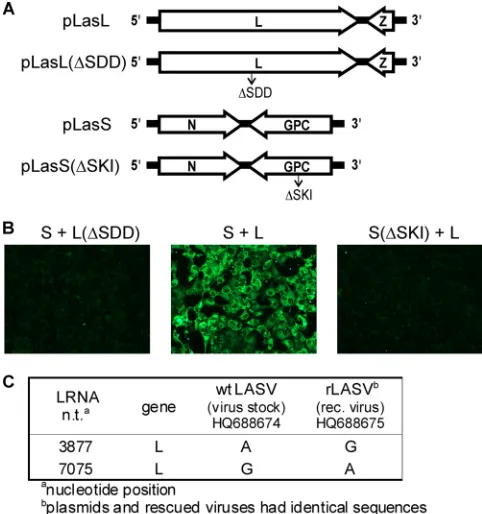
FIG. 1. (A) Schematic of plasmids used to generate fully infectious LASV. (B) Recombinant (rec.) viruses were generated in BSRT7/5 cells and passaged onto VeroE6 cells as described before (1). Infected cells were fixed at 4 dpi, and LASV proteins were detected with anti-LASV rabbit serum and anti-rabbit Alexa Fluor 488. Fluorescent photomicrographs were taken using a specific wavelength filter. (C) Minor changes in the sequence of the L RNA segment were maintained as selective markers to differentiate the recombinant from the wild-type virus.
4020
on November 7, 2019 by guest
http://jvi.asm.org/
[image:1.585.299.540.384.641.2]arenavirus, LCMV, the 5⬘- and 3⬘-terminal 19 nucleotides (nt) were found to be essential for maintaining promoter function, as mutation of these residues (nt 1 to 19) severely reduced or abolished promoter activity (24). However, deletions internal to the predicted panhandle structure (positions 20 to 23 or 24 to 33) did not reduce LCMV promoter activity. A similar report (14) identified two subregions contained within the 19-nt promoter element of LASV. Terminal residues 1 to 12 were strictly required, in a sequence-specific manner, for virus replication. However, the internal subregion (positions 12 to 19) could be mutated without a significant impact on virus promoter activity, as long as RNA terminal comple-mentarity was maintained by corresponding changes in the opposite terminus.
Reverse genetics techniques have allowed the precise
ma-nipulation of virus genomes to study critical features of the virus life cycle, including mechanisms of transcription, replica-tion, and persistence and the function of viral proteins (9, 13). Recently, reverse genetics platforms have been reported for several arenaviruses, including LCMV (12, 27), Junin virus (1), and Pichinde virus (16), allowing the development of new vaccine candidates (2, 6, 25) and tools to allow high-through-put screening of antiviral compounds (10, 28).
We report here a highly efficient and robust two-plasmid reverse genetics system to rescue recombinant LASV. We
fur-ther utilize this system to study the role of the genomic 5⬘and
3⬘noncoding regions (NCRs) of LASV inin vitrogrowth and
in vivo virulence. This system relies on the transcription of
full-length viral complementary genomes (antigenomes) on a T7 RNA polymerase-based platform that has been well
de-FIG. 2. (A) RNA secondary structure of the full-length LASV S RNA segment predicted by Mfold (29). The box on right depicts a magnification of the 5⬘-3⬘-terminal region and the predicted panhandle structure. (B) The lengths of the 5⬘and 3⬘NCRs of S RNAs from representative LASV strains are shown at the top; below are the available L RNA NCR lengths. The lengths of NCRs of S RNAs from LCMV strains are shown in the middle, and those from three representative phleboviruses are shown at the bottom.
on November 7, 2019 by guest
http://jvi.asm.org/
scribed previously (1, 7, 18). Briefly, we amplified the S and L genomic RNAs of LASV (Josiah strain) by reverse transcrip-tion (RT)-PCR and cloned them into a T7 transcriptranscrip-tion vector. For virus rescue, two plasmids encoding full-length virus com-plementary copies of the S and L segments, pLasS and pLasL (Fig. 1A), were transfected into BSRT7/5 cells and incubated at 37°C for 5 days. After this incubation, the supernatant was clarified and passed onto a fresh monolayer of VeroE6 cells. After 3 days of incubation, the cells were fixed and the pres-ence of virus was detected by indirect fluorescent-antibody assay (IFA) (Fig. 1B). As a negative control, we combined the wild-type S (wtS)-containing plasmid (pLasS) with a plasmid
encoding an inactive viral polymerase (pLasL-⌬SDD) in which
the three essential amino acids of the catalytic core motif were replaced with three alanines. As a further control, we com-bined the wild-type L (wtL)-containing plasmid (pLasL) with a
plasmid (pLasS-⌬SKI) encoding a GPC defective in G1-G2
cleavage via disruption of the natural SKI-I protease recogni-tion site. As shown in Fig. 1B, only the combinarecogni-tion of wtS and wtL allowed the rescue of recombinant LASV. As a genetic marker, two silent nucleotide changes were introduced into the pLasL plasmid for the differentiation of recombinant and wild-type viruses. The S segment plasmid (pLasS) contains a perfect copy of the wild-type LASV (wtLASV) Josiah strain (Fig. 1C). Rescue of recombinant LASV using this system was highly efficient and resulted in 100% success in at least 5 independent rescue replicates.
After the successful generation of recombinant wtLASV (rLASV), we utilized this robust system to study the role of the
5⬘and 3⬘NCRs in the virus replication cycle. The composition
of the minimum promoter element in the S segment of LCMV and LASV has been studied previously (14, 24), and a critical role for the terminal 19 nt has been shown. An analysis of the predicted secondary structure of the LASV S segment RNA (Mfold [29]) revealed this well-described 19-nt terminal pan-handle, but interestingly, a second high-energy panhandle structure could involve base pairing up to position 33 (Fig. 2A).
Further analyses revealed that the lengths of the 3⬘ and 5⬘
NCRs of the LASV S and L segments vary significantly (Fig.
2B, top). For example, the Josiah strain 5⬘NCRs are 54 and 65
nt, while the 3⬘ NCRs were 100 and 157 nt, for S and L,
respectively. This contrasts sharply with the S and L segment NCR lengths of other LASV strains, e.g., ACAR (70 to 113), Pinneo (70 to 114), and Weller (69 to 156), respectively. While they are highly variable individually, a consistent trend exists among all of the characterized LASV strains in that all of their
3⬘NCRs are longer than their 5⬘NCRs.
Similar NCR length variation can be found in LCMV (Fig.
2B, middle). The 5⬘ S segment NCR of the prototype
Arm-FIG. 3. (A) Schematic of plasmids used to generate recombinant LASV mutants carrying single or double deletions in the 5⬘and/or 3⬘ NCR. (B) Recombinant viruses were generated in BSRT7/5 cells and passaged twice on VeroE6 cells. Viral titers (right) were determined by standard TCID50assay.
FIG. 4. (A) Growth curves generated by infecting VeroE6 cells with a multiplicity of infection of 0.01 and collecting supernatants at 24-h intervals. Virus titers were determined in a TCID50assay. Peak titers reached at 3 dpi are shown on the right. (B). Replication phenotype in the
mouse model. Four groups of 14-day-old mice were infected intracranially with 500 TCID50of authentic rLASV or a single or double deletion
mutant virus. Brains and spleens were collected at 7 dpi, and LASV RNA was detected with a quantitative RT-PCR assay. The number of positive (pos) detections and the averageCT(threshold cycle) value are shown. LASV RNA was normalized between specimens using a multiplexed
primer-probe set for glyceraldehyde 3-phosphate dehydrogenase (GADPH) mRNA (ABI).
on November 7, 2019 by guest
http://jvi.asm.org/
strong strain and 13 others is 77 nt long, while it is only 60 nt long in the naturally occurring CA2003 strain (3). In compar-ison, the phlebovirus S segment, which is also ambisense, con-tain complete promoter elements in even more compressed NCRs (Fig. 2B, bottom).
The observed length polymorphisms led to a central ques-tion regarding the funcques-tion of these NCRs in the virus life cycle. To test whether replication could be modulated by mu-tations on the NCR outside of the classically recognized ter-minal panhandle, we constructed an array of S clones with precise deletions of various lengths in the S segment NCRs (Fig. 3, left). To ensure that basal RNA-dependent RNA poly-merase transcription and replication promoter elements and
translation were preserved, we left intact the 5⬘and 3⬘ 19-nt
NCR and the original Kozak motif flanking the start codon of each open reading frame.
Viral rescue was attempted as described above, by cotrans-fection of BSRT7/5 cells with the mutated pLasS-derived plas-mids and pLasL, followed by two blind passages in VeroE6 cells and subsequent titration. As shown in Fig. 3 (right), the rescue of the wild type and each mutant virus was successful. Interestingly, after 2 passages on VeroE6 cells, mutant viruses
containing deletions in the 3⬘ NCR only [rLASV-S(3⬘⌬24),
rLASV-S(3⬘⌬48), and rLASV-S(3⬘⌬74)] were rescued with
fi-nal titers (2⫻105to 4⫻10550% tissue culture infective doses
[TCID50]/ml) similar to that of full-length rLASV. In contrast,
viruses with 5⬘ NCR deletions only [rLASV-S(5⬘⌬25)] or 5⬘
and 3⬘ double deletions [rLASV-S(5⬘⌬25/3⬘⌬24),
rLASV-S(5⬘⌬25/3⬘⌬48), and rLASV-S(5⬘⌬25/3⬘⌬74)] grew to lower
titers (1⫻104to 4⫻ 104 TCID
50/ml), indicating that while
neither region is absolutely required for virus replication,
de-letions in the 5⬘ NCR are more deleterious to virus growth
efficiency than 3⬘NCR deletions.
To determine the potential significance of these minor
dif-ferences in initial virus titers, we examined thein vitrogrowth
kinetics of rLASV and three single or double deletion mutants
[rLASV-S(3⬘⌬74), rLASV-S(5⬘⌬25), and rLASV-S(5⬘⌬25/
3⬘⌬74)]. Wild-type and mutant viruses reached peak titers at 3
days postinfection (dpi) (Fig. 4). Interestingly, rLASV grew to
5 ⫻ 107 TCID
50/ml, while the rLASV-S(3⬘⌬74),
rLASV-S(5⬘⌬25), and rLASV-S(5⬘⌬25/3⬘⌬74) mutants grew to lower
titers of 5⫻106, 2⫻105, and 4⫻104TCID
50/ml, respectively.
These data clearly demonstrated that while these NCRs were not absolutely required for virus growth in cell culture, the deletions did impact virus growth efficiency.
Given the modest growth differencesin vitro, we investigated
the impact of NCR deletions on virus virulence. Fourteen-day-old weanling mice (10/group) were injected intracranially with
500 TCID50of rLASV (a known lethal dose) or 500 TCID50
of rLASV-S(3⬘⌬74), rLASV-S(5⬘⌬25), or rLASV-S(5⬘⌬25/
3⬘⌬74). At 7 dpi, all animals were humanely euthanized, and
brain and splenic tissues were collected for virus detection using a quantitative RT-PCR assay (Fig. 4B). Interestingly, in
animals inoculated with full-length rLASV, rLASV-S(3⬘⌬74),
or rLASV-S(5⬘⌬25), similar levels of viral RNA were detected
in the brain (n⫽10 of 10;CT⫽20 to 23) and spleen (n⫽8
to 9 of 10;CT⫽24 to 25). In contrast, animals infected with the
double deletion mutant rLASV-S(5⬘⌬25/3⬘⌬74) were found to
have 10- to 1,000-fold lower viral RNA copies than those
infected with full-length rLASV (brain,n⫽9 of 10;CT⫽28;
spleen,n⫽3 of 10;CT⫽29). These initial results suggest that
significant differences exist between the virulence of full-length
rLASV and that of the double deletion virus rLASV-S(5⬘⌬25/
3⬘⌬74). Apart from lower viral RNA titers, there also appears
to be a reduction in the ability of rLASV-S(5⬘⌬25/3⬘⌬74) to
pass across the blood-brain barrier and cause a disseminated infection. However, due to the inherent limitations of the suck-ling mouse model, further experiments are under way to
in-vestigate the overall contribution of these UTR deletions toin
vivolethality and disease pathogenesis in a more relevant
non-human primate model.
In summary, we describe herein a robust reverse genetics system to generate fully infectious rLASV. We further report the generation of recombinant mutant viruses carrying specific
5⬘and 3⬘NCR deletions and show that these are attenuated to
various degrees in replication and virulence. Further work is required to fully elucidate the role of the LASV NCRs in the virus life cycle and, most importantly, virus virulence.
Nucleotide sequence accession numbers.The sequences de-termined in this study have been submitted to the GenBank database and assigned the following accession numbers: wtLASV, HQ688672 and HQ688674; rLASV, HQ688673 and HQ688675.
We thank Marina Khristova for excellent assistance with LASV genome sequencing during the completion of these studies.
The findings and conclusions in this report are ours and do not necessarily represent the views of the Centers for Disease Control and Prevention.
REFERENCES
1.Albarin˜o, C. G., et al.2009. Efficient reverse genetics generation of infectious Junin viruses differing in glycoprotein processing. J. Virol.83:5606–5614. 2.Albarin˜o, C. G., et al.2011. Reverse genetics generation of chimeric
infec-tious Junin/Lassa virus is dependent on interaction of homologous glyco-protein stable signal peptide and G2 cytoplasmic domains. J. Virol.85:112– 122.
3.Albarin˜o, C. G., et al.2010. High diversity and ancient common ancestry of lymphocytic choriomeningitis virus. Emerg. Infect. Dis.16:1093–1100. 4.Auperin, D. D., R. W. Compans, and D. H. Bishop.1982. Nucleotide
se-quence conservation at the 3⬘termini of the virion RNA species of New World and Old World arenaviruses. Virology121:200–203.
5.Bausch, D. G., C. M. Hadi, S. H. Khan, and J. J. Lertora.2010. Review of the literature and proposed guidelines for the use of oral ribavirin as post-exposure prophylaxis for Lassa fever. Clin. Infect. Dis.51:1435–1441. 6.Bergthaler, A., et al.2006. Envelope exchange for the generation of
live-attenuated arenavirus vaccines. PLoS Pathog.2:e51.
7.Bird, B. H., C. G. Albarin˜o, and S. T. Nichol.2007. Rift Valley fever virus lacking NSm proteins retains high virulence in vivo and may provide a model of human delayed onset neurologic disease. Virology362:10–15. 8.Buchmeier, M. J., C. J. Peters, and J. C. de la Torre.2007. Arenaviridae: the
viruses and their replication, p. 1792–1827.InD. M. Howley and P. M. Knipe (ed.), Fields virology, 5th ed., vol. 2. Lippincott Williams & Wilkins, Phila-delphia, PA.
9.de la Torre, J. C.2008. Reverse genetics approaches to combat pathogenic arenaviruses. Antiviral Res.80:239–250.
10.Emonet, S. F., L. Garidou, D. B. McGavern, and J. C. de la Torre.2009. Generation of recombinant lymphocytic choriomeningitis viruses with triseg-mented genomes stably expressing two additional genes of interest. Proc. Natl. Acad. Sci. U. S. A.106:3473–3478.
11.Fisher-Hoch, S. P., et al.1995. Review of cases of nosocomial Lassa fever in Nigeria: the high price of poor medical practice. BMJ311:857–859. 12.Flatz, L., A. Bergthaler, J. C. de la Torre, and D. D. Pinschewer.2006.
Recovery of an arenavirus entirely from RNA polymerase I/II-driven cDNA. Proc. Natl. Acad. Sci. U. S. A.103:4663–4668.
13.Gu¨nther, S., and O. Lenz.2004. Lassa virus. Crit. Rev. Clin. Lab. Sci.
41:339–390.
14.Hass, M., et al.2006. Mutational analysis of the Lassa virus promoter. J. Virol.80:12414–12419.
15.Iapalucci, S., N. Lo´pez, and M. T. Franze-Fernandez.1991. The 3⬘end termini of the Tacaribe arenavirus subgenomic RNAs. Virology182:269– 278.
on November 7, 2019 by guest
http://jvi.asm.org/
16.Lan, S., et al.2009. Development of infectious clones for virulent and avirulent Pichinde viruses: a model virus to study arenavirus-induced hem-orrhagic fevers. J. Virol.83:6357–6362.
17.Lo´pez, N., and M. T. Franze-Fernandez.2007. A single stem-loop structure in Tacaribe arenavirus intergenic region is essential for transcription termi-nation but is not required for a correct initiation of transcription and repli-cation. Virus Res.124:237–244.
18.Lowen, A. C., C. Noonan, A. McLees, and R. M. Elliott. 2004. Efficient bunyavirus rescue from cloned cDNA. Virology330:493–500.
19.McCormick, J. B.1988. Lassa fever: epidemiology, therapy and vaccine development. Kansenshogaku Zasshi62(Suppl.):353–366.
20.McCormick, J. B., and S. P. Fisher-Hoch.2002. Lassa fever. Curr. Top. Microbiol. Immunol.262:75–109.
21.McCormick, J. B., et al.1986. Lassa fever. Effective therapy with ribavirin. N. Engl. J. Med.314:20–26.
22.Meyer, B. J., J. C. de la Torre, and P. J. Southern.2002. Arenaviruses: genomic RNAs, transcription, and replication, p. 139–149.InM. B. Oldstone (ed.), Arenaviruses I. Springer-Verlag, Berlin, Germany.
23.Monath, T. P., V. F. Newhouse, G. E. Kemp, H. W. Setzer, and A.
Cac-ciapuoti.1974. Lassa virus isolation from Mastomys natalensis rodents dur-ing an epidemic in Sierra Leone. Science185:263–265.
24.Perez, M., and J. C. de la Torre.2003. Characterization of the genomic promoter of the prototypic arenavirus lymphocytic choriomeningitis virus. J. Virol.77:1184–1194.
25.Pinschewer, D. D., et al. 2010. Innate and adaptive immune control of genetically engineered live-attenuated arenavirus vaccine prototypes. Int. Immunol.22:749–756.
26.Pinschewer, D. D., M. Perez, and J. C. de la Torre.2005. Dual role of the lymphocytic choriomeningitis virus intergenic region in transcription termi-nation and virus propagation. J. Virol.79:4519–4526.
27.Sa´nchez, A. B., and J. C. de la Torre. 2006. Rescue of the prototypic arenavirus LCMV entirely from plasmid. Virology350:370–380.
28.Urata, S., et al. 2011. Antiviral activity of a small-molecule inhibitor of arenavirus glycoprotein processing by the cellular site 1 protease. J. Virol.
85:795–803.
29.Zuker, M.2003. Mfold web server for nucleic acid folding and hybridization prediction. Nucleic Acids Res.31:3406–3415.