Welsh in Higher Education Institutions, 2013/14
This Bulletin provides information about students in higher education studying through the Welsh language at Welsh Higher Education Institutions (HEIs) and also higher education staff teaching through the Welsh language at Welsh HEIs, in the 2013/14 academic year. The data included here are taken from the Higher Education Statistics Agency (HESA) Student Record and the HESA staff record. Student numbers are based primarily on the HESA standard registration population, which includes student enrolments throughout the year. Students enrolled at the Open University (OU) are not included.
Summary of main findings
In 2013/14 there were 5,250 students at Welsh HEIs with some teaching through the medium of Welsh, a 4 per cent decrease since 2012/13, although still 11 per cent higher than in 2011/12. However the number of full-time students with some teaching through Welsh increased to 4,100 in 2013/14 compared with 3,850 in 2012/13, a 6 per cent increase.
The proportion of students at Welsh HEIs who had some teaching through the medium of Welsh also decreased slightly, compared with 2012/13 (4.1 per cent in 2013/14 and 4.2 per cent in 2012/13). Excluding Welsh language and related subjects, the most popular subjects of study for students, with
some teaching through the medium of Welsh, were education, creative arts and social studies. The vast majority of students with some teaching through Welsh were on undergraduate courses;
with more than three-quarters of these studying full-time.
300 students completed an Initial Teaching Training (ITT) course which qualified them to teach through the medium of Welsh. This was 21 per cent of all completers, four percentage points higher than in 2012/13
The number of FTE academic staff at Welsh HEIs, the FTE number of staff able to teach through the medium of Welsh, and the number teaching through the medium of Welsh have all increased since 2008/09.
Statistician: Ian Shipley Tel: 029 2082 3528 Email: [email protected] Next update: September 2016 (Provisional)
Twitter: www.twitter.com/statisticswales | www.twitter.com/ystadegaucymru
Policy Background
Welsh medium provision continues to be a key priority for the Welsh Government, including in higher education. The Welsh Government’s Higher Education Policy Statement published in June 2013
confirms the Welsh Government’s vision to see the Welsh language thriving in Wales. Through the Coleg Cymraeg Cenedlaethol, a virtual college working with universities to plan and promote Welsh medium provision, the Welsh Government will continue to support the development of Welsh-medium higher education.
Some of the Coleg’s major programmes include:
• Scholarships for students studying through the medium of Welsh • Research scholarships
• Academic Staffing Scheme • Y Porth website
• Strategic Development and Projects Fund.
Further information on these projects can be found on the Coleg’s website:
http://www.colegcymraeg.ac.uk/en/
HEFCW’s Corporate Strategy for 2013-14 – 2015-16 was approved by the Welsh Government in May 2013. The Strategy includes a target for increasing study through the medium of Welsh as follows: ‘the number of students studying higher education courses at higher education institutions and further education institutions in Wales undertaking at least 5 credits of their course through the medium of Welsh, per annum, will rise from 4,335 in 2011/12 to 5,600 in 2015/16, including a rise from 2,269 to 3,030 in the number of those studying at least 40 credits per annum’. The data in this bulletin should not be used to assess progress against the targets in HEFCW’s Corporate Strategy as they are based on different coverage. This difference mainly relates to comparisons with Coleg Cymraeg who use data on students with more than 5 credits studied in Welsh, whereas this Bulletin includes students with more than zero credits in Welsh.
Links to the Welsh Government Higher Education Policy Statement and the HEFCW Corporate Strategy are given below.
Policy Statement on Higher Education
HEFCW Corporate Strategy 2013-14 to 2015-16
This bulletin includes figures and commentary on Welsh domiciled students studying through the medium of Welsh; however, progress towards the above target cannot be measured directly from these figures due to definitional differences (see Notes: 5.2).
In September 2011 the Welsh Government introduced the Programme for Government, which translates its manifesto into a clear plan to deliver for the people of Wales. One of the key aims set out in the Programme for Government is to enrich the lives of individuals and communities through Wales’s culture and heritage, with a particular responsibility to promote the Welsh language. A link to the program for government is given below.
Welsh Government | Programme for Government 2011-2016
broadening and extending the range of Welsh medium higher education study opportunities. A link to the report is given below:
http://www.hefcw.ac.uk/documents/policy_areas/welsh_medium/CCC%20Evaluation%20Report%20-%20Final2%20(English).pdf
Section A – Student enrolments at Welsh HEIs with some teaching through the medium
of Welsh
Chart A.1 Students enrolments with some teaching through Welsh by level and mode of study
The number of full-time, undergraduate students with some teaching through Welsh continued to increase in 2013/14.
The vast majority of students with some teaching through Welsh were
undergraduates; with over three-quarters of these being full-time undergraduate students.
In 2013/14 there was a fall in part-time undergraduates receiving teaching through Welsh; this mirrors the total student population where part-time
undergraduate numbers have continued to fall.
Numbers of postgraduate students receiving some teaching through Welsh continued to increase in 2013/14.
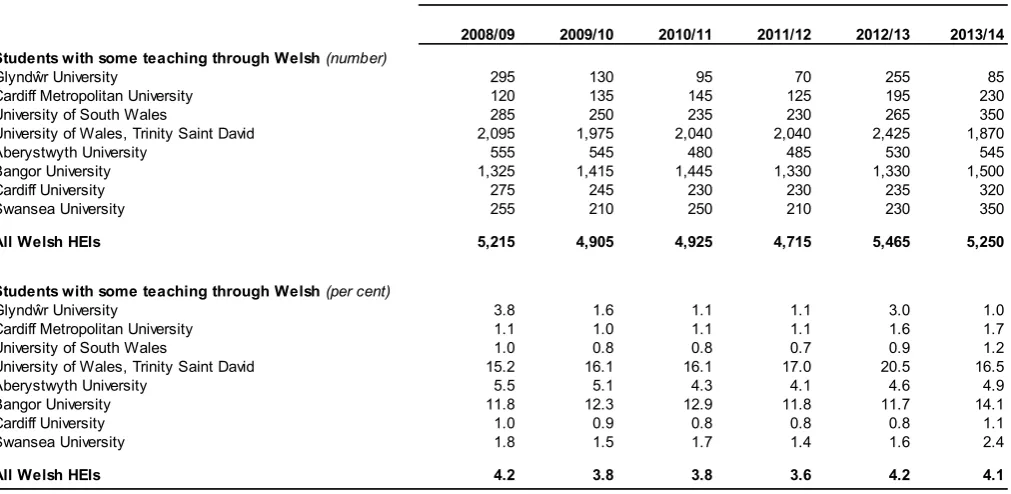
Proportion of teaching through the medium of Welsh by institution and academic year In 2013/14 there were 5,250 students at Welsh HEIs with some teaching through the medium of
Welsh, a 4 per cent increase since 2012/13 (5,465). (Table A.1)
The proportion of students at Welsh HEIs who had some teaching through the medium of Welsh also decreased, compared with 2012/13 (4.1 per cent in 2013/14 and 4.2 per cent in 2012/13). (Table A.1) The University of Wales, Trinity Saint David had both the highest number of students (1,870) and the
highest proportion of its students (16.5 per cent) receiving some teaching through the medium of Welsh. (Table A.1)
Table A.1: Students with some teaching through Welsh by institution and academic year
2008/09 2009/10 2010/11 2011/12 2012/13 2013/14 Students with some teaching through Welsh (number)
Glyndŵr University 295 130 95 70 255 85
Cardiff Metropolitan University 120 135 145 125 195 230
University of South Wales 285 250 235 230 265 350
University of Wales, Trinity Saint David 2,095 1,975 2,040 2,040 2,425 1,870
Aberystwyth University 555 545 480 485 530 545
Bangor University 1,325 1,415 1,445 1,330 1,330 1,500
Cardiff University 275 245 230 230 235 320
Swansea University 255 210 250 210 230 350
All Welsh HEIs 5,215 4,905 4,925 4,715 5,465 5,250
Students with some teaching through Welsh (per cent)
Glyndŵr University 3.8 1.6 1.1 1.1 3.0 1.0
Cardiff Metropolitan University 1.1 1.0 1.1 1.1 1.6 1.7
University of South Wales 1.0 0.8 0.8 0.7 0.9 1.2
University of Wales, Trinity Saint David 15.2 16.1 16.1 17.0 20.5 16.5
Aberystwyth University 5.5 5.1 4.3 4.1 4.6 4.9
Bangor University 11.8 12.3 12.9 11.8 11.7 14.1
Cardiff University 1.0 0.9 0.8 0.8 0.8 1.1
Swansea University 1.8 1.5 1.7 1.4 1.6 2.4
All Welsh HEIs 4.2 3.8 3.8 3.6 4.2 4.1
Source: HESA and the University of South Wales (a) Institution names are those current in the 2013/14 year. Where appropriate, figures for predecessor institutions are now displayed
under their new name. Similarly, w here institutions have merged during the time series the figures have been combined and presented under the new institution name for all years. (See Notes: 5.1 Institutions)
(b) With the exception of 2010/11 and 2012/13, Welsh medium figures for the University of South Wales w ere obtained directly from the university. (See Notes: 5.3 Accuracy)
Proportion of teaching through the medium of Welsh by institution and mode of study
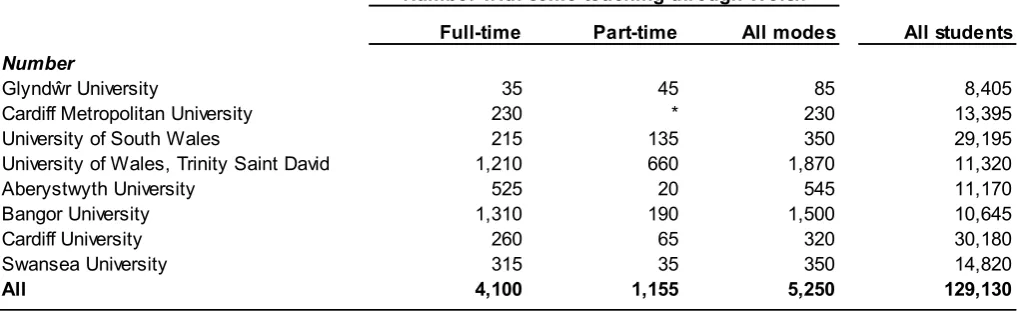
78 per cent of students receiving some teaching through Welsh were enrolled full-time. (Table A.2) A slightly higher proportion of all full-time students received some teaching through Welsh (4.3 per
cent) than did the proportion of all part-time students (3.3 per cent). (Table A.2)
57 per cent of all part-time students in Wales who received some teaching through Welsh were enrolled at University of Wales, Trinity Saint David. There was a large fall in the numbers of part-time students at this university compared with 2012/13, however the number was similar to years prior to that. Part-time students at Cardiff Metropolitan University did not receive any teaching through Welsh. (Table A.2)
Table A.2: Students with some teaching through Welsh by institution and mode of study, 2013/14
Full-time Part-time All modes All students Number
Glyndŵr University 35 45 85 8,405
Cardiff Metropolitan University 230 * 230 13,395
University of South Wales 215 135 350 29,195
University of Wales, Trinity Saint David 1,210 660 1,870 11,320
Aberystwyth University 525 20 545 11,170
Bangor University 1,310 190 1,500 10,645
Cardiff University 260 65 320 30,180
Swansea University 315 35 350 14,820
All 4,100 1,155 5,250 129,130
Full-time Part-time All modes Per cent
Glyndŵr University 0.7 1.4 1.0
Cardiff Metropolitan University 1.9 . 1.7
University of South Wales 1.2 1.2 1.2
University of Wales, Trinity Saint David 15.4 19.1 16.5
Aberystwyth University 5.9 1.0 4.9
Bangor University 15.0 9.8 14.1
Cardiff University 1.2 0.8 1.1
Swansea University 2.6 1.4 2.4
All #REF!4.3 #REF!3.3 #REF!4.1
Source: HESA and the University of South Wales
(a) Institution names are those current in the 2013/14 year. (See Notes: 5.1 Institutions)
Students with some teaching through Welsh as a percentage of all students at the same institution
and with same mode of study Number with some teaching through Welsh
Proportion of teaching through the medium of Welsh by institution and level of study
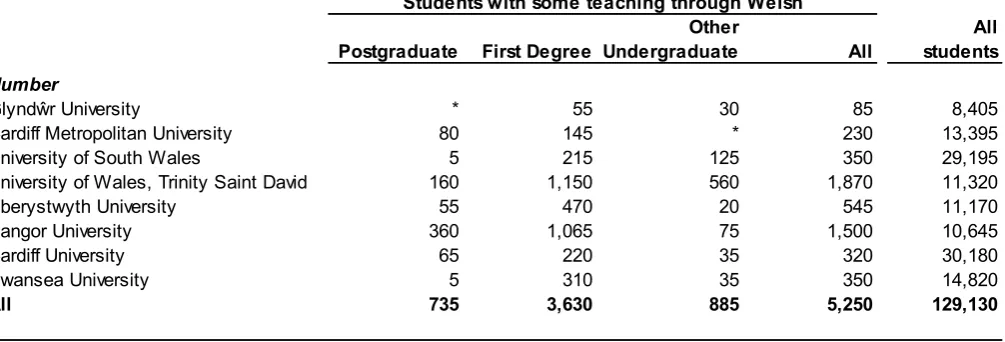
First degree students accounted for 69 per cent of all students with some teaching through Welsh. (Table A.3)
The highest proportion of students with some teaching through Welsh by level of study was amongst first degree students (4.7 per cent), and the lowest amongst postgraduates (2.6 per cent). (Table A.3) 19 per cent of other undergraduates at the University of Wales, Trinity Saint David received some
teaching through Welsh, accounting for 63 per cent of other undergraduates studying through the Welsh language in Wales. The former figure is much lower than 2012/13, but is similar to years previous to that.(Table A.3)
Table A.3: Students with some teaching through Welsh by institution and level of study, 2013/14
Postgraduate First Degree
Other
Undergraduate All Number
Glyndŵr University * 55 30 85 8,405
Cardiff Metropolitan University 80 145 * 230 13,395
University of South Wales 5 215 125 350 29,195
University of Wales, Trinity Saint David 160 1,150 560 1,870 11,320
Aberystwyth University 55 470 20 545 11,170
Bangor University 360 1,065 75 1,500 10,645
Cardiff University 65 220 35 320 30,180
Swansea University 5 310 35 350 14,820
All 735 3,630 885 5,250 129,130
Postgraduate First Degree
Other
Undergraduate All Per cent
Glyndŵr University . 1.2 1.2 1.0
Cardiff Metropolitan University 1.8 1.8 0.3 1.7
University of South Wales 0.1 1.5 1.4 1.2
University of Wales, Trinity Saint David 7.9 18.4 18.5 16.5
Aberystwyth University 3.5 6.1 1.0 4.9
Bangor University 13.8 14.6 10.2 14.1
Cardiff University 0.7 1.3 0.9 1.1
Swansea University 0.2 2.9 1.9 2.4
All 2.6 4.7 3.7 4.1
Source: HESA and the University of South Wales
(a) Institution names are those current in the 2013/14 year. (See Notes: 5.1 Institutions)
Students with some teaching through Welsh
Students with some teaching through Welsh as a percentage of all students at the same institution and at the
same level of study
All students
Students with some teaching through the medium of Welsh by subject and mode
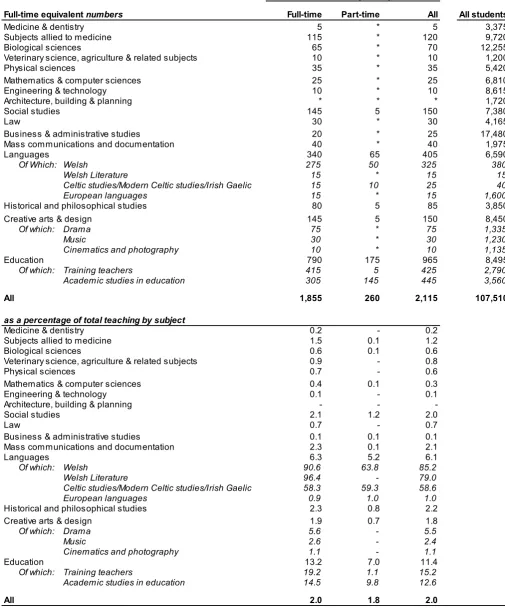
Excluding Languages, the subjects with the highest amount of activity delivered through Welsh were Education (965 full time equivalents (FTEs)), Social Studies (150 FTEs) and Creative Arts and Design (150 FTEs). (Table A.4) [see Notes: 2.4 for FTE definition]
Full-time courses accounted for 88 per cent of all courses with any teaching through Welsh. (Table A.4)
Table A.4: Students with some teaching through Welsh by module subject and mode, 2013/14
Full-time equivalent numbers Full-time Part-time All
Medicine & dentistry 5 * 5 3,375
Subjects allied to medicine 115 * 120 9,720
Biological sciences 65 * 70 12,255
Veterinary science, agriculture & related subjects 10 * 10 1,200
Physical sciences * 35 ** 35* 5,420*
Mathematics & computer sciences 25 * 25 6,810
Engineering & technology 10 * 10 8,615
Architecture, building & planning * * * 1,720
Social studies 145 5 150 7,380
Law * 30 ** 30* 4,165*
Business & administrative studies 20 * 25 17,480
Mass communications and documentation 40 * 40 1,975
Languages 340 65 405 6,590
Of Which: Welsh 275 50 325 380
Welsh Literature 15 * 15 15
Celtic studies/Modern Celtic studies/Irish Gaelic 15 10 25 40
European languages 15 * 15 1,600
Historical and philosophical studies * 80 5* 85* 3,850*
Creative arts & design 145 5 150 8,450
Of which: Drama 75 * 75 1,335
Music 30 * 30 1,230
Cinematics and photography 10 * 10 1,135
Education 790 175 965 8,495
Of which: Training teachers 415 5 425 2,790
Academic studies in education 305 145 445 3,560
All 1,855 260 2,115 107,510
as a percentage of total teaching by subject
Medicine & dentistry 0.2 - 0.2
Subjects allied to medicine 1.5 0.1 1.2
Biological sciences 0.6 0.1 0.6
Veterinary science, agriculture & related subjects 0.9 - 0.8
Physical sciences 0.7 - 0.6
Mathematics & computer sciences 0.4 0.1 0.3
Engineering & technology 0.1 - 0.1
Architecture, building & planning - -
-Social studies 2.1 1.2 2.0
Law 0.7 - 0.7
Business & administrative studies 0.1 0.1 0.1
Mass communications and documentation 2.3 0.1 2.1
Languages 6.3 5.2 6.1
Of which: Welsh 90.6 63.8 85.2
Welsh Literature 96.4 - 79.0
Celtic studies/Modern Celtic studies/Irish Gaelic 58.3 59.3 58.6
European languages 0.9 1.0 1.0
Historical and philosophical studies 2.3 0.8 2.2
Creative arts & design 1.9 0.7 1.8
Of which: Drama 5.6 - 5.5
Music 2.6 - 2.4
Cinematics and photography 1.1 - 1.1
Education 13.2 7.0 11.4
Of which: Training teachers 19.2 1.1 15.2
Academic studies in education 14.5 9.8 12.6
All 2.0 1.8 2.0
Source: HESA and the University of South Wales (a) See Notes: 2.4 for definition of Full-Time Equivalent (FTE) student numbers.
With some teaching through Welsh
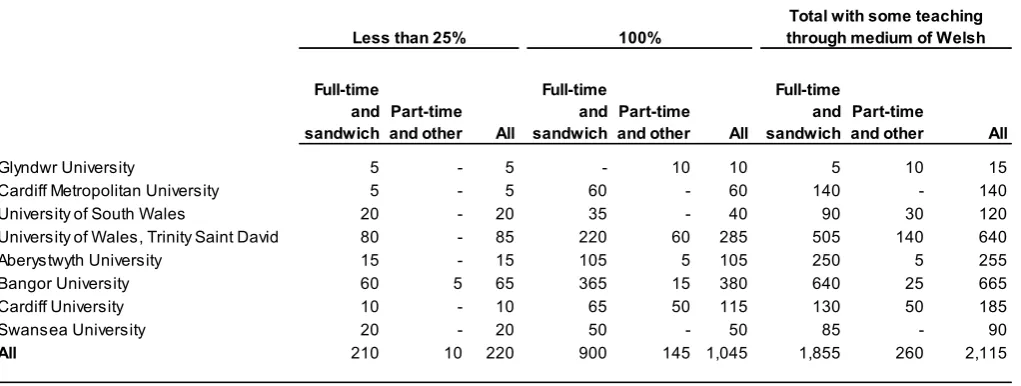
Table A4 identified that 2,115 student FTEs received at least some teaching through Welsh while Table A.5 further examines the amount or intensity of Welsh medium teaching they received. The analysis is broken down by mode and institution.
Table A.5: Intensity of Welsh medium provision for student FTEs receiving some teaching through the medium of Welsh, 2013/14
5 - 5 - 10 10 5 10 15
5 - 5 60 - 60 140 - 140
20 - 20 35 - 40 90 30 120
80 - 85 220 60 285 505 140 640
15 - 15 105 5 105 250 5 255
60 5 65 365 15 380 640 25 665
10 - 10 65 50 115 130 50 185
20 - 20 50 - 50 85 - 90 210 10 220 900 145 1,045 1,855 260 2,115
(a) Institution names are those current in the 2013/14 year. (See Notes: 5.1 Institutions)
Less than 25% 100%
Total with some teaching through medium of Welsh
All Full-time
and sandwich
Part-time
and other All
Full-time and sandwich
Part-time
and other All
Full-time and sandwich
Part-time and other
Source: HESA Cardiff Metropolitan University
Glyndwr University
Bangor University Cardiff University Swansea University
All
University of South Wales
University of Wales, Trinity Saint David Aberystwyth University
Of the 220 FTEs receiving less than 25 per cent of their teaching through Welsh, 95 per cent were full-time and 39 per cent were at University of Wales, Trinity Saint David and 30 per cent at Bangor University. (Table A.5)
Almost half of the 2,115 FTEs receiving some teaching through Welsh received all of their teaching through Welsh. The highest numbers receiving all of their teaching in Welsh were at Bangor (380 FTEs) and University of Wales, Trinity Saint David (285 FTEs). (Table A.5)
Of the 1,045 FTEs receiving all of their teaching through Welsh, 86 per cent were full-time. 41 per cent of full-time FTE students were enrolled at Bangor University, while 41 per cent of part-time FTEs were at University of Wales, Trinity Saint David. (Table A.5)
Section B - Welsh domiciled students at Welsh HEIs with some teaching through the
medium of Welsh
Tables B1 and B2 analyse teaching through the medium of Welsh to students domiciled in Wales attending Welsh HEIs (University of Wales, Newport is excluded from the time series; see Notes 5.3).
Table B.1: Welsh domiciled students at Welsh HEIs taught through the medium of Welsh, by gender (a)
2012/13 2013/14
Welsh domiciled students with some teaching through Welsh (number)
Male 1,340 1,300
Female 3,415 3,400
All 4,755 4,705
Welsh domiciled students with some teaching through Welsh (percentage by gender)
Male 28.2 27.7
Female 71.8 72.3
All 100.0 100.0
All Welsh domiciled students (number)
Male 26,660 26,660
Female 39,435 38,220
All 66,125 64,900
Students with some teaching through Welsh
(as percentage of all Welsh domiciled students)
Male 5.0 4.9
Female 8.7 8.9
All 7.2 7.2 Source: HESA (a) Welsh domiciled students are those w ho w ere ordinarily resident in Wales prior to entry into higher education.
There were 4,705 Welsh domiciled students at institutions in Wales with some teaching through the medium of Welsh; of these 72 per cent were female. (Table B.1)
Table B.2: First Year Welsh domiciled students at Welsh HEIs taught through the medium of Welsh, by gender (a)
2012/13 2013/14
Welsh domiciled students with some teaching through Welsh (number)
Male 725 655
Female 1,645 1,605
All 2,370 2,260
Welsh domiciled students with some teaching through Welsh (percentage by gender)
Male 30.6 28.9
Female 69.4 71.1
All 100.0 100.0
All Welsh domiciled students (number)
Male 13,375 13,275
Female 20,030 19,015
All 33,425 32,300
Students with some teaching through Welsh
(as percentage of all Welsh domiciled students)
Male 5.4 4.9
Female 8.2 8.4
All 7.1 7.0
(a) Welsh domiciled students are those w ho w ere ordinarily resident in Wales prior to entry into higher education.
There were 2,260 Welsh domiciled first year students at institutions in Wales with some teaching through the medium of Welsh; of these 71 per cent were female.
Section C - Initial Teacher Training
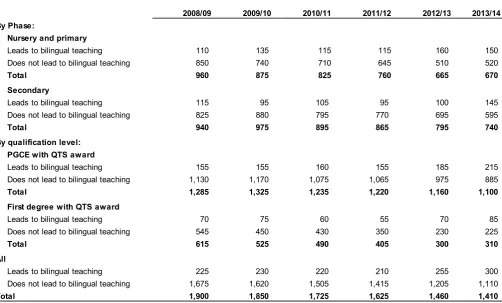
300 students completed an Initial Teaching Training (ITT) course which qualified them to teach through the medium of Welsh. This was 21 per cent of all completers, four percentage points higher than in 2012/13. (Table C.1)
[image:11.595.49.552.252.555.2] 78 per cent of these students gained a Postgraduate Certificate of Education, while 22 per cent gained a First Degree. (Table C.1)
Table C.1: Students completing ITT courses in Wales leading to bilingual teaching
2008/09 2009/10 2010/11 2011/12 2012/13 2013/14
By Phase:
Nursery and primary
Leads to bilingual teaching 110 135 115 115 160 150 Does not lead to bilingual teaching 850 740 710 645 510 520
Total 960 875 825 760 665 670
Secondary
Leads to bilingual teaching 115 95 105 95 100 145 Does not lead to bilingual teaching 825 880 795 770 695 595
Total 940 975 895 865 795 740
By qualification level: PGCE with QTS award
Leads to bilingual teaching 155 155 160 155 185 215 Does not lead to bilingual teaching 1,130 1,170 1,075 1,065 975 885
Total 1,285 1,325 1,235 1,220 1,160 1,100
First degree with QTS award
Leads to bilingual teaching 70 75 60 55 70 85 Does not lead to bilingual teaching 545 450 430 350 230 225
Total 615 525 490 405 300 310
All
Leads to bilingual teaching 225 230 220 210 255 300 Does not lead to bilingual teaching 1,675 1,620 1,505 1,415 1,205 1,110
Total 1,900 1,850 1,725 1,625 1,460 1,410
Source: HESA (a) "Leads to bilingual teaching" - student is qualified to teach bilingually and/or gains a formal certificate of bilingual education.
Section D – Academic staff qualified to teach through the medium of Welsh
Chart D.1: Staff teaching or able to teach through the medium of Welsh
In 2013/14 there were 595 academic staff teaching through the medium of Welsh compared with 645 in 2012/13. (Chart D.1) There were 975
academic staff able to teach through the medium of Welsh compared with 905 in 2012/13. There has been a 47 per cent increase in numbers between 2008/09 and 2013/14. 61 per cent of staff who
were able to, were providing some teaching through the medium of Welsh in 2013/14 compared with 71 per cent in 2012/13.
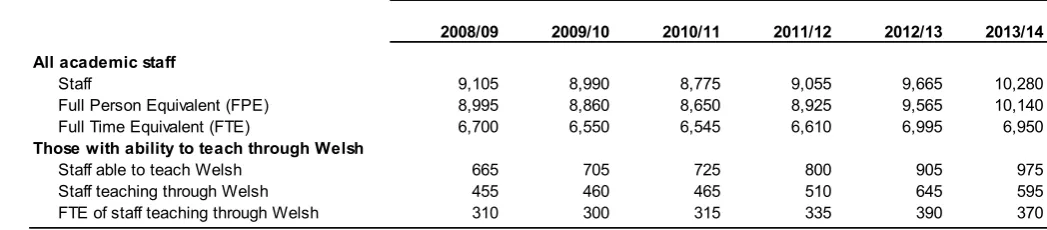
[image:12.595.28.552.510.625.2]Although the numbers of teachers able to teach through the medium of Welsh increased in 2013/14 the numbers of these actually teaching through Welsh fell in comparison to last year.
Table D.1: Number of academic staff at Welsh HEIs
2008/09 2009/10 2010/11 2011/12 2012/13 2013/14
All academic staff
Staff 9,105 8,990 8,775 9,055 9,665 10,280
Full Person Equivalent (FPE) 8,995 8,860 8,650 8,925 9,565 10,140
Full Time Equivalent (FTE) 6,700 6,550 6,545 6,610 6,995 6,950
Those with ability to teach through Welsh
Staff able to teach Welsh 665 705 725 800 905 975
Staff teaching through Welsh 455 460 465 510 645 595
FTE of staff teaching through Welsh 310 300 315 335 390 370
Source: HESA (a) See Notes 3.2 and 3.3 for definitions of FTE and FPE.
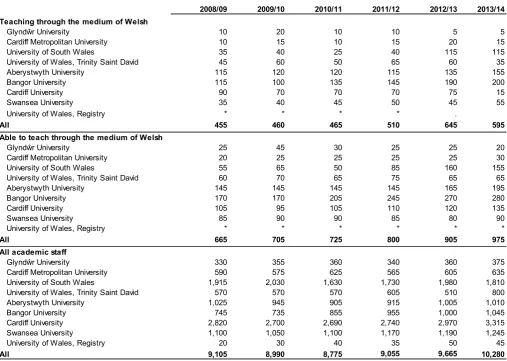
Table D.2: Academic staff teaching or able to teach through the medium of Welsh, by institution
2008/09 2009/10 2010/11 2011/12 2012/13 2013/14 Teaching through the medium of Welsh
Glyndŵr University 10 20 10 10 5 5
Cardiff Metropolitan University 10 15 10 15 20 15
University of South Wales 35 40 25 40 115 115
University of Wales, Trinity Saint David 45 60 50 65 60 35
Aberystwyth University 115 120 120 115 135 155
Bangor University 115 100 135 145 190 200
Cardiff University 90 70 70 70 75 15
Swansea University 35 40 45 50 45 55
University of Wales, Registry * * * * .
455 460 465 510 645 595
Able to teach through the medium of Welsh
Glyndŵr University 25 45 30 25 25 20
Cardiff Metropolitan University 20 25 25 25 25 30
University of South Wales 55 65 50 85 160 155
University of Wales, Trinity Saint David 60 70 65 75 65 65
Aberystwyth University 145 145 145 145 165 195
Bangor University 170 170 205 245 270 280
Cardiff University 105 95 105 110 120 135
Swansea University 85 90 90 85 80 90
University of Wales, Registry * * * * * *
665 705 725 800 905 975
All academic staff
Glyndŵr University 330 355 360 340 360 375
Cardiff Metropolitan University 590 575 625 565 605 635
University of South Wales 1,915 2,030 1,630 1,730 1,980 1,810
University of Wales, Trinity Saint David 570 570 570 605 510 800
Aberystwyth University 1,025 945 905 915 1,005 1,010
Bangor University 745 735 855 955 1,000 1,045
Cardiff University 2,820 2,700 2,690 2,740 2,970 3,315
Swansea University 1,100 1,050 1,100 1,170 1,190 1,245
University of Wales, Registry 20 30 40 35 50 45
9,105 8,990 8,775 9,055 9,665 10,280
Source: HESA
(a) Institution names are those current in the 2013/14 year. Where appropriate, figures for predecessor institutions are now displayed under their new name. Similarly, w here institutions have merged during the time series the figures have been combined and presented under the new institution name for all years. (See Notes: 5.1 Institutions)
All
All All
In 2013/14, Bangor University continued to have the highest number of academic staff able to teach through the medium of Welsh and also the highest number actually teaching through the medium of Welsh.
Bangor University had the highest proportion (27 per cent) of academic staff able to teach through the medium of Welsh. The university with the lowest proportion (4 per cent) of staff able to teach
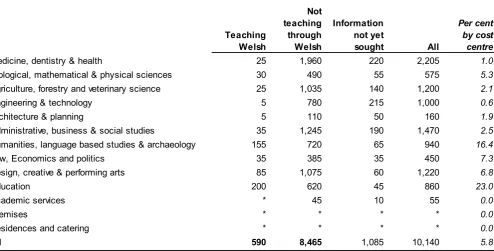
Table D.3: Full person equivalent (FPE) academic staff numbers by grouped cost centre, 2013/14
Teaching Welsh
Not teaching through Welsh
Information not yet
sought All
Per cent by cost
centre
Medicine, dentistry & health 25 1,960 220 2,205 1.0
Biological, mathematical & physical sciences 30 490 55 575 5.3
Agriculture, forestry and veterinary science 25 1,035 140 1,200 2.1
Engineering & technology 5 780 215 1,000 0.6
Architecture & planning 5 110 50 160 1.9
Administrative, business & social studies 35 1,245 190 1,470 2.5
Humanities, language based studies & archaeology 155 720 65 940 16.4
Law, Economics and politics 35 385 35 450 7.3
Design, creative & performing arts 85 1,075 60 1,220 6.8
Education 200 620 45 860 23.0
Academic services * 45 10 55 0.0
Premises * * * * 0.0
Residences and catering * * * * 0.0
All 590 8,465 1,085 10,140 5.8
Source: HESA (a) Cost centre is a financial concept which groups staff members to specific related cost centres which enables analysis
between the student, staff and finance data collections.
Following a HESA review, the methodology used to locate academic professionals has changed. From 2012/13 the field for academic functions was amended to identify academic staff. This change meant that the percentage of staff identified as “information not yet sought” was a lot higher than previous years.
The highest number of FPEs teaching through Welsh were found in the Education cost centre followed by Humanities, language based studies & archaeology. Together these two cost centres accounted for 60 per cent of the total number of FPEs teaching through the medium of Welsh. (Table D.3)
S
Section E - Level of ability to speak Welsh
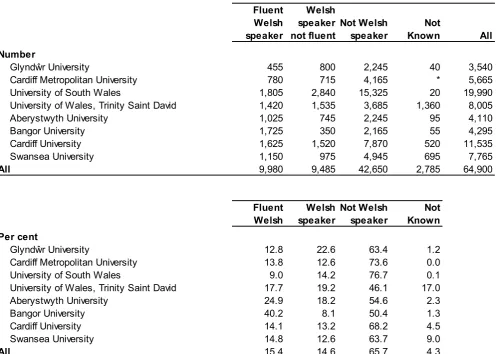
HESA collect data from all students enrolled at Welsh HEIs where the student is ordinarily (prior to study) resident in Wales. The data records whether the student deems themselves to be a Welsh speaker and whether they are fluent or not. Data quality across institutions is variable with a couple of
[image:15.595.47.544.203.557.2]institutions having a markedly larger proportion of unknowns than the majority, however as the overall rate of unknowns is lower compared with earlier years it is now more useful for analysis.
Table E.1: Welsh domiciled students – level of ability to speak Welsh by institution, 2013/14
Fluent Welsh speaker
Welsh speaker not fluent
Not Welsh speaker
Not
Known All
Number
Glyndŵr University 455 800 2,245 40 3,540
Cardiff Metropolitan University 780 715 4,165 * 5,665
University of South Wales 1,805 2,840 15,325 20 19,990
University of Wales, Trinity Saint David 1,420 1,535 3,685 1,360 8,005
Aberystwyth University 1,025 745 2,245 95 4,110
Bangor University 1,725 350 2,165 55 4,295
Cardiff University 1,625 1,520 7,870 520 11,535
Swansea University 1,150 975 4,945 695 7,765
All 9,980 9,485 42,650 2,785 64,900
Fluent Welsh
Welsh speaker
Not Welsh speaker
Not Known Per cent
Glyndŵr University 12.8 22.6 63.4 1.2
Cardiff Metropolitan University 13.8 12.6 73.6 0.0
University of South Wales 9.0 14.2 76.7 0.1
University of Wales, Trinity Saint David 17.7 19.2 46.1 17.0
Aberystwyth University 24.9 18.2 54.6 2.3
Bangor University 40.2 8.1 50.4 1.3
Cardiff University 14.1 13.2 68.2 4.5
Swansea University 14.8 12.6 63.7 9.0
All 15.4 14.6 65.7 4.3
Source: HESA (a) Institution names are those current in the 2013/14 year. (See Notes: 5.1 Institutions)
In 2013/14, Bangor University (40 per cent), Aberystwyth University (25 per cent) and University of Wales, Trinity Saint David (18 per cent) had the highest proportions of fluent Welsh speakers. Fewer than 10 per cent of students in the University of South Wales were fluent Welsh speakers.
Notes
1. Data Source
The Higher Education Statistics Agency (HESA) collects data on students, staff and resources of Higher Education Institutions (HEIs) in the UK. The data presented in this bulletin are taken from HESA’s Student Record which contains information on all students enrolled on credit bearing courses at UK HEIs and HESA’s Individualised Staff Record which contains information on all staff employed by UK HEIs. Further information about HESA and their data collections can be found on their website
www.hesa.ac.uk
2. Definitions for Sections A, B & C - Students 2.1 Coverage
The Student Record contains information about individual enrolments, which, because a student can be enrolled on more than one programme of study, will exceed the number of students. Previous analysis has shown that for Welsh HEIs, full-time enrolments are less than 1 per cent higher than full-time student numbers; part-time enrolments are less than 2 per cent higher than part-time student numbers. Postdoctoral students are not included in the HESA Student Record.
All student counts in this bulletin are based on the HESA standard registration population, which is a count of all enrolments within the reporting year 1 August to 31 July. Students who leave within 2 weeks of their start date, or anniversary of their start date, and are on a course of more than two weeks
duration, are not included in the standard registration population. Dormant students, writing-up, sabbatical, incoming visiting and exchange students from overseas and students studying for the whole of their programme of study outside of the UK are also excluded from this population.
2.2 Level of Study
Postgraduate programmes of study are those leading to higher degrees, diplomas and certificates (including Postgraduate Certificate of Education (PGCE) and professional qualifications) and usually require that entrants are already qualified to degree level (i.e. already qualified at level 6 of the National Qualifications Framework).
First degree includes first degrees with or without eligibility to register to practice with a Health or Social Care or Veterinary statutory regulatory body, first degrees with qualified teacher status (QTS)/registration with the General Teaching Council (GTC), enhanced first degrees, first degrees obtained concurrently with a diploma and intercalated first degrees.
Other undergraduate includes qualification aims below degree level such as Foundation Degrees, diplomas in HE with eligibility to register to practice with a Health or Social Care regulatory body, Higher National Diploma (HND), Higher National Certificate (HNC), Diploma of Higher Education (DipHE), Certificate of Higher Education (CertHE), foundation courses at HE level, NVQ/SVQ levels 4 and 5, post-degree diplomas and certificates at undergraduate level, professional qualifications at undergraduate level, other undergraduate diplomas and certificates including post registration health and social care courses, other formal HE qualifications of less than degree standard, institutional undergraduate credit and no formal undergraduate qualifications.
2.3 Mode of Study
Other modes of study Students who are writing-up or are on sabbatical are no longer counted in the standard registration population, but students on FE continuous delivery are.
2.4 Full-time equivalent
Student full-time equivalent (FTE) data represents the institution's assessment of the full-time equivalence of the student during the reporting year 1 August 2013 to 31 July 2014.
The FTE is used as a unit of measure in order to compare the amount of study undertaken in each subject, where study may be either full-time or part-time and include just a single subject or
dual/multiple subjects. The unit is obtained for each subject by comparing the number of hours of study over a year to the number of hours of study that would be undertaken by a full-time, single subject student. The latter would be counted as 1.0 FTE, whereas a student who studies for 50% of the full-time hours on that same single subject would be counted as 0.5 FTE. Likewise a full-time student who splits his/her time equally between two subjects would be counted as 0.5 FTE in each subject. Table A.4 shows, in FTE terms, the amount of study undertaken where there is some teaching through Welsh.
2.5 Module of study information
For each module the full-time equivalent of the module as a whole is recorded along with the proportion of the module taught through the medium of Welsh. Each module is classified by up to four subjects using the Joint Academic Coding System (JACS). The proportion of the module allocated to each subject is also recorded.
2.6 Welsh domicile
Students classified as Welsh domiciled are those whose home postcode on entry to a higher education institution was in Wales.
2.7 Qualified Teacher Status (QTS)
Table C.1 provides information about students completing courses of Initial Teacher Training (ITT) and being awarded Qualified Teacher Status (QTS).
To teach as a qualified teacher in a maintained school or non-maintained special school in Wales or England, students need to obtain QTS. Students can do this at higher education institutions by either undertaking a first degree course which combines a degree – usually a BEd, BA or BSc – with QTS or by completing a postgraduate course which leads to QTS. PGCE courses are usually postgraduate courses; however, some non postgraduate courses such as the Professional Graduate Certificate in Education (which is pitched at an undergraduate level) are classified as PGCE. Other levels such as Postgraduate Diploma in Education may also be offered.
Professional Graduate Certificate in Education courses are offered by English providers as a level 6 qualification which is classed as ‘other undergraduate’, but requires a first degree on entry. In Wales only the Open University offers this qualification with the ‘leading to QTS’ option, although other Welsh HEIs may award this qualification if a student studying for a Postgraduate Certificate in Education is deemed not to have achieved sufficient credits at Masters level.
3. Definitions for Section D - Staff
3.1 Coverage
non-Following a HESA review, the methodology used to locate academic professionals has changed. From 2012/13 the field for academic functions has been amended to identify academic staff. It is because of this change that the percentage of staff identified as “information not yet sought” in the Accuracy section of the notes is a lot higher than previous years.
The record is collected in two sections; the person table and the contract table. The person table contains one record for every person employed by an institution during the reporting period and contains
attributes of the individual such as birth date, gender and ethnicity. Each person’s employment with an institution will be governed by a legally-binding contract. A record will exist for each contract a person has with the institution.
All tables in this bulletin are based on the HESA academic staff contract population, which includes those contracts that were active on 1 December within the reporting period.
3.2 Full-time equivalent
Full-time equivalent (FTE) is that recorded in the contract and measures the equivalence to full-time over the course of the reporting period 1 August to 31 July.
3.3 Full-person equivalent
Individuals can hold more than one contract with an institution and each contract may involve more than one different activity. Staff counts have been divided amongst their activities in proportion to the declared FTE for each activity. This results in counts of full person equivalents (FPE). Staff FPE counts are calculated on the basis of contract activities that were active on 1 December of the reporting period. 3.4 Staff able to teach through the medium of Welsh
The person table includes details of the ability of staff to teach through the medium of Welsh. 3.5 Staff teaching through the medium of Welsh
The contract table includes details of staff teaching through the medium of Welsh. The number of staff teaching through the medium of Welsh is a count of academic staff with at least one academic contract involving some teaching through the medium of Welsh. In some cases staff with contracts with teaching through the medium of Welsh are recorded as being not able to teach through the medium of Welsh on the person table.
4. Rounding Strategy
The presentation of figures in this Statistical Bulletin follows the principals of the HESA rounding strategy. The strategy is intended to prevent the disclosure of personal information about any
individual. This strategy involves rounding all numbers to the nearest 5. A summary of this strategy is as follows:
0, 1, 2 are rounded to 0 and represented as ‘*’. All other numbers are rounded to the nearest 5.
Total figures are also subject to this rounding methodology; the consequence of which is that the sum of numbers in each row or column may not match the total shown precisely.
Average values, percentages and FTE values have been calculated using precise raw numbers and are not affected by the rounding strategy.
5. Key Quality Information 5.1 Institutions
Over the course of the last decade there has been, and continues to be, significant change in the number and names of higher education institutions in Wales. The approach taken in this bulletin is to use the institution names current in 2013/14, the latest year for which data is available. Where appropriate, figures for predecessor institutions are now presented under their new name. Similarly, where
institutions have merged, over the time period shown in the tables, the figures have been summed and presented under the current name for all years.
The historical changes that have taken place include:
The Royal Welsh College of Music & Drama merged with the University of Glamorgan in 2007. The North East Wales Institute of Higher Education became Glyndŵr University in 2008. Swansea Institute of Higher Education became Swansea Metropolitan University in 2008. The University of Wales, Lampeter and Trinity College Carmarthen merged in 2010 to form the
University of Wales, Trinity Saint David.
The University of Wales Institute, Cardiff became Cardiff Metropolitan University in 2011. In 2013, Swansea Metropolitan University became part of University of Wales, Trinity Saint
David.
Also in 2013, the University of Glamorgan and the University of Wales, Newport merged to form the University of South Wales.
5.2 Relevance
In 2011 changes were made to the content of the bulletin following feedback from the Welsh Language Board. The bulletin was also included in a consultation on education statistics, which did not prompt major requests for changes.
HESA is the official agency for the collection, analysis and dissemination of quantitative information about higher education. It was set up by agreement between the relevant government departments, the higher education funding councils and the universities and colleges. The primary purpose of the Student data collection is to provide each of the bodies listed above with accurate and comprehensive statistical information regarding student enrolments.
The statistics are used both within and outside the Welsh Government to monitor educational trends and as a baseline for further analysis of the underlying data. Some of the key users are:
Ministers and the Members Research Service in the National Assembly for Wales; Officials in the Welsh Government;
Other government departments;
The Higher Education Funding Council for Wales; The Welsh Language Board
informing the education policy decision-making process in Wales and to inform existing strategies, for example the Welsh-medium Education Strategy;
providing indicative information regarding progress towards the Programme for Government (PfG) indicator “Number of Welsh domiciled students undertaking some element of their higher education course through the medium of Welsh”. Note: The Higher Education Funding Council for Wales (HEFCW) provide the statistics for this target which also includes delivery at further education institutions. For this reason, and some methodological differences, the figures presented in this bulletin are not directly comparable with those published against the PfG indicator.
Programme for Government - Culture & Heritage of Wales
5.3 Accuracy
The HESA field named ‘LANGPCNT’ is used to indicate the percentage of a module that is taught through the medium of Welsh. In the past it has been required for institutions to either submit course averages or the actual values per enrolment to HESA. For the statistics used in this bulletin the course average values are not appropriate. This over-estimates the number of students being taught through Welsh since more students will have non-zero values.
In 2011 it came to light that, in recent years, the University of Wales, Newport submitted course averages which meet the HESA requirements but do not contain the level of detail required for these statistics. Thus the institution agreed to provide estimates for the numbers of unique students receiving teaching through Welsh, for academic years 2008/09 and 2009/10.
For the 2010/11 HESA data the University of Wales, Newport reported figures as percentages per enrolment on a module (rather than an as an average value across modules), which meant it was possible to use the HESA data rather than institution estimates.
However, in 2011/12 the required level of detail was again not available from the HESA record and figures were obtained directly from the University of Wales, Newport. However from 2012/13, the University of Wales, Newport was able to provide all the information required. As they were able to provide data by gender from 2012/13, tables in section B now start from 2012/13 so that all HEIs can be included in the tables.
From 2013/14, University of Wales, Newport is included in the University of South Wales figures and although data is now available, not all of it was included in the HESA data. As a result, some data for Welsh medium students was collected directly from the University of South Wales.
General information on Accuracy
The Student Record contains information about individual enrolments, which, because a student can be enrolled on more than one programme of study, will exceed the number of students (see further details in Paragraph 2.1).
The following table shows the overall percentage of records for which details of staff able to teach through the medium of Welsh and contracts with teaching through the medium of Welsh have not yet been sought.
2008/09 2009/10 2010/11 2011/12 2012/13 2013/14 2008/09 2009/10 2010/11 2011/12 2012/13 2013/14
Staff able to teach through the medium of Welsh 5.5 5.2 5.5 5.3 17.1 14.7 8 8 8 8 9 8
Staff teaching through medium of Welsh 2.3 1.7 1.8 1.0 14.2 10.8 6 6 6 6 6 8
Source: HESA
Percentage of records with "information not yet sought"
Number of institutions with records for which "information not yet sought"
5.4 Timeliness and Punctuality
HESA collected student enrolment and staff data for the 2013/14 academic year between August and October 2013. They produced their own HE Student Enrolment and Qualifications Obtained at Higher Education Institutions release in January 2015 and released their latest Staff in Higher Education Institutions publication in March 2015. This Welsh Medium bulletin now highlights a Wales specific dimension to the student and staff data collections.
5.5 Accessibility and Clarity
This statistical bulletin is pre-announced and then published on the Statistics section of the Welsh Government website.
This bulletin will be accompanied by more detailed tables on StatsWales, a dissemination site that allows visitors to view, manipulate and create tables to download.
StatsWales - Higher Education
5.6 Comparability
Owing to the nature of this bulletin, there are no comparable statistics produced for other countries within the UK.
5.7 Quality Management
Knowledge and Analytical Services within WG have published (latest version January 2013) a Statistical Quality Management Strategy, which describes the strategic objectives for quality and how we
implement them. It also covers our commitment to ensure that our statistics are fit for purpose, use appropriate processes and transparent methods and that the factual and presentational quality meets the requirement of our users. The full strategy can be found via the following link:
Statistical Quality Management Strategy