Using distributed learning as a measure to capture additional data on the quality of technology enhanced learning (TEL)
by
Associate Professor Michael Sankey, Ed.D. Director (Learning Environments and Media)
University of Southern Queensland [email protected]
and
Fernando F. Padró, Ph.D. Senior Lecturer (Quality) University of Southern Queensland
ABSTRACT
The Australasian Council on Open Distance and E-learning (ACODE) benchmarks were the first major attempt, in an Australasian context, to bring a consistent framework to the use of e-Learning at higher education institutions (HEIs). Successful as these were, given the HEI need to interpret the benchmarks differently in accordance to institutional culture, they were not able to fully capture measures of quality of technology enhanced learning (TEL). Ongoing research is demonstrating that distributed leadership can prove to be an additional dimension in establishing quality measures pertinent to TEL activity at HEIs based on identification of role and boundary of activities within a university to help attest to internal efforts and support (fiscal, human, programmatic, and technical) driving the TEL offerings provided by universities.
Introduction
Two critical areas that have developed as a result of globalization and the internationalization of university offerings are the quality control and quality assurance processes governing distance learning and e-learning in particular. The baseline requirement, according to the 2005 UNESCO-OECD Guidelines for Quality Provision in Cross-border Higher Education, is to ensure that the quality of programs delivered by universities is comparable whether provided in the home country or abroad. This also means that universities ‘also take into account the cultural and linguistic sensitivities of the receiving country’ (p. 15). National qualification frameworks and national protocols should both align to this requirement and do so overtly rather than by implication through most appropriate regulations and national standards; however, this is still not always the case. Sometimes it takes looking at different documents and protocols to look at the quality assurance provisions for e-learning.
Qualifications Framework (AQF) (2011) indicates that the benefits of alignment to it are improving mutual trust, the recognition of qualifications between nations based on reliable and transparent information, etc., implies rather than publicly states that all e-learning offerings at all qualification levels meet the outcome criteria. Australia’s Tertiary Education Quality and Standards Agency’s (2011) Higher Education Standards Framework (Threshold Standards) covers the omission of explicit reference to e-learning in the AQF though its Standard 7, Physical and electronic resources and infrastructure. Standards 7.2 through 7.4 specifically address the broad-based minimal expectations as as per recommendation c under guidelines for higher education institutions (HEIs) in the UNESCO-OECD Guidelines (2005, pp. 15-16). This is not unusual given Provezis’ (2010) comment that accrediting bodies do not prefer to be too prescriptive, preferring to ‘offer various resources to assist institutions in meeting their expectations’ (p. 3) instead.
This paper focuses on the governance of the institution’s technology enhanced learning (TEL) environments (which include open and distance education), with the assumption that the principles outlined here may also be applied to other systems. TEL is still a moving target for quality assurance schemes because of the fast moving nature of technological developments in education along with continued policy steering efforts stemming from the need to enhance access, affordability, equity, quality offerings, and relevance (UNESCO, 2009). Indeed, “[g]lobalisation has highlighted the need for the establishment of national accreditation and quality assurance systems along with promotion of networking among them” (p. 5).
ACODE Benchmarks and C-RAC “hallmarks of quality”
There is a discussion surrounding assessing and evaluating TELs within a QA scheme should be judged as close as possible in the same manner as face-to-face education (Latchem & Jung (2012). The QA process itself should distinguish between “doing the work” and assuring and improving its “quality” as suggested by Massy, Graham, & Short (2007). What needs to also be remembered is the idea of quality exists prior to and after use of TEL as an enduring signal of excellence for stakeholders (cf. Oliver, 1997).
The Australasian Council on Open Distance and E-learning (ACODE) benchmarks were the first major attempt, in an Australasian context, to bring a consistent framework to the use of e-Learning at Australian HEIs. The aim was and continues to be to provide measurable indicators toward TEL programs instead of making value judgments on various areas. Evaluation is a central characteristic of each of the eight ACODE benchmarks and it is there to ensure a quality cycle is in place within institutions and that this is present across all the elements of that quality cycle. Importantly, this is not limited to work within the institution, as evaluation also plays a very real role in mediating the many external factors at play around the effective deployment of institutional TEL environments.
“nine hallmarks of quality” to provide an assessment framework for its member bodies. HEIs are required to include evidence to which these hallmarks are met.
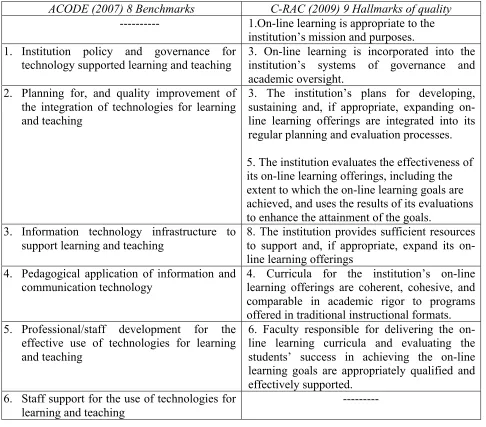
[image:3.612.65.551.292.719.2]When both the ACODE benchmarks and the C-RAC hallmarks are put side by side (Table 1), two things become apparent: (1) the degree of similarity between the two and (2) the closeness in assessment/evaluation categories between TEL and traditional academic reviews. These categories seem to fall under Stufflebeam’s CIPP (context, inputs, process, and product evaluations (Huertas, Prades, & Rodríguez, 2010; Stufflebeam & Shinkfield, 2007) while also setting up the concerns of an overemphasis on cost-benefit analysis or what Birnbaum (2000) refers to the advantages and disadvantages of Ur-management, particularly in relationship to capacity building -- too much reliance on the traditional “inputs” of earlier approaches to QA in higher education, answering the question of how much e-learning costs while not addressing the question of whether it is worth it.
Table 1. A comparison of the ACODE Benchmarks and C-RAC Hallmarks
ACODE (2007) 8 Benchmarks C-RAC (2009) 9 Hallmarks of quality --- 1.On-line learning is appropriate to the
institution’s mission and purposes. 1. Institution policy and governance for
technology supported learning and teaching 3. On-line learning is incorporated into the institution’s systems of governance and academic oversight.
2. Planning for, and quality improvement of the integration of technologies for learning and teaching
3. The institution’s plans for developing, sustaining and, if appropriate, expanding on-line learning offerings are integrated into its regular planning and evaluation processes.
5. The institution evaluates the effectiveness of its on-line learning offerings, including the extent to which the on-line learning goals are achieved, and uses the results of its evaluations to enhance the attainment of the goals.
3. Information technology infrastructure to support learning and teaching
8. The institution provides sufficient resources to support and, if appropriate, expand its on-line learning offerings
4. Pedagogical application of information and
communication technology 4. Curricula for the institution’s on-line learning offerings are coherent, cohesive, and comparable in academic rigor to programs offered in traditional instructional formats. 5. Professional/staff development for the
effective use of technologies for learning and teaching
6. Faculty responsible for delivering the on-line learning curricula and evaluating the students’ success in achieving the on-line learning goals are appropriately qualified and effectively supported.
6. Staff support for the use of technologies for
7. Student training for the effective use of technologies for learning
---
8. Student support for the use of technologies for learning
7. The institution provides effective student and academic services to support students enrolled in online learning offerings.
--- 9. The institution assures the integrity of its on-line learning offerings.
Limitations of ACODE and C-RAC
ACODE’s first benchmark relating to governance mechanisms and policies guiding the selection, implementation, utilisation/deployment, and evaluation of TEL has been a challenging one for the Australian HEI sector. The benchmark, although an excellent tool, does not go far enough. Arguably, it may not be ACODE’s role to do so as each institution will put its own interpretation on the benchmark. But therein lays the issue, for in attempting to cater for a wide variety of experiences there is an inherent weakness in the way the benchmark can be interpreted. For example, governance of an HEI’s TEL environments must be aligned with other elements within the institution. Governance needs to be actively engaging with planning and aligned with the organisational structure, ensuring resourcing is available, ensuring evaluation is implemented, and ensuring that the institution has a holistic understanding of the technologies themselves within the context of the bigger picture. The challenge here rests with finding a balance between a sense of prescriptiveness and sufficient assessment and evaluation elements to provide a more in-depth evidence of TEL quality. Again, the barometer here has to be whether or not the question of the worth of TEL (e.g., resource allocation, decisions regarding acquisition and support of technologies, environmental scanning for identifying emerging technologies, pedagogical techniques, instructional support, teacher credentials) is properly addressed.
Like ACODE, C-RAC’s hallmarks highlight the differing approaches HEIs can take toward documenting TEL performance. Hallmark 1 is the best example of this by requiring universities to demonstrate a linkage to mission. This link also indirectly sets the stage for planning and evaluation of institutional performance given the role mission has in providing guidance as to how an HEI should be evaluated (Hallmarks 3 and 5). However, C-RAC’s focus is on pedagogical merit (as seen in the examples of evidence to support Hallmark 3) instead of looking more directly at TEL from a development, support, and resource appropriateness analysis. This is not to say the former is not important. It clearly is, but there is a need to also consider other aspects of the complex decisions, processes, and supports TEL programs represent.
An approach for QA systems adding data regarding TEL by expanding existing criteria/standards
institutional TEL strength. This empowerment is typically done by giving each stakeholder a voice (distributed leadership), via the governance structures established within the institution. However, it should be noted that governance around the TEL environments should not be any different to that of other systems within the institution, such as the human resources system, the finance system, the student management system (and so on), all of which would benefit from a distributed leadership approach.
To assist an institution to place some form of framework around their particular TEL environments, the following four categories of technologies and their associated level of support are offered. Categorising the institution’s systems in the following way may also assist the OLE systems group to define its responsibilities and boundaries (also seen in Figure 2):
1. Core technologies: Systems used to support the core learning and teaching
activity of the institution. Typically, systems that may be included in this category would be the LMS, ePortfolio, virtual classrooms, lecture recording, repositories, and so on. These systems would be fully funded and supported by the central ICT and learning support services. There would also be centralised professional development and training provided to help staff make the best use of these systems.
2. Supported technologies: Systems used by discipline groups (as opposed to the whole university) for activities associated with a core system. These systems are typically funded by the department or school, but the support for running these systems on the university’s infrastructure is provided by the central ICT and learning support services. There is usually no centralised professional development and training provided.
3. Allowed technologies: Technologies that run on systems outside the university’s main ICT infrastructure. This may be on a server in a school or out in the cloud. For example, the use of Skype, Facebook, 3D immersive worlds like Second Life, and so on. Typically, the only role the central ICT service provides is to allow these systems into the university domain (through the firewalls). There is usually no support for these systems offered by the central ICT and learning support services other than, possibly, some information made available on the support website.
The benefits of a Distributed Leadership model: An Australian example
The choice of a ‘core’ TEL environment is usually a significant decision-making event, often shaping an institutions approach to online learning for a considerable period, with many institutions requiring a return on investment (ROI) period as a condition of implementation. Consequently, many institutional stakeholder are required to have a say in making and implementing such a choice, ranging across university senior executive members; various levels of faculty academic leadership; central teaching support units; IT groups; and of course the students themselves.
Almost all university academic staff, to some degree, now rely on a TEL environment to facilitate student learning. Once committing to a particular TEL solution, it is then important to ensure that the institutions key stakeholders are working together to maximise its value. This in many cases requires the collection of different types of data, from different levels of the organisation, to assure and improve the quality of use, and also serves as evidence to be acted upon through the various decision-making structures of the institution.
The effective leadership of an institutions’ TEL environment is also dependent on establishing a system that has a focus on learning and teaching ‘outcomes’ and ‘impacts’. Such a system supports the strategic importance and value of a corporately supported TEL environment and associated technology-based investments. We agree with Fullan and Scott (2009) when they state that a much greater commitment to systematic institutional evidence gathering is required when implementing TEL environments.
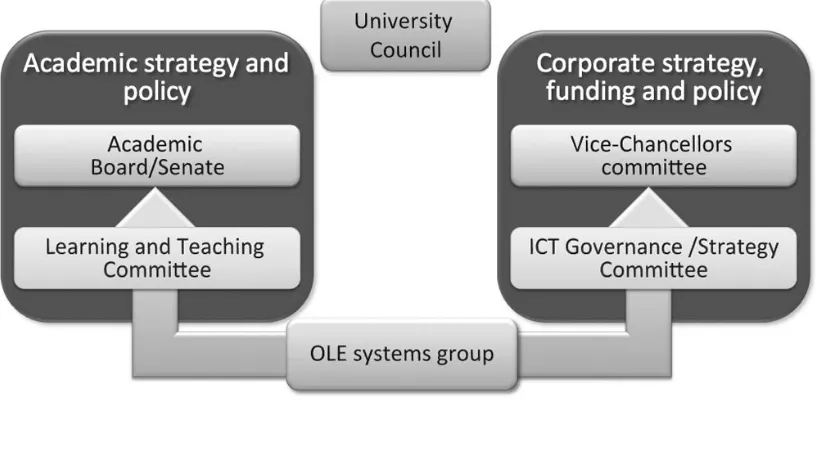
It appears reasonably consistent across most Australian universities that there are two main governance bodies that sit beneath the University Council (Figure 1): the Academic Board/Senate, responsible for academic policy and strategy; and the Vice-Chancellor’s Committee that deals with corporate strategy, funding and policy. Typically, these committees have major sub-committees. In the case of TEL environments, these would typically be a Learning and Teaching Committee, reporting to the Academic Board and, on the other side of the equation, some form of ICT governance/strategy committee reporting to the VC’s committee. Importantly, for the governance of TEL environments there is a committee that encompasses both sides of this scenario. This committee has a dual reporting line that provides for decisions to be made about funding and strategy issues, as well as academic policy issues associated with the use of these systems. For the purposes of this discussion, this committee is called the Online Learning Environments (OLE) systems group.
legitimately expected from the central ICT and learning support sections (possibly also devolved). This may be done by way of a service level agreement (SLA), or simply by being very explicit on the university support website about these expectations, particularly where this relates to systems that may not be seen as ‘core’.
Figure 1. University committee structure related to OLEs
Figure 2. Categories of OLE technologies
An inevitable consequence of rapid technological change is the need for universities to manage the life cycle of their technologies, and specifically the life cycle of high-utilisation core technologies. From the overall staff user perspective, the core technologies are the high-investment technologies, and often attract significant resistance to change. Maintenance of a positive and engaged staff perspective on the evolving suite of production technologies can be facilitated by open disclosure and consultation on the systematic life cycle management of the core technologies.
Actioning the alignment of the relationships amongst elements is a challenging task. Distributed leadership is critically important in bringing the following elements together:
• Firstly, in the governance structures established to oversee the business of mediating the
• Secondly, by the way in which universities/faculties/schools/departments ensure
sufficient and appropriate resources (both human and fiscal) are provided to the right areas to support fully the work of the institution.
In other words, governance can ensure the right systems are in place, but having an aligned organisational structure in place will also ensure the success of the institution’s TEL environments. For example, a good organisation structure would ensure that there is a robust project management methodology in place when implementing a new TEL environment. However, this methodology does need to go further than implementation. It should ensure that there is a level of sustainability in place by the time an TEL environment is fully functional and that the functionality is being fully evaluated. To ensure this sustainability, there needs to be a series of key stakeholders within the organisation that need to be fully appraised of the implications of implementing technologies constituting the TEL environment. These stakeholders would typically include (but are not limited to) the following:
• Business owner of the system – typically a PVC Learning & Teaching or DVC (Academic) • Functional owner of the system (Director of Learning & Teaching or Director of
Educational Technology)
• ICT services, or the provider of the technology to the institution
• Learning and teaching leaders within faculties (typically an Associate Dean or the like) • Student management and support people (library and academic support)
• Academics
• Finance and human resources staff • ICT trainers
• (And let’s not forget) Students themselves.
From this possible list of stakeholders it is immediately clear that the success of a TEL environment is more about communication with a diverse or distributed group of leaders within the organisation; leaders that are typically not, for example, the Vice-Chancellor, Chief Operating Officer or Registrar. The success of a TEL environment, from the organisational perspective, rests with those responsible for providing functional leadership and support, and in how these distributed groups relate to each other. It is therefore not just the responsibility of the business and functional owners of the TEL environment that need to be considered here, but the network of leaders who operate collectively underneath them. It is by empowering these people, backed by the organisation through strategies like workload relief, that the message of the vitally important role modern TEL environments play in the institution’s daily business gets right down into the organisation’s soul.
Figure 3. ICT planning cycle
The importance of communication within the organisation around the importance of the TEL environment, particularly for the future wellbeing of the institution, should not be underestimated. Typically, these communications are mediated by the business and functional owner of the systems and need to be regular. Academic staff members particularly dislike being kept in the dark about what is happening in relation to the systems they use almost daily to communicate with their students. Therefore, keeping open and clear lines of communication is essential to the health of the relationship between central support units and those responsible for using the systems these central units maintain.
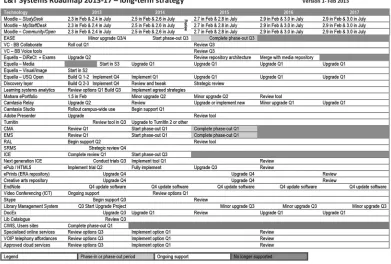
Figure 4. An example of a 5 year TEL roadmap
Conclusion
Few international or national bodies have payed sufficient heed to setting benchmarks/ performance indicators for TEL. The Quality Assurance, Quality Enhancement special interest group (QAQE, 2010) believes that there is a paradoxical relationship developing as it were. TEL is increasingly being embedded within standard practice in higher education; however, current approaches to QA are contributing to the neglect of the ways in which technology enhances rather than merely augment teaching and learning. Stroup (1966) pointed out that HEIs possess centralized and decentralized bureaucratic components that, as Gardner (1990) indicated, require continuous renewal and avoidance of complacency – even as they hold themselves to the highest of standards. What is being suggested here is to reframe the standards for institutional governance in such a way that this paradox yields useful information regarding TEL quality. The organizational climate within HEIs should be one in which action – and by extension leadership – “is not a responsibility invested only in those holding administrative appointments, but a responsibility of all those holding climates of learning in trust – a responsibility of presidents and professors” (Bogue, 1994, p. 117).
(2009), that a much greater commitment to systematic institutional evidence gathering and the systematic use of this data is required in the area of TEL implementations. And this demand will only intensify, along with the need for distributed leadership structures, as we see the continued proliferation of social media/networking/cloud-based services growing up in and around our organizations, enabling more devolved and less controllable environments for socialization and academic learning.
References
Australian National Qualifications Framework Council. (2011, July). Australian Qualifications Framework. (1st ed.). Canberra: Author.
Birnbaum, R. (2000). Management fads in higher education: Where they come from, what they do, why they fail. San Francisco: Jossey-Bass
Bogue, E.G. (1994). Leadership by design: Strengthening integrity in higher education. San Francisco: Jossey-Bass.
Council of Regional Accrediting Commissions. (2009 July). Guidelines for the evaluation of distance education (on-line learning). Chiacago: Higher Learning
Commission.Retrieved from
http://www.C-RAC_Distance_ed_guidelines_7_31_2009[1].pdf.
Fullan, M. & Scott, G. (2009). Turnaround Leadership for Higher Education. San Francisco: Jossey-Bass.
Gardner, J.W. (1990). On leadership. New York: Free Press.
Huertas, E., Prades, A., & Rodríguez, S. (2010). How to assess an e-learning institution: Methodology, design and implementation. In Grifoll, J., Huertas, E., Preades, A., Rodríguez, S. Rubin, Y., Mulder, F., & Ossiannilsson, E., Quality assurance of
e-learning, 11-17.ENQA workshop report 14. Helsinki: European Association for Quality Assurance in Higher Education [ENQA]. Retrieved from http://www.enqa.eu/pubs.lasso.
Latchem, C. & Jung, I. (2012). Quality assurance and accreditation in open and distance learning. In I. Jung and C. Latchem (Eds.)., Quality assurance and accreditation in distance education and e-learning, 13-22. New York: Routledge.
Massy, W.F., Graham, S.W., & Short, P.M. (2007). Academic quality work: A handbook for improvement. Bolton, MA: Anker.
Ministerial Council on Education, Employment, Training and Youth Affairs. (2007, October). National protocols for higher education approval process. Canberra: Author.
Provezis, S. (2010, October). Regional Accreditation and Student Learning Outcomes: Mapping the Territory. NILOA Occasional Paper No. 6. Urbana-Champaign, IL: National
Institute on Learner Outcomes Assessment.
QAQE in elearning Special Interest Group (2010) QAA Code of Practice Section 2:
Collaborative provision and flexible and distributed learning (including elearning). A commentary & Critique. Consultation Draft V 4-3
Stroup, H. (1966). Bureaucracy in higher education. New York: Free Press.
Stufflebeam, D.L. (2001). Evaluation models: New Directions for Evaluation, no. 89. San Francisco: Jossey-Bass.
Stufflebeam, D.L. & Shinkfield, A.J. (2007). Evaluation theory, models, & applications. San Francisco: Jossey-Bass.
Tertiary Education Quality & Standards Agency. (2011). Higher education standards framework (threshold standards). From website:
http://www.comlaw.gov.au/Details/F2012L00003/Download
United Nations Educational, Scientific and Cultural Organization [UNESCO]. (2005). Guidelines for quality provision in cross-border higher education. Paris: NESCO-OECD.
United Nations Educational, Scientific and Cultural Organization [UNESCO]. (2009). 2009 World conference on higher education: The new dynamics of higher education and research for societal change and development. Paris: Retrieved from
http://www.unesco.org/fileadmin/MULTIMEDIA/HQ/ED/ED/pdf/WCHE_2009/FINAL