www.biogeosciences.net/9/2247/2012/ doi:10.5194/bg-9-2247-2012
© Author(s) 2012. CC Attribution 3.0 License.
Biogeosciences
Effects of elevated CO
2
and N fertilization on plant and soil carbon
pools of managed grasslands: a meta-analysis
W. M. A. Sillen1,2and W. I. J. Dieleman1,3
1Research Group of Plant and Vegetation Ecology, University of Antwerp, 2610 Wilrijk, Belgium 2Centre for Environmental Sciences, Environmental Biology, Hasselt University, Agoralaan Building D,
3590 Diepenbeek, Belgium
3School of Earth and Environmental Sciences, James Cook University, McGregor Rd, 4878 Smithfield, Australia
Correspondence to: W. I. J. Dieleman ([email protected])
Received: 3 November 2011 – Published in Biogeosciences Discuss.: 11 January 2012 Revised: 30 April 2012 – Accepted: 2 May 2012 – Published: 22 June 2012
Abstract. Elevated atmospheric CO2 levels and increasing nitrogen deposition both stimulate plant production in terres-trial ecosystems. Moreover, nitrogen deposition could allevi-ate an increasing nitrogen limitation experienced by plants exposed to elevated CO2 concentrations. However, an in-creased rate of C flux through the soil compartment as a con-sequence of elevated CO2concentrations has been suggested to limit C sequestration in terrestrial ecosystems, question-ing the potential for terrestrial C uptake to mitigate increas-ing atmospheric CO2 concentrations. Our study used data from 77 published studies applying elevated CO2and/or N fertilization treatment to monitor carbon storage potential in grasslands, and considered the influence of management practices involving biomass removal or irrigation on the el-evated CO2 effects. Our results confirmed a positive effect of elevated CO2 levels and nitrogen fertilization on plant growth, but revealed that N availability is essential for the increased C influx under elevated CO2to propagate into be-lowground C pools. However, moderate nutrient additions also promoted decomposition processes in elevated CO2, re-ducing the potential for increased soil C storage. An impor-tant role was attributed to the CO2response of root biomass in soil carbon responses to elevated CO2, since there was a lower potential for increases in soil C content when root biomass increased. Future elevated CO2concentrations and increasing N deposition might thus increase C storage in plant biomass, but the potential for increased soil C storage is limited.
1 Introduction
Atmospheric CO2 concentrations have strongly increased since the pre-industrial era (IPCC, 2007), resulting in the contemporary CO2concentration of about 393 ppm that ex-ceeds all earlier concentrations since the late Tertiary era, when most of the modern plants evolved into their present shapes (Pearson and Palmer, 2000; Crowley and Berner, 2001). Because of the stimulating effect of these elevated CO2concentrations on photosynthesis and plant productiv-ity (Nowak et al., 2004; Ainsworth and Long, 2005; Sous-sana and Luscher, 2007), it has been hypothesized that plants can partly buffer human induced CO2 emission by seques-tering C (Gifford, 1994). Grasslands are estimated to em-body more than 10 % of the carbon (C) reservoir of the bio-sphere (Eswaran et al., 1993; Nosberger et al., 2000), with most C (up to 98 % of the total C) located in their below-ground compartment (Hungate et al., 1997). The 3.7 billion ha of the Earth’s surface with permanent grasslands have an estimated potential annual C sequestration capacity of 0.01– 0.3 GtC (Lal, 2004), which implies that 4 % of total global emissions of greenhouse gasses could be buffered by grass-lands (Soussana and Luscher, 2007).
Elevated CO2tends to increase C allocation to root com-partments (Rogers et al., 1994; Luo et al., 2006) as plants need more resources to sustain the enhanced growth (Bryant et al., 1983). In addition, plants also tend to increase root exudation in elevated CO2 (Fitter et al., 1997; Drigo et al., 2008; Lukac et al., 2009). As soil organisms tend to be C-limited (Zak et al., 1993; Hu et al., 2006), these C inputs
2248 W. M. A. Sillen and W. I. J. Dieleman: Effects of elevated CO2and N fertilization on plant and soil carbon
could fuel the microbial community (Zak et al., 2000; Heath et al., 2005), leading to increased microbial biomass and res-piration. However, when the N necessary to convert these C inputs into microbial biomass is lacking (Zak et al., 2000; Heath et al., 2005), these C inputs are mainly respired. There-fore, microbial respiration (Rh) can increase despite the lack of change in microbial biomass. As a consequence, effects of elevated CO2 on soil C content are unclear because both C inputs and decomposition processes are stimulated, and be-cause the effect on microbial growth and functioning seems to be modulated by N availability.
Because many grasslands are managed for feeding domes-tic herbivores, either directly through grazing or through for-age production, grassland C and N cycles might be affected because a large part of primary production is removed (Sous-sana et al., 2007). As a consequence, grasslands are of-ten fertilized with nutrients to sustain productivity. In addi-tion, the increased reactive nitrogen (N) deposition caused by the burning of fossil fuels and the use of artificial fertil-izers (Davidson, 2009) may affect large areas of the world in the future (Galloway, 2008). Excessive N deposition can negatively influence ecosystem health and species diversity (Aber et al., 1998), but lower concentrations can alleviate the N limitation that plants generally experience in grass-lands, thereby stimulating plant production (Lu et al., 2011). In their review, de Graaff et al. (2006) hypothesized that in-creased plant production in elevated CO2could overcome in-creased soil organic matter (SOM) decomposition processes when ecosystems are supplemented with additional N.
In this study, we used meta-analysis to investigate whether CO2elevation and/or nitrogen fertilization is likely to change carbon storage in managed grasslands. More precisely, we analysed effects of elevated CO2concentrations and N fer-tilization (i.e., combined and individually) on above and be-lowground biomass, microbial biomass and soil C content by quantitatively synthesizing data from 77 studies. More specifically, we used following hypotheses: (1) the single factor elevated CO2 treatment will stimulate plant produc-tion and will increase allocaproduc-tion of C to root compartments, (2) the single factor N fertilization treatment will stimulate plant productivity, but will leave microbial biomass unaf-fected due to C limitation, (3) the combined CO2 and N treatment will strongly stimulate above and belowground biomass production, which in turn stimulates soil C storage, and (4) management practices (i.e., aboveground biomass removal, irrigation) will shift C allocation towards above-ground plant compartments and will reduce C inputs to soil compartments.
2 Methods
2.1 Data acquisition
We constructed a database consisting of results from 77 ma-nipulation experiments in grassland systems exposed to el-evated CO2 concentrations with/without nutrient additions. Here, we focus on aboveground (AB), root (RB) and micro-bial biomass (MB), root to shoot ratio (RS, calculated where AB and RB were available) and soil C content. Figures and tables within articles were used as a source for data. Above-ground and root biomass were expressed on a dry weight per area basis. Microbial biomass was expressed on a dry weight per unit of soil weight basis, and soil C content was expressed on a dry weight per area, or dry weight per unit of soil weight basis. For soil C content data expressed on an area basis, we assumed that soil density was not affected by elevated CO2 treatments. This resulted in 192 entries that were used in the meta-analysis. A full description of the experiments and data sources is given in the supplementary Tables A1–A5.
Only studies that reported standard errors and the num-ber of replicates were included in our analysis. We selected studies on grassland systems that were exposed to elevated CO2concentrations. Results for different treatments, species, or different locations within one and the same experiment were considered as independent measurements and were in-cluded separately in the database. Weighted means were cal-culated for experiments with data from different years, using the measurement uncertainties of individual years as weight-ing factor.
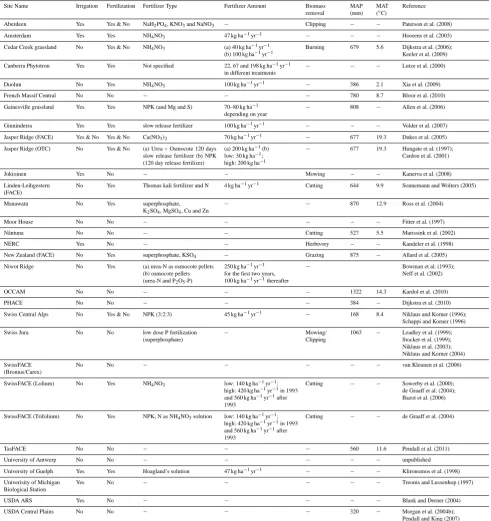
We extracted mean annual precipitation (MAP) and mean annual temperature (MAT) data, a description of the amount and type of fertilizer added (independent from the inten-tion of creating a different treatment) and the execuinten-tion of other management practices (biomass removal or irrigation) from the articles. Whenever this information was lacking, the study was considered as not including fertilization or other management. The extracted information is synthesized in Table 1.
2.2 Meta-analysis
MetaWin 2.1 software (Rosenberg et al., 2000) was used to analyse our data. The natural logarithm of the re-sponse ratio (r= (response to elevated CO2 or N fertiliza-tion)/(response to reference conditions)) was used to define the effect value. By using this metric, the calculation of an effect by percentage was made possible, while this would not have been the case if we were to use Hedges’ d-index. In addition, the response ratio is less sensitive to changes in small control groups (Hedges et al., 1999). Confidence intervals (CI) were calculated by using bootstrapping tech-niques. This method is advantageous when less than 20 stud-ies are used to calculate a CI, since the traditional 95 % CI then tends to underestimate the width of the interval at low
Table 1. Information about irrigation, fertilization, management practices and climatic conditions at the sites that were used in the exper-iments in our analysis. Different letters (a and b) within the fertilizer specifications are used to separate different experexper-iments that were executed on the same site.
Site Name Irrigation Fertilization Fertilizer Type Fertilizer Amount Biomass
removal
MAP (mm)
MAT
(◦C) Reference
Aberdeen Yes Yes & No NaH2PO4, KNO3and NaNO3 − Clipping − − Paterson et al. (2008)
Amsterdam Yes Yes NH4NO3 47 kg ha−1yr−1 − − − Hoorens et al. (2003)
Cedar Creek grassland No Yes & No NH4NO3 (a) 40 kg ha−1yr−1
(b) 100 kg ha−1yr−1 Burning 679 5.6 Dijkstra et al. (2006);Keeler et al. (2009)
Canberra Phytotron Yes Yes Not specified 22, 67 and 198 kg ha−1yr−1
in different treatments
− − − Lutze et al. (2000)
Duolun No Yes NH4NO3 100 kg ha−1yr−1 − 386 2.1 Xia et al. (2009)
French Massif Central No No − − − 780 8.7 Bloor et al. (2010)
Gainesville grassland Yes Yes NPK (and Mg and S) 70–80 kg ha−1
depending on year
− 808 − Allen et al. (2006)
Ginninderra Yes Yes slow release fertilizer 100 kg ha−1yr−1 − − − Volder et al. (2007)
Jasper Ridge (FACE) Yes & No Yes & No Ca(NO3)2 70 kg ha−1yr−1 − 677 19.3 Dukes et al. (2005)
Jasper Ridge (OTC) No Yes & No (a) Urea + Osmocote 120 days
slow release fertilizer (b) NPK (120 day release fertilizer)
(a) 200 kg ha−1(b)
low: 30 kg ha−1;
high: 200 kg ha−1
− 677 19.3 Hungate et al. (1997);
Cardon et al. (2001)
Jokioinen Yes No − − Mowing − − Kanerva et al. (2008)
Linden-Leihgestern (FACE)
No Yes Thomas kali fertilizer and N 4 kg ha−1yr−1 Cutting 644 9.9 Sonnemann and Wolters (2005)
Manawatu No Yes superphosphate,
K2SO4, MgSO4, Cu and Zn
− − 870 12.9 Ross et al. (2004)
Moor House No No − − − − − Fitter et al. (1997)
N˚antuna No No − − Cutting 527 5.5 Marissink et al. (2002)
NERC Yes No − − Herbivory − − Kandeler et al. (1998)
New Zealand (FACE) No Yes superphosphate, KSO4 − Grazing 875 − Allard et al. (2005)
Niwot Ridge No Yes (a) urea-N as osmocote pellets
(b) osmocote pellets (urea-N and P2O5-P)
250 kg ha−1yr−1
for the first two years, 100 kg ha−1yr−1thereafter
− Bowman et al. (1993);
Neff et al. (2002)
OCCAM No No − − − 1322 14.3 Kardol et al. (2010)
PHACE No No − − − 384 − Dijkstra et al. (2010)
Swiss Central Alps No Yes & No NPK (3:2:3) 45 kg ha−1yr−1 − 168 8.4 Niklaus and Korner (1996);
Schappi and Korner (1996)
Swiss Jura No No low dose P fertilization
(superphosphate)
− Mowing/
Clipping
1063 − Leadley et al. (1999);
Stocker et al. (1999); Niklaus et al. (2003); Niklaus and Korner (2004)
SwissFACE (Bromus/Carex)
No No − − − − − van Kleunen et al. (2006)
SwissFACE (Lolium) No Yes NH4NO3 low: 140 kg ha−1yr−1;
high: 420 kg ha−1yr−1in 1993
and 560 kg ha−1yr−1after
1993
Cutting − − Sowerby et al. (2000);
de Graaff et al. (2004); Bazot et al. (2006)
SwissFACE (Trifolium) No Yes NPK, N as NH4NO3solution low: 140 kg ha−1yr−1;
high: 420 kg ha−1yr−1in 1993
and 560 kg ha−1yr−1after
1993
Cutting − − de Graaff et al. (2004)
TasFACE No No − − − 560 11.6 Pendall et al. (2011)
University of Antwerp No No − − − − − unpublished
University of Guelph Yes Yes Hoagland’s solution 47 kg ha−1yr−1 − − − Klironomos et al. (1998)
Univerisity of Michigan Biological Station
Yes No − − − − − Treonis and Lussenhop (1997)
USDA ARS Yes No − − − − − Blank and Derner (2004)
USDA Central Plains No No − − − 320 − Morgan et al. (2004b);
Pendall and King (2007)
sample size (Hedges et al., 1999). For bootstrapping, 2500 repetitions were used.
In categorical analyses, we examined the effect of elevated CO2 concentrations and fertilization separately (in experi-ments where single factor CO2and combined CO2and
fer-tilization treatment effects were reported, we extracted a sin-gle factor fertilization treatment response using the control values of both CO2treatments), the effect of elevated CO2 concentration in combination with fertilization, the effects of the type and the amount of N fertilizer added (classification
2250 W. M. A. Sillen and W. I. J. Dieleman: Effects of elevated CO2and N fertilization on plant and soil carbon
Table 2. Treatment codes used in the manuscript to describe different CO2or N treatment combinations.
Treatment code Description
C Elevated CO2treatment without any nutrient addition
CF Elevated CO2treatment with nutrient addition (amount of N addition not specified) F N fertilization treatment (amount of N addition not specified)
CF-L Elevated CO2treatment with N fertilization<50 kgN ha−2yr−1(low N) CF-H Elevated CO2treatment with N fertilization>50 kgN ha−2yr−1(high N) CF-N Elevated CO2treatment with pure N fertilization
CF-NPK Elevated CO2treatment with NPK fertilization
C-M Elevated CO2treatment with biomass removal component C-m Elevated CO2treatment without biomass removal component C-I Elevated CO2treatment with irrigation treatment
C-i Elevated CO2treatment without irrigation treatment
F-L N fertilization treatment with N fertilization<50 kgN ha−2yr−1(low N) F-H N fertilization treatment with N fertilization>50 kgN ha−2yr−1(high N) F-N N fertilization treatment with pure N fertilization
F-NPK N fertilization treatment with NPK fertilization
19
1
Figures
2
Figure 1: Responses of grassland C pools to three different treatments: CO2 elevation (C), N fertilization (F) and 3
the combination of CO2 elevation and N fertilization (CF). Responses are shown as percentage increase of
4
aboveground biomass (AB), root biomass (RB), microbial biomass (MB), and soil C content (Soil C), and 95%
5
confidence intervals (CI). Treatment responses were considered statistically significant when zero was not
6
included in the 95% CI. Statistically significant differences the single factor CO2 treatment are indicated by: * P
7
< 0.05; ** P < 0.01; *** P < 0.001.
8
9
10 Fig. 1. Responses of grassland C pools to three different treatments:
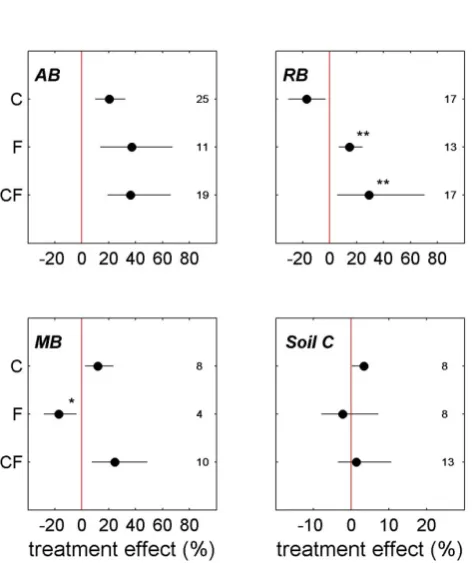
CO2elevation (C), N fertilization (F) and the combination of CO2 elevation and N fertilization (CF). Responses are shown as percent-age increase of aboveground biomass (AB), root biomass (RB), mi-crobial biomass (MB), and soil C content (Soil C), and 95 % confi-dence intervals (CI). Treatment responses were considered statisti-cally significant when zero was not included in the 95 % CI. Statisti-cally significant differences compared to the single factor CO2 treat-ment are indicated by: *P <0.05; **P <0.01; ***P <0.001.
in low and high amounts was based on a background value of 50 kg N ha−1yr−1, based on projected N deposition values in 2050, Galloway, 2008), and the effects of biomass removal or irrigation on the elevated CO2effect (see Table 2 for treat-ment codes used in figures and tables). The relationship of el-evated CO2effects with MAP, MAT, treatment duration and intensity were analysed with weighted regression analysis.
The effect of elevated CO2concentrations or fertilization were considered statistically significant when zero was not included in the 95 % CI. Differences between categorical variables and linear regression analyses were considered sta-tistically significant whenP-values were lower than 0.05.
3 Results
3.1 Single factor and combined treatment effects of elevated CO2and N addition
Aboveground biomass increased under all three treat-ments (i.e., elevated CO2 (+20 %), N fertilization (+37 %) and their combination (+36 %)) (Fig. 1). Root biomass de-creased when only CO2 levels were elevated (−17 %), but increased when nutrients were added, either with (+29 %) or without CO2elevation (+15 %) as a co-treatment (Fig. 1, Table 3). Microbial biomass increased in elevated CO2 con-centrations, both with (+24 %) and without fertilization (+12 %), and showed an opposing trend in response to the single factor fertilization treatment (−17 %) (Fig. 1, Table 3). Soil C content increased in the single factor CO2treatment (+3 %) and was unaltered under the other treatments (Fig. 1). In the combined elevated CO2and fertilization treatment, aboveground biomass responded similarly to different fertil-izer types, but was stimulated significantly more when lower
[image:4.595.52.335.87.576.2] [image:4.595.50.287.296.578.2]Table 3. Summary of the meta-analytical comparison between the responses of grassland C pools to different treatments. Results shown for: (1) CO2elevation and N fertilization treatments, (2) different N fertilization specifications with or without CO2elevation (type or amount of fertilizer) and (3) other management procedures when CO2is elevated (biomass removal and irrigation). The parameters considered are: aboveground biomass (AB), root biomass (RB), root-to-shoot ratio (RS), microbial biomass (MB) and soil C content (Soil C). Differences between responses for a parameter were considered statistically significant whenP <0.05 (bold).
AB RB RS MBC Soil C
(1) C vs. F 0.2115 0.0060 0.4042 0.0128 0.086
C vs. CF 0.2511 0.0028 0.2827 0.4346 0.7017
F vs. CF 0.9628 0.4974 0.1759 0.0716 0.5274
(2) CF-N vs. CF-NPK 0.9736 0.0036 0.0012 0.4262 0.6809 CF-L vs. CF-H 0.0168 0.2431 0.1811 0.0336 0.2019
F-N vs. F-NPK 0.1076 0.6006 0.0344 − 0.8477
F-L vs. F-H 0.5674 0.4702 0.1795 0.3419 −
(3) C-M vs. C-m 0.4958 0.0672 − 0.7093 −
C-I vs. C-i 0.3227 0.0696 0.3663 0.926 0.3503
20
1
Figure 2: CO2 and N fertilization responses of grassland C pools to different N fertilizer types (CF‐N and CF‐NPK)
2
and intensities (CF‐L and CF‐H). Responses are shown as percentage increase of aboveground biomass (AB), 3
root biomass (RB), microbial biomass (MB), and soil C content (Soil C), and 95% confidence intervals (CI). 4
Treatment responses were considered statistically significant when zero was not included in the 95% CI. 5
Statistically significant differences between fertilizer type or intensity are indicated by: * P < 0.05; ** P < 0.01. 6
7
Fig. 2. CO2 and N fertilization responses of grassland C pools to different N fertilizer types (CF-N and CF-NPK) and intensities (CF-L and CF-H). Responses are shown as percentage increase of aboveground biomass (AB), root biomass (RB), microbial biomass (MB) and soil C content (Soil C), and 95 % confidence intervals (CI). Treatment responses were considered statistically significant when zero was not included in the 95 % CI. Statistically significant differences between fertilizer type or intensity are indicated by: * P <0.05; **P <0.01.
doses of N fertilizer were added (Fig. 2, Table 3). In con-trast to the aboveground biomass response, root biomass responded strongly positively to CO2 elevation with NPK fertilizer addition, while pure N addition did not affect root biomass (Fig. 2, Table 3). The microbial biomass response
21
1
Figure 3: The CO2 effect in experiments with (C‐M) or without (C‐m) aboveground biomass removal, and in 2
irrigated (C‐I) and non‐irrigated (C‐i) experiments, compared to the full CO2 dataset (C). Responses are shown 3
as percentage increase of aboveground biomass (AB), root biomass (RB), microbial biomass (MB), and soil C
4
content (Soil C). Responses were considered statistically significant when zero was not included in the 95% CI.
5
6
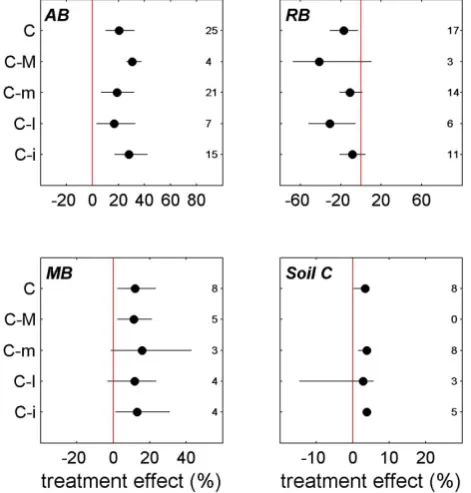
Fig. 3. The CO2 effect in experiments with (C-M) or without (C-m) aboveground biomass removal, and in irrigated (C-I) and non-irrigated (C-i) experiments, compared to the full CO2dataset (C). Responses are shown as percentage increase of aboveground biomass (AB), root biomass (RB), microbial biomass (MB) and soil C content (Soil C). Responses were considered statistically signifi-cant when zero was not included in the 95 % CI.
to elevated CO2was significantly higher under high N fer-tilization rates, compared to low ferfer-tilization rates (Fig. 2, Table 3). Weighted linear regression analysis also suggested an increase in microbial biomass in elevated CO2with higher N fertilization doses (Table 4). Soil C responses to elevated
[image:5.595.49.290.204.521.2] [image:5.595.310.546.290.537.2]2252 W. M. A. Sillen and W. I. J. Dieleman: Effects of elevated CO2and N fertilization on plant and soil carbon
Table 4. Summary of the meta-analytical regression analysis be-tween the responses of grassland C pools to increasing amounts of N fertilization as a single factor (F) or in combination with elevated CO2(CF). The parameters considered are: aboveground biomass (AB), root biomass (RB), root-to-shoot ratio (RS), micro-bial biomass (MB) and soil C content (Soil C).P-values, sign of the regression slopes, and number of data points used are given. Linear regressions were considered statistically significant whenP <0.05 (bold).
Treatment Response P-value slope n variable
CF AB 0.5196 − 16
RB 0.9891 − 15
RS 0.9083 − 14
MB 0.0314 + 7
Soil C 0.8884 + 11
F AB 0.0417 + 11
RB 0.833 + 13
RS 0.3142 − 13
MB 0.0183 − 4
Soil C 0.1117 + 8
CO2were not affected differently by different fertilizer types or doses (Fig. 2, Table 3).
For the majority of the C pools, the single factor N fertil-ization treatment effects were not significantly different be-tween fertilizer type or dosage (Fig. 2, Table 3), although a trend towards stronger aboveground biomass responses was apparent under NPK fertilization (Fig. 2, Table 3). Biomass removal or irrigation did not significantly affect CO2 re-sponses, although root biomass showed a stronger trend to-wards a decrease in systems where aboveground biomass was removed or systems that were irrigated (Fig. 3, Table 3).
3.2 Carbon allocation shifts
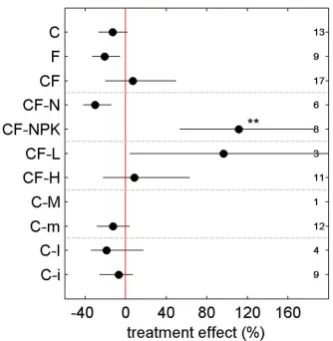
The root-to-shoot ratio (RS) of grasslands tended to de-crease in the single factor CO2treatment (-13 %), and sig-nificantly decreased in the single factor N fertilization treat-ment (−21 %), indicating an preferential allocation of C to-wards aboveground biomass (Fig. 4). The combined CO2and N treatment did not change allocation patterns in grasslands (Fig. 4). There was a strong contrast between RS-responses to elevated CO2 depending on the type of fertilizer added: pure N addition decreased RS (−30 %), while NPK fertiliz-ers increased RS in elevated CO2(+112 %) (Fig. 4, Table 3). Biomass removal and irrigation did not affect the overall RS response to elevated CO2(Fig. 4).
3.3 Relation to climatic variables and treatment duration and intensity
The aboveground biomass response to elevated CO2 concen-trations was not related to treatment intensity or duration,
22
1
Figure 4: CO2 and N fertilization responses of the root‐to‐shoot ratio (RS) to different N fertilizer types (CF‐N 2
and CF‐NPK) and intensities (CF‐L and CF‐H), and in experiments with (C‐M) or without (C‐m) biomass removal, 3
and in irrigated (C‐I) and non‐irrigated (C‐i) experiments. Responses are shown as percentage increase and 4
were considered statistically significant when zero was not included in the 95% CI. Statistically significant 5
differences between fertilizer type are indicated by: ** P < 0.01. 6
[image:6.595.69.262.169.321.2]7
Fig. 4. CO2and N fertilization responses of the root-to-shoot ratio (RS) to different N fertilizer types (CF-N and CF-NPK) and inten-sities (CF-L and CF-H), and in experiments with (C-M) or with-out (C-m) biomass removal, and in irrigated (C-I) and non-irrigated (C-i) experiments. Responses are shown as percentage increase and were considered statistically significant when zero was not included in the 95 % CI. Statistically significant differences between fertilizer types are indicated by: **P <0.01.
and did not show any dependence on air temperature (Ta-ble 5). In contrast, aboveground biomass responses tended to be smaller on sites with larger annual precipitation amounts, especially where no fertilizer was added to the experi-ments (Table 5).
Root biomass responses were greater at higher CO2 el-evation (Table 5), and tended to be larger in studies with longer duration of the CO2treatments, although the latter ef-fect completely disappeared when N fertilizer was added to the experiments (Table 5). Root responses were not related to precipitation amounts, but showed a stronger CO2response in warmer sites that received N fertilizer (Table 5).
Responses of the root-to-shoot ratio to elevated CO2were generally not affected by different climatic conditions (Ta-ble 5). RS responses did become smaller with longer treat-ment duration, indicating a gradual increase in C allocation to shoots (Table 5). In contrast, increasing treatment intensity elicited gradually larger RS responses, indicating more C al-location to roots (Table 5). Whereas the relation to treatment duration holds for both fertilized and unfertilized CO2 exper-iments, the relation to treatment intensity is only statistically significant for N fertilized CO2experiments (Table 5).
Microbial biomass and soil C responses were generally not affected by either climatic differences or increasing treatment intensity or duration (Table 5). However, we did find a sta-tistically significant increase in soil C responses to elevated CO2with increasing treatment duration for N fertilized ex-periments (Table 5).
Table 5. Summary of the meta-analytical regression analysis between the responses of grassland C pools to CO2elevation with (CF) or without (C) fertilization treatments, and mean annual temperature (MAT), mean annual precipitation (MAP), and duration and intensity of the CO2treatment. The parameters considered are: aboveground biomass (AB), root biomass (RB), root-to-shoot ratio (RS), microbial biomass (MB) and soil C content (Soil C).P-values, sign of the regression slopes, and number of data points used are given. Linear regressions were considered statistically significant whenP <0.05 (bold).
Response variable
Treatment Tested factor
P-value Slope sign
n Response variable
Treatment Tested factor
P-value Slope sign
n
AB CF MAT 0.846 + 25 MB CF MAT 0.453 + 7
MAP 0.114 − 30 MAP 0.935 − 9
CO2Duration 0.328 − 44 CO2Duration 0.695 − 18
CO2Intensity 0.898 + 44 CO2Intensity 0.403 + 18
C MAT 0.193 − 20 C MAT 0.721 + 5
MAP 0.027 − 16 MAP 0.562 + 5
CO2Duration 0.153 − 25 CO2Duration 0.823 − 8
CO2Intensity 0.852 − 25 CO2Intensity 0.128 + 8
RB CF MAT 0.044 + 19 Soil C CF MAT 0.805 − 15
MAP 0.811 + 23 MAP 0.849 + 11
CO2Duration 0.825 − 34 CO2Duration 0.027 + 21
CO2Intensity <0.001 + 34 CO2Intensity 0.058 + 21
C MAT 0.816 + 10 C MAT 0.864 + 6
MAP 0.751 − 12 MAP 0.962 + 5
CO2Duration 0.061 + 17 CO2Duration 0.358 + 8
CO2Intensity 0.004 + 17 CO2Intensity 0.681 + 8
RS CF MAT 0.803 + 20
MAP 0.247 − 24
CO2Duration <0.001 − 30 CO2Intensity <0.001 + 30
C MAT 0.558 + 10
MAP 0.232 − 12
CO2Duration 0.024 − 13
CO2Intensity 0.298 + 13
4 Discussion
Elevated CO2effects were generally in accordance with pre-vious studies, indicating increased biomass production, an increased microbial biomass and a tendency for small in-creases or no changes in soil C content (Fig. 1) (de Graaff et al., 2006; Luo et al., 2006; Hungate et al., 2009). However, considering the CO2treatment as a single factor we found a decrease in root biomass as a consequence of elevated CO2 concentrations, which is in sharp contrast to most other stud-ies (Rogers et al., 1994; Curtis and Wang, 1998; Pendall et al., 2004; de Graaff et al., 2006) and refutes our first hypoth-esis of an increased C allocation to root compartments.
Interestingly, when excluding experiments that were ir-rigated or where aboveground biomass was removed, root biomass was no longer significantly decreased by elevated CO2 (data not shown). This can be explained by the func-tional equilibrium hypothesis, suggesting optimal distribu-tion of plant resources for plant growth (Bloom et al., 1985), and offers support to our hypothesis that plants deprived of their shoots by harvest, burning or grazing, allocate propor-tionally more energy to aboveground biomass for repair and regrowth. In turn, this would impair root growth by lowering the amount of C available for belowground biomass.
Other findings further demonstrated the regulating role of water availability in plant responses to elevated CO2: root biomass tended to decrease with irrigation compared to non-irrigated systems (Fig. 3, Table 3), root biomass responses to elevated CO2increased in warmer sites (Table 5), and above-ground biomass responses reduced at sites with higher pre-cipitation rates (Table 5). This is in accordance with Volk et al. (2000), Bunce (2004) and Morgan et al. (2004a), all indi-cating that an increased water use efficiency (WUE) as a con-sequence of reduced stomatal conductance in elevated CO2 is the major reason for increased plant biomass in higher at-mospheric CO2concentrations. Our data here indeed suggest that, as a result of increased WUE plants do not necessarily need an extensive root network.
Because water availability is such an important factor in the elevated CO2effect, a more detailed study of effectively available soil water to the plant would be informative. In this respect, an analysis accounting for different soil textures in the studies included in this analysis (e.g., CO2 effect along the sandy-clayey soil continuum) could test whether the mag-nitude of the CO2 effect would be larger in drought-prone soils (i.e., sandy soils) compared to soils that easily retain water. Future studies would, therefore, need to report soil textures in their site description, which at this point was only available for a limited amount of study sites.
2254 W. M. A. Sillen and W. I. J. Dieleman: Effects of elevated CO2and N fertilization on plant and soil carbon
4.1 Non-nitrogen nutrients regulate root responses to elevated CO2
In contrast with unfertilized systems, fertilized systems dis-played an increase in root biomass in response to elevated CO2 (see also de Graaff et al., 2006), indicating a clear dependence on nutrient additions (see also van Groenigen et al., 2006). Our results showed that the root biomass re-sponse in elevated CO2 was unaffected when pure N fertil-izers were added, but increased strongly when NPK fertiliz-ers were added (Fig. 2) and that RS decreased in elevated CO2 with addition of pure N fertilizer, while it increased under NPK fertilization in elevated CO2 (Fig. 4). In addi-tion, in the single factor fertilization treatment, aboveground biomass tended to respond more strongly to NPK fertiliz-ers (Fig. 2, Table 3). These findings all suggest a progressive limitation by nutrients other than N. As it has been shown be-fore that N-fixing plant species in particular can become lim-ited by non-nitrogen nutrients in elevated CO2(van Groeni-gen et al., 2006), it seems likely that non-nitroGroeni-gen nutrients might play an important role in regulating the C allocation patterns in the elevated CO2experiments in these grasslands.
4.2 Constructive use of C in microbial biomass
The increase in the single factor CO2and the combined CO2 and fertilization treatment for microbial biomass (Fig. 1), confirms the general C limitation of microbial communities. Microbes use C compounds as their main source for energy and are, therefore, often C-limited (Zak et al., 1993; Demol-ing et al., 2007). However, microbes need N to be able to ac-cumulate C into their biomass (Niklaus and Korner, 1996), so in absence of N, microbes use the energy they obtain from decomposing easily degradable C-compounds to de-compose N-richer compounds, which can result in higher respiration rates while microbial biomass remains constant. Therefore, as expected, we found a slightly higher increase in microbial biomass in the combined CO2 and N fertiliza-tion treatment compared to the single factor elevated CO2 treatment (Fig. 1).
[image:8.595.308.544.137.326.2]Further, we found that microbial biomass positively cor-related to increasing amounts of N fertilization in ele-vated CO2, while it was negatively correlated to increas-ing amounts of N fertilization without CO2 (Table 4). The negative effect of the single factor N fertilization treat-ment on microbial biomass is also in accordance with pre-vious work (Treseder, 2008; Janssens et al., 2010), and our 2nd hypothesis, suggesting microbes either became more C limited under N fertilization, or deteriorating soil condi-tions and chemical stabilization of SOM inhibited microbial growth (DeForest et al., 2004; Treseder, 2008; Janssens et al., 2010). Because root biomass increased in N fertilized ex-periments (Fig. 1) – suggesting more labile C inputs – and microbial biomass was found to further decrease at higher N fertilization rates (Fig. 2, Table 4), it seems more likely
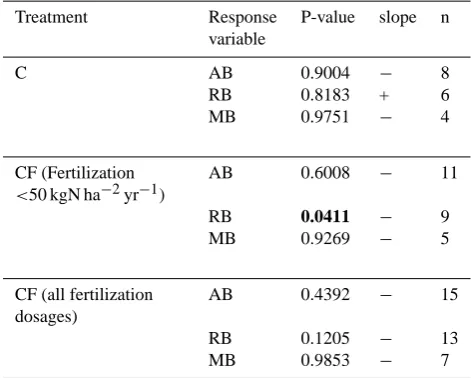
Table 6. Summary of the meta-analytical regression analysis be-tween the responses of aboveground (AB), root (RB) and microbial biomass (MB) to elevated CO2and the soil C response to elevated CO2.P-values, sign of the regression slopes, and number of data points used are given. Linear regressions were considered statisti-cally significant whenP <0.05 (bold).
Treatment Response P-value slope n
variable
C AB 0.9004 − 8
RB 0.8183 + 6
MB 0.9751 − 4
CF (Fertilization <50 kgN ha−2yr−1)
AB 0.6008 − 11
RB 0.0411 − 9
MB 0.9269 − 5
CF (all fertilization dosages)
AB 0.4392 − 15
RB 0.1205 − 13
MB 0.9853 − 7
that the inhibiting effects of N fertilization dominated in the microbial biomass response.
4.3 Soil C storage in grasslands under elevated CO2
While microbial biomass increased in elevated CO2, its lifes-pan is relatively short (Zak et al., 2000; Heath et al., 2005). Moreover, while root biomass production generally increases under elevated CO2, an increased root turnover (Lukac et al., 2009) can also result in an unchanged standing root biomass under elevated CO2 (as found in this study) with much of the root production being converted to necromass. This in-creased microbial and root biomass turnover would produce a considerable amount of C inputs into the soil that could stimulate microbial activity (Dieleman et al., 2010), and pos-sibly prime older soil C pools (for a definition of priming, see Cheng and Jonhson, 1998; Fontaine et al., 2007; Kuzyakov, 2002). At the same time, elevated CO2also stimulates root respiration (Lukac et al., 2009). As such, a multitude of ef-fects can stimulate CO2release from the soil, and can explain why an increased root and microbial biomass can result in an unchanged soil C pool under elevated CO2.
Based on the findings in this study, we suggest root dy-namics and their response to nutrients under elevated CO2 play an important role in the effect of elevated CO2on soil C storage in these grasslands (see Figs. 1–2). We did not find a correlation between root biomass responses and soil C sequestration in unfertilized elevated CO2 experiments, but found a significant correlation between the root biomass re-sponse and the soil C rere-sponse in elevated CO2when realistic amounts of N fertilizer (i.e., max. of 50 kg N ha−1yr−1)were
W. M. A. Sillen and W. I. J. Dieleman: Effects of elevated CO2and N fertilization on plant and soil carbon 2255
added (Table 6), suggesting lower potential for increases in soil C content when root biomass becomes more responsive to elevated CO2. In this case, the C inserted in the soil matrix by root exudation or root turnover might promote more rapid cycling of C inputs into the soil. In support of our find-ings, Cardon et al. (2001) showed that microbes in nutrient-poor environments are forced to decompose older soil or-ganic matter for N supply, but when excess C is available in nutrient-rich situations, the newly sequestered C inputs into the soil become preferential C substrates for microbial de-composition in elevated CO2.
N additions mainly stimulate C sequestration in long-lived biomass compartments (Pregitzer et al., 2008) and, hence, the amount of C being incorporated into the soil matrix might have been limited (Lu et al., 2011), thereby limiting the stim-ulation of microbial respiration. The larger amount of C be-ing stored in longer-lived biomass might also explain why soil C content was not significantly affected, because C was retained in biomass and not added to the soil matrix. To sup-port this, we found an increasingly positive effect on soil C content with CO2treatment duration when fertilized with N (Table 5), and for experiments with higher rates of N fer-tilization, soil C did tend to increase regardless of root re-sponses (Fig. 2). These results are in accordance with Van Groenigen et al. (2006), who reported that soil C only in-creased at high rates of N fertilization (>30 kg N ha−1yr−1). Moreover, respiration rates can be reduced when terres-trial systems are fertilized with large amounts of N through reduced microbial biomass and/or negative effects on de-composing enzyme functioning (Fog, 1988; Janssens et al., 2010). So at high fertilization rates, the inhibiting effects of N fertilizer on decomposition might have overpowered the CO2 effects on roots (Table 6), promoting an increas-ing soil C response in elevated CO2. We thus cannot con-firm, nor refute our 3rd hypothesis, as soil C did not increase in combined CO2and fertilization manipulation. Instead, we propose that the soil C response will be determined by the nutrient-dependant root biomass response and the associated feedbacks to soil C decomposition in elevated CO2.
4.4 Implications
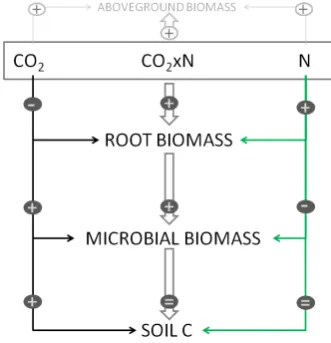
When no N fertilizer was added, elevated CO2 stimulated aboveground biomass, but reduced root biomass in grass-lands. An increased root death as a consequence might have served as substrate for microbes and a C input for soil C pools (Fig. 5). When only N fertilizer was added, both above-ground and root biomass were stimulated, but microbial biomass decreased, suggesting C limitation or chemical in-hibition of microbial communities. In addition, C storage in plant biomass limited the C inputs into soil C pools (Fig. 5). When grasslands in elevated CO2 were fertilized with N, C storage was largest and both root biomass and microbial biomass were stimulated. However, increased cycling of C left soil C pools unaffected (Fig. 5).
23
Figure 5: Synthesis of elevated CO2 effect in grasslands. When no N fertilizer was added, elevated CO2
2
stimulated aboveground biomass, but reduced root biomass. An increased root death as a consequence might 3
have served as substrate for microbes and a C input for soil C pools. When only N fertilizer was added, both 4
aboveground and root biomass were stimulated but microbial biomass was decreased, suggesting C limitation 5
or chemical inhibition of microbial communities. When grasslands in elevated CO2 were fertilized with N
6
(CO2xN), C storage was largest and both root biomass and microbial biomass were stimulated. Increased cycling
7
of C left soil C pools unaffected.
8
9
10
Fig. 5. Synthesis of elevated CO2 effect in grasslands. When no N fertilizer was added, elevated CO2 stimulated aboveground biomass, but reduced root biomass. An increased root death as a consequence might have served as substrate for microbes and a C in-put for soil C pools. When only N fertilizer was added, both above-ground and root biomass were stimulated, but microbial biomass was decreased, suggesting C limitation or chemical inhibition of mi-crobial communities. When grasslands in elevated CO2were fertil-ized with N (CO2xN), C storage was largest and both root biomass and microbial biomass were stimulated. Increased cycling of C left soil C pools unaffected.
Both CO2 elevation and N addition thus appeared to be limited in their effect by the presence of the other resource: N respectively C. Elevated CO2concentrations stimulated plant productivity, but in a less powerful way compared to when N was added. The excess C that plants thus acquired was trans-ferred to the soil microbial community, where an increased rhizodeposition might have alleviated the C limitation of soil microorganisms.
Addition of nitrogen only, on the other hand, created a strong plant growth response. However, the excess C that is provided by CO2elevation is lacking for the stimulus to propagate into the soil community. Consequently, as indi-cated by our results, it is the combination of CO2elevation and N addition that increased the C pool of plant biomass and that stimulated the soil community.
5 Conclusions
In grasslands, different management strategies did not af-fect the overall stimulating efaf-fect of elevated CO2 on aboveground biomass production. However, CO2 elevation only increased root biomass significantly when aboveground biomass production was optimized (i.e., when N fertilization was applied). We have shown here that, while other nutri-ents might become important in the future, N availability is essential for the increased C influx under elevated CO2 to
[image:9.595.344.510.68.240.2]2256 W. M. A. Sillen and W. I. J. Dieleman: Effects of elevated CO2and N fertilization on plant and soil carbon
propagate into belowground C pools. However, moderate nu-trient additions also promoted decomposition processes in el-evated CO2, reducing the potential for increased soil C stor-age. The close relationship between root dynamics and soil C storage is a crucial link in plant-soil interactions in terrestrial ecosystems, and determines the potential for increased soil C storage in elevated CO2. In conclusion, while future elevated CO2 concentrations and increasing N deposition might in-crease C storage in plant biomass, inin-creases in soil C storage are small. Because most of the biomass in non-forest ecosys-tems is short-lived, we suggest the capacity of grasslands to buffer human CO2emissions is limited.
Supplementary material related to this article is available online at: http://www.biogeosciences.net/9/ 2247/2012/bg-9-2247-2012-supplement.zip.
Acknowledgements. The authors acknowledge the support of
the ESF-network CLIMMANI (Climate Change – Manipulation Experiments in Terrestrial Ecosystems). This research was partly funded by the UA-Research Centre of Excellence ECO. WIJD held a James Cook University International Research Scholarship at the time of writing. Further funding was provided by the Flemish Methusalem Programme.
Edited by: M. Bahn
References
Aber, J., McDowell, W., Nadelhoffer, K., Magill, A., Berntson, G., Kamakea, M., McNulty, S., Currie, W., Rustad, L., and Fernan-dez, I.: Nitrogen saturation in temperate forest ecosystems – hy-potheses revisited, Bioscience, 48, 921–934, 1998.
Ainsworth, E. A. and Long, S. P.: What have we learned from 15 yr of free-air CO2enrichment (FACE)? A meta-analytic review of the responses of photosynthesis, canopy, New Phytol., 165, 351– 371, 2005.
Allard, V., Newton, P. C. D., Lieffering, M., Soussana, J. F., Car-ran, R. A., and Matthew, C.: Increased quantity and quality of coarse soil organic matter fraction at elevated CO2in a grazed grassland are a consequence of enhanced root growth rate and turnover, Plant Soil, 276, 49–60, 2005.
Allen, L. H., Albrecht, S. L., Boote, K. J., Thomas, J. M. G., New-man, Y. C., and Skirvin, K. W.: Soil organic carbon and nitro-gen accumulation in plots of rhizoma perennial peanut and bahi-agrass grown in elevated carbon dioxide and temperature, J. En-viron. Qual., 35, 1405–1412, 2006.
Bazot, S., Ulff, L., Blum, H., Nguyen, C., and Robin, C.: Effects of elevated CO2concentration on rhizodeposition from Lolium
perenne grown on soil exposed to 9 yr of CO2enrichment, Soil Biol. Biochem., 38, 729–736, 2006.
Blank, R. R. and Derner, J. D.: Effects of CO2enrichment on plant-soil relationships of Lepidium latifolium, Plant Soil, 262, 159– 167, 2004.
Bloom, A. J., Chapin, F. S. I., and Mooney, H. A.: Resource limita-tion in plants – an economic analogy, Annu. Rev. Ecol. Evol. S., 6, 363–392, 1985.
Bloor, J. M. G., Pichon, P., Falcimagne, R., Leadley, P., and Sous-sana, J.-F.: Effects of Warming, Summer Drought, and CO(2) Enrichment on Aboveground Biomass Production, Flowering Phenology, and Community Structure in an Upland Grassland Ecosystem, Ecosystems, 13, 888–900, 2010.
Bowman, W. D., Theodose, T. A., Schardt, J. C., and Conant, R. T.: Constraints of nutrient availability on primary production in 2 alpine tundra communities, Ecology, 74, 2085–2097, 1993. Bryant, J. P., Chapin, F. S. I., and Klein, D. R.: Carbon/nutrient
balance of boreal plants in relation to vertebrate herbivory, Oikos 40, 357–368, 1983.
Bunce, J. A.: Carbon dioxide effects on stomatal responses to the environment and water use by crops under field conditions, Oe-cologia, 140, 1–10, 2004.
Cardon, Z. G., Hungate, B. A., Cambardella, C. A., Chapin, F. S., Field, C. B., Holland, E. A., and Mooney, H. A.: Contrasting effects of elevated CO2on old and new soil carbon pools, Soil Biol. Biochem., 33, 365–373, 2001.
Cheng, W. and Johnson, D. W.: Elevated CO2, rhizosphere pro-cesses, and soil organic matter decomposition, Plant and Soil, 202, 167–174, 1998.
Crowley, T. J. and Berner, R. A.: Paleoclimate – CO2and climate change, Science, 292, 870–872, 2001.
Curtis, P. S. and Wang, X. Z.: A meta-analysis of elevated CO2 effects on woody plant mass, form, and physiology, Oecologia, 113, 299–313, 1998.
Davidson, E. A.: The contribution of manure and fertilizer nitrogen to atmospheric nitrous oxide since 1860, Nat. Geosci., 2, 659– 662, 2009.
de Graaff, M. A., Six, J., Harris, D., Blum, H., and van Kessel, C.: Decomposition of soil and plant carbon from pasture systems af-ter 9 yr of exposure to elevated CO2: impact on C cycling and modeling, Global Change Biol., 10, 1922–1935, 2004.
de Graaff, M. A., van Groenigen, K. J., Six, J., Hungate, B., and van Kessel, C.: Interactions between plant growth and soil nutri-ent cycling under elevated CO2: a meta-analysis, Global Change Biol., 12, 2077–2091, 2006.
DeForest, J. L., Zak, D. R., Pregitzer, K. S., and Burton, A. J.: At-mospheric nitrate deposition and the microbial degradation of cellobiose and vanillin in a northern hardwood forest, Soil Biol. Biochem., 36, 965–971, 2004.
Demoling, F., Figueroa, D., and Baath, E.: Comparison of factors limiting bacterial growth in different soils, Soil Biol. Biochem., 39, 2485–2495, 2007.
Dijkstra, F. A., Blumenthal, D. M., Morgan, J. A., Pendall, E., Car-rillo, Y., and Follett, R. F.: Contrasting effects of elevated CO2 and warming on nitrogen cycling in a semiarid grassland, New Phytologist, 187, 426–437, 2010.
Dijkstra, F. A., Hobbie, S. E., and Reich, P. B.: Soil processes af-fected by sixteen grassland species grown under different envi-ronmental conditions, Soil Sci. Soc. Am. J., 70, 770–777, 2006. Drigo, B., Kowalchuk, G. A., and van Veen, J. A.: Climate change
goes underground: effects of elevated atmospheric CO2on mi-crobial community structure and activities in the rhizosphere, Biol. Fertility Soils, 44, 667–679, 2008.
Dukes, J. S., Chiariello, N. R., Cleland, E. E., Moore, L. A., Shaw, M. R., Thayer, S., Tobeck, T., Mooney, H. A., and Field, C. B.: Responses of grassland production to single and multiple global environmental changes, Plos Biol., 3, 1829–
1837, 2005.
Eswaran, H., Vandenberg, E., and Reich, P.: Organic-carbon in soils of the world, Soil Sci. Soc. Am. J., 57, 192–194, 1993.
Fitter, A. H., Graves, J. D., Wolfenden, J., Self, G. K., Brown, T. K., Bogie, D., and Mansfield, T. A.: Root production and turnover and carbon budgets of two contrasting grasslands under ambient and elevated atmospheric carbon dioxide concentrations, New Phytol., 137, 247–255, 1997.
Fog, K.: The effect of added nitrogen on the rate of decomposition of organic-matter, Biol. Rev. Camb. Philos., 63, 433–462, 1988. Galloway, J. N.: Transformations of the nitrogen cycle: recent
trends, questions, and potential solutions, Science, 320, 889–892, 2008.
Gifford, R. M.: The global carbon-cycle – a viewpoint on the miss-ing sink, Aust. J. Plant Physiol., 21, 1–15, 1994.
Heath, J., Ayres, E., Possell, M., Bardgett, R. D., Black, H. I. J., Grant, H., Ineson, P., and Kerstiens, G.: Rising atmospheric CO2 reduces sequestration of root-derived soil carbon, Science, 309, 1711–1713, 2005.
Hedges, L. V., Gurevitch, J., and Curtis, P. S.: The meta-analysis of response ratios in experimental ecology, Ecology, 80, 1150– 1156, 1999.
Hoorens, B., Aerts, R., and Stroetenga, M.: Is there a trade-off be-tween the plant’s growth response to elevated CO2 and subse-quent litter decomposability?, Oikos, 103, 17–30, 2003. Hu, S. J., Tu, C., Chen, X., and Gruver, J. B.: Progressive N
limi-tation of plant response to elevated CO2: a microbiological per-spective, Plant Soil 289, 47–58, 2006.
Hungate, B. A., Holland, E. A., Jackson, R. B., Chapin, F. S., Mooney, H. A., and Field, C. B.: The fate of carbon in grass-lands under carbon dioxide enrichment, Nature, 388, 576–579, 1997.
Hungate, B. A., van Groenigen, K. J., Six, J., Jastrow, J. D., Lue, Y. Q., de Graaff, M. A., van Kessel, C., and Osenberg, C. W.: Assessing the effect of elevated carbon dioxide on soil carbon: a comparison of four meta-analyses, Global Change Biol., 15, 2020–2034, 2009.
IPCC: Climate Change 2007: Synthesis report, Contribution of Working Groups I, II and III to the Fourth Assessment Report of the International Panel on Climate Change, edited by: Core Writing Team, Pachauri, R. K. and Reisinger, A., IPCC, Geneva, 2007.
Janssens, I. A., Dieleman, W., Luyssaert, S., Subke, J. A., Reich-stein, M., Ceulemans, R., Ciais, P., Dolman, A. J., Grace, J., Mat-teucci, G., Papale, D., Piao, S. L., Schulze, E. D., Tang, J., and Law, B. E.: Reduction of forest soil respiration in response to nitrogen deposition, Nat. Geosci., 3, 315–322, 2010.
Kandeler, E., Tscherko, D., Bardgett, R. D., Hobbs, P. J., Kampich-ler, C., and Jones, T. H.: The response of soil microorganisms and roots to elevated CO2and temperature in a terrestrial model ecosystem, Plant Soil, 202, 251–262, 1998.
Kanerva, T., Palojarvi, A., Ramo, K., and Manninen, S.: Changes in soil microbial community structure under elevated tropospheric O-3 and CO2, Soil Biol. Biochem., 40, 2502–2510, 2008. Kardol, P., Campany, C. E., Souza, L., Norby, R. J., Weltzin, J. F.,
and Classen, A. T.: Climate change effects on plant biomass alter dominance patterns and community evenness in an experimen-tal old-field ecosystem, Global Change Biology 16, 2676–2687, 2010.
Keeler, B. L., Hobbie, S. E., and Kellogg, L. E.: Effects of long-term nitrogen addition on microbial enzyme activity in eight forested and grassland sites: implications for litter and soil organic matter decomposition, Ecosystems, 12, 1–15, 2009.
Klironomos, J. N., Ursic, M., Rillig, M., and Allen, M. F.: Interspe-cific differences in the response of arbuscular mycorrhizal fungi to Artemisia tridentata grown under elevated atmospheric CO2, New Phytol., 138, 599–605, 1998.
Lal, R.: Soil carbon sequestration impacts on global climate change and food security, Science, 304, 1623–1627, 2004.
Leadley, P. W., Niklaus, P. A., Stocker, R., and Korner, C.: A field study of the effects of elevated CO2on plant biomass and com-munity structure in a calcareous grassland, Oecologia, 118, 39– 49, 1999.
Lu, M., Zhou, X., Luo, Y., Yang, Y., Fang, C., Chen, J., and Li, B.: Minor stimulation of soil carbon storage by nitrogen addition: a meta-analysis, Agr. Ecosyst. Environ., 140, 234–244, 2011. Lukac, M., Lagomarsino, A., Moscatelli, M. C., De Angelis, P.,
Cotrufo, M. F., and Godbold, D. L.: Forest soil carbon cycle un-der elevated CO2– a case of increased throughput?, Forestry, 82, 75–86, 2009.
Luo, Y. Q., Hui, D. F., and Zhang, D. Q.: Elevated CO2stimulates net accumulations of carbon and nitrogen in land ecosystems: a meta-analysis, Ecology, 87, 53–63, 2006.
Lutze, J. L., Gifford, R. M., and Adams, H. N.: Litter quality and decomposition in Danthonia richardsonii swards in response to CO2 and nitrogen supply over four years of growth, Global Change Biol., 6, 13–24, 2000.
Marissink, M., Pettersson, R., and Sindhoj, E.: Above-ground plant production under elevated carbon dioxide in a Swedish semi-natural grassland, Agr. Ecosyst. Environ., 93, 107–120, 2002. Morgan, J. A., Pataki, D. E., Korner, C., Clark, H., Del Grosso, S. J.,
Grunzweig, J. M., Knapp, A. K., Mosier, A. R., Newton, P. C. D., Niklaus, P. A., Nippert, J. B., Nowak, R. S., Parton, W. J., Pol-ley, H. W., and Shaw, M. R.: Water relations in grassland and desert ecosystems exposed to elevated atmospheric CO2, Oe-cologia, 140, 11–25, 2004b.
Morgan, J. A., Mosier, A. R., Milchunas, D. G., LeCain, D.R., Nel-son, J. A., and Parton, W. J.: CO2 enhances productivity, al-ters species composition, and reduces digestibility of shortgrass steppe vegetation. Ecological Applications 14, 208–219, 2004b. Neff, J. C., Townsend, A. R., Gleixner, G., Lehman, S. J.,
Turn-bull, J., and Bowman, W. D.: Variable effects of nitrogen addi-tions on the stability and turnover of soil carbon, Nature, 419, 915–917, 2002.
Niklaus, P. A., Alphei, D., Ebersberger, D., Kampichler, C., Kan-deler, E., and Tscherko, D.: Six years of in situ CO2enrichment evoke changes in soil structure and soil biota of nutrient-poor grassland, Global Change Biol., 9, 585–600, 2003.
Niklaus, P. A. and Korner, C.: Responses of soil microbiota of a late successional alpine grassland to long term CO2 enrich-ment, Plant Soil, 184, 219–229, 1996.
Niklaus, P. A. and Korner, C.: Synthesis of a six-year study of cal-careous grassland responses to in situ CO2 enrichment, Ecol. Monogr., 74, 491–511, 2004.
Nosberger, J., Blum, H., and Fuhrer, J.: Crop ecosystem responses to climatic change: productive grasslands, Clim. Change Global Crop Prod., 271–291, doi:10.1079/9780851994390.0271, 2000.
2258 W. M. A. Sillen and W. I. J. Dieleman: Effects of elevated CO2and N fertilization on plant and soil carbon
Nowak, R. S., Ellsworth, D. S., and Smith, S. D.: Functional re-sponses of plants to elevated atmospheric CO2– do photosyn-thetic and productivity data from FACE experiments support early predictions?, New Phytol., 162, 253–280, 2004.
Paterson, E., Thornton, B., Midwood, A. J., Osborne, S. M., Sim, A., and Millard, P.: Atmospheric CO2enrichment and nu-trient additions to planted soil increase mineralisation of soil or-ganic matter, but do not alter microbial utilisation of plant- and soil C-sources, Soil Biol. Biochem., 40, 2434–2440, 2008. Pearson, P. N. and Palmer, M. R.: Atmospheric carbon dioxide
con-centrations over the past 60 million yr, Nature, 406, 695–699, 2000.
Pendall, E., Bridgham, S., Hanson, P. J., Hungate, B., Kick-lighter, D. W., Johnson, D. W., Law, B. E., Luo, Y. Q., Megoni-gal, J. P., Olsrud, M., Ryan, M. G., and Wan, S. Q.: Below-ground process responses to elevated CO2and temperature: a discussion of observations, measurement methods, and models, New Phy-tol., 162, 311–322, 2004.
Pendall, E. and King, J. Y.: Soil organic matter dynamics in grass-land soils under elevated CO2: insights from long-term incuba-tions and stable isotopes, Soil Biol. Biochem., 39, 2628–2639, 2007.
Pendall, E., Osanai, Y., Williams, A. L., and Hovenden, M. J.: Soil carbon storage under simulated climate change is mediated by plant functional type, Global Change Biol., 17, 505–514, 2011. Pregitzer, K. S., Burton, A. J., Zak, D. R., and Talhelm, A. F.:
Sim-ulated chronic nitrogen deposition increases carbon storage in northern temperate forests, Global Change Biol., 14, 142–153, 2008.
Rogers, H. H., Runion, G. B., and Krupa, S. V.: Plant-responses to atmospheric CO2enrichment with emphasis on roots and the rhizosphere, Environ. Pollut., 83, 155–189, 1994.
Rosenberg, M. S., Adams, D. C., and Gurevitch, J.: Metawin: Statis-tical Software for Meta-Analysis. Sinauer Associates, Inc., Sun-derland, Massachusetts, 2000.
Ross, D. J., Newton, P. C. D., and Tate, K. R.: Elevated [CO2] ef-fects on herbage production and soil carbon and nitrogen pools and mineralization in a species-rich, grazed pasture on a season-ally dry sand, Plant Soil, 260, 183–196, 2004.
Schappi, B. and Korner, C.: Growth responses of an alpine grassland to elevated CO2, Oecologia, 105, 43–52, 1996.
Sonnemann, I. and Wolters, V.: The microfood web of grass-land soils responds to a moderate increase in atmospheric CO2, Global Change Biol., 11, 1148–1155, 2005.
Soussana, J. F. and Luscher, A.: Temperate grasslands and global atmospheric change: a review, Grass Forage Sci., 62, 127–134, 2007.
Soussana, J. F., Allard, V., Pilegaard, K., Ambus, P., Am-man, C., Campbell, C., Ceschia, E., Clifton-Brown, J., Czo-bel, S., Domingues, R., Flechard, C., Fuhrer, J., Hensen, A., Horvath, L., Jones, M., Kasper, G., Martin, C., Nagy, Z., Nef-tel, A., Raschi, A., Baronti, S., Rees, R. M., Skiba, U., Stefani, P., Manca, G., Sutton, M., Tubaf, Z., and Valentini, R.: Full account-ing of the greenhouse gas (CO2, N2O, CH4) budget of nine Euro-pean grassland sites, Agr. Ecosyst. Environ., 121, 121–134, 2007. Sowerby, A., Blum, H., Gray, T. R. G., and Ball, A. S.: The decom-position of Lolium perenne in soils exposed to elevated CO2: comparisons of mass loss of litter with soil respiration and soil microbial biomass, Soil Biol. Biochem., 32, 1359–1366, 2000. Stocker, R., Korner, C., Schmid, B., Niklaus, P. A., and
Leadley, P. W.: A field study of the effects of elevated CO2 and plant species diversity on ecosystem-level gas exchange in a planted calcareous grassland, Global Change Biol., 5, 95–105, 1999.
Treonis, A. M. and Lussenhop, J. F.: Rapid response of soil protozoa to elevated CO2, Biol. Fert. Soils, 25, 60–62, 1997.
Treseder, K. K.: Nitrogen additions and microbial biomass: a meta-analysis of ecosystem studies, Ecol. Lett., 11, 1111–1120, 2008. van Groenigen, K. J., Six, J., Hungate, B. A., de Graaff, M. A., van Breemen, N., and van Kessel, C.: Element interactions limit soil carbon storage, P. Natl. Acad. Sci. USA, 103, 6571–6574, 2006. van Kleunen, M., Stephan, M. A., and Schmid, B.: [CO2] – and density-dependent competition between grassland species, Global Change Biol., 12, 2175–2186, 2006.
Volder, A., Gifford, R. M., and Evans, J. R.: Effects of elevated atmospheric CO2, cutting frequency, and differential day/night atmospheric warming on root growth and turnover of Phalaris swards, Global Change Biol., 13, 1040–1052, 2007.
Volk, M., Niklaus, P. A., and Korner, C.: Soil moisture effects deter-mine CO2responses of grassland species, Oecologia, 125, 380– 388, 2000.
Xia, J. Y., Niu, S. L., and Wan, S. Q.: Response of ecosystem carbon exchange to warming and nitrogen addition during two hydrolog-ically contrasting growing seasons in a temperate steppe, Global Change Biol., 15, 1544–1556, 2009.
Zak, D. R., Pregitzer, K. S., Curtis, P. S., Teeri, J. A., Fogel, R., and Randlett, D. L.: Elevated atmospheric CO2 and feedback between carbon and nitrogen cycles, Plant Soil, 151, 105–117, 1993.
Zak, D. R., Pregitzer, K. S., King, J. S., and Holmes, W. E.: Elevated atmospheric CO2, fine roots and the response of soil microorgan-isms: a review and hypothesis, New Phytol., 147, 201–222, 2000.