Report by the Comptroller and Auditor General
Introduction
1. The Department for Communities (the Department) is responsible for administering the statutory child maintenance scheme in Northern Ireland and the management of client funds relating to these schemes. The Department’s Child Maintenance Service (CMS) also promotes parents’ financial responsibility for their children and provides information and advice on the different child maintenance options available to parents.
2. Under the Government Resources and Accounts Act (NI) 2001, the Department of Finance has directed the Department to prepare a Statement of Client Funds Account. This is a receipts and payments account that mainly shows receipts of child maintenance from non-resident parents and payments1 to persons with care responsibilities for children.
3. The Department is also required to provide a summary of the amounts due in respect of unpaid maintenance assessments together with its assessment of the extent to which they are likely to be collected. The administration costs of running the CMS are accounted for through the Department’s Resource Account.
4. I am required to examine and certify the CMS Client Funds Account and report the results to the Northern Ireland Assembly. Every year since the creation of the Northern Ireland Child Support Agency2 in April 1993, I have qualified my audit opinion on this Account. My work this year has led to my conclusion that a qualified audit opinion continues to be required in relation to:
the regularity of the receipts and payments reported in the Account, which do not comply with the regulations governing them. This is because such receipts and payments are based on maintenance assessments calculated over several years and I consider the historic level of error in these maintenance assessments to be material (see paragraphs 5 to 17); and
the accuracy and completeness of the outstanding maintenance arrears at 31 March 2019 as shown in note 5.1 to the accounts. My examination of the arrears balance was severely limited because of an inadequate audit trail. Therefore, I was unable to obtain enough evidence to satisfy myself as to the accuracy and completeness of the
outstanding maintenance arrears balance of £29.7 million (see paragraphs 18 to 22).
The receipts and payments part of the Account has been properly presented and I have not qualified my opinion on this. Further details of the basis for my qualified opinions and an update on issues reported last year is provided below.
1 In some instances, parents also pay back benefits they have received from the Department (or the Department of Work and Pensions) to support their children.
Qualified Audit Opinion due to irregular receipts and payments
Accuracy of maintenance assessments and absence of satisfactory audit trail
5. The original 1993 legislation required up to 148 different pieces of information to calculate a maintenance assessment. An error in any element of an assessment impacts on its accuracy and therefore amounts collected from non-resident parents (receipts) and subsequently paid to the person with care in the current year (payments) will be incorrect. There are normally multiple assessments throughout the lifetime of a case. The likelihood of error also increases if there is manual case worker intervention.
6. The Department relies on IT systems developed by the Department of Work and Pensions (DWP) to calculate maintenance assessments and maintains accounting records on the:
Child Support Computer System (CSCS), used for cases opened before 3 March 2003;
Child Support 2 system (CS2), used for cases opened after 3 March 2003 until 24 November 2013 (excluding those on the new system); and
Child Maintenance Scheme 2012 (CMS 2012), initially opened on 10 December 2012 and open to all cases since 25 November 2013.
Both CSCS and CS2 have a long history of problems and are unable to generate the information needed to prepare the Account or provide accurate assessments. With the Department relying on DWP for the provision of IT systems it is not in a position to correct the underlying deficiencies that have contributed to this error. I note that the Accounting Officer has reported in her Annual Governance Statement that a key part of the strategic solution to address these control weaknesses is the full implementation of the CMS 2012 Scheme.
Implementing the new CMS 2012 Scheme
7. The 2012 statutory scheme was introduced during the first phase of the Department’s reform programme for child support. It uses a new computer system, separate from the two previous systems. It is able to obtain information on income directly from Her Majesty’s Revenue and Customs’ records and the Department’s social security systems. The Department told me that this reduces the administrative burden in the process, creates assessments that are more accurate and operates more efficiently.
8. In June 2014, the second phase of the reform programme introduced collection and
enforcement charges for parents using the new statutory scheme. Parents are able to avoid collection fees completely if they chose to set up a family-based arrangement or pay by Direct Pay3.
9. Parents with a new case now choose between making their own, family-based arrangement and applying to the CMS 2012 scheme. The Department told me that, through reactive and proactive case closure activity, cases on the legacy systems have also transitioned to the
CMS 2012 Scheme. For example, where parents seek a reassessment, arrears that are recorded on CSCS and CS2 are either transferred to CMS 2012 or written-off (if the person with care consents). Since December 2018, in line with the Department’s target, all cases are now managed on CMS 2012 with the exception of those legacy cases that have arrears but no ongoing liability. The latter cases remain on the 1993 and 2003 IT systems.
10. Before a legacy case is transferred to the new CMS 2012 system:
the Department completes an arrears cleanse process. This includes management checks to ensure no action is outstanding on the case and that all payments and non-payments are included in the arrears total. This check does not, however, include a validation of the accuracy of the amount transferred;
on the CS2 system, an internal check is performed to ensure the arrears balance is accurate; and
finally, a check is completed by the Department teams to ensure that the arrears balance leaving the legacy computer systems is accurately transferred.
Measurement of the level of error in maintenance assessments
11. The Department has established a Case Monitoring Team (CMT) within CMS to provide estimates of the level of error in maintenance assessments. This is known as Cash Value Accuracy (CVA) and is a percentage of the number of correct assessments against the total number of assessments. I am satisfied with the rationale for the Department’s approach. I also consider that the results produced by CMT represent the best available measure of CVA and are a reasonable estimate of the rate of errors in maintenance assessments.
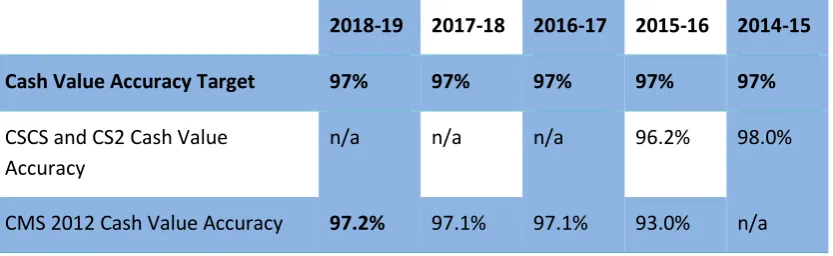
12. The Department has set a target for CVA of 97 per cent. Since 2016-17, the CVA figures contain the results of CMS 2012 cases only. While most CMS 2012 decisions are fully automated some of the more complex cases require manual intervention. The volume of cases selected for assessment is based on a formula provided by the Department’s
statisticians and at 31 March 2019, the accuracy for CMS 2012 user intervention cases was 97.2 per cent.
[image:3.595.111.528.614.742.2]13. The Department has advised that the closure of existing cases during the year means it is not possible to generate a statistically valid sample of cases on the legacy schemes (CSCS and CS2). Figure 1 shows accuracy performance against the CVA target over the last five years.
Figure 1: Cash Value Accuracy of Maintenance Assessments
2018-19 2017-18 2016-17 2015-16 2014-15
Cash Value Accuracy Target 97% 97% 97% 97% 97%
CSCS and CS2 Cash Value Accuracy
n/a n/a n/a 96.2% 98.0%
CMS 2012 Cash Value Accuracy 97.2% 97.1% 97.1% 93.0% n/a
14. I welcome the Department’s intention from April 2019 to calculate the accuracy of
maintenance assessments using a similar approach to that in place for other social security benefits. This will provide an overall accuracy assessment of caseworker error that
incorporates both manual and fully automated transactions that should be a more reliable estimate of error.
Trends in receipts and payments
15. More than two-thirds of parents using the CMS 2012 system use the Direct Pay service and avoid collection charges. As a result, the level of receipts and payments disclosed in the Client Funds Account has steadily declined over the past five years. Figure 2 shows receipts and payments since 2014-15.
Figure 2: Receipts and Payments for the five years ending 31 March 2019
2018-19 2017-18 2016-17 2015-16 2014-15
£millions
Total Receipts 4.7 5.5 9.9 13.1 17.1
Totals Payments 4.8 5.5 10.1 13.3 17.4
Source: CMS Accounts 2014-15 to 2018-19
16. The Department is required to calculate maintenance assessments in accordance with relevant legislation. Where an error is made in a maintenance assessment, both the receipt and associated payment are incorrect and therefore have not complied with the relevant legislation. In my opinion, the amount of error in relation to maintenance receipts and associated payments this year are significant because errors in assessments in previous years continue to impact on the current year. Furthermore, CMS has assessed an error of 2.8 per cent in CMS 2012manual intervention cases in the current year.
17. Although the Account properly presents the amount of child maintenance received and paid in the year, I have qualified my audit opinion on the regularity of maintenance assessments on which the receipts of £3.9 million and payments of £3.5 million reported in the Account are calculated. The assessments are not in accordance with the legislation governing them.
Disclaimed Audit Opinion - Note 5.1 Outstanding maintenance arrears balance
maintenance arrears from the legacy systems have been decreasing over the past five years while arrears from CMS 2012 have been increasing.
Figure 3: Outstanding Maintenance arrears over the last five years
At 31 March 2019 At 31 March 2018 At 31 March 2017 At 31 March 2016 At 31 March 2015 System £millions
CSCS (introduced 1993) 4.7 11.1 13.2 18.9 22.7
CS2 (introduced 2003) 8.1 32.3 35.1 39.4 45.2
CMS 2012 (introduced December 2012)
16.9 17.8 13.4 5.4 1.1
Total 29.7 61.2 61.7 63.7 69.0
Source: CMS Accounts 2014-15 to 2018-19
19. The total arrears at 31 March 2019 represents the cumulative amount of arrears since child support arrangements were established in 1993. In line with legislation, the Department can only write-off arrears in very limited circumstances. The considerable reduction in the arrears balance of £31.5 million this year has been partially achieved by CMS making use of
0 5 10 15 20 25 30 35 40 45 50
2015 2016 2017 2018 2019
Ou ts ta n d in g Ma in ten an ce Arr ear s £m ill ion s IT System
new ‘restatement4’ /write-off powers that came into operation in December 2018 (see paragraphs 23 to 28 for further detail).
20. As noted earlier both the CSCS and CS2 have a long history of problems and cannot directly generate the information, on a case-by-case basis, needed to prepare the arrears figure in the Account. The outstanding maintenance arrears balances for CSCS and CS2 at 31 March 2019 comprise numerous individual cases and can only be derived from these legacy
systems using a series of complex manual workarounds. My examination of this balance was severely limited as there is no accurate information available to support the outstanding maintenance arrears balance from CSCS and CS2.
21. The Department is able to substantiate the balances of maintenance arrears on a case-by-case basis from the CMS 2012 system. However, the Department is not reviewing the arrears balances transferred to CMS 2012 for case accuracy due to the limitations of legacy systems. There were 15,355 cases on the CMS 2012 system at 31 March 2019 with an outstanding maintenance arrears balance of £16.9 million; of this amount, £12 million was transferred from CSCS and CS2. The balance of arrears of £4.9 million may not contain a material level of error. As it is insignificant in comparison to the £29.7 million total of outstanding
maintenance arrears at note 5.1, the entire arrears balance is included in my qualification.
22. In relation to note 5.1 only, I was unable to conclude on the accuracy and completeness of the maintenance arrears balances and therefore my audit opinion in respect of this note is disclaimed. This type of audit qualification reflects the fact that I consider the uncertainties in relation to the maintenance arrears balance to be both material and pervasive to that note.
Other issues
Powers to ‘restate’/ write-off debt amounts
23. Powers introduced in December 20125 resulted in £1.2 million of outstanding arrears being written-off in 2018-19 (2017-18: £2.2 million).
24. During 2018-19, the Department introduced the Northern Ireland Compliance and Arrears Strategy6, following approval from the Department of Finance. From November 2018, CMS was able to start using new powers to ‘restate’ /write-off arrears owed to the Department. Regulations,7 introduced on 10 December 2018, provided new powers to address arrears owed to persons with care. Similar legislation and approvals were also in place in GB for DWP.8
25. The Strategy includes proposals for dealing with historic arrears and has led to an additional £13.9 million, due to the Department, being ‘restated’/written-off in 2018-19. These arrears
4 The terminology used by both the Department and DWP to describe the process of changing an arrears figure following new information. In line with DWP, CMS use this term where write-off was previously used, that is, rather than writing-off arrears in a case the Department will ‘restate’ the arrears balance on the case.
5Set out in the Child Maintenance Act (Northern Ireland) 2008. 6 Department for Communities, March 2019.
7Package one of the Regulations (the Child Support (Miscellaneous Amendments) Regulations (Northern Ireland), December 2018.
were due from parents in receipt of benefit at the time their maintenance was assessed. Following a repeal of legislation in October 2008, all cases were re-classified as private cases so had no involvement with the benefit system. There is no new debt from this date but arrears continue to be owed to the Department, for cases prior to October 2008.
26. CMS’s initial focus during 2018-19 has been on writing-off arrears owed to the Department. Their focus will now move to addressing the arrears balances owed to persons with care. The Department told me, that subject to specific criteria, this activity offers persons with care the opportunity to say if they wish the Department to attempt a final collection of their arrears. Should the person with care not wish this action to be taken, the arrears will be restated. As arrears on the legacy systems reduce, the Department, in line with DWP, hopes to be able to decommission and retire the core 1993 and 2003 systems by May 2021.
27. The Strategy also includes measures for minimising the level of initial arrears that
accumulate on the CMS 2012 system. For example, the Department now has the power to allow CMS to calculate a notional income based on assets held by the non-resident parent that will reduce the scope for efforts to be made to minimise financial liability.
28. The Department told me that their approach to addressing the longstanding legacy arrears includes a number of wider positive impacts, which support the approach being taken. These include maintaining parity with GB for persons with care in Northern Ireland, together with financial savings to be realised once the legacy IT systems are decommissioned.
Collectability of outstanding maintenance arrears
29. The Department undertook a review of maintenance arrears outstanding from the legacy schemes during 2018-19 to estimate collectability of these balances. The Department estimates that, based on its assumptions, £7.6 million of the legacy arrears balance of £24.9 million could be categorised as likely to be collected at 31 March 2019. This means that the Department now estimates that it is likely to collect around 31 per cent of legacy
maintenance arrears.
30. The Department highlighted that the collectability review is based on a snapshot of cases at a point in time, set against a fluid backdrop of ongoing ‘restatement’/ write-off activity. Furthermore, it told me that, at this stage, it is not possible to assess the impact of further work to be carried out in 2019-20 on the arrears balances.
Conclusion
31. I welcome the progress the Department is making in resolving longstanding issues with the legacy systems andthe proactive approach being taken to reduce the level of new arrears that arise. I shall continue to monitor progress in implementing the proposals set out in the Compliance and Arrears Strategy.
of £29.7 million within note 5.1, I was unable to obtain sufficient evidence to support this balance and accordingly I am unable to express an opinion on this note.
KJ Donnelly
Comptroller and Auditor General
Northern Ireland Audit Office
106 University Street Belfast
BT7 1EU